Penman No. 110: Witnessing the World

HillCoverPenman for Monday, August 18, 2014


IN MY other role as an editor rather than a writer of books, I take raw manuscripts from Iclients and friends and transform them into something publishable and popularly readable. I’ll write more about editing as a profession one of these days, because it’s an art unto itself that bears all the challenges but very little of the glamor and rewards of authorship. In the meanwhile, I’d like to talk about one of my most recent editing projects, a book about travels around the world by someone who has to be the most happily peripatetic (that’s a fancy word for “footloose”) person I know.

Julie Hill was a client before she became a friend. We were introduced to each other more than ten years ago by Jimmy Laya, who knew Julie and her late husband Arthur back from when the Hills lived in the Philippines, where Arthur represented the Ford Foundation. Then based in Southern California, Julie wanted to write a book about her life and travels with Arthur, who had just died of cancer; together, the couple had journeyed around the world, from Australia to Afghanistan, from Bangkok to Minnesota, from Samoa to China. Julie—born an Alexandrian Greek, trained in chemistry, and later a telecommunications executive—had all these stories to tell, and she needed an editor to help her tell them.

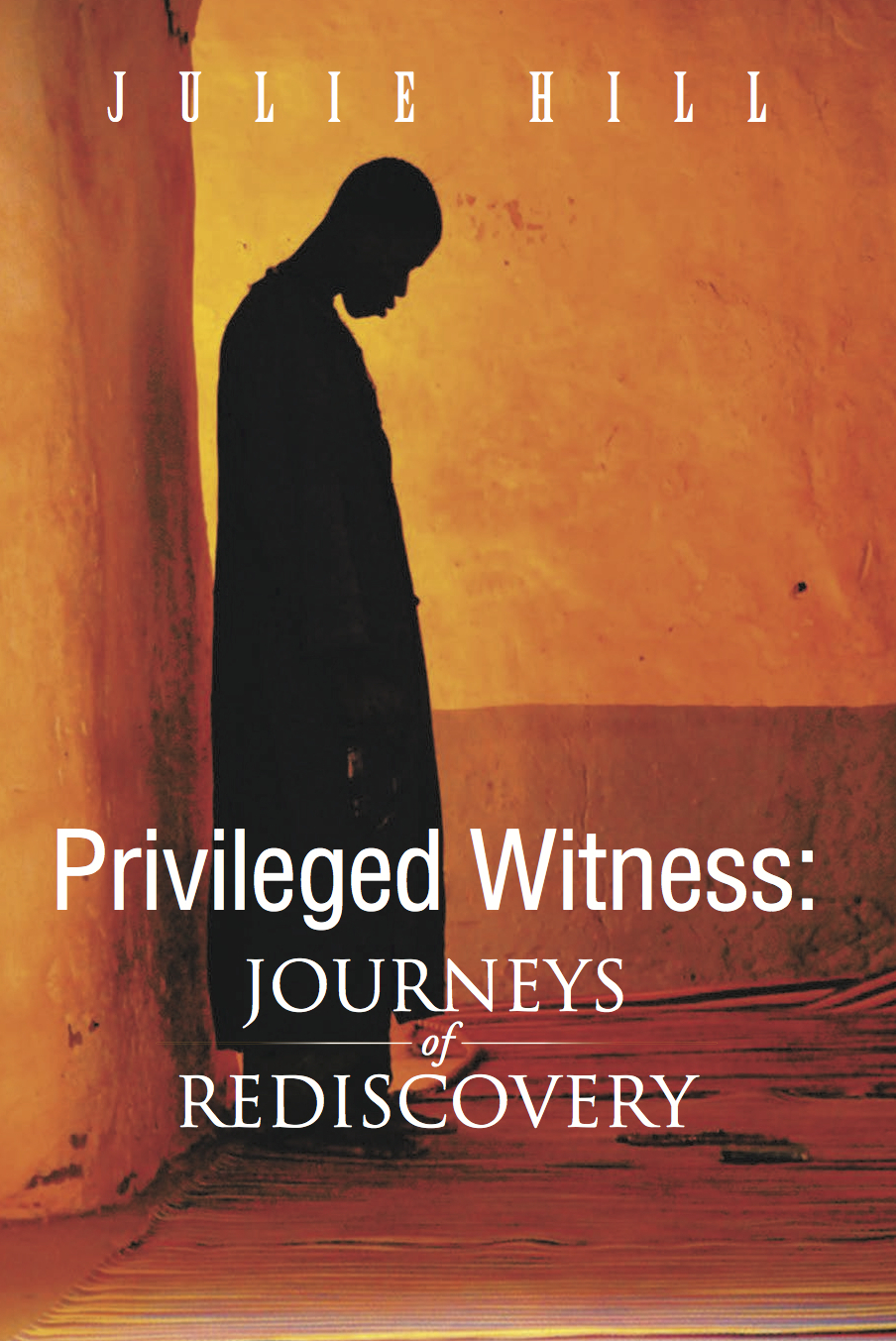
Jimmy put us together, and Julie’s first book, Promises to Keep: The Travels of Arthur and Julie Hill, came out in 2003, published by XLibris. This was followed a few years later by her second book, The Silk Road Revisited: Markets, Merchants, and Minarets (Author House, 2006). Not one to spend her widowhood moping, Julie has been actively engaged in all manner of civic pursuits, especially in her patronage of the Scripps Research Institute. Just last month, she published her third book, again with me as editor, Privileged Witness: Journeys of Rediscovery (Author House, 2014).

Julie retains a special place in her heart for the Philippines, to which she returns every now and then to visit with old friends. (In turn, Beng and I pay Julie a visit in her lovely home in Rancho Sta. Fe every time we see our daughter Demi in San Diego; Julie knows I love chocolate cake and always has a scrumptious slice of it waiting for me.)

There’s a wonderful anecdote from Julie’s first book about an encounter that she and Arthur had with then UP President Carlos P. Romulo, whom she describes as “a great raconteur.” They told each other stories about how they traveled to America, all of them being foreign graduate students, and when Julie said that she traveled by steamship, CPR asked her about, of all things, the cutlery. Julie recalls:

“’What was the cutlery like?’ asked Romulo. I was dumbfounded. Why did he take an interest in cutlery? He proceeded to tell us that he crossed the continent from Vancouver to New York on the Canadian Pacific Railway. During his journey, he systematically ‘acquired’ a set of cutlery. ‘What a better way to regale my professors at Columbia University than with cutlery embossed with my own initials: CPR!’”

In her new book, Julie takes us in hand on her journeys to around 20 countries, from Asia to Africa, to places such as Papua New Guinea, Mali, Bhutan, Botswana, and Ethiopia. She doesn’t take just the well-trodden tourist paths, but goes to the heart of the native culture, engaging with the locals to do what all good travelers (more than tourists) do: discover and reaffirm the universality of humanity. Not everyone has the ability and the resources to do the kind of traveling that Julie does, so I suggested the book title to her (taken from one of her essays), to take “privilege” in both senses of the word: as the ability to afford things, but also as the unique opportunity to see things few others could. And with that privilege comes the responsibility of witnessing and reporting.

In her introduction to the book, she writes:

“The art of adventure is the art of being bold enough to enjoy it. On a safari I must have spent hours tracking the footprints of wild animals; for other travelers the hours were too long and boring; after having seen one giraffe the others seemed all the same to them. But for me the tracking process was a fascinating adventure and locating that pride of 13 lions was an unparalleled reward, a golden joy. I could hear the muezzin in the Middle East (so much more inspiring when it is not a recording) calling the faithful to evening devotion. To me, the muezzin’s call—whether in a remote Central Asia bazaar or resounding among the tufa walls and spires of Timbuktu—is like a congregation of mountains praying.

“In my travels I have discerned a similarity among people who bear the same universal aspirations: all want their children to lead a better life and have a better future than theirs; they all cry, laugh, eat, worry, and die. We share so much, but still have to work at understanding one another…. On my travels, I have been privileged to spend time in the privacy of people’s homes and to learn of their rituals, such as the jewelry handed to the eldest daughter from generation to generation in Mali’s Djennè. An impromptu invitation at a village up in the mountains of the Caucasus brought me to a wedding, sipping vodka and dancing in a circle with other women…. Every time I was treated by my hosts as a friend, as a confessor, and I have tried to vindicate their trust by bringing their stories to life.”

In a message to her after the book was published, I told Julie that I had just watched a TV documentary about Aleppo in Syria—the subject of one of her best essays—and about the destruction that Syria’s current civil war had wrought on the ancient wonders of the place. I was almost in tears, I said, to see the Krak des Chevaliers being bombarded; without even having been there, I felt more invested in the world and in humanity, thanks to her book, for which I—in turn, as editor—was the privileged witness.

(Privileged Witness: Journeys of Rediscovery is available on Amazon.com.)


Penman No. 108: Writing as a Job

Penman for Monday, August 4, 2014


PEOPLE OFTEN ask me about my work as a professional writer—meaning, someone who makes a living out of his writing, rather than someone who just loves to write the occasional poem for sharing with friends.

There are, in fact, quite a number of people in this country who can be considered professional writers: regularly employed journalists, ad-agency copywriters, screenwriters, textbook writers, and even professional bloggers, among others. But except for the few who possess the talent and the gumption to churn out popular novels, there are really no professional Filipino writers of creative work like fiction and poetry, because there’s no market for these products out here. The typical Filipino reader would sooner buy the latest iteration of Twilight or 50 Shades of Grey than, say, a new novel by my friend Charlson Ong.

That’s why fictionists like Charlson and me have turned to writing other things for other people—biographies, histories, speeches, audiovisual presentation scripts, and even advertising copy—to supplement our incomes as teachers and columnists. But let me hasten to add that it’s more than money—as welcome and as necessary as the money is—that drives us to do this. For me—and I’m sure it’s the same thing for the others—it’s the challenge of doing something different, often something with a clear objective and a well-defined if limited audience, such as a company history, as opposed to a novel that you float like a balloon into the night sky.

At UP, where I’ve taught a course called “Professional Writing” that seeks to equip our English majors with some practical skills and attitudes, I tell students on Day One that “There’s writing that you do for yourselves, and writing that you do for others, and never get the two mixed up.”

Like my father, who wrote speeches and correspondence for politicians, I’ve been writing for others nearly all my adult life—I earned my first paycheck for a TV drama script I wrote when I was 16—so I approach professional writing with the dry eye of the frustrated engineer that I also happen to be. (This also means that, when I revert to my own fiction, I can do so with extravagance and exuberance, although fiction has its own rigor and discipline; the poets themselves will tell you that “poetic license” is really anything but license.) Over the past three decades, since my first book (Oldtimer and Other Stories) came out in 1984, I’ve published nearly 30 books of my own, aside from books I’ve edited for others. Many of these were limited-circulation books, like those I wrote on the Philippine geothermal industry and the Philippine flag, so you would never even have heard of them, but they served their specific purposes, so the job was done.

Let me offer some advice to those who want to get into writing as a living.

First, drop the ego and the angst. I knocked on a lot of doors and was paid almost nothing (and sometimes nothing) for my earliest jobs, but each one taught me something about writing and about the business of writing, both the good and the bad. Take every job as both an earning and a learning opportunity. Prepare to be edited, contradicted, and countermanded, sometimes by people who know less about writing than you (if they knew as much, they probably wouldn’t have gotten you). Give it your best shot, and leave the rest to the client. Suck it up, have a beer, then move on. (You’d be surprised how easily and how well the world can move on without you.)

Second, learn your trade and your tradecraft. This means mastering your language, both in terms of grammar and style, and appreciating the nuances that every job will involve. Write bilingually; adjust, absorb, adapt.

Third, get interested in subjects beyond writing and literature. Read the papers. Acquire a working knowledge of business and economics, politics and public affairs, history, science and technology, sports, and entertainment. This versatility will enhance your marketability. To do a job well, you’ll need to understand and even to enjoy what you’re writing about.

Fourth, set your own opinions aside. Unless you’re writing under your own byline or are being hired for your ideas, you don’t need to personally believe in and stand by everything that’s being said—you’re speaking for someone else, and your own opinions could get in the way. If your own ideas and principles matter more than the job, then say no and walk away (I’ve done this, quite a few times)—it’s the fairest thing to do, both for the client and for yourself.

Fifth, learn to multitask. These days, I typically work on three or four book projects at the same time, in various stages of completion. Life’s too short to have to wait for one project to be completed before starting the next one. Each project takes about 18-24 months, so I’ve learned to pace myself. I’ve also learned to delegate work—to assign more basic research and drafting to good assistants, so I can focus on the final organization and styling of the material.

Sixth, know the business and what business means. Use contracts, observe deadlines, pay the taxman, pay your assistants well, buy a good suit and a good pair of shoes. Keep and respect confidences. Unless you’ve been shortchanged, don’t badmouth a client from whom you gladly took a check.

Seventh, simplify your life. You can only produce so much by also giving up so much, which for me means a vastly diminished social life. I’ve pretty much given up partying or going out with friends; my only indulgences are my pens, the biweekly poker night, and traveling with Beng (of which I can never have enough, which is why I do all this). But I’m happy, which in this world is the hardest job of all.


Penman No. 106: Penguins and Paranoia

Tango_Makes_3Penman for Monday, July 21, 2014


LAST WEEK, I wrote a piece extolling the emergence of dissident themes and voices in Singaporean literature, particularly in the novel The River’s Song by Suchen Christine Lim, who reminded us how much of that city-state’s wealth and power grew on the back of its underclass. I’m sure that there are many voices harsher and more strident than Suchen’s among Singapore’s younger writers, which is good. We’ve long expected this kind of literary insurgency to happen, as it is almost invariably the writers of any nation who form the spearpoint of social protest.

As I said last week, many Filipinos—whether mistakenly or not—take Singapore’s enviable prosperity as the result of a pact with the devil of authoritarianism, a compromise between getting fed well and shutting up. So we’re glad to see Singaporean society loosening up and speaking out, and to meet the humans behind the industrial facade. Surely, we’d like to think, Singapore’s economic ascendancy and its emphatic claim to full modernization deserve to be crowned by a more liberal, compassionate, and inclusive democracy. A rich nation should be able to afford more, not less, freedom.

Or so we thought. Very recently, Singapore’s government delivered another rude reminder of how deep in the dark cavern of the feudal mind its ministers remain, even as their citizens have begun to step out into the sunlight.

At issue was the decision of the National Library Board—supported by the Information Minister—to remove three children’s books from the shelves and to destroy all remaining copies, out of fear that the books, because of their unusual content, would condone and promote homosexual behavior. (Singapore still has a law criminalizing sex between men, punishable by up to two years’ imprisonment.)

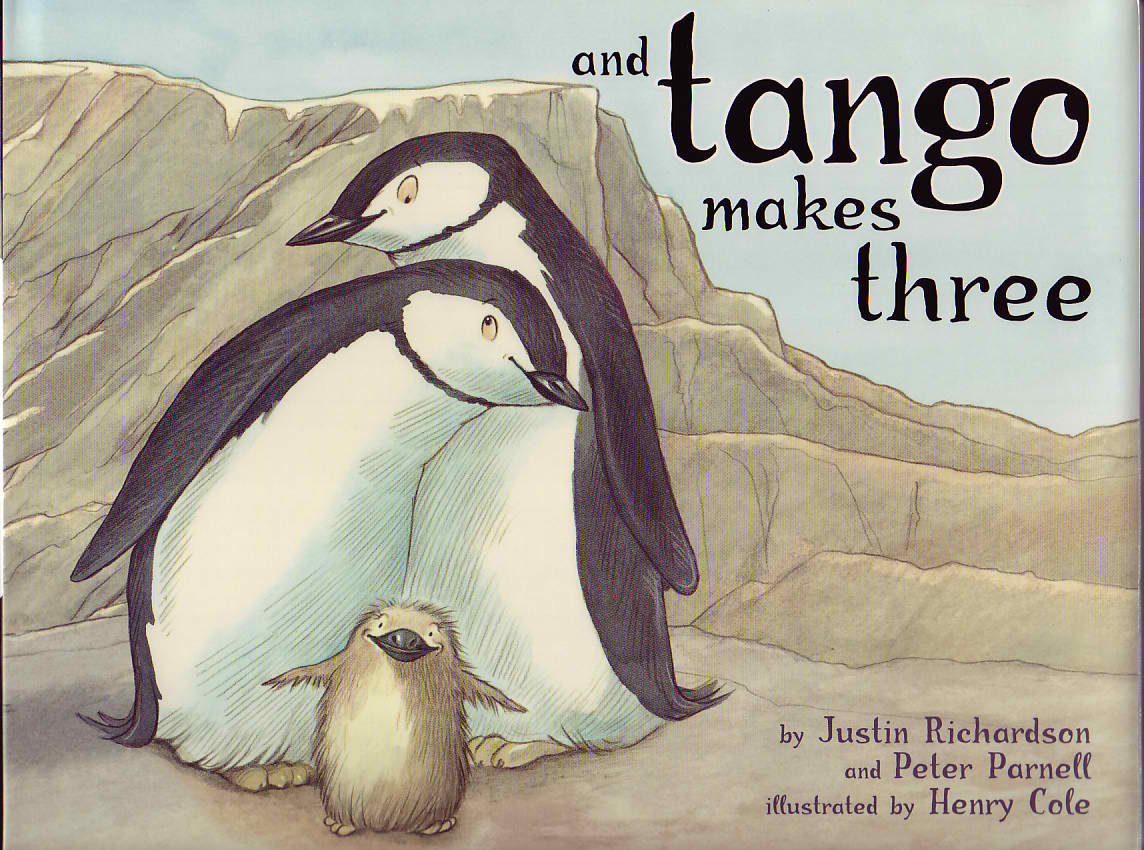
Reports say that the banned books include “And Tango Makes Three,” based on a true story about two male penguins that raised a baby penguin in a New York zoo. In “The White Swan Express,” children are adopted by straight, gay, mixed-race, and single parents. The third book, “Who’s In My Family,” includes gay couples among different types of families. Because a conservative parent complained about these books, an internal review was undertaken by the NLB, which then deemed them unsuitable and subject to removal and destruction.

Not surprisingly, Singapore’s writers, artists, and academics—the liberal types every authoritarian regime fears and detests—are up in arms over the decision. Three prominent judges have resigned from the board of the biennial Singapore Literature Prize, and writers’ and gay organizations all over the world have denounced both the homophobia and the Hitlerite evocation of bookburning that the NLB action embodies. They point out, fairly enough, that conservatives who disagree with the books have a choice not to read them, but that others should have the option and opportunity to read them should they want to.

One of the strongest voices raised against the NLB was that of Suchen Lim, who last Thursday keynoted the Asia Pacific Writers and Translators Conference at Singapore’s Arts House. (I should’ve been there, but thanks to Typhoon Glenda, my flight was canceled and I couldn’t rebook myself in time to catch my two events, so I decided to stay home and mend our typhoon-battered roof.) The Singapore Straits Times would report on Suchen’s impassioned attack on the NLB thus:

“Lim, 65, was a single parent to her two sons and was also brought up in a single parent family for a time before her mother remarried. She said the removal of these books was a disappointment.

“’In removing and pulping those books on various family structures, the National Library Board is telling these children that they and their families don’t count. In removing these books, NLB is reducing such children and their families into invisibility,’ she said.

“The audience in the Chamber of the former Parliament House stood and applauded her words, including Hong Kong writer Nury Vittachi and Singapore writers Verena Tay and Josephine Chia. Also present was writer Felix Cheong, who along with fellow authors Gwee Li Sui, Adrian Tan and Prem Anand, withdrew from an NLB panel discussion last week, to protest against the withdrawal of the picture books.

“Cheong, 49, wore a brand-new T-shirt decorated with three penguins, a logo which has been adopted by those against NLB’s removal of the books.”

Had I been there, I would’ve stood up myself and cheered Suchen on, even at the risk of being blacklisted and turned away the next time I present myself at Changi’s immigration line. The fight against prejudice and censorship knows no national boundaries, which is why I’m writing up this issue for Filipino readers who couldn’t care less about Singapore and gay penguins.

In truth, I’m a fairly frequent visitor to Singapore and have been the appreciative guest of both its government and of my fellow writers there. A couple of years ago, its tourism ministry took me, among other journalists, on a tour of Singapore’s cultural landmarks, including the National Library, and we were suitably impressed. I wrote glowing reports about Singapore’s emergence as a new cultural hotspot in Asia. Why not? The view from The Hub—a glass bubble at the top of the library—was breathtaking, and I was moved by a special exhibit their ultramodern library had of their prominent writers’ memorabilia. When, I thought, would we come around to making these investments in books and culture in the Philippines?

But as I noted last week, there are always two sides to Singapore, and this book-banning incident reminded me of (for us Filipinos) a much sadder story from almost 20 years ago, when Filipino domestic helper Flor Contemplacion, convicted of murder, was about to be hanged in Singapore’s Changi prison. As the editorial writer then of the now-defunct Today newspaper, on the eve of Flor’s execution, I looked helplessly at this painful spectacle and remarked:

“Something went terribly wrong with Flor’s dream—whether through her fault or someone else’s, as now seems highly plausible, only God for the moment knows for certain. Two people died, allegedly by Flor’s maddened hand, and that was tragic enough. Today, Flor Contemplacion will die in turn in judicial payment for those lives—and that, too, will cause untold sorrow, especially among her people who have rallied to her defense.

“But almost as saddening, perplexing, and infuriating as these losses is today’s freshest reminder of savagery in what had been held up, for all the world to see, as the very model of civilized society and behavior in our time. And this was hardly the savagery of individuals gone amuck, but the institutional primitivism of a government which, for all its claims to modernity and discipline, has finally revealed nothing but its simian brain and tom-tom heart. Flor’s execution will be a quick and convenient end; any further complications, by way of entertaining an appeal for a stay and a reinvestigation, would have strained the brutish simplemindedness of Singaporean justice.”

They were harsh words for a harsh situation, and even as I subsequently accepted and enjoyed, with not a little guilt, Singapore’s official hospitality, hoping that things had changed, I never quite lost the suspicion that beneath the First-World ease was a hair-trigger reflex that could be set off by any perceived threat to stability and security.

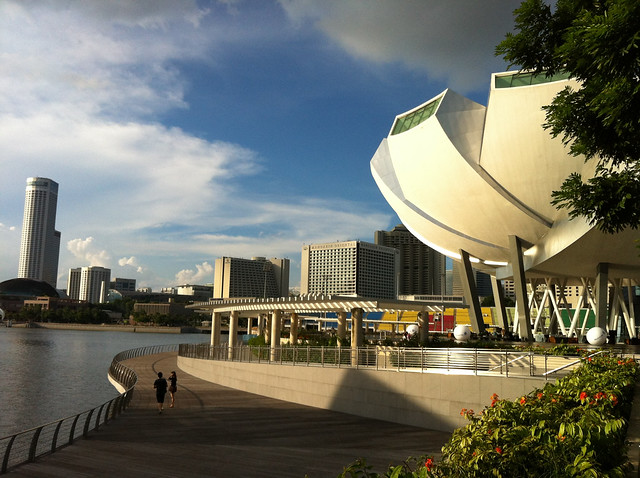
A government that fears that the carefully constructed and presumably robust society it has built can be unraveled by the affection between two male penguins is exhibiting not just ignorance but paranoia. One has to wonder of what use it is to tout such 21st-century marvels as the Marina Bay Sands—and, yes, a state-of-the-art National Library—when the consciousness that directs the place is stuck somewhere in the 16th century.

But before we Filipinos beat our chests and congratulate ourselves over how much more open we are to such modern concepts as tolerance and acceptance, let’s not forget that our own public officials share something with their Singaporean counterparts. When our President denied the accomplished actress but alleged drug user Nora Aunor the National Artist Award for fear that honoring her would encourage Filipinos to run out for their nearest dose of shabu, it showed that governments everywhere don’t have the foggiest idea of how art and artists work. But they do know that art works—much more effectively than government PR—and in that knowledge, perhaps, lies the source of their fear and disquietude.

Penman No. 105: A Novel of Singapore

146Penman for Monday, July 14, 2014


IT SEEMS entirely fitting that I’m writing this review of a Singaporean novel practically on the eve of flying to Singapore for a writers’ conference. I’m actually meeting its author—Suchen Christine Lim—at that conference where she’ll be one of the keynote speakers, so I’m sure we’re going to have an interesting conversation at the kopi tiam.

We Filipinos have generally looked at Singapore with an odd mixure of liberal disdain and a pauper’s envy. We like to imagine the typical Singaporean as an ideological robot who has to be programmed to have good clean fun, even as we shamelessly admire and imbibe Singapore’s First-World comforts on our occasional sorties through Changi’s Terminal 3 and down Orchard Road. We feel deeply conflicted by the fact that over 150,000 Filipinos work in Singapore, mainly as domestic helpers—proud of their tenacity and sacrifice, while being shamed by our inability to give them good jobs at home, with their families.

This kind of duality, we soon learn, exists within Singaporean society as well. Singapore isn’t nearly as monolithic as we commonly think, and what it is today came about as a result of a complex, continuing, and often painful process, one that involves folding the past into the ever-changing present.

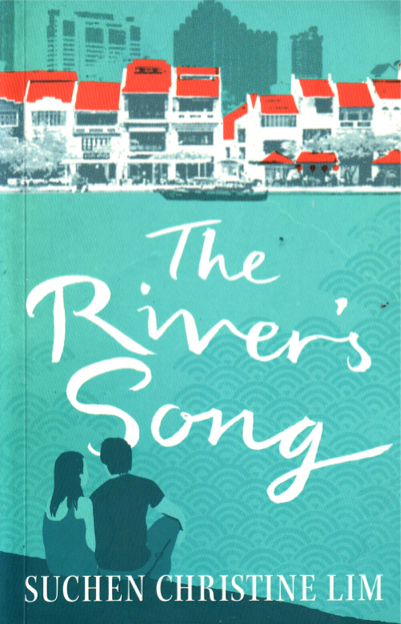
This is the narrative burden assumed by Suchen Christine Lim’s The River’s Song (UK: Aurora Metro, 2013). It’s a novel that sprawls over more than three decades and straddles Asia and North America, but its achievement lies less in its scope than in its intimacy, which is sustained throughout the work. There’s no great mystery or wizardry to Suchen’s technique: it’s solid storytelling, employing compelling and credible characters caught between being rich and poor, being young and old, being man and woman, and being loved and unloved.

Premised on the modern renewal of Singapore’s riverfront, The River’s Song takes us back to that city-state’s backwater days, and follows the lives of its two main protagonists, the girl Ping and the boy Weng, whose shared passion for music helps relieve their abject poverty and turn an innocent friendship between children into an almost irreparably difficult love between adults. Suchen evokes this lost age of Singapore with masterly precision:

“Weng ran out of the hut, pulled off his shorts and jumped into the river. At the crack of dawn the river had stirred to life. Fires were lit in the stoves in his neighbors’ huts. Bare-chested boatmen squatted on the decks of their bumboats brushing their teeth with a bit of coconut husk, gargling into their tin mugs like hundreds of tenors and baritones in the choir. This was the music Weng had heard since he was a toddler on his parents’ boat, when they still lived on a boat then. He swam out to the middle of the cool brown water. Smoke from the charcoal and wood stoves was starting to tickle his nostrils. Soon the food stalls in the market would open and his stepmother would buy fried dough sticks or fried vermicelli for the family’s breakfast.”

Ping and her mother are taken in by a rich man, and she later goes to America for an education and an escape from all the pain that Singapore has meant to her, hoping all the while to keep in touch with Weng, who becomes an activist for the poor, embittered by what he sees as Ping’s desertion. How they get back together after failed attempts at happiness with others forms the novel’s present, and Suchen composes and choreographs this reconciliation in musical terms, with Ping playing the pipa (a Chinese guitar or lute) and Weng the dizi (a flute):

“The pipa lets out an anguished groan. The Ming Ensemble joins in with a sobbing of erhu strings. The guqin gives a rippled cry. In a lilting undertone, the dizi sings a sorrowful accompaniment, underscoring the pipa’s grief. When the pipa rages in the desert storm in a fury of plucked strings, his dizi soothes in calm counterpoint. When the pipa weeps among the bleak sand dunes, his dizi comforts with broef snatches of melody. The rapt assembly has never heard the likes of this before. As bamboo, wind and strings sweep across the desolate plains beyond the Great Wall, weaving an intricate song of bleak beauty and sorrow, some people in the audience weep. When the pipa grieves her loss, the dizi consoles. When the dizi queries, the pipa replies. You left, he rues. I left, the pipa sighs.”

As with all good novels, The River’s Song is much more than the love story at its core, as satisfying as that already is. It’s a virtual chronicle of how modern Singapore came to be, and an accounting of the human and social costs of modernization, particularly at the fringes of society where every penny and every inch of land matters. Reflecting its author’s maturity and sensibility, it’s not the kind of angsty rant we tend to get from juvenile writers these days, but a poignant lament that holds out hope for redemption despite—to advert to a section heading—the darkness of the waters.

Here and there, in a spot or two, I might quibble with Suchen over a note that may be slightly off-key; I suspect, for example, that the stray quotation from the Irish poet Seamus Heaney springs more from the author than from the character, whose musical artistry and intelligence I can’t contest, but whose literary inclinations had never been clearly established. Otherwise Suchen—one of Singapore’s most celebrated writers—has an impeccable gift for dialogue and scene-setting; the novel is practically a script, needing just a camera to become the movie its material seems cut out for.

I spoke earlier of the stereotypes that we non-Singaporeans have of that place and its people. Suchen Lim banishes these stereotypes and much of our ignorance along with them. Of course there were poor and homeless Singaporeans. Of course there was principled resistance to the regime. Of course there’s a steamy underbelly to the façade of manicured lawn, polished glass, and hard-edged steel that contemporary Singapore projects. Those of us who visit and remark, perhaps too casually, about the “soullessness” of modern Singapore will have good cause to rethink that assumption; the soul may not be in Marina Bay Sands, but it’s clearly alive in the literary imagination.

If you want to know Singapore beyond what the Lonely Planet guidebook will tell you, pick up a copy of The River’s Song; I know I’m going to look up Pagoda Street, one of the book’s locales, when I get the chance this week. The book is available on Amazon. (Suchen, a frequent Manila visitor and friend to many Filipino writers, also left a copy with the Gonzalo Gonzalez Reading Room of the UP Institute of Creative Writing in Diliman; have a look at it there, then find your own copy to cherish and to share.)

[Old Singapore image from nowhere.per.sg; image of pipa player from redmusicshop.com.]

Penman No. 104: The Psychology of Collecting

48VacumaticsPenman for Monday, July 7, 2014


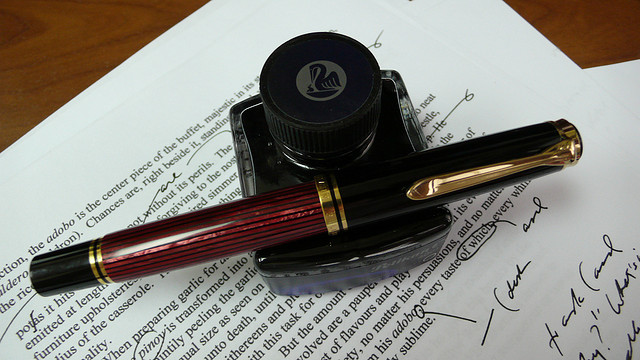
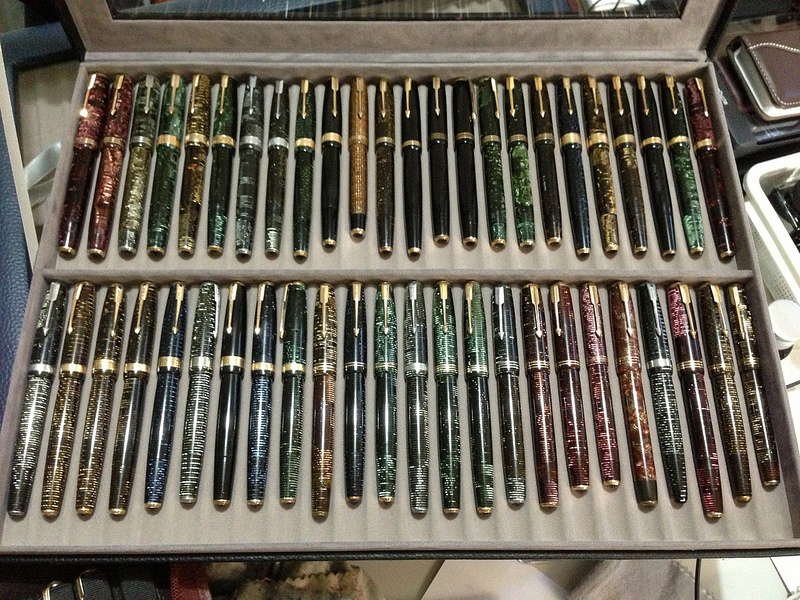
EVERY OTHER month or so, I take the 200+ contents of my fountain pen collection out of their wooden boxes and leather cases—a few of which reside in a fireproof safe—to ink, doodle with, clean, and reorganize. It’s a ritual that invariably leaves me pleased and at peace. Sometimes I reorganize the pens by age, sometimes by maker, sometimes by color or material.

Any serious collector of, well, seriously anything will recognize this behavior. And I do mean anything—I’ve met people who collect not just the usual stamps or coins or even watches and cars but barbed wire and tractor seats. (I met the tractor-seat fellow 25 years ago in a barn full of antiques in Ohio; when I expressed astonishment at his specialty, he turned around and said, with scholarly disdain at my ignorance, “There’s a fanny for every seat!”)

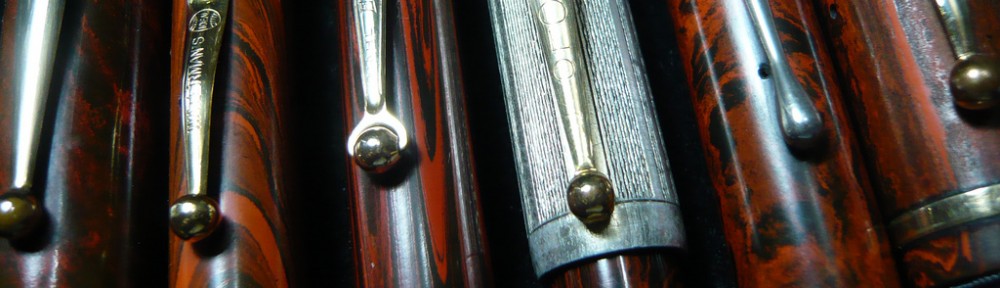
In the pen forums I inhabit, there’s a never-ending discussion about being either a “user” or a “collector,” the implication being that collectors are simply moneyed hoarders while users are simple, practical-minded folk who’ve never forgotten what things are for. I propose that the truth, as it often does, lies somewhere in between; many users are wannabe collectors, and most collectors have never stopped being users. It’s pointless to think of, say, a 1925 Waterman Sheraton or a 1934 Wahl Eversharp Doric as being just a pen you can write with, like a cheap ballpoint; they may have been utilitarian tools once, but somewhere along the way they crossed the line and became jewelry and art object.

At least that’s how I excuse amassing and periodically gloating over, say, my dozens of Parker Vacumatics, a 1930s-40s pen that forms the core of my collection. This was the pen I wrote my 1994 short story “Penmanship” about. (It’s a story about a story that I’ve often told, but the sum of it is that I found this 1938 Vacumatic Oversize in a pen shop in Edinburgh, paid a month’s salary for it, suffered buyer’s remorse, then decided to write a story about the pen, which won first prize in a contest that made me back my salary.) I know enough about Vacs that I can put you to sleep by mumbling mantras such as “Vac nomenclature covers a fascinating maze of models and colors—the Junior, the Major, the Standard, the Slender, the Debutante, the Oversize, the Senior, which is not to be confused with the Senior Maxima, since the Senior came out only in 1936….”

About 15 years ago it wasn’t pens but laptops—yes, Apple Macintosh Powerbooks, particularly the Duo line (the granddaddy of the MacBook Air and all those super-slim laptops people toss into their briefcases today). I had (and still have) about a dozen of these machines, which I used to take apart to upgrade the memory and hard drive (back when 240 megabytes made you king of the hill), before putting them back together again and then pressing the power button to hear that unmistakable startup chime that told me I had done everything right, so I could then step out and face the world and slay dragons and then sign memos.

So why do otherwise presumably sane people like me get our kicks by amassing strange objects most other people wouldn’t give a second look or drag into their homes even if you paid them to do it? I asked myself this question again last week as I changed out the inks (another ritual for the devotee) in my glorified Bics. Why do we take them out week after week, not to write a novel or a draft SONA but endless iterations of “I love this pen I love this pen”?

First of all, you want to be reassured that they’re still there. Collectibles have a way of walking away on little cat feet, and collectors have a sixth sense about what’s missing from the picture.

Second, you want to reassure yourself that you know why they’re there—that the objects have some aesthetic and monetary value. Perhaps that value’s known only to a very few people, which is not a bad thing, because it’s proof of your connoisseurship, of a certain esoteric form of expertise that’s taken you some time and expense to cultivate. It’s like getting a PhD in the truly little, truly fun things (and what’s a PhD these days except a lot of knowledge about very small things, hardly any of which is fun?).

You may be a total loser in nearly every other aspect of life—your face could resemble a well-worn shoe, your family may have deserted you for the coldest parts of Canada, your car could be an escapee from the junkyard—but if you know everything about tourbillons, carburetors, calibers, and (in my case) nibs, then you have good reason to face the world with pride if not arrogance; you have, after all, one of the world’s largest collection of GI Joes, or Tonkas, or Ken dolls, or whatever floats you boat.

Third, let’s go online and ask the experts. Dr. Mark McKinley, in a much-quoted piece on “The Psychology of Collecting” in The National Psychologist, goes back in time to note that “During the 1700s and 1800s there were aristocratic collectors, the landed gentry, who roamed the world in search of fossils, shells, zoological specimens, works of art and books. The collected artifacts were then kept in special rooms (‘cabinets of curiosities’) for safekeeping and private viewing. A ‘cabinet’ was, in part, a symbolic display of the collector’s power and wealth. It was these collectors who established the first museums in Europe, and to a lesser extent in America.”

Since I’m sure I don’t collect Sheaffers and Esterbrooks to show off my power and wealth, let’s see what M. Farouk Radwan (who holds an M. Sc., so who presumably knows what he’s talking about) says about the subject: “Since early years human beings used to collect food in order to feel safe and secure. Because acquiring food was a difficult process with uncertain outcomes humans learned to ease their anxieties by storing the food they needed. The same need, which is to feel secure, is the primary motivating force behind the creation of collections.

“Because life is uncertain and can easily make a person feel helpless some people use their collections to create a private comfort zone that they can control. By arranging and disarranging their collections compulsive hoarders can regain the sense of control over their lives. These actions reduce anxiety and helps those people cope with the uncertainty of the real world.”

So we go back to basic needs and instincts: food and security. McKinley puts these together: “For some, the satisfaction comes from experimenting with arranging, re-arranging, and classifying parts of a-big-world-out-there, which can serve as a means of control to elicit a comfort zone in one’s life, e.g., calming fears, erasing insecurity. The motives are not mutually exclusive, as certainly many motives can combine to create a collector—one does not eat just because of hunger.”

That’s a brilliant insight—“one does not eat just because of hunger”—and it leads to my favorite explanation of the psychology of collecting, propounded by Robert and Michele Root-Bernstein (co-authors of Sparks of Genius, the 13 Thinking Tools of the World’s Most Creative People) in “The Collection Connection to Creativity” (Psychology Today, May 2011):

“The fact is collecting exercises a number of important mental tools necessary for creative thinking. The collector learns to observe acutely, to make fine distinctions and comparisons, to recognize patterns within her collection. These patterns include not only the elements that make up the collection, but the gaps in it as well. Learning how to perceive what isn’t there is as important as knowing what is! And the collector also knows the surprise of finding something that doesn’t fit the collection pattern: Is the mismatch a fake? An exception? Something that belongs in another collection? Broken patterns are often the ones that teach us the most by challenging our preconceptions and expectations.”

Patterns, designs, mismatches, aberrations: early in 1937, just for a few months, Parker came out with a special Vacumatic, with the word “Vacumatic” etched in the gold-filled cap band. It’s one of the holy grails of Parker collectors, one of the rarest and most expensive of finds, and I have one. That should make it the crown jewel of my collection, but it isn’t; it’s the pen that made me write a story about it that’s the rarest one of all, that gives me a lifelong excuse for picking up tubes that squirt inks.

(If you like pens, join us at Fountain Pen Network-Philippines, www.fpn-p.org. We’re marking our sixth anniversary this week!)

Penman No. 103: Too Much Drama

Penman for Monday, June 30, 2014

IN MY other life as a dramatist, which came to an end some years ago, I wrote about a dozen plays for the stage and more than twice as many television plays and screenplays, mostly for the late Lino Brocka. Lino and I happily turned out double-hanky tearjerkers with such rousingly commercial titles (which someone presumably from the marketing department thought up) as Kailan Mahuhugasan ang Kasalanan, Ano ang Kulay ng Mukha ng Diyos, Maging Akin Ka Lamang, Miguelito, ang Batang Rebelde, and my very first one, back in 1977, Tahan Na, Empoy, Tahan.

I may have stopped writing drama to focus on fiction and nonfiction, but now and then the old skills get a workout. I’ve always said that there’s no better training for a writer of fiction than to have been a playwright, because playwriting teaches dramatic economy—how to set up a scene, how to get the most out of your characters, how to use dialogue effectively (meaning, at its most complex, how to get your characters to say things they don’t mean, or to mean things they can’t say).

Last week, I said as much again to a group of writers and program analysts from a TV network who wanted to see how writers think. I told them that drama’s to be found not only in filmscripts or on the set—it’s all around us, taking place quietly in some fastfood joint or some bus stop or some hospital ward; the writer’s task is to see that drama, to palpate it from the tedium of everyday life, and to sharpen and brighten its edges so others can see the extraordinary in otherwise ordinary moments.

We’ll save the rest of the drama lesson for another day; I bring this up only to establish my bona fides when it comes to talking about drama, and about my thesis today, which is that—even for a writer of melodrama, for which I make no excuses—there seems to be entirely too much drama around us these days, or theater if you will. (There’s a subtle difference, if you think of drama as the situation and of theater as its enactment on some kind of stage.)

Case in point: I’m sure I’m not the only one who’s sick not only of Senator Bong Revilla’s whinings about the heat in his room at the “custodial center” (it’s not even a real prison, for Pete’s sake), but also of how the media has fussed over it like it was a real news story (“Can Congresswoman Lani make it back from Greenhills in 15 minutes with the air cooler? That’s all the time she has before visiting hours end!” said one radio reporter breathlessly.) My totally un-PC prescription? Give him the fan, give him whatever creature comfort he wants, but reduce his cell to about a third of its size and keep that one window, from which I hope he sees a mall, or something with lots of people and traffic in it. There’s no better reminder of what prison means than limited space and movement, no matter what you may have with you. (I remember watching a Marlboro neon sign blink at me on the far side of martial law prison, back in 1973; that was torture.)

Senator Jinggoy Estrada’s departure for the custodial center was only slightly less theatrical, thanks again to the media who couldn’t get enough of the father-and-son story being played out in all of its bitter if obvious irony. Of course we expected the family to bond around Jinggoy, and for tears to be shed; that’s any family’s natural privilege, and its natural response. Indeed what underwhelmed me, from my dramatist’s standpoint, was how predictable everything was from start to finish, especially the inevitable “Mayor Erap, ano’ng nararamdaman ninyo sa pagkakakulong ng inyong anak?” I wanted to scream, “E ano pa?”

I can just see the video highlights from these staged “surrenders” figuring in these politicos’ next campaigns: the prayers in church, the mug shots, the hugs and waves from distraught spouses, parents, and kids; the cell doors closing, as the music goes up and under, before we hear a murmured voice-over: “May bukas pa….”

Case in point Number 2: Sometimes silence is drama; when your wife refuses to explain why she doesn’t want to talk to you, that’s drama. When the Palace refuses to explain why it dropped Nora Aunor from the list of National Artist awardees, that’s drama. All President Noynoy’s spokesmen could say was “It’s the President’s prerogative….”, which is exactly what we heard from President Gloria’s spokesmen a few years ago, the only difference being that she made dagdag, while Noynoy made bawas. I did read something about Nora’s exclusion being “in the national interest,” but it boggles the mind to figure out exactly what that means. I can understand defending the Spratlys and Scarborough Shoal as being “in the national interest”; I can even understand rooting for Manny Pacquiao on fight day—temporarily setting all his other quirks and antics aside—as being “in the national interest.” But dropping Nora?

As I wrote in this corner a few months ago, I was on a large, multidisciplinary, second-level committee that endorsed Nora Aunor to a higher body (the NCCA and CCP Boards plus the National Artists); we endorsed Dolphy as well, and if I remember right, he and Nora got the same highest votes across the board. Granted that our recommendations were just that and subject to final approval upstairs, I feel among many others in the arts that we at least deserve a full and cogent explanation for all these pluses and minuses that take place in Malacañang. The Palace—and I don’t mean just the present occupant—has never been known to be a bulwark of artistic support and sensibility, if you look at funding for the arts in relation to everything else; if it never cared for or about the arts, why should it suddenly care—negatively at that—about Nora Aunor, whom the arts community clearly feels is deserving of its highest accolade? If you can’t help, at least don’t get in the way.

I’d been told by some Palace contacts that questions came up about Nora’s alleged drug use. OK, I said, it’s fair enough to raise these questions which presumably involve moral turpitude. But since when has it been fair to use morality as a standard for artistic excellence? We’ve had National Artists whose personal lives were hardly spotless, but whose art precisely may have been deepened and enriched by those encounters with their darker side. (Conversely, we’ve had National Artists who may present themselves as moral exemplars and accuse everyone else of some fatal shortcoming, but whose work is unremittingly mediocre and soporific.) Edgar Allan Poe, Salvador Dali, Jean-Michel Basquiat, and Miles Davis, among many others, would never qualify for state honors in their countries (not that they ever cared) if our Malacañang’s standards were employed.

Last case in point: I wholeheartedly agreed with the NCCA when it protested the Palace snub of Ms. Aunor, but also wholeheartedly disagreed with the NCCA when it reportedly protested allowing the use of our national heroes’ names for such popular products as beer. (Think “Cerveza Rizal” or “Mabini Beer.”) The reason given by objectors was that it would be a sign of disrespect for these heroes to associate something as morally undesirable as alcohol with them.

Really? Which planet are we on? Didn’t our heroes drink beer and stiffer forms of alcohol—in spite (or dare I say because) of which they performed heroic deeds, anyway? Rizal complained that his fellow ilustrados in Spain drank and womanized too much, but that hardly meant that he was completely abstemious in either department. He didn’t care much for hard liquor, but drank beer (like me, on whom single malt would be a total waste). George Washington was a beer guy as well, and even famously left a handwritten recipe for his own brew (later marketed in an “Ales of the Revolution” line). So will the moral police please lighten up? If Nora’s good enough to be a National Artist, then Jose Rizal should be good enough to go on a beer bottle, and I’ll hoist many a cold Rizal in his own honor.

Heroes aren’t heroes because they’re perfect human beings; they’re heroes because—despite some truly terrible character flaws and peccadilloes (one of them even shot his wife, remember?)—they left something indelible to the national spirit and imagination, enough for us to think of ourselves as a nation. Heroes and National Artists (the real ones and the best ones) can do that; politicians—whether in prison or in the Palace—can’t.

Penman No. 102: The Cream of the Crop

2014FulbrightPenman for Monday, June 23, 2014


A FEW weeks ago, I was happy to attend a pre-departure orientation seminar for this year’s US-bound batch of Fulbright and Hubert Humphrey scholars. I’ve been to quite a few of these PDOs over the past decade or so, and normally I’d be there up front, giving one of the orientation talks.

I’m usually the closer at these seminars, my task being to remind our scholars to enjoy their stay in America and to learn all they can—and then to come home and serve their people. “Love America all you please,” goes my spiel, “but never forget where your home is, which is here—not even here in 21st century Makati, but in those parts of our country which languish in the 20th and even the 19th century. We go to the great schools of America not just to improve our lives but theirs—those Filipinos who cannot even read, or are too hungry and tired from work to read.”

Last month, I sat in the audience on the listening end, having been privileged with a Fulbright grant—again, after my first one nearly 30 years ago, when I left for the US to do my master’s at Michigan and my PhD at Wisconsin before returning in 1991. This September, if all goes well, I’ll be leaving for Washington, DC to do advanced research in connection with my ongoing book project on the First Quarter Storm, specifically to seek out American perceptions of and experiences with martial law in the Philippines, and also to interview Filipino-American activists from that period.

The Philippine-American Educational Foundation, headed by the very capable and amiable Dr. Esmeralda “EC” Cunanan, actually administers or acts as a conduit for several distinct scholarship programs that fall loosely under the “Fulbright” rubric, named after the late Sen. William J. Fulbright, who saw educational exchanges as the best way to promote international cooperation and understanding between America and the rest of the world. (The Fulbright program also sends out American scholars for studies abroad.) Indeed, as I often tell my American friends, one Fulbright scholarship will probably cost a hundredth of and produce a thousand times more enduring goodwill than one bomb. For us Filipinos, this is the pensionado concept brought over into a new century, with the important difference that our learning is no longer meant to serve American ends, but ours.

A scan of this year’s batch of outgoing scholars offers great hope for the future. Chosen from many hundreds if not thousands of applicants after rigorous evaluations and interviews, they represent truly the cream of the crop, and I felt honored to be in their company.

The so-called “classic” Fulbright scholars—those going for their master’s and PhD degrees—include the likes of Lisa Decenteceo of UP Diliman, who’s going for her PhD in Musicology at the University of Michigan in Ann Arbor (yay, go Blue!); Neil Andrew Mijares of the University of San Carlos, who’s doing an MA in Urban and Regional Planning at the University of Iowa; and Ramjie Odin of Mindanao State University-Maguindanao, who’s entering the PhD program in Fisheries and Allied Aquaculture at Auburn University.

Among my three fellow “senior” postgraduate scholars, despite the fact that she looks young enough to pass for an undergrad, is Marites Sanguila of Father Saturnino Urios University in Butuan, who’ll be going to the University of Oklahoma to undertake advanced research in “Species Diversity and Survival in a Changing Environment: Developing a New Center for Biodiversity Conservation.”

For many years now, there’s also been a special Fulbright program focused on agriculture, the Philippine Agriculture Scholarship Program for Advanced Research, which was set up at the initiative of then Agriculture Secretary Edgardo J. Angara to improve our agricultural expertise. This year’s nine grantees include Ma-Ann Camarin of MSU-Marawi who’s going to another MSU, Mississippi State University, to do doctoral dissertation research on (hold your breath) “Disease Surveillance and Study on the Bacterial Flora of Freshwater Prawn (Machrobrachium rosenbergii) as Biological Control Against Pathogenic Bacteria.” Meanwhile, Shirley Villanueva of the University of Southeastern Philippines in Tagum is going to the University of California-Davis to conduct research on the “Genetic Diversity of Native Chicken Groups in the Davao Region.”

Among the two US-ASEAN Visiting Scholars will be Jay Batongbacal of UP, one of our foremost legal experts on maritime law, who’ll be studying issues related to current disputes in the South China Sea. The three Hubert Humphrey fellows—all accomplished professionals in mid-career—include a PNP major and former Pasay City precinct commander, Kimberly M. Gonzales, who’ll be looking into public policy and administration concerns at the University of Minnesota.

To help Americans—especially Fil-Ams—learn Filipino, the Fulbright program is sending out three Foreign Language Teaching Assistants, who include Edward Nubla from the University of St. La Salle in Bacolod; he’ll be on his way to Skyline College in San Bruno, California. Lastly, four Filipino undergraduates will soon be spending a year on a US campus, thanks to the Fulbright program. They include Michiko Bito-on of Silliman University in Dumaguete, who’s taking up Mass Communications.

It’s heartening to see the diversity not only in these scholars’ expertise and concerns but also in their representation of all corners of the archipelago, ensuring that the Fulbright experience is shared not only by the usual suspects like me from Manila’s academia, but by bright young minds from north, south, and center.


SPEAKING OF the Filipino presence overseas, a big cultural event will take place in Hong Kong over this weekend, thanks to the efforts of the poet and scholar Armida M. Azada, who’s been based there for many years now.

On Friday, June 27, 5:30-7:00 pm, Mida will sit in conversation with visiting Filipino writers Joel Toledo, Charms Tianzon, and Daryll Delgado in a symposium on new Philippine writing titled “Our Words, Other Worlds,” at the Amenities Building, Lingnan University. The next day, at noon, Mida’s new book of poems, Catalclysmal: Seventy Wasted Poems will be launched at the 7th Floor of Hong Kong City Hall in Central. Earlier that morning, from 10:30 to 12 noon in the same venue, a free writing workshop will be held for Pinoy helpers and HK-Pinoy youth. On Sunday the 29th, from 6 to 7:30 pm, a poetry reading by Filipino writers and their friends will be held on the first floor of DB Plaza Terrace near Dymocks in Discovery Bay.

This is a wonderful thing that Mida Azada—a gifted poet who was a colleague at the UP Department of English before she moved to Hong Kong and the UK—is doing not just for herself but for her fellow Filipinos in the diaspora. As prizewinning poet Joel Toledo puts it in his endorsement of Mida’s new collection, “Cataclysmal is a collection of haunts and visitations. The poems here flit in and out of the Philippine archipelago, travelling to London, Hong Kong, and New York without losing touch of a Filipino rootedness. The poet’s concerns stray and meander from the personal and cathartic to the phenomenal and ultimately global. But Azada’s voice is keen and focused, filtered on the page by a careful attention to language. One may argue that this is the poetics of the expatriate ruminating on both the post-modern and post-colonial. Yet at the heart of this collection is fierce integrity, a resonant ‘I’ persona that won’t flinch. Here are poems that both strain to capture the fleeting and restrain from exoticizing the past. The poet Fanny Howe once wrote, “Double the beautiful/because they are so little.” While phenomena can sometimes be indeed cataclysmal, the hurtful is never wasted—so long as poems remember and reconstruct and, in time, recollect the sorrows, parse them into bliss.”

Mida, Joel, Charms, Daryll, and the other fine, memorable voices of their generation—they too are the cream of the crop.

Penman No. 101: The Digital Tourist (2)

photo 2Penman for Monday, June 16, 2014


LAST WEEK I wrote about some websites that you could check out if you’re planning to go on a trip, especially to some place you’ve never been before. Practically everything today can be planned online, from choosing destinations to booking flights and hotels and buying travel insurance. But what about when you’re already on the road?

This is where travel apps come in—“apps” being those small programs or applets (little applications) that come with your tablet or smartphone, or that can be downloaded to them. These apps can be lifesavers—literally, when you’re lost close to midnight in the bowels of a subway station in a strange city, without the foggiest idea how to get back to your hotel. Some will require an Internet connection, but many won’t, after their initial installation—and that’s when you’ll be happy and relieved that you had the foresight to install them when you could, before you even left for the airport. Whatever I’ll list here won’t be your only options—in many cases, there may even be other, better apps other will know about—but these are the ones I’ve roadtested myself, over many years of traipsing around the planet, with PDA (remember those?) or smartphone in hand. (Do note that I use an iPhone, but many of these apps gave their Android counterparts. For IOS devices, go to the App Store.)

Trip planning. If you travel often, you’ll need an all-around planner to organize your trips—remind you of your itinerary, make your bookings, check your flight status, provide weather forecasts, convert currencies, and such. Your datebook can take care of some of these things, but not all. For many years now, my reliable sidekick in this department has been an app called WorldMate, which can do all of the above, and more (it can also calculate tips).

WorldMate’s strongest feature is its flight planner and notifier, which comes in really handy when you have a string of flights to take in a mad dash from one airport, one terminal, and one gate to another. Let’s say you’re flying Delta to Detroit via Tokyo Narita, or Cathay to London via Hong Kong. As soon as you make your booking and receive it in your email, all you do is forward your confirmation email or e-ticket to trips@worldmate.com. WorldMate will automatically digest that email and reflect your itinerary on the app on your phone or tablet—and, if you’ve configured WorldMate to sync with your datebook, it’ll show up on your calendar as well. If your flight gets delayed, WorldMate will advise you of it. It will give you your terminal on arrival and departure. (WorldMate has a free basic version and a paid Gold version with more features.)

Flight tracking. You’re dashing to the airport in a cab, late for your flight, and you don’t even know which terminal or gate it will be leaving from (and if you’re really unlucky, you’ll be in Madrid, where Terminal 4 is several kilometers away from Terminal 2, and Terminal 4S takes another 20 minutes to get to); you’re praying like mad that your flight’s delayed. At this point, your friend is an app called FlightBoard, which tracks scheduled flights—arrivals and departures—at airports all over the world in real time. A similar app called FlightAware allows you to track all the flights between two airports for a given day, and to zero in on a particular one; if it’s up in the air somewhere over Siberia, it will show exactly where it’s supposed to be on a global map, much like you’d see on those onboard monitors. Both FlightBoard and FlightAware are free. (These apps are also good for when you’re meeting someone in Arrivals.)

photo 3

Getting around. Once you’ve reached your destination, there are two things you’ll almost certainly need to get around: a city map, and a local transport (subway and bus) guide. Many airports will give you free city maps on arrival, and they’re fun to spread out on the table over breakfast to plan the day, but they’re a hassle to unfold at streetcorners and in the middle of the plaza to locate where you are and where you’re going (and at that instant, you might as well wear a T-shirt saying, “I’m a lost tourist—please, victimize me!”).

A good map stored in your digital device—without needing to go online, as you would with Google Maps—can save you a lot of anxiety, if not a lot of footsteps. On our recent sortie around Europe, I was glad to be guided by one invaluable resource: Ulmon maps of Barcelona, Venice, Florence, and Paris. All of these maps were free, and could be blown up to the level of individual streets and even alleys; if you feel lost, you could input the name of the nearest street, and it will locate your neighborhood in relation to popular landmarks. Clicking on the name of a hotel will give you rates; public transport stops are also indicated.

Speaking of public transport, nearly all the major cities of the world have some kind of subway or metro rail line, and this gives me an opportunity to introduce my favorite travel app of all time—and I mean that almost literally, because I’ve been using it in its various incarnations since 1999, or 15 years, an eternity in digital time. It’s called Metro, and it’ a guide to the world’s subways, metros, and bus lines. I first used Metro on my Palm Pilot when I was navigating around London, and the app—though regularly updated—has remained essentially the same. You choose a city (say Paris), and decide that, from your hotel on Avenue Foch, you want to go to the weekend flea market at the Porte de Clignancourt. You input “Avenue Foch” and “Clignancourt” and tap an icon, and Metro will yield the information that the shortest subway route will take 16 stops involving one change (at Barbes-Roucheouart—thankfully, you don’t need to know how to pronounce these names), for approximately 33 minutes total. Each subway stop is identified, as well as the direction of the train you should be taking. The best thing about Metro? It’s absolutely free, and works offline.

photo 1

This list of apps could go on, but as travel is complicated enough, let’s keep it simple: for as long as you have these apps (WorldMate, FlightBoard, Ulmon Maps, and Metro), your next trip will be much less of a headache, and you can enjoy the view out the window rather than wonder and worry over where your train is going.

(Let me just add, before I forget: these apps will be totally useless if your phone or tablet is dead; I always travel with a universal adaptor, an extension cord, and a power bank for extra juice. If you blow air into my pants, I could go on a spacewalk.)