Hindsight No. 2: Myth over Matter

Hindsight for Monday, January 24, 2022

(Image from indiatimes.com)

THERE’S HARDLY a week that goes by without me receiving a Viber notice from a friend warning me about another incoming message containing some innocuous line like “Let’s go to Latvia” or “Your mother will love this,” clicking which will trigger a dizzying spiral into digital damnation: your phone will freeze, all your passwords will be stolen, your half-naked selfies will be posted to your Village Association chat group, and whatever gender you declared will be reversed in all your official records. 

It’s all well-meant, of course; some friends will even add “Sharing, just in case”—meaning, they also suspect it’s fake, but meaning further, they’ll pass final judgment on to you, a privilege you should be thankful for—on the one-percent chance that it’s true.

I’ve taken it as my civic duty to look up the particular hoax online (easy: just add “hoax” or “scam” to whatever the key words are, and Google away) and to inform the senders of their mistake. Many will reply with a terse “Thank you.” Some will protest: “It wasn’t me—it was my silly sister-in-law who swore it was true, so I passed it on!” A few (some of these senders have PhDs) will even argue back: “Now, how sure are you that snopes.com is a real fact-checker? Who’s funding them? What’s their angle?” (Makes you wonder: if they were going to be that investigative, why didn’t they ask it about the hoaxer in the first place?)

Living in the age of fake news (or “alternative truths” as Donald Trump’s aide so nicely put it), we can’t be surprised any longer by the seemingly infinite pliability of the truth, which can be warped and twisted to the point of being barely recognizable. But as it turns out, that “barely recognizable” element is key. 

An article in WIRED from 2019 on “Why People Keep Falling for Viral Hoaxes” points this out: “The narrative that Big Bad Instagram is going to take all of your most intimate personal data points and use them for nefarious secret purposes is the sort of story that is primed to appeal to the average person… because it contains a kernel of truth: You have all this data out there on the internet, and God knows who has access to it.”

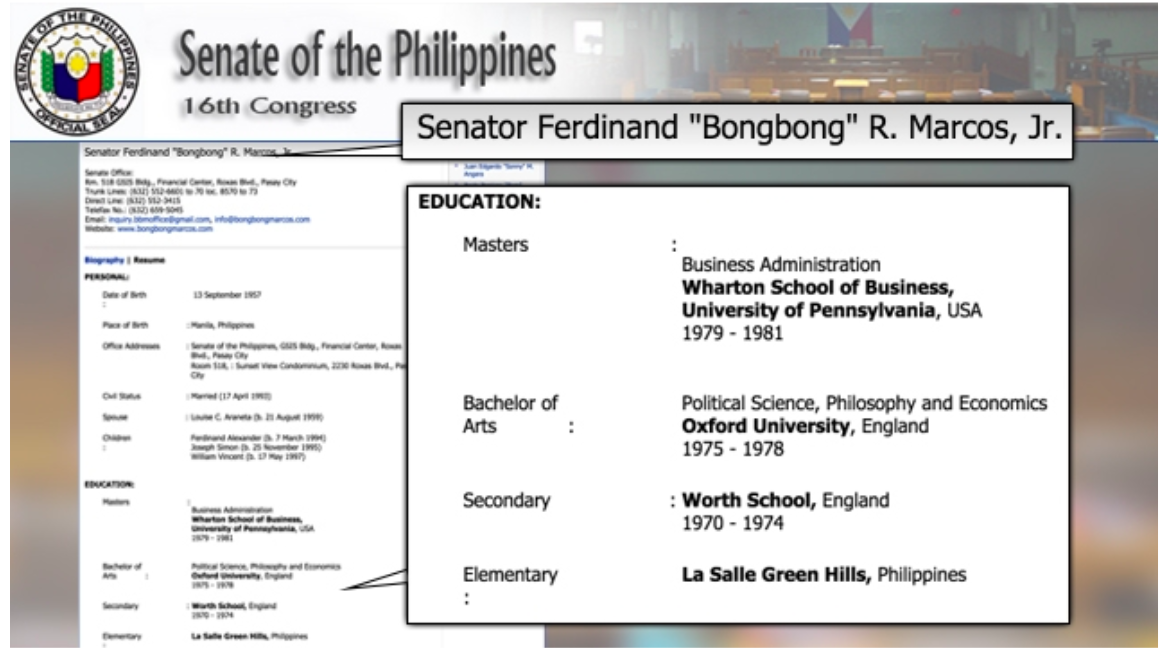
We sort of knew that already—the best lies have a little truth in them, encouraging our gullibility. When Ferdinand Marcos claimed to be a war hero with 33 medals to his name—only two of which were actually given in 1945, and both contested by his superiors—all the fellow basically had to show for proof was his picture in a uniform, surrounded by pretty hardware that you can buy today on eBay, and that was enough to make many believe that he had to be a hero.

What’s more breath-taking—and possibly more dangerous—are the outright fabrications, the brazen claims to this and that outrageous deed or achievement. You’d think that they’re too absurd to be swallowed by even the most credulous, but think again.

The story of the Tallano gold, now being trotted out on social media as the source of the Marcos fortune, is a case in point. The story that went around on Facebook is that the Tallano family—the descendants of the rulers of a pre-Hispanic, pan-Pacific kingdom called Maharlika—had paid the young lawyer Marcos 192,000 tons of gold. With one kilo of gold today at around P3 million, I don’t have enough zeroes on this line to tell you what that’s worth. And for what lawyerly labor, one wonders—a gazillion affidavits and deeds of sale? 

Never mind that Imee Marcos herself has denied this story, and even the “Yamashita gold” that her mother claimed in 1992 to have found its way to Ferdie. The late Bob Couttie had been exposing the Tallano claims as a fraud even in 2018. But the story has legs. You just have to go online to find testimonials like this from a “BQ”: “It’s true but they’re burying the truth. I myself held those documents—three reams of A4-sized paper, including the mother title of all the land here in the Philippines, which came from Great Britain!”

Never mind, too, that it’s clearly a minority of believers. It’s how and why they believe kooky fantasies like this that’s more intriguing. The WIRED article again points to a reason: that, for many people, mythmaking provides a coherent narrative, a story easier and more convenient to believe than the truth, which is often too messy and complicated to figure out.

In my fiction writing class, I often bring up my favorite quote from Mark Twain, paraphrased: “Of course fact is stranger than fiction; fiction, after all, has to make sense.” Like myth, traditional fiction has a familiar beginning, middle, and end—and even a “lesson” to clarify the haze in which we stagger through daily life.

As I said in a lecture sometime ago, “The most daring kind of fiction today is out of the hands of creative writers like me. It is being created by political propagandists who are spinning their own versions of the truth, and who expect the people to believe them. The short story and the novel are no longer the best media for this type of fiction, but the tweet, the Facebook feed, the YouTube video, and even the press conference.”

Today’s savviest political operators know this: spin a tale, make it sound appealing, trust ignorance over knowledge, and make them feel part of the story. “Babangon muli?” Well, who the heck who dropped us into this pit? It doesn’t matter. Burnish the past as some lost Eden, when streets were clean, people were disciplined, and hair was cut short—or else. Never mind the cost—“P175 billion recovered in ill-gotten wealth” is incomprehensible; “a mountain of gold to solve your problems” sparkles like magic.

Imagination is more powerful than reason—myth over matter. I hope the forces of the good and right can work with that.

Hindsight No. 1: A Time for Telling

Hindsight for Monday, January 17, 2022

IT WAS with great shock and sadness that I received the news of Manong Frankie Sionil Jose’s passing two Fridays ago; my recollections of him appeared online later that day. But just as jarring a surprise was a call I later received from Millet Mananquil, my editor in the Lifestyle section, and then from Doreen Yu, our Op-Ed editor, informing me that I had been chosen to take over FSJ’s column-space on this page.

It was a great privilege, of course, and I accepted it gratefully. But it also carried with it an awesome responsibility—to be honest, to be fair, to know enough about an issue to speak with some legitimacy about it, and also to be modest and open-minded enough to remember one’s inescapable fallibility. I don’t think that last one’s going to be a problem, because I’ve made mistakes often enough to know that—well, I make mistakes, some of which may have hurt people badly.

But last Saturday I turned 68, and with that age comes a keener sense of doing right, of accountability for one’s choices and judgments, as well as a greater tolerance for the shortcomings of others, though not of evil or of wrong itself. I intend to maintain those bearings in this new capacity.

Some readers may wonder how a Lifestyle writer like me—obsessed with fountain pens, old books, Broadway showtunes, and digital gadgetry—ends up doing op-ed, which seems a far more serious and consequential calling. A brief self-introduction might be in order.

I dropped out of UP as an engineering freshman in 1971 and, against all odds (not having spent one day in Journalism class, and being all of 18), landed a job as a features writer and general assignments reporter with the Philippines Herald in 1972. My first task was to fill up half the Features page every day—something that schooled me forever on the importance of deadlines and of resourcefulness, because I had to come up with the topics on my own. I moved to Taliba as a suburban correspondent; was arrested for my activism shortly after martial law was declared; spent seven months in prison; and upon my release joined the information staff of the National Economic and Development Authority, where I would work for the next ten years, picking up a diploma in Development Economics along the way.

I returned to school, finished up my academics all the way to a PhD (more for teaching than for my writing), and taught full-time while writing stories and film scripts. In the mid-1990s, thanks to my friend and now fellow-columnist Jarius Bondoc, I was hired as an editorial writer for the newly opened newspaper TODAY. Being busy with other aspects of management, our boss Teddyboy Locsin trusted me to do about three editorials a week, including the newspaper’s very first one. 

I discovered that opinion writing was exhilarating—but also, again, fraught with responsibility. It got to the point that I found myself wishing I could write something less driven by analysis and conscience—small things like my rickety VW Beetle, double-knit pants, and my love of crabs, instead of ponderous topics like prison reform, the defense budget, and Philippines 2000. (I still have 113 editorials that I wrote on my hard drive.) So I asked for—and got—a Lifestyle column called “Barfly” on the back page, which helped me decompress and kept me sane, reminding me that life was much more than politics and that beauty and fun were as important as anything else to happiness.

I’m going to keep that escape valve open—I’ve promised Millet that I’ll continue contributing my “Penman” column every now and then—but I’ll approach this new task with the loftiness of mind that it deserves (although you’ll excuse me if I sometimes prefer to take a more comic tack, as the best criticism is often served up with a smile). 

Unfortunately I’m not a political insider; I don’t make the rounds of kapihans and have become something of a happy recluse over the Covid lockdowns. You’ll see my politics soon enough—unabashedly liberal (with a small L), middle-force, intensely uncomfortable with both Right and Left extremes. (I came out of the Left and worked briefly for the Right as a sometime speechwriter for five Presidents—but not the last two.) I thank God every night for my family’s safety and for our blessings and for the well-being of others, but I’ve had my differences with Church dogma and would rather spend my Sundays reflecting on human frailty and redemption by reading a book or writing a story.

But I do have a deep and abiding love of history, of which I have so much more to learn. This is why I’m keeping FSJ’s “Hindsight” for this column’s title. (When I returned to UP to resume my undergraduate studies, I dithered between English and History, and chose English only because I was likely to finish it sooner). I agree with Manong Frankie, among many others, that one of the greatest obstacles to our nationhood is the fact that we have a very poor memory—much less an understanding—of our past. We’re reaping the bitter fruit of that amnesia now, in the prospect of electing a dictator’s son to the presidency, a full half-century after the father plunged this country into political and moral darkness by declaring martial law to perpetuate himself in power.

There—it’s when vexatious thoughts like that cross my mind that my fingers begin to itch and I want to editorialize, the complete opposite of my impulse as a fictionist to show and not tell. (I often begin my fiction-writing classes by comparing an editorial on, say, justice for the poor with a short story dealing with the same concern, but without once mentioning “justice,” “poverty,” and such abstractions.) But even as I remain a fictionist at heart, there’s a time for telling, for gathering up the threads of an unfolding narrative and declaring, in plain language, what they mean. That’s what I hope to do.

Penman No. 432: In memoriam, FSJ

Penman for Friday, January 7, 2022

TO THE chorus of voices mourning the passing of Manong Frankie Sionil Jose, let me add my own.

For a very long time, Manong Frankie and I were not what could honestly be called friends. I had said hurtful things about him and his work, and I could feel that he took that to heart. 

But we did begin on a very high and encouraging note. In 1983, he selected me and a few other Filipino writers—Rey Duque, Marj Evasco, and Fanny Llego among them, as far as I can remember—to attend a writer’s seminar in Bali that he and his friend the late Takdir Alisjabanah had organized to bring young Southeast Asian writers together. It was my first big international conference, and it was exhilarating to be talking literature on the fringe of a crater lake. I deeply appreciated that gesture on Manong Frankie’s part; through him I met such luminaries as Edwin Thumboo, Shirley Lim, and Cecil Rajendra. At that point I had read and appreciated The Pretenders and many of FSJ’s short stories.

Some years later, I was in America studying for my MFA in Michigan and then my PhD in Wisconsin, and at some point I was interviewed by National Public Radio about Philippine literature—I can’t recall why, or why me (it was probably just after EDSA, when the world’s eyes were upon us, and I was conveniently available)—and when FSJ’s name came up I indelicately repeated what I thought was the prevalent opinion then (and until much later) of his work among my fellow writers in English: that while he wrote about all the right things, his prose was far too plain and lacking in certain qualities. (It was an opinion that would understandably provoke a backlash from FSJ’s supporters who valued his substance more than his style.)

That must’ve gotten back to Frankie because—whether I just imagined it or not—I felt that I got the cold shoulder from him from then on. It didn’t help that he seemed to have a bone to pick with UP and creative writing workshops, and held the notion that we were out to create clones of our snooty selves, detached from the harsh realities of life on the ground. I (and many others) continued to be exasperated by his cantakerousness (I even called him “cranky Frankie”) and groaned at his propensity to lecture young writers to the point of scolding them for one shortcoming or other.

But even so no one could deny his massive and meaningful contributions to our literature and to the idea of a literature grounded on history and social reality. When I happened to serve on the preliminary committee vetting candidates for the National Artist Award the year he eventually won it, I had no problem putting my minor misgivings aside and voting for him.

I’m not sure when the thaw in our relationship began, but it must have been when we were both invited in 2017 to an NCCA-sponsored seminar in La Union where I was asked to give a talk on Manuel Arguilla. I knew he was going to be listening, and I have to admit that I wrote my lecture with him specifically in mind, wanting to reassure him that I wasn’t some city-boy snob who didn’t know one end of a carabao from the other and who couldn’t write about anything but professors sipping cappuccinos at Starbucks. Through Arguilla, I wanted him to know that I felt and understood—and indeed wrote about—his concern for common and unarticulated lives.

Later that year, when I spoke at the annual Palanca Awards dinner about how writers in our society often have to write for others for a living but also need to redeem themselves through their art, he approached me from below the podium and extended his hand to congratulate me, and I knew we had reconciled.

We were brought even closer when he and the late Sen. Edgardo J. Angara founded the Akademyang Filipino, asking me to serve as a trustee along with such stalwarts of civil liberties as former Justices Antonio Carpio and Conchita Carpio Morales. He would remind me, among the most junior members of that board, to make sure the Akademya survived him, pleading his age. (His daughter Jette, who sadly died just weeks before Frankie, was our very capable executive secretary.)

He and Manang Tess would invite me and Beng for dinner, and he was very happy and surprised when I presented him once with a copy of the maiden issue of Solidarity, which he had lost. In private, he told me something that assured me that we had, again, become friends.

Still, for all that, his mercurial politics continued to confound me. Separated by the Covid lockdown, our meetings stopped, although even if we had met I probably would not have been able to ask him to his face how he could reconcile his loathing of dictatorship with his approval for Marcos’ successor. Not I nor anyone else could have changed his mind. It was sad to see him savagely reviled for his contentious remarks about ABS-CBN and Maria Ressa, among other issues, but I suspect that there was a part of him that courted and reveled in the notoriety.

And that was what I learned about F. Sionil Jose: you had to take him as he was, all of a package, or reject him outright, which would also be a pity. Nearly all great writers had their quirks and imperfections, but it’s their work that survives and surpasses all our momentary misgivings.

Farewell, Manong!

Penman No. 431: Restoring a Binondo Landmark

Penman for Monday, January 3, 2021

THERE’S A charm and a mystery to old Manila’s Binondo district that even casual passersby can’t miss, an appeal compounded of centuries of history, commerce, and the daily lives of one of the country’s most industrious and yet also least understood communities, the Chinese Filipinos (the usage Teresita Ang See advocates over “Filipino Chinese,” given that the second term denotes their political and geographical home). 

Having been established in 1594 by the Spanish as a settlement for Catholic Chinese, Binondo (among other contiguous districts) became the world’s oldest Chinatown, evolving down the centuries into one of Manila’s most thriving business centers and choicest real estate locations. Here, all within hailing distance of the 425-year-old Binondo Church, hardware shops selling everything from portable generators and electrical equipment to automotive spare parts and screws of all sizes stand cheek-by-jowl with seafood restaurants and, inevitably, banks.

One of those banks has been an economic and cultural landmark not just in Chinatown but in the country’s history for a century now, and the restoration of its old Binondo headquarters is a fitting capstone to the bank’s centennial celebration.

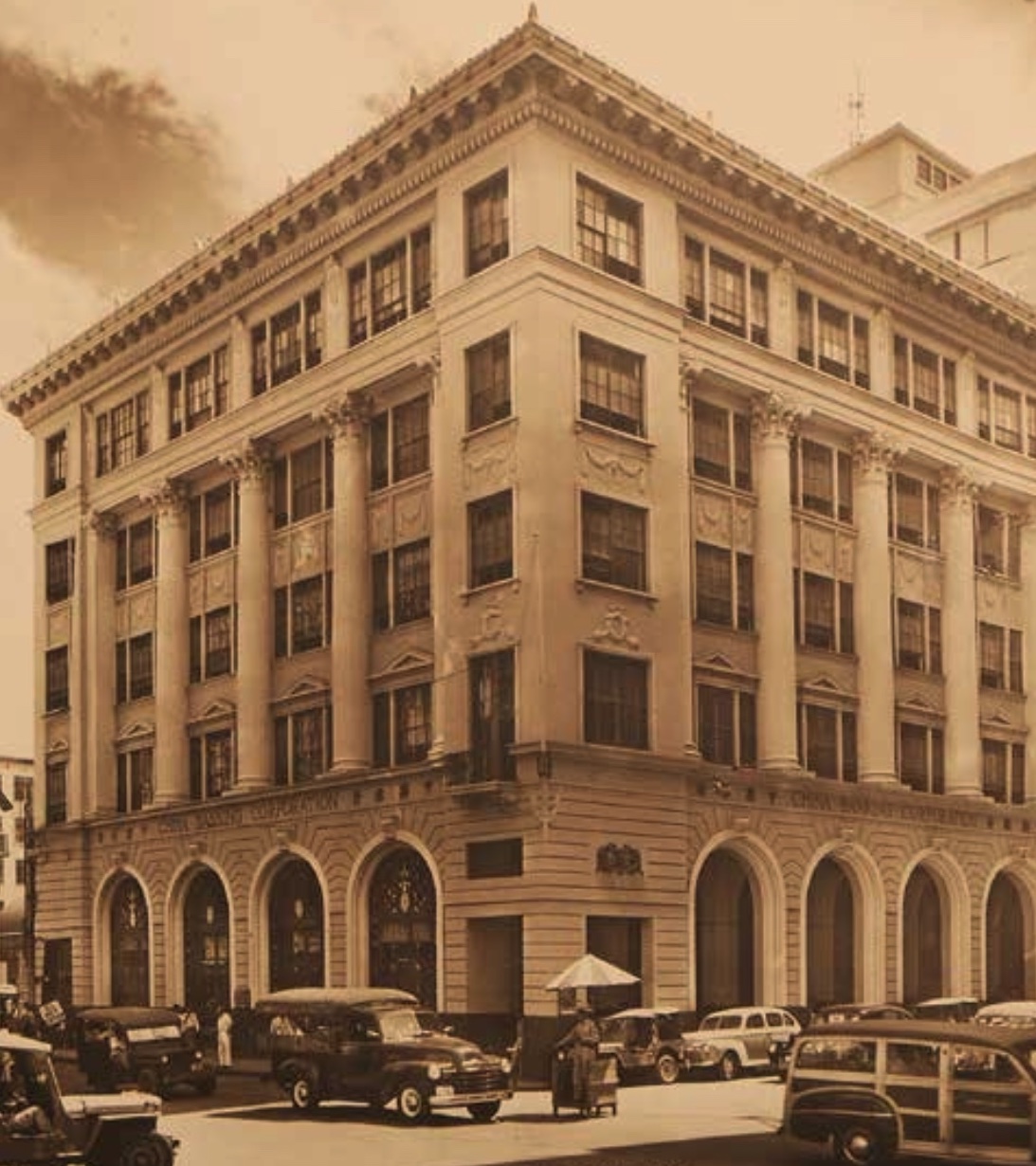
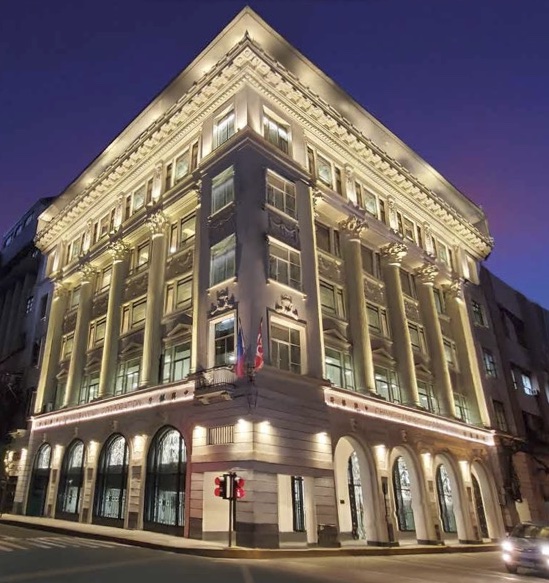
The bank is none other than China Bank, which set up shop in 1920 in the same general neighborhood—at No. 90 Calle Rosario (now Quintin Paredes St.). It didn’t take too long before the bank realized that it needed more space for its growing business, and by 1924, it had moved into its newly built, five-story (later extended to seven) building at the corner of Juan Luna and Dasmariñas streets. It had been designed by the German architect Arthur Julius Niclaus Gabler Gumbert in the Neoclassical style then in vogue, with Beaux-Arts touches. Later known as the Binondo Business Center, the building served as the bank’s head office until 1969, when China Bank moved its key operations to Makati.

No one could have walked up to that building pre-war and remained unimpressed. It was the physical manifestation of China Bank’s high ambitions, but grounded in the realities and challenges of operating in an environment that in some ways remained suspicious of if not hostile to Chinese businessmen. The young visionary Dee C. Chuan, already a lumber magnate in his twenties, was quoted to have said around 1911 that “Many Chinese known by their countrymen to be worth half a million pesos are unable to get credit from the present banks.” 

The answer was to form China Bank, with the help of such highly respected co-founders as Guillermo Cu Unjieng, Carlos Palanca, and Albino SyCip; it was to be a bank that would combine Eastern values with Western banking know-how and cater to the underserved community of Chinese businessmen and entrepreneurs in the Philippines, many of whom would move on to be become taipans in their own right. And from early on, through the Depression and the Second World War, the bank relied on its close relationship with its clients—among whom xinyong or word of honor was paramountly important—to retain their business, paying off its obligations even when other banks had defaulted on theirs. A century later, China Bank has moved far beyond its Chinese-Filipino niche market to serve a much broader public, achieving its target milestones of P1 trillion in assets and P100 billion in capital by the end of 2020. 

But the bank didn’t want to celebrate its centennial just by counting its money. According to China Bank SVP and Centennial Committee chairman Alex C. Escucha, as early as 2016, the bank’s leadership under its chairman Hans Sy had already decided that the restoration of the old Binondo headquarters would be the centerpiece of their centennial. 

Not only would the building undergo a thorough and historically authentic renovation led by Architect Manuel Noche, former secretary of the Heritage Conservation Society; a bank museum would also be built, curated by Marian Pastor Roces, for the public to appreciate the business and culture of banking through memorabilia, art, and mementoes. Sonia Olivares Santiago & Associates and Maja Olivares-Co would work on the contemporary design aspects of the Binondo branch. This was realized last December 21 with the unveiling of two historical markers for the restored Binondo Heritage Center and the China Bank Museum by the National Museum and the National Historical Commission of the Philippines.

The bank also published a comprehensive coffee table book, 100 Years of Trust: The China Bank Story, a substantially new version of its 90th-anniversary book written by the late Raul Rodrigo, updated by his wife Nancy Pe Rodrigo; edited by me, with the invaluable assistance of Alex Escucha (the bank’s encyclopedic institutional memory), Ann Ducanes, and Hershey Villegas, among others; and handsomely designed and produced by Perez NuMedia. 

But it’s the Binondo Heritage and Restoration Project that the general public will likely appreciate the most, because it visibly connects past with present and shows the way forward for institutions with similar forms of heritage to protect. At a time when cultural treasures and landmarks are being demolished wholesale to make way for new malls and condos, China Bank proves that history can be a continuing concern (in all its decades of operation, the Binondo office never stopped being a bank). What’s needed is vision and commitment, which China Bank Chairman Hans Sy and President William Whang have proven to have in abundance.

Penman No. 430: Rizal’s Typewriter

Penman for Monday, December 20, 2021

NOW THAT I have your attention, let me backtrack quickly and clarify that title: I’m talking about a typewriter that Jose Rizal or the Katipunan could have used, had they been tech-savvy enough and infected with 19th-century FOMO.

Early this month, a box I had been eagerly awaiting arrived from England, where I had found the machine on—where else?—eBay, selling for a reasonable price (“reasonable,” that is, to oddball collectors like me). Inside the box was a wooden case, visibly old, with a latch on each side. I undid both latches and the case opened to reveal what I expected to see: “an antique Blickensderfer No. 5 typewriter with spare typewheel in original oak case,” according to the ad I saw. But the first thing that struck me wasn’t the machine itself—it was the fragrance of oak, still embedded in the wood after more than a century.

Why did I even want the Blick, as the typewriter invented by the American George Canfield Blickensderfer came to be known? By the time the first Blick was patented in 1891, the typewriter had been on the market for about 17 years (many prototypes preceded the Sholes and Glidden, but were never mass-produced, except for the sci-fi-worthy Hansen Writing Ball, ca. 1870). But most were big and bulky, and—surprise—wrote on the other side of the typist, who couldn’t see what he or she was typing. 

The Blick No. 5 was the first typewriter that could truly be called a portable, with a keyboard and a front-facing platen or paper roller, much like its modern counterpart. Think of it as the MacBook Air of its time. It looked like an insect with a big head and spindly legs, and even more strikingly, it employed what its inventor called the “scientific” DHIATENSOR keyboard—those bottom-row letters supposedly figuring in 85 percent of the words in English. QWERTY had already established itself as the standard layout early on, and later Blicks would use it, but I preferred the quirkiness of DHIATENSOR.

The Blick No. 5 was given its public debut at the 1893 at the World’s Columbian Exposition in Chicago, a monumental event meant to showcase such novelties as a moving walkway, AC electricity, and the Ferris wheel. The small, lightweight typewriter became a hit, helped along by the fact that it sold at a third of the 100 dollars that most other typewriters cost at the time.

So I wanted one in my collection for historical purposes; prior to this, my earliest machine was a larger and grander-looking Hammond 12 from around 1905. That Hammond got to me, also in its original wooden case and all the way from Ohio, luckily in one piece. 

That’s the trouble with collecting any machine with scores of tiny parts a hundred years old—iron corrodes, rubber shrinks, wood warps, paint fades; screws come off, joints get fused solid, whole sections vanish, and often all you have left is a rusty lump of metal better tossed into the garbage. 

Most Blicks and other old typewriters you can find on eBay will manifest at least a few of these problems. Missing parts—obscure and ancient—can be hard to find; thankfully a global network of typewriter enthusiasts exists to offer help and advice online. Reviving a machine with frozen typebars is another major chore; but again expert repairmen still remain to come to the rescue. (Among them is our own Quiapo-based Gerald Cha, whom I’ve written about, through whose hands all my machines pass for the requisite CLA—cleaning, lubrication, and adjustment.) Shipping is yet another potentially harrowing complication—fragile, valuable, and irreplaceable machines can be turned into scrap with one drop of a poorly padded box.

It was a miracle that the Blickensderfer turned up at my doorstep whole, complete, and needing just a bit of lubrication. When Gerald typed out its first few letters in script, it was as though a mute singer had found her voice after a century.

But one more ritual had to be performed: dating the machine to the year it was manufactured (mine was an English model, made in America but sold out of Newcastle-on-Tyne). For this, typewriter collectors have an online resource to fall back on: typewriterdatabase.com, which has been painstakingly crowdsourcing and cataloguing the serial numbers of hundreds of brands of typewriters. I first had to locate the number on my Blick; it was there on the upper right of the bottom of the frame—68403. A quick check yielded the year it was made: 1896. More than liking the Blick, I now stood in awe of it.

I’d like to fantasize that some of these machines made their way to Manila and figured, somehow or other, in the Revolution, although I do have to admit that the standard image of Rizal poised to write “Mi Ultimo Adios” with a quill pen in hand is much more appealing than him pecking away at a keyboard. 

(Image from joserizal.com)

I asked Ambeth Ocampo about it, and he said that while he hadn’t come across any connection between Rizal and a typewriter, our hero surely would have encountered it in his many travels abroad. Rio Almario seems to recall having seen a copy of the Katipunan’s Kartilya in typescript, but we can’t be certain when that was made. With the Americans came the Remingtons—and it’s no small coincidence that the same company made the firearms that subdued us and the typewriters we began writing in English on. I can only stare at my Blickensderfer No. 5 and wonder what stories sailed across its paper horizon.

Penman No. 428: Wenchworld

Penman for Monday, November 22, 2021

OKAY, SO The X-Files assured us “The truth is out there,” CSI showered us with “epithelials” and impressed “blunt force trauma” into our noggins, Narcos made it cool to be a “patron,” and The Blacklist (or what I’ve seen of this nine-season, 178-episode epic so far) keeps sending us back to the “post office” or some other “black site.” K-drama, on the other hand, will forever be memorable to me for its wanton use of the word “wench.”

I’m not confessing that I’m a K-drama addict—for that, you can indict my wife Beng, who also happens to be my bedmate, which means that whatever she watches, so must I. Vicariously, therefore, I have learned that it is possible in the K-Universe to go back and forth between North and South Korea by parachute or tunnel, and even to go back and forth between Joseon and the present by holding on to a pretty girl and falling over; that a family’s most precious heirloom, on which everyone’s happiness depends, can be its secret kimchi recipe; that tall and tiny hats maketh the man; that Korean mafiosi travel with at least 300 OOTDs, to be worn just once—plus, of course, someone to keep them immaculately pressed; and that kissing in the rain is better than kissing under energy-saving light bulbs.

But most of all, the K-Universe is peopled by men (half of whom seem to be “unfilial sons”) and women (the younger half of whom are “saucy wenches”). It’s the “wench” part that gets me, because it’s a word I haven’t heard since I was slogging through my grad-school classes in Elizabethan Drama more than thirty years ago. 

Most famously, of course, in Shakespeare’s The Taming of the Shrew, Petruchio woos the intemperate Katherine: “Why, there’s a wench! Come on, and kiss me, Kate!” From Love’s Labours Lost, we get “The tongues of mocking wenches are as keen / As is the razor’s edge invisible.” The word is all over English in the 1500s and 1600s, embedded in Shakespeare and his contemporaries; Christopher Marlowe, in The Jew of Malta, has his character Barabas trying to brush away his sinful past when he is accused of fornication: “But that was in another country, and besides the wench is dead.”)

While we’re in this sort-of-scholarly mode, let’s look up “wench” to see what it was supposed to mean then. Etymonline.com gives us this block of information: 

“Late 13c., wenche ’girl, young woman,’ especially if unmarried, also ‘female infant,’ shortened from wenchel ’child,’ also in Middle English ‘girl, maiden,’ from Old English wencel, probably related to wancol ’unsteady, fickle, weak,’ from Proto-Germanic *wankila- (source also of Old Norse vakr’child, weak person,’ Old High German wanchal ’fickle’), from PIE *weng- ’to bend, curve’…. The wenche is nat dead, but slepith. [Wyclif, Matthew ix.24, c. 1380]. In Middle English occasionally with disparaging suggestion, and secondary sense of ‘concubine, strumpet’ is attested by mid-14c. Also ‘serving-maid, bondwoman, young woman of a humble class’ (late 14c.), a sense retained in the 19c. U.S. South in reference to slave women of any age. In Shakespeare’s day a female flax-worker could be a flax-wenchflax-wife, or flax-woman.”

Perhaps more helpfully, vocabulary.com tells us that “Wench used to mean young girl, so if you find someone describing a lovely wench in Shakespeare, it means a lovely girl. Wench comes from Middle English, and was a common word for girl, child, or servant. Over time it came to mean mainly serving girls, as in a bar wench, who serves drinks at a tavern. Eventually it came to mean prostitute. If you find wench in a love poem from the 16th century, think of it as an informal version of maiden. But if someone called you a wench last week, you should be insulted.”

Now, in the K-Universe, the use of “wench” transcends centuries, being equally useful in the period of the Three Kingdoms as it was under the Joseon dynasty, under Japanese annexation, and after the Korean War. (At a certain point, when you’ve watched hundreds of hours of K-drama—only because your wife is watching, mind you—you become something of an expert on Korean history, politics, and culture. I’ve even developed a taste for japchae, which I like to think of as Korean sotanghon.) It’s entirely possible for a Gangnam goon to call a confederate on his Samsung phone to say “Get rid of that insufferable wench!”

All that is probably because the Official Association of K-Drama Translators, at a crucial conference in Jeju, sat down to take up the word nyeon (“a term that refers to a female person in a degrading/derogatory manner”), with partisans debating fiercely between “bitch” and “whore.” The argument entered its second day, with tempers flaring and steel chopsticks dangerously stabbing the air, until the revered Dr. Sung Hyun-Lee, a fruit grocer by day and Confucian scholar and acupuncturist by night, woke up from his soju-assisted meditation and proposed the word “wench.” He had come across the word while watching Pirates of the Caribbean, and thought it perfect to describe a passing ship in the night.

Since all K-drama heroines can be wenches (as long as they have doe eyes, porcelain skin, and wispy hair—but wait, doesn’t that sound like all K-boys as well?), “wench” seems to have lost its pay-for-play connotations on Netflix, and now simply means “any pretty and young Korean woman who attracts and then annoys a nasty man—a cruel Joseon prince, a North Korean general, or a Seoul crime boss.” Problem solved.

The Real Subversion

(Image from The Washington Post)

A Statement by UP Professors Emeriti on the Banning of “Subversive” Books

November 11, 2021

WE, PROFESSORS Emeriti at the University of the Philippines, express our strongest support for the University Council of UP Diliman in its protest against the recent memorandum issued by the Commission on Higher Education in the Cordillera Administrative Region urging libraries in that region to remove “subversive” books and materials from their collections. 

Far from being of tangential concern to us in UP, this memorandum is an assault on academic freedom in all Philippine universities, as it sets the stage for further and possibly even more repressive measures in schools across the country. Any threat to academic freedom in any Philippine school or university is a threat to the whole system and has to be confronted instantly and squarely, regardless of whether individual institutions choose to deny the threat or to acquiesce to it. While the memorandum seems to present the removal of “subversive” books as non-compulsory, we all know how such directives, in the culture of our bureaucracy, can have coercive and chilling effects. 

We are appalled by the CHED Chairman’s subsequent statement describing the compliance of some state universities with the CHED memorandum as an “exercise of their academic freedom.” This is disingenuous if not perverse. Academic freedom is neither exercised nor asserted by submitting to its suppression. It is not the bureaucratic freedom of corporate bodies to do as they wish. It does not mean that academic leaders can invoke the principle as a personal right of administrators to define and delimit the intellectual endeavors of their entire constituencies. It is a transcendent principle that implies preserving sources of history and ideas for present and future scholars, even if these are currently unfashionable or politically incorrect. Its enshrinement in our Constitution prevents the State or other institutional bodies from restricting the rights of academics and limiting them in their intellectual pursuits.

The CHED Chairman also decries UP Diliman’s response to the CHED memorandum as a form of “disrespect” toward other institutions. But indeed the greater disrespect manifest here is that of the fundamental and constitutionally protected right of all Philippine institutions of higher learning to academic freedom. This is the real subversion taking place—the takeover of academic administrations and governance by political appointees more intent on executing some external agenda than performing their duty to defend academic freedom and excellence against all incursions.

Many of us still recall the darkest days of martial law, when our campuses and offices were raided by soldiers in search of “subversive” books. Professors and students were imprisoned for their beliefs, and books were burned for their content. Never again should the military or the government itself determine which books we can read and teach. Never should academic freedom be compromised in the name of national security. 

Again we must emphasize that academic freedom is prerequisite to academic excellence, which cannot prosper under conditions of political repression or oversight. As repositories of knowledge, university libraries must remain open to all books, so their ideas can be critiqued and contested in the classroom and laboratory, in the crucible of truth and reason. To ban books is to promote ignorance and intellectual servility, and to condone its practice is to betray one’s sacred calling as a producer and propagator of knowledge. 

We call on the CHED to revoke this ill-conceived memorandum and on our Board of Regents and university administrators to resist any efforts from within and outside UP to curtail academic freedom. We reaffirm the primacy of the faculty in all matters of academic policy and practice, of which our libraries are an integral part. To defend books and libraries is to defend democracy itself, whose strength derives from a diversity of ideas and beliefs. To that end, we recommit ourselves, and urge our colleagues in active service to do as well.

Signed:

Gemino H. Abad

Jasmin Acuña

Florian Alburo

Virgilio S. Almario

Violeta Bautista

Apolonio Chua

Ma. Cecilia Gastardo-Conaco

Gisela Concepcion

Lourdes J. Cruz

Virginia Cuevas

Jose Dalisay

Randolf S. David

Emmanuel S. de Dios

Ma. Serena Diokno

Erlinda Echanis

Cecilia Florencio

Cristina P. Hidalgo

Angelito Manalili

Ma. Lourdes San Diego-McGlone

Manolo G. Mena

Evelyn Mae Mendoza

Flora Elena Mirano

Solita Monsod 

Francisco Nemenzo

Epictetus Patalinghug

Ernesto Pernia

Rafael Rodriguez

Emerlinda R. Roman

Ramon Santos

Gerardo P. Sicat

Guillermo Tabios III

Michael L. Tan

Nicanor G. Tiongson

Amaryllis Torres

Lina Valcarcel

Corazon Villareal

Roy Ybañez

Rosario T. Yu

Penman No. 427: Lights and Loudspeakers

Penman for Monday, November 8, 2021

THE ELECTION season is upon us, and for Pinoys for whom Christmas begins in September, November 15 can’t come soon enough to start figuring out who they’ll be voting for on May 9, a full half-year down the road. That date should really have been October 8, the official deadline for the filing of candidacies, but given our penchant to further complicate the already-complicated, we just had to set the stage for the last-minute substitution dramas we expect to happen by next Monday.

What couldn’t wait for November 15 or even October 8 was the onset of the propaganda war—the long series of campaigns and battles for our hearts and minds, with the prize being the right to seat someone you think you know and who thinks they know you in the Palace by the Pasig. And if there’s anything we can depend on to display Pinoy character and creativity at their best and worst, it will be a political exercise like a presidential election, during which people who had been largely content with watching telenovelas, munching sweet corn, playing pusoy, and sharing some kakanin with the neighbors suddenly rediscover their convictions, prejudices, longings, and peeves, and jump onto one bandwagon or another, many with knives drawn. (Of course, there are others who had been suffering in silence and gritting their teeth for the past five years, just waiting for the trumpet to sound from the top of the hill.) 

As a boy in the 1960s whose father kept getting roped into some politico’s campaign, I reveled in the hoopla that heralded every election. The contending parties held rallies in the plaza or the bukid (depending, I guess, on whose side the incumbent mayor was), and places more often attended by dog poo and carabao dung were transformed into one-night circuses. 

The stages were festooned with banderitas, and the lights and loudspeakers promised an evening of entertainment, at least from the movie stars, singers, and comedians whom the people really came for, before the real jokers running for congressman or mayor came onstage. Bands played as pickpockets worked the crowd. They gave away fans, hats, key fobs, stickers, and anything they could stamp a candidate’s face on, and if you were lucky you got a T-shirt—flimsy as hell and reeking of paint thinner or whatever it was they used for silkscreening. I’m sure some folks got more than that, but being too young to vote, I missed out on the serious stuff backstage.

The speeches were loud and bombastic, and you stood in rapt attention, feeling like a droplet in a huge surging wave about to engulf the nation. (Decades later, someone would call this “astroturfing.”) One particularly artful speaker might weave a tale of woe, of how the people had only themselves to blame for all the misery they had sunk into, because they had cast their lot with the other party in the previous election. (Decades later, someone would call this “gaslighting.”) Every candidate promised the moon, the stars, and a galaxy or two of blessings dependent on his or her election: more artesian wells, more puericulture centers, free dental clinics, free coffins, and a lechon for every barrio’s fiesta (loud applause). At some point, some bags of rice and boxes of milk might even go around, the word “RELIEF” overstamped with its new donor’s name.

No self-respecting campaign today would not claim a party color or motif—pink, white, blue, checkered, etc. (What was that? Pink as well? Maybe I should have said “No self-respecting campaign today would claim another party’s color.”) Back in the day, this didn’t seem to be a big deal. The Nacionalista Party’s colors were red, white, and blue, while the Liberal Party’s colors were—well, red, white, and blue. At least, if you were a Liberal today and a Nacionalista tomorrow, which sometimes happened, you didn’t have to change your wardrobe or your paraphernalia.

Neither do I recall proprietary hand signs then, like the Cory-Laban “L” that helped to overthrow her predecessor, and FVR’s jaunty thumbs-up. Ferdinand Marcos flashed the “V” sign, but that had been around for ages, and is now more widely associated with young girls in white socks trying to look their cutest for the camera. I suppose it stands for “victory,” although the “V” word that springs to mind most quickly when I hear that particular name is “vaults.” (Is there such a word as “villions,” like a billion billions?) Mayor Isko has appropriated the “No. 1” sign, with the forefinger pointing up, as if to suggest he has nowhere else to go. (That other mayor who became President, which must inspire Isko, prefers raising the next finger.) 

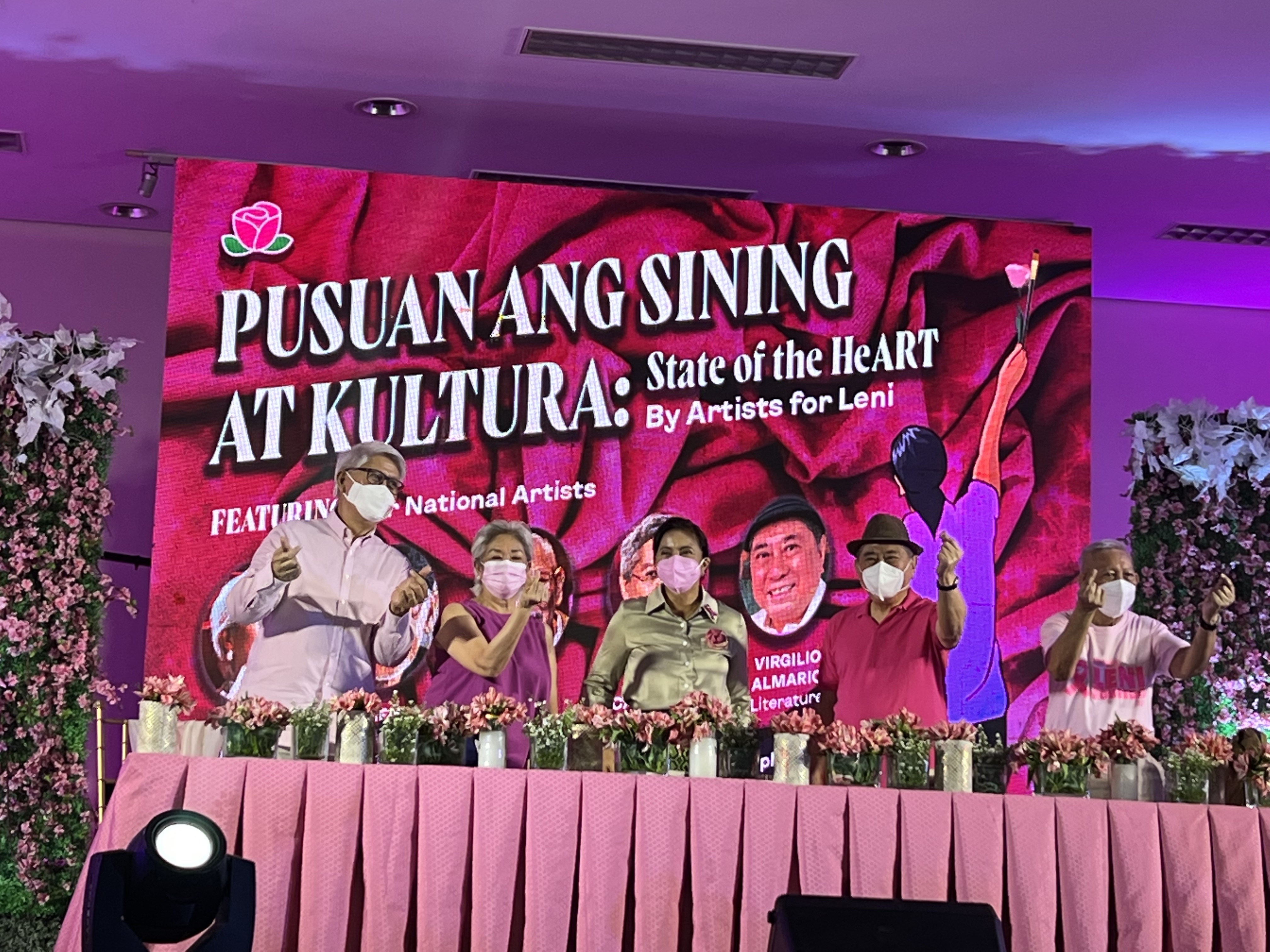
Frankly Leni’s hand sign remains a bit of a mystery to me, and I haven’t seen one from the boxer and the police general. At any rate I doubt this election will be won with carpal contortions. After all, there are only so many things you can do with your fingers, and the Vulcan “Live long and prosper” hand salute is difficult enough to master.

The fight, as everyone says, has gone to the Internet and the airwaves, and while we may like to believe that everything has changed in half a century, the very players on the field tell us they haven’t—only the lights and the loudspeakers have. So now, as ever, truth, reason, and justice will remain the underdogs, and those who root and clap for the jokers will end up getting their pockets picked.

(Photo from asiatimes.com)

The President We Deserve

I GREW up a Marcos believer.

He was the guest of honor at my grade school graduation in 1966. Newly elected, he looked every inch the hero he said he was—handsome, dashing, gifted with a golden tongue. Watching him I thought that a President was a great man, greater than all of us.

Just seven years later, I spent most of my 19th year in martial-law prison. I was there because the President I admired as a child had lied to me. He said he wanted to make the Philippines great again. Instead he acquired more power and more wealth, for which he stole from both the rich and poor, and punished those who opposed him. 

That included young students like me. They called us “radicals” and put many of us in prison, and many of my friends suffered horrible deaths. Sadly, many more Filipinos didn’t care. Happy to see new roads, they did not know that billions that should have gone to their food, housing, and education went to secret bank accounts abroad.

I was at EDSA when Marcos left, and I was overjoyed that a good and honest woman would now bring change. But even Cory couldn’t do it alone. The system was too strong. Many Presidents followed Cory, some better than others, but the lust for wealth and power did not leave with Marcos. And instead of being remembered as the man who destroyed Philippine democracy, Marcos became a model for some of his successors, who not only buried him as a hero but who now want to resurrect him in his son.

When VP Leni Robredo offered herself for the presidency and said “Mas radikal ang magmahal,” I had to think long and hard about what she meant, and what kind of difference she would make in our lives and futures. Was she asking us, like Jesus, to love our enemies? After all the evil—the corruption, the oppression, and the despotism—we have been through, could we find it in ourselves to love those who clearly do not love us?

And then I remembered what another visionary, Martin Luther King, preached on the same subject. He said: “In the final analysis, love is not this sentimental something that we talk about. Love is creative, understanding goodwill for all men. It is the refusal to defeat any individual. When you rise to the level of love, of its great beauty and power, you seek only to defeat evil systems.”

And that’s when it struck me that the real enemy is not people, but the “evil systems” that have created and supported the Marcoses among us. It is not one man or family we must vote against, but what they represent.

The easy temptation is to focus on personalities and their shortcomings. The harder option is to fight for the good and the positive.

These are the values and ideals that many of our national leaders, by their speech and behavior, have forsaken over the past five years. These are what VP Leni reminds us are worth loving and living for. And in today’s environment of violence, fear, and falsehood, to love them is to be radical indeed:

God. Country. Freedom. Justice. Peace. Truth. Life. Beauty.

Big words, they take big hearts and minds to accommodate. If I can find that largeness in me, then I can be a radical again, and instead of imprisoning us, our new President will free us from our past to become the nation we aspire to be. And that President—the President we deserve—can only be as great as we ourselves can be.

(Photos from ph.news and the Friedrich Naumann Foundation.)

Penman No. 426: A Provinciano Comes Home

Penman for Monday, October 25, 2021

THIS THURSDAY, October 28, a small and socially-distanced book launch will be held at the Development Bank of the Philippines in Makati to honor one of the DBP’s guiding lights, and one of the most distinguished and accomplished economists and diplomats of his time. I was privileged to have been asked to write this book, titled O, Ilaw: The Life and Legacy of Leonides S. Virata, by the late Leo’s son Luis Juan or Buboy, himself a highly successful businessman.

Few people below 65 will remember Leo Virata now, which was one reason why the book, published by the Cavite Historical Society, was written. For Buboy, it was to make sure that his children and grandchildren will know his father the way he did, and to introduce Leo to a new generation of Filipinos now sadly too used to seeing government officials and businessmen as crooks. 

Leo Virata was, in various phases of his life, both a public servant and a pillar of the business community. Born in Imus, Cavite in 1918 to the family that bred his eldest brother Enrique and Enrique’s son Cesar, Leo was an academic standout from grade school to college, graduating cum laude in Business Administration from the University of the Philippines before being sent on to Harvard, the University of Chicago, and Northwestern University for graduate studies. Caught by the war in the US, Leo then became Gen. Carlos P. Romulo’s indispensable aide, all the way to the United Nations. 

He returned to the Philippines after the war to set up the research department at the new Central Bank, a convergence point for the best and brightest young economic minds of the time, including Horacio Lava, Benito Legarda Jr., and Sixto K. Roxas. He then moved to Philam Life in 1952 as financial vice-president and vice-chairman of its investment committee, spearheading the company’s support for vital economic projects, including Filoil, Far East Bank, Bacnotan Cement, and Manila Doctors Hospital, among others. 

After almost two decades in the private sector, Leo was taken in by President Marcos in 1969 as Secretary of Commerce and Industry, before being appointed chairman of the DBP in 1970. The bank was then saddled by bad loans, but Leo cleaned up the mess as best he could and reoriented the bank to support countryside development. Tragically, he died in 1976 aged only 58 of lung cancer, and was universally mourned for his brilliance, his dedication to public service, and his integrity (when he took over the DBP, he explicitly ordered his relatives not to visit him at his office).

When Buboy asked me to write his father’s biography a few years ago, I had heard of the name but knew very little of the man himself, and immediately I realized how difficult it would be to reanimate the character of a subject who had been gone for over 40 years. Almost always, in my previous assignments, I had had the luxury of working with subjects who were still very much alive and blessed with elephantine memories (as Wash SyCip was) or had roomfuls of catalogued materials gathered over the decades waiting to be sorted out (as Ed Angara did). Family members are a great resource, and Buboy and his wife Libet gave me all the help they could, but sadly Leo’s wife Bebe Lammoglia Virata—a renowned art collector—and Buboy’s sister Vanna had passed on. 

Thankfully, some luminaries whom Leo mentored or influenced were still around—among them, the journalist Jake Macasaet, and businessmen and public officials such as Manny Zamora, Louie Villafuerte, Cesar Zalamea, Titoy Pardo, and Johnny Litton—from whom I was able to get the most interesting vignettes about Leo and his times. (Among other things, Leo did not let his relationship with Marcos intrude into his decisions, and could say no to the man; the Viratas had lost land to the Marcoses, recovered only after EDSA.)

Writing a biography requires more than fleshing out someone’s Wikipedia entry. I always remind my clients that I’m a novelist rather than a professional historian, so my interest lies in capturing a character inside and out, trusting the story to reveal the subject’s strengths and weaknesses without having to editorialize on his or her behalf.

My writing stalled for about a year as I struggled to fill in gaps about Leo’s professional and personal life. Impossible as it seemed, I wanted to hear the man himself; Leo was a prodigious speaker and crowd-pleaser (the title of the book adverts to his favorite kundiman, which he would sing at the drop of a hat). I got a terrific break when Buboy unearthed two scrapbooks bulging with Leo’s memorabilia and notes from his years in the US, as a student and as CPR’s right-hand man. Finally, in this collection of postcards, concert tickets, restaurant menus, and such ephemera—alongside his correspondence with CPR—the person emerged, standing on the verge of an outstanding career, finding his footing in a world wracked by war, thousands of miles away from the groves of Imus.

Despite having traveled the world and having married an Italian mestiza, Leo remained a provinciano at heart. When Leo died, hundreds of townsfolk and schoolchildren lined the road leading to his grave in his hometown, which considered him a hero. I wonder how many of our leaders today will deserve that kind of farewell.