Penman for Sunday, September 20, 2026
IT ISN’T every day that a certified celebrity comes up to shake your hand and to introduce herself to you as your fan—especially when it’s really the other way around. Here’s someone you’ve admired from a distance all your life, maybe even had a schoolboy crush on, and now here she is, taking your hands in hers like an old friend.
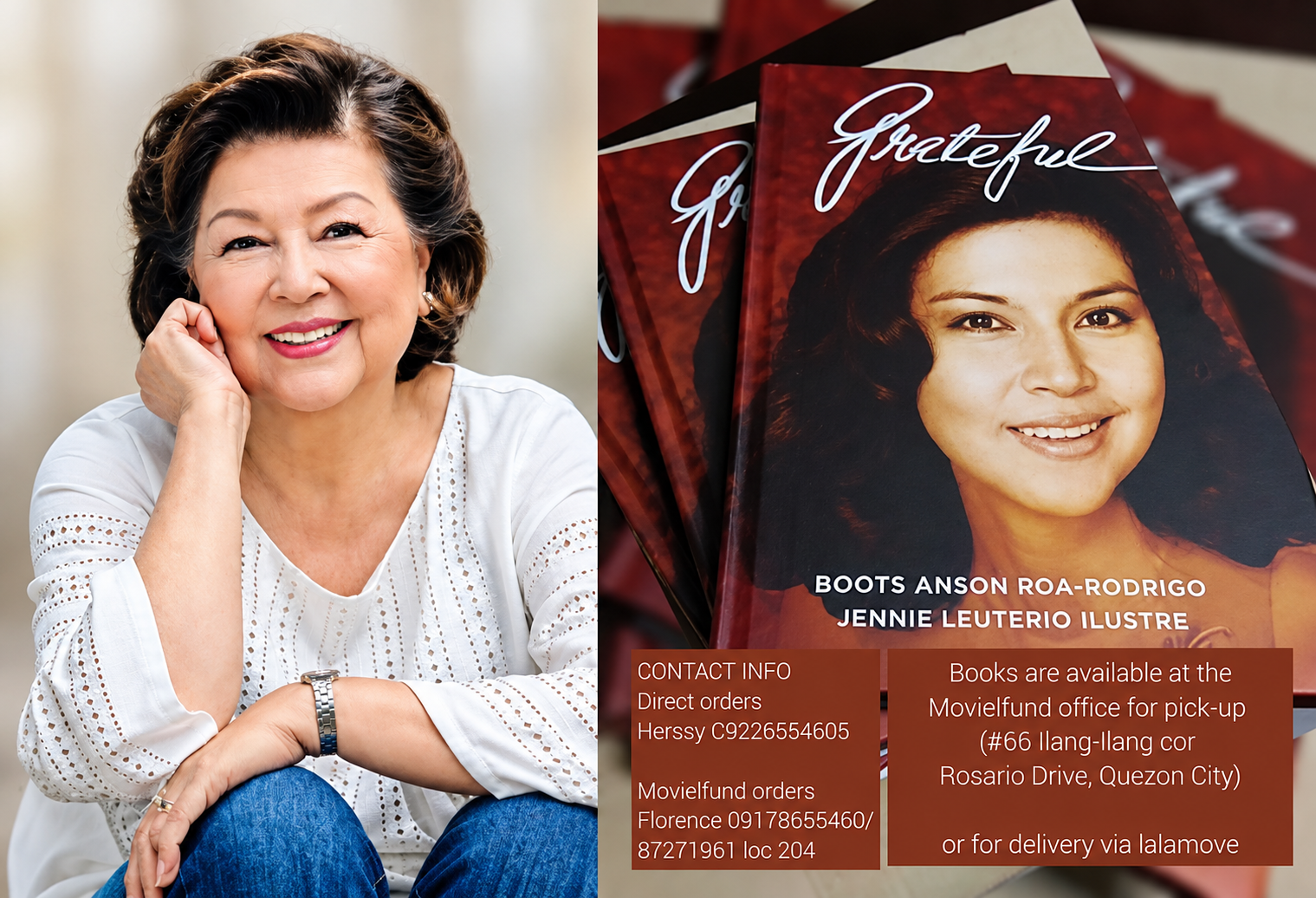
This happened last week at the Manila International Book Fair at SMX, where I was signing books for Anvil Publishing among others, and the surprise visitor to my table was none other than Boots Anson-Roa (now Rodrigo)—the actress, radio-TV host, humanitarian, and public servant—who, as it turned out, was also an Anvil author and who was also signing her newly minted biography titled Grateful, co-authored by Jennie Leuterio Ilustre.
Intrigued, I secured a copy of the book, and soon found myself drawn into the engaging story of a life well-lived, despite the inevitable dips and turns that come with surviving so many tumultuous decades. I recalled my own unpublished biography of another great Filipino actress, the late Rosa Rosal, whose vampish roles tended to be the complete opposite of Boots’ motherly persona, and whose real-life drama outclassed anything she portrayed onscreen—two very different images, and yet two women bonded by the same deeply held traditional values and by their devotion to family and public service.
Maria Elisa Cristobal Anson was born on January 30, 1945 ,just days before the Battle of Manila began, to Oscar Anson (later the actor Oscar Moreno, the “Robert Taylor of the Philippines) and Belen Cristobal, a pharmacy board topnotcher and chemistry teacher, who met and fell in love amidst the turmoil. Belen became pregnant, and the book reveals that it was only at age 53 that Boots discovered that the couple had considered terminating the pregnancy because of the harshness of the times; instead they decided to marry, making Boots possible. (The “Boots” comes from “Bebot” then “Bot.”)
The young Boots tagged along with her father to his shoots, so pretty that Sampaguita boss “Doc” Perez predicted she would become a star, but she was more interested in watching movies than being in them. She did join theater at the University of the Philippines where she studied English, speech, and drama and served as a corps sponsor, but it was a hosting gig at TV 5’s popular Dance-O-Rama—a slot she twice refused—that finally landed her onscreen.
That choice proved life-changing in another, even more significant way, because this is where the “Roa” in her name comes in, care of Pete Roa, her Dance-O-Rama co-host and reputed ladies’ man, who courted her with flowers plucked from the show’s bouquets and asked her out to post-show dinners “to critique her performance.” The tactics worked. Boots fell for Pete, the two decided to get married, the parents on both sides naturally threw a fit, leaving elopement the only way out. The two snuck out of their show after a commercial break, and managed to get then QC Mayor Norberto Amoranto to marry them on June 5, 1964, followed by a hasty church wedding that same afternoon.
So began a highly visible and celebrated marriage of 43 years that produced four children—Leah, Joey, Chiqui, and Ben. The “Roa” would stick to “Boots Anson” so permanently that even after her second wedding to King Rodrigo in 2014, King would urge her to keep it, to honor that bond.
The Boots Anson-Roa we know comes mostly from her movies—over a hundred of them—and her TV hostings. Her first movie came in 1968, when she was already a wife and mother of two, then highly unusual—indeed unheard of—for a leading lady. It was her role as the governess Carla in Lino Brocka’s landmark 1970 tearjerker Wanted: Perfect Mother that remains embedded in my memory, as in many others’—caring, loving, but also proper and self-sacrificing, an image that probably prompted her daughter Chiqui to call Boots “the quintessential Mama Mary.” Boots received a FAMAS Best Actress nomination for that performance, and she would go on to major roles in such movies as Tatay Na si Erap (named Best Actress along with Vilma Santos), May Minamahal, Mano Po, Blue Moon, Caregiver, and One True Love.
But from her elopement story onwards, Boots would be the first to upend her “Goody Two-Shoes” projection. “I’m not a saint,” she insists—just level-headed, fair, and thoroughly professional, the kind of performer who always shows up on time, delivers, then goes home to family. The book also chronicles her many other roles and jobs, which we know or remember little of: her work with the US Embassy in Washington in the 1980s, with the Population Commission in the 1970s, with the UP-PGH Medical Foundation, with the Philippine Red Cross, and up to now with Mowelfund. She also taught Communication Arts subjects in UP, Ateneo, and La Salle, wrote newspaper columns, and handled radio programs. Always more than a sweet face, she brought substance to the job.
Pete’s passing in 2007 is a poignant highlight. Hit by a stroke in 1997, Pete soldiered on for another decade (I recall being a few beds away from him for physical therapy in the early 2000s at Capitol Med). He later acquired incurable cancer, and facing the inevitable, the family prayed for a peaceful passing, which happened on August 9, 2007, with Boots at his side. Pete had requested a concert instead of a solemn wake, so the industry gathered to pay him tribute. “It was late into the night,” Boots recalls. “All sympathizers and revelers had left what was originally meant to be a quiet chapel. The music was silenced; the animated conversations were stilled; and the laughter was muted. In a rare moment alone with Pete, I did a ‘curtain call’ for his performers. Now allowing that tear to drop, I bid Pete good night until the next morning for his burial. I gleaned a peaceful countenance. I was confident we made him happy. I was glad that, in his repose, he applauded his friends’ command performances. But, tongue-in-cheek, I begged him to spare me his own standing ovation.”
But the book ends with the happy note on which it begins, with Boots’ second marriage to lawyer Francisco “King” Rodrigo Jr., an old family friend and also a widower. For both, it was love the second time around.
Indeed Boots Anson-Roa has much to be grateful for, as her book title suggests. But “graceful,” which she would never immodestly use for herself, seems just as apt for this woman who has led such a long and distinguished life with dignity, verve, and faith. Pleased and honored to shake your hand, and to wish you and King well for the rest of our earthly time!
Email me at jose@dalisay.ph and visit my blog at http://www.penmanila.ph.