Penman No. 474: Looking Back and Letting Go

Penman for Sunday, June 1, 2025

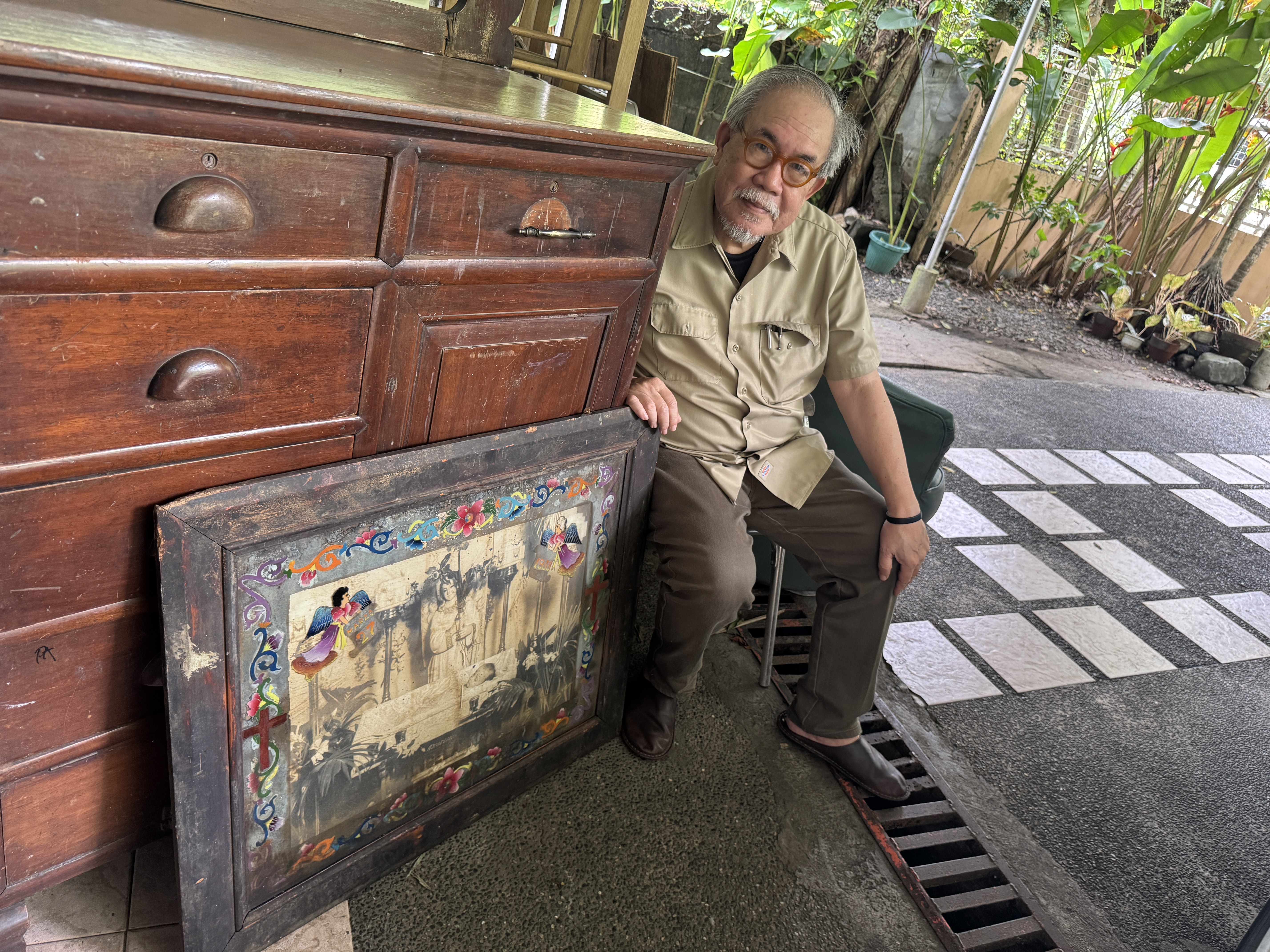
AS ANY friend who’s had the privilege of being invited to his Makati home quickly realizes, Ambeth Ocampo is more than the engaging public intellectual we all know, whose Looking Back series has made history come alive for young Filipinos. He’s also an inveterate collector of rare Filipiniana—books, ephemera, art, and historical objects—all of which come with the territory he works in. 

There have been many Filipinos of a similar bent—the legendary Alfonso Ongpin and the late Ramon Villegas come to mind, as well as the more contemporary Jimmy Laya, Melvin Lam, and Edward de los Santos, among others—but the way Ambeth has amassed his collection is noteworthy on its own, as it folds the personal almost imperceptibly into the professional. 

It comes pretty close to the classic prescription for murder—means, motive, and opportunity—all captured in his classic story of how he stumbled on and picked up Emilio Jacinto’s silver quill, a writing prize, from an antiques dealer who didn’t bother to learn what it was and let it go for its scrap value. (Having as much of Ambeth’s desire for antiquarian junk but with much less knowledge and certainly less means, I’ve often joked, between the two of us, that Ambeth’s the scholar and I’m the scavenger.)

Jacinto’s quill, along with a trove of other historical treasures from Ambeth’s personal collection, will be up for auction on June 7 at Leon Gallery. They include Juan Luna’s silver belt, Felix Resurreccion Hidalgo’s walking stick, an official copy of the Malolos Constitution, Philippine maps from 1616 and 1647, and the Noceda and Sanlucar Vocabulario de la Lengua Tagala from 1860, among many others.

Knowing how precious these objects were, I had to ask Ambeth more about them, and this is what he said.

What made you think of selling these treasures now? Surely it can’t be easy letting go of them after being their caretaker all this time?

Over the years, I have come to the realization that collecting is not the hobby it used to be. As a boy I collected stamps and learned geography, history, and the culture of foreign countries in the process. I was fortunate that my father’s company had an international correspondence, so every week his secretary would send me a batch of envelopes to sort out.

I started collecting Filipiniana books in the 1980s, stocking up from the National Bookstore Quezon Boulevard branch bargain bin where I completed my Nick Joaquin essay collection because they cost one peso each. After school, I went to the Heritage Art Center in Cubao that I learned only years later was the site of the old Philippine Art Gallery. It was a ramshackle grouping of rooms upon added rooms made from old house parts that Mario Alcantara, the owner, bought from mambubulok. I had a favorite nook where I did my homework and when bored I would explore the rooms that I think gave me an eye for art and the ability to choose what I thought was good or not.

Looking back my collecting, and my life, has been the happy intersection of skill and opportunity. Napoleon once said “ability is nothing without opportunity.” I have always seen collecting as a responsibility. Collecting significant Filipiniana is not a hobby. It is not an investment. Collecting is a responsibility, the collector a steward who preserves the collection for the next generation. 

The objects I put at auction have enriched my life in many ways and I think they will enrich the life of their next steward. Some of the lots like the Malolos Republic one-peso banknote and the printed copy of the Malolos Constitution have been tucked away in a drawer. If I drop dead tomorrow these might be carelessly thrown away as trash. They should go where they are better appreciated. Collectors de-accessioning keeps the market alive and buzzing.

Let’s get this out of the way: it’s none of our business, but what will you do with the money?


Since I am not a dealer the material reward does not really factor in the equation. I have sold other things before at cost or even at a loss, just thinking that my gain was the enjoyment I got chasing after them and acquiring them. What will I do with the proceeds? When I started selling my rare Filipiniana I thought that instead of having shelves of books, maybe I should just sell and use the proceeds to buy one or two incunabula or samples of early Philippine printing from 1593-1640. Instead of caring for a whole library I will just care for half a dozen very important books.

How did you start out as a collector of historical objects? How and where did you find them? Aside from Jacinto’s pen, what was your most serendipitous find?

Collecting historical objects came naturally from my work as a historian. I would find things in used bookstores and when supply was still plentiful in the Ermita antique shops. One of the serendipitous finds was the cedula or residence certificate of a certain Julian Felipe, a musician from Cavite. It was in a heap of old papers, initially priced at one hundred pesos. I haggled it down to fifty, paid, and ran away. 

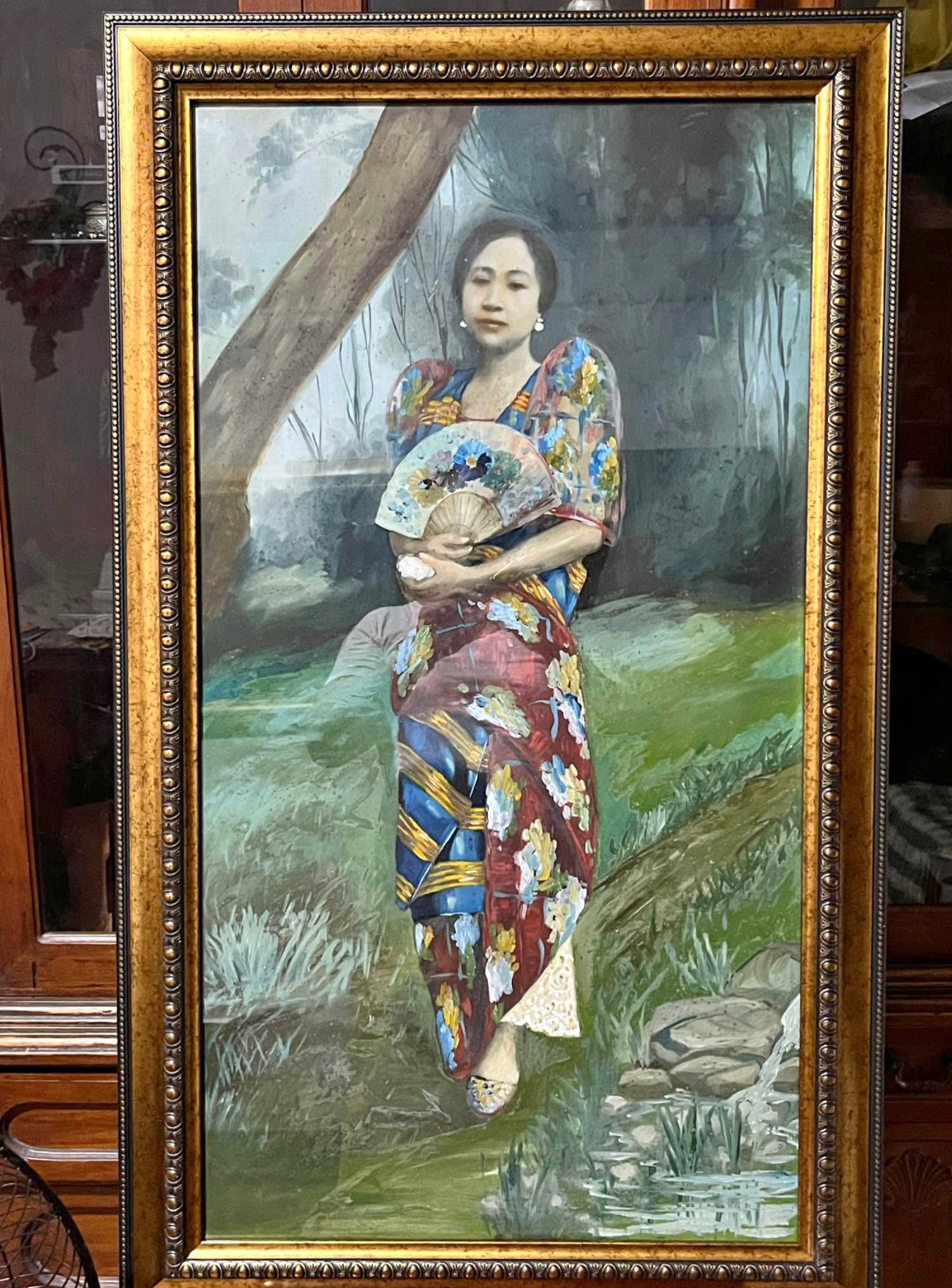
Another time my favorite antique dealer brought a “European painting” of a Virgin and Child to my home. I looked at it and knew it was Philippine. When I opened the frame to inspect the painting, hidden under the frame was the signature of the Filipino master Mariano Asuncion (1802-1855). The silver belt of Juan Luna and the bank draft in his name were acquired from Mario Alcantara. It came with the famous trove of paintings inherited by Grace Luna de San Pedro that are now in the National Museum. While everyone was going wild over the paintings, I spent many afternoons browsing the boxes of memorabilia that included the bloodied uniform Antonio Luna wore when he was assassinated, the palettes and brushes of Juan Luna, the memorabilia, some architectural plans of Andres Luna de San Pedro, and much more. I offered to buy the palettes and brushes and the painter’s smock but Mario said these were destined for the National Museum. There was also the last letter Juan Luna wrote to his son from Hong Kong, written a day before his death, not only was this letter significant, Luna did a watercolor of Hong Kong Harbor on the first page of the double-sided letter. All I could afford was the silver belt that came with Luna’s black suit that Mario said was also destined for the National Museum. Unfortunately, the Heritage Art Center burned down and with it all these memorabilia.

Do you or can you separate the collector from the scholar? Did the collecting happen naturally as a consequence of the scholarship?

The collecting grew and was enriched by my research and scholarship. If I had a PhD in Math I probably would not have recognized these odds and ends now considered treasures. I have been divesting over the years. A large part of my Filipiniana collection was donated to the Center for Kapampangan Studies, Holy Angel, Pampanga. All I keep at home are the books I need for work for teaching, lecturing, and writing, but now that I am retired from Ateneo (but still employed on a post-retirement appointment) it is easier to let go. 

The full catalog of Leon Gallery’s Spectacular Mid-Year auction can be accessed on its website at https://leon-gallery.com

Qwertyman No. 147: Literature Has Many Flags

Qwertyman for Monday, May 26, 2025

IT WILL be a tempest in a teapot to most Filipinos still caught up in the aftermath of the midterm elections, a topic of interest to a limited few, but I’m bringing it up this week because it’s important enough for larger reasons.

The Philippines will be Guest of Honor (GOH) at this October’s Frankfurt Buchmesse (FBM), the world’s oldest and largest book fair. Being GOH means that the Philippines—its literature, culture, history, and politics—will be foregrounded in Frankfurt, through the dozens of writers, thousands of books, and the many exhibits and presentations that will be brought over to the FBM, through the combined efforts of the National Book Development Board (NBDB) and the National Commission for Culture and the Arts (NCCA), among other organizations. 

Much of the groundwork for this initiative, which began well before the pandemic, was laid by Sen. Loren Legarda, the principal advocate of arts and culture in the Senate. GOH status is an honor given every year to a different country, but it doesn’t come free; the project involves hundreds of millions of pesos, which its proponents see as a worthwhile investment in raising the global profile of the Philippines through its culture and expanding the international market for Philippine books and authors. The past two years have seen intensive efforts made by the NBDB and the Philippine GOH Committee to prepare the program, select the delegates, and arrange the logistics for our historic participation in October at the FBM.

Comes now a move, led by some prominent Filipino writers and activists, to boycott the FBM for various reasons, including what some see as the government’s misplaced priorities in funding our GOH participation, but primarily in protest of the FBM’s alleged support for Israel in its war in Gaza, and also of Germany’s complicity as an Israeli ally in that conflict. At the moment, it hasn’t gained much traction, but I wouldn’t be surprised if, in the intervening months between now and October, it gathers some steam—likely not enough to stop us from going, but enough to cause some dismay and dissension within our ranks.

I’m not in favor of this boycott, for reasons I’ll shortly explain, but first, full disclosure: I have been formally invited to attend the FBM as a delegate, and have accepted the invitation; I will be involved in several events—a launch of the new Spanish translation of my second novel Soledad’s Sister, several book readings, and possibly some panel discussions. All my expenses will be answered for. This will be my third (and at my age, likely my last) participation at the Frankfurt book fair, as an author whose books have been translated into Italian, French, German, and Spanish editions. In other words, I have a vested interest in going to Frankfurt. (To those who have never been to the FBM, it is no junket; expect long hours manning the booths, talking to people, selling book rights, and walking kilometers of hallways on the enormous fairgrounds. Frankfurt is not a particularly scenic city, although a side trip to nearby Heidelberg and its Rizal connections will be a welcome break.)

Some readers might find the connection between the FBM and Gaza tenuous and the call for a boycott bewildering, but it does have some basis worth serious consideration. The relationship between Germany and Israel, or the Germans and Jews, is long and complex (highlighted by the Holocaust before Israel even came to be, and the 1972 Munich Olympics massacre, among others), but the immediate trigger for the outcry was the FBM’s controversial cancelation of an awards ceremony for the celebrated Palestinian writer Adana Shibli in the immediate wake of Hamas’ attack on October 7, 2023. 

The outrage is justifiable and widely shared. In this column and other media, I myself have written against Israel’s assault on the Palestinian people (see “The Country I Wanted to Love,” from April 19, 2024), as have many other commentators. Indeed, I know of very few Filipino writers who have cheered the onslaught on—typically those holding orthodox Catholic views upholding Israel as God’s chosen nation. 

Israel’s relentless pounding of Gaza, resulting in the wanton slaughter of innocents, has long outlived its excuse of neutralizing Hamas. It is genocidal butchery by any standard, this calculated starvation of Gaza’s remaining residents, the killing of aid workers, and the mechanical attribution of atrocities to “operational errors.” Netanyahu’s encouragement of Trump’s crass and bizarre proposal to depopulate Gaza so he can turn it into “the Riviera of the Middle East” reveals the utter moral depravity of these two men. 

Israel’s barbarism in its campaign of terror and annihilation has now exceeded Hamas’ own (yes, unlike many protestors, I hold Hamas accountable for its own brutality—something that will surely not endear me to the far Left on this issue). Those of us who study Elizabethan revenge tragedy know this only too well: the line beyond which the revenger no longer seeks justice but mindless retribution, and becomes a horrifying, blood-soaked caricature of the very object it opposes.

The question for us writers is: will any of this be helped by withdrawing our participation from one of the world’s largest (if arguably not freest) exchanges of ideas through books? Will we prevent ourselves at Frankfurt—should the need and opportunity arise—from expressing our opinions on Gaza, among a host of other global issues concerning human rights? (Current German rules restrict financial support to artists seen as anti-Israel, especially those identified with the Boycott, Divest, and Sanctions movement or BDS, among other repressive measures.)

My answer is no. I stand for peace and justice for both the Palestinian and Israeli people—indeed, for all oppressed peoples of the world, including our own. But divesting ourselves of a historic opportunity to express our collective resistance to injustice—not just in Gaza or over this one issue, no matter how pressing, will only be counter-productive. Unless it catches fire (other prominent authors elsewhere, as in Indonesia—which was GOH some years ago—have expressed support), a symbolic boycott will be as deafening and as consequential as a tree falling in the forest.

In the end, this will come down to an individual act of conscience, however one decides, for which we must reserve our respectful acceptance. Whether one goes or stays, one’s reasons or motives have to be clear, so the gesture will not be wasted. I will go to Frankfurt proudly, with neither guilt nor shame, to speak about our people and our struggles for freedom through my books. Engagement, not withdrawal, will be the best service writers can perform for their country and for all oppressed and silenced people everywhere. 

Politicians like to wave one flag—Filipino, American, Israeli, Palestinian. Literature, like all art, has many flags: peace, justice, freedom, equality, truth, love, beauty, and harmony. Let all these fly in Frankfurt.

(Image from Studio Dialogo)

Qwertyman No. 146: A Shift in the Tide

Qwertyman for Monday, May 19, 2025

THE PUNDITS have spoken and all kinds of analyses have been made about the recently concluded midterm elections, with most observers remarking on the surprise victories of Bam Aquino and Francis Pangilinan in the Senate and of Akbayan and ML in the partylist, as well as the steep decline of the hard Left alongside the continuing strength of the pro-Duterte forces. 

Some read the results as a sharp repudiation of the administration, others as a resurgence of the “Pinklawan” moderates, and yet others as just more proof of the Pinoy voter’s kabobohan in keeping the same old names in power. What’s clear is that it was a mixed outcome, giving everyone something to either crow or complain about.

At my favorite poker haunt, where I’ve been playing with a bunch of regulars for nearly twenty years, the table talk inevitably came around to the election results. The people here—mostly young and but with many seniors, mostly men, mostly middle class and urban (you need some money to play poker)—represent for me a good cross-section of our society, perhaps statistically imperfect but more grounded in gritty reality: neither scholars nor ideologues but homeboys coming from both Manila and the far provinces, brought together by nothing grander than chasing after a straight flush and pocket aces.

Maybe to rattle their opponents or to deflect attention from the cards, these guys can talk up a storm about politics. My general strategy is to shut up and smile to keep them guessing; although they know me as a UP professor and could presume on my liberalism, I’ve decided that listening rather than arguing would yield me a truer picture of the Pinoy mind, and protect my hand.

Back in 2022—to my great dismay—that mind was overwhelmingly pro-“Uniteam.” Despite all the information floating out there about Marcosian martial law and Dutertean bloodlust, my fellow pokeristas and even the dealers loudly proclaimed that they were voting for BBM, hushing the few Kakampinks in the room. 

Last week, the atmosphere in the poker place was decidedly different, one of great amazement and relief. There was surprise–but also joy—that Bam and Kiko won. The biggest buzz revolved around Pasig City Mayor Vico Sotto, less over the win that everyone expected than his political future, which everyone agreed should include the Senate and at least the vice presidency, the only concern being his youth (not that he was too young for the job, but for the legal minimum age). No tears were shed over the loss of popular entertainers and media personalities. Not much was said about BBM and VP Sara, who seemed strangely irrelevant, despite the fact that the midterms were effectively a proxy war between them.

Now of course you could say that a gambling den is hardly representative of the Filipino people, but then gamblers are among the most hardboiled cynics you can find, not easily given to idle wonderment. (And then again, poker wouldn’t thrive without foolishly hopeful patsies like me—called “fish”—who go all-in on a pair of deuces, hoping to catch a trio. Remember Anton Chekhov’s description of gamblers as people who “go out for their daily dose of injustice.”) That a shift in the tide seemed to ripple on the surface of these poker faces was encouraging. I suspect that these dehadista sentiments were there all along—but have now been emboldened to surface, and I can see this happening all over the country: it’s okay to hope, to bet on the long shot.

It’s probably a measure of how desperate we’d become, more than anything else, that progressives all over the country are ecstatic to have won two out of 12 seats in the senatorial race, never mind that the other winners were mostly your usual crowd of trapos and Family Feud participants.

After previous wipeouts and defeats that, we were convinced, only massive fraud could have engineered, these signal victories—along with a smattering of other partylist and local wins—have now raised our hopes for a more enlightened electorate and a resurgent opposition.

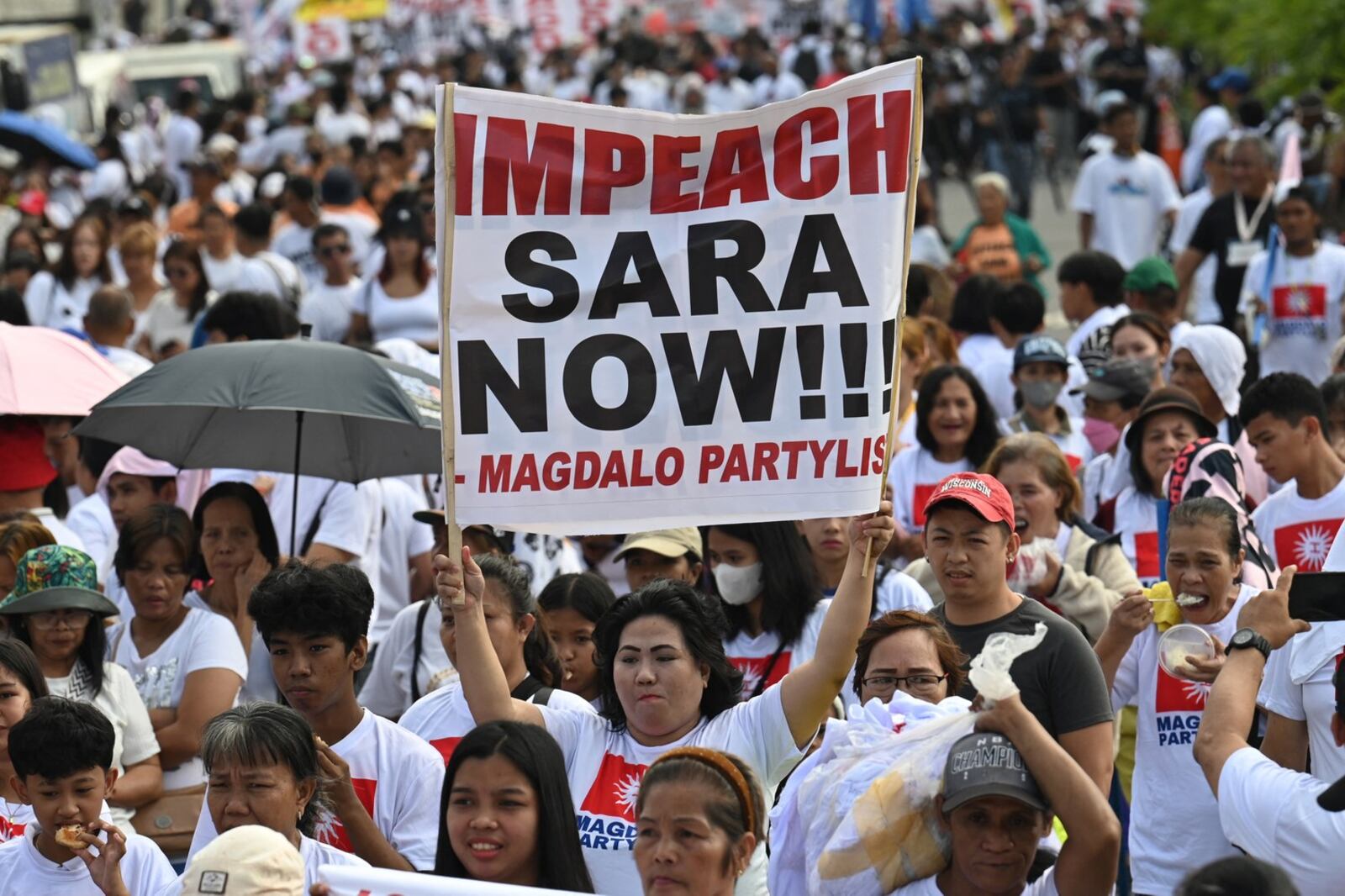
The question is, who will that opposition be, and who and what will it be opposing? Frozen out of the Palace and facing impeachment, VP Sara has claimed the mantle of opposition leader in her post-election statement. That’s “opposition” in the trapo sense of the word—another faction of the same ruling elite, another version of greed and lust for power.

It should be clear by now that a real, viable, and electable opposition can come only from the middle forces that are beginning to regain their footing after the hard loss of 2022. The sad but not surprising defeat of the more radical Gabriela and Bayan Muna partylist groups—which some see as the triumph of Red-tagging—puts the burden of the fight against corruption and for good governance on Bam Aquino, Kiko Pangilinan, Risa Hontiveros & Co., because it’s something that no one else in the government, certainly not the Dutertites, have the moral authority to undertake.

For this battle, and in preparation for 2028, this opposition has to adopt and master coalition politics—or rather their supporters have to learn how to unite, to maintain focus on the big picture, and to yield ground when necessary for the greater good.

For example, as I noted in an FB comment, Luke Espiritu and Heidi Mendoza turned in good performances—but they could have been better if some of our “liberal”-minded friends didn’t junk them on single issues: Luke for supposedly being an “abortionist” and Heidi for being a “homophobe.” Until we can get beyond our enclaves and agree on broader issues, the real evil will win. Sometimes we look for perfect candidates, people who align with all our principles, check all the boxes, lead blameless lives. But everyone’s flawed—any writer from the Greek playwrights onward knows that. 

We hand-wringers can be our own worst enemies. As a recent opinion piece in the New York Times put it, “Members of the educated elite… tend to operate by analysis, not instinct, which renders them slow-footed in comparison to the Trumps of the world…. Such elites sometimes assume that if they can persuade themselves that they are morally superior, then that in itself constitutes victory; it’s all they need to do.”

We have three years to see what was really achieved in May 2025, and if, like a good pokerista, our middle forces will know how to play a weak hand from a strong position, with a single-minded audacity and resolve.

Qwertyman No. 145: The Devil on My Shoulder

Qwertyman for Monday, May 12, 2025

TODAY, ONCE again, we troop to the polling booths in the hope of making our votes matter—votes that, if the cynics are to be believed, might as well be dust in the wind. The surveys have spoken, the winners named. All that remains is for this day to be over, for the formalities to be done with, for the supposedly inevitable to play itself out. And then we’ll watch the new-old Senators of the Republic proclaimed in a ceremony that will showcase the state of our electoral mind. 

As absurd as it may seem, many Pinoys will actually be happy with the outcome—that’s what the surveys are all about, aren’t they? These are the senators we wanted—or most of us, anyway. “Most of them” is probably what you’re thinking, if you’re a regular reader of this column and agree with most of my views.

I can’t think of a more complicated election in recent times, in terms of an answer to the question of “What’s in our best interest as Filipinos, and how do we make that happen?”

The idealist in me has the simplest and probably the morally most unambiguous response: vote for the best candidates, period: the intelligent, the progressive, the principled, the proven, the humane, the hardworking, the uncompromised. Whether they win or lose, it shouldn’t matter—you’ve done your best as a responsible citizen; in a sense, you’ve won. I sorely want to believe this, and to do this today.

But persistently, impishly, like a little devil perched on my shoulder, a contrarian spirit urges me to temper my idealism with some consideration of its practical costs.

Last week in California, a Fil-Am friend asked me to explain the significance of these elections. In the US, midterms usually mean a referendum on the incumbent President’s performance, and next year will most definitely be one for the Orange Pope and his systematic dismantling of American democracy.

For us Filipinos, May 2025 isn’t that clear-cut—although it should have been, if the armies of May 2022 had remained in place, leaving us with a stark choice between the good and the bad.

But the ruling “Uniteam” alliance has since collapsed, with each side fielding its own troubled slate of aspirants, all seething with the most primal of motives: survival, revenge, profit, and opportunity.

The opposition seems to be a loose coalition of liberal, Left, and anti-administration forces. Among these, four names have consistently surged to the top in the kind of social media neighborhood I inhabit. I’ll call them my Triple A candidates, the ones I won’t have any second thoughts about, leaving me with eight more spots to fill.

It’s those eight that give me pause—not for any lack of qualified and virtuous prospects, but because there could be dire consequences for not filling up the rest of my ballot, as some have suggested, or voting for names without a prayer of winning, as a matter of principle (or, by this time, by force of habit).

It’s interesting to observe how, unlike in previous elections where voting straight for a party’s slate was the norm, various formulas and menus have emerged on social media—cafeteria or halo-halo style—to reflect this urge for some balance between the ideal and the practical in this three-cornered fight. Even opposition stalwarts, including Leni Robredo herself, have been excoriated for their previously unthinkable endorsements of certain candidates from the other side. Whatever happened to ideological purity? (It was always an illusion: note the Left’s earlier alliances with a notoriously bloodthirsty Digong Duterte and an unabashedly capitalist Manny Villar.)

I think many Filipinos understand what’s at stake in this election—not just who will compose the next Senate, but what that composition will mean. As I told my Fil-Am friend, Rodrigo Duterte may be safely imprisoned in the Netherlands, but his specter looms large and heavy over these midterms, through his proxies led by his daughter, VP Sara and their “DuterTEN” team (now more like DuterTWELVE, if you add one Marcos and one Villar). Sara was all set to be impeached for grave threats against the First Family and grand theft Piattos—which would not only have taken her out as VP but disqualified her from running for President in 2028. But that procedure—needing at least 16 votes in the Senate—got kicked down the road, after the election, leaving Sara’s fate up to the newly reconstituted Senate to seal.

So again, I told my friend, presuming that the BBM administration’s game plan here is to freeze Sara out of the presidency so it can install its own man, 2025 is really all about 2028. It’s a referendum, sure—not so much about the present President, but rather the past and maybe the future one. We’re not just—or not even—voting necessarily for the best candidates, but for senators who will push Sara out, or keep her in. Daddy Digong’s summary extradition to the ICC, while a relief for many, merely intensified that drama, raising the stakes to a matter of survival for the Dutertes.

It’s another sad and sorry spot to be in, for these elections to come down to choosing among the lesser or the least of 8, or 16, or 24 evils, against the statistical near-certainty of another wipeout for the truly good. Should I support this fairly familiar trapo, the devil I know, over that manifest idiot, just to help ensure that the latter stays out? Or, again, should I simply disregard all the surveys and scenarios, and vote from my purest and most innocent of hearts for the best people on that ballot? (Was this how the cardinals chose Pope Leo XIV, or did more pragmatic considerations come into play?)

By the time you read this, I shall have cast an early vote as a senior in my barangay. Like we often say, we are whom we vote for, and there’s a part of me that fears what I’ve become or may have to be. I need some of that Holy Spirit with me today—we all will.

Qwertyman No. 140: The City of Stories

Qwertyman for Monday, April 7, 2025

THIS PAST weekend, I was down in Dumaguete City with National Artist for Literature Resil Mojares, historian Ambeth Ocampo, and scores of other writers for the 2nd Dumaguete Literary Festival. At my age, I’ve frankly tired of going to literary festivals, conferences, and workshops, preferring to work quietly at home—Dr. Mojares apparently feels the same way—but we couldn’t resist the allure of Dumaguete, a city central to the development of Philippine postwar literature, and always well worth visiting on its own for its gentle charms.

I personally have much to thank Dumaguete for, for what it contributed to my own budding literary and academic career. Early in 1981, shortly after I had returned from my first visit to the US, I received an invitation from Dr. Edilberto Tiempo to join the Silliman Writers Workshop which he and his wife Edith—the poet and future National Artist—had started two decades earlier upon their own homecoming from America. 

I had dropped out of college for a decade by then, and was working at NEDA, which had sent me to the US for an observation tour. What that trip to the American Midwest—mainly the campus of Michigan State in East Lansing—did for me was to rekindle my interest in learning. Dr. Tiempo’s invitation could not have come at a better time: a summer devoted to talking about poetry and fiction at Silliman University felt dreamlike, and by the time the workshop ended, my head spinning with magical lines from Robert Graves, I had resolved to quit my job, go back to UP, and just study, write, and teach for the rest of my life. And that’s what happened.

I wasn’t alone in that kind of transformative experience; as the country’s oldest writers’ workshop, the Silliman summer workshop became a virtual rite of passage for young writers, especially in English (some writers in Filipino have also attended, with works in translation). Silliman itself (older than UP by several years) has produced many of the Philippines’ finest writers, aside from the elder Tiempos—among them Ricaredo Demetillo, Aida Rivera-Ford, Merlie Alunan, Leoncio Deriada, Cesar Ruiz Aquino, Elsie Coscolluela, Rowena Tiempo-Torrevillas, Marjorie Evasco, Lakambini Sitoy, Artemio Tadena, and Myrna Peña-Reyes. It also has a strong performing arts tradition, contributing the likes of National Artist Eddie Romero, Gilopez Kabayao, Amiel Leonardia, Junix Inocian, and Elmo Makil, among others.

For all these, Dumaguete has been formally nominated to be designated as a UNESCO City of Literature—one of many such distinctions listed under UNESCO’s Creative Cities Network program that was launched in 2004 to recognize and celebrate cities around the world—350 of them form more than 90 countries to date—for their signal achievements in Crafts & Folk Art, Design, Film, Gastronomy, Literature, Music, and Media Arts. So far, 53 cities in 39 countries have been named Cities of Literature—among them Barcelona, Heidelberg, Iowa City, Lahore, and Norwich. (Iloilo has already been named a City of Gastronomy, and Quezon City is vying to be designated a City of Film.) With the Philippines serving as this year’s Guest of Honor at the Frankfurt Book Fair, Dumaguete’s recognition as a UNESCO City of Literature will raise our global cultural profile even higher, and let the Philippines be known for more than Boracay, Manny Pacquiao, and Imelda’s shoes.

Leading that charge for Dumaguete is Silliman University literature professor Ian Rosales Casocot, one of our best fictionists and co-director of the festival with Gayle Acar. Working with the Dumaguete City government, the Department of Trade and Industry, and the Buglas Writers Guild which Ian heads, Ian notes that aside from developing writers, “Dumaguete itself has been a constant subject of many literary works, from novels to poetry, from essays to plays. It is high time that Dumaguete is recognized for its role in shaping literature in our corner of the world.” The well-attended Dumaguete Literary Festival, now on its second edition, offers proof positive of that city’s continuing centrality to our literary life and culture. 

We had been invited to share our views on various aspects of Philippine literature in this age of artificial intelligence. I joined a panel of writers dedicated to that specific topic—or, as they put it, “Can AI Win a Nobel Prize for Literature?”—which happened to be something I’ve given much thought to.

Understandably, there’s been a lot of fear and anxiety—even outright hostility—generated by the emergence of AI in nearly every aspect of human life and society. Studio Ghibli’s Hayao Miyazawa, for example, has forsworn the use of AI in his work, calling it “an insult to life itself.” While it has been hailed for its contributions to such fields as medicine and criminology—shortening diagnostic procedures and sharpening digital forensics—AI’s application to less mechanical endeavors is more fraught with both ethical and technical questions. 

In previous lectures and again in Dumaguete, I showed how—at this point—AI poses little threat to the writer of truly good and imaginative literature, by yielding execrable responses to such prompts as “Write a paragraph about a summer night in Spanish Manila in the style of Nick Joaquin.” It’s worth a laugh, but I’m not sure how long we’ll be laughing; AI’s present ineptitude simply means it has a lot to learn—and it will, with the kind of training it’s being fed off our books, our texts, our manner of writing. It will only be a matter of time—I’d say less than a decade—before AI can mimic the best of global writing. For me, the best response is neither to hate nor to ignore it, but to understand it and employ it for helpful uses we have yet to find. (We’re already tapping AI every time we use Google, and no one seems to mind.) It should even be possible for authors to creatively interact with AI in what I’m calling a game of prompts.

What we can reasonably certain of is that while literary styles can be copied, the human imagination is far richer and stranger than we think. AI tends to homogenize; the good creative writer strives to be unique. Like Dumaguete, there’s a whole city, a labyrinthine cosmopolis, of stories in every writer’s mind to be discovered and explored.

Qwertyman No. 139: Filipinos for Nothing

Qwertyman for Monday, March 31, 2025

THERE’S A part of me that wants to stop beating up on the Dutertes, lest I be accused of being part of the Marcos propaganda machine (which stands to benefit from all this anyway, whatever I say), but like the gift that keeps on giving, the D’s and their people just won’t let me let them be. Being no lawyer, I’ll have nothing to say on the legality or otherwise of the former President’s arrest and forced departure for the Netherlands—except to opine, as others have, that justice sometimes works in mysterious ways.

My beef for this week is how the Duterte Agitprop Department (let’s call it DAD, like Elon Musk’s DOGE) has spun the whole ICC affair in the public sphere. These days, you never expect people to stand on the truth and nothing but the truth in these political matters. But you do hope for s0me degree of sophistication, for the kind of professional finesse that will justify the multimillions that any PR crew tasked with saving Rodrigo Duterte’s skin—or barring that, at least his reputation—will have been budgeted.

There are three propositions by the Duterte camp that I want to focus on, among many others that have arisen since the arrest.

First, his supposed global allies and endorsers. 

Donald Trump, for example, reportedly took precious time out from dismantling American democracy to declare that “We will protect Rodrigo and the Filipino people from the oppression you are facing…. I and the United States will not allow any of our allies and friends to suffer, and we will impose sanctions against the Marcos Administration for the unlawful act they did.” Why, he had even called Xi Jinping—not about tariffs, not about Taiwan, not about American forces in the Philippines—but about the “serious matter concerning our good friend Rodrigo.” For his part, Xi Jinping—who on a state visit to Manila did say “Our relations have now seen a rainbow after the rain” in response to Duterte’s more prosaic “I simply love Xi Jinping!”—supposedly brought up the Duterte arrest and the ICC in his opening address to the Boao Forum for Asia. Not to be outdone, another Duterte hero, Vladimir Putin, was reported to have threatened (someone—not specified) with “grave consequences” for Duterte’s arrest, as it violated the Rome Statute (which Russia incidentally pulled out of in 2016).

It’s all good when a national leader of superlative virtue and achievement has been so badly wronged that the world takes notice and his peers rise up in alarm to protest the injustice. But really—Donald Trump, Xi Jinping, and Vladimir Putin, all of them prime candidates for the ICC’s hospitality (Putin already is, along with Benjamin Netanyahu)? Never mind that all these supposed endorsements turned out to be fake; they still elicited applause from the DDS faithful, which I suppose was the intended effect. Q: Would it have been too much to expect an endorsement from the likes of Pope Francis? A: Yes.

Second, that call for OFWs to stop remitting their earnings home in a “Zero-Remittance Week” protest.

Our overseas workers contributed nearly $40 billion to the Philippine economy last year, so someone at DAD must have figured it would be brilliant to prick that bubble in the name of remitting Duterte home. But yet again, really? 

Granted, PRRD created the Department of Migrant Workers and the OFW Bank, and brought home hundreds of thousands of OFWs during the pandemic. Former OWWA chief Hans Cacdac even called him “the father of OFWs.” I don’t doubt that the Duterte name has a lot of traction in our expatriate communities, and that flexing a bit of their economic power in a week-long protest will ring some alarm bells, but you might as well ask people to chop off a finger to prove their fealty. For how long do you imagine will Pinoys postpone housing amortizations, tuition payments, maintenance meds, and grocery expenses to protest even the crucifixion of Jesus Christ?

Lastly, and perhaps closest to my propagandist’s heart, there’s that inexplicably vague “I am not a Filipino for nothing” slogan.

Sure, it sounds brave and bold—like it actually says and means something. But does it, really? I’ve been turning the statement around and around in my head and maybe I’m extraordinarily dense and unreceptive but I just don’t get it. In rhetoric, double negatives are often used to suggest or even emphasize the opposite (the technical term is “litotes,” as in “That’s not a bad idea” or “She’s hardly destitute”). 

Rarely do double negatives make good copy for T-shirts and streamers, if you want to rally the masses. Well, there was Winston Churchill’s “We shall never surrender” (arguably a double negative) speech on the occasion of the Battle of Britain in June 1940, but that statement was preceded by a string of powerful positives: “We shall fight in France, we shall fight on the seas and oceans, we shall fight on the beaches, we shall fight on the landing grounds, we shall never surrender.”

Ninoy Aquino—who must be rolling in his grave at being compared to Digong Duterte—famously said “The Filipino is worth dying for,” a slogan ironically made all the more resonant by the fact that it turned out to be self-fulfilling. I doubt that Duterte will carry his emulation to that extreme, but he or his handlers can learn from its clarity and brevity, which contribute to its emotional appeal. “I am not a Filipino for nothing” means, well, nothing. It says nothing about freedom, justice, peace, love, patriotism, godliness, courage, or integrity—none of the grand ideals and ideas that our heroes exemplified. Might it be because these notions were never really associated with a president whom we best remember for his crude expletives and constant exhortations to kill? 

“Sampalin ang ICC!” sounds much more honestly him. It still sounds lame, especially given where he is right now, but it seems more purposeful, and should look good on a green T-shirt.

Qwertyman No. 137: ICC Ex Machina

Qwertyman for Monday, March 17, 2025

IN PLAYWRITING and fiction, we call it deus ex machina—literally, the “god out of the machine”—which has come to mean a miraculously happy or fortuitous ending to a long and agonizing drama. 

You’ll find it, for example, when a virginal heroine—beleaguered by dirty old men and rapacious creditors—seems on the brink of yielding her precious virtue, tearfully praying on her knees for deliverance, when a kindly lawyer comes knocking on her door to announce that a distant uncle has passed away, leaving her his fortune. We rejoice with her—despite feeling, at the same time, that divine intervention came a bit too conveniently. This is why I admonish my students to refrain from employing deus ex machina in their stories, because in today’s hard-bitten and cynical world, nobody really believes in it anymore, and readers simply feel deprived of a more rational ending.

Like many things we know about drama, the idea goes back to the ancient Greeks, whose playwrights used it to great effect, Aeschylus and Euripides among them. Euripides most memorably turned to deus ex machina in Medea, where the title character—having been cheated on by her husband Jason—kills Jason’s mistress and their own two children. Guilty both of murder and infanticide, Medea seems hopeless and bound for damnation—until a machine, actually a crane shaped like a chariot drawn by dragons, emerges from behind the stage. It has been sent by Medea’s grandfather, the sun-god Helios, to pluck Medea away from her husband and from the coils of human justice and deliver her to the safety of Athens.

Was it fair of the gods to save Medea from the punishment awaiting her on earth? It’s arguable, but more than a device to resolve a messy plot, the “god out of the machine” was meant to remind the Athenian audience that a higher order of justice obtained, and that when humanity became too entangled in its own predicaments, then it was time for the gods to take over.

A lot of this swept through my mind last week as the drama of Rodrigo Duterte’s arrest and express delivery to the International Criminal Court at the Hague played out on TV and social media. Had the gods come out of the machine to impose divine justice? It had seemed nearly impossible a few years ago, when Digong was still flaunting his untouchability and taunting the ICC to come and get him. Well, we all know what happened since then—and they did. 

We understand just as well that the Marcos administration performed this operation not out of some abounding sense of justice or because it had suddenly acquired a conscience and realized the evil with which it had “uniteamed” to electoral victory in 2022. “We did what we had to do,” President Marcos Jr. explained on TV, with deadpan truthfulness—referring superficially to the Philippines’ obligation to honor its commitment to Interpol, but subtextually to the irresistible opportunity to cripple someone who had become a political arch-enemy, and providentially gain the support of masses of people harmed and disaffected by Duterte’s butchery.

The outswelling of that support—at least for Digong’s arrest and deportation—was spontaneous and sincere. Not since the Marcoses’ departure at EDSA had I felt such relief and exhilaration—and surely the irony would not have been lost on BBM, who knows what it was like to leave on a jetplane, kicking and dragging, for an uncertain future.

And what I say next may go against the grain of everything I have said and thought about the Marcoses, but no matter what ulterior motives may have come into play in this episode of the Duterte-ICC saga, I feel thankful for the resolve and the dispatch that BBM showed in this instance. Along with his administration’s resistance to Chinese aggression in the West Philippine Sea, this will be certain to count among his most positive achievements. 

The great difference between this drama and Medea, as an example of deus ex machina, is that the intervention of the ICC (with BBM helpfully providing the crane) isn’t going to save Duterte, but rather the people whom his presidency soaked in blood. But as with Medea, the “gods” step in when local justice proves impotent or inadequate (and did anyone really believe that Duterte would be hauled before and convicted in a Philippine court of law, when even the Maguindanao Massacre took a full decade to produce convictions for the principals?).

The question now is what next—not for The Great Punisher, for whom a prolonged trial at a cushy court will not be punishment enough, but for the Marcos administration, which suddenly finds itself with more political capital at its disposal, and yet also put itself at greater risk? Surely it must also realize that it not only has committed itself to tearing down the entire House of Duterte and confronting the many millions of voters they still represent, but that it has also set itself up for higher expectations, on pain of suffering the same ignominious fate?

In the hopeful bit of theater playing in my mind, I imagine BBM parlaying the bonus of goodwill he has earned from this maneuver into a broader if not genuine resolution to distance himself further from his predecessor and create a freer and more just society. There are clear and immediate steps he can take in this direction. The first gesture would be the release of all remaining political prisoners, followed by the abolition of the NTF-ELCAC, which no longer serves any useful purpose (not that it ever did). He can root out and punish the enablers and perpetrators of Oplan Tokhang and eliminate oppression and corruption from the mindset of Philippine law enforcement. And then he can begin reforming Philippine governance, starting with the quality of the people he seeks to bring to power—senators, congressmen, and the like.

But then that would be the ultimate deus ex machina, and we have been shaped by experience into a stubbornly disbelieving lot.

Qwertyman No. 136: Bringing In the No-Shows

Qwertyman for Monday, March 10, 2025

EVERY YEAR, about 100,000 Filipino high school seniors take the University of the Philippines College Admission Test (UPCAT), hoping to get into one of UP’s ten campuses nationwide. It’s an annual ritual that’s been taking place since 1968, except for a brief period during the pandemic when the test was replaced by an alternative system. (I didn’t even realize until I looked these figures up that I was among the third batch of UPCAT takers in 1970; thankfully I got in.)

Of those 100,000 hopefuls, only about 13,000-15,000 make it. That passing percentage may seem cruelly if not needlessly small, but there’s good reason for it. While we’d like more students to come to UP, admissions are limited by how many incoming freshmen UP’s campuses (or “constituent universities” such as UP Manila and UP Mindanao) can optimally absorb. Classrooms, housing, teachers, and facilities all come into play. Large campuses like Diliman and Los Baños can obviously take in more, but even so there’s a limit to admissions that needs to be observed if UP is to maintain the quality of higher education that it promises.

The more troubling statistics have to do with the distribution of those “passers” (technically, no one “fails” the UPCAT, which is just one of several factors that determine admission, including high school grades; each campus also has a different qualifying standard to rationalize admissions, so you can “fail” Diliman but qualify for UP Cebu). 

Last year, according to UP’s own statistics, 44 percent of UPCAT qualifiers came from private high schools. Another 27 percent came from the country’s science high schools. (which are publicly funded, but offer a much higher standard of education). Other public high schools accounted for only 29 percent of the total. Consider these figures against the larger picture, in which around 80 percent of our students go to public high schools, and less than 20 percent to their private counterparts. 

Compounding this gross inequality, about 70 percent of UPCAT qualifiers come from the big cities, mainly in Luzon. This, of course, is no big surprise. A recent study by UP professors showed what we didn’t need a study to know (but being academics, of course they had to prove it): that “income advantage” weighed heavily on one’s chances of passing the UPCAT and getting into UP. If you went to a good private high school, you were more likely to get in than a poor student from the boonies. To top it off, with tuition now free in public universities, we actually end up subsidizing many students from affluent families who could well afford to pay their way in private colleges.

This lopsided situation has long been the cause of much concern within and beyond UP, which, as the country’s “national university,” bears the dual responsibility of aiming to be the best university in the country bar none, and yet also serve the interests of the entire Filipino nation, and not just those of the urban elite that has apparently become over-represented in its student body. Various UP administrations have sought to address this seemingly paradoxical “excellence vs. equity” argument through different methods aimed at more democratic access—without, as current UP President Angelo Jimenez emphasizes, lowering UP’s standards. This remains a work in progress, but the aim is clear: make it possible for poorer Filipinos to get into UP so it can truly be the “university for the Filipino” it was envisioned to be.

Against all odds—and this brings me to my present point—many surprisingly do. I don’t have the actual figure on hand, but they number in the low thousands, of the 13,000-15,000 in an incoming batch. Encouraging, yes? But here’s the rub: about 1,500 of them never show up—what we call “no-shows”—not for lack of ambition, but for lack of means to cover the cost of living at a UP campus. Imagine that: it’s hard enough to get a good public high school education in what are called Geographically Isolated and Disadvantaged Areas (GIDAs), and harder still to pass the UPCAT from where you are. You’re elated to learn you made it, only to realize that you’re not leaving home after all, because you can’t afford the transportation, food, housing, books, and computers that come with college.

Thankfully, UP has initiated a new Lingap-Iskolar program to help out with these expenses and bring more GIDA passers in, starting with 300-500 students. Over the next four years, P250 million has been allotted by UP for this purpose. It’s a great initiative, but it still falls far short of minimizing the no-shows so the yawning disparity between UP’s rich and poor can be more effectively reduced.

With the education budget being squeezed even more under the current GAA, this is a great opportunity for the private sector to come in and make a clear and strategic impact on the future of the Filipino mind. If you’re a corporation or philanthropist in search of a good cause to support, look no farther—make it possible for a young Filipino from our poorest and remotest regions to study in UP. Sure, democratizing UP will require much broader and deeper moves, going back to basic education; but this step is solid, immediate, and tangible. 

I’m happy to report that I made this pitch to a dear friend in the US who had spent some time here in the Philippines more than 50 years ago with her late husband, who worked to help improve Philippine education. Responding to my call, that friend, Julie Hill, sold two HR Ocampo and Ang Kiukok paintings from her collection at a recent Leon Gallery auction, the proceeds of which she will be donating to the UP Foundation for a fund to be set up along the lines of Lingap-Iskolar. Despite being away for so long, Julie remains deeply attached to the Philippines; she’s not Elon-Musk rich and lives very modestly, but has sacrificed her best pieces so some bright young Pinoys she will never meet can have a better future and serve the nation.

If a foreigner can do that, I don’t see why our homegrown billionaires can’t. Support a GIDA scholar, and make a difference right now.

Qwertyman No. 135: Fighting the Truth

Qwertyman for Monday, March 3, 2025

BEAR WITH me as I begin this Monday’s piece with a quotation about last week’s celebration (or non-celebration, from another point of view) of the 1986 EDSA People Power uprising. It really doesn’t say anything we haven’t heard before, but I want you to read it slowly, giving it the full benefit of its sincerity and passion. If you were at EDSA as I and my family were, and no matter how distant a memory those four days in February may seem to be now, these words should still provoke even a flutter of patriotic fervor, and a wistful thought that, perhaps, the EDSA spirit does live on in these troubled times. 

“Martial law, declared by Ferdinand Marcos Sr. in 1972, left a dark legacy; countless lives were lost, freedoms were stripped away, and power was concentrated in the hands of a few. As we remember those who suffered and fought for our liberties, we must remain vigilant, especially now, when the threat of authoritarian rule once again looms over our nation. People Power was more than just a revolution; it was a testament to the collective strength of the Filipino people in demanding truth, justice, and accountability. It is also a reminder that we must remain united against any form of oppression…. Let us honor its legacy by ensuring that history is never distorted, our rights are never trampled upon, and our democracy remains intact for future generations. May the darkest times in our history never happen again.”

Just the kind of resonant exhortation you’d expect from a staunch defender of civil liberties and human rights, right? 

But would your appreciation of these words change just a bit if you knew that they were spoken not by the likes of a Leila de Lima or a Kiko Pangilinan, but by Davao City Mayor Sebastian “Baste” Duterte, whose EDSA Day message this just happened to be?

Truth? Justice? Accountability? “United against any form of oppression?” Where were these noble words when the good mayor’s dad was president, and announcing blatantly on various occasions that ““My order is shoot to kill you. I don’t care about human rights…. Let’s kill another 32 every day. Maybe we can reduce what ails this country…. I will assume full legal responsibility…. My mouth has no due process.”

That “legal responsibility,” of course, has yet to be assumed, full or otherwise. Instead, once he fell out of power, that man (and, last we heard, lawyer) who flaunted his wanton disregard of the law suddenly found religion, and the gumption to say this when his buddy Apollo Quiboloy and his cult followers were raided by the police:

“Our country has never been in a more tragic state as it is today. Rights have been trampled upon and our laws, derided…. We call on the remaining decent and patriotic members of our government not to allow themselves to be used and to be abusive and violent in enforcing illegal orders…. We call on all Filipinos, regardless of political persuasion, to offer prayers for peace and justice, and to spare our people of the unwarranted tension brought about by the reign of fear and terror by people sworn to uphold the law and protect the citizens of this country.”

It makes sense that this statement was published rather than spoken, because I can’t for the life of me imagine how The Great Punisher could say “unwarranted tension brought about by the reign of fear and terror” with a straight face and not burst out laughing—or maybe his listeners would, if they weren’t seized by, well, fear and terror.

Not to be outdone, on a recent sortie to Cebu, embattled Vice President Sara Duterte reportedly declined to answer questions about her impending impeachment trial in the Senate, preferring to leave the matter to her lawyers, but was quoted as saying that she was banking on her “loyalty to truth” to see her through. Ummm, okay…. Now can we please hear the truth, and nothing but the truth, about Mary Grace Piattos?

I suppose it’s a sign of how low the value of words like “truth,” “freedom,” and “justice’ have fallen when the very people accused of spitting them into the garbage now spout them like nobody’s business. Perhaps we shouldn’t be surprised that they’re doing this, given the success of Donald Trump at doing the very thing he says he hates, e.g. weaponizing the justice system. There must be pages of advice in the 21st century edition of Playbook for Politicians for just this kind of brazenness, maybe under the Chapter “Reversals of Fortune.” What’s surprising—and scary—is how they continue to be believed by followers such as “Ging C.” whose fervor led her to gush, on PRRD’s FB page, “By God’s favor VP Sara you will win this fight. God of truth is on your side and those people who fight the truth!” (Ooops….there’s a “for” missing there somewhere, but really, does it matter anymore?)

And lest we think only the Dutertes have mastered the art of dissimulation, let me leave you to guess who the character implicated in the following quotes is.

On Independence Day in 2018, someone posted on Facebook that “Freedom is every human being’s birthright. But to claim that right, the time always comes when we are called to fight for and defend that freedom. The Philippines and her people fought long and hard, sacrificed life, limb, treasure and more to achieve our independence 120 years ago. The call for liberty and sovereignty was answered by our heroic ancestors, sacrificing their all at the altar of honor and freedom and country.

“Today we remember, and in remembering, we consecrate that memory of all the courageous and selfless Filipino patriots—our heroes—who gave their lives for that freedom, and to whom we forever owe our status as a free, independent and sovereign nation in the community of nations. Let them long live in our minds, our hearts, in our very souls, the heroes of our great country, our beloved Philippines.”

In a speech before the Kapisanan ng mga Brodkaster sa Pilipinas last November, the guest of honor declared that “Now, more than ever, our democracy depends on an informed and vigilant citizenry…. With the 2025 elections ahead, I am committed to protecting our journalists in championing fearless and credible reporting. Together with KBP and our partners in media, we will stand firm against disinformation, ensuring that every Filipino has access to voices of truth.”

I would love to cry “Amen!” Wouldn’t you?

Qwertyman No. 134: “Forthwith” and Other Adverbs

Qwertyman for Monday, February 24, 2025

NEVER IN our modern political history has so much seemed to depend on the meaning and interpretation of one word. For the past week, politicians, lawyers, and columnists like me have weighed in with their sense of “forthwith,” as it appears in Article XI, Section 3, paragraph 1 of our 1987 Constitution, which states that “In case the verified complaint or resolution of impeachment is filed by at least one-third of all the members of the House, the same shall constitute the Articles of impeachment, and trial by the Senate shall forthwith proceed.”

At bar is the impeachment of Vice President Sara Duterte, which is hanging in the balance with the complaint signed by more than enough congressmen and forwarded to the Senate for action “forthwith.” That happened just before the Senate adjourned, whereupon Senate President Chiz Escudero announced that, hold your horses, we’re on break here with seven of our members trying to get their jobs back, and there’s a bunch of other things we need to do before the trial even starts like getting properly fitted for our judicial robes, so we’ll see you in June after the SONA. As an aside to the House, Escudero also wondered aloud why Congress was rushing him, when they had two months to get the damn thing signed and sent over. No, he insisted, “forthwith” doesn’t mean “right now”; it means “when we’re ready.”

This flew in the face of opinions by such as retired Supreme Court Associate Justice Adolf Azcuna, who argued that an impeachment wasn’t tied to the legislative calendar, and that the Senate was constitutionally bound to convene on the complaint. Minority Leader Sen. Koko Pimentel agreed, calling on Escudero to at least convene a caucus to discuss the trial.

English-major nerds like me should live for moments like this. I can fantasize about being called as an expert witness to speak to the etymology and meaning of “forthwith,” whereupon I would have sagely advised Their Honors that “Round the middle of the twelfth century, the phrase forth mid appeared (mid being essentially the same as the modern German word mit, with), later forth with, to go somewhere in the company of other people. Necessarily, if you go forth with others, you go at the same time as they do. It seems this sense of time eventually took over, though the process of transition isn’t very clear, and it’s mixed up with other phrases that also referred to time. Certainly, by about 1450 the phrase had condensed to a single adverb with the modern meaning of immediately, without delay.” Did I know that all along? Of course not. I googled it and lifted it from a source only named “Hugo.”

It does point to an interesting fact about language, however—meanings change over time, and, depending on the context, can be bent to suit one’s purposes and perceptions. While all modern dictionaries will say that “forthwith” means “immediately,” lawyers and judges (yes, that sneaky lot, with all due respect to my lawyer-friends) have opined that “surrounding circumstances” could loosen things up a bit. One Canadian commentator has noted that “Some courts have determined that the word ‘forthwith’ requires vigorous action, without any delay, and have suggested that whether there has been such action is a question of fact, having regard to the circumstances of the particular case. Others have suggested it means the action must be taken without pause or delay, or done at once, while some judges have commented that the nature of the act to be done is to be taken into consideration when determining the required immediacy…. The term ‘as soon as possible’ has been defined as meaning no more than ‘without reasonable delay’ or ‘within a reasonable time.’ Some cases have suggested that the length of the period of time involved for performance is subject to a reasonableness standard rather than a sense of urgency, and may be influenced by trade practice, custom and other circumstances.

So if this “reasonableness standard” were to apply in the matter of Sara Duterte, would SP Chiz’s reluctance to convene the Senate now as an impeachment court be reasonable? Not being a lawyer, I’ll leave the legality or constitutionality of it to those who know better—even if, as we can see, it’s lawyer vs. lawyer in this case. I did learn from another retired SC Justice (not Azcuna) that the impeachment process does require many preliminaries before the actual trial, including reviewing the rules of the Senate—and let’s not forget the robes, which the SP emphasizes (at P6,000-P8,000 each) will have to be dry-cleaned by the senator-judges themselves, to save the Senate money (a laudable show of thriftiness, given that the new Senate building in Taguig is now expected to cost over P30 billion). 

What’s apparent to this pedestrian observer is that whatever “forthwith” means, it didn’t happen, at least not the way our framers probably intended it. We’ll be in for a few more months of what Henry Kissinger creatively called “constructive ambiguity” aka fudging, while the senatorial candidates (at least those not identified with the Dutertes) avoid the issue.

“I’ve yet to see and consider the complaint,” at least one reelectionist senator has said, likely echoing others. “If I’m going to sit as a senator-judge, then I wouldn’t want to prejudge the issue” has been another refrain. It’s a reasonable—and highly convenient—stance to take, especially during this election season.

By kicking the impeachment down the road, the Senate avoids making it an election issue for those candidates who need to straddle the fence for their survival. While the House complaint signed by 215 out of 316 congressmen might suggest that the VP’s goose is cooked, the Senate is a different arena altogether, with the present numbers inclined toward Sara’s acquittal. How the administration will tip that balance in its favor will be the game to watch (an AKAP-laden budget can’t hurt). The Dutertes don’t help themselves any with their proclivity to “kill” their enemies, but any assumption that they’re politically done for will be very foolish.

We’re told that impeachments are political more than anything, which means there should be political consequences for all involved. We wish the process had begun much earlier, a month or two ahead of the campaign period, so we could have partly based our senatorial choices on their performance as jurors, and their quality of mind.

Since “forthwith” didn’t happen, let’s hope that the trial, whenever it takes place, involves two other adverbs:

“Expeditiously,” so we can all return to our normal lives (at least until the next scandal—or, God forfend, the next impeachable official, comes along); and

“Fairly,” with incontrovertible evidence, so there will be no question afterward that the right thing was done.