Qwertyman No. 16: Prisoner Y

Qwertyman for Monday, November 21, 2022

PRISONER Y was still chewing on a tasty strip of cartilage that clung to the meatless rib he had fished out of the soup when he felt Cortes’ breath on his nape and heard his wheezing voice: “The warden wants to see you. Now.” He stood up, tossed the rib back onto his tray—a hand quickly grabbed it from nowhere—and turned to follow the guard. He wondered what the warden wanted this time. 

Nearly all the fans in the mess hall were out of commission and the inmates’ sweat mixed in the air with the fat curdling in the lukewarm broth, and Prisoner Y looked forward to the air-conditioning in the warden’s office, although he was sure the warden didn’t call him in for a conversation. The last couple of times, in fact, it was the warden’s secretary who had spoken to him, and he barely glimpsed the warden through the half-open door. 

The first time, he was picked up just outside the service gate by three men in an SUV, who brought him to a warehouse in Parañaque, where a man was trussed up, his head in a sack, screaming in a language Prisoner Y couldn’t make out. One of the men handed Prisoner Y a .45 and nodded; another man pointed another .45 at him; the third man held up his phone and recorded everything. Prisoner Y aimed at the victim’s head and fired; the body spasmed and stopped writhing. They drove him back to the prison, where Cortes met him at the gate and ushered him back to his cell. 

When his cellmates asked where he had been—now and then one of them would be gone like that for a day—Prisoner Y said that the warden had asked him to do some carpentry at his home; he had been a handyman in his past life, before the debts piled up and he learned to do other things with his hands. When someone asked him why he didn’t make a break for it while he could, and someone else remarked how all he wanted was an hour at the mall to savor the cool air and watch the salesgirls bending over, Prisoner Y said—truthfully, recalling how humid that warehouse was and how it reeked of stale oil and some shapeless menace—that he felt safer inside.

On his wife’s next visit that Sunday, she was deliriously happy. A man had come by their house, she said, and had dropped off some money in an envelope, saying that it was something owed her husband for a job he had done inside the prison. What did you do, she asked, did you build a house for the warden? It was enough to buy a new stove and a smartphone for Carmela, who needed it for school. I worked on the prison chapel, he lied, knowing it would make her happy; the old roof was leaking and you know the chapel is the warden’s pet project.

The second time it was different, because he had to ride on the back of a motorcycle that one of his handlers drove, and shoot his target on the run. The man, he realized to his horror, was the prison chaplain, walking the street in a Hawaiian shirt and slacks, as though on his day off, in search of a special meal or a movie to watch. Instantly Prisoner Y understood—the chaplain had spoken to the media about how prisoners complained to him about their food, how the prison officials skimmed a percentage off every sack of rice and kilo of stringy pork that entered the kitchen; there was talk of an investigation, although the inmates doubted anything would come out of it. He was there to make sure. It should have been easier to do with the priest in common garb, shorn of his soutane, but then the priest turned toward him as he fired and he could see the man’s terminal expression, one more of resigned acceptance than anything else. Despite himself, Prisoner Y muttered a prayer for forgiveness as they sped away.

Today Cortes led him past the secretary straight into the warden’s office and closed the door behind them. The warden was on his cellphone, a cigarette in his other hand; some ashes drifted onto his barong and he shot up from his seat to stub the cigarette into an ashtray and flick the ashes off without any change of voice in his phone conversation. “Of course, pañero, you don’t even need to ask, send my love to Mercy and the girls.” He shut his phone off and turned to Prisoner Y, who remained standing with his hands behind him. “How’s your wife? Is she happy? You know what they say—happy wife, happy life!” Prisoner Y murmured something like “Yes she is, thanks,” but the warden was already coming over to his side of the table. “Let’s take a walk,” he said. “I want to talk about your future.” What was there to talk about? The future was his life sentence for murder.

In his six years in the penitentiary, Prisoner Y thought he had seen everything, every grimy corner of it, even the luxury suites inhabited by the drug lords and out-of-power politicians, but now the warden led him past the kitchen down a corridor he had assumed led to cold storage, and he was right; when Cortes unlocked the doors and pulled them open, a blast of cold air stung his nose, along with an acrid curl of some potent chemical. 

The warden flicked the light switch on and Prisoner Y saw them: a swarm of cadavers—some on raised platforms, many just on the floor, under browning blankets that could not cover everything. He could see fingers withered dry. “Stabbings, cancer, TB, chokings—they all end up here, the ones without family, the ones no one will miss. We should just burn these but there’s a budget for their maintenance. I’ve made sure of that.” 

“Why did you bring me here?” 

The warden nudged the edge of one blanket with his foot. “Your next job will be so important that it will have to be done by someone who might as well be dead.” Prisoner Y rubbed his arm and said, “I still have a family.” The warden looked at him calmly and said, “I know. You do. That’s why we’re here.” Prisoner Y shivered from a chill colder than bare ice.
Qwertyman No. 15: The Next UP President

Qwertyman for Monday, November 14, 2022

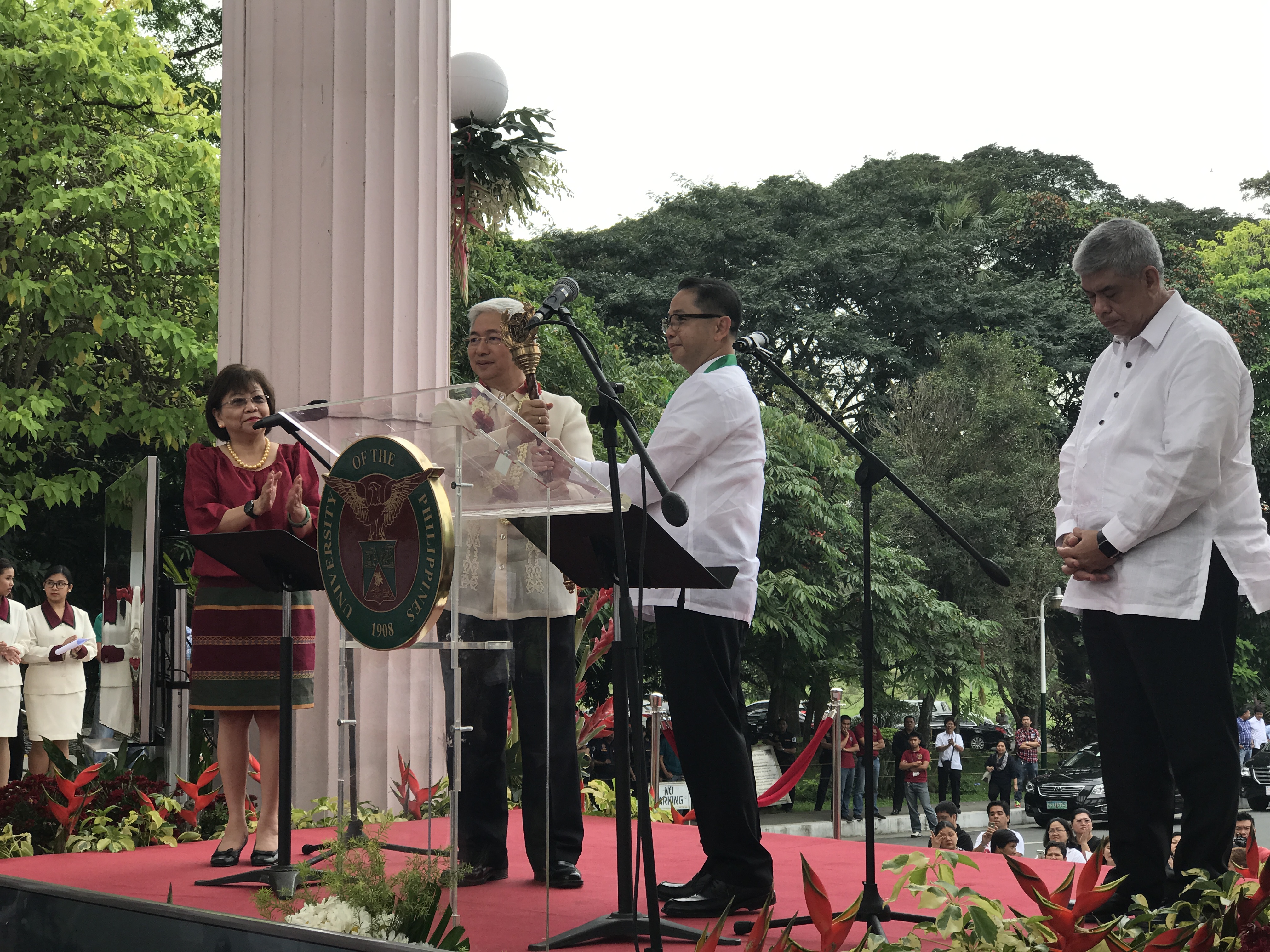
AFTER FOURTEEN straight Mondays of producing what I’ve called “editorial fiction”—make-believe vignettes meant to poke fun at the issues of the day, the prose version of editorial cartoons—I’ll take what will be the occasional break to engage more frontally with a concern of deep personal and professional interest.

Over the next few weeks, the Board of Regents of the University of the Philippines will select the 22nd president of our national university to succeed President Danilo L. Concepcion, whose six-year term ends in February next year. (Let me add quickly, for full disclosure, that I was President Concepcion’s Vice President for Public Affairs until I retired in 2019, and held the same position under former President Francisco Nemenzo in the early 2000s.)

Whether or not you graduated from UP or have a child or a relative there, this is important for every Filipino, because—like it or not—UP produces an immoderate majority of the people who make up our political, economic, and social elite. Its leadership, therefore, is a matter of national consequence. Since its birth in 1908, UP’s alumni roster has counted presidents, senators, congressmen, CEOs, community leaders, artists, writers, scientists, and, yes, rebels and reformers of all persuasions. 

There are six candidates on the BOR’s ballot, some of them, to my mind, more qualified—beyond what their CVs say—than others. The Board of Regents has eleven members—the CHED chairman, the incumbent president, the chairs of the Senate and House committees on higher education, the alumni regent, three Malacañang appointees, and three so-called sectoral (faculty, student, and staff) regents; it will take six of them to elect the next president. 

Whoever that choice is, he will be certain to have a challenging six years ahead, especially considering the present political regime, which he will have to contend and to some significant extent work with. UP remains dependent on the national government for its budget, for which it has to make its case before Congress every year, like any other agency. 

Prickly issues will face No. 22. There’s been a lot of loose talk lately about UP’s standards supposedly falling, with too many cum laudes graduating even as its international ranking has reportedly dropped. Indeed these should give rise to public concern, but there’s more to it than meets the eye, and UP’s level of service to the nation (think PGH in the pandemic) hasn’t flagged.

Historically, the relationship between the Philippine president and the UP president has been a testy if not an acrimonious one—most notably that between Quezon and Palma—because of the university’s role as social critic. But Malacañang now has much to do with choosing the latter through the power wielded by administration representatives on the BOR. What the Marcoses will do with UP remains to be seen; will the next UP president, for example, be given free rein to pursue the martial law museum project that’s already been approved for construction? It may not be the most important item on the agenda—more support for research and faculty development should be, if we want to shore up our ratings—but it will be strongly indicative of how the Palace will deal with Diliman.

What I’ve observed is that the role of the UP president has greatly evolved since Palma’s time. While many of us would like to see an ideological firebrand at the helm, UP is a broad and diverse community whose survival and growth will require keen diplomatic skills to negotiate between the university’s external and internal publics. (And yes, even firebrands can do that, against all expectations; Dodong Nemenzo did.) University presidents worldwide have increasingly been more of resource generators and managers than thought leaders—perhaps boring, but they deliver the goods. What’s important is for them to be able to practice and defend the academic freedom that also allows the university to become the best it can be. I pray our regents will bear that balance in mind in its deliberations.

ALSO, A word on my chosen approach to editorial commentary. I know that some of you can’t make heads or tails of my fictionalized renditions of our political and social culture, but I think you will, with just a little more effort. Maybe it’s the literature professor in me, but I believe readers should be challenged to figure out the sense of things, and not just have it served to them on a platter. 

We’ve fallen into the groove of letting others reach our conclusions for us, so all we need to do is nod affirmatively. Whichever side of the political fence you’re on, that only contributes to sloppy, second-hand, copy-paste thinking. In my pieces, I try not focus on just one person or one target—other and sharper columnists can do that. I’m more interested in the culture of our politics—in the way groups of us think and feel about what’s in our best interests—and in our complicity in bad governance. Sure, we have rotten eggs in high public office—every administration has had them. At this point, I’m much less bothered by the fact that we live in a world of despots than by the fact that we (or many of us) put them there, we keep them there, and we just pinch our noses when they stink.  

Another columnist (who actually writes wilder fiction than me and my feverishly imaginative friends) even complained that fiction has no place in the op-ed page. Excuse me? All fiction is opinion, and always has been; the critical commentary of fiction even preceded journalism. In earlier times, our op-ed pages even offered poetry—political commentary in verse—at a time when our poets were patriots, and our patriots were poets. Sadly those times and those exceptional commentators are gone, replaced by hacks producing not only dishonest and soulless but dishwater prose. 

I’m not a poet, so the closest I can get to that is fiction, which pretends that some things happened that didn’t (but then again, in another sense, really did—and that’s what some readers find confusing). One thing I must confess I do like about fiction is that, unlike factual commentary that readers today tend to forget after a week, a good story sticks around. Sadly for its implicit targets, fiction is forever. You can shoot me dead, but my work will survive me—and, for that matter, you.

Qwertyman No. 12: The Changing of the Colors

Qwertyman for Monday, October 24, 2022

(Image from esquiremag.ph)

PITONG STARED out the window of his Chicago apartment to the shoreline of Lake Michigan, and watched the usual Sunday crowd of families with small children in colorful tracksuits and seniors plodding nowhere at half a mile per hour on their adjustable canes. It was getting later into the fall, and the colors were exploding all over the city from Lincoln Park to Promontory Point; at the Botanic Garden in Glencoe the Japanese maples blazed a vivid red. Pitong remembered that it was at a time like this, almost twenty years earlier, when he and Marietta had arrived in the United States, and they could not believe what a transformation the seasons induced in the chlorophyll and carotenoids of leaves. 

He felt intensely drawn to his postgraduate studies, which was what they came to America for—“To explore,” as he wrote in his application, “new ideas for the energization of the Philippine economy, particularly through the deregulation of key industries, including power and telecommunications.” 

With a US-minted PhD, Pitong thought he could return to a professorship if not a deanship at a top university, or a directorship at NEDA or Foreign Affairs. So immersed did Pitong become in his anticipated future that he forgot about Marietta, who had given up a promising career in pharmaceuticals to join him as his bedmate and cook, until he began to doze off after interminable arguments online about the American capacity for policy reform. 

She snuggled up to him in the deep of winter, and he was colder than ice. In their second spring she volunteered to usher with the local symphony; by that summer she had fallen for a clarinetist, and by the fall she had found her happiness, while Pitong continued to stew in his darkening pot of theory and counter-theory, of the sticky explanations how, in the post-9/11 world, security and economic concerns were inextricably intertwined and indeed congealed in the individual consciousness.

Pitong returned home alone when he failed his dissertation defense, while Marietta began a family in California, to where her clarinetist had moved to join a new orchestra. Almost immediately, through an old friend on the Left—yes, he had had more than a passing dalliance with that crowd, although he now denied it—Pitong found himself a job in the Palace, drafting speeches for Madame President and getting close enough to hold up an umbrella for her at the slightest drizzle. He began to project some political weight and smiled at whispers to the effect that he would soon become her spokesman. When he brushed his teeth in the morning, he ended by frowning at the mirror, as if the republic were about to collapse, and elocuting in his whiny voice, trying to sound as gruff as he could, “Good morning, ladies and gentlemen of the media.” 

And then the republic did collapse, or rather Madame President did, in a scandal that whittled down her stature even more severely, and rather than desert her like those scoundrels did, Pitong made noisy pledges of allegiance to her—while secretly negotiating, on the side and through the same old comrades (the Left had influence in any government, he would realize), an accommodation with the new regime. When they laughed him out of the place, he fled the country in humiliation, hooked up with his alumni network, got a job handling loan applications in a small bank, and prayed every night that a sinkhole would devour the Palace he left behind and all of its cursed occupants.

For his own entertainment, he opened a blog under the title of “Batang Recto,” a play on the Manila street where he picked up cheap textbooks and on all the connotations of “right,” which he embraced. He took every opportunity to lambast anything that had to do with Family “A,” communists, female empowerment, abortionists (he was convinced that Marietta had purposely lost their baby, not that he wanted to care for one), drug users, hippies, Barbra Streisand, Hillary Clinton, Barack Obama (and 95% of his race), hip-hop, gun control, and climate change. 

He now proudly identified himself as an American citizen—he felt deeply insulted when someone asked if he was a “Pacific Islander,” like he paddled a dugout in his three-piece suit—and bristled when Pinoys from Pateros or Pagadian questioned his opinions on American issues like “birtherism,” as if they knew anything about American politics. But at the same time he felt perfectly free to dispense political wisdom to the islanders, because they seemed hopelessly lost in their fantasy of a liberal democratic paradise, which they failed to realize had been cooked up by a cabal in Washington since the days of Quezon and Cordell Hull to protect American economic and military interests in the Philippines for the next half-century. 

Pitong no longer relied on or believed in scholarly research to establish the truth; so much of it was produced and propagated by an academic elite intent on perpetuating its hegemony, against the challenge of intuitive thinkers like himself and a few other brave souls he had come into contact with. Together, on private networks, they reviewed and reconstructed history, and plotted a chart for human survival and development. The plan recognized the existential threats posed by liberal retardates still tied to obsolete notions like racial and gender equality, which accounted for their weakness at the core.

When a Pinoy strongman and his American counterpart became presidents of their countries, Pitong heard his angels sing. The world was clearly waking up to what he had known for many years—that there was genius latent in resentment, prejudice, and suspicion, in the politics of self-interest, the purest of human motivations. One stalwart was cheated out of re-election, but another was replaced by an even more reliable autocrat. When Russian bombs fell on Ukraine, he felt his logic justified—having denied Russia’s destiny and gone to bed with the West, Ukraine had no one else to blame for its misery but itself. Batang Recto was always right.

Pitong slept soundly on the pillow of these beliefs. He felt most virile after savaging some pink fool on his blog, and sometimes he woke up with a woman next to him, with whom he did not care to exchange names, mindful of security. When he looked out the window at the changing of the colors and at the people on the lakefront, he felt no irony, no loneliness, no remorse. He was never stronger, never surer. He tingled with anticipation at the coming of The Storm that would sweep all the liberals, tree-huggers, and Mariettas of the world away. It was the closest thing he felt to happiness.

Qwertyman No. 11: Good-Better-Best

Qwertyman for Monday, October 17, 2022

DOLANDS COULDN’T believe his good fortune; he had received his third SMS message that day offering him a bonus for playing pusoy online. Pusoy—also known as “good-better-best” to its players—was Dolands’ game of choice, allowing him to exercise what he believed was his sharply analytical mind. Dolands was one of those people who felt that life kept dealing him the wrong cards, obscuring his true potential, and he kept waiting for the opportunity to prove himself—to his Papang, to his friends, and to that snooty waitress Letty, who wouldn’t give him the time of day—that he was an achiever.

Today Dolands worked as a troll—a “social media specialist”—in an operation run by the famous Madame Venus, and while the pay was good, the job itself felt mechanical, involving nothing but the methodical execution of orders from the managers in the loft upstairs. Dolands wanted to turn “good” into “better” by becoming one of those necktied managers himself; but “best” was to be his own man, enriched by nothing but his talent, and the online gambling offers he kept receiving seemed to open that door. Sometimes Dolands suspected that his supervisors thought he was stupid, by the way they frowned at his haircut and at his fake Crocs shoes. 

Dolands was amazed that whoever texted him knew his full name and had used it in the message: “Rolando Quibuyen, now’s your chance! Here’s a P500 bonus for joining our 24-hour game of Cyber Pusoy at bahaybaraha.com. More prizes await you, including a 2023 Riva Riviera 2.0 in our grand raffle draw. Sali na!” Now, being a troll, Doland of course knew how it easy it was to get hold of mega-lists of people’s names, phone numbers, and email addresses; he knew that Madame Ventura even kept a special roster of influencers’ data for personalized messages, including death threats masked as hypothetical questions. But as lonely and lowly as he felt, Dolands wanted to believe that someone had actually taken the trouble of getting to know him and his penchant for pusoy, to craft a special message for him, and to throw him a lifeline across the water. Never mind that it was probably a bot, a faceless algorithm racing through a library of names and numbers; someone or something out there thought him worthwhile enough to bait; he existed.

He was itching to respond to the text and to click the link on his phone to start playing, but his shift wouldn’t be over for another four hours and any private use of his office computer was strictly prohibited. The managers upstairs not only had a birds’ eye view of the floor, but they could and did tap into any terminal to see what was going on. It was no different from the BPO outfit Dolands had been recruited from, except that that other job was more tedious because you had to talk people into buying this and that, which involved reason, whereas trolling played to the imagination, to what people believed and feared in their deepest of hearts. Everyone wanted to feel a sizzle of power, to say something outrageous without facing the consequences, and the trolls gave them the words for that. It was a lot more fun during the pre-election campaign when Dolands and his gang could attack a candidate’s daughters or the candidate herself with gleeful malice; today, defending the winner’s son or the winner himself when they did or said something incredibly stupid was boring and dulling. Doland looked forward to more challenging assignments where he could prove his mettle, and now he was about to get a taste of that.

“Quibuyen!” said his supervisor on the headphones. “Come up to the loft for a minute. Madame Ventura wants to talk to you.”

Dolands felt a lightning bolt shoot up his spine. He had never gone up to the loft before, nor had the madame ever spoken to him. He wondered what they needed him for, but today was truly his day to shine (although it was just past midnight, so his days were always dark). Things just got better.

Dolands fidgeted as Madame Ventura assessed him from behind her trademark dark glasses and wisp of smoke. He wished he had worn something other than the Nirvana T-shirt a US cousin had bequeathed him, to project a more professional vibe, but it was too late for that. They had to take him for what he was.

“They say you worked for the card verification and security service of a bank? You can spot fake numbers and accounts?”

“Yes, ma’am, I did, but—but I was just testing some software when—when they said, when they claimed, that I was misusing numbers—” Dolands began to sweat, amazed that they had found that sordid detail about his past that he had tried to bury and forget. 

“You mean you didn’t actually steal anything?” Madame Ventura sounded disappointed.

“No, ma’am—I mean, I just wanted to prove it could be done, so I did it.” He stole enough to buy a new car with, but he had to give it all back to escape prison, plus plugging all the digital holes he had punched into the system.

She blew another cloud of smoke into his face. “Can you still do it? Work with numbers and fake identities? Are you still that good?”

“Well—if you put it that way—”

“Let me tell you why, Mr., uh, Quibuyen. They just passed a new law requiring all SIM cards to be registered, to be attached to names of people with official IDs. We need SIMs—but we don’t want to bother real people to line up for us. So we need an official-ID generator to go with names, birthdates, addresses, maybe even pictures. Is this something you find interesting?”

“Uhm—yes—at least as proof of concept—”

“Forget concept. I want you to produce IDs for 100,000 SIM cards, just for starters. I know many people who will need this service. You do it and do it well, and I’ll make you a manager in charge of your own division. I think it’s about time we branched out from calling ugly people pretty, and vice-versa.”

Multicolored starbursts popped in Dolands’ mind—shiny shoes, flowery neckties, citrusy colognes. It was like he had been dealt 13 cards that broke down into a straight flush, a full house, and a high pair. I can’t believe I almost fell for those effing scammers, Dolands thought. This was good-better-best in real life.

Qwertyman No. 10: Monkey Poo

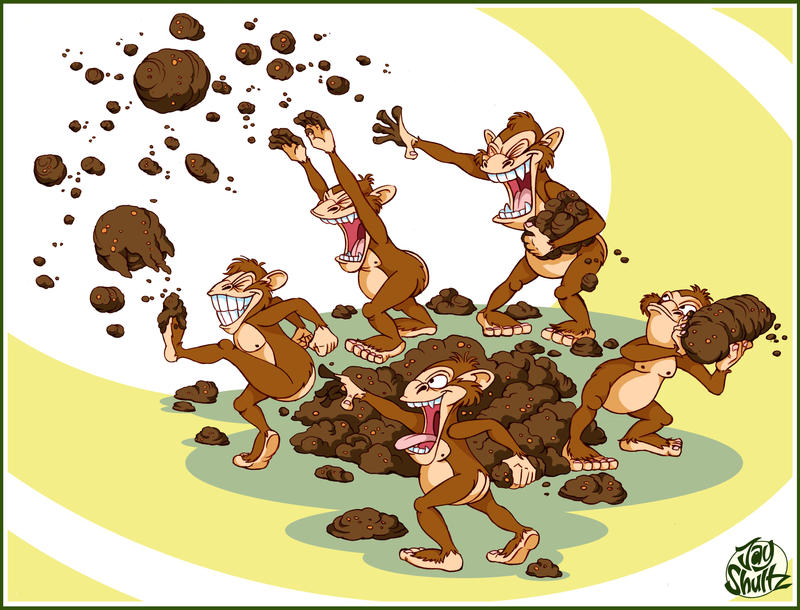
(Image from deviant art.com)

Qwertyman for Monday, October 10, 2022

THE WATER was still dripping from a leak in the ceiling of the office, caught in a pink plastic pail behind his swivel chair, when Gov. Tingting got the call from the Office of the President on the satellite phone. It was only a secretary on the line, but Tingting stood at attention as if he were speaking to the man himself, mumbling “Yessir, yessir” although it was a “ma’am” giving him instructions. 

He felt immensely relieved to have taken, at his aide Atty. Noknok’s pleading, the call which he had first presumed to be a prank, because he couldn’t imagine why President Ongong would be interested in him or his humble dominion. Well, of course there was that supertyphoon Digoy, which ravaged Suluk-sulukan among other provinces in Kawefo’s benighted southeast, but hundreds routinely died in Suluk-sulukan’s annual floods without getting more than a passing mention from the capital media, much less a call from the Palace.

Suluk-sulukan was a province best known for not being known. It occupied an island of the same name, and was reachable by a two-hour flight from Metro Kabugaw to the adjacent province of Lagunsoy, followed by a three-hour ride by pumpboat, and then another hour by bumpy tricycle from the pier to the capital town of Maunggoy. Its chief industry should have been tourism, given the abundance of its forests, nature trails, and beaches, but it came with one huge disincentive: the mountains of monkey poo that lined the roads and clogged the waterways, raising an infernal, ammoniac stink that the locals had gotten used to and barely noticed but which repelled tourists, invaders, and potential investors alike. The floods drained some of it out into the ocean but it was back as soon as the sun shone. 

Even the free face masks given out at the pier, imprinted with Gov. Tingting’s smiling face and the slogan “Beauty right under your nose” did little to encourage the intrepid to stay. Political dynasties had risen and fallen on the monkey-poo crisis, and Tingting—who had won on a promise to exterminate the monkeys—was surviving only because the bales of face masks they had airdropped on the island in the midst of the pandemic offered a temporary reprieve.

“So what did the President say, Gov?” Atty. Noknok asked, eager to absorb every snippet of political gossip, to affirm his status as “the little gov.”

“He asked me to come to the capital!” said Tingting, his eyes still glazed over with disbelief.

“Really? Will he hand you a check for disaster relief? I can take the picture, Gov! I’ll make sure it comes out in the papers.” Suluk-sulukan had exactly one paper, The Maunggoy Times, published by Tingting’s sister Mingming; there had been two, until the other paper’s editor was shot by a pair of motorcycle-riding gunmen whom witnesses could not identify because they looked too much like the governor’s bodyguards.

“What disaster relief are you talking about?” said the governor. “This is something much bigger! He’s inviting me to watch the Presidential Cup race with him, in the presidential box, at the Santa Mama racetrack! It’s the biggest race and social event of the year—remind me to get the missus one of those big, floppy, feathery hats. Imagine me, the governor of an obscure and godforsaken province, sitting beside the President!”

“What does he want—aside from, uh, the pleasure of your company?” Atty. Noknok didn’t get to where he was by being stupid. He was astute enough to know that every conversation in politics was a transaction. The President already had Suluk-sulukan’s 150,000 votes—there were more monkeys in the place than registered voters, and there was no shortage of simians willing to vote—so that wasn’t the issue. 

And then Noknok remembered: a delegation of businessmen and engineers from the great country of Wannamia had come to visit the President to talk about Suluk-sulukan’s deposits of mahalikite, reputedly the next big thing in semiconductors. Mahalikite was found in impacted monkey poo and was still a very rare mineral, but the Wannamese implied that they had found the technology to extract it from the raw stuff. Noknok had brought it up with his boss at one meeting, but Tingting was an old-school warlord whose interest in technology didn’t go far beyond guns and calibers, and so he dismissed the report as just so much chatter. 

“Nothing,” said the Gov. “He says he just wants me to have some fun, knowing how difficult it’s been for me and my family. We lost two houses and three SUVs to Digoy! Oh my God, I still shiver when I think about it. The pain of watching that Cayenne go under the bridge….”

“So you’re bringing your family?”

“Of course. I think it’s about time my boys inhaled the fine, industrial air of Metro Kabugaw, to prepare them for the challenges of urbanization.”

“Uhm, Gov—I hate to bring this up, but—won’t it look bad for you to be out there in the capital, betting on the horses, while thousands of Suluk-sukeños still don’t have enough food and are living in makeshift tents?”

“Are you my adviser or my enemy’s? That’s why I’m also taking you along—to provide PR cover and to find something good to say about my trip.”

“You are? Well—why didn’t you say so, haha, thanks! Of course, Gov, that’s elementary. We can always say that the real business in Kawefo takes place in the presidential box of the President’s Cup, and obviously, President Ongong has serious matters to discuss with you.”

“He does?” The gov sounded rather disappointed.

“Sure! I wouldn’t be surprised if he also invited the Wannamese to talk to us about large-scale exports of monkey poo for mahalikite extraction. I talked to you last month about it, but—you were too busy—”

“Of course I was! I’m always busy looking after the welfare of every Suluk-sukeño. So what were you telling me?”

“Well—we bring in the Wannamese, they take out our monkey poo, and for every metric ton, we impose a small tax, part of which will go to your, uhm, intelligence fund, which I’ll administer. It’s a win-win deal for all.”

“I like that—for the first time in our history, we can breathe poo-free air! They’ll build statues of me as the Great Liberator! What about the President? What’s in it for him?”

“He gets the bigger chunk, of course, for his intelligence fund. No worries—there’s a lot of poo to go around.”

A drop of rainwater fell on the gov’s brow, which he took to be a sign. “Forget extermination. I want you to think of a monkey-feeding program!”

Qwertyman No. 9: Fiction Counter-Fiction

Qwertyman for October 3, 2022

(Photo from pond5.com)

“LADIES AND gentlemen, we have a problem.” Ma’am Ventura, no less than the Queen of Trolls herself, looked down the long table through her oversize Versace shades at her social media managers, who were nervously fixing their ties and tapping their Jinhao pens in anticipation of what she had to say. Their managers’ meetings usually didn’t start until ten p.m.—when the day’s news would have aired and they had the whole night to prepare for the next day’s barrage of posts—but today she had messaged them to come in at eight, apparently at the request of the mystery guest who sat to her left. He was, they were told, an important man, an opinion-maker like they were, only more visible.

He seemed fidgety himself, his eyes somewhat crossed and unfocused, as if he had had laser surgery in the belief that he would look better without glasses, but the operation had gone awfully wrong. Now he simply looked stunned and misplaced, and the others couldn’t be sure if he was smiling or grimacing. Ma’am Ventura had lit up one of her Dunhill Lights and the smoke was drifting past her visitor’s face but she wasn’t apologizing for it, which told her staff that she didn’t think he was that special after all, despite what she would say.

“We have a special guest with us tonight who’ll explain why. This is Mr. Rutherford or Rudy Tuklaw, and he comes from the Bureau.” Her mention of “the Bureau” drew some gasps. It was rumored to be a top-secret, off-the-books grouping of some of the President’s most rabid supporters and enforcers. Some brought money; some were paid. To Ma’am Ventura, Rudy looked like the paid kind. 

“Thank you all for being here,” Tuklaw said after clearing his throat, as if they had a choice. “In fact, we have more than one problem.” He brought out some folded newspapers from his bag and tossed them on the table to be handed around. “Look at these columnists—this one, and this one. There might be more I don’t know about yet. These people are a disgrace to journalism and should be weeded out!”

One of the managers, Nico, read one of the columns and began giggling, showing it to his seatmate Bruce. “You should read this piece about nuns playing poker,” he whispered. “It’s hilarious!”

“You think that’s funny?” Tuklaw said, becoming even more cross-eyed. “That’s fiction! These are supposed to be serious Op-Ed columns, but these guys are writing fiction!”

A young woman named Ms. Morales raised her hand and Ma’am Ventura nodded to acknowledge her. “May I ask—sir—exactly what’s wrong with that?” Ms. Morales liked fiction—not the boring Hemingway or Faulkner stuff her English teacher had force-fed them with, but real, honest fiction like Fifty Shades of Gray.

“Why? Because it’s not fair! These people are making fun of the President, of democracy, of sensible reform measures like the ‘report-your-subversive-sister’ law and the ‘no-car, no-garage’ law, and they’re getting away with it! You and I—all of you here—we’re engaged in a war of words with these low-life misfits. Granted, some of our methods are, uhm, unconventional—but even among combatants, there are rules of engagement. Like should beget like! If I write a column attacking you, well, then write a column attacking me—don’t hide behind this cowardly contrivance called fiction, which is all made up and contains not one smidgen of fact!”

“But if it’s all made up and totally without factual basis, then—why should we be worried—sir?” Ms. Morales pursued.

“That’s exactly it!” Tuklaw responded, sputtering. “They make no clear assertions, no claims to truth, so we can’t pin them down for anything.”

Another manager named Bruce had been staring at the piece before him for minutes. “I don’t get it. I’ve been trying to make sense of it, but—I don’t see anything funny here. I just don’t get it.”

Nico leapt at the chance to score a point. “Well, there you go! If Bruce can’t make heads or tails of it, then so will most people. People are stupid.” Bruce’s eyebrows shot up. “That’s why we use short posts like Twitter. That’s all most people can deal with. Nobody reads these—these novels!”

“Maybe you can do the same thing!” Ms. Morales said. “Give them a dose of their own medicine. Fiction counter-fiction!”

Rudy was about to say “I can’t” but pursed his lips and said instead, “I won’t. I refuse to dignify the form.” It rankled him that the column-stories, written in a breezy style, seemed like they had been done in fifteen minutes while he labored into the night on his own diatribes against the enemy, especially when he had to be more creative with his scenarios, which his principals expected. 

“So what do you want us to do, Mr. Tuklaw?” Ma’am Ventura mopped some of her ashes off the table with a wet napkin. She saw herself as the professional who produced the deliverables with cool and bankable efficiency for a specified sum, not a seething hack like her visitor who kept hoping to parlay his influence into some cushy appointment with a four-syllable title. She was receiving him out of sheer courtesy, and because she had always been curious to see what Rutherford Tuklaw was like in person. Now she knew. She blew more smoke into his face.

“I want you to destroy them—these—these jokers!” 

“Isn’t that the Bureau’s department, Mr. Tuklaw? They can make people go away.”

“I don’t mean that—yet—although it’s not a bad idea, at least to scare them. I mean, we could say, if I killed these idiots, emphasize IF, then show me some leniency, something like that.”

“So destroy them in words? On Facebook? And Twitter? Maybe even longer blog posts? Go after their families, their reputations, their sexuality, their food preferences—”

“Whatever, whatever—invent what you need. I just want them to squirm like—like the worms they are!” His legs were twisted around each other beneath the table.

Ms. Morales felt chirpy. “So we can use fiction, Mr. Tuklaw? I took up six units of Fiction Writing in UP!”

Tuklaw stared grimly at his knotted fingers on the table. “Like I said. Whatever!”

Qwertyman No. 8: The Secret

(Photo from dreamstime.com)

Qwertyman for Monday, September 26, 2022

“LOLO, LOLO, was martial law really bad? We took it up in class today!”

“Bad? Said who?”

“Our teacher, Ms. Landicho. She said that awful things happened back then that people have forgotten about.”

“How old is this—Ms. Landicho?”

“Oh, maybe in her thirties? She’s just about to be married—to Mr. Arnaldo, our Physics teacher! We’d been teasing her about it for months!”

“In her thirties? Then how would she know what the heck happened under martial law? She wasn’t even born then.”

“Were you around then, Lolo?”

“Of course I was. I’m seventy-three now, so fifty years ago I was a young man. I had just left my first job because my boss was a tyrant! So I moved to another bank and that’s where I met your Lola Auring, whom I would marry two years later. If I hadn’t made that move, you wouldn’t be here!”

“Was that the bank you now own?”

“The bank we own, hijo! That’s why I want you to go to Wharton after college. I’ll be there for your graduation, and then I’ll give you the keys to that Mercedes G you’ve always wanted—”

“Really, Lolo? But that’s at least ten years away! Golly, a Mercedes G….”

“I remember, my first car was a used and beat-up Datsun Bluebird that your Lola Auring wouldn’t even step into until I got it fixed, because the door kept opening on her side, hahaha! I spent half-a-month’s salary just replacing that door. Oh, the things we went through….”

“Ms. Landicho said her lolo died under martial law….”

“So? So did a lot of people. People die all the time—of heart attacks, diabetes, even slipping in the bathroom can kill you, like my friend Pepito—”

“She said her lolo was arrested by the soldiers, and then they tortured him and dumped his body under the mango trees in Cavite.”

“Well—he must have done something to deserve that. You go against the government, what do you expect? There was a war with the communists going on. War is ugly, wherever you go. Was that was your teacher said about martial law being bad? Did she also say how many crimes and strikes were averted, how clean, peaceful, and orderly everything was, with people following the law?”

“She said her lolo did nothing wrong—”

“Of course she’d say that. Nobody’s lolo does anything wrong—right, hijo? Haha.”

“Yes, Lolo!”

“I did all the right things. I stayed out of trouble, focused on getting my life and my future together, on raising my family and raising my income. And then I went into business for myself, so nobody could boss me around. I showed everyone what I was capable of. I didn’t care about what everybody else was doing. You listen well, hijo. In this world, you take care of yourself first, and then your family next. If you can’t take care of yourself, you can’t take care of your family.”

“You’ve always taken good care of us, Lolo. Papa always tells me, if not for you, I’d be taking the bus or the jeep to a public school—”

“Like I had to, at your age! We were poor as rats and sometimes I went to school with nothing but gas in my stomach. I made sure your papa never went through that. That’s why I had to succeed.”

“Mama also says that if not for the President, you wouldn’t have succeeded. She says that you worked for people who worked for the President—”

“Is that what she said? I have to talk to your mother one of these days. There’s a lot that woman will never understand. There’s a lot that women will never understand. What you have to do to keep yourself and your family afloat. Instead of gratitude, you get questions, questions, questions—”

“What did you do for the President, Lolo? I want to know! Was it a big job, a secret mission, something nobody else could do?”

“Well, I guess you could say, all of the above! Remember, I was still a very young man. But I realized—and my bosses did, too—that I was very good with numbers. And secrets! They could trust me with their lives. But shhhhhh, don’t tell anyone!”

“Like what kind of secrets, Lolo?”

“If I told you, then it wouldn’t be a secret anymore, would it?”

“Awww, Lolo, I promise not to tell anyone! You can trust me—like they trusted you!”

“Well…. All right. Since it’s been a long time and since the President himself is gone, I suppose I can share a secret with you—but just one secret, okay? And this will remain a secret between the two of us—never tell your mama or papa.”

“Okay! Cross my heart and hope to die! What’s the secret, Lolo?”

“I… took… care… of… the… President’s… money. There was a lot of it. I had to collect it and send it safely abroad.”

“Why you? Did you carry it in a bag? Couldn’t the Air Force or the Navy do that?”

“Hahaha, it’s not that simple, hijo, a 747 wouldn’t have been enough to carry everything! He had to keep it abroad because—there were bad people here who were after it. So I was sent on secret missions to make sure everything was okay…. I went to Hong Kong, to the United States, to Switzerland. I loved Switzerland most of all—oh, to be in my thirties again and to watch the fountain at Lake Geneva at sunset. Le Jet d’Eau est tres beau!”

“So that’s where you learned French!”

Juste un peu, mon garçon! If she were still here, I would have loved to take your Lola Auring there again. You must go to Geneva—after Wharton!”

“Lolo—Ms. Landicho said—she said the President stole a lot of money—”

“Wha—I pay so much for that school and they tell you this? Your teacher keeps saying things she knows nothing about! I was there! I saw no stealing! And let me tell you something—even if I did, presuming I did, it was none of my business. Making money was his business, keeping it safe was mine. That’s called compartmentalization. Remember that word—compartmentalization! You put everything in its box, just worry about the things you should worry about, and you’ll be all right. Understood? Comprenez vous?”

“Yes, Lolo…. So I’ll put the lolo I know in one box, and then my secret lolo in another box….”

“They’re one and the same person.”

“That, Lolo, will be my secret.”

Qwertyman No. 7: No Garage, No Car

Qwertyman for Monday, September 19, 2022

(Photo from philstar.com)

JHUN-JHUN COULD barely contain himself as he stepped into the house dangling a pair of shiny keys before him. His mother looked at him; his father saw the keys. Either way, his entrance spelled trouble. They saw him for just once or twice a month at most since he moved out to a rented studio in Taguig—to experience, he announced, independent living, now that he had reached the ripe old age of twenty-three. 

“Independence,” of course, had a tiny asterisk attached to it, which was the rent paid by his parents for the place, which he promised to assume as soon as he received his promotion to unit manager. That was three years ago. He had spent his bonuses on furnishing the pad with a La-Z-Boy, a 66-inch TV, bladeless fans, air purifiers, and such other man-cave must-haves as a revolving liquor dispenser and a vintage Star Wars poster. 

“To what do we owe this visit?” said his mom in her nervous, high-pitched voice. She was going to day “the pleasure of” but decided not to lie.

“Didn’t you hear it? Didn’t you hear me coming?” Jhun-Jhun said, still jingling his keys.

“I thought I heard the garbage truck arrive,” said his dad. “Yesterday it came too early and we missed it, and now it’s almost an hour late—”

“No, Dad—you mean you heard the honking? That was no garbage truck, that was me! I was trying to get your attention!”

“You’ve been doing that, son, since you were born. What honking? Did you ask your cab driver to honk so we’d go out and pay your fare?”

“Oh, no, no, no cab driver! That was me—in my car. I wanted to show you my new car! Look, Mom, Dad—it’s out there—right in front of our gate!”

More out of fear than anything, the parents rushed to the window, and saw a shiny new car in a migraine-inducing electric blue on the street. 

“Isn’t it lovely? It’s called the Riva Riviera, a 2.0-liter crossover with Bluetooth, USB, rear parking sensors, etc. And the best part of it is—you won’t believe this, Dad, Mom—I got it because, well, because your son is now a unit manager! Finally! You’ll be so proud!”

“You got a promotion—and they gave you a car? Why—congratulations, son, I’m so proud of you!” His mother sighed in relief, and he opened his arms wide to hug her.

“No kidding!” said the disbelieving dad.

“Thanks, Mom, thanks, Dad!” Then he stepped back a bit and added, “Well, they didn’t really give it to me—I mean, I earned it, I’m earning it, I’ll pay for it—over the next five years—”

“What, you bought a new car on an installment plan? Will your raise even cover the monthly payments?” His dad was turning red in the face, but his mom was turning white.

“It will! I mean—I expect another promotion in one, two years, and by the time the 60 months are over, who knows, I might even be an assistant VP!”

“But what do you need a new car for—or even an old one? You live three blocks away from your office in that expensive condo that your mother and I are paying for, which brings up the question, weren’t you supposed to pay for your place when you got a raise?”

“But, Dad—it’s not like I’m going to be in that studio forever—or that job—I mean, it’s a dynamic, disruptive world we’re living in, I could be assigned to Makati or Vertis North, who knows? Don’t worry, I’ll take care of everything when I become AVP. I’ll get electric wheelchairs for both of you, take you out to an all-you-can-eat lunch on weekends, bring you to the seawall so we can watch the sunset together—”

“I don’t want to watch the sunset, with you or with—with Juan Ponce Enrile! I’m only 56, and I’m still working like hell because instead of you contributing to the family budget, we have to contribute to yours!”

“Dad, stop it! You know I get seizures when you scream at me like that. The last time this happened, I was in the hospital for ten days—”

His mother covered her face with her hands, like she was about to cry, and Jhun-Jhun held her to console her. “Don’t cry, Mom! I’ll be all right—”

“I hope you will be, son, because we had to sell my bridal jewelry to pay for that hospital stay!”

“Have you registered your car?”

“The dealer will, soon. Why?”

His dad smirked triumphantly. “Better give them back those keys. There’s a new law that says ‘no garage, no car.’ You don’t have parking space in your condo. So where will your Revo—”

“It’s not a Revo, Dad, it’s a Riva!”

“Where will your Rover sleep? Any vehicle left on the street will be towed away on sight!”

Jhun-Jhun looked at his car, gleaming in the sunlight just outside the gate. Inside the gate, in the old driveway, was the fifteen-year-old sedan his dad had used to bring him to school, and which he still drove to work. “Well, I’m thinking—maybe I could park it here? In our driveway?”

“What? There’s space for only one car, and it’s taken.”

“Wait,” said his mother, touching his arm. “If you park your car here, does that mean you’ll come home? I’ve kept your old room exactly as you left it, you know? Oh, I’ve prayed every night for your return! And imagine the money we could save by not having to pay your rent!”

“Wait!” said his dad. “And where’s my car supposed to go?”

“Oh, let’s think about that some other time!” his wife said, shushing him. “You can give it to Torio in the province, he can use it for buying chicken feed and bringing the fryers to market. And Jhun-Jhun can drive you to work and pick you up in the afternoons, just like you used to do for him when he was a little boy. What’s important is, we can be one loving family again, together, forever—ohhh, I never thought I would live to see this day!”

Father and son looked askance at each other, like something had gone terribly wrong. Mother’s eyes had settled on the Virgin Mary at her altar.

A heavy thud and the crunch of metal broke the spell, followed by a loud horn. They rushed to the window. The garbage truck had arrived and had smashed into the Riva’s rear. Jhun-Jhun felt faint, and the keys fell out of his hand, but nobody heard the noise they made when they hit the floor.

Qwertyman No. 6: The Extraordinary Vice Mayor Koo

Qwertyman for September 12, 2022

“PAPA, PAPA! What does ‘consanguinity’ mean?” 

“Consang-what?” Vice Mayor Edison Koo was busy with his cellphone, negotiating his cut from the new bridge they were putting up in Barangay Tullahan. It annoyed him that Mayor Baloloy was going to make double, despite the fact that all the mayor did was to sign the papers while he had to meet with the contractor at a popular girlie joint in Manila—not that he minded the female company.

“Consanguinity. C-O-N-S-A-“

“I can spell it!” VM Koo knew he wasn’t the sharpest pencil in the box—he had passed the bar on his third try, after much coaching from his friends and a novena to St. Jude the Apostle—but he could still remember what “consanguinity” meant and how to spell it. He had stumbled on a question about wills, trusts, and estates that involved consanguinity in his second bar exam, which was why he had to study it extra hard for his next retake. 

“So what does it mean, Papa?” At thirteen, Lawrence was about seven years past being cute and was just being pesky at the worst possible times, but Edison had plans for the boy’s political future and wanted to impress him with his knowledge. “Consanguinity” was easier to explain than to spell, Edison thought with a triumphant smile. 

Facing a mango tree, he recited a memorized Civil Service Commission pronouncement to impress himself with his knowledge: “Under Section 79 of the Local Government Code of 1991, the prohibition against nepotic appointments extends to the appointing or recommending authority’s relatives within the fourth degree of consanguinity or affinity, such as first cousin or first cousin-in-law.” He turned to Lawrence and said, “Does that answer your question?”

“No,” said the boy, fiddling with his cellphone, “but never mind. I found it on Google. It means ‘being descended from the same ancestor.’ So if my Science teacher says we all came from apes, that’s consanguinity? All monkeys are my cousins?”

“Weeell…. If the monkey can show a valid NSO-certified birth certificate that can prove the relationship, why not?” VM Koo congratulated himself for his clever answer; the boy had to think his dad was a genius, to follow in his footsteps and inherit his musty law books. “Why are you asking, anyway? Aren’t you supposed to be going to the mall with your friends? I gave you some money—” A mall—the town’s first—had opened six months earlier, a sure sign of the place’s progress, as a consequence of which the mayor was able to acquire a new van for his wife and an SUV for himself. This was why Edison was convinced he had to run for mayor in the next election—not because Mayor Baloloy was a corrupt bastard, but because he, Edison J. Koo, Esq., was the much better, more highly qualified bastard.

“You know I don’t like hanging out with my friends, Papa,” said Lawrence. “I prefer to stay home and read books and to listen to the news about the war in Ukraine and climate change and all the things that will affect my future as a young Filipino citizen!”

Edison looked at his son more closely, looking for signs that Lawrence was gay; it was his mother’s fault, giving the kid all those books about endangered species and disappearing islands, when any healthy teenage boy should have been hanging out in malls watching the girls in shorts go by. “So what does that have to do with consanguinity?”

“Well, I came across this news report about a new law that will require public officials like you to disclose all their relatives linked to subversive organizations, up to the fourth degree of consanguinity….”

“Really? What for? Don’t those idiots have better things to do?” It infuriated the vice mayor that on top of the SALN—on which he had to very deftly dissimulate—another reporting requirement was going to be imposed on hardworking civil servants like him.

“What does ‘subversive’ mean, Papa?”

“Oh—it means someone who doesn’t like the government, people like me, and wants to bring it down!”

“You mean like Tita Rory?” Lawrence remembered her fondly for giving him books like Catcher in the Rye and The Little Prince.

Edison felt a wave of shame and guilt wash over him, which he tried not to show the boy, who picked it up anyway. Rory was his younger sister, who had been a troublemaker since high school as far as he was concerned, who never listened, who deplored and never supported his entry into politics, and who once even denounced him in the plaza as a crook. So he also publicly disowned her, calling her a madwoman, and cut off all communication, even when she left and vanished into the underground.

“Yes, like your Tita Rory!” Edison sputtered, barely able to say the name. His eyes bulged as he began to understand the import of “consanguinity.” “Dammit, even when she’s not here, she’s going to put me in trouble!” He was thinking ahead to the next mayoral race, to being accused of consorting with the enemy, and worse, of being a subversive himself, which was the most ridiculous thing, because he didn’t have a rebellious bone in his body. He even ticked off Rory once by calling Rizal stupid for having badmouthed the Spanish.

“I like the books she gave me,” said Lawrence, thinking of a little fox and a garden of roses.

“Burn them! They’re full of silly ideas that—that will turn you into a little red monster. You won’t believe in God, you’ll disobey authority, you’ll do all kinds of terrible things—” 

“Is stealing money from the people subversive, Papa? Tita Rory said—” 

“Your Tita Rory said a lot of crazy things! That’s why she’s—not here. She’s not one of us. Not anymore. I pray for her soul, but I firmly believe in the government’s anti-insurgency program! And I’ll make sure everyone knows that—that their humble servant, Vice Mayor Koo, is a staunch defender of democracy, of peace and order, and of the rule of law! You’ll be very proud of me, my son!”

Just then a text message arrived. The bridge contractor had agreed to throw in a free trip to Seoul for him and Mrs. Koo, with a “K-drama Location Tour” attached. Edison beamed. His wife loved “The Extraordinary Attorney Woo,” and although he hadn’t seen it himself—he preferred Vin Diesel movies—she was sure to love him for it, too.

Qwertyman No. 5: A Rhetorical Question

Qwertyman for September 5, 2022

(Photo from philstar.com)

TEACHER LENLEN’S chest swelled with pride when she opened the door to her 8th grade classroom in Gen. Pupu Noknok Elementary School in the town of Bugbugan, province of Kalamias, in the People’s Democratic Republic of Kawefo. Freshly painted in the fluorescent green that seemed to be in favor since President Ongong’s election, the cavernous classroom held exactly 100 chairs, and was reputed to be the largest elementary-school classroom in the archipelago. It was so huge that Teacher Lenlen had to use a microphone hooked up to two loudspeakers in the back of the room to reach the farthest students, from Wutwut to Zygzyg. 

“Good morning, class!” she shouted on the first day of school, oblivious to the idea that she didn’t need to scream because she already held a microphone. “My name is Mrs. Lenlen Fayfay, but you can call me Teacher Lenlen, and I will be your homeroom teacher. Now, what is a homeroom teacher? According to Wikipedia, a homeroom teacher ‘is responsible for almost everything concerning a homeroom period and classroom. At the start of the school year, it is the homeroom teacher’s responsibility to make sure that each student gets relevant textbooks and materials, which are supplied by the government. The teacher is also responsible for the attendance.’ Is that understood? Did I make myself clear? If yes, then answer ‘Yes, Teacher Lenlen!’ If you did not understand what I just said, raise your hand and approach the microphone when I recognize you. Is that understood?”

“Yes, Teacher Lenlen!” The answer, magnified by the three standing microphones set up at key points along the central divide between left and right, reached Teacher Lenlen like a towering tsunami, forcing her to cover her ears.

“You don’t have to shout!” she shouted back. “Just speak in your natural voice! Okay, class?”

“Okay, Teacher Lenlen!” Another wave rolled over her, drowning her shriek of protest.

“Teacher Lenlen! Teacher Lenlen!” A boy’s hand shot up from the middle of the room.

“Yes? Who are you and what is it?” Secretly, Lenlen felt relieved to be dealing with just one student, whose solitary voice she could easily overpower. “To the microphone!”

The boy scurried to the nearest mike, giving high fives along the way to his giggling classmates. “My name is Marmar Pwepwe, and I have a question.”

Teacher Lenlen raised her hand to stop him before he could speak, seizing upon the moment as a teaching opportunity. “Before you answer me, let me make this clear, this being our first day of class. Because there are one hundred of you, we have to make sure that every question you ask is important, all right? Wait, wait, wait! Don’t answer me! If you want to say ‘Yes, Teacher Lenlen!’, just nod your head—quietly, like this.” She nodded her head, keeping her lips sealed. “Is that understood?”

“Yes, Teacher Lenlen!” came the bone-jarring reply.

“Eeeek, stop! Stop it! I told you to nod your heads! How hard is that? Didn’t your parents teach you to nod your heads? Okay, everybody, let’s nod our heads together—up, down, up down! That’s good, do it again, up, down, up down! See? A nation that can nod together can be great again!”

“Teacher Lenlen! May I ask my question now?” said the boy Marmar.

“Oh, all right! What is it?”

“Well—I googled what you said about homeroom teachers, and I discovered that it’s the definition of a homeroom teacher in Afghanistan. Teacher Lenlen—are we in Afghanistan?”

A roar of laughter erupted. His classmates had known Marmar to be a smart aleck since the lower grades, for which he had been sent to the guidance counsellor’s office more than once.

Teacher Lenlen’s cheeks turned red. It was true—there was a long list of definitions in Wikipedia for “homeroom teacher,” and she had conveniently picked out the topmost one, for Afghanistan. So what? How different could Afghanistan—wherever that was—be from Kawefo? 

“Before I answer you, don’t you know that cellphones are prohibited in this school during class time? And how could you google anything, when even I can’t get a decent wi-fi signal in this room?”

“I didn’t use a cellphone, Teacher Lenlen! It was a tablet with cellular data, which my mother gave me for my tenth birthday, for Zoom!”

“Oh, so your mother gave it to you! Maybe I should talk to your mother about using tablets in class, when we’re no longer using Zoom, but meeting face-to-face. Class, are we still on Zoom, or meeting face-to-face? DON’T ANSWER! That’s what’s called a ‘rhetorical question’—a question you already know the answer to, so you don’t even need to answer it. Everybody write this down!” She went to the blackboard and wrote “R-H-E-T-O-R-I-C-A-L!”

“What does ‘rhetorical’ mean, Teacher Lenlen?” asked a little girl in the front row. Lenlen was glad that nobody else seemed to have heard her, because, come to think of it, she didn’t know, except that when you added “question” to it, it meant exactly what she had just said. She went up to the girl and whispered, “I’ll tell you tomorrow. That’s tomorrow’s lesson.”

Marmar was still standing at the mike, and said, “If you want to talk to my mother, Teacher Lenlen, I’ll give you her phone number.” 

“I was speaking rhetorically!” Lenlen retorted. “I’m talking to you, not to her!” Marmar’s confederates snickered in their seats. “What’s so funny?”

Another boy piped up. “Teacher Lenlen, Marmar’s mother is the governor!”

Marmar Pwepe… Governor Pompom Pwepwe—of course, she should have made the connection! The governor was known for her fiery temper, punching sheriffs and other public officials who crossed her path. Beads of sweat began to form on Teacher Lenlen’s forehead.

Just then, a squadron of policemen appeared at the door, discombobulating Teacher Lenlen further. Had she been reported so quickly? What was going to happen to her pension, to the trip to Bangkok she had been planning for so long?

“Ma’am Lenlen Fayfay?” asked their commanding officer. “I’m Captain Shushu. We have been deputized by the regional office of the Inter-Agency Counter-Subversion Agency—” 

“Oh, no—you have the wrong person. I’m Mrs. Fayfay, yes, but I swear to God, I’m not a subversive! I never said anything bad about President Ongong or… or Governor Pwepwe….” She stared at Marmar, begging for mercy.

“We’re not here to arrest you or anyone, Mrs. Fayfay. We’re here to requisition thirty chairs for the regional office, which needs more furniture to properly perform its solemn duties. I trust you agree?” Captain Shushu turned to the students, counting heads. “The first three rows, get up!” His men took their chairs out into the corridor. Lenlen could hear a similar commotion happening in the other classrooms.

The students sat forlorn on the floor, clutching their bags. Teacher Lenlen wondered if she needed the governor’s phone number, after all.