Penman No. 271: From Balagtas to Gloc-9

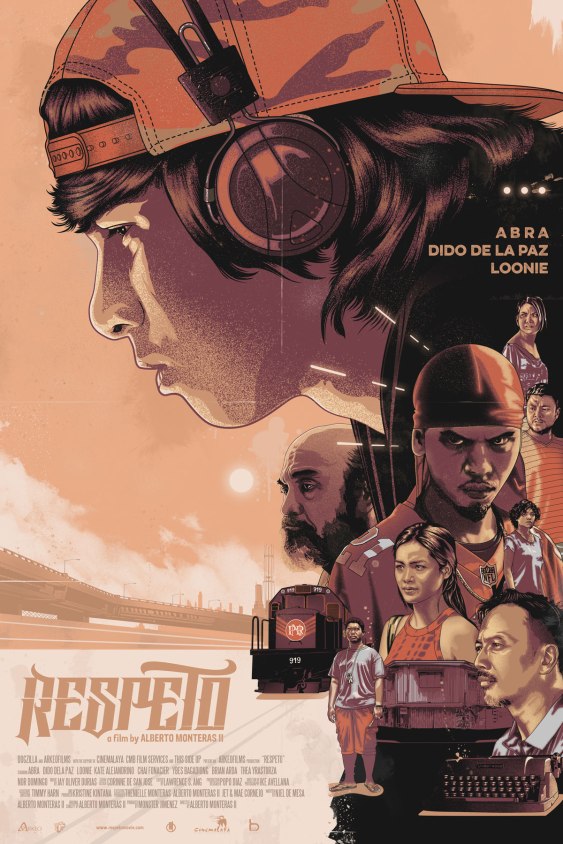
RespetoPoster.jpg

Penman for Monday, October 2, 2017


It would be easy and comforting to praise director Treb Monteras’ Respeto as a testament to the redemptive power of poetry, to art as a transcendent force in the universe—but it’s not that simple.

Yes, there’s quite a bit of that, and happily so for occasional poets like this viewer. We want to believe, in our heart of hearts, that poetry will save us, will elevate us from the sordidness of our surroundings and from our own sad and sorry failings. Two of my favorite quotations about poetry which I often bring up in class address that notion.

The first comes from that quintessential poet of the city, the Frenchman Charles Baudelaire: “When (like a poet) / the Sun descends into the city / It ennobles even / the vilest of its creatures.” So, poetry ennobles, raises up the poet from his or her pedestrian reality, no matter how vile that reality may be.

The second comes from Anne Sexton, who took her own life at age 45 after a long bout with depression, but who could still understand that “Suicide, after all, is the opposite of poetry.” Poetry was the life-force, the contributor to the poet’s heightened state of being, as Sexton would advert to in another line: “Saints have no moderation, nor do poets, just exuberance.”

These ideas were swilling in my head hours after my wife Beng and I stepped out of the cinema, still trying to figure out what I was supposed to think. We had missed Respeto during its Cinemalaya screening—they ran out of seats for us at its last showing—but had heard great things about it and weren’t about to miss it again during its regular run.

The movie itself isn’t hard to follow, even for a pair of senior citizens whose virgin ears opened up to Pinoy battle rap (always good to learn something new) for the first time. The Brockaesque descent into the urban jungle is such a familiar move for Filipino filmmakers (Hamog and Pauwi Na most recently come to mind) that it’s practically a given, but Respeto deepens the milieu by opening a door to the hip-hop subculture that many middle-class and middle-aged moviegoers have no inkling about whatsoever.

The fast and furious exchange of expletives aside, you could take Respeto as an Araby-type coming-of-age story where a young man falls for a woman, tries to gift her with something marvelous, and fails in the effort but learns something about himself in the process. Well, it’s a lot more complicated than that, because many other dualities and intersections abound in the story beyond just man and woman: that between youth and age (Hendrix, played by the ace rapper Abra, and Doc, played by Dido de la Paz), between apartment and slum, between bookshop and bar, between wisdom and wit, between Balagtas and Gloc-9, between Marcos and Duterte, and even between people who suffer and die for their beliefs and those who simply die out of poverty and crime. And perhaps, in the end, the movie asks, are they really so different? Is there some overarching reality that yokes them all together?

That reality seems to be that they’re all Filipinos living in the time of tokhang, a reality that pointedly intrudes into the narrative at key points and provides the inevitable climax. The environment seethes with menace and aggression—from the verbal violence (and blatant machismo) of the rap battles to the chilling corruption of the rogue cop Fuentes (played with understated competence by Nor Domingo). Without providing too much of a spoiler, I’ll just say that there’s no happy ending here, no triumphant reversals of fortune where the good guy bucks the odds, wins the prize, and gets the girl.

A perceptive review online by Tristan Zinampan puts it this way: “Respeto tells us that—given the cyclical oppression of Philippine society—going your own way, resignation, and apathy are not enough a vehicle to escape. Injustice is widespread; there’s simply no room to hide in this little archipelago. Just because you’re looking up, it doesn’t mean the chains on your feet aren’t there.”

Respeto’s Pinoy ‘hood is fertile ground for confrontation between good and evil in all their forms, with life and art insistently if desperately seeking to survive in the most hostile environments, even within the rap arena itself, where originality seems to be at a premium. The movie’s consistent use of a cemetery as a place for the creation of new art in words and images highlights this struggle.

Ultimately, however, at least for this viewer, Respeto affirms the inescapability of politics—especially the politics that kills—in our society, and its intrusion into our most private spaces, our most fervent dreams. There’s no doubt that the film draws much of its appeal from its running political commentary, but it’s less the topical references that create Respeto’s critical value for me than the power games that define it, some larger than others.

My takeaway isn’t a soothing one: poetry won’t save us, but guns—maybe even a rock—could, if that’s what it takes to overcome evil. And then again, the poetry—the truly great poetry, like all great art—will survive all of us: killers, victims, and bystanders alike. Catch Respeto the next chance you get, maybe on the campus film circuit, and tell me what you think.
 

Penman No. 270: Precedents for Presidents

IMG_3085.jpg

Penman for Monday, September 25, 2017


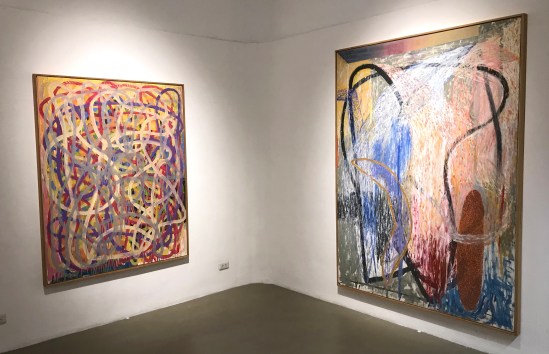
It’ll only be around for a few days more, but painter Rock Drilon’s latest exhibit at Galleria Duemila on Loring Street in Pasay City is worth looking into, if only to see how a master abstractionist is inspired by the idea and the experience of home. Titled “Homecoming: Works from Dumangas,” the show is the culmination of the past five years that he’s been staying at the Drilons’ ancestral home in Dumangas, Iloilo, after decades of living and working in the big city up north. He’d originally returned to his roots just to help out his aging mother, but the pull of the province proved too strong, and Rock found himself staying on for good.

This is the 61-year-old’s 50th-plus show, and if you’ve followed his career you’ll see familiar figures in his latest work—the loopy lines and amoeba-like shapes—suffused with color, predominantly pastel but pockmarked with black, like life itself. Of course, the wonder of—and, for many, the problem with—abstract expressionism is that a work can seem to mean anything and everything that the viewer brings to the picture.

Drilon cites Chabet, Dubuffet, and Basquiat among his major influences, aside from his mentor Joya, and it helps to appreciate their art as a whole to see a pattern among the patterns. One manifesto seeking to explain the school famously defined it as “violently opposed to common sense,” and you can see that in Drilon’s creations, whose subjects defy categorization but provoke intense examination. No soul-comforting churches, no sunsets, no ricefields here, only squiggles that could be both microbes and galaxies, as minute or as massive as our imaginations will make them. “Homecoming” is on until September 30.

RockD.jpg

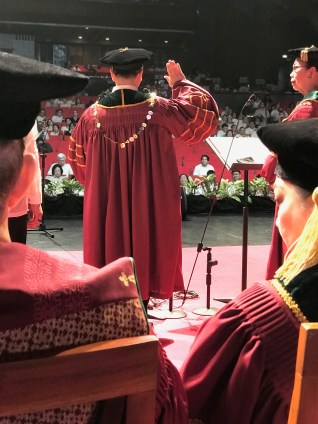
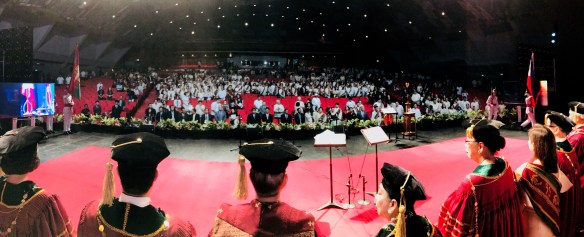
AN INVESTITURE, we’re told, is a “formal ceremony conferring the authority and symbols of high office, held during the new president’s first year in office,” and is a high point in the life of every university. Aside from the annual graduation, few opportunities exist for shows of pomp and circumstance—where the professors and administrators parade in full academic regalia—in universities like UP where egalitarianism is religion and simplicity of dress and manner are seen to complement sharpness of mind.

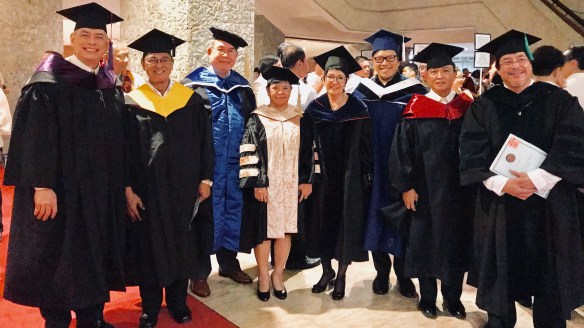
We had one at the University of the Philippines last Wednesday, in honor of our new president Atty. Danilo “Danicon” L. Concepcion, UP’s 21st, and it occurred to me that in all my 33 years in UP, I had somehow never been to one, although it’s taken place every six years in UP’s modern history. As one of his VPs, I had the honor of marching onstage, and so had a very special view of things.

The experience led me to dig into UP’s history of investitures, where I discovered more than few interesting factoids.

Our very first president, for example, wasn’t only a foreigner—an American—but also a clergyman, an Episcopalian pastor. His name was Dr. Murray Bartlett, and his investiture was held on December 20, 1911—three years after UP opened. About 2,000 students, teachers, and guests trooped to Padre Faura for the afternoon ceremony where—against the expectations of many—Bartlett argued in his speech for a “University for Filipinos” that would not merely copy US universities.

UP’s third president (after the Filipino jurist Ignacio Villamor) was again an American, and a Methodist minister—Guy Potter Benton—and his investiture in December 1921 was memorable not only for its lavish budget of P10,000 and a star-studded guest list that included Governor General Leonard Wood, Senate President Manuel Quezon, and Speaker Sergio Osmeña, but because of a feature that would never be seen again: the UP faculty wore all-white togas, which someone had thought more appropriate for the tropics. (It would be voted out the next year.)

Benton’s illustrious successor, Rafael Palma, had an investiture described as “austere,” but the word clearly did not apply to Don Rafael’s prolific pen, whose 8,000-word speech I clocked at about an hour and a half.

Flashing forward, Onofre D. Corpuz seemed to have spoken in the spirit of martial law when, in 1975, he scorned the notion of the university as a “battleground of ideas,” calling it “a romantic stereotype” which the people could ill afford to support with their taxes.

Edgardo J. Angara’s investiture in 1982 was besieged by a hostile crowd declaiming a litany of complaints—he had dared to start reforming UP’s ancient academic programs, and he would later reconfigure UP into constituent universities—but if anything, his raucous investiture would prove that you can get someone dead wrong, because Angara would go on to become one of UP’s best chief executives.

IMG_3077.jpg

These precedents were on my mind last week as I sat in my chair behind our new president, who made an impassioned appeal for the university’s constituents to find common ground, favoring “consensus over conflict, civility over calumny, and collaboration over confrontation.” UP, he said, should be “a clearing—a safe, free, and congenial space” within which its people could undertake “cutting-edge research, timely policy studies, exciting new exhibits and productions, and provocative art and literature.” (You can find the full text of his speech on www.up.edu.ph.)

We all cheered him on and wished him well—governing UP can sometimes be as difficult as governing the archipelago—and as we marched down the stage I felt more than a witness to history unfolding.

IMG_3088.jpg

Penman No. 268: What This Prize Should Mean to You (2)

IMG_2927.jpg

Penman for Monday, September 11, 2017


ONE OF the strangest moments of my life happened in 1993, when my first novel, “Killing Time in a Warm Place,” shared the grand prize with the late, great Tony Enriquez’s “Subanons.” The guest of honor then was none other than President Fidel V. Ramos, among whose speechwriters was none other than me.

There were four or five of us doing his speeches then, and the assignments were farmed out at random, and I can’t remember now if I accepted that Palanca Awards night job with delight or dismay. I suppose I could have swapped assignments with somebody else, but I had to think deeply about the situation. I was one of the awardees, so the young novelist in me wanted to sit back and hear my President’s sincerest thoughts about literature.

But the speechwriter in me also knew that those sincerest thoughts were just going to be written by somebody else in the room, so I figured, it might as well be me, to make sure that he would say nothing terribly wrong, and that he would say something very nice. And of course he did.

Incredibly enough, the same situation happened a year later, when I received a TOYM Award for Literature at Malacañang Palace, again from FVR. In both instances—because we ghostwriters preferred to remain spectral and worked far out of his sight—he had no idea that the hand he was shaking had also crafted his speech. In fact, it wasn’t until a few months ago, when I interviewed him for another book, that I finally introduced myself as the writer of 500 of his speeches, which remain on my hard drive. We had a good laugh.

I’ve written speeches for five Presidents and innumerable senators and CEOs, as well as the biographies of such diverse figures as Communist guerrillas, capitalist icons, and Marcos cronies. At any given time, I’m working on three or four book projects. I teach, write a weekly column, and peck away at stories, essays, poems, my third novel, and my unfinished oral history of the First Quarter Storm. And, oh, I also get to dress up and play the part of an academic bureaucrat.

I say this neither as a boast nor a lament, but simply to show that it’s all in a writing life. I’m happy and fortunate to have all of these writing jobs—although I must confess to being happier with some than others—because, despite all the challenges and compromises I have to face, this was what I signed up for.

Many other writers in this room have done the same thing, in varying degrees, both out of necessity and desire. Quite a few have approached me and said, “I want to do what you do,” but I wonder if they realize what they are asking for. I remember, early on, typing away at a commercial film script I had to complete, with tears streaming down my face, because what I really wanted to do was to join the Palancas, and I was out of time. That’s my greatest anxiety—to run out of time.

There will always be those who will scoff at what I do and who will insist that every word you write should be God’s own truth, as if that were humanly possible. God might as well smite all lawyers, copywriters, and PR professionals—and let’s throw in all politicians—with his righteous hand.

In a course I designed called Professional Writing, which I’ve been teaching for the past 20 years in UP, I begin every semester with this admonition: “There’s writing that you do for yourself, and writing that you do for others. And don’t ever get those two mixed up, or you’ll come to grief.” I also remind them that they can always say no, as I’ve done many times without regret.

If you embrace writing as a lifelong and life-sustaining profession rather than a weekend hobby, then you will not be writing every piece as if it were destined for the Palancas, although, as a professional, I do every job I accept as if it were my first, last, and only job, no matter how big or small.

But that again is exactly why we should value the Palancas. Too often, we lend our words to others. With these prizewinning pieces, we reclaim our words to ourselves, for ourselves, for whatever it was that first impelled us to write.

You remind me of that 21-year-old who, even as he had to write speeches, scripts, and stories for others, burned with the desire to write for himself and for his people at large—as this 63-year-old still does, awaiting blessed retirement 16 months hence so I can write the best of what remains in me to write.

Writing for the truth, writing for honor and glory, writing for the love of language—these are what your being here is all about, what the Palancas have existed for these past 67 years. While the generous cash awards are nothing to sneeze at—as the Foundation’s accountants will certainly attest to—the Palancas have always been about more than money. Your certificate tells you, this is how good you are; you look around you and you realize, that is how much better you can be.

This is our real reward, our hope, and our redemption. Whatever else you may have had to write or had to do, what you submit to these awards is your finest self, your truest words, your ineradicable proof of citizenship in the community of letters.

Let me quote President Ramos—well, in fact, let me quote myself: “It is both literature’s virtue and responsibility to reaffirm our fundamental humanity, and the unity of our interests and aspirations as a people. Every act of writing rehumanizes us, both writer and reader.” This is especially important in these darkening times, when megalomaniacal and murderous despotism threatens societies across the ocean, debases the truth, and cheapens human life. The best antidote to fake news is true fiction.

You and I have much to write about. You will not even need to wait until the next Palanca deadline to do what only you can do, and to say what only you can say. If you write for truth, freedom, and justice, and for the beauty and value of life itself, you will always be a first-prize winner in my book.

Penman No. 267: What This Prize Should Mean to You (Part 1)


IMG_2935.jpg

Penman for Monday, September 4, 2017


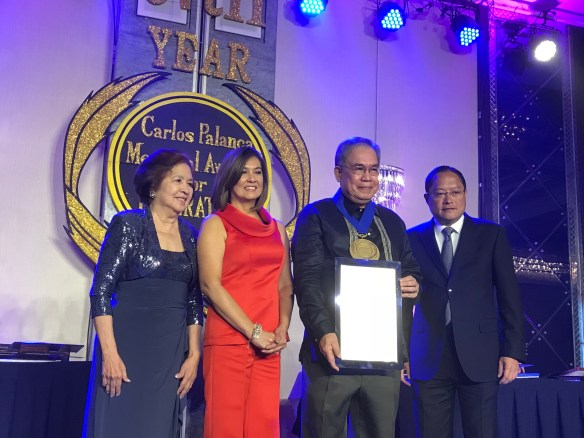
I WAS much honored to be the guest speaker last Friday at the 67th annual Carlos Palanca Memorial Awards for Literature, so I’ll share my talk with my Penman readers this week and next:

First of all, I’d like to thank the Palanca Foundation and family for this tremendous honor, which I honestly never expected to receive. For about forty years, I have been watching and listening to many very distinguished people at this podium explicating on literature and society—and you will forgive my bias if I say that the writers were usually more memorable than the politicians—but I never imagined myself to be in their exalted position.

Indeed I have been fortunate enough to join the Palanca Hall of Fame, but I am no literary genius or philosophizer. I have always introduced myself as a Swiss Army Knife of writing, a practitioner and professional who has made a living of his words. I was already working as a newspaper reporter at 18, before I won my first Palanca; I was a journalist beholden to the facts before I was liberated by fiction.

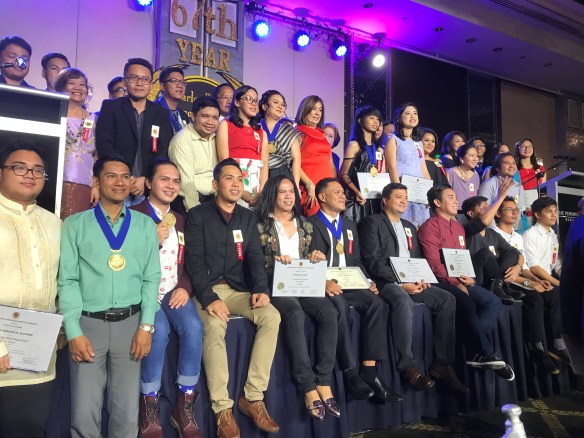
Tonight I will address myself mainly to the first-time winners in this audience, to those who entered the Rigodon Ballroom with an extra spring in their step and a sparkle in their eyes, with their parents or partners in tow.

I can tell you now that you will never forget this evening, as I have never forgotten my own introduction to this very special society of peers and comrades. It was on this day in 1975 that I won my first Palanca, a share of second prize for a short story in English. The awarding was held on the top floor of the company building in what used to be Echague—now, of course, Carlos Palanca Street—in Manila.

It was a little less opulent than this ballroom, but to that 21-year-old winning a prize the first time he joined, it might as well have been heaven, nirvana, and Camelot all rolled into one. I knew no one, and no one knew me, and I could only watch from afar as celebrated writers like Krip Yuson—who shared first prize in my category with Leo Deriada—regaled each other, likely with stories of their latest exploits in Ermita.

I still have my certificate from that ceremony: an elaborately hand-lettered work of art larger than a college diploma. Since I had dropped out in my freshman year and was working in a government office under martial law, I treasured that certificate as if it were my diploma, and had it framed. I’m told that the calligrapher who crafted those certificates has passed away, but his strokes remain indelible in my memory.

With my prize money of a couple of thousand pesos, plus some savings, I bought my first car—which tells you what kind of car it was: a canary-yellow 1963 Datsun Bluebird, battered but bright, into rehabilitating which I would throw many more years of good money after bad and not get even one day’s worth of driving, before my mechanic finally ran away with it. Years later I would get a call from the Quezon City police to inform me that they had impounded a yellow Bluebird registered in my name, and I could have it back if I paid the fee. I went over to take a look—the car’s tires were all flat, and it was riddled with bullet holes. I muttered an oath and a prayer and left it there.

So that’s what happened with my first Palanca prize, and one of these days if I turn that into a short story I might get some of my money back. But the most grievous consequence of that first victory was the fact that, for the next four years, I lost. I turned in entry after entry, and kept losing and losing. Considering who was winning—the likes of Gregorio Brillantes and F. Sionil Jose—I shouldn’t have been surprised, but I had to fight back the growing fear that my first Palanca was a joke.

In 1980 I won again, and soon hit my stride. It took 20 more years to enter the Hall of Fame, by which time I had published ten books, gone back to college, and begun another career as a teacher. I never joined the Palancas again, except to be an occasional judge, but I have come to these awarding ceremonies as often as I could, eager to witness the annual emergence of new literary talent.

I give you this overview of my long relationship with these awards to bring us to the subject proper of my brief talk this evening, “What This Prize Should Mean to You.” The quick and correct response, of course, is to say that a Palanca award will bring you honor, some fame—certainly bragging rights for your proud mama and papa—and even some money, if not for a car then for a weekend in Boracay or a new phone or laptop to replace the old one.

You will be walking on air for a couple of weeks, until the novelty wears off, the money is spent, and you return to the humdrum of teaching, call-centering, Uber-driving, or whatever it is keeps you and your family alive. You will discover that, to most people, your literary genius makes no difference and no sense. You will begin to wonder, as I did, if it was all a fleeting illusion.

Some of you will fall by the wayside, but most of you will press on, like we did, wanting this Cinderella moment to repeat itself year after year. It will not always happen, and you will learn to take your losses as well as your triumphs—those years I kept joining and losing became my real education—but if you keep at it, you will reach the point when the winning will matter less than the writing. That, I think, will be your greatest victory, the realization that these awards are but an enabler, a handmaiden of books that will be validated no longer by a panel of three judges but by a readership of thousands.

(To be continued)


Penman No. 266: The Pinoy Film Family

patay-na-si-hesus-movie-poster.jpg

Penman for Monday, August 28, 2017


LIKE MANY Filipinos, I really should see more locally made movies than the Hollywood and Netflix confections that have become our staple entertainment. That statement’s even more ironic in my case, having scripted about two dozen movies, mostly for the late Lino Brocka, between 1978 and 2003.

I missed out totally on this year’s Cinemalaya offerings because of a toxic schedule at work—I tried to catch Respeto on its last day only to find all the tickets sold out—so I made sure to make time for the Pista ng Pelikulang Pilipino the following week. I suppose I more than made up by managing to see four of the PPP entries over as many days: Patay Na si Hesus, Pauwi Na, Birdshot, and Hamog, in that order.

I might have chosen these movies because I’d heard good things about them, but I also wanted to see how they represented the Filipino family—for me an eternally fascinating subject, even from the days when Lino and I explored its complexity in such films as Tahan Na, Empoy and Inay. Filipino society (and politics, for that matter) is nothing if not about family, which seems inextricably connected to our struggles for survival—we survive for family, and also because of it.

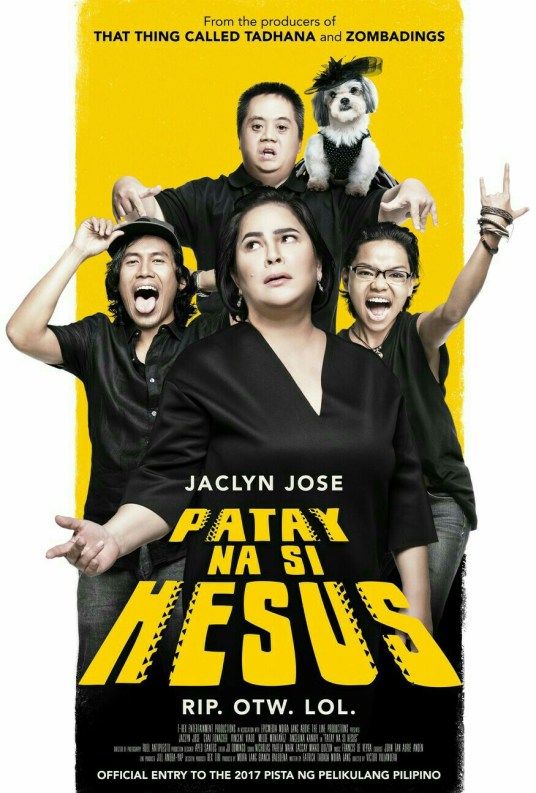
Directed by Victor Villanueva, Patay Na si Hesus has a long-estranged wife and now a widow, Iyay (Jaclyn Jose), drive her ragtag family in a minicab from Cebu to Dumaguete to attend the wake of her husband Hesus. Along the way and at the wake itself all manner of misadventure happens: a nun liberates herself, a lesbian relationship crumbles, a boy with Down Syndrome seems to get lost but actually finds his way, a coffin collapses, and a dog dies (curiously—and sorry for the spoiler—the three dogs in three of these movies all die). The dog’s demise has all the characters wailing and shedding the tears they couldn’t muster for the absent dad.

Pauwi Na is another family-on-the-road movie, with Mang Pepe (Bembol Roco) and his wife Remy (Cherry Pie Picache)—crushed by eking out an existence in the slums—transporting their brood back to the Pinoy fantasy of a paradaisical province, not by train or bus but by pedicab. Director Paolo Villaluna’s project is a long and laborious journey that ends in tragic loss, but the family’s dogged faith in a better life elsewhere infuses the film with both power and poignance. Mang Pepe is every Filipino tatay who’s gone the extra mile—many miles—to put food on the table and bring a smile to his family’s faces. (I’ll admit to having teared up remembering my own father, a highly intelligent man who wanted to become a lawyer but never quite got the right breaks, and who at one point had to work as a jeepney barker just to tide us over.)

Directed by Mikhail Red, Birdshot juxtaposes the coming-of-age of young Maya (Mary Joy Apostol) with the brutishness and brutality of political power in the rural hinterlands. The endangered eagle that she shoots dead is precious, but it’s hardly the most grievous loss the place suffers, although there’s little official interest in investigating the bigger crimes.

Hamog is set in another jungle—the bowels beneath and around Guadalupe Bridge, in the city’s slums and tenements where street urchins become almost feral in their predation. The movie is actually a diptych, an exploration of two lives—Rashid’s and Jinky’s—and it opens doors to what to most Filipino viewers would be unusual relationships (a Muslim man with several wives, a woman with a husband and a lover under one roof). While doubtlessly powerful, the narrative needed, I felt, a bit of rounding out, even assuming that its director Ralston Jover precisely wanted to make a point of leaving ends loose, as life often happens.

I’ve already mentioned the 100% mortality rate for canines in these scripts; another interesting parallel was the appearance of phantoms—Jesus Christ, a shadowy forest figure, Supergirl—in three of the films, which seemed more organic and necessary in Pauwi Na but too deliberately cinematic a touch in Birdshot and Hamog.

Their minor flaws aside, all four movies were well worth my time and money, and I was glad to see full houses for a couple of them, and appreciative audiences who clapped as the credits rolled. For someone who’s been out of the film industry for a while, it was heartening to witness such a wealth of new young talent—both on the directorial and acting sides (Chai Fonacier, who appears in the two road movies, has a great future ahead of her)—emerging to take over from the likes of Brocka, Bernal, de Leon, and the other masters of that generation. If I were to hand out my own awards just among these four, I’d give the top prize to Patay Na si Hesus, for its refreshing quirkiness and dark comedy.

What struck and impressed me from a writer’s perspective was the non-linearity of the plots and the moral ambiguity of the characters and situations—a far cry from, say, Brocka, in whose movies it was always clear who the villain was, and why.

Most important, of course, was to see how the Pinoy nuclear family had morphed in response to changing times—to nontraditional sexuality, to absentee parents, to the pressure to survive—and yet also to see the love and affection in it undiminished and even intensified by need. Bravo!


Penman No. 265: Photography as Propaganda

Empire.jpg

Penman for Monday, August 21, 2017


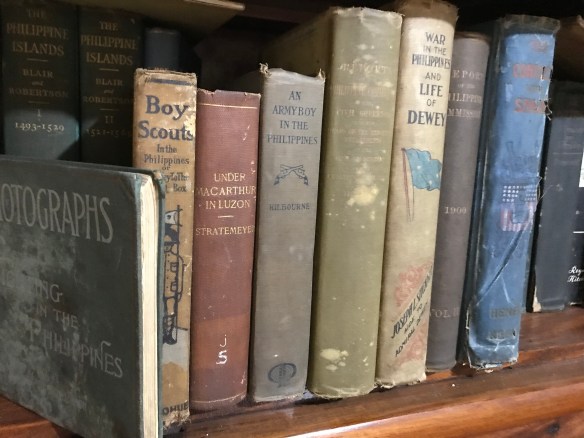
I HAVE a cabinet in my home office where I keep shelves of my most valued books—first editions, signed copies, antiquarian volumes, and such. One shelf is occupied by a special mini-collection of books from the turn of the 20th century, from the late 1800s to the early 1900s, most of them having to do with what we’ve come to call the Philippine-American War. Bearing titles like War in the Philippines and Life of Dewey, Under MacArthur in Luzon, and An Army Boy in the Philippines, the books purport to chronicle—“celebrate” might be the better term—the occupation of the Philippines by the United States from 1898 onward.

I picked up many of these books more than 20 years ago when I was a graduate student in the American Midwest and on the prowl for Philippine-related material in used bookstores and flea markets. When eBay came along, I found many more, and was pleased to secure a few, often for less than $20 plus shipping.

While old, these books weren’t necessarily rare, because they must have been printed in the high tens or hundreds of thousands as a form of patriotic propaganda that straddled journalism and popular entertainment. Often written in a triumphal tone and exulting in the victory of America—then a rising naval and imperial power—over decrepit Spain, they blended into travelogues exploring the US’ new possessions—Cuba, Puerto Rico, Hawaii, and the Philippines—turning a military project into a story of adventure in exotic lands.

Shelf.jpg

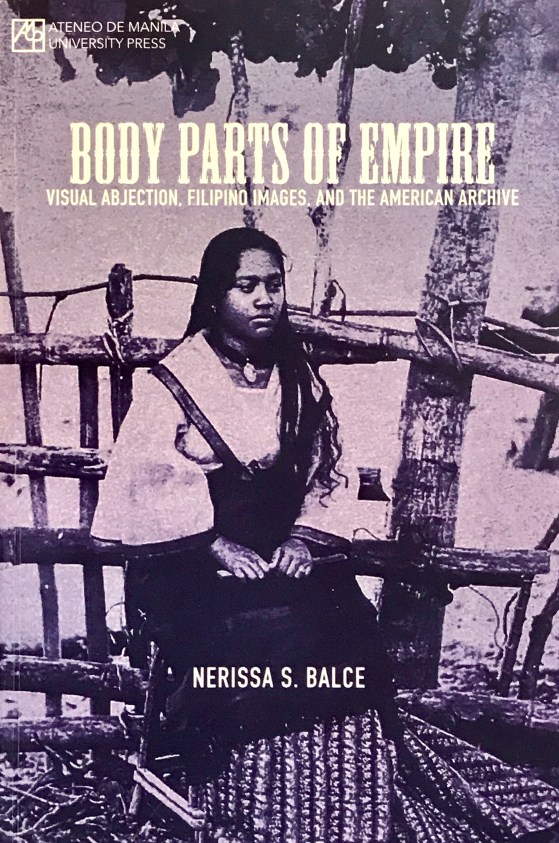
These stories—and their accompanying illustrations—were very much on my mind last week when Beng and I attended a fascinating lecture at Ateneo de Manila University by an expert who had made that dark period (which few Americans and, sadly, just as few Filipinos seem to remember) part of her academic specialty. Dr. Nerissa Balce was in Manila to read from and talk about her book Body Parts of Empire: Visual Abjection, Filipino Images, and the American Archive (AdMU Press, 2017; U of Michigan Press, 2016), and we thought it was a good opportunity to catch up with and learn from an old friend (she married my Trivial Pursuit antagonist, the poet Fidelito Cortes).

After working as a journalist in Manila, Nerissa went to the University of California-Berkeley for a PhD in Ethnic Studies, took a postdoc at the University of Oregon, and taught at the University of Massachusetts-Amherst before joining the State University of New York-Stony Brook’s Department of Asian and Asian American Studies.

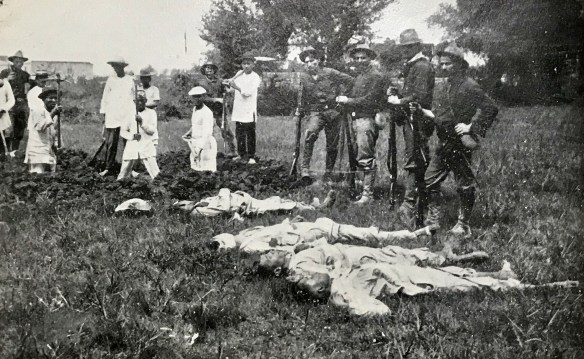
Through photographs and a refreshingly lucid lecture shorn of much of the academic jargon that often renders these presentations impenetrable to many listeners—even fellow professors like me—Nerissa showed how American photographers who were (to use a later term) embedded with the US military forces used their work to celebrate but then also obliquely if unintentionally criticize the violence of a colonial war. Photographs, she would argue in her book, have a life of their own, once taken and published; they may have been originally meant to depict the power of one side over another, and the abject position of the presumptive loser in the conflict, but seen or used a different way, they can convey other messages, like the subject’s insistent humanity or resistance.

I’d seen many such images in my books from that war; one of them—F. Tennyson Neely’s Fighting in the Philippines—typically portrays American soldiers towering angularly over the slack corpses of Filipino “insurgents” (as our fighters would be referred to for the longest time) as Filipino gravediggers prepare to bury their compatriots. This was what Washington wanted the American public to see: visual proof of American power and dominance. It must have been effective propaganda, especially when accompanied by narratives explaining America’s “civilizing” mission.

Soldiers.jpg

But, as Nerissa and other scholars point out, the very same photographs proved useful to those opposed to America’s imperial expansion. The Anti-Imperialist League published a collection of antiwar poems using a picture of a corpse-filled trench as its frontispiece. “The different political uses for the same photograph suggest the paradoxical power of the photographic image, and how photographs can celebrate as well as expose the violence of colonialism and war.” She goes beyond the battlefield to discuss how the empire shaped our image, and how that image, in a way, shaped the empire. Pictures of native women doing embroidery suggested a colony stabilizing into happy domesticity under a benign regime.

I’m not a historian, but if you want a reasonably reliable account of that period, read Brian McAllister Linn’s The Philippine War 1899-1902 (The University Press of Kansas, 2000); to see how that war was waged on the cultural front, Balce’s book makes a great companion piece. In this present time when, more than ever, pictures speak louder than words, and dead men’s bodies have begun to pile up again, we’d have to wonder what new empire is growing out of the shadows.

ph-china-drugwar.jpg

[Photo from philstar.com]


Penman No. 260: Meeting Major Kennon

Kennon

Penman for Monday, July 17, 2017


MY RECENT visit to the University of the Philippines Baguio and its new Museo Kordilerya, on which I reported last week, reminded me of another Baguio-related question which I’d been asking for some time now—in fact, every time I rode up or down Kennon Road, as I did last month. My question was, “Who was Kennon?”

I recall having found the answer to that in pre-Internet days—that he was an officer with the US Army Corps of Engineers who brought hundreds of Japanese laborers over to work on the road—but I didn’t know the details until I actively sought them out online.

 What happened to rekindle my interest was one of those early-morning trawls through eBay, where I typically look for Philippine-related material like old books, maps, and postcards, especially UP memorabilia. Prize finds have included a December 1922 issue of the Philippine Collegian, and the first English edition of Paul P. de la Gironiere’s Twenty Years in the Philippines, published in London in 1853.

I buy them when I can afford them, seeing it as my mission of sorts to repatriate these artifacts from the great indifferent and unknowing void out there, but most of the time I enjoy myself just going over the images on eBay and saving them to my hard drive—postcards of Escolta ca. 1910 and 1950, portraits of Carnival Queens from the 1930s, and press photographs of fleeting personalities like the Huk guerrillas William and Celia Pomeroy upon their arrest.

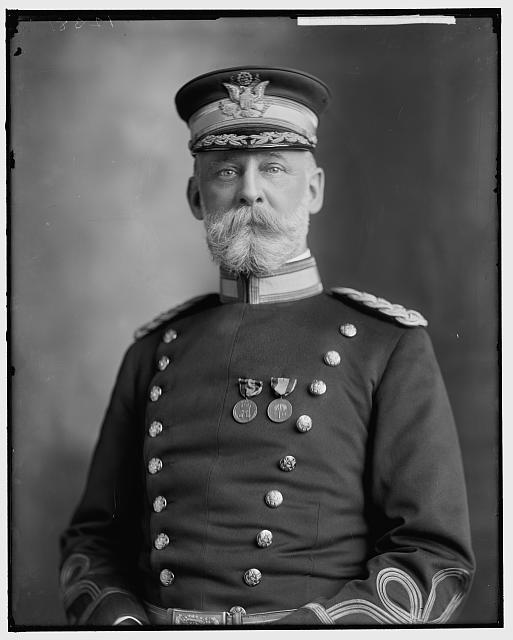
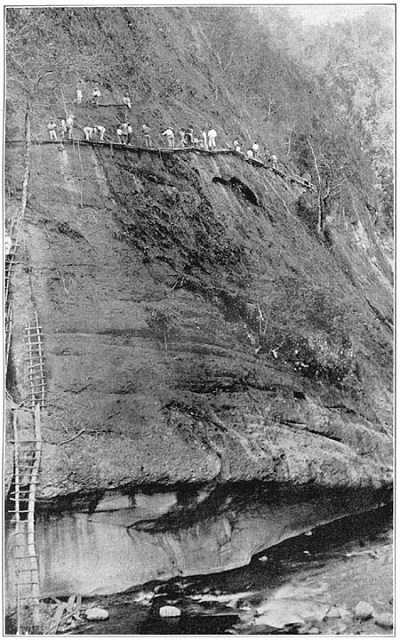
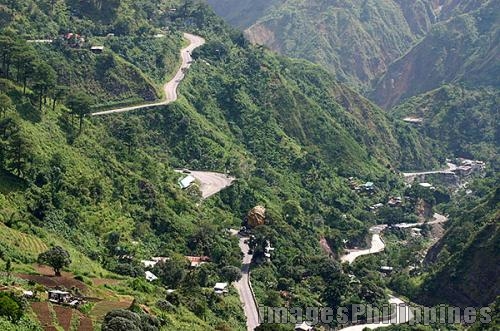
A postcard of Kennon Road—that 33.5-km stretch of zigzag road from Rosario, La Union to Baguio City—prompted me to ask again, “Who was Kennon?” Some Googling and a quick visit to Wikipedia yielded the information that Lyman Walter Vere Kennon (1858-1918) was a decorated US Army officer, a veteran of the Spanish-American War who was a major when he moved to the Philippines in 1899 after postings in Central America and Cuba. He served as the military governor of Ilocos Norte before going down to Mindanao, where he built the road linking Iligan to Lake Lanao. Then he went up north again to work on what would be called, in its early years, the Benguet Road. He finished it in two years, one year ahead of schedule, but not without much toil and sacrifice.

Benguet-Road

The real gem of that Google chase turned out to be an article by Kennon himself—a report he submitted to his superiors in August 1905 and reprinted by the Baguio Midland Courier in September 1957, the full copy of which you can read online here: http://www.baguiomidlandcourier.com.ph/centennial_article.asp?mode=centennial/supplements/kennon.txt.

In that report, Maj. Kennon lays out the scope of the task ahead of him: “The plateau (was) most difficult to access. The first explorers reached it only by following the steep, slippery, dangerous, and obscure trails of the native Igorrote. To make the highlands of Benguet accessible to the white man, the Spaniards, towards the end of the last century, built a horse trail from Naguilian to Trinidad and Baguio and planned an extensive sanitarium and other buildings in Baguio. Insurrection and war prevented the carrying out of the project.

“Soon after the American occupation the manifest need of some such institution was recognized and the Government decided to carry on into effect as soon as practical the plans of its predecessors. Baguio could practically be reached only from San Fernando and Naguilian, necessitating a sea trip of twenty-four hours from Manila and two or three days of horseback travel over a steep trail built by the Spaniards in 1892. In the stormy season, steamers were frequently a week in going from Manila to San Fernando. Evidently, such a trip was quite impossible for invalids and convalescents.”

Less than 18 months after they surveyed the terrain, Kennon could report that “This work had been done between the dates of Aug. 16, 1903 and Jan. 29, 1905—that is to say, in seventeen and one half-months. At the former date, the most optimistic prediction allowed three years for the opening of the road, ‘if it could be done at all.’ Others said it would take 20 years of work, some of the foremen on the road considered that they had ‘a life job.’”

Of course, Kennon’s triumphal report wasn’t the only side to that story. Kennon had imported large numbers of Japanese and Chinese workers to speed things up, and some of those workers stayed on, becoming part of Baguio’s rich cultural heritage. (As the late historian Lydia Yu-Jose would note, however, the real influx of Japanese immigrants would follow later.) Some of those encounters would prove almost unbearably bittersweet. Sinai Hamada’s classic love story “Tanabata’s Wife” draws on that experience, as does this story, recounted here: http://www.filipiknow.net/tragic-story-kato-brothers-benguet/.

Kennon died a brigadier general in 1918, a week after his 60th birthday, unable to join the war in Europe because of poor health, and likely a victim of the Spanish flu epidemic that decimated the global population that year. While a postcolonial view of Kennon Road would have the 4,000 anonymous workers who built the road as its real hero, it can’t hurt to remember or at least know the man who once looked up that mountainside and saw a ribbon of a road in his mind’s eye.

012506_174853

(Photos courtesy of Erwin Tiongson, Project Gutenberg, and imagesphilippines.com)


Penman No. 259: A Showcase of Cordillera Culture

IMG_2071

Penman for Monday, July 10, 2017


I WENT up to Baguio a couple of weeks ago to give the commencement address before the Class of 2017 of the University of the Philippines-Baguio (UPB), and began my talk by reminiscing how, as a young boy, “I eagerly anticipated visiting this city, which used to involve a train ride to Damortis, La Union, before transferring to a bus that would wind its way up Naguilian Road. I recall my nostrils tingling when they caught the scent of pine. In high school in the 1960s, Baguio meant the CMLI, Teachers Camp, marching on Session Road to proclaim ‘student power,’ pretty faces from a school called St. Theresa’s, and a dark and exciting place called the Basement—which some of your older teachers might remember.”

You can find the rest of that speech on my blog at http://www.penmanila.ph—it seems to have acquired a life of its own—but the real highlight of my Baguio sojourn turned out to be a visit to the new Museo Kordilyera on the UPB campus along Gov. Pack Road.

UPB, you have to realize, is unique among UP’s campuses in that it sprawls all over a hilltop, so that anything you build on it has to adapt to its challenging topography. When you think of what the builders of the Rice Terraces had to do, you get an idea of how creative and adaptive UPB’s architects have had to be to maximize the use of its property, keeping aesthetics in mind as well as safety, in this earthquake-troubled city.

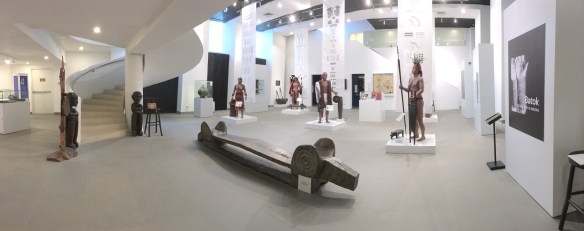
UPB Chancellor Ray Rovillos, himself a historian and one of UP’s most capable administrators, had offered to take us on a personal tour of the new museum the day after graduation, and Beng and I happily took him up on it. The three-level Museo looks little more than a glass box with a few exhibits at ground level, but it’s when you take the stairs going underground that your jaw falls at seeing what UPB’s combination of careful scholarship, administrative commitment, and sheer perseverance has produced.

Formally opened last January under the administration of then UP President Fred Pascual, the museum draws on the curatorial work undertaken by Professor Emeritus Delfin Tolentino, Jr., Prof. Victoria Diaz, archivist Cristina Villanueva and museum director Dr. Analyn “Ikin” Salvador-Amores.

IMG_2050

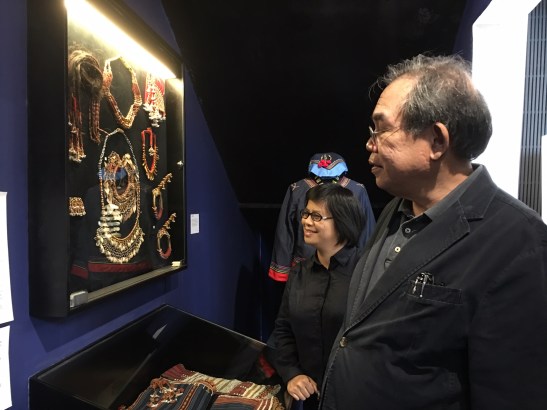
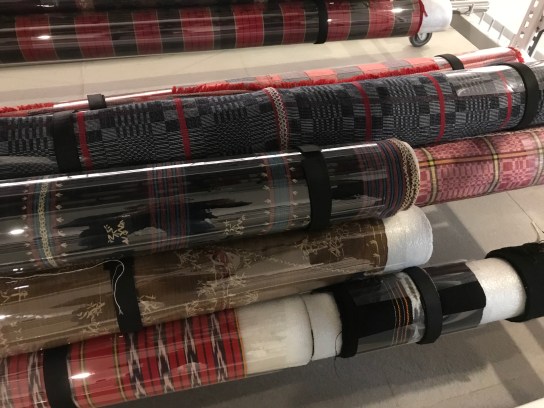
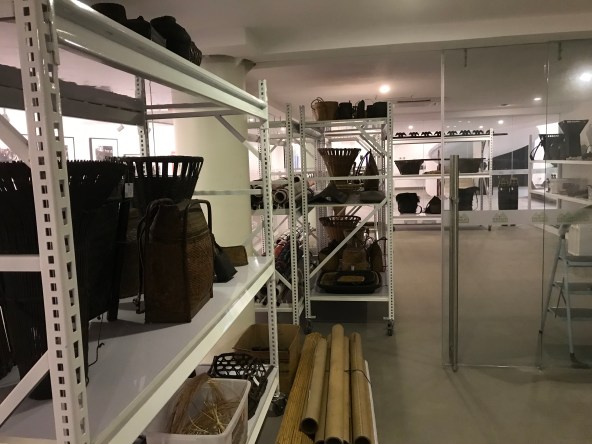
What immediately catches the eye, of course, are the life-size representations of various indigenous people in full tribal dress and gear—so accurately researched, Ikin would tell us, that some people in the community didn’t even know their ancestors had worn them. Going over the intricate weaves and beadwork, Beng and I exchanged stories with Ikin about similar objects we had seen deep in the bowels of Chicago’s Field Museum. While part of the museum’s mission is the visual showcase for the public, an equally important aspect is the scholarly research it hopes to engender. Century-old artifacts are kept in cabinets, yet to be studied, and donations from collectors are welcome to deepen the museum’s holdings.

IMG_2083

A Ford Foundation scholar at Oxford University, Ikin had published a landmark study titled Tattooing Ink, Tapping Identities: Tradition and Modernity in Contemporary Kalinga Society, North Luzon, Philippines (Quezon City: UP Press, 2013), the culmination of a long fascination with the practice and origins of tattooing that began with an encounter with an old woman in Baguio’s market almost 30 years ago.

A corner of the museum is devoted to books published by the UP Press and by the Cordillera Studies Center, which has established itself as the most important source of expertise in its area. Prominently displayed are the three excellently written and produced monographs that accompanied the launch and opening exhibits of the Museo Kordilyera: Batok (Tattoos): Body as Archive by Analyn Salvador-Amores; The Indigenous, In Flux: Reconfiguring the Ethnographic Photograph by Roland Rabang; and Jules De Raedt: Life Works, Lived Worlds by Victoria Lourdes C. Diaz. Anyone wanting deeper insights into the ways of the highlands would do well to consult June Prill-Brett’s Tradition and Transformation: Studies on Cordillera Indigenous Culture (Baguio City: Cordillera Studies Center, 2015).

Worthy of commendation for the museum’s modern but welcoming design is Architect Aris Go and the 90 Design Studio team that has been helping Chancellor Rovillos and UPB make the most of their limited space—a service Aris has also extended to UPB’s new and handsome Science Research Center, another fine example of environmentally adaptive architecture.

The UPB people were eagerly awaiting the visit of one of the country’s most fervent advocates of indigenous culture and arts, Sen. Loren Legarda, which was planned for mid-July. Knowing the senator’s passion for all things Filipino, I urged Ikin and Chancellor Ray to secure further support from her for the museum and its adjoining auditorium, which will host many conferences on indigenous culture in the years to come.

Besides the ube jam and peanut brittle at Good Shepherd—and, of course, the splendid art exhibits and architecture to be found in the Bencab Museum on Asin Road (Bencab has donated some of his most important pieces to the UPB museum)—Baguio visitors now have another must-see stop on their itinerary. The Museo Kordilyera is open Tuesday-Sunday 9 am-5 pm for a nominal entrance fee. For more information, check out its Facebook page here: https://www.facebook.com/upbmuseokordilyera/.

IMG_2084

Penman No. 258: A Boost for Art Education

IMG_2106

Penman for Monday, July 3, 2017


I WAS going to write about something else this week, but it’s impossible to avoid the elephant in the room, Ferdinand Cacnio’s sculpture “UPLift,” which has already stirred the biggest art controversy of the year on social media. That it’s happening almost literally on our front yard in UP Diliman makes it even more imperative for me to say something, as people have been asking me to do—given that, with “Vice President for Public Affairs” as my official day job, I’m supposed to speak for UP on matters of public interest, and you can’t think of something more public than sculpture.

That’s also exactly why I have to preface whatever I’ll say here with the disclaimer that I’m writing and speaking today as Butch Dalisay the arts columnist rather than Dr. Jose Dalisay Jr. the university spokesman, if you can separate the two.

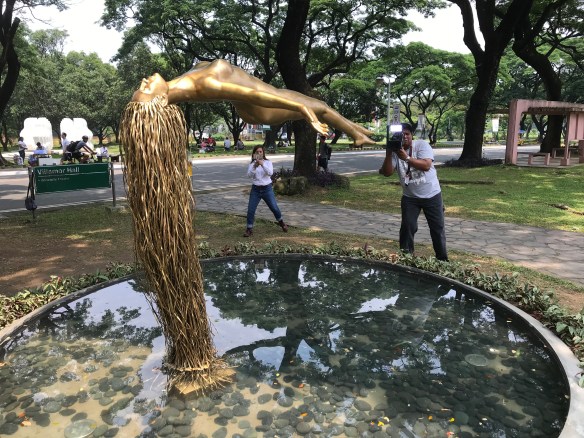
With that out of the way, let’s lay out some basic facts. Sometime ago, the UP Class of 1985 Council—a UP alumni group—initiated a project to install the Cacnio sculpture in front of the UP Theater as its donation to inspire “honor and excellence” in the UP community. Smaller versions of the statue were sold to help finance the project. The sculpture was completed and installed, and when the public saw the figure of the nude, golden lady levitating in the air, held up magically only by her hair, their reactions ranged from delight and wonderment to curiosity and agitation—and, sadly, suggestions of plagiarism.

Word began to spread online that the Cacnio piece too closely resembled the Dutch artist Elisabet Bea Stienstra’s 2001 sculpture “Virgins of Apeldoorn”—a charge that Cacnio stoutly denied; he had never, he said, seen the Stienstra work. Soon, as images of other levitating figures in global sculpture emerged, a lively and impassioned discussion erupted over the possibility of plagiarism and the even larger issue of the work’s representation of its subject.

So, what do I think?

First, plagiarism: the similarities may seem obvious, but then so many things in life and art are similar, whether by nature or by design, or even lurking in a kind of universal subconscious. The basic forms we encounter in everyday life—the human face and body, four-wheeled vehicles, trees, birds—are after all pretty much the same. (While we’re at it, just count the number of statues of naked men with arms outstretched that you can find online, from ancient Greece to Africa.) Most portraits follow the same format, even the same pose, but no two faces will ever truly be the same.

When two art pieces are so strikingly alike, it’s almost pointless to state the obvious—that one is a “copy” of the other. Rather, it’s much more fruitful to observe and study the nuances that separate the two. When you come to think of it, art is much more about differences than similarities. And let’s not forget that we live in an age of parody and homage, of memes that recycle the same fundamental image, with incremental changes.

As the painter Imelda Cajipe Endaya pointed out, however, worthier of discussion than plagiarism is the politics of representation: does the piece truly elevate women, or does it—being naked and supine—merely repeat what too many (and often male) artists have already said about women? (This reminds me how, in 1989, an anonymous group of women artists calling themselves the “Guerrilla Girls” plastered New York with posters asking, “Do women have to be naked to get into the Met Museum?” They were responding to a 1984 MOMA show that had only 13 women out of a total of 169 artists.)

With all due respect to the artist whom I’ve never met, my own sense—and here I go with my street-level appreciation of the work—is that it was in a way too passively traditional, that it missed an opportunity to highlight aspects of the female body and psyche other than its idealization.

I know how annoying it is for artists to hear comments like this, but criticism comes with the territory, even if I firmly believe the artist’s freedom of expression to be paramount, indeed near-absolute. It’s tempting and natural for viewers to wonder how the same idea might be worked by another artist—say, Agnes Arellano or Julie Lluch (or the American M. L. Snowden). That kind of speculation, while moot, is also part of our education.

As I told the TV journalist who interviewed me as UP VP about the controversy (and this is as official a statement as I can make), “The work in question was donated and accepted in good faith. Matters of artistic judgment and intellectual provenance are probably best resolved by artists themselves, by courts of law, and perhaps ultimately by the court of public opinion.”

No matter how “UPLift” appeals to us (or not), we should thank its creator for making this discussion possible, because very rarely does art capture the public imagination, as this work has. It’s certainly been worth a semester’s classes in Art Appreciation.


Our responses to art are conditioned by our experience, our preferences, and our projections—in a sense, by what we expect to get out of the work or what want it to be.

Penman No. 257: Wonder Woman in the House

IMG_2264

Penman for Monday, June 26, 2017


OVER MOST of the 43 years that we’ve been married, Beng has learned—not without some resistance—to resign herself to being introduced as “the wife of Butch Dalisay” (whatever that means). Lately, I’m happy to report, more of the reverse has been happening. I’ve been attending art events where I’ve tagged along as the quiet husband, content to watch Beng take center stage.

To step back a bit, center stage was where Beng (aka June Poticar) was when I first saw her in college. She was in UP a bit earlier than I was (although you’d never have known it just by looking), and I had a crush on her, but I didn’t think she was going to give me the time of day back then. She was a member of the University Student Council, where all the cool people were, representing Fine Arts; I was a scrawny freshman pecking away at a noisy manifesto in a corner. I admired her most when, sometime in 1971, she led the making and unrolling of the probably biggest wall painting ever made in Philippine art history, a protest piece occupying several floors of the Library building facing the Sunken Garden. I was a reporter for the Collegian, and I wrote up that story, not knowing that the girl behind the mural was going to be my wife just three years later.

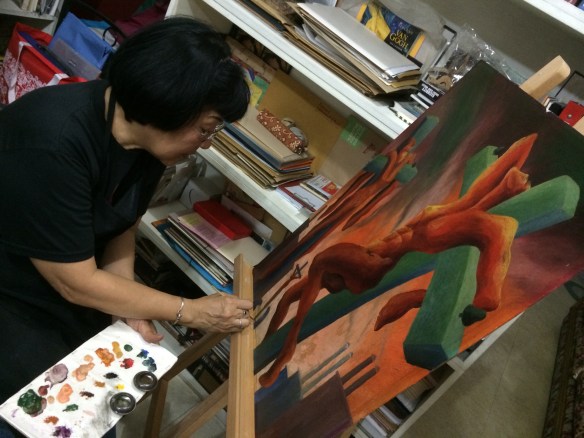
We’ll save the love story for some other time, and flash forward to 2017. After variously working for many decades as a fashion designer, a jewelry designer, a graphic artist, and a watercolorist (as well as, of course, a wife and mother), Beng has found her métier and been recognized as an art restorer and conservator—one of the country’s best—and no one could be prouder than her writer-husband.

I was invited to Iloilo last May to speak at an international conference on intangible heritage, which we both enjoyed attending. But I’d have to admit that I was more anxious to attend Beng’s lecture that same week at the University of San Agustin, which had asked her to speak on art restoration before a group of young local artists.

It’s been almost 20 years since Beng joined a group of other Filipino professionals for an intensive, year-long training program in art restoration and conservation put together by the Agencia Española de Cooperacion Internacional, the National Museum of the Philippines, and the National Commission for Culture and the Arts. That turned out to be a life-changing experience for many of them—certainly for Beng, who put up her own art-restoration company and has trained other people in this very small but absolutely necessary occupation.

ThenandNowFinal

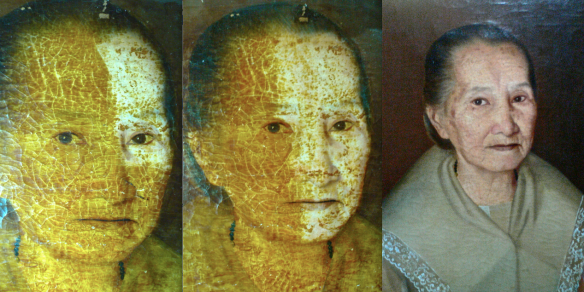
Since then, I’ve watched her and her team patiently bring scores of priceless paintings and other artworks by the masters back to life, from the partial restoration of Juan Luna’s Spoliarium, which had suffered a tear, and many other works by Amorsolo, Manansala, Botong Francisco, HR Ocampo, Fernando Zobel, Anita Magsaysay-Ho, Araceli Dans, Bencab, and their peers (once, even a Miro print).

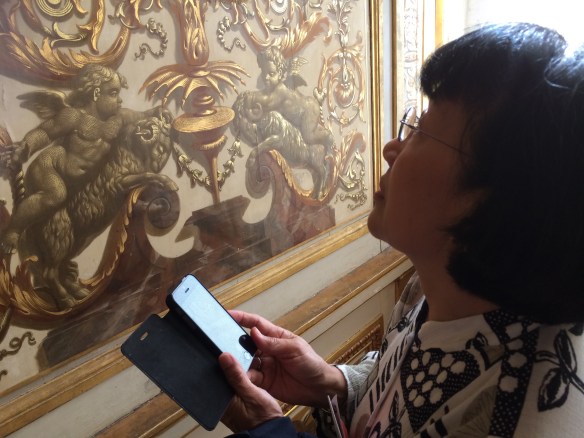
I’d have to admit that I’m more scared than she is when she applies her brush to a century-old canvas, or cleans up the browned varnish on an Amorsolo with a Q-Tip, and I’m sure my mouth hangs open in wonderment when I see the magic happen, but she’s cool as a cucumber, knowing precisely what she’s doing. I nearly scream when we visit museums like the Louvre and the Prado and she comes to within a centimeter of a Renoir or an El Greco to scrutinize the restoration job.

IMG_4335

That’s the woman I saw transforming a roomful of young Ilonggo artists—almost all of whom had never met or even heard of her before—from curious and polite listeners to an animated gaggle eager to practice on their own artworks. I sat like a mouse in a corner of the room as Beng explained the basics and intricacies of scientific art restoration which, as she pointed out, isn’t really taught in art school in the Philippines. (Sadly, not even in UP; you’d think that with the number of beautiful and valuable paintings moldering away in this country, we’d be awash in art restorers, but there’s been very little interest in putting it on the curriculum, probably because there are very few qualified practitioners to teach it.)

IMG_1754

Beng’s lecture and demo in Iloilo was a preview of what a full course should be, where she discussed some basic principles—reversibility, compatibility, durability (“Less is more; don’t do anything that isn’t necessary; always make sure that whatever material you add for patching and grafting is weaker than the original linen or cotton,” etc.)

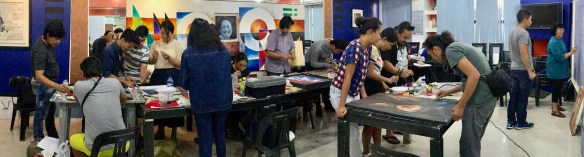
“My practice of restoration has led me to certain discoveries and I now use non-toxic ingredients to remove stubborn and deeply ingrained dirt and old discolored and hard-to-remove varnish. I have discovered new sources of local conservation materials that have lowered the cost of restoration. I have also developed my own techniques in closing and flattening cracks, softening and correcting dents, and patching tears and holes,” she wrote for Perro Berde, a publication of the Spanish embassy here.

“I’m no Wonder Woman,” Beng says when I tease her, but I suspect she had it all planned out. When she established her company 18 years ago, she chose the name “Artemis,” which English-major-me knows is another name for Diana. I better be careful.

IMG_4002