Penman No. 304: Revisiting the Print

IMG_6410.jpg

Penman for Monday, May 28, 2018


I usually reserve my weekends for truly enjoyable things, like rummaging through Japanese surplus shops or just driving down south for a hearty lunch of steaming bulalo cooled off by fresh buko juice, but there was one event a couple of Saturdays ago that I wasn’t going to miss for the world.

This was “Tirada,” the 50thanniversary retrospective show of the Association of Pinoyprintmakers (A/P, formerly known as the Philippine Association of Printmakers, or PAP) at the CCP. I recently wrote about this group when I brought up my obscure and distant past as a printmaker in the early 1970s, when I’d just stepped out of martial-law prison and was looking for something to do while I didn’t have a real job.

I turned to printmaking for a couple of years to help support myself, and those times at the PAP studio-headquarters on Jorge Bocobo Street in Ermita turned out to be one of the most instructive and wonderful periods of my life, as I immersed myself in the intricacies—and the backbreaking labors—of printmaking.

PAP50.jpg

(With Pinoy printmakers Benjie Cabrera, Jess Flores, Bencab, and Egay Fernandez at the AP retrospective.)

Despite its long and glorious history, printmaking remains misunderstood and underappreciated by many. The fact that printmakers will often make multiple copies of the same work seems to debase the value of the work in the eyes of art buyers looking for something totally unique, like an oil painting. But printmaking’s great contribution to art was precisely its democratization, by making art accessible to many, beginning with the engravings that illustrated old books and newspapers and lent visual credence to literature and journalism. Prints also adorned books on anatomy, horticulture, geography, and astronomy, among others, without which science could not have progressed.

It was an imaginative step to move from the print as functional appendage to the print as an art form in itself, and many artists took that step because it offered a fascinating alternative, with its own fresh challenges, to the sometimes staid art of painting. Prints require a heavily physical and tactile engagement with one’s tools and materials, like sculpture, working with plates, inks, papers, and presses.

Back in the PAP days—employing techniques that hadn’t changed much since Durer and Rembrandt used them centuries ago—we drew designs on zinc plates coated with an asphalt “ground,” soaked them in nitric acid which ate away the designs, cleaned and inked the plates, then rolled them onto paper under enormous pressures to produce etchings. (Today printmakers use polymer plates, not metal—a technique I’ve yet to learn, not having touched a burin or engraver’s tool in over 40 years. The Japanese, of course, used wood, and others use linoleum and stone for their material.)

The PAP was formed in 1968, led by such pioneers as Manuel Rodriguez, Sr. By the time I found my way to Jorge Bocobo five years later, its regulars included the likes of Orly Castillo, Manolito Mayo, Fil de la Cruz, Jess Flores, Joel Soliven, Rhoda Recto, Petite Calaguas, Benjie Cabrera, Fernando Modesto, Bing del Rosario, and Emet Valente. Some days I’d watch Bencab and Tiny Nuyda at work, or just listen to their banter, which was just as valuable to the salingpusaI was, eager for a whiff of the artistic life (I would become a full-time writer a few years down the road).

Some of those stalwarts have since passed on, but seeing their works on display at the CCP—alongside a whole new generation of brilliant Filipino printmakers—revived happy memories of the kind of camaraderie that AP leader and master printmaker Pandy Aviado referred to in his remarks. Painting can be a lonely art, and perhaps it needs to be, but printmaking typically attracts the collective assistance of others, as physically strenuous as the work can get.

My solitary contribution to the show—a 1975 etching of my grandmother—proudly hung beside one of Bencab’s in the corridor outside the main gallery, but I felt happiest just to share the company of old friends from another branch of the arts that I’d stepped away from, perhaps too quickly. I remembered the sheer exhilaration of lifting the dampened paper off a pressed plate to see one’s design in vivid ink, a joy tempered but also deepened by the intensity of filing away and smoothing out the rough edges of a zinc plate, or inhaling a vinegary cloud of acid, or pouring cold lacquer thinner onto one’s fingers to wash away the grime.

“I wish we had a small etching press at home,” I found myself telling Beng—only to be told by a new acquaintance, the artist Angela Silva, that the renowned Raul Isidro had one, or a few, to sell, having commissioned a raft of them to help spread the faith. I made a beeline for Raul, and then and there reserved myself a unit, with Beng’s blessings.

I’ve decided to return to printmaking in the most old-fashioned way with a technique called drypoint, scratching out my designs with a sharp tool by hand on a copper plate. I can just see how busy my retirement’s going to be a year hence—and how messy. But what a marvelous mess I hope to make.

IMG_6393.jpg

(With artist Raul Isidro, receiving my baby press. The print above is Joel Soliven’s “Owl70” from my collection.)

Penman No. 303: A Gentleman of Letters

EdMaranan

Penman for Monday, May 21, 2018


IT’S BEEN an awful season for writers and lovers of art, as I noted last week. I thought that the passing of Edgardo B. Maranan last May 8 was going to be the last of these woeful events, but no sooner had I spoken at the necrological services for Ed than I was being asked to help put similar rites together for Senator and former UP President Edgardo Angara, who died a few days later on May 13. What an odd coincidence, I thought—first, we lost the two Totis (Bautista and Villalon), and now we were bidding two Eds goodbye.

But among all of those who left us, I felt that it was Ed Maranan whom I knew best. I’d written a biography for Ed Angara, but biographers never really josh their subjects, the way I could do with Ed Maranan. Ed M. invited that, because he dished out a lot of humorous banter himself, even and especially in the worst of times. He could have been in excruciating pain—and I’m sure he was, in his worst days—but he just couldn’t pass up a chance to play with words, as all true writers do.

Most of the eulogies delivered at Ed’s brief wake memorialized and lauded him for his activism—Joma Sison even sent in a statement from Utrecht praising Ed as a “communist,” which he was, at least at some point, as far as I knew. But the Ed I chose to remember was no dour doctrinaire. He loved and enjoyed life immensely (not that communists don’t), and I never heard him spout the Party line; he was too spontaneous, too freely minded, for that.

He was older than me by some eight years, but Ed and I belonged to the same generation of playwrights in Filipino who came of artistic age in the 1970s, a brood that included the likes of Bienvenido Noriega, Bonifacio Ilagan, Nonilon Queaño, Malou Jacob, Reuel Aguila, Rene Villanueva, and Isagani Cruz.

I moved on from writing for the stage to screenwriting later in that decade, thanks to Lino Brocka, and Ed soon asked me if I could help him break into the movies, too. I did—I passed on an assignment that I might have been too busy to do then, a project starring a popular sex siren (and to this day, I wonder why I gave that one away). Later, Ed and I would share another experience—being shafted out of our fees (“nasuba,” in Pinoy screen lingo), and we learned to shrug our shoulders in dismay and disgust.

Our paths crossed again in the mid-1990s, when I got a writing fellowship to Hawthornden Castle in Scotland, and had to pass through London—my first trip ever to Europe, or some part of it. Ed had found a job as information officer with our embassy there by that time, and he became my gracious host. Having ushered at the National Theatre, he took me out to free showings of Shaw and Pinter. Having nothing to repay him with, I washed the dishes in his apartment near Goldhawk Road.

We were both named to the Palanca Hall of Fame in 2000. At that point, with 16 Palancas, I stopped joining, and told Ed that it was about time we hung up our gloves. He wasn’t listening. Like his arch-rival Rene Villanueva, he went on and on, until he had racked up more than 30 to Rene’s 27 (Rene sadly passed away in 2007). It wasn’t the prize money, but the exhilaration of joining and winning, with those two.

IMG_2458

A few years ago, in writers’ workshops in Palawan and Puerto Galera, I watched Ed in classic form, charming the ladies with his unstoppable if atrocious puns. I kept rolling my eyes but the ladies kept laughing, much to my growing annoyance. But that was his humor, sly and gentle, as easy on the ears as the guitar he loved to strum.

And then his body began giving up on him, here and there, and he’d message Beng to say, with a rare sigh of sadness, “How the heck did I get a liver problem when I don’t even drink?”

It had been his great dream to go to Hawthornden Castle like I and some other Filipinos had done, and he had been accepted and was all set to leave, but now it was not going to be. Last March, he wrote Hawthornden to say he could barely write with his fingers, and couldn’t come. I could see the deep frustration in his words.

But now he’s off to that great fellowship in the sky with Rene Villanueva, and I hope they hold a celestial edition of the Palancas to keep both guys busy and to settle, once and for all, who the more prolific prizewinner is. Toti Bautista is also going to be there, of course. I hope he enjoys puns because he’s going to get an earful—nay, an eternity of them—from Ed.

So here’s a sad goodbye to a good friend and one of the truest gentlemen of letters I knew. Paalam, kaibigan.

EDGAR-MARANAN-May-8-2018_95391F6A8F5642EDAC0E53FC10F377D2

(Pic from rappler.com)

Penman No. 301: Mysteries of Art (2)

RizalMural

Penman for Monday, May 7, 2018


LAST WEEK, I wrote about acquiring a trio of unsigned paintings I’m attributing to Serafin Serna (1919-1979), drawing on stylistic, thematic, and circumstantial evidence. This week, I’ll walk you on the trail of an art mystery that’s puzzled generations of viewers and scholars at the University of the Philippines.

For many decades now, a huge painting has been parked somewhere in UP Diliman—first at the College of Law, from where it was moved to the College of Fine Arts. Although terribly deteriorated, the painting depicts a man—clearly Jose Rizal—being accosted under the trees by at least six other men dressed in two kinds of uniforms—two priests, four soldiers—with more onlookers in the background. Rizal’s arms seem to be held behind his back, so he must be on his way to his execution; his sad, pensive demeanor certainly suggests so.

RizalMartinez

It seems to be an important painting—as any work with Rizal would tend to be, especially given its life-size dimensions (184 x 106 inches)—but the big question is, who painted it? It’s dated by the artist to “Manila, 1901,” but the signature above that has been blurred by age and grime. In the university’s inventory, it’s ascribed to an “A. Gomez,” the name whose letters appeared to emerge from the haze. Because nobody knows an “A. Gomez” who’s ever figured in our art history, the painting was considered second-rate and left quietly to decay.

Enter UP President Danny “Danicon” Concepcion, who as Law dean had seen the painting many times and had wondered, like everyone else, about its origins. Even without establishing who the painter was, now that he was president, he wanted the painting restored, given that it’s been with UP for so long and features a national hero.

For advice on the restoration, Danicon turned to my wife Beng, who’s worked on scores of master paintings over the past 20 years, from pieces by Juan Luna to Anita Magsaysay-Ho. (Just to be clear about this, Beng and I have agreed that she’s not going to do more for or with UP than give advice, pro bono, while I’m serving as Vice President for Public Affairs, to avoid any suggestion of impropriety. If no one else can or will do the job, then she’ll take it on for the most minimal fee she can quote, subject to all the applicable rules.) At the president’s request, Beng got together with noted artist Neil Doloricon, an old friend and former dean of the CFA, to sort out the situation.

They faced the same inescapable question: who painted Rizal & Co., and who was “A. Gomez”? As it happens, I think I’ve found the answer, or at least my theory of it.

MartinezSignatureEnhanced

Using high-resolution photographs Beng took of the painting, I digitally enhanced the signature and rendered it in monochrome to sharpen the contrast between the letters and the background. Indeed there’s what looks like an MEZ at the end with a long tail, and ahead of them, what seems to be an A. But I wasn’t seeing a G or an O to make GOMEZ. The more I stared at it, the more I saw “MARTINEZ” shaping up.

Martinez1

Martinez2

Some Googling revealed that a painter named Felix Martinez (1859-1907) was “a painter and muralist who created religious, genre, landscape and still-life paintings. He was a contemporary of Simon Flores, Lorenzo Guerrero, Paz Paterno and her half-sister Adelaida Paterno…. (He) also painted the interior of the San Sebastian church in Quiapo.” The ASEMUS website notes that “Felix Martinez y Lorenzo was a member of a family of sculptors and artisans. He was also an illustrator and an art professor. As an illustrator, he participated in… La Ilustración Filipina(1894-96) depicting daily life scenes. He also helped Regino García (1840-1916), another known Filipino naturalist art painter, illustrate La Flora de Filipinas(The Flora of the Philippines 1878), a creation of Fray Manuel Blanco.”

Examples of his paintings—particularly the one of “Gov. Blanco and His Troops” (1895), now at the National Museum—showed that again, in style and substance (and even in coloration), the Rizal mural could well have been his.

Martinez3

Do the signatures match? From those I’ve recovered—particularly a sharp one from a portrait of Pepita Bertoll in La Moda Filipina(with thanks to Pinoy Kollektor)—there’s a striking resemblance. I could be imagining things, but I can seem to discern the elevated M and T. Of course it will take more than my 64-year-old eyes and my enthusiasm to prove the case—further cleaning of the signature and better digital enhancement will surely yield clearer results—but an argument for Felix Martinez seems to be shaping up. But whether it’s by Martinez or not, this painting of Rizal by one of his contemporaries deserves to be saved.

Bertoll

Signature copy

(With many thanks to pinoykollektor.com for permission to repost the images.)

Penman No. 300: Mysteries of Art (1)

IMG_5617.jpg

Penman for Monday, April 30, 2018


I’LL ASK my readers to bear with me as I explore and try to solve, in another two-part series, some mysteries of art.

Alongside my recent love affair with old books, I’ve rekindled an early and abiding interest in art, particularly in paintings of a certain kind. My wife Beng, of course, is an artist—a watercolorist, a dreamer of waterscapes and landscapes—who’s also an art restorer and conservator, so the two of us have been fortunate to come closer to the works of the masters than most gallery hoppers. And I mean close, as in half an inch away from the tip of one’s nose to an Amorsolo or a Botong or, when we visit museums abroad, to a Rembrandt or a Tiepolo, because Beng can’t resist examining the minutiae of the painting’s restoration, often prompting a frantic museum guard to shriek, “Step back, Madame!”

We enjoy most schools and styles of art, from El Greco and Turner to O’Keefe and Matisse, but—as you can gather from those names I just dropped—our sexagenarian sensibilities might have a hard time cozying up to the likes of Basquiat, whom we could try to understand and appreciate, like we were taking an exam for a Humanities class, but not hang above our bed. (I’ll receive those boos now from my hipper friends.)

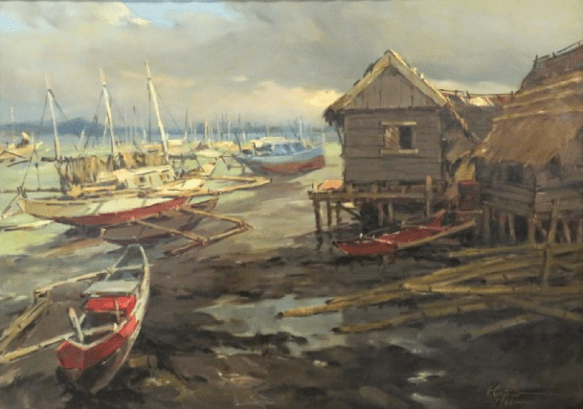
I myself have been veering closer, in my creeping senescence, toward something I can only vaguely describe as a midcentury romanticism—an imagined age of innocence before the Second World War, and of optimism after, like the war never happened, like no war could obliterate. Perhaps it’s my form of escapism from the madness of the present, but I’m drawn to landscapes with bamboos rustling in the breeze, to sunsets bursting with fruity promise, to rivers teeming with lilies, to beaches without people. Over the past few months, I’ve been picking up art pieces—paintings and prints—in this old-fashioned mode.

Given my UP professor’s salary, I have to work within a very limited budget, so I collect by sight rather than by name. This means that a painting should enthrall me—I should feel a rush of excitement, or a pang of melancholy, a cry of delight, the minute I see the piece; I should want to think about it again, to have it intrude into the most inconvenient moment of some mundane preoccupation. It might make me want to know more about the artist after—not necessarily before—I buy the painting.

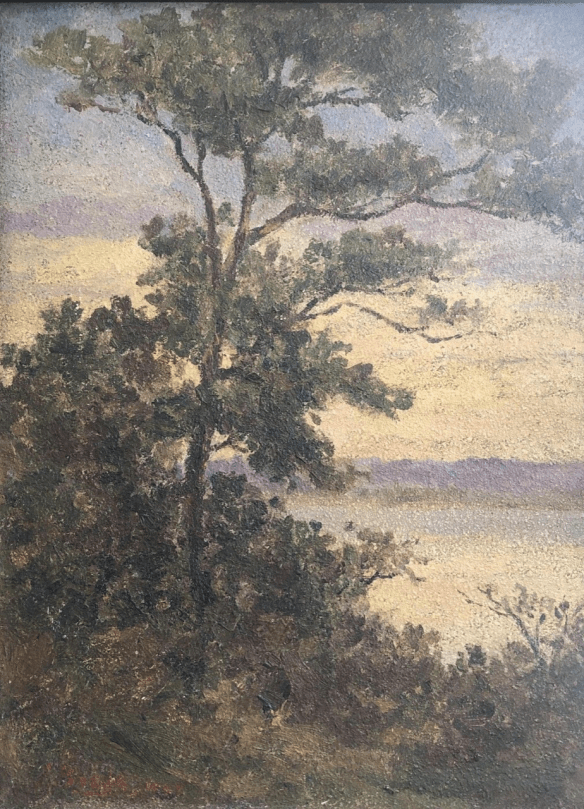
I felt that surge last month when Beng and I drove out on a Saturday to a corner of Pampanga to view three small paintings I had spotted online, being offered by a picker. They were unsigned—so forget finding some mislaid Amorsolo—but they exuded rustic charm, a harking back to a lost provincial Eden. All my seller could say about them was that he had acquired them as a batch with a fourth and larger one, in the same style, that he had sold earlier, and that other one was signed “Serna 1944.” Serafin Serna (1919-1979) was, indeed, a painter of nature, a student of Amorsolo; most significantly, his brief biography online mentioned that Serna often didn’t sign his works. So the tantalizing possibility remains that my pastoral paeans were done by his hand, and they will be so attributed in our home gallery, pending proof to the contrary.

IMG_5553.jpg

IMG_5554.jpg

Not long after, pretty much by the same route (although this one led to a gas station in Parañaque), I picked up two other little gems of the genre—landscapes done in 1957 by Gabriel Custodio (1912-1993), who I was ashamed to admit I knew nothing about until that instant. But again, encountering Custodio (another student of Amorsolo) reminded me of how important it is to scour our backyard for obscure treasures—many hidden, but others in plain sight.

Imagine my exhilaration when, two Saturdays ago, Beng and I attended the opening of the Metropolitan Museum’s fabulous new exhibit, “Fascination with Filipiniana: The Vargas Collection in the Wake of War and the Modern: Manila 1941-1961.” The curator himself, Dr. Patrick Flores, walked me up to one Serna and Custodio after the other, educating me on that key period of transition between the traditionalists and modernists—particularly the fact that the lines between were never that sharply drawn.

IMG_5587.jpg

For now this is just a long introduction to build up some credibility for what I’m about to claim, which is a heightened sense of awareness in things artistic, albeit from a strictly amateur perspective. It’s the kind of awareness that allows me to pronounce (at least to myself), “Hmmm, this painting looks nice, but unfortunately it’s a fake, because XX never used an apostrophe when he dated his later signatures, as in ’76 or ’83,” or “How can this be from 1995 when ZZ died in 1986? Besides the strokes are all wrong, they’re way too hurried.”

Next week, we’ll deal with a real whodunit: who did that life-size painting of Rizal and a cohort of Spaniards stored for decades in UP Diliman? I’ll offer my conjecture.


Penman No. 298: Books with Back Stories (1)

arts3-doctrina-filipina_2018-04-15_17-16-24.jpg

Penman for Monday, April 16, 2018


AS I’VE been chronicling here these past few months, my fascination late in life with antiquarian books and documents has led me to some wonderful, intriguing, and often serendipitous discoveries. And as I’ve been saying, I’m a scavenger, not a scholar, so I will just as likely come across and even pick up junk as I will, now and then, a jewel. My most recent acquisitions have included a gorgeous Atlas de Filipinas from 1900 in very fine condition, early editions of the Noli and Fili published in Spain, a booklet of original sketches by one of the illustrators of Puck magazine from 1889, an illustrated travel book on Luzon and Palawan from 1887 by Alfred Marche, and a signed first edition of a book by one of my most admired authors, John Updike.

As much as possible, I seek out books that have some connection to the Philippines and its history and culture. If possible—and when I can afford it—I choose the first or earlier editions, signed by the authors, to establish some personal connection to the work at its very origins. It’s a fancy fetish, for sure, more than anything; you can often legally download the entire text for free online, and gain as much scholarship from that file. But there’s nothing like holding a book that the author himself or herself held and even scribbled his or her name on with a fountain pen (or a quill pen, in the case of my 300-year-old volumes with marginal notations in fine sepia ink). It returns you to how personal the act of writing and publishing can be, in this age of e-books and PDFs.

A few weeks ago, for example, I jumped on a book that turned up in Texas, a 1948 facsimile copy of the 1593 Doctrina Christiana, the very first book printed in the Philippines (a personal encounter with which I reported on here four years ago, at the Library of Congress in Washington, DC). Facsimiles are interesting but generally passed over by collectors—you can still get a facsimile of the Doctrina locally for P250—but this one had a very special value. Not only was it published by the LOC very soon after the book (the only copy known to exist) resurfaced in Paris after the war and was donated to the LOC, proof that the LOC knew exactly how rare it was; but this copy was inscribed in green ink by Lessing J. Rosenwald to George L. McKay. Rosenwald happened to be the book collector who acquired the Doctrina and donated it, along with many other rarities, to the LOC; McKay was another well-known bibliophile. So this copy shows—against a suggestion I’d heard that Rosenwald didn’t know what he was buying—that Rosenwald prized the Doctrina highly enough to gift its facsimile to his collector-friends.

Rosenwald.png

That Doctrina facsimile has joined my collection, but another outstanding book didn’t, just when I thought it would. I’d won the bidding for a first edition, with dust jacket, of William Pomeroy’s The Forest (International Publishers, 1963). This is the book that, whenever I’m asked “Which book has influenced you the most?”, I give as an answer. It was my reading back in high school of this American GI-turned-Communist guerrilla’s lyrical and moving account of his time with the Huks in the mountains of Luzon that inflamed me to join the nationalist movement. Pomeroy met and married the Filipina Celia Mariano; they were captured, imprisoned, and later led a long life of exile in the UK, where they died not too long ago in their 90s. I already had a first edition of The Forest, but this copy was inscribed by Pomeroy to their friends Bill and Ranjana Ash—another storied couple, dedicated Marxists whose lives are well worth Googling. Sadly I later got a note from the seller that he could no longer find the book in his shop, and refunded me. What a loss!

Sometimes I don’t buy the book, but take note of some very interesting details about it. For example, I came across a work on Philippine fisheries, “Bangos Culture in the Philippine Islands,” taken from an April 1929 issue of the Philippine Journal of Science. It was co-authored by Albert W. Herre and Jose Mendoza, two pioneers in the field. But the bookseller noted that “This copy is unique in that the primary author, Albert W. Herre, has crossed out the name of the second author, Jose Mendoza, on the credit line of the first page, and written alongside it, ‘This name [Jose Mendoza] was added and my paper altered after I had sent it in for publication, all without my knowledge. Herre.’ On the second page, Mr. Herre has crossed out the second paragraph (‘Description of the Bangos’) with a few pen lines (it is still very legible) and written alongside, ‘Added without my knowledge or consent. Herre.’… given that the primary author made the aforementioned annotations, it appears that he donated it to Harvard (and wanted to make sure that Harvard understood that he was the real and only author).” Are we looking at an example of professional jealousy in the sciences?

More on these discoveries next week.

Penman No. 297: A Witness Speaks

MarchToIndependence2jap.jpg

Penman for Monday, April 9, 2018


I WAS very honored to receive a response to my recent column-piece on “Writers in Wartime” from no less than Dr. Benito Legarda Jr., the eminent economist-historian perhaps best known by contemporary readers for his harrowing accounts of the atrocities committed by the retreating Japanese forces in Manila at the closing days of the Second World War. Titling his message “Writers Under Compulsion,” Dr. Legarda pretty much confirms what I observed, but with the kind of authority I couldn’t possibly lay claim to. A teenager during the war, he also adds a couple of personal vignettes. (Previously, Dr. Legarda and I had corresponded on another topic of mutual interest, the French adventurer Paul P. de la Gironiere, whose very colorful account of his Philippine sojourn Legarda had introduced in a 1972 edition.)

This may sound like an academic discussion, especially to young readers who know or care little about what came before them, but the question of how writers respond to the challenges (and opportunities) of authoritarian regimes is actually a very timely and practical one. Dr. Legarda ends his comments with a pointed reference to martial law, but we all know that authoritarianism didn’t end with Marcos or martial law. And it’s one thing when you’re writing at the point of a Japanese bayonet—but is it much different when you take the bayonet away and replace it with a balled fist? Here’s what a witness to war had to say:

The predicament of writers working under an authoritarian regime is brought out by Jose “Butch” Dalisay in an article, “Writers in Wartime” (Philippine Star, March 26, 2018). In this column Dalisay describes the conditions under which writers worked during the Japanese occupation.

They had to toe the Japanese propaganda line of Japan as the liberator of Asian people from Western imperialism, the exemplar of nationalist governance.

Dalisay examines the December 1943 issue of the Philippine Review. How did writers comport themselves at the time? Were they cultural collaborators?

Dalisay did not know those writers himself and did not know their inner convictions but as one who lived through those times, I can say that the editor, F.B. Icasiano or “Mang Kiko,” was reportedly a collaborator and disappeared after the battle for Manila.

Other editors, all working for the Manila Shimbun Sha (the only publisher permitted), were Vicente Albano Pacis, Angel  Anden, and Jose Luna Castro—all respectable journalists who had to make a living.

It was not difficult for fiction writers like Ligaya Victorio Reyes and Estrella Alfon Rivera to avoid the propaganda line by writing Christmas stories. This was also easy with Juan Collas’ translation of Rizal’s Mi Ultimo Adiosand Jovito Salonga’s commentary on the language of the Constitution.

A friend of my youth, Isagani A. Cruz, in a different issue wrote a poem in praise of Rizal. Later, as an Associate Justice of the Supreme Court he  would be known as the most elegant prose stylist in the Court.

For the fictionists Dalisay notes the sharp and painful transition to the darkening of the times.

Not so the essayists who could not avoid mouthing the Japanese propaganda line. One was educator Camilo Osias, author of the prewar Philippine Readersseries and future Senate president, who argued for a sound eclectic choice as Japan had done in its cultural borrowings and emphasizing the precedence of the State, of social interests over the individual.

CrushAngloAmericans.jpg

Osias once escorted my mother home from a civic meeting, and at  our front steps asked my father if he was willing to send me to Japan on a scholarship. My father flatly turned him down. “I see I’m barking up the wrong tree,” he said.

Osias’ ideas were general enough to avoid being tagged propaganda; at most they might be qualified as political adjustment. Not so Luis Montilla, national librarian, who wrote fatuous praises for Japan as a guide and regenerator of true Orientalism, realizing Rizal’s supposed dream of re-Orientalizing his people.

Dalisay withholds judgment on this matter considering that it was possible for some Filipinos to regard the invading Japanese as liberators, after centuries of the white man’s rule.

But as one who lived through that time, I remember the Filipinos regarding themselves as better than the Japanese, who had cruelly ravaged Manchuria and China. They were certainly not looked on as liberators by a people who were already on the eve of full independence.

Perhaps the writer’s dilemma of the time was best expressed by a leading Filipino writer   in Spanish, Don Pedro Aunario, who told my uncle Jose “Pepito” Legarda who worked at the Shimbun Sha with him, “How fortunate you are that you don’t have to write for a living.” Yes, writing for a living under an authoritarian regime meant suppressing one’s own opinions and parroting those of the rulers. Writers would experience this again under the Marcos dictatorship. (Images above from pyswarrior.com, photo of Dr. Legarda below from ateneo.edu)

P1080143.JPG

Penman No. 295: Writers in Wartime


IMG_5382.jpg

Penman for Monday, March 26, 2018


I WAS busy a couple of weeks ago going through my library to see which books I could donate to a sale being conducted by our students to benefit worthwhile projects. I happily gave away about a hundred books and will be ready and willing to unload even more next time. But what inevitably happens when you sort out your effects like this is that long-forgotten objects turn up in the pile.

One such item that emerged from this recent overhaul was a thin journal of no more than 70 pages, the December 1943 issue of Philippine Review, published by the Manila Sinbun-sya and edited by Vicente Albano Pacis, with Angel C. Anden and Jose Luna Castro as associate editors. A little research shows that the Review didn’t last very long—it ran from March 1943 and closed down in December 1944. But during that brief lifetime, it managed to publish such later luminaries as Nick Joaquin, and apparently enjoyed quite a reputation (it was also edited for some time by Francisco “Mang Kiko” Icasiano, whose musings “From My Nipa Hut” graced the prewar Sunday Tribune Magazine).

Indeed, this issue of December 1943 contained not only short stories by Ligaya Victorio Reyes and Estrella Alfon Rivera, essays by Camilo Osias, Luis Montilla, and Federico Mangahas, and a translation of Mi Ultimo Adios by Juan Collas, but also a short commentary on the language of the Constitution by a 22-year-old Jovito R. Salonga, who had just been released from prison for his work in the underground.

It’s a fascinating window on literature in a time of war, what the politics of the moment can do to writers, and what coping strategies they employ. (My thoughts strayed quickly to a recent discussion online about Filipino writers and politics in these times of tokhang.) The issue opens with paid advertisements—mostly from Japanese companies like the Yokohama Specie Bank’s local branch—hailing “The Second Anniversary of the Outbreak of the Greater East Asia War” while at the same time greeting readers a “Merry Christmas!”

IMG_5383.jpg

The Reyes and Alfon stories (“Christmas Visit” and “Jingle Bells”) speak of love and loss, acknowledging the sudden shift in the meaning of Christmas from that December of just two years ago to this one; both stories end with their protagonists weeping uncontrollably. The Reyes story can’t help falling back on old tropes, referring to “Gary Cooper.” So for the fictionists, at least, the transition remains sharp and painful, with metaphors to imply the darkening of the times.

Most of the essayists seem to have no such qualms. In his essay on “A Program of Enlightenment,” Camilo Osias (yes, he of the Philippine Readers series, and future Senate President) argues for a new culture “for all Filipinos under an independent Philippines,” one “characterized by a sound eclecticism in the choice of its elements—by the same careful eclecticism which the Japanese have observed in their cultural borrowings…. The cultural activities to be carried out shall emphasize the precedence of State, national, or social interests over those of the individual.”

For his part, the scholar Luis Montilla writes on the theme of “Rizal as an Orientalist,” and suggests that Rizal would have been sympathetic to Japanese motives had he been alive, even implying that this could be because Rizal was partly Japanese. In his footnotes, he quotes Austin Craig’s statement in 1940 that “I am putting the finishing touches to my Rizal genealogy, now being able to show Japanese blood as well as two Spanish and five Chinese ancestors. I have church or court certificates proving everything.”

Montilla concludes: “Having had his attention directed early to the abuses, calumnies, and indignities heaped unjustly upon his people by the white race, Rizal had to be, and was, the embodiment of a true Oriental…. Now, the duly authorized representatives of the great Japanese Empire have repeatedly assured the Filipinos that Japan has come to these shores not to subjugate the natives of the country, much less to absorb them, but to guide them in their regeneration as true Filipinos, and that when they… shall have been so rejuvenated as to be, as a nation, worthy of membership in the family of Oriental nations, they will regain their long lost independence (and fully realize) the supreme efforts put up by Rizal as an Oriental to help educate and re-Orientalize his people for their preservation and dignification as a race….”

Was I reading a display of what might be called cultural collaboration? Not knowing these writers and the circumstances under which they worked, I have to withhold my judgment, keeping in mind as well that there was good reason for many Filipinos—after centuries of white-man rule—to accept the invading Japanese as liberators. But I felt much educated by these articles, which also reminded me of how our printed words define us, rightly or wrongly, long after we’re gone. They just might turn up in a dusty corner of someone’s bookshelf.

Penman No. 294: From Bach to Baleh

IMG_5277.jpg

Penman for Monday, March 19, 2018


SOMETIME LAST year, I reported on the opening of the new Museo Kordilyera at the University of the Philippines Baguio (UPB), and predicted that it was going to become one of the new “must-sees” for the culturally savvy Baguio visitor, alongside such landmarks as the Bencab Museum. I was back there last week to help inaugurate a new theater and enjoy a concert—about which you’ll hear more in a bit—but what sealed UPB’s reputation for me as that region’s cultural beacon was its new exhibit titled “Feasts of Merit” which opened last month and which will run all year long.

As UPB Professor Emeritus Delfin Tolentino explains it, the title refers to the “prestige feasts” sponsored by the well-off families of traditional societies around Asia and in the Philippine north, such as by the Ifugao, Bontok, and Ibaloy. In these feasts—now long gone, for obvious reasons—hundreds of pigs and carabaos would be slaughtered in a show of affluence—indeed, in what could be seen as a deliberate exercise in excess, as Museo director Dr. Analyn “Ikin” Salvador-Amores acknowledges. But alongside this excess was the idea that wealth was meaningless if it could not be shared with others, so the point of the feast was to have the community partake of it, thereby strengthening the ties between and among the people.

IMG_5265.jpg

To liven up the scene, the Museo purchased (with sponsorships), dismantled, transported, and reassembled a complete traditional Ifugao house or baleh which now forms the centerpiece of the exhibit. The 50-year-old house took four days to put back together, says Ikin, employing no nails. Walking around and beneath it gives the visitor an intimate sense of family and village life—as well as of the ingenuity of the native architect, in such touches as the rat guards circling every post, preventing rodents and other pests from clambering up into the house proper.

The baleh may be the most arresting feature of the exhibit, but equally fascinating are the large-scale reproductions of vintage photographs lining the walls, chronicling a lost way of life in the highlands, from Bontok women threshing rice together to other women wearing golden mouth guards to display their wealth (or, as one of those women said, “to shut us up” because the men wore no such flashy encumbrances).

IMG_5284.jpg

An especially fascinating corner of the museum houses its impressive collection of heirloom textiles, many sporting designs unseen and unwoven for many decades. As two of her assistants carefully folded and scanned some specimens to create digital files of their designs, Ikin unrolled a large swath of an indigo-dyed textile from the 1920s—still looking new and sharp—that she had found in Chicago, being sold by a Filipino, whom she had managed to persuade to sell the precious artifact.

Foreign sponsors and benefactors such as the Newberry Library in Chicago, the University of Michigan, and the Kunstkamera in St. Petersburg, Russia helped make the exhibit possible; local supporters like the National Artist Bencab have also generously lent or donated items from their extensive collections. Dr. Amores says the Museo would be very happy to receive more donations of choice items from private collections, and I can’t think of a more fitting recipient myself of such pieces than the Museo Kordilyera and its state-of-the-art facilities and curatorial services.

IMG_5279.jpg

The Museo and its exhibits are part of a broader UPB program to revitalize its campus as a regional center for cultural awareness and research under Chancellor Ray Rovillos, who also happens to be a historian. With just a six-hectare footprint and a steeply sloping landscape to work with, Dr. Rovillos and his architect, the brilliantly adaptive Aris Go, have given UPB a smart new environment that goes beyond looks to include catchments for rainwater, among other innovations.

Thanks to the support of the cultural maven Sen. Loren Legarda, UPB also now has an impressive new theater, the Teatro Amianan, which was inaugurated last week with a concert, and the adjoining Darnay Demetillo Art Space.

IMG_5261.jpg

The concert opened with some popular numbers by UPB’s homegrown Tinig Amianan, after which the audience was treated to a stellar performance by soprano Stephanie Quintin, a Baguio girl and UP graduate who has trained in Germany and Hong Kong. Stephanie presented a selection of vocal classics from Bach to Lizst and Gounod before wowing the crowd with Nicanor Abelardo’s “Bituing Marikit” and a rousing rendition of Jose Estella’s “Ang Maya.” She was very capably accompanied by the young pianist Gabriel Paguirigan, who’s still in school at the UP College of Music after graduating from the Philippine High School for the Arts, but who has already won a slew of awards.

It may be quite a stretch from Bach to the baleh, but it’s precisely the kind of imaginative leap from the tribal to the global that Baguio has always been known for, and as a UP official myself, I felt immensely proud to see UPB on top of the effort. Bravo!

IMG_5258.jpg


Penman No. 291: A Big Boost for Translation

nora.jpg

Penman for Monday, February 19, 2018


THIS YEAR marks the 40thanniversary of the University of the Philippines Institute of Creative Writing, which was established by the UP Board of Regents in 1978 as the Creative Writing Center. I had just returned to UP as an English major after dropping out for ten years when I was taken in by the CWC in the early 1980s as its fellow for drama (I was better known then as a playwright and screenwriter in Filipino than as a fictionist in English).

For a young writer on the verge of his first book, there was nothing more exhilarating than sitting at the feet of the masters—Franz Arcellana, Alex Hufana, and Amel Bonifacio, among many others; Nick Joaquin and Ben Santos came by now and then for the writers’ workshops, and I grabbed the opportunity to have my books signed and to pick their brains, or merely to breathe the same air, thinking that I could imbibe a whiff of their magic.

Since then, the ICW (as it was renamed in 2002) has been at the forefront of developing Philippine literary culture. Its fellows, associates, and advisers number among the most well-regarded writers in the country, including four National Artists for Literature—Franz Arcellana, NVM Gonzalez, Virgilio Almario, and Bienvenido Lumbera. Most of the best writers from all over the country today—be it in Filipino, English, and the regional languages—have at one time or another passed through the doors of the ICW, through the UP National Writers Workshop that UP has held every summer since 1965, even before the CWC/ICW was born. I daresay that there’s no other program that UP has run for as long, without fail, for over half of its nearly 110 years of existence, and that has been as influential in the shaping of the Filipino creative mind.

I was privileged to lead the ICW as its director for three terms, and building on the work of my predecessors (who included, aside from the aforementioned stalwarts, Jimmy Abad, Roger Sikat, Virgilio Almario, Jing Hidalgo, and Vim Nadera, and after me Roland Tolentino), the UPICW expanded its reach over that period. We upgraded the writers’ workshop to cater to mid-career writers, opened a portal to Philippine literature at panitikan.com.ph, published the country’s premier literary journal Likhaan, gave out the Madrigal-Gonzalez Best First Book Award, conducted the Panayam lecture series, and chronicled the lives and thoughts of our best writers under the Akdang Buhay series. We celebrate the literary year every December with a big program at Writers’ Night.

That’s more than any university in the Philippines—indeed in Asia—has done for creative writing, establishing the UPICW as the regional leader in its field. And as if that wasn’t enough, we’ve undertaken even more new projects these past two years, supported by UP’s Emerging Interdisciplinary Research (EIDR) program.

For example, we’ve conducted Interdisciplinary Book Forums devoted to topics as diverse as tattooing, speculative fiction, and colonial medicine. We’ve also expanded our outreach beyond the mid-career workshop to include the Amelia Lapeña-Bonifacio Workshop for beginning writers, the Bienvenido Lumbera Translators’ Seminar, and the Gemino Abad Teaching Seminar. These last two seminars are aimed at teachers of literature and creative writing, meant to equip them with better skills and insights in handling their courses.

Last February 8-10, we held the first Saling-Panitik: Palihang Bienvenido Lumbera at the UP Hotel under the directorship of ICW Fellow Joey Baquiran. Fifty participants from Bicol, Pangasinan, the Ilocos region, and Metro Manila listened to lectures by respected translation practitioners Bienvenido Lumbera, Marne Kilates, and Mike Coroza.

In their addresses, Bien Lumbera emphasized that literature and its translation in several Philippine languages is at the heart of creating the nation; Marne Kilates extolled St. Jerome as the patron saint of translation; and Mike Coroza argued that a foreign text is dead until its translation comes along for a new audience.

The participants appreciated the hands-on approach of the seminar—facilitated by Pangasinense scholar Marot Flores, Bicol writer Niles Jordan Breis, Iloco expert Junley Lazaga, and Filipino dramaturg Vlad Gonzales—whereby they were assigned texts in their respective languages, English, and Filipino, which they then translated into several versions. For example, the Ilocano group rendered Edith Tiempo’s much-loved poem “Bonsai” into Iloco. The exercises aimed to improve the participants’ translation skills which they can employ in the K-12 literature subjects which they teach in senior high school.

We’re still a long way from developing the corps of literary translators that we’re going to need if we want Philippine literature (other than English) to break into the global stage. But seminars like this are a big step forward, at least in terms of drawing attention to the importance of translation not just in literature but in society and nation-building itself.

And we have the UPICW to thank for it, as well as everyone who’s contributed to keeping it up and running for 40 years.

Penman No. 288: From Quiapo to Norwich

QuiapoPic.png

Penman for Monday, January 29, 2018


IT’S A strange title, I know, but it’s all I could come up with to highlight the two topics I’m taking up this week. They’re not actually connected—at least not yet—but they were much on my mind as I dusted off my texts for a new semester of teaching at UP (all for naught, as it turned out, as my graduate writing class was dissolved for lack of students—to my secret relief).

“Quiapo” is at the core of Quiapography, a digital-humanities project designed and led last semester by Dr. Patricia May Jurilla. Normally our resident expert on the history of books and publishing—one of those rare nerds who shares my strange attraction to Gothic blackletter and to the aroma of centuries-old paper—May branched out not only into a new subject but also a new approach to teaching and learning under the rubric of “digital humanities.”

Or maybe not that new. I asked Dr. Jurilla to explain the concept to me, and I was told that “Digital humanities has been in practice for over twenty years now. It’s emerged as a discipline itself with its own league of practitioners, dedicated book series and journals, circuit of conferences and events, degree programs, and new job opportunities in the tight academic market.”

Better than any explanation is the product itself of her PhD students’ semester, during which May directed them in a digital exploration and presentation of that most quintessentially Pinoy of urban spaces, Quiapo. That can be seen on the Quiapographywebsite at https://updigitalhumanities.wixsite.com/quiapography, “a virtual museum designed to document and map the culture of Quiapo in order to celebrate, re-view, and rediscover its heritage and its importance in Philippine history and society.”

Aside from the familiar photographs of and stories about Quiapo Church, amulet vendors, and the Black Nazarene, the site contains useful resources such as a list of literary works about Quiapo, pieces on the district’s fortune tellers, camera shops, and historical heritage, and photo galleries of just about everything.

Myself, I wish that I’d known about the project earlier, as I would’ve had my own Quiapo stories to contribute, as central as the place was to my young life—from my memories of descending for the first time into its brand-new underpass (something straight out of a sci-fi fantasy to a ten-year-old) to marching at Plaza Miranda with fist raised as a teenage Maoist and buying Christmas ham on Echague as a family man.

For those who’ve never strayed into this crucible of Filipino-ness (and sadly, in today’s mall-oriented culture, that would be millions of Pinoy millennials), Quiapographyshould provide a perfect introduction.

L1030874.jpg

And now a quick cut to Norwich, some 10,600 kilometers away from Quiapo in southeastern England. For nine months between 1999 and 2000, this city became home for me and Beng when I took up residency there as the David T. K. Wong Fellow at the University of East Anglia. It was a restful but also fruitful stay that led to what became my second novel, Soledad’s Sister.

To put it simply, UEA is the most vibrant center of creative writing in the UK. Its community of writers was founded by Sir Angus Wilson and Sir Malcolm Bradbury in 1970, and its graduates have included the likes of Kazuo Ishiguro, Ian McEwan, and Rose Tremain. (Among the privileges of being there was having books signed by future Nobel prizewinners J. M. Coetzee and Ishiguro.)

Every year, UEA invites a writer to stay and write there—no teaching, no research, no lectures, just writing and relaxation—at its expense, or rather that of a sponsor named David T. K. Wong. A former journalist, civil servant, and businessman from Hong Kong who also writes fiction, Mr. Wong did well enough in life to endow the generous fellowship, an award of £26,000 to enable a fiction writer who wants to write in English about Asia.

I was the second Wong Fellow, and over the 20 years since the fellowship’s inception in 1998, two other Filipinos have followed me to Norwich—Lakambini Sitoy in 2003, and the current fellow, the Davao-born but US-based Nathan Go.

This brings me to my pitch: if you think you have a great novel or collection of stories welling in you—and you’d like to finish it in England, looking out on a lagoon full of graceful swans—please apply for the next Wong Fellowship, like I dared to do two decades ago. All you basically need, aside from the forms and the £10 application fee, is a 2,500-word excerpt from your proposed fiction project. The deadline for applications is February 28. For forms and more information, go here:https://www.uea.ac.uk/literature/fellowships/david-tk-wong-fellowship. Good luck!