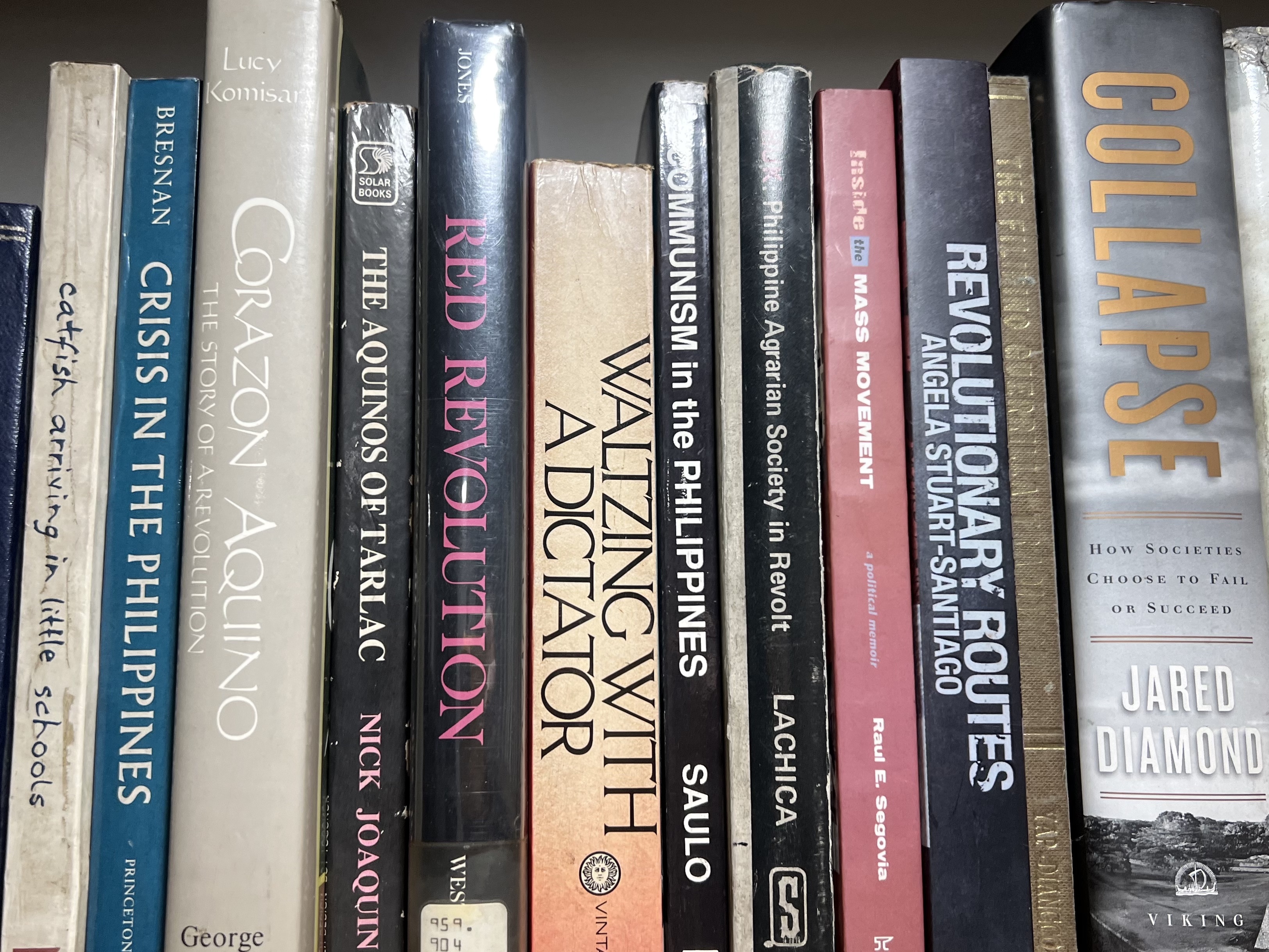
Qwertyman No. 5: A Rhetorical Question

Qwertyman for September 5, 2022

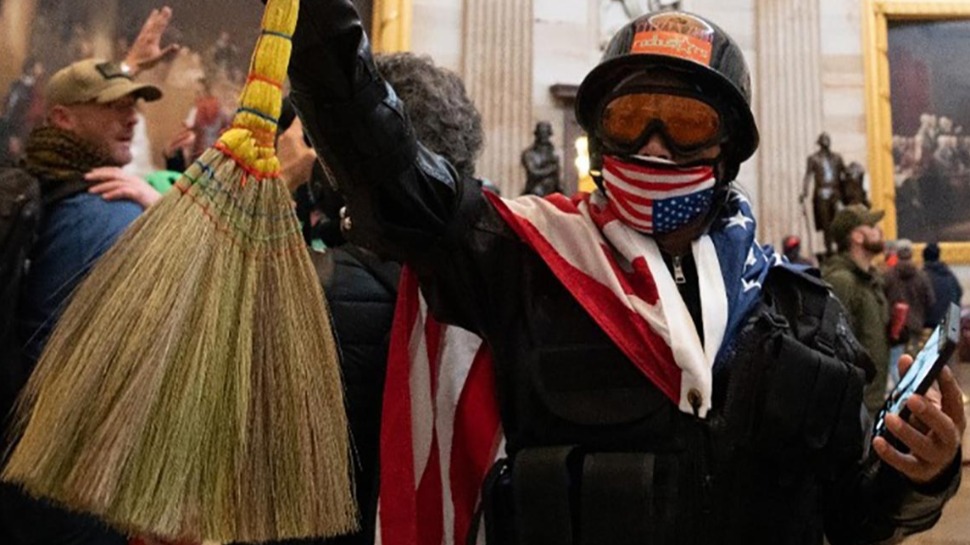
(Photo from philstar.com)

TEACHER LENLEN’S chest swelled with pride when she opened the door to her 8th grade classroom in Gen. Pupu Noknok Elementary School in the town of Bugbugan, province of Kalamias, in the People’s Democratic Republic of Kawefo. Freshly painted in the fluorescent green that seemed to be in favor since President Ongong’s election, the cavernous classroom held exactly 100 chairs, and was reputed to be the largest elementary-school classroom in the archipelago. It was so huge that Teacher Lenlen had to use a microphone hooked up to two loudspeakers in the back of the room to reach the farthest students, from Wutwut to Zygzyg. 

“Good morning, class!” she shouted on the first day of school, oblivious to the idea that she didn’t need to scream because she already held a microphone. “My name is Mrs. Lenlen Fayfay, but you can call me Teacher Lenlen, and I will be your homeroom teacher. Now, what is a homeroom teacher? According to Wikipedia, a homeroom teacher ‘is responsible for almost everything concerning a homeroom period and classroom. At the start of the school year, it is the homeroom teacher’s responsibility to make sure that each student gets relevant textbooks and materials, which are supplied by the government. The teacher is also responsible for the attendance.’ Is that understood? Did I make myself clear? If yes, then answer ‘Yes, Teacher Lenlen!’ If you did not understand what I just said, raise your hand and approach the microphone when I recognize you. Is that understood?”

“Yes, Teacher Lenlen!” The answer, magnified by the three standing microphones set up at key points along the central divide between left and right, reached Teacher Lenlen like a towering tsunami, forcing her to cover her ears.

“You don’t have to shout!” she shouted back. “Just speak in your natural voice! Okay, class?”

“Okay, Teacher Lenlen!” Another wave rolled over her, drowning her shriek of protest.

“Teacher Lenlen! Teacher Lenlen!” A boy’s hand shot up from the middle of the room.

“Yes? Who are you and what is it?” Secretly, Lenlen felt relieved to be dealing with just one student, whose solitary voice she could easily overpower. “To the microphone!”

The boy scurried to the nearest mike, giving high fives along the way to his giggling classmates. “My name is Marmar Pwepwe, and I have a question.”

Teacher Lenlen raised her hand to stop him before he could speak, seizing upon the moment as a teaching opportunity. “Before you answer me, let me make this clear, this being our first day of class. Because there are one hundred of you, we have to make sure that every question you ask is important, all right? Wait, wait, wait! Don’t answer me! If you want to say ‘Yes, Teacher Lenlen!’, just nod your head—quietly, like this.” She nodded her head, keeping her lips sealed. “Is that understood?”

“Yes, Teacher Lenlen!” came the bone-jarring reply.

“Eeeek, stop! Stop it! I told you to nod your heads! How hard is that? Didn’t your parents teach you to nod your heads? Okay, everybody, let’s nod our heads together—up, down, up down! That’s good, do it again, up, down, up down! See? A nation that can nod together can be great again!”

“Teacher Lenlen! May I ask my question now?” said the boy Marmar.

“Oh, all right! What is it?”

“Well—I googled what you said about homeroom teachers, and I discovered that it’s the definition of a homeroom teacher in Afghanistan. Teacher Lenlen—are we in Afghanistan?”

A roar of laughter erupted. His classmates had known Marmar to be a smart aleck since the lower grades, for which he had been sent to the guidance counsellor’s office more than once.

Teacher Lenlen’s cheeks turned red. It was true—there was a long list of definitions in Wikipedia for “homeroom teacher,” and she had conveniently picked out the topmost one, for Afghanistan. So what? How different could Afghanistan—wherever that was—be from Kawefo? 

“Before I answer you, don’t you know that cellphones are prohibited in this school during class time? And how could you google anything, when even I can’t get a decent wi-fi signal in this room?”

“I didn’t use a cellphone, Teacher Lenlen! It was a tablet with cellular data, which my mother gave me for my tenth birthday, for Zoom!”

“Oh, so your mother gave it to you! Maybe I should talk to your mother about using tablets in class, when we’re no longer using Zoom, but meeting face-to-face. Class, are we still on Zoom, or meeting face-to-face? DON’T ANSWER! That’s what’s called a ‘rhetorical question’—a question you already know the answer to, so you don’t even need to answer it. Everybody write this down!” She went to the blackboard and wrote “R-H-E-T-O-R-I-C-A-L!”

“What does ‘rhetorical’ mean, Teacher Lenlen?” asked a little girl in the front row. Lenlen was glad that nobody else seemed to have heard her, because, come to think of it, she didn’t know, except that when you added “question” to it, it meant exactly what she had just said. She went up to the girl and whispered, “I’ll tell you tomorrow. That’s tomorrow’s lesson.”

Marmar was still standing at the mike, and said, “If you want to talk to my mother, Teacher Lenlen, I’ll give you her phone number.” 

“I was speaking rhetorically!” Lenlen retorted. “I’m talking to you, not to her!” Marmar’s confederates snickered in their seats. “What’s so funny?”

Another boy piped up. “Teacher Lenlen, Marmar’s mother is the governor!”

Marmar Pwepe… Governor Pompom Pwepwe—of course, she should have made the connection! The governor was known for her fiery temper, punching sheriffs and other public officials who crossed her path. Beads of sweat began to form on Teacher Lenlen’s forehead.

Just then, a squadron of policemen appeared at the door, discombobulating Teacher Lenlen further. Had she been reported so quickly? What was going to happen to her pension, to the trip to Bangkok she had been planning for so long?

“Ma’am Lenlen Fayfay?” asked their commanding officer. “I’m Captain Shushu. We have been deputized by the regional office of the Inter-Agency Counter-Subversion Agency—” 

“Oh, no—you have the wrong person. I’m Mrs. Fayfay, yes, but I swear to God, I’m not a subversive! I never said anything bad about President Ongong or… or Governor Pwepwe….” She stared at Marmar, begging for mercy.

“We’re not here to arrest you or anyone, Mrs. Fayfay. We’re here to requisition thirty chairs for the regional office, which needs more furniture to properly perform its solemn duties. I trust you agree?” Captain Shushu turned to the students, counting heads. “The first three rows, get up!” His men took their chairs out into the corridor. Lenlen could hear a similar commotion happening in the other classrooms.

The students sat forlorn on the floor, clutching their bags. Teacher Lenlen wondered if she needed the governor’s phone number, after all.

Qwertyman No. 4: Subversive Sisters Having Fun

Qwertyman for Monday, August 29, 2022

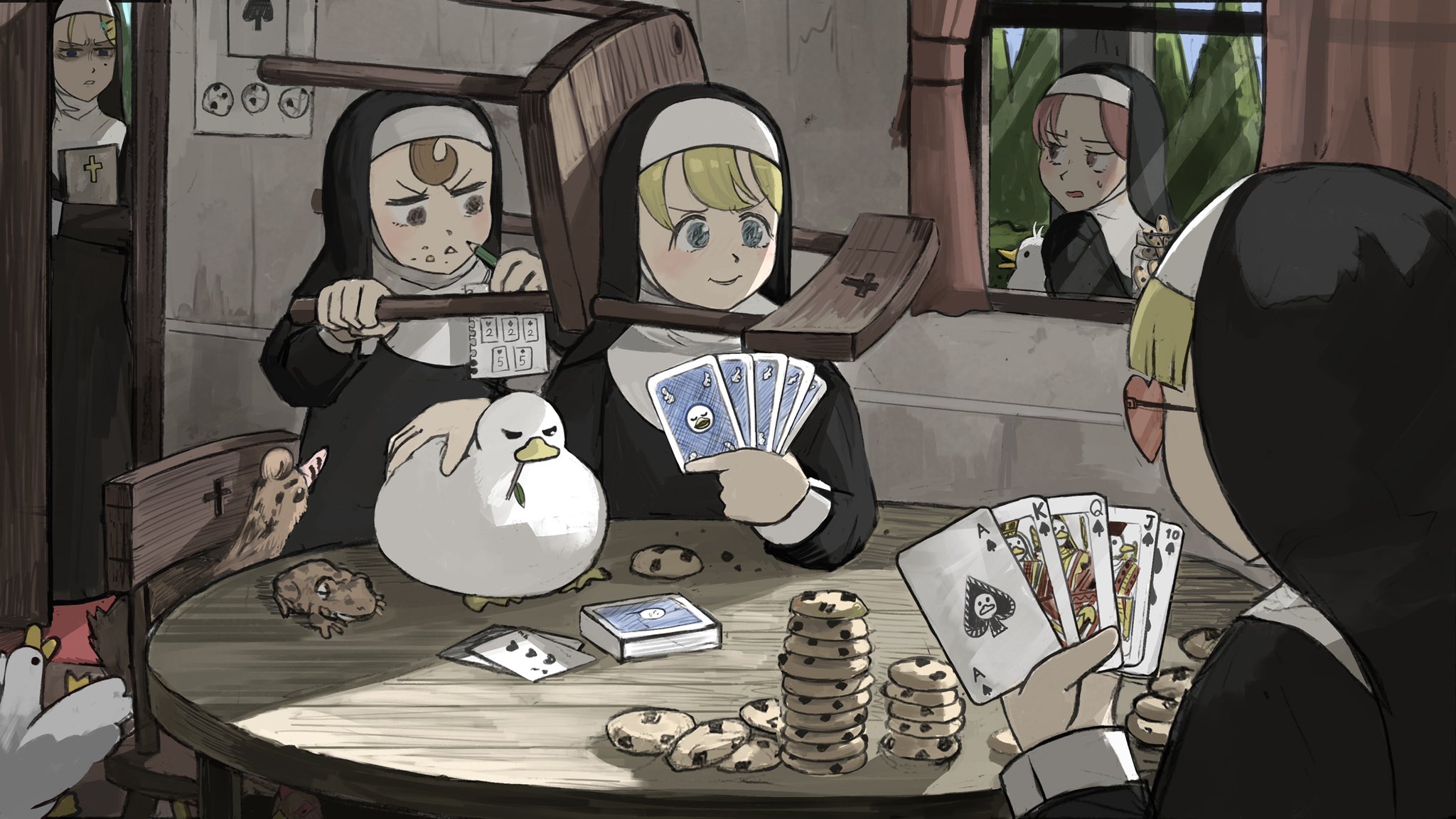
(Image from danbooru.donmai.us)

“WHY IS IT,” asked Sister Edwige as she threw a couple of green chips into the pot to call Sister Augustinha’s raise, “that every time we nuns have a little bit of fun, someone out there screams like we were indulging ourselves in some carnal revelry?”

“Sister Edwige!” said Sister Loreto, as she put her hand on her cheek, a sure tell that she had some pretty valuable cards in the hole, like a pair of jacks or an ace-king. “People might think that you—that we actually knew what you were talking about!”

“It’s no crime to know what we’re not supposed to be doing,” said Sister Edwige, who was wondering whether Sister Loreto was going to reraise, or was going to play it dumb, like she held the lowest pair. Some sisters were so transparent, which was why they chose to play Scrabble or bake muffins during their recreation hour instead of facing the likes of Sister Edwige at Texas Holdem, but with Sister Loreto, even letting on that she had a superior hand when she very possibly did not was part of the game. “Crafty” was the word for her, Edwige decided, something not necessarily malicious but with the possibility of being so.

“So are you going to call or fold?” Sister Augustinha said, annoyed that Edwige apparently didn’t feel threatened enough by her raise, and that Loreto might even move all-in.

“I’ll… just call,” Loreto said, whereupon the remaining sister, Sister Maryska, tossed her cards down, sensing imminent disaster. Acting as the dealer, Maryska drew the turn card—the king of clubs—eliciting a groan of agony from the playacting Loreto.

“Do you think it’s possible they’ll haul us off to prison and then try us for witchcraft, like they did in the old days?” asked Edwige with a chuckle.

“But whatever for?” said Maryska. In a previous life, she had been a nursery-school teacher, but had chosen to enter the order when the Virgin Mary appeared to her from a kaimito tree. “Everything we’ve done has been for the greater glory of God, hasn’t it?”

“Check!” said Sister Augustinha.

“Check!” said Sister Edwige.

“Hmmm…. Let’s make a tiny bet, shall we? Say, two hundred? Just to keep things exciting?” Sister Loreto ever so slightly pushed two even stacks of chips into the pot.

“Two hundred!” said Sister Maryska! “Why, that’s more than I can spend in a week on cookies and three-in-one coffee!”

“It’s only play money, Sister Maryska,” said Augustinha dryly. “It’s not like you or anyone here will starve to death if she makes a dumb call—which I’m not doing!” She folded her hand. “This is pretend-poker. We’re pretending that we’re escaped convicts disguised as nuns, that we stole these habits from a convent’s clothesline, and since our funds are running low and our runaway car is out of gas, we have to stake everything on a game of poker at the local bar, against the woman they know as… Madame Stolichnaya, a retired pediatric nurse and reputed mistress of the Master Demon himself, Dom Athanasius.” A shiver swept the table as Augustinha’s voice descended into a raspy whisper.

“Oooh, that’s exciting!” said Sister Maryska. “Tell us more! What did we do to become prison convicts?”

Before she joined the nunnery, Augustinha had been part of an avant-garde theater group known for its complete lack of inhibitions onstage and offstage, and it was rumored among the novices peeling potatoes in the kitchen that Augustinha had led a blissfully debauched life, complete with boyfriends, banned substances, and (dare they say it) aborted babies. That she was now one of the order’s most devout and dedicated sisters—the one who bathed lepers and tended to terminal patients—could not dispel the impression that she knew more about life than one was reasonably entitled to. 

“I fold!” said Sister Edwige, finishing the hand and letting Loreto scoop up the pot. “I think Sister Augustinha’s game is more fun. Let’s play that instead!”

“Awww, just when I was winning!” said Sister Loreto, pouting at her suddenly worthless chips. 

“Did we rob a bank?” asked Maryska. “Did someone get killed?”

Loreto said, “What do we know about robbing banks? Even if we did get some money, what would we have used it for? We made a vow of poverty—” 

“No, no,” said Edwige, “we didn’t make any vows, we’re not sisters, although we later pretend to be so. We’re villains, we like money, we like spending it on cars, houses, perfumes, vacations to Paris—” 

“Men? Did we spend on men?” asked Loreto.

“I don’t even know what it means to spend on men,” sighed Maryska. “Does that mean you—you buy them nice things, like watches and shoes and iPhones—”

“Or you can just buy them,” said Augustinha with a shrug.

“Really? For what?” said Maryska.

Edwige laughed. She had three brothers—an airline pilot, a cryptocurrency trader, and a police captain—all of whom had been left by their wives and girlfriends for various reasons. “So you can keep them as pets, snuggle up to them on rainy days, smell their body hair—”

“Ewww, I don’t even want to think about, please, please, take that thought away!” said Loreto, shaking her hands in the air. “No wonder we got caught! We had all of these impure thoughts! We robbed a bank so we could get and do all of these nasty things!”

“Technically, the bank robbery alone was enough to land us in jail. The motive doesn’t matter. We could’ve robbed a bank to give its money away to the poor. We’d still be criminals in the eyes of the law,” said Augustinha.

“It must be fun to be bad—sometimes,” said Sister Maryska, looking out into the garden, where other sisters were watering the begonias and watching the clouds turn pink.

“Do people even know what bad means anymore?” said Sister Edwige. “Or good, for that matter?”

Sister Loreto shuffled the deck of cards and said, “Let’s play another hand! And somebody close that window—I can feel a chill coming.”

Qwertyman No. 3: The Book Convention

Qwertyman for Monday, August 22, 2022

THE ANNUAL convention of the National Association for the Advancement of Books of the Democratic Republic of Kawefo was about to begin, and after a rowdy rendition of the National Hymn that was sung in two keys when the video failed, followed by a ten-minute prayer in five different languages invoking Divine Guidance in the formulation of a “coherent, cohesive, and comprehensive national book development policy,” the Introduction of the Honorable Guest Speaker began, properly enough with the birth of the speaker in the country’s easternmost islands, better known for brigandry than textual poaching. 

“Minister Fwefwe could not have arrived at her exalted position at the helm of Kawefan higher education and cultural development without her deep and abiding commitment to the promotion of knowledge, which she gained through her lifelong immersion in the world’s intellectual foundries,” intoned her introducer, the current Vice-Minister of Propaganda whom everyone knew was angling for Fwefwe’s job at the next Cabinet reshuffle. An ex-Marine colonel who had been sacked for leading his men into a rebel ambush while searching for a cellular signal on which he could call his mistress, Vice-Minister Penpen had been rehabilitated through the good graces of his cousin, the chief cook at the Palace who served President Ongong his favorite dishes. “Who could have known that a chance encounter at the circulation desk of the Manoa Public Library on that fateful day of the 23rd of November, 1986, would lead to her elevation from a humble library assistant to our republic’s Chief Cultural Czarina?”

“Good Lord,” muttered Dr. Gawgaw in his corner, “he’s going to tell the full story all over again, is he?” Gawgaw dipped a nacho into the puddle of cheese before him and munched on it noisily. He sat with a group of old men sporting flowery ties and silver-tipped canes, with a sprinkling of elderly ladies whispering in an arcane Creole-like dialect. A retired Professor of Kawefan History, Gawgaw would have preferred to stay home in his library, sniffing the powdery biblichor out of his pigskin-bound volumes on “Robinaux’s Account of Kawefan Border Crossings, 1773” and admiring the faux-Victorian binding of “Society in a Centrifuge: Sugar and the Colonial Domestication of Kawefo,” which he wrote himself. But he had to attend this silly convention on behalf of his Society for the Preservation of Kawefan History, to ensure that any new book policy did not forget to account for the past, of which he was both protector and gatekeeper. “Madame Minister, republish our books!”

Across the aisle, the Kawefan Educational Publishers Guild had other ideas. “Books are everyone’s business!” And indeed it was, especially for Mrs. Krekre, lifetime president of the guild, the grande dame of Kawefan textbook publishing, and supplier of choice to all the government’s informational requirements. The guild employed hundreds of moonlighting schoolteachers to write textbooks that satisfied whatever Kawefan industry and ideology required (the ideology changed every six or twelve years, except for the occasional coup in between), and there was always a need to refresh history and its interpretation. The new administration was anxious to encourage the rumor that its ruling family’s wealth had been founded on ancient treasure, so new myths were being discovered and stories being written about the Lost Kingdom of Lifofo, to which President Ongong could trace his divine ancestry. New material meant new editions and teaching supplements, all of which required thorough vetting by the Ministry of Public Instruction, where Mrs. Krekre’s patient goodwill ensured everyone’s satisfaction.

Oblivious to the proceedings onstage were the members of the Kawefan Popular Writers League, an association dedicated to the principle of literature as entertainment, toward which they concocted dizzying romances set in the Swiss Alps, deep-space honeymoons, movie-star ghost stories, and murder sprees provoked by a secret kimchi recipe. They sipped their wintermelon-flavored milk tea at their table, sharing stories of their latest forays and frolics, and when Minister Fwefwe screeched into the mike about something that sounded like “social responsibility,” they screeched right back and giggled, annoying everyone else, but no one could shut them up or leave them out of the party, because everyone read them in their cars and bathrooms, including Dr. Gawgaw and Mrs. Krekre.

Looking much less happier were the dozen-odd members of Kawefan PEN, who stood forlorn just outside the convention hall, clutching placards that mentioned words like “FREEDOM” and “JUSTICE” alongside a slim stand of books illustrated with skulls, barbed wire, and raised fists. They were led by Prof. Mikmik, who had done his dissertation on Baudelaire at Harvard but who, after the Vietnam War, had seen the Marxist light and now sported a goatee and wrote inflammatory poetry. He had once been friends with Dr. Gawgaw until they quarreled over whose books mattered more in the grand scheme of things. Mikmik was convinced that he was under constant and intense surveillance, especially since his FB account was barraged by friend requests from nubile ladies masquerading as masseuses and escorts.

There were spies, indeed, on the convention floor, shuttling from one exhibition booth and table to another, deputized by the Inter-Agency Counter-Subversion Agency to locate, expose, and denounce subversive literature “in whatever form, format, or genre, for the purpose of undermining the people’s faith and belief in duly constituted authority….” The IACSA’s operatives had attended a workshop in Camp Ngungu, where important questions like “What’s a genre?” were addressed by retired professors of comparative literature (“A novel, a cookbook, a nursery rhyme!”). Key words like “liberal,” “gay,” “rejection,” and “penguins” were dissected and discussed to lay bare the insurgent cancer throbbing at the heart of Kawefan society.

Agent Pogpog had joined the IACSA after sleeping on his call-center job, and was now intent on making a name for himself by bagging his first major subversive author, following the recent, high-profile arrests of poets Gemgem, Kripkrip, and Ricric. For the past three hours, pretending to be a graduate student, he had been keeping Prof. Mikmik company, trying to figure out if Mikmik’s autobiographical epic, Seven Seasons of Solipsism, was subversive or not. It contained a line about “the promethean susurrus of unvanquished desire,” which sounded suspiciously rebellious. “It’s totally subversive, I assure you,” said Mikmik, “and if those fools in the military only knew their Homer, I should have been locked up and shot dead thirty years ago when this book came out. And then this book would be in its tenth edition!”

Inside the convention hall, Dr. Gawgaw burped, Mrs. Krekre laughed, and Minister Fwefwe raised a toast to all authors past and present, and to their boundless imagination.

Qwertyman No. 2: Trouble in Cowlandia

(Photo from wikiwand.com)

Qwertyman for August 15, 2022

(Some of you may have noticed that since last week, and with my editor’s indulgence, I changed the title of this column from “Hindsight,” which I took the liberty of inheriting from Manong Frankie Sionil Jose, to “Qwertyman.” The reason was that, for more than two months now, I’ve been experimenting—okay, I’ll admit it, having fun—with fiction as opinion, which I thought could be my unique contribution to Philippine op-ed writing in this era. I became increasingly uncomfortable, however, with continuing to use FSJ’s column-title, since what I’m doing now bears very little resemblance to his work, so I asked to use “Qwertyman,” which will be my editorial persona as opposed to the arts-oriented “Penman.” It doesn’t hurt that I also collect vintage typewriters—the oldest one dates back to 1896, the onset of the Revolution—so my affinity with keyboards has always been there. So there, and now, on with the show.)

THERE WAS a great commotion in the pasture as the new Chief Bovine took his seat at the head of the Council of Beatified Bovines, enjoying the plushness of the leather (not cow leather, of course, heaven forbid, but the soft underbelly of crocodile). He was new on the job and was frankly ill-prepared for it, having spent most of his youth ogling the curvy heifers on his dad’s Playbull magazines and smoking grass (yes, there was a special kind of grass that cows could smoke). But his time had come, secured for him by his doting mother by dropping off bricks of special salt at each herd’s outpost and promising that it was just going to be a foretaste of things to come. There must have been something magical in the salt, because just a few licks made every cow believe that nothing better had happened to Cowlandia, that they were all going to be wallowing in imported hay very soon, and that the Chief Bovine’s late dad—himself a former Chief Bovine—was nothing less than a saint. 

“Hmmm, it looks like this seat wasn’t used very much,” said the Chief Bovine, pinching the leather and watching it spring back into shape. 

“Sir, your predecessor preferred sleeping under a tree,” said his Chief Minister. “Sometimes we called on him, only to find him snoring with a fallen mango stuck between his teeth.”

“Oh, that’s right!” said the Chief. “I forgot. The SOB was a boor. No manners. I’ll bet he never knew how to use a salad fork.”

The Chief Minister edged closer to the Chief’s ear: “I have it on good authority that he used a salad fork to torture 147 suspects to death, and even ate parts of them later, using the same utensil.”

The Chief shuddered. “Ewww, that’s gross! The stuff of Netflix documentaries. Remind me to issue an Executive Order prohibiting the use of salad forks for torture.”

“What about, uhm, breadknives and carving knives?”

“Let’s be reasonable. Those are perfectly valid instruments of torture. I know because I tried a breadknife on our cat once.” 

“Well, sir, you know he’s coming today, right?”

“What? Do I still owe him anything?”

“No, sir, he’s bringing up an issue that may be of some interest to you and to other members of the Council. It’s about that inquiry being launched by the International Court of Crocodiles. We need to come up with a unified position.”

“Gah! These bloody crocs! Why can’t we ever get rid of them? Haven’t we offered them enough goats to feed on?”

A cloud of dust began to form in the distance, accompanied by the deep-throated lowing of a dozen bulls. Any chickens or goats who got in their way were haplessly trampled underfoot. “Here he comes with his security escort. We better get ready,” said the Chief Minister, who had an underling lay down a bale of fresh hay for every member to munch on. The hay had been smuggled in through the far north where the impossibly ancient former Defense Minister still held sway. There were ugly rumors that, to stay alive, the old bull had drunk some secret potion mixed with crocs’ semen, which was also why he had a direct line to them. He sat in the Council, attended by a pair of hefty heifers who tickled his nose with stalks of exotic grasses.

The Chief Bovine got up to greet his predecessor. In truth, he felt exceedingly lazy and would have left matters of state to his Chief Minister so he could soak in the pond behind the Herd House and get his ears scratched, but his enemies were watching his every move, waiting for him to make some stupid mistake, so he forced himself to flash his best smile and do the customary tapping of horns with his senior. 

“Manong!” he mooed. “Good to see you again! What brings you to the Council?”

The fellow sat on his haunches, like he had been known to do even in the poshest of parties, and went straight to the point, starting with an obligatory curse. “Bakang ina, these crocs are too much! They want to investigate me and my ministers for allegedly goring to death at least 6,000 low-life goats who were illegally munching on our grass!”

“Well, did you?”

“Well, wouldn’t you? How else was I going to pay our tribute to Croclandia, which they keep raising every year? Where do you think those 6,000 bodies went? We had to put them in cold storage so they could arrive fresh and tasty. And now they want to indict me for it?” He stood up to his full height—which wasn’t very much—and began pawing the ground like he was about to charge, unsettling the gallery. “All I want to say is this: I’m willing to face these charges anytime, but only here in Cowlandia, to be tried by a court of my fellow cows, under the statutes of the Taurine Constitution!” A great moo of assent arose from the audience. 

“He’s right, of course,” the wizened ex-Defense Minister interjected. “This is isn’t about just him, or about just goats. It’s about all of us, about cattledom. What do you think tastes better than a goat? A big, fat cow! Our status as beatified bovines means nothing to them.” Horrified groans. 

“But—Manong—how do we work our way out of this?” said the worried Chief Bovine. “I heard that—that you have a special working arrangement with Croclandia….”

“Indeed I do,” said the old bull. “As I do with Monkeylandia, Vulturelandia, and so on. That’s why I’m still alive. I put my modest wisdom in political longevity at the service of others, for an even more modest fee.”

“Can I appoint you as my Special Counsel and Plenipotentiary?”

“Have I ever refused the call of patriotic duty? I shall serve you, sir, as faithfully as I served your father.” His gold incisor glinted in the sunlight.

Qwertyman No. 1: Maiden Speech

Qwertyman for Monday, August 8, 2022

(Image from Etsy.com)

THE FRESHMAN senator was worried. The Hon. Victor M. Dooley was due to deliver his maiden speech on the Senate floor in a week, and he still hadn’t come up with a brilliant idea to wow the media with, to assure his many millions of voters that they had chosen the right fellow over a couple of dozen lawyers, economists, professors, and retired generals.

No one was surprised when he won. He had all the proper credentials for a 21st century senator: his grandmother had married an American soldier, giving him square cheekbones, facial hair, and a Western surname; his father had been a commissioner of the Bureau of Customs, amassing a fortune in just a few years; he himself had been a matinee idol, a pop singer, a TV game-show host, and, when he got too old for the lover-boy roles, he reinvented himself as “Mr. Disaster,” the TV-radio hero whom you could count on to be there even before the first Navy rescue boats, the first aftershock, and the Chinese volunteer fire brigade. 

Mike in hand, and in a voice perfect for soap opera, Vic reported on the masses’ tragic losses while doling out relief bags containing a T-shirt with the “Mr. Disaster” lightning logo, a kilo of rice, three cans of sardines, five packets of instant noodles, and a prepaid phone card with P50 load, with which they could get online and thank him on FB. He had over 10 million followers on Facebook, seven children by three women, a warehouse full of supercars, his own chopper, and a new young thing named Yvonne, whom he had met in Boracay doing the TikTok dance.

It was Yvonne—once while they were playing footsie at the fish spa—who had dared Vic to run for senator, to prove that he really loved her and that he was really as popular as he claimed to be. She hadn’t even been born when Vic Dooley—sneaking out of his History class—joined a noontime TV show and shook, rattled, and rolled his way to showbiz fame. Vic giggled when she said, “Why not run for the Senate?” and she thought he was tickled by the idea, but it was only the tiny fish feeding on his toes. At any rate, like they say, the rest was history, and Yvonne stole the SONA fashion show with her see-through terno.

Now Yvonne liked to hang out in Vic’s Senate office, which she had decided to decorate with a marine motif—to remind her, she said, of her humble beginnings as a fisherman’s daughter in Caticlan. This distressed Vic’s chief of staff Roy, who was a professional operator Vic hired from a defeated incumbent, and who could not keep his eyes off Yvonne’s bare belly. She was tweaking the angle of a huge blue marlin painting on the wall behind Vic, who was too deep in thought to notice. Even now, when they were gathered around the big table to discuss Vic’s maiden speech, Roy’s gaze traveled below her navel. 

“Everyone knows me as Mr. Disaster. So we should come up with something disaster-related, right? Hmm, like maybe deputizing Boy Scouts and Girl Scouts for disaster relief operations?”

“But boss, if one of them drowns, it might be an even bigger disaster!” said Roy. 

Vic nodded reluctantly. “You’re right…. How about a change of image? Slowing down a bit to something softer, gentler. Like, uhm, Mr. Sensitive. Kuya Vic. Someone you can turn to….” He looked up dreamily at the ceiling, imagining his new persona.

“Hm, puede,” said Roy. “Instead of going out to every disaster, we can just set up a social welfare unit in the office—maybe something Ma’am Yvonne can head!”

“Did I hear my name? Are you giving me a table and a chair? Can it be in aqua?”

Vic struggled with his irritation. “I need an issue I can be identified with—something that will appeal to the heart of the masses, that they will thank me for forever…. That congressman’s anti-ghosting bill’s pure genius! I wish we’d thought of that first. Imagine all the heartache saved if people just—just told the truth! Are you there, are you alive, do you love me, what about our kids? And to think that he even linked emotional abuse to loss of productivity—” 

“If you criminalized emotional abuse, half of this country would be in prison, and mostly men,” Roy said dryly. “How’s that for loss of productivity?”

“Ohhh, you’re right again,” Vic said, remembering how he had skipped out on the three mothers of his children. “It’s a violation of—of human rights! Of the pursuit of happiness!” Instinctively he reached out for Yvonne, curling his arm around her waist. “What do you say, baby?”

“I think a sea turtle would be good for the other wall,” she said. 

Roy groaned, too audibly, and Vic frowned. Yvonne slid out of Vic’s grip and stretched her body like she was about to do calisthenics. “You know, I’d rather leave politics to you boys because I’m more interested in, uhm, the finer things in life, like beauty, health, and art. But let me give you a tip: you can’t legislate things like happiness or the truth. Ghosting? Did they even think of the implications of a law against ghosting? It would force people to tell the truth, to own up to their responsibilities, to face the consequences. Sounds good, but don’t you see where the opposition can go with this? Let me throw you a hypothetical question: if you owed someone a lot of money, like back taxes, and that person comes running after you but you pretend not to hear them, as if you never owed them anything, isn’t that ghosting?” 

She turned to Vic and planted both hands on the table, leaning into his face. This time Roy wasn’t looking at her midriff but at her eyes, which reminded him of his Math teacher in high school, when she was about to send him to the blackboard. “If you like this office as much as I do, pray for more disasters to happen, and keep doing what got you here. Novelty and political risk are directly correlated.”

“Where did you learn that?” Roy whispered.

“Western Aklan Institute of Technology, AB Political Science, magna cum laude, 2018. Best Undergraduate Thesis for ‘The Impact of Full Devolution on Environmental Compliance in Boracay Island.’”

“Can—can you write my maiden speech?” the Hon. Victor Dooley croaked. “Write whatever you want.”

“I thought you’d never ask,” said Yvonne, adjusting the tilt of the blue marlin yet again.

Hindsight No. 29: Mr. Kapwa

Hindsight for Monday, August 1, 2022

THE HONORABLE congressman tried to scream when he saw the motorcycle dart out from the huddle of cars and trucks ahead, too quickly and too late for his driver Pol to brake or swerve, and the Lexus hit the rider broadside, sending man and machine into a deathly spin on the avenue. Immediately this was followed by the screech of other vehicles trying to avoid the fallen rider. 

No sound had come out of Leonilo’s mouth but he was hearing a shriek, and he realized it was his wife Henrietta with her hands over her eyes, as if refusing to see what had just happened outside. Pol sat frozen, gripping the steering wheel, wondering which was worse: possibly killing a man or displeasing his master.

That day had begun with Leonilo and Henrietta having breakfast by the swimming pool—Henrietta had decided that their interiors needed a makeover, especially now that her husband had been named one of the House’s deputy speakers, and the new paint was still drying in their dining room. Leonilo had wanted them to move to a hotel during the renovation, but Henrietta was too mistrustful of their staff to leave her wardrobe and jewelry behind. She had been known to plant a cheap earring or a bar of Hershey’s in the kitchen or one of the bathrooms as a test, and they had always been returned to her until the chocolate had gone moldy, but she remained convinced that everyone was out to defraud her of her rightful possessions.

“I need a new bag,” she had told him, adding a dollop of whipped cream to her coffee and then a sprinkle of cinnamon. That and a sliver of toast would be breakfast for her, while he dug into his beef tapa, eggs, and fried rice. She knew she had married the son of a stevedore, but since he now owned a shipping company, he could eat with his bare hands as far as she was concerned. He had done that, in fact, throughout his campaign, supporting his claim to being “Mr. Kapwa.”

“You already have more bags than there are days of the year,” he said, chewing on his tapa

“I already brought the Birkin to the SONA. It was in all the papers. There’s a new one out in ostrich—”

“I can’t tell an ostrich from a pig when they’re skinned,” he said, annoyed at being burdened with so mundane a matter. His mind was on his pet bill. It was certain to gain support among his colleagues and mark him as a man worthy of their highest consideration, possibly even the Speakership, come the next vacancy. It was a bill “to criminalize the malicious criticism of public officials and law enforcers, through direct or indirect means, such as by editorial commentary or ridicule, whether in print, on broadcast media, or on the Internet, such malicious criticism being intended to diminish the public’s trust and confidence in their elected and designated representatives, promote divisiveness and subversion, and impede the government’s development programs.” All government officials were rapacious crooks, if you believed the videos.

“You don’t have to,” Henrietta said. “You’ll see it when it gets here—they promised to deliver it before noon. I can’t wait to bring it to the party! I’m sure no one else has this yet. You have to be on their priority list for months!” She had chosen a reputedly sustainable Stella McCartney outfit with pants to go with the bag, and had practiced her posing. The Speaker’s wife was throwing a party, and the President was expected to drop by.

The crowds were already gathering around the injured rider and the Lexus. Pol had finally stepped out to see if the man was alive. Surely everyone could tell who was at fault. Pol berated the fellow. “Didn’t you hear the wang-wang? How stupid can you get?” On ordinary days they would have had a police escort with more sirens and blinkers, but on weekends they were in short supply.

Henrietta was hyperventilating in the back seat, clutching her ostrich bag to her chest. “St. Christopher, pray for us,” she kept saying, as if they were the victims. Beside her, Leonilo sat fuming, knowing they were already an hour late, and instead of chit-chatting with the President and telling him all about his brilliant idea—with 33 other Deputy Speakers to contend with, visibility was key—he was stuck in traffic with a hysterical wife and a PR disaster brewing quickly. “If we didn’t have to wait for that stupid bag”—it had been delivered at 4 pm, after frantic phone calls—“this wouldn’t have happened!” 

Leonilo noticed that several onlookers had their cellphone cameras trained on him, while another was clearly shooting his license plate, all of it fodder for tonight’s YouTube and tomorrow’s broadcasts. He then saw that the rider was getting up, shaken and battered but in one piece. Instinctively he sprang out of the car in his size 54 Brioni blazer and rushed over to the rider who was still gathering his wits about him. The cameras trailed Leonilo’s every move. From somewhere came the squawk of an approaching motorcycle cop. 

Leonilo brushed his driver aside and made a show of checking the man’s bruises. Blood streamed out of the rider’s nose and a drop trickled onto Leonilo’s Ferragamo loafers, horrifying everyone. Even the injured rider gasped at the red blob. “I’m sorry—sir!” Pol dove for the shoe and wiped off the spot with his hankie. 

“It’s nothing,” Leonilo said, pulling out his silk Aquascutum and giving it to the rider to mop up the nosebleed. “I’m just glad you’re okay—but we need to get you to a doctor.” He looked straight into a raised Oppo camera and said, “It’s the least Mr. Kapwa can do.” People began clapping. “Pol, take this man to the car, and bring him to the hospital.” Henrietta shrieked again when she saw Pol dragging a bloody mess to the car, and jumped out. “What the hell are you doing?”

Leonilo bent over the fallen Skygo, lifted it up, and straddled it with the look of a cowboy in the heart of the badlands. He called to Henrietta and said, “Get on behind me.” She held up the Birkin and said, “What? Are you crazy? Ride that thing?”

He fired up the engine; these cheap Chinese motorbikes seemed meant to be banged up. A motorcycle cop appeared and saluted the congressman. “Sir! What happened? Can I help?”

“Clear the way,” Leonilo said. “We’re late to the party.” As Henrietta clambered, whining, onto the back seat, Leonilo stared ahead—at their dramatic entrance, at the viral videos, at the inevitable interviews on radio and TV, at the limitless horizon. Behind him, Henrietta wondered how she could hold on to both her husband and her bag. 

Hindsight No. 28: The Queen of Trolls

Hindsight for July 25, 2022

(Photo from philstar.com)

FROM THE street, the building still looked like the bank it had once been, with fluted columns crowned by precast acanthus leaves, but the paint and even the cement cladding had chipped off to reveal the pedestrian concrete underneath. It had been a branch of the old Fidelity Bank & Trust Co., which had gone under in the 1980s after its owner had fled to Southern Spain with P600 million in debts, and the building had served various lessees and uses—once, even, as a shoe emporium on its ground floor, with a restaurant in the mezzanine. But with the building of the LRT, the whole district was literally benighted, occupied by aging tenants with nowhere else to go, pitted with all kinds of booby traps for the unwary.

The former bank’s windows had all been shuttered or painted over, but a steady procession of young people still went in and out of the place through a side door at all hours of the day and night. The locals were made to understand that it had been converted to a call center, although a sign that said “Far Eastern Institute of Homeopathic Medicine” still hung beside the old entrance. Security guards—always two at a time—were posted at the side door, and they ran everyone’s ID through a screening device before letting them in.

The one exception to this routine was the woman they called Ma’am Ventura, a smallish, gray-haired lady in her late sixties who was always accompanied by her driver-bodyguard Bulag, so-called because he never took off his wraparound shades. Ma’am Ventura always wore a dark jacket, matching skirt, white blouse, and flat shoes, like a bank teller—which she had been, in this very same branch, which explained why she had chosen to lease it for her operation. 

She had had the mezzanine converted to an office with a window overlooking the cubicles below, and with a long table around which her floor managers assembled at 10 p.m. to assess the day’s metrics and discuss tomorrow’s messages. The dress code for the trolls below—the “social media specialists”—was strictly informal, the easier for them to vanish into the crowd, but for her managers, Ma’am Ventura insisted on ties, socks, skirts, and heels, so they could understand that they were professionals, as worthy of respect as any college instructor or law clerk. “Transforming society through democratic discourse” was the outfit’s pitch to its recruits.

But tonight, Ma’am Ventura was in a typically foul mood, reviewing some scripts that a new hire had prepared. “Puñeta! I’m not asking you to write an essay that will get a 1.0 from Professor Dadufalza! I want you to say, in 280 characters or less, and in words Bulag will understand, why historians lie! Can someone please show poor Ms.—uhm—Ms. Morales here how she needs to think if she wants to stay in this job?”

Ever eager to please, Nico raised his pencil from his seat on Ma’am Ventura’s right. “They’re people. Just like us. They make mistakes. We don’t even need to prove they’re wrong. We just need to show they could be.”

“Wasn’t the Code of Kalantiaw fake news? Someone just made it up,” came a voice from the far end. Nico winced, knowing it was coming. Angela never missed an opportunity to upstage him at these sessions, flaunting her UP degree—which she knew Ma’am Ventura had as well—like she was standing on a three-foot stool, spreading her arms wide. “Even historians can be fooled.” 

“How many Pinoys out there today even know about the Code of Kalantiaw?” said Bruce, Nico’s ally and Angela’s spurned suitor. “That might be good for TV or Kuya Obet’s column but it’s useless for us.”

“So what can we use? Ms. Morales, any ideas? Redeem yourself.” Ma’am Ventura lit up her first cigarette of the evening; smoking was forbidden on the shop floor but up here they would all reek of it by midnight. This was the part of the work Ma’am Ventura enjoyed the most. The business side of the meeting—impressions, reach, audience growth, engagement rate, etc.—just harvested stats for the client. The Q&A reminded her of the time, after the bank closed down, when she had to take on a teaching job at the college in her provincial hometown. She had begun by teaching Accounting, which she had studied for, but as often happened in these places, she was soon made to teach English and even History. 

At first she tried her best to keep a few chapters ahead of her students, reading the textbooks late at night and figuring out exercises to keep them busy and from asking questions she couldn’t answer. But then the load just became too heavy and she began resorting to what she told herself was just conjecture—that, for example, Josephine Bracken agreed to become Jose Rizal’s wife to escape a scandal in her family—and she soon found it so pleasurable that even her exams posed questions like “What if Japan had won the Second World War? What would you be eating and watching on TV today?” She graded them based on their inventiveness, which she took as another form of intelligence. They began with a set of known facts, and then embellished them, building speculation upon speculation. It was much more fun that just memorizing names and dates. History was a record of settled arguments—until you gave it a kick.

Ms. Morales struggled. “Well—ma’am—can we say that historians lie because—because they don’t really know what happened, so—so they may not even know they’re lying? I mean—they’re not bad people, just—”

“Historians lie because they get paid to lie—by the left-wing universities that buy their books, even by the priests who are always looking for somebody else to blame,” Nico interjected, holding his pencil like he was about to snap it. “We just have to show they’re no saints.”

Angela added, “Let’s dig up some dirt, surely there’s—”

Ma’am Ventura rapped the table. “So what’s the line, boys and girls, what are we going to feed the sharks?” Below them, the monitors from dozens of computer screens glowed like votive candles to a hungry god.

A little hand went up from Ms. Morales. Everyone stopped. A snicker escaped Bruce’s airways. Ms. Morales fidgeted with her Hello Kitty purse. “Kung—kung manghuhula binabayaran, historian pa kaya? I mean… they’re also fortune-tellers, right? Just looking backwards.” She zipped and unzipped her purse. No one spoke until Ma’am Ventura began clapping.

Hija, that’s brilliant! I want you all to write scripts around that punchline! Ms. Morales, I don’t know what you had for dinner, but I’m calling Grab to order it for everyone! Welcome aboard!” Ma’am Ventura blew a cloud of smoke so for a moment no one could see her face, but they could imagine her flashing that sweetest of smiles.

Hindsight No. 27: The Truthifier

Hindsight for July 18, 2022

IT HAD been a nightmare to create, but was—save for the occasional brownout—a dream to operate. The “Truthifier,” as the machine was called, occupied almost the entire fourth floor of the old Doña Salvacion Building on the northwest corner of Plaza Regina in the city’s warehouse district. Most other people would have insisted on a sleek, postmodern structure—or perhaps even an underground vault—somewhere in BGC, among the banks and condos that tried to outdo each other in smartness and attitude, but Arsenio would have none of that. He was a brilliant engineer who understood algorithms, quantum computing, event horizons, The Singularity, and all the other buzzwords that sci-fi junkies more than the scientists themselves loved to spout. But Arsenio was firmly old-school, with a prewar Pelikan 100 in his breast pocket and oxford brogues that he made sure were polished every day, even if he was headed nowhere else but the Factory.

The Factory was where he had built the Truthifier over seven years from the ground up, scrutinizing the assembly of every panel, bolt, nut, wheel, gear, vacuum tube, insulator, switch, dial, and the thousands of other parts that went into the machine, some of them turned out on a lathe by Arsenio himself, following his own blueprints. Arsenio was well aware that he could have programmed a computer the size of a pizza box to do his bidding, but Arsenio disdained software, which could be hacked. He believed in finely designed and intricately crafted machines that made noises like “ding!” and “zzzt!,” whose diodes glowed orange in intense concentration, then spat out text from a teletype printer at the far end.

The Truthifier had one basic purpose: to turn ugly statements, even lies, into something that sounded like the velvety truth, better than most people could. There were probably a few professors out there who could do the same thing, but like all people, professors could be distracted, they could forget, they could be bought, and they could refuse. They also lied. And they died. The Truthifier, being made of brass, wood, glass, ceramic, and copper wire, could do none of that. Arsenio had to acknowledge that he did recruit his old friend Dr. Lucas Tagbanua, retired Professor of Linguistics and Philology at the University of Wurzburg and most recently Chief Librarian at Dagupan City College, to assist him in setting up the tree of linguistic arguments which he would convert to mechanical and electronic pathways. They made history when, in their fifth year, Arsenio typed this carefully on the front-end keyboard: “I murdered my father.” After a few minutes of gears turning and bulbs flickering, Lucas received a message on the other end: “I sent my father to a better place.” It was all still very simple and unsophisticated, but the two men cheered and celebrated. And then, four months later, Dr. Tagbanua died after being hit by a truck delivering action-figure toys.

That, Arsenio sighed, was the problem with humans; they were organic. But he had gotten the fundamental logic down, and he pursued the project to the point that he now had a dial that offered Simple, Moderate, and Extreme options, where “I sent my father to a better place” (Simple) became “I relieved my father of the unbearable burden of life” (Moderate) and then “Against all my filial instincts, I decided to return my father—he of my own flesh and blood—to the source and the end of all human aspirations, to the trackless void of eternal peace and silence” (Extreme). 

“Does it bother you,” Dr. Tagbanua had asked just a week before he died, and after they had achieved success to the Moderate level, “that the Truthifier isn’t really saying the truth, but something that just sounds like it—maybe even a lie?”

“No,” Arsenio said impatiently, making miniscule adjustments on a master valve that regulated adjectives, comparatives, and superlatives. “What we’re doing is giving people a version of the truth that they will want to believe. What’s the use of the truth if you can’t believe it?”

There were many, he was certain, who would pay for Extreme, which would go a long way toward recovering his R&D costs and even make him a tidy profit. He had happily spent all the money he had won from the lottery on his project, so he was beholden to no one, but now that he had accomplished proof-of-concept, he looked forward to some payback, so he could indulge other fantasies like riding a Vespa around Rome with a footloose princess.

Sometimes, just for fun, he fed the machine outrageous fibs like “Jose Rizal was bisexual,” for which he received this Extreme result: “While Jose Rizal had many recorded relationships with women, his sexual preferences were likely as broad as his mind, and his natural curiosity would have encouraged him to explore novel possibilities with his cohort of male friends.”

As soon as word of the Truthifier got around, the clients came to the Factory, in a discreet but steady stream of cars and SUVs with dark-tinted windows whose occupants slipped into a service elevator large enough for a marching band, although they always came alone. A general wanted to explain why he had so many people executed without trial; a priest wanted to introduce his three children to one another; a woman wanted to tell her sister something about her husband. But mostly they were politicians looking for better ways to say the most mundane things, like “I will serve you” or “My opponent is a pedophile.” They paid just enough to keep the Truthifier running and re-oiled every three months.

One day a Rolls-Royce drove up to the Factory and out stepped a man in a gray three-piece suit and top hat, wielding a cane. He looked like a boy who had aged all of a sudden, his long hair hanging in graying strings. 

“How can I help you?” Arsenio asked, barely looking up from a console that monitored temperature levels within the machine. 

The man took off his hat and put it beside him on the couch. “My father was a crook. For a very long time. But I’d rather forget that. And while I’m at it, I’d rather that everyone forgot, as well. I hear your machine can help.”

“That’s—complicated,” Arsenio said, after figuring out how many propositions the statement involved. “It will cost you some.”

“You must be a very busy man, so I won’t waste your time,” said the customer, glancing at his rose-gold Nemo. “How much for the Truthifier?” With a finger, he drew a horizontal circle in the air. “The whole thing.”

Stunned speechless, Arsenio sized up his visitor, who had crossed his legs and draped his arm on the backrest, like he had all the time in the world. Despite his agitation, Arsenio began thinking of Audrey Hepburn hugging his waist, her perfume curling up his nose as their scooter drove past the Colosseum. 

(Image from videohive.net)

Hindsight No. 26: The Quick Brown Fox

Hindsight for July 11, 2022

EXAMINING THE machine in front of him, Monching could understand why it had ended up in his shop. There weren’t too many people like him left in the city—or the entire country, for that matter—and he had been told he was the best of them, which he brushed off with a shy smile but happily acknowledged. At 62, he was also the oldest Manileño he knew still fixing typewriters—well, there was Mang Torio who was in his late seventies, but he had stopped five years earlier when his daughter landed a job in Dubai as a cashier in a shoe store, and besides Mang Torio really couldn’t work on anything more complicated than a 1970s Olympia Traveller or Lettera 32 when he retired. 

The older man had an encyclopedic mind, and Monching could still remember running to him when he was having problems he couldn’t sort out himself, like a Corona platen that felt too long (“Washer—washer could be too thick,” Mang Torio would say. “Or you can try filing down the carriage end bushing.”) But you needed good eyes and steady fingers to stay on the job, and Mang Torio had lost his touch when his wife died and he began drinking. At first Monching shared a few bottles with him to commiserate with his mentor, but he stepped back when he saw the old man sinking into an emotional abyss, and soon he was taking over Mang Torio’s jobs just to save his face. 

Now he was hunched over what looked like a bucket of rust, but he knew that beneath all that pockmarked paint was one of the most beautiful typewriters ever made—a mid-1950s Underwood Quiet Tab De Luxe, a two-tone model with sexy curves, like a rich man’s car. As its name suggested, it was top of the line among Underwoods of its time, and in his mind Monching could see it gleaming with new paint and chrome, after the requisite stripdown and rebuild. It had been brought in by an interior designer who was thinking of using it as a prop—she had found it among her grandfather’s effects on a visit home to Mabitac—but Monching had cleverly persuaded her to take a portable Brother 200 repainted in yellow in trade for the hulk. 

He knew what they wanted, young people who looked for “delete” buttons and giggled when they heard the bell “ping!” and who couldn’t care less if the typeface was pica or elite; they bought them for décor, an accent piece suggesting a connection to a golden age they never knew. There were years when it seemed like no one needed typewriters anymore other than the sidewalk clerks who helped make fake IDs and official-looking papers, but now they were back in fashion, and Monching knew that the Underwood could fetch a premium price once he’d fixed it up.

As he tapped the keys to see if they would even budge, he saw something unusual on the TV that was constantly on in a corner of his shop. He didn’t really care what program was showing, and just needed the tinny chatter in the background to help him concentrate on his pawls, drawbands, and adjustment screws. But today all the channels were carrying the same thing, the live broadcast of the new president being sworn into office. 

Monching had voted for the man, like his church elders had told him to do. He had no opinion of him, one way or the other, except to note the familiarity of the name and the implication that he knew more about the job than anyone else. Mang Torio, the last time they met, was all upset and kept mouthing off about how, back when the man’s father was president, he had been clubbed and dragged to jail for joining a rally protesting police corruption and extortion, so he wanted to vote for another candidate, but couldn’t leave his house. 

Monching would have none of that nonsense. He wanted a simple and uncomplicated life, just doing what he knew best, bringing machines that had typed their last words half a century earlier back to working condition. Most had produced office reports, term papers, affidavits, inventories, and such; others wrote love letters, or cut mimeograph stencils for anti-government propaganda. Monching didn’t think much about their past. He was happiest when, done with a reassembly, he could put a drop of 3-in-1 oil (“Never WD-40, it will dry up and stick!” said Mang Torio) between the Shift and Shift Lock keys, check that they worked, feed a fresh sheet of paper into the platen, and peck out “The quick brown fox jumps over the lazy dog.” It was beauty and order restored.

He watched as a column of armored vehicles rolled across the TV screen in a show of military might, and he wondered how old they were and if they had been refurbished and repainted like his machines. He found himself wishing that people were as easy to fix; Rita wasn’t, and so he left, and had led a quiet life since, sleeping on top of his shop. He had tried to train some apprentices, but no one stuck, preferring to sell dishwashers or to drive ambulances. Only the skeletons of Corona 3s, Hermes Medias, and Remington Model 5s kept him company. He kept his shop floor tidy, picking up the tiniest screw.

Mang Torio’s life, on the other hand, was messy beyond belief. Three wives, children whose names he’d forgotten, a stint on a cruise ship that sank in the Adriatic, sudden wealth, gambling, prison (where he learned typewriter repair), walking the straight and narrow, and then descent into the bottle. Over gin, the man dithered between memory and regret, and now and then, a vain hope for something different.

On the TV, a crowd of protesters struck out at the new president, like jagged letters leaping from an unadjusted keyboard. When he was done with the Underwood, Monching promised, everything would be in line, all crisp and clear.

Hindsight No. 25: The Museum of Suffering

(Photo from philstar.com)

Hindsight for July 4, 2022

PEPITO FANCIED himself a museophile, a lover of places where old and fascinating objects were exhibited for the public’s delectation. Having achieved a certain level of leisure in his life, he had been able to indulge in a bit of travel, the highlights of which were invariably visits to local museums and galleries. While other tourists spent time posing before the Eiffel Tower or throwing coins into the Fontana di Trevi, Pepito preferred to wander the hallways of more obscure attractions such as the Musée de la Magie, where golden swans and painted ballerinas moved as if of their own accord, or the Museo Nazionale delle Paste Alimentari, where he could follow eight centuries of pasta-making across the globe. 

He was an omnivore, as far as interests were concerned. He could spend hours poring over Etruscan vases, Masamune katanas, deep-sea organisms, and Calder mobiles. Being something of a self-taught snob (he had a degree in civil engineering, but had never built a bridge or even a bungalow after he married into his late wife’s family), he liked to play guessing games—observing objects without reading their captions, making inspired surmises about their origins or back stories. 

Once, staring at a death mask from the Lambayeque culture of Peru, he voiced his suspicion to the docent beside him that “The red paint on this mask could have been human blood,” to which the docent replied, rather dismissively, “A lot of people say that, but there’s no proof, so it’s likely just cinnabar.” Years later, he was overjoyed to find vindication in a scientific report on analyticalscience.wiley.com that “The blood proteins serum albumin, immunoglobulin G, and immunoglobulin kappa constant were all identified, strongly indicating the presence of human blood in the red coating of the mask….” Pepito wanted to print out that page and mail it to the docent—in a real, stamped envelope, so the poor fellow could appreciate the materiality of the truth.

He could have been a docent himself, of course—one of those doddering retirees with nothing better to do than recite memorized scripts to glaze-eyed visitors about patinated silver and the importance of ruffles to Elizabethan gentlemen—but he found more pleasure in trailing them and the tour groups they shepherded around museums to pounce on an overheard mistake or to add his own little flourish. “There’s no proof that Jesus was born on the 25th of December,” he told some Japanese tourists examining an 18th-century belen. “Scholars calculate that he was actually born between 3 and 6 BC—before himself!” He expected them to chuckle with him, but their interpreter seemed annoyed at his intrusion and kept quiet.

No matter; truly, he didn’t care what others thought. They were all opinions, from small, provincial minds. He declared the present uninteresting, a jiggly kind of frame for the past, and politics the folly of idealists who kept hoping that communal inventions like government would get better, against obvious evidence to the contrary. He had long resigned himself to accepting whatever came, keeping his head low, vanishing into the woodwork, luxuriating in his connoisseurship of the strange and wonderful. People came and went, but things survived, and the most interesting of them were to be found in museums.

When he received the hand-lettered invitation to attend the soft opening of the new Museum of Suffering in San Miguel, Manila, Pepito wondered if they had made a mistake. Although he had posted his museum sorties on Facebook and had amassed 31,629 followers (he accepted no friends), he did not think of himself as a social media celebrity. But with vloggers now covering the President in the Palace, he figured he had been found out and finally recognized for his expertise on—well, anything and everything.

He took a cab to the address indicated on the card—about 45 minutes through the traffic, according to Waze—and tried to guess what the Museum of Suffering might feature. Pepito had to admit to a special attraction to the grotesque—to medieval instruments of torture (Prague, Toledo, Amsterdam), medical curiosities (Philadelphia, Boston), and even cannibalism (San Diego, Onnekop). This new museum had to be something of the sort, in a Philippine setting—exhibits of massacres, famines, imprisonment, floods, volcanic eruptions, locust infestations…. He looked at his driver and saw the crusty scab on the man’s neck, which probably began as an insect bite. 

He was met at the door of the refurbished mansion by—of course—a docent, but a woman not a year older than he was, wearing a pink dress with a Chinese collar to go with her dimpled smile. “Mr. Tanglaw? I’m so glad you could come. My name is Winnie, and I’ll be your guide for this tour…. Oh, don’t be surprised, we arranged this just for you, given your followership. This way, please.” Pepito looked around, expecting to be led to a roomful of specimens under glass, but instead an apple-green Vios appeared at the driveway and Winnie led him to the back seat before sitting in front. “Tikoy, let’s go,” she told the driver.

“Where are we going?” Pepito asked as the Vios eased into the traffic. 

“To the Museum of Suffering,” Winnie said. “That was just our meeting point.”

“Is it far?” Pepito asked after they had crossed three traffic lights, headed south.

“We’re low on gas,” Tikoy butted in, and slid behind a long queue of cars and jeepneys at a gas station. “Prices go up tomorrow, so everyone’s here. It was on the radio.” He turned the radio on and settled on a program where the hosts discussed tax evasion. 

Pepito looked at the prices per liter and saw nothing but numbers. He watched a truck driver wiping his face with a soiled towel. Winnie was explaining something about rice importation, but all he could think of was the olfactory testing game he played at the end of his tour of the Musée du Parfum Fragonard. He struggled to recall the scent of Belle de Nuit. He wanted out of this place. “Is it far?” he asked, gasping. “Is it far?”