
Qwertyman No. 215: Crimes and Punishments

Qwertyman for Monday, September 14, 2026

BACK IN the early ‘90s, I wrote an essay titled “Killing Time in Little Earth,“ in which I noted that “In the Philippines, we have crimes and punishments aplenty, but they have very little to do with each other.” I don’t think much has changed in thirty years, as recent events amply demonstrate.

For example, what it is about impending imprisonment that makes corrupt but otherwise bouncy politicians and officials suddenly acquire some debilitating disease that obligates their solitary confinement not in prison but in some swanky hospital suite?

Our prisons are bursting with inmates afflicted by tuberculosis, gastroenteritis, hepatitis, HIV, and host of other crippling ailments. But none of these inmates get the executive suite, and not everyone gets the treatment they need, if only because our jails are almost 300% congested, according to the BJMP’s own figures. Even if prison hospitals exist, they simply can’t keep up with the cases coming in; they’re swamped, and whoever they can’t serve go back into their overcrowded cells, carrying all kinds of communicable diseases. 

We’ve seen this happen so often here that it might as well be part of the official script: “Public officials above Salary Grade 30 charged with plunder will be subjected to a mandatory initial period of hospital confinement for a minimum of three months and to last no longer than the prescribed punitive period for their offense, during which extensive medical procedures will be undertaken to ensure the patient’s good health and fitness for prospective incarceration. Quality and substantial nutrition shall be provided, along with adequate recreational facilities for the patient’s physical and mental well-being. All this shall be at the state’s expense.”

These country-club habitues and their blue-chip physicians have been known to spin tall tales about how they suddenly acquired hypertensive atherosclerotic cardiovascular disease, osteoarthritis, respiratory ailments, and degenerative disc disease, to name the most popular diagnoses.

But to be fair, this epidemic of hospitalitis has been a global phenomenon. The Chilean dictator Augusto Pinochet, arrested in Britain, escaped repatriation and certain imprisonment for six years by reportedly feigning mental incapacity. He was later returned to Chile and charged with many crimes, but ultimately escaped judgment by dying before he could be convicted. Former Thai Prime Minister Thaksin Shinawatra, convicted of corruption, spent half of his one-year sentence in a Bangkok hospital before being kicked out by their Supreme Court for malingering. He would get in and out of jail more times since then. So politicians and despots find clever ways of replacing steel bars with green curtains, and justice often has to wait in the hallway while they take their time to recover.

Speaking of tall tales…. All this reminds me when, as an aspiring academic seeking relief from Manila’s infernal heat and university politics, I once found myself in a northern hillside village populated mostly by decrepit seniors. A young man there was causing mayhem with all kinds of vile rumors and fiendish schemes, gleefully hurting his elders without compunction for the sheer delight of watching them suffer, as if he hated what he was fated to become. How could someone so juvenile be so evil? 

A community council was called, to which I was invited as an honored guest. I would have been happy to observe the proceedings from a corner, but they sat me in a tall chair beside the village chief and handed me a bamboo cup filled with potent bugnay wine.

It was suggested, only half in jest, that this pest be disposed of as efficiently as possible, such as by driving a stake between his shoulder blades when he was squatting by the river to pollute the flow downstream. 

A heavily tattooed councilwoman less inclined to brute violence proposed instead that they approach the village shaman to lay a curse on the fellow, so that he would retch uncontrollably every time he did so much as utter a mean word, and grow pus-filled blisters between his legs whenever he mentioned the name of a specific villager who seemed to be the prime object of his mischief.

But then the chief turned to me, as the visiting writer and professor from the city, to ask me for my erudite opinion. Surprised but pleased to be consulted, and emboldened by the bugnay, I got up from my chair, thought hard, put on my sagest and most benign countenance, and drew on my command of fiction to offer counsel:

“O most noble chief, tell him this—you are cursed by the power of Fata Morgana! Fa-Tah Mor-gan-ah! Then turn your back on him—like this!—and leave him be to wonder what the curse entails. I trust life’s natural trajectory to bring him down to a deep dark valley where he will feel as much pain and misery as he is causing now. It happens to everyone. But for most of you here, having lived this long, that moment is surely behind you. For him, the worst yet to come, and he will not even know from where it will descend or arise. He will live the rest of his life in constant dread and anticipation of heaven’s inevitable retribution in some frightful form.”

I had to leave right after that to catch a bus to get to a beach resort in La Union before the sun set, pleased that I had contributed some paltry but precious wisdom to the community. The curse I conjured charmed me; I admired the uncertainty of the specifics against the certitude of the outcome.

But I later learned, in a long text message from the comely barangay nurse whom I had befriended in my first hour there, that the council had pondered my advice for about two minutes, and then, when my bus turned the corner toward the national highway, had deputized someone to whack the fellow over the head with a shovel hard enough to make him a slobbering fool forever. 

He injured no one after that, and the villager he had most maligned was kind enough to daily feed him leftovers from the pig trough with a hard wooden spoon, followed by a cool gulp of soapy dishwater, so he must have lived a reasonably long life. I never knew if he reached that low valley I predicted, but I think the plains were punishment enough.

Qwertyman No. 129: The Punishment Theory

Qwertyman for Monday, January 20, 2025

LOS ANGELES is burning as we speak, with raging fires consuming an area larger than the whole of San Francisco—or, in our terms, about seven times the size of Makati. I’m sure you’ve been just as horrified—and, let’s admit it, mesmerized—by the TV coverage showing huge swaths of what used to be thriving California communities crumbling in flames. 

Particularly compelling for onlookers is the awareness that many of those homes belong to Hollywood’s elite—people with millions of followers on social media but who, in their moments of personal distress (as in their divorces and run-ins with the law), often find it difficult to generate genuine sympathy. Not necessarily meaning to be unkind, pedestrians like us like to see the mighty (or their houses) falling; misery is a great democratizer. Even as the mansions of the rich go up in smoke, our first urge is to think that (a) they can always afford to build a new one, followed by (b) they’re just being punished for something they did wrong.

Indeed the “punishment theory” for the Great LA Fire has gained a lot of traction in social media, both within and outside the US. In Middle Eastern media, the fire was quickly seen as divine retribution for America’s support to Israel’s destruction of Gaza. As one Qatari journalist wrote, “The American aid squandered by the occupation [i.e., by Israel] in its Gaza war amounted to about $60 billion. The damage caused by the recent US fires has reached about $150 billion. Trump said a few days ago that he will bring hell upon the region, yet hell has arrived in the heart of the US, with hundreds of thousands of Americans displaced and thousands of homes and mansions lost. I trust in the vengeance and in the victory of the One and Only Almighty God.”

Not at all, said others—the fire had nothing to do with Israel but with Los Angeles, indeed California, itself. Again invoking the Almighty, Christian evangelicals rushed to proclaim the disaster “God’s punishment” for liberal licentiousness and its adherence to the false religion of “wokeness.” For being the land of hippies, Democrats, legalized marijuana, and Hollywood, California was now being chastised by an angry God. (Don’t believe it? Check Genesis 19:24-25, Amos 4:6-11—sayeth the FB and Reddit faithful. I myself suspect that if God was fair and a keen follower of American politics, he would’ve swept Mar-a-Lago away in a tsunami or a hurricane. But then I believe in an indifferent God who doesn’t take sides in wars or football games.)

Whatever, there seems to be a palpable compulsion here to go and punish the wicked, who have only themselves to blame for their calamities. Never mind that the fire has ravaged both Democrats and Republicans, blacks and whites, Christians and Muslims, Asians and Europeans, rich and poor. To those outside looking in, it’s the “other” whose tragedy we celebrate, with the innocents as collateral damage.

The word often trotted out in these situations is that old German standby, “Schadenfreude,” meaning the delight we take in the misfortunes of others. It’s all over social media when you read about the LA fires, almost to the point of gleefulness over a kind of divine justice befalling the deserving (most notably, that of a fellow named Keith Wasserman—an Elon Musk fan and Cybertruck owner who had railed against paying higher taxes, and was now begging for private firemen to save his home). 

Of course, there’s nothing like crisis to bring out both the best and the worst in people, from heroes to heels. Harder to read and more difficult to assess than these extremes is the slow and steady burn—rather than the raging inferno—in our societies.

All this talk of retribution leads me to an odd and totally unscientific theory about people. I wonder if, in fact, there’s a more proactive form of Schadenfreude that goes well beyond a smug snicker at the missteps of the perceived elite to an active courtship of their downfall.

I’m speaking not as a political scientist or sociologist, neither of which I am, but as a sometime playwright who likes to look into the darkest and strangest of human motivations. That’s normally the job of psychologists, for whom I have a healthy respect, but if psychologists could put all their patients together in a room and find a way to make sense of their nightlong chatter, then we playwrights and fictionists would be out of business.

Here’s how it goes: 

We get bad laws like the pork-laden GAA because we elect bad lawmakers. And we elect bad lawmakers because we fancy that voting for people we think we know (like entertainers and dynasts) makes us matter. With the vote being the only utterance left to the voiceless citizen, choosing the familiar becomes an act of assertion, of participation in national affairs. “He may be a lousy leader, but I put him there.” Call it the revenge of the bobotante, a term we Pinoys coined for supposedly ignorant or forgetful voters. My theory is, they’re more cunning and deliberate than we think.

Many MAGA voters didn’t so much vote for Trump the man as for the grievances they bore that he had the smarts to amplify and articulate. A convicted felon, habitual liar, bully, and egomaniac, Trump was after all the very antithesis of the righteous and virtuous leadership that evangelicals especially like to uphold (not that they don’t have their own crooks and pervs in their uppermost echelons). If they were true to themselves, even his most ardent supporters would have acknowledged—and looked past—his monstrously obvious character flaws.

They voted for him nonetheless, because—on top of the price of gas and groceries—he embraced and legitimized their consternation and disgust with a world gone far beyond their comfort zone, peopled by neighbors who don’t speak English, who have sex with the same pronouns, who kill their babies, and who run races against runners with different genitals (and go to their bathrooms). How could Donald J. Trump be worse than these? 

Today DJT takes his oath as America’s 47th, as Los Angeles continues to burn. I wonder who is being punished for what.

Qwertyman No. 4: Subversive Sisters Having Fun

Qwertyman for Monday, August 29, 2022

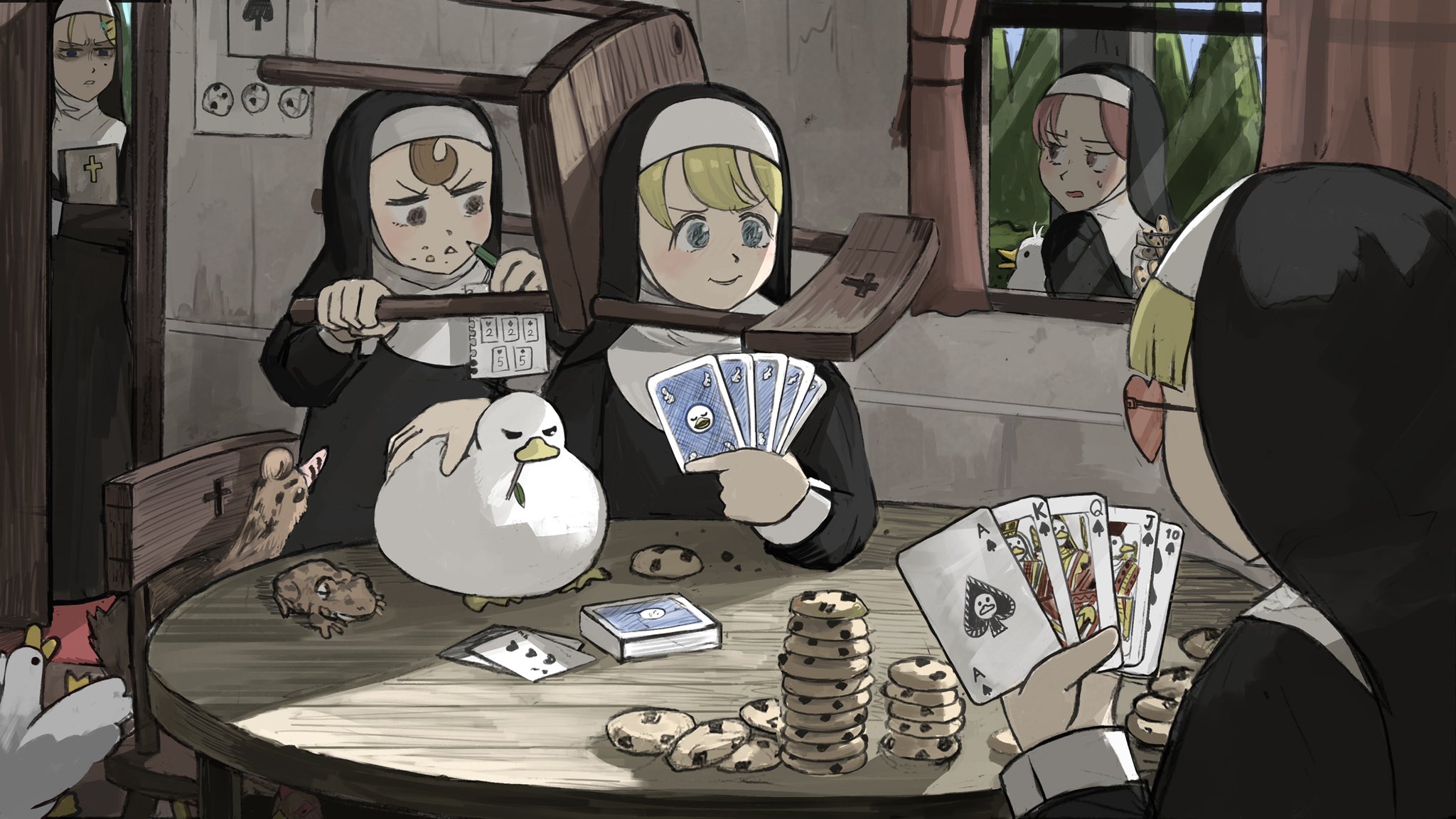
(Image from danbooru.donmai.us)

“WHY IS IT,” asked Sister Edwige as she threw a couple of green chips into the pot to call Sister Augustinha’s raise, “that every time we nuns have a little bit of fun, someone out there screams like we were indulging ourselves in some carnal revelry?”

“Sister Edwige!” said Sister Loreto, as she put her hand on her cheek, a sure tell that she had some pretty valuable cards in the hole, like a pair of jacks or an ace-king. “People might think that you—that we actually knew what you were talking about!”

“It’s no crime to know what we’re not supposed to be doing,” said Sister Edwige, who was wondering whether Sister Loreto was going to reraise, or was going to play it dumb, like she held the lowest pair. Some sisters were so transparent, which was why they chose to play Scrabble or bake muffins during their recreation hour instead of facing the likes of Sister Edwige at Texas Holdem, but with Sister Loreto, even letting on that she had a superior hand when she very possibly did not was part of the game. “Crafty” was the word for her, Edwige decided, something not necessarily malicious but with the possibility of being so.

“So are you going to call or fold?” Sister Augustinha said, annoyed that Edwige apparently didn’t feel threatened enough by her raise, and that Loreto might even move all-in.

“I’ll… just call,” Loreto said, whereupon the remaining sister, Sister Maryska, tossed her cards down, sensing imminent disaster. Acting as the dealer, Maryska drew the turn card—the king of clubs—eliciting a groan of agony from the playacting Loreto.

“Do you think it’s possible they’ll haul us off to prison and then try us for witchcraft, like they did in the old days?” asked Edwige with a chuckle.

“But whatever for?” said Maryska. In a previous life, she had been a nursery-school teacher, but had chosen to enter the order when the Virgin Mary appeared to her from a kaimito tree. “Everything we’ve done has been for the greater glory of God, hasn’t it?”

“Check!” said Sister Augustinha.

“Check!” said Sister Edwige.

“Hmmm…. Let’s make a tiny bet, shall we? Say, two hundred? Just to keep things exciting?” Sister Loreto ever so slightly pushed two even stacks of chips into the pot.

“Two hundred!” said Sister Maryska! “Why, that’s more than I can spend in a week on cookies and three-in-one coffee!”

“It’s only play money, Sister Maryska,” said Augustinha dryly. “It’s not like you or anyone here will starve to death if she makes a dumb call—which I’m not doing!” She folded her hand. “This is pretend-poker. We’re pretending that we’re escaped convicts disguised as nuns, that we stole these habits from a convent’s clothesline, and since our funds are running low and our runaway car is out of gas, we have to stake everything on a game of poker at the local bar, against the woman they know as… Madame Stolichnaya, a retired pediatric nurse and reputed mistress of the Master Demon himself, Dom Athanasius.” A shiver swept the table as Augustinha’s voice descended into a raspy whisper.

“Oooh, that’s exciting!” said Sister Maryska. “Tell us more! What did we do to become prison convicts?”

Before she joined the nunnery, Augustinha had been part of an avant-garde theater group known for its complete lack of inhibitions onstage and offstage, and it was rumored among the novices peeling potatoes in the kitchen that Augustinha had led a blissfully debauched life, complete with boyfriends, banned substances, and (dare they say it) aborted babies. That she was now one of the order’s most devout and dedicated sisters—the one who bathed lepers and tended to terminal patients—could not dispel the impression that she knew more about life than one was reasonably entitled to. 

“I fold!” said Sister Edwige, finishing the hand and letting Loreto scoop up the pot. “I think Sister Augustinha’s game is more fun. Let’s play that instead!”

“Awww, just when I was winning!” said Sister Loreto, pouting at her suddenly worthless chips. 

“Did we rob a bank?” asked Maryska. “Did someone get killed?”

Loreto said, “What do we know about robbing banks? Even if we did get some money, what would we have used it for? We made a vow of poverty—” 

“No, no,” said Edwige, “we didn’t make any vows, we’re not sisters, although we later pretend to be so. We’re villains, we like money, we like spending it on cars, houses, perfumes, vacations to Paris—” 

“Men? Did we spend on men?” asked Loreto.

“I don’t even know what it means to spend on men,” sighed Maryska. “Does that mean you—you buy them nice things, like watches and shoes and iPhones—”

“Or you can just buy them,” said Augustinha with a shrug.

“Really? For what?” said Maryska.

Edwige laughed. She had three brothers—an airline pilot, a cryptocurrency trader, and a police captain—all of whom had been left by their wives and girlfriends for various reasons. “So you can keep them as pets, snuggle up to them on rainy days, smell their body hair—”

“Ewww, I don’t even want to think about, please, please, take that thought away!” said Loreto, shaking her hands in the air. “No wonder we got caught! We had all of these impure thoughts! We robbed a bank so we could get and do all of these nasty things!”

“Technically, the bank robbery alone was enough to land us in jail. The motive doesn’t matter. We could’ve robbed a bank to give its money away to the poor. We’d still be criminals in the eyes of the law,” said Augustinha.

“It must be fun to be bad—sometimes,” said Sister Maryska, looking out into the garden, where other sisters were watering the begonias and watching the clouds turn pink.

“Do people even know what bad means anymore?” said Sister Edwige. “Or good, for that matter?”

Sister Loreto shuffled the deck of cards and said, “Let’s play another hand! And somebody close that window—I can feel a chill coming.”