
Qwertyman No. 215: Crimes and Punishments

Qwertyman for Monday, September 14, 2026

BACK IN the early ‘90s, I wrote an essay titled “Killing Time in Little Earth,“ in which I noted that “In the Philippines, we have crimes and punishments aplenty, but they have very little to do with each other.” I don’t think much has changed in thirty years, as recent events amply demonstrate.

For example, what it is about impending imprisonment that makes corrupt but otherwise bouncy politicians and officials suddenly acquire some debilitating disease that obligates their solitary confinement not in prison but in some swanky hospital suite?

Our prisons are bursting with inmates afflicted by tuberculosis, gastroenteritis, hepatitis, HIV, and host of other crippling ailments. But none of these inmates get the executive suite, and not everyone gets the treatment they need, if only because our jails are almost 300% congested, according to the BJMP’s own figures. Even if prison hospitals exist, they simply can’t keep up with the cases coming in; they’re swamped, and whoever they can’t serve go back into their overcrowded cells, carrying all kinds of communicable diseases. 

We’ve seen this happen so often here that it might as well be part of the official script: “Public officials above Salary Grade 30 charged with plunder will be subjected to a mandatory initial period of hospital confinement for a minimum of three months and to last no longer than the prescribed punitive period for their offense, during which extensive medical procedures will be undertaken to ensure the patient’s good health and fitness for prospective incarceration. Quality and substantial nutrition shall be provided, along with adequate recreational facilities for the patient’s physical and mental well-being. All this shall be at the state’s expense.”

These country-club habitues and their blue-chip physicians have been known to spin tall tales about how they suddenly acquired hypertensive atherosclerotic cardiovascular disease, osteoarthritis, respiratory ailments, and degenerative disc disease, to name the most popular diagnoses.

But to be fair, this epidemic of hospitalitis has been a global phenomenon. The Chilean dictator Augusto Pinochet, arrested in Britain, escaped repatriation and certain imprisonment for six years by reportedly feigning mental incapacity. He was later returned to Chile and charged with many crimes, but ultimately escaped judgment by dying before he could be convicted. Former Thai Prime Minister Thaksin Shinawatra, convicted of corruption, spent half of his one-year sentence in a Bangkok hospital before being kicked out by their Supreme Court for malingering. He would get in and out of jail more times since then. So politicians and despots find clever ways of replacing steel bars with green curtains, and justice often has to wait in the hallway while they take their time to recover.

Speaking of tall tales…. All this reminds me when, as an aspiring academic seeking relief from Manila’s infernal heat and university politics, I once found myself in a northern hillside village populated mostly by decrepit seniors. A young man there was causing mayhem with all kinds of vile rumors and fiendish schemes, gleefully hurting his elders without compunction for the sheer delight of watching them suffer, as if he hated what he was fated to become. How could someone so juvenile be so evil? 

A community council was called, to which I was invited as an honored guest. I would have been happy to observe the proceedings from a corner, but they sat me in a tall chair beside the village chief and handed me a bamboo cup filled with potent bugnay wine.

It was suggested, only half in jest, that this pest be disposed of as efficiently as possible, such as by driving a stake between his shoulder blades when he was squatting by the river to pollute the flow downstream. 

A heavily tattooed councilwoman less inclined to brute violence proposed instead that they approach the village shaman to lay a curse on the fellow, so that he would retch uncontrollably every time he did so much as utter a mean word, and grow pus-filled blisters between his legs whenever he mentioned the name of a specific villager who seemed to be the prime object of his mischief.

But then the chief turned to me, as the visiting writer and professor from the city, to ask me for my erudite opinion. Surprised but pleased to be consulted, and emboldened by the bugnay, I got up from my chair, thought hard, put on my sagest and most benign countenance, and drew on my command of fiction to offer counsel:

“O most noble chief, tell him this—you are cursed by the power of Fata Morgana! Fa-Tah Mor-gan-ah! Then turn your back on him—like this!—and leave him be to wonder what the curse entails. I trust life’s natural trajectory to bring him down to a deep dark valley where he will feel as much pain and misery as he is causing now. It happens to everyone. But for most of you here, having lived this long, that moment is surely behind you. For him, the worst yet to come, and he will not even know from where it will descend or arise. He will live the rest of his life in constant dread and anticipation of heaven’s inevitable retribution in some frightful form.”

I had to leave right after that to catch a bus to get to a beach resort in La Union before the sun set, pleased that I had contributed some paltry but precious wisdom to the community. The curse I conjured charmed me; I admired the uncertainty of the specifics against the certitude of the outcome.

But I later learned, in a long text message from the comely barangay nurse whom I had befriended in my first hour there, that the council had pondered my advice for about two minutes, and then, when my bus turned the corner toward the national highway, had deputized someone to whack the fellow over the head with a shovel hard enough to make him a slobbering fool forever. 

He injured no one after that, and the villager he had most maligned was kind enough to daily feed him leftovers from the pig trough with a hard wooden spoon, followed by a cool gulp of soapy dishwater, so he must have lived a reasonably long life. I never knew if he reached that low valley I predicted, but I think the plains were punishment enough.

Qwertyman No. 28: Catching Fluffy

Qwertyman for Monday, February 13, 2023

(Disclaimer: Our story today has nothing to do with the recent capture and deportation of the Japanese criminal mastermind known as “Luffy,” for which we congratulate our brave and vigilant law enforcers, although I have to admit to being inspired by that diabolically fearsome alias.)

HIS PHONE rang at the worst possible time. The chief of the Metropolitan Investigation Division was just about to reach the climax of his story—the ladies around him all open-mouthed and wide-eyed in anticipation—when the Tiktok “Moonlight” song, which he had been using as his ringtone, broke the spell, instantly sending some of the girls into their habitual gyrations.

“Chief!” exclaimed Melanie, his special girl in the club, “I didn’t know you liked that song! You’re so cool! Come, let’s dance!” She took his free hand and tried to drag him to the dancefloor, but he resisted. It was unusual for Chief Tiny (short for “Agustin”) to resist Melanie’s persuasions, but she could see from his look that this was something serious.

Chief Tiny had spotted the name on the call—Bungi, his lead investigator—and he knew that Bungi knew not to call him at this hour for any reason less than to report the mysterious sighting of a bearded man walking on the waters of Manila Bay. If this was just to tell him that his wife was at the station looking for him again, for which Bungi was supposed to have had a dozen excuses at his disposal, why, he was going to make sure Bungi was demoted to jail guard in charge of sanitation. Tiny was especially annoyed because he had been trying to impress the girls with his story of how he had found and captured Don Waldo—the country’s most notorious drug and gambling lord, compadre to this senator and that congressman, master of a reputed harem of 100 women, and ruthless widow-maker dozens of times over. Tiny had geo-located him through the Facebook feeds of his then girlfriend, the previous year’s Ms. Matabungkay, and had negotiated his peaceful surrender, much to everyone’s relief. Of course, he wasn’t going to tell them that Don Waldo posted bail one hour after he was arrested, and that the two men had exchanged winks at the station after the media photographers had had their fill. It was all part of his standard MO: catch the bad guy, work out a deal, and let him off the hook on some technicality. 

“Boss,” said Bungi in a whisper over the phone, “we found him—Fluffy.”

“Fluffy!” Tiny screamed with all his 250 pounds, jolting everyone. “Are you sure it’s him, the Fluffy, ourFluffy?”

“Yes, sir. Of course they call him ‘Fruffy’ in Japanese, but I saw him myself—absolutely no doubt he’s our man.”

As Chief Tiny continued to chat with his caller, Melanie shrank back into her seat beside the chief, trying to catch as much of the conversation as she could while collecting her own thoughts. She knew this man called “Fluffy”—personally, professionally, biblically, in all kinds of ways. When the chief wasn’t around, Fluffy took his place in her private quarters, in a condo overlooking the Pasig River, from the other side of which she had triumphantly risen. Initially there had been a language problem—his vocabulary would have been considered coarse even in Japan—but what they needed to communicate did not require too many hand-signs. What didn’t need explaining was his nickname, made obvious by the two clumps of steel-woolly hair on his head, like a poodle.

From his Pinoy bodyguard, Melanie learned that Fluffy ran an extensive Japanese mafia in the Philippines, which controlled the distribution of everything from fake Japanese car parts, Ebisu dolls, Voltes V figurines, and ramen noodles. They competed with an equally vicious Korean mafia engaged in pushing fake Korean car parts, BTS coffee mugs, CLOY T-shirts, and kimchi, as well as a Chinese mafia flooding the market with fake American, European, and everyone-else’s car parts, imported galunggong, POGO workers, and tikoy. Sometimes the rivalry got too hot and blood was spilled on Manila’s streets, giving Chief Tiny unnecessary headaches that required a few hours with Melanie to cure. But now Melanie herself felt the onset of a massive migraine: if her two patrons found out about the other and their common interest, then all hell would break loose.

“Sorry, girls, but I have to go,” Chief Tiny announced, getting to his feet. “I have to catch a master criminal.” With that, he gave Melanie a quick hug, and hurried off.

Melanie had to think fast. Chief Tiny made her feel protected—not only when he encircled her in his ham-like arms, but more importantly when she or her friends ran into trouble or needed a big favor like a police escort for a relative’s funeral. Fluffy was strange but sweet, gifting her with exotic desserts like green tea cookies and mochi; she was scared but also thrilled by his insistence that she take on his tattoos. Whom would she choose? She thought of sending Chief Tiny an anonymous text message telling him where Fluffy was, but then they already knew that. She thought of sending Fluffy another message to tell him that Chief Tiny was on his way to get him, but if he ran away then that would only prolong her own predicament. She decided to let fate take its course and to stick by whoever survived. Meanwhile, she wasn’t going to waste her time, and moved on to the next cubicle to make the acquaintance of a Korean gentleman who reminded her of that oppa Gong Yoo.

Two hours later, Melanie and her new partner were happily warbling BTS’ “Butter” on the videoke: Smooth like butter, like a criminal undercover / Gon’ pop like trouble breaking into your heart like that, ooh!”Suddenly she heard two all-too-familiar voices from the other side.

“You’re very hard to catch, Mr. Fluffy! You’re very good!”

“No, Mr. Tiny, you’re better because you caught me, haha!”

“Next time, don’t hide under the table, haha! That’s the first place we look!”

“Thank you for not shooting me, haha!”

“How can we be friends if I shoot you, haha! Now, let’s have a good time—I will introduce you to my very pretty girlfriend!”

“You also have a very pretty girlfriend, also here? Me, too! But my girlfriend is prettier, haha!”

The Korean gentleman in the next cubicle was perplexed. “Melanie! Where you go? Why you hiding under the table?”

(Photo from bbc.com)

Qwertyman No. 4: Subversive Sisters Having Fun

Qwertyman for Monday, August 29, 2022

(Image from danbooru.donmai.us)

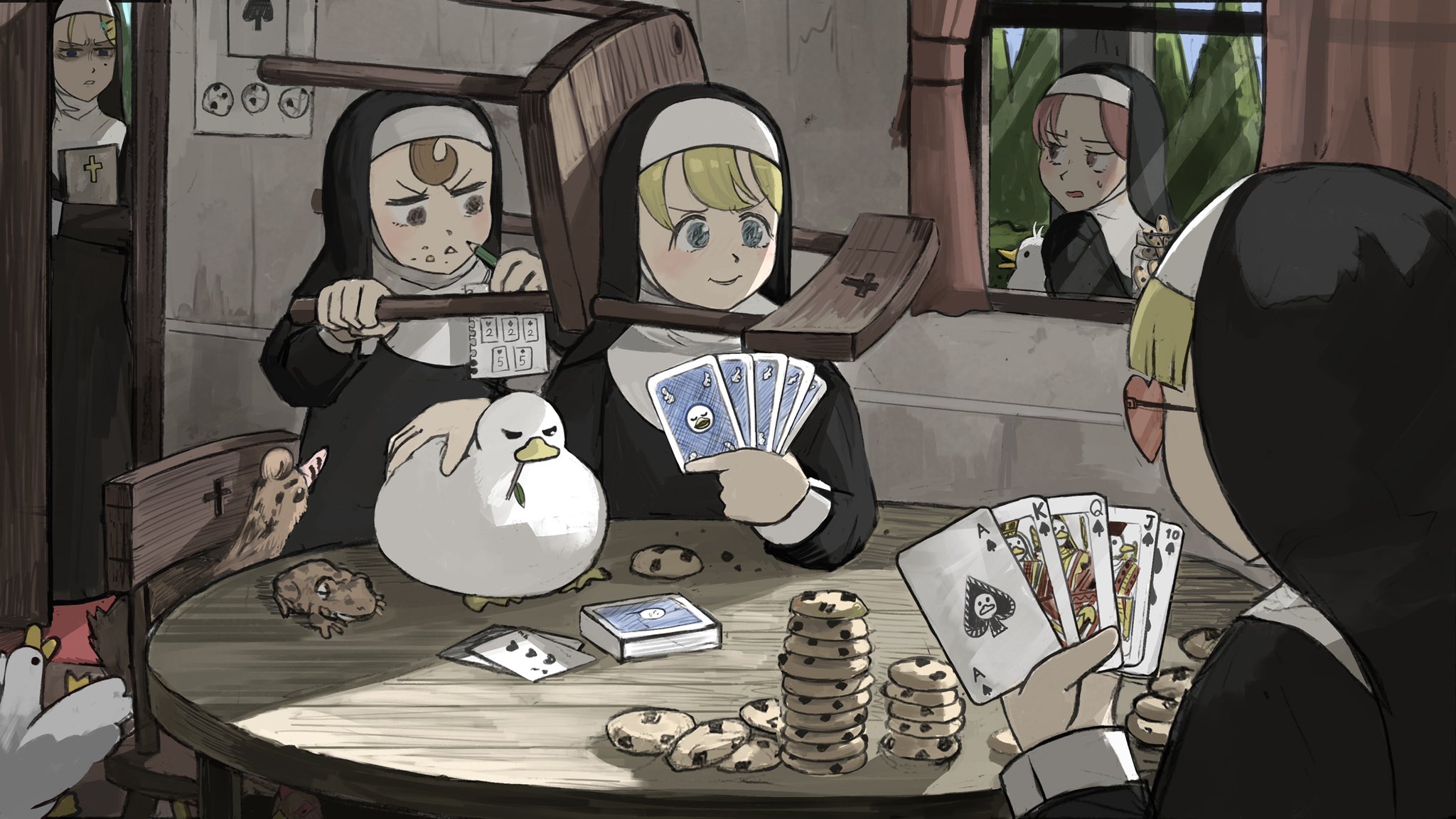
“WHY IS IT,” asked Sister Edwige as she threw a couple of green chips into the pot to call Sister Augustinha’s raise, “that every time we nuns have a little bit of fun, someone out there screams like we were indulging ourselves in some carnal revelry?”

“Sister Edwige!” said Sister Loreto, as she put her hand on her cheek, a sure tell that she had some pretty valuable cards in the hole, like a pair of jacks or an ace-king. “People might think that you—that we actually knew what you were talking about!”

“It’s no crime to know what we’re not supposed to be doing,” said Sister Edwige, who was wondering whether Sister Loreto was going to reraise, or was going to play it dumb, like she held the lowest pair. Some sisters were so transparent, which was why they chose to play Scrabble or bake muffins during their recreation hour instead of facing the likes of Sister Edwige at Texas Holdem, but with Sister Loreto, even letting on that she had a superior hand when she very possibly did not was part of the game. “Crafty” was the word for her, Edwige decided, something not necessarily malicious but with the possibility of being so.

“So are you going to call or fold?” Sister Augustinha said, annoyed that Edwige apparently didn’t feel threatened enough by her raise, and that Loreto might even move all-in.

“I’ll… just call,” Loreto said, whereupon the remaining sister, Sister Maryska, tossed her cards down, sensing imminent disaster. Acting as the dealer, Maryska drew the turn card—the king of clubs—eliciting a groan of agony from the playacting Loreto.

“Do you think it’s possible they’ll haul us off to prison and then try us for witchcraft, like they did in the old days?” asked Edwige with a chuckle.

“But whatever for?” said Maryska. In a previous life, she had been a nursery-school teacher, but had chosen to enter the order when the Virgin Mary appeared to her from a kaimito tree. “Everything we’ve done has been for the greater glory of God, hasn’t it?”

“Check!” said Sister Augustinha.

“Check!” said Sister Edwige.

“Hmmm…. Let’s make a tiny bet, shall we? Say, two hundred? Just to keep things exciting?” Sister Loreto ever so slightly pushed two even stacks of chips into the pot.

“Two hundred!” said Sister Maryska! “Why, that’s more than I can spend in a week on cookies and three-in-one coffee!”

“It’s only play money, Sister Maryska,” said Augustinha dryly. “It’s not like you or anyone here will starve to death if she makes a dumb call—which I’m not doing!” She folded her hand. “This is pretend-poker. We’re pretending that we’re escaped convicts disguised as nuns, that we stole these habits from a convent’s clothesline, and since our funds are running low and our runaway car is out of gas, we have to stake everything on a game of poker at the local bar, against the woman they know as… Madame Stolichnaya, a retired pediatric nurse and reputed mistress of the Master Demon himself, Dom Athanasius.” A shiver swept the table as Augustinha’s voice descended into a raspy whisper.

“Oooh, that’s exciting!” said Sister Maryska. “Tell us more! What did we do to become prison convicts?”

Before she joined the nunnery, Augustinha had been part of an avant-garde theater group known for its complete lack of inhibitions onstage and offstage, and it was rumored among the novices peeling potatoes in the kitchen that Augustinha had led a blissfully debauched life, complete with boyfriends, banned substances, and (dare they say it) aborted babies. That she was now one of the order’s most devout and dedicated sisters—the one who bathed lepers and tended to terminal patients—could not dispel the impression that she knew more about life than one was reasonably entitled to. 

“I fold!” said Sister Edwige, finishing the hand and letting Loreto scoop up the pot. “I think Sister Augustinha’s game is more fun. Let’s play that instead!”

“Awww, just when I was winning!” said Sister Loreto, pouting at her suddenly worthless chips. 

“Did we rob a bank?” asked Maryska. “Did someone get killed?”

Loreto said, “What do we know about robbing banks? Even if we did get some money, what would we have used it for? We made a vow of poverty—” 

“No, no,” said Edwige, “we didn’t make any vows, we’re not sisters, although we later pretend to be so. We’re villains, we like money, we like spending it on cars, houses, perfumes, vacations to Paris—” 

“Men? Did we spend on men?” asked Loreto.

“I don’t even know what it means to spend on men,” sighed Maryska. “Does that mean you—you buy them nice things, like watches and shoes and iPhones—”

“Or you can just buy them,” said Augustinha with a shrug.

“Really? For what?” said Maryska.

Edwige laughed. She had three brothers—an airline pilot, a cryptocurrency trader, and a police captain—all of whom had been left by their wives and girlfriends for various reasons. “So you can keep them as pets, snuggle up to them on rainy days, smell their body hair—”

“Ewww, I don’t even want to think about, please, please, take that thought away!” said Loreto, shaking her hands in the air. “No wonder we got caught! We had all of these impure thoughts! We robbed a bank so we could get and do all of these nasty things!”

“Technically, the bank robbery alone was enough to land us in jail. The motive doesn’t matter. We could’ve robbed a bank to give its money away to the poor. We’d still be criminals in the eyes of the law,” said Augustinha.

“It must be fun to be bad—sometimes,” said Sister Maryska, looking out into the garden, where other sisters were watering the begonias and watching the clouds turn pink.

“Do people even know what bad means anymore?” said Sister Edwige. “Or good, for that matter?”

Sister Loreto shuffled the deck of cards and said, “Let’s play another hand! And somebody close that window—I can feel a chill coming.”