Penman No. 338: Back to Balangiga

9781616959449.jpeg

Penman for Monday, January 28, 2019


THE RECENT return of the fabled bells of Balangiga from the American West to their home in Samar reminded me of my fleeting involvement years ago in the effort to draw renewed attention to that traumatic episode of the Philippine-American War.

Sometime in 2001, the late film director Gil Portes called to ask me to work with him on a project that would focus on what people—echoing the American view—were then calling the “Balangiga massacre,” culminating of course in the loss of the bells (hardly the event’s most tragic outcome, considering the slaughter of innocents that the Americans undertook in the attack’s aftermath).

I suppose we were still basking in the afterglow of the Philippine Centennial, and directors were eager to take on historical subjects, long before Heneral Luna would prove that history artfully told could do well at the box office. In fact, our project ran alongside a similar one being put together by the formidable tandem of director Chito Roño and screenwriter Pete Lacaba. (Pete and I were good friends and knew what the other was doing.) The main difference was that our version was going to be a Filipino-American co-production, with the script in English, for a global audience.

I can’t recall now who our producer was, but I knew that Gil was in conversation with US-based financiers, and I did get a down payment for the sequence treatment and the script itself, so we were seriously engaged in the project—seriously enough that Gil and I went on a reconnaissance visit to Balangiga.

Balangiga is a small fourth-class municipality in Eastern Samar, reachable by surprisingly good roads (at least that long ago) from Tacloban across the San Juanico Bridge and past Basey. When we went there, we were billeted in the only “hotel” in town, where the rooms cost P100 a night and I tried to read my notes under a 10-watt lamp. But we were able to find and interview the descendants of Valeriano “Bale” Abanador, the town’s chief of police who led the attack in retaliation against American repression. I was even shown the wooden stick that Abanador was supposed to have waved as a signal to begin the attack that morning of September 28, 1901.

Sadly, after all the research and three drafts of the script, and despite rumors that Sony was going to be involved and that the likes of John Malkovich were being considered for the lead roles, our project fell through, as did the other one. One reason I heard was that in the wake of 9/11, it was proving difficult to bring a battalion of American actors over. Years later, Gil asked me for a copy of the script, thinking to revive the project, but then Gil himself died suddenly two years ago.

I don’t pretend to be a Balangiga expert, although I drew heavily on the writings of such real Balangiga scholars as UP Prof. Rolando Borrinaga and writer Bob Couttie, who have sorted much of the fiction from the facts of the event. I did fictionalize my treatment, as I was expected to do for dramatic purposes, without altering the basic facts as they were known to me. My chief conceit was to create a character named Ramon Candilosas, the fictional son of the bell ringer Vicente, who was a teenager when the attack happened.

My treatment opened this way:

SEQ. 1. Intro. EXT/INT. Fort Warren, Wyoming. Day.

 An old man, around 70, walks across the yard in Fort Warren, Wyoming, to where they keep the Balangiga bells. He pauses before one of them, takes off his hat, and reaches out with a trembling hand to touch one of the bells.

 Later, we see him signing his name with a scratchy fountain pen on a guestbook; a CLOSE-UP reveals his name: RAMON CANDILOSAS. “I do not know everything,” his voice begins to intone. “This is only what my father told me, and what I imagine to have happened in our hometown, in a war over a hundred years ago. It is a war we have forgotten, a war we find difficult if not impossible to believe.”

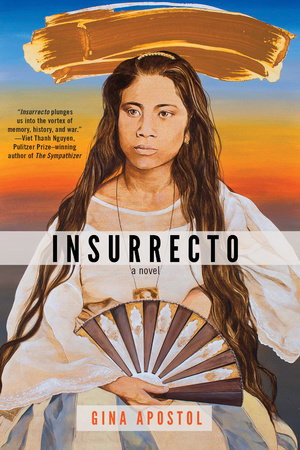
 Indeed, as I often remark to my American friends, I can understand if few Americans remember the Philippine-American War (downplayed for the longest time in American annals as the Philippine Insurrection). What’s sad is how few Filipinos do. At least writers like the US-based Gina Apostol are reviving that memory through her most recent and highly acclaimed novel Insurrecto, a complex and contemporary take on that century-old event.

But I’m glad for history’s sake that the bells are back, and that, for once, the fact has overtaken the fiction.

Penman No. 335: Senior Moments

Rainbow's_Suns_poster.jpg

Penman for Monday, January 7, 2019


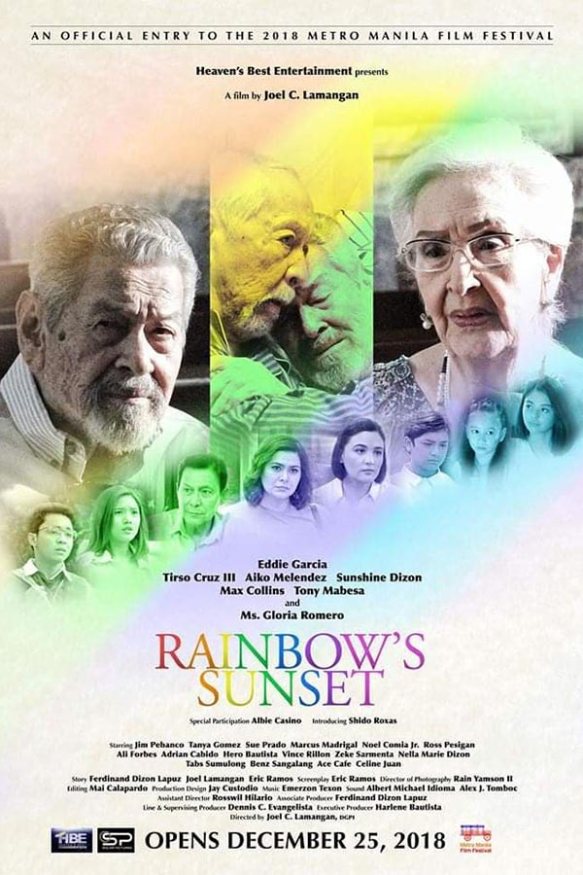
BEFORE ANYTHING else, I’d like to put in a word of praise for the only movie that my wife Beng and I really wanted to see among the entries to the recent Metro Manila Film Festival, Joel Lamangan’s Rainbow’s Sunset, a film about two gay old men on the brink of death and of the family around them. I’ve often said that in our youth- and gimmick-centered culture, we don’t have enough movies (or books and songs, for that matter) about old people, and not enough intelligent movies, either.

 Rainbow’s Sunset satisfies both criteria, offering a sensitive, often comic, in-your-face portrayal of the undiminished decades-old love between two men—and of the woman who loves them both—without losing sight of the very real complications it creates for others, no matter how sympathetically inclined. It’s a project that could very easily have given in to caricature and condescension, but it doesn’t. The acting performances are solid and engaging, both individually and as an ensemble. Aside from the lead actors Eddie Garcia and Tony Mabesa, of course, Gloria Romero and the three children—Tirso Cruz, Aiko Melendez, and Sunshine Dizon—are a delight to watch.

It’s far from a perfect movie—I find the title a bit strained (I get it, I get it) and there are a few off-key notes in the drama—but the minor flaws shouldn’t take much away from its overarching achievement. It will probably be gone from the mainstream theaters by the time this comes out, but it deserves more than passing notice, and I hope it leads to more good movies about seniors, who should know a thing or two about love and life.

WahlDeco.jpg

SPEAKING OF seniors, I started the New Year in the best and the worst possible way: by buying an old pen, I suppose as a late Christmas or early birthday gift to myself, but whatever the excuse, I’m happy, because it was one of the last of what we collectors call our “grail” pens (as in “Holy Grail”), something I had been dreaming about for, oh, thirty years.

I woke up early on January 1, and like most of us do, I picked up my phone to scan my messages—nothing too interesting there beyond the predictable plethora of New Year greetings. And then, unlike most of us, my digits drifted off to the fountain pen sites, just to see what people could be possibly up to. There is such a thing as a global fountain-pen community (just as there’s an antique typewriter community, a wristwatch community, a Japan-surplus community, and an Apple community—and yes, I belong to all of those, too), and it’s become my virtual hangout online.

Unlike real friends, with whom you have to chug beers and trade miserable stories that inevitably involve retirement options, Metformin, and political sleaze, these thing-centered, Web-based communities offer mostly good cheer and kind intentions. Sure, we get our share of jerks and trolls, but they’re pretty easy to weed out with a few keystrokes. These sites are the best distraction I can find from the front-page news (let’s not get started on that, shall we?), and they offer something often lost in today’s Twitter-driven dystopia: a sense of wonder and discovery, and for an aging romantic like me, an enchantment with things past. I know that we keep bemoaning how consumerism has turned us into heartless, mindless brutes, but you’ll be surprised how people can be their nicest, most civil, and most helpful selves when talking about flexing vintage Waterman nibs, locating the tension lever on an Olivetti Lettera 22, and using Stage Light in Portrait Mode on an iPhone X.

But all that’s a long excuse for treating myself in my creeping old age—I’ll hit 65 and retire in two weeks—with a new old pen. “Senior moments” are supposed to be about forgetting things, but they should also be about remembering things, chiefly that life is short and keeps getting shorter, which means that any treats you deserve or expect had better come sooner rather than later.

The fountain pen I grabbed when I saw it was a (hold your breath) Wahl-Eversharp Personal Point Gold Seal Deco Band Oversize in woodgrain ebonite with a factory 14K stub nib—meaning a large, fancy, impressive-looking pen with gold trim, great for loopy signatures and maybe for stabbing malevolent strangers in the dark (but with a stub or flat nib, it won’t do much damage). A 25-peso ballpoint will probably write better for most people, but with all due respect to most people, I’m a bit odd in some ways.

In its time, the W-E Deco Band was among the classiest of them all, alongside the Parker Duofold Senior and the Waterman Patrician—think Duesenbergs, Auburns, and Bugattis in terms of 1920s cars. This pen I got survived wars (and worse, people with clumsy hands), and given a few weeks, it will make its way from Pennsylvania to California and then to me. It won’t write a novel—maybe it’ll sign a few greeting cards—but even just sitting in my pocket, it will make a boy from Romblon feel like the Great Gatsby, for once in his Nick-Carrawayish life.


Penman No. 333: An Academy of Our Own

DSC_9291.JPGPenman for Monday, December 24, 2018


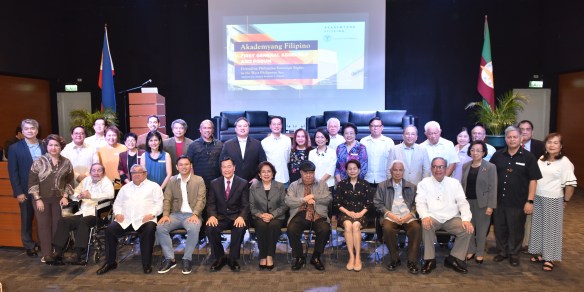
EXACTLY A month ago, in the auditorium of the newest campus of the University of the Philippines at Bonifacio Global City, an event of great historical significance took place—the first general assembly and forum of the newly organized Akademyang Filipino, the first Philippine academy of arts, sciences, and the professions.

Conceived together by National Artist F. Sionil Jose and the late Sen. Edgardo J. Angara, the independent and non-partisan Akademyang Filipino was set up for three main goals:

“To recognize and bring together, in one chamber, the best of Filipino minds and spirits, accomplished representatives of the Filipino arts, sciences, and professions, imbued with love of country and the spirit of service to the nation;

“To uplift the material and moral lot of the Filipino people, to define, promote and defend the best interests of the Filipino nation, and to find and nurture new sources of hope and inspiration for the Filipino youth; and

“To provide a forum for the rational discussion of pressing issues and the exploration of pathways to a better future.”

In other places, such academies have had somewhat more focused roles. The venerable Academie française is devoted to being the authority on the French language; the Taiwan-based Academia Sinica covers a broad range of disciplines but supports advanced research.

In the United States, the National Academies of Sciences, Engineering, and Medicine is the collective name of the three honorific academies in those disciplines. Since its founding in 1863, these national academies have pledged “to marshal the energy and intellect of the nation’s critical thinkers to respond to policy challenges…. When faced with a complex question, we bring together experts from across disciplines to look at the evidence with fresh eyes and openness to insights from other fields. These study committees survey the landscape of relevant research, hold public meetings to gather information, and deliberate to reach consensus, which results in a shared understanding of what the evidence reveals and the best path forward.” Studies and advice by the National Academies have covered such diverse topics as fixing the Hubble telescope, preventing wrongful convictions, and preparing young Americans for careers in science and engineering.

This is probably closer to what the Akademyang Filipino aims for—to repeat, “a shared understanding of what the evidence reveals and the best path forward.”

In our first forum, Justice Carpio gave a masterful presentation of the history of China’s claims to Philippine territories in the West Philippine Sea, using ancient maps to prove—as a good lawyer might be expected to do—the paucity of those claims. A panel of Akademya members and West Philippine Sea experts—De La Salle University’s Renato Cruz de Castro, UP’s Jay Batongbacal, and author and columnist Richard Heydarian—discussed the current Philippine government stand on the disputes was and warned against a policy of appeasement and surrender.(The DFA was invited but apparently declined to send a representative to the forum.)

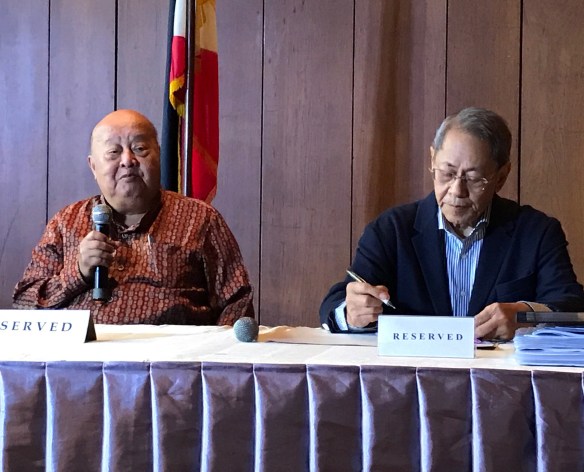
The Akademya’s 100-plus founding members—a roster that could grow as more names are vetted—were selected by an interim board composed of NA Frankie Jose, National Scientist Angel Alcala, former Ombudsman Conchita Carpio Morales, Senior Associate Justice Antonio Carpio, Sen. Sonny Angara, former Sen. Ramon Magsaysay Jr., Atty. Felipe Gozon, Dr. Lydia Echauz, Ms. Doris Magsaysay Ho, and myself. We also elected Justice Carpio Morales our chairperson, and NA Jose as Chairman Emeritus.

Some easily recognizable faces at the launch included former UP President Emerlinda Roman, former Education Sec. Armin Luistro, former Foreign Affairs Sec. Delia Albert, former National Historical Commission Chair Maris Diokno, former Prime Minister Cesar Virata, historian Dr. Ricky Soler, Mapua University President Rey Vea, businessman Jack Ng, novelist Cristina Pantoja Hidalgo, sculptor Toym Imao, and Anvil Publishing chief Andrea Pasion-Flores.

A smaller group had met less formally for the first time in February last year, when Sen. Ed Angara was still around and very much involved in getting the academy off the ground alongside NA Frankie Jose. It still called itself the “Academia Filipina” then, but later changed its name in deference to an existing Academia Filipina de la Lengua Española.

IMG_0895.jpeg

This was the first but certainly not the last of our forums, and we intend to have several of these large assembly-type meetings every year for issues of great and general significance, concerning not just politics and business but also science and the arts. We need to create new interdisciplinary points of intersection and interaction. Our artists and scientists hardly ever get heard by our policy makers. With all due respect to the lawyers and the businessmen, they too might benefit from the insights of these other disciplines, so that we do not get mired in the kind of cynical pragmatism that drives too many of our decisions today, and remember to value such abstractions as beauty and logic.

The dues we collect will help support a very small back room and also our future activities. Sponsorships are of course needed and welcome, for so long as they do not compromise the independence of our association.

On that note I would like to thank, once again, aside from our speakers, our sponsors for the Akademyang Filipino event, including the UP College of Law, whose Dean, Fides Cordero-Tan, also happens to be the Executive Director of UP-BGC. I’d also like to thank the National Commission for Culture and the Arts, Sen. Jun Magsaysay, and other donors who prefer to remain anonymous for their assistance. My special thanks go to our Executive Director, Ms. Jette Jose Bergkamp, and my UP team from the Padayon Public Service Office and the Media and Public Relations Office.

Penman No. 332: Southern Surprises

IMG_8556.jpeg

Penman for Monday, December 17, 2018


MY RECENT forays to southern Taiwan—the first to Tainan, and the second to Kaohsiung—reminded me that while we Pinoys love to chuckle and even snicker at how the Chinese (among others) mangle English, the economic and technological leaps they’ve made (using their own language, let’s not forget) are no laughing matter, unless you’re a Chinese entrepreneur or engineer on his or her way to the bank.

This occurred to me as I was flipping through the local travel and leisure magazines in my hotel room in Tainan between sessions of the academic conference I was attending. Typical of the prose was this advertisement for a resort on the island: “Join the exclusive equestrian sports of the aristocrats, so that parents can easily experience the price of the people, the wonderful and rich itinerary, you can easily lick the children without going far! Let you play and don’t want to go home anymore.”

I could imagine some snooty Filipinos, more English than the English, rolling on the floor and thinking that people who write that way can’t possibly go anywhere, but I would’ve liked to bring those people to the exhibits downstairs showcasing Taiwan’s state-of-the-art research in biomedical engineering, solar power, and materials science, including an interesting project aimed at improving your basketball skills through “a virtual reality basketball tactic training system.”

I don’t know how close that project will bring Taiwan to a world basketball championship, but I could see, from the presentations I was listening to, that they were going all out to become world-class champions in research and development. Our host, the National Cheng Kung University, had almost US$145 million to spend on R&D in 2017, mostly from the government. (That’s about half of the University of the Philippines’ budget for everything.)

Thankfully, we did have a break from all the S&T reports on the last day of our Tainan conference, and we were given a choice of tours between visiting a museum or an aquaculture farm. Now, I love fish as much as you do—it’s often the first thing I eat in the morning—but I wanted to have a closer look at Taiwan’s culture and history, so I hopped on the museum bus. What we saw was, well, anything but Taiwanese—unless you take the act of presenting the thing itself as an expression of Taiwan’s place in the world today.

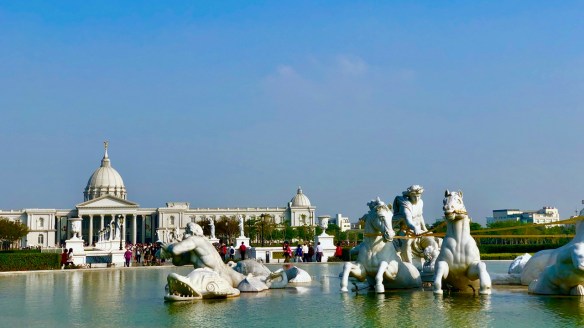
Our destination was the Chimei Museum, named after the company that’s now the world’s largest maker of ABS resin, which goes into the making of popular plastics such as computer keyboards, auto body parts, and bicycle helmets.

The Chimei Museum is an imposing if rather odd homage to Western art and artisanship. Located on the outskirts of Tainan, it was built in 1992 by the billionaire industrialist Shi Wen-long. Now 90, Shi never got a college degree. But he’s also a passionate amateur violinist who’s played with Yo-yo Ma. That, plus his personal fortune, has allowed him to put together a stunning collection of vintage musical instruments—including priceless violins by Stradivari, Guarneri, and Amati—that are now on display at the museum, in an exhibition that recreates the workshop of a master luthier or violin maker.

The Chimei’s other showstopper—aside from the Rodin gallery and some masterpieces of French realism—is its exhibit of ancient arms and armor, from the time of the Greek hoplites and medieval knights to the Japanese samurai and English crossbowmen. I have to admit to a boy’s fascination with weaponry, and having visited many of the world’s best museums, I’d have to say that the Chimei’s collection was comprehensively fearsome. These were the real things, folks, not cheap or 3-D printed replicas.

Indeed, there’s hardly anything Chinese in the design of the Chimei or in its exhibits. The large, neoclassical, Corinthian-columned museum—set off from the street by a long walkway flanked by tall statues of the Greek gods and goddesses—could have stood anywhere in Europe or the US, and comes off as a statement, as if to say, “We could have given you the chinoiserie you expect, but we chose to acquire and to present the best of the West.”

IRide.png

And I can’t let this column end without mentioning the other surprise I came across in southern Taiwan, in the port city of Kaohsiung, where I also attended a conference on distance education. Our host, Dr. Eing-Ming Wu, made use of a free afternoon to introduce us to the city in a most unconventional way—by giving us tickets to take the I-Ride, Kaohsiung’s so-called “flying theater”—kind of like a rollercoaster in an Imax—powered by the homegrown Brogent Group’s 3D technology, which it has exported to Hollywood and other amusement capitals worldwide. If I needed to be impressed by Taiwan’s engineers, this was the best way to do it, screaming my head off, feet dangling in the air, as we swooped over a Buddhist temple then plunged into the ocean.

While travel to Taiwan remains visa-free for Pinoys, I’m definitely returning as a tourist to Kaohsiung with my wife Beng, if only to have her  experience the exhilaration of the I-Ride and maybe take her on a cruise on the Love River, feasting on the sweet giant atisuntil our eyes bulge. As they say, in Taiwan, “you can easily lick the children without going far”—whatever that means, it sounds like fun!


Penman No. 331: Opening up to Taiwan


IMG_8621.jpegPenman for Monday, December 10, 2018


AS IT happened, I was in Taiwan twice last month to represent the University of the Philippines in two conferences that underscored the vitality of our academic partnerships with our Taiwanese counterparts—and the importance they accord to improving relations with Philippine universities.

Over the past decade, the Philippines has been sending scores of graduate students to various universities in Taiwan for their masteral and doctoral degrees, mainly in the sciences, where Taiwan has a lot to offer the world, given its cutting-edge technologies and laboratories. This also plays into one of the island’s growing predicaments—a demographic dip that has encouraged its policymakers to draw students for its universities from around the region, embodied in its so-called “New Southbound Policy” of promoting relations with South and Southeast Asia and Australasia.

Southern Taiwan has been especially aggressive in opening and developing academic relations with Philippine universities, banking on its geographical and cultural proximity to us. (It always amazes me how closely their aboriginal costumes and folkways resemble ours.)

The first conference I attended was the Presidents’ Forum of the South and Southeast Asian and Taiwan Universities (SATU), a consortium organized 15 years ago and since led by the National Cheng Kung University based in Tainan. This year’s meeting was devoted to strengthening linkages between universities and industries, with experts from Thailand (medical sciences) and India (engineering) supporting their Taiwanese counterparts in providing models for cooperation. SATU universities match experts who then work collaboratively on projects ranging from robotics and wind tunnels to dengue and stem cell research.

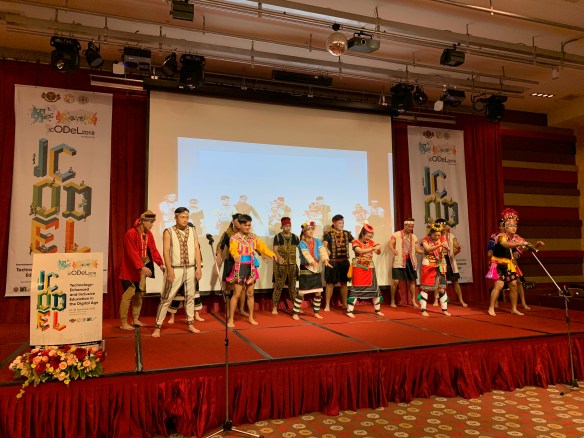
The second and larger conference was held in the port city of Kaohsiung, even farther south (both Tainan and Kaohsiung are easily reachable from Taipei by high-speed train). This was the 3rdInternational Conference on Open and Distance e-Learning (ICODeL) with the theme “Technology-Enhanced and Inclusive Education in the Digital Age,” and while it took place in Taiwan, it was actually organized and run by the UP Open University (UPOU), with support from the Commission on Higher Education (CHED), the Manila Economic and Cultural Office (MECO), the National University of Kaohsiung, the Open University of Kaohsiung, the Southern Taiwan Universities Alliance, and Taiwan’s Edu-Connect Southeast Asia network, among others.

This is as good a time as any to highlight the work of UPOU, one of UP’s eight constituent universities—one that happens to have the smallest physical footprint (it occupies a small lot in Los Baños, Laguna) but the largest global reach, because of its online presence. Founded almost 25 years ago to democratize access to quality higher education through distance education, UPOU came fully online in 2007, with 25% of its enrollees spread out over 70 countries. It offers three undergraduate, about 30 graduate diploma and masteral, and three doctoral degree programs, from which it has produced close to 3,000 graduates, mostly from its Multimedia Studies and Education programs.

All of this happened, former UPOU Chancellor Grace “Gigi” Javier Alfonso told me, without compromising UP’s high educational standards. “Applicants to our undergraduate degree programs still have to pass the UPCAT,” she said.

There’s a persistent impression out there that open universities and distance education offer cheaper but also lower-quality education and easier-to-pass courses, but UPOU has been working hard to prove this stigmatization wrong. “We offer the same quality of education as any other UP CU,” said current Chancellor Melinda Bandelaria, who also presides over the Asian Association of Open Universities (AAOU). “What open universities like UPOU provide is a chance for working professionals, housewives, entertainers, and OFWs to acquire a college or graduate education at their own pace, wherever they may be in the world. It’s not a replacement for, but an alternative to, traditional residential colleges.”

Many of UPOU’s students are OFWs working on their degrees, which will boost their skills and employability where they are and when they come home. One of the highlights of ICODeL was the inauguration of a Philippines Learning Commons in Kaohsiung where UPOU students could access their materials online. Much of the instruction of UPOU and other open universities is done through Massive Open Online Courses or MOOCs, which have become increasingly popular in the global academic landscape. UPOU now has more than 70 MOOcs on its roster, with 3 MOOCs typically covering a 3-unit course. It typically takes three years to finish a master’s degree with UPOU.

Mandated by RA 10650 or the Open Distance Learning Act to assist CHED and TESDA, UPOU had engaged industry experts help it in designing Open Educational Resources  or OERs which are free to use by teachers and students; UPOU then develops MOOCs using these OERs. “When industries work with universities, they create a powerful engine for economic growth and innovation,” said Dr. Bandelaria.

The point of bringing ICODeL to Kaohsiung was also to match UPOU and the many Philippine SUC officials who attended the conference with their Taiwanese counterparts. The chief matchmaker was Edu-Connect’s indefatigable Executive Director, Dr. Eing-Ming Wu, a political scientist and Chair Professor at Shu-Te University who has been one of the most energetic promoters of the Philippines abroad that I’ve ever met.

With these connections in place, Philippine educators may not have to look much farther than our closest northern neighbor for vital help in raising their educational standards.

Penman No. 330: From Parrots to Maroons

up-maroons-86-championship.jpg

Penman for Monday, December 3, 2018


I HAD a whole other column lined up for this Monday, but that’s going to have to wait after last Wednesday’s titanic ballgame—you all know what I’m referring to, that heart-stopping semifinal do-or-die clash between the Adamson Soaring Falcons and the UP Fighting Maroons for a spot in the UAAP finals. Without a ticket to the live game at the Araneta Coliseum, I watched the nailbiter on a giant screen at the UP Theater with 2,000 other maroon-shirted fans, and screamed my head off as shrilly as the girls around me when UP sealed the 89-87 win with a shot in the closing seconds.

I can’t say that I’m a huge basketball fan—I hardly know what’s going on in the NBA or PBA—but I’m a big fan of school spirit, and have cheered for UP since my mother (BSE, 1956) indoctrinated me by playing a 78 rpm record of “UP Beloved” and “Push On, UP” every day when I was a boy. I do have to confess that I wore green and sat with DLSU last season, having reconnected with my grade-school classmates, but UP just wasn’t a serious contender then.

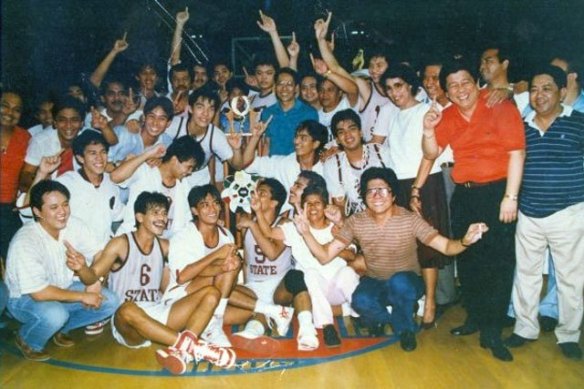
The victory over the Falcons sent me scurrying back to my UP history files, the last time we had been in the UAAP basketball finals having been 1986, when we emerged champions. Since then it’s been a long and frustrating story of losses and thwarted ambitions, reversed only this year by the Maroons’ Cinderella appearance in the finals which began last Saturday.

I dug into UP’s unpublished history and discovered some interesting factoids—one of the most interesting and rather unfortunate tidbits being that back in the ‘60s, as UP oldtimers may still recall, the Maroons were briefly called the Parrots, the emblems worn by the cheering squad. They were already known as the Maroons in the 1930s, when UP was part of the Big Three Basketball League (the other two being UST and NU). UP team captain and later Senator Ambrosio Padilla, who also played baseball, led the Philippine team in the 1936 Olympics and in the 1934 10th Far Eastern Championship Games, where we came out champions, beating Japan and China.

A bit of a spoilsport, UP President Jorge Bocobo pulled UP out of the Big Three, citing complaints that players had begun sporting a “star complex” and that the spectators had become too rowdy. Intramurals between UP Manila and UP Los Baños took over, as well as two annual “playdays”—one for boys, and one for girls. When the UAAP was founded in 1938, UP rejoined the big league. When we lost a game, we told ourselves (and others) that it was okay, because we were smarter anyway—a lame excuse we’ve fallen back on way too often down the decades.

But the evidence was there to show that our athletes had, indeed, as much brain as brawn. The unpublished history notes that “Alfonso Ybañez, varsity football captain of 1939, placed second in the board examinations for mining engineers in 1940. In that same year the spirit of sports enthusiasts was further lifted when Ambrosio Padilla joined the law faculty. And, while there might have been some excitement among the law freshmen at the news that he was going to teach the introductory course on family relations, his appointment was taken more as ‘an auspicious sign for their local basketball team.’”

Given our country’s crazy infatuation with basketball, few remember that UP actually won the general championship of the UAAP in the 1977-78 season, having bested all others at volleyball, track and field, baseball, football, and women’s basketball.

But UP’s 1986 basketball championship—powered by the likes of future PBA stars Benjie Paras and Ronnie Magsanoc—still glimmers in the memory of many Maroons of my generation, harking back to a golden age when we had just ousted a dictator (ironically also one of UP’s own) and were looking forward eagerly to a bright new future not only in sports but also in society itself. Neither of those expectations materialized—not so easily and not so quickly.

As I walked back to my car after the Adamson game, the cheers and chants of the crowd still ringing in my ears, I savored the extraordinary sense of solidarity that sports can bring to a community all too easily fractured by politics. Everyone needed the relief after a couple of weeks dominated by horribly bad news about misogyny and brawling among frat boys—a discussion that can’t and shouldn’t go away, but which also can’t be everything that defines a university.

After the 1986 victory, UP went wild, holding a big motorcade featuring three bands and capped the night with a bonfire. I’d have to wonder how we’ll top that in the event that the miracle continues and we rout our favored Katipunan neighbors. Raze the arboretum? Just to annoy the mighty Eagles, I think I’ll look for a parrot, dye it maroon, and train it to screech “Atin ‘to! Atin ‘to!


Penman No. 329: Focus on the Intangible

IMG_8334.jpeg

Penman for Monday, November 26, 2018


THIS TOOK place last month, but it can’t be too late to congratulate the University of the Philippine Visayas for organizing and hosting the 2ndInternational Conference on Intangible Cultural Heritage (ICH) in Iloilo City last October 25-26. This gathering brought together participants from all over the country and from around the world to focus on an aspect of our cultural, social, and even economic life that we literally don’t see—our intangible heritage, meaning our beliefs, customs, and practices that form a deep spiritual and intellectual resource that we should be tapping into, but have neglected in favor of Facebook and such other attractions of this digital age.

One paper, for example, by Sashah B. Dioso of the Center for West Visayan Studies of UP Visayas, dealt with the role of indigenous beliefs in resource conservation and sustainability in Pandan, Antique. The paper cites how an old man was walking home one day when it suddenly rained. He then “cut two banana leaves to serve as umbrellas for both of them. The latter was heard speaking to the banana that he needed the leaves for them not to get wet and then thanking the plant including ‘kon sin-o man ang rugyan’ or whoever was there (referring to the taglugar). In that situation, the value given to a plant and the respect accorded to the taglugar were evident.

In general, the indigenous beliefs discussed contribute to the communities’ collective sense of protecting their environment and helping sustain natural resources. The practices mentioned share a common characteristic which is to use natural resources and the environment sustainably. Failure to observe due care in using natural resources may earn the ire of the spirits dwelling in the environment. The taglugar, considered guardians of the environment, are portrayed by these beliefs as active protectors of the environment that constantly watch and give the due punishment to transgressors (while also giving) rewards to people who use natural resources in a manner that is acceptable to the spirits (in terms of) a good catch and bountiful harvest.”

There were dozens of these fascinating reports and presentations on offer at Pagtib-ong (Hiligaynon for “to lift up”), and I was sorry that I couldn’t stay for the two full days, after giving a brief talk at the opening.

I had the privilege of attending the first conference last year and found it extremely informative, provocative, disturbing in some ways at it should be, but also giving reason for hope, in that we clearly have not forgotten the importance of those parts of our cultures and societies—parts far removed from the limelight of entertainment and social media—that define who we are.

Those engaged in ICH know that the life of a cultural scholar and researcher can be a very lonely, thankless, and sometimes even dangerous one. They sometimes wonder if their hard work matters to anyone else, or if it will bring real change to people’s lives. They forego more lucrative pursuits chasing after obscure languages and songs that will never make the Top Ten, or even the Top 1,000. The agencies they apply to for funding ask if their work has any practical economic benefits.

This conference was a welcome and warm reminder that they were not alone, that they all belonged to a community of people who understand, almost intuitively, what many others choose to ignore.

Studies like theirs go into the nerves and the bones—indeed, the DNA—of our culture, of what holds us together as peoples deep beneath the skin. The intangible heritage they are retrieving and preserving is an invaluable resource that we can all draw upon in our respective countries and communities around the ASEAN regionNo one else can do this but universities like UP and UPV, and their counterparts around the region, and scholars and cultural workers who believe fervently in needs other than the physical and the economic, those immediately tangible and measurable bottomline concerns that governments and administrations typically prefer to support.

But there is a cultural bottomline as well that we have barely plumbed, that very few people seem to be interested in, forgetting the fact that many of our national and regional problems are cultural in nature, stemming from our ignorance of who our people truly are and what they truly need and want.

This conference happened at a time when truth and human rights have been devalued all around the world. The delegates met in the face of a creeping train of anti-intellectualism, of suspicion and outright hostility towards teachers, students, and universities who dare to speak to power and to challenge falsehood.

This was all the more reason for ICH workers to persevere in what they do—in recovering the threads of our nationhood and weaving them into a coherent narrative that not even the fractiousness of our politics today can tear asunder.


Penman No. 328: Writers for Peace

GwangjuPic.png

Penman for Monday, 19 November 2018


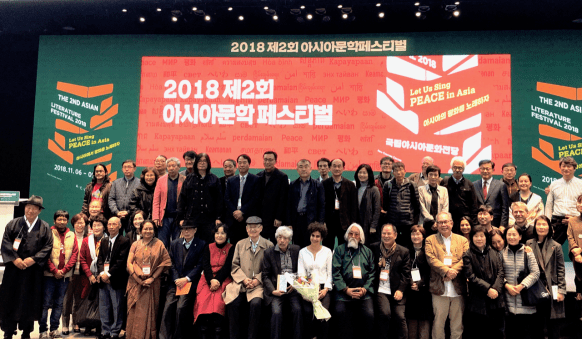
TO FOLLOW through on my initial report last week on the 2ndAsian Literature Festival in Gwangju, South Korea from November 6 to 9, it was an exhilarating and enlightening experience to be among fellow Asian writers getting together to wield literature as a weapon of peace.

I’ve been to many international literary festivals and conferences, but inevitably these gatherings—even those held in Asia—have tended to focus on Western writers and their concerns. For a while back there, the Man Asian Literary Awards, which culminated in a gala ceremony in Hong Kong, drew some special attention to contemporary Asian writing, but that fledgling effort folded up too soon. The Asia Pacific Writers and Translators (APWT), which will be holding its annual conference in Australia a few weeks from now, is arguably the region’s largest and most active literary network, but with so many topics on offer and so many attendees, it’s hard to keep your eyes and minds on one thing at any one time.

The Gwangju meeting felt just right, bringing together 11 writers from outside Korea to meet and interact with about the same number of their Korean counterparts. I was privileged to be the first Filipino to be invited to this young festival, which was headlined last year by 1986 Nobel Prizewinner Wole Soyinka. This year, the prolific and immensely talented Chinese novelist Yan Lianke, winner of the Franz Kafka Prize, led the delegates, who also included the Mongolian poet Damdinsuren Uriankhai, the first winner of the Asian Literature Award, which is given out at the festival.

Why Korea? Because—even as it globally exports kimchi, Koreanovelas, cellphones, and K-Pop—Korea (at least the southern part of it) is seeking to strengthen its cultural connections to the world at large, by exposing its people to cultural and literary movements from the outside, especially from beyond the Eurocentric zone. Among the key agents of this pivot is the publisher and editor Kim Jae-yong, a professor of modern Korean literature and world literature at Wonkwang University in Iksan, supported by the likes of Prof. Sohn Sukjoo from Dong-a University in Busan. Last year, it was also Prof. Kim and Prof. Sohn who brought another group of writers, including myself, to Jeju to discuss how our literatures were emerging out of the Western shadow.

The Gwangju event was less a conference than an intense but still festive sharing of experiences and responses to the many threats to peace, freedom, and justice around the world today, especially in Asia. As the festival chair Prof. Paik Nak-chung put it, “Particularly, 2018 is a special year when the journey towards denuclearization and lasting peace on the Korean Peninsula began as the leaders of the two Koreas met in Panmunjom and in Pyongyang. The festival urges Asian writers to carry on the spirit of peace on the Korean Peninsula to sublimate Asia’s wounds through literature.”

Writers, of course, are neither politicians nor diplomats (despite Shelley’s generous attribution of poets as the “unacknowledged legislators of the world”). Much of what we write inevitably has political content and intent, but governments don’t listen to writers (and would, in fact, shut down the teaching of language and literature as superfluities, like our magistrates did last week). We agreed, therefore, that our approach has to be direct to our peoples and audiences, to resensitize them to their humanity; freedom and justice are prerequisites to any kind of real and lasting peace, and these in turn are premised on the worth of the individual, which literature can help establish.

It was a great honor to share the company of the likes of Bao Ninh, a Vietnamese novelist who had fought the Americans during the war and had once found just himself and a comrade left alive in their platoon after a bloody encounter. His novel Sorrows of War is a poignant reflection on the fruitlessness of war, and the man’s quiet but fervent advocacy persuaded us (with me as one of the jurors) to award him the Asian Literature Award for this year. Another writer I got along very well with was the Taiwanese novelist Syaman Rapongan, a champion of his Tao tribe from Taiwan’s Orchid Island, who gave up a professorship in anthropology to pursue his true passions, writing and seafaring; “The ocean is a poem we cannot recite to the end,” one of his works memorably begins. The bestselling Korean novelist Sim Yungkyung, a molecular biologist by training, also became a good friend, and with our very capable guide Ms. Kim Hye Ji, my wife Beng and I saw the best of Korean culture and hospitality that week.

Not incidentally, the Asian Literature Festival was organized and sponsored by Korea’s Ministry of Culture, Sports, and Tourism through Gwangju’s impressive Asian Culture Center (ACC), which should be a model for other countries to emulate. But the best service of festivals like this is to remind writers—especially writers of conscience—that as solitary and sometimes as disheartening as their work can be, they are not alone, and are appreciated.

Penman No. 327: More than Memorials

IMG_8420.jpg

Penman for Monday, 12 November 2018


I WAS in Gwangju, South Korea last week to participate in the 2nd Asian Literature Festival, a new, Korea-based gathering of writers from across the continent aimed specifically at promoting peace through literature, with dozens of delegates from as far as Palestine attending. Initiated and supported by Korea’s Ministry of Culture, Sports, and Tourism through Gwangju’s Asia Culture Center (ACC), the festival draws its strength from Gwangju’s historic role in keeping Korean democracy alive.

I’ll share more impressions about the literary part of the festival next week, but as this was being written just as the festival opened, I’d like to dwell for a moment on our first formal activity there, which set the tone for the whole week.

Korea’s sixth largest city, Gwangju is about 300 kilometers south of Seoul, an hour and a half away by high-speed train. Known for its cuisine, Gwangju (the name means “city of light”) is also an important cultural center in Korea. It came to global prominence in May 1980, when the city’s people rebelled against the newly installed government of Chun Doo-hwan, who had led a military coup just months before, and who imposed nationwide martial law on May 17, closing down universities, muzzling the press, and arresting critics like future President Kim Dae-jung. (Does any of this sound familiar to us Filipinos?)

Among others in other regions, Gwangju’s citizens rose up against the strongman, as they did against the Japanese. In response, over nine days starting on May 18, the military undertook a brutal campaign of suppression against what came to be known as the Gwangju Uprising, leading to the deaths of hundreds of civilians branded as communists by the government. In 1987, a memorial cemetery was set up to honor the city’s freedom martyrs, and subsequent governments have made amends to these victims and their families.

GettyImages-515125644-589bcd983df78c4758f88864-1.jpg

Not surprisingly, therefore, and before anything else, the visiting writers were brought by their hosts to this cemetery, Mangwol-dong, for everyone to pay their respects not just to the dead, but also to the spirit of peace that their sacrifice engendered. The cemetery at Mangwol-dong is set in a poignantly serene landscape, resplendent in autumnal colors when we visited. A tall monument rises up to the sky, overlooking hundreds of graves, each marked when possible by a picture of the lost one—a poet here, a garbage collector there, a teacher, a student.

I’ve visited many war memorials in America and elsewhere, and have found them no less sad and moving. But almost invariably they honor the fallen soldiers, rather than the civilian casualties. Korea does it differently.

IMG_E1647.jpg

Last year, I visited another memorial as well, on the island of Jeju, where thousands of civilians were massacred by government troops on April 3, 1948. Jeju’s memorial to those victims—with its harrowing exhibits but also its emphasis on finding peace and justice in our time—offers, like Gwangju’s, another model for our own martial law museum. While it will not have the same space and breadth of sky in its projected site in Diliman, our memorial should not only be able to provoke horror, but also hope amidst the sorrow, hope that can only materialize through sustained struggle. Beyond memorials, South Korea has ingrained democratic values in its citizens, regardless of their Presidents.

As Dr. Roslyn Russell, chair of the International Committee of the UNESCO Memory of the World Register, put it, “Unlike the piecemeal attempts to redress past histories of violence and crimes against humanity committed by the government that have been seen in South America and South Africa, the objectives of liquidation of the past—including ‘investigation,’ ‘punishment of those involved in the repression of the uprising,’ ‘recovery of honor,’ ‘compensation for the victims’ and ‘efforts to commemorate it’—were achieved in Gwangju. The May 18 Democratic Uprising played a key role in the democratization of Korea, and influenced the end of the Cold War and the spread of democracy in East Asia…. Pro-democracy movements occurred in the Philippines, Thailand, China, Vietnam, and other countries following in Korea’s footsteps.”

The Koreans know how to jail their misbehaving Presidents—and to keep them there, instead of springing them free after a few years. They’ve also shown that economic progress doesn’t have to come at the cost of democracy and human rights, as many Filipinos enamored of strongman rule love to claim, albeit with little material benefit to show for the surrender of their souls and minds. Koreans value and enjoy their prosperity, but they also remain vigilant against corruption by their corporate giants and government leaders. In 2016-2017, Korea’s Candlelight Revolution mobilized 17 million candle-bearing citizens to peacefully depose another untenable regime.

A statement was flashed onscreen during one of our sessions: “What we must fear is not pain as such but allowing pain to close our mouths.” That’s courage I seem to remember we once had, and could yet recover.

Penman No. 326: A Season of Winners

Cafe.jpgPenman for Monday, November 5, 2018


UNEXPECTEDLY, OCTOBER turned out to be a season of winners, with a series of important awards being announced involving culture and the arts.

Foremost, of course, were the National Artist Awards, eagerly anticipated by the cultural community every two years or so. Dismayed as I was by the Palace’s decision to drop Nora Aunor (and even more by the silly excuse they gave for doing so—I’m reasonably sure I can live with the agony and torment if they went nuts and named me a National Artist, which I would shyly accept), the rest of the list pretty much got a pass from the arts community, as far as I could tell.

I was especially happy to see old friends and acquaintances like Amel Bonifacio, Resil Mojares, Kidlat Tahimik, and Ryan Cayabyab on the list, people whose work I’ve known and respected for a long time. And not to take the shine off any of the winners, but I was also sad to find, once again, that my personal bets for this highest of creative honors—among them the poet Jimmy Abad and the artists Junyee and Jaime de Guzman—would have to wait for yet another round. Having been involved to some minor degree in the search process for previous NAs, I know that more visibility for the artist helps, and we’ll work on it next time.

But there was plenty of recognition to go around last month, albeit on a more local scale.

For the past six years, I’ve been privileged to serve on the Selection Committee of Quezon City’s Manuel L. Quezon Gawad Parangal for Outstanding Citizens and Institutions. It’s a task I’ve shared with former Budget Minister and City Administrator Manny Alba, former UP President Emer Roman, former QC councilor Bert Galarpe, lawyer Vicky Loanzon, and former QC Vice Mayor Connie Angeles.

There’s never any shortage of achievers from Quezon City to acknowledge in whatever field, from politics, education, and business to the arts, media, and entertainment. This year, in ceremonies last October 12, I was delighted to greet some friends among the awardees. (I assure you our friendship had nothing to do with their recognition, impeccably supported by the evidence.)

Among them was the engineer and educator Rey Vea, who belonged to the mythical first batch of the Philippine Science High School, two years ahead of me; we worked together in the UP Collegian, were arrested within a day of each other under martial law, and flew to the US in the same batch of Fulbright study grantees. Rey went on to become dean of the UP College of Engineering, administrator of the Maritime Industry Authority, and president of Mapua University.

Another outstanding QC citizen honored was the poet, editor, and screenwriter Jose “Pete” Lacaba, one of those colleagues I deeply admire as much for his craft as for his dedication to it. Like his own hero Nick Joaquin with whom he worked, Pete never drew a line between journalism and creative writing, and produced first-rate results with whatever he put his mind to. A few years older than me and a Pateros boy, Pete hung out in the same Rizal Provincial Library that I spent many an afternoon in back in the mid-1960s. We later both wrote scripts for Lino Brocka, along with Ricky Lee and Joey Reyes, and the joke among us was that Pete got all the best, long-gestating projects like Jaguar and Bayan Ko because he also wrote the slowest.

And this is as good a time as any to congratulate my fellow STAR columnist and another good friend, the writer and entrepreneur Wilson Lee Flores, whom you’ll find smiling even in the most difficult circumstances, such as when the 79-year-old Kamuning Bakery that he had almost singlehandedly revived burned down last February. The bakery itself had won the same award last year for its artisanal bread, but our committee thought that the proprietor—also a three-time Palanca laureate—deserved one on his own.

In the institutional category, my loudest cheers went to Ma Mon Luk, the iconic house of noodles I’ve patronized since I was a boy and whose owner George Ma Mon Luk is a fellow fountain pen and typewriter collector, and the Erehwon Art Center, which its founder and patron Raffy Benitez has tirelessly guided within a few short years to becoming one of the city’s true cultural oases, virtually a mini-CCP that has projected the best of Philippine art both here and overseas.

And I can’t let this review pass without mentioning the Palanca Awards for Literature, which for the first time in its 68-year-long history held its Awards Night this year in October instead of the customary September 1. Among the winners was a neurosurgeon named Ron Baticulon who had nursed a dream of writing well enough to win a Palanca, which his work “Sometimes You Can’t Save Them All” did, for Second Prize in the Essay in English category. The piece is a powerful and moving account of a young doctor’s encounters with the families of the dying, and of the humanity that asserts itself in the bleakest of situations. I’m looking forward to the release of Ron’s first book from the UP Press early next year.

To them and all the other winners from last month’s derbies, my warmest congratulations.

Baticulon.jpeg