Penman No. 181: A Designer on an Island

IMG_7775.jpg

Penman for Monday, January 4, 2016


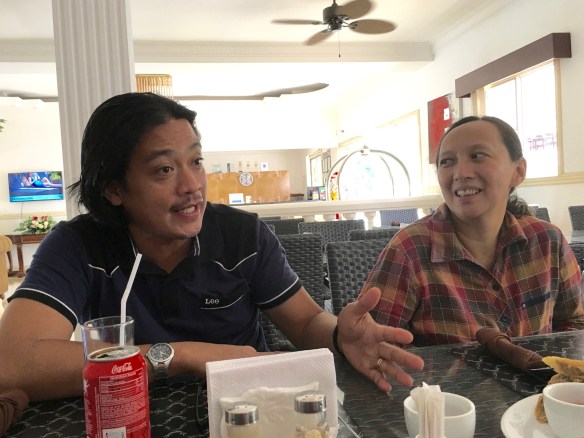
ONE OF the side benefits of our recent visit to Bohol was an opportunity to reconnect with an old friend and professional colleague, the prizewinning book designer Felix Mago Miguel, who has chosen to live and work in Bohol for the past ten years with his wife Amel and their five children.

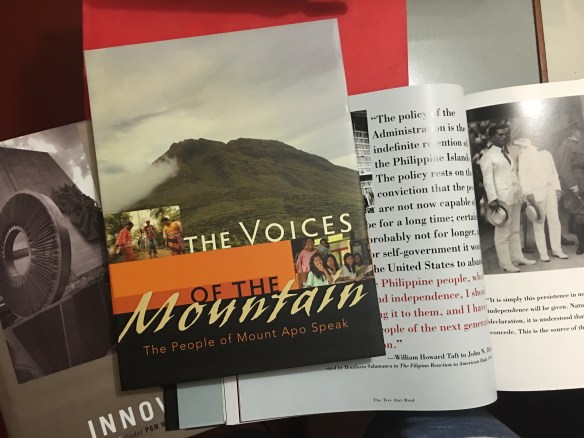
Beng and I had known Felix for a long time, since she saw and bought some of his paintings and gifted the then-newlyweds with her own painting and some plates by the potter Lanelle Abueva-Fernando. (“The plates are all gone now, because we used them and would break one every year,” said Amel apologetically, “but the painting’s still there!”) Felix and I had worked together, as writer and designer, on some coffee table book projects, notably those on Philippine-American relations, the Mt. Apo geothermal project, and the Government Service Insurance System. After my early collaborations with the late, lamented Nik Ricio, it was a relief and a pleasure to find the young and talented Felix, who has rightfully taken over Nik’s mantle as one of the country’s most sought-after book designers.

We invited the couple over to lunch at our hotel and we had a nice long chat about life, work, and what it’s like to keep on top of your profession from an island far from the country’s business and cultural center.

“Honestly, it hasn’t been all that difficult,” said the former Manileño. “In fact, I didn’t tell my clients for a whole year that I was working from Bohol because they might worry about my accessibility and meeting deadlines and so on. But with the help of the Internet and by scheduling my trips to Manila, I’ve been able to cope with the demands of the job. I use WeTransfer and Google Drive to move large files online, on my SmartBro account.”

Amelia Zubiri was born in Bohol, but also grew up and went to school in Manila, where she and Felix met in UP Diliman, where Felix was a Fine Arts major, graduating in 1992. They decided to move to Bohol to get away from Manila’s toxic atmosphere and to raise their children, now aged 16 to 7, in a healthier and more relaxed environment; all the children—the twins Ulan Kalipay and Ulap Namnama, Angin Kalinaw, Araw Naasi, and Langit Biyaya (the only one born on the island)—have been home-schooled. Deeply spiritual, the Miguels have learned to repose their trust in Providence, and their faith has been well placed.

When a huge earthquake devastated Bohol on October 15, 2013—just two weeks before supertyphoon Yolanda ravaged the Visayas—the Miguels and their one-storey home emerged shaken but unscathed, and they shared their good fortune by helping out with relief efforts. “The earthquake was a life-changer for many Boholanos,” Amel reflected. “It encouraged many Boholanos who had left for jobs overseas to come home and spend more time with their families. Seeing the new houses they had painstakingly built crushed in seconds seemed to remind them that nothing was more important than time together.”

Most of these OFWs work as seafarers, an occupation historically favored by Visayans. “It’s not uncommon for a Boholano family to have one or two seamen working on ocean-going vessels,” said Amel. “You can tell the houses that they build with their remittances by little design elements like anchors and portholes,” added Felix, smiling.

Felix Mago Miguel’s own journey to the crest of the book design business is a story of good breaks, sheer talent, and perseverance. Now 44, he started out in 1996 by designing Soledad Lacson-Locsin’s landmark translations of the Noli and Fili for Bookmark. “I’d done book covers before, but this was the first time that the publisher, Lori Tan, let me do everything from cover to cover,” said Felix. Later that same year, another book project, Water in the Ring of Fire: Folktales from the Asia-Pacific, edited by Carla M. Pacis, won for Felix his first design award from the National Book Awards. Since then, he has designed over a hundred books, some of them winning him recognition from the National Book Awards and the Gintong Aklat competition.

It isn’t the awards, however, that drives him to excel in his craft, but the satisfaction that he gets out of seeing a happy client. The project that has given him the most pleasure has been XYZ: The Creativity of Jaime Zobel, which drew on Zobel’s three decades of work in photography and art. “Don Jaime was so ecstatic about the book that he told me he needed to take a Valium to calm down,” recalled Felix. It’s that kind of reception that drives Felix to spend long nights staring at a computer screen, poring over one image after another.

The most technically challenging was Cuaresma, put together by Cora Alvina and edited by Gilda Cordero-Fernando and Fernando Zialcita, and winner of the National Book Award in 2000. “This was before digital photography, and I had to work with a huge box of color slides,” said Felix. But then again, “The technical aspects of book design are often easier to deal with than some people behind the books,” Felix confessed.

Like me, he’s had his share of good book projects that, for some reason or another, went nowhere. He did get paid for work done, as I was, but it’s such a waste of labor and good material when a project that seemed so promising never sees the light of day, because someone in the production process fails to deliver, or because the clients themselves lose interest or change their minds. Thankfully for Felix and me—as I wrote in this column a few weeks ago—coffee table books remain in high demand, and I expect to be working with him again on one or two forthcoming projects soon. One current project he’s excited about is a book on native Philippine trees that he’s doing for the Lopezes.

While he’s based in Tagbilaran, Felix flies out to Manila to personally check on his projects in the press. This used to be done abroad for high-quality printing jobs, but local printers have expanded and improved significantly enough to take on the challenge. “Our best local printers like House Printers can now compete head to head with their counterparts in Hong Kong and Singapore,” Felix said. (House Printers produced one of my most recent books, the biography of former Sen. Ed Angara.)

He misses painting, and spoke wistfully about the last big painting he did, a mural for the Church of Gesu on the Ateneo campus in Quezon City. But the children, the Miguels said, seem to be taking intuitively to art; Felix and Amel have monitored their time online to make sure that they can attend to more active and creative pursuits, and it may not be long before this couple’s decision to forsake Manila for a southern island bears fruit beyond more beautiful books.
IMG_7785.jpg


Penman No. 180: Escapade in Bohol

IMG_7630.jpeg

Penman for Monday, December 28, 2015


YEARS AGO I made a promise to take my wife Beng to all the beautiful places in the world I’ve been, so we’ve been traveling up a storm, flying off to whatever destination our aging knees and limited budget can still afford. The pre- and post-Christmas break is a great time for escapades like this, and we’ve run off to Shanghai and Beijing in Decembers past, availing ourselves of budget fares we’d booked months ahead for the privilege of slurping hot noodles in the freezing cold.

This year—encouraged by another irresistible combo deal on airfare and a good hotel—we chose to go down to Bohol. I’d been there a couple of times before on business and Beng and I actually found ourselves stranded there once, overnight, because our Dumaguete-bound ferry couldn’t make it through a frightful storm, so this time we decided to do a proper tour of the place, mixed in with a bit of work we both had to catch up on.

IMG_7627.jpg

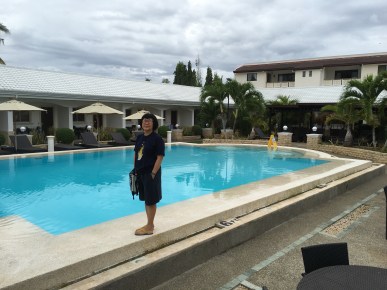
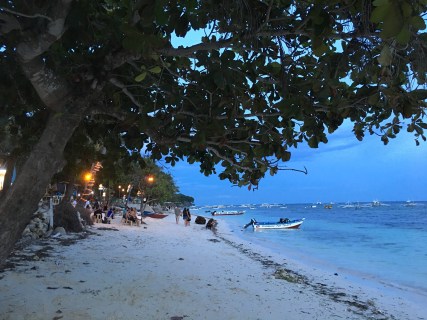
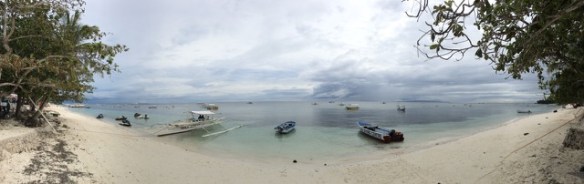
We were lodged at the mid-range Panglao Regents Park Resort, about a 30-minute ride from the airport and a short walk to Alona Beach, a focal point not just for swimming and food but also for the innumerable dive shops that cater to showcasing Panglao’s top attraction, its underwater life. Being sedate and sedentary seniors, Beng and I contented ourselves with sipping cool mango shakes and watching the scenery, but there’s never a dearth of interesting things to look at in Bohol, whether beneath the sea or aboveground.

IMG_7618.jpg

We signed up for two tours: the “Chocolate Hills” tour, which takes you on a daylong ride around the island for an eyeful of its most scenic spots, and the “island-hopping” tour, which promises an early-morning rendezvous with dolphins, snorkeling and lunch at Balicasag Island, then a short detour to Virgin Island. Seasoned travelers may disdain these one-size-fits-all tours, but Beng and I never do, knowing that they’re pretty efficient and often good value for money for first-time tourists, and that ultimately it all depends on knowing what to look for, and knowing how to appreciate what you’re looking at.

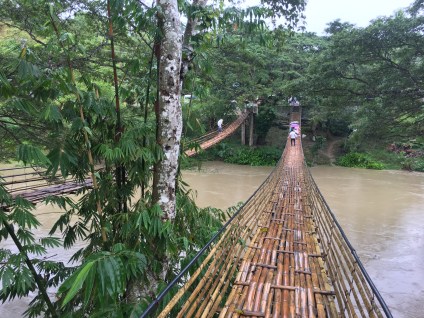
It was a rainy day when we headed out for the Chocolate Hills, so the tarsiers were huddled under the branches and the hills themselves were shrouded in mist, but I took the rain in stride, seeing how it lent a certain freshness and vividness to things, and I could sense the earth exhaling after a long dry spell. The tour guide at the butterfly farm led us along with deft humor, making even dead insects come alive, and we gamely crossed the Hanging Bridge, to and fro, like schoolkids on a dare.

IMG_7658.jpg

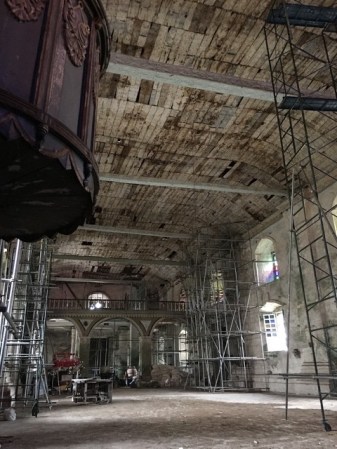
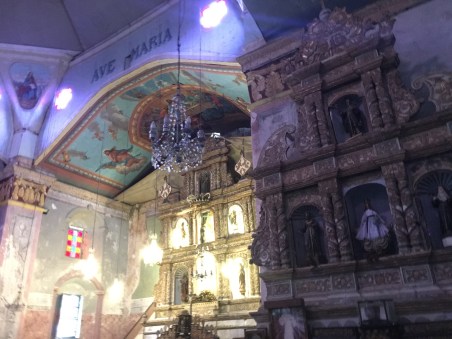
I had visited the old Loboc Church before an earthquake devastated it a few years ago, so I was sad to see it covered in scaffolding, awaiting restoration. What I didn’t expect to be more deeply moved by—not being a regular churchgoer (I pray every night, but have quarrels with dogma)—was stepping into the Baclayon Church, which I had missed on my first visit. Its altar—a main retablo framed by two smaller ones—stood intact and as majestic as ever, and washed in orange, green, and blue light seemed ethereal. But behind a red cloth curtain and the yellow “Caution” warnings gaped what used to be the nave, a cavity that in the 1800s must have throbbed with pious energy, as well as with the flutter of fans and the murmur of courtships, disapprovals, and ungodly gossip.

IMG_7667.jpeg

IMG_7674.jpg

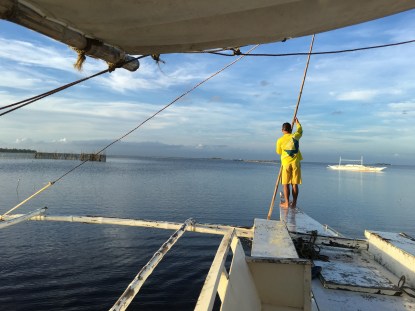
We set out for our island cruise at 6 am the following morning, and much to Beng’s relief the sky was clear and the water was silvery smooth. We shared our large banca with two women from Canada and another from Germany, our banter laced with the anticipation of meeting our goal for the morning: finding dolphins in the open water. I knew from previous reading that several species of dolphin and whale could be found in the Bohol Sea, but I would have been happy to spot any one of them. Dolphins feed in the morning, until about eight, so it was important that we head out quickly enough, also given that about half a dozen other boats were in the same area for the same reason.

IMG_7692.jpg

Our boatman, whom we’ll call Dencio, was an experienced spotter (more on his story later), and soon enough, about 30 minutes out of port, he pointed to our right, where two gray and shiny heads bobbed in and out of the water—our first of several sightings. Dolphin and whale watching is the sort of thing a CIA analyst would be good at—discerning, from the seemingly immutable pattern of cresting waves and foamy wavelets, the odd leap of a creature into the air. The Risso’s dolphins we saw (the Flipper of TV fame was a bottlenose) broke out out in pairs and trios, but for every one of them that surfaced, we were told, there were many more underwater. Dencio pushed out his boat much farther than the others did, and for a long while it felt like we were simply drifting toward Siquijor, but just as I was about to give up, I noticed a commotion in the distance—a pod of maybe a dozen spinner dolphins frolicking in the air. The whole boat came alive with glee and Dencio tried to give chase, but we were going against the waves, which had become too choppy, and the shiny caravan of fins and flippers vanished into the horizon.

IMG_7721.jpg

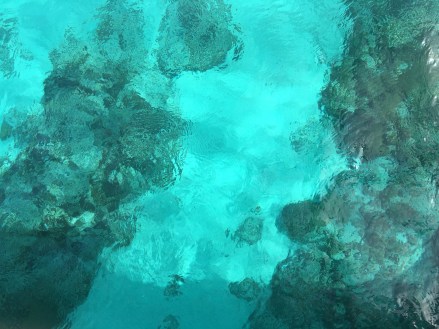
Balicasag Island is where the divers go, and was our midday stop. While our companions snorkeled in the fish sanctuary and watched giant turtles feeding on the sea grass, Beng and I ordered lunch (fresh fish, of course, broiled and kinilaw) and listened to Dencio’s story: “We used to hunt whale sharks,” he said, “and would kill two of them a day, baiting them and catching them with large hooks.” (This hook called the pamilac lent its name to Pamilacan Island nearby.) “We sold them very cheaply, not knowing that in Japan, a whale shark could sell for about half a million pesos. We could have been millionaires! We did this until a TV crew filmed what we were doing, and then a ban was imposed, so now we don’t catch whales anymore. Today you can find very large ones swimming under your boat. They’re very smart, and can sense danger. Sometimes they look straight at you with their eyes.”

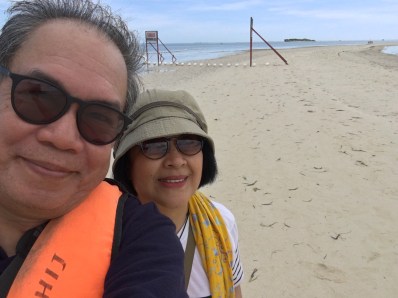
On the ride back to Panglao, we stopped by Virgin Island (renamed Isola di Francesco by its private owner, who has turned the island into a religious shrine)—little more than a long curling strip of white sand with a clump of trees on one end, but serene and restful, a fine ending to a colorful day. Or rather, make that ending a Thai massage, a grilled seafood dinner, and a cold beer.

IMG_7733.jpg

“They’ll burn in the sun,” Beng had remarked of our European companions, who took every opportunity to swim and to laze in the tropic heat. “That’s because they’ll be flying home in a few days to an icy winter,” I said, “while we just have Manila’s traffic and pollution to deal with.” Sounds like a good reason for another escapade.

Penman No. 179: Pedestrian Pleasures

IMG_7589.jpg

Penman for Monday, December 21, 2015


THERE’S NOTHING better we’d like to do on a weekend—unless we’re running off to some southern island or parts beyond—than to have a foot massage from our suki Tonton branch on West Avenue before taking in a movie and a Chinese or ramen dinner at Trinoma. In fact, we don’t even wait for the weekend to indulge ourselves in these pedestrian pleasures, but do this routine on a Tuesday and then again on a Thursday, whenever the spirit moves us.

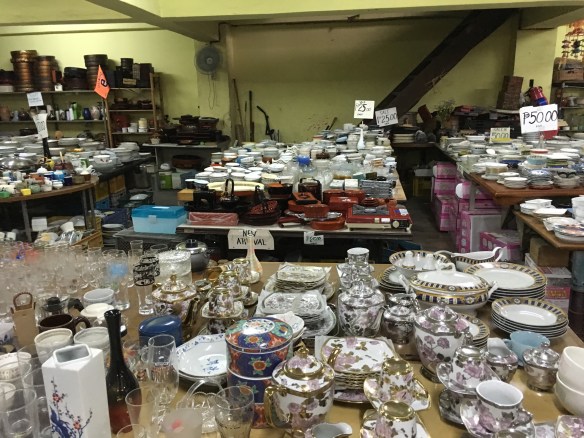
Every other month or so, we do something special—we go down to Sta. Cruz (my students no longer have any idea where these districts and streets around Quiapo are), have a fried-chicken lunch at Ramon Lee’s, then check out our favorite ukay-ukay and Japanese-surplus shops on Avenida Rizal, happily carting home several bagfuls of glorious junk, with as much pleasure as we would’ve gotten from the flea markets of New York or Paris.

Beng and I cheerfully acknowledge that this must be one of the signs of aging—settling into a fairly small and thoroughly familiar comfort zone, and stepping out of it just often enough to keep things lively and to refresh the horizon. Or maybe I’m mainly speaking for myself, because Beng’s always been far more adventurous than me, especially culinarily speaking, and now and then exhales a wistful longing for some Indian food (which flusters me, because I can’t stand curry, recognizing only salt, pepper, garlic, onion, and soy sauce in the kingdom of spices and flavors).

The simple explanation is, ours is a generation used to walking a lot. And it wasn’t as if we had a choice. We grew up without cars—the richer kids had them, but not us—and even getting to the jeepney or bus stop meant walking. I remember, as a boy of nine or ten, walking from our rented place on Halcon Street along Boni Avenue in Mandaluyong to what was then Highway 54 (EDSA to you younger ones), crossing the highway, and then taking the bus to Gilmore Avenue, crossing the highway again, and walking several blocks to La Salle Green Hills (“Greenhills” was spelled as two words then)—lugging my heavy bag of books and notebooks, whose cheap unpadded leather cut into my hands. In the afternoon, I would do the same thing all over again, in reverse, unless a chauffeured classmate took pity on me and gave me a ride.

But as torturous as that routine was, it was nothing compared to the literally kilometric walks that our elders took. One of my favorite walking stories is that of the late NVM Gonzalez, who walked many kilometers from their barrio in Mindoro to the poblacion, where he could type his manuscripts in the municipio, making the long trek back in the afternoon (and when his contributions returned months later, rejected by some editor, his father would kid him and say, “Your stories are like homing pigeons!”). That’s a story I like to tell my writing students, who—with the fanciest computers and the Internet at their fingertips—will still sometimes complain about not having “enough material” or “enough time” to produce their first drafts.

Another story I recall having read somewhere involves Bienvenido Santos and Diosdado Macagapagal, who—as students of the University of the Philippines back when it was just on Padre Faura Street in Manila—walked to school together from their lodgings in Tondo. And until his death some years ago, my uncle Juan, who must have been in his nineties, thought nothing of walking the seven kilometers of mountain road between his home in Guinbirayan to the poblacion of Sta. Fe in Romblon, just to deposit the cash in his pocket to his savings account.

I myself took to walking for my health a few years ago when I was diagnosed with diabetes, and had to undergo a radical lifestyle change. Three or four laps around the UP Oval every day, Broadway blaring in my ears, quickly took care of the problem; I lost 45 pounds in five months (some of which I’ve regained since then, but my blood stats still look good).

But walking, of course, is never just a chore and never just exercise to the willful and the observant. I’ve used my long walks around campus as thinking time, composing paragraphs in my head, mulling over turns of phrase and gentler ways of expressing unpleasant truths (the sad corollaries of holding an administrative post). I enjoy the scenery—both natural and human—and store striking details, scenes, and vignettes in my head that I can use for my stories. Once, walking towards the Carbon market in Cebu, I found myself on a street full of sellers of cut flowers, in the midst of which emerged a dark, wiry man, bare from the waist up, heaving over his head a huge basket full of red roses—a veritable Charles Atlas, bearing the weight of all that beauty. That haunting image became the germ of a story I would title “Delivery,” the tale of a lie and its terrible if unintended consequences.

And many of my sharpest memories of my foreign sorties are from long walks taken on fabled boulevards and strange alleyways, very often leading to unexpected discoveries off the tourist guidebooks: a pen shop in Edinburgh, a Filipina hotel worker taking a quick puff from a balcony in Como, a pair of fierce guard dogs prowling the perimeter of a mansion in Johannesburg, beneath a copious spray of jacaranda blossoms.

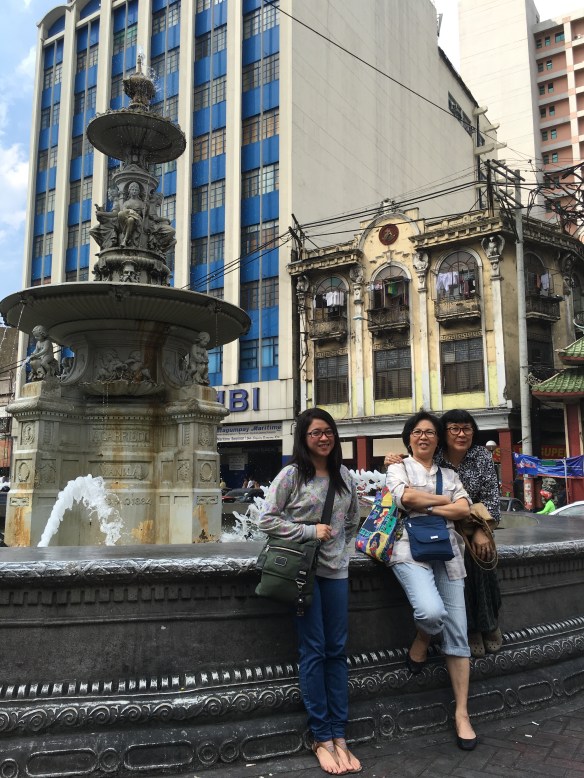
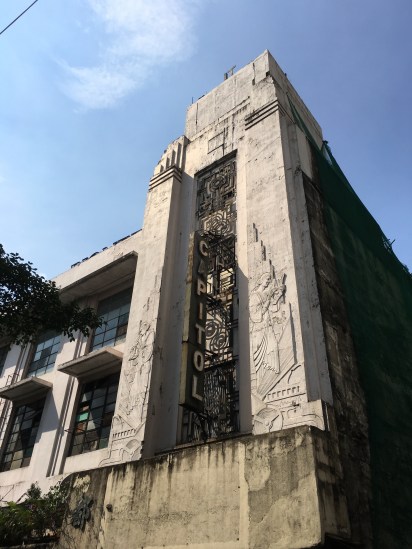
So it was in this quest of adventure that Beng and I took her sister Jana and our niece Eia on a walking tour of downtown Manila a couple of weeks ago (a zone my friend Krip Yuson affectionately calls “the armpit of the city”), to reacquaint them—newly returned from many years in New York—with home, in all of its bewildering, exasperating, ammoniac intensity. We took them to our Japanese-surplus suki on Avenida and then to lunch at Ramon Lee, before essaying Escolta and the Art-Deco innards of the First United Building; we lamented the loss by fire of the old Savory Restaurant, but pressed on to Chinatown for bagfuls of hopia and ma chang (sampling the goodies both at Polland and Eng Bee Tin) before turning into Ongpin and re-emerging into Sta. Cruz and its amalgam of gold and grime.

It was a day well spent, much of it on foot, and while our soles may have complained, our spirits tingled with reawakened excitement.

IMG_7583.jpg

IMG_7591.jpg

IMG_7596.jpg

Penman No. 175: Filipinos at the Field Museum

IMG_8116.jpg

Penman for Monday, November 23, 2015


AS MANILA got busy with preparations and lockdowns for the Asia-Pacific Economic Cooperation summit, Beng and I flew out to Chicago for the culmination of a cross-continental initiative of another kind: the Art and Anthropology project hosted by the Field Museum and funded by the John D. and Catherine T. MacArthur Foundation.

A few months ago, sometime in August, five Filipino-American artists (Jennifer Buckler, Elisa Racelis Boughner, Cesar Conde, Joel Javier, and Trisha Oralie Martin) came over to Manila to work with their homegrown counterparts on a large mural (technically a free-standing painting) featuring objects from the Field Museum’s vast collection of Philippine anthropological artifacts. That phase was hosted locally by the Erehwon Art Center in Quezon City, on the board of whose foundation Beng (aka June Poticar Dalisay, the painter and art conservator) sits as Vice President.

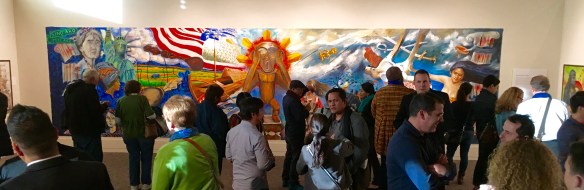
This October, the five Filipino artists (Leonardo Aguinaldo, Florentino Impas, Jr., Emmanuel Garibay, Jason Moss, and Othoniel Neri) went to Chicago to do the same thing—working collaboratively with the Fil-Ams on a 28’ x 7’ mural at the Field Museum, locating ancient Filipino artifacts in a more contemporary and inevitably globalized context.

The moving spirit behind this project was the indefatigable Dr. Almira Astudillo Gilles, a Chicago-based Filipino-American cultural scholar and activist who also happens to be a prizewinning writer and presidential awardee for her work as an overseas Filipino. Inspired by the Philippine artifacts at the Field Museum, Almi—the only Filipino research associate at the Field—had secured a grant from the prestigious MacArthur Foundation for the project, which both the foundation and the museum acknowledged to be groundbreaking in many ways.

Better known for its so-called “genius grants” awarded to outstanding individuals, the MacArthur Foundation rarely provides funding for large institutions like the Field Museum, Almi says, but they saw in her proposal an opportunity to spur not just a trans-Pacific collaboration among artists but also a dialogue with the past. And there was no better host in the US for this project than the venerable Field Museum, whose collection of indigenous Philippine archaeological and ethnographic materials—numbering around 10,000 objects, most of them brought over by museum expeditions to the islands at the early part of the 20th century—is one of the world’s most comprehensive.

The mural produced by the artists in Chicago—which will be on display at the Field for six months since its formal unveiling last November 7—is both a celebration and indictment of our rich and complicated history, invoking all manner of element from the archetypal bulol and the revolutionary KKK (a symbol that predictably sparked some controversy, given its American context) to McDonald’s and Tito, Vic & Joey.

For the artists themselves, the collaboration was a rich, if sometimes unavoidably difficult, learning experience—learning about themselves, about each other, about art-making, about the mutable meanings of “Filipino” over time and space. Prior to the project, some of the Fil-Ams had never been to the Philippines, and some of the Filipinos had never been to America; that alone ensured sufficient provocation in their approach to the task at hand. The collaborative aspect itself was a challenge, given the need to manage and balance each artist’s individuality with some overarching purpose or design. But in the end, as Joel Javier would tell me, despite all the dialectics involved, it was “a once-in-a-lifetime experience” that every participant—chosen by a jury in each country—would have signed up for.

Our sortie into the Field Museum—a place I’ve visited quite a few times over the past two decades, but can never exhaust, like the Smithsonian—was made even more special by a private tour arranged for us by Almi Gilles into the heart of the Philippine collection itself, in the underground vaults of the Field. As a certified museum rat and armchair adventurer, I took it as an invitation to die and go to heaven; the closest I hope to get to Indiana Jones was to wear his hat, which I wore on the appointed day.

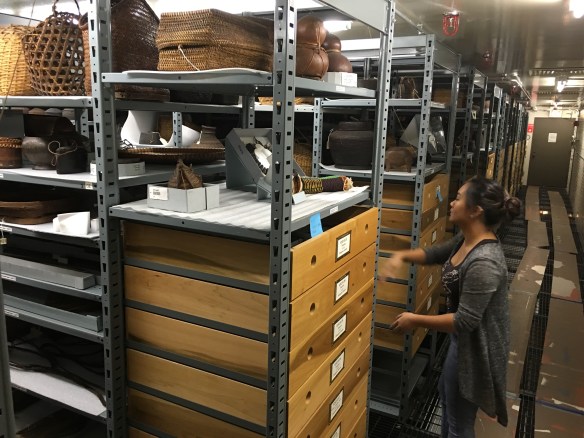
We were met at the museum by co-curator Alpha Sadcopen, a young Filipino-American woman with roots in the northern highlands; she held the key to the collection, and led us into a large room where shelf upon shelf of tribal and cultural artifacts—baskets, textiles, weapons, utensils, body decorations, etc.—were preserved, most of them never likely to be put on display outside. “I could feel a shiver down my spine,” Beng would tell me later, and I certainly did myself, walking past the priceless objects, and discerning in each one of them a pair of hands, a face, a story.

IMG_7418.jpg

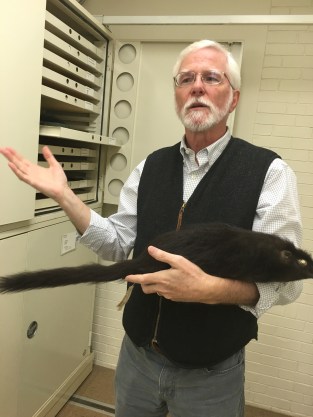
As if that peek into our material past wasn’t a treat enough, Almi then led us down a few more corridors to meet with another titan of Philippine studies—the renowned zoologist Dr. Lawrence Heaney, curator and head of the museum’s Division of Mammals. Larry began studying the wildlife of the Philippines in 1981, a lifelong passion that has resulted in the discovery of dozens of previously unknown mammalian species, in many landmark publications, and in the establishment, with Larry’s Filipino colleagues, of the Wildlife Conservation Society of the Philippines.

We often think of world-class scientists as surly, self-absorbed individuals who can’t relate to anything beyond what they see in their microscopes and telescopes, but Larry defies that stereotype. You couldn’t have met a nicer man, and one who chose not only to sound the usual alarm about our threatened environment, but also to emphasize the positive and the possible. “Hectare for hectare, the Philippines is the world’s richest place for endemism,” he told us, cradling what seemed to be a huge rat saved from a 1946 expedition to Luzon, “and there certainly are serious threats to Philippine wildlife, but we’ve also noticed some bright spots. For example, the growth of overseas jobs for many Filipinos—despite its social costs—has also eased the pressures on the environment and on wildlife in many rural communities.” Dr. Heaney is coming over to Manila next year to launch another book, and I’ll be sure to be there.

IMG_7448.jpg

And what’s next for Almi Gilles? She’s looking skyward, into the connections between Philippine anthropology and astronomy. Her colleagues at the museum seem thrilled by the idea, and so are we.

For more pictures of the Philippine collection at the Field Museum, see here: https://www.flickr.com/photos/penmanila/albums/72157660699359089.


Penman No. 166: Ernest Meets Nestor

NVMEH

Penman for Monday, September 14, 2015

A COUPLE of months ago, I wrote a piece here about the Nobel prizewinning novelist Ernest Hemingway’s brief visit to Manila in February 1941. When my friend Dr. Erwin Tiongson read that, he sent me more materials about that brief encounter between the literary titan and his local readers, including a reference to a second visit by Hemingway on May 6, presumably on his way back to the US.

(Now based in Washington, DC and a professor of economics at Georgetown, Erwin was recently in Manila himself with his journalist wife Titchie for a vacation and a series of presentations about their fascinating project of historical sleuthing, which you can find online at https://popdc.wordpress.com. I’ll be writing more next time about the Tiongsons and their meeting with Teresa “Binggay” Montilla, the granddaughter of Philippine Commissioner to Washington Jaime C. de Veyra and his remarkable wife Sofia, about whom the Tiongsons unearthed a trove of interesting historical material.)

Meanwhile, I’d like to share a bit of what Erwin sent me, taken from the American Chamber of Commerce Journal of June 1941, unbylined but attributed to the journal’s publisher and editor, Walter Robb. It’s an account of Hemingway as a man and a regular guy—41 years old, 225 pounds, black-haired and black-eyed, whose Spanish “runs along like a garrulous brook… words never fail him, nor picturesque phrases. He likes singing Basque folk songs and he and the Basques seeing him off on the clipper sang them all the way from the Manila Hotel to Cavite….”

Farther down that article, the reporter notes that “It’s easy to get Hemingway’s autograph, just ask for it and have a pen handy…. He autographed many copies of his book while he was in town. The book has been pirated at Shanghai, of course; when one of these spurious copies, no royalty to Hemingway, came along for autographing, Hemingway grinned and autographed it. He likes to use a standard typewriter in his work, which he does of mornings, but For Whom the Bell Tolls was not written that way: it was written in longhand. Hemingway uses a heavy stub fountain pen and this longhand of his, as bold as sword strokes, but honestly legible and well-spelled, flows across the paper as straight as a line.”

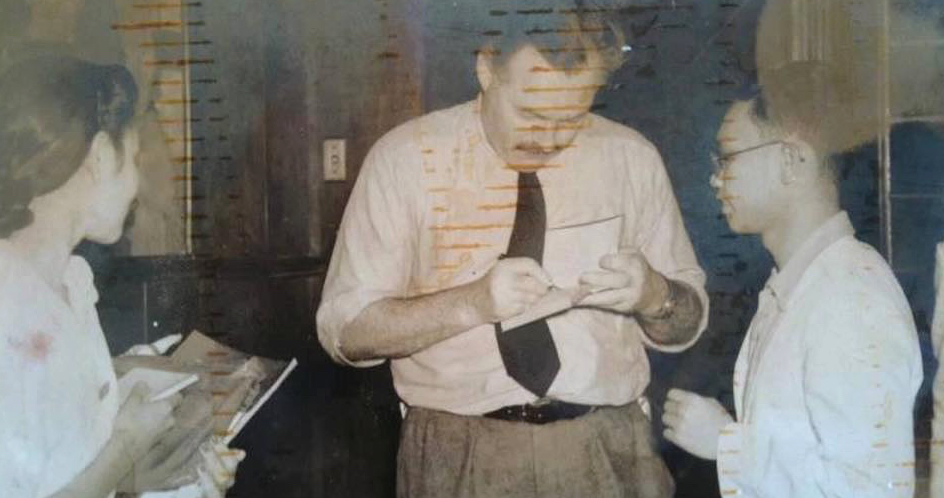
I was, of course, attracted to that passage because it particularly mentioned Hemingway’s pen, which I would have dearly loved to see; but also, it talked about Hemingway signing books, which reminded me of a photograph I adverted to in my earlier column, showing Hemingway signing a book for a young Filipino writer named Nestor Vicente Madali Gonzalez, who in early 1941 would have been no more than 25 years old. I’d seen that picture in NVM’s house in UP when he was alive, and had worried that it might have been lost when the house burned down. But after my piece came out, I was happy to hear from NVM’s youngest daughter Lakshmi that she had posted a copy of it on her Facebook page, and I hope she doesn’t mind if I repost it here—Ernest meets Nestor, you might say.

Speaking of NVM Gonzalez, the literary community marked the centenary of his birth last Tuesday, September 8, in an evening of tributes at the Executive House at the University of the Philippines in Diliman organized by Prof. Adelaida Lucero. NVM, of course, taught with UP—among many other universities here and in the United States—for many years despite the fact that he never completed his bachelor’s degree. As director of the UP Institute of Creative Writing, I was asked to say a few words at the testimonial dinner, which was attended by NVM’s widow Narita, and here’s a reconstruction of the remarks I made:

“NVM and I were born only 60 kilometers away from each other in Romblon—he on Romblon Island and I on neighboring Tablas—but also almost 40 years apart, and I never had the good fortune of being his student in UP. It’s actually my wife Beng who’s been closer to the Gonzalezes, having been Narita’s student at UP Elementary. But I had the chance to meet NVM and to enjoy his company when he returned to UP in the 1990s as International Writer-in-Residence under the auspices of what was then the UP Creative Writing Center. I had the honor of drafting his nomination as National Artist, signed by then Dean Josefina Agravante.

“Franz Arcellana was my teacher, and Bienvenido Santos and Greg Brillantes were my literary models; but it was NVM who hung out with us, whom we had fun with in our workshops in Baguio and Davao. And as advanced as he was in years, he was forward-looking and eager to learn. I remember running into him once in what was then the SM North Cyberzone, and I asked him what he was doing there. ‘I’m looking for a book on multimedia!’ he told me with that twinkle in his eyes.

“We didn’t always agree, but the one thing I can say about NVM is that he never threw his weight around, never pulled rank on us his younger associates, never thundered about how much older or more accomplished he was to suggest why he was right and we were wrong, despite his obvious seniority in age, experience, and wisdom. We appreciated that. That’s why, in the foreword to a book of essays by his friends that I edited after his death in 1999, I said that some writers are respected and admired, and others are loved. NVM was both.”

The celebration of NVM’s centenary won’t stop with that dinner—which also saw the launch, by the way, of new books on NVM: his poems, edited by Gemino Abad, and a Filipino translation of Seven Hills Away by Edgardo Maranan, published by the UP Press and the Komisyon sa Wikang Filipino, respectively. At the end of this month, the UP Department of English and Comparative Literature will hold an exhibit of photographs of and works by him. His son Myke, based in the US, is organizing a fiction-writing workshop in January, the first half to take place in Diliman and the other in Mindoro, and the UPICW will be helping Myke out with that project.

It never ceases to amaze me how a web of words (make that a Worldwide Web, these days) can bring people together across the miles and years.

[Photo courtesy of Lakshmi Gonzalez-Yokoyama]

Penman No. 160: Hemingway in Manila

HemingwayManilaPenman for Monday, August 3, 2015

THE LAST time I thought about Ernest Hemingway, it was a few weeks ago when I was teaching his controversial 1927 short story “Hills Like White Elephants,” one of my all-time favorites for its compactness and subtlety, not to mention its grasp of human psychology.

Coincidentally, when I was giving that lecture, one of the pens in my pocket was an Ernest Hemingway—the first in a series that Montblanc called its Writers Edition pens, issued in 1993. Considered one of the “holy grails” of pen collectors, it had been generously given to me by a fellow member of the Fountain Pen Network-Philippines (www.fpn-p.org); we had a small business arrangement, but the cost of my own service was so negligible that the pen was practically a gift, most thankfully accepted.

My pen’s inscribed with Hemingway’s signature, but ironically, I don’t think Hemingway was ever much of a fountain-pen person, and being the practical, outdoorsy person he was, would probably have disdained carrying anything fancier than a Parker Jotter. He was actually known to favor pencils and typewriters—Angelina Jolie bought his 1926 Underwood as a wedding gift to Brad Pitt—and he wrote this down to explain why:

“When you start to write you get all the kick and the reader gets none. So you might as well use a typewriter because it is much easier and you enjoy it that much more. After you learn to write your whole object is to convey everything, every sensation, sight, feeling, place and emotion to the reader. To do this you have to work over what you write. If you write with a pencil you get three different sights at it to see if the reader is getting what you want him to. First when you read it over; then when it is typed you get another chance to improve it, and again in the proof. Writing it first in pencil gives you one-third more chance to improve it. That is .333 which is a damned good average for a hitter. It also keeps it fluid longer so that you can better it easier.”

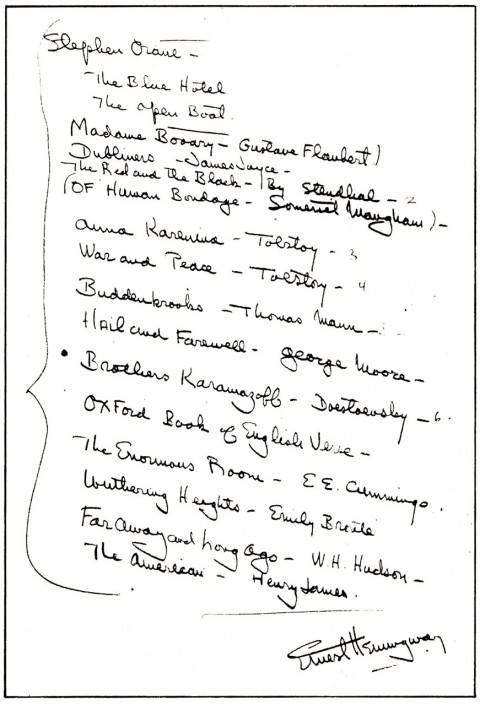
I’ve since located an online sample of Hemingway’s handwriting—likely in pencil—which has him drawing up a list of recommended readings for young writers (among them, Stephen Crane’s short stories, Madame Bovary, The Brothers Karamazov, and The Oxford Book of English Verse). It’s comforting to know that his penmanship is a lot like mine—cramped, stiff, and generally ugly.

HemNote

One of the things that I forgot to mention to my audience—a group of English teachers—was that Hemingway once visited Manila, in February 1941, with the clouds of war already hovering above Europe, where the young Ernest had served as an ambulance driver in World War I. (Ambulance driving seemed to be strangely attractive to young men who would soon make a name for themselves in the arts and letters. Aside from Hemingway, these illustrious WWI volunteers included the writers John Dos Passos, E. E. Cummings, W. Somerset Maugham, and Archibald MacLeish, the composer Maurice Ravel, and the filmmakers Jean Cocteau and Walt Disney.)

In another uncanny connection to fountain pens, Hemingway and Dos Passos served in Italy close to the factory of the Montegrappa fountain pen company, as Montegrappa continues to recall on its website: “Close to the Elmo-Montegrappa factory was situated the Villa Azzalin, which during the conflict. was converted into a field hospital. Two volunteer ambulance drivers for the Italian Red Cross at that time were the famous writers Ernest Hemingway and John Dos Passos, both of whom spent many happy hours visiting the factory and experimenting and testing various Montegrappa fountain pens, and availing themselves of the Company’s after-sales service.”

But back to Hemingway in Manila.

An article by Brown University Prof. George Monteiro in The Hemingway Review (Fall 2010) talks about Hemingway’s short 1941 visit, a stopover on his longer assignment to China as a journalist. Accompanying Hemingway then was his third wife Martha Gellhorn, herself a distinguished writer, a novelist and a war correspondent. (Annoyed by her frequent absences—she would be the only woman to land with the Allied troops on D-Day—Ernest wrote her to ask, “Are you a war correspondent, or wife in my bed?” She led a long and colorful life after her divorce from Hemingway, and tragically, like Ernest, died by her own hand at the age of 89 in 1998.)

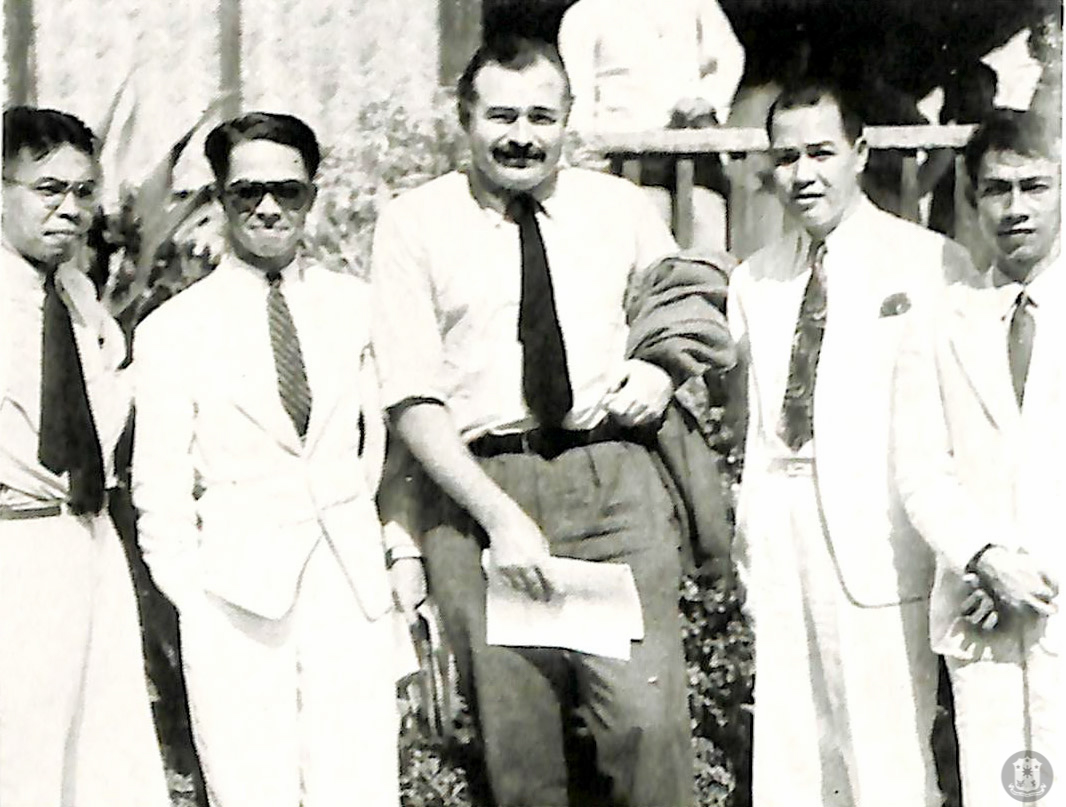
Flying to Hong Kong by Pan Am Clipper from San Francisco via Honolulu and Guam, Ernest and Martha stopped by in Manila for a few days and stayed at the Manila Hotel, and managed to meet with representatives of the Philippine Writers League, which was then led by Federico Mangahas. There’s a picture in the Flickr photo gallery maintained by Malacañang’s Presidential Museum and Library (whose Director, Edgar Ryan Faustino, just happens to be a member of FPN-P), taken from A.V.H. Hartendorp’s Philippine Magazine, showing Hemingway meeting with Filipino writers.

Seeing it reminded me of a similar picture of the big white Ernest looming over a small brown young Filipino named Nestor—a picture that NVM Gonzalez himself showed me in the 1990s, which sadly may have been lost in the fire that later razed the Gonzalez home in Diliman. Monteiro’s account mentions that Hemingway shared this bit of wisdom with his Filipino counterparts: “I think a writer’s gravest problem, always, is to write the truth and still eat regularly.”

Unfortunately I couldn’t access the rest of the Monteiro article online (you need membership access to Project MUSE), but I read enough of it to understand that brief as it was, Hemingway’s stopover created quite an impact, enough for the Manila Hotel to use a quote from the big guy as one of its taglines: “If the story’s any good, it’s like Manila Hotel.” The bayside hotel, founded in 1912, has of course hosted other luminaries such as Douglas MacArthur, John Wayne, John F. Kennedy, and the Beatles, aside from another popular postwar writer, James Michener.

As we all know, Hemingway killed himself with his favorite shotgun in July 1961, seven years after receiving the Nobel Prize for literature, in a fit of depression. It was a sad ending to a many-splendored life that we were privileged to glimpse, however briefly.

Penman No. 159: Border Insecurity

Penman for Monday, July 27, 2015

I’M NOT as big a TV fan as I used to be—I haven’t seen a single episode of Game of Thrones—but I can’t get enough of certain types of reality shows. I’ve been strangely attracted to Project Runway, and despite being a culinary philistine who hates cheese, I’m a sucker for food shows. I don’t care much for Survivor-type formats, believing that living in Manila beats sharing an island with snakes and monkeys anytime. I reserve my highest praise and deepest fascination for junk-o-ramas like American Pickers and Pawn Stars, being the kind of ukay-ukay addict who flew to Barcelona not for Gaudi’s Sagrada Familia but for the Encants flea market.

But there’s another kind of show I’m fixated on, in the same odd way that I hate even the prospect of surgery—I shrink like a schoolboy at the sight of a needle—but can be engrossed by medical documentaries, where other people get cut up. It’s the airport immigration and customs show, like Border Security Australia and Border Security Canada, where incoming passengers go through a gauntlet of questions and searches meant to find out if they’re drug dealers or food smugglers or people pretending to be tourists but are either (a) jobseekers; (b) international terrorists; or (c) fugitives from justice in disguise.

I cringe whenever a passenger—usually an Asian, sometimes a Pinoy—is loudly asked a dozen times, in clear, slow English, “Are you carrying any food?” The passenger looks stricken and bewildered, but ultimately decides to feign ignorance and/or linguistic incompetence and shakes his or her head, immediately upon which the customs officer opens the passenger’s bags to reveal enough meats, cooked dishes, condiments, and desserts for a wedding feast. The officer points to the customs form in which the passenger has boldly checked “No,” which occasions even more vigorous head-shaking, or the groan of discovery, or the wheezy laughter of surrender. The culprit is then fined, or given a stern warning, and the illegal edibles are confiscated, presumably for incineration (in this country, I think we know where they’ll end up—it’s a bigger crime to waste good food!).

As a frequent traveler myself to places out West, I shouldn’t rejoice at these embarrassing encounters between cat and mouse, but I’d have to shamefully admit that I do, which is why I keep watching these shows, for more of the same thing. I suppose it’s what the Germans call schadenfreude—the strange but delectable pleasure we get from the misfortunes of others, if only because it happens to them and not to us. Or at least that’s what we’d like to think.

I remember how, just a couple of years ago and after having made dozens of trips across the Pacific and gone through countless immigration lines, I foolishly “forgot” that I’d bought a few packets of chicharon—the deadlier bituka version, mind you, not the more innocent-looking rinds—at a planeside shop in NAIA, thinking that I would munch on them on the flight to San Francisco in the long stretch between meals. I must’ve fallen asleep instead, because they were still in my carry-on bag when Beng and I arrived in SFO, and had the misfortune of being singled out for random inspection (I think they read the vibes I must have subliminally emanated: “This guy is carrying chicharon. Arrest him.”) I speeded through the immigration process like the veteran I’d thought I was, chatting up the border agent in my best Midwestern-accented English, only to find myself in a special customs queue for secondary inspection. OK, I thought with a minor shrug of annoyance, no problem, let’s get this over and done with, shall we?

The immigration gods didn’t desert me completely, however, assigning me to a customs agent who was obviously Fil-Am, and who just as obviously knew how to deal with sneaky kababayans like me. “Magandang umaga po,” she said sweetly in Filipino as she took hold of my bag. “May pagkain po ba kayong dala ngayon—bagoong, chicharon, mangga?” I was all set to harrumph and put on my foulest professorial airs when I suddenly remembered—at her mention of the usual suspects—the packets of chicharon that I’d stuffed into the side pocket of my bag.

For a millisecond I toyed with gambling on her missing them—the chicharon bulaklak seemed even more delicious, being forbidden, and now I was never going to get a taste of it—but decided to come clean. Decades earlier (you see how these things have histories), an immigration beagle had sniffed out a stash of dubious comestibles in Beng’s luggage, meant for lonesome me in Milwaukee; now I was sure that they had 21st-century detectors and X-ray profiles of bagoong, chicharon, etc. in some secret room behind a nearby wall.

Ay, may chicharon bulaklak pala ako!” I exclaimed, throwing my hands up. “I meant to eat it on the plane, but forgot,” I added, grinning sheepishly. The agent reached in, felt for, and fished out the offending packets, and tossed them into a trash bin that seemed about to overflow with other people’s confiscated contraband. “I’m glad you told me, sir,” the Fil-Am agent said, with the barest hint of regret. “I would have fined you $300 if you didn’t!” I shuddered at the thought of having to fork over $300—the price of a fancy fountain pen—for three packets of pork innards that I didn’t even get a bite of. There, I thought, but for the grace of a kind Pinay go I.

So whenever I watch those poor, guilty souls trudging toward the immigration and customs agents on the TV shows, I silently scream at them, “Confess! Reveal the sausages and the century eggs! Resistance is futile!” Of course they never do, and I feel rewarded with my minute of smug satisfaction at having narrowly escaped the clutches of Western justice. (And it’s just them, right? Nobody but nobody ever asks incoming Americans, Canadians, or Australians, “Excuse me, sir, but do you have hotdogs, burgers, or French fries in your luggage?” Perhaps our immigration people should be better trained.)

SPEAKING OF overseas Pinoys, a fraternity brother in Toronto, Fred Postrado, emailed me to ask for some help in reaching out to his batchmates from the Manila High School Class of 1973, which is planning to hold a reunion during the last week of February 2016. Those interested may contact organizers Zen Alcantara Cabaluna at 0908-8849190 and goldland_zen@yahoo.com, Mario Bulatao at 0917-5215739 and supermcb55@yahoo.com or Virgie Nudalo Calimag at 0932-8615484 and vncalimag@yahoo.com.

Penman No. 156: Why I’ll Never Become Ambassador

Penman for Monday, July 6, 2015

IN MY early middle age, around 40, I nursed an ambition of becoming an ambassador, an official representative of the Republic of the Philippines. Some of my friends and schoolmates were on their way to becoming one—Vicky Bataclan, now in Belgium, and Libran Cabactulan, now at the UN, were just two of them—and I imagined that I might carve out a new career in my seniorhood in the grand tradition of writer-diplomats such as Pablo Neruda, Octavio Paz, and our own Manuel Viray and S. P. Lopez. I’ve met a few real and truly worthy ambassadors and have been much impressed by their demeanor—Cesar Bautista, Delia Albert, and Joey Cuisia, for example.

With a background in literature and economics, and having written a slew of speeches for Presidents, senators, and CEOs, I thought that I had acquired enough political savvy and possessed the language to be able to craft an intelligent and suitably tart or nuanced response to any issue from island-grabbing in the West Philippine Sea to the Chinese in all of us. I also happen to like wearing suits and to be driven around, and I can say “Good morning” in six languages, so I have the externals covered. If I were serious about my ambassadorial plans two decades ago, all I needed to do (if I didn’t want to go the career route and take the FSO exams) was to hitch my wagon to some political star, which is apparently how one too many stragglers like me get to be called “Ambassador” for life, their diplomatic skills be damned.

But I suppose I’ve always had at least two strikes going against my being posted to some swanky European capital: my incipient misanthropy, and my culinary incorrectness.

The older I get, the more reclusive I tend to be, shying even farther away from the frenzy of Facebook and the emoji-enabled spontaneity of many online “friendships.” It’s not that I actively dislike people; I think most strangers will find me friendly, and I warm up easily once we get a real conversation going. (With the exception, I must say, of telephone conversations; having grown up without a phone, I have always disliked—loathed would be the better word—talking on the phone, especially for anything longer than three minutes.)

It’s just that, past 60, I’ve come to seek out human company less and less, preferring to keep to myself and family, and a few close friends who wouldn’t mind not hearing from me for months or years and picking up where we left off, which is my gauge of a true friendship. Over the past five years or so, I’ve become such a homebody (my poker nights excepted) that Beng feels like she has to ask me now and then, “Don’t you have any friends?” She means, of course, people other than herself, because she knows that I’ve been perfectly happy to just have her for company, at home or on the road, and that, in our sixties, our need and desire to socialize as a couple has diminished considerably.

Beng compensates for this by being a Facebook fiend, and aside from her snoring bedmate, Facebook’s the first thing she sees in the morning and the last thing she sees at night. Like I wrote here not too long ago, I’m not even on FB, and obstinately stay out of it, because I think it’s cheapened the meaning of “friend.”

Diplomacy, of course, requires not only meeting with a lot of people, but people you hate, and who very likely feel likewise—sort of like the online world, only it’s face to face. Now, I can fake pleasantness as well as anyone else—except maybe Beng, who’d lose our house and car at poker within five minutes—but I know, from practice, that while they say it takes just 17 muscles to smile and 42 to frown, smiling can be a lot more tiring than frowning, especially if you don’t mean it.

The more important reason I’ll never head an embassy is the mess I would likely make of our foreign relations by my equally boneheaded refusal to acquire a more catholic or at least a more cosmopolitan palate, despite Beng’s entreaties for us to try menus more complicated than Chow King’s. Nothing flusters me more than the prospect of “fine dining.” (I recall how, many years ago, I begged off from joining a very exclusive and epic feast prepared by ten of Manila’s top chefs—much to the dismay of a fellow professor who had wangled the invitation—precisely because all that good food would have been wasted on me.)

That’s also why I’ve declined dinner invitations, especially from people I don’t know or who don’t know me and my curious preferences, to spare us the mutual embarrassment of my shying away from anything with cheese, or oregano (I can sniff out one part in a million), or the aforementioned curry, which effectively leaves out much of Italian, French, Greek, Indian, and Mexican cuisine. No pizzas, thank you! But I’ll take pancit, lechon, adobong pusit, Ligo sardines, chicken mami, and KFC anytime—I’m actually easy to please.

Ambassadors should be able to eat anything with anyone, and not just gorge like a hungry peon (someone called my rice-and-pancit combo “pagkaing obrero”) but dine intelligently, knowledgeably, with the ability to make off-the-cuff remarks like “Don’t you just love the tanginess and the fruitiness of this Dréan d’Auvergne? It’s a bit more complex than the St. Nectaire, don’t you agree?” (Thanks to cheesenotes.com for the technical details.)

The only place I can imagine not having this culinary quandary would be China—where I’ve gone pretty often because, as I told Beng, I was sure to find a lot of yummy Chinese food there—but I’d hate to tell my Chinese hosts what I really thought of the nine-dash line, and I’d hate to have to explain, on the rebound, why bright kids with Chinese names can create such a fuss on Pinoy Facebook.

Penman No. 155: Writing Virtual Reality

Penman for Monday, June 29, 2015

I WAS surprised to receive a text message the other week from a former student, Dada Felix, herself a prizewinning short story writer. Dada told me that she’d just heard from another acquaintance who was now working in Saudi Arabia, and who’d written her about the sandstorms in that country. “It was just as you described it in your novel Soledad’s Sister,” Dada said.

I thanked Dada for the compliment—and I took it as a compliment, because while a third of that novel takes place in Saudi Arabia, I’d never been to that country—not before I wrote the novel in the early 2000s, and not since. In fact, I had to look back at my manuscript—it’s funny how little you retain in your head of your own work after a few years, except perhaps for specific passages—to see what exactly I had written. I found this:

“Seven weeks after Soledad arrived, a sandstorm blew in from the east, a dark, mountainous reddish-brown cloud that rolled over the city with a great cavernous howl, obscuring and blistering everything in its path. She had just stepped back into the servants’ dormitory from giving Amina a bath, and all the girls were rushing to seal the doors and windows with towels. Still unused to the voluminous abaya, Soledad fought with herself to move as quickly as the others…. As the sandstorm blew around them, making the glass in the windows sing but striking terror in the hearts of the foreign maids and workers in the compound as it raked and scoured everything in its path, Meenakshi’s lightness of mood seemed even more out of place. When Soli cowered in a corner near her bunk, holding on to her knees, Meenakshi crept up to her and whispered, ‘He wants me to meet him tonight, in the harbor, near the fountain.’

“.… Around them the wind had miraculously fallen to a hush; the sandstorm had left as quickly as it had arrived, spending its force at the water’s edge, and people began reopening the windows cautiously to look up at the sky, which was still a murky brown but through which patches of blue were beginning to show.”

I remembered that I wrote in that scene to introduce some visual drama, and also to create a contrast between the fierceness of the storm and the almost casual decision the girls make that would change their lives forever.

But what looking back at my own text truly reminded me of was how often, in the course of writing fiction and even nonfiction, I had to recreate factual scenes based on research and my imagination. This will happen quite often to anyone dealing with historical material, or anything that happens outside his or her personal experience.

Research, of course, is invaluably helpful. When I wrote the biography of accounting pioneer Washington SyCip (who incidentally turns 94 tomorrow—happy birthday, Wash!), I chose to start the narrative at a crucial turning point in his youth, when he was returning to the Philippines in mid-1945 after serving as a codebreaker with the US Army, and his ship steamed in to Manila Bay. I had to ask myself, what would Wash have seen, standing on the deck of that ship? I consulted several sources to reconstruct the likely scene:

“In the city’s oldest section, within the stone walls of Intramuros, an entire procession of churches—the Manila Cathedral, Lourdes, Santo Domingo, San Francisco, San Ignacio—had crumbled to the ground; only San Agustin remained. Of the city’s many universities and colleges, only two colleges—Letran and Sta. Rosa—withstood the bombs and the artillery. The City Hall, the Post Office building, and the Metropolitan Theater were all vacant hulks, their bone-white shells pockmarked in thousands of places by sustained bombardment between February and March 1945.”

That kind of factual rendition isn’t too difficult to achieve, so I tried to get beyond the physical into something more internal—Wash had been told, mistakenly, that his father had been killed by the Japanese, and he was brimming with anxiety—so I followed up that description thus:

“The man on board the Navy ship was too far to see these details for himself, but the strange concavity of what had been the metropolitan skyline, the impression of a body supine and overrun by tubercular rot, and the brooding silence that waited across the bay would have encouraged his worst fears.”

Strangely enough, this was a scene—steaming into Manila Bay—that I had already rehearsed some 25 years earlier, in a novella titled Voyager, set in the 1880s, when a steamship arrives from Hong Kong, carrying a Spaniard who has just killed a compatriot on the voyage to protect a Filipino revolutionary. An officer of the law, he has seen the best and the worst in men—himself most of all—and projects this duality of vision onto the unfolding panorama before him, in the novella’s closing scene:

“And now, in an afternoon of dolphins and rainbows playing above the water, we return to the wide-open arms of Manila Bay, the home of Spain and the throne of God on this side of the earth, the ramparts of its forts rising proudly into the sky, and yet anchored to the earth by dungeons, tunnels, pipes hissing with the force of sewage seeking to be expelled. Below the great Cathedral are catacombs I have yet to visit. Across the street, in Fort Santiago, is a flight of steps that leads down to a room of solid stone, with a solitary window offering a view of the river through the iron; when the tide rises, both view and viewer go in a muddy froth. This is where and how the City holds the secrets that keep it alive, where God, I must believe, now and then deserts His pigeoned domes to visit.”

I had to imagine much of that, this being the time before computers and Google, and when I had scant time for and access to libraries, as a working stiff outside of academia. Years later I would read a contemporaneous account that pretty much validated what I had made up.

Do I always get it right? Heck, of course not. These forays into virtual reality are inherently risky—you’re guessing half the time, and all it takes is one small but noticeable mistake to ruin the seamlessness of the effect. There’s a long list out there of factual boo-boos poets and novelists have made—not that it matters much to their unsuspecting readers.

But not all readers can be so easily seduced by fluid prose. It took an Indonesian professor who had flown to and from Saudi Arabia to gently, almost apologetically, inform me that I had my time zones all wrong in my opening scene in Soledad’s Sister—the same work that Dada praised for what seemed to be its uncanny accuracy—that a plane flying eastward from Jeddah would have flown behind the daylight clock rather than ahead of it. I thanked her profusely, and made a note to correct that in future editions of the book.

(Image from alarabiya.net)

Penman No. 150: Looking Eastward in Toronto

IMG_7573 (1)Penman for Monday, May 25, 2015

I FLEW out to Toronto in Canada a little over a week ago to take part in that city’s Festival of Literary Arts, possibly the first Filipino author to join that long-running festival, now on its 15th year. Previously, the festival had focused on South Asia (India, Pakistan, Bangladesh, Sri Lanka), but has recently opened itself up to more representation from East Asia, Africa, and the Caribbean, thus my inclusion in this year’s roster of invited writers and speakers.

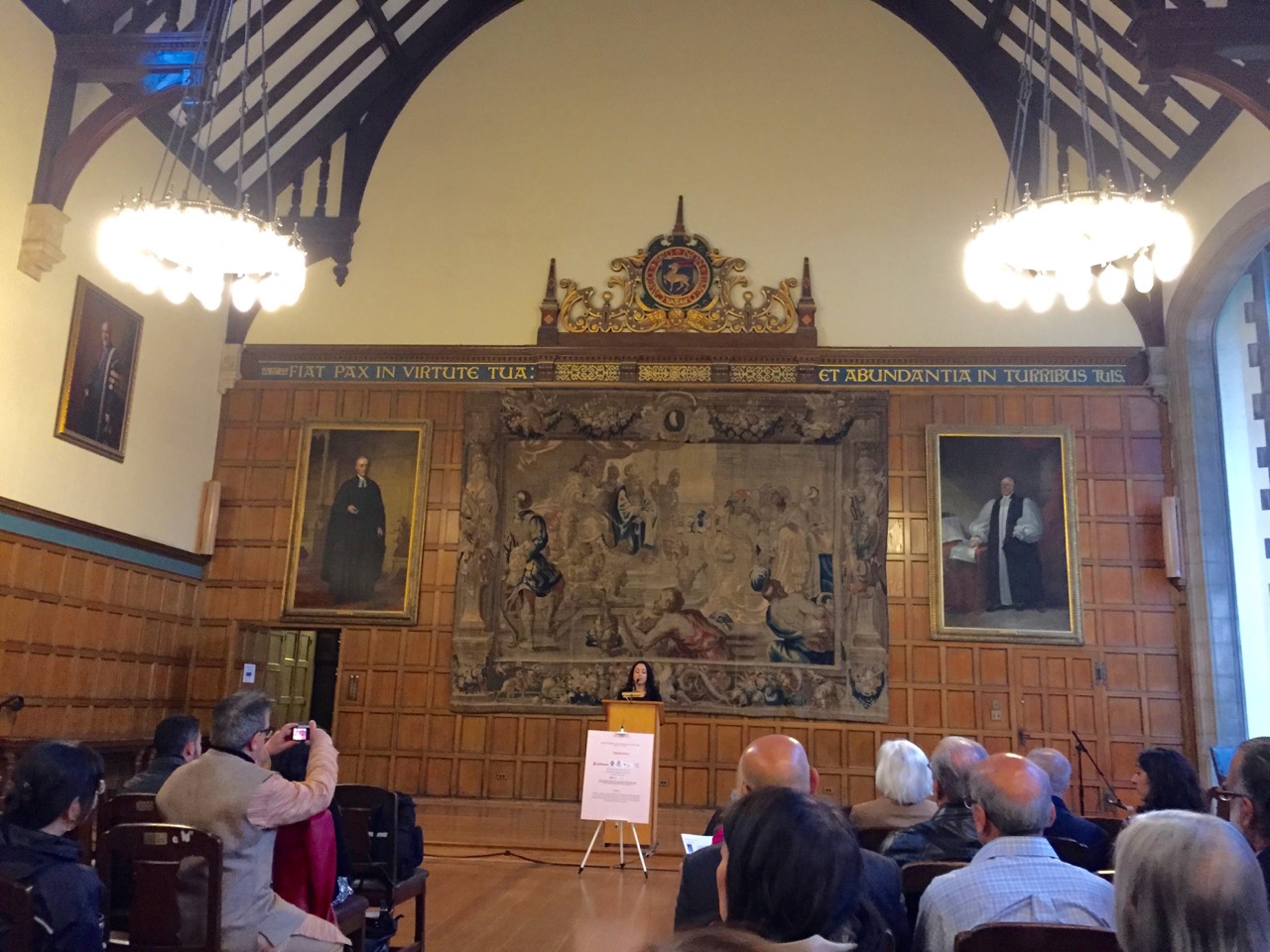
Over a weekend, from Friday to Sunday (May 15-17), several dozen representatives from these regions and from Canada met in various venues on the scenic campus of the University of Toronto and its environs to tackle issues and problems besetting writers and publishers from outside the global centers. How does a writer from the periphery break through to the center? Or is that “periphery” its own legitimate center? Is yearning for publication and validation in the West a vestige of the colonial mindset, an experience shared by all the countries represented in Toronto?

Aside from these seminal discussions, of course, the meeting was first and foremost a festival, a sharing of the artists’ finest work, and I felt privileged to be introduced to authors and creations I would otherwise have totally missed or blithely ignored. With many of the authors coming from expatriate and postcolonial backgrounds, the offerings were rich and deeply nuanced, the talents outstanding.

Among others, I discovered a major international writer in the festival director, the novelist M. G. Vassanji, who had been born in Tanzania in East Africa, and whose account of his pilgrimage to his ancestral roots across the ocean (A Place Within: Rediscovering India) is a modern classic of creative nonfiction—a sympathetic but unsentimental and often searingly critical chronicle of his encounter with the sprawling reality of India today.

The visit also allowed me to reconnect with some old Filipino friends who had migrated to Toronto and had built new lives there. I was very graciously taken out to a scrumptious dimsum lunch in Toronto’s fabled Chinatown by Patty Rivera and her husband Joe. Patty and I worked together 40 years ago as writers and editors at the National Economic and Development Authority (an unlikely Camelot for young writers and artists under the patronage and protection of then-Sec. Gerry Sicat).

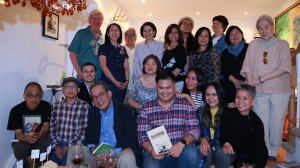
Though trained and still active as an editor and journalist, Patty has since developed into an accomplished and prizewinning poet, with three volumes to her name. Her first collection, Puti/White, was shortlisted for the 2006 Trillium Book Award for Poetry. Patty’s husband Joe, a former Ford executive who also wrote plays in the Philippines, became a lawyer in Canada and then, upon his recent retirement, turned to painting, an avocation in which he demonstrates a most unlawyerly exuberance. I also met and was happy to engage with some Alpha Sigma fraternity brothers led by Amiel “Bavie” de la Cruz, who now runs his own accounting firm in Toronto. IMG_7597 (1) Patty and Joe arranged a reading for me with a large and lively group of Toronto-based Pinoys (including Hermie and Mila Garcia, the moving spirits behind Canada’s longest-running Filipino newspaper, the Philippine Reporter, and expat poet Naya Valdellon); this was held in the very stylish apartment of writer-artist Socky Pitargue, and a great time was had by all as we threshed out the travails of Philippine literature and politics, two deathless topics that occupy me on every one of these overseas sorties. DALISAY_HMG_8056-300x168 Yet another meaningful encounter I had, thanks to the festival organizers, was with two classes of high school students at the Mother Teresa Catholic School in Scarborough, a Toronto suburb with a high concentration of Asian students, including Filipinos. These teenagers had very likely never met a living writer before, let alone a Filipino one, and I was glad to try and show them that we do exist, and that we have something to say. I, too, learned something from their teacher Kathy Katarzyna, who ended our session with a terrific quote from the Canadian poet Leonard Cohen: “There’s a crack in everything…. That’s how the light gets in.”

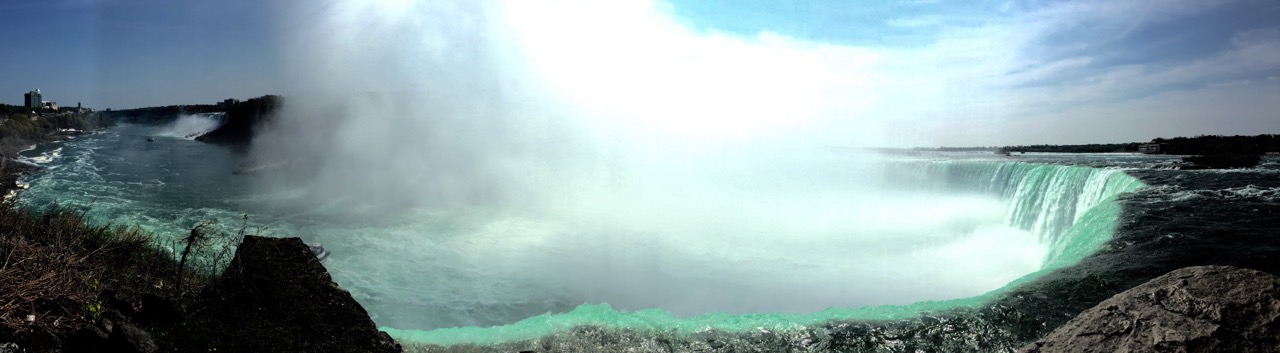
Many thanks to the Sri Lankan poet Aparna Halpe for taking me to the school. Of course, my thanks wouldn’t be complete without acknowledging the help and support of my sister Elaine Sudeikis and her husband Eddie, who flew in from Washington, DC to join me at the festival and to show me Toronto and a bit of Ontario (most notably Niagara Falls—we walked over to the US side as well for my shortest visit to the US, ever). Ed’s dad Al—all of 92 but still feisty—also gave me a little taste of Lithuania in Toronto.

And the visit would never have happened for me without the recommendation of Prof. Chelva Kanagayakam, an eminent scholar and festival founder whom I’d met in Manila, who tragically died of a heart attack a few months before the festival, on the very day he was inducted into the Royal Society of Canada. I found Toronto itself to be a highly livable and largely safe city (guns are under strict control in Canada), with a vibrant ethnic mix.

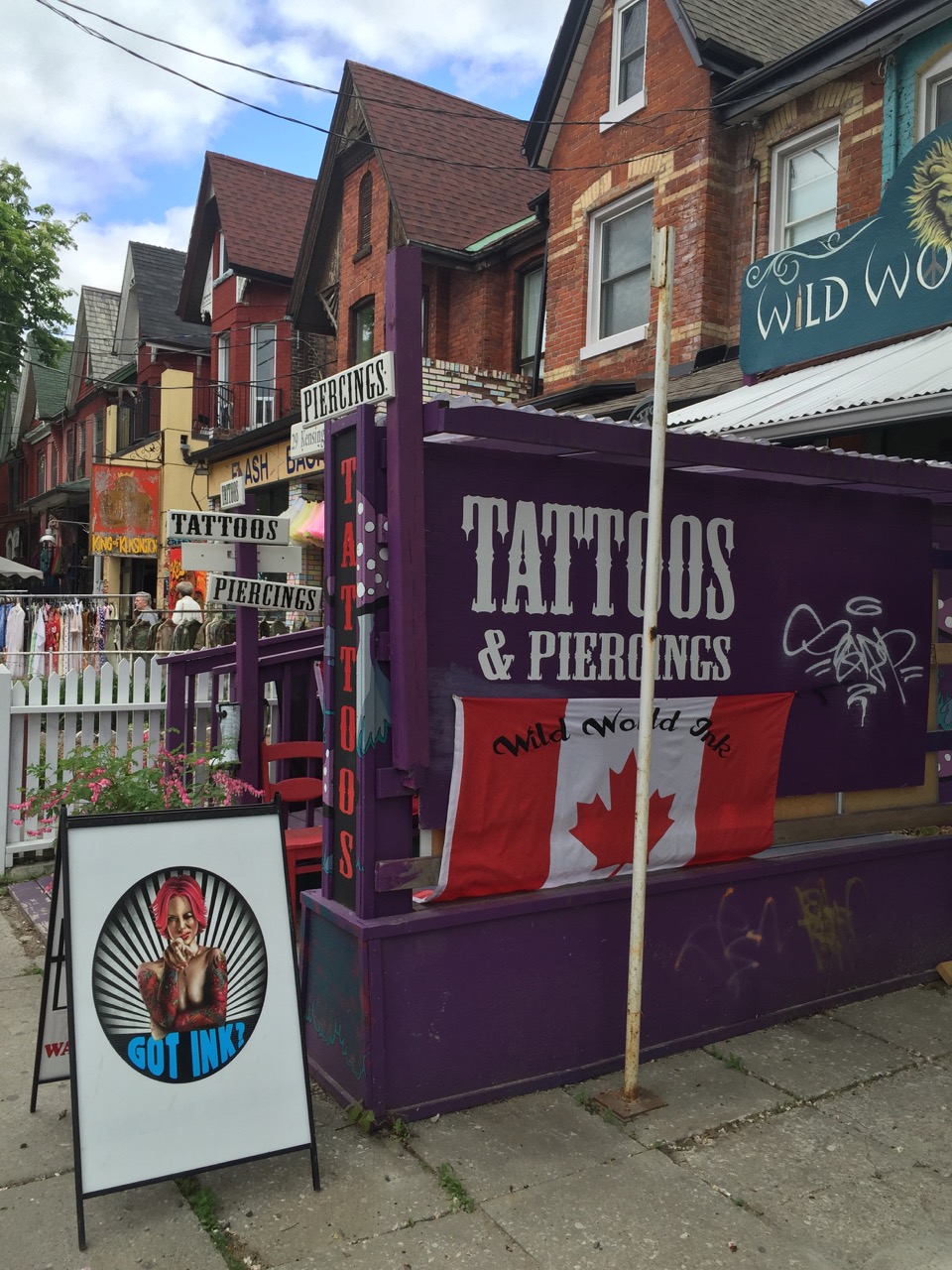
One out of every two Torontonians comes from somewhere else, and Vietnamese, Tibetan, and Puerto Rican restaurants stand cheek-by-jowl beside each other, not to mention a Chinatown noted to be among North America’s best culinary havens. (A Pinoy food store aptly named “Butchokoy” stood a block away from my lovely B&B—a three-storey house from 1853—on Dunn Street.) Victorian structures still in use by the university and the city government contrast sharply with ultramodern architecture in an eclectically energetic skyline. Seekers of the funky and the quirky can have their fill in the city’s counterculture-inspired Kensington Market. IMG_7691 (1) For someone schooled in Americana, this exposure to things Canadian was an interesting re-education—to think, for example, in terms of “Tim Hortons” instead of Starbucks or Seattle’s Best; of “Roots” instead of Gap; of “Hudson Bay” instead of Sears or JC Penney, etc.

But the most useful re-orientation took place for me at the festival itself, in reminding me that we have a lot to learn from South Asia as far as developing readerships in local languages is concerned, among other issues. We Filipinos think we’re well traveled and globally savvy, but we actually don’t get around enough in terms of mixing with our fellow Asians, let alone Africans. We seek out Western—specifically American—tutelage and patronage, often to our own deep disappointment.

It seems ironic that I had to learn this in Toronto—a true cosmopolis like New York—but sometimes you have to stand in the West for a better view eastward.

[Group photo from philippinereporter.com]