Qwertyman No. 58: A Long Grace Note

Qwertyman for Monday, September 11, 2023

AT ABOUT this time fifty years ago, I was newly released from martial-law prison after seven months of what everyone euphemistically called “detention,” and wondering what to do with the rest of my life. I was just nineteen, so I suppose you could say that I had a lot of living ahead of me, but I felt very differently then. More than a dozen of my friends—all of them in their twenties or even younger—had died horrible deaths fighting the regime. We exalted them as the martyrs that they were, but grimly realized and acknowledged that given how things were going, we ourselves would be fortunate to see the ripe old age of thirty.

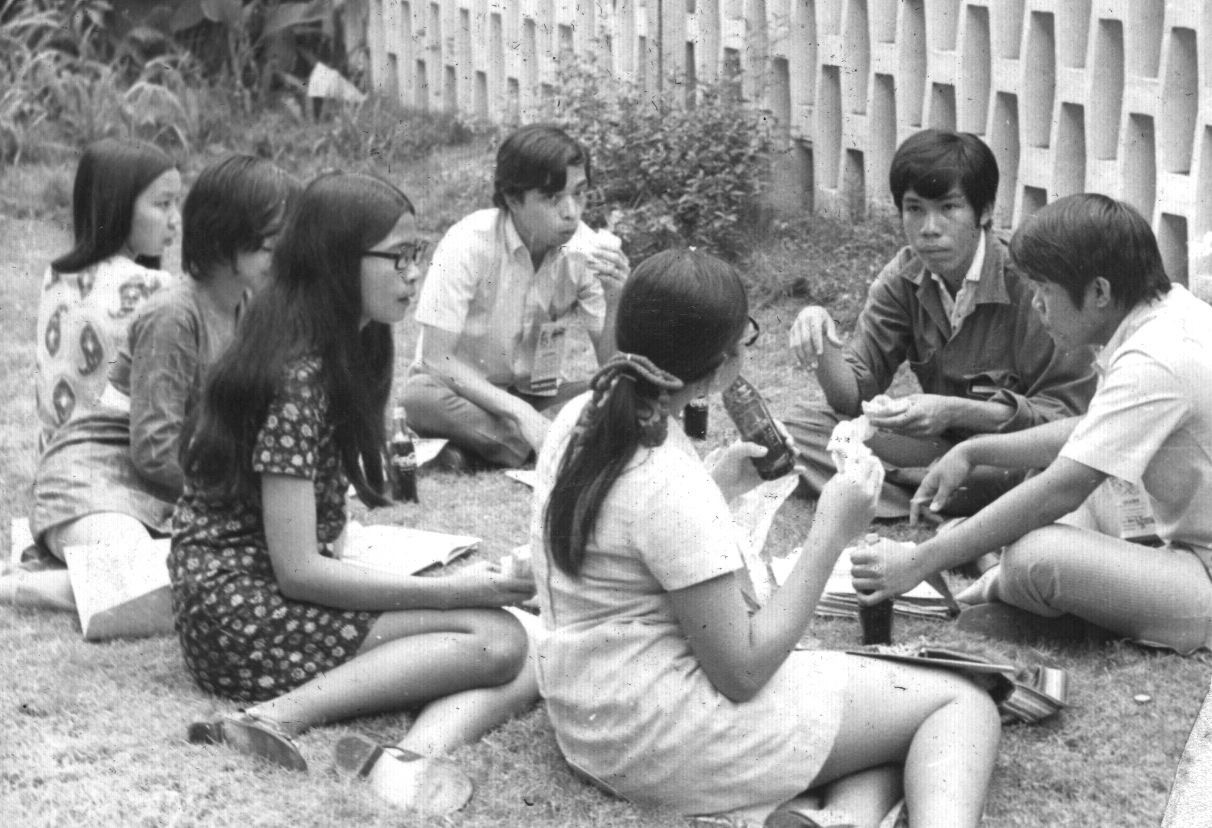
I had been arrested at home on a cold January morning in 1973, just past midnight. Like many student activists, I had dropped out of college during the First Quarter Storm of the early 1970s. But instead of joining “the movement” full-time, I improbably found a job with a newspaper as a general-assignments reporter. It was heady stuff at age eighteen, covering three-alarm fires, floodwater rescues, and the very same demonstrations I had joined on the other side of the police barricades. And then martial law was declared—I was actually covering a rally in UP, and thought I had a scoop when a radio station nearby came under fire from the Metrocom, only to be told by my night editor when I tried to phone the story in that we no longer had a newspaper to publish, because soldiers had taken over the office. 

Over the next few months I shuttled between part-time jobs and clandestine meetings with the anti-martial law underground, moving around the city. I wasn’t doing much, given how green I was, but I thought it was important to take part in the resistance in whatever way. And then when Christmas came, like a good boy, I went home to my parents and foolishly had a chat with a neighbor who turned out to be a military asset. Not long after, a posse of soldiers appeared at our door, and when my father nudged me awake, I had a gun pointed at my face. I was being arrested under a catch-all “Arrest, Search, and Seizure Order” or ASSO issued by the Defense Minister, Juan Ponce Enrile, for whom I would ironically be writing some speeches during his post-EDSA reincarnation (he won’t remember that, as I was a tiny mouse in the office).

My release in August 1973 came right out of a Kafka story. I was taking a shower one morning in our prison—which, by the way, is roughly where St. Luke’s BGC is today—when I heard my name being called over the PA system. “Dalisay, report to the guardhouse immediately!” The last time I had done that, after one Sunday dinner, I had been beaten up by some drunken guards just for the heck of it, so I groaned when I heard the announcement. Not again, and so early? As it happened, I was received by an Army officer with a stack of papers. He pulled mine out, squinted at it, and said, “Dalisay, you’re still here? Pack your things. We have nothing on you.” The first place I visited after I went home was the AS Steps in UP, where we had gathered for many a raucous rally; it was vacant and deathly silent, and I knew that I wasn’t going back to school just then. Only after a long detour—working as a printmaker, a writer, an economist, and meeting Beng and fathering Demi—did I return to UP and graduate with my degree at age thirty.

I’ve written about my activism and incarceration in my first novel, Killing Time in a Warm Place (Anvil Publishing, 1992), and it isn’t what this column is really about. Rather, it’s about the aftermath, about having a life after martial law, and an unexpectedly long one at that. 

For any activist from my generation who’s still alive, every breath we’ve taken after our 30th birthday is a grace note—what the dictionary describes as “an extra note added as an embellishment and not essential to the harmony or melody”—in other words, a bonus. Considering that we could have been gunned down like dogs or buried alive like some of our comrades were, you can understand why we feel that way. It’s almost absurd to contemplate, but education, marriage, career, success, fame, fortune—and all the downsides and flipsides that come with them—all these were a long string of surprises, any one of which might never have happened, but for a twist of fate or a stroke of luck (clichés, like life’s very milestones, but ones we appreciate).

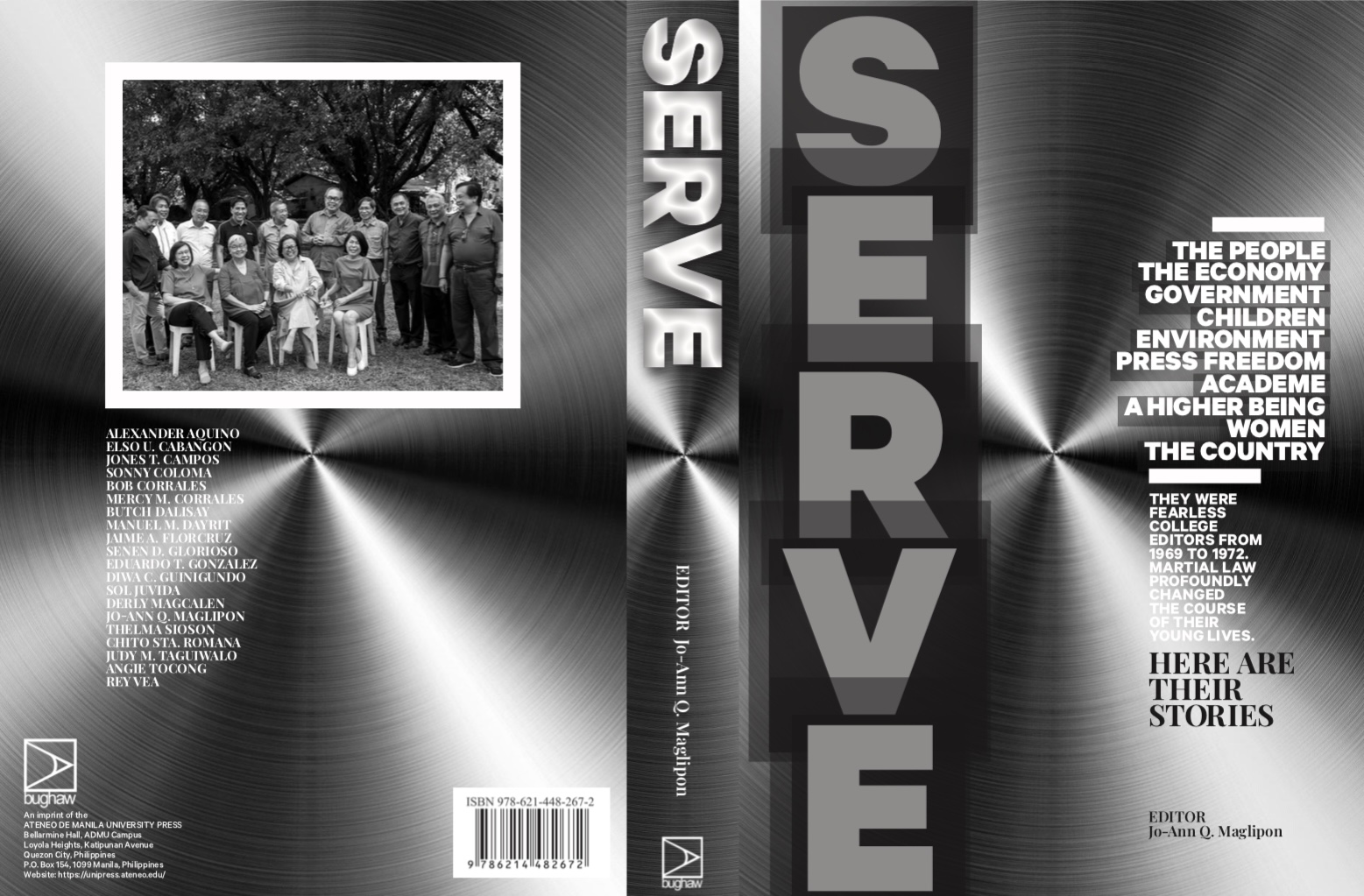
When my fellow FQSers and I—all college editors who were part of the SERVE book that I wrote about last week and that we launched last Saturday—gathered around a table before the launch to pre-sign some copies, we noted with much chuckling how surprisingly old we had become. We were beset by diabetes and hypertension, which were lethal enough but easier to bear than the four bullets one of us took to his face and body; he was with us that day, laughing, his spirits buoyed by his fervent Christian faith. 

We had become university presidents and professors, Cabinet secretaries, CEOs, magazine editors, pastors, and opinion-makers. I don’t think there was anyone in that room who believed any longer in the necessity nor the efficacy of violence, but neither did anyone imagine that our youthful goals had been met, that the country had become a kinder place, and that our work for justice and freedom was done. We had come to terms with our past, were busily in the present, and were hoping to enjoy what little we had left of our extended lives. But like those shaken passengers who stagger away from a crashed plane, leaving the uncounted dead behind, I’m sure that we felt driven by survivor’s guilt to make the most meaning of our gifted years, to do well and to do good, and to serve our people in any way we could. 

We learned that everything may be political, but also that politics is not everything, and that the road to happiness and deliverance may be wider than we had thought. I myself have resolved that even as I fight on for truth and beauty, I will not allow my happiness to be determined by our political vicissitudes, if I can help it. That will be my sweet revenge on my jailers. I will survive you, live a fuller life, and meet my Maker with a clear conscience and a smile.

Qwertyman No. 54: Two Valedictories

Qwertyman for Monday, August 14, 2023

TWO SPEECHES delivered by graduating students of the University of the Philippines made the rounds of social media last week, garnering generally positive responses for their forthrightness. One was more strident than the other, but both carried essentially the same message: we need to reframe the way we look at the education of the poor, and what true success should mean for the working student.

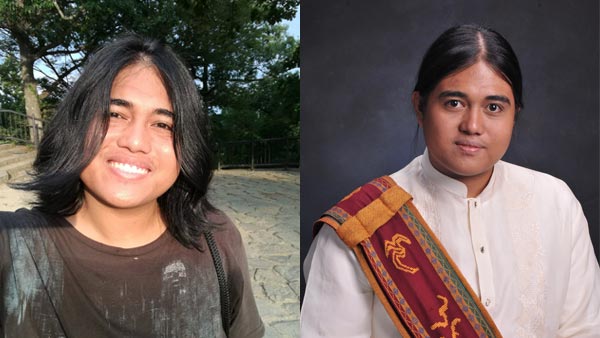
The first was Val Anghelito R. Llamelo, summa cum laude and class valedictorian, Bachelor of Public Administration. The son of an OFW, Val began working at a very young age at a BPO, as a marketing assistant, and as a tutor to support his needs and that of his family’s. He was, almost needless to say, the first UP graduate his family produced, and finishing summa against all odds was the icing on the cake.

He wasn’t there, he said, to deliver the usual valedictory speech you’d expect from a person with his kind of success story. He was grateful for his opportunities, but he didn’t feel like celebrating his hard-won triumph, which people would typically applaud for its sheer improbability. And that, precisely, was the problem, according to Val.

“Why should I be an exception?” he asked in so many words. “Why can’t more Filipinos from my background do well in college and finish like I did? Why does access to a quality education remain the privilege of a few? During the pandemic, how many poor students underperformed because of their lack of access to digital technology?”

Again I’m paraphrasing here, but Val went on to say, “I don’t want to be your inspiration or role model. No one should have to endure what I faced. I want you to be disgruntled enough with the system to demand something better and not settle for less, to yearn for a system where working students, indigenous people, and individuals from impoverished families can have fair opportunities to study and to succeed. Praising us gives politicians in power an excuse to renege on their commitment to improve our lives. We overvalue resilience. Using the familiar analogy of the glass that’s half-full and half-empty, we’re often made to feel that we should be contented with the fact that it’s half-full, but we should focus on the fact that it’s half-empty, and should hold our leaders accountable for filling it up.”

The other speaker was Leo Jaminola, a BS Political Science cum laude and MA Demography graduate who juggled six jobs—as an encoder, transcriptionist, library student assistant, tutor, writer, and food vendor—to complete his bachelor’s degree. 

“Graduating with honors back then was nothing short of a miracle,” says Leo. “In the years that followed, the list of jobs I took just grew longer as I became a research assistant, a government employee, a development worker, and a consultant for different projects with some engagements overlapping with each other.  

“The past years have been a long-winding maze of seeking financial security and I have still yet to find a way out of this crisis. From full-time work, part-time work, and competitions, I did my best to provide not only for myself but also for my family. 

“While some of my peers have hefty investments in high-yield financial instruments, here I am still overthinking whether I deserve an upgrade to a large Coke while ordering at the local fast food chain. 

“During my childhood, I saw how poverty manifested itself in the form of cramped makeshift houses, children playing near litter-filled canals, and senior citizens succumbing to illnesses without even getting a proper diagnosis. Growing up, I thought of these as normal occurrences that should be accepted as it is the way of life. Now, I do not think that this should be the norm. 

“Some people will say that poverty is a personal failure and that the members of my community should work harder but I know better. One of the things that I learned from my experience is that hard work as the primary factor in being successful is a myth. That’s not to say that it doesn’t play a role but privilege and access to resources have greater impacts on whether a person ends up successful or not. 

“If hard work is all it took, then the many young breadwinners I know who continue to support their families while chasing their own dreams would not be constantly organizing their budget trackers to find ways how to stretch their salary until the next payday. 

“Others will read this and use it as some kind of living proof that people, even those from the most marginalized groups, can make it in life simply by working hard rather than addressing structural barriers. But what of those who didn’t make it despite working as hard or even harder than me? How are their experiences not evidence of the continued inaccessibility of education and opportunities in our country? 

“Rather than success, we should see my experience and the stories of so many others as systemic failures. If anything, my story should make us angry and move us to demand a much better society—one that allows our people to live with dignity, dream freely, and enjoy equal opportunities.”

The speeches echo each other, but then so have the “model” valedictories that Val and Leo so forcefully seek to subvert. Indeed, the usual narrative we hear is that of the poor boy (or girl) made good, followed by congratulatory praises for his or her tenacity and faith in Divine Providence. (Some of them, like the poor boy from Lubao, even become President.)

I have to admit that we find such stories inspiring if not necessary, because they offer the possibility of salvation for a lucky and plucky few. But we have to bear in mind as well—as Val and Leo emphasize—that for every summit achieved like theirs lie hundreds if not thousands of others who never got past base camp, not for lack of talent or will but simply for lack of means. To succeed as a nation and society depends much less on producing exceptional one-offs than on leveling the playing field for most.

(Photos from Philstarlife and pep.ph)

Qwertyman No. 53: Too many laudes?

Qwertyman for August 7, 2023

LIKE MANY alumni and casual onlookers, I couldn’t help but be bothered by the announcement that more than half of this year’s graduating class of the University of the Philippines Diliman were finishing with Latin honors—2,243 out of 3,359 undergraduates, 305 of them summa cum laude, 1,196 magna cum laude, and 742 cum laude. Critics were quick to point out that it was a sure sign of grade hyperinflation, that UP had turned into a diploma mill, and that a UP education was no longer what it used to be.

Having taught in UP for almost 40 years, I disagree with the harshest of these conclusions—there are many external indicators to prove that UP graduates and UP as an institution are globally competitive and remain high above national averages in terms of professional certifications and such. 

But the surge in honor graduates is indeed so high that it leads many to worry if a summa today means the same thing it did ten years ago, when only 15 out of 4,365 graduates claimed that distinction. What happened in between? Did both UP students and their professors become so suddenly much better that they outperformed historical expectations? Can we back this up with scientific data, or at least with some reasonable conjectures?

My own guess—and that’s all it is, an educated guess—is that we’re seeing the outcome of an enforced leniency in grading during the pandemic, when the normal grading rules were stretched to be as accommodating as possible to the situation that our undergraduates found themselves in—under lockdown, taking classes on Zoom under highly variable conditions of connectivity, with little or no access to physical libraries and laboratories, with little social interaction face to face, and under the critical eye of hovering parents and siblings at home. 

During the pandemic, in UP (and perhaps in other universities and colleges as well), a “no-fail” policy was put into effect; no student could be given a failing grade, except in cases of intellectual dishonesty. The normal one-year period for resolving “Incomplete” grades was extended. Professors could not “drop” students for absences or lack of communication. Students could opt to have their grades “deferred.” University rules on scholastic delinquency and retention were suspended. And because universities worldwide had to shift abruptly to online teaching, resulting in many adjustment problems on both sides of the video camera, UP decided that numerical grades earned during this adjustment period would not be factored into the General Weighted Average (GWA), on which Latin honors are based. Note that under normal rules—which, to my knowledge, are mostly if not entirely now back in effect—any one of these infractions or deficiencies could have cost you your laude; their relaxation meant that the door was now open for many candidates who might have been disqualified on technical grounds. 

But then again, that’s just my personal explanation for this aberration (which statistically it is, if you’ve seen the charts). I don’t mean for any of this to diminish the pride, happiness, and sense of accomplishment that I saw on the faces of the graduates and their parents that waterlogged morning of July 30 when UP Diliman held abbreviated commencement exercises despite the weather. No speeches were made to put safety over ceremony, but then perhaps none were needed, as the swell of “UP Naming Mahal” rose defiantly over the rain. You could not walk up to any one of those honor graduates and tell him or her “You don’t deserve your medal,” because you had no idea what he or she went through during the pandemic to earn it. If the system failed, then let it be faulted, and let the post-mortem happen, but don’t take it out on the students who only did what they were supposed to do. 

Even as professor emeritus, I’m still teaching after retirement, and last semester I chose to teach Fiction Writing to a class of undergraduates, wanting to see for myself what our young people were thinking and also to give them the unusual experience of being taught by a grizzled old fellow. I was generally pleased with the level of talent and enthusiasm I encountered. As expected, two or three students stood out above the rest, many sat in the middle, and a few lagged behind, not for incompetence but for such other factors as attendance and class participation, both important in a writing workshop. Most did well enough, in my estimation, to earn at least the 1.75 that would have qualified them for honors. Was I part of the grade inflation? But if they did much worse than that, then they had no business being in UP. I didn’t give out any “1.0”s, but I didn’t flunk anyone, either. If anything, my chief complaint would be how alienated our young people are from their social and cultural environment beyond their cohort and from their history. They can write well, but they still have to learn and understand what truly matters.

As far as Latin honors are concerned, it might help to see what the financial website Investopedia has to say on it, adjusting for the fact that it’s US-based:

“While Latin honors can look good on a diploma, college transcript, or résumé, do they make any difference in real life? Two researchers at the University of Illinois at Chicago, Pauline Khoo and Ben Ost, attempted to answer that question in a 2018 paper titled ‘The Effects of Graduating With Honors on Earnings.’

“’We find that obtaining honors provides an economic return in the labor market, but this benefit only persists for two years,’ they wrote. ‘By the third year after college, we see no effect of having received honors on wages, suggesting that firms may use the signal for new graduates, but they do not rely on the signal for determining the pay of more experienced workers.’ They also found that the economic benefit applied only to students who had graduated from selective schools.

“Critics of Latin honors are less concerned with their potential post-graduation benefits than the unintended effect they may have on students while they’re still in school. A 2011 editorial in Harvard University’s student newspaper, the Crimson, called for their abolition at the school.

“By rewarding students who achieve a minimum GPA across classes, the Latin honors system does more to discourage academic achievement than to encourage it. It encourages students to view classes outside of their concentration as a means to an end, the end being the highest possible grade, rather than an opportunity for intellectual exploration.”

Given our Pinoy penchant for titles and distinctions, I don’t see us getting rid of laudes anytime soon, but it may be time to find another and better way to recognize and reward student achievement beyond book learning.

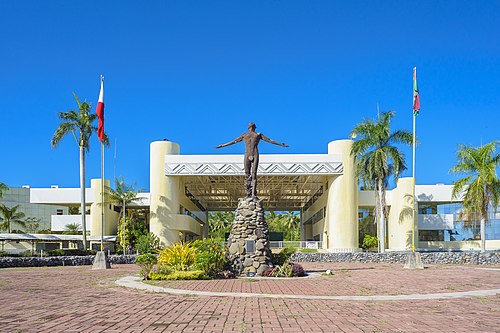
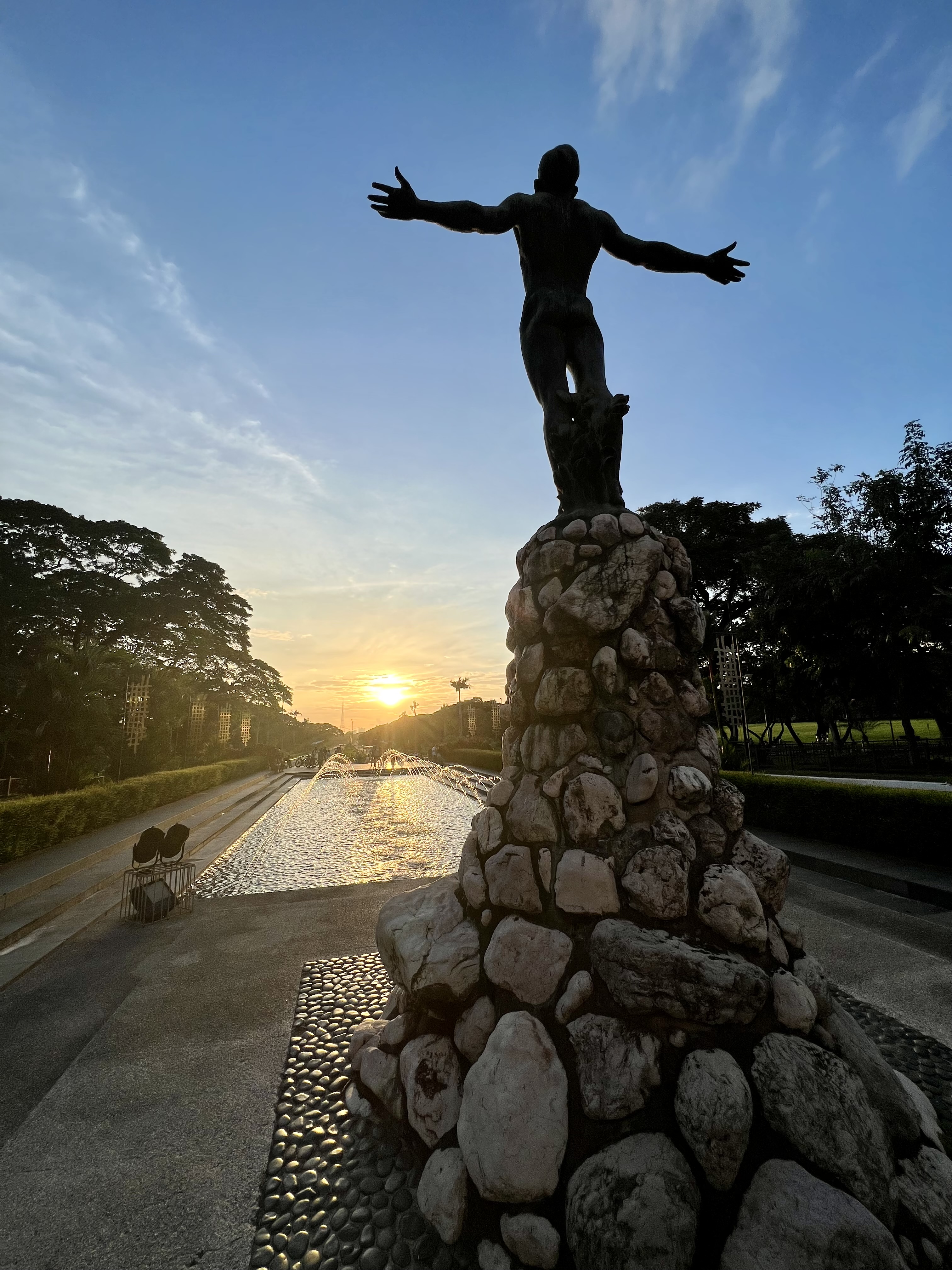
(Photo from upd.edu.ph)

Qwertyman No. 47: An Open Door

Qwertyman for June 26, 2023

A FEW weekends ago, the traffic was tied up in knots around the University of the Philippines campus in Diliman, where we live, and we knew why. Many thousands of high school seniors hoping to enter UP were taking the university’s UPCAT or entrance exam, which had gone back to its old physical, face-to-face format after two years of being suspended in favor of a statistical formula because of the pandemic. This year, over 100,000 applicants took the UPCAT, out of whom about a tenth will be taken in, the actual number of admissions being determined by the capacity of UP’s eight “constituent universities” like UP Los Bañ0s and UP Mindanao, aside from Diliman, to absorb new freshmen.

As a campus resident and now a retired professor who still teaches a course every semester (an option I avail myself of, just to keep my foot in the classroom and know what the young people are thinking), I witness this ritual every year, and smile every time I see those bright and eager faces, squinting at the sun and looking a little lost; the first challenge every UP freshman faces is finding out where things are and the fastest way to get from Point A to Point B. 

That’s literally thinking on your feet, which is a survival skill we inculcate in our students. If there’s a smarter way to solve a problem than brute force, we’ll find it. (I recall how, in the middle of an exam for a Shakespeare class which I usually aced, I was stumped for the right answer, and in despair just responded with a quotation from A Midsummer Night’s Dream: “So quick bright things come to confusion!” My professor let me off with a 1.25.)

Frankly or perhaps unkindly, UP people are called pilosopomagulang, or maangas by those unfamiliar or uncomfortable with the forthrightness and cleverness that our academic culture encourages. At worst, we’re called “godless communists” by those who don’t see how packed our chapels and parking lots are (although of course, today, the most successful communists are called oligarchs). On this point, I can guarantee you that no one can be more annoyed if not enraged by a UP person than another UP person; our faculty feuds are legendary. Indeed that has become a liability with some employers who prefer to hire graduates who will simply do as they’re told without asking “Why?”

“Why?” may indeed be the wrong entry-level thing to say, but it’s also what has moved science and society forward, quickly followed by “How?” If no one asked it, we’d still be chasing animals over clifftops for food and sacrificing our first-borns for bigger harvests. This urge to apply reason to the most basic of human and natural functions again can be occasionally irritating, especially when it is accompanied by the unflinching (or perhaps juvenile) certitude that one is absolutely right. 

As a teenage activist in Diliman, I was sure that the only way out of the mess we were (and continue to be) in was an armed revolution; Marxist logic said so. Approaching 70, I’m just glad that I lived long enough to reason my way out of it, but looking back at that pimply 17-year-old who carried Harry Shaw’s College English in one hand and Mao’s Little Red Book in the other, I can understand why I thought the way I did. And no, it wasn’t like my professors force-fed me with rebellious notions. I was a reasonably bright kid who read the news—murders and massacres here, extreme poverty and hunger there, corruption and scandal all around, with few of our leaders seeming to care—and I was looking for a comprehensive and compelling framework to explain all this and map out a route forward. The Left offered that.

It’s important to note that then, as now, most UP students and certainly most Filipino students didn’t feel the same way and do as I and my comrades did, which was to put activism over academics. Our protests may have hogged the headlines and typecast UP for good as a school for rebels (although it had been a hotbed of student protest since Quezon’s time), but the majority of UP students then continued attending their classes, turning in their assignments, and picking up their diplomas, as was their right. Like I often emphasize, as vocal dissidents, we were (and are) in a distinct minority. That comes with the territory of resistance—not just in a university but in society as a whole.

Given what’s happened since, were we wrong to protest and did we waste our youth (and, as some politicians and red-tag-happy trolls might say, our people’s money as well)? Some of us persisted and stayed on that path; many paid with their lives, or devoted the entirety of their lives to their cause. Some turned 180 degrees and now rabidly renounce their past, casting their lot with their former enemies. Some, like me, now see moderate liberalism as the only viable way forward—to endure and survive, gaining ground from one generation and one community to the next, instead of in one fell swoop. Somehow I understand all of these outcomes, which are all human, all fallible, and none of them assured of success. I can only be hopeful, and not certain, that my option is the best one.

As I looked at the UPCAT examinees posing for selfies in front of the Carillon and the Oblation in Diliman, I remembered that eight UP students are now facing charges for their recent attempt to storm past a closed door at Quezon Hall to protest an unpopular decision by the Board of Regents. Among the complainants’ grievances, ostensibly, was that the wooden door was part of UP’s heritage, and had to be protected at all costs.

That saddened me, because the last image that one could imagine to stand for a university like UP is that of a closed and impregnable door. UP’s true heritage doesn’t lie in its furniture but in its tradition of free speech, and even of protest, the occasional overflow of passion included. I can only pray that UP’s new and compassionate president, Jijil Jimenez, can draw on his own activist past to see that point, and to keep an open door for his constituents to his mind and heart.

Qwertyman No. 43: Perhaps It Takes a Fire

Qwertyman for May 29, 2023

THE WORST fire I ever witnessed was that of the Family Clinic hospital near Quiapo in Manila in 1972. I was a police reporter for the Philippines Herald, on the graveyard shift at the MPD HQ, when the three-alarm alert came in and we sped out in our jeep to the fire. Flames were billowing out of the upper floors and people were on the roof when we got there, and soon, sickest of all, I began to hear the thuds of bodies falling onto the pavement, of those who could no longer bear the heat and chose the only other terminal option. When I called the night editor to tell him what I was looking at, he had an additional assignment for me: “Count up the bodies, we need a figure.” I spent the early morning making the rounds of the nearby hospitals and their morgues, seeing up close what fire can do to a human body, the weeping of burnt flesh. I was eighteen, a college dropout eager to work; that night was worth a year in journalism school for me.

Many decades later, early in the morning of April 1, 2016, I was playing poker with some friends when I got a text message from another night owl that the UP Faculty Center was burning. Ever the skeptic, my first thought was that it was the first of what would be many April Fool’s Day jokes, but then other messages confirmed the terrible news. I dropped my cards and drove back to the campus—where I also live, by the way—behind the blare of firetrucks speeding to the scene of the fire, their loudness and haste almost superfluous in the stillness of the night. 

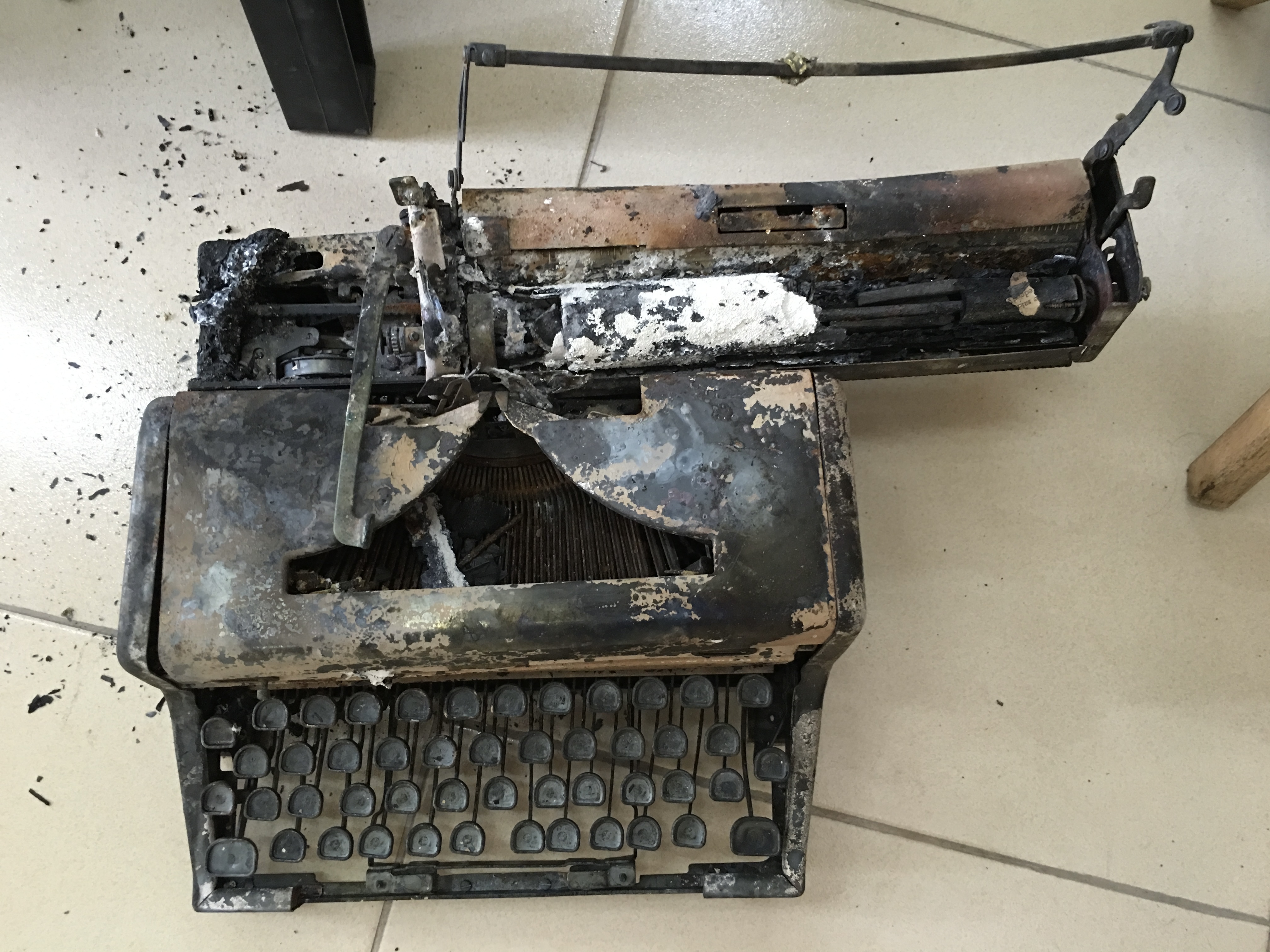
I arrived in time to catch the sight of my office burning—the whole first floor, our whole department, was burning. Strangely at that moment I felt no pain, no sense of loss; I didn’t flail around or throw up my hands in anguish. I suppose that was a form of shock, the way our brain throws a cold, wet blanket around us to insulate us from the heat, to keep us immobilized and therefore safe in the face of catastrophe. Unavoidably my mind began taking inventory of what was in my room—books, paintings, the best student papers of thirty-some years, twenty first-edition copies of my book Penmanship I had saved for its special paper, a computer, flotsam and jetsam from an academic life. There were many precious and irreplaceable pieces in that office, for sure, but again strangely, as soon as I remembered them, I said goodbye; I realized that I was muttering what amounted to a prayer.

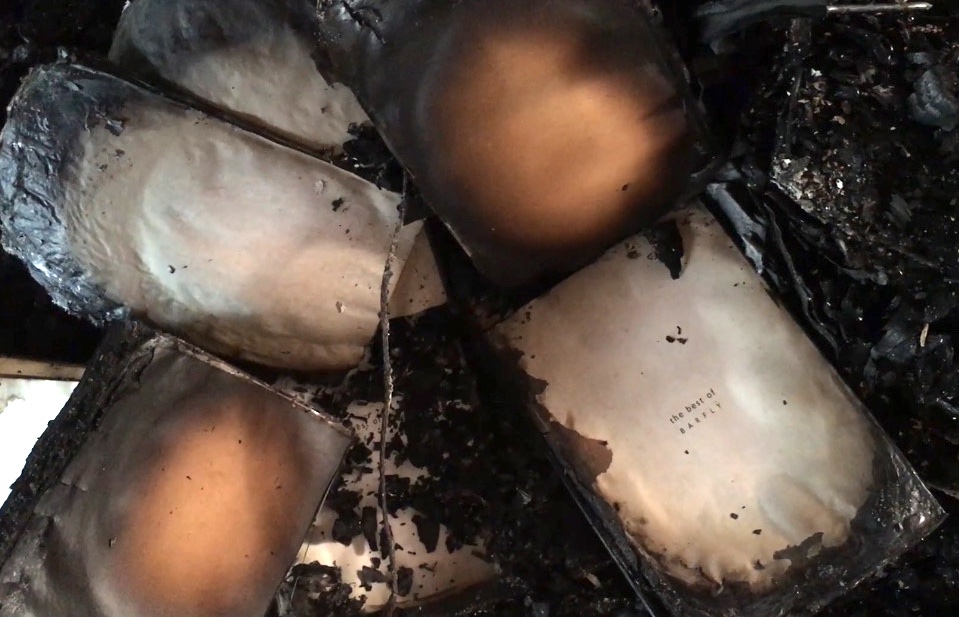
Two days later, when the smoke had cleared, I stepped into the gutted building and took a video with my phone. The embers were still steaming beneath my feet. I confirmed with my own eyes the finality of things. Everything but the shards of a ceramic cup was gone—and my book of stories, prettily charred around the pages as though for some theatrical presentation. My writer’s mind was compensating, salvaging scraps of beauty from the crushing loss. That comes to us like second nature; we want to give our grief exquisite form, hoping for meaning and consolation.

There is something about a fire, a compelling majesty, that Filipinos instinctively respond to—not necessarily to help, which is beyond most of us, but to watch and be spellbound by. Where is the child who didn’t jump out of bed and dash into the street at the shouts of “Sunog!”, followed by the festive clangor of alarms and firetrucks? Nighttime fires are especially dramatic, as the sky glows orange and the smoke curls into your nostrils. You are aware that something terrible is happening to someone, and the next morning the news will carry the grim details: a family trapped, a mother curled over her baby, a son who had just graduated the week before. We feel sorry for these victims, while being secretly relieved that we ourselves were spared. Perhaps what attracts us to fire is its anticipation of The End, with science assuring us that the sun will scorch the earth in its last embrace and religion threatening yet more heat for miscreant souls.

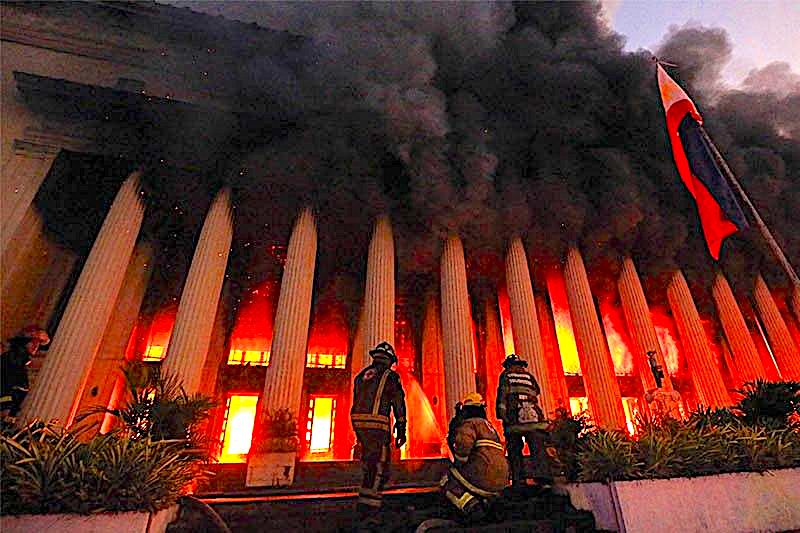
When I heard about the fire at the Manila Central Post Office building last week and began seeing the pictures coming online, I reacted with the same stunned silence, trying to absorb the enormity of it all, while morbidly, guiltily, indulging my fascination with fire. It was epic theater—the inferno raging behind and through the neoclassical columns that had withstood a war. I should have been mourning the loss of hand- and typewritten letters—rarities themselves in these days of email—and of other valuables in that building (oh, the stamp collection of the Bureau of Posts!), but my mind drew me back to my childhood, when my father was working at what was then the Department of Public Works, Transportation, and Communications, which was housed in that building.

I must have been just five or six when my dad brought me there to his mezzanine office; I recall rocking on his wooden swivel chair, and playing with the double-tipped red-blue pencils on his desk. At lunch, we crossed an inner courtyard to the cafeteria. My father was just a clerk then, but to me, he seemed like the boss of the place, and I wanted to be like him, seated behind a big table with a pen in hand (in my sixties, I would buy a similar swivel chair). 

Editorials will and should be written about the MCPO building’s loss and for its reconstruction. Explosive words like “arson,” “heritage,” “accountability,” and “negligence” will fly up in the air. For a while, like the fire itself, they will consume us, hold us in thrall, until they flicker out and we return to our daily business, our outrage expended.

Once again we find ourselves loving what is gone too late. But perhaps it takes a fire to awaken love and memory, and to teach us important albeit bitter lessons about impermanence, and thus the need to care and to give value while we can. Whether started by accident or by diabolical intent, fires remind us that we are not what we accumulate but what we regret losing, and struggle to rebuild and recover.

(MCPO photo from philstar.com)

Qwertyman No. 39: My Mother Emy

Qwertyman for Monday, May 1, 2023

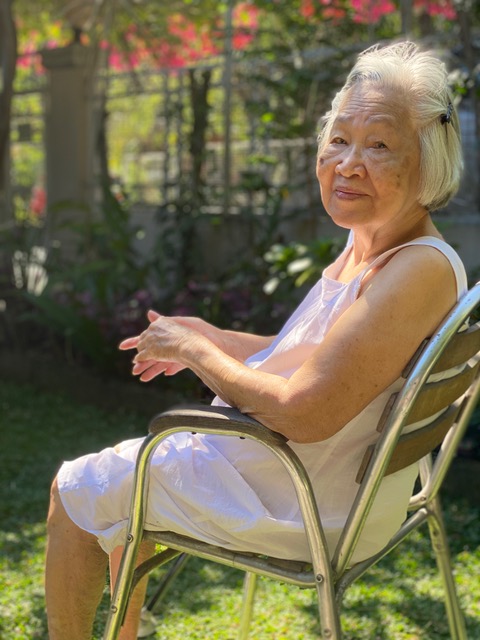
Pardon me if my column this week is a bit personal, because its subject is my mother Emilia, who will turn 95 next week, against all odds and through the grace of the One she prays to every night and every morning, and in the loving embrace of her five children and many grandchildren and great-grandchildren.

In this age of murderous Covid, rampant cancers, devastating disasters, and political turmoil, to reach 95 is extraordinary. To be 95 and be reasonably healthy, free of dementia (but for a few memory lapses that even I at 69 am prone to), able to walk a few hundred meters for her daily exercise, read without glasses, and comment tartly on the day’s political and entertainment news is almost superhuman. 

Like today’s children, my mom Emy can’t be removed from her iPhone and her iPad; she loves to play word games, beats my wife Beng at Scrabble, devours Netflix by the series, and has her telenovela programming graven in stone. She has daily Facetime audiences with our daughter Demi in California and my sister Elaine in Toronto. She even gave up her US green card to spend, she says, the rest of her time at home. In her “Tuesday Circle” of elderly friends, she is now the most senior, but hardly the most infirm. Best of all, she looks forward to reading my books and columns, and although I suspect that they sometimes bewilder her as much as they do my other readers, she invariably likes them because they were written by her first-born, who cannot possibly write anything badly. (This week’s surprise column, I think, will be a hit with her.)

A quarter-century ago, shortly after my father Jose Sr. died, we thought we were going to lose her as well. That’s what they say often happens—one dies, and then the other follows, in the utmost expression of devotion and sympathy. Emy was diagnosed with tuberculosis, so serious and advanced that we felt we were gathering at her deathbed, her sheets spotted with the blood she was coughing up. I had never seen her so frail and so helpless. She was missing my father terribly, and I’m sure she wouldn’t have minded leaving us to join him at that moment. 

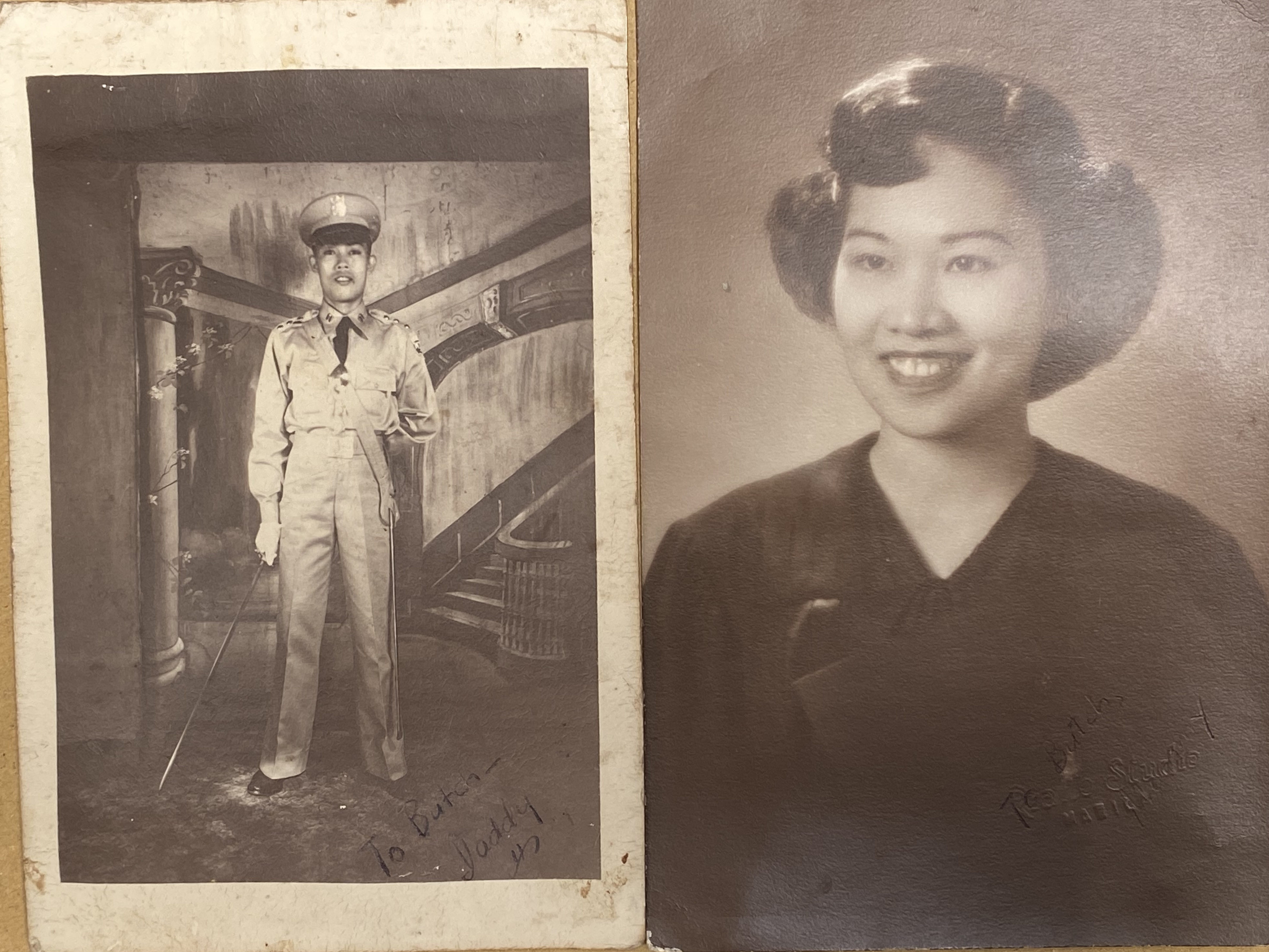
Theirs had been a storybook, whirlwind romance. She was the youngest daughter of a landowner in Romblon, the only one in their brood of twelve whom her father had trusted to study and go to college in UP in Manila. She was her father Cosme’s pet, a girl who rode horses on his farm and who accompanied him when he took a boat to the big city to off-load his copra harvest and to buy necessities and a few baubles for his large family. It must have pained him when she decided to finish her high school in Manila (“I was walking on Padre Faura and saw UP High, and so I went in to see how I could study there,” she says) and to stay there so she could study to become a teacher.

My father Joe was the brightest boy in his school and, so the local legend goes, in the whole province. He was an eloquent writer and speaker and cut a dashing figure. The only problem was, his family was poor—his grandfather had been a sharecropper, his father a farmer. His parents had separated shortly after he was conceived—another story that deserves a telling of its own—and lived about a kilometer apart for the rest of their lives. Raised by my grandmother Crispina, Joe seemed destined for great things far beyond Romblon. He already had a girlfriend, among the town’s prettiest bachelorettes (I met her once when I was a boy, unaware of why she was looking at me a certain way.)

One day Emy and Joe met at the pier in Manila waiting for other people and other things. Some sparks must have flown, because not long after, they were together and engaged to be married. I was the first outcome of that improbable union, born in a nipa house in Alcantara, Romblon, pulled out of my mother by a midwife (whom I would meet about twenty years later, walking barefoot on the asphalt road, and whom I would rather awkwardly gift with a pack of Marlboros in token thanks for my delivery).

The decades following would be a mixture of toil and triumph, of struggle and hope. Both my parents had enrolled in law school, but the need to sustain us foiled that dream. Joe had even gone to the police academy, in the class of James Barbers. He clerked for Public Works, became a Motor Vehicles Office agent with a shiny badge, and took on all kinds of jobs to support us. My mother Emy, despite her pride as a UP Education graduate, soldiered on beside him and sold stamps as a postal clerk. We went through some very rough times, constantly moving around the city with all our worldly possessions on the back of a truck in search of more affordable lodgings. Sometimes my father would be gone for long periods, working as far away as Mindanao to be able to send us some money. 

But one thing they always held up for us was the value of education. My parents slaved and my siblings sacrificed so I could go to a private school, thinking like most Filipinos of their generation that a facility in English would be my ticket to success. It was a huge relief for all (and a good excuse to buy our first TV) when I got a full scholarship to the PSHS. So it must have felt like a stab in my mother’s heart when I announced, shortly after entering UP on the swell of activism, that not only was I not going to be a scientist (my Math grades were miserable) but that I was also dropping out of college to find work (which I did at 18, to write for the Philippines Herald). Despite everything, I wanted to follow in my father’s footsteps and gamble on my talent.

But I did come to my senses and many years later returned to school, where I remain to this day, with a lofty title my wife Beng prefers to downplay to “Chauffeur Emeritus.” Instead of following Joe to his grave, my mom Emy fought back, miraculously recovered, traveled the world, and cradled her great-grandchildren. So good things do happen to those who persevere and survive, for as long as we’re willing to give life another chance.

I honestly don’t think I’ll reach 95 myself, but I have the privilege—and the challenge—of living with someone to inspire me every day. Happy 95th, with all our love, Nanay!

Qwertyman No. 38: Getting into UP

Qwertyman for Monday, April 24, 2023

(For this week, let me offer a little family drama about my favorite school, this being exam season, and before I get the usual calls from anxious friends.)

“HEY, UPCAT is back, they’re holding UPCAT live again!” Marides waved the newspaper in her husband Bong’s face. Bong was watching a car show on TV where they found old cars in barns and turned a bucket of rust into a gleaming, raging roadster. Somehow it gave him hope that, down the road when he became a senior and ached all over, they could ply him full of oils and sealants and make him go like a teenager again.

“What UPCAT?” At least the question proved he was listening. Marides had that godawful habit of intruding on his most blissful moments with some real-world problem, and then getting on his case when he ignored her. Twenty-five years of marriage, four kids, and she still didn’t know when to leave him be. 

“UPCAT—the University of the Philippines College Admission Test, the same one I took and passed thirty years ago, which led to me representing UP and meeting and beating you in an inter-collegiate debate, remember? After which you got my number and asked me out and proposed to me three months later, remember?”

Bong hated it when Marides reminded him of that first encounter and its outcome, which became a given of sorts in their household—she was smarter than him, she had all the better arguments, and who knows what she could have become—a corporate genius, a Supreme Court justice—if he hadn’t saddled her with babies and insisted on working for the both of them. He was good with the money, she had to grant him that, because he was the agreeable type who made all the right connections and who could hustle his way out of a guilty verdict if he had to, as he more than once had to. 

“So what if UPCAT’s back?” he asked for the sake of asking. On the TV, two mechanics were staring at a big hole where a Corvette’s engine should have been.

“Dondon is in his senior year. He’s supposed to be taking it soon. We need to make sure his papers are in order. Where’s that boy? Dondon! Come out for a minute, will you?” 

A teenager with frizzy hair and a phone glued to his ear straggled out of his room and deposited himself in the nearest chair, across the room from his parents, still mumbling on his phone.

“You know UPCAT is happening, right? Have you filed your application yet?”

“Yes, Ma—mumble mumble….”

“Will you please put that phone down while your parents are talking to you? Bong, could you teach your son some manners—”

Bong: “Mumble mumble….”

“I’m serious! You two listen to me—our family’s reputation is on the line!”

“What reputation, Ma?” Dondon grudgingly put his phone aside, and Bong yawned and stretched his arms to acknowledge that he was in for a long spell.

“The one I started, by passing the UPCAT, getting into UP, and serving the people any way I could!”

“But, Ma, all you ever did was to bear us babies, and look what we became—Ate Glo is divorced in the States, all Kuya Jeff does is drive Papa around, and Kuya Milo thinks more tattoos will make him a better rocker. And all of them passed the UPCAT because you told them to!”

“Well—that was my service—to them, and to our people. I give you the opportunity, and what you make of it, well, that’s your business….” Marides started sobbing, and Dondon ran across the room to embrace her.

“Aw, Ma, that’s not what I meant. I just wanted you to see that getting into UP doesn’t guarantee anything.”

“That’s what I’ve been saying all these years!” Bong added. “We’ve been sending our kids to a school for communists, and they don’t even make good communists anymore!”

“No, they don’t,” Marides shot back, “because those communists took the top five places in the bar exams!” She sniffled and Dondon handed her a box of tissues.

“Don’t cry, Ma. It’s all right, it’s all okay. Applications are done online now and my school sent all my papers in last week. I just didn’t tell you both because—well, Papa wanted to explore other options—”

“Other options? Like what?”

“Like sending him abroad to a school of his choice. We have the money—”

“What, you’ll be sending my baby, our bunso, away for the next four years?”

“Or he can pick any other school here he wants to! UP’s not the only good school for engineering or science in this country—”

“I don’t want to be an engineer, Pa….”

“What? You’re a science high school scholar! You have to be an engineer—or a chemist, a physicist, do something with numbers, you don’t have a choice!”

“I never did, Pa, you and Ma chose my high school for me, I just took the exam. Maybe I should have just failed it.”

“So what the hell do you want to do with your life? Who’s going to take over the business when I’m gone?”

“Maybe you should trust Kuya Jeff more. Keep him in the backseat with you. Me, I want to draw, to paint, to design, do something creative. I know I’m good—you’ve seen my sketches, you just haven’t paid much attention to them.”

“We just want you to be happy, son,” said Marides. “We’ll support whatever you decide—won’t we, Bong?”

“Uhm—yes, okay, sure, if it makes you happy, but will you stop crying? I’ll make sure Dondon gets into UP, even if he fails the UPCAT—”

“Pa!”

“I’ll call an old friend of mine, you know me, I know all the right people. He used to be a VP in Quezon Hall, I’m sure he can pull a few strings and get you in—”

“Pa, that’s not how I want to get into UP, that’s not what UP’s about—”

“Oh, you mean that guy who now writes a column about funny things like fountain pens and his wife Weng for a newspaper? Forget it. Chuchay called him last year to ask for the same favor, but he said sorry, no, he won’t do anything of the sort, that it’s just not done in UP!”

“Why, that useless jerk! Doesn’t he know how things work in this country? I’m sure UP’s just as full of jokers and crooks as Customs, Congress, the Palace, you name it! Don’t half the people in those places come from UP?”

“Maybe, Pa—but that’s why I want to go there, because it still has people like your friend who won’t let me in unless I pass the UPCAT! Don’t worry, Ma—I’ll do my best, I promise.”

“Oooh, my son’s going to be the next Amorsolo!” Starts singing: “UP naming mahal, pamantasang hirang….”

“I have a friend who owns a gallery….” Bong began.

Qwertyman No. 32: This Business of Titles

Qwertyman for Monday, March 13, 2023

THERE’S BEEN a lot of buzz online recently about the use of titles like “Doctor” and “PhD,” a topic of inflammatory interest to Pinoys for many of whom those extra letters before and after one’s name can mean everything between abject inconsequence on the one hand and celestial esteem on the other.

While nobody seems to question why public officials from the president down to the barangay kagawad use their titles with gleeful abandon, academic degrees—which are arguably harder to earn honestly than votes—provoke much hand-wringing, notably among academics themselves who like to worry about things that would make ordinary people happy.

To put it simply, some people like using their titles, and others don’t. Those who do believe that they deserve it, having worked their posteriors off to gain them. Those who don’t apparently think that it’s unseemly to earn an exalted degree like a PhD and then to wear it on your T-shirt so nobody forgets to address you by your honorific, “Doctor.” The only “PhDs” I know who are above all this are those who got them for being, say, a generous taipan, and who feel elated to be called “Dr.” for the rest of their lives.

As it happens, I have a PhD in English, which I got more than thirty years ago from the University of Wisconsin-Milwaukee, after my Master of Fine Arts from the University of Michigan. As soon as I say that, I feel like I’m boasting, which I suppose I am. But I only brought it up to make the point that, well, I hardly ever bring it up. Nobody ever calls me “Dr. Dalisay” or “Prof. Dalisay” except in an academic or professional context (they do call me “the Prof” at my favorite poker hangout, where I play with guys going by monikers like Daga, Todas, Hot Sauce, and Paos). I pull it out now and then when I suspect it will enhance my credibility and maybe even my paycheck by 200 percent. But most of the time I’m quite happy to be just “Butch” or “Sir Butch” (or “Ho-zay” when I’m in the US, to save myself the long explanation for why my father Jose Sr. chose to call his first-born “Butch”). 

So for me, it’s entirely situational, and no one should be made to feel immodest if he or she insists on being called “Doctor,” as Dr. Jill Biden does. The only caveat I’ll make is that, among writers, nobody seriously gives a hoot about academic degrees, unless you plan on teaching, which is really what the PhD is for, practically speaking. In UP these days, particularly in the sciences, you can’t teach for long without a PhD—the idea being that going through a doctoral program pushes you beyond your practical experience and innate talent toward some appreciation of theory and into research. 

In the Philippines, for many reasons, it’s still easier for teachers in many universities to become professors before finishing their PhDs, and so there’s a tendency to value the “Dr.” above the “Prof.”—which is not the case in UP and in most foreign universities, where the title “Professor” (meaning a full professor and not an assistant or associate professor) remains one’s ultimate career goal. The presumption is that a PhD should be an entry-level qualification for higher teaching, an early step in one’s ascent to full professorship. (Which reminds me to say that there’s no such degree as “PhD cand.” or “MA units”, as I’ve seen on some CVs—you’ve either done it or you haven’t.)

Why do we fuss over these titles? Because, in a society that offers few material rewards and consolations for academics, they can assume inordinate importance, and invest their holders with an intellectual and moral authority that demands or at least deserves respect—never mind that academia, like the rest of our institutions, is home to any number of crackpots and charlatans in togas, as corruptible as every other traffic cop. Let’s not forget that Hitler’s propaganda minister, Joseph Goebbels, had a PhD in Drama from the University of Heidelberg, and that PhDs from Stanford and Harvard, among others, greased the wheels of Marcos’ martial law.

But lest we think we’re the only ones seemingly obsessed by the trappings of imagined power, there’s at least one other country more retentive down there when it comes to academic titles, perhaps for the opposite reason—not because they’re rare, but because they’re part of such a long and prolific tradition that an elaborate hierarchy has to be put in place. 

That place is Germany—where, until 2008, and thanks to a Nazi-era law, you couldn’t call yourself “Dr.” unless you secured your PhD in Germany itself or was the kind who could fix broken bones. Ian Baldwin, a molecular ecologist from Cornell, found himself charged with “title abuse” when he put “Dr.” before his name on his card, as were at least six other American PhDs working in Germany. The law was later relaxed, but you get the point—when it comes to degrees, Deutschland still thinks of itself as being über alles.

The Germans make one more formal distinction—the precedence of the professor over the PhD, again on the assumption that while PhDs can be had for a dime a dozen, professorship is a career-capping accomplishment achieved only by exemplary research, publication, and mentorship. And thus, if you were teaching at, say, Humboldt University of Berlin (which as of 2020 had 57 Nobel laureates and almost 3,000 PhD students), your full title would be “Prof. Dr. XXX.” And because some people can’t find happiness and fulfillment with just one PhD, they would be called “Prof. Dr. Dr. XXX.” (I kid you not—go ahead and Google it. The Guinness record stands at 33 PhDs for a guy from Hyderabad, whom I don’t even want to begin to address.) Some titles would include variants like “ir” for “ingeneur” or engineer, and “hc” for honoris causa (often conveniently forgotten by hc recipients). The Austrians, I’m told, can be even more particular than the Germans, and can legally use their titles on their passports. The Dutch, by the way, have a “Drs.” degree which can be a bit confusing—it’s short for doctorandus, which means you’re studying for your PhD.

But who cares, other than the title-holder? Certainly not the Quakers, who value equality between people to the point of eschewing all titles, including (until recently, and only in America) “Mr.” and “Mrs.” If you’re familiar enough with each other, you can use first names. If not, then full names will do. When I visited the Quaker HQ in Philadelphia many years ago, I was “Jose Dalisay.” British Quakers were said to have referred to the late Queen as “Betty Windsor.” 

But something tells me that notion of equality won’t work here, where calling people “Digong,” “Bongbong,” and “Sara” won’t bring you any closer to the kingdom of heaven (or some such dominion). 

Qwertyman No. 31: A Homecoming for Anwar

Qwertyman for Monday, March 6, 2023

TODAY WE pause our fictional forays to focus on some happily factual news—the visit last Thursday of Malaysian Prime Minister Anwar Ibrahim to the University of the Philippines, which conferred on him an honorary Doctor of Laws degree.

I’ve been missing many university events especially since I retired four years ago, but I made it a point to attend this one because I’ve long been intrigued by Anwar’s colorful if mercurial political career—one that witnessed his meteoric rise from a student leader (who majored, at one point, in Malaysian literature) to minister of culture, youth, and sports, then of agriculture, and then of education, before being named Finance Minister and Deputy Minister in the 1990s.

As Finance Minister during the Asian financial crisis of 1997, Anwar imposed very strict measures to keep the Malaysian economy afloat—denying government bailouts, cutting spending, curbing corruption and calling for greater accountability in governance. His zeal and effectiveness gained him international recognition—Newsweek named him Asian of the Year in 1998—and put him on track to succeed his mentor Mahathir Mohamad as Prime Minister. 

However, his growing popularity came at a steep personal price. In what he and his supporters denounced as political persecution, he was imprisoned twice following a fallout with Mahathir. In the meanwhile, Malaysia sank into a morass of corruption under the since-disgraced Najib Razak, making possible the brief return to power of Mahathir, who enabled the release of his sometime protégé Anwar. Anwar’s eventual accession to the prime ministership in December 2022 was for many a just culmination of decades of near-misses (in our lingo, naunsyami).

His visit to Diliman last week was actually a homecoming. Anwar had visited UP more than once as a young student being mentored by the late Dr. Cesar Adib Majul, our leading specialist in Islamic studies. Like other Malaysian scholars, Anwar has also had a deep and lifelong appreciation for the life and work of Jose Rizal, with whom he shared the notion of a pan-Asian community of interests.

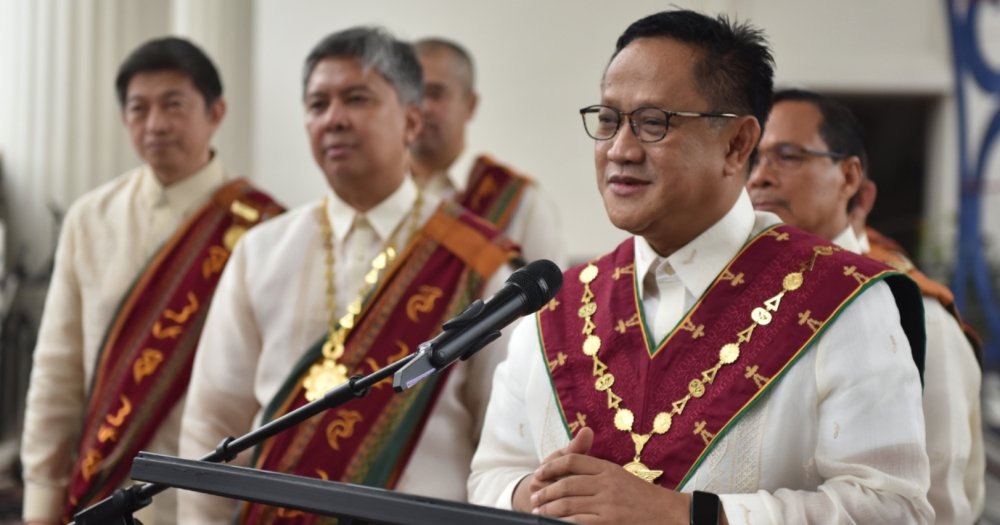
Most instructive was the new UP President Angelo Jimenez’s summation of Anwar’s political philosophy, in his remarks welcoming and introducing the PM:

“Beneath Anwar Ibrahim’s sharp sense of financial management lies a deep well of moral rectitude, a belief in right and wrong that seems to have deserted many of today’s political pragmatists. Much of that derives from his strong religious faith—which, unlike the West, he does not see as being incompatible with the needs and priorities of modern society. To him, this is a native strength that can be harnessed toward an Asian Renaissance.

“Like Jose Rizal, who self-identified as ‘Malayo-Tagalog’ and who was a keen student of the cultural and linguistic connections between Malays and his own countrymen, Anwar appreciates the West as a source of knowledge but cautions against neglecting or yielding our cultural specificity.

“At the same time, he has championed a more inclusive and pluralistic Malaysia, arguing—and here I quote from his book on The Asian Renaissance—’not for mere tolerance, but rather for the active nurturing of alternative views. This would necessarily include lending a receptive ear to the voices of the politically oppressed, the socially marginalized, and the economically disadvantaged. Ultimately, the legitimacy of a leadership rests as much on moral uprightness as it does on popular support.’”

In his talk accepting the honorary degree, Anwar argued strongly and eloquently for the restoration of justice, compassion, and moral righteousness to ASEAN’s hierarchy of concerns, beyond the usual economic and political considerations. He was particularly critical of ASEAN’s blind adherence to its longstanding policy of non-interference in its members’ internal affairs, noting that “ASEAN should not remain silent in the face of blatant human rights violations” and that “non-interference cannot be a license to disregard the rule of law.” 

Extensively quoting Rizal, whom he had studied and lectured often about, Anwar urged his audience to free themselves from the self-doubt engendered by being colonized, while at the same time remaining vigilant against subjugation by their “homegrown masters.” I found myself applauding his speech at many turns, less out of politeness than a realization that I was in the presence of a real thinker and doer whose heart was in the right place. (And Anwar was not without wry humor, remarking that as a student leader visiting UP, “I was under surveillance by both Malaysian and Philippine intelligence. Now I have the Minister of Intelligence with me.”)

Speaking of honorary doctorates, I recall that UP has had a longstanding tradition of inviting newly elected presidents of the Republic, whoever they may be, to receive one, as a form of institutional courtesy. As soon as I say that, I realize that many readers will instantly recoil at the idea for reasons I need not elaborate upon. But let me add quickly that not all Malacañang tenants have accepted the honor. Some have had the good sense to find a reason to decline, knowing the kind of reception they will likely get from Diliman’s insubordinate natives, beyond the barricades that will have to be set up for their security. For everyone’s peace of mind, I humbly suggest that it may be time to retire this tradition, which agitates all but satisfies no one. 

For the record, UP has given honorary doctorates to less than stellar recipients, including the Romanian dictator Nicolae Ceaucescu and the martial-law First Lady Imelda R. Marcos. Even some recent choices have stirred controversy and dismay. 

As a former university official, a part of me understands why and when a state university dependent on government funding employs one of the few tools at its disposal for making friends and influencing people. But as a retired professor who has devoted most of his life to UP and its code of honor and excellence, I find the practice unfortunate if not deplorable. 

I don’t make the rules, but if I did, I would automatically exclude incumbent Filipino politicians, Cabinet members, and serving military officers from consideration. This is not to say that they cannot be deserving, as some surely are, but that they can be properly recognized for their accomplishments upon leaving office. This will also leave much more room for the university to hail truer and worthier achievers of the mind and spirit—scientists, artists, scholars, civil society leaders, entrepreneurs, other outstanding alumni, and fighters for truth, freedom, and justice in our society.

Qwertyman No. 26: UP’s New President

Qwertyman for January 30, 2023

TWO FRIDAYS from now, a change of leadership will take place at the University of the Philippines, when outgoing President Danilo L. Concepcion turns his office over to Atty. Angelo “Jijil” A. Jimenez. Elected by the Board of Regents last November after what was known to be a tightly contested three rounds of voting, Jimenez will serve for the next six years as UP’s 22nd president. (By tradition, the BOR’s formal announcement of the vote declares it to have been “unanimous” although, to the best of my knowledge, it never has been, at least in modern times.)

Jimenez is no stranger to UP’s political and academic culture. A sociology and law graduate from UP with a master’s in management from the National University of Singapore, Jimenez served twice on the Board of Regents as Student Regent in 1992 and as Regent from 2016 to 2021. 

How he will win over the faculty is something else. It’s no secret that many professors emeriti and other faculty members—myself included—openly declared themselves in support of the candidacy of UP Diliman Chancellor Fidel Nemenzo, whom his supporters saw to have the best academic and administrative experience among all the six candidates for the position. That did not mean that no one else was qualified, and the BOR apparently saw something more in Jimenez that we did not, and so we will have to live with that decision.

The faculty’s chief concern may have been that Jimenez has never taught full-time in UP, raising fears that he might not appreciate or respect UP’s academic culture as strongly as a UP president should.

Academic culture is hard to explain to outsiders, but it is a way of life founded on intellectual meritocracy, on the idea that authority and respect are earned through hard-won knowledge, the currency of learning. And “intellectual” here doesn’t simply mean knowing something and being smart (and in some cases, insufferably arrogant), but actually doing something about it—through teaching, research, or some form of social action. Universities value people who contribute to our understanding of ourselves and to the improvement of human life. This is more than gaseous talk that nobody else can understand. It’s doing the deep thinking that nobody else will do, because they either have no interest or see no profit in it, or because they’re not trained to. A national university like UP, funded by our taxes, applies that thinking and learning to real-world problems and places its resources at the service of society. UP demonstrated this social commitment during the pandemic through the heroic sacrifices of its staff at the Philippine General Hospital and the research conducted by the Philippine Genome Center, among others.

Nonetheless, I can sense that despite their initial misgivings, many members of UP’s academic community are willing to give Jimenez a chance to prove himself as a protector and promoter of UP’s interests rather than someone imposed by the powers-that-be to bring the unruly natives to heel. 

“Jijil knows UP’s academic culture, and he listens. He studies things carefully before making a decision,” a highly respected colleague who knows (and once taught) Jimenez assured me. I have to say that in the few times that I met and observed him when I served as Concepcion’s VP for Public Affairs, I was impressed by Jimenez’s grasp of the issues and his willingness to learn. And this will not be the first time that someone perceived to be an outsider was chosen to sit in Quezon Hall; the most notable and perhaps the most effective of such predecessors was Edgardo J. Angara in the 1980s, who had no qualms about using his powers to modernize and streamline UP’s aging bureaucracy, against stiff resistance from within.

Jimenez has led a colorful life that included being posted as labor attaché in war-torn Iraq and him and his wife adopting a baby girl who was left at their doorstep. As a labor lawyer, he will understand the plight of the disempowered, and know how to speak to power and, just as importantly, to negotiate with it as well. 

Ultimately, it will be his character that will be on trial—how he will perform and decide under pressure from both left and right, what values lie at his moral core, and how he will steer the university and ensure its well-being under an indifferent if not hostile political regime. 

PAAJ, as he will be known in UP (Concepcion was PDLC), will have to contend with the rabid red-taggers at UP’s gates (and some of them well within its campuses), who will expect him to deliver UP, and specifically Diliman, on a platter to Malacañang. Curiously, just before the voting, Jimenez—a Duterte appointee to the Board of Regents—was denounced by another newspaper’s resident canine as a communist, alongside Fidel Nemenzo. UP has never had a shortage of detractors rooting for nothing less than its closure, but expect the troll armies to work overtime the minute PAAJ asserts its academic freedom.

Internally, Jimenez will have to deal with the conditions and demands of a constituency just emerging from the temporary and unnatural constraints imposed by the pandemic and eager to spring back into normal academic life but with even more incentives to work and to teach. Some colleagues will berate me for this, but “serve the people” no longer seems to be reason enough to study and to teach in UP. The sense of entitlement afflicting society at large has also crept into UP’s culture, with students complaining about their grades, freshly hired instructors complaining why they haven’t been promoted, and professors complaining why their work wasn’t given more points in their evaluation. Economic issues are easy to understand in a time of rampant food prices (and gross profligacy on the part of public officials), but this goes beyond a bigger paycheck. 

Given his two stints on the Board of Regents, Jimenez will be familiar with these issues down to their minutiae, as perhaps a lawyer can best comprehend. Appointing a capable executive staff will be key to his success, but again, they can only act on judgments emanating from the president’s fundamental sense of good and bad and right and wrong.

Arguably, the visible function of university presidents has changed in recent times, from being exemplars of scholarship and ideological firebrands to resource generators and managers. (Concepcion was particularly adept at the latter role.) How Angelo A. Jimenez will distinguish himself over the next six years will be a story entirely his to craft. I will be eager to read it, and wish him well.