Penman No. 153: Elderly Expressions

IMG_6478

Penman for Monday, June 15, 2015

LAST WEEK’S piece on my memoir-writing workshops must have touched a few sympathetic nerves, because I got a number of messages from my fellow seniors asking about the next workshop, and if and how they could get into it. Sadly, I had to tell them that the workshops I mentioned were put together by special arrangement with Marily Orosa, squeezed into a very tight schedule (it’s insane, but I’m working on eight book projects all at the same time, in various stages of completion). It’s still possible that Marily could arrange another workshop for me before the year ends, but that depends on a lot of factors; if it happens, I’ll let you know.

If you’d like to work with me, the best thing to do would be to enroll for one of my graduate fiction or nonfiction workshop courses at the University of the Philippines, possibly as a non-degree student (which will make admission earlier, if you just want to take this one course); I’ll be teaching fiction writing, Fridays 4-7 pm, when I return from my sabbatical leave this August.

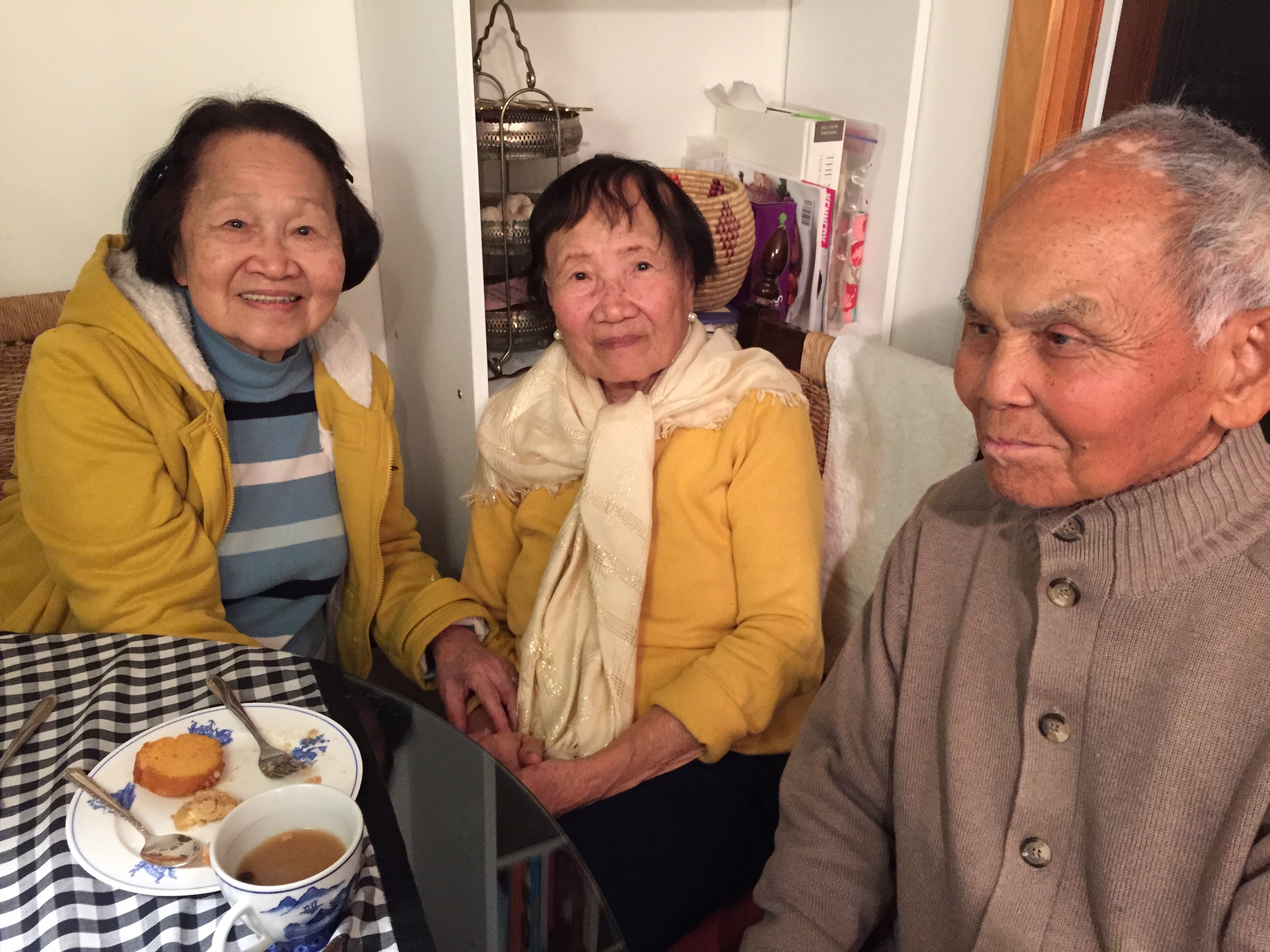
I’ve had quite a few senior students in these workshops—and by “senior” I don’t mean that they’re in their fourth year; more likely they’re in their 65th, and just went back to school for a rejuvenating dip in the waters of academia. In many places, they call this “continuing education,” and the good thing about having seniors in class is that not only do they get educated, but the rest of the class as well (myself included), especially the young ones who can benefit from the rich experiences of their elders.

The “oldies” may not always be up to speed as far as the latest and fanciest literary theories are concerned, but they’ll never lack for stories to tell, and you know that when they talk about things like loss or suffering, or bring up words like “rapture” or “redemption,” they’ve looked at life in the eye and kissed it full on the lips, and said some very sweet hellos and some very hard goodbyes.

This isn’t to say, of course, that older people have a monopoly of wisdom or expertise; some of my younger students have amazed me with both the gravity and the finesse of their work, displaying insights well beyond their years. (Let’s not forget that Jose Rizal wrote and published the Noli in his mid-twenties.) Conversely, I’ve seen mature students, mired in their prejudices and predispositions, unable to get beyond a dull and sightless monotone in their narratives.

But there’s clearly need for more room within our society for elderly expressions—and I don’t mean just more welfare-type laws to benefit seniors and such initiatives, although we’d certainly be happy if there were more support for the aged among us, especially the poor. I mean more coverage and exposure in the media and even in our literature of older characters and their concerns, going beyond stereotypes and easy expectations. (If you haven’t seen “The Second Most Exotic Marigold Hotel,” you should.)

We need more stories, poems, plays, movies, and articles with older Filipinos, their predicaments, and their achievements in focus—handled realistically, minus the aura we customarily accord to doting grandmothers and kindly uncles. Certainly they can be saintly, but seniors can also be just as vicious and as avaricious as people half their age, and why not? (I’m sure we’ve all heard of that filthy-rich aunt or neighbor who refuses to feed her househelp properly and puts a lock on the refrigerator.) Acknowledging people’s weaknesses as well as their strengths is acknowledging the diversity and individuality of humanity, which is incumbent upon every writer to do.

For the past many years, in my undergraduate literature classes (and yes, I’ve always insisted on teaching at least one undergraduate class every semester, so our freshmen and sophomores can know what’s it like to be taught by a senior professor, like I did in my time), I’ve taken up two poems that deal with aspects of aging. One of them is “Stepping Westward” by the late Denise Levertov (a mentor of my friend Fidelito Cortes when he was at Stanford). The poem begins thus:

What is green in me / darkens, muscadine. / If woman is inconstant, / good, I am faithful to / ebb and flow, I fall / in season and now / is a time of ripening.

Here, the speaker or the persona asserts her pride in and her comfortability with her advancing years, likening it to the maturing of good wine (muscadine). She has learned to accept—indeed to embrace—the inevitability of aging and death, as a fruit falls off its stem when it ripens. She also fiercely reserves her right to be inconstant and unpredictable, to change her mind if and when she wants to (Angela Manalang Gloria’s sonnet “Change” provides another terrific variation on this theme). She declares that

There is no savor / more sweet, more salt / than to be glad to be / what, woman, / and who, myself.

The poem closes with a wonderful image of life as a basket of bread to be carried—yes, a burden, but also a blessing to be eaten from.

The other poem is a local one, by Merlie Alunan, and is always a hit in class because of a theme that’s practically become taboo in our conservative society: not just female sexuality, but desire in older and unglamorous women (ie, older than Anne Curtis and Solenn Heussaf). The poem is “Young Man in a Jeepney,” which deals with a typical working woman, probably a housewife in her forties or fifties, who takes a jeepney ride home, clutching her bag to her chest, only to find herself seated beside a sweaty young man. The contact, however innocent, stirs up an ancient longing in her:

“Heat,” I mutter. “It melts / the very bones,” feeling / as I say this, inside me /awakening sweet April.

The unsuspecting young man gets off the jeepney and life goes on:

I do not watch you turn / the corner to the sudden dusk / —but I smile to savor /my sin in secret.

So what is that “sin,” I ask my students, and why does she call it so? Is it, indeed, a sin for a respectable and somewhat dowdy matron—and decidedly one of the lower class, the kind who would not have boy toys or affairs with their amigas’ husbands—to feel desire?

Discussions like these remind us that while many things seems to get simpler with age, both by choice and by necessity, human complexity itself doesn’t diminish over time.

Penman No. 113: The Discipline of Words

Penman for Monday, September 8, 2014


LET ME acknowledge, first of all, the readers who responded to last week’s column, “Exercises for the editorially minded,” where I shared some exercises that I give my class in Professional Writing to help rid my students of their wordiness and show them how to say the same thing in different ways. It was gratifying to see so many people coming out of the woodwork and professing an interest in the discipline of words. (For lack of space and to give that topic its due, I’ll save the responses to the exercises for next week.)

That’s what this business is all about, ultimately—discipline and practice, more than just loose talk, especially talking about writing. Some folks keep talking about writing all the time—about their plans for their novel or their epic poem—but they never get around to doing it. Sometimes writers—especially when they’ve had one too many drinks—have a tendency to run off at the mouth, or to pontificate endlessly on matters they know next to nothing about. I myself will gladly admit to these occasional displays of verbal excess, which are as inevitable as an old car coughing up a foulness of black smoke.

But when all the bluster is done and we retire to our fortresses of solitude, armed with a steaming cup of coffee (and, for incorrigible holdouts like my friends Krip Yuson and Jimmy Abad, a lighted cigarette), it all comes down to a date and a duel with the blinking cursor, and to the rules of engagement of writing, a code defined far more by discipline than by license, more by routine than romance. (See what I mean about running off at the mouth?) And what are those rules? To me, they all boil down to this: shut up and write.

Just recently, a friend asked how it was possible for me to be working on seven book projects all at once—a company history, the biographies of two political leaders and two business families, an oral history of the First Quarter Storm, and my third novel; these aside from my weekly column and the occasional short story and magazine article and blog entry.

I told him that I’m no genius or superman, but I do work as hard as I can, acutely aware of time passing, and of the need to tell stories (and to make a decent living from the telling) while I can. Some years ago I realized that life was too short to wait to finish one book before starting the next one. I felt inspired by something I had read about Isaac Asimov, who reputedly had a row of typewriters in one room, on each one of which a different project was afoot. Thankfully computers now make it possible to squeeze those typewriters into an iPhone (on which, not incidentally, I’m writing this column using the Notes app, while playing in a poker tournament). I also look up to the example and the work ethic of the late Nick Joaquin, whose prodigious beer drinking was matched by his copious writing. Not only was he superbly versatile, producing stories, novels, essays, poems, journalistic pieces, and commissioned biographies. He was also thoroughly professional, and no matter how much drinking or partying he did, he was known to submit his manuscript on the dot, on the appointed deadline.

We writers like to bitch about how little time we have to write what we really want to write—which for me is that novel or that story that keeps whining like some neglected waif in a corner of my mind. It’s true; real life has a way of crushing the good fiction out of you, and there are days I get up from my desk dazed after completing a book draft or grading my students’ papers and commenting on their work, dispirited by fatigue, and wishing I was working on one of my own stories instead. (I don’t forget for one minute that we gents have it easier than the ladies, who give up so much more of their life and liberty so we can pursue our happiness.) So what do I do? I stop kvetching about how unfair it is that some other guy can earn zillions more while I’m slaving away at a piece few will read and much less care about, consider myself lucky that I can work with my fingertips instead of my arms, think about my parents, and then I shut up and write.

Last week, in the midst of frantic preparations for a three-month stay in the US (where I’ll be by the time you read this), I put everything aside for a day and focused on finishing a short story I had promised to contribute to an Australian literary journal. This was a sad love story that I had begun in 1998 (I have unfinished stories in computer files going back to 1990, in a folder optimistically labeled “Ongoing”); like my characters, I lost my way in the plot, and recovered my bearings only when the Australians asked for a story and gave me a deadline.

My deadline was a Sunday; that Saturday morning I took a six-kilometer walk around the UP Oval and thought the story through; I was halfway in it, and approaching a critical turn in the plot. A line kept insinuating itself in my head: “the clarity of things,” begging to become the title. When I felt my characters beginning to speak on their own behalf without much prodding from their puppetmaster, I knew it was time to sit down and write. That afternoon until early the next morning, I wrote in a white heat, laying down over 2,500 words in what eventually became a 6,000-word story. (At this point in the tournament, I’ve just lost to someone’s pocket aces, but strangely I feel relieved, wanting instead to tell this story of a story.)

“The Clarity of Things” is the first long story I’ve finished in years, and whether or not the Australians take it, I’m happy to remind myself that I can still play with raw emotions and describe places I’ve never seen on the digital page. I enjoy the cool and calm precision of nonfiction, the seeming unimpeachability of fact; but it’s the terrific and also terrifying ambiguity of fiction that makes me want to be a writer all over again, to feel like one, and to work like one.

Penman No. 112: Exercises for the Editorially Minded

Penman for Monday, September 1, 2014


TO MY pleasant surprise, last week’s piece on what editors do drew a stream of positive responses—I never imagined that so many readers would find the thankless and dimly illuminated job of editing so fascinating—but my biggest surprise after the column came out was to realize that I’d already written not just one but two columns on editing, back in 2010. Thankfully, I didn’t repeat myself too much, and since I’ve already written dozens of pieces on, say, fiction and nonfiction, I don’t see why I can’t do a fourth one on editing, focusing this time on how an editor thinks or should think.

But before I go one step further into the trenches, let me just point out another important fact about the editor’s job. Particularly in a journalistic context, where some element of public interest is presumably involved (as opposed to literary publishing, which comes down to very personal tastes), “editing” involves much more than dotting I’s or finding better substitutes for problem words. Editing in journalism inevitably involves matters of policy—the publication’s policy in respect of the treatment of, say, political and social issues. What newspaper and magazine editors worry or should worry about are spelled out in a textbook titled Creative Editing by Bowles and Border (Wadsworth, 2000), which says, in a chapter on Situational Ethics:

“Copy editors are likely to be concerned with decisions involving the writing, editing and production processes: Is the use of profane language or obscene photographs ever justified? When? Are the implicit biases of the editor or the newspaper as a cultural institution evident in the selection of 
stories and photos? Should they be? Do certain people groups or institutions receive more play than others? Conversely, are some people groups or institutions ignored? Are headlines and captions fair and accurate? Are stories edited to eliminate bias and opinion? Are subjective words or words suggesting a viewpoint 
given thoughtful consideration?

“Managing editors and other senior editors are likely to be concerned with questions of policy: Should victims of crimes be identified? If so, when? In stories about rape? About incest? About battering? In stories involving juveniles? Should suspects in crimes be identified? If so, when? At their arrest? When they are charged? At the time
of trial? Should the cause of death be listed in obituaries involving victims of suicide or AIDS? Who in the newsroom should know the identity of confidential sources? Just the reporter? The supervising editor? The managing editor? The publisher? If a reporter pledges confidentiality to a source, are editors
bound by the same promise? How involved should newsroom employees be in writing and editing special sections that promote 
consumer products? How should corrections and clarifications be handled?”

Frankly, when I contemplate questions like these, I’m glad to be in the classroom rather than the newsroom, knowing how tricky these situations can get. It would seem that they should have clear and easy answers, but they rarely do, especially given the realities of Philippine publishing and politics—but that’s a story for another day.

Today, let’s do something more elementary—elementary enough to be among the very first exercises I give my students in CW198, Professional Writing. (I don’t care if my future students see this here, because they’ll still be hard put to cough up the answers. As all my students know, I always give open-book exams.) You might know if you have an editor lurking inside you if you can do these exercises reasonably well. Just for fun, I’ll respond to the first 10 responses emailed to me—if you don’t hear back from me, that means you were No. 11.

The first exercise has to do with the bane of Filipinos who love English too much, to the point of using 30 words where three will do, and of using a P1,000 word where a five-peso one will do. Cut. Simplify. Ruthlessly.

The second exercise is rather more advanced, and involves matters of judgment, nuance, and vocabulary—in other words, style. This is something that an editorial or opinion writer (which I was, way back when) would specialize in. I tell my students that they can express the same idea in three ways—nice, neutral, and nasty—depending on their specific purpose. I don’t mean for anyone to be nasty, of course, but just like learning karate or shooting, you never know when you might need it. Let’s have some fun!

I. Wordiness: Simplify and shorten the following sentences without changing their meaning.

  1. I managed to traverse the thoroughfare without jeopardizing my safety.
  2. The people of the Philippines have a great liking for festive occasions.
  3. Society as a whole, as well as the individual persons in it, should practice the virtue of honesty.
  4. In my personal opinion, it is my idea that a prohibition on pistols, revolvers and rifles should be implemented.
  5. His actuations produced a profound surprise in the very depths of me.
  6. We have insufficient information with regard to this state of events.
  7. Let us satisfy the requirements of our bodies for nourishment.
  8. The outbreak of hostilities was within the realm of possibility.
  9. I give you my permission to continue doing whatever it was you were doing.
  10. He was a uniformed enforcer of the law.

II. Modulation: Rewrite the following statements in the “nice-normal-nasty” modes, as required:

  1. (neutral) The Philippines is a country whose people are predominantly poor. (turn into nice and nasty)
  1. (nice) Heroic overseas workers contribute greatly to the health of the Philippine economy. (turn into neutral and nasty)
  1. (nasty) Your proposal is almost totally bereft of intelligence and originality, and is unacceptable in its present form. (turn into neutral and nice)

Penman No. 108: Writing as a Job

Penman for Monday, August 4, 2014


PEOPLE OFTEN ask me about my work as a professional writer—meaning, someone who makes a living out of his writing, rather than someone who just loves to write the occasional poem for sharing with friends.

There are, in fact, quite a number of people in this country who can be considered professional writers: regularly employed journalists, ad-agency copywriters, screenwriters, textbook writers, and even professional bloggers, among others. But except for the few who possess the talent and the gumption to churn out popular novels, there are really no professional Filipino writers of creative work like fiction and poetry, because there’s no market for these products out here. The typical Filipino reader would sooner buy the latest iteration of Twilight or 50 Shades of Grey than, say, a new novel by my friend Charlson Ong.

That’s why fictionists like Charlson and me have turned to writing other things for other people—biographies, histories, speeches, audiovisual presentation scripts, and even advertising copy—to supplement our incomes as teachers and columnists. But let me hasten to add that it’s more than money—as welcome and as necessary as the money is—that drives us to do this. For me—and I’m sure it’s the same thing for the others—it’s the challenge of doing something different, often something with a clear objective and a well-defined if limited audience, such as a company history, as opposed to a novel that you float like a balloon into the night sky.

At UP, where I’ve taught a course called “Professional Writing” that seeks to equip our English majors with some practical skills and attitudes, I tell students on Day One that “There’s writing that you do for yourselves, and writing that you do for others, and never get the two mixed up.”

Like my father, who wrote speeches and correspondence for politicians, I’ve been writing for others nearly all my adult life—I earned my first paycheck for a TV drama script I wrote when I was 16—so I approach professional writing with the dry eye of the frustrated engineer that I also happen to be. (This also means that, when I revert to my own fiction, I can do so with extravagance and exuberance, although fiction has its own rigor and discipline; the poets themselves will tell you that “poetic license” is really anything but license.) Over the past three decades, since my first book (Oldtimer and Other Stories) came out in 1984, I’ve published nearly 30 books of my own, aside from books I’ve edited for others. Many of these were limited-circulation books, like those I wrote on the Philippine geothermal industry and the Philippine flag, so you would never even have heard of them, but they served their specific purposes, so the job was done.

Let me offer some advice to those who want to get into writing as a living.

First, drop the ego and the angst. I knocked on a lot of doors and was paid almost nothing (and sometimes nothing) for my earliest jobs, but each one taught me something about writing and about the business of writing, both the good and the bad. Take every job as both an earning and a learning opportunity. Prepare to be edited, contradicted, and countermanded, sometimes by people who know less about writing than you (if they knew as much, they probably wouldn’t have gotten you). Give it your best shot, and leave the rest to the client. Suck it up, have a beer, then move on. (You’d be surprised how easily and how well the world can move on without you.)

Second, learn your trade and your tradecraft. This means mastering your language, both in terms of grammar and style, and appreciating the nuances that every job will involve. Write bilingually; adjust, absorb, adapt.

Third, get interested in subjects beyond writing and literature. Read the papers. Acquire a working knowledge of business and economics, politics and public affairs, history, science and technology, sports, and entertainment. This versatility will enhance your marketability. To do a job well, you’ll need to understand and even to enjoy what you’re writing about.

Fourth, set your own opinions aside. Unless you’re writing under your own byline or are being hired for your ideas, you don’t need to personally believe in and stand by everything that’s being said—you’re speaking for someone else, and your own opinions could get in the way. If your own ideas and principles matter more than the job, then say no and walk away (I’ve done this, quite a few times)—it’s the fairest thing to do, both for the client and for yourself.

Fifth, learn to multitask. These days, I typically work on three or four book projects at the same time, in various stages of completion. Life’s too short to have to wait for one project to be completed before starting the next one. Each project takes about 18-24 months, so I’ve learned to pace myself. I’ve also learned to delegate work—to assign more basic research and drafting to good assistants, so I can focus on the final organization and styling of the material.

Sixth, know the business and what business means. Use contracts, observe deadlines, pay the taxman, pay your assistants well, buy a good suit and a good pair of shoes. Keep and respect confidences. Unless you’ve been shortchanged, don’t badmouth a client from whom you gladly took a check.

Seventh, simplify your life. You can only produce so much by also giving up so much, which for me means a vastly diminished social life. I’ve pretty much given up partying or going out with friends; my only indulgences are my pens, the biweekly poker night, and traveling with Beng (of which I can never have enough, which is why I do all this). But I’m happy, which in this world is the hardest job of all.


Penman No. 77: Writers at Their Best

wn13_1Penman for Monday, December 16, 2013


WRITERS’ NIGHT 2013 went off last Dec. 6 in UP Diliman with nary a hitch, thanks to tremendous support from the Philippine writing community (and, of course, from my staff at the Institute of Creative Writing). It was a night of celebration that began early, with the Filipinas Copyright Licensing Society (FILCOLS) holding its general meeting and handing out historic (and substantial!) first checks to Filipino authors whose works had been used with permission in textbooks.

This was followed by the presentation of the 13th Madrigal-Gonzalez First Book Award, an annual recognition of the best first book by a Filipino author writing in English or Filipino (the award alternates between these two languages, so the award covers publications for the past two years in each language; it was English’s turn this year). This P50,000 prize—established and generously endowed by the Madrigal-Gonzalez family through Atty. Gizela Gonzalez-Montinola—has become another important rite of passage for Filipino writers, and over the years it has gone to such talents as Angelo Lacuesta, Luna Sicat Cleto, F.H. Batacan, Ellen Sicat, Vicente Groyon, Kristian Cordero, Rica Bolipata Santos, Zosimo Quibilan, Adam David, Lualhati Abreu, Lawrence Ypil, and Will P. Ortiz.

The actual awarding is preceded by a lively forum featuring the finalists, who remain unaware of the winner until the end of the ceremony. This year’s board of judges was chaired by prizewinning fictionist Charlson Ong, with poet Mookie Katigbak-Lacuesta and Prof. Shirley O. Lua of De La Salle University as members. It was a banner year for the University of Sto. Tomas Publishing House, whose books accounted for five of the six finalists.

The citations that the judges prepared for the finalists were little gems in themselves, so to give you an idea of what our best new writers have been producing, let me quote from those citations:

Daryll Delgado, After the Body Displaces Water (UST Publishing House, 2012): “In After the Body Displaces Water, Daryll Delgado draws upon both romantic and realistic traditions in fiction, the personal as well as the political, to deliver an outstanding debut collection. Here are tales of the post-EDSA uprising generation who navigate through the murky mire of lost certainties, failed expectations, of promise and compromise. Here, water, cleansing, life-giving yet dangerous, is prime element. Water is memory: malleable, mesmeric. It suggests the comfort of the womb and of early death, but must finally give way to the body, to present and authentic self. These stories offer up no easy answers only uneasy angles, uncanny ways of seeing as ‘through a glass darkly.’”

Marc Gaba, Have (Tupelo Press, 2011): “’Stories are about the dropped stitch,’ writes an American fictionist. The dropped stitch interrupts the pattern and disturbs an existing order. To stretch a metaphor: when this happens, a stitch falls off your needle and unravels for several rows beneath the row you are working on. At some point in your writing career, you are going to drop a stitch.
You will forsake what you know for what you don’t know.
Writers less fearless would try to reach that dropped stitch, slide a crochet hook into its loop, and mend a rent in the pattern.
But Gaba’s poems are about the dropped stitch—the one that makes the reader imagine a pattern because it has gone completely missing. His is the stitch that unravels the whole.”

Anna Maria L. Harper, Agueda:
A Ballad of Stone and Wind (UST Publishing House, 2012): “Rare is the Philippine historical novel, rarer still one with a woman main character. Agueda may be an attempt at national allegory, but its richness of detail make it a quite engaging read. Though treading familiar ground, the book visits nooks and crannies of our past usually ignored by historical texts. We catch glimpses of our forebears—rich and poor—heretofore unseen and gain further insight into who and why we are. Who knows, in time, its heroine may become as familiar to readers as the likes of Maria Clara and Salome?”

Neal Imperial, Silver Fish, Hook of Moon (UST Publishing House, 2012): This collection affirms the power of language in all its majestic simplicity and frugality, as if self-denial is a form of art. The seeming effortlessness of the poems’ cadence complements the stream of images and metaphoric turns which seek to stir the mind of the listener, such verses as ‘We hear the silence / of dead birds / combing the wind / for wings / stuffed / in the belly of a gun,’ ‘To love an older woman / is to bleed / on a bed of salt,’ or ‘You are too-much-food / too late…” This engaging work claws at our heart, like ‘the hook of moon.’”

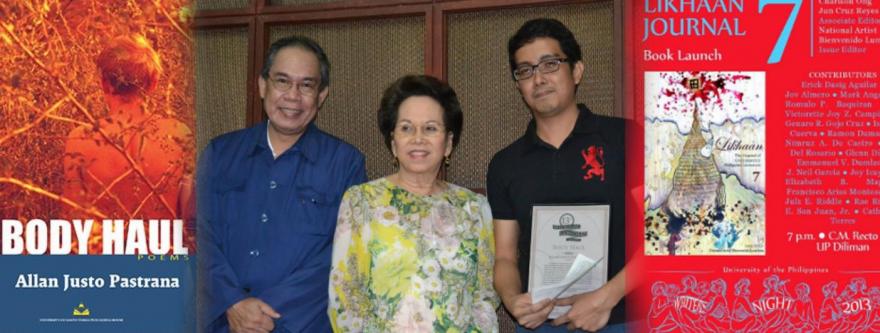
Allan Pastrana, Body Haul (UST Publishing House, 2011): “Called at turns difficult and lyrical, Pastrana’s poetry is deeply personal (and to the casual reader, hard to inhabit). His poems pose a difficult conundrum, for despite their apparent inaccessibility, an internal music moves them. Pastrana must be credited with such precise notation. Each of his themes seem set to an appropriate time signature—nostalgia, desire, childhood, domesticity—each one is given a clipped and particular music. It is music first that draws the reader into the writer’s milieu, uncertain of what he might find there, or if he will find anything at all…. First and last is his music. First and last is music of such virtuosity that Pastrana must be one of our finest poets.”

John Jack Wigley, Falling Into the Manhole: A Memoir (UST Publishing House, 2012): “This selection of essays shows the author’s deep-reflective investigation of his identity, whether as a boy growing up in the City of Angels, as a novice traversing through the muddled metropolis of our sad republic, or as a determined man embarking on a delicate quest in the land of his white forefather, a land deemed an earthly paradise by Spanish conquistadores. The personal narratives are unabashedly candid and sensitive, infused with humor and irony, and peppered with thrilling bits of pop culture. This book is both a delightful and heart-ripping read.”

The winner was Allan Pastrana, of whose work the judges had this further to say: “Like Orpheus’ lyre, Body Haul lures us with its refreshing variations of songs, stories, and tall tales. Like a prophet’s rod, it bestows spirit to birds, forces the word ‘trap’ to speak in three different languages, and illumines a path out of Eden to a re-worlding of stars and love. Pastrana’s kingdom is nonetheless that of a sophisticated intellectual, whose appreciation for music, literature, and the visual arts obtrusively yet gracefully seeps through the many fine verses in the collection.”

The evening’s highlight was an auction of writers’ memorabilia that we held for disaster relief, particularly for writers hard-hit by supertyphoon Yolanda. Beyond their craft, here were writers at their best, donating choice items and dipping liberally into their pockets to help out their fellows.

The money we raised came chiefly from a 1940s Parker Vacumatic fountain pen donated by yours truly (won by Jimmy Abad for P18,000 in spirited bidding over film director Auraeus Solito); a Smith Corona Portable Classic 12 donated by Paolo Manalo (won by a member of the Inkantada Band for P5,500); two manuscripts of works by Gregorio Brillantes and myself (won by Andrea Pasion-Flores for P4,200); and assorted manuscripts, author’s proofs (including that of Soledad’s Sister), and other memorabilia donated by Jimmy Abad and myself (won by rocker-news anchor-novelist-etc. Lourd de Veyra for P6,000). Poet Alan Popa went home with a drawing by fictionist Merlinda Bobis, donated by Chari Lucero, for P2,200. We’d also like to thank our other donors, buyers, and supporters—among them, National Artists Bien Lumbera and Rio Alma, poet Cirilo Bautista, and other writer-friends like Efren Abueg, Amelia Lapeña Bonifacio, Alma Miclat, Richard Gappi, Carlo Clemente, Dolores Mose, Francis Quina, Khavn de la Cruz, the NBDB, and the Chancellor’s Office of UP Diliman—for their generosity. We were all winners! See you all again in Writers Night 2014.


Penman No. 76: A Lesson in Description

Penman for Monday, December 9, 2013


NOW AND then I walk my students in Creative Writing through a lesson in description, which—as I’ve often noted in this corner—is at best always more than a rendition of the physical setting and the people and things in it. In the hands of a skilled or a gifted writer, a plain object can acquire a strange and memorable luminosity. Sometimes all it takes is the uncommon but logical and precise choice of a word, such as when William Faulkner describes a campfire as being “shrewd,” struggling and managing to keep alive despite the wind. At other times good description requires the writer to step back and to set things in a larger context, balancing fine detail with the broader sweep of memory and understanding.

I don’t even need to draw on the likes of Faulkner or Greg Brillantes or Kerima Polotan to demonstrate what I mean. Take this passage from a story submitted to my fiction class a couple of semesters ago by a young student named Katrina del Rosario, part of a story titled “Paying Respects.” Rather quiet in class, she more than made up for her reticence with this outpouring of brilliant prose:

The first Dayaos had been very successful farmers, and the land burst with green and trees and stalks and vines heavy with bright fruit; now only one or two Dayaos farmed the land, with the most magnificent of trees cut down to build houses. The elders remembered entire lives lived underneath the shadows of trees and grown roofs of vine, childhoods spent working the fields. They did not remember it as work. They remembered instead the bits of sugarcane that could no longer fit into carts and the sap sticky on their chins as they tore off strips of the bark with their teeth; getting lost in entire walls of tall grass that needed to be cut down; the cool of the mud and manure against their knees in the middle of a field exposed to all the ghastly splendor of a high sun; as small children, play was pretending to chop wood for the hearth and desiring to be old enough to pound the rice, watching in awe as their mothers tossed the grains into the air like a high wave and catching it again, cooking kangkong in hot water in their small toy pots made of clay. Everything they needed could be found on trees, in the fields. They had been perfectly comfortable. They were never hungry. Home was where the land began, and ended; living was the certainty of land and its fruit.

What’s even more interesting about this example is how little use it makes of adjectives and adverbs—the crutches that beginning writers often employ to carry the burden of description (“he snarled angrily,” “the bright, sunny morning,” etc.). “Write with nouns and verbs!” I keep reminding my students.

There are many ways of describing the same scene, but one approach I offer student writers is the option of gauging one’s emotional and psychological distance from the subject, and rendering the scene accordingly.

Depending on your purpose, you can choose to describe a person, thing, or place in one of several alternative modes. Your purpose, of course, will depend in turn on the kind of fiction or scene you are working on. I made up the following examples (so you’ll forgive me if they sound cheesy) to illustrate these alternatives.

What I call the technical/objective mode is strictly that, a seemingly factual, no-frills rendition of the scene, as a police report might put it:

The apparition was reported by a male witness, 45 years old, a farmer and a native of the town of Libmanan, Camarines Sur where previous sightings were said to have occurred. The man, Angelo Camagay, described what he saw as a woman in her early thirties, about 5 ft. 4 in. tall, and with distinctly Caucasian features: light brown hair, blue eyes, and fair complexion. She was clothed in a full body-length white robe of soft material; Camagay could not remember seeing footgear of any kind. She appeared before him at about 5:45 am on the opposite bank of a stream where he had paused to draw water in his bamboo container, prior to working in the fields.

Somewhat warmer and more detailed is the neutral/realistic mode. It’s still a fairly straightforward description without much emotional coloring, but we see things more vividly:

Augusto dipped the thick, three-foot length of bamboo trunk into the water; it had been severed at the nodes, with a hole cut into the top and a wooden handle attached to one side. Now the cool, clear water gurgled into the hole as Augusto held the container down, feeling the stream swirl around his wrists and the bamboo struggle to keep afloat. Later, in the heat of noon, the same water would slake his thirst and wash the paddy mud off his hands. Augusto looked up; it might have been a bird bursting out of the trees that caught his eye; but it was a woman on the opposite bank, blinding in her pure white robe. She, too, was white of skin; her hair was a light brown, and she stood closely enough for him to see that her eyes were blue. He could not see her feet, which were lost in the lush grass. She seemed younger but somewhat taller than his wife. Augusto knew that in all of his forty-five years in Libmanan, he had never seen anyone like her; but some of his townmates had, and now he believed them.

And finally—though perhaps with the greatest degree of difficulty—one can go into the lyrical/romantic mode, which involves a certain degree of abstraction and sublimation, and certainly a more pronounced attitude, not to mention some linguistic dexterity:

Rough the palms that trapped the water, brown the arms that fought its surge. Come into my bamboo cup of cups and fill me in my driest need, my limpid blood of morning. Come. And Augusto looked up for an instant, thinking that a great white bird had exploded in the trees, flushed out by his presence. But no bird there, no stark familiar creature of his town’s well-traveled woods. Maria, Ave Maria, oh fair oh pure oh thou footless light disconsolate. Eye of sky, hair of corn, I come to you. And bathed in her sudden radiance, Augusto thirsted as he had never had, but as others had, and now he saw, and now he knew.

Whichever mode the writer employs, he or she should remember that the best description always does more than physically describe: it prepares and conditions us for what is about to follow, and, working with the narrative, provides a context against which we can understand characters and their situations better.


LAST WEEK’S piece on the forgotten master Constancio Bernardo—whose 100-year retrospective dazzled us when we attended its opening last Wednesday—prompted the following recollection from the Davao-based poet Ricky de Ungria, who also paints and draws occasionally:

“My first teacher in the arts was Ms. Katy Bengzon of DLSU. I took a summer class there in Taft when I was still in high school and copped a prize for a watercolor of mine. My second teacher was Constancio Bernardo. My father enrolled me in a summer class of his at the old CMLI gardens somewhere in Quezon City. He taught me how to do landscapes in watercolor. In fact in one of my old sketchpads he showed me how to do shadows of leaves on trees. Very calm, soft-spoken and gentle man, as I remember now. All this to tell you how much I appreciate your piece on him today because I knew so little of him.”

Penman No. 51: A Kick in the Pants

Editing

Penman for Monday, June 17, 2013

MORE THAN a couple of times this past summer, in nearly all the writers’ workshops I attended as a lecturer or panelist—in Baguio, Hong Kong, Dumaguete, and Iligan—I found myself saying the same thing to some hapless fellow. I said it as nicely but as firmly as I could: “This needs a kick in the pants.”

By that I didn’t mean that the story in question deserved to be tossed into the trash bin. Workshop panelists of yore were wont to say such hurtful things, if only to watch the fellow on the hot seat squirm and burst into bitter tears, but I’d like to think that we’re long past that kind of cruelty. We do our best to be more helpful these days, and my comment was made in that benign spirit, as unfriendly as it may have sounded.

So what exactly was my beef?

It had to do with an observation I’ve often raised in this corner in respect of much of the new writing by young people that I come across in my classes and in workshops. And that’s the frustrating fact that many young writers don’t know what a real story is—a complete, fully rendered, emotionally engaging and satisfying story, the kind of story you’d like to read over and over again, and that leaves a welt on your memory for years afterward.

Here’s what I keep seeing young writers do: they’ll detail a character and a situation to bits, explaining all manner of complication besetting their hero. They can do this very well, being in possession of an English honed by TV, Hollywood, and Starbucks, an English they don’t just write but speak in everywhere they go.

But when things just begin to get really interesting—somewhere on Page 9, when something you didn’t expect looks like it’s just about to happen—the author pulls the plug and declares the story over, as if to dismiss the reader with a coy “That’s enough.” The idea seems to be that this intensely focused, microscopic investigation of a character and a problem—say, a young woman’s ironic inability to make meaningful connections to others, despite the fact that she works in a call center—is enough.

But it’s not—there’s been loads of exposition, but the story hasn’t really moved far beyond us knowing who this person and what her problem is. We’re still in the problem, which the author has worried like a bad tooth, but it hasn’t really been brought to a point of real drama—the kind of drama that gives us headaches and heart palpitations because we’re that engrossed in the conflict and its possible outcome. But how many stories written today leave you breathless like that, aching to turn the page?

Too many drafts I’ve seen resort to abrupt conclusions—premature ejaculations, if you will—because of the writer’s unwillingness or inability to take real risks with the story, indicating either a fear of the unknown (which no real writer can afford to have) or, in some cases, a lack of the kind of emotional maturity and sophistication you need to be able to navigate the dimly lit paths the human mind and heart can take. Instead of producing real dramatic substance, many young writers depend on tricks of language—on witticisms, for example, instead of wisdom—to carry the story.

And please don’t tell me they’re just trying to be “postmodern.” I know and can enjoy a good postmodern story when I see one—such as Donald Barthelme’s “The Balloon” or Dino Buzzati’s “The Falling Girl”, both of which I teach in my short story class. Postmodern stories have a very sharp edge—they need to, to gut the conventions that came before them. A poorly executed traditional story doesn’t bring it one step closer to being postmodern.

Just for the exercise, let me take up an example of the fully rendered, fully dramatized short story that I’ve been adverting to: “Paul’s Case,” written by Willa Cather in 1905. The story is set in Pittsburgh—even then already wallowing in industrial grime—where the artistically-inclined 16-year-old Paul is dreaming of bigger things, and spends his time as an usher in the theater, pretending to be bigger than who he really is. Now, many young writers would stop there in the theater scene, content to mark the irony between the glittering stage and the sooty reality of Pittsburgh outside. Not Cather: she forces Paul into a real dilemma by putting a large sum of money in his hands—money his father expects him to deposit in the bank; at this point, Paul snaps and buys a train ticket to New York City, the paradise of his fantasies. This would be Ending B for many writers, thinking that it’s enough for Paul to decide to leave Pittsburgh, come what may.

But again, not Cather: she brings Paul to New York, where he lives it up like a prince for a week, buying up clothes and treating himself to fancy meals, until the inevitable news comes that he is wanted as a fugitive and that his storybook life will soon come to an end. This should be good enough for Ending C: a long, last wistful look at New York’s dizzying opulence, then a step into an indeterminate future. But Cather goes further, not content with ambiguity: she brings Paul out to some desolate backyard out of town, where he makes a final if foolish gesture of defiance, hurling himself in front of an oncoming train, at which instant “the disturbing visions flashed into black, and Paul dropped back into the immense design of things.”

That’s what I mean by pushing the narrative to its farthest limits, subjecting the character to intense pressure, indeed to the breaking point (although Paul arguably never breaks in his composure, meeting the end with inimitable style). While I generally don’t like and discourage ending stories with the death of the protagonist (many writers use death as a convenient way out rather than thinking the problem through), here the death comes as a logical conclusion, the enactment of the final scene in Paul’s theatrical conception of himself.

Or take the case of Kerima Polotan’s 1952 classic, “The Virgin,” where the schoolmarmish Miss Mijares meets a man who—despite being beneath what she imagines to be her social station—awakens her dormant desires. Most student writers today would actually end with that encounter, with Miss Mijares getting all worked up about this handyman who can fix wooden birds. But Polotan, of course, can’t be content with just setting things up; she brings man and woman together, in a jeepney on a rainy night, and drops them off where they both don’t expect to be, until “her flesh leaped, and she recalled how his hands had looked that first day, lain tenderly on the edge of her desk and about the wooden bird (that had looked like a moving, shining dove) and she turned to him with her ruffles wet and wilted, in the dark she turned to him.”

So how do you bring a story to that memorable point?

When I tell my students that I want to give them and their stories a kick in the pants, I could be meaning one of two things:

1. As I explain above, I’d like them to push their narratives to a point beyond the visible horizon, to that “somewhere we’ve never been” that even the capable writer himself or herself will not have predicted until he or she began writing the story. (I never plot my stories beforehand; I may have a vague notion of how it will end, but I’d rather let the story itself lead me at some point, so everything remains fresh and wonderful, rather than plotted and predictable. If I can plot it, someone else can, in the same way—in which case, why even bother?)

2. I’d like them to step out of their comfort zones and immerse themselves in the cultural, social, and economic life of the nation. I suspect that this is, indeed, the deeper problem, one of cultural illiteracy and alienation: our young writers, especially those who grew up in privileged surroundings, know and may even care little about the rest of society, and therefore can’t have much to say about the world beyond their own gated villages and schools. Again I can appreciate fantasy and its attractions, but I think it’s tragic if a Filipino teenager knows more about Hogwarts than Cubao. The challenge I pose to my young spec-fic writers is to bring Hogwarts to Cubao, to find the extraordinary in the seemingly ordinary.

So, all together now: raise the stakes, and push the narrative! Bring us somewhere we’ve never been!

Penman No. 47: Another Summer in Silliman

Dumaguete

Penman for Monday, May 20, 2013

LAST WEEK had me enacting another familiar ritual—sitting on the panel of the 52nd edition of the Silliman University National Writers Workshop in Dumaguete City. The oldest of all the country’s literary workshops, Silliman’s is also the longest at three weeks—a format it has retained for many decades now, certainly since I was a fellow myself in 1981. Three weeks of poetry, ocean, and boozing by starlight may be a young writer’s dream escapade, but old geezers like us panelists can’t take that much time off from the more mundane claims of life, so we sign up for no more than a week, and this year I took the middle week.

I shared the week’s paneling duties with a couple of old friends: the prizewinning short story writer and now Silliman workshop director Susan Lara and the Mindanao-based poet and retired rocker Ricky de Ungria, as well as the La Salle-based playwright and historian Vic Torres and a poet and car mechanic that the workshop flew in from Hong Kong, David McKirdy. (David’s “car mechanic” tag isn’t just being cute—that’s his real profession, and an enviable one it is, since he specializes in repairing vintage Rolls Royces, and flies around the world to revive Silver Shadows from the 1930s and such.)

Quite by chance, this panel acquired a trademark of sorts: David and I turned up in the panama hats we’d been accustomed to wearing, and Susan also sported a black hat, prompting Ricky and Vic to procure hats themselves, and soon the panel resembled a gathering of Mafiosi or mandarins.

Hatters

On the other side of the table were this year’s fellows: Corina Marie B. Arenas, Nolin Adrian de Pedro, Patricia Mariya Shishikura, Brylle Bautista Tabora, and Lyde Gerard Villanueva for poetry; Tracey de la Cruz, Sophia Marie Lee, Rhea Politado, and Patricia Verzo for fiction; Jennifer de la Rosa Balboa, Ana Felisa Lorenzo, and Arnie Q. Mejia for creative nonfiction; and Mario Mendez for drama. In addition, two special fellows joined the workshop from Singapore: Christine Leow and Nurul Asyikin from Singapore Management University.

Every batch of fellows is arguably unique and different from its predecessors, but writers and workshops being what they are, the panelists will often find themselves dealing with the same old problems and challenges, albeit in new manifestations. Last week, in our sessions at the Rose Lamb Sobrepeña Writers Village in Camp Lookout in Valencia, we found an abundance of fresh writing talent, but also the need, as ever, to bring focus and refinement into the work of young wards.

I’ll spare you the usual writing lesson (don’t worry, you’ll get an earful in the weeks to come, as I have more workshops on the schedule), but this week I kept hearing myself muttering my mantras: (1) “Raise the stakes, and push the narrative!”; (2) “Why this day, and why this hour? Choose the best point of attack for your story!”; and (3) “Think cinematically! What’s in the frame? How far way are we from what we’re looking at?”

Thankfully it wasn’t all work, and there were timeouts aplenty from the daily dose of criticism that the fellows got.

A high point of the week was Wednesday spent at Antulang Beach Resort in Siaton, about an hour from downtown Dumaguete. Run by the very amiable and capable Anabelle Lee-Adriano and her husband Edu, Antulang alone is one great reason to fly in to Dumaguete and to spend a long week or weekend there. The 11-hectare, 48-room resort runs along a strip of white beach lapped by crystalline blue-green water, and while the resort itself stands high above the water, a path winds down to the beach, with the vertical distance providing some privacy for bathers and beachcombers. (For a glimpse of what we saw and experienced, check out Antulang’s website here: http://www.antulang.com/new/main.html.)

Antulang

When you get tired of the beach, Antulang offers an alternative that I daresay no other beach resort in the whole archipelago has: thousands of good books in its Edith L. Tiempo Reading Room, a cozy little corner devoted to Dumaguete’s literary mother. I was very pleased to sign two books of mine that were on the shelves, but even more fun was talking with Edu and Annabelle about books and movies we all remembered and liked—the novels and autobiographical works of Han Suyin (after whom the Adrianos’ daughter Suyen was named), and The Seventh Dawn starring Capucine and William Holden. Anyone who likes Han Suyin and Capucine is a friend of mine!

As a bonus, the Adrianos brought us to the nearby house of their friend Karl Aguila, one of the country’s brightest young talents in sculpture and design. There’s no better showcase of Karl’s work than the sandstone-colored house itself, perched on a promontory overlooking scenic Tambobo Bay. With Mt. Talinis on the opposite side, it was just the sort of place where fabulous novels might get located, if not written.

Aguila

A candlelit poolside dinner was also tendered on the fellows’ and panelists’ behalf by Simon Stack and his wife Virginia (or “Tata”), with Simon’s gracious mom Joanna assisting them with the hosting. The Stacks have transplanted themselves from New York and the Bahamas to settle in Dumaguete, where Tata helps run a school for Koreans. Simon and Tata have become welcome and welcoming members of Dumaguete’s cultural community, and whether he’s playing the sitar, reciting Milton from memory, or rapping like a New York gangsta—which he did in the after-dinner reading—Simon shows how comfortable he feels in the bosom of that community.

Again I’d like to thank the workshop sponsors—the NCCA, the Edilberto and Edith Tiempo Creative Writing Center, the United Board of Christian Higher Education in Asia, the US Embassy, and, of course, Silliman University—for having me over and making these memorable encounters possible. Thanks, too, to workshop coordinator Ian Casocot for facilitating everything.

Next up in my datebook: the Iligan writers workshop, where I’ll be by the time you read this.

Chicago

ON A side note, and just as I expected, my piece on fountain-pen repair a few weeks ago—as esoteric as it may have sounded to many—generated quite a number of responses and inquiries from readers, and fresh sign-ups at our fountain-pen club at http://groups.yahoo.com/group/fpn-p/. I’m always pleasantly surprised by how many people out there remember writing with pens, and still enjoy doing so despite the general shift from letters to digits in our daily life.

I’m almost ashamed to report that despite my crazy summer schedule, I managed to squeeze in a week-long trip to the US in early May, ostensibly to pick my mother up in Virginia and to accompany her home, but also to make a quick two-day trip to the Midwest for the 2013 Chicago Pen Show, to gorge on an overdose of vintage Parkers, Sheaffers, Watermans, and nearly every other pen maker known to man. This is what the boy in me slaves away at all kinds of tedious jobs for: a day at the toy store, also known as pen heaven.

If you have any questions about your fountain pens—whether they’re heirlooms from your grandfather’s drawer or the pen you sign big contracts with—I’d be happy to try and answer them by email, time permitting. (To answer in advance a common question about value, I’d urge you to go online to ebay.com, and do a search for your pen under the “Completed” listings. That will give you a fair idea of how much your pen is worth in today’s market—which, I should forewarn you, will often be much less than the sentimental value you or your family might attach to the object.)

And if you feel like disposing of that useless old pen that won’t write, let me be your trashcan.

Penman No. 46: Writers in Progress in Dumaguete, Iligan—and Umbertide

Silliman2013

Penman for Monday, May 13, 2013

IT’S BEEN a very busy traveling month for me, and it’ll get even busier these next few weeks, with paneling duties in two of our country’s premier writers’ workshops—in Dumaguete from May 12 to 17, and Iligan from May 20 to 24. The UP National Writers Workshop usually begins right after Holy Week, with Dumaguete and Iligan following in May. The University of St. La Salle in Bacolod, the Ateneo de Manila University, and the University of Sto. Tomas also hold their writers’ workshops sometime over the summer.

This means that Filipino writers both young and old don’t get much of a vacation from the writing life, which is probably as things should be, as those who profess to writing as a lifetime profession should consider themselves pledged to a kind of priesthood bound by certain vows—among them, to be able to think and to function as writers under any circumstance, and to see everything, including whatever tragedies may befall one’s life, as material for the imagination to convert and elevate to meaning. I remember having a good chat about this with my workshop students in Hong Kong last month—that, even when sitting idly at the airport waiting for a flight, a writer should be able to look around the pre-departure area and construct stories about that old man with a cough and that boy with a yellow Tonka truck and that flight attendant rubbing the back of one leg with the other, unshod foot.

But it isn’t as if a writers’ workshop means a week of drudgery and hard labor—there’ll be much mental labor, for sure, but it’ll be the labor of birthing, of seeing a project through to its best possible completion, with joy and delight attending the pain and anxiety. Of course there’ll be a few stillbirths as well, a logical and ultimately merciful form of natural selection; apprentice writers who just can’t make the cut should be told early on that they might make better lawyers or engineers, and perhaps they will. We discuss works in progress at the workshops, but the real subjects, in a sense, are the writers themselves—the writers in progress—and their talents, problems, and prospects. As I’ve noted before, a writers’ workshop is half boot camp and half support group, and it could feel one or the other on different days.

I’ll be on the panel this year in both Dumaguete and Iligan, with barely a day separating the two workshops for me, and it’ll be grueling, but I’m looking forward to engaging with our best young writers, especially those from outside of UP and outside of Metro Manila. This is the service that region-based (but no less national) workshops like Dumaguete (which is run by Silliman University) and Iligan (run by the Iligan Institute of Technology of Mindanao State University) perform for the larger literary community: they locate and develop the best entry-level writers, particularly from the outlying area or region, even as they both accept entries from as far away as Luzon. (The UP workshop targets generally older, mid-career writers with at least one published book.)

I’ve long been associated with Dumaguete since I myself became a fellow in 1981 (and thereafter pledged myself to a life of writing), but this will be the first time I’ll be sitting at the Iligan workshop—I’ll be delivering the keynote there as well—so let me talk a bit more about Iligan. This will be the Iligan National Writers Workshop’s 20th year, and it will be hosting five workshop alumni and 13 new fellows chosen from 65 applicants. The inclusion of the five alumni is a special feature for this anniversary, and is a sign of the workshop itself maturing through time under the guidance of MSU-IIT’s leading literary lights, Drs. Christine Godinez-Ortega and Steven Patrick Fernandez.

This year’s writing fellows will be the following:

LUZON: Fiction (English): Ma. Vida Cruz, Ateneo de Manila University/Quezon City; Laurence F. Roxas, UP Diliman/Pasig City; Poetry: Louise Vincent B. Amante (Filipino) UP Diliman/Quezon City. VISAYAS: Fiction: Nikos H. Primavera (English), UP Visayas/Iloilo City; Poetry: Ma. Carmie Flor I. Ortego (Waray), Leyte Normal University/Calbayog City. Ortego is the 3rd Boy Abunda Writing Fellow. MINDANAO: Play: Dominique Beatrice T. La Victoria (Sebuano), Ateneo de Manila University/Cagayan de Oro City;  Fiction: Edgar R. Eslit (Sebuano), St. Michael’s College/Iligan City; Rolly Jude M. Ortega (English), Notre Dame of Marbel University/Isulan, Sultan Kudarat; Poetry: Amelia Catarata Bojo (Sebuano), Central Mindanao University/Musuan, Bukidnon; Marc Josiah Pranza (English), UP Mindanao/Surigao City; Shem S. Linohon (Higaunon), Central Mindanao University/ Valencia City. He is likewise the 5th Manuel E. Buenafe Writing Fellow; and Vera Mae F. Cabatana (English), MSU-IIT/Iligan City. Cabatana is the 5th Ricardo Jorge S. Caluen Writing Fellow.

The INWW alumni will be:

LUZON: Fiction: Susan Claire Agbayani (Filipino), Maryknoll College/Manila. VSIAYAS: Fiction:  Hope Sabanpan Yu (Sebuano), University of San Carlos/Cebu City; Norman T. Darap (Kinaray-a), University of San Agustin/Iloilo City; Poetry: Cindy A. Velasquez (Sebuano), University of San Carlos/Cebu City. MINDANAO: Poetry: Ralph Semino Galan (English), MSU-IIT/Iligan City.

This year’s panelists include Leoncio P. Deriada, John Iremil Teodoro, Merlie M. Alunan, Victorio N. Sugbo, Macario D. Tiu, Steven Patrick C. Fernandez, German V. Gervacio, Antonio R. Enriquez, Christine Godinez-Ortega (INWW Director) and the keynote speaker, yours truly.

The Iligan workshop is unique among the five national writers’ workshops in that it publishes every year’s proceedings, so last year’s output, edited by Dr. Godinez-Ortega, will be launched this month. The workshop will also feature the Jimmy Y. Balacuit Memorial Literary Awards and a Seminar on Literature, Translation & Pedagogy on May 20 for tertiary language and literature teachers organized by the Department of English of the College of Arts & Social Sciences. Teachers interested in joining the seminar should call Honeylet Dumoran of the MSU-IIT Department of English at (063) 2233806.

Civitella

ON A related note, I’m very happy to report that two Filipino writers are among this year’s Civitella Ranieri Fellows: the Canada-based novelist Miguel “Chuck” Syjuco and the poet Mark Anthony Cayanan, who’s now working on his MFA in Creative Writing at the University of Wisconsin in Madison. Chuck zoomed to rightful prominence five years ago when his novel Ilustrado won the Man Asian Literary Prize, and he’s since been at work on another novel, which is very likely what he’ll be doing on this fellowship. Mark taught at AdMU and was one of the editors of the internationally-recognized Kritika Kultura as well as the author of a poetry collection titled Narcissus (AdMU Press, 2011).

The Civitella Ranieri Fellowship, which I was privileged to enjoy two years ago, is one of the writing world’s great luxuries, a prize in itself. Fellows spend a month in a medieval castle in Umbertide in central Italy, not too far from Perugia, to work on some significant personal project; I was able to put down 30,000 words of my third novel in that time, and while it’s still a long way from completion—a novel can take me five to ten years to finish—it wouldn’t have found that surge without some help from the Civitella Ranieri Foundation, which runs the Italian program from New York. Civitella attracts more than writers—musicians, painters, and performance artists make up the rest of each batch of 12 to 14 fellows from all over the world. You don’t apply for a Civitella fellowship, at least not directly; you get nominated anonymously by some authority in your field, and then you propose a project that a jury will review and approve.

Many of my fellow fellows at Umbertide were as old as or even older than I was, in their fifties and sixties, and it’s wonderful that Chuck and Mark are receiving this honor in the prime of their youth, with their best years and works still ahead of them. Chuck was a fellow in the 1998 Dumaguete Writers Workshop, and Mark was a fellow in the 2001 UP Writers Workshop in Baguio. Some days it may seem a very long way from Dumaguete or Baguio to Umbertide, but Chuck and Mark show that you can build that path and all the bridges you need to cross the water, word by patient word, word by luminous word.

Penman No. 45: Distance and Intimacy in Prose

RRSCMC

Penman for Monday, May 6, 2013

VERY RECENTLY, over a long weekend, I was at the City University of Hong Kong where I had been invited to hold what they call a “generative workshop” for the university’s Master of Fine Arts program in Creative Writing. City U’s low-residency MFA program has been a pioneer of its kind in our part of the world; what “low-residency” means is that you can take and complete most of the program from afar, online, having only to physically attend two or three sessions a year with one’s mentors at City U’s sprawling campus near the Kowloon Tong MTR station.

I’ve been privileged to be one of these long-distance mentors (in my spare time, of course, as I teach full-time at UP), and to meet and interact with the kind of international crowd that Hong Kong and City U’s unique MFA setup attract. (Of note, two Filipinos—Karla Delgado and Sheree Chua—have graduated from this relatively new program.)

The low-residency formula allows for both students and instructors to come from all over—Asia, the US, the UK, and Europe. This time, my “mini-residency” group included a French woman doing risk analysis at a bank; a Chinese teacher of American literature; a Chinese-American woman who returned to Beijing from Chicago; an American working for a high-tech firm in Shenzen; and a Chinese-Canadian musician. None were full-time creative writers, but all shared a passion for the written word, and all had interesting stories to tell, whether in fiction or nonfiction.

The mini-residency is an intensive morning-to-evening three-day workshop designed to generate ideas for new work, and my fellow instructors (this year, it was the eminent American nonfictionist Robin Hemley—who’ll soon be heading the Yale-NUS liberal arts program in Singapore—and the Indian novelist Sharmistha Mohanty) and I were asked by the program director, the Chinese-Indonesian-American novelist Xu Xi, to focus on the subject of intimacy: not how intimately characters feel about each other, but how intimacy (and its correlative, distance) might be achieved in a creative work.

I designed my workshop to explore how writers employ different approaches and techniques to suggest distance or intimacy in their work, primarily through description and narration. We took “distance” here to mean both the physical and psychological distance between reader and subject—factors that mediate the reader’s response to the text and, of course, the presentation of the narrative itself.

In both fiction and creative nonfiction, writers assume a certain standpoint or perspective vis-à-vis their subject. This has a lot to do with—but is not necessarily the same as—point of view. A writer might be detached and clinical in his or her approach, describing things and narrating events from a distance or from behind a glass wall, with seemingly little or no involvement in the unfolding narrative. And then again, he or she might be and might sound totally immersed in the scene, surrendering all objectivity to subjective impression, led on less by logic than by emotion.

The best writers know how to provide both accurate descriptive detail and an evocation of a mood or an attitude by which we can perceive the subject. In his story “Breasts,” for example, Stuart Dybek writes: “When Joe looks up, Marisol stands as if she’s emerged from the morning glories. She has a white flower in her auburn hair. Her flower scent obliterates the mix of pigeons, garbage, and motor oil he’s come to associate with Johnny Sovereign. She’s dressed in white cotton x-rayed by sunlight: shirt opened a button beyond modest, tied in a knot above her exposed navel, and tight white toreador pants. The laces of the wedged shoes he used to call her goddess sandals snake around her ankles. Her oversized shades seem necessary to shield her from her own brightness.” Note the use of “white” and brightness as a motif, the incongruity of “pigeons, garbage, and motor oil,” the “sandals (snaking) around her ankles.”

Sometimes authors will nudge our attitudes along with some fine and subtle commentary. Look at how Dino Buzzati opens his now-classic postmodern short story “The Falling Girl”:

“Marta was nineteen. She looked out over the roof of the skyscraper, and seeing the city below shining in the dusk, she was overcome with dizziness. The skyscraper was silver, supreme and fortunate in that most beautiful and pure evening, as here and there the wind stirred a few fine filaments of cloud against an absolutely incredible blue background. It was in fact the hour when the city is seized by inspiration and whoever is not blind is swept away by it. From that airy height the girl saw the streets and the masses of buildings writhing in the long spasm of sunset; and at the point where the white of the houses ended, the blue of the sea began. Seen from above, the sea looked as if it were rising. And since the veils of the night were advancing from the east, the city became a sweet abyss burning with pulsating lights. Within it were powerful men, and women who were even more powerful, furs and violins, cars glossy as onyx, the neon signs of nightclubs, the entrance halls of darkened mansions, fountains, diamonds, old silent gardens, parties, desires, affairs, and above all, that consuming sorcery of the evening which provokes dreams of greatness and glory.”

Note how the city is “seized by inspiration” and becomes “a sweet abyss”, and how “the long spasm of sunset” descends into “that consuming sorcery of the evening.”

And it isn’t just in fiction where the writer can manipulate the reader’s reception of a subject by calibrating distance. One of my favorite nonfiction writers, the surgeon Richard Selzer, describes an operation he undertakes with in-your-face immediacy:

“I follow his gaze upward, and see in the great operating lamp suspended above his belly the reflection of his viscera. There is the liver, dark and turgid above, there the loops of his bowel winding slow, there his blood runs extravagantly. It is that which he sees and studies with so much horror and fascination. Something primordial in him has been aroused—a fright, a longing. I feel it, too, and quickly bend above his open body to shield it from his view. How dare he look within the Ark! Cover his eyes! But it is too late; he has already seen; that which no man should; he has trespassed. And I am no longer a surgeon, but a hierophant who must do magic to ward off the punishment of the angry gods.”

This comes from an essay titled “The Surgeon as Priest,” so the religious imagery is intentional and necessary, but Selzer demonstrates how the physical can rise to the philosophical, as when he talks about opening up a patient’s body on the operating table:

“It is the stillest place that ever was. As though suddenly you are struck deaf. Why, when the blood sluices fierce as Niagara, when the brain teems with electricity, and the numberless cells exchange their goods in ceaseless commerce—why is it so quiet? Has some priest in charge of these rites uttered the command ‘Silence’? This is no silence of the vacant stratosphere, but the awful quiet of ruins, of rainbows, full of expectation and holy dread. Soon you shall know surgery as a Mass served with Body and Blood, wherein disease is assailed as though it were sin.”

We’re all a long way from being Buzattis and Selzers, but in my workshop, we took a look at how both fiction and nonfiction writers deal with distance and intimacy, and why certain approaches work best in certain situations. This led to the student-writer’s own exploration of his or her options when contemplating a work in prose: how far or how near are you going to be to your subject? How do you negotiate and calibrate physical and psychological distance?

Over the weekend, I gave my students a series of increasingly more complex exercises: first, to provide an objective description of a setting, any familiar spot in Hong Kong; second, to introduce a character into that setting; third, to give that character a problem; and fourth, to write a dramatic monologue, from within that character’s point of view, dealing with the problem and reflecting in some way the setting around the character.

City U’s impressive new Run Run Shaw Creative Media Center (pictured above), where our workshops were held, stands on top of a hill from where the lights of distant buildings glow and twinkle through the afternoon mist. It’s a great vantage point from which to appreciate the new, culturally resurgent Hong Kong—and to reflect on one’s own location in the great GPS of an increasingly globalizing literature.