Penman No. 42: The Memoir as Mediated Memory

LarsonPenman for Monday, April 15, 2013

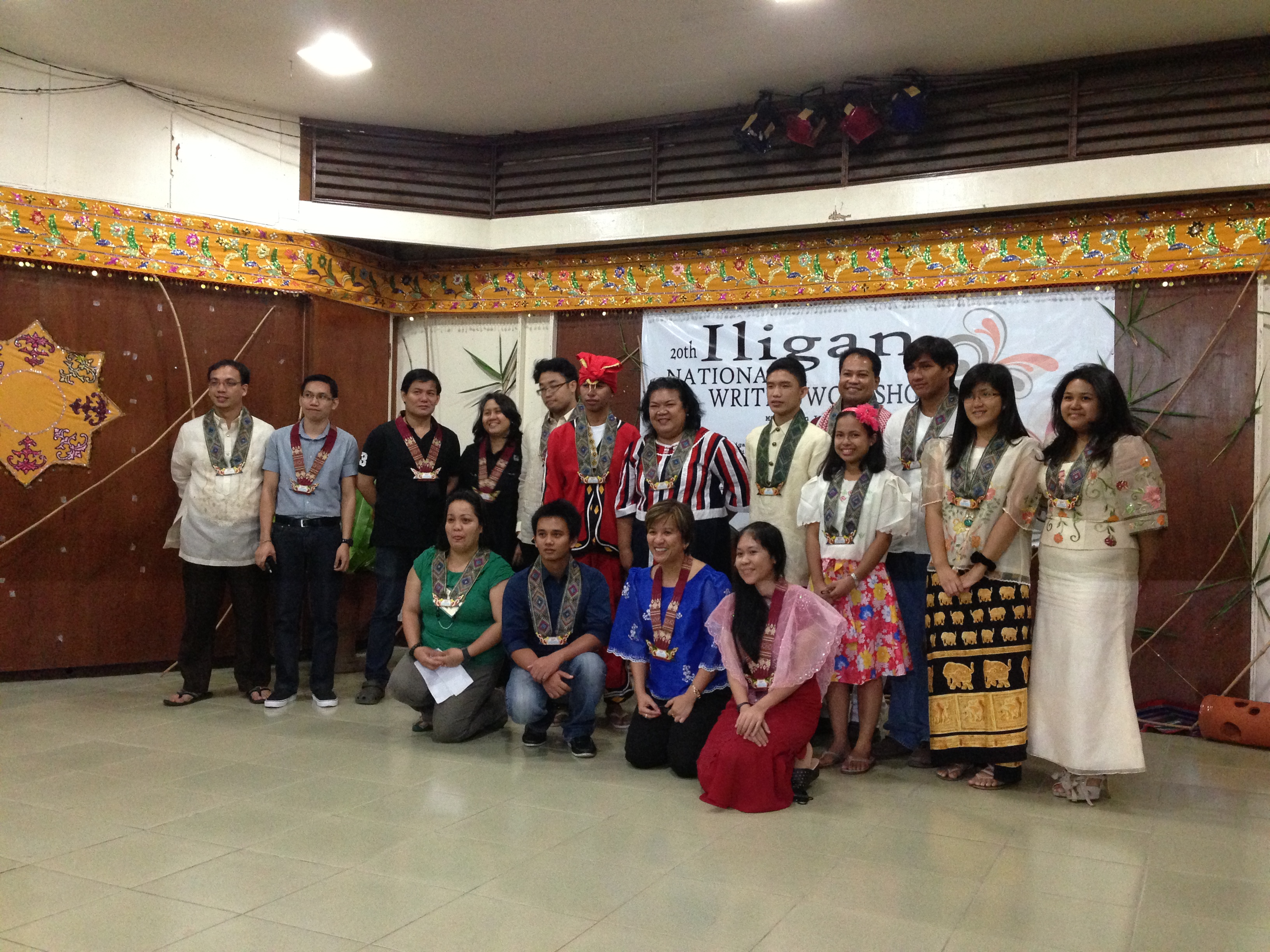
AMONG THE most interesting topics that came up in the recent UP National Writers Workshop in Baguio was that of writing the memoir. More and more people—and not necessarily celebrities or historical figures—have been writing their memoirs lately, and it could even be argued that many blog entries are, effectively, memoirs, although the quality of the prose and of the sensibility behind it might vary widely. No matter, for now: what’s important is that we’ve put a considerable value on what people say they remember, so it’s as good a time as any to look at memoir-writing with a critical eye, as we did in Baguio.

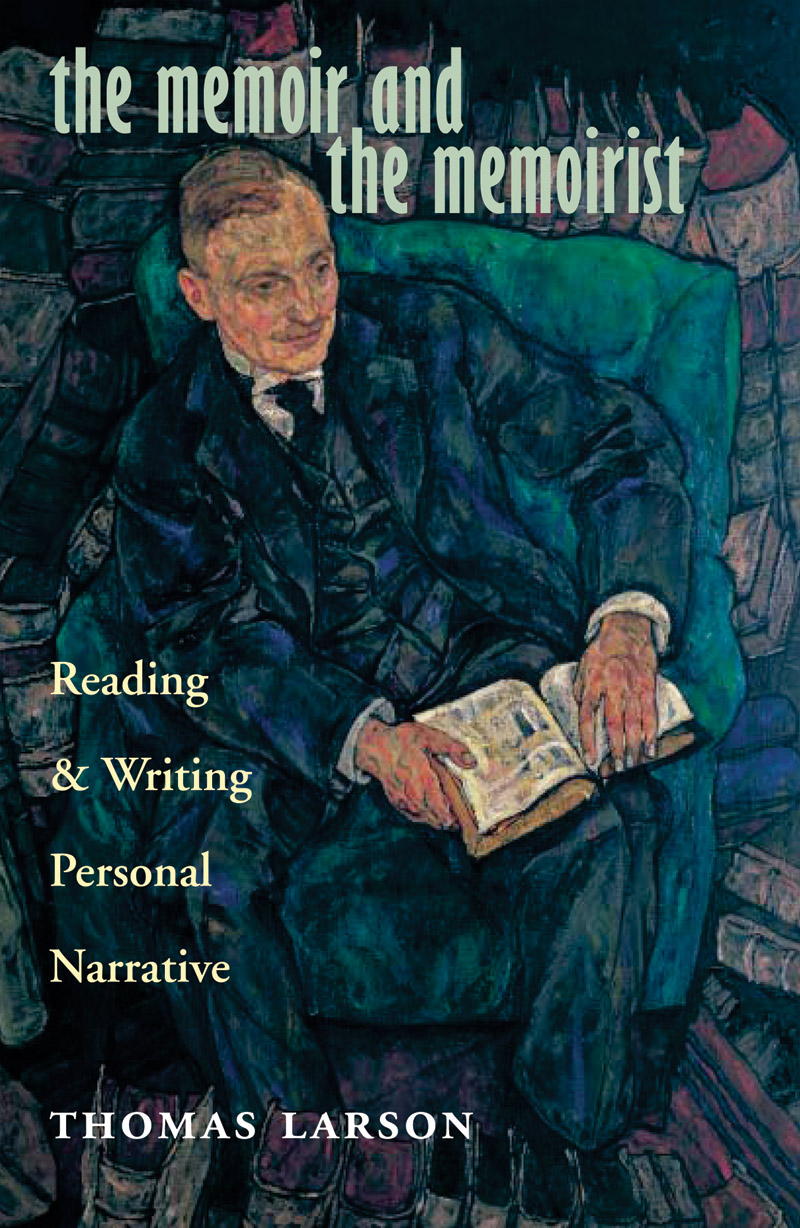
Having been assigned to lead that discussion, I drew on a book that I’ve had my students in creative nonfiction read before they mine their own lives for material with which to complete the course. Written by Thomas Larson, the book is titled The Memoir and the Memoirist: Reading and Writing Personal Narrative, and it was published in 2007 in the US by the Swallow Press of the University of Ohio. It was my wife Beng who found the book for me during one of our visits to San Diego, and I’m very happy that she did. I rarely read books from cover to cover in a few sittings, but this was one of those exceptions. I found myself nodding and putting check marks on the margins here and there, so cogently did Larson raise his points.

So rather than dilute Larson’s wisdom with too much of my own commentary, and since this isn’t a full-scale lecture on the memoir, I’m going to quote extensively from his book by way of raising issues that the potential memoirists among my readers can consider.

Let me just take off from what I said last week about the writing of historical fiction—about how the past speaks to the present, and how, beyond nostalgia, history is of value to the writer as material with which to explore why we are who and what we are today. Memoir writing, when you come right down to it, poses the same challenges and opportunities as historical fiction, except that it really happened, and it happened to you.

But in the memoir, Larson suggests, the past in a vital sense did not just happen; it continues to happen. In other words, the past is never over, and it is the memoirist’s job to be aware of and to remark on the happening.

Quote: “You need to emphasize that which captivates you in the present…. The past drama is not the only drama. The present drama of recollection is equally alive, equally in and of the story. [The memoirist finds] that as she remembers she is being emotionally altered by what she remembers.”

Memoir is different from autobiography, Larson says, in that it deals with small, intimate, ambiguous portions of a life rather than a coherent whole. The memoirist’s stance is one of self-doubt rather than the biographer’s certitude.

Quote: “The Encyclopedia Britannica describes the old plural form, ‘memoirs’, as that which emphasizes ‘what is remembered rather than who is remembering.’ If we invert this, we can call a book that emphasizes the who over the what—the shown over the summed, the found over the known, the recent over the historical, the emotional over the reasoned—a memoir…. It cannot be the record of the past as autobiography tries to be. Memoir is a record, a chamber-sized scoring of one part of the past.”

Larson says that indeed, the true subject of memoir is not the past but the mutable self.

Quote: “[In] the construction of a relative self in the memoir… the person who is writing the memoir now is inseparable from the person the writer who is remembering them. The goal is to disclose what the writer is discovering about these persons…. What the memoirist does is connect the past self to—and within—the present writer as the means of getting at the truth of his identity.”

In revisiting the past, Larson refers to what Virginia Woolf calls “moments of being,” those events, instances, and decisions that define the self. The memoirist actively seeks out these moments, and explores and amplifies them until they acquire a kind of resonance.

Quote: “The exceptional moments are ‘moments of being.’ They are physically overwhelming and, over time, represent a legendary quality about the self.”

Context is vital to the definition of this self.

Quote: “The memoir’s prime stylistic distinction is a give-and-take between narration and analysis, one that directs the memoirist to both show and tell…. In memoir, how we have lived with ourselves teeter-totters with how we have lived with others—not only people, but cultures, ideas, politics, religions, history and more.”

The memoir is therefore more than raw memory, but is rather memory mediated and processed by a host of factors, including one’s position and interests in the present.

There will, of course, be times when the memoirist seems unsure of exactly what happened—and that uncertainty is part of the game. The best memoirists, Larson says, don’t deliberately invent events (as in that infamous case of James Frey); they don’t have to.

Quote: “In the memoir, the truth and the figuring out the truth abide. The best way to deal with the tension between fact and memory, as one uncovers the tension in the course of one’s writing, is to admit to the tension—not to cover it up…. What we learn in memoir writing is that memory has far more of its own agency than we thought, that the very act of remembering may alter what did occur…. This layered simultaneity… is the prime relational dynamic between the memoir and the memoirist: the remembering self and the remembered self.”

And finally, there’s no escape from chronology, says Larson. The whole point of memoir is that one thing will lead to another, and that what we’re trying to palpate from these flows of memory is the underlying plot of our lives—even if, or perhaps because, we don’t know what will happen next. The memoir is itself a story, but is also part of a longer story yet to be fully grasped and told.

Quote: “Be it abuse, death, grief, a fall off a horse or the rise to the presidency, a memoir is, as tale and discovery, always consequential, even if one tries narratively to evade or delay the consequence…. Memoir is reminding us that its largely essayistic direction allows readers and writers not to know ahead of time what will be said. And to preserve that not-knowing, that tentativeness, is vital to the memoir’s story.”

Penman No. 41: Writing Historical Fiction

Deed of SalePenman for Monday, April 8, 2013

AS I write this, we’re up in Baguio with this year’s crop of 12 fellows attending the 52nd UP National Writers Workshop, and we’re discussing the works-in-progress presented by the fellows, who are all practicing and accomplished creative writers with at least one published book to their name. We’re calling them mid-career writers, but their ages range widely from the mid-20s to seniorhood.

In our youth-oriented culture, we often forget how maturity can have its advantages, and how the literary imagination can improve with age. I was reminded of this when we took up the works of two of this year’s older fellows, Thomas David Chavez and Anna Marie Harper, both of whom happened to be working on historical novels.

Writing the novel is difficult enough, but the writing of historical fiction poses some special challenges, which probably explains why not too many writers essay the medium.

History deals with the past, but whenever we present it today—whether as fact or fiction—it inevitably also deals with the present, and by projection, with the future. In other words, the past is truly important to us—beyond its curiosity value—insofar as it informs the present, and provides clues as to what the future might be.

The “historical” part of the term “historical fiction” apparently requires close attention to factual detail, which means exhaustive research of an almost academic nature, to make certain that one is taking off from solid ground. Just how solid that ground is will of course be debatable and may even be the subject of the fiction itself—“What really happened?”—but no matter what departures from fact are taken, a certain familiarity with the past (perhaps a fictive or imagined familiarity) is assumed.

Indeed the basic proposition of historical fiction can be summed up thus: “We think we know the past, but we don’t.” A more severe formulation might be: “We don’t know the past at all.”

The fictionist’s conceit lies in his or her suggestion that fiction, rather than even more thorough or more scholarly research, can remedy this lack of understanding. It’s the same conceit we carry over to contemporary fiction, which is our response, our proposed alternative, to CNN, to the White House or the Malacañang Press Secretary, to the Departments of History and Political Science. The fictionist’s reason for being draws from one of my favorite quotations, this one from Mark Twain, a man who knew how to spin a fanciful yarn while being engaged in the most significant political debates of his time. In so many words, Twain said: “Of course fact is stranger than fiction; fiction, after all, has to make sense.”

The sense-making of fiction relies, in turn, on dramatic plausibility—or, to put it in Aristotelian terms, on probability and necessity, in the logic of the human heart and mind. (To Aristotle, tragedy—which you can take to be literature itself—was superior to history, because history merely dealt with what happened, while tragedy concerned itself with what could happen). What makes fiction interesting is that this logic of the human heart and mind can often be bewilderingly illogical, although it will, at some point, acquire a frightening inevitability.  I’ve often told my students that characters become truly interesting if and when they go out of character, and these turning points are what we wait for, both in history and fiction.

It is, therefore, the burden of the historical fictionist to offer more than both ordinary historians and ordinary fictionists can offer. The past has to be more than setting or décor, the pitfall of bad historical fiction; and the fiction will require more than an embellishment of known fact. Historical fiction is not fictionalized history; it is not creative nonfiction. It is a fictionist’s creative use of the past as material with which to make sense of the present, of how we came to be what we are, of how we will likely be tomorrow.

Dave Chavez’s novel is set in the American Occupation, told from the point of view of the Filipino butler and cook of an American officer who heads the health service in a time of war and cholera. It goes a bit farther back to 1874, when a boatload of Japanese lepers arrives in Manila Bay from Nagsaki under the command of a Captain Kurosawa:

“Only in the last minute was Kurosawa informed of the nature of his gruesome mission, although two weeks before setting sail, he was told to recruit an able-bodied crew of 14 ocean-tested men, then to stock up on supplies treble that number, and finally, to organize a guild of petty merchants who could assemble on such short notice a credible cargo for trade in Manila. Given the time constraint, the captain orchestrated a passable, if rough and ready nine tons of merchandise. Kurosawa inspected and oversaw for himself the weighing of the bales of Kyushu silk, wax-sealed jars of Shikoku soy sauce and crates of Western-style gleaming steel cutlery from the foundries of Fukuoka.

“Of course, there were special items that were not for sale or barter, but were primed spotless and sheening just the same under orders of the Overlord. In there were intricately- packaged gifts of dolls, fans of gilt brocade paper, ukiyo-e scrolls, pictures of the fleeting world depicting the pillow tales of cloistered Genroku noblewomen, some fancy paper from the presses of Nagoya, and finely-wrought cotton yukatas from the prefecture of Nara. These were presents for Manila’s notables, including Governor-General José Malacampo Monje, the Spanish and mestizo nobles of Intramuros and Ermita, the regidor of the port, and finally the Archbishop of Manila, Gregorio Melitón Martinez Santa Cruz.”

Bambi Harper’s second novel will be a prequel to her first one, Agueda, published last year. While Agueda charted a woman’s and her society’s progress from the late 19th to the early 20th century, The Shadow on the Sundials starts with the British Occupation of 1762, and introduces a colorful cast of characters that includes a visionary beata, a dashing Spanish rake, a native servant girl, and a dwarf. Harper draws the curtains on our bygone days thus:

“The entire upper floor of the house that overlooked the narrow provincial road formed a giant screen with its window panes of capiz shells, while below the sills were ventanillas where as a child Tita dangled her chubby legs through the spaces between the carved balusters. The house stood on the corner beside an old stone bridge and massive doors opened into a saguan where granite steps led to the caida, an anti-sala overlooking a garden of fruit trees. The lower classes waited here to be summoned into the august presence of the owner—even poor relations of Doña Titik unless they were in the kitchen eating with the help. The lucky visitor who was invited into the inner sanctum of the sala meant you were either a friar, a foreigner, rich, or all of the above. No expense had been spared in the décor of the living room that revealed ceilings painted with garlands held up by rose-cheeked cherubs. Trompe l’oeil of receding colonnades on the walls created an illusion of expanding space. No carpets hid the glory of the wide narra floor planks that were rubbed daily with a coconut husk and banana leaves to a mirror finish.”

I look forward to the completion of both projects—indeed, of more novels that draw on our tremendously rich history to examine the emergence of our nationhood.

I’D LIKE to acknowledge and express my appreciation for a message from reader Nikko Salvador, who wrote in to say—in response to my GenSan piece last week—that a museum can indeed be found at his school, the Notre Dame of Dadiangas University, and that a few steps away stands a thorny dadiangas plant. I’ll make sure to visit these spots the next time I fly down to GenSan.

Penman No. 39: A Weekend of Bargains

Malakas at Maganda baybayinHIGH RESOLUTION (3)Penman for Monday, March 25, 2013

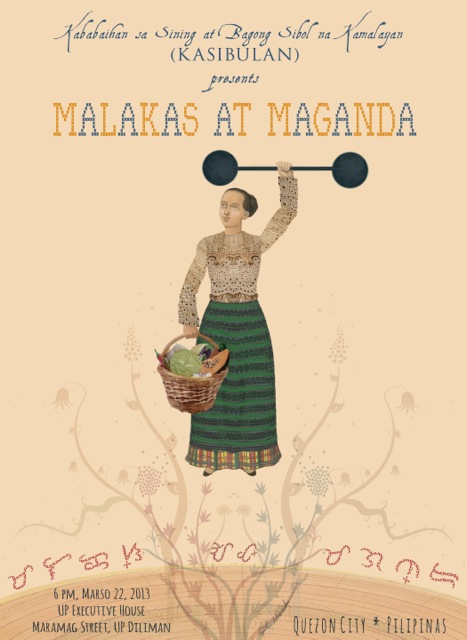
BEFORE ANYTHING else, let me put in a plug for a show that my wife Beng is curating on behalf of Kasibulan (Kababaihan sa Sining at Bagong Sibol na Kamalayan). Founded in 1989 by such stalwarts as Imelda Cajipe-Endaya, Brenda Fajardo, Ana Fer, Julie Lluch, and Ida Bugayong, Kasibulan has since gone on to engage a new generation of leading Filipino women artists. Those women—older and younger—have come together in a major exhibit titled “Malakas at Maganda,” a celebration of the power of female artistry. The show opened last Friday at the Executive House at the University of the Philippines, and will run for a month. I’ve seen it, and I can guarantee—especially to my fellow men—that it’s a marvelous eye-opener.


AS THE minders of an empty nest, Beng and I can be excused for being foolishly footloose—running off to unlikely destinations like Melaka and Ho Chi Minh City on budget tours, leaving our daughter Demi with little more than a clutch of leaky old fountain pens for an inheritance. But we’ve never forgotten the fun of finding even cheaper thrills right here at home. Indeed, for all the traveling we’ve done, Beng and I inevitably come to the same old conclusion: it’s more fun in the Philippines.

A couple of weekends ago—after both of us had slogged through a particularly tough week of work—we decided to blow the weekend off on our favorite pastime: shopping for ukay-ukay bargains. For many years now, the two of us have been shameless and ardent ukay-ukay and thrift-shop habitués, partly out of necessity but more, I’d say, for the sheer adrenaline rush of getting something for next to nothing. Now and then I need to put on a blazer for business, and two of my favorites—a Zegna and a Ferragamo, brands whose posh boutiques I’d never think of stepping into—were both Cubao ukay-ukay finds, for about P150 each. (And, of course, being the inveterate tourists that we are, we’ve carried the habit overseas, scoping out and revisiting our favorite resale shops in New York, Virginia, and San Diego. The highlight of my shopping year is our October jaunt to the flea markets of Manhattan—a treat I’m going to have to forgo this year, my semestral break already consumed as of this moment by other commitments.)

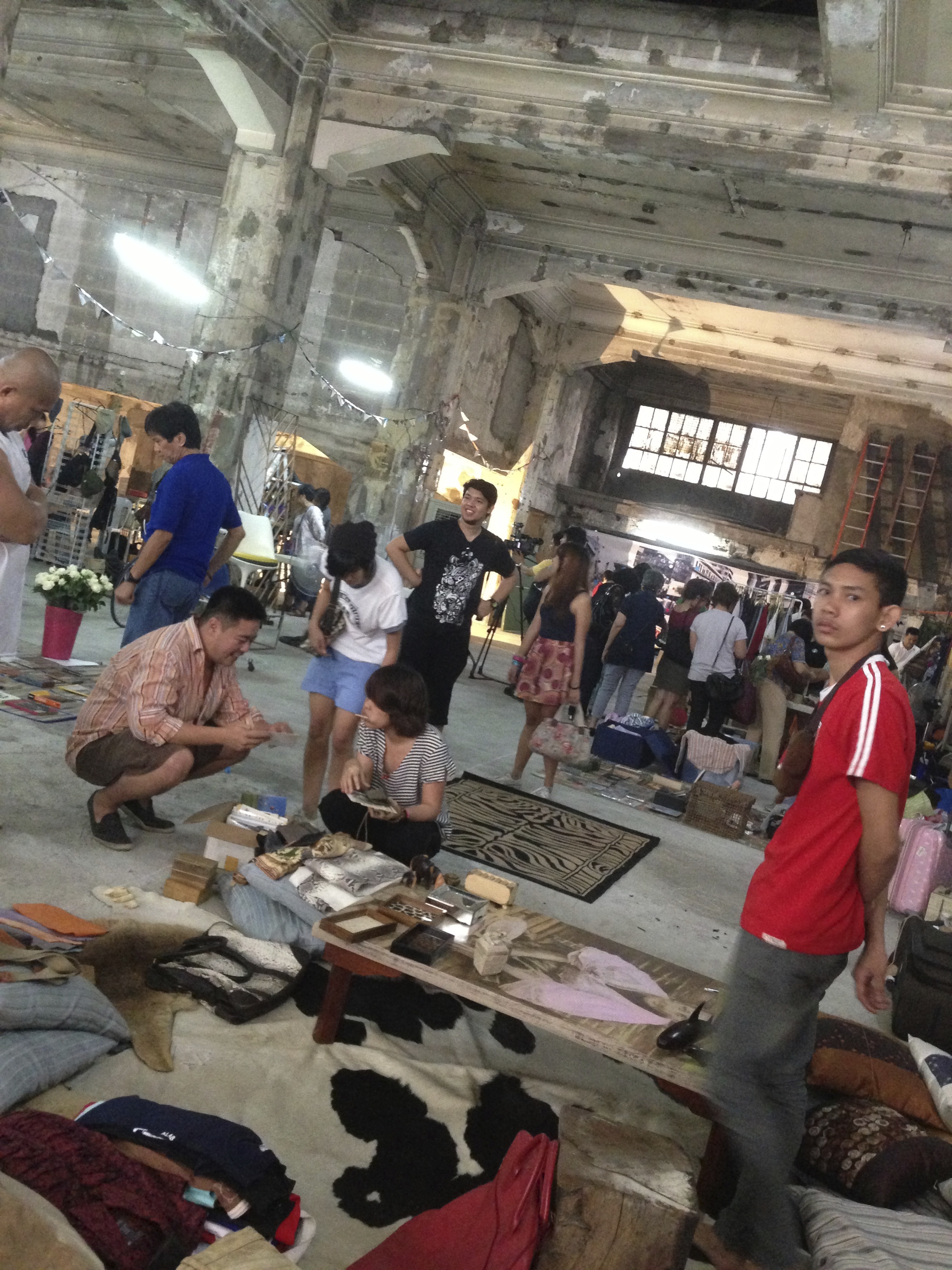
This time we had a special address on our weekend itinerary: the old Berg department store on the Escolta, where a group of young artists had organized a Saturday market. Beng spotted the notice on Facebook (she’s on it, I’m not) and it took little to convince me to go. I still remembered the Escolta of my youth, and how swanky it was back then. And they didn’t get much swankier than Berg, which was there before Rustan’s, before the malls, before eBay. (I have this recurrent dream of time-traveling to the past and walking into a store like Berg to the pens section, and, seeing row upon row of pristine Parker Vacumatics, picking out a blue and red Senior Maxima or maybe even a gold Imperial—the grandest of the ‘40s Parkers—and paying no more than P40 for each, a princely sum at the time.)

When we got there—from our parking spot in front of the iconic Savory Restaurant on Plaza Goiti—we saw that a crowd had begun to gather in the concrete cavern that was all that remained of the old store. Vendors—about 26 of them, I would later learn—had claimed their 2 x 2-meter squares on the bare floor and had laid out a cornucopia of books, clothes, shoes, trinkets, records, old bottles, cameras, bags, and other staples of the flea market trade.

IMG_0833

The people behind the event were the members of 98B, a “collaboratory” of young progressive artists led by Mark Salvatus, one of the brightest new names in the contemporary art scene. We had a happy reunion with Mark, whom we had come to know purely by chance almost ten years ago when we strayed into the Salvatus home and folk-art shop in Lucban during one Pahiyas. He was just starting out then, and we were glad to see him again—in old Escolta, of all places. His collective thought of the Saturday market as a way of revitalizing Escolta, a shabby relic of its old stylish self. “We’d like to encourage local businesses to grow,” said Marika Constantino, another 98B member, “which is why we didn’t bring in any food concessionaires, so locals could set up food stalls outside.” Another familiar face we ran into at Berg was that of Jason Moss—for many years now, Beng’s personal favorite and mine, another brilliant artist whose rise we’d predicted and followed. “He’s one of our guiding spirits,” said Mark. We gathered that 98B would look into regularizing the Saturday market—a great idea, going by the inaugural turnout.

Since we were in the neighborhood, Beng and I then availed ourselves of the opportunity to enjoy a hearty lunch of machang and pancit at Polland in Binondo. We walked off all that starch in our stomachs by following Ongpin all the way to Avenida Rizal (passing by another culinary landmark, the Ramon Lee fried chicken place in Sta. Cruz). Benighted as it may have been by the LRT overhead, this avenue—another childhood paradise—still contains many treasures for the bargain hunter. (I remember when, back in the early 1990s, I picked up a trove of gorgeous vintage pens—sold as new old stock—from the shops on Avenida for 1960s prices.)

This time, we plunged into a succession of ukay-ukay stores—one turned up a smart herringbone Ralph Lauren blazer (P380)—culminating in the three-story Japan surplus shop that we had visited years earlier and were glad to see was still there. The usual racks of clothes occupied the first floor, but on the top floor—the houseware section—were all manner of china and cutlery. Beng pounced on the bowls and teacups, but I took away a lovely lacquered bento box (P180) that I would use for my ink bottles. The floor also yielded possibly the day’s best score: two good-as-new Japan-made titanium eyeglass frames (P200 each) that Beng and I are now wearing with prescription lenses.

As if Escolta wasn’t enough, we took to the road the next day for more good food and cheap fashion—in Tagaytay, which has some of the best roadside restaurants and ukay-ukay palaces in the country. I suppose we use one as an excuse for the other—the eating and the shopping—but no one really needs an excuse to spend a lazy Sunday in Tagaytay, a treat we shared with Beng’s mom Juliet and her caregiver Meann, and our driver Vic. Food took priority, and our great discovery of the day was an unassuming restaurant along the ridge (turn right at the junction) called Tootsie’s. We had never been before, and were taking a chance since the usual suspects (bulalo at Leslie’s for me) were full to the brim, but we got lucky. Much to my mom-in-law’s delight, Tootsie’s proved to be something of a Visayan oasis in the Tagalog heartland, offering such delights as kansi bulalo (P485, soured with Bacolod batwan) and sus kadyos (P335). The crispy daing na biya (P137) was a terrific appetizer, and the roast chicken kawi (P305)—described by Chef Ed Quimson as an “unexpected, unintended chicken concoction on the way to a busy day” was a big hit, with its subtly smoky flavor.

Then we were off for a quick run to the ukay-ukay shops near the junction—I came away with a linen Giordano blazer for P200, and Beng picked up a straw hat for herself, rubber sneakers for Meann, and a cap for Vic—before dessert of halo-halo, turon, and mais con hielo at Ming’s on the way home. I tried not to eat too much, mindful of the inevitable connection between food and fashion. (The most visible beneficiary of my recent weight-loss program has been my waist, which dropped from a salbabida-size 40 to a more manageable 34. I had to send all of my pants to the tailor for alteration, but that’s easier to do with pants than shirts and jackets, so it’s also given me a great excuse to refurbish my wardrobe—all, of course, in the ukay-ukay. For the first time in years, I’ve been able to wear shirts marked L—without the X or XX—or even M. And thank God I didn’t throw or give away my linen Ferragamo, whose buttons I could barely close; today there’s room to spare.)

And so a fun weekend was had by all for not too much; we would morph back into working stiffs come Monday, but as we patted our stomachs and surveyed our haul from our forays that Sunday evening, Beng and I could only look forward to that long and endless weekend upon retirement, to be spent in the city’s and the world’s finest junk shops and food stalls.


Penman No. 38: Why I Teach Creative Writing

English Class

Penman for Monday, March 18, 2013

LAST THURSDAY, I delivered the keynote speech at a conference of creative writing teachers held at the University of the Philippines, and this was part of what I told them:

I’m going to propose an idea that will probably sound like heresy today: I teach creative writing not to promote the science or the politics of literature, but to help enlighten the mind and ennoble the spirit. These are big words, but creative writing is a big thing. It has been a big thing for a very long time, and one might even argue that it got a lot smaller when it became an academic discipline, subject to the vagaries and vicissitudes of departmental politics, and the constant and sometimes annoying need to justify its existence to those who ask, with ill-concealed derision, “Can creative writing be taught?”

Let me humor that point for a minute. No one ever asks if music can be taught, or if ballet can be taught, or if painting can be taught—and yet, in all of these artistic endeavors, a mentor-mentee relationship has been the practice if not the rule for ages. It may be that writing is a more solitary act, and indeed, until the 20th century, was something self-taught, and people like Shakespeare and Nick Joaquin wrote without the benefit of a BACW or an MFA.

But most people aren’t Shakespeare and aren’t Nick Joaquin, and we’re no longer in the 17th or even the 20th century. Genius can take care of itself; most people can’t, particularly in a time when what are seen to be the more practical necessities of life militate strongly against a young person’s decision to choose a life of art. This, I believe, is the social function of artistic education today—the preservation and promotion of art as a vital human enterprise, alongside the sciences and the professions, without which society would fail, in the absence of the self-critical mirror that the artistic imagination provides.

Those of us who teach creative writing—or music, or dance, or painting, and so on—should fight to claim our space in academia, not because we need the jobs (which of course we do), but because society needs us for its own well-being, as nurturers of our people’s imagination. Like life itself, each work of art emerges from a synthesis of method and mystery, and sometimes the happiest and most wondrous results arise from what may seem to be accident and serendipity. But as a social project, the production of art cannot be left to chance.

This is particularly significant in the context of a country and a society like ours, whose people remain in dire need of a sense of nationhood—a sense that can only be artificially defined if not distorted by politicians, but more authentically apprehended by artists. The stories, poems, essays, and plays that our students write are this generation’s understanding of who and what we are, and this has been one of the key principles of my own teaching of creative writing: to help the student find not only himself or herself, but to find himself or herself in the community of others, in the life of the nation.

Thus, this semester in my graduate fiction class, I have asked my students to write about characters decidedly unlike themselves, to explore a milieu larger than their immediate and familiar surroundings. “Write about what you know” is what we often tell them, and that’s fine for starters; but I like to push this further and to suggest, as the title of one of my books says, that the knowing is in the writing, that they will never really know their subject until they’ve written all they could about it, until they’ve stood at the edge of the unknown and made that headlong freefall into the abyss of the human condition.

In this respect, allow me to make some observations about the state of the art as I see it in our students’ work. As a writer and a teacher of creative writing, I’ve been privileged to come across the work of some of our best young writers today—in my classes, in workshops, and in literary competitions—and to note their strengths and weaknesses.

The strengths are rather obvious to me—most notably, sharp and felicitous language. It always surprises me how—at a time when it’s become customary to deplore the deterioration of the language skills of our young people—new writers keep emerging who can use English with a mastery and confidence I didn’t have at their age. I suppose that comes from an earlier and more natural affinity with English, which many Filipino writers of this post-martial law generation not only write but think and speak in—at home, at school, at work, at play.

Another hallmark of our younger writers—not only in English but in Filipino and other Philippine languages as well—is their awareness and deployment of more contemporary literary theories that have done away with the stodgy realism of old, and value freshness of approach and cleverness of idea. They write in and from the margins, employ unusual points of view, play around with their use of time, and assume a variety of voices. They cross genres, mix languages, and generally don’t seem to care or worry too much about what other people might think of their work (except for readers of their own generation), and about whom they get published by.

That’s all well and good, but let’s go to the downside of things.

The most persistent shortcoming I’ve noticed in my students’ work is their inability or unwillingness to go beyond the safe and the familiar, to push the story to the farthest limits of its dramatic possibilities. They can take risks with treatment and technique, but in terms of the human drama at the core of the piece, they fall short. In other words, they’re great at writing scenes, sketches, and setups—vignettes that define a character or a situation—but, with a few outstanding exceptions, they won’t go over the edge and take us somewhere we’ve never been. They may be technically polished and even perfect, but they are immemorable and add little to our understanding of ourselves as Filipinos. They don’t connect to a larger audience beyond the university, making what we do seem even more esoteric and irrelevant to many. We often talk in these corridors about the need to popularize science, but what about the popularization of art?

Now, I’m not making a pedestrian demand for our art to be simple and accessible, or to be held to a standard of social relevance as the measure of excellence. I firmly believe that art is intrinsically elitist, even if its aims may not be. Whether among the most common folk or the most privileged, only a few possess the sensibility and the skill to create art.

All I’m asking for is for us to encourage our students to see writing not only as a means of self-expression but as a form of engagement with the larger human community—a love letter, as it were, to the world at large, perhaps full of pain and disappointment and yet remaining open to appeal and negotiation, if not reconciliation. This, I suppose, is what I meant by “enlightenment and ennoblement”—a recognition and admission of oneself, through art, as a human being, with all of its attendant privileges and responsibilities.

That’s the challenge you and I have to pose and, ourselves, to meet: to help produce not only great art, but great art that somehow matters. By “matters”, I don’t mean that it will foment a revolution the next day or the next year, but that it will, one way or another affirm and enrich our sense of humanity and community.

The fact is that very few of our students—counting even the CW majors—will go on to become writers for life. That’s all the more reason why their brief encounters with us should be memorable ones. No matter how poorly conceived or executed, a work sincerely presented for workshop by a student still represents an act of the imagination, which deserves respectful consideration. The best students will benefit the most, taking our admonitions to heart in the same way that I can still remember what my writing teachers told me. From Mrs. Vea, my English teacher in high school: “Good writing doesn’t depend on your mood.” From Franz Arcellana: “This is good, but it needs rounding out.” From my American professor Nick Delbanco: “Don’t forget the narrative line!” What have we told our students that they will remember 40 years hence?

I have always believed that every student has at least one good story, poem, or essay in him or her—and if we draw that out of them before they move on to become lawyers, engineers, and politicians, then we shall have done our duty. If we can inspire the best of them to consider taking the same breathless gamble we took in devoting ourselves to the life of words, then we shall have gone beyond performing our teacherly duties to helping secure the future of the Filipino imagination.

Penman No. 37: The Rebirth of Joly Benitez

Jana and Joly

Penman for Monday, March 11, 2013

UNTIL VERY recently, the first and the only time I met Dr. Jose Conrado Benitez—better known to many by his nickname “Joly” (yes, with the single L)—was almost 40 years ago, when he visited and spoke to our class in Development Economics at the University of the Philippines.

I was working as a writer then for the National Economic and Development Authority, and my boss—the very supportive Gerry Sicat—had sent me, a college dropout, as a special student to UP to learn some economics quickly. I had been imprisoned under martial law and still carried my leftist sentiments with me, but there being few other options and being newly married, I decided to take my studies as seriously as I could.

There was something of a rivalry between NEDA on the one hand and the Ministry of Human Settlements and the Development Academy of the Philippines on the other, and Joly Benitez was associated with both latter agencies, so when the young Deputy Minister of the MHS came to our class, I can’t say that I was in a very welcoming mood, his ministry (and its chief, the First Lady Imelda Marcos) being seen then to be the source of some of the strangest ideas to have come out of martial law. Still, I was impressed by Benitez’s energy and enthusiasm, and while I remained a skeptic, I found myself opening up to the heretical notion that—with the right leadership and intentions—martial law was an unprecedented opportunity to get some things done right. (Of course, by and large, that didn’t happen, and I was out of NEDA in 1983 and on the street at EDSA in 1986.)

Flash forward to a few weeks ago, on February 21: that evening, a crowd began to gather at the newly established Erehwon Center for the Arts in Old Balara, Quezon City for the opening of “Apple by the Tree,” an exhibition of paintings by the father-and-daughter tandem of Joly and Jana Benitez. I had been invited to the opening by my old friend, kumpare, and Erehwon founder Raffy Benitez, a cousin of Joly. Perhaps ironically, Raffy and I had become friends in martial-law prison; when he later opened a printing press, Raffy drew on some unused paper stock and became the publisher of my first book, Oldtimer and Other Stories, in 1984. In other words, he’s a guy I can’t say no to, and when he invited me to the Benitez exhibit, despite having other plans for the evening, comradeship and curiosity prevailed, and I went.

I came in for a pleasant surprise. Joly’s daughter Jana was already an established New York-based painter, a magna cum laude Fine Arts graduate of Brown University with wide international exposure. Her work, noted the critic Alice Guillermo, “probed the secrets of both the abstract and the figurative, [creating] an art that is young, vital, integral to life and being.” I saw bold splashes of color in the abstract-expressionist style: you step back and translate form and color into thought and emotion.

Joly Benitez was the revelation. The Stanford-trained technocrat may be more at home with economics, but he stood his ground alongside Jana, working in the same style but mainly in black and white. What was even more remarkable was that, six months earlier, he had been close to death, with a debilitating kidney disease that required dialysis four times a week. “People were already calling me a widow,” said his wife, the banker Joanne de Asis. A timely transplant gave him a new lease on life—but it was the return from New York of Jana and their painting sessions that gave Joly a fresh reason to hang on.

Intrigued by this turnabout, I interviewed Joly—who was still visibly weakened by his ordeal but fit enough to climb four flights of stairs—and asked him about his new avocation. It turns out that painting wasn’t all that new to him.

“I had painted before,” he said, “from the time I was a high school teenager, hanging around and going to the PWU School of Fine Arts, after classes from La Salle high school. Even during my stint in government, I did some ten large canvases which I then displayed in the Technology Resource Center. At my home in Cubao, I hosted the Philippine Association of Printmakers, and we had weekly figure drawing sessions. I have painted in brief but intense spurts over various intervals for the last five decades. At this point of my life, I feel more confident and comfortable about displaying my paintings in public, and to continue to explore various modes of abstract self-expression.”

His new work is concerned with perspective, such as how one might see Earth from space. “Sometime ago, I did a series of over ten ‘Earth-scape’ prints and paintings, reflective of my preoccupation with ‘cosmic space’ abstract images.  The predominance of black and white in some of my paintings is the challenge of depicting movement, perspective, texture and expression with a highly and consciously limited palette,” he says.

Working with Jana was “intense and fruitful—a deep conversation in art. We talked continuously and began to appreciate our artistic differences. We sought to elevate our collaborative work to a different threshold. While painting, when she or I would perform brush strokes, or compositional elements, or color hues reflective of our differences, we would consciously attempt to integrate and reconcile them. We had our differences—but in art as in life, mutual respect and appreciation of each other’s idiosyncrasies and differences are paramount.”

After the Marcos years, Benitez served for over a decade as president of the family-owned Philippine Women’s University (his son Kiko now serves in that capacity), where he introduced various ladderized-curricular innovations, including pioneering programs for on-line distance education and continuing education.

The older Benitez is far more mellowed and subdued than the gung-ho guy I recall from the mid-1970s, but he retains a sharp critical edge. I asked him about his views on Philippine development today. “We are highly dependent on the remittances of our OFWs, we don’t have significant industries or manufacturing, our agriculture is in need of major structural changes, and our service sector relies heavily on call centers for employment,” he observes. “We still have to see a national eco-sustainable development strategy that addresses a basic needs approach, with structural changes reflected in locational and spatial dimensions.”

As the architect of many of the Marcoses’ social infrastructure programs, Benitez sees some evidence of a useful legacy left behind from his tenure at the MHS: “Some of our initiatives remain as relevant as ever. They include the establishment and organization of a mass housing system, involving a financial saving system (PAGIBIG), the Home Guaranty Corporation (HGC), the National Home Mortgage Finance Corporation, (NHMFC), and so on, although one would wish that the various housing agencies would operate like a symphony rather than competing and sometimes working at cross-purposes. We also made efforts to promote small- and medium-scale industries, especially focusing on livelihood projects, entrepreneurship, adaptive technology and countryside community organization and development. We sought to introduce a locational and spatial dimension in national, regional, and provincial comprehensive development plans—through the national and regional framework plans, the preparation of provincial atlases and municipal level town plans, and zoning ordinances. We used to say that ‘True structural development should have a face and an address.’ An abstract strategy or a mere compilation of various infrastructure projects do not make for national development.”

At this point of his extended life, Joly Benitez says he’d like “to focus on a few income-generating projects for myself and my family, but most of all I would like to explore and pioneer some ecologically sustainable projects, especially on village level.”

And, of course, produce more art, by himself or alongside Jana. The historians, political scientists, and Filipinos on the street will have their own assessment of the Marcos years and of the role that Jose Conrado Benitez played in it—and I suspect he will not be hopeful enough to imagine that that assessment, given what has happened since, will be largely benign—but the rebirth and refuge offered by art can only sustain this complex man.

Penman No. 36: Literary Networking

3288650777_5fbf76ee05_z

Penman for Monday, March 4, 2013

AT THE recent Taboan Philippine Writers Festival held in Dumaguete last month, I sat on a panel devoted to the topic of “Literary Networking,” which deals with how writers come into contact with one another and with other people in the profession—publishers, editors, agents, and, of course, readers, teachers, and critics—to improve and to promote their writing.

In my column two weeks ago, I noted how writing can be one of the loneliest if not most thankless endeavors anyone can undertake, especially in a country where writing is considered to be little more than a hobby. Networking helps reduce that sense of isolation and creates communities of writers and other literary professionals who are all looking for that same one thing: the next great read. So today I’m going to list down some of the most effective ways of literary networking, hoping that our writers, especially the young ones, can avail themselves of these venues to extend their reach.

School. As every high school graduate knows, friendships forged in school tend to be stronger and last for life. The university is where most writers decide to become writers and find that they’re not alone in their love of words. The bonds that lead to what some critics would call “cliques” and “cabals” start naturally in school, and may even be formalized in groupings such as the famous pre-war Veronicans and post-war Ravens at the University of the Philippines. Today, literary organizations such as the UP Writers Club, the Thomasian Writers Guild, and the DLSU Writers Guild keep the flame alive on Philippine campuses. MFA programs, especially those abroad, can create larger networks, although the atmosphere in these programs tends to be more competitive.

Workshops. Related but not limited to school, workshops bring young and new writers together in what amounts to a combination of boot camp and support group. The idea behind a writers’ workshop is that collective wisdom can improve individual talent, and like most adages, this may be generally but not always true. For writers needing company and affirmation, workshops can feel like a refuge, if not a narcotic—and indeed some go workshop-hopping. For Filipino writers, entry-level and local or regional workshops and mid-career and national workshops exist—a strength unique within the region.

Conferences and festivals. They may run only a few days, but they can be intense and can connect a writer to the big stars and luminaries of literature. I’ve been able to meet Nobel laureates and Pulitzer and Booker prizewinners in these events, and while such contacts may be fleeting—I have no illusions about these worthies remembering me the day after—they can be tremendously inspiring to newer writers, and also demystify the literary gods and make one feel a fundamental commonality with others around the world. Conferences and festivals also have much more value beyond elbow-rubbing and camaraderie—they are a great source of new ideas, particularly in areas that are relatively new to us Filipinos—literary editing and literary agencies, for example.

Fellowships and residencies. Fellowships and residencies involve applying for and securing grants to places that allow writers the opportunity to work in productive seclusion for periods ranging from a few weeks to a year. For many years now, Filipino writers have successfully applied for some of the world’s most prestigious fellowships and residencies—in Iowa, Breadloaf, Macdowell, Stanford (the Wallace Stegner fellowship), and Yaddo in the United States, and Hawthornden, Bellagio, Norwich (the David TK Wong fellowship), Bogliasco, Chateau de Lavigny, and Civitella Ranieri in Europe. While isolation is part of the idea, one is never entirely alone in these places, and strong friendships and professional connections will inevitably arise between fellows.

Prizes and competitions. By their very nature, prizes and competitions tend to divide rather than unite people, but writers at their best will recognize and admire talent in the other, and so these venues also become fertile ground for networking. They also bring other important elements into the picture—agents, publishers, and critics, who take note of the winners and help them on with their careers. In this regard, I’m happy to acknowledge the fact that my being shortlisted for the Man Asian Literary Prize some years ago was probably the most significant single boost for my literary career. I didn’t win the prize, but the publicity helped me find an agent (or, actually, he found me) who then secured Italian, French, American, and Spanish translations and editions for my two novels. I also developed very fruitful contacts around the region, particularly with my fellow short-listee, the Chinese-Indonesian-American writer Xu Xi, who now directs the low-residency MFA program at the City University of Hong Kong.

Social media. In this age of Facebook and Yahoogroups, can writers possibly resist the urge to network online? The Internet is chock full of writers’ groups and mailing lists (see writers-network.com, for example) that allow anyone with writing aspirations to sign up.

Of course—as I’ve often been reminded—networking of any kind has its downsides. It can become intrusive (which is why I’ve obstinately refused to get on Facebook), and just as in other spheres of our lives, not everyone you meet will be friendly and benign. Some writers can be the most obnoxiously difficult people to deal with, and quite a few are better read than met. That said, it’s almost always good to hear another human voice in the wilderness, and you can’t get more human than a writer using language to explore and to prove what it means to be human.


LAST WEEK’S piece on radio provoked this lively response from a faithful correspondent, the lawyer Rem Maclang:

“Pardon me, Butch, but we never ‘return’ to radio—every now and then, we turn to it.  Even with the advent of IT, which has engulfed our daily life with a variety of novel communication gadgets long after the radio became our can’t-be-without home companion, it has never left the scene. Radio’s exalted role in the annals of our country cannot be taken for granted. It was through radio that the grim and sad but inspiring Voice of Freedom broadcast about the Fall of Bataan was heard worldwide, and [radio that announced] the return of MacArthur. EDSA 1 could not have happened within the short span of four days had it not been for radio that broadcast the announcements of Cardinal Sin and June Keithley. Radio was responsible in making our growing-up years a whole lot more enjoyable while being informative. If TV is the idiot’s box, radio is the dreamer’s delight.”

Penman No. 35: Return to Radio

Radio

Penman for Monday, February 25, 2013 

I ACCEPTED an unusual invitation for an interview a couple of weeks ago—unusual because of the medium involved, which was radio, specifically DZUP, the on-campus station of the University of the Philippines. DZUP station manager Rose Feliciano asked me to guest on her noontime show so I could talk about the UP Institute of Creative Writing and its flagship programs, and I was happy to oblige—not only because, as UPICW Director, it’s my job to promote the institute, but also because I’ve always had a warm spot for radio, and remain a fan of the medium.

For Filipinos weaned on the Internet, radio must seem like a blast from the past, and, in a very real sense, it is. We’re told that the first local radio stations came on the air in June 1922, so we’re just nine years away from celebrating radio’s centennial in the Philippines. While there’s some dispute as to who really invented radio, no one disagrees with the fact that Guglielmo Marconi made the first successful radio transmission in 1895—when our revolucionarios were just plotting their moves against Spain—and received a British patent for it the year after.

Of course a century’s just a drop in the bucket of human history, but in terms of technology, it’s virtually an eternity. The idea of an invention remaining just as useful after a hundred years boggles the mind, in an age when, say, the floppy disk gave way to the CD, which then gave way to the DVD and then the USB drive, all within the span of a few years. And of course radio today is a far cry from the rasp across the ether that it was at its inception (you can hear a pin drop and bounce off the floor on FM), but the basic idea remains the same—a message is electronically transmitted and received, completing the cycle of communication.

I belong to that generation of Pinoys for whom radio, and not even TV, was our main source of information and entertainment while we were growing up. I remember listening to radio soaps such as “Eddie, Junior Detective” “Erlinda ng Bataan,” and “Gabi ng Lagim.” This last program, a horror show, would go into a TV version (on MBC, Channel 11, if I remember right), but there was nothing like being in your room and quaking all by your lonesome at every creak of the door or every drag of the chain, all these creepy sounds magnified by your fervid imagination.

And that was the magic of radio, especially in the pre-visual age. TV and film may look busier, but they’re actually more passive, in that they require little more of the viewer than for him or her to sit back and be flooded by images and sounds. Radio reaches deep into your brain and forces you to supply the missing image. (When I was very small, I was convinced that there were little people inside the big wooden box that ruled the living room, and was perplexed when I managed to peek into the back of the cabinet and could find nothing but glass tubes.)

One British commentator explains the continuing relevance of radio this way: “Radio is at once intimate and universal, capable of keeping you company like a proper pal and able to impart the gravest of news with a little respect rather than the hubris of its flash-git brother, TV. And it’s also brilliant at being (a) bridge builder…. I remember sitting at traffic lights as one of my British radio heroes, Chris Evans, cracked a joke on his breakfast show a decade or so ago; I turned left and right to see a plasterer in his pick-up truck cracking up and a suit in a Jag grinning at the same moment at the same joke, right there, live—and it was moving. It was like an advert for something but it rang true.

“The thing is this: radio does what we do, it sounds like we sound…. Radio’s better at being really well-behaved. It doesn’t need to be lit, over-orchestrated or faked. Radio requires a bit of description, it’s got an artistic bent; radio’s beauty is that it’s a bit abstract—it’s painting pictures, while TV’s just taking photos. Radio is also the secret to younger-looking skin because no-one can see you.”

But who listens to radio these days? I know I do—I tune in to the news the minute the car rolls out of the driveway, if only to check out the traffic situation, although of course I get to listen to the commentary (admittedly often insipid) as well. At night, on our way home from a movie and dinner, Beng and I gorge on the free medical and legal advice on radio for dessert.

Like that Brit said, radio comes across to us like an old friend—sometimes funny, sometimes silly, sometimes even truly useful and irresistible, such as during impeachment trials, disastrous floods, and post-election vote counts. And I know we’re hardly alone—it’s a safe bet to say that in an archipelago like the Philippines, radio remains the best and the cheapest bridge across the islands, shaping the tastes and opinions of millions of our countrymen, particularly the working poor who have to leave for work on jeepneys and buses at five or six in the morning.

I do wonder if my teenage and twenty-something students still listen to radio; I suspect they don’t, preferring to retreat into the individualized, hermetic cubicles of their iPods rather than engage in the community-building enterprise that’s radio. Perhaps I should worry, but I don’t. DZUP just marked its 55th anniversary, and I have little doubt that some version of it will live to be a hundred. In the same way that print survives and continues to be needed in this era of electronic and digital media, radio will continue to find its audience, for as long as the human voice appeals to the human ear and to our dreaming brain.

(Photo from dreamstime.com) 


Penman No. 34: The Loneliness of the Long-Distance Writer

Foundation U

Penman for Monday, February 18, 2013

ONE OF the good things about holding the annual Taboan Philippine Writers Festival around the country and outside of Manila is the opportunity it provides to introduce us to writers whom we might otherwise have never known or heard about. Earlier this month, more than 40 writers from all over the archipelago gathered in Dumaguete, many of them meeting one another for the first time.

As I’ve noted on other occasions, writing is one of the loneliest professions; you’ll realize that when you’re working on a novel or a column like this one at 3 in the morning and all you have for company is the blinking cursor. Last week I wrote about the cliquism or the clannishness that our writing community has been accused of—not without reason. The truth is, like it or not, our best friends are often fellow writers, whom we count on for personal and professional support, since there’s hardly anyone or anything else out there to fall back on.

I think that’s entirely human—and, in our case, also entirely social, given how (despite this talk of a literary “elite”), we as a community are marginalized in the national mainstream. We may argue among ourselves, but on the whole, no one out there really gives a hoot about us and what we do, whether we’re Ramon Magsaysay awardees or some indie upstart trying to publish his or her first novel. So we close ranks, and find comfort in each other’s misery.

A big writers’ festival like Taboan goes a long way toward diminishing the writer’s loneliness, especially that of the writer working from the country’s geographical and political fringe—he or she can be lonely, yes, but certainly not alone.

Sometimes those connections to other writers cut across not space, but time. I was especially glad to have come to Dumaguete because of one session that—against all my expectations, for a Saturday morning that I would was itching to spend on the beach or on an airy hilltop—proved to be one of the most uplifting I’d attended in ages. It was uplifting not because the subject was a happy one—it was a gifted poet who, some suggested, may have killed himself at the age of 38—but because I discovered another Filipino writer whose luminous talent outlived him, not only in his books but in the inspiration that he provided others.

The writer in question was Artemio Tadena (1939-1977), and the session was held in Dumaguete’s small but picturesque Foundation University, Tadena’s alma mater. To be perfectly honest, not knowing Tadena or his work, we attended the session more out of a sense of duty than anything, but were rewarded by a brilliant discussion of a poet’s life and influence.

It was Myrna Peña Reyes, herself a fine poet and a friend of the late Artemio, who keynoted the session with a brief but moving account of Tadena’s life and work. Let me quote from that keynote:

“A high achiever with many talents, at 15, he won First Place for his water color painting representing the Philippines in an international UNICEF Contest that had gone around the world for judging.  In high school at the East Visayas School of Arts and Trade (now NORSU), he won First Place in declamation and oratorical contests, and he edited the school paper.

“At Foundation University where he earned an A.B. and a Law degree, he was English professor and English Department Head, as well as Head of the Office of Publications and Research at the time of his untimely death in 1977, the same year he also passed the Bar.  He had received the Most Outstanding Alumnus Award from Foundation in 1975.

“When we were already teaching at our respective schools, he at Foundation and I at Silliman, he would come over sometimes to the campus to look up people and to talk.  He did most of the talking, and I was a good listener.  It was always about writing and writers.  He admired Yeats and Hopkins and read Rilke and Pound and American poets like Robert Lowell and James Dickey, many others.  He favored Carlos Angeles and Edith Tiempo, among Filipino poets.

“He was a voracious reader, very well informed, and used a lot of what he gleaned from his readings in his poems.  For example, I know he didn’t speak French or Italian, but he used them in a poem or two.

“I recall borrowing books from the Library and seeing his written comments—in ink—on some pages.  He made copious marginal notes, quarreled with assertions in the book, approved of some, and left his comments as a permanent part of the book.  I recognized his distinctively beautiful cursive handwriting that he was most vain about.

“He published in national magazines and the Sands and Coral, and when the Silliman Writers Workshop was going on in the summer, he would come around to meet the writers and to go out drinking with some of the guys. Twice, he was an official Writing Fellow at the Workshop.  He was also a Fellow at the U.P. Writers Workshop held in Cebu in 1971.”

Tadena was a prodigious poet, publishing five collections of his poetry within seven years between 1968 and 1974. He won several Palanca Awards, including First Prize in 1974 for his last collection, Identities.

Sadly, hardly any of his books have survived, and although I had heard his name mentioned before, I had never really come across his work until that morning session in Foundation University. Aside from Myrna’s informative keynote, we also heard some very sharp commentary on Tadena’a poetry from two of his friends and former colleagues, the accomplished poets Cesar Ruiz Aquino and Francis Macansantos (incidentally, the same two fellows who took me in hand in the 1981 Silliman Workshop and infected me for life with their passion for poetry), who both acknowledged the older Tadena’s influence on their own work. Theirs were not fawning accolades, but sincere if sometimes critical evaluations of the craft of a poet imbued with a sense of the dramatic.

Artemio Tadena died of an asthma attack—some suggest he refused to take his medicine, although no one seems to have proof of that—in 1977, soon after he had passed the bar and while he was preparing for his first court appearance. One can only imagine what other wonders this southern light would have produced had he lived on.

I’ll close with another quotation from Myrna Peña Reyes’ keynote, describing the man’s poetry and providing a stirring example of it:

“From the poems, one senses a poet who thoroughly revels in the sound and flow of words.  In fact, one could say that he is literally drunk with words, sometimes, one feels, to excess, but the reader always feels he is reading poetry.  The same lyrical, eloquent, graceful facility and ease of expression that so impressed us in college mark the poems.  Many are moving, sharing wisdom of our human condition.

“In his writing style, Tadena was not an experimentalist.  Although his poems are complex, they are accessible.  His early models may have been the traditional British and Irish poets whose forms he borrowed (especially the sonnet), but his sensibility is modern, his style, his own.

“He is not a minimalist whose language is lean and spare, whose lines are short.  Although he has poems of regular line length, many of his poems’ lines are often long, dense, textured; his sentences compound and complex, often overflowing with clauses.  He uses the colon, semi-colon, and the dash unsparingly. For example, here is an excerpt from an early poem about a man and a woman in a tryst at a hotel, feeling very nervous about being seen:

“Although invisible eyes will always / Follow them wherever they go:  now, in noon’s bronze /Shifting for them into a haze

“Of gold where at first, enraptured / They gaze at each other; then suddenly look askance / To save nothing of this but the shared

“Absolution of each / Other’s need, each other’s fears—and what / Remorse can reach,

“And fortify, faithfully observed at first, and then / At first sight of each other woe- / fully abandoned.  Ears are clocks and / So is blood…” (In a Haze of Gold: The Other She)”

It may well be that there’s nothing lonelier than writing a poem, but nothing also assuages loneliness better than a poem.


Penman No. 33: At the Literary Table

Dumaguete

Penman for Monday, February 11, 2013

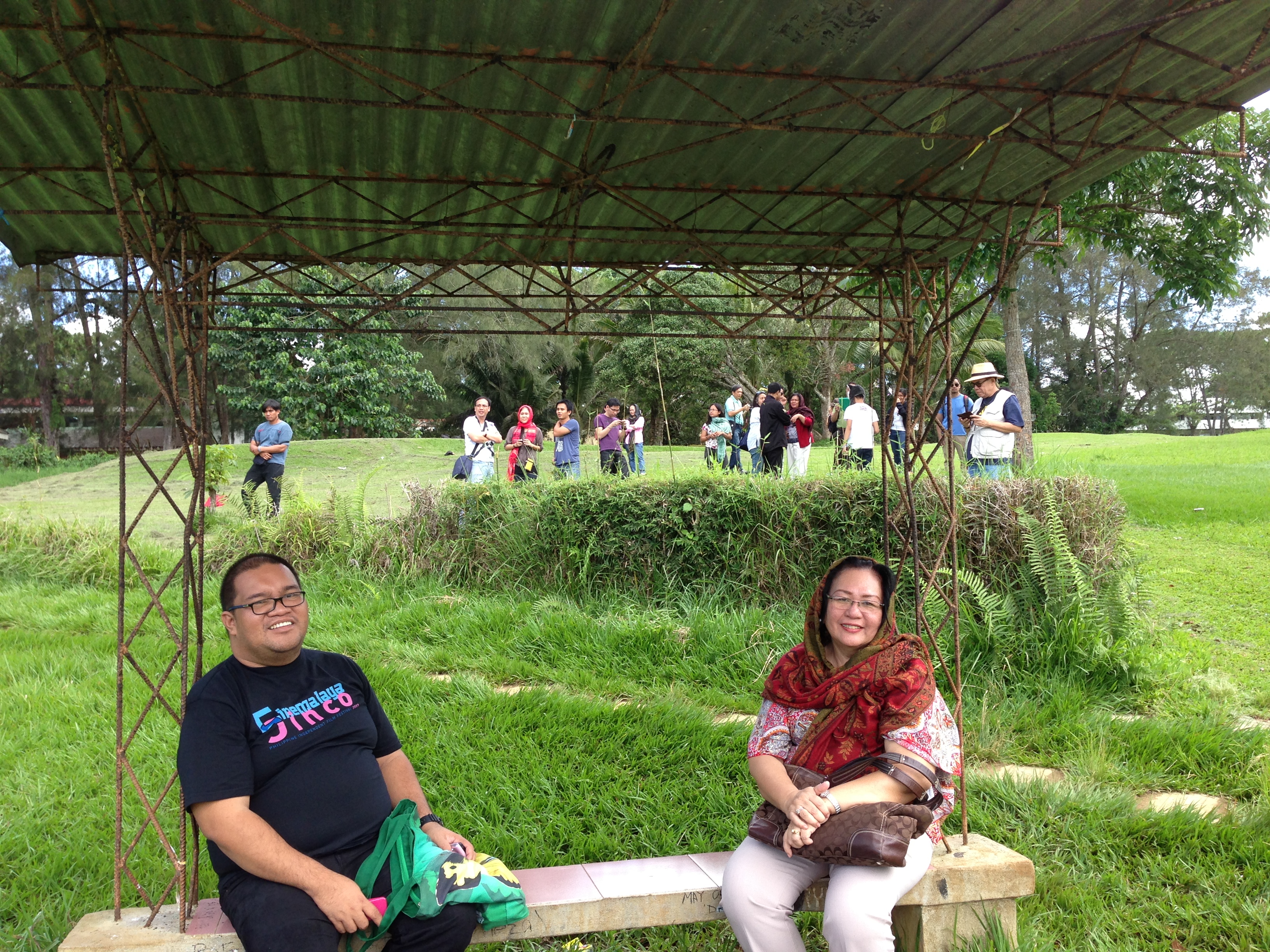
I’M HERE in Dumaguete City for Taboan, otherwise known as the Fifth Philippine Literary Festival, an annual gathering of writers from all over the archipelago, and even a few parts beyond. Dumaguete, of course, is inextricably linked with Philippine literary history as the home of the first and longest-running writers’ workshop in the country—the Silliman Writers Workshop, based in Silliman University—which explains its proud and rightful claim to be the “City of Literature.”

Scores of the country’s finest writers, especially in English, have passed through Silliman’s portals (in Silliman’s case, these are real portals, as iconic and as symbolic as the Oblation is to the University of the Philippines), thanks largely to Edith and Edilberto Tiempo, who started the workshop in 1962 after their return from the United States. I myself might not have thought of going back to school after having dropped out for ten years and of taking up fiction seriously after laboring as a playwright if it hadn’t been for the Silliman workshop, which I attended in 1981.

So holding Taboan in Dumaguete was in many ways a logical homecoming, and the fact that festival director Dr. Christine Godinez-Ortega (who now teaches at MSU-Iligan) is a Silliman alumna helped things along immensely. The university administration and the city government were very supportive, and the festival began on an appropriately celebratory note with a parade around the city on Thursday morning, led by National Artist Bienvenido Lumbera.

But it was the keynote address delivered shortly after by the Cebuano scholar and writer Dr. Resil Mojares that best reminded me why it’s important for Filipino writers and academics to go out of Manila and listen to what the rest of the nation has to say if writers are to help in achieving that sense of nationhood that’s eluded us for ages. Resil—whose level-headed scholarship and clarity of thought I’ve always admired—spoke on “The Visayas in the National Imagination” (there was some confusion about the topic, but in the end it didn’t matter).

He spoke of how complicated the writer-nation relationship can be: “A writer’s relationship to his or her country cannot be one of blind faith or easy self-love. I think there is much in what the Peruvian novelist Mario Vargas Llosa says about his relationship to his native Peru that we can recognize as our own. ‘For me,’ Llosa says, ‘Peru is a kind of incurable illness and my relationship to it is intense, harsh, and full of the violence of passion… [a relationship] more adulterous than conjugal… full of suspicion, passion, and rages.’ Yet, for all these, Llosa confesses to a ‘profound solidarity’ with the country. He says: ‘Although I have sometimes hated Peru, this hatred, in the words of the poet Cesar Vallejo, has always been steeped in tenderness.”

That relationship can get even more difficult when the writer feels like a stranger or second-class citizen in his or her own country, as a writer working outside the national center might be made to feel. This dichotomy between the “national” and “local” (or “regional”) writer has been a longstanding point of concern and conflict in Philippine literature for which there have been no easy answers. Dr. Mojares couldn’t have illustrated the problem more clearly than in this excerpt from his keynote:

“Perhaps we have to bow to the historical fact that it is where power is accumulated and concentrated that the ‘nation’ is most effectively imagined. It is where the ‘local’ ascends to the level of ‘national.’

“The literary situation today is that writers and works have to be recognized in Manila for them to acquire the status of ‘national.’ The center exercises the power to canonize and consecrate. A Cebuano writer who publishes in a ‘vernacular’ magazine with a circulation of 30,000 is merely a ‘local’ writer, while one who publishes a book of English poetry in Manila with a print run of 750 copies is ‘national.’ So effective is Manila’s consecrating power that a writer may start out in Dumaguete or Davao but Manila is where he hopes to ‘arrive.’ Dumaguete may be the ‘city of literature’ but it is not its capital.

“Some years ago, the poet-and-critic Virgilio (Rio) Almario asked me—with a hint of mischief and challenge—‘Where’s the new Cebuano poetry?’ I did not have a ready answer but assured him that there was a great deal of fresh, exciting work being done by young Cebuano poets. But Rio’s question did tell me that much of today’s Cebuano-language poetry—that circulates in manuscripts, poetry readings, small local publications, and Internet blogs—remains largely invisible outside of Cebu and Cebuanos, and that we (Cebuanos) have been remiss in defining and projecting to a wider audience what in this poetry is distinct, different, and deserving of ‘national’ attention. Yet, the encounter with Rio did remind me that indeed one has to be consecrated by readers and critics like Rio for one to acquire the status of ‘national.’ I say this without malice. Rio is a friend. But such is the politics of recognition.”

The discussion got even more lively in the plenary session following Resil’s talk, which was devoted to the topic of “Your Place at the Writers’ Table,” around the idea that while a national literature should ideally be inclusive, many writers still felt left out—not just because of the cultural and political distance between the center and the margins, but also because of the generational divide, and perhaps even of sheer snobbery on the part of “established” writers unwilling to yield ground to younger, fresher talent.

I’d meant to keep quiet and let others do the talking, but was prodded for my opinion on this “insider/outsider” argument, which I understand had been a hot topic online. Not being on Facebook, I caught on to it late, and composed a response that I circulated privately, from which I’ll quote:

Small as it is, Philippine literary society is indeed ruled in a way by cliques, barkadas, orthodoxies, and prescriptions. In some cases, these institutions and conventions may have made it difficult for new, alternative, and dissident voices to emerge and be heard.

I myself will indefensibly admit to being part of this ruling elite—I suppose by default, being the director of an institute of creative writing, a professor of literature, and a member of an NCCA committee that gives out grants. I’ve done well by the system (Silliman workshop, CW degree and MFA, Palancas, etc.) and the system, I think, has also done well by me.

But all this doesn’t mean that my mind is closed to new ideas or that I will shoot them down when I get the chance. Within the system, I have voted and even argued for writers and kinds of writing I personally don’t prefer, because I remain aware of what’s at stake, which is much larger than what I like. I have voted down my friends, denied them grants, and brought in people left out in the usual pollings , again because—as an old-time, squishy, hand-wringing liberal—I believe in fair play, imperfect as any cultural or political regime will always be.

By and large, the system works, if getting ahead the usual way is all you want: join a workshop, write like your mentors, win a few prizes, publish a book or two. But I keep reminding my students that this isn’t the only way to writing fulfillment and happiness, and that they’re free to choose other paths and listen to other gurus—but also, and again, that the alternatives won’t be easy. We all make our own choices—but we should do so with full self-awareness, mindful of the costs and benefits to ourselves and to society.

How important is writing to you? Whom or what do you write for? What do you expect to get out of writing? How do you want to be seen or remembered by others through your writing? I’ve answered all these questions for myself—the bottom line is that writing is my livelihood and profession; I’m less a romantic than a realist—but I can’t hazard an answer for others. As a member of the barkada, the best I can do is to enlarge the table and to bring others to it—if they even want to be there, in the first place; if they don’t, well, perhaps they shouldn’t mind too much if we dine in peace and enjoy each other’s company—and maybe even manage to write a good book or two on the side.

Penman No. 31: The (Ink and) Paper Chase

Oxblood

Penman for Monday, January 28, 2013

ONE THING that fountain pen fanciers rather quickly realize is that their obsession (read: expenses) won’t end at buying another Parker, another Sheaffer, or another Pelikan. You can have bread without butter, or even without coffee on the side; but you can’t write without ink and paper, so that anyone who habitually buys and collects pens soon metamorphoses—even without meaning to—into an ink and paper hoarder as well.

Indeed, inks and papers have become collectibles on their own, and not necessarily together. I have friends who couldn’t care less about pens, but for whom the sheer texture and even the faint aroma of paper can trigger paroxysms of pleasure. These are the people who seek and haunt stationery and art-supply shops, pawing through exotic papers from Thailand, Japan, and Italy, paper that might not even end up being lettered on but pressed into some other service. (And while we’re on this subject, please, please never say “stationary” to refer to writing paper; it’s “stationery” with an E, referring to “stationers”—the people who, in medieval times, sold books in fixed places, as opposed to peddlers who went around with their wares.)

My wife Beng, a watercolor painter and professional art restorer, has one such mecca on 3rd Avenue in New York City, on the second floor of which, up a steep flight of stairs, can be found an astounding array of the world’s finest art papers. But when she visits, Beng’s not looking for paper to paint on; instead, she wants a delicate, silk-like paper made in Thailand that she can use to lay over and stabilize patches of paintings where the paint has begun to flake off.

Forty years ago, when I worked briefly as a printmaker (another of the many hats I’ve worn—and I still wear them now, the real ones!), I too rhapsodized over art paper—the thicker and creamier the better—and on good days or for special jobs, I’d splurge on Strathmore paper, whose texture somehow made any print I designed, however poorly, look rich.

Indeed, it seemed rich of me to get so picky about my papers when, just a few years earlier in my mid-teens, the only paper I knew and cared about was bond paper (the kopong bond we bought at the corner store for 5 centavos a sheet), ruled pad paper for school, and yellow legal pad paper. For special purposes, there was oslo paper and onion skin, and maybe when we got moony we bought some fancy stationery at the bookstore (mine had a picture of the Beatles on every sheet) to write the crush of the moment on (yes, all I’ve ever had in my meager arsenal all my life has been words, words, words).

I still look for good paper these days, but it’s no longer to woo the wenches with (better not, says Beng) nor to pen my next novel on, but simply to test my nibs and inks, like a driver might look for a pristine stretch of track on which to lay some nasty rubber.

And what’s to like and not like about paper? While many kinds of paper—especially the smooth ones—may all look the same from the top, on the microscopic level, they could vary a lot, in terms of the makeup of the fibers and how closely they’re packed together. That means that when the ink flows out of the pen’s nib and gets onto the paper, it will either hold together and more or less stay in one place, or spread out like mad through spaces in the fibers and saturate the paper in such a way that the ink will bleed through, or be visible from, the back side of the sheet.

This latter process is called “feathering” and “bleeding.” You’ll know that your paper feathers when the line you write quickly becomes thicker and fuzzier, sometimes to the point that the letters become hard to read; bleeding or bleed-through, on the other hand, is obvious when you turn the page over and can see the ink. Feathering, I think, is worse than bleed-through; at least you can write on just one side of the paper and still have something crisp and clear, but paper that feathers horribly will leave you with one big blur.

As a general rule, cheap paper—thin, with loose wood-pulp fibers—will feather and bleed. More expensive papers, such as those that use linen, will tend to be thicker and more compact, and therefore offer a more pleasant writing experience. A simple pad or notebook could cost many hundreds of pesos, especially if they sport leather covers and other accoutrements.

In our pen club, the Fountain Pen Network-Philippines, members are forever on the hunt for good but affordable writing paper, even as we may indulge ourselves in the occasional pad of proven performers like Clairefontaine and Rhodia, available in some local bookstores. One sad and surprising discovery that fountain-pen users make early enough is that the iconic Moleskine notebook—whose design I love and have offered whole essays to—isn’t fountain-pen-friendly at all, showing awful feathering and bleeding.

Thankfully, many alternatives to (and copies of) Moleskine now exist, some dearer and others cheaper. A recent experience of mine seems to prove a point. Feeling more expansive than usual on my birthday, I went to the bookstore and spotted a very handsome-looking, leather-bound Jadeco notebook with what appeared to be excellent paper; the tag price of nearly a thousand pesos made me gulp, but what the heck (as I often rationalize these days), at 59 I can excuse anything. I picked it up, paid for it out of my birthday budget, and soon confirmed my expectation that the paper would hold up well to runny fountain-pen ink. The following day, on another sortie to National Book Store, I saw a small spiral notebook (that’s all it says on the kraft-paper cover: “Notebook”) that cost all of P28; on a whim, I bought that, too, and discovered to my chagrin that it performed almost just as well as the Jadeco. I would later learn from friends that some good compromises can be found in the middle of these extremes; I found another one myself a week later, at Fully Booked, under the brand-name Schützen—a regular-sized spiral notebook for P285 that didn’t feather and bled just minimally.

This brings us to inks, which really deserve another column-piece on their own (which I’ll do some other time). Let’s just say for now that inks can even be more bewildering and exhilarating than paper, given the seemingly infinite range of colors and hues you can produce from a mixture of water and pigment. Some inks are also thicker and more saturated than others; some are permanent, and others washable. Some specialty inks, like De Atramentis, can even carry the scents of fruits, flowers, and wines.

I’m not a very adventurous person ink-wise, and for the longest time wrote only with black, blue-black and brown inks; green, bright blue, purple, and red (not to mention yellow and orange) were simply out of character for me. They still are, but I’ve since nudged my range a bit to include Diamine Oxblood (a robust maroon) and Rohrer & Klingner Sepia (a greenish gray reminiscent of old manuscripts) in my small stable. I’m still on the hunt for the perfect blue-black, alternating between the Parker, Pelikan, Montblanc, and Lamy versions. Most days, I just liberally mix things up, turning my desktop into Inkspot City. (Better than alchemy, drop in at Scribe Writing Essentials in Eastwood Mall for a plethora of inks such as J. Herbin, not to mention many fine pens.)

Do take note that the final appearance of your ink will depend not just on chemistry, but on the paper quality, and also on the pen and the nib you use—a wider nib like a stub will deliver a thicker line that shades beautifully as it moves along; that’s what sends pen pushers into seventh heaven.

And what do I write with these exquisite implements? Aside from the occasional signature, absolutely nothing meaningful. I’ve come to realize and to accept that this is how I relax and make myself feel good: by taking hold of a pen worth what someone else more practical might have paid for a fridge or a flat-screen TV, and doing nothing more with it than doodling for hours on premium paper. I liken it to driving around on a lazy weekend to nowhere in particular, just enjoying the scenery and the sweet hum of a perfectly tuned engine. Such are one’s pleasures on the doorstep of one’s dotage.