Penman No. 185: Wired for Fun

IMG_7932.jpg

Penman for Monday, February 1, 2016


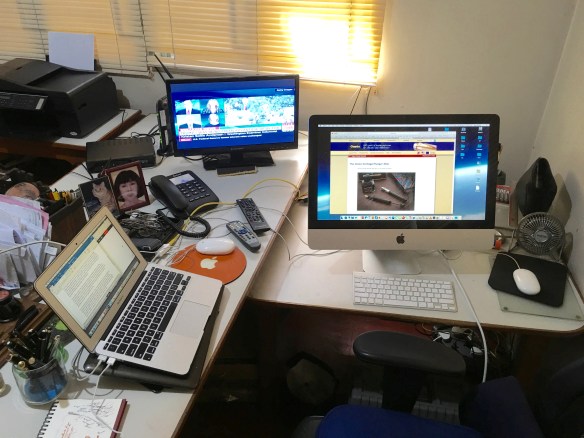
SOME INTERESTING changes took place in my home-office environment over the recent Christmas break. First, as a gift to the household, especially my movie-loving mom, I got a multi-user subscription to Netflix. Second, because of Netflix, I signed up with a lifetime Virtual Private Network (VPN) service, which, among other benefits, allows users to watch US-based offerings (like Netflix, which very recently opened a limited Philippine operation, largely dispensing with the need for VPN). Third and perhaps most importantly for the long run, I ramped up our Internet connection, from the old 5 Mbps to a whopping 100 Mbps fiber-optic line that had just become available in our Diliman neighborhood. The setup then prompted me to acquire an Apple TV unit, which streams Netflix shows, among others, from the Internet to your HDTV set, completing the home-movie experience (well, throw in some popcorn and Coke for the full effect).

If you’re not too tech-savvy and if I’ve left you hopelessly confused by that exasperatingly jargon-laden paragraph, let me unpack it for you, as I’d explain it to someone like my mom. (I should add that my mother is unlike most 87-year-olds. She doesn’t have a computer, but she’s otherwise glued to four devices—her TV, her iPhone, her iPad, and her Android tablet. She loves playing vocabulary and bubble-type games, which keep her brain cells humming, on top of the 20-minute walk she takes every afternoon.)

“Home office” refers to the fact that over the past three decades, with the rise of the Internet and indeed its indispensability to modern living, more people have been able to work at home, or to bring much of their work home. I teach at the university, but most of my writing is done at home. My wife Beng also has her art-restoration studio at home. This means that we have to invest in equipment and technology that will allow us to get our work done, and done well, right where we are.

For me, that means several computers—I use a small MacBook Air as my main workhorse, portable but powerful, with a very fast processor and a large hard drive; for a backup, I have an older, larger MacBook Air, a bit slower, but good to have around just in case the main machine falters or is in repair; I also keep an iMac on another desk for when I need to see larger images, or to have fun surfing (or playing online poker) while I work. Yet another screen is almost always open at my desk: a tabletop TV, on which I keep up with the news.

All that hardware would be of little use without a fast and reliable Internet connection, and here I was lucky to be living in an area now covered by PLDTFibr, which ran a promo over the Christmas break offering a 100 Mbps service for six months (it’ll slide back down to 50 after six months, but you can’t sneeze at 50 Mbps either—and no, I’m not getting anything from the company for this plug, not even a coffee mug).

What does “100 Mbps” mean for the consumer? Webpages load in a snap, instead of crawling down the screen as some circular icon keeps spinning; you can download a 1-gigabyte software update in minutes rather than hours or overnight, as I used to be resigned to; and you can upload large files, say to DropBox or YouTube, without having to knit a doily while it loads. Is it expensive? It cost me only P500 more to level up from my old 5 Mbps service from another provider, which I had been a faithful client of for over ten years.

The best beneficiary of a fast Internet connection, however, is streaming, which is the way those who sell movies and music, like the iTunes Store and Netflix send you their material over the air—in one continuous flow, like you were watching a movie at the theater. But that’s more hopeful than achieved for most Pinoy consumers, because, as of a year ago, the Philippines had the third-slowest average Internet speed, at about 2.8 Mbps, in Asia, according to the folks at Akamai, who keep tabs on these things (No. 1 Korea averages 23.6 Mbps).

That means that your screen will very likely freeze just when things get really interesting in the movie, as your provider struggles to bring up the rest, like those guys who ran reels between theaters in the old days. (Lilia Ramos Shahani wrote a great piece on this for the Star, “Why Is Our Internet So Slow?” last August.)

And there’s nothing better to do with streaming than watch movies and TV shows from where they’re stored—the servers of US-based Netflix, for example, which we used to be able to access only through VPN. (Netflix didn’t want people in countries it didn’t serve—like the Philippines, until recently—to see Netflix shows. The Internet being what it is, some smart folks found a workaround, VPN, which tricks the Internet into thinking that you’re in Tampa, Florida instead of Tuguegarao, Cagayan.) There’s been a lot of argument over whether VPN-enabled Netflix is illegal, but it isn’t piracy—you still pay for Netflix, but are simply diverting its stream to your barong-barong. (I pay about $12 or less than P600 a month for a four-user license.)

That argument is now moot, as Netflix has officially added the Philippines to its serviced countries, albeit with a thinner menu; you’d still need to turn on your VPN to get the full US package (Netflix, however, has rethought its toleration of VPN, so that option might not last. I’m not too bothered, as I value VPN more for the PBS documentaries I like to watch on my iPhone in some traffic jam or over long, boring meetings. VPN is also good for your digital security, masking your real IP address from snoopers.)

The piece de resistance in this upgraded setup is the Apple TV, a small black box that uses wi-fi and your TV’s HDMI port to let you enjoy Netflix, YouTube, and other Internet video—even your own library of movies, music, and photos—on your big TV, instead of squinting at them on your phone or laptop. It isn’t cheap—the gadget costs a bit less than P9,000 for the basic fourth-generation model—but there are alternatives. Chromecast, a thumb-sized thingy made by Google and marketed by Globe for about P2,000, will hook you up to Google Play Movies, YouTube, Spotify, and other entertainment fare.

I’ll admit, it’s hard to think of work when you’re this wired for fun, but you can also say that this what makes all that work worth it—digital Disneyland at the click of a remote-control button.


Penman No. 180: Escapade in Bohol

IMG_7630.jpeg

Penman for Monday, December 28, 2015


YEARS AGO I made a promise to take my wife Beng to all the beautiful places in the world I’ve been, so we’ve been traveling up a storm, flying off to whatever destination our aging knees and limited budget can still afford. The pre- and post-Christmas break is a great time for escapades like this, and we’ve run off to Shanghai and Beijing in Decembers past, availing ourselves of budget fares we’d booked months ahead for the privilege of slurping hot noodles in the freezing cold.

This year—encouraged by another irresistible combo deal on airfare and a good hotel—we chose to go down to Bohol. I’d been there a couple of times before on business and Beng and I actually found ourselves stranded there once, overnight, because our Dumaguete-bound ferry couldn’t make it through a frightful storm, so this time we decided to do a proper tour of the place, mixed in with a bit of work we both had to catch up on.

IMG_7627.jpg

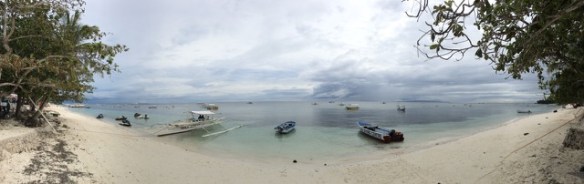
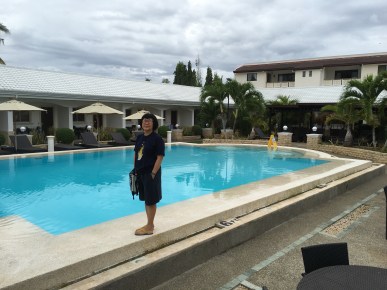
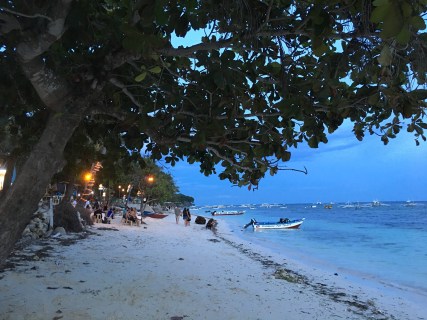
We were lodged at the mid-range Panglao Regents Park Resort, about a 30-minute ride from the airport and a short walk to Alona Beach, a focal point not just for swimming and food but also for the innumerable dive shops that cater to showcasing Panglao’s top attraction, its underwater life. Being sedate and sedentary seniors, Beng and I contented ourselves with sipping cool mango shakes and watching the scenery, but there’s never a dearth of interesting things to look at in Bohol, whether beneath the sea or aboveground.

IMG_7618.jpg

We signed up for two tours: the “Chocolate Hills” tour, which takes you on a daylong ride around the island for an eyeful of its most scenic spots, and the “island-hopping” tour, which promises an early-morning rendezvous with dolphins, snorkeling and lunch at Balicasag Island, then a short detour to Virgin Island. Seasoned travelers may disdain these one-size-fits-all tours, but Beng and I never do, knowing that they’re pretty efficient and often good value for money for first-time tourists, and that ultimately it all depends on knowing what to look for, and knowing how to appreciate what you’re looking at.

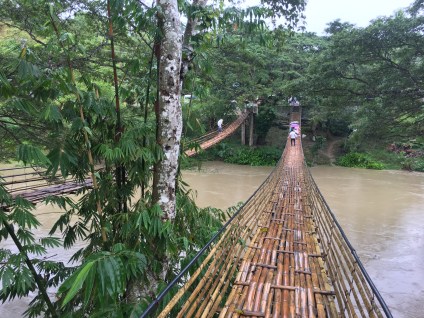
It was a rainy day when we headed out for the Chocolate Hills, so the tarsiers were huddled under the branches and the hills themselves were shrouded in mist, but I took the rain in stride, seeing how it lent a certain freshness and vividness to things, and I could sense the earth exhaling after a long dry spell. The tour guide at the butterfly farm led us along with deft humor, making even dead insects come alive, and we gamely crossed the Hanging Bridge, to and fro, like schoolkids on a dare.

IMG_7658.jpg

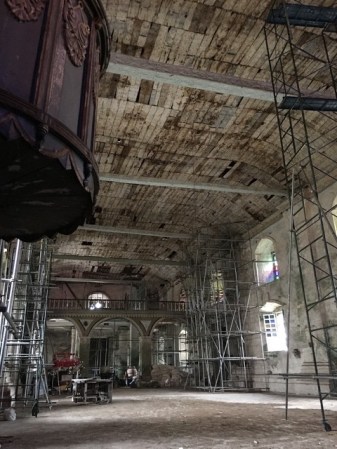
I had visited the old Loboc Church before an earthquake devastated it a few years ago, so I was sad to see it covered in scaffolding, awaiting restoration. What I didn’t expect to be more deeply moved by—not being a regular churchgoer (I pray every night, but have quarrels with dogma)—was stepping into the Baclayon Church, which I had missed on my first visit. Its altar—a main retablo framed by two smaller ones—stood intact and as majestic as ever, and washed in orange, green, and blue light seemed ethereal. But behind a red cloth curtain and the yellow “Caution” warnings gaped what used to be the nave, a cavity that in the 1800s must have throbbed with pious energy, as well as with the flutter of fans and the murmur of courtships, disapprovals, and ungodly gossip.

IMG_7667.jpeg

IMG_7674.jpg

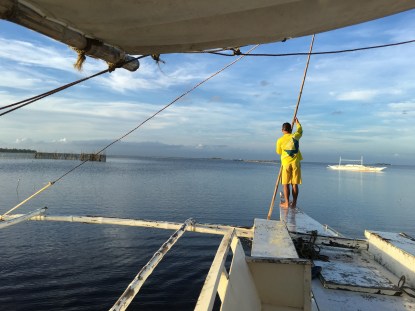
We set out for our island cruise at 6 am the following morning, and much to Beng’s relief the sky was clear and the water was silvery smooth. We shared our large banca with two women from Canada and another from Germany, our banter laced with the anticipation of meeting our goal for the morning: finding dolphins in the open water. I knew from previous reading that several species of dolphin and whale could be found in the Bohol Sea, but I would have been happy to spot any one of them. Dolphins feed in the morning, until about eight, so it was important that we head out quickly enough, also given that about half a dozen other boats were in the same area for the same reason.

IMG_7692.jpg

Our boatman, whom we’ll call Dencio, was an experienced spotter (more on his story later), and soon enough, about 30 minutes out of port, he pointed to our right, where two gray and shiny heads bobbed in and out of the water—our first of several sightings. Dolphin and whale watching is the sort of thing a CIA analyst would be good at—discerning, from the seemingly immutable pattern of cresting waves and foamy wavelets, the odd leap of a creature into the air. The Risso’s dolphins we saw (the Flipper of TV fame was a bottlenose) broke out out in pairs and trios, but for every one of them that surfaced, we were told, there were many more underwater. Dencio pushed out his boat much farther than the others did, and for a long while it felt like we were simply drifting toward Siquijor, but just as I was about to give up, I noticed a commotion in the distance—a pod of maybe a dozen spinner dolphins frolicking in the air. The whole boat came alive with glee and Dencio tried to give chase, but we were going against the waves, which had become too choppy, and the shiny caravan of fins and flippers vanished into the horizon.

IMG_7721.jpg

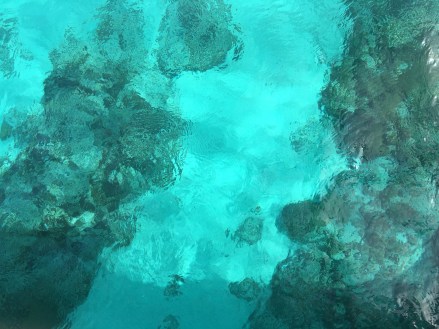
Balicasag Island is where the divers go, and was our midday stop. While our companions snorkeled in the fish sanctuary and watched giant turtles feeding on the sea grass, Beng and I ordered lunch (fresh fish, of course, broiled and kinilaw) and listened to Dencio’s story: “We used to hunt whale sharks,” he said, “and would kill two of them a day, baiting them and catching them with large hooks.” (This hook called the pamilac lent its name to Pamilacan Island nearby.) “We sold them very cheaply, not knowing that in Japan, a whale shark could sell for about half a million pesos. We could have been millionaires! We did this until a TV crew filmed what we were doing, and then a ban was imposed, so now we don’t catch whales anymore. Today you can find very large ones swimming under your boat. They’re very smart, and can sense danger. Sometimes they look straight at you with their eyes.”

On the ride back to Panglao, we stopped by Virgin Island (renamed Isola di Francesco by its private owner, who has turned the island into a religious shrine)—little more than a long curling strip of white sand with a clump of trees on one end, but serene and restful, a fine ending to a colorful day. Or rather, make that ending a Thai massage, a grilled seafood dinner, and a cold beer.

IMG_7733.jpg

“They’ll burn in the sun,” Beng had remarked of our European companions, who took every opportunity to swim and to laze in the tropic heat. “That’s because they’ll be flying home in a few days to an icy winter,” I said, “while we just have Manila’s traffic and pollution to deal with.” Sounds like a good reason for another escapade.

Penman No. 179: Pedestrian Pleasures

IMG_7589.jpg

Penman for Monday, December 21, 2015


THERE’S NOTHING better we’d like to do on a weekend—unless we’re running off to some southern island or parts beyond—than to have a foot massage from our suki Tonton branch on West Avenue before taking in a movie and a Chinese or ramen dinner at Trinoma. In fact, we don’t even wait for the weekend to indulge ourselves in these pedestrian pleasures, but do this routine on a Tuesday and then again on a Thursday, whenever the spirit moves us.

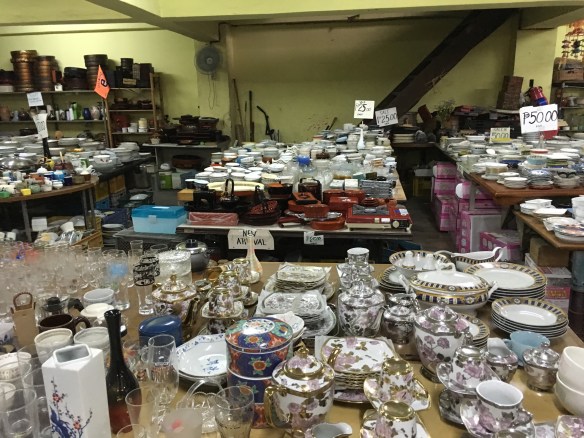
Every other month or so, we do something special—we go down to Sta. Cruz (my students no longer have any idea where these districts and streets around Quiapo are), have a fried-chicken lunch at Ramon Lee’s, then check out our favorite ukay-ukay and Japanese-surplus shops on Avenida Rizal, happily carting home several bagfuls of glorious junk, with as much pleasure as we would’ve gotten from the flea markets of New York or Paris.

Beng and I cheerfully acknowledge that this must be one of the signs of aging—settling into a fairly small and thoroughly familiar comfort zone, and stepping out of it just often enough to keep things lively and to refresh the horizon. Or maybe I’m mainly speaking for myself, because Beng’s always been far more adventurous than me, especially culinarily speaking, and now and then exhales a wistful longing for some Indian food (which flusters me, because I can’t stand curry, recognizing only salt, pepper, garlic, onion, and soy sauce in the kingdom of spices and flavors).

The simple explanation is, ours is a generation used to walking a lot. And it wasn’t as if we had a choice. We grew up without cars—the richer kids had them, but not us—and even getting to the jeepney or bus stop meant walking. I remember, as a boy of nine or ten, walking from our rented place on Halcon Street along Boni Avenue in Mandaluyong to what was then Highway 54 (EDSA to you younger ones), crossing the highway, and then taking the bus to Gilmore Avenue, crossing the highway again, and walking several blocks to La Salle Green Hills (“Greenhills” was spelled as two words then)—lugging my heavy bag of books and notebooks, whose cheap unpadded leather cut into my hands. In the afternoon, I would do the same thing all over again, in reverse, unless a chauffeured classmate took pity on me and gave me a ride.

But as torturous as that routine was, it was nothing compared to the literally kilometric walks that our elders took. One of my favorite walking stories is that of the late NVM Gonzalez, who walked many kilometers from their barrio in Mindoro to the poblacion, where he could type his manuscripts in the municipio, making the long trek back in the afternoon (and when his contributions returned months later, rejected by some editor, his father would kid him and say, “Your stories are like homing pigeons!”). That’s a story I like to tell my writing students, who—with the fanciest computers and the Internet at their fingertips—will still sometimes complain about not having “enough material” or “enough time” to produce their first drafts.

Another story I recall having read somewhere involves Bienvenido Santos and Diosdado Macagapagal, who—as students of the University of the Philippines back when it was just on Padre Faura Street in Manila—walked to school together from their lodgings in Tondo. And until his death some years ago, my uncle Juan, who must have been in his nineties, thought nothing of walking the seven kilometers of mountain road between his home in Guinbirayan to the poblacion of Sta. Fe in Romblon, just to deposit the cash in his pocket to his savings account.

I myself took to walking for my health a few years ago when I was diagnosed with diabetes, and had to undergo a radical lifestyle change. Three or four laps around the UP Oval every day, Broadway blaring in my ears, quickly took care of the problem; I lost 45 pounds in five months (some of which I’ve regained since then, but my blood stats still look good).

But walking, of course, is never just a chore and never just exercise to the willful and the observant. I’ve used my long walks around campus as thinking time, composing paragraphs in my head, mulling over turns of phrase and gentler ways of expressing unpleasant truths (the sad corollaries of holding an administrative post). I enjoy the scenery—both natural and human—and store striking details, scenes, and vignettes in my head that I can use for my stories. Once, walking towards the Carbon market in Cebu, I found myself on a street full of sellers of cut flowers, in the midst of which emerged a dark, wiry man, bare from the waist up, heaving over his head a huge basket full of red roses—a veritable Charles Atlas, bearing the weight of all that beauty. That haunting image became the germ of a story I would title “Delivery,” the tale of a lie and its terrible if unintended consequences.

And many of my sharpest memories of my foreign sorties are from long walks taken on fabled boulevards and strange alleyways, very often leading to unexpected discoveries off the tourist guidebooks: a pen shop in Edinburgh, a Filipina hotel worker taking a quick puff from a balcony in Como, a pair of fierce guard dogs prowling the perimeter of a mansion in Johannesburg, beneath a copious spray of jacaranda blossoms.

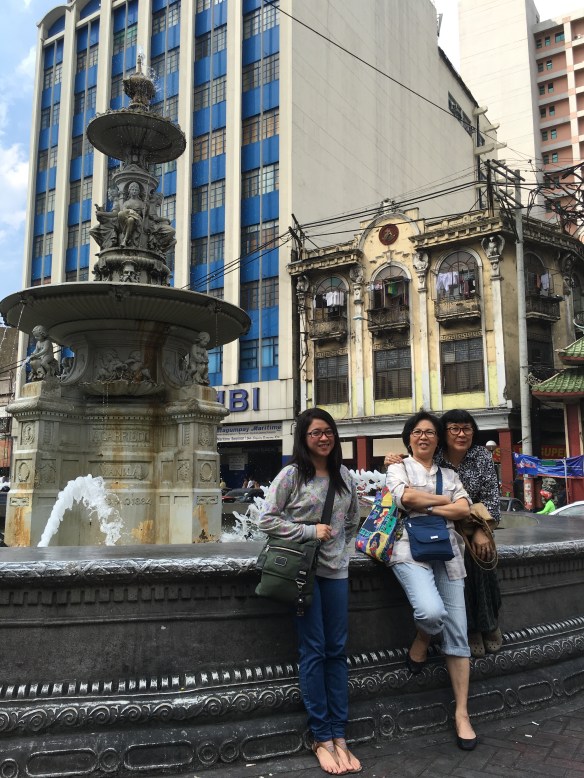
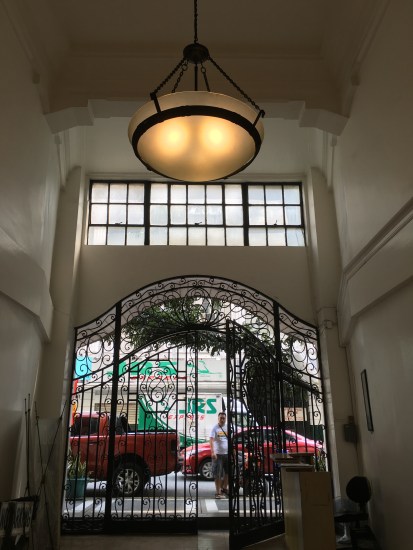
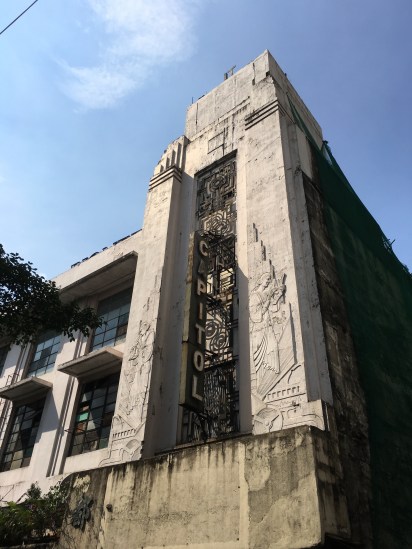
So it was in this quest of adventure that Beng and I took her sister Jana and our niece Eia on a walking tour of downtown Manila a couple of weeks ago (a zone my friend Krip Yuson affectionately calls “the armpit of the city”), to reacquaint them—newly returned from many years in New York—with home, in all of its bewildering, exasperating, ammoniac intensity. We took them to our Japanese-surplus suki on Avenida and then to lunch at Ramon Lee, before essaying Escolta and the Art-Deco innards of the First United Building; we lamented the loss by fire of the old Savory Restaurant, but pressed on to Chinatown for bagfuls of hopia and ma chang (sampling the goodies both at Polland and Eng Bee Tin) before turning into Ongpin and re-emerging into Sta. Cruz and its amalgam of gold and grime.

It was a day well spent, much of it on foot, and while our soles may have complained, our spirits tingled with reawakened excitement.

IMG_7583.jpg

IMG_7591.jpg

IMG_7596.jpg

Penman No. 177: Compress, One More, Wacky!

IMG_6071.jpg

Penman for Monday, December 7, 2015


GET SEVEN or more Pinoys together for a group photo and you’ll invariably hear this mantra: “Compress! One more! Wacky!” To the uninitiated foreigner—already surprised by our propensity to grab them by the arm for a quick and giggly shot—they’re orders that demand translation, so here goes:

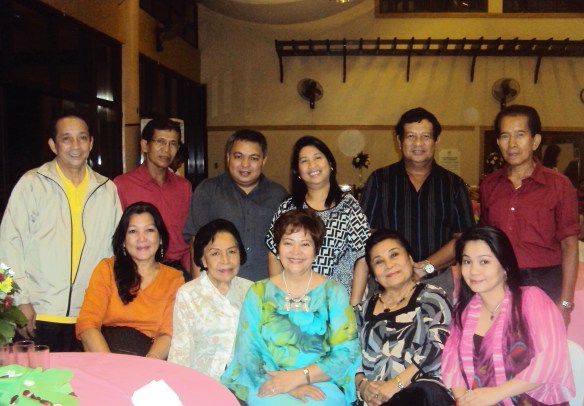
“Compress!” technically means that not everyone can fit into the shot and that everyone should therefore squeeze together, at which point people will take a deep breath and turn sideways, turning a 40” midsection into what they imagine is a svelter 38”. This process can morph into a quick trip-to-Jerusalem rearrangement of the subjects, if the hold-your-breath trick doesn’t work. “Small ones in front!” or “Kneel! Kneel!” will be the next order of business, followed by a flurry of to-ing and fro-ing, and split-second negotiations over who’s taller than the other by half an inch, or whose knees can take the bending.

“Compress!” can also mean some young swain’s opportunity to snuggle up to an unsuspecting loved one. But even without the side benefit of romance, “Compress!” manifests the Pinoy’s sense of personal space, which is to say, ”I’ll let you dig your elbow into my rib cage, or touch your knee against mine—but I warn you, go no further, lest you think me immodest!”

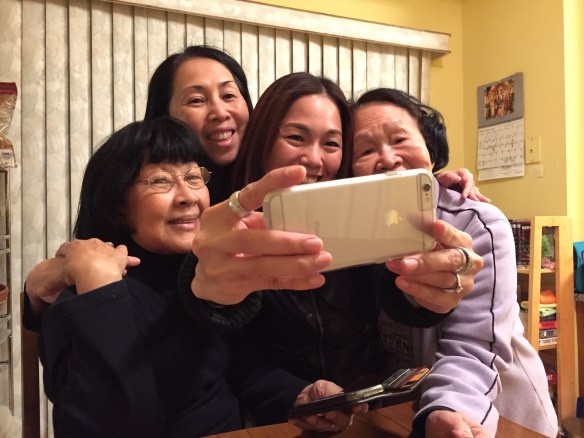
The coming of the selfie—or more precisely, that new word I picked up from a book launch last week, the “groufie”—has made compression even more necessary than ever—which, let’s admit it, is a lot more fun than the scientific solution, which is to get a wider-angle lens.

“One more!” reaffirms the Pinoy’s fatalistic conviction that something will surely go wrong and that the first shot taken will prove to be a bad one, or will mysteriously vanish into some dark photographic abyss, from which no memorable snapshot ever returneth. This seems to have been more likely to happen in the bygone days of film, when everything from a faulty sprocket to invasive sunlight could spoil the most carefully posed portrait. But the onset of digital photography has clearly offered no measure of assurance to the Pinoy, who remains deathly suspicious of solitary shots, and who will scream, from the back of the pack, “One more!,” as if the course of history depended on the preservation of that instant.

And so the photographer dutifully fires off a few more shots, giving the subjects a chance to modulate and modify their poses and expressions—more often for naught, because the Pinoy’s fatalistic conviction that something will surely go wrong just happens to be correct, and the camera almost always takes the shot at the worst possible millisecond, when one’s mouth is half-open or one’s eyes are half-closed. This foreknowledge, seared by experience into the Pinoy’s subconscious, likely accounts for the multiplicity of shots taken at every occasion, and “One more!” is never meant to be taken literally, but rather to resound like an echo.

Let’s not forget the equally inevitable complication to this phase. Just when it seems all the angles have been exhausted and the smiles have dried on people’s incisors, some latecomer—who had been blithely chatting away on her cellphone across the grounds, in full view of the pictorial entourage—just has to make a mad dash across the grass, yelling, “Wait! Me, too!” And being the world’s most hospitable people, Pinoys will invariably accommodate the catcher-upper with a frozen smile, even as their eyes glare at her like live coals. And having wedged herself into the frame with a cheery sigh, Ms. Latecomer, of course, will have every right to demand “One more!”

“Wacky!” is probably the most perplexing word in the vocabulary of Pinoy photography for the foreign observer. “Compress!” and “One more!” at least make practical sense, but the command to go “Wacky!”—sometimes given in dead seriousness by some phlegmatic photographer—taxes Occidental logic. To visitors who’ve never witnessed it—meaning, you haven’t been here for more than 24 hours—“Wacky!” means assuming some ridiculous stance, or putting on a clownish face, the permutations of which are theoretically endless, but which typically reduce themselves to tongues stuck out, googly eyes, hands like Mickey Mouse ears, and poses like zombies or broken marionettes.

It isn’t all that strange when the subjects of the “Wacky!” shot are fifteen years old and younger—after all, it’s second nature to juveniles, who don’t need to be asked to act like they were, well, kids. It approaches the bizarre when—say at the closing of the 16th Annual Meeting of the Southeast Asian Society of Gerontology or of the National Consultative Assembly of Tripartite Wage Boards—grown men and women in shiny barongs and power suits are exhorted to do their “Wacky!” best, and deliver on demand.

Professional anthropologists and sociologists (who do the same thing at their conventions, for certain) will have a proper explanation for this behavior, but it can’t be too far-fetched to surmise that the photographic display of Pinoy wackiness is meant to be a healthy release of our inhibitions, even a democratizing gesture of self-effacement and bonhomie. It’s good to look and feel silly once in a while. Never mind that, given our itch to socialize, to see and be seen, “once in a while” happens three times a week on average.

As Paul Anka put it, “the times of your life” will always be worth remembering, and always worth compressing for, one more time, the wackier the better.


Penman No. 176: The Heart’s Serenade

HARANA NG PUSO WITH SONIA ROCO.JPG

Penman for Monday, November 30, 2015


I WAS down in Davao a couple of weekends ago to speak at the Philippine International Writers Festival organized by the National Book Development Board, and while these festivals and conferences can become a repetitive blur after a while, I’m always happy to attend them, because they’re a chance to meet with many new writers as well as to touch base again with old friends.

This time around, I felt particularly lucky to have had breakfast at the same table with Dr. Michael “Mike” Coroza, a guy I’d been meaning to have a chat with for a long time. The reason was that my wife Beng and I have been fans of Mike’s weekly radio program, “Harana ng Puso,” which goes on the air every Sunday from 8 to 10 pm on DWBR, 104.3 FM. Like many members of our generation, Beng and I have remained avid radio listeners even in this age of the Internet and satellite TV—an interest abetted by Manila’s horrendous traffic, in the grip of which radio often offers the only consolation.

Marikina-born and bred but with family roots in Laguna, Mike—who teaches literature at the Ateneo—is one of our finest poets in Filipino, a SEAwrite awardee who also happens to be a proponent and practitioner of the balagtasan, the traditional Tagalog poetic joust that used to cap many a fiesta celebration. He has taken the balagtasan to appreciative audiences in America, parrying the thrusts of his longtime stage rival, fellow poet Teo Antonio.

It was, however, Mike’s other passion—the kundiman—that prompted me to sidle up to him at breakfast in Davao and to confess to being a follower of his radio program, which will be celebrating its tenth anniversary next February.

Almost certainly one of its kind in Philippine radio, “Harana ng Puso” features performances of the kundiman as sung by such mainstays as the seemingly immortal Mabuhay Singers (composed of individual members Raye Lucero, Cely Bautista, Emma Lucero, Peping de Leon, Eddie Suarez, and Jimmy Salonga) and such occasional guests as the late singers Susan Fernandez and Gamaliel Viray, and Armida Siguion-Reyna, Heber Bartolome, and Joey Ayala. The talented and irrepressible amateur Sonia Roco—among other friends of the program—also sings frequently on the show. They’re all accompanied by the nimble-fingered Eddie Suarez, who can make a guitar sound like an orchestra, without any sheet music to boot.

Mike’s love affair with the kundiman began as a boy in Marikina, when he would listen to Tia Dely’s musical program, “Serenatang Kumbidahan,” on DZRH. (Being older than Mike, I too recall long afternoons in Pasig with my ear glued to the transistor radio—then as big as a shoebox—on which I would follow both musical and dramatic programs. The romance of radio is a hard one to explain to millennials—try movies without the pictures, which made a show like “Gabi ng Lagim” even scarier, with the imagination supplying the imagery.) The iconic Tia Dely (Fidela Magpayo in real life) died in 2008, and her program ended in 2005, but by that time Mike had already convinced the late DWBR station manager Jun Ruiz to host “Harana ng Puso” as the station’s contribution to the promotion of traditional Filipino music.

Thanks to that support, Filipino listeners can now enjoy two hours of the kundiman every Sunday evening, rendered with informed expressiveness by people whose own musical careers have been synonymous with the form, in the footsteps of such legends as the late Ruben Tagalog (who, despite his name, was actually from Iloilo) and Ric Manrique, Jr. Both Ruben and Ric were, incidentally, members of the Mabuhay Singers, which had been formed by the Villar Recording Company in 1958.

The kundiman’s origins continue to be debated; while today primarily Tagalog, some scholars trace its roots to the Visayas. “At some point,” says Mike, “the kundiman was so popular that translations would be made into Spanish by the likes of Manuel Bernabe and Jesus Balmori.” The form was refined and brought to its apex by such master composers as Francisco Santiago (“Madaling Araw,” “Pakiusap”) and Nicanor Abelardo (“Nasaan Ka, Irog?”, “Bituing Marikit”—and I’d have to add the music to “UP Beloved,” later “UP Naming Mahal”).

“It seems to me,” I told Mike half in jest, “that all the kundiman ever says is ‘I love you and and if you don’t love me, too, then I will kill myself!’” He laughed and said, “Well, that’s true, but it wasn’t always all about romantic love.” He brought up the example of the kundiman “Jocelynang Baliuag,” popular among Filipino insurrectos during the revolution against Spain, where the beloved is allegorically not just a beautiful woman but Freedom herself.

Outside of Sundays, I get my kundiman fix on YouTube, but there’s still nothing like hearing it on the air like a live serenade, which is what Mike Coroza and his deathless crew endeavor to do with their show—which, incidentally, Mike hosts pro bono, as a labor of love. “We survive on donations,” he says, “on the kindness of compatriots who feel as strongly as I do about the need to preserve this most Filipino of musical forms.”

If you feel like giving Mike Coroza and the kundiman a helping hand, get in touch with him at mcoroza@ateneo.edu. “Harana ng Puso” is a serenade well worth crooning and listening to for many more decades to come.


Penman No. 173: Lines and Letters

IMG_8288

Penman for Monday, November 2, 2015

IT’S BEEN a while since I’ve written about my favorite pastime (aside from my weekly poker binges and my foot-massage-and-movie dates with Beng), so indulge me this break from the headaches of literature and politics and let me talk about those obscure objects of my writerly desire—pens and all things appurtenant thereto, as my lawyer friends would say.

We have, not incidentally, a good many lawyers among our members at the Fountain Pen Network-Philippines (FPN-P), which isn’t surprising, given how lawyers have traditionally used pens in their work, and at least in taking their bar examinations. Those pen-wielding members of the Philippine bar include Undersecretaries Albert Muyot, Ronnie Geron, and Rey Cruz; SEC Chairperson Tess Herbosa and SEC lawyer Joanne Ranada; pro-gun advocate Ticky Tabujara; former ACCRA lawyer Elsa Divinagracia; and Aboitiz lawyer Anthony Goquingco. While he hasn’t formally signed up with FPN-P, Supreme Court Justice Marvic Leonen, an avid pen user, has turned up at a meeting or two.

We also have a sizeable representation of doctors—among others, Novartis executive Aileeen Dualan, surgeons Jojo Hosaka, Joy Grace Jerusalem, and Leo Ona III, Healthway Medical head Eleanor Bengco-Tan, barrio doctors Edrie Alcanzare and Jim Lopez, Dagupan-based rehab specialist Hazel Gazmen, company physician Kristine Arabaca, and new Med graduate Mark del Rosario. Predictably, there’s a special thread in our forum devoted to providing specimens of our doctors’ handwriting—the more unreadable, the more impressive.

Alongside these professionals come teachers, writers, artists, businessmen, bankers, students, and all manner of writing enthusiast, drawn to the group if not by pens then by inks, papers, calligraphy, or drawing. What started out in my front yard in Diliman seven years ago with less than 20 people has grown to over 500 members on our dedicated website at http://www.fpn-p.org/, and more than 2,000 on our Facebook page (being FB-averse, I stay out of that group, but you’re welcome to sign up there if FB’s your thing).

Once or twice a month, we get together—typically for a long Saturday lunch in a Makati or Ortigas restaurant—to play with our pens and to doodle away in wild abandon. While we may talk politics in the corners of the meeting and devote some attention to tangential interests like watches and knives (you’d be surprised how many pen people have one or the other or even both as secondary hobbies), the focus is clearly on fountain pens, inks, and papers.

Whatever for? There’s no better way I can explain it than group therapy. As I’ve said in this column many times, it’s the sheer tactile pleasure of laying down lines and letters on a page, of watching the ink spread through the paper’s fibers, creating networks of meaning, or otherwise an impression of beauty, an entirely handmade beauty at that. This is what you can’t get from a ballpoint or a rollerball—a soft or shaped nib that can create breathtaking line variations from from extra-fine to triple-broad, that can be so sensitive to the touch that the merest tremor can betray some deep-seated emotion. With every stroke of the pen, another worldly care is banished, another rampant anxiety quelled. There’s nothing more intimate yet more revealing than that stroke, the physical commitment of thought to paper.

Fountain pen collectors (among other creatures infected by the same virus of compulsive acquisition) often speak of their “grail” pen, that one elusive, near-unattainable pen that calls to them in their dreams and shimmers like a mirage on the horizon of their consciousness. That pen could be as simple as a Parker 51 that they recall their father used, or as weighty as the Montblanc 149 favored by Supreme Court Justices, or as uncommon as a custom-made Nakaya or Hakase epitomizing the finest of Japanese craftsmanship.

Over the past 30 years of immersing myself in the hobby, I’ve had many such “grail” pens cross my fevered brain, and have actually had the good fortune of realizing most of them—a 1938 Parker Vacumatic Oversize in burgundy, a Parker “Big Red” Duofold from 1926, a Montblanc Agatha Christie from 1993, and, most recently, a Montblanc Ernest Hemingway from 1992. Almost as interesting as the pens themselves, each of these pens has a story behind it, a near-mythical chase across decades and continents.

Unlike many collectors, I don’t keep my best pens in a case, under lock and key. I rotate them for daily use, praying that I’ll never lose one, although that’s almost a statistical certainty. It isn’t ostentation that impels me to do this, but rather an acute and growing awareness of time passing—of the sense that, at my age, I probably have another ten good years left, and what a waste they would be if I let my happiest acquisitions moulder away in some dark drawer, never having kissed paper.

If all this talk of pens makes you want to reach for one—whether in memory of a long-forgotten practice or in anticipation of a novel experience—then join us this Saturday, November 7, at the Cinema VIP Lounge of Century City Mall on Kalayaan Avenue in Makati as we celebrate International Fountain Pen Day (yes, such a day exists) around the theme of “Celebrating Analog Writing in a Digital Age.”

Open to the general public, the day’s events will include a pen-and-ink art exhibit, a calligraphy workshop, a sketching session, as well as an introduction to fountain pens for children. Guests may also avail themselves of services such as vintage pen restoration, appraisals, and nib tuning.

For supporting this project, FPN-P would like to thank Manila’s leading purveyors of quality writing instruments such as Everything Calligraphy, Faber‐Castell, Lamy, Parker, Scribe Writing Essentials, Sheaffer and Wahl‐Eversharp/PenGrafik. Our special thanks go as well to Asia Brewery for their assistance.

Entrance is free, so take those leaky old pens out of your grandfather’s desk drawer and bring them to us for a cleaning and a good chat. But I warn you: fountain pen use can be highly addictive, and leave your fingers stained in the most wonderful colors.

Penman No. 169: I Saw Them Standing There (Almost)

Beatles

Penman for Monday, October 5, 2015

I WAS playing Texas Hold ‘Em with a bunch of younger guys a couple of weeks ago in my favorite poker joint and one of them was delivering a spirited rendition of Bruno Mars’ “Nothing on You” (yes, this old fogey knows the singer and the song)—probably to disguise a pair of Kings—and the table talk came around to our preferences in music.

“I can tell where this is going,” I thought. But then they call me “Daddy Butch” in the place—everyone above 50 is a “daddy” or a “mommy,” which is better than the monikers some other regulars sport, such as “Itlog,” “Daga,” “Paos,” and “Payat”—so my age wasn’t the issue. The young ‘uns were really interested in knowing what kind of music my generation listened to, so after everyone else had spoken in praise of pop, hip-hop, grunge, and metal, I yielded the one and only answer any soul born in 1954 can truthfully produce: “The Beatles.”

Some nodded, smiling, and then our dealer—a sweet girl in her mid- to late 20s—shuffled the cards and said, “Were they really big?”

I have to say, I almost lost it at that point.

I pride myself at the table on my poker face, a point my adversaries readily concede—“You can never tell what hand Daddy Butch is holding!”, I’d often hear. But that fearsome inscrutability more likely comes from the fact that, at the freewheeling 10-20 cash game, I’ll bet on anything from a pocket pair of Jacks to a 7-deuce off-suit. In others words, I’m what they call a “loose and aggressive player,” possibly mad, possibly idiotic, possibly serious. I lose a lot of money playing this way (I behave much better in tournaments) but it’s worth the sight of my tablemates guessing and squirming.

But again, I almost lost that carefully crafted coolness when I heard (with better emphasis) “Were THE BEATLES really big???” It was worse, to me, than those schoolkids who asked why Mabini was chairbound throughout that whole “Heneral Luna” movie. I felt a vile sourness welling up from my gut and bubbling out of my ears and nostrils. You might forget the Philippine Revolution of 1896 and I won’t even bother you with trivia like the Tydings-McDuffie Act and the Military Bases Agreement, but THE BEATLES????? (Let’s add a couple more question marks for real emphasis.)

I was too apoplectic to answer, but eventually someone on my left, a forty-something fellow who just might have been old enough to be rocked to sleep to the strains of “Ob-la-di, Ob-la-da,” said “Yes, they were big.”

“Bigger than Nirvana?” someone else chimed in.

“Yes, bigger than Nirvana.”

“Bigger than One Direction?”

“Yes, bigger than One Direction.”

“Bigger than Michael Jackson?”

“Well, maybe MJ came closest to the Beatles in popularity.”

“Actually, they even claimed to be more popular than Jesus Christ,” I finally said, “and depending on the number of Muslims and Buddhists in the world at that time, it just might have been true.”

“Really, they said that? When?

“In 1966—just before they came to the Philippines.”

“They CAME to the Philippines?”

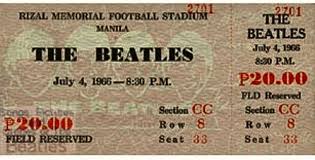
“Sure—they had a big concert here on July 4, 1966—and I ALMOST saw them!” The bile had snuck down my throat now, and I was feeling much better, given a rapt audience for one of my favorite stories.

With full relish, I recounted how the Fab Four flew into Manila, were met by screaming, fishnet-stockinged girls, offended Bongbong Marcos, and were practically chased out of the old MIA by Liberace fans who clearly believed that—at least in the Philippines—the Beatles couldn’t possibly be bigger than the Marcoses.

Somewhere in there I interjected the story of how my mother had promised a 12-year-old named Butch that they were going to see the Beatles at the Rizal Coliseum. The indulgent mother and her eager son get as far as Quiapo Boulevard from their humble abode in Pasig, whereupon she sees a new moviehouse trumpeting the wonders of Cinerama. “Let’s watch this movie instead!” the lady says, and the boy’s once-in-a-lifetime chance of seeing John, Paul, George, and Ringo standing on the stage—albeit from 1,674 feet away in the bleachers—vanish into the gutter. That afternoon, as luckier fans swoon to “Please, Please Me” and “I Wanna Hold Your Hand,” tank fire and bazookas echo in the boy’s ears, all throughout the two hours of “The Battle of the Bulge.”

My poker playmates look at me with wide-eyed wonder—I try to read their faces, like a a poker player ought to be be able to do—but I can’t tell if they can’t believe that I’m that old, or if they’re just awed to be sitting at the same table with someone who actually breathed the same jeepney-flavored air in the same politician-infested city as the lads from Liverpool.

They got nothing on you, Beatles!

Picture-'Britain's Finest' Beatles tribute band

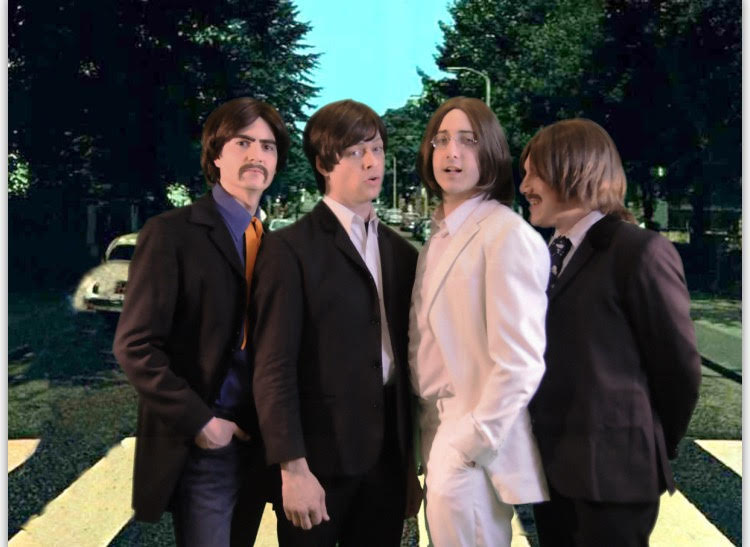
AND IF these memories make you feel like suiting up in your collarless jackets and zippered boots and swaying to “Eight Days a Week,” you’ll get a chance to relive the Beatles experience when one of Britain’s finest Beatles tribute bands—called, well, Britain’s Finest—come to Manila for a concert on October 14, Wednesday, at the tent of the Midas Hotel and Casino on Roxas Boulevard in Pasay City.

You can get your tickets (P3,800 for the VIP and P2,800 for the gold section at all SM Tickets (470-222) and TicketWorld (891-9999) outlets or via www.ticketworld.com.ph.

I’m planning to go, but I think I’ll leave my mom at home this time.

Penman No. 163: The Gentler Path

IMG_7998

Penman for Monday, August 24, 2015

FOR THE first time in something like 20 years, I’m teaching two undergraduate classes this semester. I usually teach one graduate and one undergrad class, but thanks to what I’m taking as a glitch in the registration process, my graduate fiction writing class—which is usually oversubscribed—had zero enrollees this term, forcing its cancellation and my reassignment to a course usually reserved for young instructors, English 11 or “Literature and Society.”

I should make it clear that I’ve always insisted on teaching at least one undergrad class every semester, and have done so unfailingly since I returned from my own graduate studies abroad in 1991. The benefits go both ways—young students get to learn from more experienced professors, and senior profs get to know how young people think. With four years of active teaching left before retirement (it’s hard to believe, but I’m getting there), these encounters with some of the country’s brightest young minds will only become more precious, and as with every class I take on, I can only hope that, many years from now, my former students will remember something useful that they picked up from me.

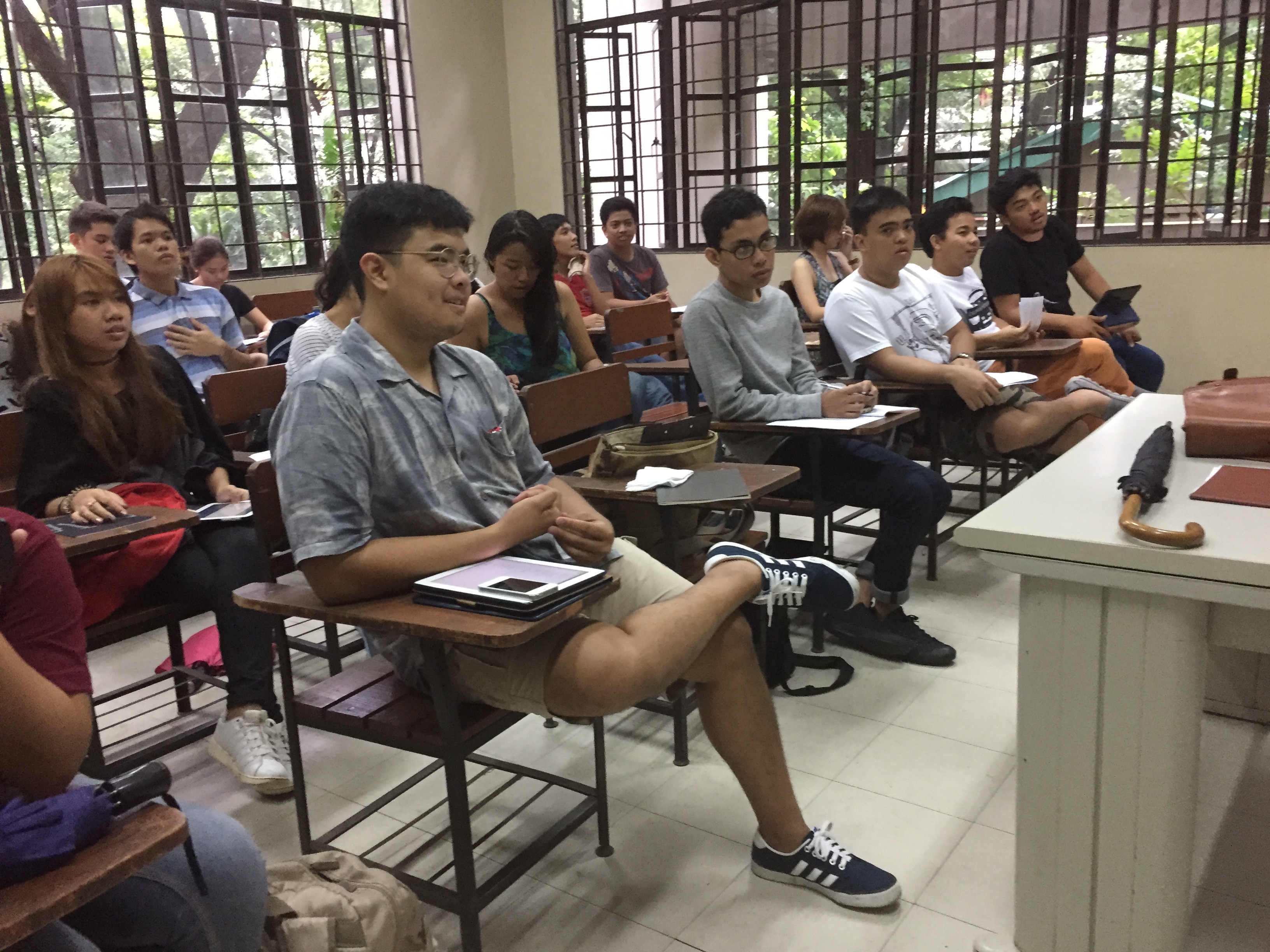
I haven’t taught English 11 in ages, so it was with some trepidation that I entered the classroom on our first day a couple of weeks ago, under UP’s new academic calendar. Students don’t realize this, but professors can be just as full of anxiety at the start of the semester as they are. As I scan the roomful of faces, I’m already wondering who will likely give me problems and who will make it worth the effort of preparing for every day’s lesson as if I myself were taking an exam. Thankfully, most of these mutual apprehensions soon retreat as I reassure my students that I know what I’m talking about—and that I won’t scream at them if they don’t—and as I begin to understand what exactly I’m working with, which is always a welcome challenge.

This semester, I was glad to discover that my English 11 class of about 30 students was composed of mainly science and engineering majors. You’d think that teaching the humanities to them would pose problems, but I see it as a unique opportunity to lead smart people on an adventure they might have missed out on otherwise. Of course, UP’s General Education program makes sure that our graduates acquire a balanced outlook on life, so my students didn’t really have any choice, but I see my job as making them see Literature as much less an imposed subject than a welcome relief from everything else—in other words, fun. When you disguise labor as discovery, and emphasize incentives over penalties, the students—and you yourself—can feel more relaxed.

English 11 is what used to be English 3 in my time—an introduction to literature—and while some teachers see this as a chance to pile on the heavy stuff like The Brothers Karamazov (and I can understand why), I prefer to take the gentler path to literary enlightenment, and begin with things the students know or can apprehend. That way you can lead them to stranger and more intriguing discoveries about the way language works to convey human experience.

Last week, for example, one of the first poems we took up in class was “Southbound on the Freeway,” a poem published in 1963 by the American poet May Swenson. We could’ve done something like T. S. Eliot’s “The Wasteland,” but unless you train lay people to look at poetry a certain way—to see it as a puzzle or a riddle to be solved, for example—it’s often very hard for them to get a handle on what some poets do on a high and abstracted level of language and idea, much like the way Picasso’s departure into Cubism (think of his women-figures with their eyes looking this way and their noses pointing that way) can be better appreciated if you first consider what goes into a traditional portrait like the Mona Lisa.

“Southbound on the Freeway” reads like a rather simple and even funny poem, in which alien visitors on a spaceship look down at the Earth, and see creatures “made of metal and glass…. They have four eyes. / The two in the back are red. / Sometimes you can see a 5-eyed / one, his red eye turning / on the top of his head.” It doesn’t take much for the student to see that the aliens, hovering above a freeway, have concluded that the cars themselves are Earthlings, and even that some cars—like the “5-eyed” police car—are more special than others.

In literature, this is a familiar device we call “defamiliarization,” by which poets and other artists take something we see everyday and present it to us in fresh and unexpected ways, revealing facets and insights we never really thought about before. The Swenson poem seems like all it does is show us how perspective can change our perception of things, but it goes beyond that eye-trick and asks a very intriguing question at the end: “Those soft shapes, / shadowy inside / the hard bodies—are they / their guts or their brains?”

At this point, I ask the class, what’s this poem really about? Is it just about aliens and humans, or about cars on the road? Inevitably, someone spits out the magic word: technology! So what is it about technology that’s so important, I press on, and what does it have to do with our lives? Why, everything, the class exclaims in a chorus—we’d die without our cell phones and iPads!

We go into a brief and engaging discussion about what exactly technology means, and whether it has benefited human society—or not. We talk about mechanization, automation, better and easier ways of doing things, products that were invented to improve human life, and inventions that did the opposite. We talk about armaments, and about Eli Whitney’s cotton gin and how it actually helped to encourage more slavery in the American South. I tell them that at some point, later in the semester, I’ll talk to them some more about the legend of Dr. Faust and how it led to the stereotype of the mad scientist, all the way to Dr. Strangelove, Lex Luthor, and Doc Ock. I can see that the class is listening, and I’m happy.

I ask them what the real question is that the Swenson poem is posing, and they get it. It’s been a good day in school for Literature and Society.

Penman No. 159: Border Insecurity

Penman for Monday, July 27, 2015

I’M NOT as big a TV fan as I used to be—I haven’t seen a single episode of Game of Thrones—but I can’t get enough of certain types of reality shows. I’ve been strangely attracted to Project Runway, and despite being a culinary philistine who hates cheese, I’m a sucker for food shows. I don’t care much for Survivor-type formats, believing that living in Manila beats sharing an island with snakes and monkeys anytime. I reserve my highest praise and deepest fascination for junk-o-ramas like American Pickers and Pawn Stars, being the kind of ukay-ukay addict who flew to Barcelona not for Gaudi’s Sagrada Familia but for the Encants flea market.

But there’s another kind of show I’m fixated on, in the same odd way that I hate even the prospect of surgery—I shrink like a schoolboy at the sight of a needle—but can be engrossed by medical documentaries, where other people get cut up. It’s the airport immigration and customs show, like Border Security Australia and Border Security Canada, where incoming passengers go through a gauntlet of questions and searches meant to find out if they’re drug dealers or food smugglers or people pretending to be tourists but are either (a) jobseekers; (b) international terrorists; or (c) fugitives from justice in disguise.

I cringe whenever a passenger—usually an Asian, sometimes a Pinoy—is loudly asked a dozen times, in clear, slow English, “Are you carrying any food?” The passenger looks stricken and bewildered, but ultimately decides to feign ignorance and/or linguistic incompetence and shakes his or her head, immediately upon which the customs officer opens the passenger’s bags to reveal enough meats, cooked dishes, condiments, and desserts for a wedding feast. The officer points to the customs form in which the passenger has boldly checked “No,” which occasions even more vigorous head-shaking, or the groan of discovery, or the wheezy laughter of surrender. The culprit is then fined, or given a stern warning, and the illegal edibles are confiscated, presumably for incineration (in this country, I think we know where they’ll end up—it’s a bigger crime to waste good food!).

As a frequent traveler myself to places out West, I shouldn’t rejoice at these embarrassing encounters between cat and mouse, but I’d have to shamefully admit that I do, which is why I keep watching these shows, for more of the same thing. I suppose it’s what the Germans call schadenfreude—the strange but delectable pleasure we get from the misfortunes of others, if only because it happens to them and not to us. Or at least that’s what we’d like to think.

I remember how, just a couple of years ago and after having made dozens of trips across the Pacific and gone through countless immigration lines, I foolishly “forgot” that I’d bought a few packets of chicharon—the deadlier bituka version, mind you, not the more innocent-looking rinds—at a planeside shop in NAIA, thinking that I would munch on them on the flight to San Francisco in the long stretch between meals. I must’ve fallen asleep instead, because they were still in my carry-on bag when Beng and I arrived in SFO, and had the misfortune of being singled out for random inspection (I think they read the vibes I must have subliminally emanated: “This guy is carrying chicharon. Arrest him.”) I speeded through the immigration process like the veteran I’d thought I was, chatting up the border agent in my best Midwestern-accented English, only to find myself in a special customs queue for secondary inspection. OK, I thought with a minor shrug of annoyance, no problem, let’s get this over and done with, shall we?

The immigration gods didn’t desert me completely, however, assigning me to a customs agent who was obviously Fil-Am, and who just as obviously knew how to deal with sneaky kababayans like me. “Magandang umaga po,” she said sweetly in Filipino as she took hold of my bag. “May pagkain po ba kayong dala ngayon—bagoong, chicharon, mangga?” I was all set to harrumph and put on my foulest professorial airs when I suddenly remembered—at her mention of the usual suspects—the packets of chicharon that I’d stuffed into the side pocket of my bag.

For a millisecond I toyed with gambling on her missing them—the chicharon bulaklak seemed even more delicious, being forbidden, and now I was never going to get a taste of it—but decided to come clean. Decades earlier (you see how these things have histories), an immigration beagle had sniffed out a stash of dubious comestibles in Beng’s luggage, meant for lonesome me in Milwaukee; now I was sure that they had 21st-century detectors and X-ray profiles of bagoong, chicharon, etc. in some secret room behind a nearby wall.

Ay, may chicharon bulaklak pala ako!” I exclaimed, throwing my hands up. “I meant to eat it on the plane, but forgot,” I added, grinning sheepishly. The agent reached in, felt for, and fished out the offending packets, and tossed them into a trash bin that seemed about to overflow with other people’s confiscated contraband. “I’m glad you told me, sir,” the Fil-Am agent said, with the barest hint of regret. “I would have fined you $300 if you didn’t!” I shuddered at the thought of having to fork over $300—the price of a fancy fountain pen—for three packets of pork innards that I didn’t even get a bite of. There, I thought, but for the grace of a kind Pinay go I.

So whenever I watch those poor, guilty souls trudging toward the immigration and customs agents on the TV shows, I silently scream at them, “Confess! Reveal the sausages and the century eggs! Resistance is futile!” Of course they never do, and I feel rewarded with my minute of smug satisfaction at having narrowly escaped the clutches of Western justice. (And it’s just them, right? Nobody but nobody ever asks incoming Americans, Canadians, or Australians, “Excuse me, sir, but do you have hotdogs, burgers, or French fries in your luggage?” Perhaps our immigration people should be better trained.)

SPEAKING OF overseas Pinoys, a fraternity brother in Toronto, Fred Postrado, emailed me to ask for some help in reaching out to his batchmates from the Manila High School Class of 1973, which is planning to hold a reunion during the last week of February 2016. Those interested may contact organizers Zen Alcantara Cabaluna at 0908-8849190 and goldland_zen@yahoo.com, Mario Bulatao at 0917-5215739 and supermcb55@yahoo.com or Virgie Nudalo Calimag at 0932-8615484 and vncalimag@yahoo.com.

Penman No. 157: Dandy Doodles

14100168582_2191dbaffc_zPenman for Monday, July 13, 2015

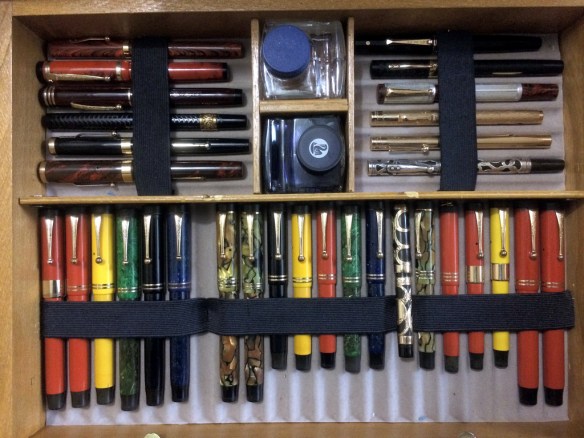
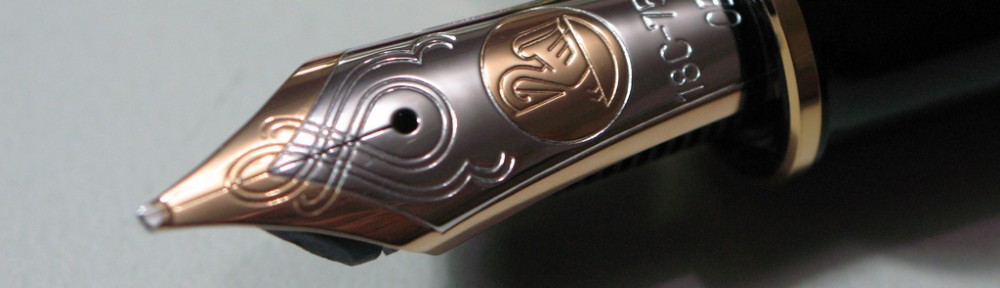
YOU’LL UNDERSTAND if I’m mighty proud of my fountain pen collection, built up painstakingly over the past 30 years. Now numbering about 200, it contains some of the world’s rarest and most desirable vintage and modern pens, and I’m still upgrading it, bringing down the numbers while raising the quality, hoping to downsize it to about 30 of the very best that I can pass on to our daughter Demi not too long from now.

At least that’s the press release. What I’m not saying, and what I’m not too proud of, is how awful my penmanship is, a trail of chicken tracks worthy at best of a Bic ballpoint. We have members in our fountain pen club like advertising executive Leigh Reyes and designer Fozzy Dayrit who can carve out whole new careers as professional calligraphers should they want to, so artfully do they put nib to paper. Oafs like me just wear our pens like others might sport brooches and hats, as body décor to look more substantial and interesting, especially as our other charms wane with age.

The fact is, I can’t write more than half a page of anything with a fountain pen before my fingers start crimping with fatigue, more accustomed as they’ve become to tapping on a keyboard with whispery ease. The saddest part of the story is, the only time my fountain pens get any real exercise is when, joylessly, I have to write out checks to pay for the credit cards and the utility bills.

It’s not as if fountain pens are alien, certainly not to me. We used them as grade-school kids in La Salle, where we also wrote loopy letters for Penmanship class, and where an inkstain on one’s shirtfront was just a blue badge of honor (or so I told myself, to mitigate the embarrassment). But as the world has since moved from writing in cursive to block letters, and from the pen to the computer, our writing muscles have atrophied, and the feathery Fs and coily Qs that garnished our forebears’ documents are a barely legible memory.

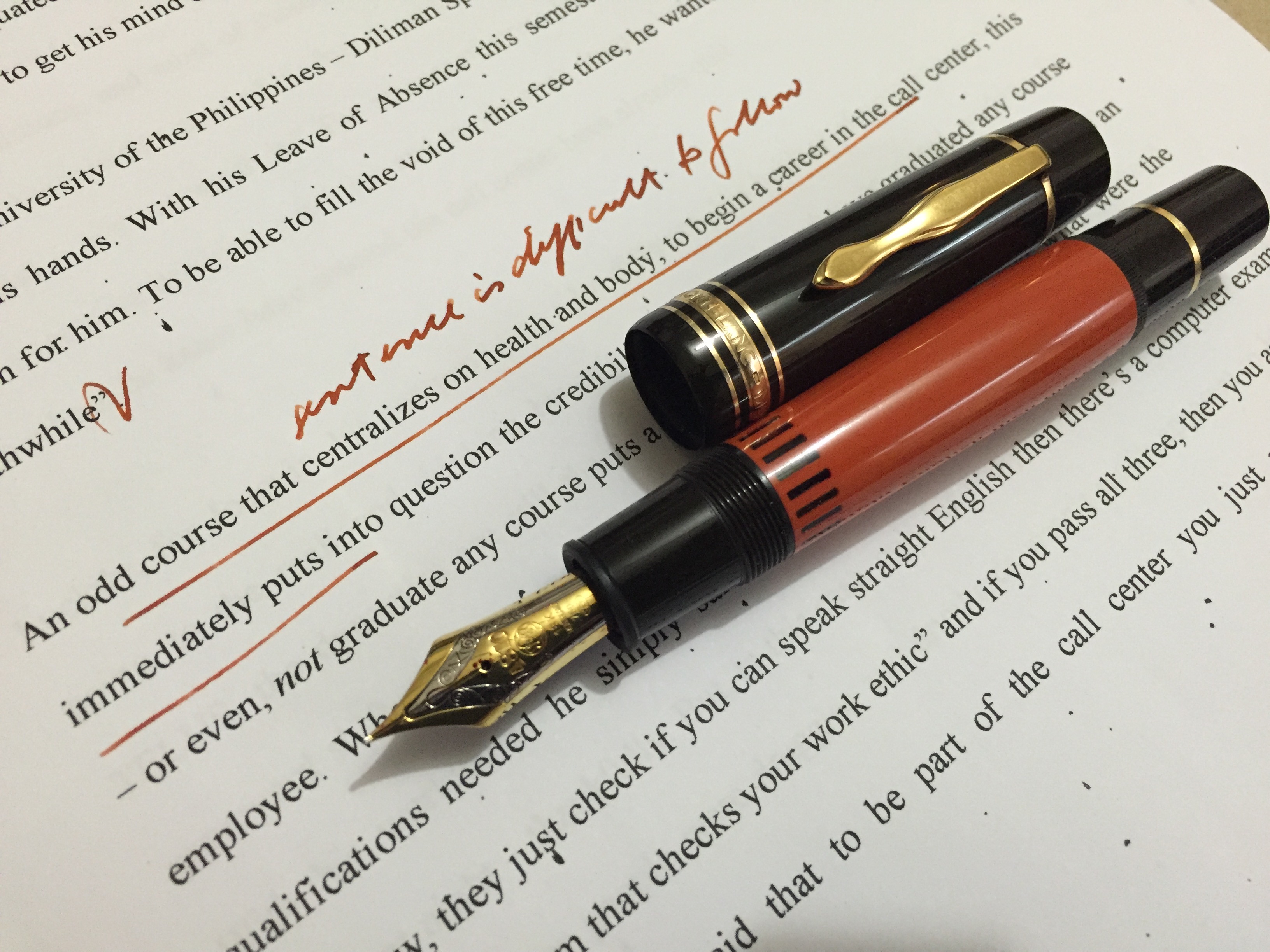
So how do I derive pleasure from my pens beyond the sheer, avaricious thrill of ownership? When the day comes to cart away my papers and my trash, they’ll find stacks of well-used notepads in my drawers and cabinets, and the nosy rummager might well imagine discovering some private snippets, or passages from an unfinished novel, among my scribbles. I hate to disappoint the snoops, but they’ll find nothing of the sort; instead, all they’ll come across will be a trail of doodles—page after page of doodles in every color of ink and width of nib. And that’s going to be the big dark secret out of my bag: I buy fancy pens not to craft great literature with, but just to doodle all day, wasting time, ink, and paper on nothing grander than the pursuit of pointless happiness.

My dictionary defines “doodle” as “To draw or sketch aimlessly, especially when preoccupied,” which isn’t too far from Wikipedia’s take on it, which sees a doodle as “a drawing made while a person’s attention is otherwise occupied.”

Here we see that the key idea behind doodling is distraction: you’re thinking about something but don’t really want to think about it, so you do something else, and if there’s a pen in your hand, that pen will have a mind of itself and start making squares and circles and lines that lead nowhere and everywhere. In my case, I know exactly what it is I’m running away from: work! I’m so drowning in book projects that I have no proper business doing anything else—not even writing a column like this—but it’s when things get tough that the doodles get going.

I’m sure that psychologists have a perfect explanation for this, but I’m convinced that there’s a symbiotic relationship between work and distraction, and that doodling actually helps me get my work done by letting me relax while my brain processes headache-inducing conundra like “How can we pass an anti-dynasty bill when 14 out of our 24 senators belong to a dynasty?” You’ll agree that it’s more fun to deal with questions like “Hmm, should I go with the Rohrer & Klingner Sepia in the Montblanc Oscar Wilde or the Diamine Oxblood in the Parker Vacumatic? Heck, let’s do both!”

To some others, doodles are more serious business—or at least halfway-serious, as the Google Doodles illustrate. You may not have heard of them as such, but you’ve surely seen them if you’ve ever used Google, because they’re the quirky, funny, topical drawings that periodically festoon the Google landing page to mark an anniversary, a birthday, or some other cause for celebration.

Googling around, I discovered that there’s actually something called the Doodle Arts Magazine (www.doodleartsmagazine.com), which happens to be Philippine-based. The people behind the website organized Doodle Fest 2015 a few months ago, and you can still catch the artwork online. If you want to see how good doodle art can get all around the world, have a look at http://www.creativebloq.com/illustration/doodle-art-912775.

Me, I’m happy with my squiggles and X’es and endless iterations of “This is a 1928 Duofold” and “This is a Sheaffer Balance” and “This is Carlo Collodi ink” and “This is a fine pen.” Maybe if I wrote something more sensible like “I come from a country without snow and without raspberries,” I could get another novel going and done in no time, but that sounds too much like real work, which apparently was never what these glorious pens and inks were meant to do.

19237231981_7d296c415f_z