Penman No. 182: In NVM’s Footsteps

IMG_7884.jpg

Penman for Monday, January 11, 2016


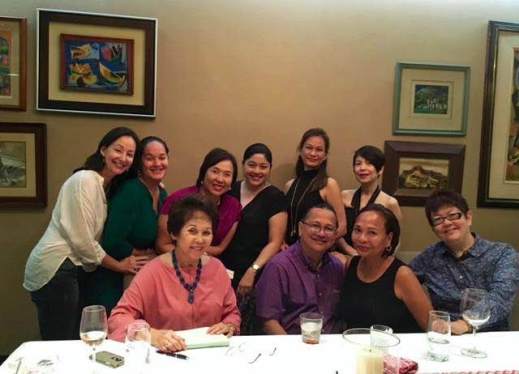
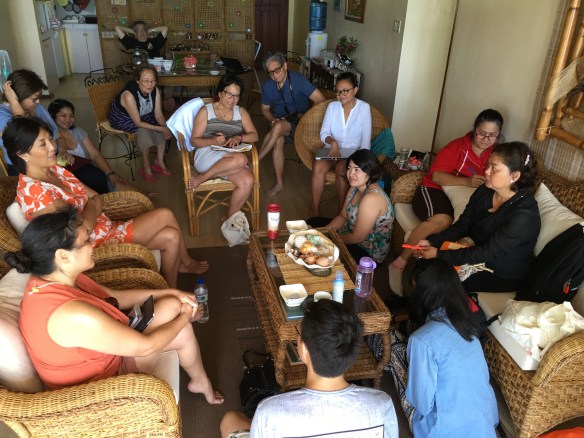
I’M WRITING this in Calapan, Oriental Mindoro, where I’ve come with a group of writers, most of them visiting Filipino-Americans, for the second and closing leg of the NVM Gonzalez Workshop, organized and led by NVM’s son Dr. Michael Gonzalez. Last year, 2015, marked the centenary of the late National Artist’s birth, and Myke thought that it would be fitting to hold the workshop, now on its sixth iteration, in the place most closely associated with his father, Mindoro.

NVM was actually born in my home province, Romblon (“about 60 kilometers and 40 years away,” I like to say), but he grew up in Mindoro, and wrote most of his works about its hardy people and their way of life, even when he moved to the United States. NVM died in 1999, but his memory remains fresh among his friends, colleagues, and former students on both sides of the Pacific. It was to honor that memory that Myke put this group together for both a workshop and a literary pilgrimage to the Philippines.

This year’s US-based contingent includes Mary Grace Bertulfo, who has written for television and children’s education and who runs a children’s creative writing workshop, Taleblazers, in Chicago; Anna Alves, a PhD student with the American Studies Program at Rutgers University in New Jersey; Chris “Kawika” Guillermo, a mixed-race Asian-American with Chinese, Filipino and Irish roots who has a PhD in English from the University of Washington, specializing in Asian and Asian-American fiction; Lisa Suguitan Melnick, a third-generation Filipina-American, an adjunct professor at the College of San Mateo and a contributing writer for PositivelyFilipino.com; Penelope Flores, a retired mathematician and educator from San Francisco State University; Myke Gonzalez, of course, who teaches Philippine Studies and Behavioral Science at the City College of San Francisco; and Evelina Galang, the workshop director, an accomplished fictionist who directs the Creative Writing program at the University of Miami.

Their local counterparts were Kat Cruz, a UP Business Administration graduate and company executive with a keen interest in writing; Meeko Camba, a young opera singer now studying Journalism in UP; Sarah Matias, a Creative Writing major who now runs Ant Savvy Creatives, a marketing and events company; Marily Orosa, a prizewinner publisher of coffee table books; Timmy Tuason, an expert in instructional design, materials development and project management; Jojo Hosaka, a surgeon and dog-show judge (and, like Timmy, a fellow fountain-pen enthusiast); Claire Agbayani, a graduate writing student at DLSU and PR practitioner; Judith Castillo, a teacher of English in Calapan; and Raul Manicad, an engineer, businessman, and guitarmaker. Myke and Evelyn were backstopped on the teaching staff by veteran fictionist Charlson Ong and myself.

We held the first part of the workshop from January 4 to 5 at the University of the Philippines in Diliman, where NVM had taught for many years in the 1950s, in the Gonzalo Gonzalez Reading Room of the College of Arts and Letters Library, which my office—the UP Institute of Creative Writing—administers as a repository of contemporary Philippine and Southeast Asian literature. From January 6 to 9, we moved to Calapan, where NVM used to go from their home in Mansalay to type out his manuscripts at the municipio, on paper that, Myke recalls, NVM apparently “borrowed” from the municipal government, whose stamp it bore.

The mixed composition of the group and the diversity of the participants’ backgrounds led to some very interesting discussions dealing with identity, race, language, and representation. While this was a writers’ workshop focused as much on technique as one’s philosophy of writing, inevitably the politics of writing took the foreground, given the Fil-Ams’ engagement with the issues that come with writing as a minority in America.

We talked about how the writer’s political positions define or feed into craft and technique, and how they shape the story itself. Understandably, given the environment they operate in, our US-based friends were keen on discussing the representation of race, of the Other, and the depiction of character in a racially or ethnically charged environment. We agreed that it was important to be accurate and to be fair in creating characters who will inevitably be seen to represent their race, whatever they may be; on the other hand, I interjected, it was just as important to remember that the character had first to succeed as an individual in the story, and that the character could even—and more interestingly—go against type; while we share many beliefs and practices as Filipinos, not all Filipinos think alike, and thankfully so.

The discussions also became a mutual revelation of what it was like to write as a Filipino and as a Filipino-American, and how we could be so similar yet also different in many ways. It wasn’t just the vocabulary, but the sensibility that came into play. In the end, we took the cue from NVM himself, who once famously explained his use of language thus: “I write in Filipino, using English.”

I learned a new word from Myke, who has a background in the social sciences—schismogenesis, promoted by the anthropologist Gregory Bateson in the 1930s, which roughly translates into how groups proliferate by breaking up. The context was the oft-made observation of how Fil-Ams and their organizations tend to fall apart because of personal and political differences (by one account I read, there are more than 3,500 Fil-Am organizations in Southern California alone)—a tendency we uniformly deplore. But Myke’s new word suggests a positive aspect, a way by which a race and its culture propagates itself.

We’d like to thank our hosts—the Madrigal-Gonzalez clan, for the use of the reading room in UP; Myke’s sister Selma, who spread out a very generous merienda for us; the Mother Butler Guild of Calapan, who conducted a charming putongan ceremony for the visitors; Florante Villarica, who has written a history of Oriental Mindoro and who had us over for dinner at his home; Anya Postma and the Mangyan Heritage Center, who made a wonderful presentation on Mangyan life and culture; and Chicago-based Almi Gilles, who lent us her their family’s beach house in Puerto Galera for our penultimate day in Mindoro.

And thanks, of course, to Myke and the Gonzalez family, for keeping their father’s flame alive.

Penman No. 181: A Designer on an Island

IMG_7775.jpg

Penman for Monday, January 4, 2016


ONE OF the side benefits of our recent visit to Bohol was an opportunity to reconnect with an old friend and professional colleague, the prizewinning book designer Felix Mago Miguel, who has chosen to live and work in Bohol for the past ten years with his wife Amel and their five children.

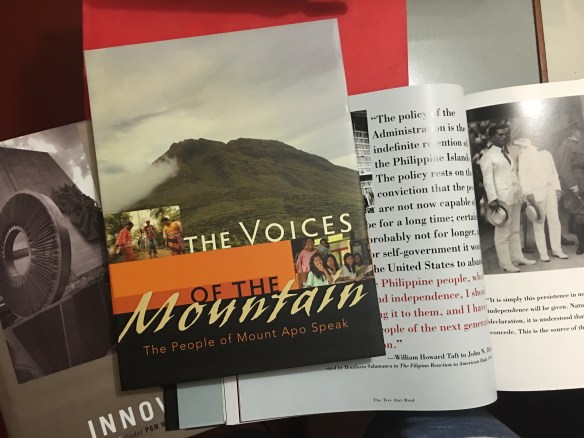
Beng and I had known Felix for a long time, since she saw and bought some of his paintings and gifted the then-newlyweds with her own painting and some plates by the potter Lanelle Abueva-Fernando. (“The plates are all gone now, because we used them and would break one every year,” said Amel apologetically, “but the painting’s still there!”) Felix and I had worked together, as writer and designer, on some coffee table book projects, notably those on Philippine-American relations, the Mt. Apo geothermal project, and the Government Service Insurance System. After my early collaborations with the late, lamented Nik Ricio, it was a relief and a pleasure to find the young and talented Felix, who has rightfully taken over Nik’s mantle as one of the country’s most sought-after book designers.

We invited the couple over to lunch at our hotel and we had a nice long chat about life, work, and what it’s like to keep on top of your profession from an island far from the country’s business and cultural center.

“Honestly, it hasn’t been all that difficult,” said the former Manileño. “In fact, I didn’t tell my clients for a whole year that I was working from Bohol because they might worry about my accessibility and meeting deadlines and so on. But with the help of the Internet and by scheduling my trips to Manila, I’ve been able to cope with the demands of the job. I use WeTransfer and Google Drive to move large files online, on my SmartBro account.”

Amelia Zubiri was born in Bohol, but also grew up and went to school in Manila, where she and Felix met in UP Diliman, where Felix was a Fine Arts major, graduating in 1992. They decided to move to Bohol to get away from Manila’s toxic atmosphere and to raise their children, now aged 16 to 7, in a healthier and more relaxed environment; all the children—the twins Ulan Kalipay and Ulap Namnama, Angin Kalinaw, Araw Naasi, and Langit Biyaya (the only one born on the island)—have been home-schooled. Deeply spiritual, the Miguels have learned to repose their trust in Providence, and their faith has been well placed.

When a huge earthquake devastated Bohol on October 15, 2013—just two weeks before supertyphoon Yolanda ravaged the Visayas—the Miguels and their one-storey home emerged shaken but unscathed, and they shared their good fortune by helping out with relief efforts. “The earthquake was a life-changer for many Boholanos,” Amel reflected. “It encouraged many Boholanos who had left for jobs overseas to come home and spend more time with their families. Seeing the new houses they had painstakingly built crushed in seconds seemed to remind them that nothing was more important than time together.”

Most of these OFWs work as seafarers, an occupation historically favored by Visayans. “It’s not uncommon for a Boholano family to have one or two seamen working on ocean-going vessels,” said Amel. “You can tell the houses that they build with their remittances by little design elements like anchors and portholes,” added Felix, smiling.

Felix Mago Miguel’s own journey to the crest of the book design business is a story of good breaks, sheer talent, and perseverance. Now 44, he started out in 1996 by designing Soledad Lacson-Locsin’s landmark translations of the Noli and Fili for Bookmark. “I’d done book covers before, but this was the first time that the publisher, Lori Tan, let me do everything from cover to cover,” said Felix. Later that same year, another book project, Water in the Ring of Fire: Folktales from the Asia-Pacific, edited by Carla M. Pacis, won for Felix his first design award from the National Book Awards. Since then, he has designed over a hundred books, some of them winning him recognition from the National Book Awards and the Gintong Aklat competition.

It isn’t the awards, however, that drives him to excel in his craft, but the satisfaction that he gets out of seeing a happy client. The project that has given him the most pleasure has been XYZ: The Creativity of Jaime Zobel, which drew on Zobel’s three decades of work in photography and art. “Don Jaime was so ecstatic about the book that he told me he needed to take a Valium to calm down,” recalled Felix. It’s that kind of reception that drives Felix to spend long nights staring at a computer screen, poring over one image after another.

The most technically challenging was Cuaresma, put together by Cora Alvina and edited by Gilda Cordero-Fernando and Fernando Zialcita, and winner of the National Book Award in 2000. “This was before digital photography, and I had to work with a huge box of color slides,” said Felix. But then again, “The technical aspects of book design are often easier to deal with than some people behind the books,” Felix confessed.

Like me, he’s had his share of good book projects that, for some reason or another, went nowhere. He did get paid for work done, as I was, but it’s such a waste of labor and good material when a project that seemed so promising never sees the light of day, because someone in the production process fails to deliver, or because the clients themselves lose interest or change their minds. Thankfully for Felix and me—as I wrote in this column a few weeks ago—coffee table books remain in high demand, and I expect to be working with him again on one or two forthcoming projects soon. One current project he’s excited about is a book on native Philippine trees that he’s doing for the Lopezes.

While he’s based in Tagbilaran, Felix flies out to Manila to personally check on his projects in the press. This used to be done abroad for high-quality printing jobs, but local printers have expanded and improved significantly enough to take on the challenge. “Our best local printers like House Printers can now compete head to head with their counterparts in Hong Kong and Singapore,” Felix said. (House Printers produced one of my most recent books, the biography of former Sen. Ed Angara.)

He misses painting, and spoke wistfully about the last big painting he did, a mural for the Church of Gesu on the Ateneo campus in Quezon City. But the children, the Miguels said, seem to be taking intuitively to art; Felix and Amel have monitored their time online to make sure that they can attend to more active and creative pursuits, and it may not be long before this couple’s decision to forsake Manila for a southern island bears fruit beyond more beautiful books.

IMG_7785.jpg


Penman No. 179: Pedestrian Pleasures

IMG_7589.jpg

Penman for Monday, December 21, 2015


THERE’S NOTHING better we’d like to do on a weekend—unless we’re running off to some southern island or parts beyond—than to have a foot massage from our suki Tonton branch on West Avenue before taking in a movie and a Chinese or ramen dinner at Trinoma. In fact, we don’t even wait for the weekend to indulge ourselves in these pedestrian pleasures, but do this routine on a Tuesday and then again on a Thursday, whenever the spirit moves us.

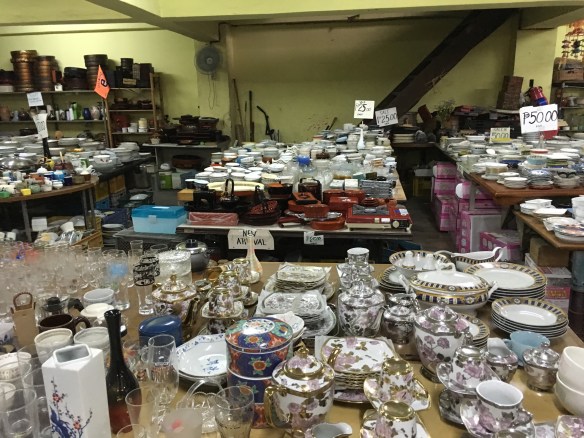
Every other month or so, we do something special—we go down to Sta. Cruz (my students no longer have any idea where these districts and streets around Quiapo are), have a fried-chicken lunch at Ramon Lee’s, then check out our favorite ukay-ukay and Japanese-surplus shops on Avenida Rizal, happily carting home several bagfuls of glorious junk, with as much pleasure as we would’ve gotten from the flea markets of New York or Paris.

Beng and I cheerfully acknowledge that this must be one of the signs of aging—settling into a fairly small and thoroughly familiar comfort zone, and stepping out of it just often enough to keep things lively and to refresh the horizon. Or maybe I’m mainly speaking for myself, because Beng’s always been far more adventurous than me, especially culinarily speaking, and now and then exhales a wistful longing for some Indian food (which flusters me, because I can’t stand curry, recognizing only salt, pepper, garlic, onion, and soy sauce in the kingdom of spices and flavors).

The simple explanation is, ours is a generation used to walking a lot. And it wasn’t as if we had a choice. We grew up without cars—the richer kids had them, but not us—and even getting to the jeepney or bus stop meant walking. I remember, as a boy of nine or ten, walking from our rented place on Halcon Street along Boni Avenue in Mandaluyong to what was then Highway 54 (EDSA to you younger ones), crossing the highway, and then taking the bus to Gilmore Avenue, crossing the highway again, and walking several blocks to La Salle Green Hills (“Greenhills” was spelled as two words then)—lugging my heavy bag of books and notebooks, whose cheap unpadded leather cut into my hands. In the afternoon, I would do the same thing all over again, in reverse, unless a chauffeured classmate took pity on me and gave me a ride.

But as torturous as that routine was, it was nothing compared to the literally kilometric walks that our elders took. One of my favorite walking stories is that of the late NVM Gonzalez, who walked many kilometers from their barrio in Mindoro to the poblacion, where he could type his manuscripts in the municipio, making the long trek back in the afternoon (and when his contributions returned months later, rejected by some editor, his father would kid him and say, “Your stories are like homing pigeons!”). That’s a story I like to tell my writing students, who—with the fanciest computers and the Internet at their fingertips—will still sometimes complain about not having “enough material” or “enough time” to produce their first drafts.

Another story I recall having read somewhere involves Bienvenido Santos and Diosdado Macagapagal, who—as students of the University of the Philippines back when it was just on Padre Faura Street in Manila—walked to school together from their lodgings in Tondo. And until his death some years ago, my uncle Juan, who must have been in his nineties, thought nothing of walking the seven kilometers of mountain road between his home in Guinbirayan to the poblacion of Sta. Fe in Romblon, just to deposit the cash in his pocket to his savings account.

I myself took to walking for my health a few years ago when I was diagnosed with diabetes, and had to undergo a radical lifestyle change. Three or four laps around the UP Oval every day, Broadway blaring in my ears, quickly took care of the problem; I lost 45 pounds in five months (some of which I’ve regained since then, but my blood stats still look good).

But walking, of course, is never just a chore and never just exercise to the willful and the observant. I’ve used my long walks around campus as thinking time, composing paragraphs in my head, mulling over turns of phrase and gentler ways of expressing unpleasant truths (the sad corollaries of holding an administrative post). I enjoy the scenery—both natural and human—and store striking details, scenes, and vignettes in my head that I can use for my stories. Once, walking towards the Carbon market in Cebu, I found myself on a street full of sellers of cut flowers, in the midst of which emerged a dark, wiry man, bare from the waist up, heaving over his head a huge basket full of red roses—a veritable Charles Atlas, bearing the weight of all that beauty. That haunting image became the germ of a story I would title “Delivery,” the tale of a lie and its terrible if unintended consequences.

And many of my sharpest memories of my foreign sorties are from long walks taken on fabled boulevards and strange alleyways, very often leading to unexpected discoveries off the tourist guidebooks: a pen shop in Edinburgh, a Filipina hotel worker taking a quick puff from a balcony in Como, a pair of fierce guard dogs prowling the perimeter of a mansion in Johannesburg, beneath a copious spray of jacaranda blossoms.

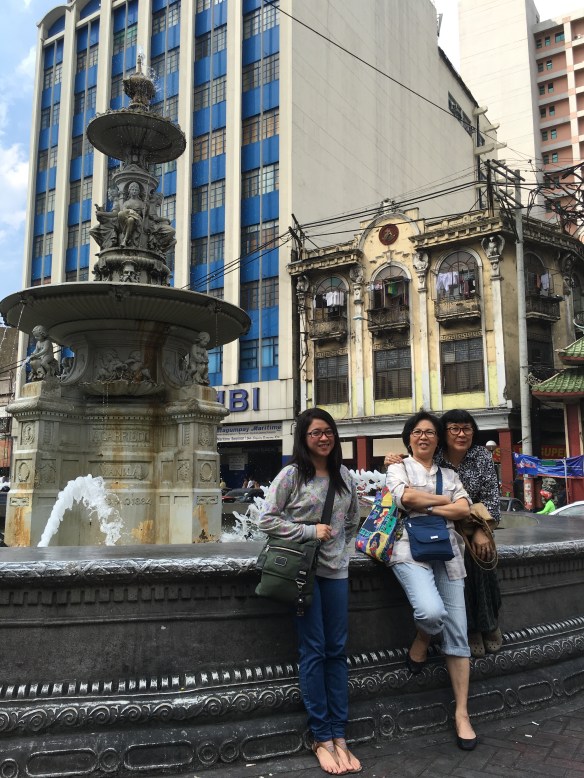
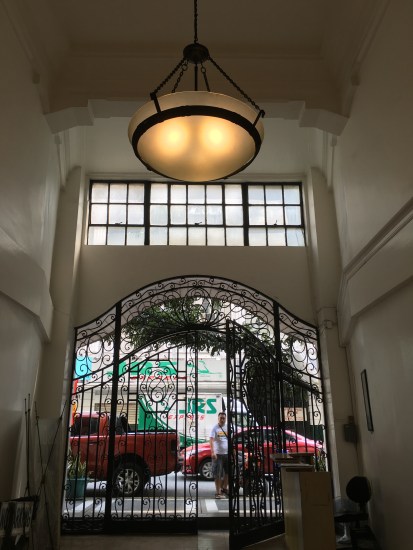
So it was in this quest of adventure that Beng and I took her sister Jana and our niece Eia on a walking tour of downtown Manila a couple of weeks ago (a zone my friend Krip Yuson affectionately calls “the armpit of the city”), to reacquaint them—newly returned from many years in New York—with home, in all of its bewildering, exasperating, ammoniac intensity. We took them to our Japanese-surplus suki on Avenida and then to lunch at Ramon Lee, before essaying Escolta and the Art-Deco innards of the First United Building; we lamented the loss by fire of the old Savory Restaurant, but pressed on to Chinatown for bagfuls of hopia and ma chang (sampling the goodies both at Polland and Eng Bee Tin) before turning into Ongpin and re-emerging into Sta. Cruz and its amalgam of gold and grime.

It was a day well spent, much of it on foot, and while our soles may have complained, our spirits tingled with reawakened excitement.

IMG_7583.jpg

IMG_7591.jpg

IMG_7596.jpg

Penman No. 178: So You Want to Do a Coffee Table Book

IMG_7603.jpg

Penman for Monday, December 14, 2015


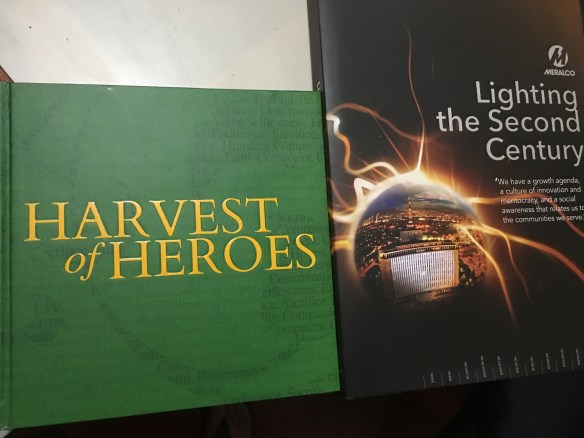
PEOPLE OFTEN ask me what it takes to produce a coffee table book. As a writer and editor, I’ve been involved with quite a few of them over the past twenty years. Just a couple of weeks ago, I was happy to attend the launch of one I co-wrote with Exie Abola and Felice Sta. Maria, Lighting the Second Century, produced for Meralco by the prizewinning Studio 5 group of publisher Marily Orosa.

While I suspect I know the answer, the first thing I tell anyone who asks me is, “What do you want a coffee table book for?”

Coffee table books are not cheap, running into the millions to produce—and, with few exceptions, they don’t make money for their publishers. So why even bother? Why does every year bring a plethora of new CTBs off the presses?

Many of those books don’t even come to market—they’re never meant to be sold or to make their investment back, and therein lies the reason for their existence: not to make money so much as to make an impression, not even to the general public but among a select group of readers, fellow connoisseurs, enthusiasts, and avatars of a certain thing or idea, to whom they can be given away as promotional material.

Because they’re generally not for-profit projects and because they require a sizable investment, CTBs are almost always conceived and funded by large institutions—corporations, foundations, universities, and the government—whose leaders have found some special reason to commission a CTB.

That reason is usually to commemorate and to celebrate an important milestone—the founding of an institution, the centenary of a founder, the completion of a major undertaking. CTBs can also be used to introduce or promote a new initiative—say, a province’s tourism program. Some CTBs may seem downright frivolous and extravagant, but many do serve a higher purpose beyond public relations, as visual records of our social and economic history,

But why a book, and why a coffee table book? Even and especially in this digital age—abounding with possibilities online and with new media—print still suggests permanence and prestige. The Web reaches far more people and is practically free, but many see it as an ephemeral medium, lacking the solidity and credibility of a book in the hand. For people and institutions seeking to perpetuate some shining moments and memories, the appeal and cachet of a CTB can be hard to resist.

CTBs are relatively new on the local publishing scene, and it wasn’t until the late 1970s when Gilda Cordero Fernando came out with such landmark tomes as Turn of the Century and A Question of Heroes that this new category of “desirable object” emerged. My own first exposure to CTBs was an epic challenge, when I edited the 10-volume Kasaysayan: The Story of the Filipino People for Readers’ Digest Asia in 1998, working with and learning from such legends as our editorial consultant, the late writer Doreen Fernandez, the late designer Nik Ricio, and our indefatigable project director, Tere Custodio.

Institutions usually go to PR or ad agencies for CTB projects, which are too complicated for in-house PR units to do all by themselves. They can also be put together and undertaken by people like me, Tere, or Marily who’ve had some experience in the work involved, but even I have to assemble a crew of first-rate professionals who can deliver good work on schedule.

CTBs are, first of all, conceptualized by the client in consultation with the writer or the PR specialists. While top management can and should give the marching orders early on—purpose, theme, scope, audience, treatment, budget—it’s best if a mid-level person with some understanding of media were designated to represent the client in dealings with the creatives, with full authority to streamline decisions and processes. (My worst nightmare would be to deal with a whole board of directors, each one of whom will be dipping into the editorial pie and making a general mess of things.)

Aside from the client, the CTB team will typically comprise the project director or manager; the head writer and his or her assistants; the executive editor; the book designer or art director; the photographer; and a production or editorial assistant in charge of logistics—handling money, setting up appointments, liaising with the client, following up the paperwork.

Many future problems can be solved right at the conceptualization stage. If the book’s purpose, scope, and audience are clear from the start, expensive adjustments can be avoided later on. Schedules, budgets, and deliverables have to be established and stipulated in a contract, leaving a little wiggle room for exigencies.

A CTB is picture-intensive, and will typically have a ratio of 60/40 or even 70/30 in terms of images to text. This means that there’s absolutely no excuse in a CTB for bad photography, bad design, and bad printing. If you can’t afford to come up with a good-looking product—never mind the text for the time being—then save your money and go for a regular, black-and-white book, not a CTB. Take note that a good designer could cost more than a good writer. (My pet peeves design-wise include designers who get too fancy with typography or insist on laying out text over an image, compromising readability.)

That said, showing off a well-designed book with awful text—poorly written and riddled with grammatical errors and misspellings—will be much like going to town with a date with the looks but also the brains of a lovebird (not that some people would mind). So invest in a good writer, one possessing a mastery not only of the language but also of the material, and with the patience and maturity to deal with both the client and his or her fellow creatives.

I’ve often found that the actual writing is the easiest and most pleasurable part of the job. Dealing with and interviewing clients can be quite stressful, and there’s a saturation point one reaches with almost any project, no matter how interesting it is.

Like any other book, CTBs also require sharp editors who can look over the writers’ shoulders. I never mind being edited myself, if the editor knows what he or she is doing. (If I don’t have the time to write the books myself, I’ll sometimes offer to do the editing.) CTBs, surprisingly enough, often reveal their lack of editorial oversight in their most visible and therefore vulnerable parts—in their titles, picture captions, and the front and back matter, which tend to be the last pieces of text to come in and are easily overlooked. I’ve seen expensive and glossy books with spelling errors on their title pages!

A good CTB should be a pleasure to read and to own. It should be a showcase of the art of good writing and good design. But above all, beyond being a plaything for creatives, it should do what it was meant to do—provide useful information in a visually engaging way. The best CTBs will retain their value over time and even become heirloom pieces on their own. That’s something worth keeping in mind next time somebody with more money than sense cries, “I want a coffee table book!”


Penman No. 177: Compress, One More, Wacky!

IMG_6071.jpg

Penman for Monday, December 7, 2015


GET SEVEN or more Pinoys together for a group photo and you’ll invariably hear this mantra: “Compress! One more! Wacky!” To the uninitiated foreigner—already surprised by our propensity to grab them by the arm for a quick and giggly shot—they’re orders that demand translation, so here goes:

“Compress!” technically means that not everyone can fit into the shot and that everyone should therefore squeeze together, at which point people will take a deep breath and turn sideways, turning a 40” midsection into what they imagine is a svelter 38”. This process can morph into a quick trip-to-Jerusalem rearrangement of the subjects, if the hold-your-breath trick doesn’t work. “Small ones in front!” or “Kneel! Kneel!” will be the next order of business, followed by a flurry of to-ing and fro-ing, and split-second negotiations over who’s taller than the other by half an inch, or whose knees can take the bending.

“Compress!” can also mean some young swain’s opportunity to snuggle up to an unsuspecting loved one. But even without the side benefit of romance, “Compress!” manifests the Pinoy’s sense of personal space, which is to say, ”I’ll let you dig your elbow into my rib cage, or touch your knee against mine—but I warn you, go no further, lest you think me immodest!”

The coming of the selfie—or more precisely, that new word I picked up from a book launch last week, the “groufie”—has made compression even more necessary than ever—which, let’s admit it, is a lot more fun than the scientific solution, which is to get a wider-angle lens.

“One more!” reaffirms the Pinoy’s fatalistic conviction that something will surely go wrong and that the first shot taken will prove to be a bad one, or will mysteriously vanish into some dark photographic abyss, from which no memorable snapshot ever returneth. This seems to have been more likely to happen in the bygone days of film, when everything from a faulty sprocket to invasive sunlight could spoil the most carefully posed portrait. But the onset of digital photography has clearly offered no measure of assurance to the Pinoy, who remains deathly suspicious of solitary shots, and who will scream, from the back of the pack, “One more!,” as if the course of history depended on the preservation of that instant.

And so the photographer dutifully fires off a few more shots, giving the subjects a chance to modulate and modify their poses and expressions—more often for naught, because the Pinoy’s fatalistic conviction that something will surely go wrong just happens to be correct, and the camera almost always takes the shot at the worst possible millisecond, when one’s mouth is half-open or one’s eyes are half-closed. This foreknowledge, seared by experience into the Pinoy’s subconscious, likely accounts for the multiplicity of shots taken at every occasion, and “One more!” is never meant to be taken literally, but rather to resound like an echo.

Let’s not forget the equally inevitable complication to this phase. Just when it seems all the angles have been exhausted and the smiles have dried on people’s incisors, some latecomer—who had been blithely chatting away on her cellphone across the grounds, in full view of the pictorial entourage—just has to make a mad dash across the grass, yelling, “Wait! Me, too!” And being the world’s most hospitable people, Pinoys will invariably accommodate the catcher-upper with a frozen smile, even as their eyes glare at her like live coals. And having wedged herself into the frame with a cheery sigh, Ms. Latecomer, of course, will have every right to demand “One more!”

“Wacky!” is probably the most perplexing word in the vocabulary of Pinoy photography for the foreign observer. “Compress!” and “One more!” at least make practical sense, but the command to go “Wacky!”—sometimes given in dead seriousness by some phlegmatic photographer—taxes Occidental logic. To visitors who’ve never witnessed it—meaning, you haven’t been here for more than 24 hours—“Wacky!” means assuming some ridiculous stance, or putting on a clownish face, the permutations of which are theoretically endless, but which typically reduce themselves to tongues stuck out, googly eyes, hands like Mickey Mouse ears, and poses like zombies or broken marionettes.

It isn’t all that strange when the subjects of the “Wacky!” shot are fifteen years old and younger—after all, it’s second nature to juveniles, who don’t need to be asked to act like they were, well, kids. It approaches the bizarre when—say at the closing of the 16th Annual Meeting of the Southeast Asian Society of Gerontology or of the National Consultative Assembly of Tripartite Wage Boards—grown men and women in shiny barongs and power suits are exhorted to do their “Wacky!” best, and deliver on demand.

Professional anthropologists and sociologists (who do the same thing at their conventions, for certain) will have a proper explanation for this behavior, but it can’t be too far-fetched to surmise that the photographic display of Pinoy wackiness is meant to be a healthy release of our inhibitions, even a democratizing gesture of self-effacement and bonhomie. It’s good to look and feel silly once in a while. Never mind that, given our itch to socialize, to see and be seen, “once in a while” happens three times a week on average.

As Paul Anka put it, “the times of your life” will always be worth remembering, and always worth compressing for, one more time, the wackier the better.


Penman No. 176: The Heart’s Serenade

HARANA NG PUSO WITH SONIA ROCO.JPG

Penman for Monday, November 30, 2015


I WAS down in Davao a couple of weekends ago to speak at the Philippine International Writers Festival organized by the National Book Development Board, and while these festivals and conferences can become a repetitive blur after a while, I’m always happy to attend them, because they’re a chance to meet with many new writers as well as to touch base again with old friends.

This time around, I felt particularly lucky to have had breakfast at the same table with Dr. Michael “Mike” Coroza, a guy I’d been meaning to have a chat with for a long time. The reason was that my wife Beng and I have been fans of Mike’s weekly radio program, “Harana ng Puso,” which goes on the air every Sunday from 8 to 10 pm on DWBR, 104.3 FM. Like many members of our generation, Beng and I have remained avid radio listeners even in this age of the Internet and satellite TV—an interest abetted by Manila’s horrendous traffic, in the grip of which radio often offers the only consolation.

Marikina-born and bred but with family roots in Laguna, Mike—who teaches literature at the Ateneo—is one of our finest poets in Filipino, a SEAwrite awardee who also happens to be a proponent and practitioner of the balagtasan, the traditional Tagalog poetic joust that used to cap many a fiesta celebration. He has taken the balagtasan to appreciative audiences in America, parrying the thrusts of his longtime stage rival, fellow poet Teo Antonio.

It was, however, Mike’s other passion—the kundiman—that prompted me to sidle up to him at breakfast in Davao and to confess to being a follower of his radio program, which will be celebrating its tenth anniversary next February.

Almost certainly one of its kind in Philippine radio, “Harana ng Puso” features performances of the kundiman as sung by such mainstays as the seemingly immortal Mabuhay Singers (composed of individual members Raye Lucero, Cely Bautista, Emma Lucero, Peping de Leon, Eddie Suarez, and Jimmy Salonga) and such occasional guests as the late singers Susan Fernandez and Gamaliel Viray, and Armida Siguion-Reyna, Heber Bartolome, and Joey Ayala. The talented and irrepressible amateur Sonia Roco—among other friends of the program—also sings frequently on the show. They’re all accompanied by the nimble-fingered Eddie Suarez, who can make a guitar sound like an orchestra, without any sheet music to boot.

Mike’s love affair with the kundiman began as a boy in Marikina, when he would listen to Tia Dely’s musical program, “Serenatang Kumbidahan,” on DZRH. (Being older than Mike, I too recall long afternoons in Pasig with my ear glued to the transistor radio—then as big as a shoebox—on which I would follow both musical and dramatic programs. The romance of radio is a hard one to explain to millennials—try movies without the pictures, which made a show like “Gabi ng Lagim” even scarier, with the imagination supplying the imagery.) The iconic Tia Dely (Fidela Magpayo in real life) died in 2008, and her program ended in 2005, but by that time Mike had already convinced the late DWBR station manager Jun Ruiz to host “Harana ng Puso” as the station’s contribution to the promotion of traditional Filipino music.

Thanks to that support, Filipino listeners can now enjoy two hours of the kundiman every Sunday evening, rendered with informed expressiveness by people whose own musical careers have been synonymous with the form, in the footsteps of such legends as the late Ruben Tagalog (who, despite his name, was actually from Iloilo) and Ric Manrique, Jr. Both Ruben and Ric were, incidentally, members of the Mabuhay Singers, which had been formed by the Villar Recording Company in 1958.

The kundiman’s origins continue to be debated; while today primarily Tagalog, some scholars trace its roots to the Visayas. “At some point,” says Mike, “the kundiman was so popular that translations would be made into Spanish by the likes of Manuel Bernabe and Jesus Balmori.” The form was refined and brought to its apex by such master composers as Francisco Santiago (“Madaling Araw,” “Pakiusap”) and Nicanor Abelardo (“Nasaan Ka, Irog?”, “Bituing Marikit”—and I’d have to add the music to “UP Beloved,” later “UP Naming Mahal”).

“It seems to me,” I told Mike half in jest, “that all the kundiman ever says is ‘I love you and and if you don’t love me, too, then I will kill myself!’” He laughed and said, “Well, that’s true, but it wasn’t always all about romantic love.” He brought up the example of the kundiman “Jocelynang Baliuag,” popular among Filipino insurrectos during the revolution against Spain, where the beloved is allegorically not just a beautiful woman but Freedom herself.

Outside of Sundays, I get my kundiman fix on YouTube, but there’s still nothing like hearing it on the air like a live serenade, which is what Mike Coroza and his deathless crew endeavor to do with their show—which, incidentally, Mike hosts pro bono, as a labor of love. “We survive on donations,” he says, “on the kindness of compatriots who feel as strongly as I do about the need to preserve this most Filipino of musical forms.”

If you feel like giving Mike Coroza and the kundiman a helping hand, get in touch with him at mcoroza@ateneo.edu. “Harana ng Puso” is a serenade well worth crooning and listening to for many more decades to come.


Penman No. 175: Filipinos at the Field Museum

IMG_8116.jpg

Penman for Monday, November 23, 2015


AS MANILA got busy with preparations and lockdowns for the Asia-Pacific Economic Cooperation summit, Beng and I flew out to Chicago for the culmination of a cross-continental initiative of another kind: the Art and Anthropology project hosted by the Field Museum and funded by the John D. and Catherine T. MacArthur Foundation.

A few months ago, sometime in August, five Filipino-American artists (Jennifer Buckler, Elisa Racelis Boughner, Cesar Conde, Joel Javier, and Trisha Oralie Martin) came over to Manila to work with their homegrown counterparts on a large mural (technically a free-standing painting) featuring objects from the Field Museum’s vast collection of Philippine anthropological artifacts. That phase was hosted locally by the Erehwon Art Center in Quezon City, on the board of whose foundation Beng (aka June Poticar Dalisay, the painter and art conservator) sits as Vice President.

This October, the five Filipino artists (Leonardo Aguinaldo, Florentino Impas, Jr., Emmanuel Garibay, Jason Moss, and Othoniel Neri) went to Chicago to do the same thing—working collaboratively with the Fil-Ams on a 28’ x 7’ mural at the Field Museum, locating ancient Filipino artifacts in a more contemporary and inevitably globalized context.

The moving spirit behind this project was the indefatigable Dr. Almira Astudillo Gilles, a Chicago-based Filipino-American cultural scholar and activist who also happens to be a prizewinning writer and presidential awardee for her work as an overseas Filipino. Inspired by the Philippine artifacts at the Field Museum, Almi—the only Filipino research associate at the Field—had secured a grant from the prestigious MacArthur Foundation for the project, which both the foundation and the museum acknowledged to be groundbreaking in many ways.

Better known for its so-called “genius grants” awarded to outstanding individuals, the MacArthur Foundation rarely provides funding for large institutions like the Field Museum, Almi says, but they saw in her proposal an opportunity to spur not just a trans-Pacific collaboration among artists but also a dialogue with the past. And there was no better host in the US for this project than the venerable Field Museum, whose collection of indigenous Philippine archaeological and ethnographic materials—numbering around 10,000 objects, most of them brought over by museum expeditions to the islands at the early part of the 20th century—is one of the world’s most comprehensive.

The mural produced by the artists in Chicago—which will be on display at the Field for six months since its formal unveiling last November 7—is both a celebration and indictment of our rich and complicated history, invoking all manner of element from the archetypal bulol and the revolutionary KKK (a symbol that predictably sparked some controversy, given its American context) to McDonald’s and Tito, Vic & Joey.

For the artists themselves, the collaboration was a rich, if sometimes unavoidably difficult, learning experience—learning about themselves, about each other, about art-making, about the mutable meanings of “Filipino” over time and space. Prior to the project, some of the Fil-Ams had never been to the Philippines, and some of the Filipinos had never been to America; that alone ensured sufficient provocation in their approach to the task at hand. The collaborative aspect itself was a challenge, given the need to manage and balance each artist’s individuality with some overarching purpose or design. But in the end, as Joel Javier would tell me, despite all the dialectics involved, it was “a once-in-a-lifetime experience” that every participant—chosen by a jury in each country—would have signed up for.

Our sortie into the Field Museum—a place I’ve visited quite a few times over the past two decades, but can never exhaust, like the Smithsonian—was made even more special by a private tour arranged for us by Almi Gilles into the heart of the Philippine collection itself, in the underground vaults of the Field. As a certified museum rat and armchair adventurer, I took it as an invitation to die and go to heaven; the closest I hope to get to Indiana Jones was to wear his hat, which I wore on the appointed day.

We were met at the museum by co-curator Alpha Sadcopen, a young Filipino-American woman with roots in the northern highlands; she held the key to the collection, and led us into a large room where shelf upon shelf of tribal and cultural artifacts—baskets, textiles, weapons, utensils, body decorations, etc.—were preserved, most of them never likely to be put on display outside. “I could feel a shiver down my spine,” Beng would tell me later, and I certainly did myself, walking past the priceless objects, and discerning in each one of them a pair of hands, a face, a story.

IMG_7418.jpg

As if that peek into our material past wasn’t a treat enough, Almi then led us down a few more corridors to meet with another titan of Philippine studies—the renowned zoologist Dr. Lawrence Heaney, curator and head of the museum’s Division of Mammals. Larry began studying the wildlife of the Philippines in 1981, a lifelong passion that has resulted in the discovery of dozens of previously unknown mammalian species, in many landmark publications, and in the establishment, with Larry’s Filipino colleagues, of the Wildlife Conservation Society of the Philippines.

We often think of world-class scientists as surly, self-absorbed individuals who can’t relate to anything beyond what they see in their microscopes and telescopes, but Larry defies that stereotype. You couldn’t have met a nicer man, and one who chose not only to sound the usual alarm about our threatened environment, but also to emphasize the positive and the possible. “Hectare for hectare, the Philippines is the world’s richest place for endemism,” he told us, cradling what seemed to be a huge rat saved from a 1946 expedition to Luzon, “and there certainly are serious threats to Philippine wildlife, but we’ve also noticed some bright spots. For example, the growth of overseas jobs for many Filipinos—despite its social costs—has also eased the pressures on the environment and on wildlife in many rural communities.” Dr. Heaney is coming over to Manila next year to launch another book, and I’ll be sure to be there.

IMG_7448.jpg

And what’s next for Almi Gilles? She’s looking skyward, into the connections between Philippine anthropology and astronomy. Her colleagues at the museum seem thrilled by the idea, and so are we.

For more pictures of the Philippine collection at the Field Museum, see here: https://www.flickr.com/photos/penmanila/albums/72157660699359089.


Penman No. 174: What Women Remember

4510563825_5f753e970a

Penman for Monday, 16 November 2015


I WAS very pleased and much relieved—and, as one of the convenors—immensely proud for the Philippines to have successfully hosted this year’s conference of the Asia Pacific Writers and Translators (APWT) late last month in Manila.

Among the highlights of the conference was a keynote talk given on the last day by none other than one of our foremost fictionists and critics, Dr. Cristina “Jing” Pantoja-Hidalgo, now the Director of UST’s Center for Creative Writing and Literary Studies, who spoke on a subject even her fellow Filipino writers like me know very little about or pay only minor attention to—the journals, memoirs, and autobiographies of Filipino women. I found her lecture (titled “The Subversive Memory: Women Tell What Happened”) so informative that I asked her permission to excerpt parts of it to share with my readers, so here:

Several generations are represented in the seven women who are the subject of my new book, which I called To Remember to Remember…. t today is referred to as multi- er, is available at the UST Publshing Housee so informative that I asked her permission to exce

The oldest, Paz Policarpio-Mendez, was born in a small town in the province of Nueva Ecija in 1903, and was among the first children to enter the American public school system, and one of the first women to go all the way to college in UP. But, to get there and to stay there, she had to fight her father – who did not hesitate to beat her when he objected to her behavior or her opinions. Always painfully aware of her father’s preference for his sons, she strove to win honors in school, to merit his approval. But he never gave it. Later, she married a journalist who eventually became a diplomat, and finally the Secretary of Foreign Affairs. But Paz went right on studying and teaching, while raising a family, and attending to the duties of a diplomat’s lady.

The youngest, Rica Bolipata-Santos, was born in Manila, and educated entirely in Catholic schools, until she decided to get a PhD in Creative Writing in UP. She is sister to the three famous Bolipata brothers, musical child prodigies. This doomed her to play second fiddle to them, to grow up feeling unimportant, untalented, even ugly. Kept back from developing her own musical talent (she could sing!), not deliberately or maliciously, but through neglect, she found her voice in writing and in teaching. Now she is also an academic administrator. But the biggest trial in her life has been her special child, and her memoir is the story of her struggle to cope with anger, sorrow, sometimes despair.

In between there is Solita Camara-Besa, a woman who describes herself as a battered child – this abuse by her father did not let up even after she was married, until her husband, demanded that she choose between himself and her parents. For all this, she became one of the country’s first women doctors—though again, she experienced appalling gender discrimination in the UP College of Medicine, of all places—and was part of the heroic little band of UP faculty members who kept UP and its teaching hospital, the Philippine General Hospital – running throughout World War II.

The remaining four writers who are part of the book took for granted their right to an education and to careers of their own. But they had their own battles to fight. For Gilda Cordero-Fernando (b. 1930), maker of baby bags, keeper of antique shop, fashion designer, publisher, and one of the country’s finest writers of fiction and nonfiction, the battle was against her mother and the convent school education that she felt trapped in; against her husband who resented her writing, her writer friends, and the many worlds that her numerous gifts opened up to her, but kept a mistress for most of their life together; and against conventional ideas about what constitutes accomplishment and success.

For the prize-winning poet and academic, Merlie Alunan (b. 1943), it was the battle to hold it all together when she became a single parent, seeing herself and her children through school, teaching in college, holding workshops for struggling young writers, and picking up poetry awards along the way.

Jennifer Ortuoste (b. 1968) trained as an apprentice racehorse jockey, married a professional jockey and raised her babies in the Santa Ana Racetrack. Hers is the story of a battered wife; and the story of the collapse of her marriage is told against the backdrop of the demise of the racetrack that she loved. When her marriage fell apart, she picked herself up, became a journalist, got an M.A., and is now writing prizewinning fiction and nonfiction.

Criselda Yabes (b. 1964) chose a profession, which until the generation before hers was not considered quite respectable for women—journalism. The most independent, unconventional and alienated of the seven, her story is focused on 16 months of her life, the period after she had been abandoned by her lover of seven years. And, to keep a hold on sanity, she went to Europe, first on a scholarship, then as a war correspondent in different countries, until, in a borrowed apartment in Athens, she began to write about the year she had just lived through, and so found her way home.

In life, these women broke from the mold. They would not settle for what was expected of and from them as women. They wanted different things. In writing their memoirs, they, again, transgressed. For in the Philippines, family matters are kept private, particularly matters which will make the family lose face; one’s personal memoirs inevitably include other members of the family. They may not have been flaming radicals, marching down streets, waving banners and chanting slogans, or being hauled off to jail, being tortured and even killed, as some of their sisters were. But, in their own quiet way, they were rebels….

I read the memoirs of the three older writers as variations on a theme, the theme being the education of the modern Filipino woman, and her transformation, from sheltered schoolgirl into formidable, professional woman without relinquishing the role of wife and mother. I do not claim for this narrative that it applies to all modern Filipino women, nor even all modern Filipino women of the middle class (to which all three belong). But I do believe that it is a pattern that many Filipinas aspire to, and can therefore identify with. And I suggest that in telling their own life stories, these writers are creating a different myth, to replace the older narratives about the Filipina and her role in society….

These are the narratives that we, the next generation of Filipino women writers inherited. Most of our mothers had college degrees and careers. After they married, those who lived in extended families, or could afford reliable yayas went on working, and became quite expert at juggling their several roles, what today is referred to as multitasking, and they trained their daughters to do the same.

The memoirs of the younger writers are, in a sense, their response to these narratives. I take them as signposts. They mark the latest paths taken by Filipinas and what they reveal is the distance they have travelled, but not a change of direction. Those pioneers, some of them already so bold for their time, but working in relative obscurity, had pointed the way….

What these women have done is take the personal narrative—either the full-length autobiography or the memoir—and use it to open doors previously kept firmly locked, and to explore their own thoughts and feelings about the monsters lurking in its shadowy corners. This they have done in language both precise and elegant. Thus have they contributed to the story of their country, and the place in it of Filipino women.

(Jing Hidalgo’s new book, To Remember to Remember, is available at the UST Publishing House for P400.)


Penman No. 173: Lines and Letters

IMG_8288

Penman for Monday, November 2, 2015

IT’S BEEN a while since I’ve written about my favorite pastime (aside from my weekly poker binges and my foot-massage-and-movie dates with Beng), so indulge me this break from the headaches of literature and politics and let me talk about those obscure objects of my writerly desire—pens and all things appurtenant thereto, as my lawyer friends would say.

We have, not incidentally, a good many lawyers among our members at the Fountain Pen Network-Philippines (FPN-P), which isn’t surprising, given how lawyers have traditionally used pens in their work, and at least in taking their bar examinations. Those pen-wielding members of the Philippine bar include Undersecretaries Albert Muyot, Ronnie Geron, and Rey Cruz; SEC Chairperson Tess Herbosa and SEC lawyer Joanne Ranada; pro-gun advocate Ticky Tabujara; former ACCRA lawyer Elsa Divinagracia; and Aboitiz lawyer Anthony Goquingco. While he hasn’t formally signed up with FPN-P, Supreme Court Justice Marvic Leonen, an avid pen user, has turned up at a meeting or two.

We also have a sizeable representation of doctors—among others, Novartis executive Aileeen Dualan, surgeons Jojo Hosaka, Joy Grace Jerusalem, and Leo Ona III, Healthway Medical head Eleanor Bengco-Tan, barrio doctors Edrie Alcanzare and Jim Lopez, Dagupan-based rehab specialist Hazel Gazmen, company physician Kristine Arabaca, and new Med graduate Mark del Rosario. Predictably, there’s a special thread in our forum devoted to providing specimens of our doctors’ handwriting—the more unreadable, the more impressive.

Alongside these professionals come teachers, writers, artists, businessmen, bankers, students, and all manner of writing enthusiast, drawn to the group if not by pens then by inks, papers, calligraphy, or drawing. What started out in my front yard in Diliman seven years ago with less than 20 people has grown to over 500 members on our dedicated website at http://www.fpn-p.org/, and more than 2,000 on our Facebook page (being FB-averse, I stay out of that group, but you’re welcome to sign up there if FB’s your thing).

Once or twice a month, we get together—typically for a long Saturday lunch in a Makati or Ortigas restaurant—to play with our pens and to doodle away in wild abandon. While we may talk politics in the corners of the meeting and devote some attention to tangential interests like watches and knives (you’d be surprised how many pen people have one or the other or even both as secondary hobbies), the focus is clearly on fountain pens, inks, and papers.

Whatever for? There’s no better way I can explain it than group therapy. As I’ve said in this column many times, it’s the sheer tactile pleasure of laying down lines and letters on a page, of watching the ink spread through the paper’s fibers, creating networks of meaning, or otherwise an impression of beauty, an entirely handmade beauty at that. This is what you can’t get from a ballpoint or a rollerball—a soft or shaped nib that can create breathtaking line variations from from extra-fine to triple-broad, that can be so sensitive to the touch that the merest tremor can betray some deep-seated emotion. With every stroke of the pen, another worldly care is banished, another rampant anxiety quelled. There’s nothing more intimate yet more revealing than that stroke, the physical commitment of thought to paper.

Fountain pen collectors (among other creatures infected by the same virus of compulsive acquisition) often speak of their “grail” pen, that one elusive, near-unattainable pen that calls to them in their dreams and shimmers like a mirage on the horizon of their consciousness. That pen could be as simple as a Parker 51 that they recall their father used, or as weighty as the Montblanc 149 favored by Supreme Court Justices, or as uncommon as a custom-made Nakaya or Hakase epitomizing the finest of Japanese craftsmanship.

Over the past 30 years of immersing myself in the hobby, I’ve had many such “grail” pens cross my fevered brain, and have actually had the good fortune of realizing most of them—a 1938 Parker Vacumatic Oversize in burgundy, a Parker “Big Red” Duofold from 1926, a Montblanc Agatha Christie from 1993, and, most recently, a Montblanc Ernest Hemingway from 1992. Almost as interesting as the pens themselves, each of these pens has a story behind it, a near-mythical chase across decades and continents.

Unlike many collectors, I don’t keep my best pens in a case, under lock and key. I rotate them for daily use, praying that I’ll never lose one, although that’s almost a statistical certainty. It isn’t ostentation that impels me to do this, but rather an acute and growing awareness of time passing—of the sense that, at my age, I probably have another ten good years left, and what a waste they would be if I let my happiest acquisitions moulder away in some dark drawer, never having kissed paper.

If all this talk of pens makes you want to reach for one—whether in memory of a long-forgotten practice or in anticipation of a novel experience—then join us this Saturday, November 7, at the Cinema VIP Lounge of Century City Mall on Kalayaan Avenue in Makati as we celebrate International Fountain Pen Day (yes, such a day exists) around the theme of “Celebrating Analog Writing in a Digital Age.”

Open to the general public, the day’s events will include a pen-and-ink art exhibit, a calligraphy workshop, a sketching session, as well as an introduction to fountain pens for children. Guests may also avail themselves of services such as vintage pen restoration, appraisals, and nib tuning.

For supporting this project, FPN-P would like to thank Manila’s leading purveyors of quality writing instruments such as Everything Calligraphy, Faber‐Castell, Lamy, Parker, Scribe Writing Essentials, Sheaffer and Wahl‐Eversharp/PenGrafik. Our special thanks go as well to Asia Brewery for their assistance.

Entrance is free, so take those leaky old pens out of your grandfather’s desk drawer and bring them to us for a cleaning and a good chat. But I warn you: fountain pen use can be highly addictive, and leave your fingers stained in the most wonderful colors.

Penman No. 172: Going Against the Grain

IMG_8272

Penman for Monday, October 26, 2015

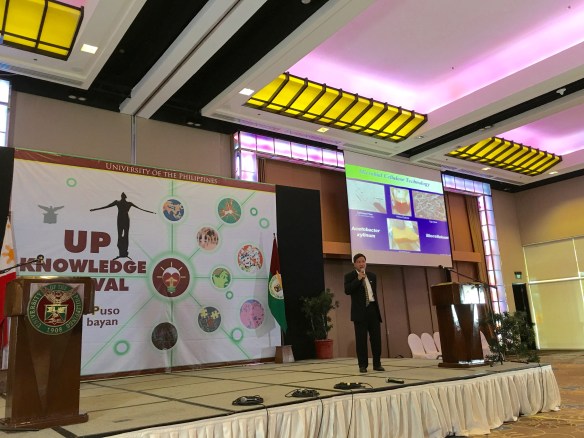
I WAS asked to give the first keynote last week at the annual meeting of the Asia Pacific Writers & Translators at the University of the Philippines, on the conference theme of “against the grain,” and here’s part of what I said:

The Filipino writer is among the freest in the world as far as self-expression is concerned; but the Philippines is also one of the deadliest countries for journalists in the world—according to the New York-based Committee to Protect Journalists, it ranked second only to Iraq in 2013.

Creative writing won’t pay you much, but you can say whatever you want and reasonably expect to stay alive and ambulant. Nobody in this country ever got killed or imprisoned in recent times because of a novel or a story. Neither has a Filipino despot been deposed because of a play or a poem. Journalism, on the other hand, can be a dangerous enterprise, especially if you live and work far away from the glare of the metropolis.

…. We have one of the region’s richest concentrations of writers, and very likely the region’s most strongly developed systems for the development of new writers; but these writers have precious few readers.

We have never lacked for writers, and likely never will. The Filipino writing community is very much alive, producing new work not only in English but in Filipino and in many regional languages.

Within the region, we can claim to have the oldest, the longest-running, and possibly the most comprehensive writing programs—not just writers’ workshops which go back 50 years, but also degree programs from the BA to the PhD in several major universities. The Palanca Awards, which are handed out every year to the best work in many categories and several languages, have been running now for 65 straight years.

New young writers will find it easier to break out and get noticed by their peers and seniors here than in many other places, because, while Filipinos respect their elders, and everyone above 40 is a “Sir” or a “Ma’am,” we do not have the kind of master-apprentice, or senior-junior relationship that exists elsewhere. You do not need a senior’s validation or sponsorship to advance; indeed you might move forward much faster by slaying a literary father or two.

But for all the literary talent we think we have, it can be argued that creative writers really don’t matter much in Philippine politics today—certainly not as much they used to—because, to be hyperbolic about it, no one reads, no one buys books, and no one understands nor cares what we’re doing.

It’s a sad fact that in a country of 100 million people, with a literacy rate of about 97%, a first printing for a new novel or book of stories will likely run to no more 1,000 copies—which will take about a year to sell, and earn the author a maximum of about P50,000 (about US$1,000) for a few years’ work—good enough for a new iPhone. There’s no such thing as a professional novelist or playwright in the Philippines, which makes it easier for writers of any worth to be sidetracked or co-opted by the government or by industry.

It’s ironic that Philippine literature’s political edge should be blunted not by timidity nor by censorship but by sheer market forces. The simplest reason many Filipinos don’t buy books has to be poverty, with the price of an average paperback being higher than the minimum daily wage.

But perhaps we writers ourselves are also to blame, for distancing ourselves from the mainstream of popular discourse. Politics is nothing if not the domain of the popular, and the very fact that many of us write in English is already the most distancing of these mechanisms. The question of language has always been a heavily political issue in multilingual Philippines, where some regionalists still resent the choice of Tagalog as the basis of the new national language Filipino in 1935, and where English is reacquiring its prominence not only as the lingua franca and the language of the elite but as our economic ticket to the burgeoning global call-center industry.

Political change in the Philippines has historically been led by the middle and upper classes, from the Revolution against Spain of 1896 to the anti-Marcos struggle of the 1970s and the 1980s to the Edsa uprisings of 1986 and 2001. Therefore, one might argue that English is, in fact, the language of reform and revolt in the Philippines in modern times.

But it is this same English-literate middle class—our potential readership—that is the strongest bastion of neocolonialism in the Philippines, blindly infatuated with Hollywood, hip-hop, and Harry Potter, keen on trading the local for the global, opportunistic in its outlook and largely unmindful of the social volcano on the slopes of which it has built its bungalows. As I often remind my fellow Filipino writers, our rivals on the bookshelves are not each other, but J. K. Rowling, Stephenie Meyer, E. L. James, Paulo Coelho, and Tom Clancy.

When I return to the two main points I raised—that we are free to speak and to write, but only in politically inconsequential forms; and that we have writers aplenty, but very few readers—I have little choice but to conclude that the main culprit is our self-marginalization through English, and the academicized, Western-oriented mindset the language encourages.

The interesting upside of this unfortunate situation is that—largely untethered from the considerations of commerce and politics—our writers have been free to write their hearts and minds out, producing poetry and fiction of a high quality that, in a double irony, might yet break through to the global market.

The triple irony would be that it sometimes takes the international spotlight for local readers to take notice of native genius. It sounds like wishful thinking, but by being here today, and connecting our literature to yours, we might do enough together to push our literatures to the forefront of our peoples’ consciousness.

But let’s face it: the margins are familiar if not comfortable territory to many of us, not only here but wherever we live and write, as they give us a clearer view of the center. Going against the grain is very much in the grain of how and why we work. And if you didn’t think so, you wouldn’t be here today.