Penman No. 153: Elderly Expressions

IMG_6478

Penman for Monday, June 15, 2015

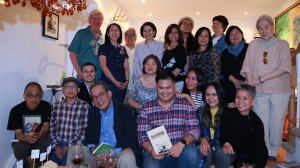
LAST WEEK’S piece on my memoir-writing workshops must have touched a few sympathetic nerves, because I got a number of messages from my fellow seniors asking about the next workshop, and if and how they could get into it. Sadly, I had to tell them that the workshops I mentioned were put together by special arrangement with Marily Orosa, squeezed into a very tight schedule (it’s insane, but I’m working on eight book projects all at the same time, in various stages of completion). It’s still possible that Marily could arrange another workshop for me before the year ends, but that depends on a lot of factors; if it happens, I’ll let you know.

If you’d like to work with me, the best thing to do would be to enroll for one of my graduate fiction or nonfiction workshop courses at the University of the Philippines, possibly as a non-degree student (which will make admission earlier, if you just want to take this one course); I’ll be teaching fiction writing, Fridays 4-7 pm, when I return from my sabbatical leave this August.

I’ve had quite a few senior students in these workshops—and by “senior” I don’t mean that they’re in their fourth year; more likely they’re in their 65th, and just went back to school for a rejuvenating dip in the waters of academia. In many places, they call this “continuing education,” and the good thing about having seniors in class is that not only do they get educated, but the rest of the class as well (myself included), especially the young ones who can benefit from the rich experiences of their elders.

The “oldies” may not always be up to speed as far as the latest and fanciest literary theories are concerned, but they’ll never lack for stories to tell, and you know that when they talk about things like loss or suffering, or bring up words like “rapture” or “redemption,” they’ve looked at life in the eye and kissed it full on the lips, and said some very sweet hellos and some very hard goodbyes.

This isn’t to say, of course, that older people have a monopoly of wisdom or expertise; some of my younger students have amazed me with both the gravity and the finesse of their work, displaying insights well beyond their years. (Let’s not forget that Jose Rizal wrote and published the Noli in his mid-twenties.) Conversely, I’ve seen mature students, mired in their prejudices and predispositions, unable to get beyond a dull and sightless monotone in their narratives.

But there’s clearly need for more room within our society for elderly expressions—and I don’t mean just more welfare-type laws to benefit seniors and such initiatives, although we’d certainly be happy if there were more support for the aged among us, especially the poor. I mean more coverage and exposure in the media and even in our literature of older characters and their concerns, going beyond stereotypes and easy expectations. (If you haven’t seen “The Second Most Exotic Marigold Hotel,” you should.)

We need more stories, poems, plays, movies, and articles with older Filipinos, their predicaments, and their achievements in focus—handled realistically, minus the aura we customarily accord to doting grandmothers and kindly uncles. Certainly they can be saintly, but seniors can also be just as vicious and as avaricious as people half their age, and why not? (I’m sure we’ve all heard of that filthy-rich aunt or neighbor who refuses to feed her househelp properly and puts a lock on the refrigerator.) Acknowledging people’s weaknesses as well as their strengths is acknowledging the diversity and individuality of humanity, which is incumbent upon every writer to do.

For the past many years, in my undergraduate literature classes (and yes, I’ve always insisted on teaching at least one undergraduate class every semester, so our freshmen and sophomores can know what’s it like to be taught by a senior professor, like I did in my time), I’ve taken up two poems that deal with aspects of aging. One of them is “Stepping Westward” by the late Denise Levertov (a mentor of my friend Fidelito Cortes when he was at Stanford). The poem begins thus:

What is green in me / darkens, muscadine. / If woman is inconstant, / good, I am faithful to / ebb and flow, I fall / in season and now / is a time of ripening.

Here, the speaker or the persona asserts her pride in and her comfortability with her advancing years, likening it to the maturing of good wine (muscadine). She has learned to accept—indeed to embrace—the inevitability of aging and death, as a fruit falls off its stem when it ripens. She also fiercely reserves her right to be inconstant and unpredictable, to change her mind if and when she wants to (Angela Manalang Gloria’s sonnet “Change” provides another terrific variation on this theme). She declares that

There is no savor / more sweet, more salt / than to be glad to be / what, woman, / and who, myself.

The poem closes with a wonderful image of life as a basket of bread to be carried—yes, a burden, but also a blessing to be eaten from.

The other poem is a local one, by Merlie Alunan, and is always a hit in class because of a theme that’s practically become taboo in our conservative society: not just female sexuality, but desire in older and unglamorous women (ie, older than Anne Curtis and Solenn Heussaf). The poem is “Young Man in a Jeepney,” which deals with a typical working woman, probably a housewife in her forties or fifties, who takes a jeepney ride home, clutching her bag to her chest, only to find herself seated beside a sweaty young man. The contact, however innocent, stirs up an ancient longing in her:

“Heat,” I mutter. “It melts / the very bones,” feeling / as I say this, inside me /awakening sweet April.

The unsuspecting young man gets off the jeepney and life goes on:

I do not watch you turn / the corner to the sudden dusk / —but I smile to savor /my sin in secret.

So what is that “sin,” I ask my students, and why does she call it so? Is it, indeed, a sin for a respectable and somewhat dowdy matron—and decidedly one of the lower class, the kind who would not have boy toys or affairs with their amigas’ husbands—to feel desire?

Discussions like these remind us that while many things seems to get simpler with age, both by choice and by necessity, human complexity itself doesn’t diminish over time.

Penman No. 152: Writing the Stories of Your Life

Studio5

Penman for Monday, June 8, 2015

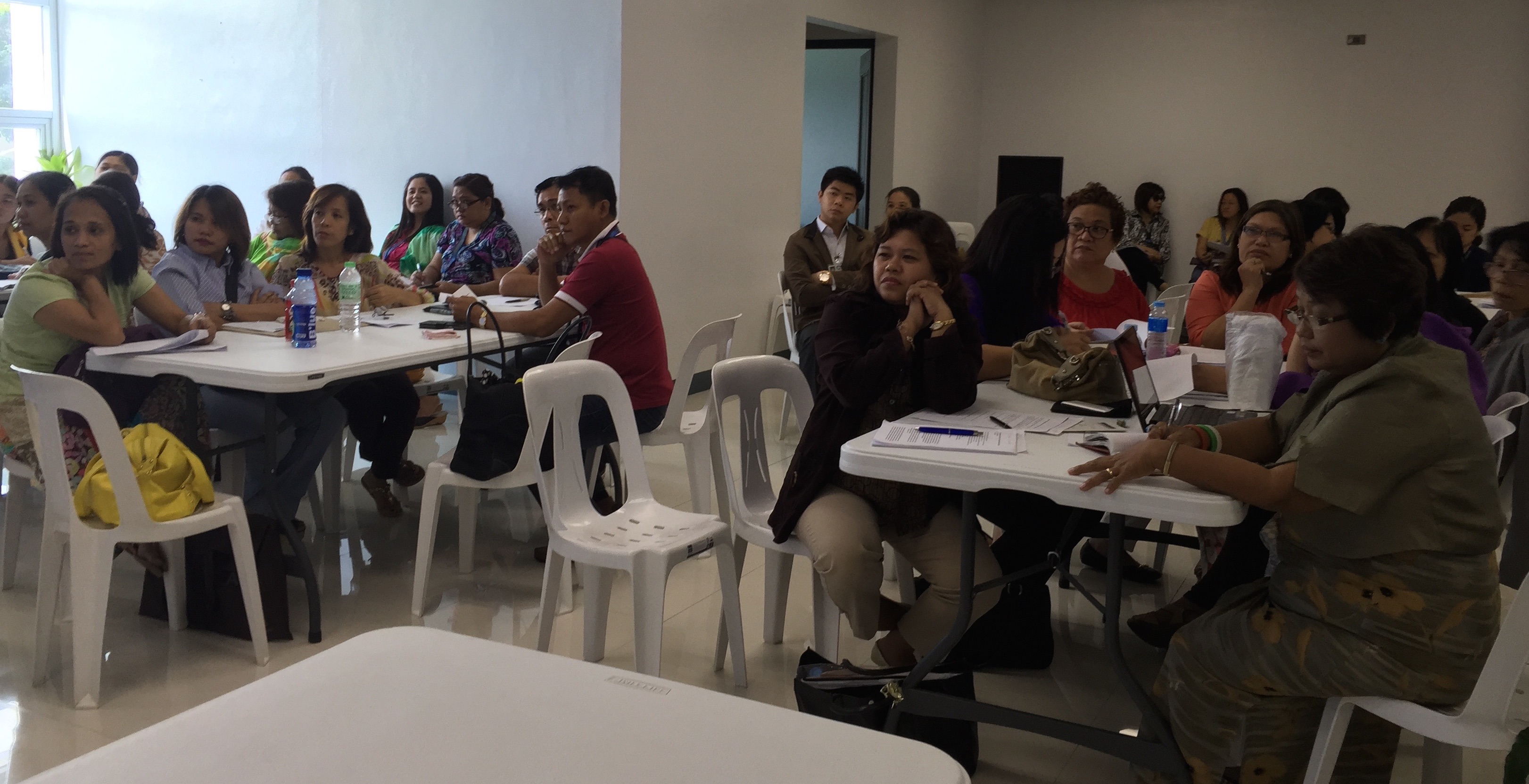
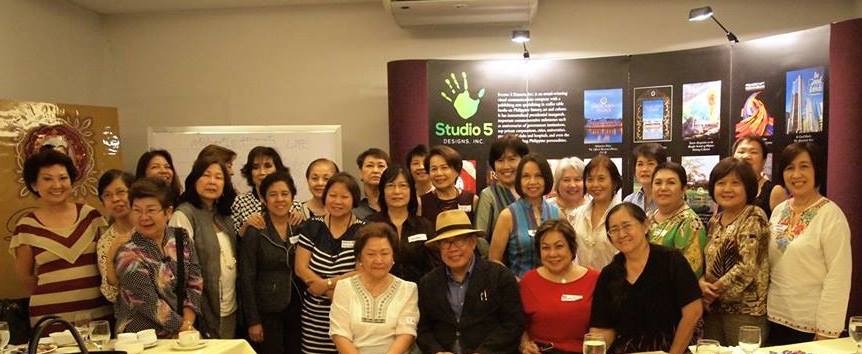
TWICE OVER the past three months, I’ve been giving workshops to medium-sized groups of people in my general age range (let’s put that at 50 to 70), people who came together because they had stories to tell, but needed some guidance on how to tell them. These workshops were arranged by the publisher and writer Marily Orosa, who had come up with very engaging book ideas to which these potential writers could contribute, and who thought that it would be a good idea to have a practicing writer give them a bit of coaching before they plunged into the actual task of writing.

I was glad that Marily put these workshops together, first because I’ve always believed that every person has at least one good story in him or her, and that it’s my job as a writing teacher to get that story out of the person. Second, being a senior myself, I’m happy when older people get an opportunity to express themselves in this obsessively youth-centered world.

Many if not most members of my audience were retirees or approaching retirement after many decades of productive work in their professions. One was a former Cabinet secretary and another a university president, among other luminaries, but in the end, it wasn’t one’s position that mattered as much as one’s experiences, which seniors have in spades.

I couldn’t cram a semester’s worth of lessons into a Saturday afternoon, but I did what I could to give them a framework, an approach, and some tools with which to get their stories out of their memories and onto the digital page. First, we talked about the basic difference between life (their life experience, the raw material) and art (the finished product they were expected to come up with).

What do artists—writers, painters, musicians, and so on—do to and with their materials to make works of art? What do artists see in the things around them that most other people don’t? In this way, we try to get people to see their own lives and experiences as matter to be structured and shaped—not to distort the truth (the object, I think, of all honest art) but precisely to get at it and to bring it out, even if it may not always be pleasant—and indeed much art out there is meant to disturb.

We talk about selection, and how the writer or artist chooses material to use directly in the artwork (the text) and leaves other things out (the context), given that you can’t possibly use everything out there. We talk about how artists work with concrete images and objects to suggest ideas, rather than the grand abstractions that, say, editorial writers and philosophers use.

When we consider life experiences, we then talk about distances in space and time, and about physical and emotional distance. Many participants at these workshops, for example, want to talk about travels they undertook to interesting places, and what I try to do is to get them to write something beyond the verbal equivalent of a posed snapshot in front of the Eiffel Tower or the Golden Gate. A trip to Paris isn’t just ever about Paris, but also, implicitly, about Tagbilaran or Bayombong, wherever it was the narrator or protagonist came from, and it’s that perspective that makes this particular experience of Paris unique.

Writing about the past really involves two protagonists (taking a page from Thomas Larson): the remembered self and the remembering self. Writing about a journey involves not just traversing physical territory, but also that internal space within which the character grows—so the physical journey is always paralleled by an internal, often spiritual, one.

After clarifying these fundamental concepts, I then introduce them to some basic tools of the trade—the elements of fiction which, when carried over to nonfiction, liven up the narrative and make both writing and reading a more engaging experience. We talk about plot, character, theme, point of view, dialogue, description, and setting—how to employ time, how to bring scenes to life, what to say and what to leave out.

I remind them what a lonely and (for most people) unremunerative occupation writing is, but going beyond the money or the lack of it, how important it is to write one’s stories down before the memory deserts or defeats us. It’s especially important for the young to know about how their elders lived and thought. It might take them another 20 years to become receptive readers, but the record will be there, and they’ll be surprised to find, as we ourselves did, how the past anticipated the future in so many ways.

I feel drained at the end of these three-hour workshops, faced with a flood of eager questions, but I also feel elated by all the creative energy I seem to have unleashed among my fellow seniors, and I can only begin to imagine what a touch of art can do to that rich lode of memories lying deep in their many-chambered brains.

Treasures

AND NOW’s as good a time as any to draw attention to the good work done by Marily Orosa’s Studio 5 Designs, which has been in the business of producing not just books but prizewinning ones, lauded both for their design and their substance. I’ve had the pleasure of working with Marily on a couple of coffeetable book projects, most notably De La Salle University’s centennial volume, The Future Begins Here, which I edited and wrote for, and which won a Quill and an Anvil Award (the Quill, Anvil, and National Book Awards are the local publishing and PR industry’s measures of excellence).

Studio 5 has also won NBAs for In Excelsis (The Martyrdom of Jose Rizal) by Felice P. Sta. Maria and The Tragedy of the Revolution (The Life of Andres Bonifacio) by Adrian Cristobal. Malacañan Palace (The Official Illustrated History) by Manuel Quezon III and Jeremy Barns also won a host of local and international awards, as did the magnificent Treasures of the Philippine Wild. Freundschaft/Pagkakaibigan (celebrating 60 years of friendship between Germany and the Philippines) will be included in the prestigious international design annual, Graphis.

Beyond being visual treats, these are all significant books, and their creators and publisher deserve high praise and encouragement.

Penman No. 150: Looking Eastward in Toronto

IMG_7573 (1)Penman for Monday, May 25, 2015

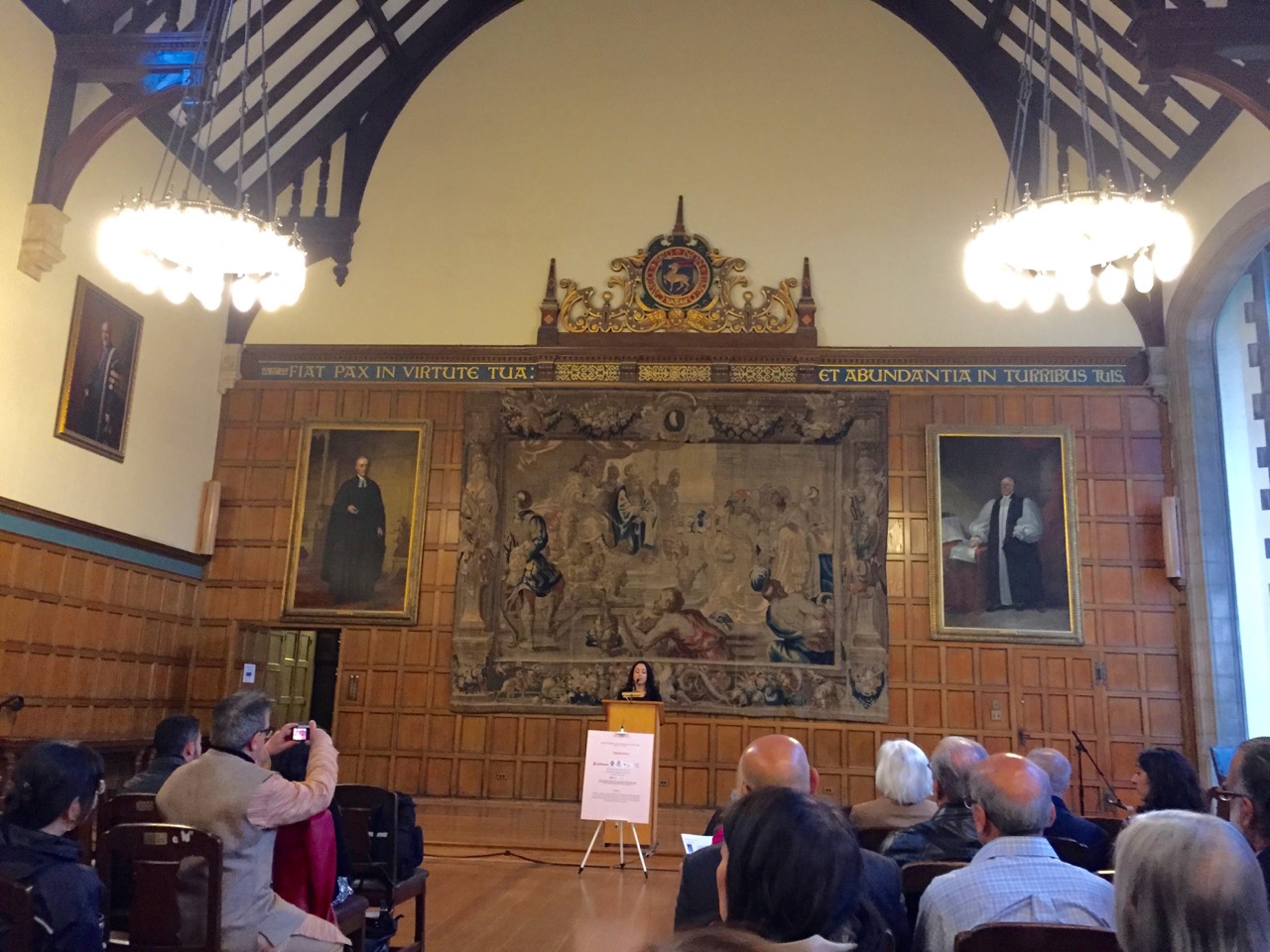
I FLEW out to Toronto in Canada a little over a week ago to take part in that city’s Festival of Literary Arts, possibly the first Filipino author to join that long-running festival, now on its 15th year. Previously, the festival had focused on South Asia (India, Pakistan, Bangladesh, Sri Lanka), but has recently opened itself up to more representation from East Asia, Africa, and the Caribbean, thus my inclusion in this year’s roster of invited writers and speakers.

Over a weekend, from Friday to Sunday (May 15-17), several dozen representatives from these regions and from Canada met in various venues on the scenic campus of the University of Toronto and its environs to tackle issues and problems besetting writers and publishers from outside the global centers. How does a writer from the periphery break through to the center? Or is that “periphery” its own legitimate center? Is yearning for publication and validation in the West a vestige of the colonial mindset, an experience shared by all the countries represented in Toronto?

Aside from these seminal discussions, of course, the meeting was first and foremost a festival, a sharing of the artists’ finest work, and I felt privileged to be introduced to authors and creations I would otherwise have totally missed or blithely ignored. With many of the authors coming from expatriate and postcolonial backgrounds, the offerings were rich and deeply nuanced, the talents outstanding.

Among others, I discovered a major international writer in the festival director, the novelist M. G. Vassanji, who had been born in Tanzania in East Africa, and whose account of his pilgrimage to his ancestral roots across the ocean (A Place Within: Rediscovering India) is a modern classic of creative nonfiction—a sympathetic but unsentimental and often searingly critical chronicle of his encounter with the sprawling reality of India today.

The visit also allowed me to reconnect with some old Filipino friends who had migrated to Toronto and had built new lives there. I was very graciously taken out to a scrumptious dimsum lunch in Toronto’s fabled Chinatown by Patty Rivera and her husband Joe. Patty and I worked together 40 years ago as writers and editors at the National Economic and Development Authority (an unlikely Camelot for young writers and artists under the patronage and protection of then-Sec. Gerry Sicat).

Though trained and still active as an editor and journalist, Patty has since developed into an accomplished and prizewinning poet, with three volumes to her name. Her first collection, Puti/White, was shortlisted for the 2006 Trillium Book Award for Poetry. Patty’s husband Joe, a former Ford executive who also wrote plays in the Philippines, became a lawyer in Canada and then, upon his recent retirement, turned to painting, an avocation in which he demonstrates a most unlawyerly exuberance. I also met and was happy to engage with some Alpha Sigma fraternity brothers led by Amiel “Bavie” de la Cruz, who now runs his own accounting firm in Toronto. IMG_7597 (1) Patty and Joe arranged a reading for me with a large and lively group of Toronto-based Pinoys (including Hermie and Mila Garcia, the moving spirits behind Canada’s longest-running Filipino newspaper, the Philippine Reporter, and expat poet Naya Valdellon); this was held in the very stylish apartment of writer-artist Socky Pitargue, and a great time was had by all as we threshed out the travails of Philippine literature and politics, two deathless topics that occupy me on every one of these overseas sorties. DALISAY_HMG_8056-300x168 Yet another meaningful encounter I had, thanks to the festival organizers, was with two classes of high school students at the Mother Teresa Catholic School in Scarborough, a Toronto suburb with a high concentration of Asian students, including Filipinos. These teenagers had very likely never met a living writer before, let alone a Filipino one, and I was glad to try and show them that we do exist, and that we have something to say. I, too, learned something from their teacher Kathy Katarzyna, who ended our session with a terrific quote from the Canadian poet Leonard Cohen: “There’s a crack in everything…. That’s how the light gets in.”

Many thanks to the Sri Lankan poet Aparna Halpe for taking me to the school. Of course, my thanks wouldn’t be complete without acknowledging the help and support of my sister Elaine Sudeikis and her husband Eddie, who flew in from Washington, DC to join me at the festival and to show me Toronto and a bit of Ontario (most notably Niagara Falls—we walked over to the US side as well for my shortest visit to the US, ever). Ed’s dad Al—all of 92 but still feisty—also gave me a little taste of Lithuania in Toronto.

And the visit would never have happened for me without the recommendation of Prof. Chelva Kanagayakam, an eminent scholar and festival founder whom I’d met in Manila, who tragically died of a heart attack a few months before the festival, on the very day he was inducted into the Royal Society of Canada. I found Toronto itself to be a highly livable and largely safe city (guns are under strict control in Canada), with a vibrant ethnic mix.

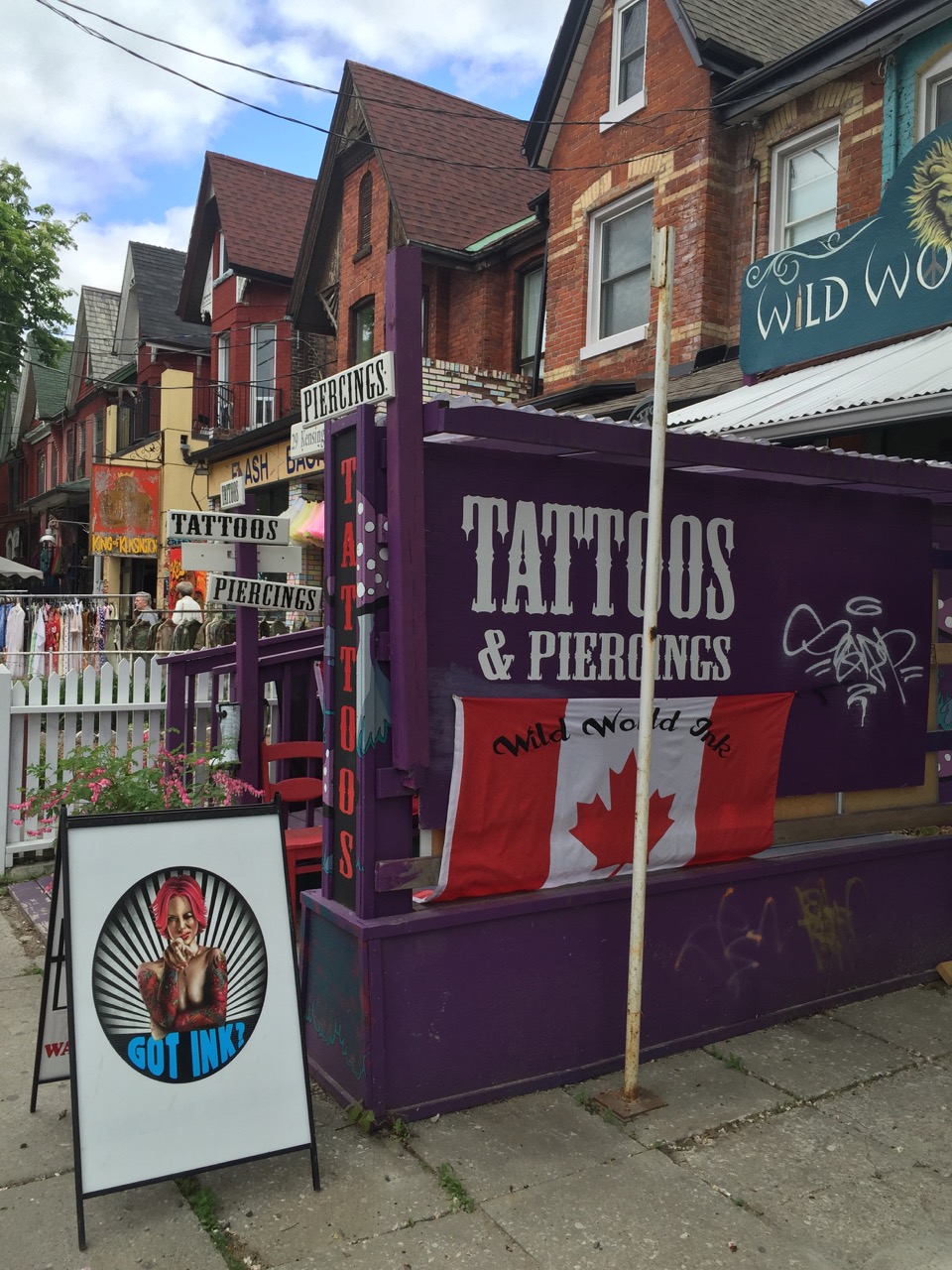
One out of every two Torontonians comes from somewhere else, and Vietnamese, Tibetan, and Puerto Rican restaurants stand cheek-by-jowl beside each other, not to mention a Chinatown noted to be among North America’s best culinary havens. (A Pinoy food store aptly named “Butchokoy” stood a block away from my lovely B&B—a three-storey house from 1853—on Dunn Street.) Victorian structures still in use by the university and the city government contrast sharply with ultramodern architecture in an eclectically energetic skyline. Seekers of the funky and the quirky can have their fill in the city’s counterculture-inspired Kensington Market. IMG_7691 (1) For someone schooled in Americana, this exposure to things Canadian was an interesting re-education—to think, for example, in terms of “Tim Hortons” instead of Starbucks or Seattle’s Best; of “Roots” instead of Gap; of “Hudson Bay” instead of Sears or JC Penney, etc.

But the most useful re-orientation took place for me at the festival itself, in reminding me that we have a lot to learn from South Asia as far as developing readerships in local languages is concerned, among other issues. We Filipinos think we’re well traveled and globally savvy, but we actually don’t get around enough in terms of mixing with our fellow Asians, let alone Africans. We seek out Western—specifically American—tutelage and patronage, often to our own deep disappointment.

It seems ironic that I had to learn this in Toronto—a true cosmopolis like New York—but sometimes you have to stand in the West for a better view eastward.

[Group photo from philippinereporter.com]

Penman No. 149: Advice to Freshmen

Penman for Monday, May 18, 2015

AFTER LAST week’s piece on “Why I’m not on Facebook,” I thought I should add or clarify that I’m not entirely off the grid, Web-wise. I do choose the websites or forums I frequent (and in case you’re wondering, I’ll explain the difference between forums and fora one of these days), to make sure that I deal only with things and people I’m truly interested in. For over a decade now, I’ve moderated the Philippine Macintosh Users Group (www.philmug.ph), and more recently the Fountain Pen Network-Philippines (www.fpn-p.org); now and then you’ll also find me at the Philippine Watch Club (www.philippinewatchclub.org). I keep a blog at www.penmanila.ph, and send out an occasional tweet, usually about my poker fortunes and misfortunes, from @penmanila.

It was on one of these sites—Philmug, which has grown to become one of the world’s most active Apple user groups—that I came across a thread I’m tapping for my topic today. While Philmug is the place to talk about anything and everything Apple, it’s also a community that can spark very lively discussions about such motley topics as Manny Pacquiao, Manila traffic, where to stay in Hanoi, and what SIM cards to get in Europe. One such “offline” thread that perked my interest last week was one titled “College freshman tips,” started by a young member about to enter college. Was there anything, he asked, that his elders could tell him about college life?

It’s a thread that’s grown to ten pages long the last time I looked, and predictably, many Muggers (as Philmug members call themselves) recited that age-old mantra that all college freshmen know by heart (and sophomores even better): “Party hard, study harder!”

Other suggestions were more specific:

  1. Join student organizations and socialize, but choose which ones you’ll be joining wisely. These “orgs” could become networks for life, for both friendships and professional contacts.
  2. Avoid fraternities and such groups that employ physical initiation and advocate violence. You’re in college to study—not to maim or be maimed by other people.
  3. Get out of your comfort zone, and be a little more adventurous. Make friends with people who may be totally unlike you. That’s where a lot of learning happens—in knowing about how other people live and think.
  4. Manage your resources well—your budget and time, most especially. Learn how to take care of yourself, and consider taking a student job, both to earn and to learn some professional working habits.
  5. Master the freshman basics: the campus map, how to take notes, who the best (not necessarily the easiest) teachers are.
  6. Don’t confuse a college diploma with education. A lot of learning takes place outside the classroom.
  7. Don’t believe everything you hear, even from your professors. Learn how to argue, and argue well.
  8. Never plagiarize. It’ll never be worth it.
  9. Don’t be afraid to fail. Go ask a girl out if you really like her. Failure is part of learning.
  10. Don’t try to do everything in your freshman year. You’ll find yourself being pulled in so many directions that it’s easy to lose focus. Map out a clear and unimpeded path to your sophomore year.

Some other suggestions were a bit more unusual, although no less practical. “Always sit beside a female classmate and you will never regret college life, because they are lifesavers (and your immediate supply of pens, paper, books, assignments, and exams),” proposed one member (who now just happens to be one of our smartest cops in the PNP). “They smell better than boys,” another member, a retired pharmaceuticals executive, agreed.

And what did I say? Quite a bit, but among them was, “Don’t bother playing mind games with your professor (as in ‘I’m smarter than this guy, and I’m going to prove it’). You will lose; even if you are smarter than your prof, you will lose… Learn how to argue and come across as being smart without being snarky. I’m a very gentle prof myself, but nothing makes me happier some days than to give some smartypants a dose of his own medicine.”

Now, of course, like many 16- and 17-year-olds, I didn’t follow all this sound and sage advice I’m giving and hearing.

In my freshman year in UP in 1970-71, I (1) joined a frat and got beaten black and blue; (2) joined a militant student organization and went to dozens of rallies, many of them violent; (3) joined the staff of the Philippine Collegian, the student newspaper; (3) met (and lost) my first girlfriend, and did what boys and girls do; (4) got a 1.0 in English and a 5.0 in Math (for absenteeism—I was a Philippine Science high grad and arrogantly thought that Math 17 was beneath me); (5) shifted courses, from Industrial Engineering to Journalism, I think; and (6) went up to the mountains of Quezon and Bulacan to do “mass work.” It was, to say the least, an interesting year.

Within another year or so, I would drop out and divide my time between my activism and a job as a newspaper reporter (I may have been the youngest regularly-employed newspaper reporter of my time, at 18); also at 18, I was in martial law prison; by my 20th birthday, I was married, and became a father before I turned 21.

Not surprisingly, it took me forever to get back to school and finish. I resumed my undergrad studies at age 27, and graduated with my AB in English, cum laude (you could still get honors then even with a failing mark if it wasn’t in your major—I had shifted to English by then—and if your GWA could sustain it) at age 30. I made up for lost time by finishing my Master’s by 34, and my PhD by 37. Some of us like to hurry… and then to take our time… and then to hurry again.

I suppose my ultimate advice to freshmen is just to hang in there and don’t do anything stupid like get killed before turning 20, unless you’re doing it for God and country. But don’t stay too safe, either, because the best things you’ll be learning from will be your most grievous mistakes. One of the wisest things I ever heard came from a friend, now departed, spoken over beer and stale cigarettes at 2 in the morning: “Everyone should be entitled to one big mistake.” Or, as my professor in German once put it, “Ein Fehler ist kein Fehler”—one mistake is no mistake.

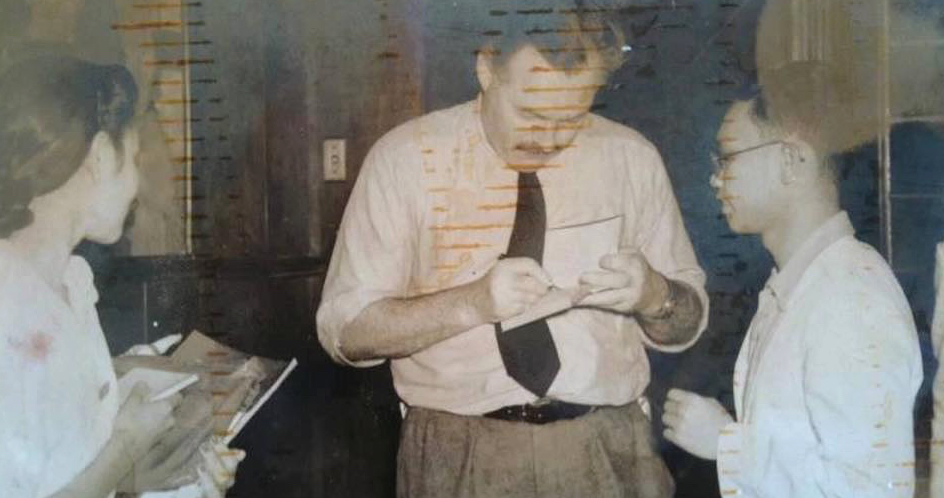
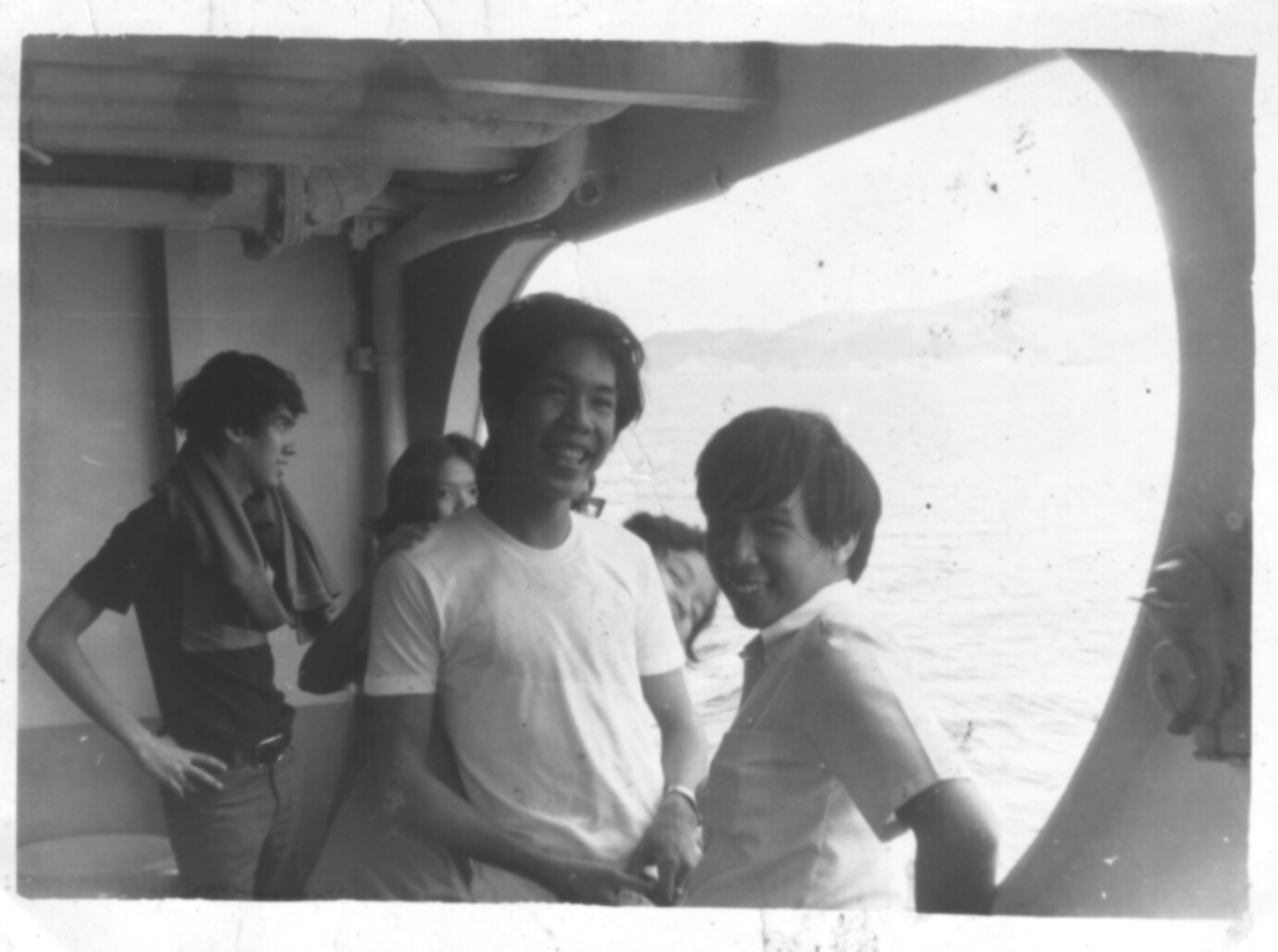
We made a few, and have survived and maybe even prospered despite and because of them. For a Thursday throwback, I posted a picture in that thread of myself as a lanky freshman, beside activist leader and fellow PSHSer Rey Vea (now president of Mapua University), on a boat to a CEGP convention in Dumaguete ca. 1970. My only question was, where did all that hair and leanness go?

1971

Penman No. 147: On Southern Seas

IMG_7501

Penman for Monday, May 4, 2015

“ON A CLEAR day, you can see Malaysia,” they said. And we did, from the waters off Balabac, on the southernmost tip of Palawan. At that point, approaching the lighthouse at Cape Melville, our guide pointed to a gray mass on the far horizon across the strait, and said, “That’s part of Sabah.”

We had arrived in Balabac the day before, after a six-hour ride by van from downtown Puerto Princesa to the station at Rio Tuba, and then another three- to four-hour trip by motorized boat to Balabac’s poblacion. It was an unlikely adventure for Beng and me, being the only seniors in our party that included our favorite traveling companions—my niece Susie, her husband Toto, my cousin Edith, and our good friends the Puerto-based expat innkeeper Herwig and his wife the chef and baker Theresa. We’ve been to Palawan pretty often—staying when possible with Herwig and Theresa, who run the very aptly named Amazing Villa in Aborlan just outside of Puerto—but had never been down to Balabac. An invitation from a Balabac native, Theresa’s lawyer Atty. Regidor Tulale, proved compelling enough to make us pack our bags and head out to our southern frontier.

I’ve always wondered why our tourists—both foreign and local—seem so fixated on Boracay when Palawan offers beaches just as spectacular, in contexts far more interesting than D’Mall, without the crush of tricycles and tourist vans depositing hordes on fellow visitors on the same crowded stretch of white sand. Puerto Princesa alone and the islands on Honda Bay offer enough pleasures and treasures for the urban straggler, but, as we would discover, the farther out you go, the closer you get to tropical nirvana.

There are buses that ply the 240-kilometer route from Puerto to Rio Tuba, the nickel-mining barangay in the town of Bataraza past Brooke’s Point, but it’s a trip best taken in an air-conditioned van, given the summer heat and the need—especially for the elderly—to stop at a gas station now and then for some private relief. It’s a long but pretty ride, not unlike the run up to Baguio from Manila in the distance and scenery, on a road flanked by views of cloud-topped mountains, and golden showers blooming riotously.

Rio Tuba itself seems as rough as mining towns tend to be, an impression little helped by a recent fire that gutted the area around the pier, the transit point for boats venturing on to Balabac. Nevertheless, there was a plucky, pick-me-up cheerfulness to the locals (the fire, they said, had started accidentally in one of the big stores in the neighborhood, and everyone was busy rebuilding what they had lost), and the pier at the end of a huddle of houses on the water bustled with traffic.

The boats they use in these waters are large motorized outriggers that can easily take 30 passengers, seated four or five to a row on wooden planks; they can theoretically reach Sabah in a few hours, but, we were told, these boats were prohibited from docking in Malaysian ports because their breadth took up too much berthing space; the sleeker and faster kumpit would be the vessel of choice for that voyage. There was clearly a lot of trade going on between Palawan and Sabah, judging from the stockpiles of Malaysian goods and groceries in Rio Tuba, and one had to wonder how much of that went through customs and other legal encumbrances, but we opted, I think wisely, not to ask too many questions.

The three-hour ride to Balabac itself, with one or two stopovers on the way, was smooth and pleasant. “Balabac” is the central island and town in the area, but it also broadly refers to a cluster of more than 30 islands, and you’re never too far from one of these. (“That’s owned by Senator XXX and by former President YYY,” our guide would tell us as we passed by one paradaisical isle after another.) The glassine sea challenged the poet to come up with all variables of blue and green, and with some luck—not that day—dolphins were known to swim alongside the boats.

IMG_7470

Balabac’s town proper was small and compact, with one main street along which shops selling clothes and groceries huddled; the largest and most impressive building in town, aside from the municipio, was the Coast Guard quarters, a sign of how important patrolling these waters was. The local tribe, the Molbog, are said to have migrated from North Borneo and have their own dialect, but what surprised me throughout this visit was how widely Tagalog (or, more accurately in a national context, Filipino) was spoken, even by the locals among themselves.

You won’t have any problems choosing a place to stay, because there’s only one public lodging house in Balabac, above and adjacent to the Sing and Swing Karaoke Bar. Maybe not the best prescription for a good night’s sleep, as some of my companions would discover, but for P300 per room a night with shared toilets and baths (P100 per extra person), you can’t complain.

What to do in Balabac, aside from shopping for Malaysian chocolates and biscuits? Why, island-hopping, of course, and dining on the plentiful fish, which we did the next day, taking a boat out to Candaraman Island and dipping into the cool clear water beside the small seaweed farms cultivated by the people for their livelihood. Unfortunately, the low tide prevented us from docking and marching up to the century-old lighthouse on Cape Melville, but we did get that glimpse of Malaysia along the way, in a day that culminated in one of the most stunning sunsets I’d ever seen.

As the darkness deepened around us, we sat quietly along the dock, watching the southern summer sky. Above us blazed Venus, a solitary sparkle; down to its left, as if a genie had conjured it up with a wave of his hand, emerged a crescent moon. It was a long way from home, but a sight well worth the journey.

Penman No. 144: Postscript to the Palancas

Penman for Monday, April 13, 2015

FIRST OF all, let me express my belated thanks to Mrs. Sylvia Palanca Quirino and the Palanca Foundation for responding promptly to our recent appeal for them to reconsider and rescind what many writers thought were rather onerous rules for this year’s Palanca Awards competition. That has happened—we’re basically back to the old rules, which prospective entrants can read on the Palanca website. I do have to remind people to mind the check box on the entry form, where you need to indicate whether you’re giving your express permission for the Foundation to publish your work in full, in case it wins.

We can understand the Foundation’s desire not just to give away monetary prizes for literature as it’s done for over 60 years now, but also to develop a readership for good writing. That’s why it’s important to strike a balance between the authors’ rights to their work and the sponsor’s need to share some of that work with the public for whom it’s presumably being written. As someone who’s come to be associated, and happily so, with the Palanca community, I’m relieved that this little tempest was dealt with expeditiously and reasonably by the Palancas and their lawyers—with the personal and gracious intercession, of course, of Mrs. Quirino.

I should note that both sides came away with the clear understanding that the rules are a work in progress—as are the Palanca awards themselves—as the literary and publishing environment itself continues to evolve in ways no one could have predicted, say, 20 years ago. They will be reviewed and modified as the times require, but meanwhile, it’s back to the old rules (minus the retroactivity provision, which turns out to have been there before with hardly anyone noticing; at least the recent discussion surfaced that). Thanks, too, to other stalwarts in the literary community such as Krip Yuson, Karina Bolasco, and Andrea Pasion-Flores who also worked behind the scenes to help clarify and resolve issues.

On the sidelines, this brouhaha raised some old, perennial questions, mainly from younger writers. For example, I received another message on my blog asking if it’s absolutely important to join the Palancas and win a prize or two to gain literary recognition. My answer has always been, of course not—not absolutely. I’m sure that many accomplished authors never joined the Palancas nor won one of its many prizes; quite a few, both old and young, disdain the idea of joining for their own reasons, chiefly the distastefulness of seeming to curry favor with the literary Establishment.

From a practical standpoint—and I’ve always been a practical man—I have no doubt that a Palanca award or two, or better yet a dozen, can help perk up the CV and gain some attention from editors, publishers, and grant-givers (if that sort of thing is important to you at all, because it may not be and doesn’t have to be, if you’re independent-minded and/or have independent means).

That may sound a bit crass to the idealist, but it’s never really been just about the money—which is appreciable but not all that much in the grand scheme of things. It’s about the inner lift you get from a bit of validation from one’s peers and seniors (and again, if you don’t need or want that validation, feel free to look elsewhere).

And that, too, has practical effects, as the encouraged writer produces more (and, over time, hopefully better) work. Writing is a lonely job; there’s very little popular but credible criticism in this country that deals with contemporary literature, especially of work written by writers 40 and below. With very few readers and critics about, the only quick check you might get on your work could be that prize (ie, from your readership of three judges)—or its absence. It’s a sad thing to note, in a way, but that’s how it is.

Are the Palancas an infallible gauge of literary merit? Of course not. Any juried award involves people, and anything involving people is bound to be subject to human error and bias. You’ll hear ugly stories from some joiners about how they were cheated out of their well-deserved award by narrow-minded judges promoting their own favorites, but absent any direct proof, I’ll have to put this down to the natural quirks of the process. (I do respect the possibility that these plaints aren’t just griping by sore losers, but a reasoned critique of what some see as the ossification of an institution.)

I can’t speak for everyone else, but I’ll just say what it was like for me. When I began joining the Palancas in the mid-1970s, I didn’t know anyone and nobody knew me. I was a college dropout, and hadn’t even gone to a writers’ workshop then. I took my chances, and lost more times than I won. I won a share of second prize the first time I joined, in 1975 when I was 21 (after which I naturally felt like God’s own child), but this was followed by a straight and miserable four-year losing streak.

Whenever I lost, I felt sick to the stomach and couldn’t wait for another year to roll over as quickly as possible. But I didn’t curse the heavens or the judges. After sulking for a week, I went back to my desk—reading writers I could learn from—and wrote more stories and plays (many of them lousy ones for sure, but even bad work strengthens some muscles) and joined and lost and joined again.

At some point, I began winning more often than I lost—yes, that felt good and it got addictive—but when I had won enough, I stopped joining and focused on more important things, like teaching. (Everyone’s free to join and seniorhood shouldn’t prevent anyone from duking it out with the youngsters—hey, we semi-retirees can still write about steamy sex!—but my personal sense is, there’s a time to look for other thrills.)

It comes down to this: one or two or even a whole raft of Palancas won’t make you a writer, or make you as a writer. They’ll give you a helpful leg up and make you feel like a king or a queen for a week—you’ll certainly be the most famous writer in your barangay—but ultimately, the awards will only be as good as you make them, as you parlay them into good, sustained writing and publishing.

Forget those three-person boards of judges and their foibles; worry about the faceless thousands of readers out there you’ll never see, but who will all have something to say about your work (or worse, prove indifferent). At some point, stop worrying about prizes; worry about your next book. That’s what people should best remember you by.

(This year’s competition will close on April 30. Check out www.palancaawards.com.ph for more information.)

[Image from gmanews.tv] 

Penman No. 142: A Foray into Fairyland

IMG_7223

Penman for Monday, March 30, 2015

LIKE I promised to do after an all-too-brief overnight sortie last January, I returned to my birth province of Romblon a couple of weeks ago—my first real visit home in almost 20 years—for a full week of catching up with a barangay of cousins, uncles, and aunts, some of whom hadn’t seen me since I was a boy.

But the family reunions and the endless festivities aside, what stood out on this trip was a foray into Fairyland—a highly unusual detour for this hardcore skeptic, who nevertheless went gamely along for the ride, and who came out richly rewarded with fairy tales if not with actual encounters with the other kind.

You won’t see it in any of the tourist guidebooks, and you might need to know the cousin of a cousin to navigate safely around the place. They call it Calatong—a word for which, in the local dialect of Guinbiraynon, there seems to be no precise translation, but it’s otherwise known even to the place’s youngsters as fairyland, the mountain inhabited by encantos, the enchanted ones. It dominates this corner of Romblon’s largest island of Tablas, both physically and culturally; from far at sea, Calatong’s tall hump offers an unmistakable landmark; by land, along the winding dirt road from Alcantara to Guinbirayan, it rises on your left, a massive mystery, although it might take some time and tuba to get the stories about Calatong flowing through the conversation.

I had seen and known about Calatong from my earliest years in Guinbirayan—my mother’s hometown—and even on this most recent visit, it was the first thing I would see outdoors when I stepped out of the house at daybreak, because the sun would emerge from behind it like a glowing crown above a dark and brooding head.

But I had never gone out there, although it seemed close enough to walk from where I stood on the shore. On this trip, at age 61, I told myself that it was now or never, and on the appointed morning we rode out to Calatong, but not before Letty, the retired schoolteacher who kindly hosted us, armed each one of us with a sliver of ginger. My mother Emy, now 86, had not been back to Calatong since she was a nine-year-old schoolgirl on a field trip with her class. “My teacher never let me out of her sight the whole time we were here,” my mother said as we parked the SUV as far up the dirt road as it could go. We walked up to the shore and took a banca over the glassine water—now turquoise, now emerald—to view the mountain from the sea, turning back only when the waves grew choppy.

IMG_7267

It’s said that during the War, when the Japanese flew over Calatong, they saw a brightly lit city, but then found nothing on the ground. This gave rise to the legend of Calatong as a ciudad, the name by which many of the locals still call it.

Somewhere in that sylvan cosmopolis was a waterfalls or a spring they called Labhang Dalaga, or “where the maidens washed,” from which flowed bubbly water, fragrant as if it had carried soap. We didn’t venture far enough inland to catch this frothy spectacle, but the rocks did sparkle in the sun in Calatong, as we were told they would; it was easy to see that the rocks were granitic, and contained liberal inclusions of quartz and mica, among other shiny minerals.

The mountain resists poachers and souvenir-hunters unless they’re locals who respectfully ask permission. They say that a woman who picked up a black rock and brought it home was horrified to find that the rock, left in her bathroom, had turned into a snake. A man who reportedly dug up oil and brought it out would find his precious discovery turning to water. There’s talk of siphoning water from Calatong to serve the nearby barangays, but already there’s grumbling about irregularities in the process, and about the likely consequences of displeasing the spirits.

The encantos, our cousins said, were fair-skinned, and one way of ascertaining who they were was to note the absence of a philtrum—that depression in the skin on your upper lip beneath your nose. The encantos liked to come to town to join the dances during the fiesta, when beautiful strangers typically appeared from nowhere, enjoying themselves and charming the locals. The encantos seemed to particularly favor the pretty nurses from far away who came to serve in Romblon as part of their martial-law-era YCAP duties. The antidote to their charms was to eat quinta, or black mountain rice; marriage to a local boy also seemed to ward off any further claims by the spirits—so swore my cousin Fred, who thereby met and married his wife Nanette.

You had to be careful about whom you made friends with, as a boy would realize when he accompanied his new friend home, and made the Sign of the Cross to be on the safe side of things—only to suddenly find himself hanging from the limbs of a tree. The townspeople would also see their neighbors jumping out their windows—and these neighbors would later return with fantastic stories about riding golden chariots over the mountaintops.

IMG_7245

The most persistent story also happens to be the most fantastic one, its incredibility only magnified by the insistence of the storytellers upon its veracity. Among those storytellers was an aunt-figure we’ve always known as Manang Munday, who recounted her story at the dining table, thusly:

One mid-afternoon in 1942, when she was in the fourth grade, Manang Munday heard a large commotion brewing and joined a throng of people rushing to the Guinbirayan shore. There, she says, she and the others saw a light-colored ship—the kind that plied the Romblon-Manila route—with the name “COSME YAP” brightly emblazoned in gold letters on its side. It sailed behind Calatong, but when the people tried to follow it and view it from afar, it was nowhere to be found. Years later the villagers would swear that they had heard the sound of an anchor chain being unwound in the night from the direction of Calatong.

Cosme Yap was my maternal grandfather, a merchant and a goldsmith, one of the richest citizens of Guinbirayan in his time. Lolo Cosme did own a sailboat, a batel as they call it in those parts, but it rather dramatically sank in a storm on its maiden voyage, Titanic-like (his wealth survived the catastrophe, but how it eventually vanished is another novel unto itself, albeit an unimaginatively prosaic one). The boat and the gold probably explain the persistence of this tale, and of its variations. Relatives say that when my Aunt Nieves was close to death, she had a vision of Lolo Cosme coming to fetch her in a golden airplane.

Again, unlike my sweet Beng who’s wired to the Universe, I don’t believe in spirits—but if something golden flashes before my eyes in my final hour, at least I’d have an inkling where that was coming from.

Penman No. 141: War and Remembrance

IMG_7163Penman for Monday, March 23, 2015


A FEW weeks ago, I had the pleasure of having coffee at the Ayala Museum with some good friends visiting briefly from the United States—the historian and professor Sharon Delmendo and her mother Judy, and the retired soldier, consul, and West Point lecturer Sonny Busa.

Both Sharon and Sonny were in town to do research—Sharon on President Quezon and the Manilaners, the Jewish refugees whom Quezon took in just before the War, and the Visayas-born Sonny on the guerrilla movement, for which he’s helping to seek more recognition in the US, especially those who may have fallen through the cracks of the American legal system. (Even Judy Delmendo proved to be a revelation, as I Iearned the story of how, as an idealistic young teacher, Judy signed up for the Peace Corps as soon as she heard JFK’s clarion call about doing something for one’s country. She was among the very first Peace Corps volunteers to ship out, and landed in Masbate, where she ended up marrying a handsome Filipino named Rene.)

Not surprisingly, history—both past and current—dominated our discussion. I’m not a historian myself, but have a keen interest in the subject, and might even have taken it up as my profession. (There was this fork in the road, more than 30 years ago, when I was returning to college from a long hiatus and was choosing between English and History as my major; pressed for time, I chose the path of less resistance.)

It must have been all those movies I saw and comic books I read as a kid, but I’ve been especially and inordinately fascinated by war and conflict—despite the fact, to which my friends will hopefully attest, that I’m a most unwarlike person, and have never fired a gun in all my 61 years. (In her college years, our daughter Demi was a proud member of UP’s rifle and pistol team.) I may be enthralled by the engineering that goes into a piece of weaponry, and I’m easily impressed and moved by tales of courage and heroism in battle, but I never for a minute forget that war is an ugly business, brutal and brutalizing, inevitably attended by grief and sorrow, and by the all-too-human impulse to wage even more war.

Sharon and Sonny had come to the Ayala Museum that morning not just to see me but also to take part in a conference on World War II, coinciding with an exhibit at the museum. I hadn’t known about the conference and couldn’t stay on for the rest of the day, but I did stay long enough to catch the first event, which was an exhibit on wartime Manila, particularly the uniforms worn by military personnel on both sides. The reason for this curious but interesting angle became apparent when we were soon surrounded by people dressed up as Japanese and American officers and soldiers, and also as nurses, guerrillas, and even a Makapili informer.

I turned around to see a familiar face, albeit in a totally unfamiliar context: that of the prizewinning sculptor Toym Imao, son of the late National Artist Abdulmari Imao and an accomplished artist in his own right. I’d last met Toym (so named because of the award his dad received) when he was a speaker at our Fulbright pre-departure orientation last year; he had been a Fulbright scholar in Maryland, honing his skills there. But now Toym the sculptor had transformed into Toym the tank commander, a figure right out of Fury.

“We started out as an Airsoft group,” Toym told me, “but we soon realized that it would be more interesting if we went for historical re-enactments using historically correct uniforms and costumes.” Thus was born the Philippine Living History Society, which had put up that morning’s special display. The society, which now has nearly a hundred members, counts HR managers, call center agents, and media professionals among others in its ranks; older persons, women, and children are also part of the group, which has staged re-enactments of famous battles or encounters (a mere costume parade, I learned, is simply an “impression”; members also have a term, “farb,” for historically inaccurate gear). Some of their uniforms and equipment are genuine artifacts—preserved, rediscovered and restored, or sourced from eBay; others are reproductions, but accurate down to the last button.

Despite their strong military bent, the society’s members are no warmongers. “We just want Filipinos to appreciate history better, and this is a good way of getting their attention,” Toym explained. They certainly got ours—even Sonny Busa, probably the only real soldier in the room (he had served with the US Army’s Special Forces before joining the diplomatic service), was caught up in the drama.

FullSizeRender

Speaking of war and remembrance, I’d like to note the recent completion and turnover to the Philippine National Police Academy of a huge and breathtaking mural by the Erehwon Art Collective, a division of the Quezon City-based Erehwon Art World Corporation. We don’t have enough military art in this country, and quite apart from its powerful emotional appeal, this mural will be an important contribution to that genre. Let me draw on the description provided by Erehwon founder Raffy Benitez:

“Tagaligtas: Heroic 44 is a military mural that realistically depicts each and every member of the SAF 44 in their combat gear and uniform, portrayed as they are about to go into combat in realistic formations and stances. They gaze at the viewer with pride and fondness as comrades, sons, brothers, and fathers who have passed on into history. Portrayed across 182 square feet of canvas that measures 7 feet tall by 26 feet long, the SAF 44 are depicted in their various unit configurations, with the commanding officers and senior inspectors in front, middle ranking patrolmen in the middle, and junior-ranking patrolmen at the rear.”

Incredibly, the mural was completed in just three weeks by a talented and tireless team that included Grandier Gil Bella (head artist), Jerico de Leon, Neil Doloricon, Camille Dela Rosa; Lourdes Inosanto, Jonathan Joven, Othoniel Neri (assistant head artist), Emmanuel Nim, and Dario Noche (head researcher and photodocumentor); and Eghai Roxas. The Philippine Chamber of Commerce and Industry (PCCI) provided financial support for the project, while PSSupt Gilbert D.C. Cruz of the PNP-NCR Southern Police District provided technical advice. The mural design was conceptualized by Dr. Reuben Ramas Cañete.

So whether through the theater of costumery or the quieter grandeur of a mural, the warrior lives on in our common memory.

Penman No. 138: On Wall and Paper

IMG_7127Penman for Monday, March 2, 2015


OF ALLl the forms of art, nothing catches the public eye quite like a mural—a painting on a wall. It isn’t just that murals tend to be massively larger than your usual living room portrait or still life. They very often seek to capture and represent the spirit and experience of a community, voicing the concerns and celebrating the values of that community. Starting with cave paintings, murals are also the oldest human art form, but they’ve survived surprisingly well into the 21st century, creatively adapting—often literally—to their physical and social environment. (For some of the world’s best contemporary murals, see here: http://www.cartridgesave.co.uk/news/the-50-most-stunning-wall-murals-from-around-the-world/)

In the Philippines, muralists like the late National Artist Carlos “Botong” Francisco have defined the content, style, and temper of the form, much like Diego de Rivera and Jose Clemente Orozco did in Mexico. Informed by history and politics, their work also incorporates ethnic and religious elements, presented in a sweeping visual montage.

Given our colorful history and the need to inflame our people with greater patriotic fervor, you’d think we should have more murals adorning our many walls—think of the kilometer-long mural that snakes through downtown Hanoi, for example—but sadly, we don’t. Good murals take time, resources, and of course artistic talent and vision to make, not to mention the large blank spaces that are the muralist’s work- and play-ground.

Thankfully, the University of the Philippines—in cooperation with the UP Alumni Association and the Araneta Center Complex—has taken a major step to redressing that shortage, by commissioning 28 of the university’s top alumni artists to produce murals depicting various periods and aspects of Philippine history.

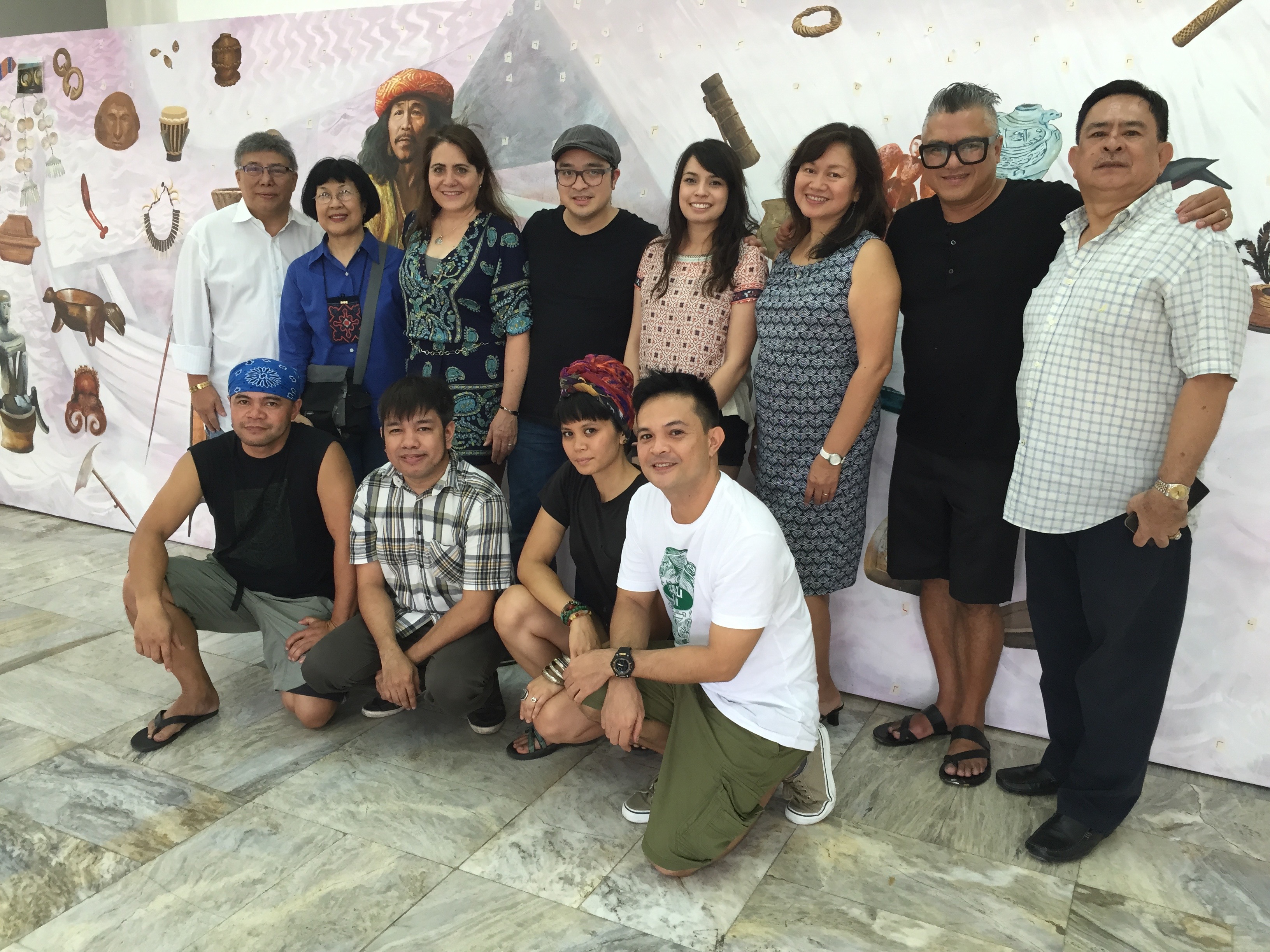
This distinguished roster includes Adonai Artificio, Armand Bacaltos, Adi Baen-Santos, Grandier Bella, Benjie Cabangis, Ben Cabrera, Angel Cacnio, Romeo Carlos, Cris Cruz, Denes Dasco, Gig de Pio, Simkin de Pio, Vincent de Pio, Neil Doloricon, Norman Dreo, Amado Hidalgo, Abdul Asia Mari Imao, Ben Infante, Gigi Javier-Alfonso, Aileen Lanuza, Romeo Mananquil, Norlie Meimban, Julius Samson, Jonahmar Salvosa, Randy Solon, Michael Velasco, Jun Yee, and Janice Young. The resulting exhibit, titled “” or Philippine History in Art—opened at the Araneta Center’s Gateway Gallery last February 18.

The murals—all of a uniform 6’ x 12’ size—cover the full range of Philippine history from pre-Hispanic times to the present, under the guidance of historian Dr. Luisa Camagay and project director and artist Dr. Gigi Javier Alfonso. To UP President Alfredo Pascual, the project is UP’s way of helping to promote a keener historical consciousness among Filipinos, especially the young. The Araneta Center in Cubao, which is marking its 60th anniversary, graciously agreed to host the exhibit in its new 5th-floor gallery.

Coming from a science background, a senior UP official whom I was touring the exhibit with asked me for my critique of the murals on show. I told her that while I was of course pleased with the project as a whole, with its intentions and execution, I personally preferred those works that went a step beyond the literal in their treatment of history, and that dwelt less on the big and obvious historical figures and more on pedestrian realities. I do understand that murals can’t be too abstract, lest they fail to connect with their intended mass audience; in any case, the murals did what they were meant to do, which is to provoke more thought and talk among their viewers.

FullSizeRender

On another front, and also in Quezon City which seems to be shaping up as the cultural center of the metropolis, a new exhibit of paper and paper-based art titled “Pumapapel” opened last week at the Erehwon Center for the Arts, probably the city’s most dynamic privately-operated art center.

This exhibition expands the possibilities of Filipino artistic expression by combining many fields of art making, from painting, drawing, printmaking, mix-media, sculpture and installation, to photography and book/graphic illustration by focusing on the unique qualities of paper as both ground and medium. Curated by UP professor Dr. Reuben R. Cañete, “Pumapapel” features the works of about 100 artists including those of National Artists Vicente Manansala and Benedicto Cabrera, as well as those of Philip Victor, Renato Villanueva, Ofelia Gelvezon-Tequi, Manuel Rodriguez Jr., Juvenal Sanso, and Manuel Ocampo. Also on the list are upcoming artists from the Cordillera, Cebu, Bacolod, and Mindanao, and photographers and graphic artists, among others.

“Pumapapel”’s focus on paper art brings us back, like murals do, to the earliest periods and forms of artistic human expression. From paintings to paper sculpture, this exhibit showcases the myriad possibilities of paper both as medium and material, and also not incidentally celebrates Erehwon’s third year as the upcoming place-to-be for QC-based artists.

Erehwon may not be the easiest place to get to (it’s located at 1 Don Francisco Street, Villa Beatriz Subdivision, Old Balara) but it’s served as a home not only for painters and sculptors but also for musicians, dancers, and writers, thanks to the generosity of its founder and president, Raffy Benitez, and the support of people like Erehwon Arts Foundation President Boysie Villavicencio. (I shouldn’t forget to mention my wife June, who serves as Boysie’s vice president and who has been spending many sleepless nights helping to put this exhibition together.) The Erehwon Center for the Arts’ new Dance Studio was also inaugurated last week.

Pay these exhibits a visit, and you’ll remember and understand how and why art means something to ordinary people, in extraordinary ways.

(Mural by Janice Young. Batik painting on paper by Maela Jose.)


Penman No. 137: The Other Filipino Values

Penman for Monday, February 23, 2015


DURING THIS most recent US visit, I had a chance to have a chat over a few beers with Ray Ricario, the older brother of our daughter Demi’s husband Jerry, and with some of Ray’s friends. Born in the US to parents from Albay, Ray’s a retired naval officer and an entrepreneur. He and his family are registered albeit moderate Republicans—as you might expect of Filipino immigrants steeped in a proud military tradition—and Ray knows that Beng and I are passionate liberals, so we have a lively but always civil conversation going about current events in the US, the Philippines, and around the world.

More often than not we end up agreeing on more things than we disagree on, especially when it comes to strengthening ties between Filipinos and Americans, and raising the profile of the Philippines in America. I always look forward to meeting with Ray, not the least because he and his wife Lorie are unfailingly gracious hosts and we both love beer and barbecue.

Our last conversation revolved around a common concern: the preservation of Filipino values and their transmission to the next generation of Filipinos and Filipino-Americans. As the father of three children, Ray feels strongly about the need for them to have some vital cultural connection to the old country, even as they join—as they should and inevitably will—the American mainstream. The others around our table lamented how Filipino values seemed to be eroding among the Filipino-American youth, but were rightfully proud at the same time of their efforts to preserve them. One of the ways mentioned was the practice of taking the hand of one’s elder to one’s forehead in a gesture of respect—our famous and unique “mano po.”

That was fine and laudable, I said, but it also got me thinking about what other values we seek to pass on to our young, aside from the respect we expect and sometimes demand of them. I had to wonder what a young Filipino-American, told by his dad or mom to do mano to an older Filipino stranger entering the room, would be feeling at that moment of contact—would that be genuine respect, or a grudging sense of obligation, accompanied by a shudder at the external silliness of the deed?

The mano po is a wonderful tradition (even though, to be honest, you hardly see it being done anymore even in Manila), and those of us who still practice it know and understand that the value it embodies is respect for one’s elders. But how well is that value valued in such a place as America, where the native-born young—without necessarily meaning to be disrespectful or impertinent—might see things (such as authority) differently? How well can values and traditions carry over in another context—or sometimes, without the context that gave them meaning in the first place?

I suggested that perhaps “respect for elders” could itself be revisited and explained in a way that young people today (as we ourselves were, not too long ago) could better understand and accept. Having been social rebel in my own youth, I refuse to see “respect for elders” as the blind acceptance of the authority of the old; that will only ingrain resentment and resistance. I’d rather take and present it as a willingness to listen, an acceptance of the possibility (however remote it may seem to a 16-year-old) that this older person might actually have something sensible and useful to share with you. When I do the mano po, I accept you—in all my youthful arrogance—as my equal.

That brought me to other Filipino values—both of a philosophical and practical sort—that I don’t think we emphasize enough, whether in America or at home. I’d argue that principled resistance is one of them. We’ve had a long tradition of protest and rebellion against tyranny, injustice, and bondage, as our many revolutionary heroes will bear out—but instead we seem to emphasize acceptance and acquiescence, in the desire not to give offense or to create conflict. That’s why we wear our crown of thorns with misguided pride, sometimes reveling more in our capacity for suffering rather than addressing its causes.

Our table talk didn’t get this far, but I could have proposed two more—and truly practical values—to push among the young today on both sides of the Pacific.

The first is respect for food—especially in America, where so much of it goes around, and goes to waste. This can be one of the most personal and practical applications of a social conscience—don’t take or order more than what you can eat, and finish what’s on your plate. For Beng and me, that especially applies to rice, having which we always take as a privilege. If we can’t finish our meal at a restaurant, we have it wrapped up—even that half cupful of rice—and bring it home, or hand it over to some needier person on the street.

The second is cleanliness and tidiness. We Filipinos like to keep ourselves and our surroundings clean and neat, and it’s important that we do this by ourselves. Growing up as children, our day literally began by folding our mats and mosquito nets; even if we didn’t have much, we never saw poverty as an excuse for becoming slovenly. Want to promote democracy? Teach the señorito to clean up after himself; forget any thoughts of achieving national greatness if we can’t even discipline ourselves.

Knowing Ray and seeing what a wonderful family he has, I know that I’m not shouting in the wind when I bring up these notions. I wish he’d vote for Hillary, but that’s another topic for another day.