Penman No. 43: Bencab and Biboy

Bencab and Jim LibiranPenman for Monday, April 22, 2013

EVERY SUMMER, when the UP National Writers Workshop caravan heads up to Baguio for a week-long literary retreat, our first stop right after we drop off our bags at the hotel is an art and ethnographic museum on Asin Road off Naguilian, built and run by National Artist Benedicto Cabrera, better known to all as Bencab. This Easter-Sunday visit with Bencab has become one of the staunchest of workshop traditions, as eagerly anticipated as the Friday evening poetry slam at the Mt Cloud bookshop.

Most years, there’ll be three National Artists in attendance at these meriendas—aside from Bencab himself, we’ll have workshop panelists Virgilio “Rio” Almario and Bienvenido “Bien” Lumbera with us (and if our prayers gets answered and poet Gemino “Jimmy” Abad gets named to this grandest of honors one of these days, there’ll be one more). It’s a treat for the workshop fellows, this leisurely afternoon with cultural heroes, and as mid-career writers with at least one major book or work behind them, they’re not expected to genuflect before the luminaries but to chat with them as peers—although, of course, it can’t be helped if some get star-struck and tongue-tied.

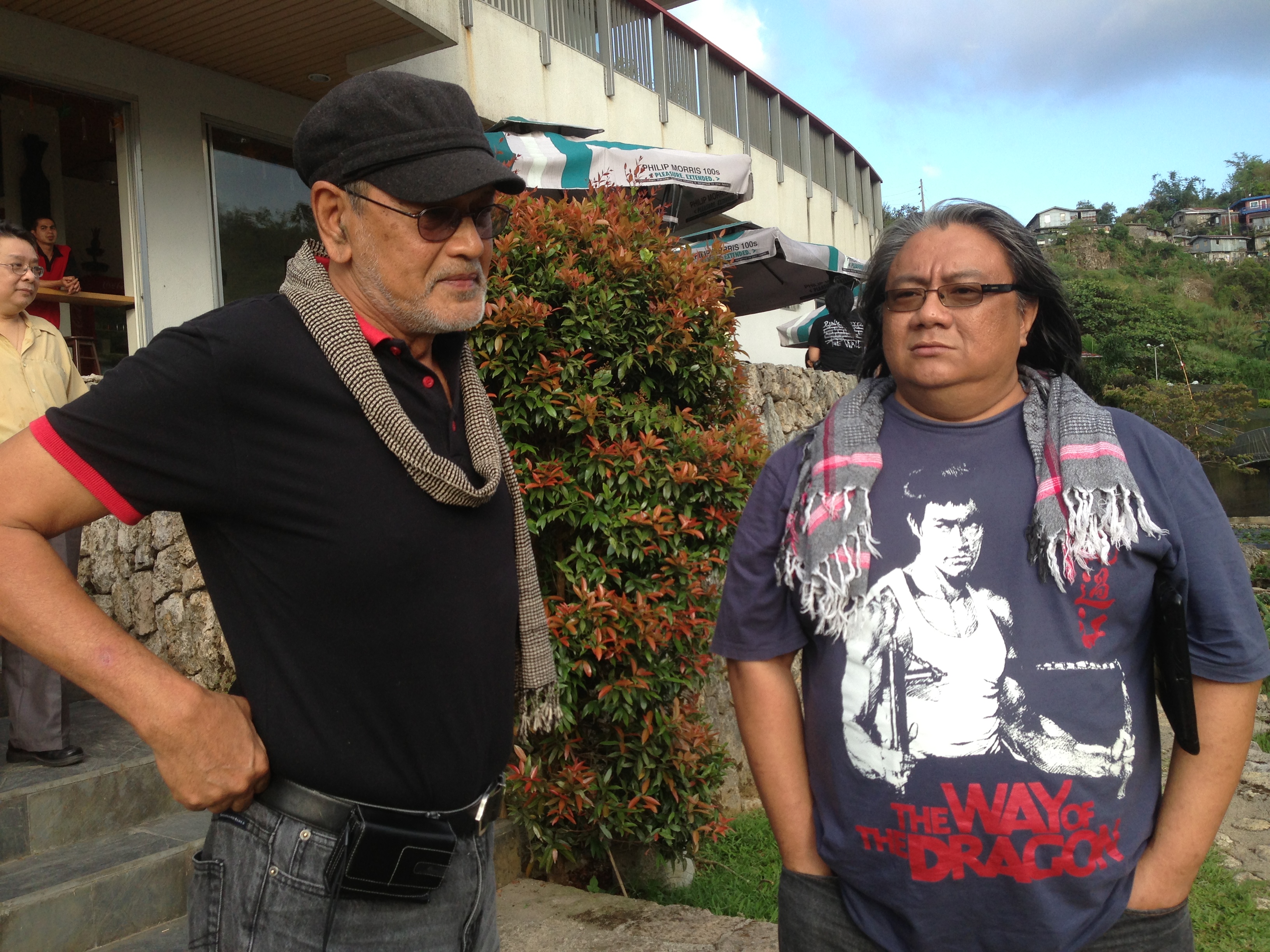
Bencab makes it easier for everyone by personally welcoming the workshop fellows (that’s him with filmmaker Jim Libiran, above) and leading them to the generous merienda, which also serves as his birthday celebration (he was born on April 10, 1942). Then he’ll lead a smaller group of fit and intrepid volunteers on a walking tour of the grounds, showing off new additions and developments.

It has to be said that the Bencab Museum has become a reason unto its own to go up to Baguio. Built on one side of a gorge (Bencab had the foresight and thankfully the wherewithal to acquire both sides, to ensure the integrity of the view), the modernistic multilevel museum and its adjoining buildings dominate the landscape, a white counterpoint to green. It’s been 13 years since Bencab decided to move his studio from the old artists’ village in Tam-awan to Asin, and we’ve had the privilege of watching the museum grow from year to year, a few bricks and exhibits at a time. These days, the museum features not only paintings—Bencab’s own and those of some of the best young Filipino artists today—but a world –class collection of traditional Northern highlands art, including the iconic bulol. The sculpted grounds covering five hectares all in all feature plots of homegrown strawberry, coffee, and lettuce, and this time we got to meet the museum’s newest denizens, the delight of squealing children—15 Peking ducks in the pond.

Despite the entrance fee of P100 per person (discounted to P60 for seniors and students), the place attracts many hundreds of visitors on weekends, and if you’d rather have Benguet coffee than acrylic abstractions, the museum has Café Sabel (named after Bencab’s signature character) with a fabulous view.

I’ve admired Bencab’s work since the early 1970s, when I first met him at the old Printmakers Association of the Philippines shop on Jorge Bocobo in Malate. Fresh out of martial law prison—where I’d studied art with a fellow detainee, the printmaker Orly Castillo—I was apprenticing with the masters at PAP, and Bencab himself would drop by. Knowing my limitations, I soon shifted from prints to prose—but not before I met my wife-to-be, the artist June Poticar, at PAP; the other bonus of that brief foray into printmaking was a lifelong friendship with people like Bencab.

When we visited him last Easter Sunday, Bencab was just about to leave for New York to participate in an international exhibition and symposium with 17 other artists from the Spanish-speaking world. He spoke eagerly of the new commissions he had been working on, including an eight-foot sculpture for the recently inaugurated Solaire casino. Not too long ago, he had been a resident artist at the Ken Tyler Print Institute in Singapore; his pieces have been realizing premium prices at international auctions.

Here, I thought, was an artist who, at 71, was still at his productive prime, generously sharing his experience and his influence with younger artists and the public through the museum. But while he’s assumed a public persona, he’s never forgotten—like all good artists—to return to his studio beside the museum and to work in creative solitude. You can’t share what you don’t have, and Bencab’s been great at doing both. Thanks again, Ben, and we look forward to more visits and chats with you.

IMG_1016

I WAS also fortunate to have been invited last month to the opening of Antipas “Biboy” Delotavo’s 13th one-man show, titled “Mallcontents”, at the ArtInformal gallery on Connecticut Street in Greenhills. Biboy and I also go back a long way to 1978 when he illustrated the poster of the first movie I ever scripted, “Tahan Na, Empoy,” for director Lino Brocka. It turns out that Biboy was born a couple of months after me in 1954 (as were Jacky Chan and Kazuo Ishiguro, so I suppose I’m in good company, ha ha.)

Biboy has been called a social realist, an artist whose work carries an explicitly political agenda. Indeed his paintings have demonstrated a keenly political sensibility, an awareness of how ordinary Filipino lives are shaped if not mangled by forces much larger and more powerful. You can see this in one of his most familiar works, “Itak sa Puso ni Mang Juan,” which depicts a man on the street walking against the backdrop of a giant Coca-Cola sign—suggesting, perhaps, a form of cultural imperialism, of how we’ve allowed brands and loyalties like Coke to define our tastes and therefor define us.

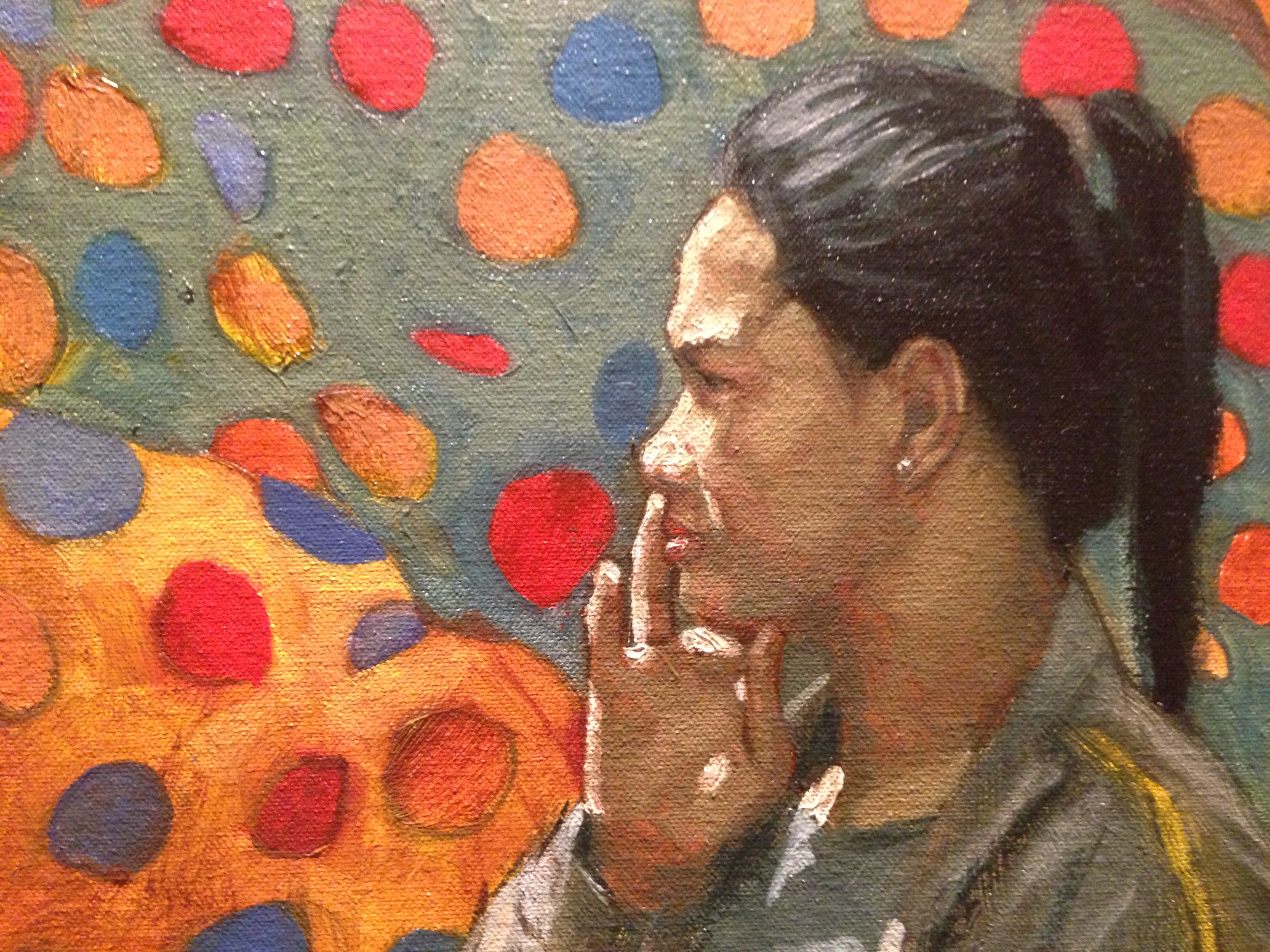
But whatever you may think of the politics of art, no one captures the contemporary, everyday Pinoy as sharply as Biboy Delotavo. His portraits of pedestrians in “Mallcontents” are painstakingly honest—neither pessimistic nor jubilant, neither warped nor romanticized. These are people just getting through another day, mulling over the usual problems (rent, supper, tuition, cellphone load, birth certificate, happiness, relief, rheumatoid arthritis); they don’t look particularly hopeful but they’re not despondent, either—they’re thinking about possible ways of coping. You look at a Delotavo portrait and see yourself and people you know, and you feel that one way or another you’ll survive, and the affirmation of that shared experience—of community and society—makes it well worth the visit to the gallery.

Penman No. 41: Writing Historical Fiction

Deed of SalePenman for Monday, April 8, 2013

AS I write this, we’re up in Baguio with this year’s crop of 12 fellows attending the 52nd UP National Writers Workshop, and we’re discussing the works-in-progress presented by the fellows, who are all practicing and accomplished creative writers with at least one published book to their name. We’re calling them mid-career writers, but their ages range widely from the mid-20s to seniorhood.

In our youth-oriented culture, we often forget how maturity can have its advantages, and how the literary imagination can improve with age. I was reminded of this when we took up the works of two of this year’s older fellows, Thomas David Chavez and Anna Marie Harper, both of whom happened to be working on historical novels.

Writing the novel is difficult enough, but the writing of historical fiction poses some special challenges, which probably explains why not too many writers essay the medium.

History deals with the past, but whenever we present it today—whether as fact or fiction—it inevitably also deals with the present, and by projection, with the future. In other words, the past is truly important to us—beyond its curiosity value—insofar as it informs the present, and provides clues as to what the future might be.

The “historical” part of the term “historical fiction” apparently requires close attention to factual detail, which means exhaustive research of an almost academic nature, to make certain that one is taking off from solid ground. Just how solid that ground is will of course be debatable and may even be the subject of the fiction itself—“What really happened?”—but no matter what departures from fact are taken, a certain familiarity with the past (perhaps a fictive or imagined familiarity) is assumed.

Indeed the basic proposition of historical fiction can be summed up thus: “We think we know the past, but we don’t.” A more severe formulation might be: “We don’t know the past at all.”

The fictionist’s conceit lies in his or her suggestion that fiction, rather than even more thorough or more scholarly research, can remedy this lack of understanding. It’s the same conceit we carry over to contemporary fiction, which is our response, our proposed alternative, to CNN, to the White House or the Malacañang Press Secretary, to the Departments of History and Political Science. The fictionist’s reason for being draws from one of my favorite quotations, this one from Mark Twain, a man who knew how to spin a fanciful yarn while being engaged in the most significant political debates of his time. In so many words, Twain said: “Of course fact is stranger than fiction; fiction, after all, has to make sense.”

The sense-making of fiction relies, in turn, on dramatic plausibility—or, to put it in Aristotelian terms, on probability and necessity, in the logic of the human heart and mind. (To Aristotle, tragedy—which you can take to be literature itself—was superior to history, because history merely dealt with what happened, while tragedy concerned itself with what could happen). What makes fiction interesting is that this logic of the human heart and mind can often be bewilderingly illogical, although it will, at some point, acquire a frightening inevitability.  I’ve often told my students that characters become truly interesting if and when they go out of character, and these turning points are what we wait for, both in history and fiction.

It is, therefore, the burden of the historical fictionist to offer more than both ordinary historians and ordinary fictionists can offer. The past has to be more than setting or décor, the pitfall of bad historical fiction; and the fiction will require more than an embellishment of known fact. Historical fiction is not fictionalized history; it is not creative nonfiction. It is a fictionist’s creative use of the past as material with which to make sense of the present, of how we came to be what we are, of how we will likely be tomorrow.

Dave Chavez’s novel is set in the American Occupation, told from the point of view of the Filipino butler and cook of an American officer who heads the health service in a time of war and cholera. It goes a bit farther back to 1874, when a boatload of Japanese lepers arrives in Manila Bay from Nagsaki under the command of a Captain Kurosawa:

“Only in the last minute was Kurosawa informed of the nature of his gruesome mission, although two weeks before setting sail, he was told to recruit an able-bodied crew of 14 ocean-tested men, then to stock up on supplies treble that number, and finally, to organize a guild of petty merchants who could assemble on such short notice a credible cargo for trade in Manila. Given the time constraint, the captain orchestrated a passable, if rough and ready nine tons of merchandise. Kurosawa inspected and oversaw for himself the weighing of the bales of Kyushu silk, wax-sealed jars of Shikoku soy sauce and crates of Western-style gleaming steel cutlery from the foundries of Fukuoka.

“Of course, there were special items that were not for sale or barter, but were primed spotless and sheening just the same under orders of the Overlord. In there were intricately- packaged gifts of dolls, fans of gilt brocade paper, ukiyo-e scrolls, pictures of the fleeting world depicting the pillow tales of cloistered Genroku noblewomen, some fancy paper from the presses of Nagoya, and finely-wrought cotton yukatas from the prefecture of Nara. These were presents for Manila’s notables, including Governor-General José Malacampo Monje, the Spanish and mestizo nobles of Intramuros and Ermita, the regidor of the port, and finally the Archbishop of Manila, Gregorio Melitón Martinez Santa Cruz.”

Bambi Harper’s second novel will be a prequel to her first one, Agueda, published last year. While Agueda charted a woman’s and her society’s progress from the late 19th to the early 20th century, The Shadow on the Sundials starts with the British Occupation of 1762, and introduces a colorful cast of characters that includes a visionary beata, a dashing Spanish rake, a native servant girl, and a dwarf. Harper draws the curtains on our bygone days thus:

“The entire upper floor of the house that overlooked the narrow provincial road formed a giant screen with its window panes of capiz shells, while below the sills were ventanillas where as a child Tita dangled her chubby legs through the spaces between the carved balusters. The house stood on the corner beside an old stone bridge and massive doors opened into a saguan where granite steps led to the caida, an anti-sala overlooking a garden of fruit trees. The lower classes waited here to be summoned into the august presence of the owner—even poor relations of Doña Titik unless they were in the kitchen eating with the help. The lucky visitor who was invited into the inner sanctum of the sala meant you were either a friar, a foreigner, rich, or all of the above. No expense had been spared in the décor of the living room that revealed ceilings painted with garlands held up by rose-cheeked cherubs. Trompe l’oeil of receding colonnades on the walls created an illusion of expanding space. No carpets hid the glory of the wide narra floor planks that were rubbed daily with a coconut husk and banana leaves to a mirror finish.”

I look forward to the completion of both projects—indeed, of more novels that draw on our tremendously rich history to examine the emergence of our nationhood.

I’D LIKE to acknowledge and express my appreciation for a message from reader Nikko Salvador, who wrote in to say—in response to my GenSan piece last week—that a museum can indeed be found at his school, the Notre Dame of Dadiangas University, and that a few steps away stands a thorny dadiangas plant. I’ll make sure to visit these spots the next time I fly down to GenSan.

Penman No. 40: Some Things Fishy in New GenSan

Microtel

Penman for Monday, April 1, 2013

THE FIRST thing I realized when I flew down to GenSan last weekend was how big the plane was—a wide-bodied Airbus A340 that seated eight people across—and how the plane was almost full for our early morning flight. This wasn’t going to be some spit of land under a clump of coconut trees.

Oddly enough, in my nearly 60 years, I’ve been to almost all corners of this country and about two dozen others, but had never visited General Santos City, not even back when it was still called Dadiangas. I simply had no reason to, which explained why I was there this time—to help tell the story of the city and of its entrepreneurial spirit through a biography of one of its business pioneers and of his family. I had told my client that his story had to be the story of the city as well, and that my sheer ignorance of it—beyond a few touristic slogans and clichés I’d heard about the place being the country’s tuna capital and the home of boxing champs both faded and fabled—was a good thing, because I was going to be interested in everything about the city, as I always am especially on a first visit.

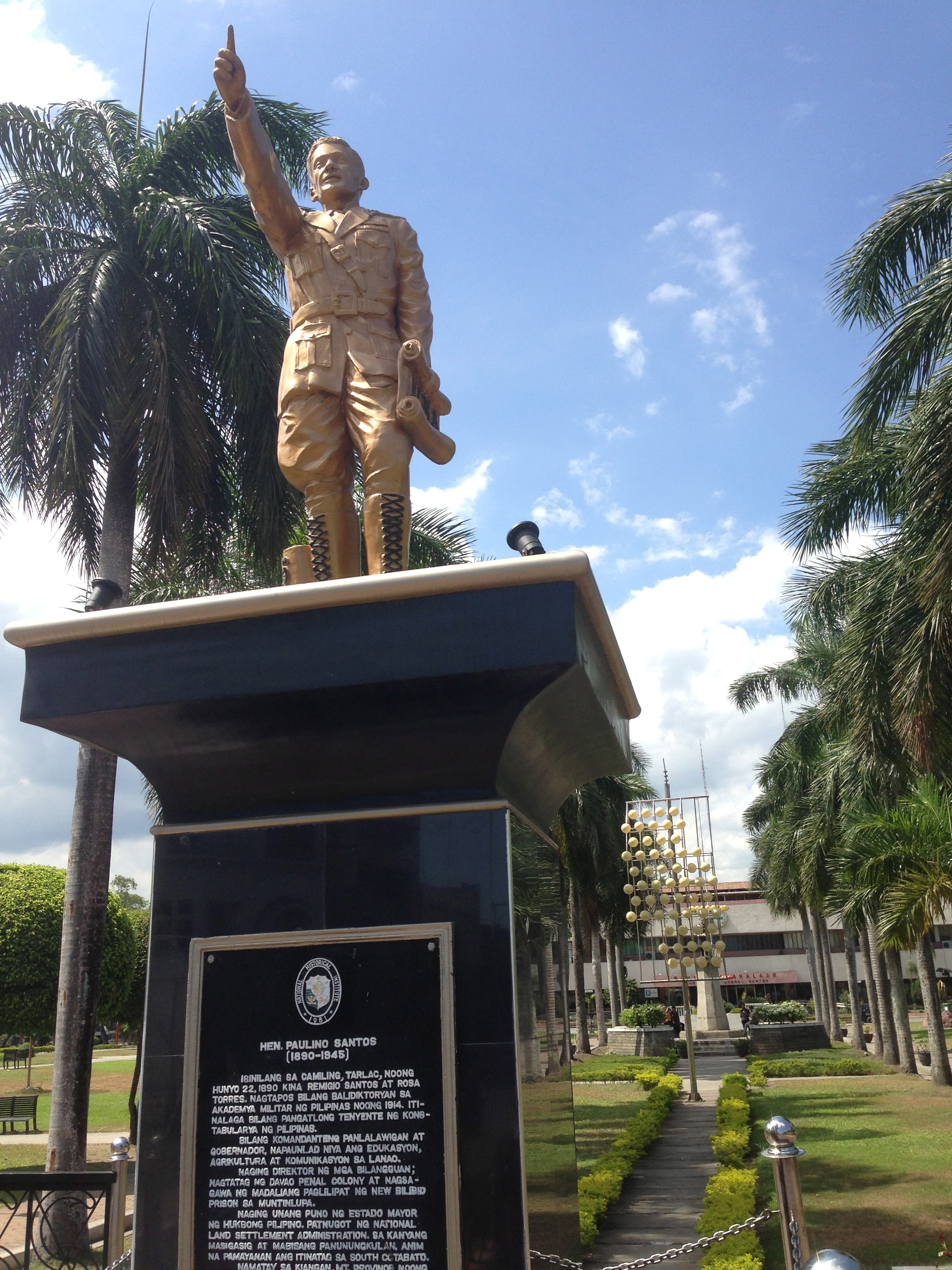
So I read as much as I could, online, about GenSan before coming over. I came across the story of how, back in the days of President Quezon, a group of 62 Christian settlers led by Gen. Paulino Santos arrived on a steamship on the shores of Sarangani Bay. They were the spearhead of thousands more who followed them from Luzon and the Visayas, displacing the native B’laan, who called the place Dadiangas, after a tree. Dadiangas was then just part of the municipality of Buayan. In 1954, Buayan was renamed General Santos, which became a city in 1968, and was reclassified into a highly urbanized city in 1988.

“Highly urbanized” might suggest something like Cebu or Davao, with sprawling suburbs, heavy traffic, and crowded malls, but GenSan clearly—and perhaps thankfully—isn’t in that same category yet. As your plane prepares to land at the new international airport in Bgy. Tambler—built with significant and some say suspicious American support, its runway is big enough to take Boeing jumbo jets and even the new Airbus A380—the view at the window is that of rolling hills and even of mountains in the distance. That tall, cone-shaped mountain looming almost 2,300 meters over the plains is an active volcano called Mt. Matutum, South Cotabato’s highest point. (On the flight home at dusk, these mountains would turn velvet, laced by low-hanging clouds.)

GenSan’s city center is about a 20-minute drive from the airport, and the businesses along the tree-lined highway still suggest the old frontier: rough-hewn lumber, hardware, heavy machinery. A familiar face pops out of a billboard beside a shop selling bottled water—but this isn’t just any water, it’s “PacMan H2O, Ang Pambansang Tubig.” This is Manny Pacquiao country—or would have been, more convincingly, if he hadn’t lost in that congressional bid some years ago to Darlene Custodio, now GenSan’s incumbent mayor. Congressman Pacquiao of course now represents neighboring Sarangani just across the river, but he remains very much a presence in GenSan, maintaining two big houses there (“Mansion 1” and “Mansion 2,” as the locals called them), plus a gym.

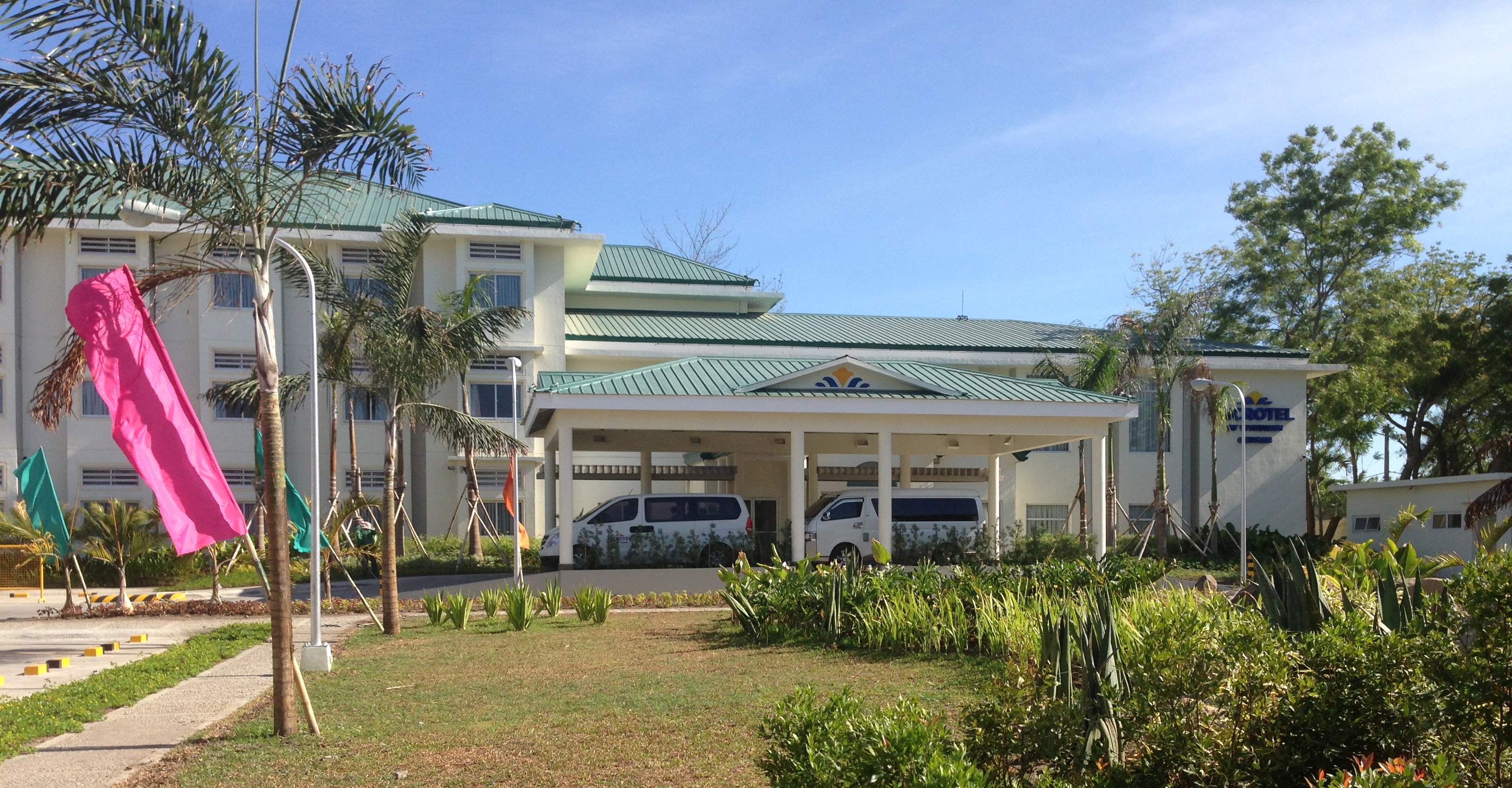
I was billeted at the Floirendo-owned Microtel, GenSan’s newest landmark along the national highway, not too far from the East Asia Royale Hotel, the city’s grandest. The Microtel was neat and comfortable, as a business hotel should be, and was flanked by an equally new strip of restaurants, culminating in a big McDonald’s fronting the highway (across, inevitably, a Jollibee). This sense of newness in this city of more than 500,000 people and almost 500 square kilometers was pervasive—down Santiago Boulevard off the main highway was GenSan’s own SM (what’s a Pinoy city without an SM?), which opened just last August and was already drawing crowds from the older Robinson’s, Gaisano, and the homegrown KCC mall. Not surprisingly, the vehicle of choice hereabouts was the SUV or its pickup variant, especially in white, with rows of them lining the parking lots.

Gen. Santos

So what happened to the old GenSan? The former Buayan airport had been converted to an Air Force station, with goats and cows grazing beside the runway. I asked my guide to bring me to the older and poorer part of town, near the wharf and up Pioneer Avenue, towards City Hall. Now and then a house from the 1940s turned up, its paint long scoured and blistered by time and by the swirling dust that Gensan oldtimers remember. But even later structures looked forlorn or boarded up. “Everyone’s moved to SM,” said my guide. We got off a the park in front of City Hall to visit the statue of Gen. Santos, who headed Quezon’s land settlement program, and also to look for a living specimen of the dadiangas tree; surprisingly, we couldn’t find any, even when we went to a nearby plant nursery. “It has thorns and has yellow blossoms” was all the older people could tell us. There was no museum we could visit to look up the tree or a history of GenSan for that matter (and I’d be grateful for any leads from readers to a good history of Dadiangas or GenSan).

Most of my three-day visit went to work—interviews with my subjects and tours of plants and facilities—but it was very pleasurably punctuated by sorties to the local restaurants, and as a seafood addict, I found that I’d gone to heaven. I had to arm-wrestle the gargantuan crabs at Gusteau in the newish Sun City Suites complex (another popular local restaurant was Grab a Crab) and, of course, we were served schools of luscious tuna in all manner of preparation.

The sea being the source (excluding PacMan) of much of GenSan’s present wealth, I asked to see the city’s fish port in operation, and even as we arrived too late to observe the day’s tuna catch being unloaded for auction at 5:30 in the morning, the port was still abuzz with activity an hour later, with batches of tuna being graded, weighed and sorted out for resale to various end-buyers. I got a fascinating crash course in what we archipelagic Pinoys should know by heart but barely do—Tuna 101, or some things fishy in our economy and culture.

IMG_0925

I learned how tuna came in three basic varieties—bluefin (the premium kind that gets sold for record prices in Tokyo’s famous Tsukiji market—a 222-kg fish recently brought in US$1.78 million, or almost $8,000 per kilo); the more common yellowfin, which was what I saw that morning; and skipjack, the much smaller tuna that goes into canning and eventually onto your sliced bread. A Class A yellowfin could fetch P400 per kilo at the fish port, while its Class C brother could go for P180; the fish traders have to know which is which by sight and by an instinct honed through years of experience, although they could—only after buying their fish—take core samples from a natural slit under the dorsal fin to confirm their judgments.

I learned how the wooden boats that brought them in ventured out for weeks as far as the edge of the Indonesian border, the smaller ones returning with about 200 fish in their bellies, the larger with about 500. (The modern and large steel-hulled catchers of my hosts, the RD Corporation, remain at sea—with licenses to fish in Indonesia and Papua New Guinea—for as long as two years, employing helicopters to help track the migratory tuna; the “master fishermen” directing these operations on every vessel could earn as much as P200,000 a month—so get out of that call center, and learn to catch tuna!)

That afternoon, I visited a canning plant—the frustrated engineer in me would rather tour a factory than linger at a boutique—and saw how a skipjack gets thawed, pre-cooked, and stripped to its most useful parts by hand before it gets sterilized and canned for shipment in containers to the US, Europe, and Japan, among others. (The tuna that gets used in a Subway sandwich in New York and comes in a Subway-labeled can might have come from GenSan.)

Such was the energy fueling the new General Santos—but alas, it was more to be found in people than in the power lines, as the city remains plagued by chronic brownouts occurring twice a day in 3.5-hour stretches. Beyond another mall, GenSan needs more juice for its ice plants, its canneries, and its factories—in other words, for its future—and it can’t hurt to have even a small museum with a dadiangas tree in front to let weekend visitors like me know a little more about its past.

Penman No. 37: The Rebirth of Joly Benitez

Jana and Joly

Penman for Monday, March 11, 2013

UNTIL VERY recently, the first and the only time I met Dr. Jose Conrado Benitez—better known to many by his nickname “Joly” (yes, with the single L)—was almost 40 years ago, when he visited and spoke to our class in Development Economics at the University of the Philippines.

I was working as a writer then for the National Economic and Development Authority, and my boss—the very supportive Gerry Sicat—had sent me, a college dropout, as a special student to UP to learn some economics quickly. I had been imprisoned under martial law and still carried my leftist sentiments with me, but there being few other options and being newly married, I decided to take my studies as seriously as I could.

There was something of a rivalry between NEDA on the one hand and the Ministry of Human Settlements and the Development Academy of the Philippines on the other, and Joly Benitez was associated with both latter agencies, so when the young Deputy Minister of the MHS came to our class, I can’t say that I was in a very welcoming mood, his ministry (and its chief, the First Lady Imelda Marcos) being seen then to be the source of some of the strangest ideas to have come out of martial law. Still, I was impressed by Benitez’s energy and enthusiasm, and while I remained a skeptic, I found myself opening up to the heretical notion that—with the right leadership and intentions—martial law was an unprecedented opportunity to get some things done right. (Of course, by and large, that didn’t happen, and I was out of NEDA in 1983 and on the street at EDSA in 1986.)

Flash forward to a few weeks ago, on February 21: that evening, a crowd began to gather at the newly established Erehwon Center for the Arts in Old Balara, Quezon City for the opening of “Apple by the Tree,” an exhibition of paintings by the father-and-daughter tandem of Joly and Jana Benitez. I had been invited to the opening by my old friend, kumpare, and Erehwon founder Raffy Benitez, a cousin of Joly. Perhaps ironically, Raffy and I had become friends in martial-law prison; when he later opened a printing press, Raffy drew on some unused paper stock and became the publisher of my first book, Oldtimer and Other Stories, in 1984. In other words, he’s a guy I can’t say no to, and when he invited me to the Benitez exhibit, despite having other plans for the evening, comradeship and curiosity prevailed, and I went.

I came in for a pleasant surprise. Joly’s daughter Jana was already an established New York-based painter, a magna cum laude Fine Arts graduate of Brown University with wide international exposure. Her work, noted the critic Alice Guillermo, “probed the secrets of both the abstract and the figurative, [creating] an art that is young, vital, integral to life and being.” I saw bold splashes of color in the abstract-expressionist style: you step back and translate form and color into thought and emotion.

Joly Benitez was the revelation. The Stanford-trained technocrat may be more at home with economics, but he stood his ground alongside Jana, working in the same style but mainly in black and white. What was even more remarkable was that, six months earlier, he had been close to death, with a debilitating kidney disease that required dialysis four times a week. “People were already calling me a widow,” said his wife, the banker Joanne de Asis. A timely transplant gave him a new lease on life—but it was the return from New York of Jana and their painting sessions that gave Joly a fresh reason to hang on.

Intrigued by this turnabout, I interviewed Joly—who was still visibly weakened by his ordeal but fit enough to climb four flights of stairs—and asked him about his new avocation. It turns out that painting wasn’t all that new to him.

“I had painted before,” he said, “from the time I was a high school teenager, hanging around and going to the PWU School of Fine Arts, after classes from La Salle high school. Even during my stint in government, I did some ten large canvases which I then displayed in the Technology Resource Center. At my home in Cubao, I hosted the Philippine Association of Printmakers, and we had weekly figure drawing sessions. I have painted in brief but intense spurts over various intervals for the last five decades. At this point of my life, I feel more confident and comfortable about displaying my paintings in public, and to continue to explore various modes of abstract self-expression.”

His new work is concerned with perspective, such as how one might see Earth from space. “Sometime ago, I did a series of over ten ‘Earth-scape’ prints and paintings, reflective of my preoccupation with ‘cosmic space’ abstract images.  The predominance of black and white in some of my paintings is the challenge of depicting movement, perspective, texture and expression with a highly and consciously limited palette,” he says.

Working with Jana was “intense and fruitful—a deep conversation in art. We talked continuously and began to appreciate our artistic differences. We sought to elevate our collaborative work to a different threshold. While painting, when she or I would perform brush strokes, or compositional elements, or color hues reflective of our differences, we would consciously attempt to integrate and reconcile them. We had our differences—but in art as in life, mutual respect and appreciation of each other’s idiosyncrasies and differences are paramount.”

After the Marcos years, Benitez served for over a decade as president of the family-owned Philippine Women’s University (his son Kiko now serves in that capacity), where he introduced various ladderized-curricular innovations, including pioneering programs for on-line distance education and continuing education.

The older Benitez is far more mellowed and subdued than the gung-ho guy I recall from the mid-1970s, but he retains a sharp critical edge. I asked him about his views on Philippine development today. “We are highly dependent on the remittances of our OFWs, we don’t have significant industries or manufacturing, our agriculture is in need of major structural changes, and our service sector relies heavily on call centers for employment,” he observes. “We still have to see a national eco-sustainable development strategy that addresses a basic needs approach, with structural changes reflected in locational and spatial dimensions.”

As the architect of many of the Marcoses’ social infrastructure programs, Benitez sees some evidence of a useful legacy left behind from his tenure at the MHS: “Some of our initiatives remain as relevant as ever. They include the establishment and organization of a mass housing system, involving a financial saving system (PAGIBIG), the Home Guaranty Corporation (HGC), the National Home Mortgage Finance Corporation, (NHMFC), and so on, although one would wish that the various housing agencies would operate like a symphony rather than competing and sometimes working at cross-purposes. We also made efforts to promote small- and medium-scale industries, especially focusing on livelihood projects, entrepreneurship, adaptive technology and countryside community organization and development. We sought to introduce a locational and spatial dimension in national, regional, and provincial comprehensive development plans—through the national and regional framework plans, the preparation of provincial atlases and municipal level town plans, and zoning ordinances. We used to say that ‘True structural development should have a face and an address.’ An abstract strategy or a mere compilation of various infrastructure projects do not make for national development.”

At this point of his extended life, Joly Benitez says he’d like “to focus on a few income-generating projects for myself and my family, but most of all I would like to explore and pioneer some ecologically sustainable projects, especially on village level.”

And, of course, produce more art, by himself or alongside Jana. The historians, political scientists, and Filipinos on the street will have their own assessment of the Marcos years and of the role that Jose Conrado Benitez played in it—and I suspect he will not be hopeful enough to imagine that that assessment, given what has happened since, will be largely benign—but the rebirth and refuge offered by art can only sustain this complex man.

Penman No. 26: New Novelist in Town

OFW AwardPenman for Monday, Dec. 23, 2012

IT’S ALWAYS a pleasure to welcome a new novelist into our ranks, and today will be one of those happy days when we acknowledge the arrival—literally and figuratively—of a new talent in our midst, Dr. Almira Astudillo Gilles, or just Almi to her friends.

Almi flew in from Chicago as one of 29 recipients of the 2012 Presidential Awards for Filipino Individuals and Organizations Overseas, which were given out last December 5 by President Aquino at Malacañang. I had met her at the ICOPHIL conference in Michigan last September, although she had introduced herself to me by email earlier, as a fellow Filipino eager to make contact with other writers in the US and the Philippines.

Last December 9, Almi also launched her first novel, The Fires Beneath: Tales of Gold (San Francisco: Philippine American Writers and Artists, Inc., 2012), at the Ayala Museum. The novel deals with how a poor man’s discovery of ancient gold in the Philippine South changes him, his family, and his community. I haven’t finished reading the book, but I’ve been much impressed by her sharpness of eye and precision of language.

Writing about Quiapo and Binondo, for example, Gilles observes that “In Quiapo, the Golden Mosque is flanked by the Church of the Black Nazarene while the Binondo Chinese worship at Our Lady of China. On the sidewalks surrounding both places, vendors set up storefronts assembled from canvas, corrugated metal, or pieces of plywood, displaying items promising an easier spiritual journey. ‘Bypass purgatory,’ the vendors hawk. ‘Take one step closer to paradise… at a fraction of retail.’ Most believe, all pray. Both acts of nature and man cause great suffering. Metropolitan Manila lies beneath sea level and all it takes is one bad rainy season to show the inadequacy of the government’s flood control system. But the people take this all in stride. They buy both prayer beads and rubber boots.”

Since she was busy enjoying a well-deserved Christmas break with her family in the Philippines, I asked Almi to respond to a few questions I sent her by email, to map out the unlikely course she took to becoming a novelist from a professional background in the social sciences.

BD: Tell me something about yourself and your background.

AAG: I spent a few childhood years in Frankfurt, Germany where my father was assigned by the World Bank. Hence, English was the first language I learned formally. I was in premed psychology at UP Diliman and switched to AB psychology in my third year because I never intended to be a doctor and the subjects were getting harder. I graduated cum laude, and went to work for Sycip, Gorres, and Velayo (management consulting). After two years, I left for graduate school in the US, where I eventually finished a doctorate in social science, a master’s in political science, and a master’s in labor and industrial relations, all from Michigan State U. I also met my husband there, a doctoral student in economics, and got married there, on campus. My husband works in the telecommunications industry. I have a 22-year-old-son who works for Facebook and a 17-year-old daughter who’s starting college next year. I have a brother in Vancouver, Canada, and a brother and sister in the Philippines. My parents live in Manila.

BD: What started you writing?

AAG: I started writing poetry when I was about seven years old, and as I grew older I also started writing essays which were often published in the school newspaper. After graduate school, I joined the management faculty at De Paul University as adjunct professor, and taught at other area universities as well. At the same time, I had young children and my husband was traveling frequently. None of my childcare arrangements were satisfactory. After I grew dizzy and almost fainted in one of my classes (a night class for graduate MBAs), I went to see a doctor the next day and was diagnosed with hypertension, which apparently had been going on for quite a while. I then decided to quit teaching (I was teaching at campuses all over the Chicago area and would often get home around 11 at night) and try my hand at writing. My children’s book, Willie Wins, was published soon after, and I was hooked on writing. I started out writing for children since I had young ones of my own, and have published poetry, essays, short stories (one of which won a national award in the US), and plays for community theater. Now that my children are older, I thought I’d try something more adult, hence this novel.

BD: Where did the idea for this novel come from?

AAG: My friend’s sister was curator of the gold exhibit at the Ayala Museum, and she suggested I write a novel based on the discovery of the Surigao treasures. It took me about three years to finish, but I was working on other projects as well. I was fortunate that a video series of this story already existed, and I used that as reference.

I wanted the novel to reflect the tug between secularism and religiosity, and tried to delineate this struggle through my main characters (the gold discoverer and his family). Since I consider myself as a writer of the diaspora, I was careful to maintain a high level of authenticity about the Filipino experience (especially since the setting is the Philippines), while trying to appeal to American readers as well. Several chapters were workshopped at a master novel writing class led by a Northwestern University professor, and they were all white (no writer of color). While they liked the voice and style, they defined it as magical realism—a sad commentary on their knowledge of other cultures since the characters, setting, scenes were typical of a Filipino lifestyle. Some were also uncomfortable with my sentence construction (I tried to mimic the rhythms of Tagalog) but generally they liked the novel very much. In a writing workshop organization to which I belong, I’m the only Filipino writer (of English), and the only Filipino writer I know of actively publishing in the Midwest, so I feel I have to work extra hard to publicize my work and get the American readership to be more open to Filipino writing in English.

BD: What did your presidential award mean to you, and where do you go from here?

AAG: I write full time, but I guess you can say that days are filled with a lot of community organizing in addition to my writing projects. I’m very active in the Filipino American community in Chicago, and have a good working relationship with the Field Museum of Natural History. I try to promote Filipino culture whenever I can and am also invited by many schools to talk to students about multicultural writing. I’ve spoken at institutions and conferences all throughout the US, most notably at the Smithsonian Institution in Washington DC.

I’m humbled by the achievements of all the awardees—they are really exceptional people who have given so much back to the Philippines. I’m grateful that my writing has been recognized (Willie Wins is the most widely circulated Filipino American children’s book in the US, available in many schools and libraries, and is on the reading list of most multicultural publications), but I feel that a presidential awardee is obligated to continue to serve. My other passion is conservation and the environment (as president of the UP alumni group in Chicago, we raised funds for a marine study in UP Visayas), and I’m always trying to push both literacy and conservation. I’m encouraged by the feedback I get about my efforts because many have told me that I have motivated them to either write or start doing something to save the environment. I try to use the award to open doors so that I might do more, and the awards have been very effective in helping me to connect to others whom I might recruit for my cause.

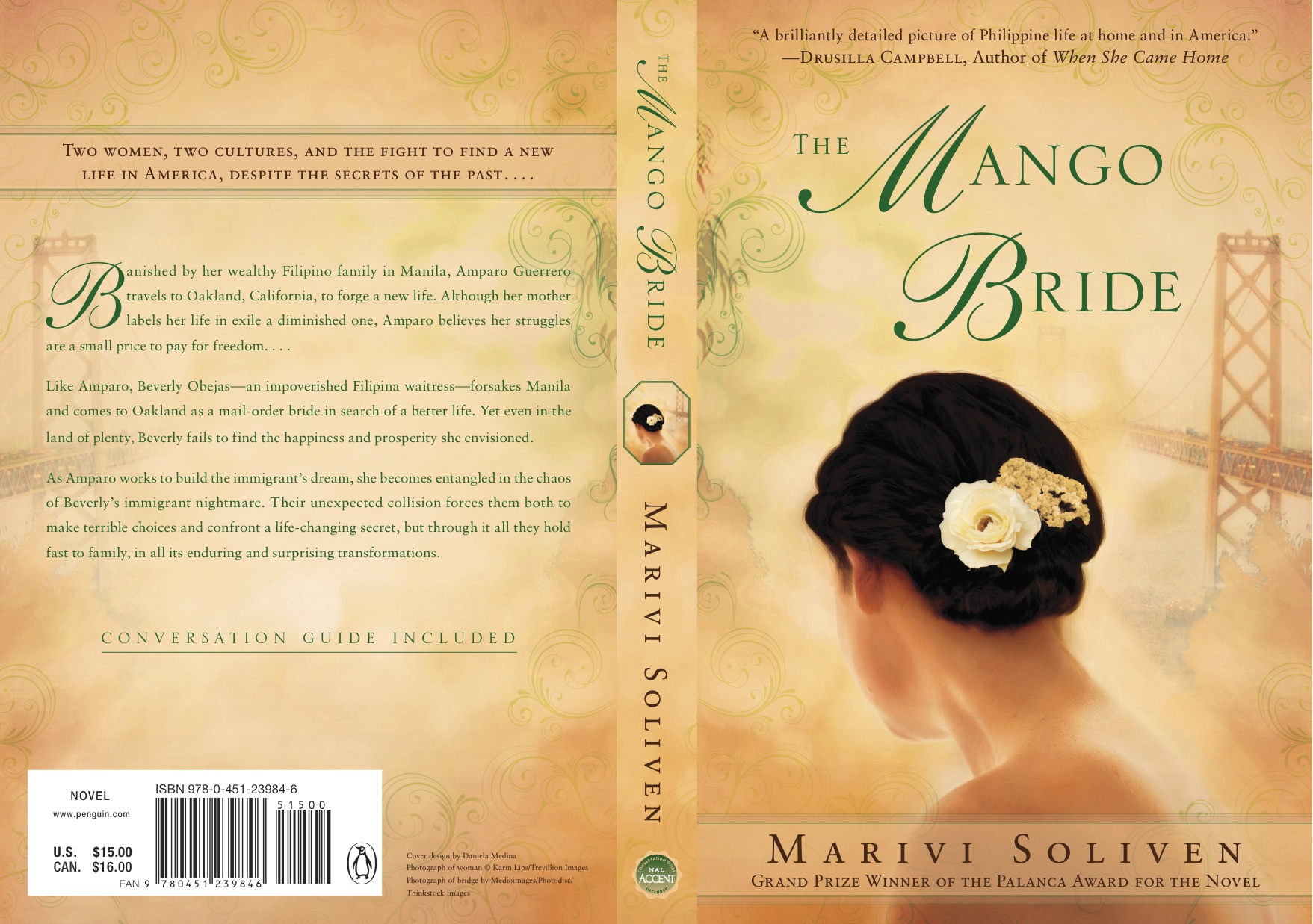
AND SPEAKING of new novels, I’m awaiting an early copy of Marivi Soliven Blanco’s The Mango Bride, a comic romp through contemporary Filipino relationships, which will be released by Penguin in the US this coming April. Like Almi, the San Diego-based Marivi started out writing stories for children. Their examples should encourage more Filipinos, especially women, to make their mark in global publishing.

Penman No. 25: EQ Yap, a Filipino Patriot

EQYPenman for Monday, Dec. 17, 2012

LAST DECEMBER 9 would have been the 81st birthday of a man named Emmanuel Quiason Yap—a name unfamiliar to most Filipinos, but who deserved more of his countrymen’s attention than they were able or willing to give him when he was around. Yap was one of the last in a distinguished line of nationalist Filipino intellectuals who emerged in the second half of the 20th century, a roster that included the likes of Renato Constantino, Alejandro Lichauco, and Hernando J. Abaya.

More than a year ago, I was asked by Yap’s family to write his biography, and I agreed—first, because he was the father of a former student of mine, and second, because I had met him earlier in the company of the Lavas, a family of committed revolutionaries whom I had also written about. (He was also a Yap, which is my mother’s maiden name, so we might have had a mutual ancestor somewhere back in Fujian.) I had heard of “Manoling” Yap’s own nationalist convictions, but had never really sat down with him to learn how he had acquired them.

I had several meetings with him and had begun on the book—which I’m now a week or two short of finishing—when he suddenly died in September 2011. Thus I begin the book this way:

“When Emmanuel Quiason Yap died all of a sudden on September 26, 2011, very few Filipinos knew what they had lost. It was almost as if a stranger had walked into a sleeping household, had left a precious gift in their midst, and had walked away; waking up in the morning, the family members see the object and wonder what it is and who brought it there, but they cannot recognize its value, and put it aside.

“His peers and colleagues would recognize and refer to him, even within his lifetime, as a visionary, an astute student and critic of his nation’s political and economic fortunes, a shaper of minds whose firm nationalist beliefs might have led the Philippines on to another track of growth and progress. He was an adviser to Presidents, senators, and congressmen; for a time, he headed an economic planning office for the House of Representatives; he helped to foster stronger diplomatic ties between the Philippines and socialist countries; and he founded a popular movement to promote patriotism among Filipinos. In various venues over many decades, including a newspaper column, he campaigned strenuously for a more independent foreign policy, a more self-reliant economy, and for greater justice in a society riven by exploitation and oppression.

“Manoling Yap, in other words, was a reformer, a man who never tired of thinking how life might yet be bettered. And he was no armchair dreamer, but someone who took his battles to the political arena, risking his life and freedom in pursuit of his principles. But as many if not most reformers soon discover, Manoling Yap would often find his idealism opposed, rejected, or even taken advantage of by others resigned to a more pragmatic view of things.”

Few may remember it now, but Yap—born in Angeles, Pampanga to a family of lawyers and entrepreneurs—was instrumental, along with Mayor Rafael del Rosario, in achieving cityhood for Angeles in the early 1960s and for planning its modernization. However, their plans ran afoul of the rackets being run by the notorious Kumander Sumulong, who issued death threats against the mayor and Manoling.

Trained as an economist, Manoling later went to Georgetown for graduate school with the encouragement of former President Jose P. Laurel, who urged him to go to America “to learn how the Americans are fooling us.” Yap took the admonition to heart—this was the time of parity rights—and came home an even more ardent nationalist. He taught at the Lyceum, then a bastion of radical thinking.

He set up the Congressional Economic Planning Office—a forerunner of what today is the National Economic and Development Authority—and worked with the old man Laurel’s son, Speaker Jose B. Laurel, in crafting the Magna Carta for Economic Freedom and Social Justice, which argued strongly for a more independent economic policy and for vigorous industrial and agricultural development. The Magna Carta was signed into law by Marcos in 1969, but languished in implementation, and Speaker Laurel himself fell from power soon afterwards—the victim, Yap was convinced, of imperialist machinations (as was, Yap would later believe, Marcos at Edsa).

Yap was also instrumental in opening diplomatic and trade ties with the socialist bloc in 1967—surprisingly, even as anti-Red rhetoric was escalating along with the Vietnam War, and well before Richard Nixon undertook his own diplomatic initiative toward China. He accompanied Rep. Manuel Enverga, chairman of the House Foreign Relations Committee, on a grueling three-month journey behind the Bamboo and Iron Curtains. Years later, he would also advise Sen. Leticia Ramos Shahani, when she chaired the Senate Foreign Relations Committee, and help her draft a more independent foreign policy moving away from the traditional Philippine-US alliance to stronger ties with our neighbors in the Asia-Pacific, and with countries in the Middle East, the Indian Ocean, and Central Asia.

In the last decade of his life, Manoling Yap devoted much of his time and energy into setting up and promoting the People’s Patriotic Movement, an effort to unite Filipinos from all backgrounds and persuasions behind the fundamental need for a sense of nationhood. “Together,” he wrote, “we will rediscover our common historical truth, rectify the errors of our colonial past, muster the national will to reconstruct the Filipino nation into a strong nation-state which can adequately feed, educate and protect its own people by the sweat of its brow and not from mendicancy and subservience to other nations, and ultimately assure a better future to all our children.”

As with many intellectuals, he was a man of ironic contradictions—an Atenean who sang Latin hymns as a boy with touching fervor, but one who grew into a brooding skeptic; a civil libertarian, but one who imposed strict family discipline; a seeker and defender of freedom and a friend of known Communists, but one who appreciated Ferdinand Marcos as a progressive nationalist; and an astute analyst who predicted the end of the Cold War but who blithely ignored the signs of his own failing health.

Emmanuel Quiason Yap was a complex man; his burning idealism often met with disappointment and disenchantment, and in the end he had very few friends left to talk to—among them his cousin the historian Serafin Quiason Jr., the painter Dan Dizon, and my fellow STAR columnist Billy Esposo. But he had his country at heart and died a patriot, joining the privileged company of his heroes—Rizal, Mabini, and the old man Laurel.

Penman No. 24: The Necessity for Nonfiction

NonfictionowPenman for Monday, Dec. 10, 2012

A FEW weeks ago, in Melbourne, I had the pleasure and privilege of speaking before a global audience of experts in and practitioners of nonfiction—that broad branch of writing that straddles everything from journalistic reportage, history, and philosophical essays to personal memoirs, travelogues, and cookbooks. I gave one of the four keynote addresses in that three-day-long Bedell Nonfictionow Conference; the other speakers were David Shields, on collage and appropriation; Helen Garner, on the central place of the interview in nonfiction; and Margo Jefferson, on the boundary between criticism and nonfiction. I chose to take a less technical and more social tack, and talked about why, more than ever, there’s a need for nonfiction in this age of the Internet, particularly in places off the global literary centers like the Philippines.

I wasn’t alone in representing the Philippines and its literature. Lawrence Ypil, one of our brightest young poets who’s doing a second MFA at the University of Iowa, this time for nonfiction, spoke about using family photographs to solve a mystery, and also introduced the work of Resil Mojares and Simeon Dumdum Jr. from his native Cebu. Longtime activists Bonifacio Ilagan and Marili Fernandez-Ilagan discussed the political possibilities of nonfiction in print, film, and theater; Boni also gave a comprehensive overview of recent political nonfiction from the Philippines. Their talks provoked much interest, and reminded me of just how far ahead of the curve our writing is in many ways, despite the obvious obstacles to writing in a society that doesn’t seem to value books much.

So I used my keynote as an opportunity to reintroduce contemporary Philippine literature to others, highlighting our work in nonfiction, particularly that of the late, great Nick Joaquin. Below is the full text of that 40-minute talk (because of space limitations, I was able to provide only an excerpt for the newspaper column version of this piece):

Thank you all for this great honor of having me as one of the keynote speakers for this conference, and for this opportunity to introduce another literature and another literary experience to a global audience, from which we Filipinos have been largely removed. And who, exactly, are we Filipinos? Just two days ago, a Gallup poll revealed that Filipinos were the most emotional people on the planet. We laugh and we cry with equal facility—so don’t be too surprised if this talk descends from the sublime to the ridiculous within a paragraph of each other.

This being a keynote, let me assure you that this talk will be about more than our domestic literature, and that it will connect to the greater issues of nonfiction in the world. But I have chosen to begin on a point of disconnection, from the periphery, because our vagrant experience presents some interesting possibilities for looking at how nonfiction—if not literature itself—has served self and society outside of the West.

Indeed, these past few years, I’ve traveled around various literary conferences around the world with a stock speech titled “Why You’ve Never Heard of Me,” by way of addressing the relative obscurity in which the Filipino writer has labored—even and especially in the company of our fellow Asians such as the Chinese, the Japanese, and the Indians who have understandably gained much greater international attention and prominence.

In sum, my thesis is that we Filipinos don’t write enough novels, and the novel has been the ticket to literary fame and consequence in 20th century publishing. It also hasn’t helped that, as a former colony of Spain and the United States, we are out of the Commonwealth loop. We no longer write in Spanish, and as for our writing in English—a thriving, century-old literature—the Americans (with the notable exception of Robin Hemley) don’t quite know how to receive it, despite its troubling familiarity, like the bastard child who suddenly appears at the door with an expectant smile. We also have a robust literature in our other national and regional languages, but again they hardly connect to the other native literatures of Southeast Asia, in gatherings of which the non-Bahasa-speaking Filipino has often been the odd person out.

That’s all the more strange when we consider the Filipino diaspora which—like that of the Indians, the Nigerians, and many other ambulatory nationalities—has taken our workers all over the planet. We are you maids, your nurses, your sailors, your entertainers. One-tenth of our population of over 90 million people now live and work overseas, in places as remote to us as Iceland, Angola, and Syria, providing not just the foreign remittances that keep our economy afloat but also a wealth of material for our literary imagination. Indeed it often takes the literary imagination, more than journalistic reportage, to sort out these experiences of dislocation.

But why even go abroad for alienation? If there’s anything colonialism does to the colonized, it’s to leave behind two states of mind, often manifested in two or more predominant languages, one of which represents the colonial elite. That’s American English in our case, and while it’s given us a global edge in the BPO or call-center industry—in which we now rank second, next only to India—it has produced no comparable literary dividends, with our literature in English trailing far behind India’s, and even behind translations to English from the Chinese and Japanese, in the attention of the world.

Thus we represent an insular experience. But like exotic species which—after a geological point of separation—have survived and mutated on their own in some tropical plateau or some literary Galapagos, literatures like ours can be interesting and useful objects of study, because they manifest both fundamental similarities to and striking departures from the biological mainstream. They speak back to the mainstream, as I am speaking today, and offer up a mirror—perhaps a somewhat distorted or distorting mirror—in which others can see versions of themselves.

Our insularity has resulted in some interesting courses of evolution. Given the absence of a market for novels, we have developed our strengths in poetry and the short story. Given further that there is no money to be made either in poetry or the short story—but also that these genres require little material investment—our writers have focused on producing the best art they can, rather than on satisfying a market (and there was, arguably, a market for these in our newspapers and magazines of the early 20th century, when they were part of the entertainment mainstream).

In the case of Philippine nonfiction, curiously enough, more titles have been emerging over the past 20 years—memoirs, biographies, histories, essays, travelogues, cookbooks, and motivational materials for business and religion. Most it not all of this production has been in English rather than in the national language, Filipino—not surprisingly, since books are expensive and considered non-essential items in a country still largely poor, and the people who can buy books at and for their leisure speak and write in English. (Parenthetically, this introduces another interesting element for further thought: if translating language means inevitably translating experience, what goes on in nonfiction in a foreign or borrowed, and especially a colonial, tongue? Whose stories tend to get told, and how, from what perspective?)

There has also been a perceptible rise in enrollments in courses and workshops for nonfiction, seen by many—correctly or otherwise—to be a less formidable and more accessible entry point to writing than fiction or poetry.

The rising global popularity of nonfiction is manifest in the region. A quick glance at the recent titles taken up by the Hong Kong-based Asian Review of Books will reveal a clear preponderance of nonfiction, covering such diverse topics as the undercities of Mumbai, Christianity in Communist China, the Thai monarchy, the Amritsar Massacre, the Jewish community in Shanghai, and Japanese ninjas. Not surprisingly, much of this nonfiction deals with China and India, being both the largest sources of and markets for such work. There is great interest in the West in these two countries, as well as in Japan and Korea, because their economies are umbilically tied to those of the West.

But let me go beyond money and markets, and talk about the necessity for nonfiction in less familiar and less mediagenic countries such as ours.

To state the obvious, nonfiction provides an alternative to fiction and of course to itself. In the first instance, I don’t simply mean the choice the reader faces at the bookshop at any given moment between buying a novel or a book of essays, but as a means to appreciating the truth, in which everyone is presumably interested and invested.

That truth can be particularly elusive in a country and society where there has been a longstanding tradition of suppressing it—in our case, the nearly two decades of the rule of Ferdinand Marcos, carrying over to his successors, one or two of whom turned out to be even more adept than Marcos in kleptocracy and in hiding the truth.

In this experience we Filipinos can hardly be alone, given the emergence and in many cases the continuing rule of autocrats, despots, and demagogues around the world, from Asia and the Middle East to Africa and Latin America. Personal accounts and testimonies are important in such places where an “official version” of events is often promoted, if not enforced.

While fiction might best capture the grotesqueness of life and the absurdity of the truth in many of these places—and I’ll get back to this later—it is nonfiction that bears the burden of presenting the facts on the ground, often at great risk to the author and even to the reader.

It was just a little over a week ago when PEN International marked the Day of the Imprisoned Writer—an issue I could personally relate to, having been imprisoned for seven months in 1973 at age 18 not for writing any earth-shaking novel but rather political flyers and such ephemera. Among those on PEN’s list of “focus cases” was Ericson Acosta, a young poet and activist who had been writing and filing reports on human rights abuses in the Philippine countryside. He has been held without trial since February last year—ironically, under the regime of President Benigno Aquino III, whose family has been canonized for its espousal of civil liberties.

The authoritarian State not only seeks to stifle the truth: it is an active and imaginative producer of fiction. In the Philippines, this was never more palpable than during the long years of martial law, from 1972 until the expulsion of the Marcoses—at least for the time being—in 1986. Let me share a few stories in this regard.

In 1964, just before he first ran for President, Marcos commissioned Hartzell Spence—an American author and editor of Yank magazine, who contributed the word “pinup” to the vocabulary—to write his biography, titled For Every Tear a Victory (later reissued as Marcos of the Philippines), of which a film version was later made. These biographies touted Marcos’ wartime heroism, for which he supposedly received 27 medals, thus becoming the most highly decorated soldier of the war on the American side. Most of these decorations were subsequently proven to be fake. Spence reported that Marcos sustained wounds from singlehandedly engaging 50 Japanese soldiers in a gun battle, a claim Newsweek later disproved. Marcos also claimed to have led a guerrilla force of more than 8,000 men, which the US Army dismissed upon investigation as “fraudulent” and “absurd.”

There was no doubt that Marcos was a brilliant fellow—he topped the bar examinations in 1939, having reviewed for the exams while in prison for allegedly shooting his father’s political enemy at night between the eyes; the young Marcos had been a sharpshooter with the ROTC, and was the natural suspect. He defended himself before the Supreme Court and was acquitted, and the legend was born. Indeed, it was easier to create and to promote the myth because the known facts in themselves seemed incredible enough.

Sometimes the myth was not about himself, but about the nation and its prehistory. In 1971, one of the biggest stories to rock the anthropological world was the discovery of the Tasaday, supposedly a Stone Age tribe that had somehow survived in the Philippine South in benign innocence, well into the 20th century. They made the cover of the National Geographic and were hailed as if Adam and Eve themselves had stepped wild-eyed out of Eden, until skeptical parties spoiled the fun by decrying the Tasaday as an elaborate hoax. As chronicled by Robin Hemley, more responsible investigation has since established that the truth very likely lay somewhere in between—that the Tasaday were neither quite that ancient nor that synthetic, but had lived largely by themselves for a long time. The Marcos government, however, felt deeply invested in validating the notion of a lost tribe, as it seemed to extend the arc of development even farther back, as if to say, “Look how far we’ve come.”

To make sure that the future got things right, in 1977, Marcos published a multivolume history of the Filipino people under his own byline, titled Tadhana, or “destiny,” for which he had actually commissioned some of the country’s most eminent historians.

To reach beyond the range of books, the Marcoses ventured into film. One of the most memorable projects I’ve ever worked on—if only because of its intentions—was an abortive film epic conceived and commissioned by Imelda Marcos, circa 1978, involving the production of a four-hour extravaganza on Philippine history from Ferdinand Magellan to Ferdinand Marcos. This was to be the Marcoses’ version of Hitler’s Triumph of the Will. But instead of having just one Leni Riefenstahl, Imelda wanted eight of the country’s top film directors and their scriptwriters to stitch the opus together, dividing four hundred years of Philippine history among themselves into a half-hour segment each.

As it was the height of martial law, there was no saying no to the Madame, and film director Lino Brocka took me along, as a 24-year-old rookie scriptwriter, to a meeting with Mrs. Marcos in a State guesthouse near the presidential palace where, over bottomless cups of coffee and increasingly crumbly cupcakes, she lectured us for at least six hours on how to make a good movie. The meeting lasted so long that we had to be issued special passes, because a 10 pm curfew was in effect, and we staggered home around 2 am. The movie was done, but for some reason was—and I should probably add thankfully—never shown and never seen in its entirety, not even by its makers. It remains one of the great mysteries of mythmaking under martial law—all those reels of footage devoted to the historical inevitability and apotheosis of Marcos, which must now lie in a warehouse somewhere in Manila and have themselves become historical relics.

But this kind of mythologizing did not begin nor end with Marcos, and it would be naïve to think that other Filipino leaders did not avail themselves of the power of fiction—or, otherwise, the power of silence.

Let me point out here quickly that while repression remains a very real threat in our society, Philippine literature and journalism are wonderfully wanton—we have no sacred cows, no taboos. We feel free to write as we please, if only because we suspect, with some justification, that the government is functionally illiterate, and doesn’t give a rat’s ass about what you say in your obscure novel or inscrutable poem. But this doesn’t mean that there’s no political backlash, when someone upstairs does read or misread your report in the newspaper, the magazine, or online.

Those genres tell us something, by the way—that, at least in the Philippines, nonfiction is a far riskier enterprise than fiction. Statistics kept by the international Committee to Protect Journalists show that 73 Filipino journalists have been killed since 1992. So far, no novelists or poets have figured on the death list.

Some of our journalists eat death threats and libel suits for breakfast. One of them has been Marites Vitug, a groundbreaking magazine editor and investigative reporter whose two books on the Philippine Supreme Court—and the shenanigans within, which culminated in the recent impeachment of the Chief Justice—have become two of the hottest nonfiction titles in town. I copyedited both books—doing the first one anonymously, asking my name to be left out of the acknowledgments—not necessarily because I feared for my life or freedom, but because I knew that the book would result in a libel suit which would be more an annoyance than anything; I had many foreign engagements lined up and a libel suit (two of which I’d already faced myself, one from the former President’s husband) would mean that I would have to secure permission from the court even to spend, say, a weekend in Hong Kong. Sure enough, Vitug got slapped with a libel suit and a death threat, which thankfully went nowhere.

But speaking of journalists, let me introduce a name that will be unfamiliar to most of you, by way of celebrating the indigenous explosion of creative nonfiction around the world.

Born in 1917, Nicomedes Marquez Joaquin, better known as Nick Joaquin, was, by popular acclamation, the greatest Filipino writer of his generation, a man who effortlessly straddled the worlds of street-level journalism and highbrow fiction. He practiced New Journalism well before the term was coined, and wrote true-crime fiction well before Truman Capote put it on the publishing map. To Nick—and to use his own words—journalism was “literature in a hurry,” and Nick Joaquin seemed to be in an awful hurry, producing an average of 50 feature articles a year, according to his biographer. He wrote these under a pseudonym that was also an anagram of his surname, Quijano de Manila. He would also write some of the most memorable Filipino short stories and plays of his time, in an English inflected with the exuberance of the Spanish he also knew and loved, but it was his unique reportage that made him accessible to a broad public. He took on all subjects—politics, crime, showbiz, and sports.

According to critic Resil Mojares, “He raised journalistic reportage to an art form. In his crime stories—for example, ‘The House on Zapote Street’ (1961) and ‘The Boy Who Wanted to Become Society’ (1961)—he deployed his narrative skills in producing gripping psychological thrillers rich in scene, incident, and character. More important, he turned what would otherwise be ordinary crime reports (e.g., a crime of passion in an unremarkable Makati suburban home or the poor boy who gets caught up in a teenage gang war) into priceless vignettes of Philippine social history.”

I’m going to read you a few short paragraphs of his prose, just to suggest his treatment of his material, and also his language:

In “Flesh and the Devil,” published in January 1962 in the Philippines Free Press, Joaquin introduced a story of white slavery by harking back to ancient mythology:

Proserpine, in classic myth the daughter of the earth mother, was kidnaped by the lord of the underworld and carried to hell. Rescued and brought back to earth, she found herself alien to its light and flowers; half of her heart had turned dark; she had eaten of hell’s pomegranates and must ever partly dwell in shadow.

The pomegranates of hell were news last week in the story of four girls who said they had escaped from hell after several months of an evil bondage; their flesh had been made merchandise. Three of the girls are 19 years old, but the fourth is a child of 15, and her name is Proserpina.

But he could be as hard-boiled as they came. In “The Mystery of the Murdered Bigamist,” published in May 1961, he reported on the discovery of a corpse:

He had been stabbed eight times in the left breast, his throat had been slashed, and he had been hit so hard in the face his left eyeball had sunk. He had been trussed up with a rope, his hands and feet bound together behind him, and he had been stripped of his wallet, watch, ring, and shoes…. In the ditch where he was found, the police found the bloodstained fragments of a letter in Pampango. The writing was almost illegible, but the signature was clear: Felino.

And always, Joaquin sets the piece in its larger context, as the enactment of an ageless drama. Reporting in 1963 on the bloody assault of a government office by private security guards gone rogue who had axed the skulls of their victims—also security guards—he would write that:

In the August 26 robbing of the Rice and Corn Administration’s main office in Manila, the security-guard culture, long a-ripening, has burst into saga and epic. The eyer is now the eyed, and the figure that has so long lurked at the edges of our consciousness has moved into the center of our attention. We stare at the symbol of our unsafeness.

Security guards were the victims, security guards were the villains… The tragedy happened within a special sphere, among an esoteric society or knighthood of men bound by their own codes, their own private rituals, a shared lore…. A couple of the invaders had been false to the code of the brotherhood and had been ousted, and returned in stealth and were let in, because they knew the secret words and rites.

Joaquin goes on to chronicle sundry acts of mayhem and mésalliance: the murder of a movie star’s delinquent son; the affair between a Filipino ambassador and a German baroness; an abortive shooting of an actor who later became President of the Philippines. Despite his many awards for his fiction and drama, he never considered journalism beneath him. In 1996, he said that “Journalism trained me never, never to feel superior to whatever I was reporting, and always, always to respect an assignment, whether it was a basketball game, or a political campaign, or a fashion show, or a murder case, or a movie-star interview.”

In 1977, his best journalistic pieces were compiled in several anthologies, under the titles Reportage on Crime, Reportage on Lovers, and Reportage on Politics, and eventually these selections grew to more than ten books; in addition, he wrote histories, almanacs, and a dozen biographies.

I brought up Nick Joaquin (who died in 2004) not just to introduce a name, but also to show that the New Journalism and creative nonfiction were laying down native roots in other parts of the world outside of the West—certainly not only in the Philippines—before we knew them by these terms. Joaquin’s Free Press pieces, which began in 1957, antedated Truman Capote’s In Cold Blood, which was published in 1966. Of course Capote never claimed to have invented the true-crime genre, and neither did Joaquin, and more thorough investigation will easily turn up far earlier examples from all around the world.

Indeed, we are often referred back to the Scotsman William Roughead, who began attending trials at age 19 and, in 1913, published the first of many collections, Twelve Scots Trials, which he called “adventures in criminal biography.” It’s instructive that Roughead lamented his publisher’s choice of that title, which he thought was too dry. He said that “Trials suggested to the lay mind either the bloomless technicalities of law reports or the raw and ribald obscenities of the baser press.”) You’ll note that in this desire to eschew “bloomless technicalities” and “raw and ribald obscenities” lies the fundamental impulse for creative nonfiction.

The highest crimes, of course, are often perpetrated by the State, and this again is where the greatest value of nonfiction lies, in unraveling the truth where the outcome could affect the lives and fortunes of millions. Sometimes the most significant outcomes are no more immediate and practical than an understanding of the past, especially when alternative histories face off against each other.

This is where nonfiction competes against itself, one version versus another. We often speak of nonfiction in the same breath that we say “the truth,” as if nonfiction and the truth were interchangeable, but this is something that everyone in this conference should know cannot always be so. Nonfiction is, in a sense, a process rather than a product, a way to establishing certain verities most of us can accept or agree with or recognize, albeit with some resistance.

Most notably, nonfiction is an arena for competing histories or interpretations of history. This again is particularly important where the formation of a people’s self-image is involved, especially in a colonial or postcolonial context.

Traditional historians, for example, have viewed and represented the uprisings of poor peasants in the Philippines as the epileptic seizures of cultist fanatics, rather than legitimate and inevitable revolts of the feudal oppressed. The communist guerrillas who fought the Japanese in the Second World War and struggled on against the American-supported postwar regime—much like the Vietnamese resistance—were presented as power-hungry troublemakers and stooges of the Soviet Union and Red China, disregarding their deep nationalist and anti-imperialist orientation.

These histories and their alternatives continue to be written in my country and, I’m sure, in yours. In my own nonfictional work, I’d like to think that I’ve contributed to this conversation through the biographies and institutional histories that I’ve been writing, about which I’ll say more in this afternoon’s panel discussion on nonfiction from the Philippines. Nonfiction is even more essential in this age of Facebook and Twitter, when every event is deemed newsworthy within five seconds of its occurrence, for even the worst—or some would say the best—of gonzo journalism bears some of the composure and the composition of art.

Nevertheless, the argument can always be made that sometimes the best response to fact is fiction—not the fiction of the State, but the fiction that emanates from deep within the individual’s heart and conscience, bodied forth by the free imagination. Fiction—especially the kind of realist, pre-postmodern fiction that still predominates in Asia—is relentless in its effort to make sense of events and of the characters who impel them. Our narratives tend to be straightforward, transparent or at least translucent rather than opaque, trading cleverness of presentation and virtuosity of language for what is seen—or hoped to be seen—as honest, heartfelt storytelling, the object of which is the understanding of character and the improvement of community.

Our national hero Jose Rizal was an excellent polemicist who scored the abuses and effects of Spanish colonial rule in one essay after another—but it was his two novels from the 1880s, Noli Me Tangere and El Filibusterismo, that captured both the obviousness of the need for some kind of revolutionary action and yet also the complexity and difficulty of making this choice. His farewell poem, supposedly written in his prison cell on the eve of his execution by firing squad, is impressed in the national consciousness.

Under martial law, when our presses were shut down and all the newspapers and magazines were producing hosannas, it was poetry, fiction, and drama that took up the fight—slyly, stealthily, employing such disguises and devices as we knew would escape the regime’s eyes and yet catch the public’s. In 1983, when Sen. Ninoy Aquino returned from exile in the US, only to be gunned down by an assassin at the airport—thereby precipitating a chain of events that would ultimately lead to Marcos’ downfall and departure—my reaction was to write not an essay, but a novella set in 1883, with a revolutionary agent returning from Hong Kong being assassinated on his homebound voyage.

I’ve also written a novel about those years, about growing up under Marcos and about our complicity in the whole project; but one of these days I’d like to embark on my dream project, which is an oral history of our martial-law experience through the eyes of various protagonists from all the sectors involved—the resistance, the government, the military, the businessmen, the citizens.

And then perhaps we will understand why, 40 years after they virtually proclaimed themselves rulers for life over one of the happiest and yet also the most dolorous people on the earth, and even long after the downfall and the death of their patriarch in 1989, the Marcos family remains staunchly embedded in our political firmament, with Imelda Marcos in Congress, her daughter Imee in the governor’s mansion, and her son Ferdinand Marcos Jr., now a senator, being groomed for the presidency. It was as if martial law never happened—and to many Filipinos, especially the young, it never did.

Simply put, the full story of this most traumatic episode in our modern history has yet to be told. Most of us never knew what happened behind the barbed wire; most of us never understood that the prison began well before the barbed wire, and extended into our homes and our subconscious. We cannot remember what we never knew, and we can never learn from what we cannot remember.

And this, ultimately, is the necessity for nonfiction—whether it comes in the form of personal memoir or national history, of comic musing or tragic reflection, of travelogue or cookbook, of political polemic or erotic encounter: it constrains us to confront the tangible world, reminds us of our vulnerable, mutable, insurgent physicality, and connects us to a shared past, present, and future. Today it connects me to you and our literature to yours, for which opportunity I once again am deeply grateful.

Penman No. 20: Report from Lansing

Icophil

Penman for Monday, November 12, 2012


THANKS TO superstorm Sandy, which shut down nearly all public traffic on the US East Coast, my flight back to New York from Lansing, Mich. was canceled a couple of weeks ago, requiring me to stay for the last day of the International Conference on the Philippines (Icophil), where I had come to read a paper. I’d planned on leaving that Tuesday because our departure for Manila was set for Thursday, and I wanted the extra day to tie up loose ends and do some last-minute shopping with Beng, who was waiting at her sister’s in New York. But Sandy nixed all that, threatening even my flight home.

But Providence must have had other things in mind, because that last day at Icophil turned out to be a most productive one for me, in terms of making new contacts and friends and listening to provocative presentations.

Let me report, first of all, that Icophil 2012—the ninth of this once-in-four-year series—was a resounding success, with about 250 participants signing in, well over the 150 the organizers had been expecting. This means that there’s a lot of interest in the Philippines and in Philippine studies out there, not only from us Filipinos but also from foreign scholars specializing in Philippine concerns and affairs. (And if you’re wondering why, ask instead why not—given how we’re a fairly large country of more than 90 million people, living in one of Asia’s richest cultural crossroads and exporting our labor and talent to nearly every other country on the planet.) Indeed, about half or more than half of all the participants I met at Icophil weren’t based in the Philippines (from where, admittedly, going to international conferences can be quite expensive, especially without university or government support).

What were they interested in? As Icophil’s programme went, everything from archaeological digs, Pinoy boxing, and the Ati-atihan festival to the economy, indigenous peoples, peace building, and electoral reform. There’s never a dearth of subjects to be explored where the Philippines is concerned, and every door at Icophil was an invitation to a new dish at an intellectual smorgasbord. Everyone I spoke to agreed that they had a hard time choosing which session to attend, and I myself ended up walking into session rooms almost at random, imbibing whatever was on offer to get the full range of things.

I learned a lot by listening to Jay Gonzalez—who teaches political science while also serving as an assistant boxing coach at the University of San Francisco—talk about how he used boxing as an entry point to introducing his students to Filipino and Asian values and attitudes. Robert Balarbar of the National Museum explained the intricate process by which he and his team restored Botong Francisco’s “The Progress of Medicine in the Philippines,” a painting now hanging at the Philippine General Hospital. Robin Hemley of the University of Iowa undertook his own investigation of the controversy surrounding the alleged discovery of the Stone Age Tasaday tribe in Mindanao in 1971—a discovery soon denounced by critics as a hoax—and came to the tentative conclusion that the truth was probably somewhere in between the claims of both believers and naysayers. Sharon Delmendo, a professor at St. John Fisher College in New York who has written extensively about Philippine-American relations, shared the early fruits of her recent research on the “Manilaners”—Jewish refugees from Nazi persecution who found refuge in Manila under the auspices of President Manuel Quezon. Her findings were supported by film footage and interviews put together by independent Fil-Am filmmaker Sonny Izon. Speaking of film, award-winning director Nick Deocampo closed the conference with a screening of his brilliantly animated new documentary on American influences in Philippine cinema.

I’m becoming something of a recluse the older I get, but Icophil—and that extra day—reminded me of how valuable and important it was to keep in touch with fellow academics, particularly those engaged in significant and interesting research that very few other people can be expected to undertake. That’s the burden of scholars and scholarship: their concerns may seem obscure if not downright silly and useless to more practically oriented people, but their ultimate service is to help us better understand ourselves.

They don’t do our thinking for us so much as lay out possible ways of thinking about a problem or situation like migration, conservation, or resource management. I’m fairly sure that many scholars would make lousy executives (although this has been resoundingly disproved in some cases), but their insights into human and social behavior, not to mention their understanding of the physical and natural world, help politicians and businessmen make smarter decisions (unfortunately, not always more socially beneficial ones).

At Icophil, over the farewell dinner that I would have missed had I left on schedule the day before, I also had the pleasure of meeting Stephen Feldman and Mario Feir, who together run Asian Rare Books (www.asianrarebooks.net) from One McKinley Place in Global City. ARB had operated in New York City for over three decades before moving to the Philippines, where Stephen and Mario oversee an incredible, multi-thousand-volume collection of rare books. It’s accessible by appointment only, and I fully intend to avail myself of their kind invitation to visit them one of these days.

To digress a bit, I had one more reason to be rushing home to the Philippines, notwithstanding Sandy. As a shameless, diehard ‘60s liberal, I’m a big Obama fan, and wanted to see him re-elected. But I seem to have had a personal history with American presidential elections: I was in the United States on my first visit when Ronald Reagan won in 1980, and there again as a grad student when George Bush the Father won in 1988. In 2008, I was also in the US on a family visit, but left just a few days before the election, and Barack Obama won. Call it a voodoo jinx, but I knew I had to be out of there before November 6 if I wanted my guy to win. And that’s what happened—Beng and I managed to fly out of JFK on November 1, a day after the airport reopened. Barack, you owe me a big one.

Penman No. 17: Another October, Another Michigan

Penman for Monday, October 22, 2012

LIKE I mentioned last week, I’m in the US to visit family and to participate at the International Conference on the Philippines (Icophil), which is taking place Oct. 28-30 at Michigan State University in East Lansing, Michigan.

Dealing with all aspects of Philippine Studies, Icophil happens every four years, and it’s been held around the world—mainly in the US and the Philippines, but also in Australia and the Netherlands; the upcoming conference in Michigan will be the ninth. Icophil’s international reach reflects not only the global Filipino diaspora, but also the growing interest and engagement of non-Filipino scholars in Philippine affairs. While most participants still come from the Philippines, a significant number of speakers and panelists come from foreign universities.

Icophil also provides scholars an opportunity to assess the state of Philippine Studies around the world, in a roundtable organized by Prof. Belinda Aquino of the University of Hawaii at Manoa, who is Icophil’s founding chair. Convenors for this year’s conference are the eminent scholars Dr. Roger Bresnahan of MSU and Dr. Bernardita Churchill of UP.

Aside from us Filipinos, this meeting will bring together Filipinists from the US, Japan, Singapore, Thailand, Australia, France, Russia, Spain, and the Netherlands. By institutional affiliation, the confirmed Filipino participants will include Jose Buenconsejo, Marilyn Canta, and myself (UP Diliman)); Filomeno Aguilar, Jr., Czarina Saloma-Akpedonu, and Lisandro Claudio (Ateneo de Manila); Paul Dumol and Clement Camposano (University of Asia and the Pacific); Raymundo Rovillos (UP Baguio); Teresita Ang See (KAISA); Nick Deocampo (Center for New Cinema);  Genevieve L. Asenjo (DLSU); Hope Sabanpan-Yu (University of San Carlos), Kristian Cordero (Ateneo de Naga); and Prisciliano Bauzon (University of Southern Mindanao).

Icophil 2012’s keynote speaker will be an international expert on climate change, Dr. Rodel Lasco, Senior Scientist and Philippine Program Coordinator of the World Agro-Forestry Centre (ICRAF) and Affiliate Professor, UPLB School of Environmental Science and Management. A recipient of the Outstanding Young Scientist Award in 1997, Dr. Lasco has been a member of the Intergovernmental Panel on Climate Change since 1999. In 2009, he was elected to the National Academy of Science and Technology of the Philippines.

Trailers for two new and interesting documentaries will be shown: one by MSU Prof. Geri Alumit-Zeldes on the two Filipino nurses who were wrongly convicted for murdering their patients in Ann Arbor, Mich. in the mid-1970s, and another, by filmmaker Sonny Izon, about the “Manilaners”—Jewish refugees from the Nazi Holocaust who found refuge in Manila through the intercession of President Manuel Quezon. Filmmaker Nick Deocampo will also be showing a documentary on American influences on Philippine cinema.

The panel discussions cover a predictably broad range of topics, from indigenous peoples, the Pinoy diaspora, and peace-building to economic relations, modernization, and popular culture (one of my early favorites on the program: “Automats, Supper Clubs, Drive-ins, and Quarantined Carinderias: The Contradictions of Restaurant Culture in Post-War Manila” by Peter Keppy of the Netherlands Institute for War Documentation).

I expect to be ruffling a few academic feathers with my chosen topic, which just happens to be one of my recent areas of expertise: “The Commissioned Biography: Confessions of a Hired Gun.” I’ll be speaking less as an academic than a professional writer, and I’ll try to keep it light, but I’ll be dealing with some serious ethical and academic questions raised by the practice of biographical writing from a sympathetic point of view, as opposed to the independent and critical stance expected of the unpaid scholar. Aside from payment for the writer and PR for the subject, can there be anything to be gained from the commissioned biographies that have appeared in recent years on Philippine shelves? Can they be of any service to the academic historian, political scientist, and litterateur? My provisional answer is yes, but I’m going to have to prove my case.

I tacked on the official part of this trip to my annual vacation so it’s not costing UP anything, but I have another personal reason for going to Icophil. I’m a proud graduate of Michigan State’s archrival, the University of Michigan (MFA ’88), but it was MSU (the “other” Michigan) and East Lansing that hosted me for more than two months on my first visit to the US (and my first trip abroad) in 1980. I’d never been away from my home and family for so long, and it was here that my 30-year-plus relationship with America took off. I would even write about that first autumn—about a foray into the yellow forest in my backyard called Sanford Woods—in my first novel, Killing Time in a Warm Place (1992):

“Sandbar, Sandfar, Sanford. Sanford Woods. In the shock of autumn, the first of my life, I took a walk in Sanford Woods with Estoy. Estoy himself had arrived in the United States just the previous year to take a Ph.D. in Development Economics on a fellowship, and I took the train up to Michigan the first chance I got to leave the conference in New York. I had never stepped into a forest of red and gold before, and for the first few minutes I trod carefully on the layered ground, as though disturbing it would hurtle me back in a swirl of pretty leaves to prison camp. We let ourselves be taken in and covered by that new season: we watched the squirrels shimmy up the trunks, and, coming into a patch of pure, delirious yellow, I persuaded Estoy to pose for a snapshot he could send home to his wife Marie. He stood stiffly against the color, hands in his jacket pockets, and he muttered an oath about the cold, but his grin was true. On the way back we observed how fat the squirrels were. In Manila, Estoy said, they’d be roasting on a spit, if they ever got that big. I said that there probably was a law preventing people from doing that in this country.”

That fellow “Estoy” was based on a real character, a friend who passed away a few years ago, whose life was marked by both blinding brilliance and consuming darkness. I barely told his story in the novel, and it will be a moving experience for me to retrace our steps into those woods, in another October more than three decades after.

More comic is the memory of my first kitchen disasters in that new country: of how I walked miles to the nearest Asian food store, craving food from home, and then eagerly frying a panful of dilis in my dorm room, only to have people hammering on my door, asking where that awful smell was coming from; and of stashing bottles of Coke in the freezer and forgetting about them, to be greeted by a ragged waterfall of black ice upon opening the fridge.

I’ll have a thing or two to say in East Lansing, but I’m really looking forward to more private conversations with the squirrels and sugar maples of Sanford Woods.