Penman No. 119: Bulosan in the Heart

Penman for Monday, October 20, 2014


TAKING A short break from my fellowship in Washington, DC, Beng and I flew off to the West Coast a couple of weeks ago for a weekend with our daughter Demi and her husband Jerry. Demi was celebrating her 40th birthday (can you believe it?) and had sent us tickets to join them in Seattle; they live in San Diego, but they’d loved Seattle from a previous visit and wanted to share that discovery with us.

Over three days, we did the Seattle thing, and had loads of fun: the Pike Place Market, the Space Needle, a glimpse of the Chihuly glass garden, antiquing in Snohomish, and a boys’ tour of the Boeing plant in Everett. But it was an unexpected turn in the program that made it all the more worthwhile.

On the drive into the city from the airport, I had mentioned to Jerry (who had been born in Rhode Island to parents from Bicol) that two Asian-American icons—Carlos Bulosan and Bruce Lee—were buried in Seattle. Jerry’s an engineer in the aviation industry, but like Demi, he has a keen interest in culture and in his roots.

Bulosan’s name holds a special significance for our family. In high school, with some help from Beng, Demi had put together a book report on America Is in the Heart—Bulosan’s sprawling semi-autobiographical novel about the Filipino immigrant experience in America, first published by Harcourt Brace in 1946. I myself had written my undergraduate thesis at the University of the Philippines on Bulosan, fascinated by his often paradoxical appreciation of America, which he described as being at once “so kind and yet so cruel.”

Born in Pangasinan, he shipped out to Seattle in 1930, and never returned until his death from bronchopneumonia, also in Seattle, on September 11 (yes, 9/11) in 1956. (There’s some debate over the year of his birth, which has been variously listed as 1911, 1913, and 1914.) In the US, without the benefit of college, he became a voracious reader and taught himself to write, and became known both as a writer and a labor activist. Since the 1970s, many critics such as Epifanio San Juan Jr. have championed a reappreciation of Bulosan and his work; in 1973, the University of Washington Press republished America Is in the Heart, which was translated into Filipino as Nasa Puso ang Amerika by Carolina S. Malay and Paula Carolina S. Malay and published by Anvil in 2000.

When Demi and Jerry made plans to marry in 2007, I knew what I was going to give them as a wedding gift. After a long and eventful search culminating in a meeting with the seller in a Jollibee in Diliman, I had just acquired a first edition of America Is in the Heart, and carried it with me to San Diego. This copy had been inscribed by Bulosan to his friend Fred Ruiz Castro: “This story of my life will, I hope, bring me closer to you and our native land through our good friend J. C. Dionisio, with my best wishes, Carlos Bulosan, Los Angeles, 3-6-1946.”

Upon receiving the book in Manila almost a month later, Castro—who became Chief Justice in 1976—also signed it on April 4, 1946. I signed the book on a following page on April 2, 2007, and Beng and I presented it to Demi and Jerry on April 15. The book now rests proudly on their bookshelf in San Diego. (When I first wrote about this in my column—about finding that “holy grail” of a signed first edition and giving it to our only child on her wedding in America—I got a pleasant surprise upon my return: the gift of another copy of an early edition, acquired by another Filipino writer when he was in college, Greg Brillantes. That book, signed by Greg, now sits on my topmost shelf in Diliman.)

Now back to Seattle. On our last full day there, after touring the Boeing plant in the morning while our wives did their own thing downtown, Jerry and I were hit by the same brain wave in the car: why not look for Carlos Bulosan’s grave and pay our respects to our literary hero? A little Googling quickly revealed his gravesite, at the Mt. Pleasant Cemetery on Queen Anne Hill. We picked up Beng and Demi at the hotel, and located the cemetery not too far away.

GPS helped bring us there, but it couldn’t pinpoint the exact grave among the many hundreds on the site; thankfully, Google also yielded a picture of the grave itself, and the four of us spread out across the cemetery, looking for visual markers—particularly a white obelisk in the distance; it took about 20 minutes until Demi yelled “I found it!”

It was, ironically, very close to the cemetery gates, on the left side. Beng picked some flowers nearby and offered them at the foot of the marker, which read: “CARLOS BULOSAN 1914-1956 Writer Poet Activist,” followed by an epitaph that Bulosan himself had written: “Here here the tomb of Bulosan is / Here here are his words dry as the grass is.” It was a pretty spot, truth to tell, and the grass was hardly dry. After the cemetery, we visited Seattle’s International District near the waterfront, to peek at the Bulosan exhibit through the windows of the historic Eastern Hotel, where Bulosan and other Filipino cannery workers lived.

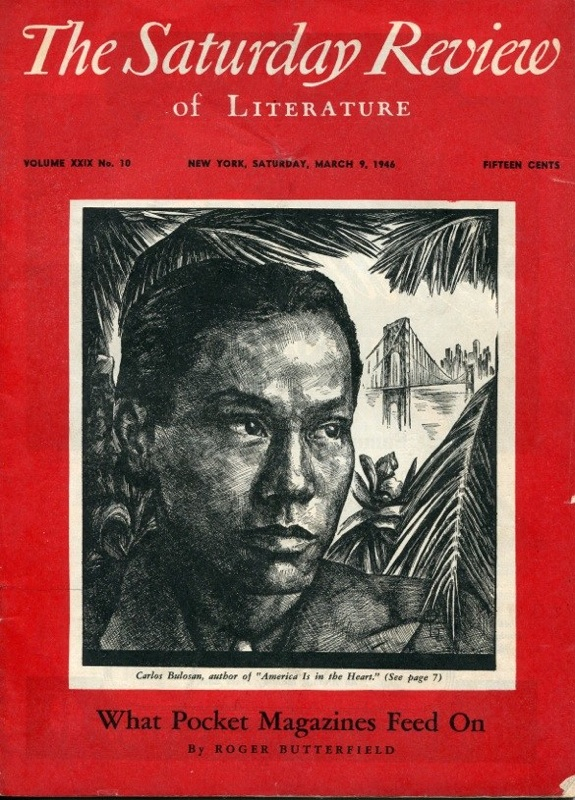
Demi and Jerry don’t know it yet, but they have another Bulosan memento coming from me: a copy of the Saturday Review of Literature from March 9, 1946, on the cover of which the famous pen-and-ink portrait of Bulosan first appeared. One of these days, I’ll pay another homage, to the Bulosan memorabilia on exhibit at the University of Eastern Pangasinan in Binalonan, where they keep copies of his letters, commemorate September 11 as Carlos Bulosan Day, and teach a 3-unit course on his life and works. There’s a trove of material on him at the University of Washington library, and perhaps on another visit to Seattle, with more time, I might look into that, too. But as every Fil-Am and indeed every Filipino should know, a pioneering voice like Carlos Bulosan’s can ring everywhere and forever, in the heart.
Bulosan

Penman No. 117: The Way We Were

IMG_4726Penman for Monday, October 6, 2014


I’D LIKE to thank the people who’ve given me their time and accorded me their hospitality during my current visit to the US. I’m here to do more research for a book project—an oral history of the First Quarter Storm (the story of my generation, in other words)—and so far I’ve had wonderfully productive interview sessions with some people who were either active participants in the anti-martial law movement or were on the other side of things (or simply on the roadside) at the time.

Those who’ve helped me out, either as interview subjects or facilitators, include former campus journalist and retired engineer Gerry Socco and his wife Chet; lawyer Rodel Rodis; editor Rene Ciria-Cruz; tech journalist and developer Joey Arcellana; and journalist Gemma Nemenzo and her husband, Col. Irwin Ver. All of them are conveniently based in the San Francisco Bay Area, so Beng and I flew out there from DC for a long weekend of interviews and reunions with old friends.

Rodel and I go back all the way to the Philippine Science High School, where I served as Rodel’s associate editor when he helmed The Science Scholar. It was also in high school—when I myself became editor in chief—that I first heard of Joey Arcellana from our adviser, Mrs. Agnes Banzon Vea (mother of the accomplished Doy and Rey Vea), who told me one day: “There are two young writers I’d like you to read. One of them writes for the UP Collegian, and his name is Joey Arcellana. The other is still in high school and writes for the Highlights, and his name is Gary Olivar.” Gemma, who now edits the ezine Positively Filipino, also edited the late, lamented Filipinas magazine, which I used to write a column for. Gerry I knew from the pre-martial law College Editors Guild of the Philippines, and we met again in the worst of possible circumstances—as fellow political prisoners in Bicutan; today, in our sixties, we share an unabashedly bourgeois passion for collecting vintage pens and watches.

In Washington, DC, where I’m formally based through my association with the George Washington University, I’ve been lucky to meet and to interview one of the torchbearers of the anti-Marcos resistance on the East Coast, Jon Melegrito, a retired librarian at GWU who now writes for the DC-based fortnightly Manila Mail. I’ve also been glad to gain the insights of three former State Department officials: former Ambassador John Maisto, who headed the old Office of Philippine Affairs and served in Manila in the late 1970s; his colleague Hank Hendrickson who now serves as executive director of the US-Philippines Society, of which Amb. Maisto is the president; and Santiago “Sonny” Busa, a Filipino-American who has served as consul in Manila, Addis Ababa, and Kuwait, and who has taught International Affairs at West Point. I’ll be doing a bit more traveling to see people in New York and possibly the Midwest.

So far, I’ve interviewed about 30 people for the book, which I’ve begun to write at my sister’s place in Virginia. It’s very strange in a way to write about bloody encounters in coconut groves in the Philippine South while reveling in the sight, outside my window, of bluejays and robins perched on the branches of trees just beginning to acquire an autumnal glow. But perhaps it’s precisely this physical and psychological estrangement that I need to handle such an emotional project—emotional, at least, for members of my generation.

Sometimes what I hear gets a bit too much; for the first time, after having written and published over 25 books with a very dry eye, I wept as I listened to an account of someone I knew shooting—executing—someone who had been her best friend. At the same time, events that might have been terrifyingly life-threatening 40 years ago can now sound absolutely hilarious—or deadpan ironic, such as when firebrand Fluellen Ortigas, selected as one of the Ten Outstanding Students of 1968, stands beside President Marcos at the awarding ceremonies, with a book titled The Essentials of Marxism in hand. “Join my staff,” Marcos tells him. “I can’t,” Ortigas replies. “You’re going to be a dictator!” Ortigas would later work for Ninoy Aquino, go underground in Panay, get arrested before martial law, get released in 1976, flee to the US via Sabah, get an MBA, and become a businessman in San Francisco.

I have many more stories like Flue’s to tell, each with its own highlights and insights—Elso Cabangon being ambushed on Taft Avenue and taking four bullets, one of them tearing through his cheek; Boy Camara auditioning for the role of Judas before eventually playing Jesus Christ, Superstar; a female comrade being married in the rites of the Party, one hand on her heart, and the other on Mao’s Quotations (it’s a marriage, like many in the movement, that will unravel). But they’ll have to wait until the book itself, which I hope to finish by early next year.

Even now, many old friends and comrades are probably wondering why I haven’t approached them yet or asked so-and-so to be interviewed, because they have interesting and important stories to tell. I’m sure they do, and I have to extend them my apologies in advance, simply because I just don’t have the time or space at the moment to include everything and everyone I should be covering. I’m almost certain that this oral history will lead to a sequel, all the way to EDSA (a book that someone else should begin writing soon). Some people I’ve asked haven’t replied or have declined, and I can only respect their implied wish to be left alone.

Again, this book will be about the past, and while we might bemoan the innocence we lost, or even wax romantic about the way we were, I don’t think too many of my respondents will want to relive their lives in exactly the same way, knowing what they do now. We might not regret what we did—it arguably needed to be done—but we or our children don’t have to repeat it, if it can be helped. That’s how history helps the future.

Penman No. 115: The Clarity of Prose

Penman for Monday, Sept. 22, 2014


“THE CLARITY of Things” is the title of the new short story I finished a few weeks ago, which will soon be coming out in the Australian literary journal Westerly. The phrase has been ringing in my ears and suggested this piece about the value of clarity in prose—an element whose importance seems so obvious but which still escapes many writers, especially those who remain unsure of what it is exactly they want to produce.

I was thinking of this the other day as I was reading, with much delight, an old essay by the New York-based Luis Francia on Jose Garcia Villa, which begins thus: “Loved New Yorker cartoons. Hated its poetry. ‘Prose,’ he’d sniff.” The essay (in which I happily discovered that I shared with Villa not just a first name but an aversion to French food and cheese) went on to describe Villa’s fabled workshops, where he decried, Luis recalls, “the prose or narrative mentality. Anathema to the poet’s creed. He urged us not to read fiction, to purify ourselves, our poems, and have that lyric spirit fly unfettered.” There was, Villa and Francia agreed, too much bad prose going around, passing itself off as poetry.

It’s an admirable and entirely understandable stance, coming from a consummate aesthete like Villa. I don’t think there’s a real writer alive who won’t concede that, in the hierarchy of letters, poetry sits at the topmost tier; I often remind students too eager to proclaim themselves poets that there’s nothing harder to do well and easier to do badly than poetry. I’ve published a book of what I offer to be poems and I’ve won a couple of prizes for poetry, but I wouldn’t for one minute describe myself as a poet; I am not worthy.

That said, the writing of good and great prose—whether fiction or nonfiction—poses its own challenges, heedless of poetry’s demands for complexity, compactness, and layered meanings. For me, the charm of prose is precisely in its accessibility—or at least, in its seeming accessibility—and then, like stepping into a roomful of riches, in its delivery of even more than the view from the doorway may have suggested.

At its most basic, and also at its best, prose should be unflinchingly clear, which means it should be written with certainty and precision, if not efficiency, from physical description to philosophical musing. (I keep hearing the imaginary voice—ironically, he was a chronic stammerer—of W. Somerset Maugham, one of my early models, intoning in one of his treatises on writing: “Clarity, clarity, clarity!”) A blue sky should come off as blue, or shade into its proper variant; a crowded room should suffocate the reader. Clarity does not imply a singularity or inevitability of meaning, especially in fiction, which thrives on ambiguity; I don’t have to understand what I’m seeing, not right away, but I should know what I’m looking at—a wet street, an orange jacket, an old man’s face. Witness the prudish Miss Mijares in Kerima Polotan’s “The Virgin”: “Secret, short-lived thoughts flitted through her mind in the jeepneys she took to work when a man pressed down beside her and through her dress she felt the curve of his thigh”; she wished she were “in the movies, to sink into a seat as into an embrace, in the darkness with a hundred shadowy figures about her and high on the screen, a man kissing a woman’s mouth while her own fingers stole unconsciously to her unbruised lips.”

Some works, like popular songs, are best understood right away to be fully enjoyed.

On our flight to the US earlier this month, I gorged on the onboard entertainment, and dwelt in particular on an HBO documentary on the life and work of the lyricist-composer Stephen Sondheim, who reminded his audience that the difference between the poem and the song lyric is that the listener has to get the song on the spot, whereas the poem’s meaning can be teased out at leisure. (And sometimes meaning doesn’t matter as much as the music: try figuring out “Send in the Clowns.”)

Clarity often comes with concrete objects, but can be even more valuable when dealing with abstractions—ideas, feelings, complex notions often more surely grasped by the many-fingered poem. I’ve found that the most complex notions are best served by the simplest language. Clarity and simplicity are not always the same thing, but can’t be too far apart. There’s a much-quoted passage from C. S. Lewis’ The Four Loves that illustrates how simple words—with a few exceptions like “irredeemable”—can reach at the most complex of meanings:

“To love at all is to be vulnerable. Love anything, and your heart will certainly be wrung and possibly be broken. If you want to make sure of keeping it intact, you must give your heart to no one, not even to an animal. Wrap it carefully round with hobbies and little luxuries; avoid all entanglements; lock it up safe in the casket or coffin of your selfishness. But in that casket—safe, dark, motionless, airless—it will change. It will not be broken; it will become unbreakable, impenetrable, irredeemable. The alternative to tragedy, or at least to the risk of tragedy, is damnation. The only place outside of Heaven where you can be perfectly safe from all the dangers of love is Hell.”

This also reminds us that good, clear writing begins with good, sharp thinking, which is perhaps the hardest task of all.


Penman No. 107: Small Loans for Big Dreams

WS-Butch-1Penman for Monday, July 28, 2014


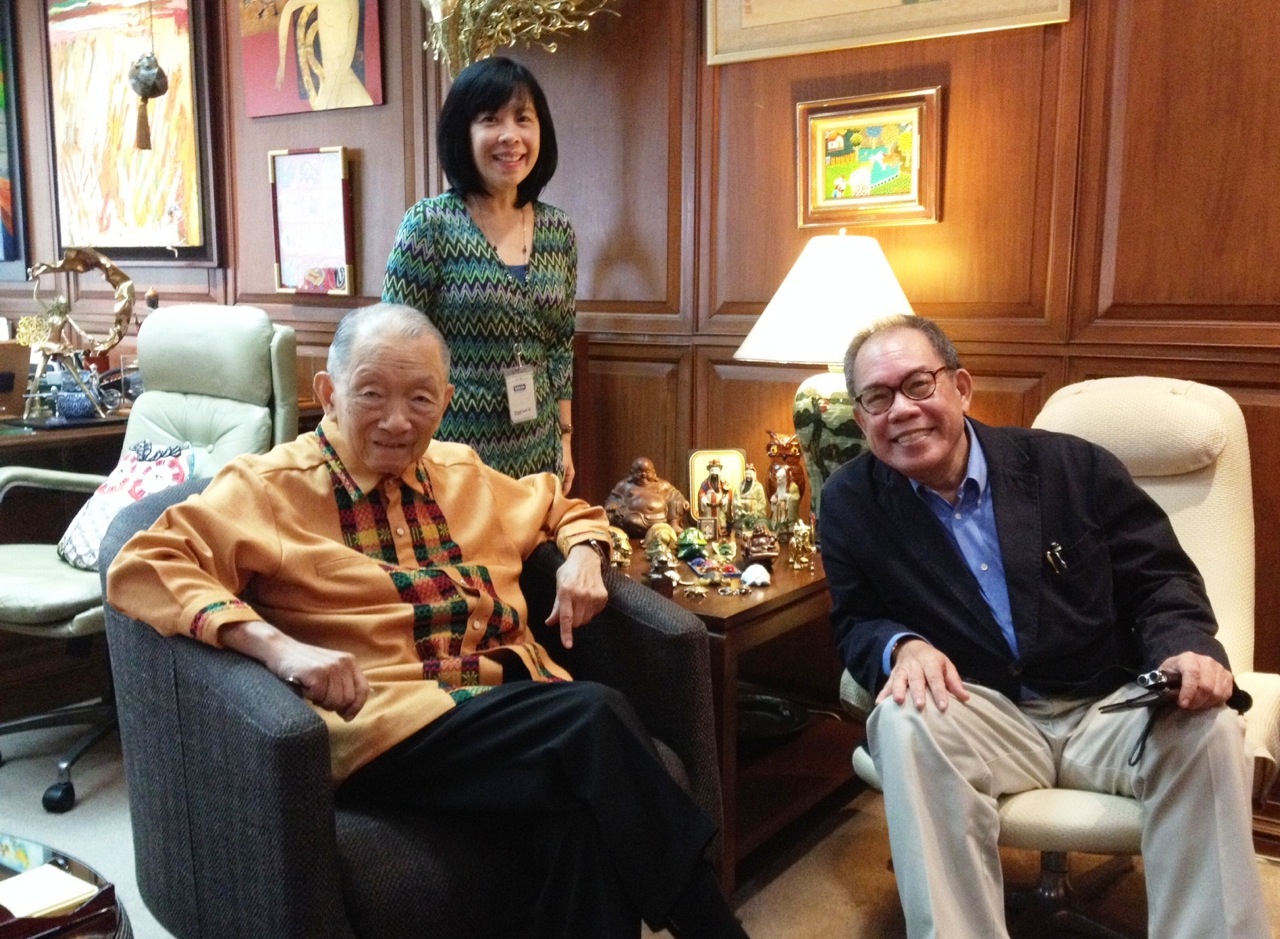
IT HAD been a few years since I last sat down for a chat with the accounting and business guru Washington SyCip, whose biography (Wash: Only a Bookkeeper, published in 2009) I had been privileged to write, so I was only too happy to oblige when our mutual friend Marlu Balmaceda asked if I could spend some time last week to shoot the breeze with Wash.

Both Wash and I had aged a bit since we started working on his book back in 2006—I more so than he, who last month turned 93. Having just gotten my senior card in January, I’ve been feeling entitled to some relaxation, but Wash SyCip was right at his desk in his old 14th floor office where I last saw him, working away, surrounded by a growing menagerie of owls, turtles, and roosters, the gifts of friends. On the wall was a Chinese painting of a dignitary, perhaps the Emperor himself, seeking the counsel of a wizened turtle. Wash caught me looking at it and told me what the turtle’s sage advice was: “Take it easy.”

As cool and dapper as he is, Wash makes it look like he’s taken it easy all his life, but I know for a fact—having chronicled that life—that it just isn’t so. No slouch could’ve put up and sustained what became the regional accounting giant SGV.

But this time, Wash wasn’t talking about himself, but about a new program for education that he and a friend began three years ago, called the Zero Dropout Education Scheme, which seeks to put and keep poor Filipino kids in school. “The country’s biggest problem remains poverty and the wide gap between the rich and the poor,” Wash says. “For me, education is key to alleviating poverty, but ironically, the poorer you are, the more children you have, so half go to school and half don’t. Those who don’t will stay illiterate, and will be resigned to poverty all their lives.”

Seeing that illiteracy still afflicted millions of Filipinos, Wash resolved to do something about it and committed US$1 million of his own money to a fund aimed at the problem. Helping him along was his friend, the Armenian-American businessman and philanthropist Paul Kazarian, who pledged to match Wash’s contribution dollar for dollar. But even with that funding, Wash was modest and realistic enough to know that he couldn’t do the job by himself. “I don’t really know the poor, and how best to reach them,” he admits. “So I got in touch with CARD-MRI, which has been a leader in Philippine microfinance, to help us out.” Radiowealth Finance Corporation has also geared its CSR program toward the Zero Dropout scheme, and committed to provide P30 million.

The Center for Agriculture and Development-Mutually Reinforcing Institutions or CARD-MRI goes all the way back to 1986 when Dr. Jaime Aristotle Alip and 14 other rural development practitioners got together to set up CARD specifically to help empower women in poor communities. In 2008, it received the Ramon Magsaysay Award for Public Service. “With over 1,400 units all over the country, CARD had a network in place we could tap for our program,” Wash says.

Initially available to CARD members, the Zero Dropout scheme offers small renewable loans ranging from P1,500 to P3,000, at a monthly interest rate of 1 percent. “Basic education may be free,” Wash acknowledges. “But families still need money for school supplies, slippers, clothes, and other expenses. That’s where we come in. We’d like to provide not just the money, but an easy way of getting it, with as little red tape as possible.”

As of March this year, the program had supported over 46,000 students through loans totaling over P160 million, out of which P130 million in principal and P6.5 million in interest has already been paid back. They expect to hit 100,000 beneficiaries by year’s end.

While most beneficiaries come from Region IV-A (the Calabarzon area), the program has expanded to the ARMM in Mindanao, where the dropout rates are the highest. Typical beneficiaries include Lucena native Lilia Fernandez, a mother of nine who works as a manicurist alongside her husband, a construction worker; her son Erick dreams of becoming an engineer.

Unlike the government’s conditional cash transfer program, which gives cash direct to poor beneficiaries, Zero Dropout is a loan program. “They repay the loan through microfinance, by increasing their income with a loan for a store, a tricycle, and so on,” adds Wash.

If you think poor borrowers can’t or won’t repay their loans, think again. CARD has made a name for itself making sure its system works, basically because it’s led by people from the very grassroots it serves. Wash tells this story: “I had CARD’s management people over for dinner at my house once, and discovered that none of them were from Makati or Manila. They were all from the rural areas, and they were mostly women, very bright women. I was very impressed with their dedication. CARD knows its clientele. It works with groups of 20 women who guarantee each other. I’ve attended meetings with these groups and I can see that our poor communities are full of people with initiative and drive.”

I came away most impressed by an incident that Wash related: “When Yolanda hit, 8,000 students under the program were affected in Leyte and other places. My first reaction was to cancel their loans, as the least we could do to help. But Dr. Alip said, Wash, no—the poor are more honest than the rich. And as reconstruction took off, the loans also began to be repaid, even if the borrowers had lost their homes.” If that’s not inspiring—in the context of billions lost to crooks and scammers—I don’t know what is.

Penman No. 103: Too Much Drama

Penman for Monday, June 30, 2014

IN MY other life as a dramatist, which came to an end some years ago, I wrote about a dozen plays for the stage and more than twice as many television plays and screenplays, mostly for the late Lino Brocka. Lino and I happily turned out double-hanky tearjerkers with such rousingly commercial titles (which someone presumably from the marketing department thought up) as Kailan Mahuhugasan ang Kasalanan, Ano ang Kulay ng Mukha ng Diyos, Maging Akin Ka Lamang, Miguelito, ang Batang Rebelde, and my very first one, back in 1977, Tahan Na, Empoy, Tahan.

I may have stopped writing drama to focus on fiction and nonfiction, but now and then the old skills get a workout. I’ve always said that there’s no better training for a writer of fiction than to have been a playwright, because playwriting teaches dramatic economy—how to set up a scene, how to get the most out of your characters, how to use dialogue effectively (meaning, at its most complex, how to get your characters to say things they don’t mean, or to mean things they can’t say).

Last week, I said as much again to a group of writers and program analysts from a TV network who wanted to see how writers think. I told them that drama’s to be found not only in filmscripts or on the set—it’s all around us, taking place quietly in some fastfood joint or some bus stop or some hospital ward; the writer’s task is to see that drama, to palpate it from the tedium of everyday life, and to sharpen and brighten its edges so others can see the extraordinary in otherwise ordinary moments.

We’ll save the rest of the drama lesson for another day; I bring this up only to establish my bona fides when it comes to talking about drama, and about my thesis today, which is that—even for a writer of melodrama, for which I make no excuses—there seems to be entirely too much drama around us these days, or theater if you will. (There’s a subtle difference, if you think of drama as the situation and of theater as its enactment on some kind of stage.)

Case in point: I’m sure I’m not the only one who’s sick not only of Senator Bong Revilla’s whinings about the heat in his room at the “custodial center” (it’s not even a real prison, for Pete’s sake), but also of how the media has fussed over it like it was a real news story (“Can Congresswoman Lani make it back from Greenhills in 15 minutes with the air cooler? That’s all the time she has before visiting hours end!” said one radio reporter breathlessly.) My totally un-PC prescription? Give him the fan, give him whatever creature comfort he wants, but reduce his cell to about a third of its size and keep that one window, from which I hope he sees a mall, or something with lots of people and traffic in it. There’s no better reminder of what prison means than limited space and movement, no matter what you may have with you. (I remember watching a Marlboro neon sign blink at me on the far side of martial law prison, back in 1973; that was torture.)

Senator Jinggoy Estrada’s departure for the custodial center was only slightly less theatrical, thanks again to the media who couldn’t get enough of the father-and-son story being played out in all of its bitter if obvious irony. Of course we expected the family to bond around Jinggoy, and for tears to be shed; that’s any family’s natural privilege, and its natural response. Indeed what underwhelmed me, from my dramatist’s standpoint, was how predictable everything was from start to finish, especially the inevitable “Mayor Erap, ano’ng nararamdaman ninyo sa pagkakakulong ng inyong anak?” I wanted to scream, “E ano pa?”

I can just see the video highlights from these staged “surrenders” figuring in these politicos’ next campaigns: the prayers in church, the mug shots, the hugs and waves from distraught spouses, parents, and kids; the cell doors closing, as the music goes up and under, before we hear a murmured voice-over: “May bukas pa….”

Case in point Number 2: Sometimes silence is drama; when your wife refuses to explain why she doesn’t want to talk to you, that’s drama. When the Palace refuses to explain why it dropped Nora Aunor from the list of National Artist awardees, that’s drama. All President Noynoy’s spokesmen could say was “It’s the President’s prerogative….”, which is exactly what we heard from President Gloria’s spokesmen a few years ago, the only difference being that she made dagdag, while Noynoy made bawas. I did read something about Nora’s exclusion being “in the national interest,” but it boggles the mind to figure out exactly what that means. I can understand defending the Spratlys and Scarborough Shoal as being “in the national interest”; I can even understand rooting for Manny Pacquiao on fight day—temporarily setting all his other quirks and antics aside—as being “in the national interest.” But dropping Nora?

As I wrote in this corner a few months ago, I was on a large, multidisciplinary, second-level committee that endorsed Nora Aunor to a higher body (the NCCA and CCP Boards plus the National Artists); we endorsed Dolphy as well, and if I remember right, he and Nora got the same highest votes across the board. Granted that our recommendations were just that and subject to final approval upstairs, I feel among many others in the arts that we at least deserve a full and cogent explanation for all these pluses and minuses that take place in Malacañang. The Palace—and I don’t mean just the present occupant—has never been known to be a bulwark of artistic support and sensibility, if you look at funding for the arts in relation to everything else; if it never cared for or about the arts, why should it suddenly care—negatively at that—about Nora Aunor, whom the arts community clearly feels is deserving of its highest accolade? If you can’t help, at least don’t get in the way.

I’d been told by some Palace contacts that questions came up about Nora’s alleged drug use. OK, I said, it’s fair enough to raise these questions which presumably involve moral turpitude. But since when has it been fair to use morality as a standard for artistic excellence? We’ve had National Artists whose personal lives were hardly spotless, but whose art precisely may have been deepened and enriched by those encounters with their darker side. (Conversely, we’ve had National Artists who may present themselves as moral exemplars and accuse everyone else of some fatal shortcoming, but whose work is unremittingly mediocre and soporific.) Edgar Allan Poe, Salvador Dali, Jean-Michel Basquiat, and Miles Davis, among many others, would never qualify for state honors in their countries (not that they ever cared) if our Malacañang’s standards were employed.

Last case in point: I wholeheartedly agreed with the NCCA when it protested the Palace snub of Ms. Aunor, but also wholeheartedly disagreed with the NCCA when it reportedly protested allowing the use of our national heroes’ names for such popular products as beer. (Think “Cerveza Rizal” or “Mabini Beer.”) The reason given by objectors was that it would be a sign of disrespect for these heroes to associate something as morally undesirable as alcohol with them.

Really? Which planet are we on? Didn’t our heroes drink beer and stiffer forms of alcohol—in spite (or dare I say because) of which they performed heroic deeds, anyway? Rizal complained that his fellow ilustrados in Spain drank and womanized too much, but that hardly meant that he was completely abstemious in either department. He didn’t care much for hard liquor, but drank beer (like me, on whom single malt would be a total waste). George Washington was a beer guy as well, and even famously left a handwritten recipe for his own brew (later marketed in an “Ales of the Revolution” line). So will the moral police please lighten up? If Nora’s good enough to be a National Artist, then Jose Rizal should be good enough to go on a beer bottle, and I’ll hoist many a cold Rizal in his own honor.

Heroes aren’t heroes because they’re perfect human beings; they’re heroes because—despite some truly terrible character flaws and peccadilloes (one of them even shot his wife, remember?)—they left something indelible to the national spirit and imagination, enough for us to think of ourselves as a nation. Heroes and National Artists (the real ones and the best ones) can do that; politicians—whether in prison or in the Palace—can’t.

Penman No. 102: The Cream of the Crop

2014FulbrightPenman for Monday, June 23, 2014


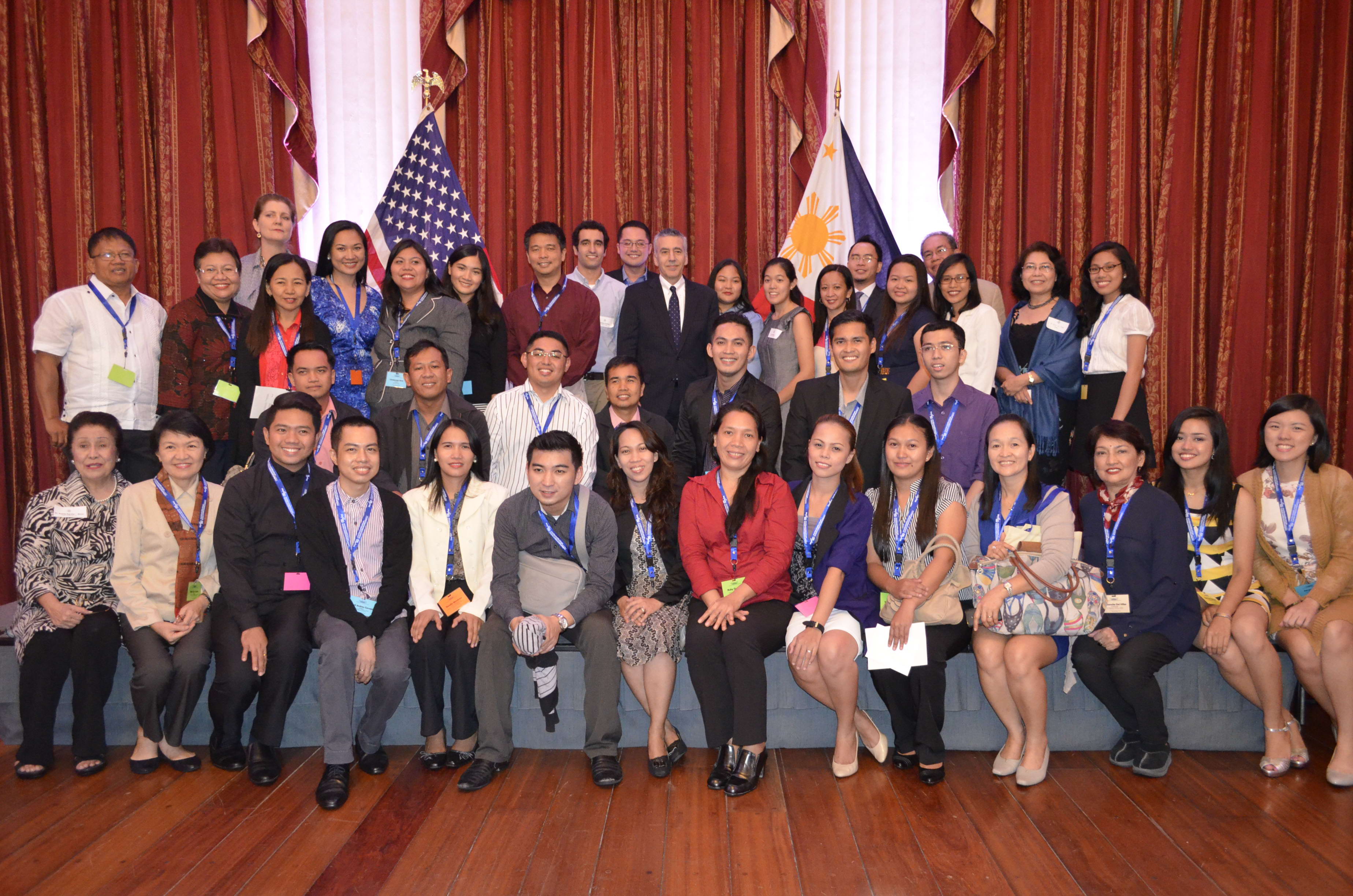
A FEW weeks ago, I was happy to attend a pre-departure orientation seminar for this year’s US-bound batch of Fulbright and Hubert Humphrey scholars. I’ve been to quite a few of these PDOs over the past decade or so, and normally I’d be there up front, giving one of the orientation talks.

I’m usually the closer at these seminars, my task being to remind our scholars to enjoy their stay in America and to learn all they can—and then to come home and serve their people. “Love America all you please,” goes my spiel, “but never forget where your home is, which is here—not even here in 21st century Makati, but in those parts of our country which languish in the 20th and even the 19th century. We go to the great schools of America not just to improve our lives but theirs—those Filipinos who cannot even read, or are too hungry and tired from work to read.”

Last month, I sat in the audience on the listening end, having been privileged with a Fulbright grant—again, after my first one nearly 30 years ago, when I left for the US to do my master’s at Michigan and my PhD at Wisconsin before returning in 1991. This September, if all goes well, I’ll be leaving for Washington, DC to do advanced research in connection with my ongoing book project on the First Quarter Storm, specifically to seek out American perceptions of and experiences with martial law in the Philippines, and also to interview Filipino-American activists from that period.

The Philippine-American Educational Foundation, headed by the very capable and amiable Dr. Esmeralda “EC” Cunanan, actually administers or acts as a conduit for several distinct scholarship programs that fall loosely under the “Fulbright” rubric, named after the late Sen. William J. Fulbright, who saw educational exchanges as the best way to promote international cooperation and understanding between America and the rest of the world. (The Fulbright program also sends out American scholars for studies abroad.) Indeed, as I often tell my American friends, one Fulbright scholarship will probably cost a hundredth of and produce a thousand times more enduring goodwill than one bomb. For us Filipinos, this is the pensionado concept brought over into a new century, with the important difference that our learning is no longer meant to serve American ends, but ours.

A scan of this year’s batch of outgoing scholars offers great hope for the future. Chosen from many hundreds if not thousands of applicants after rigorous evaluations and interviews, they represent truly the cream of the crop, and I felt honored to be in their company.

The so-called “classic” Fulbright scholars—those going for their master’s and PhD degrees—include the likes of Lisa Decenteceo of UP Diliman, who’s going for her PhD in Musicology at the University of Michigan in Ann Arbor (yay, go Blue!); Neil Andrew Mijares of the University of San Carlos, who’s doing an MA in Urban and Regional Planning at the University of Iowa; and Ramjie Odin of Mindanao State University-Maguindanao, who’s entering the PhD program in Fisheries and Allied Aquaculture at Auburn University.

Among my three fellow “senior” postgraduate scholars, despite the fact that she looks young enough to pass for an undergrad, is Marites Sanguila of Father Saturnino Urios University in Butuan, who’ll be going to the University of Oklahoma to undertake advanced research in “Species Diversity and Survival in a Changing Environment: Developing a New Center for Biodiversity Conservation.”

For many years now, there’s also been a special Fulbright program focused on agriculture, the Philippine Agriculture Scholarship Program for Advanced Research, which was set up at the initiative of then Agriculture Secretary Edgardo J. Angara to improve our agricultural expertise. This year’s nine grantees include Ma-Ann Camarin of MSU-Marawi who’s going to another MSU, Mississippi State University, to do doctoral dissertation research on (hold your breath) “Disease Surveillance and Study on the Bacterial Flora of Freshwater Prawn (Machrobrachium rosenbergii) as Biological Control Against Pathogenic Bacteria.” Meanwhile, Shirley Villanueva of the University of Southeastern Philippines in Tagum is going to the University of California-Davis to conduct research on the “Genetic Diversity of Native Chicken Groups in the Davao Region.”

Among the two US-ASEAN Visiting Scholars will be Jay Batongbacal of UP, one of our foremost legal experts on maritime law, who’ll be studying issues related to current disputes in the South China Sea. The three Hubert Humphrey fellows—all accomplished professionals in mid-career—include a PNP major and former Pasay City precinct commander, Kimberly M. Gonzales, who’ll be looking into public policy and administration concerns at the University of Minnesota.

To help Americans—especially Fil-Ams—learn Filipino, the Fulbright program is sending out three Foreign Language Teaching Assistants, who include Edward Nubla from the University of St. La Salle in Bacolod; he’ll be on his way to Skyline College in San Bruno, California. Lastly, four Filipino undergraduates will soon be spending a year on a US campus, thanks to the Fulbright program. They include Michiko Bito-on of Silliman University in Dumaguete, who’s taking up Mass Communications.

It’s heartening to see the diversity not only in these scholars’ expertise and concerns but also in their representation of all corners of the archipelago, ensuring that the Fulbright experience is shared not only by the usual suspects like me from Manila’s academia, but by bright young minds from north, south, and center.


SPEAKING OF the Filipino presence overseas, a big cultural event will take place in Hong Kong over this weekend, thanks to the efforts of the poet and scholar Armida M. Azada, who’s been based there for many years now.

On Friday, June 27, 5:30-7:00 pm, Mida will sit in conversation with visiting Filipino writers Joel Toledo, Charms Tianzon, and Daryll Delgado in a symposium on new Philippine writing titled “Our Words, Other Worlds,” at the Amenities Building, Lingnan University. The next day, at noon, Mida’s new book of poems, Catalclysmal: Seventy Wasted Poems will be launched at the 7th Floor of Hong Kong City Hall in Central. Earlier that morning, from 10:30 to 12 noon in the same venue, a free writing workshop will be held for Pinoy helpers and HK-Pinoy youth. On Sunday the 29th, from 6 to 7:30 pm, a poetry reading by Filipino writers and their friends will be held on the first floor of DB Plaza Terrace near Dymocks in Discovery Bay.

This is a wonderful thing that Mida Azada—a gifted poet who was a colleague at the UP Department of English before she moved to Hong Kong and the UK—is doing not just for herself but for her fellow Filipinos in the diaspora. As prizewinning poet Joel Toledo puts it in his endorsement of Mida’s new collection, “Cataclysmal is a collection of haunts and visitations. The poems here flit in and out of the Philippine archipelago, travelling to London, Hong Kong, and New York without losing touch of a Filipino rootedness. The poet’s concerns stray and meander from the personal and cathartic to the phenomenal and ultimately global. But Azada’s voice is keen and focused, filtered on the page by a careful attention to language. One may argue that this is the poetics of the expatriate ruminating on both the post-modern and post-colonial. Yet at the heart of this collection is fierce integrity, a resonant ‘I’ persona that won’t flinch. Here are poems that both strain to capture the fleeting and restrain from exoticizing the past. The poet Fanny Howe once wrote, “Double the beautiful/because they are so little.” While phenomena can sometimes be indeed cataclysmal, the hurtful is never wasted—so long as poems remember and reconstruct and, in time, recollect the sorrows, parse them into bliss.”

Mida, Joel, Charms, Daryll, and the other fine, memorable voices of their generation—they too are the cream of the crop.

Penman No. 96: A Lovely House, a Lively Conference

Penman for Monday, May 12, 2014


MY WIFE Beng’s profession as an art restorer and conservator brings her into contact with some very interesting people, and one of them is a quiet, unassuming man named Mike Santos, whose arrival at our home always causes the usually calm and cool Beng to groan in distress, not because of anything she holds against the fellow but because she’s sure that, invariably, he’s going to be bringing in another job that will test Beng’s skills as a restorer to the limit.

“Why do you do this to me?” I keep hearing Beng wail at the smiling Mike. One piece I remember him dropping on Beng was a century-old poster or banner of the Virgin Mary, apparently painted or printed on silk, lovely except for the fact that the silk was stained, tattered, and coming apart in places, like a battleworn flag. “Can this even be saved?” I recall thinking. But wonder of wonders, after weeks of careful and well-studied work, Beng was able to restore the piece and to return it to a happy Mike.

Perhaps in appreciation for all her labors, Mike invited Beng and the rest of her family—that meant me, my mother, Beng’s mother, Beng’s cousin Lando, and my sister Elaine and her husband Eddie who were visiting from the States—to merienda in his Antipolo home. But as sumptuous as it was, the merienda was just the climax to the real purpose and pleasure of the visit, which was the ancestral house itself.

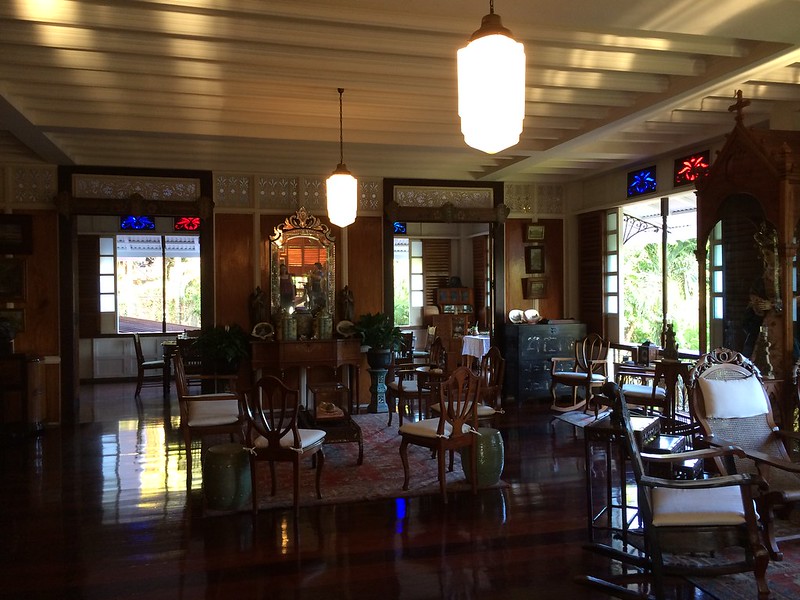
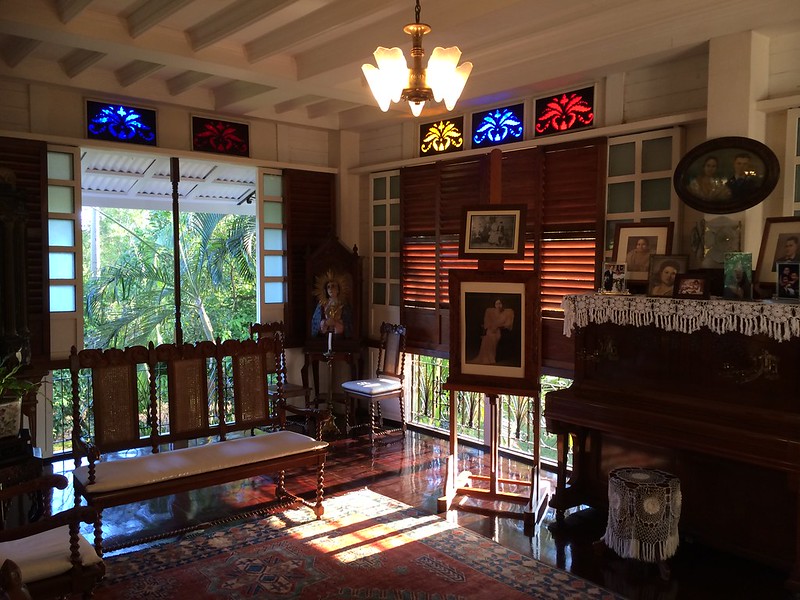
The Santos house now stands on a hilltop lot in one of Antipolo’s subdivisions, and what’s remarkable about it isn’t just the beauty of the Spanish-American colonial architecture but the information you soon receive that this house was transported and rebuilt brick by brick and plank by plank from Navotas to Antipolo. It had been built by Mike’s grandfather Roman—the founder of Prudential Bank—for his young wife in 1917.

Over the decades, it withstood all kinds of natural and human challenges—Navotas’ chronic flooding periodically soaked the lower floor, and during the Second World War the Japanese used the house as a garrison and torture chamber, and of course the ravages of time took their toll on the structure and the furnishings—but sheer love of the house and what it stood for drove Mike and his family to save it before it got much worse. But it would have suffered the same fate over the decades where it stood, so the Santoses decided to move the house to high ground in Antipolo, where it now towers over its more modernistic neighbors.

We were delighted with our tour of the house, marveling at how well preserved the furnishings and appointments were, many of them handed down the generations. The merienda, of course, was excellent, with everything from suman to hot chocolate with pinipig and the sweet mangoes that Mike now grows on the family farm in Bulacan. The company and the stories of Mike and his neighbor Eddie Lindenberg made the afternoon even more special. Of course Beng didn’t get away scot-free: she got a glimpse of her next headache, another century-old painting on canvas of the Immaculate Heart of Jesus that had been cut into several pieces, with losses, then mounted on a wooden board. If it’s going to a house like Mike’s Antipolo manse, I’m sure Beng isn’t going to mind. Salamat, Mike!

THIS JULY, from the 17th to the 20th, another big regional conference will take place in Singapore, promising to bring Asia’s best and most active literary practitioners together under the auspices of Asia-Pacific Writers and Translators.

This moveable feast has been hopping around the region—these past two years, it’s been held in Bangkok, but previous meetings have taken place in Hong Kong and Australia, and next year we’ll get to host it in Manila. I’ve been to most if not all of these meetings—they put me on the APWT board last year, probably in recognition of the fact that a sizeable Filipino delegation has always attended these conferences—and they’ve invariably proven to be well worth the expense of going. (APWT is almost totally dependent on membership and conference fees, and many members like myself go on our own; since the annual conference happens somewhere just around Asia, it’s often doable on a budget fare, and members in academia can and do apply for travel grants to cover costs.)

The difference between APWT and other similar literary conferences is that APWT focuses on practice rather than theory; in other words, while it welcomes teachers, critics, and scholars, APWT is intended primarily for working writers and translators, so they can get together to discuss common concerns like publishing, copyrights, digital media, censorship, and various aspects of the craft. No long and abstruse academic papers are read at APWT; instead, writers and translators engage in lively, jargon-free conversation, sharing experiences across the region and the world.

This July in Singapore, the focus will be on “Bridging Cultures,” and the first keynote will be delivered by none other than our recent guest in Manila, the Singaporean novelist Suchen Christine Lim. Another keynote, titled “Border Lover in Uncertain Times: Story-Making Across Cultures, Languages, and Literary Forms” will be delivered bythe amazingly versatile and accomplished Merlinda Bobis, who was born and bred in Bicol but who has been a longtime resident of Australia, where she teaches at the University of Wollongong. I regularly teach one of Merlinda’s short stories, and am immensely proud of how she has been able to interject a Filipino voice into Australian literature.

According to the tentative program, I’ll be involved in at least two sessions. The first will be a roundtable that I’ll moderate on “Twisting the Truth: Truth in Fiction, Lies in Non-Fiction,” an exploration of storytelling as art and why we tell stories, with David Carlin, Lisa Walker, Michael Vatikiotis, and Philip McLaren. The second will be a session on “Writing Under Political Pressure,” moderated by Michael Vatikiotis, where I’ll be speaking with translator Alfred Birnbaum, who translated the work of Burmese novelist Nu Nu Yi, and with our own Menchu Sarmiento, who’ll be giving an overview on the literary work of some political prisoners in the Philippines.

Aside from myself and Menchu, fellow Filipino writers Christine Godinez-Ortega and Hope Sabanpan-Yu are also already on the tentative program, which can be accessed at http://wp.me/p2yK4I-bD. There’s still room for Filipino delegates to participate in panels they may be interested in and qualified for, but they’d have to register for the conference very soon, according to APWT’s executive director, Jane Camens, who has been the organization’s busybody all these years, and who’s hoping for another big turnout from the Philippines in Singapore. The full member registration is now S$60, and non-member registration is $$80 (in US$ that amounts to around $45 and $65).

Filipino writers and translators interested in attending the conference should know, again, that the organization has no funds to support individual writers, so they’ll have to book their own fares and lodgings for the July 17-20 event. I got online and booked budget airfares for myself and Beng, and then looked for and found a good, clean, cheap hotel—the only seeming downside being that it’s located in Geylang, Singapore’s red light district. This is going to be an interesting conference.

For more details, please check www.apwriters.com.

Penman No. 94: Poverty in Fiction

Penman for Monday, April 28, 2014

ONE OF the liveliest discussions we had at the recent UP National Writers Workshop in Baguio had to do with one of the oldest and yet still most current issues in writing—the depiction of poverty in fiction. A pocket debate arose over a workshop fellow’s short story, the protagonist of which was a 13-year-old boy, poor but streetsmart, who runs into some bad luck but, by the end of the story, is hit by a brain wave and dreams of opening a sawsawan, a kind of food stall, near the tricycle stand he works from.

It was an upbeat ending, an uptick to an otherwise beleaguered existence, but it provoked an unexpected reaction from some members of the workshop—fellows and panelists alike—who felt that the story offered false hopes, given that it was highly unlikely that a sawsawan would provide a real solution to the systemic problem of poverty in this country.

Of course, it’s typical of a UP workshop to get a response like that, and while I didn’t agree with that reading, I was rather glad about the fact that we had people on board who could look at writing and literature for more than felicity of language and agreeability of character and dramatic situation. Sharp-eyed and well-schooled critics these days can take a very long step backward and see things in stories that you or even the author never thought were there—buried or even unintended messages, hidden desires, the author’s own confused and febrile imaginings, latent ideologies. Authors in workshops—especially new ones—will sometimes cry foul at these readings or misreadings, protesting that they never intended their work to be taken that way.

The bad news for authors is that, in today’s critical environment—especially in academia—it’s all fair game; whatever you write can be interpreted in any which way by anyone, and the author’s intentions are often lost by the wayside, seemingly the least important factor to consider in appreciating the story. (In this sense, a writers’ workshop may be the only place where these intentions are given primacy—we try to find out what you really want to do or say with your piece, and then try to help you achieve that purpose.) But it’s not all necessarily bad, as even hostile criticism can be insightful and helpful in the long run to the writer intent on improving his or her craft and vision.

So we should understand when a keenly political critic looks at a story and says that it may be nicely written, but it’s essentially peddling a romantic confection by suggesting that something short of a revolution can banish mass poverty. (Here I may be overstating the specific comments made about that workshop story, but I’m pushing the argument to the extreme for greater clarity’s sake.)

We all agreed that no one does the poor a favor by romanticizing their plight and putting a halo above their heads (instead of saying “their” I should probably say “our,” because most of us are poor compared to the few same people we keep reading about in the glossies). The poor can be as vicious as they can be virtuous; desperation and desire can drive people to outrageously evil acts, and the very poor and the very rich—and the seemingly normal middle class between them—can be perfectly capable of it.

To be honest, my fiction actually deals more with the predicaments of the Filipino middle class, which for me remains the most fascinating source of characters because it’s also the most vulnerable. In a sense, the poor have nothing to lose, and the rich will always find a way to survive; but we, the middle class, entertain the most fervid and the most elaborate ambitions—we know exactly which brands and models to buy, all their technical specifications, sometimes even more so than the wealthy; we just don’t have the wherewithal. Hovering between plenitude and penury, we are one windfall away from a new house in the suburbs, and also one catastrophic illness away from utter destitution.

But I’ve written about the poor and the oppressed in my own fiction often enough (that cranky fellow who keeps implying that I’m some snooty señorito who never stepped on carabao pie and who writes workshop-processed fluff obviously hasn’t read my work). I’d call myself middle-class, but growing up and well into adulthood, we hit rock bottom many times; you all know the sob story, so I don’t need to go there again to vet my poor-boy cred.

What I always say and think about the poor is this: the poor are about more than their poverty. Poverty is awful and dehumanizing, but it’s what people do and how they act at a given disadvantage that I find interesting and even inspiring as a person and as an author, not the overwhelming odds themselves. I’ll leave the objective analysis of poverty to the social scientists and its alleviation to the activists; my job as a fictionist is to see and employ it as another means to understand why we do the things we do. Even poverty needs to be defamiliarized, and especially so, because we think we already know it, when we might not; one exercise I’ve given my writing students is to write a scene or a story about poverty without employing the usual clichés of the sampaguita flower-seller or the shanty in Payatas.

Getting back to the Baguio workshop, I took up the cudgels for the story, reasoning that I didn’t think the author intended for us to believe that the protagonist’s dream of becoming an entrepreneur would necessarily materialize and change his and his family’s life. Indeed the odds seemed stacked against him, and the objective if sad likelihood was that he would falter and fail. What grabbed me about the story was not the dark futility of hope, but the poignancy and the audacity (as Obama would have put it) of even hoping. At that particular moment, this boy thought he saw something better he could do and become—a “bossing,” as he described himself.

As I’ve said, the chances can’t look too good that this boy (nicknamed “Kadyot”) would become the next Manny Pangilinan. But this is where fiction and literature diverge from the social sciences. Fiction isn’t about certainties and probabilities—if anything, the best fiction doesn’t just tell you what you already know, but challenges what you think you know, and even makes the improbable reasonable if not inevitable.

I’ll even up the ante here, and ask why we should take it as an article of faith that this dreaming boy will fail, and that society can’t be changed one person, one family, and one community at a time. We don’t stop hoping or dreaming as individuals because systemic problems demand systemic solutions. The records of banks, cooperatives, and NGOs are full of these stories of lives transformed because one poor guy, maybe being a little silly, dared to dream of starting a business or learning a trade.

I suspect that part of our problem as university-based readers is that we have a traditional humanist bias, gained from decades of immersion in revolutionary politics, against the notion of capitalist enterprise. Mining, for example, will always be a villain in Philippine fiction, no matter what social and economic good the industry or particular companies may produce. Call me an unfashionable neoliberal, but I can’t buy into that kind of summary judgment. Anytime we authors employ simplistic social formulas to explain and to move our characters, the fiction loses, leaving us all the poorer.


Penman No. 93: Resurrecting Another Lost Master

143Penman for Monday, April 21, 2014

ON THIS Easter Monday, a kind of resurrection story seems to be in order. A few months ago, I wrote a piece about the late painter Constancio Bernardo, a lost master and pioneer of Philippine modernism whose life’s work was then about to be celebrated with a centennial retrospective at the Ayala Museum. Little did I know that—a few weeks later, and thanks to a chance encounter at a literary festival—I would learn of yet another and largely forgotten hero of early 20th century Philippine art.

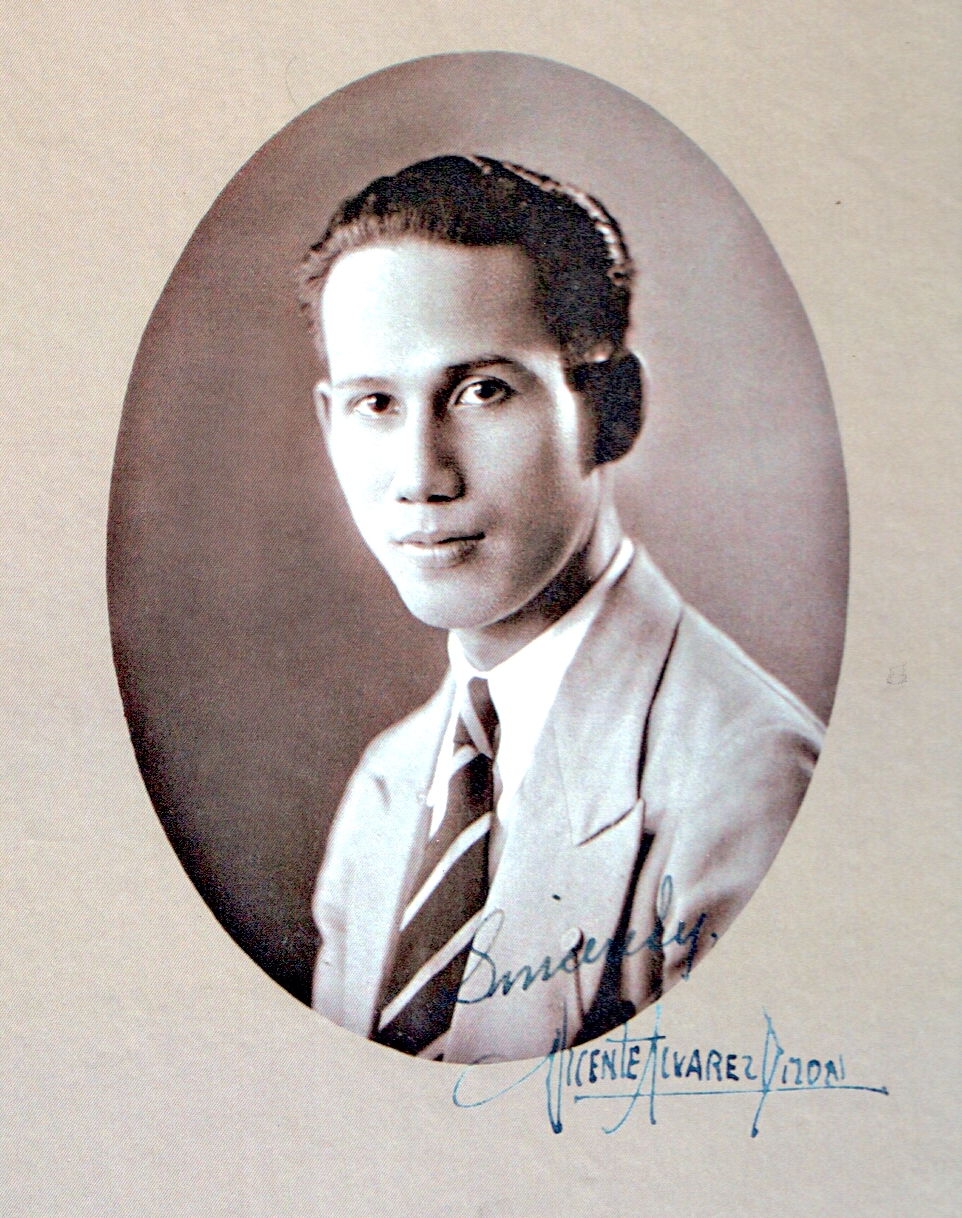
The venue was the Taboan Writers Festival, which we held this year in Subic, with closing ceremonies in Clark Field. It was at Clark that I met Josie Dizon Henson—a painter, writer, and community leader who gifted me with a pair of books she had written. One was a study on Kapampangan orthography, of more scholarly interest; the other book, which caught my fancy, was a slim but substantial, privately published volume titled After the Day’s Toil: A Golden Moment in Philippine Art, a biography of her late father, Vicente Alvarez Dizon and an account of his long-lost masterpiece.

Even at first mention, the name rang a bell in my mind. Two years ago, while doing research for a biography of the late nationalist thinker Emmanuel Q. Yap, I had met (at least by email) a painter named Daniel Dizon, one of Manoling Yap’s boyhood friends. Reminiscing on his friendship with the Yaps, Dan Dizon happened to mention the fact that his father had himself been an accomplished artist—so accomplished that he had won over Salvador Dali in an international competition in the US before the war. That amazing feat—and its doer, Vicente Alvarez Dizon—stuck in my memory. More on that Dali story later.

I had never heard of Vicente Alvarez Dizon before, and as it happened, I would not hear of him again until I met his daughter (and Dan’s younger sister) Josie in Clark. Hearing her name, I made the connection to Dan and to her father, and she seemed delighted to learn that I knew something about her father, and brought me a copy of her book. I set the book aside for a more leisurely read, and when that opportunity arose recently, I found myself engrossed by its account of another extraordinary Filipino life.

Born in Malate, Manila in 1905, Vicente graduated with a diploma from the School of Fine Arts with high honors in 1928. His talent got him a scholarship to Yale in 1934, a sojourn from which he emerged not only with his BFA but also with diplomas in Advanced Painting, Museum Administration and Art Appreciation. Back in Manila, he taught at UP, Mapua, and the National Teachers College; for the rest of his brief life, Dizon would become a staunch advocate of art education and art scholarship, tirelessly lecturing on art subjects around the country.

But his finest hour—the “golden moment” Josie’s book refers to in its title—was likely the Golden Gate International Exposition in San Francisco in 1939, an ambitious, visually opulent panorama that rivaled the New York World’s Fair that opened the same year on the opposite coast of America.

Within the exposition, International Business Machines, already an industry giant under its founder Thomas Watson, decided to sponsor an international art exhibition and competition featuring artists from 79 countries where IBM did business, including the Philippines. The Philippine pavilion in San Francisco actually displayed two other works by young Filipino masters, murals by Victorio Edades (assisted by Botong Francisco) and Galo Ocampo. But as fate would have it, it was Dizon’s painting that IBM chose to represent the Philippines.

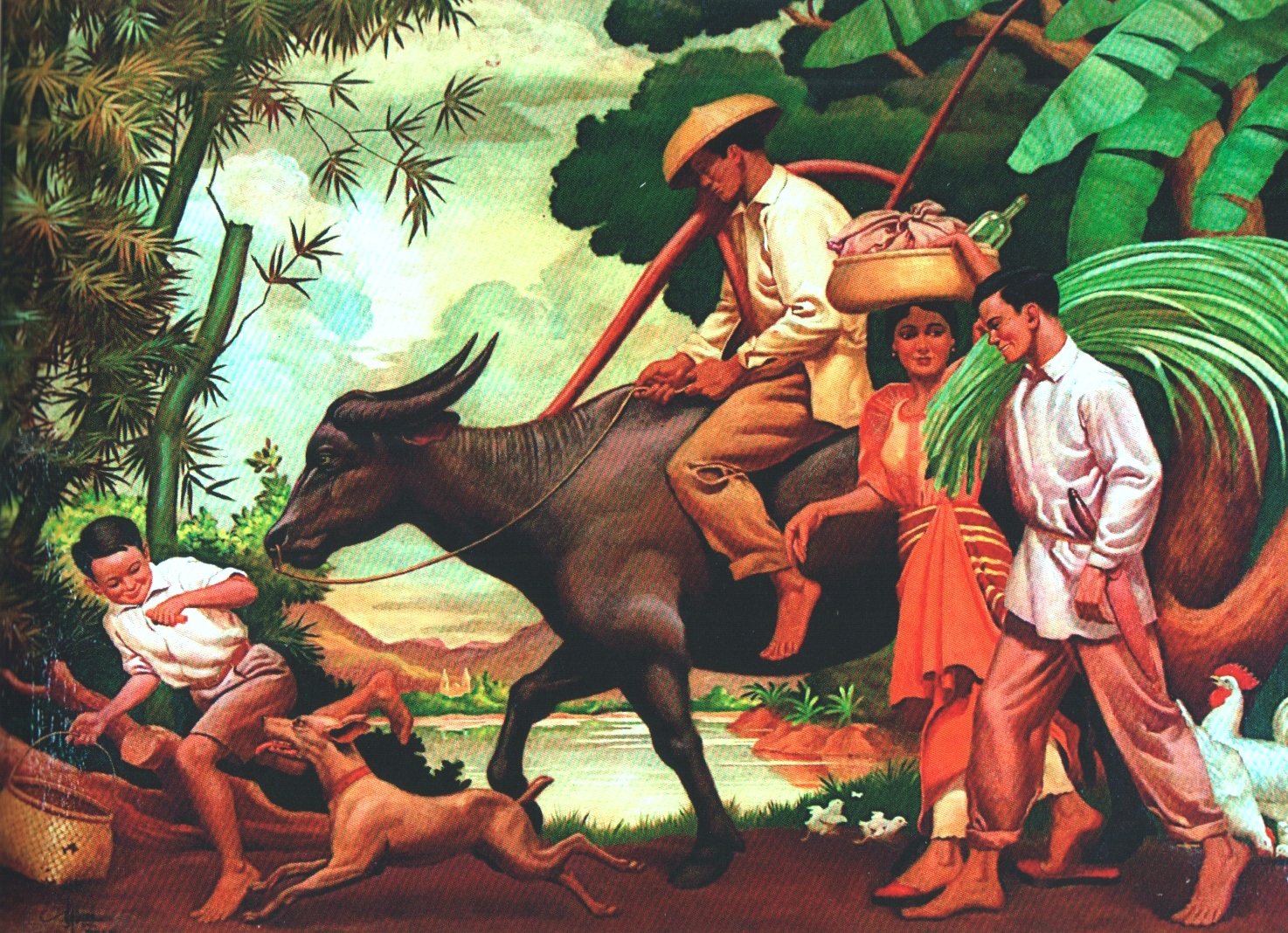
142The painting had been Vicente’s thesis project at Yale. Typical of its time in its evocation of a rustic, romantic countryside, the painting depicted a Filipino family—father, mother, son, carabao, and other farm animals—heading for home at the end of another working day. Because he worked on it at Yale, he had to use Caucasian models for his studies, but replaced the faces with their native counterparts in the final work. He apparently took it home upon graduation, because it was in Manila where IBM’s Philippine representative, Kevin Mallen, saw and bought the painting for IBM, which shipped it to America for the competition. When the results were announced, Dizon had won first prize, followed by Spain’s Salvador Dali and by the American Robert Philipps. (Coincidentally, at the other global fair in New York that same year, another Filipino, Fernando Amorsolo, also won first prize for his painting “Afternoon Meal of the Workers.”)

But that’s not where the remarkable story of this remarkable painting and its creator ends. Vicente himself, sadly, would die young and penniless in 1947 at just 42, afflicted with tuberculosis, a condition that, according to Dan, also ravaged the family’s finances. His masterpiece and legacy lived on—although it was almost lost.

In October 1980, the Batangas-born Filipino-American physician, Roger Pine, received a letter at his home in Princeton, New Jersey from a New York art dealer informing him of the availability of a painting with a Filipino theme titled “After the Day’s Toil,” 40 x 53 inches, signed “V. A. Dizon, 1936.” Would he be interested in looking at and possibly acquiring it? The dealer sent a transparency of the painting along.

The painting had last been seen by the Dizons in 1952, when it had been shipped from the US to Manila on loan from IBM for a local exhibition. And then it vanished. Further inquiries produced no leads other than the name of a New York gallery, which had no records of it.

When Roger Pine received the invitation from his dealer, he felt an instant connection to the painting, having grown up in a family of farmers. He knew nothing about the painting, the artist, nor its provenance, but he did know, especially after seeing the painting itself in New York, that he just had to have it. The dealer—who said that he had earlier tried to interest the National Museum in Manila to no avail—let the Pines have it on installment. It was also only in New York that Roger Pine realized that he had found and bought a long-lost prizewinner.

Next came the trans-continental search for the painter’s family—not an easy task in those pre-email, pre-Google days. It eventually took 25 years and a bit of luck—a dinner conversation during one of the Pines’ visits back in Manila—to connect the Pines with the Dizons. In 2006, the two families met, and the following year, two generations of Dizons trooped to Princeton, New Jersey to visit the Pines and to see, once again, Vicente’s painting. It was a tearful but joyful reunion, the kind of happy ending that deserves to be written about in a book. That’s what Josie Dizon Henson has done.

Poster 12x38

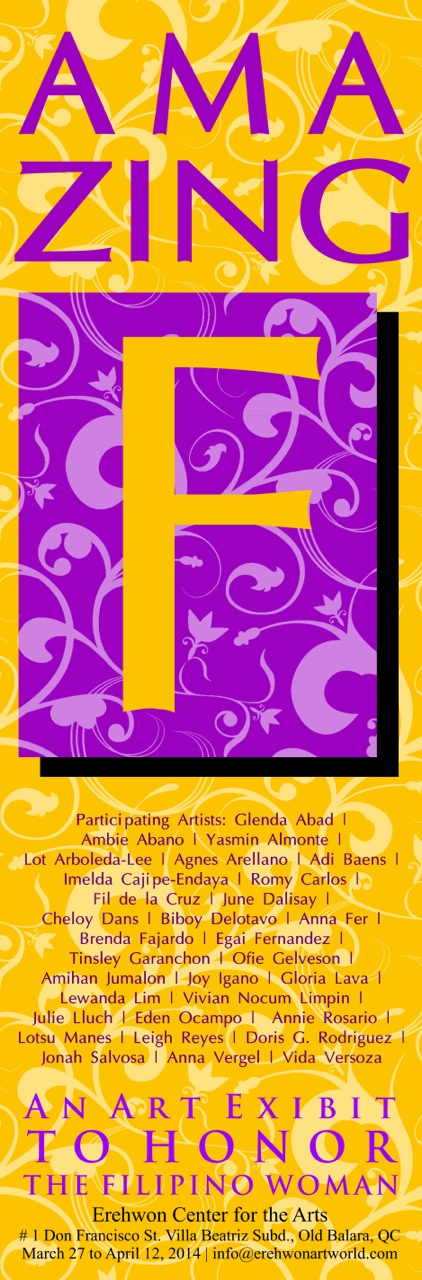
AND WHILE we’re on the subject of documenting Philippine art, let me note that, in celebration of the Filipino woman and of Women’s History Month, the Erehwon Center for the Arts in Quezon City recently hosted “Amazing F,” featuring some of the country’s leading artists, both women and men.

The participating artists included Glenda Abad, Ambie Abano, Yasmin Almonte, Lot Arboleda-Lee, Agnes Arellano, Adi Baens, Imelda Cajipe-Endaya, Romy Carlos, Fil de la Cruz, June Dalisay, Cheloy Dans, Biboy Delotavo, Anna Fer, Brenda Fajardo, Egai Fernandez, Tinsley Garanchon, Ofie Gelvezon, Amihan Jumalon, Joy Igano, Gloria Lava, Lewanda Lim, Vivian Nocum Limpin, Julie Lluch, Eden Ocampo, Annie Rosario, Lotsu Manes, Leigh Reyes, Doris G. Rodriguez, Jonah Salvosa, Anna Vergel, and Vida Verzosa.

Erehwon—located at #1 Don Francisco St, Villa Beatriz Subdivision, Old Balara, Quezon City—is fast becoming one of Metro Manila’s most vibrant art centers, hosting not just painters but also musicians like the Metro Manila Concert Orchestra. The Amazing F show, which ran until last week, was another of its projects to benefit the Erehwon Arts Foundation, which aims to run a residency program for talented but financially challenged young Filipino artists.

It was curated by Erehwon Arts Foundation Vice President June Poticar Dalisay, who said that “AMAZING F is an art exhibit that explores the different facets of the Filipino woman, a complex and enigmatic individual whose roles are varied and endless, affecting every sphere of our personal and public lives. She is warm, sweet, and compassionate, but she can also be can be cunning, feisty, and combative.” Don’t I know that—and yes, June, I stand amazed!

Penman No. 89: Camels and Scribes

d4966305xPenman for Monday, March 17, 2014

A FEW months ago, I wrote about the fountain pens that famous people like T. S. Eliot, Winston Churchill, and Neil Gaiman used, and especially about how Eliot’s pen had been donated by his widow Valerie to the Royal Society of Literature for members to sign themselves with into the society’s logbook. The more practical-minded will and should, of course, dismiss any such discussions of celebrity memorabilia as mere fetishism, an adoration of idle and otherwise meaningless objects.

Happily, that’s a charge I can live with, as an incorrigible collector of lovable old junk, particularly pens to which I’m drawn by some deep Freudian current I won’t even try to palpate. I never even excuse the fact that I collect pens not so much to write as to doodle with—I enjoy laying wet bright lines on a crisp sheet of paper and watching the ink spread and shade. Whatever words I may be forming really mean little; it’s the sheer pleasure of forming the words that matters for the moment, the joy of the first pictographer tracing the outline of a bull on a cave wall, of the medieval scribe illuminating the Book of Genesis.

Eliot and Co. weren’t collecting Watermans and Conway Stewarts, of course; they were putting them to work. In their time, everyone wielded a pen, from insurance executives like Wallace Stevens to ambulance drivers like Ernest Hemingway and Walt Disney. Soldiers carried pens with them to the trenches, using ink pellets they could dilute in water; today these wartime pens and their embedded pellets are highly prized.

I was thinking of just this scene last week when I came across a thread in a pen forum talking about the pen or pens that T. E. Lawrence—Lawrence of Arabia, immortalized by Peter O’Toole in the 1962 film epic—used in his desert campaigns. Lawrence was an indefatigable writer, and his Seven Pillars of Wisdom remains as interesting today as when he published it in 1922.

The forum discussion wasn’t really even about Lawrence’s pen but the ink he used; apparently, he preferred a special French-made ink, one that his pen could safely ingest and expel. India or carbon ink is fine for drawing but is usually too thick for use with conventional fountain pens, whose feeds or ink channels it will clog. A forum member (many thanks to “carlos.q” from Puerto Rico) had dug up a typewritten letter from Lawrence, who was back in Southampton, dated May 3, 1934 and addressed to a friend initialed “FV”. In it, he complains (note his curious abuse of the colon) that “I apologize for the ink. The only carbon ink that will run in a fountain pen is Bourgeois: and that is sold only by Reeve in the bottom of Charing Cross Road. I have emptied my bottle of all but the too-thick dregs: I cannot demand more by post: but as soon as the R.A.F. will pay my expenses to London for a working day I shall go to the shop and buy some, and again charge the excellent pen. Only carbon ink is ink—that I wholly agree. I badly want to reach London again, but cannot afford a private visit.” (It’s sad enough to see this proud man in such dire straits, but sadder still to know that he would be dead in a year, from a motorcycle spill.)

Lawrence’s pen—two of them, actually, a Swan and a Conway Stewart—would turn up in a Christie’s auction in 2007, realizing over $5,000. The pens were accompanied by a 1969 letter from a Lawrence associate establishing their provenance, which noted that they had both been “trodden on by a camel & broken,” although this likely applied only to the Swan, as the Conway Stewart pictured had been made much later than Lawrence’s camel-riding days. The letter does end, presciently: “They may be worth something one day.”

That’s something we all wish we could say for our possessions, hopefully without requiring the chunky foot of a roving dromedary to enhance their narrative value. Having just stepped into the gray zone of seniorhood, I often wonder what will become of my trove of mostly vintage Parkers, Sheaffers, Montblancs, Pelikans and what-not once I sign my last signature. They’ll be worth something, for sure, but all of them put together might not even be enough to trade up for a Rolex, so it isn’t their bankable value I’m thinking about, but the stories they carry, especially the dozen or so in my daily rotation: “This one I got from the Thistle Pen Shop in Edinburgh, and it led to a story that became a book; this one I found in the Greenhills tiangge, selling for a tiny fraction of its actual worth; this one was being sold by a shop in Auckland, but it was missing a tiny part, a tassie which I later found online at the Berliner shop in New York; this one I found in an antique shop on Morato, inscribed to a ‘Consuelo,’ who would have worn it as a pendant on a chain….” And so on.

Last year I told myself that I would try to unload about a third of the collection, thinking to keep just the best dozen or so by the time I turn 70, but turning 60 gave me an excuse to acquire even more ink-spitting baubles. How to say no to a half-priced Montblanc Oscar Wilde, the flamboyant companion to my black-and-formal Agatha Christie? Or the Onoto Magna Classic in mottled tortoiseshell, its golden tongue spinning tales in a summery green-gold (known to ink connoisseurs as Rohrer & Klingner Alt-Goldgrun)? Let me declare this here and now: camels are strictly forbidden from entering my barangay in UP Diliman; any large humpbacked mammal coming within a hundred meters of my house will be shot on sight (with liberal squirts of india ink).

Scribe

Now, if all this talk of bygone pen-mongering strikes a responsive chord in you—evoking the inner Lawrence or the inner Agatha (Christie tracked Lawrence’s footsteps in Syria, intrigued by his spying)—you might want to pay a visit to the newest pen palace in town, a veritable emporium of pens, papers, inks, and even wax seals.

The members of our local (and still growing on its sixth year!) pen club, the Fountain Pen Network-Philippines, were a captive crowd at the recent launch of Scribe’s new flagship store at the East Wing of Shangri-La Plaza Mall. Scribe’s owner, the lovely and gracious Marian Yu-Ong, recalled how the business began in 2002 as an importer of writing and reading products, before opening its first store in Eastwood Mall in 2009. Also featured at the launch were the works of three master calligraphers whom Scribe has designated its ambassadors: hand-lettering maven Fozzy Dayrit, advertising executive Leigh Reyes, and architect-conservator Mico Manalo.

Today, if you want to feast your eyes on the largest and most sumptuous range of quality pens, papers, and inks in Metro Manila, there’s really no other place to go but Scribe Writing Essentials—make that “places,” because aside from Shang and Eastwood, Scribe can also be found at Glorietta 5, SM Aura Premier, and SM Megamall Fashion Hall.

I paid a visit to Scribe’s new flagship store after the launch, and was impressed to find an assortment of quality pens that we used to have to order online or fly to Hong Kong, KL, or Singapore for, and at very competitive prices, brands like Pelikan, Sailor, Platinum, Kaweco, and TWSBI, as well as the more familiar Cross and Lamy.

Here’s my standing advice to fountain-pen newbies, faced with these choices: if you want one good, classic pen you can expect to use for the next ten years, invest in a Pelikan; if you want a good, well-designed pen with a great nib for a price that won’t break the bank, try the Taiwan-made TWSBI (twis-bee), a huge hit among pen aficionados. Then treat yourself to a bottle of J. Herbin ink and a Midori notebook, and before long you’ll be scanning the horizon for wayward camels.

(Upper photo from christies.com)