Penman No. 124: Pinoys on the Potomac

cropped-logo-rizal-washington8Penman for Monday, Nov. 24, 2014


ERWIN TIONGSON and his wife Titchie are in their early 40s, successful professionals and the parents of young sons; they live in Fairfax, Virginia, a pleasantly wooded suburb just outside of Washington, DC. An Atenean from Nueva Vizcaya, Erwin teaches Econometrics at Georgetown University, while Titchie, a prizewinning writer, has chosen to stay at home to look after the children. Outwardly they might seem to be just another Filipino couple living the good American life, steadfastly focused on the present and the future. But their true passion inclines elsewhere, as Beng and I would discover in one of the most fascinating encounters we’ve had in our current American sojourn.

I’d first heard about Erwin from another new Fil-Am friend, Sonny Busa, a retired Marine, a former consul and instructor in international relations at West Point. (Sonny, in turn, had been introduced to me by upstate-NewYork-based Sharon Delmendo, who has done a lot of research on Philippine-American relations—so now you see how the academic circuit works.) Sonny had mentioned to me that there was a Filipino in the community who had taken it upon himself to chronicle the history of the Philippine presence in Washington and the surrounding area—more than a century of visits and residencies by Filipino politicians, diplomats, writers, artists, musicians, and other personages whose life and work, in one way or another, drew them to the American capital.

That’s how I found the website that contained all this information—a WordPress site titled “Philippines on the Potomac: Filipino-American Stories in Washington, D.C.” (https://popdc.wordpress.com). If you’ll take a minute to click on that link, you’ll discover what I did, with a child’s wonderment at the entrance of a carnival: short articles and accompanying photographs tracing the connections between Filipinos and Washington, DC.

As might be expected, the big political figures, especially those from the Commonwealth and postwar period, dominate the reportage: Manuel L. Quezon, Carlos P. Romulo, Sergio Osmeña, Manuel Roxas, and Jose Abad Santos. But cultural luminaries are also well represented: Juan Luna, Jose Garcia Villa, Juan Arellano, Enya Gonzalez, Fernando Amorsolo, and Bienvenido Santos, among others.

Quezon had served as Resident Commissioner—effectively our ambassador—in Washington until 1916, and when he went to the US on his wartime exile and died in New York in 1944, it was at the Cathedral of St. Matthew the Apostle in Washington—not too far from where our embassy now sits—where his funeral mass was held prior to his interment at Arlington (less than 20 years later, John F. Kennedy would follow the same route; MLQ’s remains were moved to the Philippines after the war, and now lie at the Quezon Memorial).

Carlos P. Romulo and his family lived in a home on Garfield Street for 16 years, CPR having served in many capacities, from aide de camp to Gen. Douglas MacArthur to Resident Commissioner, ambassador, and president of the United Nations General Assembly. (One of the website’s most remarkable images has an old sepia photograph of the Romulos superimposed exactly over the same spot in front of the present house, which has barely changed.)

The site provides a treasure trove of other historical facts—including, inevitably, tidbits of information that serious scholars might dismiss as trivia, but which enthusiasts like me can’t get enough of. The sculptor and National Artist Guillermo Tolentino, for example, once worked as a waiter in Washington, and somehow managed to meet President Woodrow Wilson and to present him with the gift of a small statue, which Wilson kept in his room until his death; Wilson later helped Tolentino get a scholarship to art school. We also learn that Juan Luna and Felipe Agoncillo went to Washington in 1899 to campaign against the Treaty of Paris, and stayed at the Arlington Hotel, where they were spied upon by the Secret Service. (All these stories are properly attributed and referenced, by the way.)

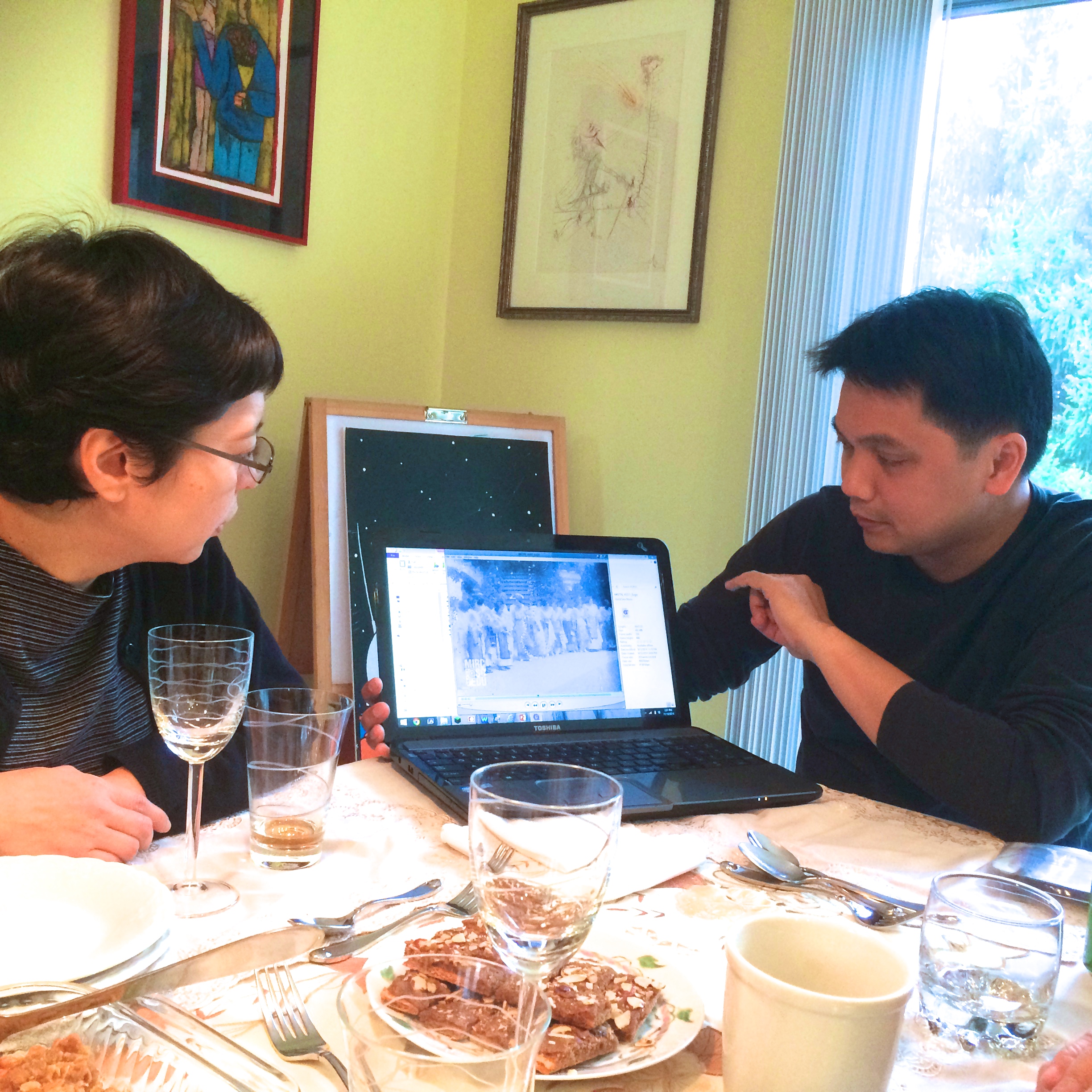
Better than just poking around the website, the Tiongsons invited us to lunch and show-and-tell, and I couldn’t wait. Learning of my current affiliation with the George Washington University, Erwin had pointed me to an article written by CPR’s granddaughter Liana relating how Romulo had coached a debating team from the University of the Philippines in an engagement with the GWU team, over this issue: “Resolved, That the Philippine Islands should be granted immediate and complete independence.” The debate took place on April 18, 1928 at GWU’s Corcoran Hall. “UP won,” said Erwin. “It was the team’s fifth victory, after defeating Stanford, California, Utah, and Colorado. The team would go on to defeat all their other opponents—a total of 14 universities, if I remember correctly.”

Tiongsons

Even more interesting were the personal stories that Erwin and Titchie shared with us (after a sumptuous lunch of home-made corned beef and baked salmon, which all by itself was well worth the Sunday visit). I can’t go too deeply into the details now, but Beng and I were thrilled to share Erwin’s elation over his most recent discovery, a book that had been inscribed by Maximo Kalaw, MLQ’s private secretary, to a “Nina Thomas”—who turned out to be the American lawyer the young Quezon had been engaged to (he broke off the engagement after being advised that marrying an American was political suicide). Erwin made contact with Nina’s heirs in Virginia; she never married, but she passed on Quezon’s monogrammed walking stick and their engagement ring to her niece.

Erwin also showed us a movie poster from 1946 of Anna and the King of Siam, featuring Rex Harrison, Irene Dunne, and a little-known actress named “Chabing”—who turned out to be Isabel Rosario “Dimples” Cooper, Douglas MacArthur’s girlfriend (not mistress) between marriages; after MacArthur left her, she resumed her film career (she was notable for having recorded the first on-screen kiss in Philippine movies in 1926), assuming the single name “Chabing,” whose filmography you can look up on IMdb.

It was also a treat to listen to a radio recording of Jose Garcia Villa, made in the 1950s, of him reading his “Lyric 17” (1942) which famously begins with “First, a poem must be magical….” Most moving was the 20-minute documentary of President Quezon’s funeral—directed by no less than the renowned director John Ford—that Erwin had magically retrieved from somewhere in the many university libraries, archives, and museums that he still haunts in search of fugitive Filipiniana. He has begun a collection of war correspondence from the early 1900s and the Second World War; one 1902 letter poignantly retained a swatch of jusi, which the wife of an American official in Iloilo wanted her folks to see.

We could have stayed there the whole day, reveling in our memories of the grand old men of Philippine letters—NVM Gonzalez, Ben Santos, Nick Joaquin, Manuel Viray; I shared my own little adventures in cultural retrieval. But Beng and I had sadly had to trundle out again into the autumn chill, warmed by our imaginations, and in my ears rang a line from Viray’s poem about his old house in Washington, on Cathedral Avenue, which the Tiongsons had also located: “A streak of light aslant / On the screen door creeps up the line of dusty books.”


Penman No. 117: The Way We Were

IMG_4726Penman for Monday, October 6, 2014


I’D LIKE to thank the people who’ve given me their time and accorded me their hospitality during my current visit to the US. I’m here to do more research for a book project—an oral history of the First Quarter Storm (the story of my generation, in other words)—and so far I’ve had wonderfully productive interview sessions with some people who were either active participants in the anti-martial law movement or were on the other side of things (or simply on the roadside) at the time.

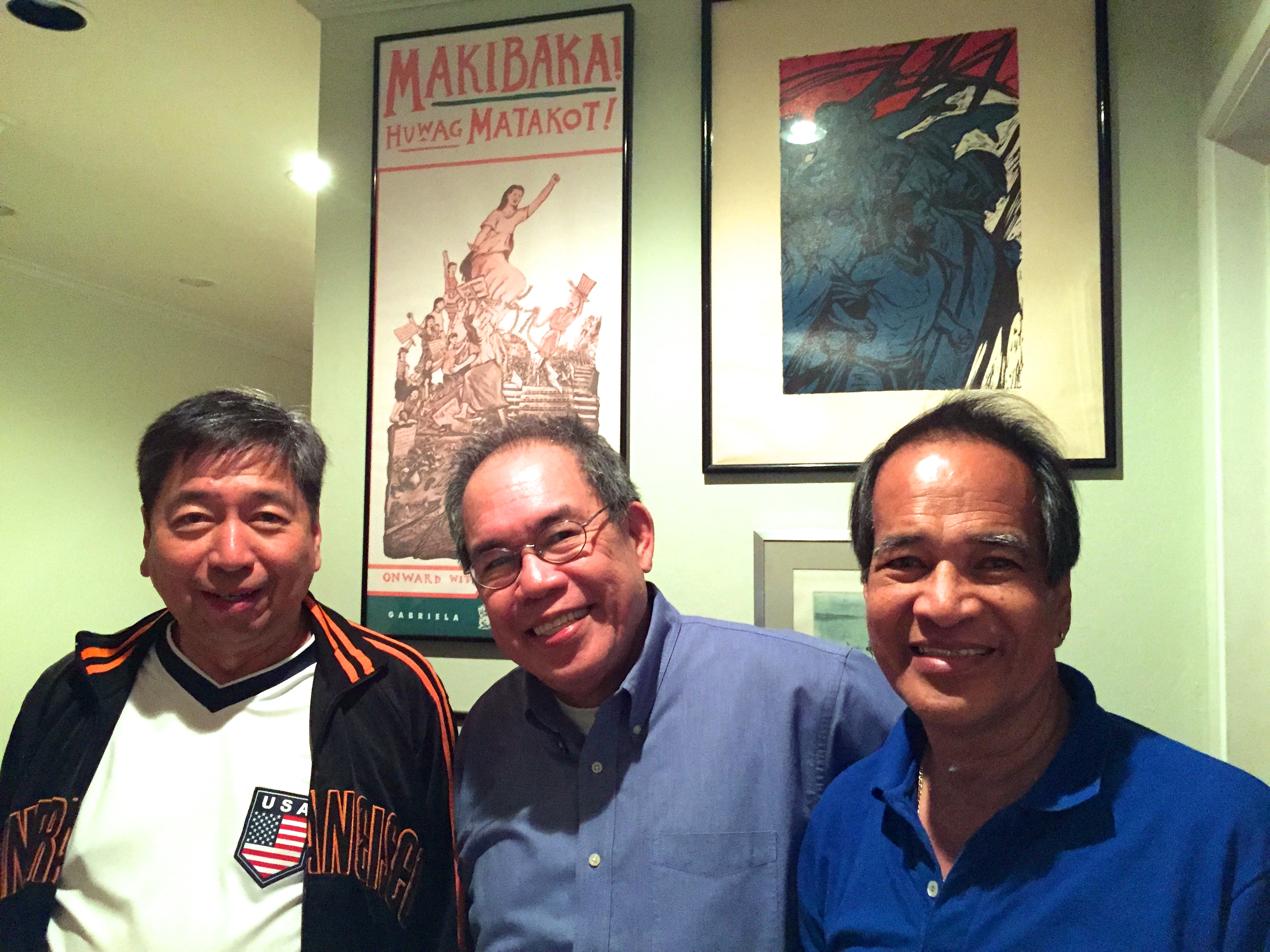
Those who’ve helped me out, either as interview subjects or facilitators, include former campus journalist and retired engineer Gerry Socco and his wife Chet; lawyer Rodel Rodis; editor Rene Ciria-Cruz; tech journalist and developer Joey Arcellana; and journalist Gemma Nemenzo and her husband, Col. Irwin Ver. All of them are conveniently based in the San Francisco Bay Area, so Beng and I flew out there from DC for a long weekend of interviews and reunions with old friends.

Rodel and I go back all the way to the Philippine Science High School, where I served as Rodel’s associate editor when he helmed The Science Scholar. It was also in high school—when I myself became editor in chief—that I first heard of Joey Arcellana from our adviser, Mrs. Agnes Banzon Vea (mother of the accomplished Doy and Rey Vea), who told me one day: “There are two young writers I’d like you to read. One of them writes for the UP Collegian, and his name is Joey Arcellana. The other is still in high school and writes for the Highlights, and his name is Gary Olivar.” Gemma, who now edits the ezine Positively Filipino, also edited the late, lamented Filipinas magazine, which I used to write a column for. Gerry I knew from the pre-martial law College Editors Guild of the Philippines, and we met again in the worst of possible circumstances—as fellow political prisoners in Bicutan; today, in our sixties, we share an unabashedly bourgeois passion for collecting vintage pens and watches.

In Washington, DC, where I’m formally based through my association with the George Washington University, I’ve been lucky to meet and to interview one of the torchbearers of the anti-Marcos resistance on the East Coast, Jon Melegrito, a retired librarian at GWU who now writes for the DC-based fortnightly Manila Mail. I’ve also been glad to gain the insights of three former State Department officials: former Ambassador John Maisto, who headed the old Office of Philippine Affairs and served in Manila in the late 1970s; his colleague Hank Hendrickson who now serves as executive director of the US-Philippines Society, of which Amb. Maisto is the president; and Santiago “Sonny” Busa, a Filipino-American who has served as consul in Manila, Addis Ababa, and Kuwait, and who has taught International Affairs at West Point. I’ll be doing a bit more traveling to see people in New York and possibly the Midwest.

So far, I’ve interviewed about 30 people for the book, which I’ve begun to write at my sister’s place in Virginia. It’s very strange in a way to write about bloody encounters in coconut groves in the Philippine South while reveling in the sight, outside my window, of bluejays and robins perched on the branches of trees just beginning to acquire an autumnal glow. But perhaps it’s precisely this physical and psychological estrangement that I need to handle such an emotional project—emotional, at least, for members of my generation.

Sometimes what I hear gets a bit too much; for the first time, after having written and published over 25 books with a very dry eye, I wept as I listened to an account of someone I knew shooting—executing—someone who had been her best friend. At the same time, events that might have been terrifyingly life-threatening 40 years ago can now sound absolutely hilarious—or deadpan ironic, such as when firebrand Fluellen Ortigas, selected as one of the Ten Outstanding Students of 1968, stands beside President Marcos at the awarding ceremonies, with a book titled The Essentials of Marxism in hand. “Join my staff,” Marcos tells him. “I can’t,” Ortigas replies. “You’re going to be a dictator!” Ortigas would later work for Ninoy Aquino, go underground in Panay, get arrested before martial law, get released in 1976, flee to the US via Sabah, get an MBA, and become a businessman in San Francisco.

I have many more stories like Flue’s to tell, each with its own highlights and insights—Elso Cabangon being ambushed on Taft Avenue and taking four bullets, one of them tearing through his cheek; Boy Camara auditioning for the role of Judas before eventually playing Jesus Christ, Superstar; a female comrade being married in the rites of the Party, one hand on her heart, and the other on Mao’s Quotations (it’s a marriage, like many in the movement, that will unravel). But they’ll have to wait until the book itself, which I hope to finish by early next year.

Even now, many old friends and comrades are probably wondering why I haven’t approached them yet or asked so-and-so to be interviewed, because they have interesting and important stories to tell. I’m sure they do, and I have to extend them my apologies in advance, simply because I just don’t have the time or space at the moment to include everything and everyone I should be covering. I’m almost certain that this oral history will lead to a sequel, all the way to EDSA (a book that someone else should begin writing soon). Some people I’ve asked haven’t replied or have declined, and I can only respect their implied wish to be left alone.

Again, this book will be about the past, and while we might bemoan the innocence we lost, or even wax romantic about the way we were, I don’t think too many of my respondents will want to relive their lives in exactly the same way, knowing what they do now. We might not regret what we did—it arguably needed to be done—but we or our children don’t have to repeat it, if it can be helped. That’s how history helps the future.

Penman No. 107: Small Loans for Big Dreams

WS-Butch-1Penman for Monday, July 28, 2014


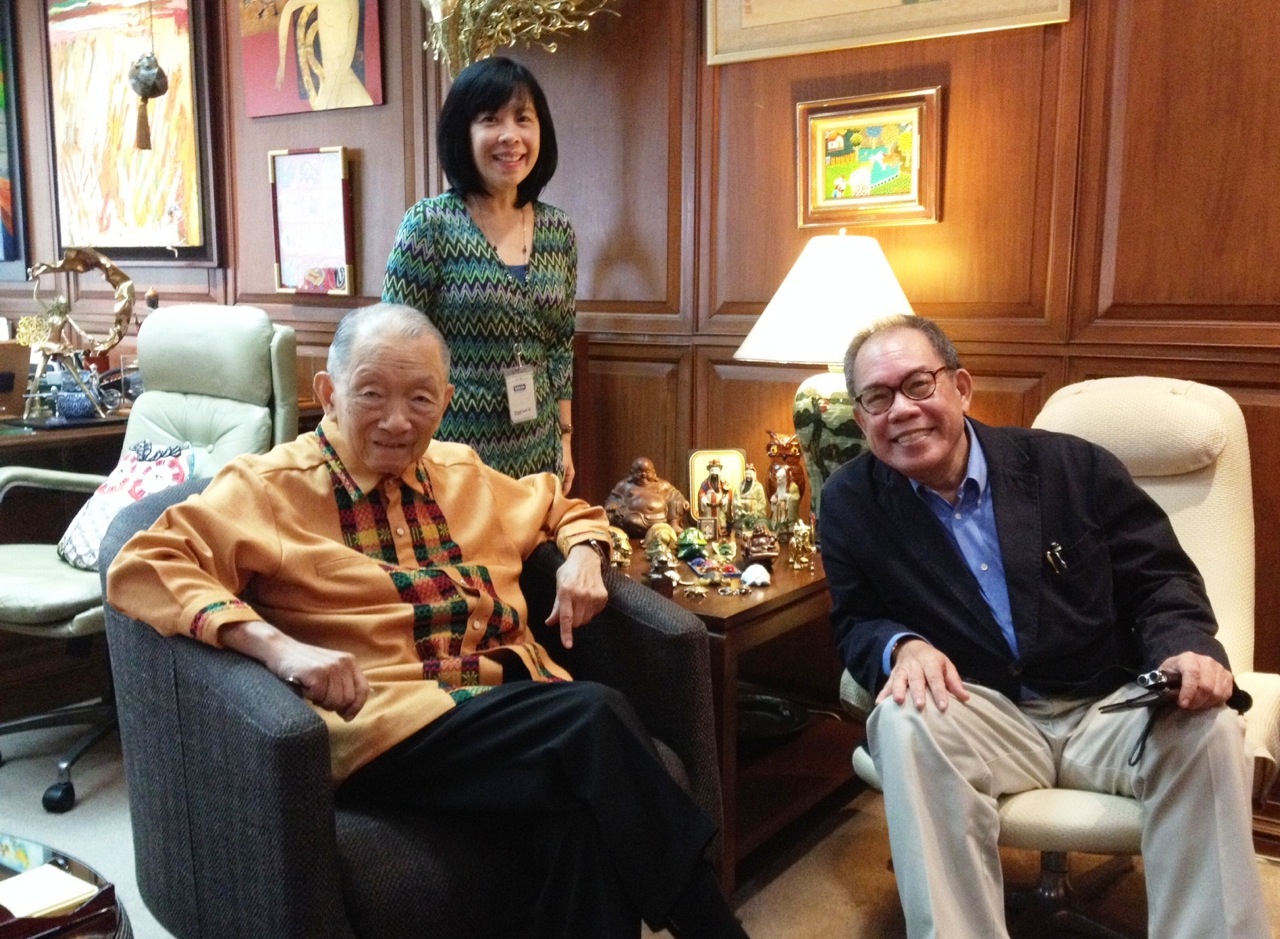
IT HAD been a few years since I last sat down for a chat with the accounting and business guru Washington SyCip, whose biography (Wash: Only a Bookkeeper, published in 2009) I had been privileged to write, so I was only too happy to oblige when our mutual friend Marlu Balmaceda asked if I could spend some time last week to shoot the breeze with Wash.

Both Wash and I had aged a bit since we started working on his book back in 2006—I more so than he, who last month turned 93. Having just gotten my senior card in January, I’ve been feeling entitled to some relaxation, but Wash SyCip was right at his desk in his old 14th floor office where I last saw him, working away, surrounded by a growing menagerie of owls, turtles, and roosters, the gifts of friends. On the wall was a Chinese painting of a dignitary, perhaps the Emperor himself, seeking the counsel of a wizened turtle. Wash caught me looking at it and told me what the turtle’s sage advice was: “Take it easy.”

As cool and dapper as he is, Wash makes it look like he’s taken it easy all his life, but I know for a fact—having chronicled that life—that it just isn’t so. No slouch could’ve put up and sustained what became the regional accounting giant SGV.

But this time, Wash wasn’t talking about himself, but about a new program for education that he and a friend began three years ago, called the Zero Dropout Education Scheme, which seeks to put and keep poor Filipino kids in school. “The country’s biggest problem remains poverty and the wide gap between the rich and the poor,” Wash says. “For me, education is key to alleviating poverty, but ironically, the poorer you are, the more children you have, so half go to school and half don’t. Those who don’t will stay illiterate, and will be resigned to poverty all their lives.”

Seeing that illiteracy still afflicted millions of Filipinos, Wash resolved to do something about it and committed US$1 million of his own money to a fund aimed at the problem. Helping him along was his friend, the Armenian-American businessman and philanthropist Paul Kazarian, who pledged to match Wash’s contribution dollar for dollar. But even with that funding, Wash was modest and realistic enough to know that he couldn’t do the job by himself. “I don’t really know the poor, and how best to reach them,” he admits. “So I got in touch with CARD-MRI, which has been a leader in Philippine microfinance, to help us out.” Radiowealth Finance Corporation has also geared its CSR program toward the Zero Dropout scheme, and committed to provide P30 million.

The Center for Agriculture and Development-Mutually Reinforcing Institutions or CARD-MRI goes all the way back to 1986 when Dr. Jaime Aristotle Alip and 14 other rural development practitioners got together to set up CARD specifically to help empower women in poor communities. In 2008, it received the Ramon Magsaysay Award for Public Service. “With over 1,400 units all over the country, CARD had a network in place we could tap for our program,” Wash says.

Initially available to CARD members, the Zero Dropout scheme offers small renewable loans ranging from P1,500 to P3,000, at a monthly interest rate of 1 percent. “Basic education may be free,” Wash acknowledges. “But families still need money for school supplies, slippers, clothes, and other expenses. That’s where we come in. We’d like to provide not just the money, but an easy way of getting it, with as little red tape as possible.”

As of March this year, the program had supported over 46,000 students through loans totaling over P160 million, out of which P130 million in principal and P6.5 million in interest has already been paid back. They expect to hit 100,000 beneficiaries by year’s end.

While most beneficiaries come from Region IV-A (the Calabarzon area), the program has expanded to the ARMM in Mindanao, where the dropout rates are the highest. Typical beneficiaries include Lucena native Lilia Fernandez, a mother of nine who works as a manicurist alongside her husband, a construction worker; her son Erick dreams of becoming an engineer.

Unlike the government’s conditional cash transfer program, which gives cash direct to poor beneficiaries, Zero Dropout is a loan program. “They repay the loan through microfinance, by increasing their income with a loan for a store, a tricycle, and so on,” adds Wash.

If you think poor borrowers can’t or won’t repay their loans, think again. CARD has made a name for itself making sure its system works, basically because it’s led by people from the very grassroots it serves. Wash tells this story: “I had CARD’s management people over for dinner at my house once, and discovered that none of them were from Makati or Manila. They were all from the rural areas, and they were mostly women, very bright women. I was very impressed with their dedication. CARD knows its clientele. It works with groups of 20 women who guarantee each other. I’ve attended meetings with these groups and I can see that our poor communities are full of people with initiative and drive.”

I came away most impressed by an incident that Wash related: “When Yolanda hit, 8,000 students under the program were affected in Leyte and other places. My first reaction was to cancel their loans, as the least we could do to help. But Dr. Alip said, Wash, no—the poor are more honest than the rich. And as reconstruction took off, the loans also began to be repaid, even if the borrowers had lost their homes.” If that’s not inspiring—in the context of billions lost to crooks and scammers—I don’t know what is.

Penman No. 106: Penguins and Paranoia

Tango_Makes_3Penman for Monday, July 21, 2014


LAST WEEK, I wrote a piece extolling the emergence of dissident themes and voices in Singaporean literature, particularly in the novel The River’s Song by Suchen Christine Lim, who reminded us how much of that city-state’s wealth and power grew on the back of its underclass. I’m sure that there are many voices harsher and more strident than Suchen’s among Singapore’s younger writers, which is good. We’ve long expected this kind of literary insurgency to happen, as it is almost invariably the writers of any nation who form the spearpoint of social protest.

As I said last week, many Filipinos—whether mistakenly or not—take Singapore’s enviable prosperity as the result of a pact with the devil of authoritarianism, a compromise between getting fed well and shutting up. So we’re glad to see Singaporean society loosening up and speaking out, and to meet the humans behind the industrial facade. Surely, we’d like to think, Singapore’s economic ascendancy and its emphatic claim to full modernization deserve to be crowned by a more liberal, compassionate, and inclusive democracy. A rich nation should be able to afford more, not less, freedom.

Or so we thought. Very recently, Singapore’s government delivered another rude reminder of how deep in the dark cavern of the feudal mind its ministers remain, even as their citizens have begun to step out into the sunlight.

At issue was the decision of the National Library Board—supported by the Information Minister—to remove three children’s books from the shelves and to destroy all remaining copies, out of fear that the books, because of their unusual content, would condone and promote homosexual behavior. (Singapore still has a law criminalizing sex between men, punishable by up to two years’ imprisonment.)

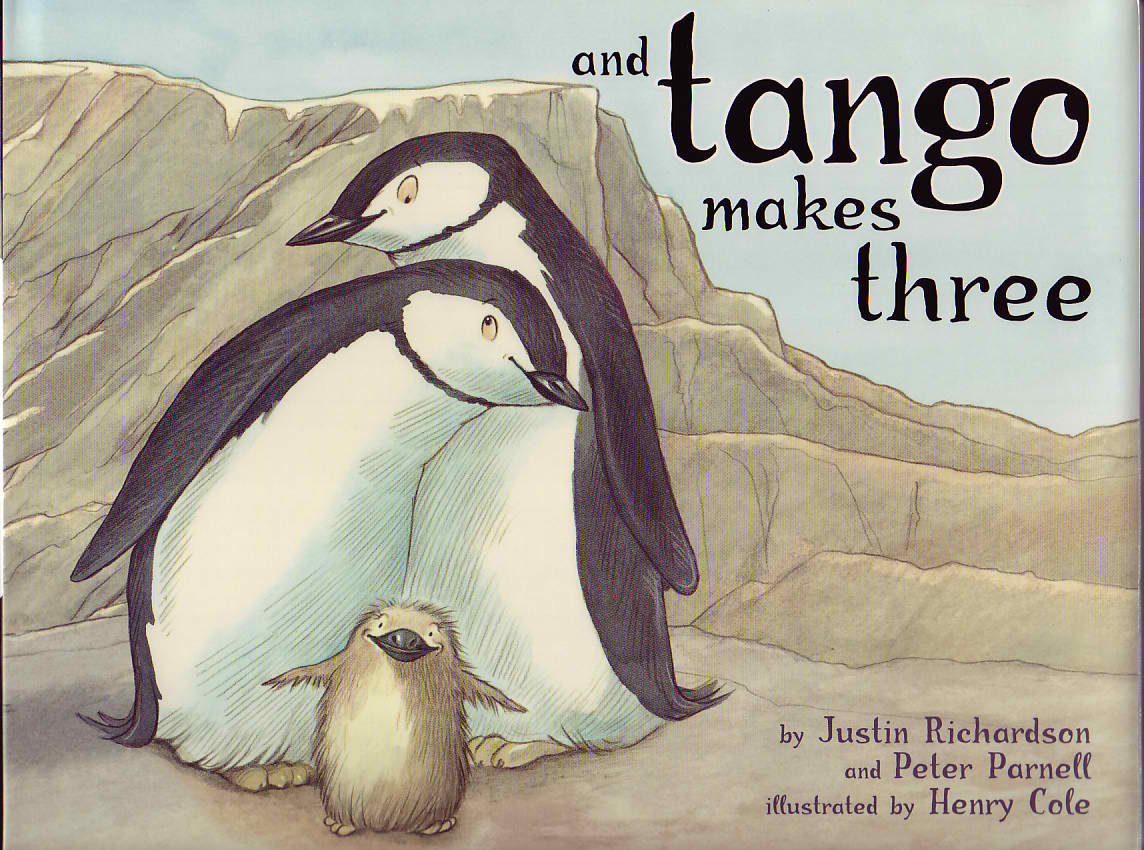
Reports say that the banned books include “And Tango Makes Three,” based on a true story about two male penguins that raised a baby penguin in a New York zoo. In “The White Swan Express,” children are adopted by straight, gay, mixed-race, and single parents. The third book, “Who’s In My Family,” includes gay couples among different types of families. Because a conservative parent complained about these books, an internal review was undertaken by the NLB, which then deemed them unsuitable and subject to removal and destruction.

Not surprisingly, Singapore’s writers, artists, and academics—the liberal types every authoritarian regime fears and detests—are up in arms over the decision. Three prominent judges have resigned from the board of the biennial Singapore Literature Prize, and writers’ and gay organizations all over the world have denounced both the homophobia and the Hitlerite evocation of bookburning that the NLB action embodies. They point out, fairly enough, that conservatives who disagree with the books have a choice not to read them, but that others should have the option and opportunity to read them should they want to.

One of the strongest voices raised against the NLB was that of Suchen Lim, who last Thursday keynoted the Asia Pacific Writers and Translators Conference at Singapore’s Arts House. (I should’ve been there, but thanks to Typhoon Glenda, my flight was canceled and I couldn’t rebook myself in time to catch my two events, so I decided to stay home and mend our typhoon-battered roof.) The Singapore Straits Times would report on Suchen’s impassioned attack on the NLB thus:

“Lim, 65, was a single parent to her two sons and was also brought up in a single parent family for a time before her mother remarried. She said the removal of these books was a disappointment.

“’In removing and pulping those books on various family structures, the National Library Board is telling these children that they and their families don’t count. In removing these books, NLB is reducing such children and their families into invisibility,’ she said.

“The audience in the Chamber of the former Parliament House stood and applauded her words, including Hong Kong writer Nury Vittachi and Singapore writers Verena Tay and Josephine Chia. Also present was writer Felix Cheong, who along with fellow authors Gwee Li Sui, Adrian Tan and Prem Anand, withdrew from an NLB panel discussion last week, to protest against the withdrawal of the picture books.

“Cheong, 49, wore a brand-new T-shirt decorated with three penguins, a logo which has been adopted by those against NLB’s removal of the books.”

Had I been there, I would’ve stood up myself and cheered Suchen on, even at the risk of being blacklisted and turned away the next time I present myself at Changi’s immigration line. The fight against prejudice and censorship knows no national boundaries, which is why I’m writing up this issue for Filipino readers who couldn’t care less about Singapore and gay penguins.

In truth, I’m a fairly frequent visitor to Singapore and have been the appreciative guest of both its government and of my fellow writers there. A couple of years ago, its tourism ministry took me, among other journalists, on a tour of Singapore’s cultural landmarks, including the National Library, and we were suitably impressed. I wrote glowing reports about Singapore’s emergence as a new cultural hotspot in Asia. Why not? The view from The Hub—a glass bubble at the top of the library—was breathtaking, and I was moved by a special exhibit their ultramodern library had of their prominent writers’ memorabilia. When, I thought, would we come around to making these investments in books and culture in the Philippines?

But as I noted last week, there are always two sides to Singapore, and this book-banning incident reminded me of (for us Filipinos) a much sadder story from almost 20 years ago, when Filipino domestic helper Flor Contemplacion, convicted of murder, was about to be hanged in Singapore’s Changi prison. As the editorial writer then of the now-defunct Today newspaper, on the eve of Flor’s execution, I looked helplessly at this painful spectacle and remarked:

“Something went terribly wrong with Flor’s dream—whether through her fault or someone else’s, as now seems highly plausible, only God for the moment knows for certain. Two people died, allegedly by Flor’s maddened hand, and that was tragic enough. Today, Flor Contemplacion will die in turn in judicial payment for those lives—and that, too, will cause untold sorrow, especially among her people who have rallied to her defense.

“But almost as saddening, perplexing, and infuriating as these losses is today’s freshest reminder of savagery in what had been held up, for all the world to see, as the very model of civilized society and behavior in our time. And this was hardly the savagery of individuals gone amuck, but the institutional primitivism of a government which, for all its claims to modernity and discipline, has finally revealed nothing but its simian brain and tom-tom heart. Flor’s execution will be a quick and convenient end; any further complications, by way of entertaining an appeal for a stay and a reinvestigation, would have strained the brutish simplemindedness of Singaporean justice.”

They were harsh words for a harsh situation, and even as I subsequently accepted and enjoyed, with not a little guilt, Singapore’s official hospitality, hoping that things had changed, I never quite lost the suspicion that beneath the First-World ease was a hair-trigger reflex that could be set off by any perceived threat to stability and security.

A government that fears that the carefully constructed and presumably robust society it has built can be unraveled by the affection between two male penguins is exhibiting not just ignorance but paranoia. One has to wonder of what use it is to tout such 21st-century marvels as the Marina Bay Sands—and, yes, a state-of-the-art National Library—when the consciousness that directs the place is stuck somewhere in the 16th century.

But before we Filipinos beat our chests and congratulate ourselves over how much more open we are to such modern concepts as tolerance and acceptance, let’s not forget that our own public officials share something with their Singaporean counterparts. When our President denied the accomplished actress but alleged drug user Nora Aunor the National Artist Award for fear that honoring her would encourage Filipinos to run out for their nearest dose of shabu, it showed that governments everywhere don’t have the foggiest idea of how art and artists work. But they do know that art works—much more effectively than government PR—and in that knowledge, perhaps, lies the source of their fear and disquietude.

Penman No. 103: Too Much Drama

Penman for Monday, June 30, 2014

IN MY other life as a dramatist, which came to an end some years ago, I wrote about a dozen plays for the stage and more than twice as many television plays and screenplays, mostly for the late Lino Brocka. Lino and I happily turned out double-hanky tearjerkers with such rousingly commercial titles (which someone presumably from the marketing department thought up) as Kailan Mahuhugasan ang Kasalanan, Ano ang Kulay ng Mukha ng Diyos, Maging Akin Ka Lamang, Miguelito, ang Batang Rebelde, and my very first one, back in 1977, Tahan Na, Empoy, Tahan.

I may have stopped writing drama to focus on fiction and nonfiction, but now and then the old skills get a workout. I’ve always said that there’s no better training for a writer of fiction than to have been a playwright, because playwriting teaches dramatic economy—how to set up a scene, how to get the most out of your characters, how to use dialogue effectively (meaning, at its most complex, how to get your characters to say things they don’t mean, or to mean things they can’t say).

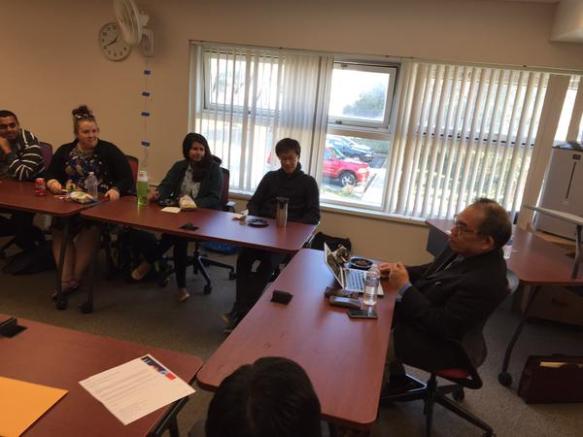
Last week, I said as much again to a group of writers and program analysts from a TV network who wanted to see how writers think. I told them that drama’s to be found not only in filmscripts or on the set—it’s all around us, taking place quietly in some fastfood joint or some bus stop or some hospital ward; the writer’s task is to see that drama, to palpate it from the tedium of everyday life, and to sharpen and brighten its edges so others can see the extraordinary in otherwise ordinary moments.

We’ll save the rest of the drama lesson for another day; I bring this up only to establish my bona fides when it comes to talking about drama, and about my thesis today, which is that—even for a writer of melodrama, for which I make no excuses—there seems to be entirely too much drama around us these days, or theater if you will. (There’s a subtle difference, if you think of drama as the situation and of theater as its enactment on some kind of stage.)

Case in point: I’m sure I’m not the only one who’s sick not only of Senator Bong Revilla’s whinings about the heat in his room at the “custodial center” (it’s not even a real prison, for Pete’s sake), but also of how the media has fussed over it like it was a real news story (“Can Congresswoman Lani make it back from Greenhills in 15 minutes with the air cooler? That’s all the time she has before visiting hours end!” said one radio reporter breathlessly.) My totally un-PC prescription? Give him the fan, give him whatever creature comfort he wants, but reduce his cell to about a third of its size and keep that one window, from which I hope he sees a mall, or something with lots of people and traffic in it. There’s no better reminder of what prison means than limited space and movement, no matter what you may have with you. (I remember watching a Marlboro neon sign blink at me on the far side of martial law prison, back in 1973; that was torture.)

Senator Jinggoy Estrada’s departure for the custodial center was only slightly less theatrical, thanks again to the media who couldn’t get enough of the father-and-son story being played out in all of its bitter if obvious irony. Of course we expected the family to bond around Jinggoy, and for tears to be shed; that’s any family’s natural privilege, and its natural response. Indeed what underwhelmed me, from my dramatist’s standpoint, was how predictable everything was from start to finish, especially the inevitable “Mayor Erap, ano’ng nararamdaman ninyo sa pagkakakulong ng inyong anak?” I wanted to scream, “E ano pa?”

I can just see the video highlights from these staged “surrenders” figuring in these politicos’ next campaigns: the prayers in church, the mug shots, the hugs and waves from distraught spouses, parents, and kids; the cell doors closing, as the music goes up and under, before we hear a murmured voice-over: “May bukas pa….”

Case in point Number 2: Sometimes silence is drama; when your wife refuses to explain why she doesn’t want to talk to you, that’s drama. When the Palace refuses to explain why it dropped Nora Aunor from the list of National Artist awardees, that’s drama. All President Noynoy’s spokesmen could say was “It’s the President’s prerogative….”, which is exactly what we heard from President Gloria’s spokesmen a few years ago, the only difference being that she made dagdag, while Noynoy made bawas. I did read something about Nora’s exclusion being “in the national interest,” but it boggles the mind to figure out exactly what that means. I can understand defending the Spratlys and Scarborough Shoal as being “in the national interest”; I can even understand rooting for Manny Pacquiao on fight day—temporarily setting all his other quirks and antics aside—as being “in the national interest.” But dropping Nora?

As I wrote in this corner a few months ago, I was on a large, multidisciplinary, second-level committee that endorsed Nora Aunor to a higher body (the NCCA and CCP Boards plus the National Artists); we endorsed Dolphy as well, and if I remember right, he and Nora got the same highest votes across the board. Granted that our recommendations were just that and subject to final approval upstairs, I feel among many others in the arts that we at least deserve a full and cogent explanation for all these pluses and minuses that take place in Malacañang. The Palace—and I don’t mean just the present occupant—has never been known to be a bulwark of artistic support and sensibility, if you look at funding for the arts in relation to everything else; if it never cared for or about the arts, why should it suddenly care—negatively at that—about Nora Aunor, whom the arts community clearly feels is deserving of its highest accolade? If you can’t help, at least don’t get in the way.

I’d been told by some Palace contacts that questions came up about Nora’s alleged drug use. OK, I said, it’s fair enough to raise these questions which presumably involve moral turpitude. But since when has it been fair to use morality as a standard for artistic excellence? We’ve had National Artists whose personal lives were hardly spotless, but whose art precisely may have been deepened and enriched by those encounters with their darker side. (Conversely, we’ve had National Artists who may present themselves as moral exemplars and accuse everyone else of some fatal shortcoming, but whose work is unremittingly mediocre and soporific.) Edgar Allan Poe, Salvador Dali, Jean-Michel Basquiat, and Miles Davis, among many others, would never qualify for state honors in their countries (not that they ever cared) if our Malacañang’s standards were employed.

Last case in point: I wholeheartedly agreed with the NCCA when it protested the Palace snub of Ms. Aunor, but also wholeheartedly disagreed with the NCCA when it reportedly protested allowing the use of our national heroes’ names for such popular products as beer. (Think “Cerveza Rizal” or “Mabini Beer.”) The reason given by objectors was that it would be a sign of disrespect for these heroes to associate something as morally undesirable as alcohol with them.

Really? Which planet are we on? Didn’t our heroes drink beer and stiffer forms of alcohol—in spite (or dare I say because) of which they performed heroic deeds, anyway? Rizal complained that his fellow ilustrados in Spain drank and womanized too much, but that hardly meant that he was completely abstemious in either department. He didn’t care much for hard liquor, but drank beer (like me, on whom single malt would be a total waste). George Washington was a beer guy as well, and even famously left a handwritten recipe for his own brew (later marketed in an “Ales of the Revolution” line). So will the moral police please lighten up? If Nora’s good enough to be a National Artist, then Jose Rizal should be good enough to go on a beer bottle, and I’ll hoist many a cold Rizal in his own honor.

Heroes aren’t heroes because they’re perfect human beings; they’re heroes because—despite some truly terrible character flaws and peccadilloes (one of them even shot his wife, remember?)—they left something indelible to the national spirit and imagination, enough for us to think of ourselves as a nation. Heroes and National Artists (the real ones and the best ones) can do that; politicians—whether in prison or in the Palace—can’t.

Penman No. 94: Poverty in Fiction

Penman for Monday, April 28, 2014

ONE OF the liveliest discussions we had at the recent UP National Writers Workshop in Baguio had to do with one of the oldest and yet still most current issues in writing—the depiction of poverty in fiction. A pocket debate arose over a workshop fellow’s short story, the protagonist of which was a 13-year-old boy, poor but streetsmart, who runs into some bad luck but, by the end of the story, is hit by a brain wave and dreams of opening a sawsawan, a kind of food stall, near the tricycle stand he works from.

It was an upbeat ending, an uptick to an otherwise beleaguered existence, but it provoked an unexpected reaction from some members of the workshop—fellows and panelists alike—who felt that the story offered false hopes, given that it was highly unlikely that a sawsawan would provide a real solution to the systemic problem of poverty in this country.

Of course, it’s typical of a UP workshop to get a response like that, and while I didn’t agree with that reading, I was rather glad about the fact that we had people on board who could look at writing and literature for more than felicity of language and agreeability of character and dramatic situation. Sharp-eyed and well-schooled critics these days can take a very long step backward and see things in stories that you or even the author never thought were there—buried or even unintended messages, hidden desires, the author’s own confused and febrile imaginings, latent ideologies. Authors in workshops—especially new ones—will sometimes cry foul at these readings or misreadings, protesting that they never intended their work to be taken that way.

The bad news for authors is that, in today’s critical environment—especially in academia—it’s all fair game; whatever you write can be interpreted in any which way by anyone, and the author’s intentions are often lost by the wayside, seemingly the least important factor to consider in appreciating the story. (In this sense, a writers’ workshop may be the only place where these intentions are given primacy—we try to find out what you really want to do or say with your piece, and then try to help you achieve that purpose.) But it’s not all necessarily bad, as even hostile criticism can be insightful and helpful in the long run to the writer intent on improving his or her craft and vision.

So we should understand when a keenly political critic looks at a story and says that it may be nicely written, but it’s essentially peddling a romantic confection by suggesting that something short of a revolution can banish mass poverty. (Here I may be overstating the specific comments made about that workshop story, but I’m pushing the argument to the extreme for greater clarity’s sake.)

We all agreed that no one does the poor a favor by romanticizing their plight and putting a halo above their heads (instead of saying “their” I should probably say “our,” because most of us are poor compared to the few same people we keep reading about in the glossies). The poor can be as vicious as they can be virtuous; desperation and desire can drive people to outrageously evil acts, and the very poor and the very rich—and the seemingly normal middle class between them—can be perfectly capable of it.

To be honest, my fiction actually deals more with the predicaments of the Filipino middle class, which for me remains the most fascinating source of characters because it’s also the most vulnerable. In a sense, the poor have nothing to lose, and the rich will always find a way to survive; but we, the middle class, entertain the most fervid and the most elaborate ambitions—we know exactly which brands and models to buy, all their technical specifications, sometimes even more so than the wealthy; we just don’t have the wherewithal. Hovering between plenitude and penury, we are one windfall away from a new house in the suburbs, and also one catastrophic illness away from utter destitution.

But I’ve written about the poor and the oppressed in my own fiction often enough (that cranky fellow who keeps implying that I’m some snooty señorito who never stepped on carabao pie and who writes workshop-processed fluff obviously hasn’t read my work). I’d call myself middle-class, but growing up and well into adulthood, we hit rock bottom many times; you all know the sob story, so I don’t need to go there again to vet my poor-boy cred.

What I always say and think about the poor is this: the poor are about more than their poverty. Poverty is awful and dehumanizing, but it’s what people do and how they act at a given disadvantage that I find interesting and even inspiring as a person and as an author, not the overwhelming odds themselves. I’ll leave the objective analysis of poverty to the social scientists and its alleviation to the activists; my job as a fictionist is to see and employ it as another means to understand why we do the things we do. Even poverty needs to be defamiliarized, and especially so, because we think we already know it, when we might not; one exercise I’ve given my writing students is to write a scene or a story about poverty without employing the usual clichés of the sampaguita flower-seller or the shanty in Payatas.

Getting back to the Baguio workshop, I took up the cudgels for the story, reasoning that I didn’t think the author intended for us to believe that the protagonist’s dream of becoming an entrepreneur would necessarily materialize and change his and his family’s life. Indeed the odds seemed stacked against him, and the objective if sad likelihood was that he would falter and fail. What grabbed me about the story was not the dark futility of hope, but the poignancy and the audacity (as Obama would have put it) of even hoping. At that particular moment, this boy thought he saw something better he could do and become—a “bossing,” as he described himself.

As I’ve said, the chances can’t look too good that this boy (nicknamed “Kadyot”) would become the next Manny Pangilinan. But this is where fiction and literature diverge from the social sciences. Fiction isn’t about certainties and probabilities—if anything, the best fiction doesn’t just tell you what you already know, but challenges what you think you know, and even makes the improbable reasonable if not inevitable.

I’ll even up the ante here, and ask why we should take it as an article of faith that this dreaming boy will fail, and that society can’t be changed one person, one family, and one community at a time. We don’t stop hoping or dreaming as individuals because systemic problems demand systemic solutions. The records of banks, cooperatives, and NGOs are full of these stories of lives transformed because one poor guy, maybe being a little silly, dared to dream of starting a business or learning a trade.

I suspect that part of our problem as university-based readers is that we have a traditional humanist bias, gained from decades of immersion in revolutionary politics, against the notion of capitalist enterprise. Mining, for example, will always be a villain in Philippine fiction, no matter what social and economic good the industry or particular companies may produce. Call me an unfashionable neoliberal, but I can’t buy into that kind of summary judgment. Anytime we authors employ simplistic social formulas to explain and to move our characters, the fiction loses, leaving us all the poorer.


Penman No. 78: My FQS Project

CEGP Penman for Monday, December 23, 2013

FOR SEVERAL weeks now, some friends from way back—more than 40 years back—have been getting private messages from me, inviting them to take part in what could be an important historical project—important not only to our generation, but more especially to those who have come after us, who know so little about their past.

I’ve just begun what I consider to be my lifelong dream project: The First Quarter Storm: An Oral History. It’s not as if I don’t have enough books to write; at the moment, I’m working on five books in various stages (two nearly done, two halfway through, and this one just started), not to my mention my third novel, which has had to sit on the back burner. I’m no Superman, but I write books for a living, and take on every engagement as a privilege and a responsibility. Still, this one’s a special self-assignment.

After writing biographies and histories for such varied personalities as the Lava brothers, the business icon Washington SyCip, and the former Marcos associate Rudy Cuenca, I felt the time had come for me to do something for my own generation, whose political awakening came about in the late 1960s and early 1970s.

That was one of the most politically charged periods in recent Philippine history, a time many Filipinos my age call the “First Quarter Storm” or FQS, referring to the tumultuous years just before and after the declaration of martial law by President Ferdinand Marcos on September 21, 1972.

Those few months around martial law were both frightening and exhilarating, murderous and ennobling, challenging a generation of young Filipinos to offer themselves up to the altar of revolutionary resistance. The martial law regime would last for 14 years and claim thousands of lives, and cause deep damage to Philippine democratic institutions. By the time a peaceful street revolt restored democracy in 1986, the course of Philippine history and the complexion of that FQS generation had been irreversibly changed.

And yet today, 40 years later, many principals from the martial law regime remain entrenched in power along with pretty much the same ruling elite that prospered under martial law. Despite more democratic space, the same deep-seated problems of poverty and injustice remain. It is as if nothing has been learned—most Filipinos born after 1986 have no inkling of what happened before them—which is not surprising, because a definitive history of martial law and the FQS has yet to be written.

I’d like to help in redressing that amnesia by writing an oral history of the First Quarter Storm, a project that will involve conducting in-depth interviews with many of the surviving principals from that period—from the resistance, the government, the military, the religious, and ordinary citizens—while they are still alive and accessible. My interest in the subject is both personal and professional. As many readers know, I myself was imprisoned for seven months as an 18-year-old student activist in 1973, an experience that became the basis for my first novel, Killing Time in a Warm Place (Anvil Publishing, 1992).

I’ll focus less on the broad sweep of policy than on personal narratives, contextualizing these against particular flash points of the FQS. These personal accounts, I think, will reach deeper into the consciousness of Filipinos today and allow them to grasp the realities and implications of martial law more effectively than an academic paper could.

I’ll be looking for personal stories—including but not limited to or focused on the most harrowing cases of torture and imprisonment (although we’ll certainly have those, unavoidably and necessarily). I’ll be looking for stories of everyday life both aboveground and in the underground; of people preparing for demonstrations and for war, of dealing with separation from family and loved ones, of watching from the sidelines (or even the other side of the barricades), of trying to live an ordinary life amid the chaos, of achieving some kind of balance between the personal and the political. I want stories of courage, of doubt, of heroism, of betrayal, of commitment, of guilt, of loss, of survival. I’ll also be looking for funny, poignant, ironic stories. And then I’ll have an update on everyone interviewed—what they did and what they became after the FQS—for a brief epilogue.

I have no overarching agenda for this book, just an honest recording of people’s memories (as flawed or as self-serving as they may turn out to be), before those participants in and witnesses to history vanish. I don’t mean for this book to be a manifesto or an indictment or any kind of political treatise; I will maintain strict journalistic and scholarly neutrality, endeavoring to gather a multitude and a variety of voices. I will be contextualizing what people say with some factual background, but I will not editorialize or romanticize or make judgmental commentary. Rather than take an obvious stance, I will let the book’s stories speak for themselves, and will leave it to the professional historians and political scientists to use the book as material for their critical evaluations. (In the interest of full disclosure, let me acknowledge a grant from the National Historical Commission of the Philippines, which kindly offered their assistance after hearing about my project, as part of their own project for the documentation of the martial-law period.)

I’ve begun with a small group of people I know, which I expect to enlarge over the next year that I will devote to this project. (So far, they’ve included former SDK and later GMA spokesman Gary Olivar; former UP Vanguard and UPSCAn Ed Maranan; UP activist stalwart Rey Vea; former Makibaka member Sylvia Mesina; Cebu firebrand and now Judge Meinrado Paredes; colegiala-turned-activist Joy Jopson Kintanar; former UP Student Council Chairman and Upsilonian Manny Ortega; and Jesus Christ Superstar and Afterbirth mainstay Boy Camara, among others.) Of course, I’ll remain open to suggestions about whom else to reach out to. I’m particularly interested in stories from the military and the police, as well as from government officials, businessmen and ordinary citizens who may have vivid memories of that period. I’m interviewing people who were active in the Visayas and Mindanao. Sometime next year, on a visit to the US, I will also be interviewing US-based former activists and other principals.

If you think you have an interesting first-person story from that period that you can share with others—whatever your political position was then, or may be now—send me a message at my email at jdalisay@mac.com. (I’m not surprised—I do feel doubly responsible—when some interviewees tell me that “I’m telling you my story so my children will know what really happened and what I did.”) I can’t promise to include everyone’s story in the final manuscript, which will be subject to space and other editorial limitations (I’ll be sending everyone whose story will be included a copy of the text, for their final revisions and approval); but I can promise to be fair, and to render what people tell me as faithfully as possible.

By so doing, I hope that this book can contribute to a deeper understanding of how democracy has been challenged and has survived in the Philippines, and to continuing efforts at national reconciliation, by bringing out the human and more personal aspects of a nation in crisis and a society under stress. This way, it might also provide guideposts for the thinking and behavior of young 21st century Filipinos facing their own choices and challenges as individuals and as citizens. Wish me luck!

Penman No. 72: Martial Law in Three Filipino Novels

KillingPenman for Monday, November 11, 2013 

LATE LAST month, I flew down to Davao for a group organized by the chair of the National Historical Commission of the Philippines, Dr. Maris Diokno, for a roundtable discussion on narratives of martial law. The Martial Law Historical Advisory Committee, created by Administrative Order No. 30, had been tasked to collect, evaluate, and preserve documentary and other materials pertaining to the Philippine martial law experience, and this roundtable was an early but vital stage of that process, a thinking-through of basic assumptions and expectations from participants in and scholars of that period.

I was invited not only because of my activist background and imprisonment under martial law, but because I’ve written a novel and some stories about it, and will write yet more—a nonfiction oral history of the First Quarter Storm, for which I’ve been given a grant by the NHCP. I’ll say more about this project in a forthcoming column, but in the meanwhile, let me share excerpts from a brief think piece that I contributed to the Davao roundtable (which, incidentally, was both insightful and moving, attended by the likes of martial law veterans Joy Jopson Kintanar and Judge Meinrado Paredes, as well as younger scholars and writers Leloy Claudio and Roby Alampay). Here’s what I wrote:

In his review in Philippine Studies of Azucena Grajo Uranza’s Bamboo in the Wind—one of the first and few novels to have dealt with our martial-law experience—Fr. Joseph Galdon quoted another writer, Linda Ty-Casper, who wrote that:

Literature is one way [by which] history, which too often reduces life to dates and events, can animate life so that man is returned to the center of human existence. It is man, after all, not nations, who feels the hunger caused by economic recessions and market fluctuations, who suffers separations and dislocations from social upheavals, who catches the bullets and bombs of war. It is in man’s flesh and bones that the events of history are etched. Individuals die, while their country goes on. It is in literature that generations of images representing man are preserved. It is in literature that we can recover again and again the promise of our resurrection. It is the house of our flesh in which we can refresh, restore and reincarnate ourselves.

I’m beginning with this quotation because I’d like to suggest that, in some ways, the best way to remind Filipinos and to make sense of what happened to them under martial law is through fiction rather than factual narrative, because fiction requires and creates a wholeness of human experience. Young Filipinos, especially, need to see martial law as a story—a continuing story with consequences reaching into their generation and even the next.

Considering that the Marcos era lasted more than 20 years—from his first election in 1965 to his forced departure in 1986—it’s a bit surprising that not too many Filipino novels have been written about Marcos and martial law. (I should immediately qualify this statement by saying that, actually, not too many Filipino novels have been written, period. As a literary form, the novel—whether in English or Filipino—has never been our strong suit, unlike the Indians and the Chinese.) You would expect that martial law, in particular, would have left a thick scar or welt on our literary consciousness and imagination, in the same way that many survivors of martial-law prison were plagued by intense, recurring nightmares long after their incarceration. In fact, however, we have barely dealt with it in our literature, and if our children today know little if anything at all about martial law, it is because we have not written enough about it, and have left the little that we have written out of the curriculum.

Online can be found two very interesting and fairly comprehensive listings and discussions of the literature we have produced on our martial law and martial law-related experience. The first is a lecture delivered by the writer Edgardo Maranan in London’s School of Oriental and African Studies in 1999 and published by the site Our Own Voice in 2007, titled “Against the Dying of the Light: The Filipino Writer and Martial Law.” The second is a reading list compiled by a blogger and bibliophile who calls himself “rise.” Both lists contain and discuss works of fiction, poetry and nonfiction produced during and after martial law, material that now generally falls under the rubric of “protest literature.”

Understandably perhaps, it takes time, will, and bit of distance to process—with the benefit of hindsight and a freer imagination—a traumatic experience like martial law. In my case, it took nearly 20 years after my imprisonment to try and make sense of it in a novel. I’m not even sure, at the end of things, if I succeeded. But it’s important in any case to make the effort—for our creative writers to inscribe their own history of our political and social experience—because the writerly imagination is a powerfully intuitive tool for sense-making. Creative writing is integrative, rather than analytical; it puts things together, rather than taking them apart, as scholarship and criticism tend to do.

Today, I’ll focus on how three novels—I’m immodestly including mine—have represented our martial law experience in its various aspects. At least one of these three novels—two in English and one in Filipino—would be how our students today encounter, if at all, martial law and its causes and effects. The novels I am referring to are Dekada ’70 by Lualhati Bautista, first published in 1988; Bamboo in the Wind by Azucena Grajo Uranza (1990); and Killing Time in a Warm Place by myself (1992).

What the three novels share most strongly is a narrative of how martial law came about and what its immediate effects were. Of the three, Dekada ’70 offers the broadest sweep of things, covering the whole decade as it follows the individual paths that the members of the Bartolome family take. It is also the most unabashedly didactic, presenting long and detailed expositions of the political situation obtaining at that time, an approach that literary aesthetes might find too direct but which, when you think of it, is probably the only explanation young readers will have of an episode that to them might as well be ancient history.

All three novels are basically grounded in the specific experience of the middle class, taking note of its bright-eyed idealism and yet also its vulnerability to vacillation and co-optation. In this respect, Bamboo in the Wind attempts to cover the broadest ground, reaching across the social spectrum to present the plight of peasants under feudal tenancy as well as to display the clannishness of the elite. It ends just after the declaration of martial law, on the portentous note that “It was going to be a long night,” as indeed martial law would be, for the next decade.

My semi-autobiographical first novel Killing Time in a Warm Place is focused on the person and the growth of its narrator, Noel Bulaong, who has provincial roots but grows up in Manila, studies in UP, becomes an activist, is imprisoned under martial law, and then, upon his release, joins the government service as a propagandist no less; faithless, loveless, and friendless, he leaves for the United States to study and live there, coming home only for the death of his father, where the novel begins. Of the three novels, it is the most personal, although Dekada ’70 can also be read as Amanda’s story, the making of a feminist in the crucible of political and personal turmoil.

To my mind, the most important contribution these three novels make to the discourse on martial law is not even and not only their depiction of the horrors and excesses of martial law—the obligatory scenes, you might say, the arrests, the tortures, the rapes, the thievery, the brute exercise of State power over the people. It is their exploration of the element of collusion and complicity—of how we, in a sense, allowed ourselves to be ruled by a regime that promised peace and progress for the price of a little national discipline.

In Dekada ’70, Julian Bartolome Sr. gives the regime every benefit of the doubt, convincing himself of the government’s good intentions, despite Julian Jr.’s deepening involvement in the Left. In Killing Time, Noel Bulaong does a 180-degree turn and joins the dark side—an acrobatic maneuver that many former activists, including me myself, performed, caught in a bipolar world. Having left the Left, it seemed that one had little choice but to cast one’s lot with the Right, and it’s no surprise that many ex-activists became the sharpest thinkers and most active doers of Marcos, Cory Aquino, Ramos, Estrada, and Arroyo. Bamboo in the Wind delves into how martial law benefited the elite, especially those factions that sided with the regime, and how it sought to corrupt intellectuals with progressive inclinations. In other ways, these novels speak of guilt and redemption, of how we are defined by family and class, of abject betrayal and astounding heroism.

These novels are far from perfect, and we can argue all day about what they failed to say and how they may have misrepresented this and that. But writing and promoting works of fiction like them may yet be the best way we can remind our people, especially this “selfie” generation, of the fact of martial law in the Philippines, and of its continuing legacy.

Penman No. 62: A Letter to the Philippines

Penman for Monday, Sept. 2, 2013

I RECEIVED a very interesting message in my mailbox last week from a good friend now based in Singapore, the American writer Robin Hemley, who serves as Director and Writer-in-Residence of the Yale-NUS Writing Program at the National University of Singapore. Robin and I have been to many conferences and workshops together, breaking bread and chugging beer not too long ago in Hong Kong, Michigan and Melbourne.

Just retired from Iowa, Hemley’s one of the world’s foremost experts on creative nonfiction, and a mean writer of fiction himself; I teach one of his stories, a very funny piece titled “Reply All,” in my class. He’s a frequent visitor to Manila—not surprisingly, since his wife Margie is Filipino. But Robin has been more intimately engaged with Philippine culture and society than his family ties would suggest. Fairly recently, he found himself stranded on a remote island in one of the Babuyan Islands while doing research for a novel. That’s my kind of writer—someone who immerses himself in his material to the point of self-endangerment.

Thus being no stranger to risk, Robin didn’t surprise me when he sent me a copy of a letter he had written in the wake of the pork barrel scandal, by which he had been deeply disturbed. It was addressed to no one in particular—he had titled it “A letter to the Philippines”—and Robin asked me what I thought of it, and if it would be worth sharing with others. I read the letter, and immediately wrote Robin to say that I thought it was worth publishing, and that I would be happy to do the honors in this column, with his approval—which came shortly after, with his thanks.

That creative writers and other artists respond to the day’s political issues is something we’ve learned to expect, if not encourage, although our responses more often take the form of our art itself, with its necessary mediations and interpretations. When we respond directly—like Beng and I did in joining the Million People March last Monday—it’s more as citizens than as artists. And that’s actually a relief and a reminder of sorts, that we can act as ordinary people, with ordinary people, away from the pressures of performance.

I decided to publish Robin’s letter to acknowledge his participation, if not his citizenship, in our society. Surely there are many others like him, though few perhaps as articulate, who feel deeply invested in our affairs but who, out of caution or a sense of propriety, have decided to keep quiet. Robin’s letter will also surely upset some Filipino readers who may feel that the pork barrel scam—or whatever wrongdoing takes place here—is none of a foreigner’s business. And that, I think, would be a sad thing, because if evil is universal and cuts across countries and cultures, so should the outrage that it deserves to be met with. Here’s Robin’s letter to us:

I want to preface my remarks by stating that although I am a foreigner, I have nothing but love and respect for the peoples of the Philippines. I’m married into the culture, have written extensively about it, and consider it my second home. If I could, I would become a citizen of the Philippines, but becoming a citizen of the RP is much more difficult than becoming a citizen of the U.S., which my wife did a few years back, not because she loves her country any less, but for logistical reasons, i.e. visa-free travel, as much as anything.

The most recent scandal in the Philippines, involving Janet Napoles and a number of prominent politicians, has prodded me to think more deeply about the privilege of citizenship. Unfortunately, politicians in almost all countries seem to think the number one qualification for any public position is the fearless ability to betray the public trust. Political scandals in the Philippines are nothing new. In fact, they seem to occur with such frequency that the Philippines’ famously free press ironically seems to exacerbate the ability of these officials to sink to ever lower depths of betrayal by giving the public a safety valve to impotently express their outrage. The hard-working public, the people who pay taxes, have become so inured to the corruption of their public officials or so resigned to it, that the frequent scandals in the papers become so much public theater, producing little in the way of results.The latest scandal seems so egregious that it has rightfully sparked enough outrage to bring people into the streets. If I were in the Philippines right now, I would join them, but I’m living in Singapore at the moment, a country that doesn’t have the same free press as the Philippines, but that has also a low tolerance for corruption of public officials.

I wonder if I would be welcome to join the protests in the Philippines. I know my friends would welcome my presence, but Filipinos by and large are sensitive to foreigners criticizing them, and for many good reasons which I respect. But I’ve also been to Cuba several times in the last few years, and I was impressed by the willingness of the Cuban people, almost from the beginnings of their fight against the Spanish, to enlist the support of sympathetic foreigners. Che Guevara, probably the most revered figure of the Cuban revolution, was Argentinian. And there have been many others, though I hasten to add that I’m not making any comparisons here other than this observation. I’m not communist and I don’t look good in a beret or a moustache.

Still, I think of the young Dutchman, himself apparently a communist sympathizer who famously made a policeman cry and then was deported from the Philippines for being obnoxious. This seems to me a serious blunder of the Philippine government, displaying a lack of maturity at best. While the Dutchman was undoubtedly immature himself, I’m not sure that his act warranted deportation. In principle, I should say I’m not opposed to making policemen cry. Not that I’m against the police of the Philippines. My late father-in-law was an honest policeman in Mindanao, and lived relatively modestly his entire life, but led a life of dignity because he refused to take a bribe, a temptation many of his fellow police couldn’t resist. He taught his children to be honest, too, a couple of them who have become lawyers and who refuse to enter politics because they don’t want to be corrupted. One, who works for the government, also refuses to take bribes, though they are routinely offered. And this of course makes me proud of the family into which I’ve married.

These are the people who should be in politics, but they’re too wise to do so. To me, they are the real patriots, the people who will never grab headlines, but who choose to live a life of quiet dignity serving the people and their homeland in the small ways available to them.

Instead of deporting critics of the Philippines, no matter how annoying they might be, no matter whom they make shed tears, perhaps the real villains of the Philippines should finally be called to account for their multiple betrayals. To set up fake NGOs, and contribute millions to their coffers in the name of the public good while cynically using this money for their own gain, seems to me to be a new nadir of betrayal. If found guilty, perhaps these politicians should lose what they should have valued most from the start: their citizenship.

Penman No. 57: On Politics in Fiction

BaldwinPenman for Monday, July 29, 2013

I WAS in Hong Kong last weekend to talk to an international group of graduate writing students about a subject that, I proposed, we were all acutely aware of and very likely had done something in, but rarely dwelt on in creative writing class (although we do discuss it a lot in a reading or critical context): the relationship between literature and politics, or self and society. I’d put together a module that explored the way various authors from different environments have dealt with political subjects, primarily in fiction.

The selections I chose—15 short stories and three novels from all over—covered a range of specific issues from race to sexuality, and also a range of approaches and techniques. We discussed these examples, paying close attention to how the authors drew attention to their causes and concerns in an aesthetically satisfying and politically effective manner.

My students came from the UK, the US, India, New Zealand, and Singapore, and many lived in Hong Kong or mainland China. Therefore, they represented a broad range of social and political experiences, which also informed their responses to the fiction we took up. (We Pinoys—at least the older ones among us—are relatively immersed in political literature and discourse, given our history and our circumstances; whether as readers or writers, we can’t avoid Rizal, and why should we? Despite more recent forays into postmodernism, speculative fiction, and other fresher approaches, our fiction remains stolidly realist in the mainstream, compelled to account for the harrowing truths that drip from our headlines.)

We opened by discussing three stories that dealt with the thorny issue of race—thornier, of course, in some countries and societies than others. Race may not be as visible and as contentious a political factor with us Filipinos as it is in, say, Singapore or Malaysia, not to mention the US and the UK, if only because we have assimilated the Chinese, for example, so well into our bodies and body politic that it will be nigh impossible to mount anything anti-Chinese without cutting off our own noses. That doesn’t mean that we’re above or beyond racism, regionalism, and ethnic bias; this will raise some hackles, but I suspect that we Pinoys practice a benign racism in insisting that all our PBA imports should be black. It’s for this reason, among others, that I make sure I cover African-American material in my classes.

The three race-related stories that I chose were James Baldwin’s “Going to Meet the Man,” Nadine Gordimer’s “Six Feet of the Country,” and Alice Walker’s “Everyday Use.” Baldwin and Walker dealt with the African-American experience, and Gordimer with apartheid in South Africa. (I wish I’d found a Chinese or Malaysian story dealing with race issues, and will do that the next time I do this module.)

Not only were the Baldwin, Gordimer, and Walker stories gut-wrenchingly powerful pieces of prose. They also represented different approaches to the same presumptive subject of the search for racial equality and self-realization, and this was what I wanted my students to see: how you could be so potently political, so committed to your cause, and yet also so level-headed and so composed that you never lose control of your material, or otherwise strangle it with heavy-handedness.

“Going to Meet the Man” was published in 1965 at the peak of the civil rights campaign in the US, and Baldwin—one of America’s most prominent black writers—could have written a typical story featuring a black character struggling against injustice and racial oppression at the hands of the white majority. All these elements are in the story, but James Baldwin does the daringly unexpected: for his narrator, he assumes the voice of Jesse, a white sheriff. The mild-mannered Jesse is a patronizing racist who can’t understand how blacks could be so upset with their lot that they would march in the open and disturb the peace, forcing him to take punitive action. Jesse also has a far more domestic problem: he can’t get it up for his wife, and the only way he can solve that is to pretend, strangely enough, that she’s black. But the story’s most horrifying moment comes from Jesse’s past, from his recollection of a childhood “picnic” that turns out to be the brutal lynching of a black man.

Nadine Gordimer’s story, first published in 1953—four decades before the formal abolition of apartheid in South Africa—is also told from the point of view of a white man, a landowner who albeit reluctantly takes up the cudgels for his black workers when the white authorities make a ghastly administrative mistake and return the wrong corpse for the man’s relatives to bury. (“There are so many black faces—surely one will do?”) The white protagonist here acts not out of politically enlightened outrage, but rather out of a deep annoyance with the bureaucracy, as if he himself had been personally offended. (And yes, before you ask, the tragicomic mix-up of bodies here would inspire my own Soledad’s Sister many years later.)

Alice Walker would gain fame for The Color Purple, a sprawling novel with a large cast of characters, but before that she wrote the story “Everyday Use,” which focuses on the home visit of a young, college-educated black woman to her poor mother and sister. Told from the mother’s point of view, the story shows how differently the educated and politically empowered daughter Dee now acts from those she left behind—she wants her mother to give her a precious quilt, a family heirloom, that she plans to use as a piece of décor, and can’t understand when her mother refuses to give it to her, since the quilt has been promised to her sister Maggie, who’ll be putting it to everyday use. Thus, no matter how much Dee may have gained in the city in political and cultural sophistication (she has even changed her name to “Wangero” in her own affirmation of black power), she has clearly lost touch with her own roots, no longer able to recognize the truly authentic and truly valuable.

What’s there to learn for writers from these three examples?

First, that good, sharp authors reject the obvious, and are willing to take risks with their material and their treatment. For his central character, Baldwin chose the antagonist, the one more difficult to portray with fidelity, if you’re on the other side; rather than demonize Jesse, Baldwin presents him with not a little sympathy, making him even more alarming. Rather than the victim, Gordimer chose to focus on the man in the middle, the individual caught in a moral dilemma; the man’s bravado is ultimately ineffectual, but his decision to act challenges the reader more likely to fence-sit in the same circumstances. Walker takes on the natural protagonist with her all-black cast, but also highlights the important differences between them, reminding us that “race” comprises individuals and great divergences of experience and belief.

Second, that they don’t come to easy conclusions, and allow for the complexity and even the complicity of their characters to come through. You don’t do characters and their readers a favor by creating flawless heroes and thoroughly hateful villains. Real life very often lies somewhere in between.

In other stories by authors such as Gabriel Garcia Marquez, John Updike, Cynthia Ozick, and our own Merlinda Bobis, my students and I also saw how authors with very strong political messages to convey did so, more effectively, by employing restraint and ambiguity, rather than excess and unyielding certainty. In other words, the best writers trust the intelligence and the natural humanity of their readers to lead them to what is reasonable and just. If you want to write good political fiction, first create good art, and leave the sloganeering to the editorial writers.

(Photo from time.com)