Flotsam & Jetsam No. 32: An Ode to My iPen 5s

I’M CALLING it my “iPen,” but yes, it’s the new iPhone 5s (the 32gb “slate gray” version) that this incorrigible Apple fanboy couldn’t resist during a recent sortie to Bangkok’s MBK shopping mall, which had loads of these gray-market goodies coming out a few days or even weeks ahead of its scheduled launch in most parts of the world. It came at a considerable premium, of course, but if you factor in US sales taxes and shipping (plus how much you would pay for that ineffable factor called instant gratification), it all evens out, or at least I convinced myself so. What does the 5s have over the 5 (mine’s not even a year old, picked up in the US last October)? Not much—they’re the exact same size, so I just slipped the new phone into the old, custom saddle-leather case—but it does have this cool fingerprint-ID technology that saves you a lot of passcode and password keystrokes, and the camera is blazingly fast and sharp. Worth all the extra bucks? I guess. Do I really need it? Very probably not. Do I really want it? Absolutely. Here’s a visual ode to what I’ll be signing with as my “iPen”:


Flotsam & Jetsam No. 27: My iOS7 Home Screen

IT WAS time to move to Apple’s iOS7 this week. I think the new, simplified icons actually work best against a black or plain background. I’ve retained my old wallpaper (a shot of one of my pocket watches) for the lock screen, but for my home screen, I use plain black (you just take a pic in the dark, or shoot a dark colored object and save the pic).

Come to think of it, it’s not much different from how my very first iPhone screen looked like (yes, I saved this image from Oct. 8, 2007, nearly six years ago!):

Flotsam and Jetsam No. 26: Handmade Heaven

You can find many wonderful things handmade by artisans on etsy.com, and that’s where I went to get this matched pair of saddle-leather cases for my iPhone and iPad mini. It took some time and it wasn’t cheap (but then I’ve spent sillier money on pens), but these cases will outlast the gadgets in them, and maybe even the user:

You can find more from the maker here.

Penman No. 58: Hello STOP Goodbye STOP

Penman for Monday, August 5, 2013

FROM INDIA, last week, came the news that the company that handles that subcontinent’s telegram service had sent out its last telegram, ending a facility that had been available to Indians since 1850. It was also from India that, two years ago, we received word of the demise of the last operating manufacturer of typewriters in the world, a company called Godrej and Boyce, which was still making up to 12,000 typewriters a year until 2009.

It might seem then that the horizon of obsolete technologies lies somewhere between Srinagar and Chennai, but of course we Pinoys know differently. For even in this age of Twitter, Instagram, SMS, and FaceTime, many Filipinos—the oldest and the poorest of us, that is—still have one foot firmly planted in the 20th century, and it will be a while before we’ll learn to let go, at least in our minds, of the things that made our life easier back in 1963.

A surprisingly comprehensive history of the Philippine telecommunications industry, written and published online by Federico and Rafael Oquindo, says that the Spanish began laying out a telegraphic service in the Philippines in 1867.

I’m not sure if we can actually still send paper telegrams to one another, since the old telegraphic companies have either died out or been taken over by telecoms giants more interested in moving money than messages. Your relatives would surely be more interested in receiving a MoneyGram from you, anyway, than your telegraphic best wishes. If you’re feeling wacky, you could also send them a singing telegram, which—for around P2,000—will include a box of chocolates to go with the guitarist and singer, and your favorite song.

But where has the old-fashioned, STOP-punctuated slip of paper gone? Gone the way of the horse-drawn carriage and the steam engine and the carrier pigeon, it would seem, replaced by faster, sexier, and maybe even cheaper ways of getting a message from A to B. In the US, Western Union sent its last telegram in 2006.

To be perfectly dry-eyed about it, few 21st-century citizens will miss and mourn the telegram. To send one, you had to go to an office and scrawl your message on a pad of paper—a message that, depending on your agent’s sharpness of eye and adequacy of mind, could come out garbled on the other end. The cost of the telegram was computed by the word, and how fast it traveled depended on how much of a premium you were willing to pay; I remember that “NLT”, or night letter, was the cheapest option, because you had to wait for some night clerk to attend to your message after everything else went out for the day. And then your telegram, encased in a flimsy plastic envelope, had to ride along with a bagful of others in the back of a motorcycle or even a bicycle to cross rivers and mountains to get to its recipient, two or three days after pushed your message across the counter.

It all seems too cumbersome and too quaint now, but there was a reason for the telegram’s popularity in its day. Very often, it went out to people and places without telephones (yes, there was such a country and such a time), and it was much faster than a regular letter, albeit more tight-lipped. Arguably, the telegram was unique in the power it conveyed and the significance it implied, for only the most important—both the saddest and the happiest—of messages merited a telegram.

Unlike SMS, or even the pager (remember EasyCall?) that preceded the cellular phone, the telegram was too slow for casual banter, too terse for courtship or argument. It worked best at bringing you the good news and the bad news: prizes won, loved ones lost, congratulations, condolences, reminders, pleadings.

I have a soft spot for the telegram, because it figured prominently in my literary career, starting with one I received in May 1969, informing me that I—then a high school senior—had won a national essay competition. Over the next two decades, at around this time of year, I would scan the horizon for the RCPI messenger, the bearer of the only telegram that mattered to me and hundreds of other aspiring Filipino writers: one sent by the Carlos Palanca Memorial Awards Foundation, telling us that we had won and inviting us to the September 1st awarding ceremony. (Our exuberant imagination supplied the rest of the unspoken message, which understandably would have cost the Palancas too much to tack on to their congratulations: “You’re a wizard of words, a literary lion, a paladin of prose whose works will sell a million copies, attract hordes of screaming fans, foment revolutions, and uplift human life and civilization!”) I did receive a number of those telegrams, a few of which I still keep as souvenirs, reminders of the Jobsian admonition to “stay hungry.”

There was one telegram I remember sending, sometime in the mid-1970s, from my small hometown in Romblon where I had gone on a short visit with my father and had quickly run out of cash, not having had much to bring in the first place. In desperation, I cabled my new bride Beng, whom I had to leave behind in Manila: “MISSUS I MISS US HONEY SEND MONEY.” And so she did.

And that’s all the old telegram companies do these days—send money to presumably happy recipients. Let text and Twitter take care of the bad stuff. If it’s the physical telegram itself you really want to send or to get, just so you can relive the good old days when people got inky fingers from writing long letters with fountain pens and licked postage stamps and waited for weeks to get something back in the mail, there’s hope for you. A company will still deliver a telegram to a Philippine address (and to over 200 other countries), for $24.95 plus 88 cents per word (no NLT option here); you’ll just need to go online at www.itelegram.com to avail yourself of this charming if pricey service.

SPEAKING OF other countries, it’s always good to read positive things about the Philippines when you’re abroad, even if they happen to be advertisements. In Hong Kong a couple of weeks ago, I beamed when I turned to the travel pages of a local newspaper and saw how many ads featured our national tourism tagline: “It’s more fun in the Philippines!” The ads offered special packages for Manila (read: the new Solaire casino) and other parts of the country (read: Boracay) via Philippine Airlines and Cebu Pacific.

Now, I’m one of those guys who—no matter how strongly I might criticize our foibles and follies back home—like to wave the Philippine flag when they’re on the road. Any chance I get, I invite my foreign friends to come and visit, allaying their usual fears by pointing out that they could get mugged in New York or robbed in Prague, anyway—they might as well enjoy our sunshine! Lord knows we need all the plugging we can get, with neighbors like Thailand roping in some 22 million tourists a year versus our 4 million.

I’m wondering now if it was schadenfreude—that wicked burst of pleasure you get when something nasty happens to your neighbor but not to you—that coursed through my veins when I came across an article in The Standard noted that traveling to Thailand was fraught with danger “from jet-ski scams to robbery, assault and even police extortion.” Hah! I thought—that’s what I’d been trying to tell my Hong Kong friends—it’s more fun in the Philippines!

Then I read on, turning the page: “Britain said Thailand is the country where its citizens are second most likely to require consular assistance, behind the Philippines.” Ooops! Sounds like we need to do a little more work in the Philippines.

(Image from philippinephilatest.net)

Penman No. 35: Return to Radio

Radio

Penman for Monday, February 25, 2013 

I ACCEPTED an unusual invitation for an interview a couple of weeks ago—unusual because of the medium involved, which was radio, specifically DZUP, the on-campus station of the University of the Philippines. DZUP station manager Rose Feliciano asked me to guest on her noontime show so I could talk about the UP Institute of Creative Writing and its flagship programs, and I was happy to oblige—not only because, as UPICW Director, it’s my job to promote the institute, but also because I’ve always had a warm spot for radio, and remain a fan of the medium.

For Filipinos weaned on the Internet, radio must seem like a blast from the past, and, in a very real sense, it is. We’re told that the first local radio stations came on the air in June 1922, so we’re just nine years away from celebrating radio’s centennial in the Philippines. While there’s some dispute as to who really invented radio, no one disagrees with the fact that Guglielmo Marconi made the first successful radio transmission in 1895—when our revolucionarios were just plotting their moves against Spain—and received a British patent for it the year after.

Of course a century’s just a drop in the bucket of human history, but in terms of technology, it’s virtually an eternity. The idea of an invention remaining just as useful after a hundred years boggles the mind, in an age when, say, the floppy disk gave way to the CD, which then gave way to the DVD and then the USB drive, all within the span of a few years. And of course radio today is a far cry from the rasp across the ether that it was at its inception (you can hear a pin drop and bounce off the floor on FM), but the basic idea remains the same—a message is electronically transmitted and received, completing the cycle of communication.

I belong to that generation of Pinoys for whom radio, and not even TV, was our main source of information and entertainment while we were growing up. I remember listening to radio soaps such as “Eddie, Junior Detective” “Erlinda ng Bataan,” and “Gabi ng Lagim.” This last program, a horror show, would go into a TV version (on MBC, Channel 11, if I remember right), but there was nothing like being in your room and quaking all by your lonesome at every creak of the door or every drag of the chain, all these creepy sounds magnified by your fervid imagination.

And that was the magic of radio, especially in the pre-visual age. TV and film may look busier, but they’re actually more passive, in that they require little more of the viewer than for him or her to sit back and be flooded by images and sounds. Radio reaches deep into your brain and forces you to supply the missing image. (When I was very small, I was convinced that there were little people inside the big wooden box that ruled the living room, and was perplexed when I managed to peek into the back of the cabinet and could find nothing but glass tubes.)

One British commentator explains the continuing relevance of radio this way: “Radio is at once intimate and universal, capable of keeping you company like a proper pal and able to impart the gravest of news with a little respect rather than the hubris of its flash-git brother, TV. And it’s also brilliant at being (a) bridge builder…. I remember sitting at traffic lights as one of my British radio heroes, Chris Evans, cracked a joke on his breakfast show a decade or so ago; I turned left and right to see a plasterer in his pick-up truck cracking up and a suit in a Jag grinning at the same moment at the same joke, right there, live—and it was moving. It was like an advert for something but it rang true.

“The thing is this: radio does what we do, it sounds like we sound…. Radio’s better at being really well-behaved. It doesn’t need to be lit, over-orchestrated or faked. Radio requires a bit of description, it’s got an artistic bent; radio’s beauty is that it’s a bit abstract—it’s painting pictures, while TV’s just taking photos. Radio is also the secret to younger-looking skin because no-one can see you.”

But who listens to radio these days? I know I do—I tune in to the news the minute the car rolls out of the driveway, if only to check out the traffic situation, although of course I get to listen to the commentary (admittedly often insipid) as well. At night, on our way home from a movie and dinner, Beng and I gorge on the free medical and legal advice on radio for dessert.

Like that Brit said, radio comes across to us like an old friend—sometimes funny, sometimes silly, sometimes even truly useful and irresistible, such as during impeachment trials, disastrous floods, and post-election vote counts. And I know we’re hardly alone—it’s a safe bet to say that in an archipelago like the Philippines, radio remains the best and the cheapest bridge across the islands, shaping the tastes and opinions of millions of our countrymen, particularly the working poor who have to leave for work on jeepneys and buses at five or six in the morning.

I do wonder if my teenage and twenty-something students still listen to radio; I suspect they don’t, preferring to retreat into the individualized, hermetic cubicles of their iPods rather than engage in the community-building enterprise that’s radio. Perhaps I should worry, but I don’t. DZUP just marked its 55th anniversary, and I have little doubt that some version of it will live to be a hundred. In the same way that print survives and continues to be needed in this era of electronic and digital media, radio will continue to find its audience, for as long as the human voice appeals to the human ear and to our dreaming brain.

(Photo from dreamstime.com) 


Penman No. 27: One for the 5

Penman for Monday, Dec. 31, 2012

WITH ALL the literary reportage I’ve been doing lately, I haven’t found the time and opportunity to indulge in my favorite pastimes (aside from poker, which I really can’t promote too much in this family-friendly corner), so let me use these holidays as an excuse to talk about my preferred stocking-stuffers.

Yes, you guessed right—they have to do with gadgets both digital and analog, namely phones and pens. If these things don’t excite you even half as much as they do me, you can turn the page now—or you can forget who you are and forget who I am and just join me these next few minutes as I transform into a 58-year-old boy taking out his tractors for a spin on the living-room floor. I’ll save the pens for another time, and focus on that object of desire that my undergrad students swore they couldn’t live without (as their professor quietly agreed), the cellular phone.

The phone on my mind and in my hand is, of course, the iPhone 5, and I’m writing this piece partly to answer the question that many friends who know me as an Apple fanboy have been asking lately: “How’s the iPhone 5 and do I need to upgrade it to it now?”

Let’s answer the easy part of that question first, which is the second part, and the quick answer is “No.” To be brutally honest—something that won’t come easy to those terminally ill with gadget lust—nobody really needs to upgrade to anything now or almost anytime. Seriously. That phone or that laptop or that camera that served you so well this past year or even longer should be able to do the same thing for you for a few more years, with reasonable care.

What we might call “upgraditis” is a terrible affliction that makes old useful objects—once sparkling with charm and oozing with sex appeal—suddenly look dumpy and inutile, leaving you with little option but to dig into your meager savings or even go into credit-card debt for something newer and shinier. Solid-state hard drives? More gigabytes. Digital cameras? More megapixels. Batteries? More mAh (milliampere-hours to the uninitiated). Upgraditis also leads to a state of mind that equates “want” with “need,” and makes a P35,000 phone or P70,000 laptop look not only a reasonable but an irresistible buy.

So, knowing all these nuggets of wisdom so well and dispensing them so liberally, why did I upgrade my iPhone 4S, barely a year old, to the IP5? To be honest (I make that sound easy), because I’m 58—59 in a couple of weeks—and I don’t need an excuse to get anything new, with my profound awareness that I don’t have too many more sentient years ahead of me to enjoy all the wonderful gadgets that they’ll design in Cupertino and manufacture in Shenzen; I’d be lucky to be around when the iPhone 12 rolls out of the factory, so I’ll take the 5 right now, thank you.

That was actually easier said than done, given the traditional lag time between a product rollout in the US and its appearance on Philippine shelves. The IP5 was released in the US, with the usual fanfare, last September 21, and it didn’t have an official Philippine launch until two weeks ago, on December 14, when Globe and Smart released their stocks (Smart slightly ahead of Globe, at a midnight bash). I couldn’t wait that long, and like a few hardcore Pinoy techies, I got mine in the US when I was there last October for a conference. Other members of our Apple users group (www.philmug.ph) got theirs in Singapore, Hong Kong, the UK, Australia, and even France. Why these countries? Because iPhones are sold factory-unlocked (often by law) in these places, so you can use them with any GSM network worldwide, unlike in the Philippines, where most network-supplied cellphones will require a touch of Greenhills magic to set free.

The US iPhones come in several varieties (Verizon, AT&T, and Sprint), and to spare you a long discussion about 4G or Long Term Evolution (LTE) networks and what will work here, let me tell you that the most compatible, factory-unlocked iPhone 5 version to get in the US for Philippine use is the Verizon one (yes, it’s a CDMA phone, but has a GSM capability as well) that you can now get contract-free from places like Best Buy. That’s what I got off eBay last October, and at the December 14 Philippine launch I got Beng a white IP5 for not too much under a retention plan, so now her iPhone 4 goes to my mom, who’d been using an iPod Touch. Why are we all on iPhones—us here, and my mom, daughter, sister, brother-in-law, and sister-in-law in the US? Because of what I think is the iPhone’s true killer feature, for binational Pinoy families: FaceTime, the free, limitless videoconferencing app that’s even easier to use than Skype and virtually pays for the cost of the phone over time.

So what’s so great about the IP5? Frankly, for me, nothing too earth-shaking; it’s just nice to have if you can cough up the cash. If I wanted to rationalize the hit on my Amex card (minimized by the quick sale of my 4S to my happy sister), I’d say that the IP5 is narrower, thinner, and lighter in the hand; the screen is bigger because of the phone’s extended length, the already-good camera is even sharper, the processor is faster, and the phone is LTE/4G capable, meaning that it’s good to go for the faster networks our telcos have promised to build. (I tested LTE on Verizon in New York, and it was blazingly fast.)

On the downside, the iPhone’s uninspiring battery life hasn’t really improved, at least in my own field tests, so that I’ve taken to carrying a power bank—a rechargeable battery—in my bag or glove compartment just to get through the day and my all-night poker binges. (I use my phone as a business machine rather than a toy—I check my email, surf, and even do school work and write articles like this on it—so I can’t afford to employ battery-saving tricks like turning 3G or Wi-Fi off.) Also, unlike the hard glass and tough plastic of the 4/4S, the anodized aluminum back and sides of the IP5 have been reportedly prone to scuffing in both the black and white models. (Another problem may be network-related; what’s the use of a 4G capability if your network is so slow, even on 3G?)

So what’s my bottomline on the IP5? Five million people apparently felt that they just had to have it within three days of its first release, but if you’re happy with your iPhone 4/4S or even your Samsung (and if you’re not 58 and bothered by your mortality), stick with what you have; it should serve you well for another year or so.

Otherwise, bite the bullet, sell the farm, and queue up for the iPhone 5 at your nearest Globe or Smart branch. Remember all the tedious routines and forms you’re going to have to fill out (there was much tearing of hair and gnashing of teeth at the December 14 launch over the four-hour queues, messed-up reservations, and unactivated nano-SIMs). Why? Because I’ll bet you my black 32-gig iPhone 5 that—for all the moaning and groaning and the buyer’s remorse that you’ll be going through now—you’ll be doing it all over again for the iPhone 5S, 6, 7, and 8.

Flotsam & Jetsam No. 14: iPhone 5 Adapter + iPad 1 Dock = :)

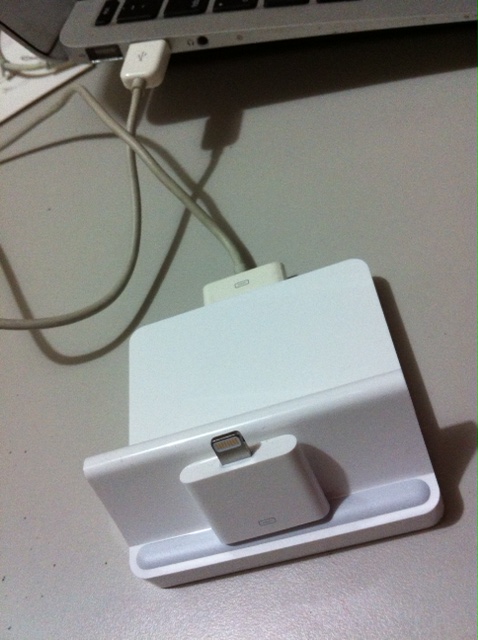
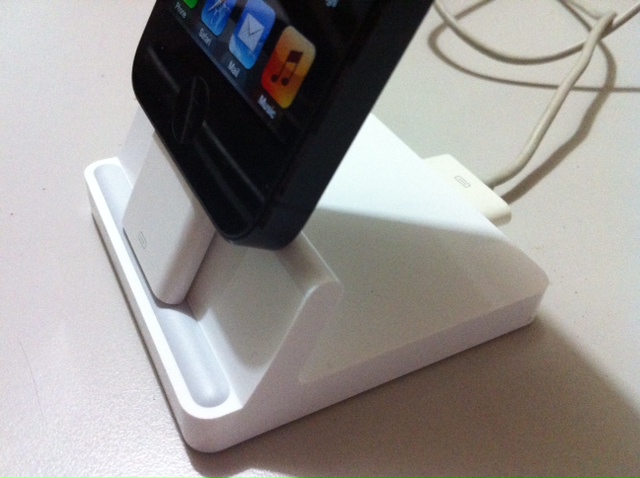
A BRAINWAVE hit me a few minutes ago as I was going all the Mac junk in my man-cave and I saw an iPad dock for the original iPad—remember these expensive and practically useless thingies that couldn’t hold up an iPad in its case? I’ve had this dock since i bought my iPad 1 and never even opened the box—I swear, it was that useless!

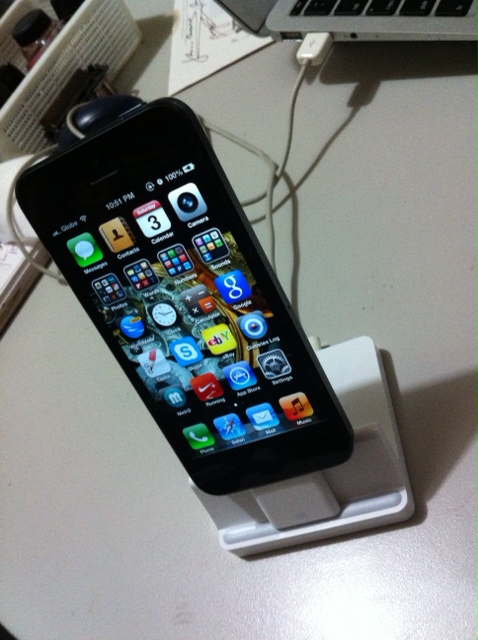
Well… I came home last night from the US with an iPhone 5 and a Lightning-to-30-pin adapter…. So what would happen if I plugged the adapter on to the iPad dock? Voila—a standing charger for the iPhone 5! There’s just enough stability and clearance to lift up the IP5 (it’ll work even with a thin case or skin—I tried it). So, suddenly, my useless iPad dock becomes a neat bedside accessory! (I should’ve kept more of these to sell right now, ha ha.)

It charges—and, yes, it syncs.