Penman No. 441: The Mystery of the Word

Penman for July 31, 2022

TO BEGIN with a small personal note: this week marks my 22nd anniversary writing Penman for the Philippine STAR, an adventure that began on August 5, 2000 with a piece about my recent writing fellowship in Norwich, England, working on the novel that eventually became Soledad’s Sister (Anvil Publishing, 2008). I’ve kept every column I’ve written since then in my digital files, now numbering over 1,100 pieces; a couple of years ago, I selected what I thought were the ones worth reading again (not every column is, to be perfectly honest) and put 110 of them together in a book titled A Richness of Embarrassments and Other Easy Essays (UP Press, 2020, still available on Shopee and Lazada). 

It’s hard to believe that 22 years and 1,100 columns later, I’m still at it, and perhaps even harder yet to believe that I’m enjoying it with the same sense of discovery and delight, looking forward to seeing my text in print with a cub reporter’s enthusiasm. Much of that I should credit to my editors, Millet Mananquil, along with Igan D’Bayan and now Scott Garceau, who have been extremely supportive, sometimes to the point of indulgence (such as when I stray far beyond the normal bounds of art and culture). I’ve since learned to moderate myself, to stay within the zone, and to proactively seek out less known but worthy cultural endeavors to publicize. (The eager beaver in me has made sure that my editors never have to worry about my meeting deadlines; my columns are usually done the week before.)

I began reporting and writing for the old Philippines Herald at age 18, in 1972; at 68, I still remind myself that writing for a national broadsheet, even in this age of Facebook, is a tremendous privilege, so I still respect my editors, my deadlines, and my readers’ intelligence. I can only hope that our younger writers—who now have the freedom and capability to write whatever they like whenever they want on their blogs—will understand that journalism is also a community of shared values (by which I don’t simply mean pakikisama, although there’s a lot of that), and that no matter how brilliant you may think you are, you still have to earn your union card, so to speak, to gain the goodwill and respect of others (and if those things don’t matter to you, then you have a problem, and good luck with that). 

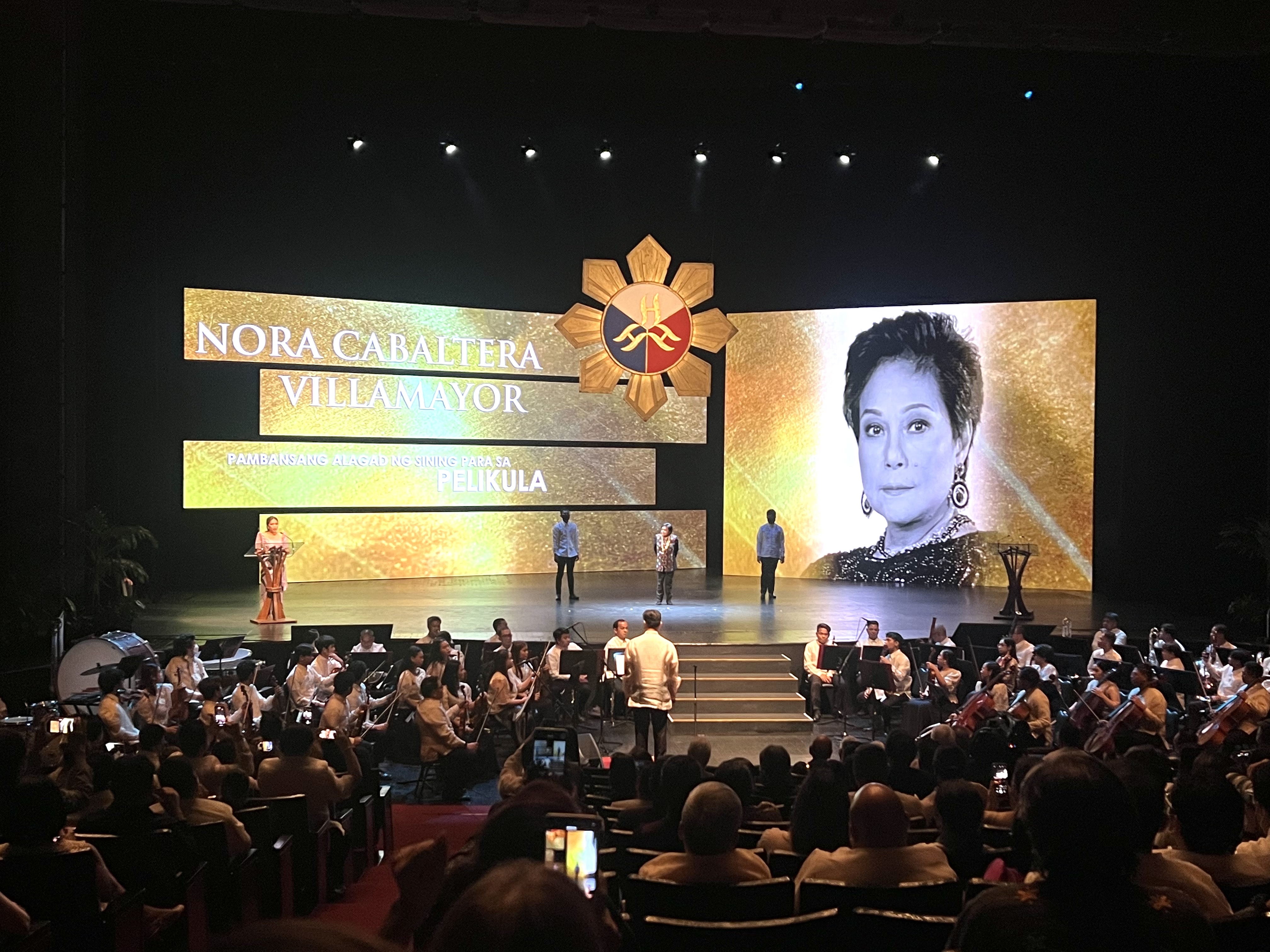
Moving on to other fruitful friendships and associations, I was elated to attend the Parangal for our newest National Artists at the CCP Main Theater last month. The eight new laureates were Agnes Locsin for Dance; Nora Villamayor (aka Nora Aunor) and Ricardo “Ricky” Lee for Film and Broadcast Arts; Gemino Abad for Literature; Fides Cuyugan-Asensio for Music; and posthumously, Antonio “Tony” Mabesa for Theater, Salvacion Lim Higgins for Fashion Design, and Marilou Diaz-Abaya for Film and Broadcast Arts.

I was proud to note that I had worked with or for many of them, and was well aware of their exceptional talent and dedication to their craft. I had never met Nora Aunor, but had written a script for her, “Ina Ka ng Anak Mo,” directed by the late (and also National Artist) Lino Brocka. Lino regaled me with stories about how amazingly good a natural actress Nora was, and I thought so myself, watching her onscreen. I had many issues with former President Rodrigo Duterte’s governance, but I have to credit him for not interfering—unlike many of his predecessors—with the National Artist selection process, particularly in Nora’s case, which everyone knew had been previously held up because of her alleged drug use.

I had worked with directors Tony Mabesa and Marilou Diaz-Abaya, sadly both of them now gone. Tony directed several of my plays and always managed to get just the right tone I wanted to come across. Marilou directed my script which eventually became “Ika-11 Utos: Mahalin Mo Asawa Mo” (someone else always made up these more marketable titles, for which I had absolutely no talent), a crime and domestic drama that received respectable reviews but didn’t win any prizes. But what I observed in Marilou was her work ethic and her methodical approach to the material. I had been used to churning out one-week wonders for Lino, but with Marilou, the scripting process took months, because she would pause and analyze every scene and snippet of dialogue for its political and philosophical implications. 

I was gratified to have made the right call in the cases of Jimmy Abad and Ricky Lee; I had privately predicted, before the results were announced (and with no inside information whatsoever) that the two would be very strong contenders (I also mentioned Lualhati Bautista and Pete Lacaba, among those still living; for the record, I was also nominated, but it was more to make my 94-year-old mom proud and happy, which she was, and so I was). I had known Ricky for a long time, both of us being Lino Brocka’s go-to’s when he needed a script done fast. Ricky, of course, was more than fast; he was good. And while I wandered off into many other kinds of writing, Ricky turned screenwriting into the art and profession it deserved to be, not just for himself but for scores of acolytes. We used to ask each other, half-jokingly, why Pete seemed to get all the choice, festival-bound assignments; and we decided that it was because, by his own admission, Pete was the slowest scriptwriter among us, and therefore got to work on the long-gestating projects.

But I was happiest of all for my former professor and dear friend Jimmy Abad, whom I felt should have received this honor at least ten years earlier, given his elevated poetry, outstanding scholarship, and generous mentorship to generations of writers. For someone who began by studying to be a farmer at UP Los Baños and who then entered the Jesuit seminary (when he left after three years, he recalls, “The first thing I did was to look for a store and smoke a cigarette!”), Jimmy found his true calling in unraveling the Mystery of The Word, of language and how it shapes our view of life. I can think of no writer more purely dedicated to his art than Jimmy, the classic absent-minded professor who drives up one-way streets and whom I had to remind of his exact age. When it comes to words and their meanings, he is ever-aware, ever-present, and ever-caring. A true National Artist, indeed. Heartiest congratulations to all!

Hindsight No. 28: The Queen of Trolls

Hindsight for July 25, 2022

(Photo from philstar.com)

FROM THE street, the building still looked like the bank it had once been, with fluted columns crowned by precast acanthus leaves, but the paint and even the cement cladding had chipped off to reveal the pedestrian concrete underneath. It had been a branch of the old Fidelity Bank & Trust Co., which had gone under in the 1980s after its owner had fled to Southern Spain with P600 million in debts, and the building had served various lessees and uses—once, even, as a shoe emporium on its ground floor, with a restaurant in the mezzanine. But with the building of the LRT, the whole district was literally benighted, occupied by aging tenants with nowhere else to go, pitted with all kinds of booby traps for the unwary.

The former bank’s windows had all been shuttered or painted over, but a steady procession of young people still went in and out of the place through a side door at all hours of the day and night. The locals were made to understand that it had been converted to a call center, although a sign that said “Far Eastern Institute of Homeopathic Medicine” still hung beside the old entrance. Security guards—always two at a time—were posted at the side door, and they ran everyone’s ID through a screening device before letting them in.

The one exception to this routine was the woman they called Ma’am Ventura, a smallish, gray-haired lady in her late sixties who was always accompanied by her driver-bodyguard Bulag, so-called because he never took off his wraparound shades. Ma’am Ventura always wore a dark jacket, matching skirt, white blouse, and flat shoes, like a bank teller—which she had been, in this very same branch, which explained why she had chosen to lease it for her operation. 

She had had the mezzanine converted to an office with a window overlooking the cubicles below, and with a long table around which her floor managers assembled at 10 p.m. to assess the day’s metrics and discuss tomorrow’s messages. The dress code for the trolls below—the “social media specialists”—was strictly informal, the easier for them to vanish into the crowd, but for her managers, Ma’am Ventura insisted on ties, socks, skirts, and heels, so they could understand that they were professionals, as worthy of respect as any college instructor or law clerk. “Transforming society through democratic discourse” was the outfit’s pitch to its recruits.

But tonight, Ma’am Ventura was in a typically foul mood, reviewing some scripts that a new hire had prepared. “Puñeta! I’m not asking you to write an essay that will get a 1.0 from Professor Dadufalza! I want you to say, in 280 characters or less, and in words Bulag will understand, why historians lie! Can someone please show poor Ms.—uhm—Ms. Morales here how she needs to think if she wants to stay in this job?”

Ever eager to please, Nico raised his pencil from his seat on Ma’am Ventura’s right. “They’re people. Just like us. They make mistakes. We don’t even need to prove they’re wrong. We just need to show they could be.”

“Wasn’t the Code of Kalantiaw fake news? Someone just made it up,” came a voice from the far end. Nico winced, knowing it was coming. Angela never missed an opportunity to upstage him at these sessions, flaunting her UP degree—which she knew Ma’am Ventura had as well—like she was standing on a three-foot stool, spreading her arms wide. “Even historians can be fooled.” 

“How many Pinoys out there today even know about the Code of Kalantiaw?” said Bruce, Nico’s ally and Angela’s spurned suitor. “That might be good for TV or Kuya Obet’s column but it’s useless for us.”

“So what can we use? Ms. Morales, any ideas? Redeem yourself.” Ma’am Ventura lit up her first cigarette of the evening; smoking was forbidden on the shop floor but up here they would all reek of it by midnight. This was the part of the work Ma’am Ventura enjoyed the most. The business side of the meeting—impressions, reach, audience growth, engagement rate, etc.—just harvested stats for the client. The Q&A reminded her of the time, after the bank closed down, when she had to take on a teaching job at the college in her provincial hometown. She had begun by teaching Accounting, which she had studied for, but as often happened in these places, she was soon made to teach English and even History. 

At first she tried her best to keep a few chapters ahead of her students, reading the textbooks late at night and figuring out exercises to keep them busy and from asking questions she couldn’t answer. But then the load just became too heavy and she began resorting to what she told herself was just conjecture—that, for example, Josephine Bracken agreed to become Jose Rizal’s wife to escape a scandal in her family—and she soon found it so pleasurable that even her exams posed questions like “What if Japan had won the Second World War? What would you be eating and watching on TV today?” She graded them based on their inventiveness, which she took as another form of intelligence. They began with a set of known facts, and then embellished them, building speculation upon speculation. It was much more fun that just memorizing names and dates. History was a record of settled arguments—until you gave it a kick.

Ms. Morales struggled. “Well—ma’am—can we say that historians lie because—because they don’t really know what happened, so—so they may not even know they’re lying? I mean—they’re not bad people, just—”

“Historians lie because they get paid to lie—by the left-wing universities that buy their books, even by the priests who are always looking for somebody else to blame,” Nico interjected, holding his pencil like he was about to snap it. “We just have to show they’re no saints.”

Angela added, “Let’s dig up some dirt, surely there’s—”

Ma’am Ventura rapped the table. “So what’s the line, boys and girls, what are we going to feed the sharks?” Below them, the monitors from dozens of computer screens glowed like votive candles to a hungry god.

A little hand went up from Ms. Morales. Everyone stopped. A snicker escaped Bruce’s airways. Ms. Morales fidgeted with her Hello Kitty purse. “Kung—kung manghuhula binabayaran, historian pa kaya? I mean… they’re also fortune-tellers, right? Just looking backwards.” She zipped and unzipped her purse. No one spoke until Ma’am Ventura began clapping.

Hija, that’s brilliant! I want you all to write scripts around that punchline! Ms. Morales, I don’t know what you had for dinner, but I’m calling Grab to order it for everyone! Welcome aboard!” Ma’am Ventura blew a cloud of smoke so for a moment no one could see her face, but they could imagine her flashing that sweetest of smiles.

Hindsight No. 27: The Truthifier

Hindsight for July 18, 2022

IT HAD been a nightmare to create, but was—save for the occasional brownout—a dream to operate. The “Truthifier,” as the machine was called, occupied almost the entire fourth floor of the old Doña Salvacion Building on the northwest corner of Plaza Regina in the city’s warehouse district. Most other people would have insisted on a sleek, postmodern structure—or perhaps even an underground vault—somewhere in BGC, among the banks and condos that tried to outdo each other in smartness and attitude, but Arsenio would have none of that. He was a brilliant engineer who understood algorithms, quantum computing, event horizons, The Singularity, and all the other buzzwords that sci-fi junkies more than the scientists themselves loved to spout. But Arsenio was firmly old-school, with a prewar Pelikan 100 in his breast pocket and oxford brogues that he made sure were polished every day, even if he was headed nowhere else but the Factory.

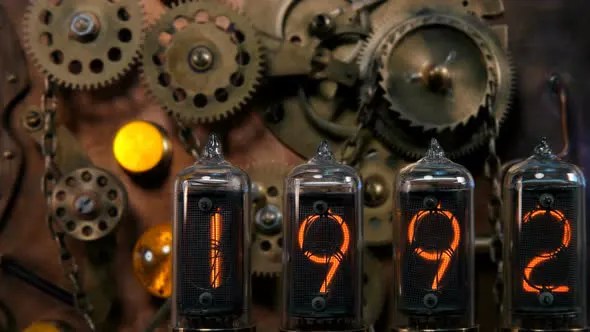
The Factory was where he had built the Truthifier over seven years from the ground up, scrutinizing the assembly of every panel, bolt, nut, wheel, gear, vacuum tube, insulator, switch, dial, and the thousands of other parts that went into the machine, some of them turned out on a lathe by Arsenio himself, following his own blueprints. Arsenio was well aware that he could have programmed a computer the size of a pizza box to do his bidding, but Arsenio disdained software, which could be hacked. He believed in finely designed and intricately crafted machines that made noises like “ding!” and “zzzt!,” whose diodes glowed orange in intense concentration, then spat out text from a teletype printer at the far end.

The Truthifier had one basic purpose: to turn ugly statements, even lies, into something that sounded like the velvety truth, better than most people could. There were probably a few professors out there who could do the same thing, but like all people, professors could be distracted, they could forget, they could be bought, and they could refuse. They also lied. And they died. The Truthifier, being made of brass, wood, glass, ceramic, and copper wire, could do none of that. Arsenio had to acknowledge that he did recruit his old friend Dr. Lucas Tagbanua, retired Professor of Linguistics and Philology at the University of Wurzburg and most recently Chief Librarian at Dagupan City College, to assist him in setting up the tree of linguistic arguments which he would convert to mechanical and electronic pathways. They made history when, in their fifth year, Arsenio typed this carefully on the front-end keyboard: “I murdered my father.” After a few minutes of gears turning and bulbs flickering, Lucas received a message on the other end: “I sent my father to a better place.” It was all still very simple and unsophisticated, but the two men cheered and celebrated. And then, four months later, Dr. Tagbanua died after being hit by a truck delivering action-figure toys.

That, Arsenio sighed, was the problem with humans; they were organic. But he had gotten the fundamental logic down, and he pursued the project to the point that he now had a dial that offered Simple, Moderate, and Extreme options, where “I sent my father to a better place” (Simple) became “I relieved my father of the unbearable burden of life” (Moderate) and then “Against all my filial instincts, I decided to return my father—he of my own flesh and blood—to the source and the end of all human aspirations, to the trackless void of eternal peace and silence” (Extreme). 

“Does it bother you,” Dr. Tagbanua had asked just a week before he died, and after they had achieved success to the Moderate level, “that the Truthifier isn’t really saying the truth, but something that just sounds like it—maybe even a lie?”

“No,” Arsenio said impatiently, making miniscule adjustments on a master valve that regulated adjectives, comparatives, and superlatives. “What we’re doing is giving people a version of the truth that they will want to believe. What’s the use of the truth if you can’t believe it?”

There were many, he was certain, who would pay for Extreme, which would go a long way toward recovering his R&D costs and even make him a tidy profit. He had happily spent all the money he had won from the lottery on his project, so he was beholden to no one, but now that he had accomplished proof-of-concept, he looked forward to some payback, so he could indulge other fantasies like riding a Vespa around Rome with a footloose princess.

Sometimes, just for fun, he fed the machine outrageous fibs like “Jose Rizal was bisexual,” for which he received this Extreme result: “While Jose Rizal had many recorded relationships with women, his sexual preferences were likely as broad as his mind, and his natural curiosity would have encouraged him to explore novel possibilities with his cohort of male friends.”

As soon as word of the Truthifier got around, the clients came to the Factory, in a discreet but steady stream of cars and SUVs with dark-tinted windows whose occupants slipped into a service elevator large enough for a marching band, although they always came alone. A general wanted to explain why he had so many people executed without trial; a priest wanted to introduce his three children to one another; a woman wanted to tell her sister something about her husband. But mostly they were politicians looking for better ways to say the most mundane things, like “I will serve you” or “My opponent is a pedophile.” They paid just enough to keep the Truthifier running and re-oiled every three months.

One day a Rolls-Royce drove up to the Factory and out stepped a man in a gray three-piece suit and top hat, wielding a cane. He looked like a boy who had aged all of a sudden, his long hair hanging in graying strings. 

“How can I help you?” Arsenio asked, barely looking up from a console that monitored temperature levels within the machine. 

The man took off his hat and put it beside him on the couch. “My father was a crook. For a very long time. But I’d rather forget that. And while I’m at it, I’d rather that everyone forgot, as well. I hear your machine can help.”

“That’s—complicated,” Arsenio said, after figuring out how many propositions the statement involved. “It will cost you some.”

“You must be a very busy man, so I won’t waste your time,” said the customer, glancing at his rose-gold Nemo. “How much for the Truthifier?” With a finger, he drew a horizontal circle in the air. “The whole thing.”

Stunned speechless, Arsenio sized up his visitor, who had crossed his legs and draped his arm on the backrest, like he had all the time in the world. Despite his agitation, Arsenio began thinking of Audrey Hepburn hugging his waist, her perfume curling up his nose as their scooter drove past the Colosseum. 

(Image from videohive.net)

Hindsight No. 26: The Quick Brown Fox

Hindsight for July 11, 2022

EXAMINING THE machine in front of him, Monching could understand why it had ended up in his shop. There weren’t too many people like him left in the city—or the entire country, for that matter—and he had been told he was the best of them, which he brushed off with a shy smile but happily acknowledged. At 62, he was also the oldest Manileño he knew still fixing typewriters—well, there was Mang Torio who was in his late seventies, but he had stopped five years earlier when his daughter landed a job in Dubai as a cashier in a shoe store, and besides Mang Torio really couldn’t work on anything more complicated than a 1970s Olympia Traveller or Lettera 32 when he retired. 

The older man had an encyclopedic mind, and Monching could still remember running to him when he was having problems he couldn’t sort out himself, like a Corona platen that felt too long (“Washer—washer could be too thick,” Mang Torio would say. “Or you can try filing down the carriage end bushing.”) But you needed good eyes and steady fingers to stay on the job, and Mang Torio had lost his touch when his wife died and he began drinking. At first Monching shared a few bottles with him to commiserate with his mentor, but he stepped back when he saw the old man sinking into an emotional abyss, and soon he was taking over Mang Torio’s jobs just to save his face. 

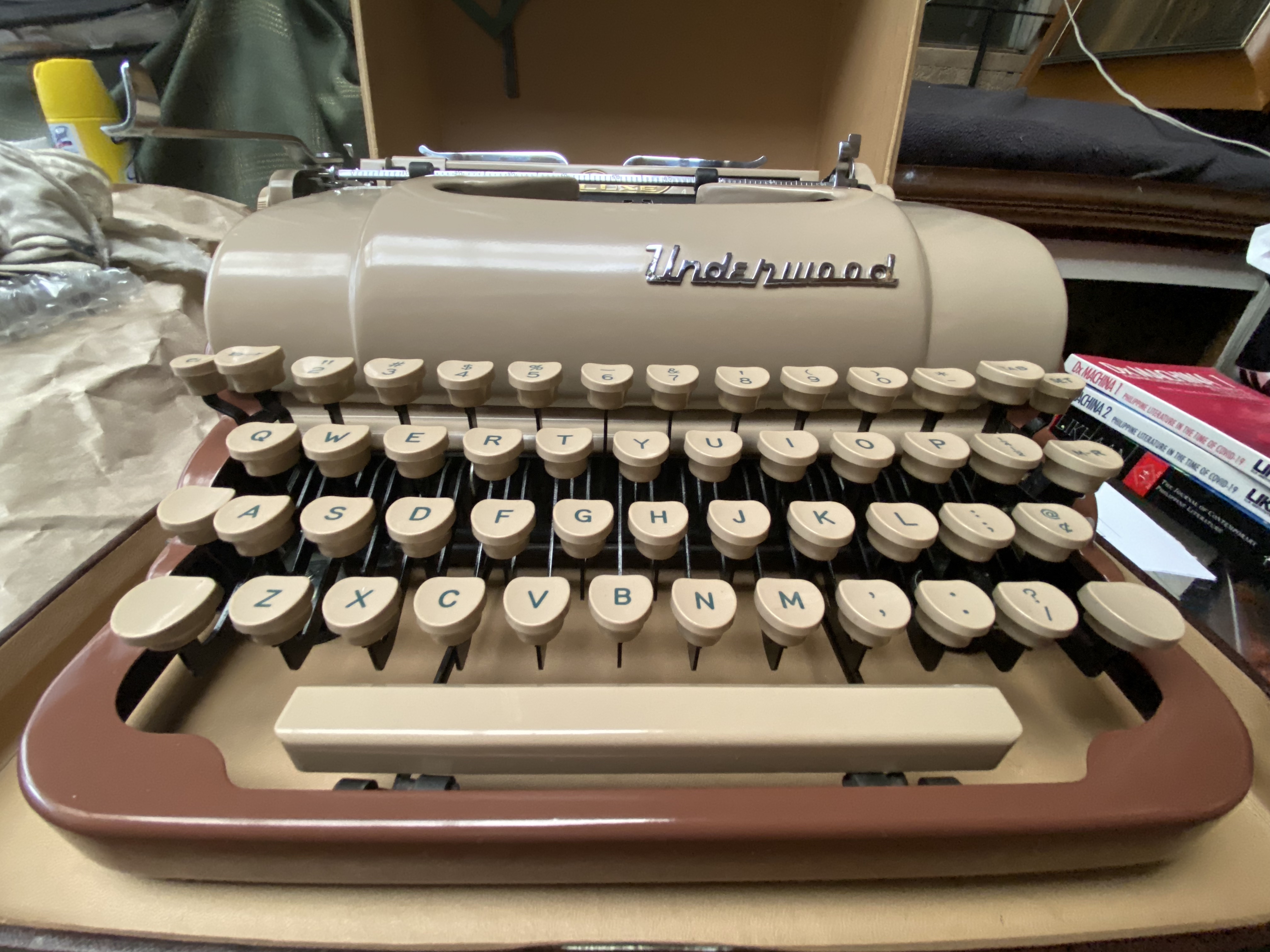
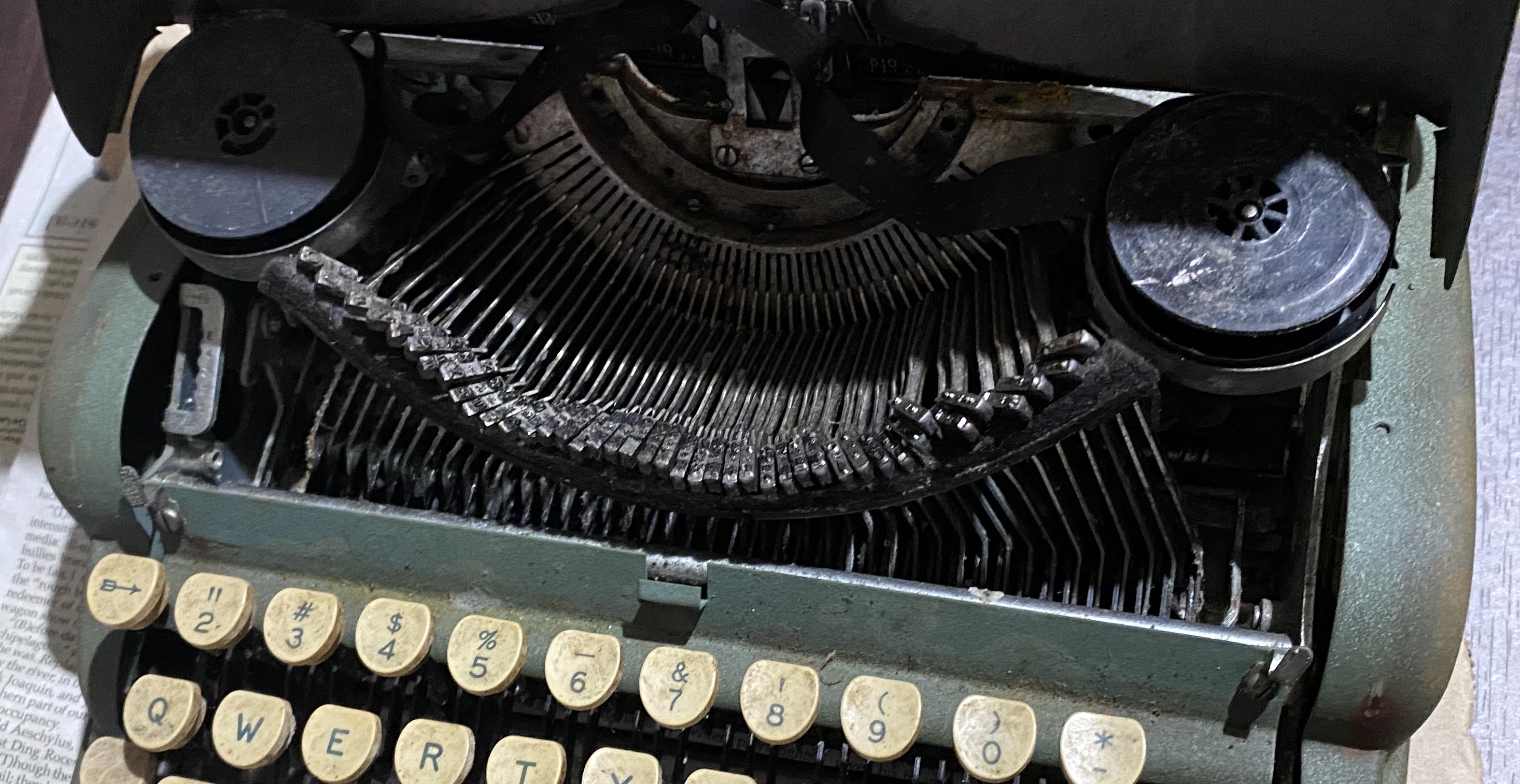
Now he was hunched over what looked like a bucket of rust, but he knew that beneath all that pockmarked paint was one of the most beautiful typewriters ever made—a mid-1950s Underwood Quiet Tab De Luxe, a two-tone model with sexy curves, like a rich man’s car. As its name suggested, it was top of the line among Underwoods of its time, and in his mind Monching could see it gleaming with new paint and chrome, after the requisite stripdown and rebuild. It had been brought in by an interior designer who was thinking of using it as a prop—she had found it among her grandfather’s effects on a visit home to Mabitac—but Monching had cleverly persuaded her to take a portable Brother 200 repainted in yellow in trade for the hulk. 

He knew what they wanted, young people who looked for “delete” buttons and giggled when they heard the bell “ping!” and who couldn’t care less if the typeface was pica or elite; they bought them for décor, an accent piece suggesting a connection to a golden age they never knew. There were years when it seemed like no one needed typewriters anymore other than the sidewalk clerks who helped make fake IDs and official-looking papers, but now they were back in fashion, and Monching knew that the Underwood could fetch a premium price once he’d fixed it up.

As he tapped the keys to see if they would even budge, he saw something unusual on the TV that was constantly on in a corner of his shop. He didn’t really care what program was showing, and just needed the tinny chatter in the background to help him concentrate on his pawls, drawbands, and adjustment screws. But today all the channels were carrying the same thing, the live broadcast of the new president being sworn into office. 

Monching had voted for the man, like his church elders had told him to do. He had no opinion of him, one way or the other, except to note the familiarity of the name and the implication that he knew more about the job than anyone else. Mang Torio, the last time they met, was all upset and kept mouthing off about how, back when the man’s father was president, he had been clubbed and dragged to jail for joining a rally protesting police corruption and extortion, so he wanted to vote for another candidate, but couldn’t leave his house. 

Monching would have none of that nonsense. He wanted a simple and uncomplicated life, just doing what he knew best, bringing machines that had typed their last words half a century earlier back to working condition. Most had produced office reports, term papers, affidavits, inventories, and such; others wrote love letters, or cut mimeograph stencils for anti-government propaganda. Monching didn’t think much about their past. He was happiest when, done with a reassembly, he could put a drop of 3-in-1 oil (“Never WD-40, it will dry up and stick!” said Mang Torio) between the Shift and Shift Lock keys, check that they worked, feed a fresh sheet of paper into the platen, and peck out “The quick brown fox jumps over the lazy dog.” It was beauty and order restored.

He watched as a column of armored vehicles rolled across the TV screen in a show of military might, and he wondered how old they were and if they had been refurbished and repainted like his machines. He found himself wishing that people were as easy to fix; Rita wasn’t, and so he left, and had led a quiet life since, sleeping on top of his shop. He had tried to train some apprentices, but no one stuck, preferring to sell dishwashers or to drive ambulances. Only the skeletons of Corona 3s, Hermes Medias, and Remington Model 5s kept him company. He kept his shop floor tidy, picking up the tiniest screw.

Mang Torio’s life, on the other hand, was messy beyond belief. Three wives, children whose names he’d forgotten, a stint on a cruise ship that sank in the Adriatic, sudden wealth, gambling, prison (where he learned typewriter repair), walking the straight and narrow, and then descent into the bottle. Over gin, the man dithered between memory and regret, and now and then, a vain hope for something different.

On the TV, a crowd of protesters struck out at the new president, like jagged letters leaping from an unadjusted keyboard. When he was done with the Underwood, Monching promised, everything would be in line, all crisp and clear.

Hindsight No. 25: The Museum of Suffering

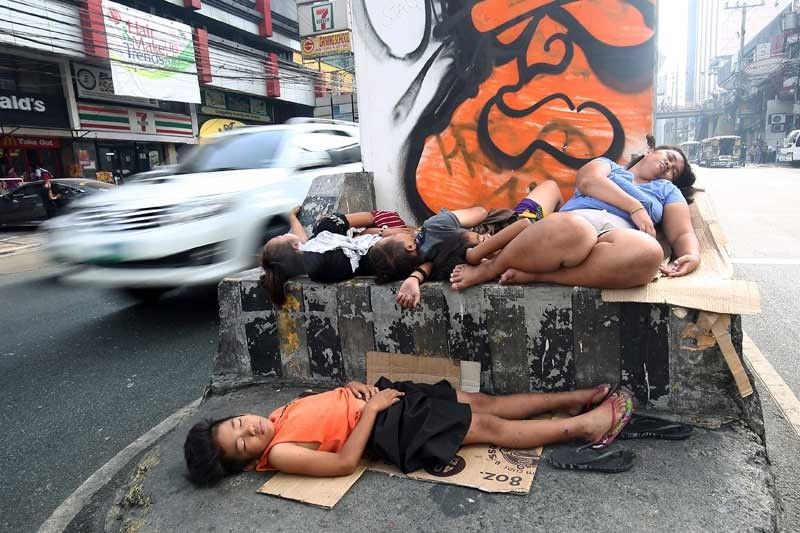
(Photo from philstar.com)

Hindsight for July 4, 2022

PEPITO FANCIED himself a museophile, a lover of places where old and fascinating objects were exhibited for the public’s delectation. Having achieved a certain level of leisure in his life, he had been able to indulge in a bit of travel, the highlights of which were invariably visits to local museums and galleries. While other tourists spent time posing before the Eiffel Tower or throwing coins into the Fontana di Trevi, Pepito preferred to wander the hallways of more obscure attractions such as the Musée de la Magie, where golden swans and painted ballerinas moved as if of their own accord, or the Museo Nazionale delle Paste Alimentari, where he could follow eight centuries of pasta-making across the globe. 

He was an omnivore, as far as interests were concerned. He could spend hours poring over Etruscan vases, Masamune katanas, deep-sea organisms, and Calder mobiles. Being something of a self-taught snob (he had a degree in civil engineering, but had never built a bridge or even a bungalow after he married into his late wife’s family), he liked to play guessing games—observing objects without reading their captions, making inspired surmises about their origins or back stories. 

Once, staring at a death mask from the Lambayeque culture of Peru, he voiced his suspicion to the docent beside him that “The red paint on this mask could have been human blood,” to which the docent replied, rather dismissively, “A lot of people say that, but there’s no proof, so it’s likely just cinnabar.” Years later, he was overjoyed to find vindication in a scientific report on analyticalscience.wiley.com that “The blood proteins serum albumin, immunoglobulin G, and immunoglobulin kappa constant were all identified, strongly indicating the presence of human blood in the red coating of the mask….” Pepito wanted to print out that page and mail it to the docent—in a real, stamped envelope, so the poor fellow could appreciate the materiality of the truth.

He could have been a docent himself, of course—one of those doddering retirees with nothing better to do than recite memorized scripts to glaze-eyed visitors about patinated silver and the importance of ruffles to Elizabethan gentlemen—but he found more pleasure in trailing them and the tour groups they shepherded around museums to pounce on an overheard mistake or to add his own little flourish. “There’s no proof that Jesus was born on the 25th of December,” he told some Japanese tourists examining an 18th-century belen. “Scholars calculate that he was actually born between 3 and 6 BC—before himself!” He expected them to chuckle with him, but their interpreter seemed annoyed at his intrusion and kept quiet.

No matter; truly, he didn’t care what others thought. They were all opinions, from small, provincial minds. He declared the present uninteresting, a jiggly kind of frame for the past, and politics the folly of idealists who kept hoping that communal inventions like government would get better, against obvious evidence to the contrary. He had long resigned himself to accepting whatever came, keeping his head low, vanishing into the woodwork, luxuriating in his connoisseurship of the strange and wonderful. People came and went, but things survived, and the most interesting of them were to be found in museums.

When he received the hand-lettered invitation to attend the soft opening of the new Museum of Suffering in San Miguel, Manila, Pepito wondered if they had made a mistake. Although he had posted his museum sorties on Facebook and had amassed 31,629 followers (he accepted no friends), he did not think of himself as a social media celebrity. But with vloggers now covering the President in the Palace, he figured he had been found out and finally recognized for his expertise on—well, anything and everything.

He took a cab to the address indicated on the card—about 45 minutes through the traffic, according to Waze—and tried to guess what the Museum of Suffering might feature. Pepito had to admit to a special attraction to the grotesque—to medieval instruments of torture (Prague, Toledo, Amsterdam), medical curiosities (Philadelphia, Boston), and even cannibalism (San Diego, Onnekop). This new museum had to be something of the sort, in a Philippine setting—exhibits of massacres, famines, imprisonment, floods, volcanic eruptions, locust infestations…. He looked at his driver and saw the crusty scab on the man’s neck, which probably began as an insect bite. 

He was met at the door of the refurbished mansion by—of course—a docent, but a woman not a year older than he was, wearing a pink dress with a Chinese collar to go with her dimpled smile. “Mr. Tanglaw? I’m so glad you could come. My name is Winnie, and I’ll be your guide for this tour…. Oh, don’t be surprised, we arranged this just for you, given your followership. This way, please.” Pepito looked around, expecting to be led to a roomful of specimens under glass, but instead an apple-green Vios appeared at the driveway and Winnie led him to the back seat before sitting in front. “Tikoy, let’s go,” she told the driver.

“Where are we going?” Pepito asked as the Vios eased into the traffic. 

“To the Museum of Suffering,” Winnie said. “That was just our meeting point.”

“Is it far?” Pepito asked after they had crossed three traffic lights, headed south.

“We’re low on gas,” Tikoy butted in, and slid behind a long queue of cars and jeepneys at a gas station. “Prices go up tomorrow, so everyone’s here. It was on the radio.” He turned the radio on and settled on a program where the hosts discussed tax evasion. 

Pepito looked at the prices per liter and saw nothing but numbers. He watched a truck driver wiping his face with a soiled towel. Winnie was explaining something about rice importation, but all he could think of was the olfactory testing game he played at the end of his tour of the Musée du Parfum Fragonard. He struggled to recall the scent of Belle de Nuit. He wanted out of this place. “Is it far?” he asked, gasping. “Is it far?”

Penman No. 440: A Classic Reborn

Penman for Sunday, July 3, 2022

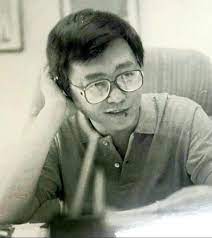
I’VE LONG believed that my late friend and contemporary, Bienvenido “Boy” M. Noriega, Jr., was one of our very best modern playwrights, and indeed worthy of a National Artist Award. I—and many who knew him and his work—had been hoping that he would get that distinction this year, but too much time may have passed since he left us 28 years ago for critics to recall just how good he was.

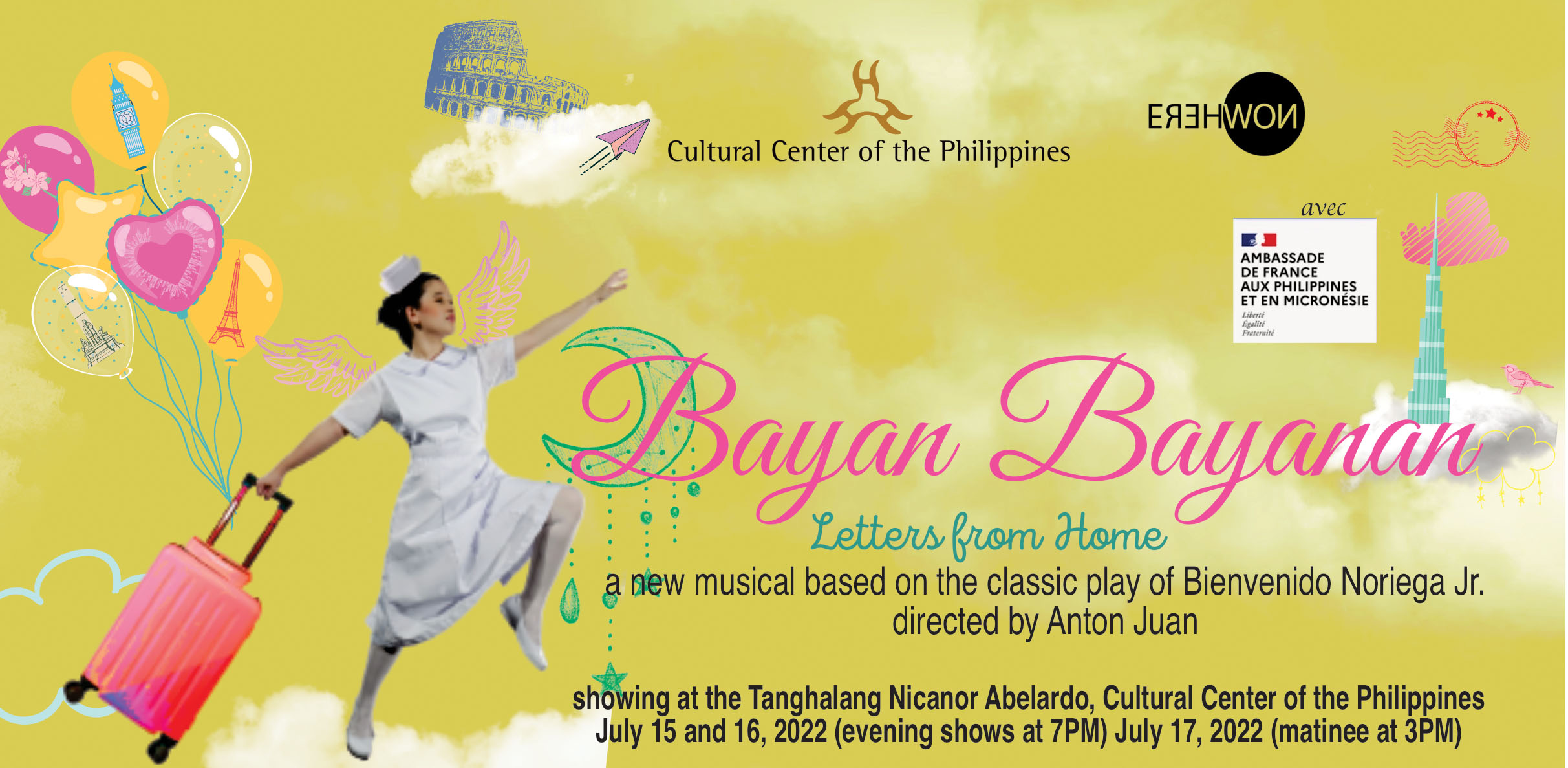
Still, there’s great news today for Boy’s fans, and for everyone eager for the return of great theater to the Philippine stage. The seminal Noriega play, “Bayan-Bayanan,” which premiered at the CCP’s Little Theater in 1975 and won that year’s Grand Prize for the Full-Length Play in the Palancas, is going to be shown again in Manila this month, rendered as a new musical, “Bayan Bayanan: Letters from Home.”

Directed by Dr. Anton Juan and produced by the Erehwon Center for the Arts with support from the Embassy of France, the updated play promises to offer fresh insights into the OFW experience, having been originally written and presented long before overseas Filipino workers came to be known as OFWs. Back in the early ‘70s, as martial law descended on the country, they were all just exiles, migrants, transients, and vagabonds, some by choice, others by the lack of it. In Europe, and specifically in Geneva where the play is set, Filipinos tended to be middle-class professionals drawn there by their work, as Boy Noriega himself was as a government economist in his early 20s attending global trade negotiations. 

As I’ve written about before, Boy and I were very close friends—and fervid contest competitors—in those days. We were UP Alpha Sigma fraternity brothers who found ourselves working in literally the same office at NEDA Padre Faura. He was two years older than me, so I looked up to him as a mentor, and when he went to Harvard for graduate school and then began flying to all these conferences abroad, he wrote me long letters to share his exhilaration at studying our heroes like Chekhov and Ibsen (he was enrolled in Public Administration, but took side courses in Drama). When he came home, we spent many lunch hours talking about the plays we were writing or wanted to write. 

Boy announced himself to Philippine theater in the most spectacular way—by writing “Bayan-Bayanan” and having it presented at the CCP almost at the very start of his playwriting career. Immediately you knew that you were witnessing a major talent unfolding. His kind of drama was quiet, thoughtful, cumulative in its impact. Writing under martial law and being somewhat more politically engaged, I resorted to historical allegory, but Boy took the present head-on, albeit from another angle, of the young Filipino discovering the world in both geographical and emotional terms.

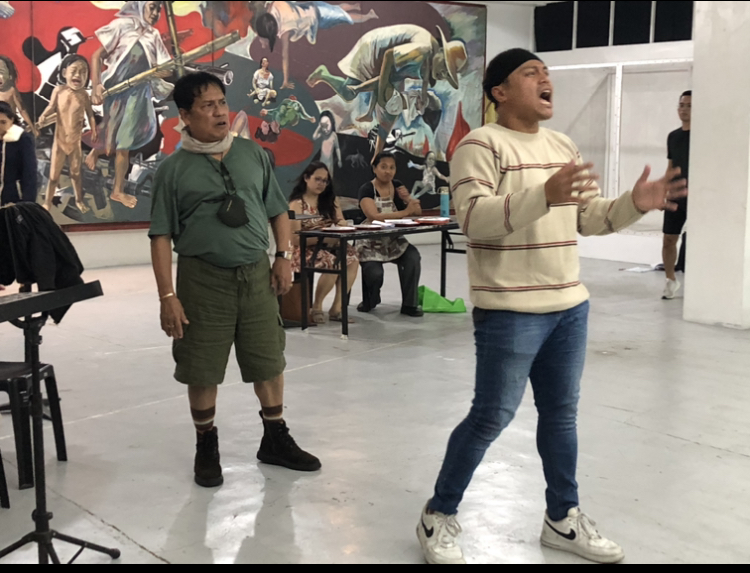
When I heard that Erehwon was planning to revive “Bayan-Bayanan” as a musical, I was delighted and at the same time a bit concerned how Boy’s material was going to be handled almost half a century down the road. But my worries lifted when I learned that the revival was going to be directed by none other than Anton Juan, who knows the play better than anyone else around, having directed it in Athens, London, Geneva, Paris, Chicago, and Toronto, and having himself been the kind of global traveler that Boy dwells on. “I have directed this play many times before in Europe, and each time there is always something new,” Anton says. “It grows like a pearl, takes shape in the memory and hearts of those who perform it and those who watch it: why? Because it is real. It is grounded on real characters we can identify with, in all their beauty and vulnerability, in all their strengths and their weaknesses.”

Anton Juan composed some of the new songs for the play, along with Cleofe Guangko-Casambre, who had composed for the play “‘Rizal’s Sweet Stranger;” Russ Narcies Cabico, also a theater and television actor and singer; pianist-composer Andrew Bryan Sapigao; and composer-musical arranger Jonathan Cruz.

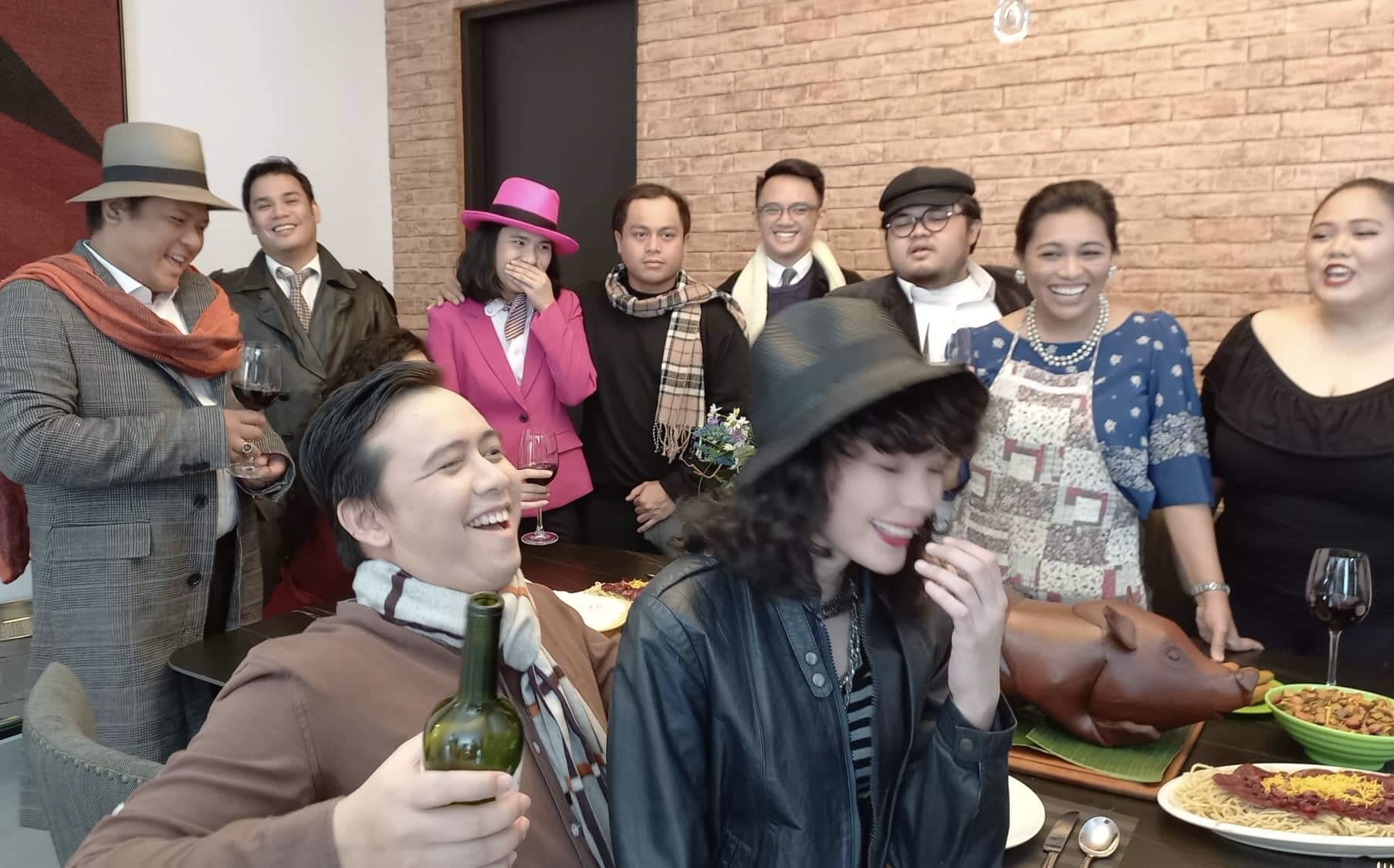
The cast comprises a mix of veterans and newcomers. Professional theater actress and singer Banaue Miclat-Janssen portrays the central character Manang, while Dino—the “Boy” in the play—is portrayed by theater actor and classically trained singer Carlo Mañalac. Supporting them are Ava Olivia Santos, Roxy Aldiosa, Carlo Angelo Falcis, Jacinta Remulla, Richard Macaroyo, Greg de Leon, and Jane Wee. Of special note is the participation of French-Filipino actress Uno Zigelbaum, through the sponsorship of the French Embassy.

The role of the Erehwon Center for the Arts (of which Anton is Creative Director) is also noteworthy. Founded by another old friend of mine, Raffy Benitez, Erehwon has established itself firmly in our country’s cultural landscape as a sponsor of painters, sculptors, musicians, dancers, and writers, who have come to see Erehwon’s Quezon City headquarters—also its performance and exhibition venue—as a haven for the arts at a time when cultural budgets everywhere have fallen. Funded largely by Raffy’s own generosity and by some other patrons, Erehwon hopes that this collaboration with the CCP and the French Embassy will lead to other significant projects that can ultimately be self-sustaining. 

The play will premiere on  the evening of July 15, followed by a 7 pm evening show on July 16 and a 3 pm matinee on July 17, at the CCP’s Tanghalang Nicanor Abelardo. Tickets are available at Ticketworld. See you there!

Hindsight No. 23: An Unsolicited Draft (2)

Hindsight for June 20, 2022

(Photo from philstar.com)

LAST WEEK, I indulged in some wishful thinking to imagine what a truly different and refreshing BBM presidency would be, with the rosiest inaugural speech I could confect. This week, as we edge closer to the real inauguration of Ferdinand Marcos Jr. as our 17th president, I’m going to try my speechwriting hand one more time at a grimmer version of what he might say. 

Again, friends, this is all fun and games, a finger exercise, not to be confused with the real draft that a roomful of gifted (and expensive) wordsmiths, some of whom I probably know, are probably toiling over this very moment. (For those who missed last week’s installment, again, please look up what “satire” means, and smile.) This is what you get from a fictionist posing as a political pundit, with no spicy gossip to share and no entrée to the corridors of power. 

And so, meaning no disrespect to No. 17, here we go with the kind of speech his most ardent followers, some more BBM than BBM, might want to hear. His language won’t be this fancy, of course—his dad’s would have been—but since this is make-believe, let’s turn up the volume.

My countrymen:

Let me thank you, first of all—the 31 million of you, most especially—for entrusting me with this loftiest of honors. Not too long ago, our opponents laughed when one of you presented the prospect of my presidency as “an act of God.” 

I seem to hear no laughter from that corner now. Instead I hear the anguished sobs of defeat from those who cast themselves as the angels of the good, and us as evil incarnate, an army of witless orcs streaming across the plain. Why, they may be asking, has their God forsaken them? Could it be that in their self-righteousness, they forgot that pride is the most capital of the Seven Deadly Sins, because it usurps God’s judgment and arrogates unto oneself the inscrutable wisdom that He alone possesses? 

How could they have presumed that they were right and we were wrong—that you, my faithful friends, were  bereft of all moral discernment in selecting me as this country’s leader for the next six years? Put morals aside—they called you stupid, unthinking, unable to make intelligent decisions on your own behalf. 

But let me ask anyone who cares to answer: is it not a supreme form of intelligence to vote to win, to choose someone who offers the best hope for your survival, to cast your lot with someone who has proven his ability to endure, to bide his time, and then to seize the right opportunity and prevail over a motley legion of adversaries? With this victory—our victory—you have vindicated yourselves, and you can stand proudly before anyone—before any priest, any professor, any employer, anyone who ever lectured you about right and wrong, or pushed you down to your humble station—and declare: “You have nothing to teach me. I won.”

And let me tell you something else: it is not only the unschooled, the hungry, and the unshod that I have to thank for today. All over the country, I found doctors, lawyers, businessmen, teachers, and community leaders who may not have been as vocal in their support, perhaps for fear of persecution by the pink mobs, but for whom the name “Marcos” promised the return of discipline and progress to our benighted country. Now I say to you, my dear brothers and sisters: “Step out. Step up. We have a Strong Society to rebuild, and you will be its vanguard.”

But let us be magnanimous in triumph. To anyone who voted for someone else, even the most rabid of my detractors, I offer the hand of unity. “Unity” was the overarching—indeed the only—theme of my campaign, and I pledge today to ensure that it will be far more than a vapid slogan. 

National unity is every Filipino citizen’s choice: you are either for it, or against it. Any Filipino who rejects our generous invitation to unity and insists on treading the path of unbridled individualism and anti-authoritarianism will only have himself or herself (note how we observe gender sensitivity in our Strong Society) to blame. Self-exclusion by these disuniters—let’s call them DUs—will mean their willful abdication of social services and other resources that can be better devoted to patriotic citizens.

To this end, I am creating a National Unity Council—to be chaired by the Vice President, with representatives from the DND, DILG, NTF-ELCAC, CHED, DepEd, and NCCA—to formulate a National Unity Program that will be undertaken at all levels of government, from the LGUs and the military to our schools and cultural agencies. Its aim will be to forge and promote a truly Filipino culture, based on a truly Filipino ideology, that de-emphasizes conflict, promotes discipline and conformance, and upholds respect for duly-constituted authority. For this purpose, for example, we will practice mass calisthenics, sponsor competitions for patriotic songs extolling unity and discipline, and conduct workshops and seminars for the proper identification of DUs at the barangay level and their subsequent re-education and reintegration. We will review our curricula and our educational materials to ensure that they contain only our best stories as a nation, to instill pride in our people and to remind ourselves that, as my father said, this nation can be great again. 

Half a century ago, we stood on the edge of that destiny, in a bold experiment that would have transformed the Philippines into a bastion of democracy against communism and a beacon of development in Southeast Asia. That dream was thwarted by a perverse alliance between the CIA and the communists and their Yellow cohorts that resulted in my family’s forced exile. Today we resume that march to greatness, and we will brook no more interruptions, no more distractions, no more needless delays. A society’s strength radiates from its leader, and I vow to be that leader for you, so help me God.

Hindsight No. 21: Mr. Secretary

Hindsight for Monday, June 6, 2022

(Note: This could be the strangest thing you will ever see on an Op-Ed page, a new genre I’m going to call “editorial fiction,” observations of the current scene rendered as short stories. No direct references are intended.)

THE CALL came at a little past one in the morning, well after bedtime for George and his wife Trina. Trina stirred in their bed and pulled the blanket over her shoulder in a gesture of irritation, but as soon as she gathered whom George was speaking with, she froze and tried to capture every word that was being said, over the hum of the aircon and the occasional screech of late-night traffic along the boulevard twelve floors below. She had wanted a unit as close to the penthouse as they could get, but the price was just beyond their reach, so they settled for a 14th-floor corner suite—the 13th floor, of course, was non-existent for superstition’s sake—with a broad view of the bay on one side and a long thread of highway on the other, fading into the southern suburbs.

George should have been annoyed as well to have been called so late, but he was not. He had not even been asleep, having watched an episode of The Blacklist without paying too much attention to what Raymond Reddington was whispering into Elizabeth’s ear. He had been swilling his Cragganmore, not bothering with his usual routine of adding a few drops of water to unravel its complexity; his taste buds felt dull and flat. Life itself suddenly seemed tentative and purposeless. He had been staring at his phone for an hour, checking its battery status, thumbing through his messages to make sure he had not missed anything important. 

When the phone rang he had to gulp down the whisky with which he was simply wetting his throat, utterly without pleasure, but instantly he straightened up in bed and took the call, curling a conspiratorial palm over his mouth, as if a spy lived on the 15th floor.

“Good evening—good morning—sir!… Oh, no sir—I was still awake—I mean, I read the newspaper and was surprised to see my name there, but…. Yes, of course, I mean, I wasn’t expecting anything, since you know how I feel about—well, about… things, things that happened in the past…. The future, of course, the future, I agree…. I appreciate that, I honestly never imagined that I would be talking to—oh, no, sir, no ‘doctor’ or ‘professor,’ please, just call me George, George is fine, everybody calls me George…. Haha, yes, I’m older than you by four years, but you’re the president! Or will be—I mean, in a few weeks…. I’m deeply, deeply honored, sir, of course I am….Uhhh…. Sir, could you maybe give me some time, a couple of days, just to talk it over with Trina?”

At this point, Trina had dropped all pretenses of trying to sleep and was watching George intently, making words with her mouth that George couldn’t be bothered to read. But George looked in her direction and continued talking as if she wasn’t there. In the background, at the other end of the line, he could hear people laughing and shouting, and the pounding rhythm of a Village People tune. His friend Estoy who had texted him earlier to expect a call was probably there; Estoy had been a consistent flunker in college, but now he seemed unusually adept, even prescient. 

“Yes, sir, Trina, Katrina Palileo, the sorority sister of your cousin Angie…. Our two children are both in the States…. She’s retired now but still consults for—oh, no, no, I don’t think it will be a problem…. 48 hours, thank you, sir, I’ll talk to her and get back to you…. Many thanks again, sir, and good morning!”

George slumped into his bedside chair, threw his phone on the bed, and poured himself a fresh shot. He grinned at the hapless Trina, waiting for her to pop the question.

“So? So what did he say? Did you get the position?”

George tried to put on a straight face, without much success. “I said I would think about it—I said I would ask you first.”

“Idiot!” Trina said, laughing, and threw a pillow at him, almost hitting his shot glass. “You call him right back, right now, and tell him I approve! Of course I approve, 110 percent!” She picked up his phone and held it out to him. “Call him now, while he’s still awake, and before he changes his mind!”

George brushed the suggestion away, turning pensive. “No, no, I shouldn’t look too eager, like I really, really want it—”

“But you do, right? I mean—a week ago I never would have thought this would happen, but when your name came up in the news, I thought, oh my God, really?”

“That’s what I’m asking—why. Why me?”

“And why the hell not? Nobody knows the field more than you, you’ve published zillions of academic papers, people hold you in enormous respect, you’re better appreciated in London and Geneva than you are here, and you were never known to be his flunkey!”

“No,” said George, “I never was. That’s why I think he wants me. Maybe I could change things.” He looked at Trina, who was about forty pounds heavier than when they first met, across a barbed wire fence in martial-law prison. He himself had been thin as a rake, having had very little to eat in their Marikina safehouse. He took it as a blessing to have been arrested in a raid; there was more food in prison, and he would have died within a week of scaling the mountains. And there was Trina, whose pageboy bob had been replaced by shoulder-length curls dyed some shade of sunset. He couldn’t blame her for wanting to forget what she had gone through, and he never brought it up. To survive and to live well—that alone was sweet revenge.

“We used to talk a lot about the future—is this it? How did this happen?”

She put her arms around him and pulled him back to bed. “You think too much,” Trina said, and planted a wet kiss on his cheek. “Congratulations and good night, Mr. Secretary! Let’s call the kids in the morning!”

Out the window, the lights of a tanker flickered on the pitch-black bay, the only way to tell that there was a horizon.

Penman No. 439: New Looms for Old

Penman for Sunday, June 5, 2022

WHEN WE first met Dr. Analyn “Ikin” Salvador-Amores at the University of the Philippines Baguio five years ago, she was already the director of the new and fascinating Museo Kordilyera that had just opened to showcase the culture of the northern highlands. Ikin graciously took Beng and me on a tour of the exhibits, which UPB had painstakingly put together from its own collections and from the donations of such patrons as National Artist and Baguio resident Bencab. 

But going beyond what was on display, Ikin brought us to the museum’s laboratory—research is the other important part of its mandate—to show us their growing collection of rare Philippine textiles. Some of these were a century old, retrieved and repatriated from collections abroad by Ikin herself, or donated by collectors. This, she indicated, was going to be a vital aspect of the Museo Kordilyera’s mission—to gather and preserve the threads of the past for the appreciation of new generations of Filipinos. 

Indigenous textiles have a long history in the Philippines, having been woven long before the Spanish came—indeed, more than a millennium before the Christian era. They were used for clothing and also for ceremonial purposes such as the burial of the dead. They come in a wide range of materials, designs, and uses, from the abel and Bontoc of the north to the hablon and piña of the Visayas and the Yakan and tinalak weaves of the south, among many others. Using local fibers and dyes, native weavers employ hand looms to turn their traditional designs—animals, celestial objects, humans, deities, and geometric shapes—into not just functional clothing but works of art and visual bearers of their tribe’s or community’s culture.

But these traditional weavers and their products are under threat from many factors, and unless proper and timely intervention is undertaken, cultural advocates like the Oxford-trained Dr. Salvador-Amores worry that they could decline further if not vanish in this digital century. She points to four major reasons for this decline: the advanced age of master weavers and the lack of young people willing to take their place; the scarcity of materials for weaving such as cotton; new technology, cheaper mass-produced substitutes, even fake “ethnic” fabrics; and ready-to-wear clothes and ukay-ukay, reducing demand for traditional textiles.

Enter the Cordillera Textiles Project or CordiTex, which Ikin is also directing, aimed at finding and employing new technology to revive the ancient art of weaving and train and engage a new generation of weavers. The technology comes in the form of the Universal Testing Machine that analyzes the internal and external characteristics of Cordillera textiles so they can be technically described, and the digital loom, which—with the help of software—can recreate old designs and fabrics, especially those that weavers can no longer make, and assist those weavers in doing them on their traditional backstrap or foot looms.

Before the machines come into the picture, however, much research has to be done. CordiTex is a multidisciplinary endeavor, involving anthropology, ethnobotany, ethnomusicology, ethnomathematics, physics, chemistry, ergonomics, economics, and geography. (I’ll bet some of us didn’t even realize these disciplines existed. And if we wonder why “ergonomics” is important in weaving, it’s because weavers often suffer from musculoskeletal problems of the neck, shoulders and lower back; strain from incorrect posture; and chronic lower back problems.)

Ikin’s team has conducted research not just in the Cordillera region, but also in weaving collections in the US, Germany, and Austria, where samples gathered a century ago by expeditions to the Philippines are kept. In the US, for example, much material and information can be found at the Museum of Anthropology at the University of Michigan, the Field Museum in Chicago, the American Museum of Natural History, and the Newberry Library.

Mathematical symmetry analysis figures out the math behind traditional designs so they can be rendered into formulas, followed by 3-D modeling, to take the physical properties and the weaving structures of the fibers into account. 

Now enter the digital loom—the Thread Controller 2 or TC2—a machine designed, developed and made by Digital Weaving Norway (DWN) to turn design ideas into woven fabrics. Rolled out in 2012, the TC2 is a hand-operated electronic jacquard loom, capable of producing both traditional and contemporary weaves for industrial and artistic purposes. The University of the Philippines has acquired two of these machines—one for UP Baguio, and another for the College of Home Economics in UP Diliman. Six researchers from UP led by Ikin went to DWN to study the use of the machines, and workshops have since been conducted in Baguio and Diliman, assisted by a visiting expert from DWN, to introduce the TC2 and its technology to local weavers and researchers.

Dr. Salvador-Amores is emphatic that their work in CodiTex is not aimed at replacing hand looms. “While CordiTex can now replicate and reconstruct traditional extant textiles through digitization and digital loom weaving, we are doing this so that the younger generation can re-weave these in their traditional looms,” she said. “Hopefully this will empower local weavers, engender ethnic identity, and sustain Cordillera weaving.”

The next time you visit Baguio, take a side trip to the Museo Kordilyera to see what the fuss is all about. You might get lucky and catch Ikin—or if not, then her pioneering book Tapping Ink, Tattooing Identities: Tradition and Modernity in Contemporary Kalinga Society (UP Press, 2014), yet another fascinating topic altogether.

(Photos courtesy of Analyn Salvador-Amores)

Hindsight No. 20: Mindfulness and Memory

Hindsight for May 30, 2022

(Photo from toolshero.com)

WHEN I I unexpectedly slipped into a black pool of anxiety and depression a couple of years ago—another unwitting casualty of the pandemic—I learned a new word from my psychiatrist: “mindfulness,” defined as “the basic human ability to be fully present, aware of where we are and what we’re doing, and not overly reactive or overwhelmed by what’s going on around us.” 

It’s a therapeutic technique to keep your mind from straying into dark forests and crevices, focusing instead on the pen in your hand or the chunk of melon you’re about to swallow. Accompanied by meditation and measured breathing, it slows and calms you down just long enough for you to understand that you’re alive, you’re safe, and you will be well. It puts you back in control of your runaway thoughts and emotions, giving you back the composure you need to face your problems for the day.

It works. Of course I still take my nightly dose of sertraline (your doctor might prescribe something else; don’t take my word for it), but even just the awareness that you can, on your own, stake out a little zone of peace and quiet around yourself is liberating. Paradoxically, it allows you to deal with the stress of the moment by putting you in the moment. It’s the anticipation of terrible things about to happen—especially bad for imaginative minds—that brings on the fear and anxiety. Mindfulness snaps you back from that bungee jump to despair.

I thought about this last week as I encountered many friends online still in shock and grief over their electoral loss, brimming with agitation over what political atrocities could be forthcoming, and eager to begin the campaign for 2028 pronto. The trolls are gleefully feeding this anguish: one prayed that VP Leni’s plane would crash, another declared all Kakampinks “enemies of the state” who deserve to be hunted down, and yet another—despite doing it herself—faulted the Robredos for the crime of taking graduation pictures. 

When I realize that this is the world we now live in, roiling with nastiness, idiocy, and barbarity, I feel like reaching for something stronger than Zoloft to ward off the bad vibes (I also have a prescription for Xanor, but haven’t touched it for a year). But then I remember the old Jedi mindfulness trick, take a few deep abdominal breaths, think about places the ogres can’t reach, and soon enough I’m functional again, capable of absorbing the absurdities and ironies of the hour.

One more thing about mindfulness: it works well with daydreaming of the positive and wishful kind. The writer Sam Brinson quotes the psychologist Scott Barry Kaufman: “A wandering mind is more creative, better at future planning and goal-driven thought, and helps with memory consolidation.” Kaufman argues for a balance between focusing your thoughts and letting them stray, which is relaxing, and a relaxed mind is better at making creative connections.

I don’t know if you could call it daydreaming, but lately my mind has drifted back to my own “golden era”—a time when things felt good and I felt good, when the country was in a bouncy mood and seemed to be going in the right direction: the mid- to late 1990s, the FVR years. We had a lot of problems—a rash of brownouts among them—but you could sniff the optimism in the air. (Full disclosure: I was one of FVR’s speechwriters, so it’s possible that I drank the Kool-Aid and fell for my own prose.) 

Beng and I got ourselves a decidedly downscale apartment close to West Avenue where huge rats scurried overhead at night, and we bought our food from the talipapa down the street. Having brought up that memory, I realize that we like thinking and talking about the past mainly for the fact that it’s over, it already happened, which means that whatever it was, we survived, presumably for the better. I’m sure it wasn’t as rosy as I now make it out to be, and that I’m blocking out the less pleasant parts. But that’s the way the memory works, the way it protects us from pain and provides us with some sense of certainty, some clear point of reference, in these nebulous times.

Just recalling how it was ten, eleven years ago fills me with a combination of wistfulness and regret. It was a time when despots around the world—Egypt’s Mubarak, Libya’s Khaddafi, North Korea’s Kim Jong Il—were being toppled or dying; Donald Trump’s presidential ambitions were still something of a joke; China was being rocked by pro-democracy protests; and a new platform called Friendster made waves on the Internet, where there were still pockets of innocence and honesty to be found.

It was a time when people and politics still retained a modicum of civility and intelligence, when the truth was nothing but the truth, when human rights were not to be cursed or spat upon, when bad leaders got their due, and when God seemed to be awake most of the time, sending a bolt of lightning here and a swath of sunshine there. It was the world before Covid, when all our friends and loved ones were still alive and laughing over their beer and sisig, when face masks were for the sick, when people danced and even kissed and made love without fear. The future sounded like it would be a wonderful place; technology and human genius would make sure of it.

When I woke up last week to the news that 19 schoolchildren and two teachers had been massacred in Texas, I tried to imagine what a mother there must have felt, how she would have given her own life to turn back the clock just one day. I was only beginning to be inured to the savagery in Ukraine, and now I saw that it was always possible for evil to become even crueller. For a minute, the aches left by May 9 felt dull and trivial.

There are things that Zoloft will not banish, but I know that mindfulness and the memory of a saner past can give me the cool head and steady heart that I will need for the long fight. Bring it on; we will survive, if not prevail.