Penman No. 473: New Light on (and from) the Philippine Short Story

Penman for Sunday, April 6, 2025
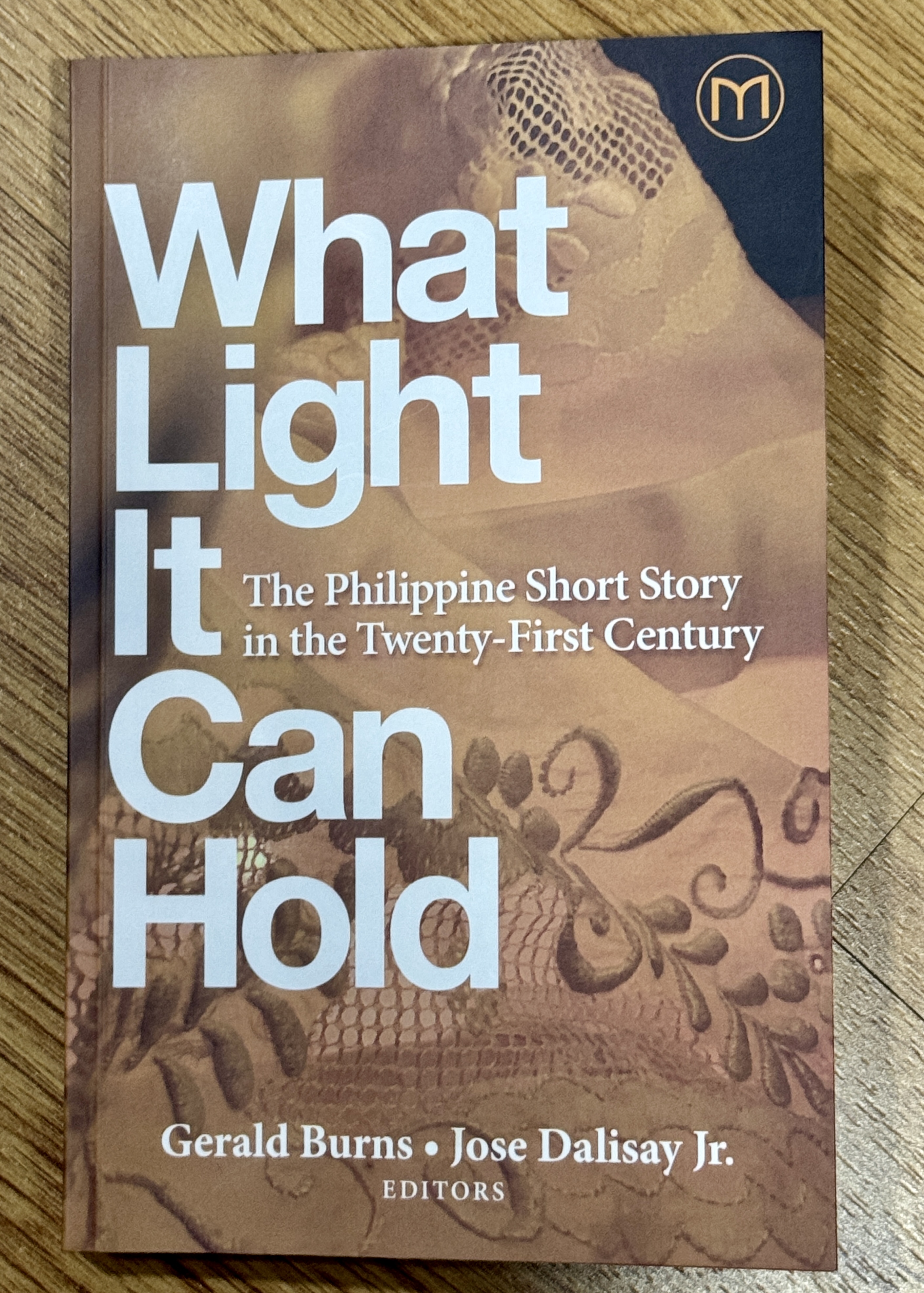
FEW MAY have noticed, but this year, 2025, marks the centenary of what has been widely acknowledged to be our first classic short story in English, Paz Marquez Benitez’s deathless “Dead Stars.”

As I’ve often observed as both a writer and teacher of Philippine literature, there’s probably no literary form more popular among Filipinos than the short story and its predecessors—myths, legends, folktales, and such stories that draw on the power of narrative to tell and teach us something about human life. 

A lot of this has to do with the fact that people and cultures everywhere have made use of stories to make sense of things—to establish causality in human actions—often as a way of prescribing and also proscribing certain behaviors. Stories were there to learn from, like the biblical parables, Aesop’s fables, and the creation myths. The more exciting and entertaining the stories were, the easier the learning happened. Even the mere recognition of oneself in a story that could have taken place a thousand years ago in a place across the planet makes our lives seem more meaningful.

In the Philippines—as it did in the West, where the modern short story took form—the short story was a staple of prewar weekly magazines like the Sunday Tribune, where a story written by an American author would be matched by a local story during what our early literary scholars like Leopoldo Yabes would call our period of apprenticeship. This was in English, but the short story in Filipino (then Tagalog) and other Philippine languages had developed even earlier, and continued (as it continues) to explore new forms and material.

Why the short story and not the novel? That’s another long discussion to be had, and I’ve addressed it in a lecture titled “Novelists in Progress,” but the short of it is that, well, we Pinoys like things in small doses (think Nick Joaquin’s “heritage of smallness”), and the short story satisfies our craving for a touch of fiction and fantasy in our ordinary lives. We’re not marathoners, but great sprinters; we’re not summiteers or navel-gazers, but masters of the street and alley. 

And so, over the past century, important anthologies of the Philippine short story have been published, tracking the development of the genre and its practitioners, from Yabes’ landmark Philippine Short Stories 1925-1940 (a project continued by Gemino Abad for 1956-2008) to Isagani Cruz’s Best Philippine Short Stories of the Twentieth Century (2000). Outside of English, Mga Agos sa Disyerto edited by Efren Abueg came out in 1964, proclaiming new directions for Tagalog short fiction, and the much-needed Ulirat: Best Contemporary Stories in Translation from the Philippines was published in 2021, edited by Kristine Ong Muslim.

But the 21st century is now a quarter of the way through, and just in these past two decades or so, a fresh bumper crop of brilliant new stories has built up, awaiting harvest.

Five years ago, an American friend named Gerald “Jerry” Burns—a fellow academic and a scholar of Philippine literature in English, now Emeritus Professor at Franklin Pierce University in New Hampshire—decided to do just that: review the best of the newest Philippine short stories and produce a selection with which to introduce them to the world. He needed a collaborator, and having worked with Jerry earlier when he was a Fulbright professor at our English department in UP, I agreed to co-edit the volume with him. Because of our backgrounds, our stories would be mainly those written in English (and the excellent Ulirat had already covered much more ground in the other Philippine languages than we ever could) but Jerry wisely insisted that we should have at least some representation of non-English stories in translation in the book, if only to lead the reader to explore more in Ulirat.

The selection process was predictably long and bruising, with all the political, aesthetic, and practical considerations that go into anthologizing, but in the end we came up with 18 stories written by both familiar and fresh names, from within and beyond the Philippines, including the diaspora: Dennis Andrew Aguinaldo, Dean Francis Alfar, Mia Alvar, John Bengan, Ian Rosales Casocot, Richard Giye, Vicente Groyon, Ino Habana, Carljoe Javier, Monica Macansantos, Perry Mangilaya, Doms Pagliawan, Ma. Elena Paulma, John Pucay, Anna Sanchez, Larissa Mae R. Suarez, Lysley A. Tenorio, and Socorro Villanueva. We also found an agreeable and supportive publisher, Milflores Publishing, fortuitously run by Andrea Pasion-Flores, herself a fine fictionist who understood the need for a new anthology like this, especially on the threshold of the Philippines’ participation as Guest of Honor in this year’s Frankfurt Buchmesse.

The book’s title, What Light It Can Hold: The Philippine Short Story in the Twenty-First Century, was suggested to Jerry by an encounter with the piña weavers of Kalibo, Aklan, and a caption he saw that said: “How fragile a single thread of piña is, how delicate, but look how much light it can hold.” He explains that “What Light… is intended to recognize the limited capacity of the Philippine short story in this period to offer any widespread or definitive illumination of the nation’s life and culture. At the same time, a more expansive understanding of that title is possible. For the short story, as will be suggested in the next pages, is a signature Philippine product, too. And these slender narratives, fashioned by their makers with a skill, patience, and devotion comparable to the piña weavers’, bring what light they can hold to vital areas of contemporary Philippine and larger human experience.”

No anthology project will be without its perceived failures and omissions, and Dr. Burns and I remain fully open to criticism in that respect. But we believe the sympathetic reader still stands to profit from both the selections and the introduction, penned largely by Jerry, that makes salient observations on the changes that have taken place in this most favored literary form of ours over the past century. Happy reading! (What Light It Can Hold is available on Lazada and Shopee.)
Qwertyman No. 132: A False Horizon

Qwertyman for Monday, February 10, 2025

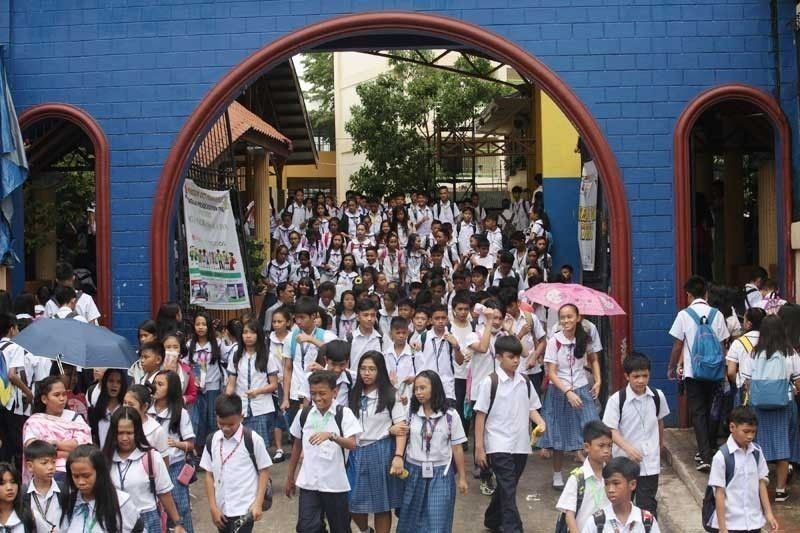
I DON’T know why, but like the proverbial bad penny that keeps turning up (English teachers: note the British idiom), every few years, some Filipino school announces its adoption of an “English-only” language policy on its campus, ostensibly in the service of a sublime objective such as “global competitiveness” or “global competence.”

This time around, it’s the Pamantasan ng Cabuyao that’s enforcing the rule. PNC president Librado Dimaunahan has issued a memo declaring that “In line with our vision of developing globally competitive and world class students, the Pamantasan ng Cabuyao (University of Cabuyao) is now an English-speaking campus starting Feb. 03, 2025…. All transactions and engagements with officers, students, employees, and workers should be communicated in English, whether written or otherwise. For strict compliance.” What he wanted to create was no less than “a strong English-speaking environment.” 

A few years ago, it was Cavite State University which required its students, teachers and staff to speak exclusively in English or face punishments like getting your ID confiscated and having to sing the CvSU hymn (in English, of course). Filipino could be used only by maintenance workers—and by others, but only in the restrooms and cafeteria.

I’m not going to add to the brickbats that these ideas have already received, not unreasonably. But I will add my two cents’ worth (my, where do these “brickbats” and “two cents” come from?) to the conversation, as a lifelong user and teacher of the language.

I have a PhD in English—something I don’t often bring up because it sounds so pompous and presumptuous—earned in America where, to my smug satisfaction and my classmates’ consternation, my professor would single out my prose for, among others, its perfect punctuation. I was the only one in our graduate literature class who could explain the difference between parataxis and hypotaxis (no, nothing to do with Yellow Cabs and Uber). Was that global competitiveness? I guess so. Was I proud of my English language skills? Of course. Did it make me or the Philippines any richer? Not a dollar more. Is this what a national language policy should be about? Heck, no.

I’ve done well in English not because I was forced to, but because I love the language, and languages in general. I should have loved Spanish—discovering its beauty too late, when I had to read and translate Federico Garcia Lorca for a grad-school exam—but I didn’t, because we had been forced by our curriculum to take so many units of it (24, in my mother’s time). I started on German and French in high school and college and am picking German up again on Duolingo, in preparation for the forthcoming Frankfurt Book Fair. (I write plays and screenplays in Filipino, despite being born in Romblon.)

What I’ve realized from studying these languages and from a lifetime of writing, speaking, and using English is that in our country of over a hundred languages, English can’t be taught and learned well by exclusively using English. I’m learning German on Duolingo using English.

I don’t mind saying that when I teach creative writing or literature in English, I pause when my students can’t seem to understand what the text is saying—and then we pursue the same line of inquiry in Filipino, and everybody goes “Ah!” It makes simple teaching sense. You can’t get more out of a student—in English—if he or she can’t understand or even recognize the problem, in English. 

And just to be clear, these are questions of comprehension and interpretation that even native speakers of English would have a hard time with. (How do I know? I taught the American short story to American undergraduates in Wisconsin.) These are questions like “So what’s John Updike saying about the position of the rebel or nonconformist in society at the end of his story ‘A&P’?” That’s best answerable if you also discuss as we do what America was like in the 1960s, with Vietnam, Woodstock, the civil rights movement, and the moon landing in the background. (I always tell my students that we’re not studying American literature and history to become Americans, but to become better and wiser Filipinos.) 

Boomers like me like to recall that in many private schools of our time, students were fined five centavos for every instance they were caught using Filipino. Some may find that quaint or even charming, but if you think anyone learned and loved English because of these stupid rules, think again. Students learn good English from good teachers who don’t teach English as a grammar rulebook but as a road map or even a cheat sheet to an adventure.

English is best learned along the way of learning something else—like how the world works, in science and literature—as a key to unlocking knowledge and meaning. English proficiency all by itself is a non-goal, a false horizon that can delude people into believing that they’ve arrived. Arrived where? What for?

All the English in the world isn’t going to turn the Philippines into an economic powerhouse—which Japan, China, Russia, and Germany managed to become without a mandatory word of English in their curricula from decades back. Better English could make us become more employable as waiters, domestic helpers, and seamen—and I’m not downplaying this, because the language does give us an advantage in those markets—but these jobs, noble as they are, aren’t what universities were made for.

All the English in the world isn’t going to drive a moral spine up the backs of our leaders. Intolerable as it was, one president’s foul mouth and boorish manners may not be far worse than a General Appropriations Act legitimizing the wholesale thievery of people’s money in perfectly edited English. 

We can speak all we want with an American accent—only to realize that, in Trump’s America, where one of his appointees has declared pointblank that “It takes a competent white man to get things done right,” the color of your skin still matters more than whether you can pronounce “Adirondack” or “tortoise” correctly. Trump’s maniacal edicts and pronouncements—cutting foreign aid, expelling Palestinians so he can turn Gaza into an American beach resort, and turning the FBI and the DOJ into his personal security force and loyalty police—have all been made in his lazy, slurring English, each word delivering chaos and disaster with as much consequence as Hitler’s Nuremberg rants.

More shameful than lack of proficiency in English is lack of proficiency in one’s own language, which I see in the children of parents anxious to “globalize” their kids without mooring them first in their own culture. Those children will be maimed for life, insulated from and unable to communicate with or relate to their common countrymen. We need our own languages to understand ourselves.

Teach good values and good citizenship. Even if that student’s English turns out less than stellar, our country can’t be worse off.

Qwertyman No. 96: Not Filipino Enough

Qwertyman for Monday, June 3, 2024

IN THE current feeding frenzy over Bamban, Tarlac Mayor Alice Guo’s allegedly questionable citizenship (to which I admittedly contributed with my tongue-in-cheek take two weeks ago), a consensus appears to have formed that Mayor Guo isn’t Filipino, or isn’t Filipino enough. All kinds of “tests” of “Filipino-ness” have come up online, things that every homegrown Pinoy is supposed to know: dinuguanchismis, Dolphy, chakapeks man, etc.

The ancient Hebrews had a word for this practice, by which they distinguished friend from foe: “shibboleth,” which supposedly couldn’t be pronounced correctly by the enemy, much like the myth that “Mickey Mouse” was the password American GIs used on D-Day, because it was something only Yanks understood.

We can understand how and why these exclusionary measures serve a purpose: to protect the community from external threat. At the same time, these cultural code words help define that community by establishing a common denominator (as common as can be—not George Washington or Alexander Hamilton, but Micky Mouse). Interestingly, they say as much about the excluders as the excluded.

The larger question that needs to be asked by truly inquiring minds is this: what does it really take or mean to be Filipino? Not just “a Filipino,” a matter of citizenship or legal personality provable with birth certificates and passports, but “Filipino” in a more personal, cultural, and even psychological sense.

When we challenge Mayor Guo’s identity—is she who she claims to be?—we imply that we know ours, and feel secure in that knowledge. We think that eating balut and pinakbet, dancing the tinikling and budots, listening to the Eraserheads and April Boy Regino, putting out an open palm ahead of us and bending when we cross a busy room, and counting on our hand from one to five starting with the pinky finger make us Pinoy—and of course they do; but are they enough?

Academics (and, let’s not forget, politicians) have long wrestled with this question, given how our extensive colonial history has effectively extinguished whatever the aboriginal pre-Filipino may have been in most of us. For better or for worse, the “Filipino” we speak of and identify as today is a fairly modern construct and, to my mind, still very much a work-in-progress, as is the Filipino nation itself.

One such academic view was provided by UP Assistant Professor Jay Yacat in the Philippine Journal of Psychology in 2005, where he wrote that “The label ‘Filipino’ functions as a social category. And as such, it is important to identify its boundaries. The meaningful boundaries define the loob/labas of the concept of Filipino. Identity as Filipino was found to have three relevant components: pinagmulan (socio-political component); kinalakhan (cultural component); and kamalayan (psychological component). This supports the position that national identity is more than a political identity. It is possible to think of national identity as three kinds of relationships: relationship with the state; relationship with culture; and relationship with self and others.…

“However, the more interesting finding is that individuals and groups place differing emphases on the three dimensions…. Another important implication is… the constructed-ness of our national identity. Our notion of being Filipino is negotiated and not fixed. This means that our definitions of being Filipino have the potential to be changed depending on a variety of factors: gender, ethnicity, age, political convictions, background, upbringing among others. True, this flexibility may bring about more confusion about our national identity but on a more positive note, this could also provide maneuverable spaces for marginalized groups to participate in a national context: Chinese-Filipinos, Amerasians and other biracials in the Philippines; naturalized citizens; indigenous peoples; and non-Christian groups….

“The analysis identified two kinds of Filipino-ness. This is based on the level of identity integration into one’s loob. A more integrated sense of Filipino identity is called ‘Pilipino sa puso.’ The individual who has not fully integrated this sense of being Filipino into the self is known as ‘Pilipino sa pangalan.’ Kamalayan (psychological sense) seems to be the primary determining factor of Filipino-ness.”

That’s a lot to digest, but my clearest takeaway—which we don’t really need a professor to tell us—is that Filipino-ness can be superficial or deeply felt and understood. The degree of that understanding—of who we are, where we came from, where we want to go, how to get there, and whom we need or want to make that journey with—may yet be the ultimate gauge of how Filipino we are. 

Another suggestion I’d like to make is that to be Filipino is to be inclusive, and therefore tolerant of other ethnicities, cultures, and beliefs. We’d never have survived this far if we weren’t so, despite the regionalism that seems ineradicable in our national politics. 

The Senate is right to continue probing Mayor Guo for her suspected ties to illegal gambling and human trafficking, and for the questions hovering over her citizenship. But Filipino-Chinese cultural advocate Teresita Ang See is also right to deplore the disturbing turn of the public mood into one of a witchhunt against the Chinese among us. 

Continuing Chinese provocations in the West Philippine Sea present a clear and present danger. The Guo allegations and suggestions of “sleepers” in the country are riding on those concerns to build up a hysteria that might ultimately divide rather than unify us. They deserve to be investigated, but without losing focus on the real enemy. I’ve seen some of the vicious feedback that Ang See has received for her sober warning; none of that vitriol makes her any less a Filipino than her attackers.

Indeed, the worst damage to our security and sense of nationhood isn’t being done by Chinese spies, but by Filipinos parroting the Chinese line or selling us the story that opposition to Chinese aggression is futile and that seeking international help against it will only bring on a war we can’t win. These are the real sleepers in our midst.

Qwertyman No. 75: Trump 2.0

Qwertyman for Monday, January 8, 2024

IN MY column last week, I mentioned the “Trumpian dystopia” threatening to take over the United States and many other rightward-leaning societies and governments around the world. 

A “dystopia” is, of course, a place or a situation where everything has been turned on its head, where the bad has become good and the wrong has become right, and where the things we most feared or abhorred have become the norm. You find this in George Orwell’s 1984, where the government controls everything; younger readers and viewers will relate to Suzanne Collins’ The Hunger Games, where citizens are sacrificed for the Capitol’s entertainment. In other words, it’s social and political hell for those reared in the kind of postwar liberalism that eschews racial discrimination, authoritarianism, gender inequality, and religious intolerance, among other shibboleths.

It’s hard to believe that much of America seems to be marching in lockstep toward that dystopia under a revived Donald Trump, wh0m nearly all polls see as leading the race for the US presidency, which will be at stake in November this year. On this date three years ago, he was squarely in the doghouse in the aftermath of the shockingly violent assault on Congress on January 6 by Trump partisans unwilling to accept that he had lost to Joe Biden in the election. Even his closest allies at that time distanced themselves from his apparent captaincy of that bloody caper, although many of them have returned to his kennel. 

Nearly a full presidential cycle later, he’s back in the Republican saddle, way ahead of a pack of rivals who, save one, have refused to denounce Trump for what he is: the greatest single threat to American democracy because of what he represents (leaving aside foreign tyrants like Vladimir Putin and Kim Jong-un). That, not surprisingly, is President Joe Biden’s exact description of him, so some might say it’s biased, but to remain unbiased against Donald Trump is to lie prostrate in front of a steamroller, begging to be annihilated.

It doesn’t help that the incumbent is 81 years old, palpably slow, avuncular, and whispery where Trump screams into people’s ears (to the delight of many). Their age difference—just four years—isn’t actually all that much, but beyond personalities, it’s a difference in cultures, and perhaps of understanding how politics works in this post-Facebook age, where obnoxiousness has become a virtue and regularity a liability.

Trump thrives on notoriety, parlaying the four indictments involving 91 criminal charges against him—plus the two disqualifications from state ballots—into a kind of a badge of courage, flipping prosecution into persecution. Rather than fracture his base, any attack on Trump (and any attack by him) only seems to consolidate the estimated 30-40% of hardcore Trumpers who now effectively define the Republican party, the tail wagging the dog.

Among the most repugnant (and, by Trumpian logic, among the most attractive) of his recent statements has been his denunciation of undocumented migrants as “poisoning the blood of our country,” specifically mentioning Latin America, Africa, and Asia as the sources of what in other speeches he has called rapists, terrorists, and Covid carriers.

You would think that that kind of Hitlerian rhetoric would galvanize the Hispanic and Asian-American—not to mention the African-American—communities in America against Trump, but no. If anything, his support among these groups seems to be rising, driven ironically enough by his hardline position on immigration, the very same factor that made these minorities possible to begin with.

What I’m interested in is how the Filipino-American community will respond to Trump 2.0, and what that will say of us as a people, albeit as one of many minorities in America’s multiracial society.

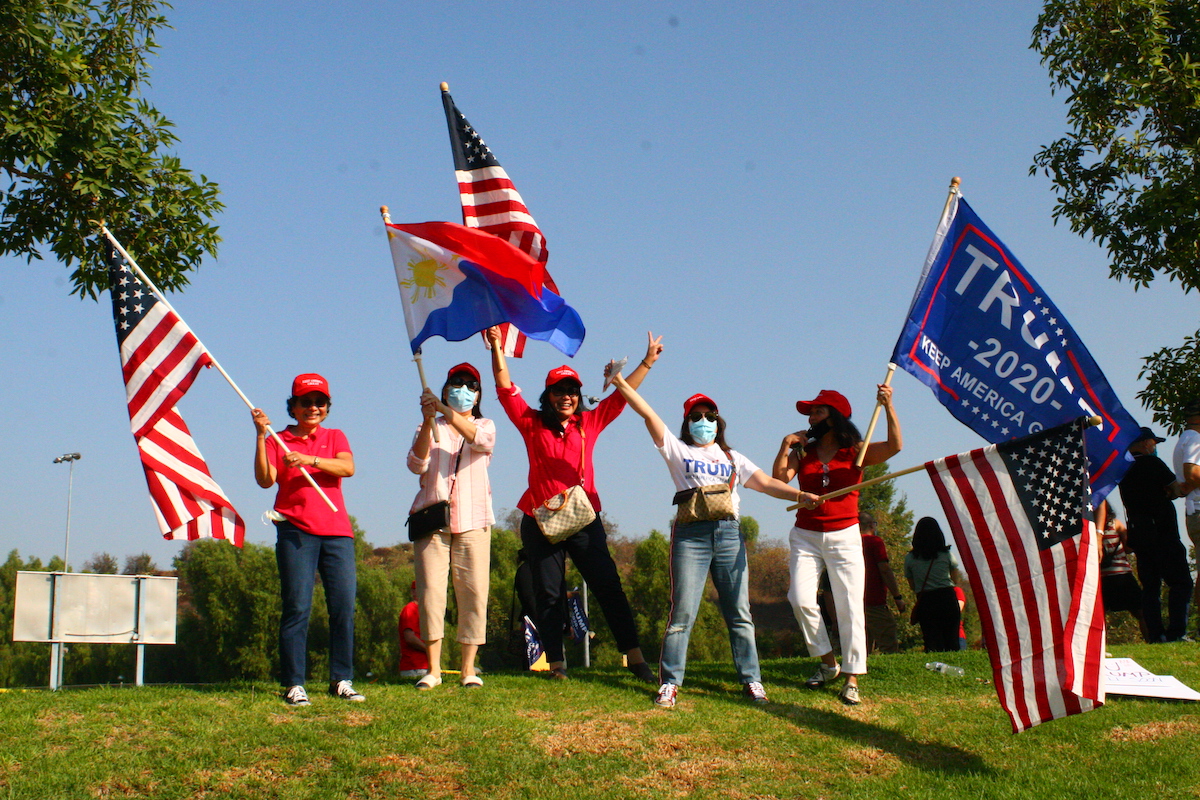
There are now about 4 million Filipino-Americans; half of them, 2 million, are voters. (To put this in context, the US population now stands at 336 million, of whom 170 million are voters.) Historically, Filipino-American voters have leaned Democrat, with a majority of them voting for Hillary Clinton and Joe Biden in 2016 and 2020. But a very vocal (though perhaps somewhat less visible, as many people tend to reveal their preferences only in the voting booth) “Filipinos for Trump” movement exists, and if trends persist will likely gain more traction this time around.

In 2020, Filipino pro-Trumpers cited “family, religion, and faith” as the main reasons they were backing him, like many American evangelicals, despite all the evidence to the contrary in Trump’s personal behavior and speech. For many, it all came down to one issue—abortion—the right to which has now been successfully rolled back by the Supreme Court’s conservative majority. This time around, the flashpoint will likely be immigration, a global problem abetted by collapsing economies and repressive regimes. Well-settled minorities such as Filipino-Americans derive a strong sense of entitlement from all the personal sacrifices and legal processes they went through to acquire their citizenship, and feel cheated by migrants scrambling across the border. This kind of single-issue vote—a gross simplification and reduction of values into one criterion—favors demagogues like Trump, who work through two-dimensional posterization.

A more interesting—and more sinister—reading of Trump’s popularity came up in a recent guest essay in the New York Times by Matthew Schmitz, arguing in his title that “The Secret to Trump’s Appeal Isn’t Authoritarianism,” but rather that “Mr. Trump enjoys enduring support because he is perceived by many voters—often with good reason—as a pragmatic if unpredictable kind of moderate” and “a flexible-minded businessman who favors negotiation and compromise.” That logic, while fetching, predictably drew quick rebukes. One reader said: “Thanks, Mr. Schmitz, but we’re already well aware of this. Italians liked Mussolini because he ‘made the trains run on time.’ This is exactly our point. This is how dictatorships happen.”

That brought me back to our own long and continuing affair with despotism, and how sharply simplified populist sloganeering can cut through and cut down on complex reasoning—with devastating consequences for democracy, here and across the Pacific. 

(Photo from colorlines.com)

Penman No. 381: The Best of New Writing in English

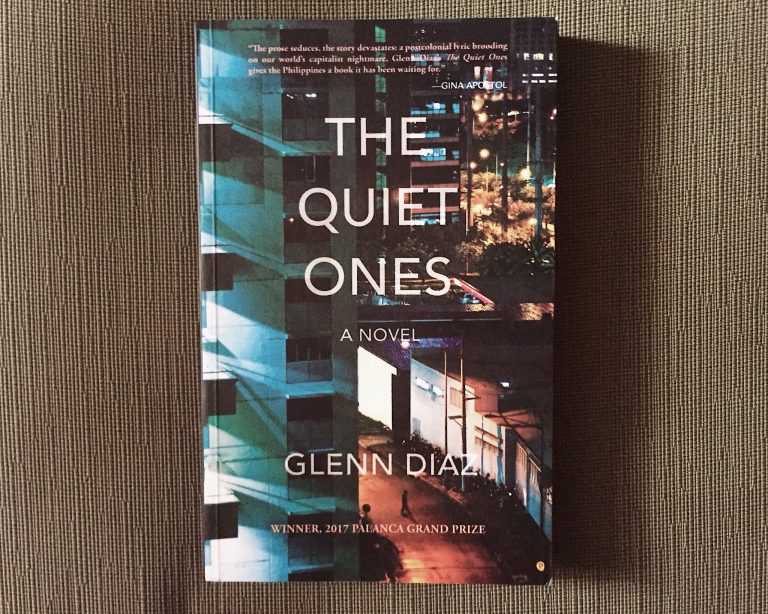
QuietOnes.jpg

Penman for Monday, February 17, 2020


ONE OF the things we’ve been proudest of doing at the University of the Philippines Institute of Creative Writing (UPICW) has been to encourage new writers in both Filipino and English—whether through workshops, grants, or publishing opportunities. Sometimes all writers really need is a bit of recognition from their masters and their peers, some formal acknowledgment of their talent to spur them on in a career with few rewards beyond the smiles and the sighs of their readers.

For nearly two decades now, thanks to the generosity of Atty. Gizela M. Gonzalez, herself a gifted writer, the Madrigal-Gonzalez Best First Book Award has honored its self-described winners—the best first publication in book form by a writer in Filipino or English for the past two years (alternating between the two languages every other year). A cash prize of P50,000 accompanies the award. Entries are submitted by publishers, for whom victory lies in discovering the next new literary star. It’s a safe bet: previous winners have included such luminaries as Sarge Lacuesta, Luna Sicat Cleto, Ichi Batacan, and Kristian Cordero, among others.

The 19th MGBFBA was given out at Writers Night last December in UP. I was in Singapore for another ceremony but was very interested in who would win (a surprisingly well-kept secret that even UPICW fellows are not privy to until the night itself). Only later did I hear, happily, that the winner was a former student of mine, Glenn Diaz, for his novel The Quiet Ones (Ateneo de Manila University Press, 2018), described by the judges as “a tour de force, an awesome game of fictional juggling, mastering multiple narratives that cascade, skim and collide, leaving the reader breathless, wondering if that was a whodunit, a philosophical foray into globalization, or a poignant story of love.” Well done, Glenn! But let’s give a shout out for the other finalists as well.

Jude Ortega’s Seekers of Spirits (UP Press, 2017) “opens up to readers a world of spirits, ancestral yet ever present, unseen yet all too powerful. They are constantly in the lives of humans, offering succor or malice. Yet, these stories suggest that, whatever power these spirits possess, no terror may be worse than that we inflict upon each other.”

Manuel Lahoz’s autobiographical Of Tyrants and Martyrs: A Political Memoir (UP Press, 2018) is “a riveting political memoirof martial law in the Philippines and its many victims… a record of Lahoz’s own apotheosis from priest to social activist to political prisoner and participant in the political underground. In his personal transformation we sense as well the coming of age of an entire generation.”

 Francis Quina’s Field of Play and Other Fictions (Visprint, 2018) displays “the sensibility of a poet as well as the rigor of the literary scholar and writing teacher. He seeks to dissect both the intricacies of the human heart and the manner by which these are re-enacted in art. His is a new, vibrant voice in fiction.”

Christine Lao’s Musical Chairs (2017) is a “small and compact chapbook… (of) stories in the way they were first invented: as lore, as fable, as stories of good and evil but, in this collection, rendered with the complexity of the modern world.”

Johanna Michelle Lim’s What Distance Tells Us: Travel Essays About the Philippines (Bathalad, 2018) covers “twelve Philippine destinations, from Batanes to Sitangkai, from Sagada to Siargao… (and) lures us with language, entices us into the territories of enchantment not always of the exotic but also the local and commonplace. In these peregrinations… she evolves en route: in the various guises of the traveler, artist, and activist she aspires to be, but also the one she was never ready for.”

Sarah Fernando Lumba’s The Shoemaker’s Daughter (Visprint, 2018) consists of “tightly woven tales, narratives sewn together with the deliberate shoemaker’s art, with the rough edges shaved off as if with a leather skiver—these are what make The Shoemaker’s Daughter an important contribution to new Filipino fiction…. (They) take us through Marikina shoemakers’ country, with its achingly familiar small-town complexion and its river changing from a benign periodic visitor to an existential threat.”

Marichelle Roque-Lutz’s Keeping It Together (Roque-Lutz Publishing, 2018) “traverses what might be called an intercontinental trampoline that stretches from Manila to Nigeria and America, which need not be only geographic because the memoirist from the start is a soul-in-search, ever moving through time and into herself. Most memoirs are helped by faithfully kept journals. Keeping It Together is directly helped by a copious streaming from the heart, a first book by an able and polished author, a fully evolved, mature soul.”

It was a strong batch, all told, which can only bode well for the future of creative writing in English in the Philippines, fraught as it has always been with political and aesthetic challenges. As the late NVM Gonzalez used to put it, “I write in Filipino, using English”—a formula that seems to be working just fine.

Penman No. 333: An Academy of Our Own

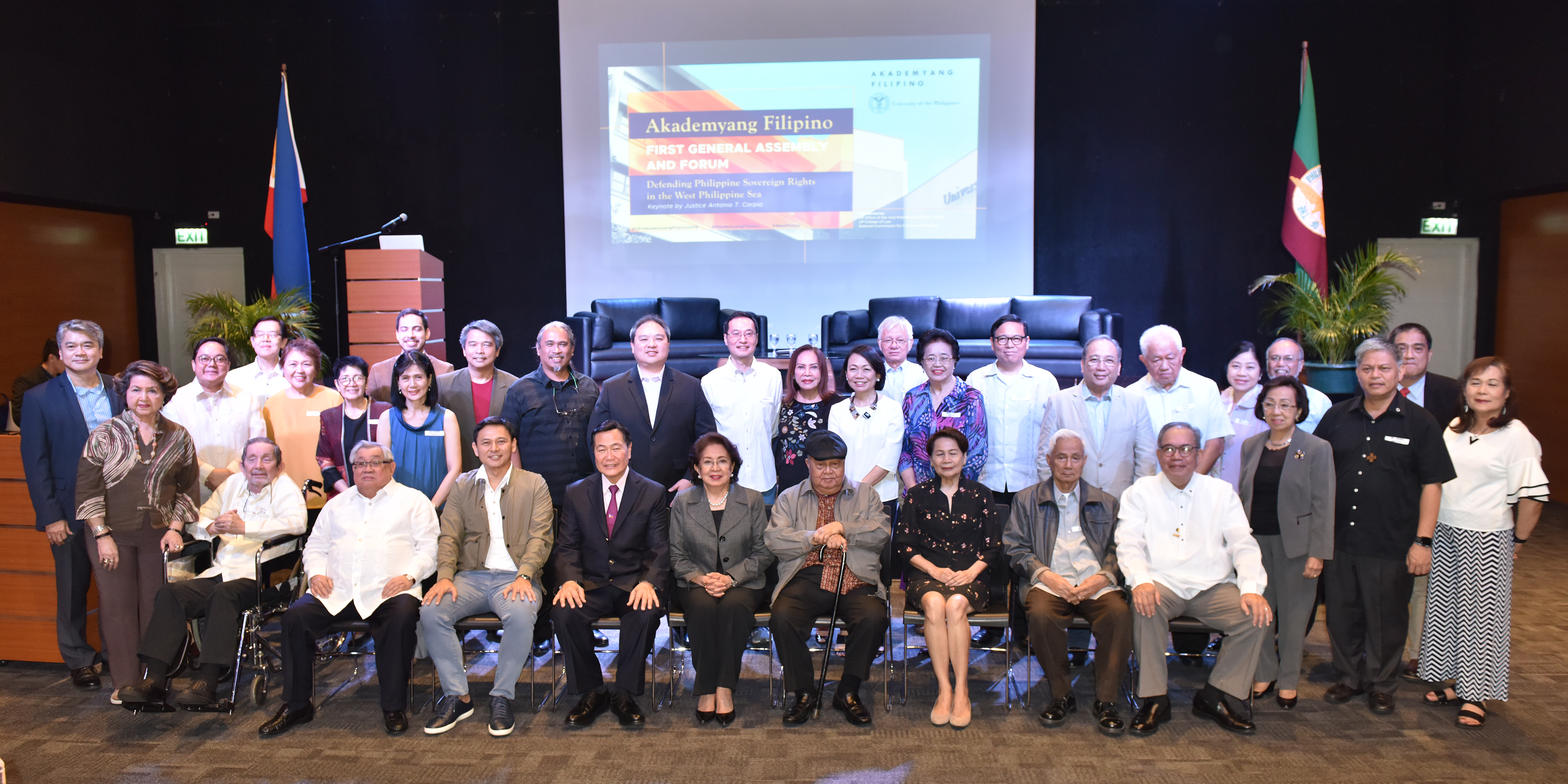
DSC_9291.JPGPenman for Monday, December 24, 2018
 

EXACTLY A month ago, in the auditorium of the newest campus of the University of the Philippines at Bonifacio Global City, an event of great historical significance took place—the first general assembly and forum of the newly organized Akademyang Filipino, the first Philippine academy of arts, sciences, and the professions.

Conceived together by National Artist F. Sionil Jose and the late Sen. Edgardo J. Angara, the independent and non-partisan Akademyang Filipino was set up for three main goals:

“To recognize and bring together, in one chamber, the best of Filipino minds and spirits, accomplished representatives of the Filipino arts, sciences, and professions, imbued with love of country and the spirit of service to the nation;

“To uplift the material and moral lot of the Filipino people, to define, promote and defend the best interests of the Filipino nation, and to find and nurture new sources of hope and inspiration for the Filipino youth; and

“To provide a forum for the rational discussion of pressing issues and the exploration of pathways to a better future.”

In other places, such academies have had somewhat more focused roles. The venerable Academie française is devoted to being the authority on the French language; the Taiwan-based Academia Sinica covers a broad range of disciplines but supports advanced research.

In the United States, the National Academies of Sciences, Engineering, and Medicine is the collective name of the three honorific academies in those disciplines. Since its founding in 1863, these national academies have pledged “to marshal the energy and intellect of the nation’s critical thinkers to respond to policy challenges…. When faced with a complex question, we bring together experts from across disciplines to look at the evidence with fresh eyes and openness to insights from other fields. These study committees survey the landscape of relevant research, hold public meetings to gather information, and deliberate to reach consensus, which results in a shared understanding of what the evidence reveals and the best path forward.” Studies and advice by the National Academies have covered such diverse topics as fixing the Hubble telescope, preventing wrongful convictions, and preparing young Americans for careers in science and engineering.

This is probably closer to what the Akademyang Filipino aims for—to repeat, “a shared understanding of what the evidence reveals and the best path forward.”

In our first forum, Justice Carpio gave a masterful presentation of the history of China’s claims to Philippine territories in the West Philippine Sea, using ancient maps to prove—as a good lawyer might be expected to do—the paucity of those claims. A panel of Akademya members and West Philippine Sea experts—De La Salle University’s Renato Cruz de Castro, UP’s Jay Batongbacal, and author and columnist Richard Heydarian—discussed the current Philippine government stand on the disputes was and warned against a policy of appeasement and surrender.(The DFA was invited but apparently declined to send a representative to the forum.)

The Akademya’s 100-plus founding members—a roster that could grow as more names are vetted—were selected by an interim board composed of NA Frankie Jose, National Scientist Angel Alcala, former Ombudsman Conchita Carpio Morales, Senior Associate Justice Antonio Carpio, Sen. Sonny Angara, former Sen. Ramon Magsaysay Jr., Atty. Felipe Gozon, Dr. Lydia Echauz, Ms. Doris Magsaysay Ho, and myself. We also elected Justice Carpio Morales our chairperson, and NA Jose as Chairman Emeritus.

Some easily recognizable faces at the launch included former UP President Emerlinda Roman, former Education Sec. Armin Luistro, former Foreign Affairs Sec. Delia Albert, former National Historical Commission Chair Maris Diokno, former Prime Minister Cesar Virata, historian Dr. Ricky Soler, Mapua University President Rey Vea, businessman Jack Ng, novelist Cristina Pantoja Hidalgo, sculptor Toym Imao, and Anvil Publishing chief Andrea Pasion-Flores.

A smaller group had met less formally for the first time in February last year, when Sen. Ed Angara was still around and very much involved in getting the academy off the ground alongside NA Frankie Jose. It still called itself the “Academia Filipina” then, but later changed its name in deference to an existing Academia Filipina de la Lengua Española.

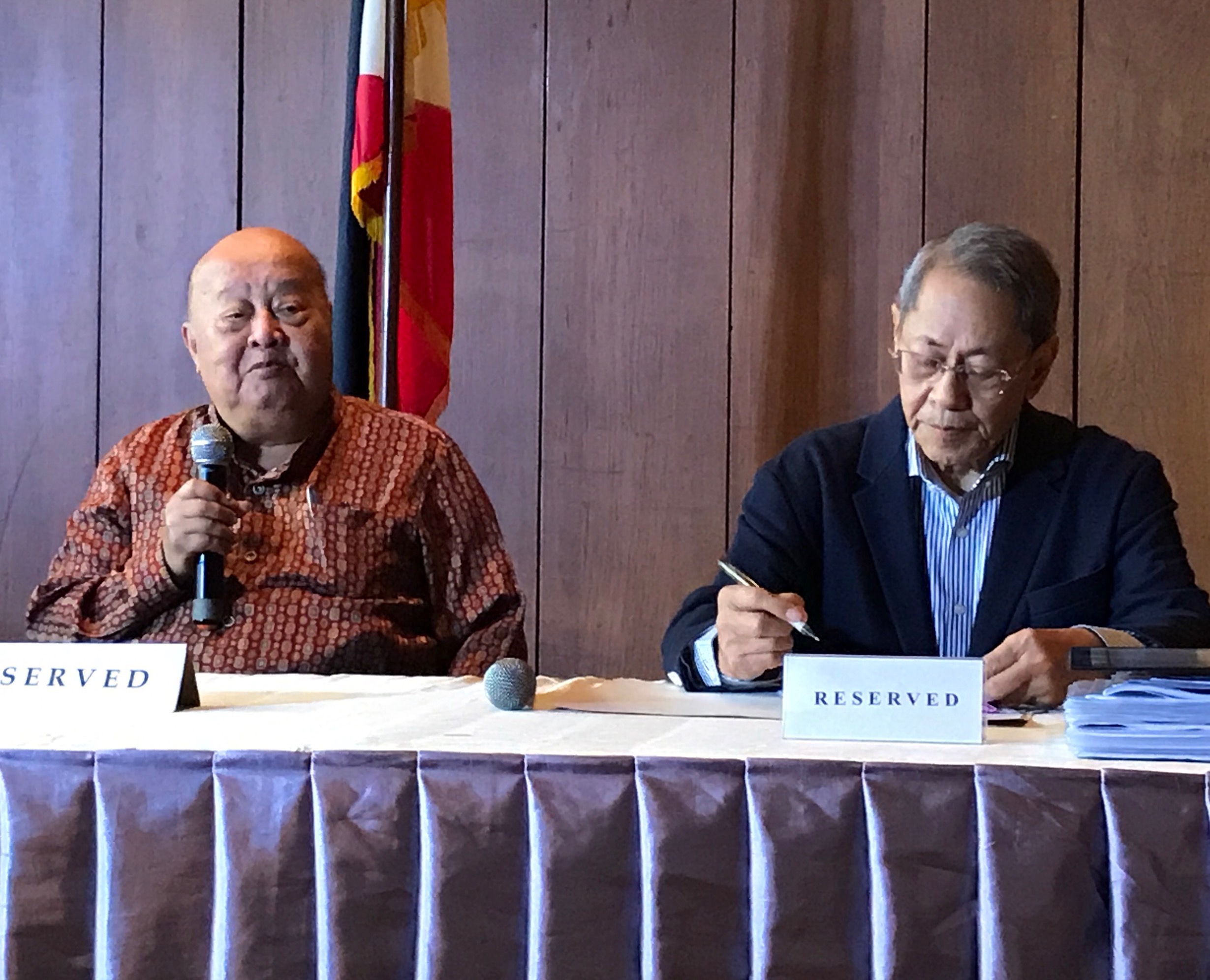
IMG_0895.jpeg

This was the first but certainly not the last of our forums, and we intend to have several of these large assembly-type meetings every year for issues of great and general significance, concerning not just politics and business but also science and the arts. We need to create new interdisciplinary points of intersection and interaction. Our artists and scientists hardly ever get heard by our policy makers. With all due respect to the lawyers and the businessmen, they too might benefit from the insights of these other disciplines, so that we do not get mired in the kind of cynical pragmatism that drives too many of our decisions today, and remember to value such abstractions as beauty and logic.

The dues we collect will help support a very small back room and also our future activities. Sponsorships are of course needed and welcome, for so long as they do not compromise the independence of our association.

On that note I would like to thank, once again, aside from our speakers, our sponsors for the Akademyang Filipino event, including the UP College of Law, whose Dean, Fides Cordero-Tan, also happens to be the Executive Director of UP-BGC. I’d also like to thank the National Commission for Culture and the Arts, Sen. Jun Magsaysay, and other donors who prefer to remain anonymous for their assistance. My special thanks go to our Executive Director, Ms. Jette Jose Bergkamp, and my UP team from the Padayon Public Service Office and the Media and Public Relations Office.

Penman No. 319: A Priceless Literary Treasure

IMG_7732.JPG

Penman for Monday, September 17, 2018


SINCE I seriously got into antiquarian book collecting not too long ago, I’ve picked up quite a few books that have required the services of a professional book restorer. Surprisingly for most people (but not to bibliophiles who know the history of papermaking and publishing), the books most in need of help often turn out to be the newer ones—and by “newer” I mean a hundred years old or so, books published in the early to mid-1900s.

My oldest book dates back to 1551, an abridged volume in English on the history of institutions. I found it in, of all places, Cubao via an OFW who received it from her employer in Paris and sent it on to her son, who thankfully for me had little use for it and advertised it online. It’s amazingly robust for its age, still tightly bound in its original leather covers, the paper crisp and the printing sharp and clear, annotated here and there by the hand of its various owners down the centuries. (I was tempted, but I didn’t dare inscribe my name on it.)

That’s also true for relatively more recent books from the 1700s and 1800s, some of which look and feel like they rolled off the press yesterday. (I first fell in love with old books as a graduate student of Renaissance drama at the University of Michigan, which kept books from the 1600s on the regular shelves of the library, fascinating me with the stiffness of their paper and the tactile feedback of the letters). I often treat visitors to my office with a whiff of centuries past, ruffling the pages of, say, a Jesuit history from 1706 beneath their noses.

But books from the 1900s and later typically turn yellow and crumbly. The culprit, of course, is the acid that forms in modern, wood-based paper because of a number of both internal and external factors.

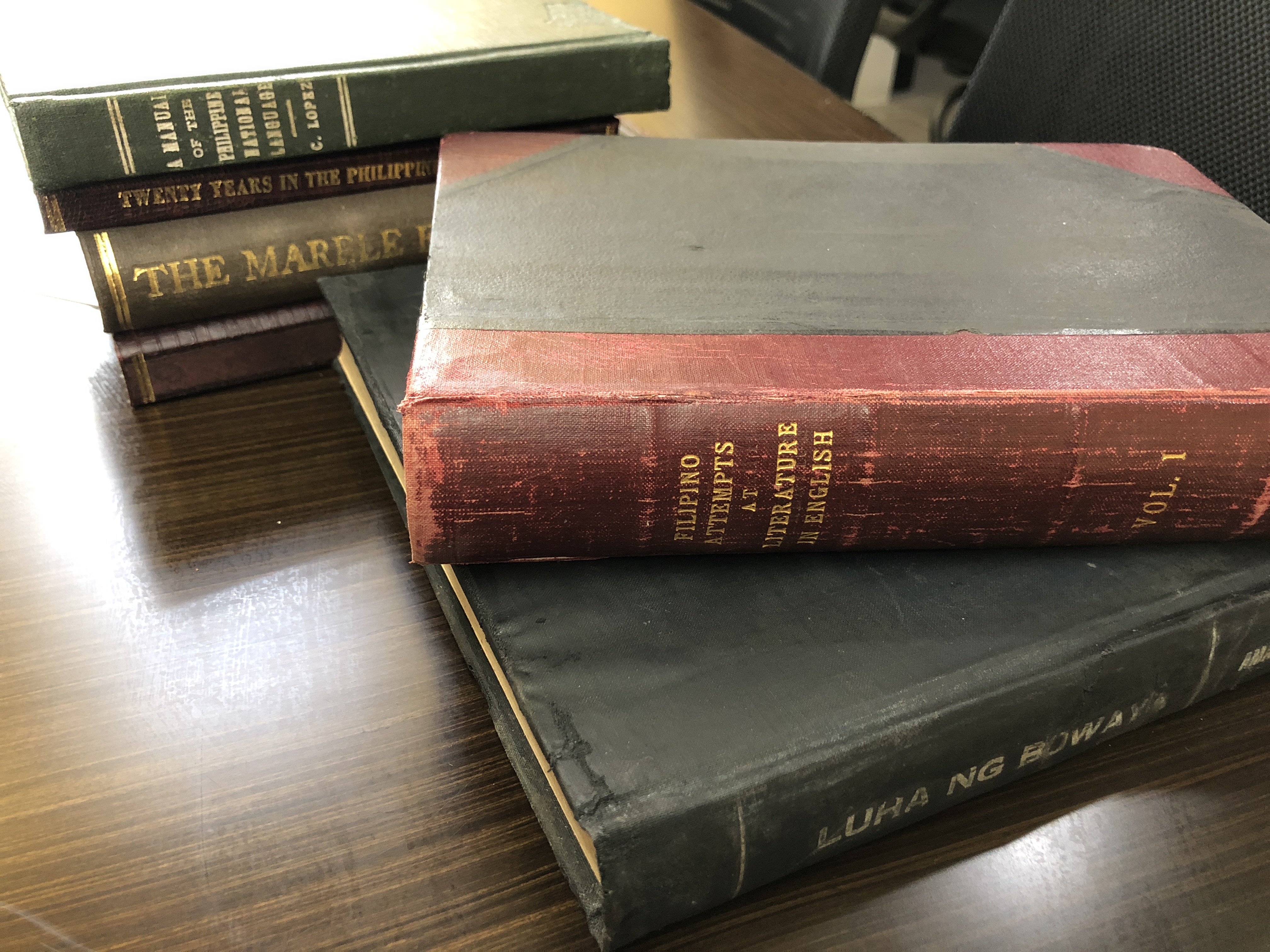
This was certainly true of a recent batch of books that I got back from my favorite book restorer (who shall remain unnamed for now lest she be deluged with requests, given that she has a full-time day job to mind). They included no book older than 1853 (a coverless edition of Paul P. de la Gironiere’s Twenty Years in the Philippines) and 1860 (a copy of Nathaniel Hawthorne’s The Marble Faun, which I didn’t even realize was a first edition until I noted the bookseller’s penciled notation 20 years after I’d bought it).

IMG_7699.jpg

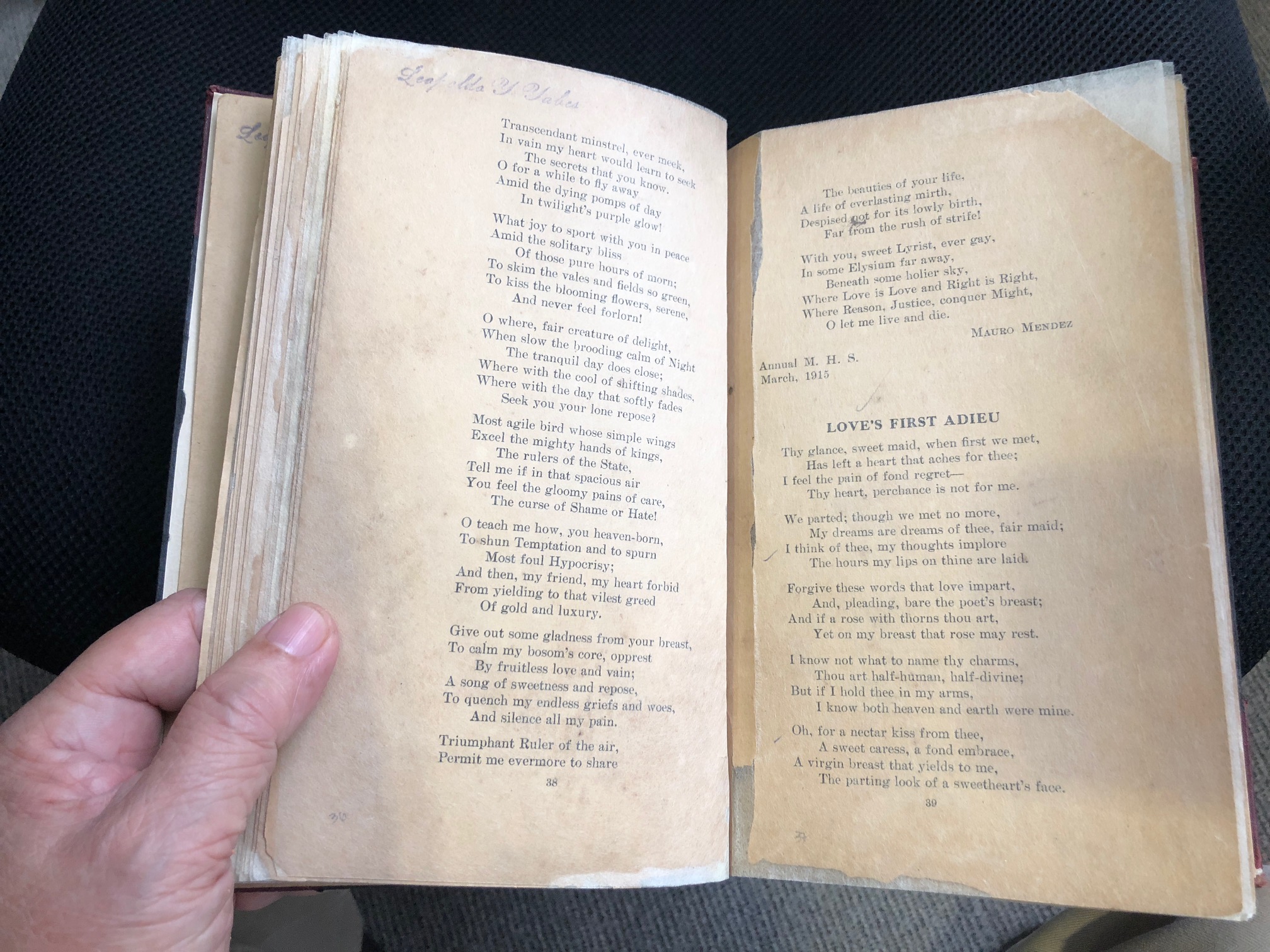
The prize in the pile was a thick clothbound book titled Filipino Attempts at Literature in English, Vol. 1 (Manila: J.S. Agustin & Sons, 1924). The volume is a compilation of smaller books from the 1920s to the 1930s, put together by the legendary professor and anthologist Dean Leopoldo Y. Yabes (1912-1986), who was scarcely in his twenties when he assembled and bound this compendium (signed “Bibliotheque Particuliere de Leopoldo Y. Yabes No. 118).

It’s an outstandingly rare collection, because it contains the only extant copy, as far as we know, of Rodolfo Dato’s landmark Filipino Poetry—the first major collection of Filipino poems in English. In the florid prose typical of the time, Dato prefaces his book by describing it as “a collection of the maiden songs of our native bards warbling in borrowed language,” acknowledging that “the full flowering of our poetic art has not yet come, but the fertile field smiles abundant growth and gives promise of a rich and bountiful harvest in a day not far distant.” In various pieces rhymed and metered, writers like Maximo M. Kalaw, Fernando Maramag, Procopio Solidum, and Maria Agoncillo give praise to mayas, moonlight, sampaguitas, and Motherland.

I had long been searching for the Dato book in the usual places online, for naught; but one day, at a committee meeting, my dear friend Jimmy Abad—the poet and anthologist—slipped it over to me, with the note “Priceless!” And indeed it was. Dean Yabes had gifted it to Prof. Abad, who was now passing it on to me in that timeless ritual that exalts and humbles writers and teachers who know exactly what they are receiving.

The compendium also contains an English-German Anthology of Filipino Poets  translated and edited by Pablo Laslo, with a preface by Salvador P. Lopez (Libreria Manila Filatelica, 1934); Dear Devices, Being a First Volume of Familiar Essays in Englishby Certain Filipinos (N. p., 1933); and the 1935 Quill, the Literary Yearbook of the University of Sto. Tomas, edited by Narciso G. Reyes. I’ll say more about these other seminal works later, as they’re truly invaluable glimpses into our earliest impulses as writers in English (and I have to wonder, if this was just Vol. 1, what Vol. 2 was like, if any).

Friendship aside, Jimmy must also have known that I was in a better position to take care of the volume, whose first 80 pages or so—almost the entire Dato book—had been torn, not just detached, from the spine by that infernal chemistry I described earlier. So I sent it to my restorer, who patiently mended each torn and fragile page with Japanese paper. Like my other jewels, this book will find its way to the UP Library at some point, now renewed for another generation of readers and scholars.


Penman No. 317: Bringing the Minor Masters Home

IMG_7340.jpeg

Penman for Monday, August 28, 2018


I’VE WRITTEN a few pieces recently about my self-assigned mission of finding and bringing home, from various sources overseas, masterpieces of Philippine publishing and literature, from early texts in Spanish to travel books about the Philippines and first editions or first publications of notable literary works.

This week I’m going to extend that to another burgeoning interest of mine—the recovery and repatriation of Filipino art pieces abroad, particularly those of painters who may never have quite achieved the status of a Juan Luna or Fernando Amorsolo, but whose works have their own charms to recommend them.

I may be luckier than most art fanciers in that I happen to know someone who restores the masters, so I get to see more than my fair share of Manansalas, Ocampos, Botongs, Magsaysay-Hos, and Luzes, up close, warts and all. But unless I win the Nobel Prize, I’m never going to own one of these masterworks, so I’ve learned to moderate my ambitions and aim for something both significant and reasonably attainable within a professor’s means.

Those goals crystallized for me when I attended, some months ago, an exhibit titled “Fascination with Filipiniana: The Vargas Collection,” curated by my friend and fellow UP prof Dr. Patrick Flores, who walked me through the show and pointed out how interesting (and not quite so seamless) the transition was between tradition and modernism, sometime in the past midcentury. I could see the tensions between the two, occasionally manifesting in the same artist’s earlier and later work (I don’t recall that he was in this Met exhibit, but Constancio Bernardo, who left the Philippines as an ardent follower of his teacher Amorsolo and came home a committed modernist, much to Amorsolo’s dismay, provides a good example.)

Many of the paintings on exhibit belonged to the school of “Mabini art,” a term often and unfairly used in the pejorative sense, suggesting cheap art done in haste for the tourist market. Indeed there’s a lot of that (and the purposes may not have changed; they’ve just become more pretentious, pitched toward buyers with deeper pockets), but these pioneering Mabini artists were talented in their own right, persistently romantic in a time of gloomy realism.

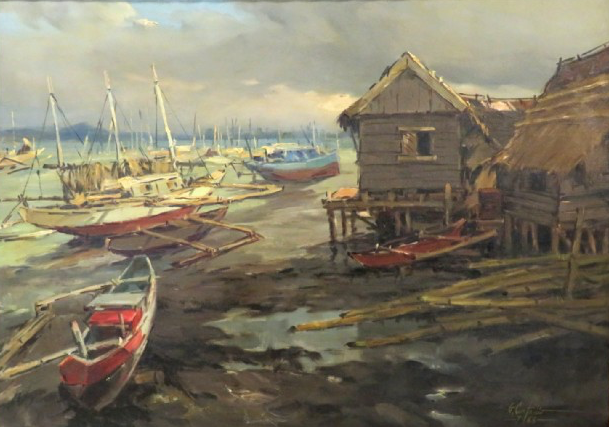
I was particularly drawn to the work of Gabriel Custodio (1912-1993), another student of Amorsolo and Fabian de la Rosa. I had earlier acquired two small paintings of his from the late 1950s, restful vignettes depicting rice fields and bamboo groves. The Tanza, Cavite native had produced larger seascapes that I admired, but the art market had caught on to him and I couldn’t possibly afford him at auction—at least not here.

I’ve long been convinced that in the United States—languishing in bedrooms, barns, garages, and resale shops—must be scores of Filipino art works brought over by American servicemen and diplomats after World War II and the Vietnam War, surfacing only recently with the passing of these veterans and being disposed of at auction by their heirs.

IMG_5767.PNG

A few months ago, a large painting by Custodio, about 2’ x 3’, turned up in, of all places, a Goodwill Store in Spokane, Washington—and I happily snagged that, and rolled it up in a tube for bringing home to Manila when I visited the US last month. Characteristically, Custodio signed it front and back, dated 1966; I’m calling it “Tanza Shore” in honor of his hometown and of its economic and cultural affinity to the water.

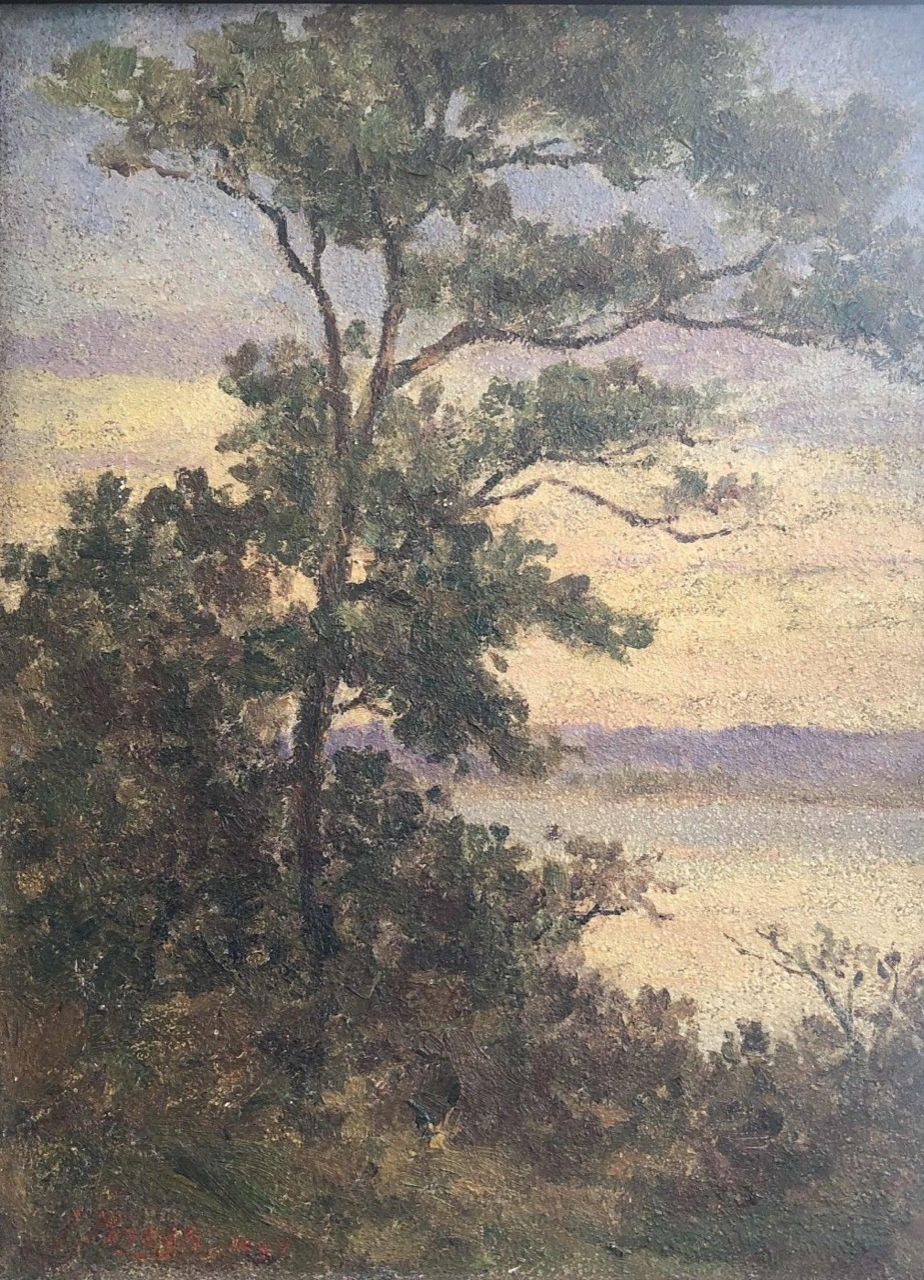
It was also on that trip when I secured and repatriated two other smaller but no less interesting pieces. One, shipped out of the East Coast, was an oil painting of a tree at sunset, more than anything an evocation of mood, an impressionist play of mauves, pinks, and oranges. It had been done by Jorge Pineda in 1937 and was still in its presumably original frame; the browned and crusty paper backing was beginning to crumble, but I plan to preserve it that way, as it bears the sticker of its framer: the Henry Schultheis Company, well known framers and gallery owners in New York City (Schultheis died in 1948). Pineda (1879-1946) himself was no mean painter, having won a prize for his work at the 1904 St. Louis World’s Fair and later becoming a teacher to Amorsolo.

Pineda1937 copy.png

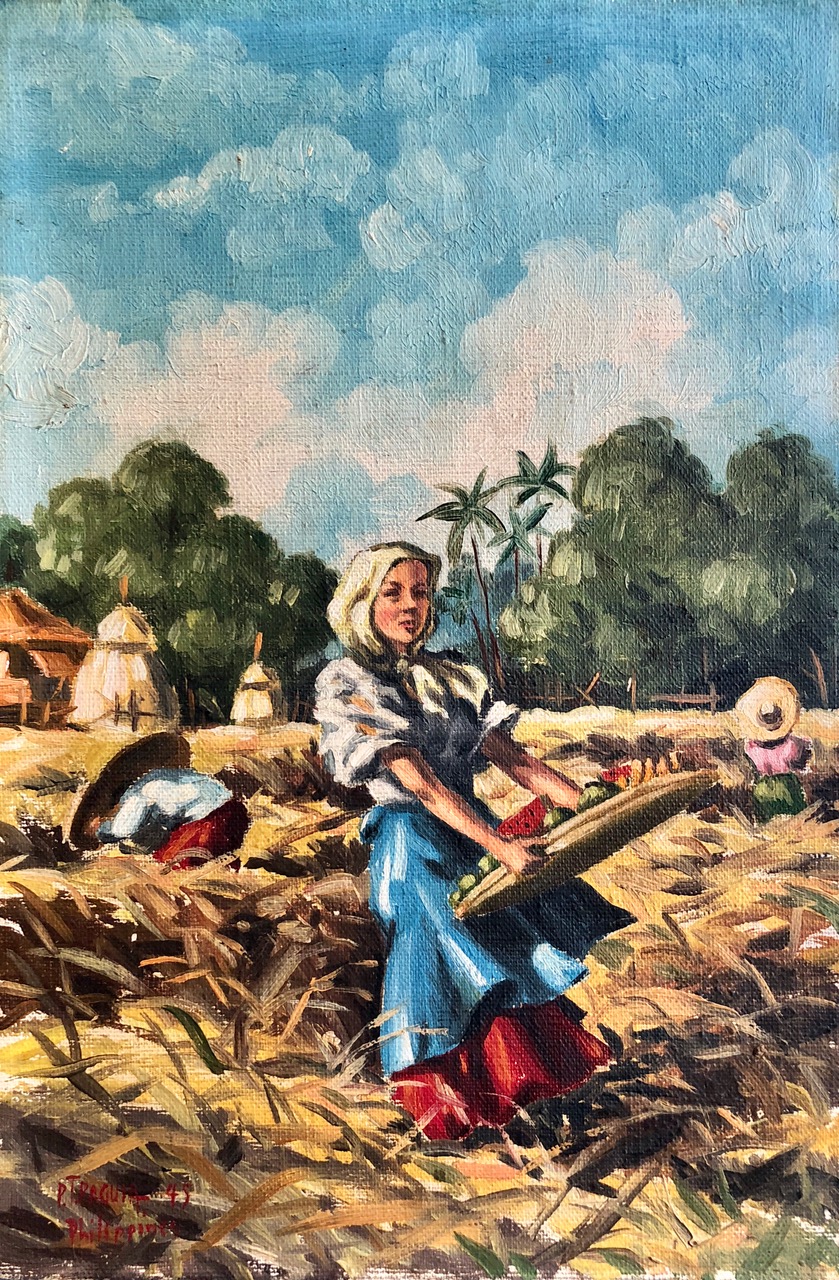
The third piece I brought home—sold by an antiques dealer in Connecticut—caught my eye not just because of its subject but also because of its symbolic use of color. It’s an oil-on-paperboard depiction of Filipino farmers harvesting rice—pretty typical enough, and unremarkable of itself. But this work had been done by one P. T. Paguia in 1945, at the end of the war and in a season of new hope—a patriotic optimism exuded by the red, blue, and white in the dress of the woman bearing a bilao of fruits in the foreground, echoed by the other farmer and the brilliant sky. (Patrick Flores reminded me that Amorsolo had done a similar work in these colors, Palay Maiden, in 1920.) Sadly I could find nothing on P. T. Paguia, except a reference to Pedro T. Paguia being the illustrator of a 1952 book by Ramon Tapales, Singing and Growing for the Primary Grades.

Whether by established or obscure artists, these paintings from decades ago bring me joy and relief from the vexations of our time. Of course I could resell them, but frankly they probably won’t make too much, and just looking at them makes me happier than wondering what they may be worth, which I suppose is what amateur collecting should be about. Call them escapist, but they fortify my spirit by reminding me of the need to fight for beauty and plenitude for all.


Penman No. 263: Geekdom Galore at Comic-Con 2017 (2)

IMG_2677.jpeg

Penman for Monday, August 7, 2017


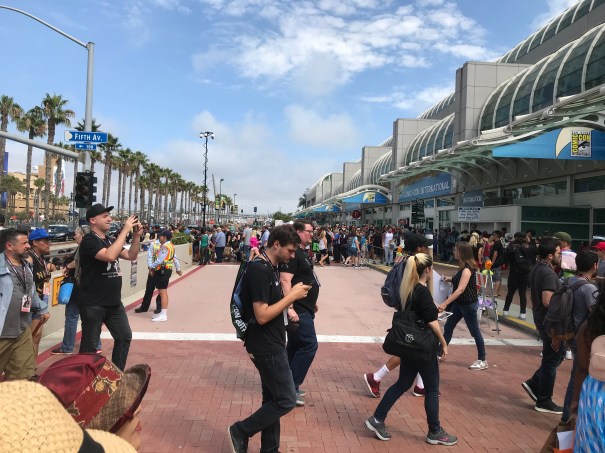
LET’S START with some stats: last month, Beng and I were two of the 35 million visitors who would have trooped to San Diego, California by the end of the year. We go there regularly for our daughter Demi, but most others would probably mention the beaches, the ships, the Mexican food, the whale-watching—and, for 130,000 people in late July, that long weekend of masked madness called Comic-Con International. Those fun-seeking fans will book all of San Diego’s 40,000 hotel rooms—many a year in advance, at room rates easily triple the normal—and on the average spend over $600 per person, injecting some $80 million in direct spending and another $70 million in multiplier effects.

Geekdom, in other words, is serious business, and there’s no stronger pitch that the spinners and purveyors of fantasy can make to their market than Comic-Con, which began in San Diego itself in the dim and dingy basement of the rundown US Grant Hotel one day in March 1970. Since then, the US Grant—where Demi works—has been refurbished into the city’s swanky grande dame, and Comic-Con, like the superheroes it glorifies, has morphed from a pimply kid to a sleek and powerful machine.

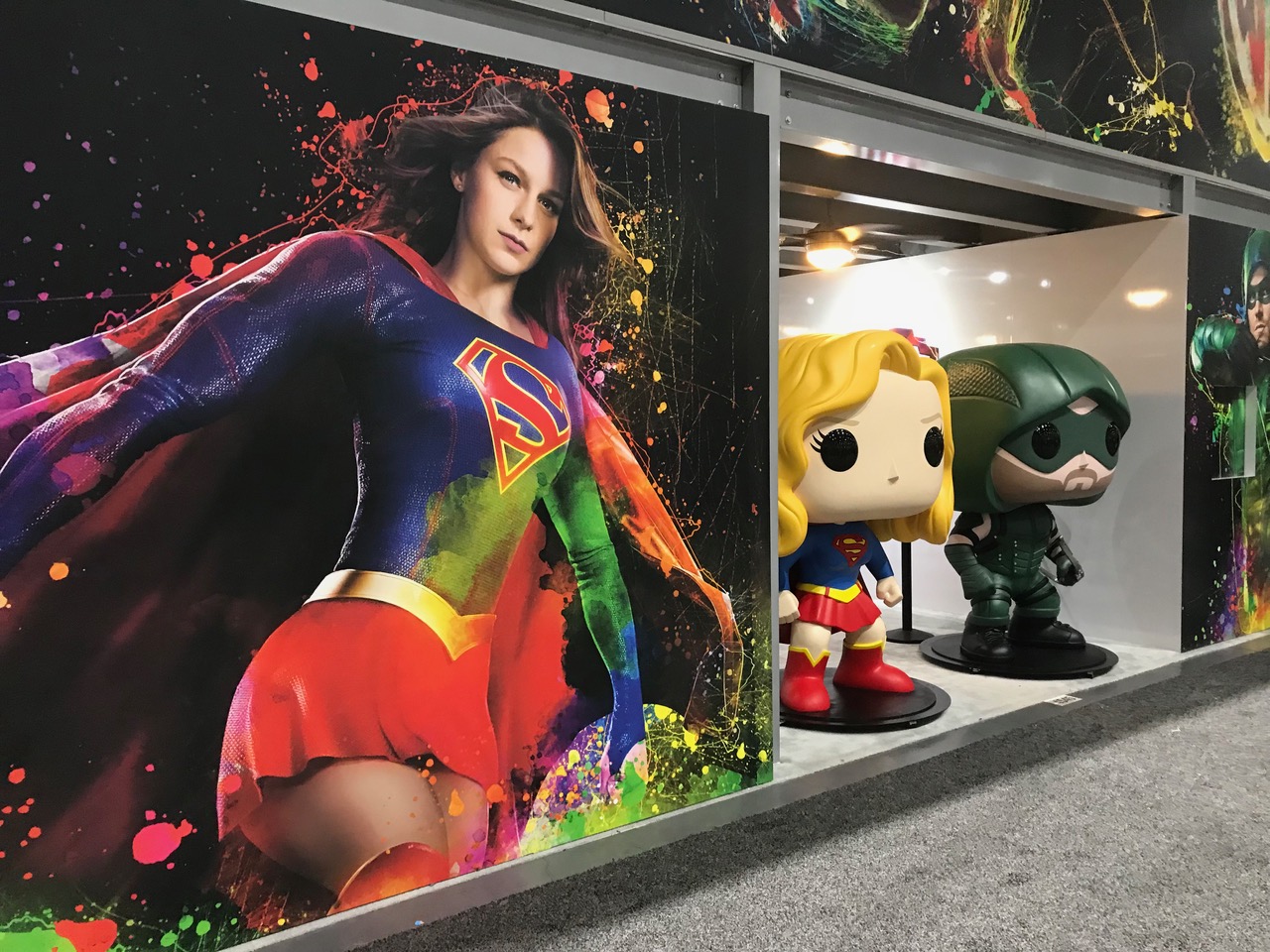
I’m sure the fans aren’t thinking much about the history when they stream through the doors of the SDCC on opening day and emerge with bags and boxes of new Funko Pop Justice League figurines, Deadpool Wooden Push Puppets, and one of this year’s exclusives, a Twin Peaks Agent Cooper Bobble Head, all yours for $14.99. The comic-book collectors could dwell on decades past, but most of Comic-Con is decidedly future-oriented, always looking around the corner for the next TV season’s plot spoilers and the next sequel’s new villain.

IMG_2653.jpg

There’s even been an urban-dictionary term coined for the phenomenon: “FOMO,” or “fear of missing out,” the hidden impulse behind the surge of the pop-culture hysteria best exemplified by Comic-Con. It’s all fun, of course, on the level of cosplay and souvenir shopping. For others, it’s also a profession and the work of a lifetime.

There were two such professionals and icons I sought out in this year’s Comic-Con: the Filipino-American artists Whilce Portacio and Alex Niño. I’d already met and interviewed Whilce in last year’s event, and subsequently at the Asia Pop Comic-Con in Manila, but it was good seeing him again in top form, signing autographs and artworks for fans in his booth in the Artists’ Alley.

Whilce actually wasn’t there yet when we arrived, as he was being interviewed by Syfy about his work, so Beng and I wandered off to observe a long queue forming for the autograph of another artist whom we frankly had never heard of before—the very young Patrick Ballesteros, another Fil-Am and San Diego native.

“We’re everywhere!” Whilce would remind me later. “Marvel, DC, Pixar, you name it, we’re there.” Whilce himself would co-found Image Comics and create Bishop for the X-Men, and he has been going back and forth to the Philippines to mentor young graphic talents such as Leinil Yu and to set up a studio that can meet the growing global demand for illustrators and animators.

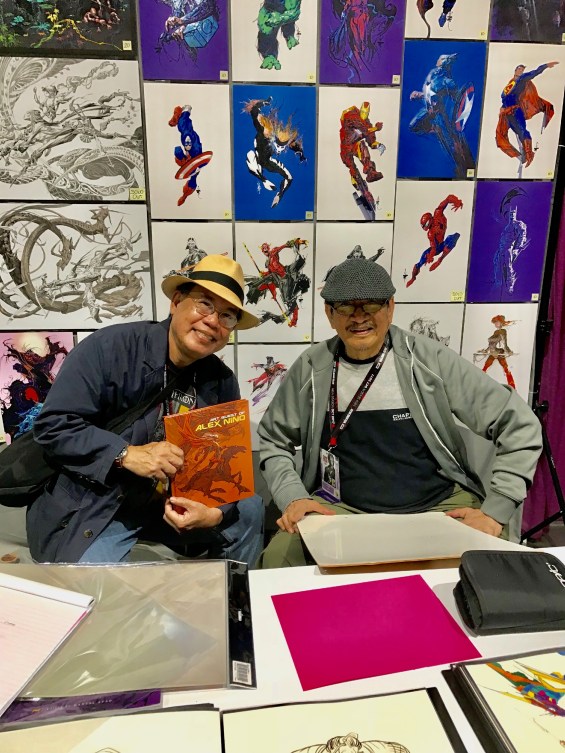
I missed Alex Niño last year—at 77, he now attends only the last couple of days of Comic-Con, leaving it to his son Jules to mind the booth—but I caught him this time at Comic-Con’s closing hour for a quick chat about his struggle to rise to the top of his profession in the US. Tony de Zuñiga blazed the trail for all of them, but Alex, Nestor Redondo, Larry Alcala, and later Whilce and his peers followed shortly after in the 1980s and 1990s.

Alex recalled a crucial moment at the beginning when, still in the Philippines, he was approached by DC to draw a comic, he came up with a carefully drawn work, only for DC to balk at his price. “I tore the pages up,” Alex said. “I preferred to do that than get short-changed.” Unknown to him, his wife Norma had painstakingly pieced and pasted the drawings together overnight, and had sent it to DC—which, understanding what had happened, paid Alex’s price. This sense of self-worth would serve Alex and his compatriots well.

He moved to the US in 1974, and I’ll leave you to check out Wikipedia for his voluminous credits since then. Time may have slowed him down a bit, but it hasn’t stopped him from working, albeit more traditionally than others. He has just finished illustrating a book on wines for Jay Ignacio. “I don’t mind technology, but I never got used to a tablet. With digital art, you can’t tell what or where the original artwork is. I still use a pen and ink, and markers. I had to evolve my own style to be different from the others. None of my five children have taken after me, but my grandson in the Philippines works in animation. I can’t retire, because I’ve yet to be satisfied by what I’ve done. I feel that my best work, my masterpiece, is still out there.”

Way to go, Alex—spoken like a true Pinoy superhero! Until next year—if we get those badges.

IMG_2662.jpg


Penman No. 183: Why I Choose to Italicize

Abilidad.jpg

Penman for Monday, January 18, 2016


ONE OF the more interesting sidelights in our discussions at the NVM Gonzalez Centennial Workshop in Mindoro a couple of weeks ago had to do with the seemingly small issue of whether or not to italicize Filipino and other non-English words in an English text.

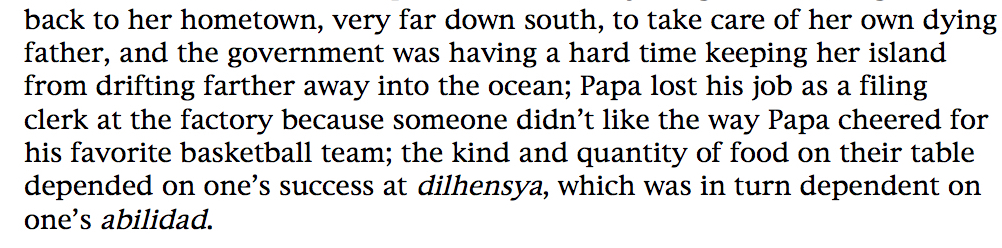
The conventional practice, of course, has been to italicize words like utang na loob, bagoong, kaibigan, and so on. That’s explicitly embodied in editorial stylebooks employed by such publications as The Economist, which hews to the policy that “FOREIGN WORDS AND PHRASES, such as cabinet (French type), dalits, de rigueur, jihad, glasnost, Hindutva, in camera, intifada, loya jirga, Mitbestimmung, pace, papabile, perestroika, sarariman, Schadenfreude, ujamaa, should be set in italics unless they are so familiar that they have become anglicised and so should be in roman. For example: ad hocapartheid
 a priori
 a propos
 avant-garde, etc.”

Not everyone, however, feels bound by this rule. Increasingly, over the past couple of decades, writers of color in both the US and the Commonwealth (and, yes, the Philippines) have chosen to resist and reject italicization, believing that doing so represents a form of acquiescence to the dominance of English, and of exoticizing one’s own language, making it appear quainter and therefore more artificially attractive than it should. It’s a political rather than a mere technical decision, a declaration of independence, as it were, from the strictures of style laid down by the old regime.

One of the most quoted sources for this position is the New York-based novelist Daniel Jose Older, who demonstrates in a YouTube video why italicizing Spanish words and phrases in an English text would sound silly in the real, spoken world.

This was brought up again at the recent NVM Gonzalez workshop, where half of the participants were Filipino-Americans who came over from the US. The workshop leader—the very capable fictionist Dr. Evelina Galang, who directs the creative writing program at the University of Miami—discussed the use of Filipino words in a mainly English text, and why glossaries (and, not incidentally, italics) are better dispensed with, leaving the writer with the responsibility of establishing or at least hinting at their meaning in context.

(Evelina has an essay devoted to this concern, and let me quote an eloquent passage from that piece: “As a girl who grew up hanging upside down on easy chairs with a book in her hand, I often read words—English and other words—that I did not understand. I rarely stopped to define them. Sometimes I wrote them down and looked them up later. (I was a geek, after all.) But more often than not, having stepped into a fiction John Gardner called ‘that vivid and continuous dream,’ and driven to know what happened next, I kept reading. Like Angel, I let the words wash right over me, I watched them working next to other words. I listened to them. I tasted them and felt the weight of them in my mouth. I imagined them surrounded by nothing at all. I followed them as they floated down the page, bumping into semicolons, swimming through parentheses, slapping up against em-dashes, evading italics, and falling right off the page. I read the words in context and, right or wrong, I gave the words their meaning.”

I agree perfectly with Evelina as far as contextualization goes. I’ve always taken it as a technical challenge to show what Filipino words like bucayo and manananggal mean without defining them in that direct but clumsy way that glossaries or footnotes provide. Importantly, Evelina went on to emphasize that these choices are, ultimately, for each author to make for his or her own good reasons, and that those choices deserve to be respected by other writers and readers.

As it happens, I’m one of the holdouts in the matter of italicization, and I premise my position on both technical and political grounds. First, in terms of readability, italics may seem intrusive—and if there’s too many of them in the text, that will certainly be true—but my pet theory is that it’s actually easier on the reader’s eye and mind to spot a non-English word coming up in the text and to prepare for it, rather than be surprised by something “foreign”, even if it’s one of our own. (Just imagine the confusion that words like “ate” (older sister), “pain” (bait), and “noon” (then) would make.) Personally, I don’t want my readers—especially in my fiction—stopping to wonder what specific words mean, which is why the older I get, the simpler my vocabulary becomes; I want the reader to grasp whole sentences, paragraphs, and scenes, and not to trip on individual words.

Politically, when I italicize Filipino words in an English text, I also mean to say that these words are special to me and to my culture, and I don’t want them to be diluted by a dominant foreign language, which is English. As far as I’m concerned, the whole book in English is already a translation of Filipino experience; most of the dialogue there was never spoken in English, in the first place.

I suppose it’s different when you’re writing in English as a minority in America, and you feel bound (as I would, in that situation) to claim and establish a parity between your mother tongue and English. And let’s face it—for many hyphenated minorities, especially second- and third-generation writers, English has become their mother tongue. When they write fiction about themselves, their characters will speak in English, and the odd Filipino word will be just that.

Indeed the issue goes beyond italicization; the question of when and how to use Filipino or other non-English words in an English text should be seriously pondered by every Filipino or Filipino-American (and Filipino-Canadian, etc.) writing in English, mindful that there are words and concepts in Filipino without exact translations in English, which might be better used as is. (And as Salman Rushdie once put it, “To unlock a language, look at its untranslatable words.”) However, one also needs to resist the urge to exoticize one’s writing by peppering it needlessly with native words and expressions just to add more “local color,” especially when ready translations are available.

I’ll go at greater length into matters of translation in another column-piece, but I’ll rest my case on this issue of italics for now, hoping that it adds a bit more asim to the global sinigang of language.