Hindsight No. 11: A Political Playbook

Hindsight for Monday, March 28, 2022

I WAS rearranging the books and periodicals in my library the other day when I came across a copy of a journal from more than 60 years ago—the 3rd quarter, 1958 issue of Comment, self-described as “a quarterly of Philippine affairs… conceived in the observation that absence of thought has resulted from a prevailing atmosphere of conformity and dread of ideas.” 

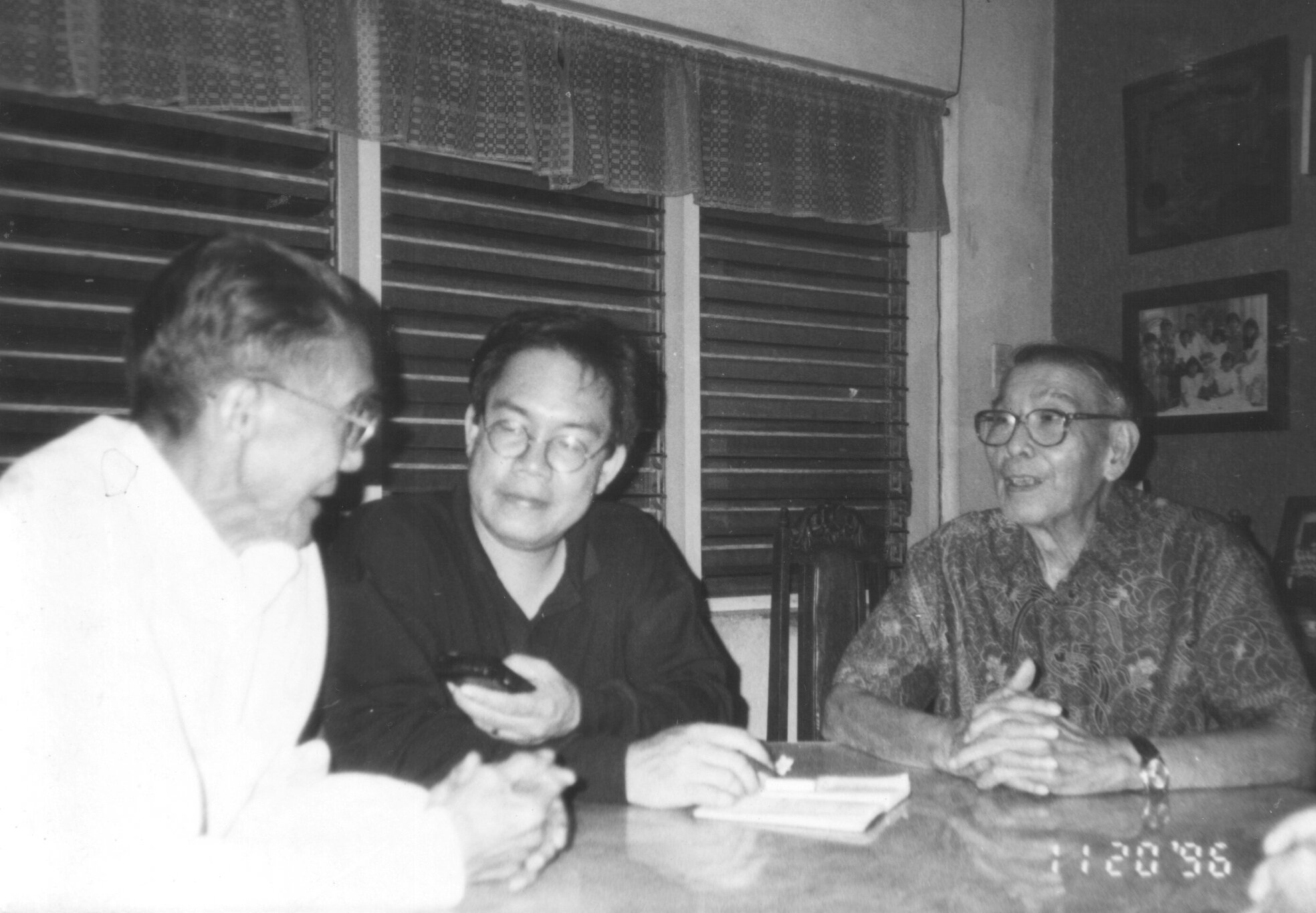
It was quite an assertion to make, but the journal’s mainstays were up to livening things up in the Cold War chill that had turned many Filipinos—both in government and academia—into rabid anti-communists. On Comment’s editorial board were F. Sionil Jose, Onofre D. Corpuz, and G. Burce Bunao (on leave for their studies abroad were Alejandrino Hufana and Elmer Ordoñez). Then only in their early thirties or even younger, these men would count among the most prominent intellectuals and writers of their time. 

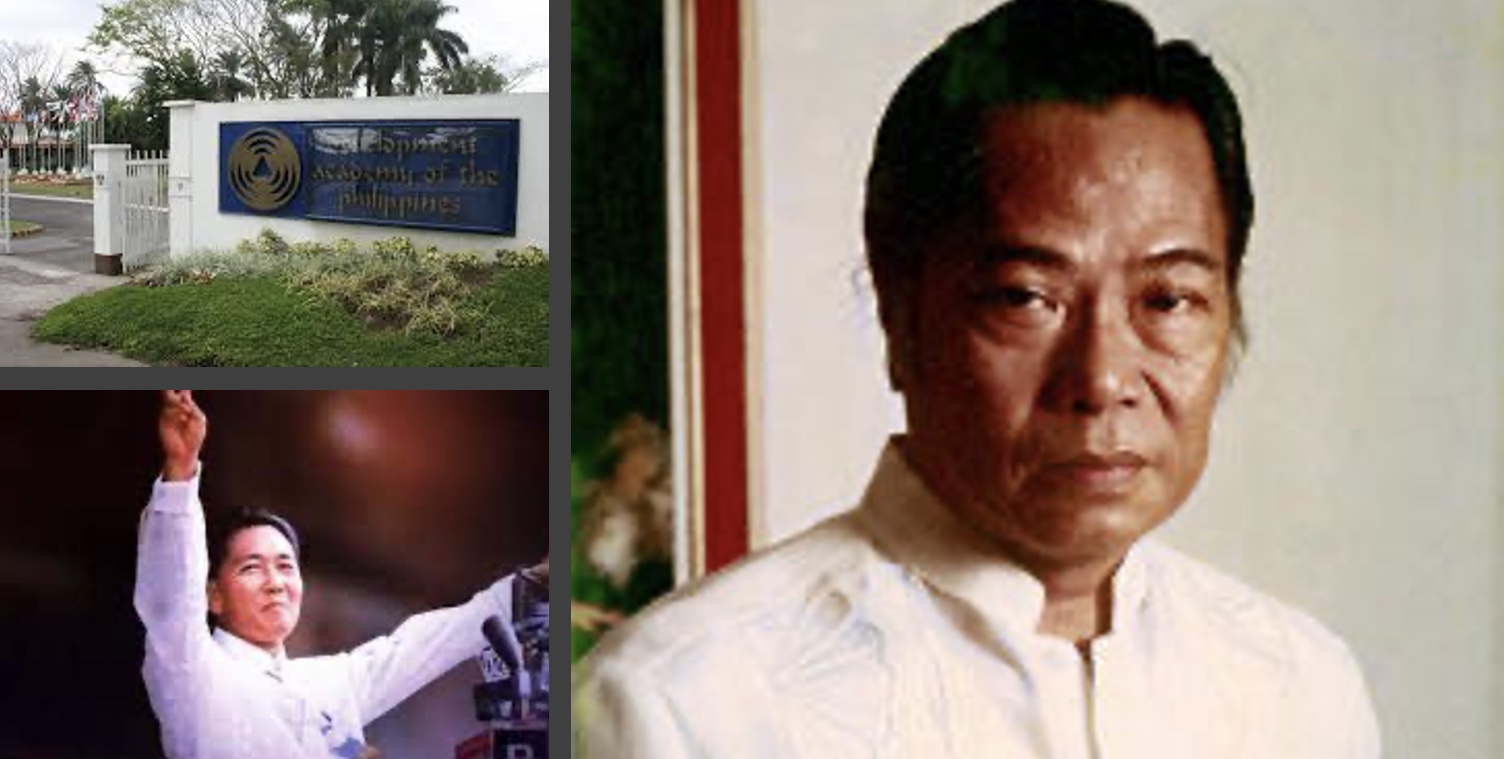
What particularly caught my attention was an article written by Corpuz on “Filipino Political Parties and Politics.” O.D., as he would be known, had just recently returned with his PhD in Political Economy and Government from Harvard, on the verge of a long and prominent—though sometimes contentious—career in public administration that would see him serve as Secretary and then Minister of Education, founder and president of the Development Academy of the Philippines, member of the Batasang Pambansa, and president of the University of the Philippines. 

Another political scientist and UP president, Jose V. Abueva, gave due praise to Corpuz upon the latter’s passing in 2013, citing his landmark scholarship in economic history. But Abueva also pointedly noted that O.D. was “soft in his judgment of Marcos’ authoritarian rule.” (Interestingly, Corpuz had described martial law as “an anti-democratic but constitutional coup” and EDSA as “a democratic but unconstitutional coup.”)

I was curious about what O.D. Corpuz observed of Philippine politics in the 1950s and if those observations would still hold today. Let me share a few choice quotations from the article, and you tell me if they don’t remind you on some level of what we’ve been seeing lately.

First, he notes the political centrality of the family and the elite:

“The importance and strength of the family and of its manifold of values, interests, ethics, and behaviors is one of the basic facts in the cultural context of politics and government in this country…. Close association between party and family was natural from the outset. 

“The first elections in this country in this century were municipal elections. This meant that, as a general rule, during the critical time when the foundations of political leadership were to be established in this country, those foundations had to be local…. The organization of national politics that later came after 1907 was essentially a superstructure resting on local foundations, in which the locally dominant families were the primary factor.”

I knew that only men could vote until 1937, but I didn’t know until I read Corpuz that, early on, you also had to own “real property worth at least five hundred pesos or paid at least thirty pesos of the established taxes annually” and read, write, or speak English or Spanish.

These requirements of maleness, wealth, and literacy lodged if not locked political power within the elite. Citing the French political scientist Maurice Duverger, Corpuz then goes on to classify political parties into “cadre” and “mass” parties, with practically everyone falling into the former category (the communists being the notable exception), comprising individuals bound by common interests and goals. These groupings were temporary, opportunistic, and shared the mindset of the elite from where their members came. These members also freely defected from one party to the other as circumstances required or suggested:

“The frequency of defections is a unique and interesting characteristic of Philippine politics. No party system abroad seems to breed that adventurous individual in whom ours abounds, who changes his party affiliation almost every season…. Defectors do not defect by themselves. They have personal and independent followings that go with them wherever they go, and it is these, as much as the defectors themselves, that are coveted by the parties.”

All parties needed money, and they knew where to get it:

“Cash contributions come in the form of large donations. M. Duverger calls this the system of capitalist financing…. The majority party would enjoy a positional advantage over the minority in the matter of contributions, forced or voluntary, from business firms. It is similarly favored when it comes to per capita levies from aliens, especially the overstaying Chinese, who render their donations unto Caesar during the Christmas and political seasons.” 

Corpuz predicts, presciently, that the old landed aristocracy would at some point be matched or supplanted by new wealth coming out of commerce and industry, which would then control the political levers. Ultimately, family trumps party and ideology; its survival and prosperity are what matter most:

“A somewhat more important factor is the existence of private and family interests that are not subordinated to the demands of administration unity or party discipline. Some families affiliate themselves to a party only as a tactical maneuver, with the basic aim of acquiring a means for aggrandizing family interests.”

Finally, Corpuz observes the existence of a significant “floating electorate”—today’s “undecided” or “convertible” voters—and how to win them over:

“In the Philippines, to a degree rarely matched elsewhere, the slogans of the parties belong to the corpus of political myths…. The lack of ideological meaning in the party platforms is often lamented… (arising from) the fact that the attitude of the floating voter is unpredictable…. As a minimum condition, they must not alienate the floating vote. In this case, therefore, the safest course of action for the campaign planners is to declare the party’s unswerving dedication to generalities.”

I’ll leave it to your imagination what those “generalities” might be today. But I have to say that for a minute back there, I thought I was reading a political playbook for the 2020s.

Hindsight No. 10: A Princely Welcome

Hindsight for Monday, March 21, 2022

IT WAS a little burp in the flood of election-related stories that we’ve been wading through all month so it may have gone unnoticed by most, but it piqued my interest strongly enough to take note of it for a future column, and here it is.

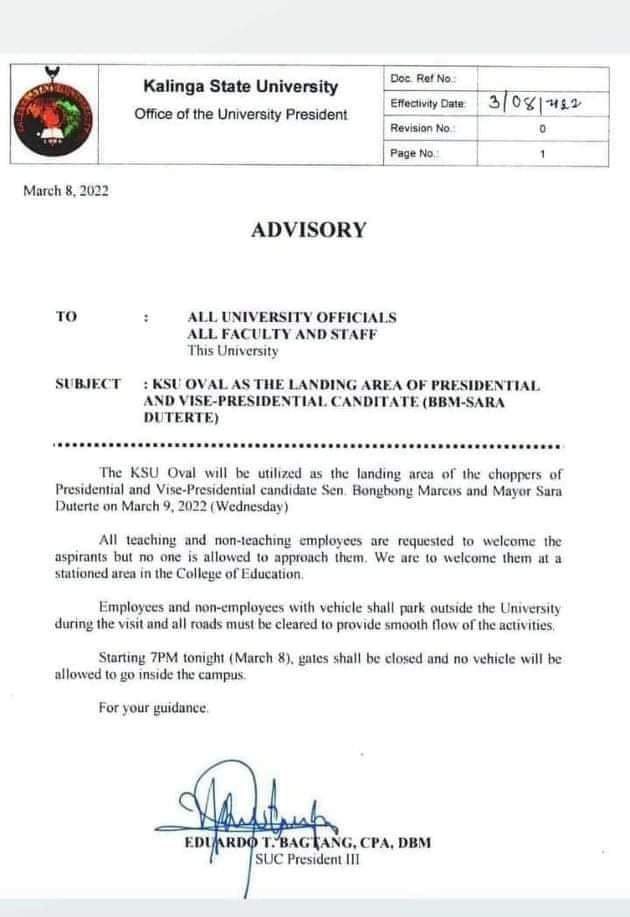
Last March 8, the faculty and staff members of Kalinga State University in Tabuk, Apayao received a memo from their president, Dr. Eduardo T. Bagtang, informing them that the KSU Oval was going to “be utilized as the landing area of the choppers” of presidential and vice-presidential candidates Bongbong Marcos and Sara Duterte the following day. Accordingly, all teaching and non-teaching employees were “requested to welcome the aspirants but no one is allowed to approach them. We are to welcome them at a stationed area in the College of Education.” 

The memo was replete with misspellings and other small infelicities that initially caught my attention as an English teacher, but let’s get past those to the substance of the memo, which was clearly aimed at giving the “Uniteam” combo a warm and hospitable reception. 

Was there anything wrong with that, legally or morally? I’m not entirely sure, which is why I’m raising the question. To be honest, my knee-jerk reaction—as a self-declared non-fan of candidates who avoid debates—was to say yes. To be fair, however, it’ll be good to look at it from both sides, as a study of our culture and its political aspects. The DepEd, the Civil Service Commission, and the Comelec all have rules prohibiting public officials and employees from electioneering. Did the KSU memo cross that line? Was a “request” tantamount to an order?

Just between us Pinoys, it seems the polite and civil thing for a state university president to welcome political candidates. State universities and colleges depend on government support, and whichever parties or officials come to visit, we deem it acceptable if not adroit for SUC presidents to (let’s not say “curry favor”) establish cordial relationships with those in power, or expect to be. (And before we forget, let’s congratulate CHED Chairman Dr. Prospero “Popoy” de Vera, last year’s KSU graduation speaker, for having been named an “adopted son” of Kalinga just this month on the occasion of his visit to KSU.)

Hospitality is arguably ingrained in the Filipino. When then vice-presidential candidate Mar Roxas visited Davao City in November 2009, then Mayor Rodrigo Duterte pulled out all the stops to give him a royal welcome, and even endorsed him for being “clean.” Of course seven years later, running against each other, Rody was calling Mar “the most incompetent Filipino ever to run for president,” but they could both look back to happy memories of walking the streets of Davao together, and of Mar even driving Rody’s pickup truck then. 

Political incumbents routinely welcome campaigning candidates to their territory, which the visitors can spin to their advantage. When Isko Moreno visited Cotabato to meet with BARMM Interim Chief Minister Ahod Ebrahim last month, newspapers were quick to interpret the Manileño’s introduction by Ebrahim as “our incoming president” as a “virtual endorsement” of his candidacy. It was denied the next day by the BARMM spokesman, but denials don’t stick that well in the memory. 

Of course there are thorny exceptions to this ritual politesse. The logistical obstacles reportedly thrown in the way of VP Leni Robredo’s massive rallies by some local politicians and their allies come to mind. Not only were these hosts inhospitable but openly hostile, as if they had been visited and threatened (they probably were) by a pink virus. 

In contrast to the red carpet prepared by KSU President Bagtang and his staff for the BBM-Sara team, a “welcome activity” being planned by the Baybayog National High School in Alcala, Cagayan for Leni set for March 12 had to be scrapped after questions about its “official” nature. The school had sent consent forms for parents to allow their children to attend the activity—deemed “official” because Leni was still, after all, the sitting Vice President, and waving as her convoy passed would have been part of their “civic duty”—but the plan was dropped, to avoid controversy.

This reminds me how it used to be pretty normal for us, when we were kids, to stand at attention under the hot sun for visiting dignitaries, wave flags or flowers, and cheer like our lives depended on it (and maybe, in some ways, they did). We thought politicians, priests, generals, and CEOs were all respectable people and worthy of our admiration. When we realized they were not, the flags and flowers turned into streamers and placards. This is why all but the bravest and most progressive politicians have been loath to set foot in liberal citadels like UP, where a reception of another kind awaits them.

Now, KSU is clearly not UP, by which statement I do not wish to denigrate the strides KSU has made in higher education, which can be found on its website. I refer to the intellectual atmosphere and spirit that inhabit each school and how these are fostered by their constituencies and leadership. KSU, I now recall, was also one of three SUCs that pulled out “subversive” books from their libraries last year in compliance with a much-criticized CHED memo urging them to toe the anti-Red line. Given that background, I shouldn’t have been surprised to find it opening its arms wide to the “Uniteam,” which says it wants national unity for and with everyone—as long as they don’t read, teach, and keep certain naughty books. 

But let’s not be too judgmental, as the campaign season is far from over, and it’s possible that candidates Robredo, Lacson, Pacquiao, Moreno, and de Guzman might yet decide to visit Tabuk, and land their choppers on the greens of KSU. In that case I expect Dr. Bagtang to be his old congenial self and to issue more memos requesting the faculty and staff to welcome the visitors, although I doubt that VP Leni and Ka Leody will be landing in such princely fashion.

Hindsight No. 9: Only the Stupid

Hindsight for Monday, March 14, 2022

(Image from the diplomat.com)

MY BELATED foray into Facebook and the whole FB notion of “friends” led me to ask myself if—in these contentious times—it would be wise to apply a political filter to the many “friend requests” I receive every day, 90% of which come from total strangers.

My simple, old-fashioned liberalism said no. Keep it open. If I were confident in my beliefs, values, and principles, then I shouldn’t fear the presence of contrary ideas, which could be a springboard for a lively and high-minded discussion of alternative futures. 

Maybe I could even make fast friends from the other side, people who were equally concerned about our country’s situation and the need for capable leadership. Maybe we could even meet sometime for coffee or a few beers, engage in playful joshing about other’s politics, and end the day with a soulful rendition of “Kumbaya” around a bonfire. We could show the world the true meaning of unity, love, compassion, and all those nice words politicians can’t resist mouthing every five seconds.

It sounded good—at least in theory. Agree to disagree, turn the other cheek, and all that. Embrace the enemy, and the burrs, bumps, and other imperfections of democracy. Celebrate political diversity as a strength. Accept whatever happens in May as the sovereign will of the people, and yield gracefully to the new president’s wisdom. 

I wish I could say that that I took that high road—but I didn’t; I couldn’t. I did leave the door wide open on my first month on FB, during which I said yes to practically every request that came my way, and kept all my posts public. Soon enough, as my political preferences became obvious, I began to be cursed and trolled. Okay, par for the course—you express an opinion, you expect blowback. I tolerated it for a while, and then I asked myself—do I really want or need this, in my personal space? Were these silly comments enlightening me in any way, except to prove how much savagery you can draw from the tiniest scrap of brain? 

And so I learned the other side of Facebook that everyone else seemed to be adept at: delete, block, mute, unfriend. I began screening every “friend” request to reject dubious characters outright, including and especially those openly campaigning for candidates perpetually too busy to attend public debates. Now, I realize I’m being politically suicidal that way, by hunkering down in my hermit’s cave and refusing to participate in the time-critical mission of conversion. So please don’t do what I did, and be nice. 

But forget the trolls—that’s like talking to your toilet. So far, my toilet’s been telling me this: “Our guy will win. Look at the polls. It’s over. Only the stupid think otherwise.” I flush it all down, but it keeps floating back up. 

Seriously, going beyond paid-by-the-click trolls, I want to find an intelligent, articulate supporter of He Who Will Not Debate and ask just one question: “Why?” 

Do such people exist? They certainly do—I’ve personally known quite a few. Brilliant, eloquent, educated in the world’s best schools, well-traveled, at the top of their professions. They will claim to have been there, done that; some may even have been torchbearers and ideologues for the Left. Somewhere along the way, for reasons known only to them, they make a complete about-face, declare liberal causes dead, and cast their lot with the same people they once found repugnant. They become the gurus of the Right, the stylists of a fashionable authoritarianism they try to invest with narrative inevitability. 

Odd as it may seem, like Franco and his fascists, they will profess to be servants of God, and can be judged only by Him. They are not in it for the money, they will insist, although they live very comfortably. They affect a carapace of cynicism—they support He Who Will Not Debate, not out of love nor confidence in his admittedly mediocre talents, but because he will win, like it or not, so they are already thinking ahead to how he can be manipulated by his No. 2, their real horse. They are in it for the long game.

Sure, they’re smart, or seem to be. The only problem is, they’ve lost a fundamental sense of right and wrong. They’re beyond outrage. Proficient at turning fiction into “fact,” and inflated by their proximity to power, they mistake cleverness for conviction, and survival for salvation. In the end, they believe in nothing but themselves; they are their own echo chambers. “I don’t care what people think about what I think,” one such pundit told me, and it told me enough. 

So if and when I ask these people “Why him?”, I don’t expect a gush of praises for the fellow’s virtues, but rather a PowerPoint lecture on why he will win, regardless of everything. “Only the stupid,” they will remind me, “look at elections in terms of good and evil.” 

Even academics can over-analyze things and ignore or forget the basic question: Is it the right and the good thing to do? “Realpolitik”—a pet word of cynics—is no excuse for resignation and acceptance. 

All the scholarly explanations for Vladimir Putin’s Russo-centric world view can’t justify Russian aggression. Putin may have a right to feel threatened by a pro-NATO Ukraine, but he still doesn’t have a right to invade it and shell it to pieces. And we need to say so. As so often happens, to pose as “neutral” in this case (ostensibly because we have no dog in this fight) is to support the oppressor. We do have a dog, and it isn’t so much Ukraine itself but justice. 

So when I choose my Facebook friends, I choose people who still believe passionately in truth, freedom, and such things as the strategists of the Dark Side find foolish and irrelevant. I choose people who will restore and reinforce my faith in humanity, and who will remind me that we, too, are in this for the long fight, way beyond May 9.

“Only the stupid” may refuse to surrender in the face of looming annihilation, but I’ll take the Zelenskys of the world anytime over its Putins. 

Hindsight No. 7: Disinformation and Democracy

Hindsight for Monday, February 28, 2022

(Image from designtaxi.com)

LAST FRIDAY—the 36th anniversary of EDSA 1—I spoke to a group of university students who wanted to know what I thought of Filipino democracy. 

I told them that at EDSA, along with millions of other Filipinos, I jumped for joy at the news that Ferdinand Marcos had fled with his family. We did not know—and might not have cared too much then—that they had brought two planeloads of gold and cash with them to Hawaii. All we wanted to hear was that they were gone, presumably for good, and that we were off to a fresh start at peace, freedom, justice, and prosperity. The darkness of the past twenty years would lift, and a new Philippines would emerge, truly democratic and firmly opposed to any form of despotism.

Today we realize what a fantasy that was, what a temporary reprieve. Under Rodrigo Duterte, if the polls are right, most of our people have once again embraced authoritarian rule, implicitly accepting its attendant excesses. The dictator’s son is back, and may even become our next President—to the delight of his supporters for whom martial law never happened; or if it did, then it was a golden age to which we will soon be returning, an age of new roads and bridges, clean streets, industrial peace, Miss Universe pageants, and eternal sunshine. 

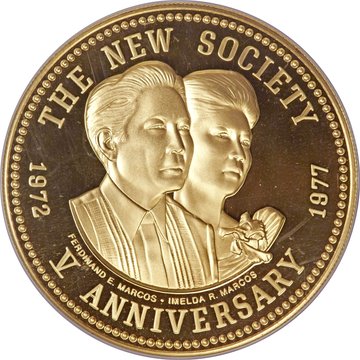
Indeed it would be as if the past half-century between 1972 and 2022 were a confused and hazy dream, and now we were waking up where we had left off yesterday, when Ferdinand E. Marcos was poised to “save the Republic and build a New Society.” His son is making sure that we don’t miss the connection by heralding his entrance at his campaign rallies with the anthem of martial law, “May Bagong Silang.” Most of his followers today have never heard that song, or understand its chilling context, or the price we paid—in blood and in billion-dollar loans—for that “new dawn.” To them, it is a catchy jingle, in marching tempo. It comes with the smell of money and power in the air, the promise of a shower of gold for the hopeful masses. 

This, of course, is also a fantasy, but a powerful one—and I think I will be correct to surmise that many of the students I addressed, and even their teachers, fully believe it. And why not? They were never taught in school about the horrors of martial law. Instead, they were told that those were good times, that the Marcoses were good leaders who were deposed by their enemies and the CIA, that rich people don’t steal, and that the Marcos billions came from the gods, Yamashita, and anywhere but the Philippine treasury. That diet of lies has now become a catered banquet. 

The biggest enemy of democracy today—more than at any other time in our or even the world’s history—is disinformation: the willful distortion or fabrication of information to create false beliefs or impressions in the minds of people, turning bad to good, wrong to right, and vice versa. 

This is happening not only here in the Philippines, but in many other places around the world—including America, where Donald Trump has been pushing the “Big Lie” of a stolen election, despite the lack of any credible evidence. Even earlier, in what has by now become a cliché, Josef Goebbels thundered that if you repeat a lie a thousand times, it becomes the truth. 

During and after WWII, military experts engaged in what was called “psywar” or psychological warfare to weaken the enemy’s mental defenses, lower morale, and make people switch sides. This was done through radio, leaflets, newspapers, and other media available at the time.

Today the prevalence of the Internet and social media has magnified the means for disinformation by a magnitude of millions. And this is scary, because according to a recent survey, every other Pinoy can’t tell real news from fake. How can a society so prone to disinformation—to fake news—function well as a democracy?

Last month, the Akademyang Filipino (on whose Board of Trustees I serve) sponsored a forum on the topic of “Can Democracy Win in May 2022?” Most such questions are meant to be rhetorical, with obvious answers. But this time, the more I thought about it, the more I was bothered by its actual complexity. The problem, I realized, is that we no longer have a clear and common idea of what “democracy” means.

There are as many definitions of democracy as there are politicians eager to appropriate it. “Democracy” has to have been one of the most ambiguous and most abused words of the 20th century, going into the 21st. When a brutal totalitarian state like North Korea styles itself as the “Democratic People’s Republic of Korea,” you know something somewhere has gone awfully wrong. Dictators will call their actions democratic—as Ferdinand Marcos and Muammar Ghaddafi did—by asserting that they are acting on behalf of the people, a responsibility that presumably entitles them to extraordinary powers and compensations.

In my layman’s understanding, democracy is the rule and exercise of power by the people through representatives they choose by a free and fair election. It seems simple, but immediately we can see how vulnerable this definition of democracy is to interpretation and manipulation. What is a “free and fair” election? Does it simply mean an election free of vote-buying, coercion, and fraud?

If a candidate wins more than 51% of the vote without obvious coercion or cheating, then will that candidate have won a democratic election? But what if those voters had been fed provably false information? What if they willingly believed that information to be true, and voted on the basis of it? Would this still be democracy at work? 

Arguably, yes, because democracy never promised only intelligent outcomes. Elections are emotional, not rational, exercises. This disturbs me deeply, but again I have to ask myself, am I idealizing democracy as something that can be perfected? Or should I just accept that democracy, like society itself, is inherently messy, mercurial, and manipulable? 

What kind of democracy do we Filipinos have, and what kind of democracy do we want? The vote this May will help provide the answer. 

Hindsight No. 6: A Cultural Agenda

Hindsight for Monday, February 21, 2022

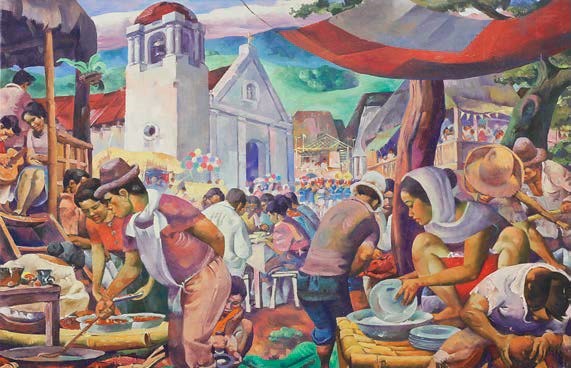
(Botong Francisco’s “Pista sa Angono”)

NOTABLY ABSENT from the platforms of nearly all candidates for the presidency is any mention of culture and the arts as a vital element in our quest of nationhood. Everyone has an opinion about the economy, the pandemic, corruption, peace and order, foreign relations, infrastructure, the environment, and countryside development, but you can hardly hear anyone speak—beyond the usual generalizations and platitudes—about what makes us Filipino, what it means to live as an archipelago with over 100 languages, and why and how we can be so similar in some ways and yet so different in others.

These are all matters of culture, which are often given tangible expression in the arts—the songs that make us weep, the paintings that brighten our walls, the stories that make us wonder about what’s important to us, the dances whose gestures take the place of words. At their best, culture and the arts rehumanize us, remind us of our truest, noblest, and also most vulnerable selves.

Unfortunately, we have been brought up to see them as little more than adornments, passing entertainments, intermission numbers to play in between presumably weightier and more consequential concerns. On an official level, culture has been treated as an adjunct of other ventures such as sports and tourism, culminating in beauty contests and street dances. 

The National Commission for Culture and the Arts (NCCA) and the Cultural Center of the Philippines (CCP) have had active programs for funding the arts and for sponsoring performances and exhibitions, but despite many previous initiatives, efforts to set up a formal Department of Culture to oversee a broader cultural agenda have failed, again because of the low priority accorded to the sector.

Many studies have shown, however, that the arts—transposed into the creative industries that produce cultural products covering everything from books, movies, and TV shows to music, food, advertising, and advertising—create a large economic footprint.

Citing UNCTAD figures, a report commissioned by the British Council some years ago noted that “Depending on how they are defined, the Creative Industries are estimated to represent anywhere from 3% to 12% of global GDP.”

In 2010—the last year for which I have solid figures—copyright-based industries or CBIs contributed more than P660 billion to the economy, according to the Intellectual Property Organization of the Philippines. In GDP terms, the economic contribution of CBIs climbed from less than 5 percent in 2006 to more than 7 percent in 2010. Core CBIs comprising companies in the arts, media, and advertising largely accounted for this surge. A corresponding rise in employment occurred in the sector, from 11 percent of the total number of jobs in 2006 to over 14 percent four years later. Surely these figures have risen much higher since then.

But the most important argument for a clear and strong cultural agenda remains the moral one. Culture is an essential element of national growth and development, as it helps define our national identity and our national interests. Without culture, we have nothing to stand on except our territory. Culture is a dynamic description of our commonalities and differences, without understanding which we will be moving forward blindly, guided only by the political and economic interests of our elites.

That understanding of who we are and why we think and act the way we do should be the end-goal of our education, grounded in an appreciation of our history. But as recent questions have highlighted, the DepEd’s decision to integrate Philippine history into other areas of learning effectively diluted and diffused its teaching in high school, a critical period in the formation of young minds.

For these reasons, a group of Filipino artists, writers, scholars, and cultural workers have organized the Katipunan sa Kultura at Kasaysayan (KKK) to present the leading presidential candidates with a cultural agenda for the next administration. The key items on that agenda include the promotion of a liberative, creative, and innovative culture; support for the study, appreciation, and critical interpretation of Philippine history; the promotion of cultural and creative industries, and Filipino products; the promotion of democratic education and programs to raise literacy nationwide; and serving the health and welfare interests of cultural workers. (Full disclosure: I work with National Artist Virgilio Almario in this organization.) We presented that agenda to all the leading candidates but heard back from only one, who endorsed it warmly: VP Leni Robredo. We were not surprised.

It’s not surprising, either, that those who understand Filipino culture best are those intent on exploiting its fractures and contradictions. The manipulation of public opinion and political outcomes thrives on knowing how people and groups behave, what emotional levers to pull, and which buzzwords to propagate. 

The confused and fragile state of our culture can be easily seen in how susceptible our people are to fake news. A recent SWS survey showed that 51 percent of Filipinos—every other one of us—find it difficult to tell real news from fake. The traditional sources of what most people have deemed the truth—the government, the Church, the traditional media, the schools, law enforcement, and even scientists—no longer carry the same trustworthiness they used to. Their places have been taken over by social media, cable TV, and micro-networks that can spread disinformation at lightning speed.

When I heard the New Society theme “May Bagong Silang” being played at Ferdinand Marcos Jr.’s proclamation rally, I recalled how music, theater, and art were harnessed by the martial-law regime to create spectacle, a key instrument of enthrallment and intimidation, from imperial Rome’s circuses to Nazi Germany’s torchlit parades. That’s culture at the service of dictatorship, belying Leonard Bernstein’s claim that music was one art “incapable of malice.” 

I’ve often noted, in my talks on this topic, how ironic it was that the only presidency that put culture and the arts at the forefront was Marcos Sr.’s, and today even the staunchest of Imelda’s critics will grudgingly acknowledge the value of the CCP. But there was an ulterior agenda to that, which makes it even more urgent to promote a culture that will uphold truth, reason, and justice as a basis for national unity, instead of being used as a glitzy curtain to mask wanton murder and thievery.

Hindsight No. 5: The Dropout Factor

Hindsight for Monday, February 14, 2022

(Image from thetimes.co.uk)

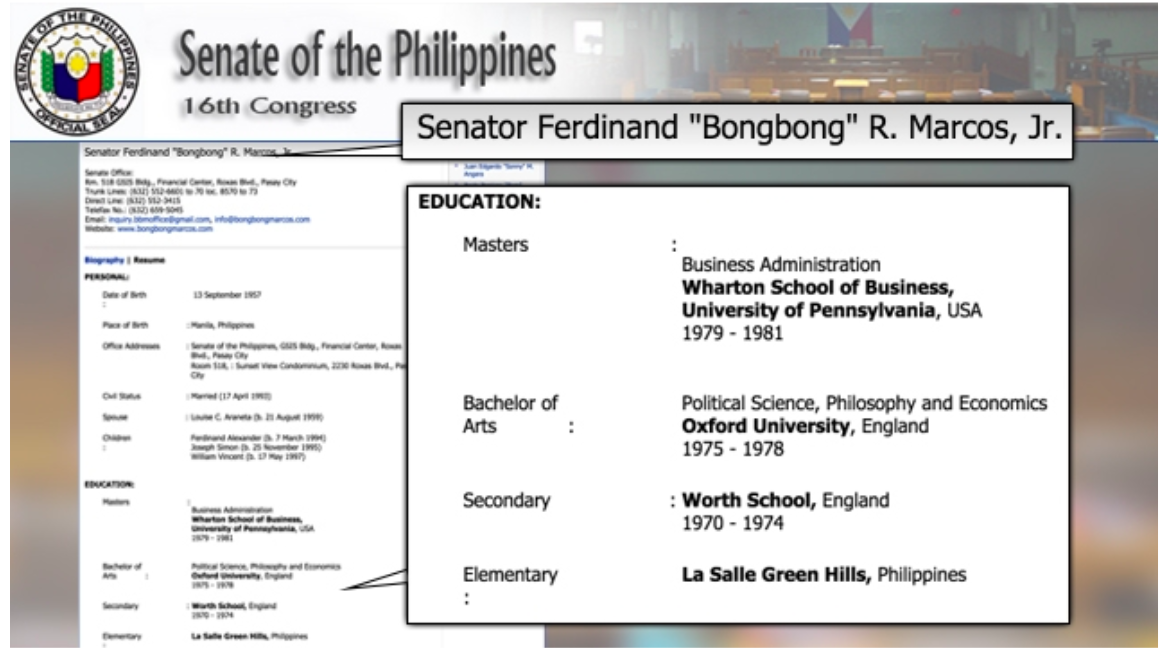
HOW MUCH of a factor is Ferdinand Marcos, Jr.’s being a college dropout in making people decide whether he’s worthy of being voted President or not? The anti-Marcos forces seem to think it’s a viable issue, on two counts: first, that Junior failed to complete his studies at Oxford and subsequently at Wharton, despite the extravagant resources put at his disposal; and second, that Junior and his people have repeatedly asserted that he graduated from both institutions, despite clear evidence to the contrary. 

One would think that, in a country where higher education is widely seen to be the only ticket out of poverty, Junior’s profligate ways should have turned off if not outraged large swaths of the CDE electorate that everyone now acknowledges will effectively choose our next leader.

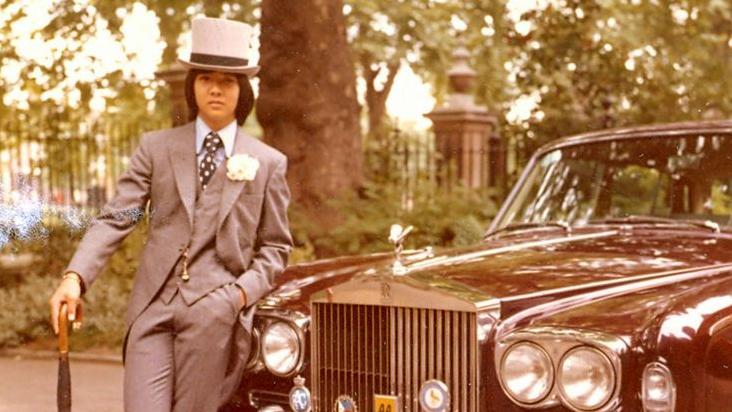
The picture of him posing as a top-hatted dandy in front of a Rolls Royce when he should have been sticking his nose into a book in the library should be sickeningly ridiculous to anyone who has had to take three sweaty and dusty jeepney rides to school. That he or his cohorts would insist that he has a BA and an MBA from the world’s top universities without proof of an actual diploma should offend anyone who failed to finish college, despite a bright mind and high grades, for lack of money—like my father did.

But sadly I suspect that for many of Junior’s supporters, the dropout factor is a non-issue, for a number of reasons. To begin with, going by the statistics, ours is a nation of dropouts. Even well before the pandemic, according to one study, the graduation rate from college was only 61%, which means that two out of every five students fell off the rails. So Junior should be in good company. 

I myself dropped out of UP in my freshman year because I was becoming increasingly more involved with student activism, and I was also itching to get a job and earn some money. Like many dropouts who managed well enough on their own, I wore my undergraduate status for many years like a badge of honor. But there came a point when I simply longed to learn in a more structured way, so I went back to school, and graduated with my AB at age 30.

To Junior’s defenders, dropping out of Oxford is understandable. “Oxford is even harder to get into than UP!” said one online. And besides, said another, he did get a special diploma, which “is already equivalent to having a degree. UK educ system is different from PH system. Between him showing certification vs emailing Oxford, I would believe him.”

As I noted in last week’s column on “Denial and Dissonance,” the politically captive mind will fashion creative explanations for everything from the “fake” landing on the moon to Donald Trump’s “stolen victory” over Joe Biden.

A Reddit thread on the topic overwhelmingly agreed that being a dropout wasn’t the problem; rather, lying about it was. “At least Erap admitted to being a dropout, and he still became President,” said one poster.

Publicly exposed, Junior back-pedaled. His official Senate resume in 2014—digitally preserved for all time on archive.org—clearly showed him claiming a master’s degree in Business Administration from Wharton and a Bachelor of Arts in Political Science, Philosophy, and Economics from Oxford. This has since been amended to “graduate coursework” for Wharton and a “special diploma” for Oxford.

(Image from rappler.com)

But there’s another side to this college-dropout issue that’s worth thinking about: what’s a diploma really worth, anyway, and what exactly have we done with ours?

We have many thousands of college graduates working well beneath their professional capabilities as domestic helpers overseas, or in jobs that require more use of their hands than their brains. So a diploma has never guaranteed success (and as Junior’s example shows, you can get very far in life without one). 

But also, since when was a college degree a measure of intellectual ability and, even more importantly, of moral probity? What has our incumbent Palace dweller done with his law degree, beyond assuring the tokhang brigade of his full protection and threatening to defy the Supreme Court? At least Ferdinand Sr. used his to cloak his every ploy with a veneer of legality. 

In terms of intellectual caliber, Marcos had probably the most illustrious Cabinet members in our history, with PhDs from the world’s foremost universities, but even they could not rein in his regime’s excesses, and some even abetted them. The good ones left early; a few tried to draw a line; others became willing accomplices to dictatorship and plunder. As idealistic and upright as they may have been or started out, Marcos suborned many of these technocrats and forever compromised the edukado in Philippine society, turning that respected figure into a minister at the foot of a despot, his wife, and their whimsy.

Our incumbent burnished anti-intellectualism into a virtue to curry favor with the crowds, and got flunkies with LLB’s to explain away his bad behavior like auditioning comedians. You listen to their tortured spiels and you ask, was this what they went to college for?

Wealth and power hold far more charm for many of us than schooling, because we see education as but a means to those ends. To be rich is to be smart and praiseworthy enough. If the rich behave imperially, impudently, irresponsibly—well, they earned it, didn’t they? We can forgive and excuse them no end; we still think like tenants thrilled to be invited into the big house for a cup of chocolate. 

We seem surprised and suspicious when a well-educated person with an honest heart claims to love and understand us, and promises to improve our lives, because we no longer recognize real goodness and ability when we see them. So we go with the devil we know, and who cares how he fared in History or Philosophy? As Ping Lacson puts it, logic was never our strong suit: “Ayaw mong manakawan, tapos, boboto ka ng magnanakaw?” I have a PhD, and I can’t figure that one out.

Hindsight No. 4: Denial and Dissonance

Hindsight for Monday, February 7, 2022

(Image from contemplativestudies.org)

I FIRST heard the phrase “cognitive dissonance” fifty years ago in UP from my friend Jose “Oying” Rimon, then a Mass Comm major just grasping the mechanics of social behavior. Oying would go on to become a population expert and close adviser to Bill and Melinda Gates on public health, capacities in which he had many occasions to see cognitive dissonance at work in shaping people’s attitudes and responses to development policy. 

I’m not a psychologist, so I’m going to have a real one, Dr. Sam Mcleod, explain what the concept means: “Cognitive dissonance refers to a situation involving conflicting attitudes, beliefs or behaviors. This produces a feeling of mental discomfort leading to an alteration in one of the attitudes, beliefs or behaviors to reduce the discomfort and restore balance…. When there is an inconsistency between attitudes or behaviors (dissonance), something must change to eliminate the dissonance.” 

The examples that usually turn up in the literature are fairly simple: you smoke, but know that smoking is bad for you; you know you need more exercise, but put it off for tomorrow, citing the workload on your desk.

Why is this relevant to our present situation? I’ll get to that in a minute. First, let me quote from an article by Dr. Eddie Harmon-Jones in Psychology Today wondering why so many Christian Americans still voted for and supported Donald Trump despite his patently un-Christian behaviors, such as adultery. “As president, he has engaged in many actions that seem immoral. How do so many still support him? Surely they must experience dissonance over this. How do they reduce this dissonance?” (For that matter, why did so many conservative Fil-Ams vote for Trump on the excuse that he was supposedly “pro-life,” ignoring his many other moral infirmities?)

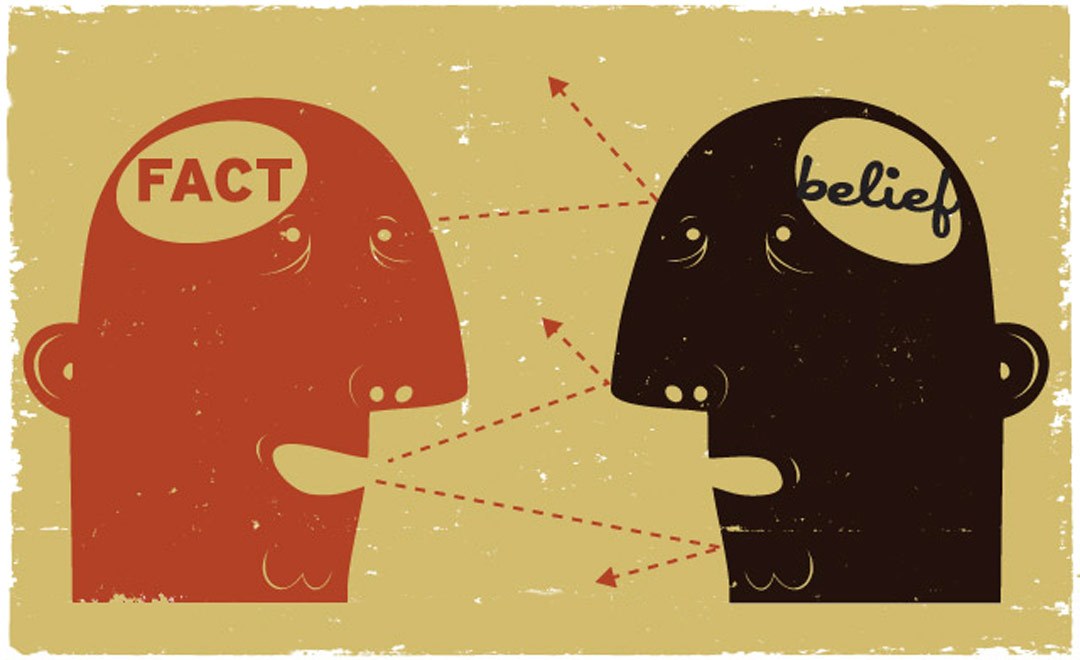
Why do people believe what they want to believe, regardless of the hard facts and figures in front of them? How do they reconcile these contradictions in their minds to feel like they’re doing the right thing and to feel better about themselves? (The science suggests that we humans have a natural impulse toward feeling good.)

This is what the psychologists call reducing or resolving dissonance—accepting or acknowledging what the more logical part of your brain is saying, but then coming up with a rationalization or justification for sticking to your original belief anyway; or, with much more effort, you find a reason to cross over to the other side. Sure, smoking is bad for me, but so is anxiety; sure, maybe vaccines work for other people, but I’m not like other people—I haven’t been sick in twenty years; sure, I lied on my tax declaration—but haven’t bigger people done much worse?

Dissonance is a shade different from denial, which is the outright rejection of proven or provable fact. Holocaust deniers will insist it never happened; other neo-Nazis will say it did, but that the Jews brought it upon themselves, or that Hitler wasn’t to blame for the genocide. 

This is the stuff that conspiracies and conspiracy theories are made of—a little truth here and a little truth there, interwoven by threads of fanciful fabrications to create some semblance of alternative logic. Spun imaginatively and cast widely enough, this web of lies can begin to acquire the sheen of truth, or what passes for it among its believers.

Are those believers stupid or crazy? Not necessarily. An interesting paper by the psychologist Andrea Kohn Maikovich argues that terrorists aren’t simply the hate-filled loonies they’re often pictured to be. Rather, recruits go through a radicalization process during which they negotiate between their personal predisposition not to commit violence and the collective pressure to do more than carry placards on the street. When the dissonance hits its peak, some leave; those who stay have found a way to convince themselves that violence is good and necessary.

Writing for the Atlantic Monthly on “The Role of Cognitive Dissonance in the Pandemic,” Elliot Aronson and Carol Tavris note that “When people feel a strong connection to a political party, leader, ideology, or belief, they are more likely to let that allegiance do their thinking for them and distort or ignore the evidence that challenges those loyalties. The social psychologist Lee Ross, in laboratory experiments designed to find ways to reduce the bitter conflict between Israelis and Palestinians, took peace proposals created by Israeli negotiators, labeled them as Palestinian proposals, and asked Israeli citizens to judge them. ‘The Israelis liked the Palestinian proposal attributed to Israel more than they liked the Israeli proposal attributed to the Palestinians,’ he told us.”

In this context, it isn’t hard to see why pro-Marcos narratives can seem so compelling to many Filipinos, despite the clear and documented evidence of ill-gotten wealth (let’s say it plainly: theft), brutality, deception, and other abuses of power during the martial law years. They’re rich and powerful—which we all want to be—so they must have done something right.

People who are already rich don’t steal; it wasn’t FM Sr. who committed martial law’s excesses, but his administrators; EDSA 1 was nothing but a CIA operation; Imelda was never imprisoned, so she can’t be guilty of any charges thrown at her; the younger Marcoses knew nothing about what was going on, and so will be different from their parents; if the Marcoses were bad, the Aquinos and Lopezes are worse; et cetera. If you feel comfortable with any of these ideas, then you’ve made your own kind of sense of the past, even if you may not even have been there.

Of course, I have my own set of stubborn core beliefs and dissonances as well. I keep holding on to the idea that Filipinos are worth dying for, only to be disappointed by the way many of us choose our leaders. I believe in democracy, but I feel frustrated when it’s gamed by people who obviously don’t care much about it. 

According to cognitive dissonance theory, something has to give: your cherished notions, or the hard truth. It seems much easier just to give up hope, but there’s no real comfort nor resolution in that, either.

Hindsight No. 3: A False Nostalgia

Hindsight for Monday, January 31, 2022

SINCE MY belated debut on Facebook just over a month ago, I seem to have acquired something of a reputation for my posts about the past—not in the scholarly mode of a real historian, which I most certainly am not, but as a collector and keeper of objects that evoke strong associations with times and people long gone. These include century-old fountain pens and typewriters, and even older books and documents steeped in the accumulated oils of the hands that held them.

I’ll admit to having an intense, almost fetishistic, interest in the past—the 1930s are of particular significance to me, because I’m writing a novel set in that period—and I can identify with the romance conjured by postcards of ocean-going liners and of the old Manila Hotel. If you play “Smoke Gets in Your Eyes” on a turntable, you’ll float to the ceiling in my esteem. In my dreams, I fantasize about strolling into the Crystal Arcade one fine day in 1937 and stepping out with a fistful of Parker Vacumatic Senior Maxima pens while towing a cart with all 55 volumes of Blair and Robertson.

But that’s where the nostalgia ends. In many if not most respects—as I’ve told friends who, for example, ask me if UP’s fabled Cadena de Amor ceremony is worth reviving—there’s one place the past deserves to be, which is exactly where it is. Nostalgia is comforting precisely because the past is over, and because we tend to remember just the good parts, and even burnish them to perfection.

But it was never really all that good. Amorsolo’s maidens all seem fresh out of the batis and every Joseon prince’s robes on K-drama seem immaculately pressed even after a swordfight, but the past was literally a filthy place. Queen Elizabeth I was said to take a bath once a month. William Shakespeare and his friends wore those fluffy collars around their necks because that’s all they changed. The lovely ladies of Versailles doused themselves in perfume to quell the odor of their unwashed bodies. The “buntis” window grilles we now admire in old Manila houses were once drenched with dubious liquids being dumped on the street below.

Neither was it so peaceful. Even without counting the devastation of war, the past was fraught with danger, hardship, and unrest. It may have been a grand and glorious time for the rich in their cars and villas, but the masses were suffering in the farms and factories. Power was brazenly exercised, as in the torture and murder of Moises Padilla in 1951. Postwar congressmen carried .45s at their waist into the session hall. As a young police reporter in 1972, I learned where you could find a gun for hire for P500 per target.

We like to think that the past was simple, with fewer choices to be made. But it was never that simple for many without real choices. Poverty was and is never simple, because every morning the mind races to figure out where supper is coming from, and if Nanay can survive on a third of her prescribed dosage or on plain salabat.

All these come to mind when I hear Filipinos today—many of them not even in their 40s—talking about how a return to the “glory days” of Marcosian martial law would set this country back on track and bring us the prosperity, the peace, and the prestige we once enjoyed. I wonder what it is exactly they are “remembering,” and if they understand what putting a Marcos back in Malacañang will mean to this country. This goes beyond the historical amnesia we often hear about these days; the Dictionary of Obscure Sorrows calls it “anemoia,” a nostalgia for a time someone has never known, or that never happened.

No, I’m not calling them stupid or wicked by any means. In many cases they’re simply innocent or uninformed, and therefore suggestible. If they feel oppressed by the present and are facing an uncertain future, the past will acquire the appeal of the womb, offering safety and security. The idealization of martial law as a time when streets were wide and clean and when new buildings were rising right and left is a more inviting prospect for those who can’t be bothered with facts and figures about debt-driven growth, cronyism, and horrific abuses under military rule. (For those facts, check out https://newslab.philstar.com/31-years-of-amnesia/golden-era)

That even oldtimers can wax nostalgic over the Marcos years isn’t hard to understand. Like the Germans under Hitler, many if not most Filipinos then never saw a prison camp, never had a son or daughter tortured and salvaged, never had a business taken over by the regime. Those of us who actively resisted dictatorship were in a distinct minority—as we still are today. Complicity has to be endemic for despots to thrive.

But now once again we are called to arms, in a battle for the imagination—a battle of competing narratives and modes of narration. Will the cold, hard truth alone triumph over romantic fantasy, or will we need to be more inventive in our messaging to get through to those unlike us? Instead of just revisiting the past, should we dwell more on a rosy but realizable vision of the future? Instead of staking out May 9 as a referendum on martial law, should we double down on what a presidential election should be—a competition between platforms and qualities of leadership? (And then use the next six years to correct our history textbooks.)

It’s true that we have good reason to long for seemingly lost or threatened graces like statesmanship and civility (not to mention intelligence) in politics, as well as plain good manners and delicadeza. There are good things we can yet recover and revive from better days, with the right leadership and inspiration. But to do that, we have to save the future from those who would drag us back 50 years into a past that was as morally sordid, as violent, and as dispiriting as anything that ever happened in our history. 

Hindsight No. 2: Myth over Matter

Hindsight for Monday, January 24, 2022

(Image from indiatimes.com)

THERE’S HARDLY a week that goes by without me receiving a Viber notice from a friend warning me about another incoming message containing some innocuous line like “Let’s go to Latvia” or “Your mother will love this,” clicking which will trigger a dizzying spiral into digital damnation: your phone will freeze, all your passwords will be stolen, your half-naked selfies will be posted to your Village Association chat group, and whatever gender you declared will be reversed in all your official records. 

It’s all well-meant, of course; some friends will even add “Sharing, just in case”—meaning, they also suspect it’s fake, but meaning further, they’ll pass final judgment on to you, a privilege you should be thankful for—on the one-percent chance that it’s true.

I’ve taken it as my civic duty to look up the particular hoax online (easy: just add “hoax” or “scam” to whatever the key words are, and Google away) and to inform the senders of their mistake. Many will reply with a terse “Thank you.” Some will protest: “It wasn’t me—it was my silly sister-in-law who swore it was true, so I passed it on!” A few (some of these senders have PhDs) will even argue back: “Now, how sure are you that snopes.com is a real fact-checker? Who’s funding them? What’s their angle?” (Makes you wonder: if they were going to be that investigative, why didn’t they ask it about the hoaxer in the first place?)

Living in the age of fake news (or “alternative truths” as Donald Trump’s aide so nicely put it), we can’t be surprised any longer by the seemingly infinite pliability of the truth, which can be warped and twisted to the point of being barely recognizable. But as it turns out, that “barely recognizable” element is key. 

An article in WIRED from 2019 on “Why People Keep Falling for Viral Hoaxes” points this out: “The narrative that Big Bad Instagram is going to take all of your most intimate personal data points and use them for nefarious secret purposes is the sort of story that is primed to appeal to the average person… because it contains a kernel of truth: You have all this data out there on the internet, and God knows who has access to it.”

We sort of knew that already—the best lies have a little truth in them, encouraging our gullibility. When Ferdinand Marcos claimed to be a war hero with 33 medals to his name—only two of which were actually given in 1945, and both contested by his superiors—all the fellow basically had to show for proof was his picture in a uniform, surrounded by pretty hardware that you can buy today on eBay, and that was enough to make many believe that he had to be a hero.

What’s more breath-taking—and possibly more dangerous—are the outright fabrications, the brazen claims to this and that outrageous deed or achievement. You’d think that they’re too absurd to be swallowed by even the most credulous, but think again.

The story of the Tallano gold, now being trotted out on social media as the source of the Marcos fortune, is a case in point. The story that went around on Facebook is that the Tallano family—the descendants of the rulers of a pre-Hispanic, pan-Pacific kingdom called Maharlika—had paid the young lawyer Marcos 192,000 tons of gold. With one kilo of gold today at around P3 million, I don’t have enough zeroes on this line to tell you what that’s worth. And for what lawyerly labor, one wonders—a gazillion affidavits and deeds of sale? 

Never mind that Imee Marcos herself has denied this story, and even the “Yamashita gold” that her mother claimed in 1992 to have found its way to Ferdie. The late Bob Couttie had been exposing the Tallano claims as a fraud even in 2018. But the story has legs. You just have to go online to find testimonials like this from a “BQ”: “It’s true but they’re burying the truth. I myself held those documents—three reams of A4-sized paper, including the mother title of all the land here in the Philippines, which came from Great Britain!”

Never mind, too, that it’s clearly a minority of believers. It’s how and why they believe kooky fantasies like this that’s more intriguing. The WIRED article again points to a reason: that, for many people, mythmaking provides a coherent narrative, a story easier and more convenient to believe than the truth, which is often too messy and complicated to figure out.

In my fiction writing class, I often bring up my favorite quote from Mark Twain, paraphrased: “Of course fact is stranger than fiction; fiction, after all, has to make sense.” Like myth, traditional fiction has a familiar beginning, middle, and end—and even a “lesson” to clarify the haze in which we stagger through daily life.

As I said in a lecture sometime ago, “The most daring kind of fiction today is out of the hands of creative writers like me. It is being created by political propagandists who are spinning their own versions of the truth, and who expect the people to believe them. The short story and the novel are no longer the best media for this type of fiction, but the tweet, the Facebook feed, the YouTube video, and even the press conference.”

Today’s savviest political operators know this: spin a tale, make it sound appealing, trust ignorance over knowledge, and make them feel part of the story. “Babangon muli?” Well, who the heck who dropped us into this pit? It doesn’t matter. Burnish the past as some lost Eden, when streets were clean, people were disciplined, and hair was cut short—or else. Never mind the cost—“P175 billion recovered in ill-gotten wealth” is incomprehensible; “a mountain of gold to solve your problems” sparkles like magic.

Imagination is more powerful than reason—myth over matter. I hope the forces of the good and right can work with that.

The President We Deserve

I GREW up a Marcos believer.

He was the guest of honor at my grade school graduation in 1966. Newly elected, he looked every inch the hero he said he was—handsome, dashing, gifted with a golden tongue. Watching him I thought that a President was a great man, greater than all of us.

Just seven years later, I spent most of my 19th year in martial-law prison. I was there because the President I admired as a child had lied to me. He said he wanted to make the Philippines great again. Instead he acquired more power and more wealth, for which he stole from both the rich and poor, and punished those who opposed him. 

That included young students like me. They called us “radicals” and put many of us in prison, and many of my friends suffered horrible deaths. Sadly, many more Filipinos didn’t care. Happy to see new roads, they did not know that billions that should have gone to their food, housing, and education went to secret bank accounts abroad.

I was at EDSA when Marcos left, and I was overjoyed that a good and honest woman would now bring change. But even Cory couldn’t do it alone. The system was too strong. Many Presidents followed Cory, some better than others, but the lust for wealth and power did not leave with Marcos. And instead of being remembered as the man who destroyed Philippine democracy, Marcos became a model for some of his successors, who not only buried him as a hero but who now want to resurrect him in his son.

When VP Leni Robredo offered herself for the presidency and said “Mas radikal ang magmahal,” I had to think long and hard about what she meant, and what kind of difference she would make in our lives and futures. Was she asking us, like Jesus, to love our enemies? After all the evil—the corruption, the oppression, and the despotism—we have been through, could we find it in ourselves to love those who clearly do not love us?

And then I remembered what another visionary, Martin Luther King, preached on the same subject. He said: “In the final analysis, love is not this sentimental something that we talk about. Love is creative, understanding goodwill for all men. It is the refusal to defeat any individual. When you rise to the level of love, of its great beauty and power, you seek only to defeat evil systems.”

And that’s when it struck me that the real enemy is not people, but the “evil systems” that have created and supported the Marcoses among us. It is not one man or family we must vote against, but what they represent.

The easy temptation is to focus on personalities and their shortcomings. The harder option is to fight for the good and the positive.

These are the values and ideals that many of our national leaders, by their speech and behavior, have forsaken over the past five years. These are what VP Leni reminds us are worth loving and living for. And in today’s environment of violence, fear, and falsehood, to love them is to be radical indeed:

God. Country. Freedom. Justice. Peace. Truth. Life. Beauty.

Big words, they take big hearts and minds to accommodate. If I can find that largeness in me, then I can be a radical again, and instead of imprisoning us, our new President will free us from our past to become the nation we aspire to be. And that President—the President we deserve—can only be as great as we ourselves can be.

(Photos from ph.news and the Friedrich Naumann Foundation.)