Penman No. 142: A Foray into Fairyland

IMG_7223

Penman for Monday, March 30, 2015

LIKE I promised to do after an all-too-brief overnight sortie last January, I returned to my birth province of Romblon a couple of weeks ago—my first real visit home in almost 20 years—for a full week of catching up with a barangay of cousins, uncles, and aunts, some of whom hadn’t seen me since I was a boy.

But the family reunions and the endless festivities aside, what stood out on this trip was a foray into Fairyland—a highly unusual detour for this hardcore skeptic, who nevertheless went gamely along for the ride, and who came out richly rewarded with fairy tales if not with actual encounters with the other kind.

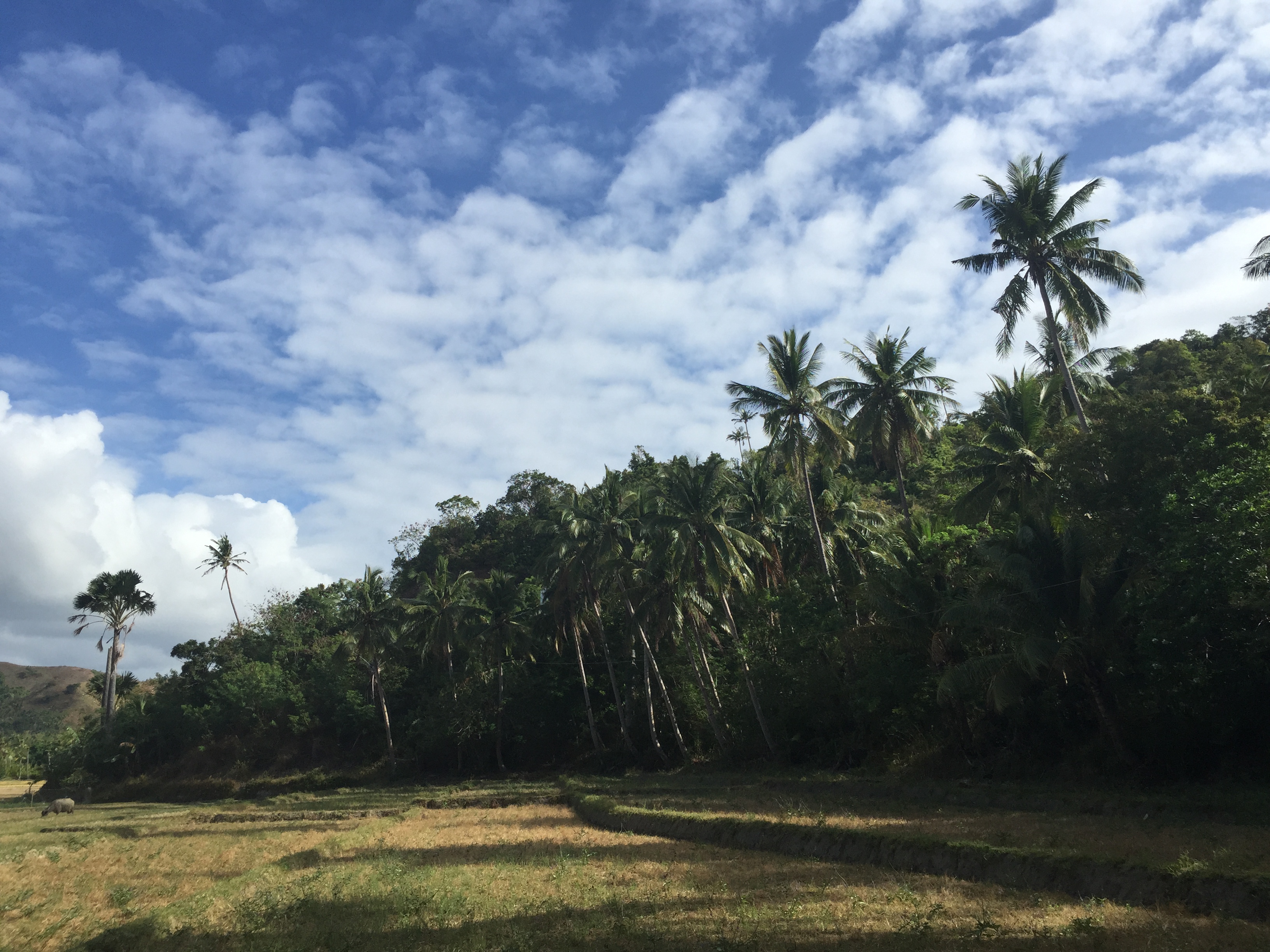
You won’t see it in any of the tourist guidebooks, and you might need to know the cousin of a cousin to navigate safely around the place. They call it Calatong—a word for which, in the local dialect of Guinbiraynon, there seems to be no precise translation, but it’s otherwise known even to the place’s youngsters as fairyland, the mountain inhabited by encantos, the enchanted ones. It dominates this corner of Romblon’s largest island of Tablas, both physically and culturally; from far at sea, Calatong’s tall hump offers an unmistakable landmark; by land, along the winding dirt road from Alcantara to Guinbirayan, it rises on your left, a massive mystery, although it might take some time and tuba to get the stories about Calatong flowing through the conversation.

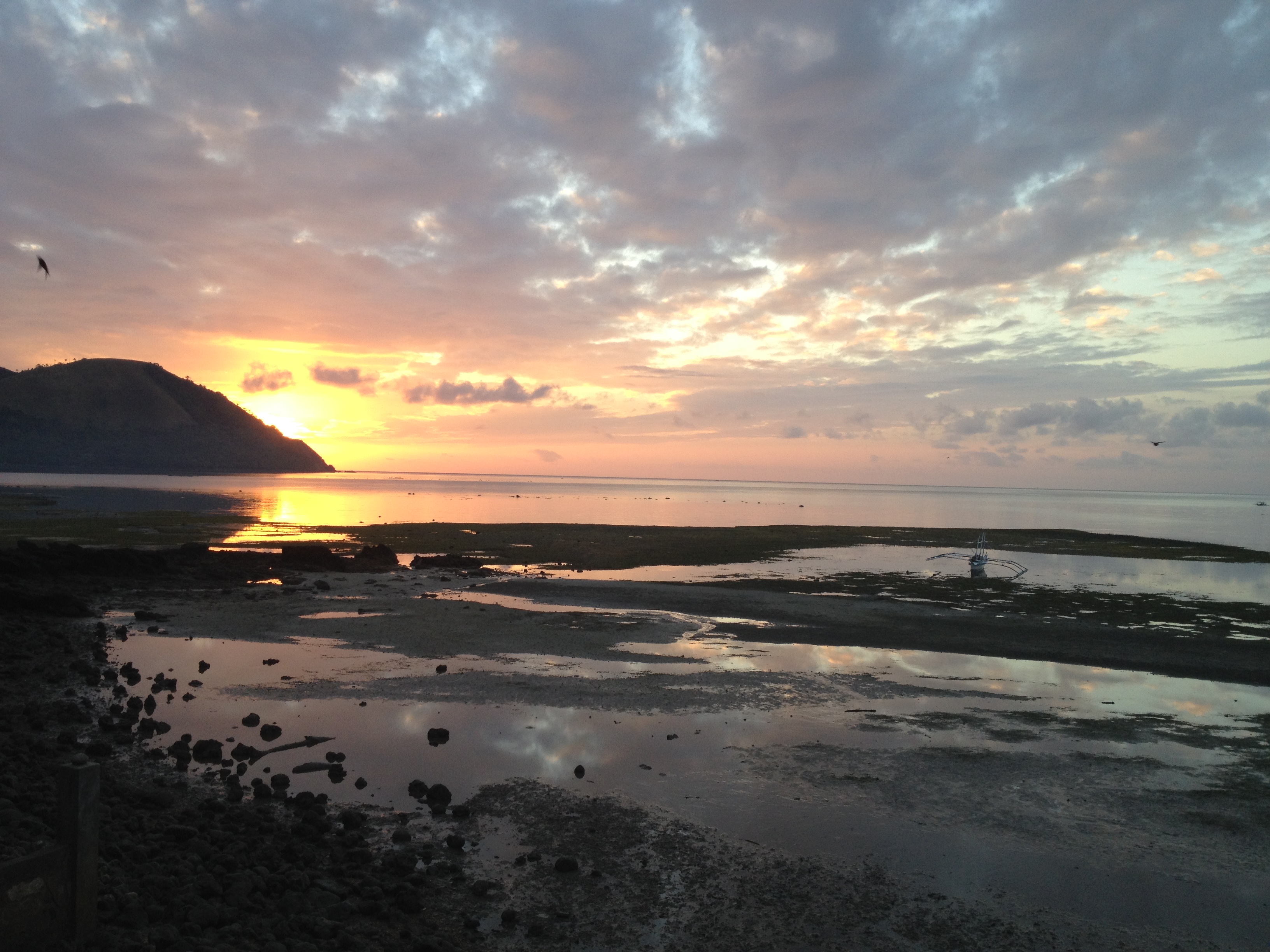
I had seen and known about Calatong from my earliest years in Guinbirayan—my mother’s hometown—and even on this most recent visit, it was the first thing I would see outdoors when I stepped out of the house at daybreak, because the sun would emerge from behind it like a glowing crown above a dark and brooding head.

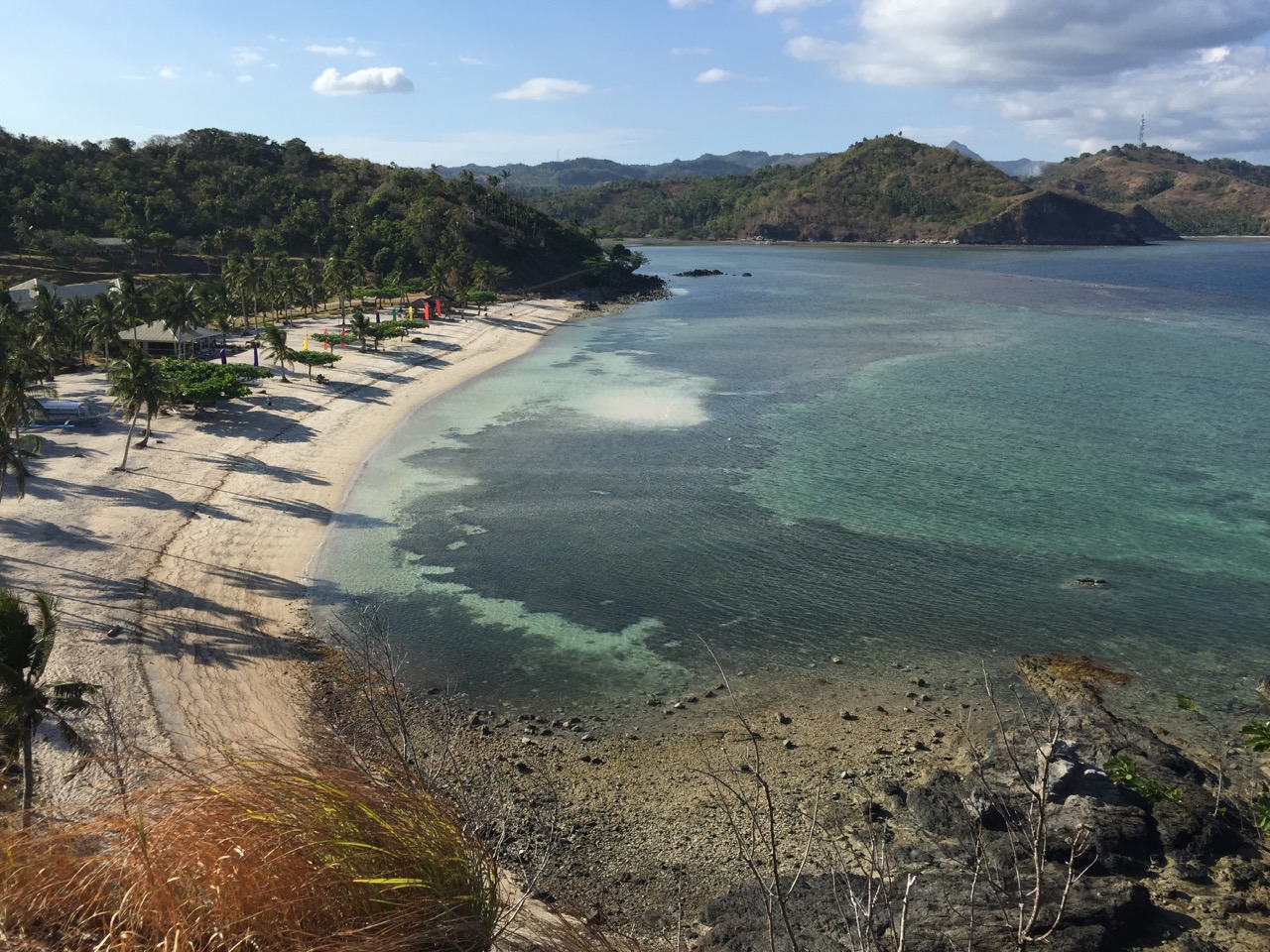
But I had never gone out there, although it seemed close enough to walk from where I stood on the shore. On this trip, at age 61, I told myself that it was now or never, and on the appointed morning we rode out to Calatong, but not before Letty, the retired schoolteacher who kindly hosted us, armed each one of us with a sliver of ginger. My mother Emy, now 86, had not been back to Calatong since she was a nine-year-old schoolgirl on a field trip with her class. “My teacher never let me out of her sight the whole time we were here,” my mother said as we parked the SUV as far up the dirt road as it could go. We walked up to the shore and took a banca over the glassine water—now turquoise, now emerald—to view the mountain from the sea, turning back only when the waves grew choppy.

IMG_7267

It’s said that during the War, when the Japanese flew over Calatong, they saw a brightly lit city, but then found nothing on the ground. This gave rise to the legend of Calatong as a ciudad, the name by which many of the locals still call it.

Somewhere in that sylvan cosmopolis was a waterfalls or a spring they called Labhang Dalaga, or “where the maidens washed,” from which flowed bubbly water, fragrant as if it had carried soap. We didn’t venture far enough inland to catch this frothy spectacle, but the rocks did sparkle in the sun in Calatong, as we were told they would; it was easy to see that the rocks were granitic, and contained liberal inclusions of quartz and mica, among other shiny minerals.

The mountain resists poachers and souvenir-hunters unless they’re locals who respectfully ask permission. They say that a woman who picked up a black rock and brought it home was horrified to find that the rock, left in her bathroom, had turned into a snake. A man who reportedly dug up oil and brought it out would find his precious discovery turning to water. There’s talk of siphoning water from Calatong to serve the nearby barangays, but already there’s grumbling about irregularities in the process, and about the likely consequences of displeasing the spirits.

The encantos, our cousins said, were fair-skinned, and one way of ascertaining who they were was to note the absence of a philtrum—that depression in the skin on your upper lip beneath your nose. The encantos liked to come to town to join the dances during the fiesta, when beautiful strangers typically appeared from nowhere, enjoying themselves and charming the locals. The encantos seemed to particularly favor the pretty nurses from far away who came to serve in Romblon as part of their martial-law-era YCAP duties. The antidote to their charms was to eat quinta, or black mountain rice; marriage to a local boy also seemed to ward off any further claims by the spirits—so swore my cousin Fred, who thereby met and married his wife Nanette.

You had to be careful about whom you made friends with, as a boy would realize when he accompanied his new friend home, and made the Sign of the Cross to be on the safe side of things—only to suddenly find himself hanging from the limbs of a tree. The townspeople would also see their neighbors jumping out their windows—and these neighbors would later return with fantastic stories about riding golden chariots over the mountaintops.

IMG_7245

The most persistent story also happens to be the most fantastic one, its incredibility only magnified by the insistence of the storytellers upon its veracity. Among those storytellers was an aunt-figure we’ve always known as Manang Munday, who recounted her story at the dining table, thusly:

One mid-afternoon in 1942, when she was in the fourth grade, Manang Munday heard a large commotion brewing and joined a throng of people rushing to the Guinbirayan shore. There, she says, she and the others saw a light-colored ship—the kind that plied the Romblon-Manila route—with the name “COSME YAP” brightly emblazoned in gold letters on its side. It sailed behind Calatong, but when the people tried to follow it and view it from afar, it was nowhere to be found. Years later the villagers would swear that they had heard the sound of an anchor chain being unwound in the night from the direction of Calatong.

Cosme Yap was my maternal grandfather, a merchant and a goldsmith, one of the richest citizens of Guinbirayan in his time. Lolo Cosme did own a sailboat, a batel as they call it in those parts, but it rather dramatically sank in a storm on its maiden voyage, Titanic-like (his wealth survived the catastrophe, but how it eventually vanished is another novel unto itself, albeit an unimaginatively prosaic one). The boat and the gold probably explain the persistence of this tale, and of its variations. Relatives say that when my Aunt Nieves was close to death, she had a vision of Lolo Cosme coming to fetch her in a golden airplane.

Again, unlike my sweet Beng who’s wired to the Universe, I don’t believe in spirits—but if something golden flashes before my eyes in my final hour, at least I’d have an inkling where that was coming from.

Penman No. 141: War and Remembrance

IMG_7163Penman for Monday, March 23, 2015


A FEW weeks ago, I had the pleasure of having coffee at the Ayala Museum with some good friends visiting briefly from the United States—the historian and professor Sharon Delmendo and her mother Judy, and the retired soldier, consul, and West Point lecturer Sonny Busa.

Both Sharon and Sonny were in town to do research—Sharon on President Quezon and the Manilaners, the Jewish refugees whom Quezon took in just before the War, and the Visayas-born Sonny on the guerrilla movement, for which he’s helping to seek more recognition in the US, especially those who may have fallen through the cracks of the American legal system. (Even Judy Delmendo proved to be a revelation, as I Iearned the story of how, as an idealistic young teacher, Judy signed up for the Peace Corps as soon as she heard JFK’s clarion call about doing something for one’s country. She was among the very first Peace Corps volunteers to ship out, and landed in Masbate, where she ended up marrying a handsome Filipino named Rene.)

Not surprisingly, history—both past and current—dominated our discussion. I’m not a historian myself, but have a keen interest in the subject, and might even have taken it up as my profession. (There was this fork in the road, more than 30 years ago, when I was returning to college from a long hiatus and was choosing between English and History as my major; pressed for time, I chose the path of less resistance.)

It must have been all those movies I saw and comic books I read as a kid, but I’ve been especially and inordinately fascinated by war and conflict—despite the fact, to which my friends will hopefully attest, that I’m a most unwarlike person, and have never fired a gun in all my 61 years. (In her college years, our daughter Demi was a proud member of UP’s rifle and pistol team.) I may be enthralled by the engineering that goes into a piece of weaponry, and I’m easily impressed and moved by tales of courage and heroism in battle, but I never for a minute forget that war is an ugly business, brutal and brutalizing, inevitably attended by grief and sorrow, and by the all-too-human impulse to wage even more war.

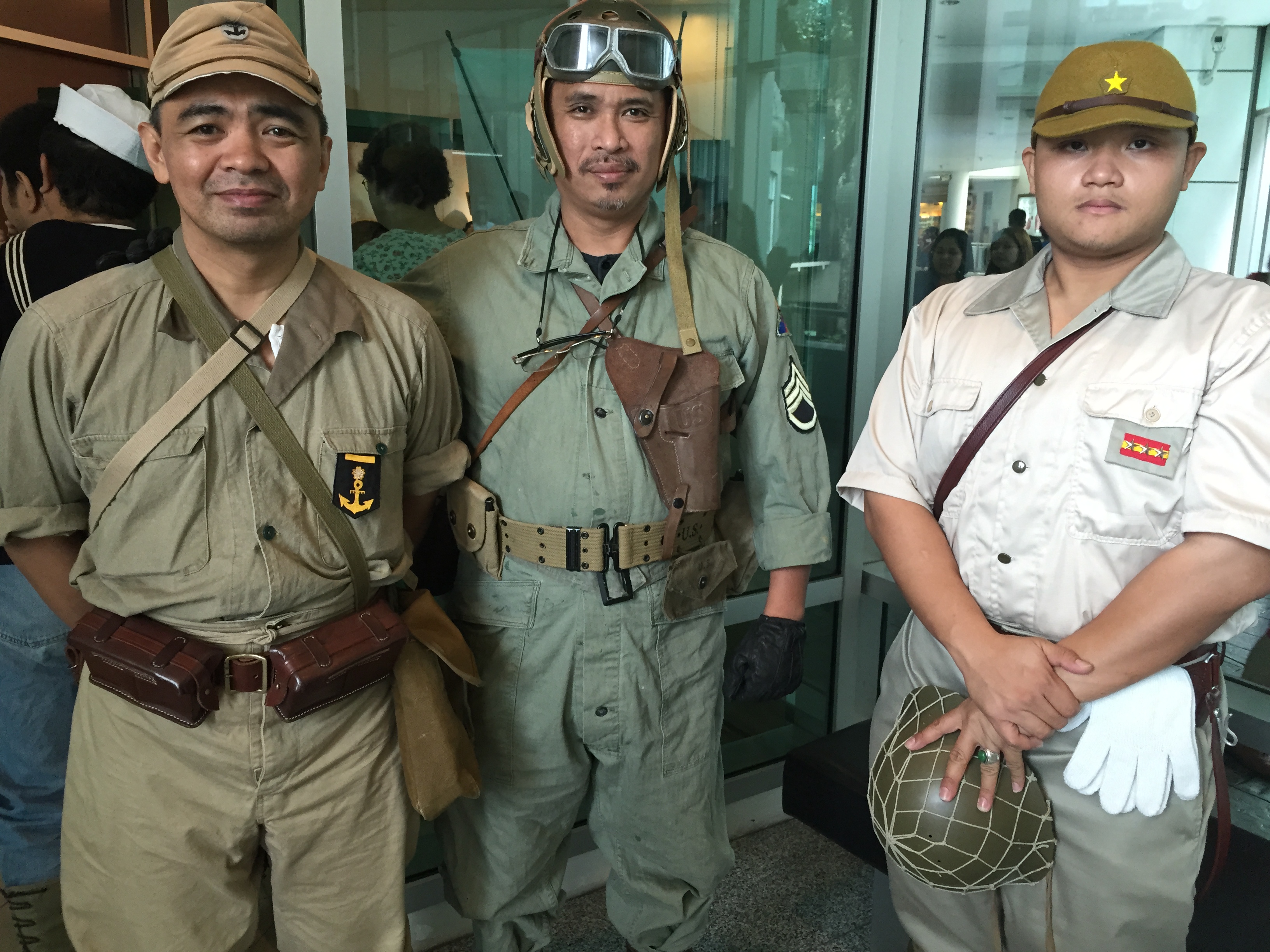
Sharon and Sonny had come to the Ayala Museum that morning not just to see me but also to take part in a conference on World War II, coinciding with an exhibit at the museum. I hadn’t known about the conference and couldn’t stay on for the rest of the day, but I did stay long enough to catch the first event, which was an exhibit on wartime Manila, particularly the uniforms worn by military personnel on both sides. The reason for this curious but interesting angle became apparent when we were soon surrounded by people dressed up as Japanese and American officers and soldiers, and also as nurses, guerrillas, and even a Makapili informer.

I turned around to see a familiar face, albeit in a totally unfamiliar context: that of the prizewinning sculptor Toym Imao, son of the late National Artist Abdulmari Imao and an accomplished artist in his own right. I’d last met Toym (so named because of the award his dad received) when he was a speaker at our Fulbright pre-departure orientation last year; he had been a Fulbright scholar in Maryland, honing his skills there. But now Toym the sculptor had transformed into Toym the tank commander, a figure right out of Fury.

“We started out as an Airsoft group,” Toym told me, “but we soon realized that it would be more interesting if we went for historical re-enactments using historically correct uniforms and costumes.” Thus was born the Philippine Living History Society, which had put up that morning’s special display. The society, which now has nearly a hundred members, counts HR managers, call center agents, and media professionals among others in its ranks; older persons, women, and children are also part of the group, which has staged re-enactments of famous battles or encounters (a mere costume parade, I learned, is simply an “impression”; members also have a term, “farb,” for historically inaccurate gear). Some of their uniforms and equipment are genuine artifacts—preserved, rediscovered and restored, or sourced from eBay; others are reproductions, but accurate down to the last button.

Despite their strong military bent, the society’s members are no warmongers. “We just want Filipinos to appreciate history better, and this is a good way of getting their attention,” Toym explained. They certainly got ours—even Sonny Busa, probably the only real soldier in the room (he had served with the US Army’s Special Forces before joining the diplomatic service), was caught up in the drama.

FullSizeRender

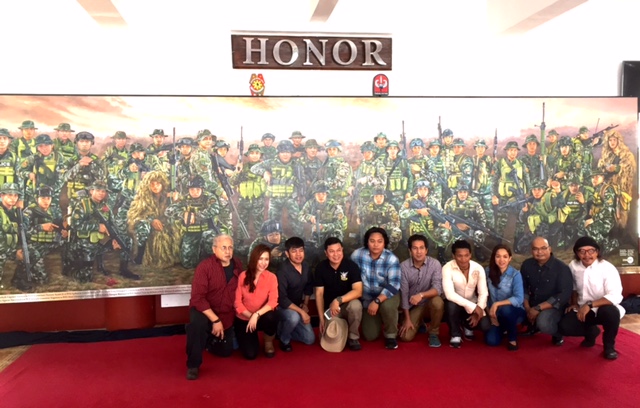
Speaking of war and remembrance, I’d like to note the recent completion and turnover to the Philippine National Police Academy of a huge and breathtaking mural by the Erehwon Art Collective, a division of the Quezon City-based Erehwon Art World Corporation. We don’t have enough military art in this country, and quite apart from its powerful emotional appeal, this mural will be an important contribution to that genre. Let me draw on the description provided by Erehwon founder Raffy Benitez:

“Tagaligtas: Heroic 44 is a military mural that realistically depicts each and every member of the SAF 44 in their combat gear and uniform, portrayed as they are about to go into combat in realistic formations and stances. They gaze at the viewer with pride and fondness as comrades, sons, brothers, and fathers who have passed on into history. Portrayed across 182 square feet of canvas that measures 7 feet tall by 26 feet long, the SAF 44 are depicted in their various unit configurations, with the commanding officers and senior inspectors in front, middle ranking patrolmen in the middle, and junior-ranking patrolmen at the rear.”

Incredibly, the mural was completed in just three weeks by a talented and tireless team that included Grandier Gil Bella (head artist), Jerico de Leon, Neil Doloricon, Camille Dela Rosa; Lourdes Inosanto, Jonathan Joven, Othoniel Neri (assistant head artist), Emmanuel Nim, and Dario Noche (head researcher and photodocumentor); and Eghai Roxas. The Philippine Chamber of Commerce and Industry (PCCI) provided financial support for the project, while PSSupt Gilbert D.C. Cruz of the PNP-NCR Southern Police District provided technical advice. The mural design was conceptualized by Dr. Reuben Ramas Cañete.

So whether through the theater of costumery or the quieter grandeur of a mural, the warrior lives on in our common memory.

Penman No. 140: An Oktoberfest for Writers

Penman for Monday, March 16, 2015


FOR THE past several years now, I’ve been actively involved in a regional organization called the Asia Pacific Writers and Translators (APWT), which has shaped up to be the liveliest and most active such grouping that I’ve joined. Writers and literary academics can join any number of professional associations and interest groups all over the world—ranging from the venerable and highly respected PEN to the more academically-oriented Modern Languages Association—and each of them will have their individual qualities and strengths, but nothing has worked quite as well for me as APWT.

The difference, I’ve found, is that this is a network that actually works as a network should—members get to know each other and help each other out on matters of both professional and personal concern; many become good friends, so you can always depend on being able to ring up a fellow writer in every port around the region for tea and sympathy. We meet as an organization once a year—it began in India, but has moved around to Hong Kong, Australia, Thailand, and Singapore. The Filipino delegation to these annual conferences has been increasingly large and substantial. Moreover, these participants are much less the familiar, senior faces like me than new, young, aspiring writers eager to establish their own contacts and networks.

This year, for the first time, APWT will be meeting in Manila, from October 22 to 25. As a member of the APWT Board, I’m helping to spread the word this early so Filipino writers can prepare to join the conference and present proposals for presentations at the conference sessions.

APWT 2015 is being spearheaded by the University of the Philippines’ Department of English and Comparative Literature, headed by its very capable chair, Dr. Lily Rose Tope, with funding from the National Commission for Culture and the Arts. Also providing key support are De La Salle University and the University of Sto. Tomas, with further assistance from the British Council, Ateneo de Manila University, and Anvil Publishing.

For this year’s conference theme, we chose something close to our contrarian hearts: “Against the Grain: Dissidence, Dissonance, and Difference in Asia-Pacific Writing and Translation.” That’s a mouthful, but just think of going “against the grain” or against the current. Like I wrote in a blurb for the conference, “That theme comes out of several centuries of an other-mindedness that seems to come naturally to Filipinos. We’re very agreeable people, but we love to argue, sometimes just for the sake of it, and value freedom of speech above everything else. That makes for a robust if raucous democracy where there are absolutely no taboos or sacred cows.” In other words, in Manila, we can talk about anything in any way we like—which you can’t necessarily say for our more, uhm, circumspect neighbors.

We’re fortunate to have the Sri Lankan-born and now London-based Booker Prize finalist Romesh Gunesekera among our keynote speakers, especially since Romesh grew up in the Philippines, where his father was one of the founders of the Asian Development Bank. APWT 2015 will open and take place for the first two days in UP Diliman, then move to La Salle and UST on its closing day. (On opening night, Anvil will host a launch and poetry reading at the thematically apt Conspiracy bar on Viasayas Avenue.)

Aside from the main plenaries and readings, there will be at least ten breakout sessions for panels on such possible topics as literature in a time of terror; taboo and transgression; writing violence, writing trauma; transmedial translation (writing across disciplines); publishing outside the center; writing within/without/beyond the canon; regional literatures in a global context; the writing life; and translating Westward, translating in-country. We will also have a special “new voices” session and several workshops with renowned international experts.

So let me lead the call for proposals for presentations by interested Filipino authors. By “presentations,” we mean informal but well-thought-out discussions of literary topics of broad interest lasting no more than 10 minutes. APWT is not the venue for long, narrowly focused academic papers; you may wish to present popularized abstracts of such work, if applicable.

At APWT, people don’t read papers; they talk. We value the idea of writers and translators in conversation—among themselves, and with the audience. For this reason, we’ll make sure that the 10-minute limit will be strictly imposed (and I won’t mind wading in and pulling the plug myself), to allow for a longer and livelier Q&A. We will discourage the use of PowerPoint unless absolutely necessary to minimize setup delays and glitches.

By “proposals,” we mean a paragraph or two about your chosen topic, its significance and possible connection to the theme, and the main points you’d like to raise about it. The broader the appeal of the topic and the sharper the edge, the likelier it will be accepted. Proposals sharing a common thread will be grouped together.

Please provide a brief CV (with a high-resolution photograph, if possible) highlighting your background and expertise, as well as your contact information. Direct all submissions and inquiries to apwt2015@gmail.com. (No deadline has been set yet for proposals, but we’ll close the panels when we have enough of them; simple participation will be open until the conference itself.)

We’d also like to remind potential participants that APWT has no funds for the travel and lodging of participants, and has traditionally subsisted on the private initiative of its members, who are strongly encouraged to seek sponsorships for their participation. A modest conference and membership fee will be collected to help sustain the association’s other activities. We can send individual invitations either upon acceptance of your proposal or upon request. For more information about APWT, visit our website at www.apwriters.org.

See you at APWT 2015!


Penman No. 139: Memo to the Palancas

Penman for Monday, March 9, 2015

[THIS JUST IN: Mrs. Sylvia Palanca-Quirino, director-general of the Palanca Awards, called me to announce that the implementation of the copyright rule discussed below will be suspended pending a review to be conducted by the foundation.]

THE PALANCA Awards—the country’s best known and, especially for young writers, still the worthiest literary award to go for—are entering their 65th year this year. I was happy to be reminded of this milestone by an email I recently received from a representative of the Carlos Palanca Memorial Awards for Literature Foundation, which administers the awards. The rules and entry forms, I was told, were now available at http://palancaawards.com.ph/newPalanca/entries.php.

I took a peek at that page—not because I was thinking of joining, something I haven’t done in 15 years since I was inducted into the Hall of Fame—but because I was curious to see what was going on with the Palancas, to which I and hundreds of other Filipino writers owe so much of whatever we’ve made of ourselves and of our work.

For the members of my generation—those of us who began our writing careers under martial law, when there were hardly any publishing venues and free speech was under the gravest threat—the Palancas were a lifeline, engendering the production of good new work, even though much of this would come to light only after 1986.

The Palanca Awards have also been vital to the encouragement and promotion of new writing from the regions and from young writers, for whom special categories have been added. Its biennial prize for the novel—which is up for grabs again this year—is key to the production of new work in this flagship genre, which I’ve argued is really our only way to get our writing known to publishers and audiences overseas.

For all these, the Palanca Foundation and family deserve every Filipino writer’s deep gratitude.

I should note, however, something I spotted in the rules that might be cause for concern. Pardon the long quote, but you’ll see why this should raise eyebrows:

“21. In submitting the Work(s) the contestant and parent/guardian (if applicable) (the “Contestant”) accepts and agrees to the rules of the contest (the “Rules”). In the case of a winning Work or Works, the Contestant further grants and assigns to the Sponsor the concurrent and non-exclusive right to exercise the full copyright and all other intellectual property rights over such Work(s), as well as all intellectual property rights over the Contestant’s previous Palanca Award prize–winning work(s) if any, (collectively, the “Work(s)”), and waives all moral rights over all his or her Palanca Award prize-winning Work(s) in favor of the Sponsor.

“This grant, assignment, and waiver of rights (the “Sponsor’s Rights”), may be exercised by the Sponsor to the extent permitted under existing laws applicable at the time of exercise. The Sponsor’s Rights shall extend to all forms of storage, transmission, dissemination, and communication, presently existing or subsequently created. To the extent permitted by law, the Sponsor’s Rights shall be worldwide, continuous, and may be exercised by the Sponsor for the maximum time allowed by applicable law. In furtherance of education the Sponsor reserves the right to donate copies of individual winning Works or compilations of Winning Work(s) to public and private educational institutions and public libraries.

“To promote Philippine Literature in the modern world of information technology, the Sponsor intends to make the winning entries accessible through the Internet or other electronic media, to serve as a literary archive of the contest. The website or other media to be established for this purpose are intended to be a repository of the award-winning Works, recording the history of the development of Philippine literature over the years through the Palanca Awards. In making the Work(s) thus available to the public, the Sponsor intends purely to promote literary appreciation for and public awareness of such Work(s), and not to commercially exploit the same. Contestants must indicate on the Official Entry Form whether they agree to have their Work(s) posted on the CPMA website and made available for downloading by the public for free in the event that a prize is awarded for the entry; in the absence of any indication in the entry form, it is presumed that the author has agreed to such inclusion of the Work. To encourage use for educational purposes, winning Work(s) shall be posted on the website in their entirety. Should any winning author subsequently instruct the Sponsor in writing to include or remove the Work(s) from the Internet archive, such instruction will be honored and the Work shall be included or removed from the Internet archive within a reasonable time from Sponsor’s receipt of the author’s written instruction. The exclusion of any winning Work or Works from the website shall not constitute a waiver of any of the Sponsor’s Rights.

“The prize money which may be awarded to the Contestant for the Work(s) shall constitute full payment for the Sponsor’s Rights, and shall be in lieu of any royalties or other compensation to the Contestant.”

Please correct me if I’m wrong (and I hope I am), but this this reads to me—and I wonder who else will read the rules so carefully—practically like a blanket waiver or surrender of one’s rights to the present work, including those to one’s previous winning works, as well as e-book rights—to the foundation. Unless you explicitly say no, your winning work could also be published in its entirety online and downloaded.

In this age when Filipino writers have just begun to understand the value of their work as intellectual property and to exercise those rights, this rule could be a deal-breaker for many established authors wanting to join the competition, and a rather onerous imposition on new writers dying to get a break.

Some other Palanca oldtimers like fellow Hall of Famer Krip Yuson and I have had the occasional pleasure of a private lunch with Palanca Awards director-general Sylvia Palanca-Quirino to informally review the rules and update them if necessary. Since Sylvia’s not been too well lately, we haven’t had this privilege, else I would have told her personally what I’m saying now, thinking that this over-claiming of intellectual property rights could have been a well-intentioned oversight meant to facilitate the promotion of Philippine literature.

But since the rules are out there and the competition is now officially open to all, I feel obliged—on behalf of my fellow writers—to go public with this appeal to review and moderate those rules, to make for a competition that’s freer, fairer, and more fun.

(Image from palancaawards.com)

Penman No. 138: On Wall and Paper

IMG_7127Penman for Monday, March 2, 2015


OF ALLl the forms of art, nothing catches the public eye quite like a mural—a painting on a wall. It isn’t just that murals tend to be massively larger than your usual living room portrait or still life. They very often seek to capture and represent the spirit and experience of a community, voicing the concerns and celebrating the values of that community. Starting with cave paintings, murals are also the oldest human art form, but they’ve survived surprisingly well into the 21st century, creatively adapting—often literally—to their physical and social environment. (For some of the world’s best contemporary murals, see here: http://www.cartridgesave.co.uk/news/the-50-most-stunning-wall-murals-from-around-the-world/)

In the Philippines, muralists like the late National Artist Carlos “Botong” Francisco have defined the content, style, and temper of the form, much like Diego de Rivera and Jose Clemente Orozco did in Mexico. Informed by history and politics, their work also incorporates ethnic and religious elements, presented in a sweeping visual montage.

Given our colorful history and the need to inflame our people with greater patriotic fervor, you’d think we should have more murals adorning our many walls—think of the kilometer-long mural that snakes through downtown Hanoi, for example—but sadly, we don’t. Good murals take time, resources, and of course artistic talent and vision to make, not to mention the large blank spaces that are the muralist’s work- and play-ground.

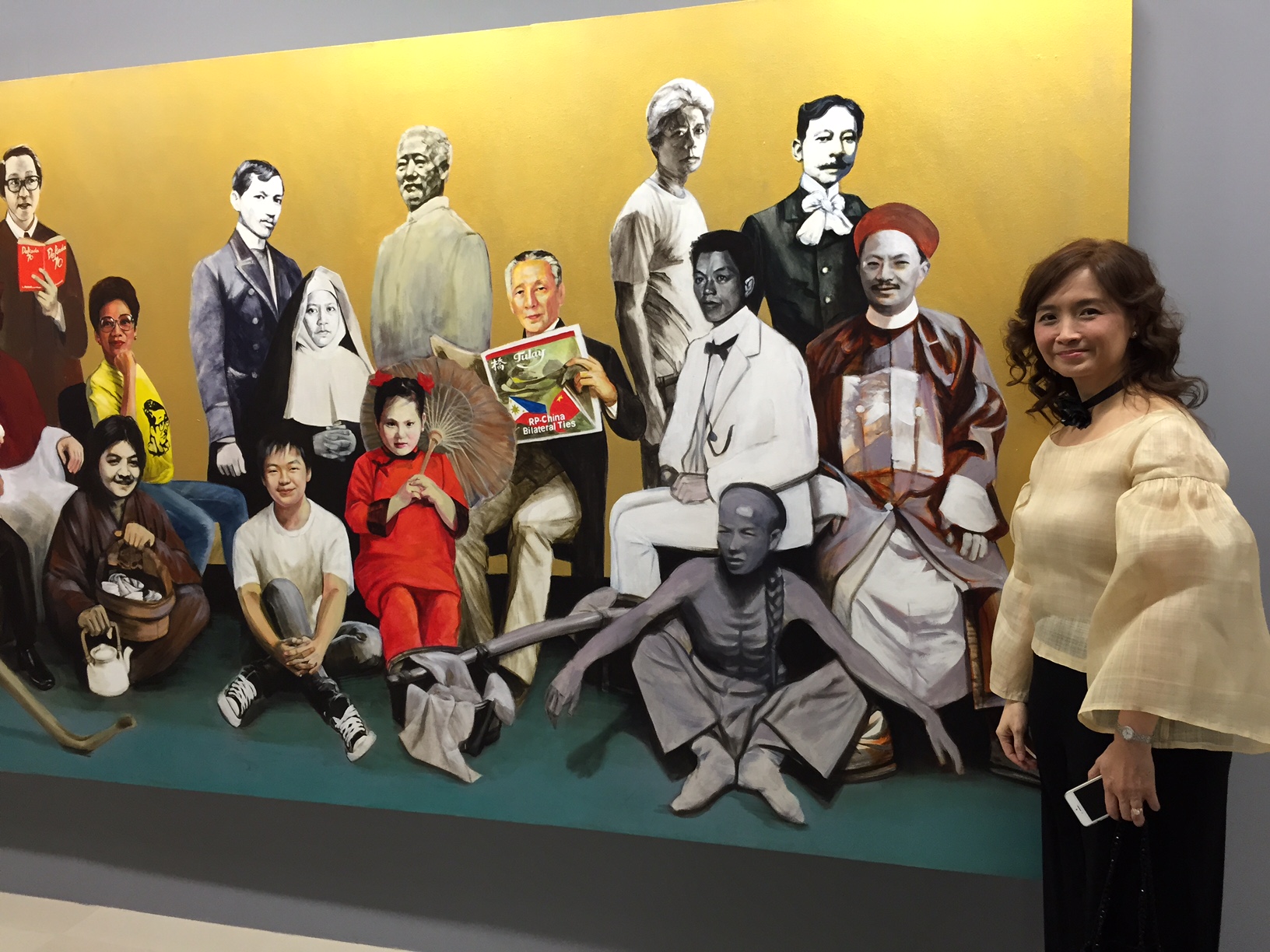
Thankfully, the University of the Philippines—in cooperation with the UP Alumni Association and the Araneta Center Complex—has taken a major step to redressing that shortage, by commissioning 28 of the university’s top alumni artists to produce murals depicting various periods and aspects of Philippine history.

This distinguished roster includes Adonai Artificio, Armand Bacaltos, Adi Baen-Santos, Grandier Bella, Benjie Cabangis, Ben Cabrera, Angel Cacnio, Romeo Carlos, Cris Cruz, Denes Dasco, Gig de Pio, Simkin de Pio, Vincent de Pio, Neil Doloricon, Norman Dreo, Amado Hidalgo, Abdul Asia Mari Imao, Ben Infante, Gigi Javier-Alfonso, Aileen Lanuza, Romeo Mananquil, Norlie Meimban, Julius Samson, Jonahmar Salvosa, Randy Solon, Michael Velasco, Jun Yee, and Janice Young. The resulting exhibit, titled “” or Philippine History in Art—opened at the Araneta Center’s Gateway Gallery last February 18.

The murals—all of a uniform 6’ x 12’ size—cover the full range of Philippine history from pre-Hispanic times to the present, under the guidance of historian Dr. Luisa Camagay and project director and artist Dr. Gigi Javier Alfonso. To UP President Alfredo Pascual, the project is UP’s way of helping to promote a keener historical consciousness among Filipinos, especially the young. The Araneta Center in Cubao, which is marking its 60th anniversary, graciously agreed to host the exhibit in its new 5th-floor gallery.

Coming from a science background, a senior UP official whom I was touring the exhibit with asked me for my critique of the murals on show. I told her that while I was of course pleased with the project as a whole, with its intentions and execution, I personally preferred those works that went a step beyond the literal in their treatment of history, and that dwelt less on the big and obvious historical figures and more on pedestrian realities. I do understand that murals can’t be too abstract, lest they fail to connect with their intended mass audience; in any case, the murals did what they were meant to do, which is to provoke more thought and talk among their viewers.

FullSizeRender

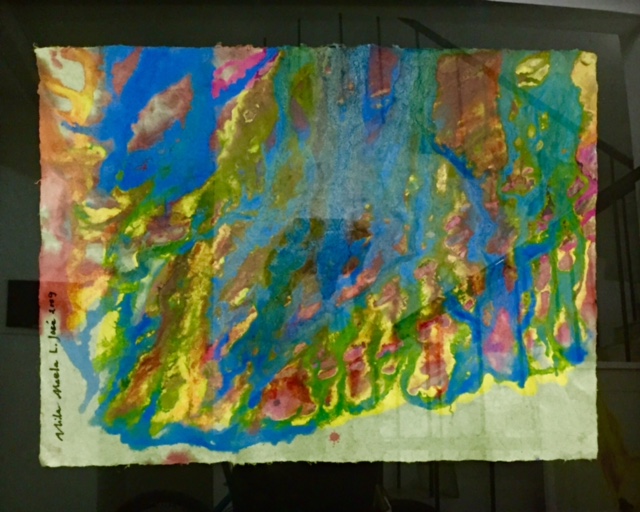
On another front, and also in Quezon City which seems to be shaping up as the cultural center of the metropolis, a new exhibit of paper and paper-based art titled “Pumapapel” opened last week at the Erehwon Center for the Arts, probably the city’s most dynamic privately-operated art center.

This exhibition expands the possibilities of Filipino artistic expression by combining many fields of art making, from painting, drawing, printmaking, mix-media, sculpture and installation, to photography and book/graphic illustration by focusing on the unique qualities of paper as both ground and medium. Curated by UP professor Dr. Reuben R. Cañete, “Pumapapel” features the works of about 100 artists including those of National Artists Vicente Manansala and Benedicto Cabrera, as well as those of Philip Victor, Renato Villanueva, Ofelia Gelvezon-Tequi, Manuel Rodriguez Jr., Juvenal Sanso, and Manuel Ocampo. Also on the list are upcoming artists from the Cordillera, Cebu, Bacolod, and Mindanao, and photographers and graphic artists, among others.

“Pumapapel”’s focus on paper art brings us back, like murals do, to the earliest periods and forms of artistic human expression. From paintings to paper sculpture, this exhibit showcases the myriad possibilities of paper both as medium and material, and also not incidentally celebrates Erehwon’s third year as the upcoming place-to-be for QC-based artists.

Erehwon may not be the easiest place to get to (it’s located at 1 Don Francisco Street, Villa Beatriz Subdivision, Old Balara) but it’s served as a home not only for painters and sculptors but also for musicians, dancers, and writers, thanks to the generosity of its founder and president, Raffy Benitez, and the support of people like Erehwon Arts Foundation President Boysie Villavicencio. (I shouldn’t forget to mention my wife June, who serves as Boysie’s vice president and who has been spending many sleepless nights helping to put this exhibition together.) The Erehwon Center for the Arts’ new Dance Studio was also inaugurated last week.

Pay these exhibits a visit, and you’ll remember and understand how and why art means something to ordinary people, in extraordinary ways.

(Mural by Janice Young. Batik painting on paper by Maela Jose.)


Penman No. 137: The Other Filipino Values

Penman for Monday, February 23, 2015


DURING THIS most recent US visit, I had a chance to have a chat over a few beers with Ray Ricario, the older brother of our daughter Demi’s husband Jerry, and with some of Ray’s friends. Born in the US to parents from Albay, Ray’s a retired naval officer and an entrepreneur. He and his family are registered albeit moderate Republicans—as you might expect of Filipino immigrants steeped in a proud military tradition—and Ray knows that Beng and I are passionate liberals, so we have a lively but always civil conversation going about current events in the US, the Philippines, and around the world.

More often than not we end up agreeing on more things than we disagree on, especially when it comes to strengthening ties between Filipinos and Americans, and raising the profile of the Philippines in America. I always look forward to meeting with Ray, not the least because he and his wife Lorie are unfailingly gracious hosts and we both love beer and barbecue.

Our last conversation revolved around a common concern: the preservation of Filipino values and their transmission to the next generation of Filipinos and Filipino-Americans. As the father of three children, Ray feels strongly about the need for them to have some vital cultural connection to the old country, even as they join—as they should and inevitably will—the American mainstream. The others around our table lamented how Filipino values seemed to be eroding among the Filipino-American youth, but were rightfully proud at the same time of their efforts to preserve them. One of the ways mentioned was the practice of taking the hand of one’s elder to one’s forehead in a gesture of respect—our famous and unique “mano po.”

That was fine and laudable, I said, but it also got me thinking about what other values we seek to pass on to our young, aside from the respect we expect and sometimes demand of them. I had to wonder what a young Filipino-American, told by his dad or mom to do mano to an older Filipino stranger entering the room, would be feeling at that moment of contact—would that be genuine respect, or a grudging sense of obligation, accompanied by a shudder at the external silliness of the deed?

The mano po is a wonderful tradition (even though, to be honest, you hardly see it being done anymore even in Manila), and those of us who still practice it know and understand that the value it embodies is respect for one’s elders. But how well is that value valued in such a place as America, where the native-born young—without necessarily meaning to be disrespectful or impertinent—might see things (such as authority) differently? How well can values and traditions carry over in another context—or sometimes, without the context that gave them meaning in the first place?

I suggested that perhaps “respect for elders” could itself be revisited and explained in a way that young people today (as we ourselves were, not too long ago) could better understand and accept. Having been social rebel in my own youth, I refuse to see “respect for elders” as the blind acceptance of the authority of the old; that will only ingrain resentment and resistance. I’d rather take and present it as a willingness to listen, an acceptance of the possibility (however remote it may seem to a 16-year-old) that this older person might actually have something sensible and useful to share with you. When I do the mano po, I accept you—in all my youthful arrogance—as my equal.

That brought me to other Filipino values—both of a philosophical and practical sort—that I don’t think we emphasize enough, whether in America or at home. I’d argue that principled resistance is one of them. We’ve had a long tradition of protest and rebellion against tyranny, injustice, and bondage, as our many revolutionary heroes will bear out—but instead we seem to emphasize acceptance and acquiescence, in the desire not to give offense or to create conflict. That’s why we wear our crown of thorns with misguided pride, sometimes reveling more in our capacity for suffering rather than addressing its causes.

Our table talk didn’t get this far, but I could have proposed two more—and truly practical values—to push among the young today on both sides of the Pacific.

The first is respect for food—especially in America, where so much of it goes around, and goes to waste. This can be one of the most personal and practical applications of a social conscience—don’t take or order more than what you can eat, and finish what’s on your plate. For Beng and me, that especially applies to rice, having which we always take as a privilege. If we can’t finish our meal at a restaurant, we have it wrapped up—even that half cupful of rice—and bring it home, or hand it over to some needier person on the street.

The second is cleanliness and tidiness. We Filipinos like to keep ourselves and our surroundings clean and neat, and it’s important that we do this by ourselves. Growing up as children, our day literally began by folding our mats and mosquito nets; even if we didn’t have much, we never saw poverty as an excuse for becoming slovenly. Want to promote democracy? Teach the señorito to clean up after himself; forget any thoughts of achieving national greatness if we can’t even discipline ourselves.

Knowing Ray and seeing what a wonderful family he has, I know that I’m not shouting in the wind when I bring up these notions. I wish he’d vote for Hillary, but that’s another topic for another day.

Penman No. 135: Democracy and Cultural Expression

DSC_0024Penman for Monday, February 9, 2015


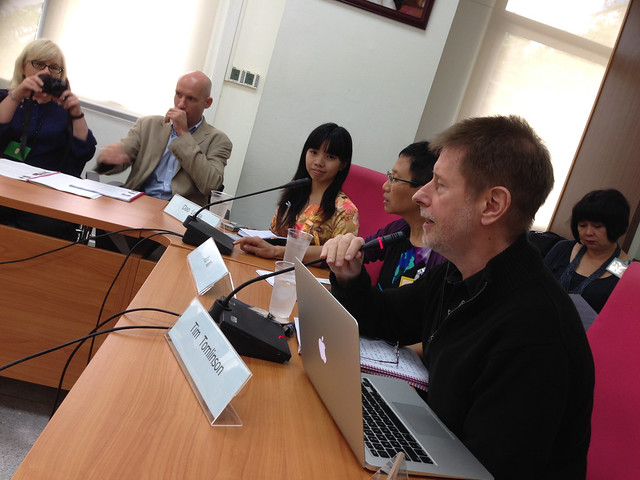
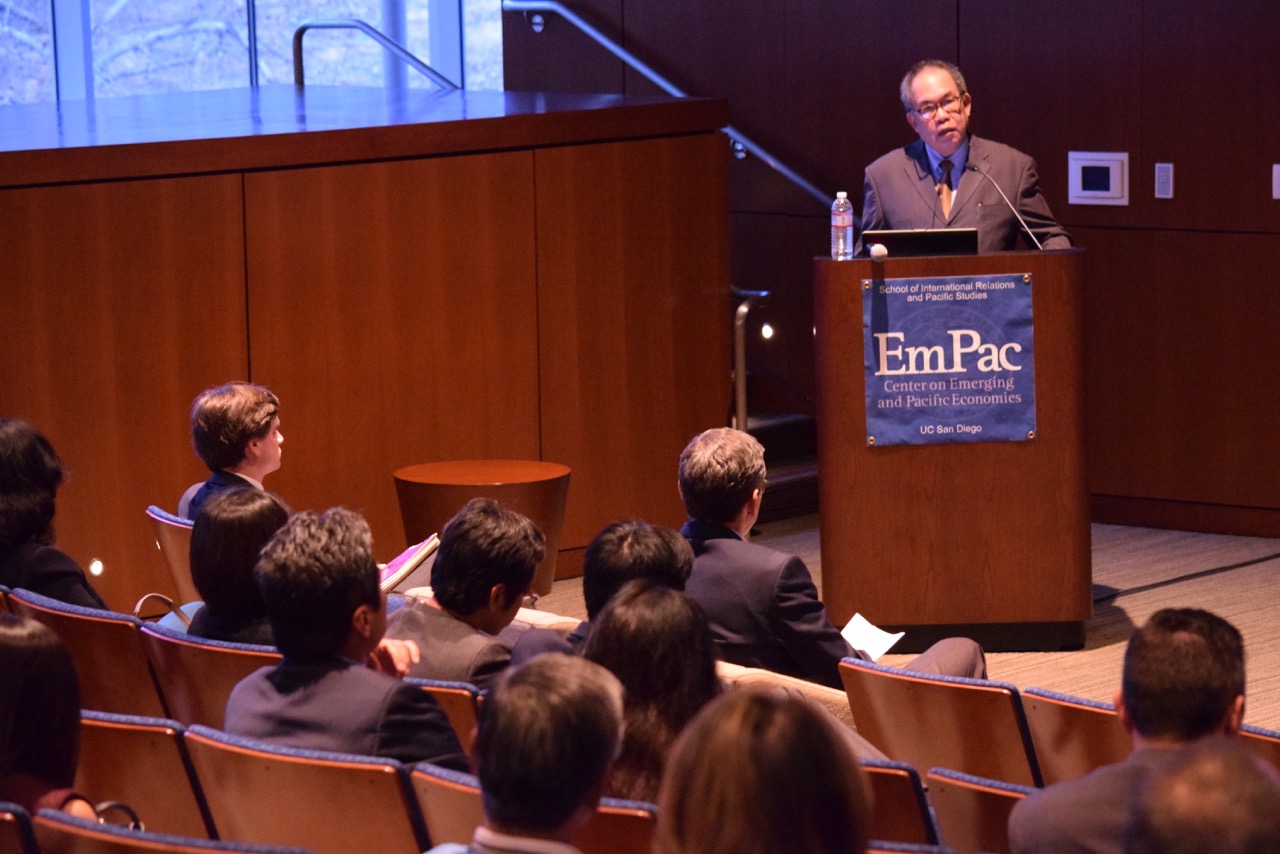
I SPENT the past two weeks as a Pacific Leadership Fellow at the School of International and Pacific Relations of the University of California, San Diego, and the highlight of my fellowship was a 40-minute talk I gave on the general topic of “Democracy and Cultural Expression: Confronting Modernization in the Philippines.” The PLF—usually a government or business leader from the Asia-Pacific region—is asked to make a public presentation to a large audience composed of academic and community representatives, to introduce and discuss major issues facing his or her society.

I felt it safer to presume that the non-Filipino members of my audience last January 28 knew very little about Philippine history and politics, so I began with a broad overview of that history, bringing things to the present and the medium-term horizon, considering both our strengths and resources—noting the robustness of our recent economic growth—but also the longstanding inequalities and structural weaknesses that continue to hold us back. Here’s a slightly edited excerpt from the rest of my talk:

We have to pause and wonder exactly what kind of democracy we have in the Philippines, and what needs to be done—particularly on the cultural front—to achieve a fuller sense of the word.

I wouldn’t go so far as to call Philippine democracy a sham, because most Filipinos enjoy fundamental rights and freedoms absent in patently undemocratic societies—freedom of expression, of association, of mobility, of enterprise; the right to vote, and a presumptive equality under the law. But that presumption is also the weakest leg our democracy stands on, undermined by gross economic and social inequalities in our society showing Philippine democracy as more a democracy of style and spirit than one of substance.

Indeed, economically and politically, the Philippines has been ruled for more than a century by an elite, a roomful of families from the landed gentry and comprador capitalists who developed their wealth and power as agents and executors of colonization, and have taken turns at governing the country well into the present.

We cannot have true democracy without achieving a better balance in our economic and social structure, and its best hope in the Philippines could be in our enlarging middle class. They may not yet have the economic and political clout of the elite, but coming from the poor and aspiring in their own way to become more prosperous, they have the most at stake in creating a new regime of opportunity and fairness.

It is the middle class that has served as the voice of Philippine democracy, primed by its education to value freedom of thought and expression. It is the middle class that stands at the vanguard of modernization, having not just the desire but also the means—through education and entrepreneurship—to change the future.

… One out of every ten Filipinos now lives and works abroad in a decades-long diaspora that has kept the Philippine economy afloat through remittances amounting to more than $25 billion in 2013. But they bring home not only money but new ideas, and I feel confident that, in the long run and for all its social costs, this diaspora will have salutary effects because that domestic helper in Milan or plumber in Bahrain will no longer be simply a domestic helper or plumber when they come home. Tourists bring home snapshots of pretty places and exotic food; foreign workers bring home real learning, lessons in survival and getting ahead, and raised expectations of their local and national leaders.

This exposure to global culture and its elevation of local aspirations will be a major force in reshaping the Filipino future. And again, it is the middle class—the dwellers of the Internet and the Ulysses of this new century—that will lead in this transformation, just as they have led the most important movements for political and social reform in our history.

… One of the bright spots of Philippine society today is the fact that civil society is very much alive, constantly on guard against governmental or corporate abuse and wrongdoing, ever ready to uphold the rights of ordinary citizens and communities, and firmly rooted in those communities. It has stood at the forefront of the movement to fight corruption, which recently came to a new climax with the explosive revelation of a billion-peso pork-barrel scam going all the way to the Senate and even possibly higher.

One of the greatest challenges of our modernization may be that of electoral reform—not just a reform of the electoral process, but a reform of the voter’s mind—not to vote for popular candidates, but to vote wisely, to see the vote as a chance to short-circuit a historical process and to lay claim to one’s equality and patrimony.

And this is where culture comes in, as an instrument of social and political reform and modernization. If we look at culture more proactively not just as a way of living but a way of thinking, then there is much room for the promotion of true democracy through cultural expression.

By cultural expression I don’t mean simply the writing of stories, poems, plays, and essays, which is what I do most days, partly as my civic duty. I mean the use of all media at our disposal—the arts, the press, the Internet, whatever can influence the Filipino mind—to forge and sustain a set of core values, of national interests that cut across family, class, and region.

Of course, we can take “cultural expression” in its more popular and familiar forms—stories, poems, plays, music, painting, and dance, among others—as gestures toward the idea of a larger, national culture. After all, with every poem or painting, the artist seeks to palpate, from an audience of citizens, a sense of what is common and what is important—or to put it both ways, what is commonly important and what is importantly common. This has always been the social value and the political mission of art—not just as a means of self-expression, but of establishing, affirming, and promoting certain commonalities of thought and feeling.

… We need nothing less than a new cultural revolution—focused on the assertion of the ordinary citizen’s rights over power and privilege, on the importance of the rule of law, and on our understanding and acceptance of what it means to be a Filipino in this globalized world. Forging that sense of national identity is crucial to securing our future, again in a world and in a part of the world where the Chinese, the Japanese, the Koreans, and the Americans seem to have very clear ideas about their roles and capabilities. In this ocean of resurgent nationalisms, we Filipinos need to redefine ourselves as more than America’s students and surrogates.

In sum, much remains to be done to lend more substance to Philippine democracy in terms of addressing age-old economic and social inequalities. But the first field of battle exists in the mind and spirit, and the first campaign in this battle, the first declaration of freedom, has to be an act of the imagination.

I prefer to see democracy as a process rather than a product; the aspiration can be as powerful as its actualization. This democracy is first formed by its assertion: by seeking democracy, we begin to achieve it, and this assertion is the task of our artists, writers, thinkers, and opinion makers, the imaginative shapers of our national identity.

Penman No. 133: Revolution in the Time of Facebook

B75xPtWCIAEFJJ4Penman for Monday, January 26, 2015


I’M BACK in the US for a few weeks, to give a series of lectures on Philippine culture and politics as a Pacific Leadership Fellow with the Center on Emerging and Pacific Economies at the School of International Relations and Pacific Studies (IR/PS) of the University of California, San Diego. The PLF is a post usually reserved for senior government officials and business leaders engaged in economic and political affairs, and it’s the first time they’re bringing over someone from the humanities; some years ago, I was preceded in this fellowship by former Central Bank Governor and NCCA Chairman Jimmy Laya.

I have a major talk coming up this week on the ponderous topic of “Democracy and Cultural Expression: Confronting the Challenge of Modernization in the Philippines,” but last Wednesday, I sat down with a group of graduate students from IR/PS for a more personal chat. The general topic was “The Youth and Social Reform,” and I decided to share some of my experiences as a former student activist in the 1970s and to observe how protest movements and actions have changed since then.

I began by talking about the First Quarter Storm—our own version of Tiananmen, to use a metaphor more familiar to my audience, and the subject of my current research—my arrest and imprisonment in 1973, and the novel that I wrote about that experience. I recalled the many friends and comrades I lost, remarking on the ironic truth that “If I hadn’t been arrested that cold January evening, I probably wouldn’t be here, or be writing novels; I’d very likely have long been dead,” because I would have gone up to the hills and, being totally unprepared for the life of a guerrilla, would have made an easy target for the military. Here’s part of the rest of my short talk:

It would be nice to think that these horrors belong to the distant past, that the world has become more civilized in this new century of Facebook and social media. Indeed, authors like Steven Pinker (The Better Angels of Our Nature: Why Violence Has Declined) have argued that the world is actually a much safer place today than it was centuries ago, in terms of casualties of war and homicides, among other indices. That may be statistically true, but our street-level perception must surely be different.

It may be bright and sunny here in Southern California, but the world is full of dark and dangerous corners where bombs get strapped to ten-year-old girls who then get blown up in public places. I didn’t even need to tell you that, because it’s all over the evening news, before it all too quickly—and with much relief—gets brushed aside by the latest antics of Kim Kardashian and the latest gadgets from the Consumer Electronics Show. And why not? It seems grossly unfair in a way to be burdened by the misdeeds of others, by the ideological and ethical quandaries of a world one didn’t create, or even wanted to be a part of.

I’m not suggesting that young people today necessarily have it easier. Each generation has to confront its own demons, and those demons can be as large and as fearsome as you want them to be. You don’t have to live in Afghanistan with the Taliban or in Nigeria with the Boko Haram or in the Philippines with the Abu Sayyaf to know what terror is; you could be living in LA, New York, Columbine, or Ferguson to understand what fear or loss or danger means. In other words, we can never trivialize what other people may be going through.

But in another sense, youth and student activism today is rather different from what it was in my time, in my place. Today, people can pick their causes, instead of taking on the whole world. The starting point is the self, and what the self needs or wants, in a social and cultural climate that’s keenly focused on the here and now, with a very short attention span. Facebook promotes the self; Twitter and Instagram capture the unfolding present. We respond instantly to what we see, and do not necessarily work out of a comprehensive agenda for regime or global change. We don’t seek to save the world, but parts or aspects of it we care strongly about, whether it be whales and redwood trees or indigenous peoples or immigration reform or renewable energy.

In the Philippines, I’ve long maintained that the Communist Party lost much of the ground it had held back in the 1970s and 1980s not so much because of the success of the Philippine military on the battlefield, or even because of the collapse of the Soviet Union and its satellites, but because of the emergence of workable options for idealistic young people desiring social and political change, not necessarily by violent means. With almost 70,000 registered NGOs, Filipinos have a lot of causes to choose from.

For my generation, for all its flaws, we had only Marxism, which gave us a comprehensive world-view. Even though we felt in constant danger, that danger in itself was a comfort, an odd assurance or validation that we were on the right path, doing the right thing. It’s chilling to think that, while they may be very different in many ways, the young men and women joining ISIS today may be moved by a kindred spirit. There’s a frightening coherence and consistency to extremism, an inexorable logic strange to everyone else.

I ultimately opted out of Marxism because while we were convinced that everything was political, I came around to realizing that politics wasn’t everything. Also, as a creative writer, I could no longer abide by the need to observe the Party line.

What have I learned from all that?

First, compromise can be good and necessary. Second, I would not ask others to do what I could not do myself. Third, silence and reflection can result in better outcomes than strident shouting. Fourth, despair or cynicism is easy; hope is more difficult, and therefore the worthier challenge.

Indeed the darker aspects of life have never surprised me. It came as a deep disappointment to find comrades breaking under torture or other forms of duress, or even embracing outright betrayal for comfort and coinage—but that did not surprise me. It may have seemed very strange when I myself took up a job with the government shortly after my release from prison—but that, too, was almost inevitable, since all the old media offices had been shut down and the only real employer in town was the government. When people take the path of least resistance and adjust to new conditions to survive, I can understand that, having done it myself.

What keeps surprising me is courage, hope, goodness, and perseverance, which seem such old-fashioned notions but such necessary imperatives in these times. One no longer has to die for the things one values, but to live for them.

Even though, unlike most of my countrymen, I stopped going to church many years ago in protest of the Catholic Church’s position on many social issues, I was deeply moved, almost to tears, by the recent visit of Pope Francis to the Philippines, particularly to the areas ravaged by Typhoon Haiyan. His affection for the poor was palpable, but equally moving was the strength and faith manifested by the poor—one young woman who had lost her right arm in the storm had walked many miles to see him, and what she said with a smile stuck with me: “I am often sad, because I cannot find a job, but life cannot be all sadness all the time.”

For your generation, in your time and in your place, you will have to find your own pathways to social reform, which may have to begin, first of all, with a clarification of your own goals, although a deeper personal transformation will surely take place within the process of social engagement itself. Studying for professional success cannot ever be a bad thing; but it can only be better when all that sharpness of intellect can mean something to the lives of others.

Penman No. 131: Museums and Musicals (Part 2)

IMG_5928Penman for Monday, January 12, 2015


LAST WEEK I wrote about museums as a popular form of American entertainment and education, reporting in particular on my encounter with the MacArthur Memorial in Norfolk, Virginia. Musicals are arguably no less educational, except that they educate the heart and spirit rather than the mind.

There seems to be something fundamentally silly about people suddenly breaking into song in moments of high tension (in Bollywood, of course, they’d start shimmying and shaking), but the truth of the matter is (and the magic of the musical is) that it feels just right, and that the characters are singing exactly what we’re feeling. When Nancy sings “As Long as He Needs Me” in “Oliver” or when Tuptim and Lun Tha bewail their lot in “We Kiss in a Shadow” in “The King and I,” we absolutely understand what’s going on, and root even for the most ill-fated love.

Sometimes silliness is pure fun: who could have resisted Mary Poppins (except her famously persnickety creator, P. L. Travers) trilling “Supercalifragilisticexpialidocious”? Some songs just give you a lift to sing, like “On the Street Where You Live” from “My Fair Lady,” “Till There Was You” from “The Music Man,” and “The Impossible Dream” from “Man of La Mancha.”

And then there are those rare and very strange moments when a song from a musical just walks into your life, providing the perfect refrain for the occasion. This happened to me 40 years ago, as I waited outside the maternity ward while Beng was giving birth; at that very instant, as if on cue, a song came on over the PA system, and it was the “My Boy Bill Soliloquy” from “Carousel,” where the expectant father wonders what it would be like if the son he expects turns out to be a girl… as our Demi was.

I don’t know what it was that drew me to musicals when I was a young boy growing up in Pasig, except the long hot summer afternoons better spent in a cool dark moviehouse than under a tin roof at home. Ours was a moviegoing family, and I’d already seen “South Pacific,” “The King and I” and “West Side Story” in some theater downtown on Avenida Rizal, but the musical that got me hooked—maybe because it coincided with the onset of puberty—was “The Sound of Music.” What this chaste production full of nuns and Nazis had to do with adolescence could be answered by the doe-eyed Brigitta, aka Angela Cartwright, who was Penny in “Lost in Space”; of course I also nursed a crush on Julie Andrews, but she could’ve been my mom. I watched “The Sound of Music” six, seven times until I could recite the libretto and sing the songs by heart. (For fans of “The Sound of Music,” there’s a very interesting story about the writing of the song “Edelweiss” here: http://www.steynonline.com/6683/edelweiss.)

Prurient considerations aside, the old-fashioned Broadway musical (which we Pinoys got in the movie version) had something going for it that Westerns, thrillers, and spy movies hardly ever did: an insistent optimism, even in the darkest and direst of circumstances. “West Side Story” doesn’t end with just a death; it ends with the song “Somewhere,” and a plaintive hope for “peace and quiet and open air;” “Carousel” ends with the redemption of the likeable scoundrel Billy Bigelow, promising that “You’ll Never Walk Alone.” (Billy may have gone to heaven, but critics gave “Carousel” hell for changing the ending of the original play on which it had been based.) “Camelot” was probably the first musical I saw that didn’t come with a happy ending, but even Lerner and Loewe couldn’t possibly undo centuries of Arthurian lore.

In a time of AIDS, 9-11, tsunamis, and ISIS, the darkening of the American musical was probably inevitable if not mandatory. One of art’s most necessary functions is to provide relief to the distressed even by the mere recognition and reflection of pain, and today’s less melodic, more dissonant musicals do that, acknowledging that rainbows don’t come with pots of gold, and may not even come at all after a long day’s rain.

I watched my first live Broadway musical—Fats Waller’s “Ain’t Misbehavin’,” which was actually more of a revue—in 1980, from behind a post, the cheapest seat in the house. Since then I’ve been able to afford a few seats with a view, though not by much; as I reported in this corner a couple of years ago, my happiest hours in the musical theater came not on Broadway but in Melbourne, during a rousing Australian production of “South Pacific” that I watched from the topmost row where I sat all by my lonesome, to the amused consternation of the ushers, who urged me to move on down after the lights had dimmed. But I declined, because where I was, I could merrily sing along to “Dites-moi, Pourquois” and “There Is Nothing Like a Dame.” Having outgrown Angela Cartwright, I now rank “South Pacific” my most favorite of musicals, with “West Side Story” a close second (Beng has a soft spot for “The King and I,” and never fails to cry when Mongkut dies).

On this most recent trip to the States, we caught “Evita” (my third favorite) at the Kennedy Center in DC and a trio of shows in New York: “From Burlesque to Broadway,” a revue of an art form that I wish I’d seen at a more responsive age; “The Bandwagon,” the revival of a forgotten art-about-art opus with three showstoppers (“You and the Night and the Music,” “That’s Entertainment,” and “Dancing in the Dark”) and, finally, the Rockettes Christmas Special, classic Americana.

We stepped out of the theaters freezing in the cold but warm and dizzy with song, fortified against the inevitable anxieties and disappointments of another day.


[Images from flixster.com, childstar.com, musicalheaven,com, and amazon.com]

Penman No. 130: Museums and Musicals (Part 1)

Penman for Monday, January 5, 2015


IF THERE’S anything in America I keep returning to—aside from the flea markets and antique shops—it’s the two things I consider to be among the country’s prime cultural resources: its museums and its musical theater.

Both are, at heart, forms of popular entertainment. While museums are arguably more educational, the first American museums, we’re told, began as collections of curiosities that attracted entrepreneurs like the showman P. T. Barnum, who bought up bizarre objects and juxtaposed them with such live attractions as bearded ladies and exotic animals. The American musical, on the other hand, descended from burlesques and operettas imported from Europe, livened up by chorus girls and minstrel songs, until (notes theater historian Mark Lubbock) Oscar Hammerstein II and Jerome Kern came up with Show Boat in 1927 and refashioned the musical as a play unto itself, beyond the pastiche of production numbers that it had been.

I suppose I should be adding “major-league sports” to this list. The NBA is, after all, one of America’s biggest exports, with a global cultural impact that extends far beyond the ballgame itself. As a graduate student in Milwaukee, I spent whole Saturday afternoons enjoying double-headers at the baseball park, and I once cut a class in Shakespeare to watch Michael Jordan pull off a last-second three-pointer to beat the hometown Bucks (and despite being Bucks fans, we all stood up and cheered). And then there’s Hollywood, America’s mammoth fantasy machine.

But sports and movies can now be had on satellite TV and even your iPhone. Museums and musicals—I’m thinking Broadway and off-Broadway here—are still best experienced live, despite the likely availability of much of the material online or on DVD. Many Americans themselves apparently agree. A 2008 article that came out on National Public Radio reveals an interesting statistic: the total combined attendance for all major-league sports (basketball, baseball, football, and hockey) that year was estimated at around 140 million, against the estimated attendance at American museums, pegged at 850 million.

I landed in Washington, DC on my first American visit 35 years ago, and I’ve been returning to the Smithsonian Institution ever since, looking at but never tiring of the same old things: Abraham Lincoln’s hat, George Washington’s dentures, the Hope Diamond, the Space Shuttle, the giant squid. Every pilgrimage to the Smithsonian (and, in London, to the British Museum) transforms me into a wide-eyed boy, seized by the collar and shaken into speechlessness by the majesty of history.

On this last sojourn, as I reported last week, a visit to the exhibition of historic signatures at the National Archives Museum proved to be one of the highlights of our museum-hopping. But we visited other equally arresting exhibits, most notably the MacArthur Memorial Museum in Norfolk, Virginia.

I’d always been fascinated by this monumental figure—who, like many monuments, came with more than a deep fissure or two. I was born too late to appreciate him as the liberator of occupied Philippines, but I’d always nurtured a vague memory of going to the Luneta as a boy to see him, one 4th of July, a day of floats and big horses. I later suspected that memory to be false, until I confirmed, online, that MacArthur had indeed made one last sentimental journey to the Philippines in July 1961, when I was seven.

Norfolk seems an odd place for a MacArthur Memorial; it’s a Navy town, and he was an Army man through and through, and West Point—where he had served as superintendent—would have been far more logical. But his mother’s family was rooted in Norfolk, and Douglas himself would have been born there had not his father Arthur, himself an Army officer, been assigned to Little Rock, Ark., where Douglas was born in 1880.

Some things surprised me at the MacArthur museum: first of all, the discovery that it was also his and his second wife Jean’s resting place. The first thing you notice upon entering the memorial, flanked by rows of flags from various campaigns (Bataan, Corregidor, Leyte, Lingayen, and Manila are prominently cited), is the sunken crypt in which the two tombs lie side by side. Second, I was struck by the number of Philippine items and references in the place—perhaps logically so, because even Arthur himself had been a general in the forces that occupied Manila in 1898.

Third—although I should have expected this—there was absolutely no mention of Isabel Rosario “Dimples” Cooper, the Scottish-Filipino actress who became Douglas’ girlfriend in between his marriages (his first wife, Louise Cromwell Brooks, had been a socialite). A fourth discovery was of interest only to this hardcore fountain-pen collector: the famous Parker “Big Red” Duofold, already an iconic pen when MacArthur reportedly used one to sign Japan’s surrender papers with on the Missouri, turned out to be a smaller lady’s version loaned to him by Jean.

There were recordings of his speeches, and I listened closely. MacArthur spoke famously simple words. His “I shall return” pledge ranks among the most familiar of rhetorical refrains; less known but equally moving was his farewell to West Point, two years before his death in 1964: “When I cross the river, my last conscious thoughts will be of The Corps, and The Corps, and The Corps.” But the verbal simplicity came out of a complex man, one who could fearlessly take on what he saw to be the communist colossus (and be sacked for his perceived recklessness in Korea by President Truman) but who was, by many biographical accounts, a mama’s boy.

It was, all told, a most impressive exhibition, amplifying a figure already larger than life to begin with. I suppose my biggest surprise was my own continuing fascination with this Big White Man, in the way that I’ve often wondered about the postcolonial (or should that be neocolonial) chic we attach to names like “McKinley” and “Rockwell,” especially when they involve high-priced property.

Those of us who luckily came too late to experience the horrors of the Second World War can argue all day about the moral wrongs of American imperialism and the self-serving designs of America on the Pacific—and would very probably be right. But in these days of tension in the South China or West Philippine Sea, we might end up wishing a MacArthur were around to do what no pragmatic politician in Washington or Manila today would imagine doing.

Next week, the musicals.