Qwertyman No. 176: Remembering CAB (1929-2025)

Qwertyman for Monday, December 15, 2025

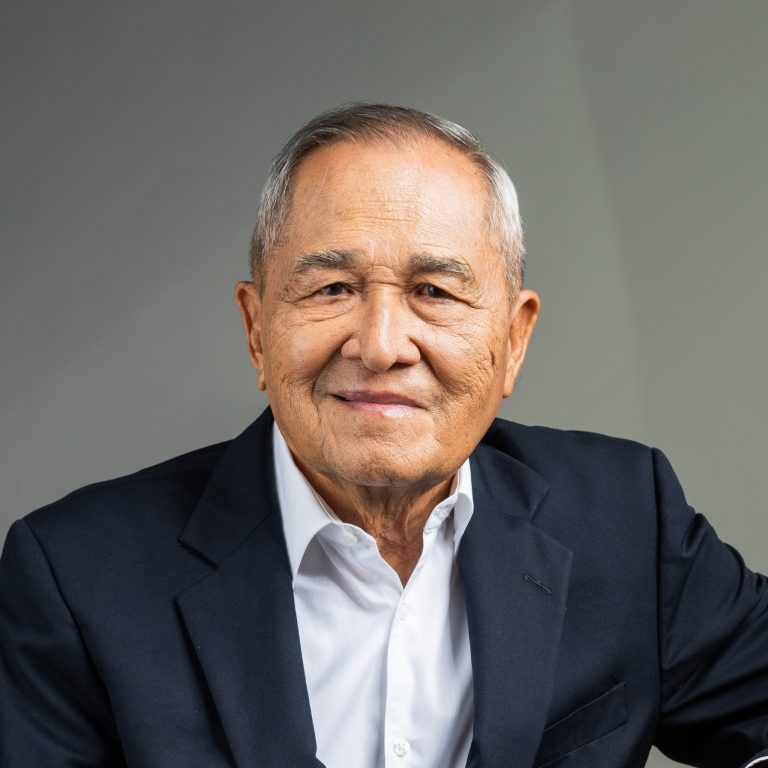
THE DEATH last week at the age of 95 of Cesar Augusto Buenaventura—known to his friends and associates as CAB—marked the passing of yet another member of that golden generation of Filipinos who lived through the Second World War and almost literally built and shaped Philippine industry and society in its aftermath. An engineer by training, CAB was also a management pioneer, a business leader, a civil libertarian, and a valued adviser to presidents. (As a former member of the UP Board of Regents, CAB would often text me for news about goings-on in Diliman, concerned as ever with the state of Philippine higher education and of UP’s role in it.)

I had the privilege of writing a yet-unpublished biography of the Buenaventura siblings (Cesar was followed by social worker Elisa, lawyer Chito, and banker Paeng). And while Cesar chose to self-publish his own three-volume biography a few years ago (I Have a Story to Tell), the original draft has many interesting anecdotes worth sharing with young Filipinos who barely know their economic history. Let me pull up this except you can keep in mind the next time you gas up at a Shell station, visit the UP Chapel, or see a DMCI building.

As soon as he graduated from UP in 1950, Cesar started looking for a job, and almost immediately found one with a man who would become an important influence in his life and a titan in the Philippine construction industry, David M. Consunji. Right after the war, Consunji began building houses—a skill then in high demand in the war-ravaged city—competing on the principle of “price plus quality.” David also made sure that he got the best people and paid them the best wages. And so a strapping 21-year-old named Cesar Buenaventura, fresh out of college, strode into Consunji’s office and got his first job, as Consunji himself recounts:

“In 1951, I hired my very first engineer, Cesar Buenaventura. He was then a young civil engineering graduate from UP who was waiting for the results of the board exams he had just taken. It was my brother Raul, his classmate in UP, who told him to see me because I was starting my own construction company. I thought he was very capable so I hired Cesar. 

“Soon after, we started doing our own projects, and among Cesar’s first assignments were three houses we were building in Forbes Park. Forbes was not yet a posh village then; land there was selling at just P4.00 to P6.00 per square meter. After that, Cesar and I did some more houses. I made Cesar the cost engineer and field engineer for our various other projects. He also took care of the payroll, which amounted to P15,000 to P20,000 a week.

“It was in the Laguna College project that Cesar took on greater responsibilities. While we were doing the plans, Cesar said, ‘Don’t bother hiring a structural engineer, I’ll do it. I asked him if he was sure he could do it and he said ‘Yes.’ Every time I would see him, long after the building was finished, I would tell him that it was still standing intact, even after several earthquakes, without a single crack on a wall.

“Cesar was my very first assistant, and even then, I could see that he would go far. I wanted him to stay with us, but he decided to go to the United States for graduate studies in 1952.”

(Upon returning from Lehigh University with his MS in Civil Engineering), Cesar rejoined Consunji for some work on the UP Chapel, which had been designed by a young architect named Leandro Locsin. Locsin had impressed Fr. Delaney with a small church he had designed in Victorias, and now he took on what would become one of his signature pieces, the UP Chapel. Fred Juinio served as structural engineer, with Dave Consunji as the builder. 

But armed with his Lehigh degree and eager to make full use of his new learning, Cesar could now consider more options. And the offers came. UP, for one, wanted him to teach, and was willing to pay him P400 a month. But a big petroleum company offered him P300 more, with his salary to be raised upon completing probation as an executive trainee. In 1956, Cesar went with Shell—a decision that would define the rest of his professional life.

In 1975, Cesar Buenaventura achieved what no other Filipino had up to that point by becoming president of Shell Philippines and Chief Executive Officer of the Shell Group of Companies.

Cesar’s rise to the helmsmanship of Shell also got the attention of someone in great need of executive talent: Ferdinand E. Marcos, president of the Philippines and, at that time, the country’s martial-law ruler. With the global oil crisis still hurting the Philippines in the wake of the Arab-Israeli war, Marcos put up the Philippine National Oil Company to explore for oil and develop alternative energy sources, and was scouting for the right man to head it. His eye fell on Cesar, who had just stepped up to the Shell presidency; surely such a man had the skills and the vision to head the new PNOC. Marcos had Buenaventura called to Malacañang. 

While he may have been honored to be offered the position, Cesar remembered his father’s admonition against serving in government. He went to see Marcos in the Palace. Luckily, before Marcos could make his pitch and demand Cesar’s commitment, a phone call from the First Lady, who was in New York, interrupted the conversation. Cesar used that break to gather his wits and to come up with the argument that such a move to government would be premature, coming so soon after his appointment as the first Filipino head of a major multinational company. Cesar suggested that he could serve the country’s interests better if he were able to persuade Shell to search for oil in the Philippines—which they eventually did. Marcos did not press the point, and Cesar was spared.

Yet more of Cesar’s friends would join Marcos’s Cabinet: David Consunji, as Secretary and later Minister of Public Works, Transportation, and Communication, then by Dean Fred Juinio in the same post, followed much later by Totoy Dans, when the Cabinet post was divided into two departments—Public Works, and Transportation and Communications. Consunji labored mightily to fight corruption in that notoriously graft-ridden department, only to find himself unceremoniously removed for refusing to play along. Dans followed the same straight and narrow path when took on the job in 1979, but he would later be, in Cesar’s eyes, unjustly vilified for his association with Marcos, even if he hadn’t enriched himself. 

So instead of taking what could have been a personally and politically costly detour into the Marcos government, Cesar Buenaventura managed to stay on at his beloved Shell, in a position he would hold with distinction for the next 14 years. 

Qwertyman No. 171: “Quezon” as Theater

Qwertyman for Monday, November 10, 2025

I’M COMING late to the party, having been away for a couple of weeks, but even in faraway Frankfurt, I was itching to come home to see what the brouhaha over the “Quezon” movie was all about.

Rarely does a Pinoy movie stir a hornet’s nest like this one did, and even without seeing it, I took that as a good sign for our film industry, especially big-ticket projects which sometimes leave people wondering why they were even made.

What especially piqued my interest, of course, was the reaction of Quezon family members and friends who thought the old man’s cartoonish depiction as a womanizing, scheming, and power-hungry politician despicable.

Now, my own grandfathers led pretty quiet lives, so I’m sure that if anyone called them womanizing, scheming, and power-hungry, I’d be mighty upset, too.

The difference is, unlike my lolos and going by what the historians suggest, Manuel Luis Quezon seems to have been all of the above—which isn’t to say he wasn’t much more than all those negatives put together. It was apparently that “much more” that the Quezonistas were looking for—MLQ the patriot and freedom fighter—to balance out the picture, especially since most young Filipinos know nothing of the man except as a place-name. Had that been shown, the outrage might arguably have been muted, the image softened.

But of course that wasn’t what the movie’s makers were going for. As has already been noted by dozens of reviewers before me, “Quezon” is no documentary (and let’s not forget that even documentaries can be biased—just watch Leni Riefenstahl’s adoring portrayal of Hitler and his Nazis in her bizarrely beautiful “Triumph of the Will”). From the outset, it declares that it is mixing up history with “elements of fiction,” which is just as good as using that old commercial come-on, “based on a true story.”

I’m no historian—I’ll confess to being an enthusiast—but as it so happens, I’ve been a playwright, screenwriter, biographer, and fictionist at various points of my otherwise uneventful life, so I can probably speak to these issues with some experience. I can attest, for example, having written some biographies of the rich and famous, that families and descendants can inherit myths about their patriarchs, and treat and pr0pagate them as God’s own truth. 

My take is, I don’t think we should receive “Quezon” as history, biography, fiction, or even film. It’s theater (captured on film), and it declares itself as such right from the beginning, as I’ll shortly explain. This may be due to the fact that the script was co-written by one or our most accomplished playwrights, Rody Vera, alongside director Jerrold Tarog. His approach was explicitly stylized and non-realistic, from the use of silent-movie title cards, ghoulish makeup, and painted backdrops in the black-and-white sequences (including that almost balletic choreography of the young MLQ rising from the floor of his prison cell) to the conception and blocking of such scenes as those of Quezon working the floor of the House and the capitalist bosses gathering round the table. (If all this seems obvious and elementary, dear reader, my apologies—in these days of TikTok, I don’t know what people are looking at anymore).

So what if the movie is theater disguised as film? Does that explain or excuse its supposed excesses and exaggerations?

Well, theater is, almost by nature, exaggeration—movements and motives get simplified and magnified, the easier to get them across. Theater is agitational—it aims to provoke emotion, to bring people to their feet, clapping in delight or screaming in rage.

And that’s what “Quezon” did, didn’t it? It got its message across, effectively and efficiently, like a train on schedule, and taking it as theater, I found it roundly entertaining. By and large, the actors carried themselves off with aplomb, from Jericho Rosales’ masterful Quezon, Romnick Sarmenta’s comic-cool Osmeña (his was actually the most difficult role to play, to my mind), Mon Confiado’s aggrieved Aguinaldo, and Karylle’s restrained Aurora. The employment of the fictional journalist Joven Hernando was what a smart scriptwriter would do, to weave the narrative threads together. (Teaser: Quezon and Aguinaldo figure in the novel I’ve been writing about prewar Manila.)

My quibbles have to do with minor complaints like (don’t be surprised) “Wrong period fountain pens again, all of them—why don’t they ever ask me?” (Quezon did hold his pen that odd way, though) and “Does every movie chess scene have to end with a checkmate?” I could have added “Why does everyone’s shirt and pants look fresh in a period movie?” but we’ll excuse those as theatrical costumes.

If there was anything I would have added to the content, it would have been a quiet moment of self-reflection, in which we realize just how Quezon sees himself. That alone might have lifted up his character from caricature.

The real Quezon seems to have been every bit as petty as the movie shows him to be, but also every bit as great, as it seems to have taken for granted.

Quezon had something of a history with the University of the Philippines, whose protesting students (one of them a young buck named Ferdinand Marcos, who accused Quezon of “frivolity” over all the dance parties in Malacañang) led him to ride into UP’s Padre Faura campus astride a white horse to either charm or intimidate them.

He had a long-running tiff with then UP President Rafael Palma over the Hare-Hawes-Cutting Act, and when Palma retired after ten hard years in the hot seat, citing a technicality, the government denied Palma the gratuity that was his due. When Palma died, however, Quezon reportedly went to his wake to deliver a eulogy worthy of the man.

You didn’t see that Quezon in the movie—and then again, maybe you did.

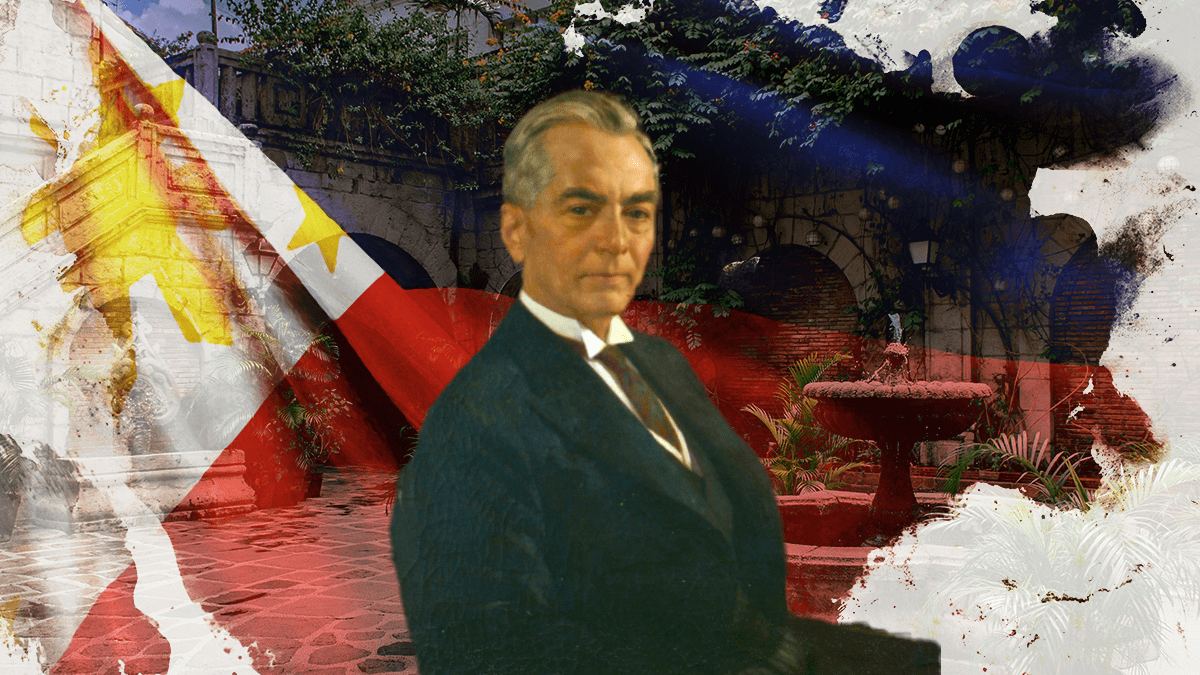
(Image from banknoteworld.com)

Penman No. 477: (Almost) Working with Mike de Leon

Penman for Sunday, September 7, 2025

IT’S ALMOST criminal to admit this, given the understandable outpouring of grief and adulation that followed the announcement of film director Mike de Leon’s recent passing. But the truth is, I didn’t really know him or his work all that well. I’d seen a few of his movies—Kisapmata and Citizen Jake come to mind—but for some reason missed out on the best and most celebrated ones: Batch 81Sister Stella LKung Mangarap Ka’t Magising, and so on. I shouldn’t have, but there it is, like all the great books I never got to read, because I was busy doing something else.

From the late 1970s to the early 2000s, I was writing scripts for many directors—mostly Lino Brocka, but also Celso Ad. Castillo, Marilou Diaz Abaya, Laurice Guillen, Gil Portes, and Joel Lamangan. (Never for Ishmael Bernal, either, nor for Eddie Romero; they’re all gone now except for Laurice and Joel.) Mike de Leon was and remained a mystery—until, on December 30, 2022, from out of the blue, I got this message in my inbox (I’ll be excerpting Mike’s messages to me from hereon; he typically writes in lowercase but I’ve edited everything):

Butch,

We’ve never met but I guess we know of each other. 

I just wanted to know if you are interested in working with me on a possible screenplay that I hope I can still turn into a film even at my late age (going on 76, Stage 4 prostate cancer, but still able to function). 

I admit I have never seen any of the films you made with Lino, and the only book of yours that I have is The Lavas which I have largely forgotten. But in that anthology book, Manila Noir, I found your short story, “The Professor’s Wife” the best of the lot. 

The only thing I can say about my film idea is that it is part of my memories as a young boy during summer months in Baguio in the late 1950s. In other words, it is just about a group of rich people who play mahjong and the battalion of maids and drivers who serve them. This is probably the result of the flood of memories that are still spilling out of my mind after completing my book Last Look Back. It is no big production because it is the characters I am most interested in. A picture of the members of the idle rich when Baguio was still the exclusive enclave of the privileged elite, from which I’ve descended, of course. 

I did ask Sarge Lacuesta and he was quite interested but he is going to direct his first film for Cinemalaya. So I picked up Manila Noir again and looked for that story and found out that it was you who wrote it. 

Anyway, as I always say, suntok sa buwanBaka hindi rin matuloy because of my health but I’d like to give it a try anyway. If you think you might be interested, please email me back. 

I wrote him back to say that of course I was happy and honored to be asked to work with him:

The project sounds like something I’d be very comfortable with—a quiet family drama with an upstairs-downstairs element to it. Coincidentally, i’ve been working on a novel set in 1936 in one of those Dewey Boulevard mansions, with the Manila Carnival (and Quezon and Sakdalistas in the background). But that’s at least still another year from being done. I just wanted to say that the idea of revisiting the past to show how it has shaped the present—throwing light and shadow where they belong—is dear to me.

And now, the inevitable hitch: I’m working on three commissioned book projects at the same time, and these books will be due in 2023. I’m retired, but I’m also writing columns for the Star and teach one graduate class in UP.

I can imagine from your situation that this project is a matter of great personal significance and urgency to you—which is why I so want to be a part of it, despite my own load. At the same time, I don’t want to be a hindrance to you, especially if you want this done soonest. If you just need me to flesh out some scenes and develop some ideas and write up the sequences and dialogue as we go along, maybe we can do something together. Let the thing grow and go where it will. 

Then he sent me more notes about what he had in mind:

As you probably know by now, I like shooting a film in Baguio. I now own the former family house and I’ve restored it and maintained it well. It can still pass for an authentic American colonial house of the late 1950s. Actually, the house was built in the 1930s, but I’m not sure of the exact date until I find the papers. The original owner was an American officer named Emil Speth. He married one or two native women and was the vice-mayor of Baguio when the Japanese bombed the city on December 8, 1941. Quezon was in the mansion and I read an account that Speth asked Quezon to take shelter in his house (maybe not the same one because Speth owned many houses) because he had a bomb shelter. 

By the way, this is not an autobiographical film. It’s the mahjongistas I’m more intrigued about. I used to watch them with a fascination because it was not really gambling but a form of social intercourse with its own rituals. 

Within a few days, much to his surprise, I emailed him back with a full storyline based on what he said he wanted to do. I’ve always been a fast writer, and I guess it was one of those things I would be known in the trade for. I delivered quickly, without fuss, just needing to be paid.

He responded:

Quite surprised to get this email and story idea. I just read it quickly but I will read it more carefully in a while, when I’m wide awake. It seems too complex, the characters as well. I was thinking of more opaque characters (from the point of view of the young boy, and the viewer, they cannot explain their behavior, that is what I’m looking for). His memories are speculative and will probably remain so until his old age. By which time, most of them are dead anyway. But I’m amazed at how you put this story together. Give me a couple of days to react to it and I will jot down my own notes.

On January 9, in the New Year, began what would become a painful series of revelations:

Sorry for the late reply. I’ve not been feeling well, possibly because of the gloomy rainy weather. I can’t take my regular early morning walks around Horseshoe or Greenhills. Also, I’m kinda antsy about my scheduled PET scan next week. My doctors told me last year, after the first PET scan, that I may not live another eight months or so, but it’s been more than a year and I’m still here. Fortunately, I was able to finish my book. 

I am writing my “impressions” of what I feel the film should be or “feel.” One important thing is that I think the film should start in medias res, the family is already in Baguio, several weeks in fact. The kids are playing or doing what they usually do (perhaps a little bored) and mahjong sessions are ongoing. I don’t want to give them family names, just Tita Rita, Tito Hector, Nicky (the kid). 

I think I need to paint a more vivid picture of what life was like back then for your benefit. I’m selecting photos of my youth in Baguio and sending them to you. I would like to give the impression that the film is “almost” biographical but not entirely so. So please give me another week to put something together. So there can be nothing like a murder. Psychological violence is more interesting to me. 

Pahinga muna ako, I’m always tired. 

A couple of weeks later, he followed through:

Sorry for the long silence. I’m pondering a lot of things at the moment. I haven’t written anything but the concept keeps growing in my mind that it is becoming unfeasible. I finished reading a book on the 1950s and I started reading “Cameo” last night, and I really like the way you write. 

Don’t hold me to this but I’m thinking that “The Professor’s Wife” may be the right kind of film for me but I was wondering if it can be set in Baguio. Not in my house, of course, it’s too grand for the story. I have some very dear friends in Baguio who may help me look for the right location for the story. 

I’ve been asking myself the same question over and over, do I still want to make films? It’s not just my health but a lot of other things. 

I’m sorry if I seem very unpredictable but I feel you can understand and empathize with my situation. I thought I’d be dead by now, but I’m not. 

And then:

Sorry for the long silence. My new PET scan results are not very encouraging. Although the bone metastasis has not spread (from the prostate cancer), there is worrisome new activity in my liver that was not there before. I will have to undergo a liver biopsy, an outpatient procedure but my doctor wants to have me admitted. And if I can do this early next week, it takes a week for conclusive results to come out. 

So that kinda leaves in a kind of limbo. In many ways, I feel so vulnerable, something that I did not feel when I was first diagnosed with prostate cancer in 2016. I feel that my life has just stopped. Anyway, the story I’m most interested in now is the aborted script of my own “Unfinished Business,” or its new title “Sa Bisperas” for obvious reasons. I was beginning to make major revisions when Bongbong was elected, but now it seems very appropriate to my life—an existential film masquerading as a ghost story.

Sorry about all of this, butch. I will keep you updated. Perhaps we can co-write the revisions if you are open to that sort of thing. But in the meantime, I have to try to beat this thing.

In January 2024, a year after our first contact, he wrote me:

I hope you’re doing fine and I’m really sorry for the long silence. So much is happening in my life right now but I’m still hoping to make one more film next year, that is if my medical condition doesn’t take a turn for the worse. 

I was wondering if anyone has made a film of your short story “The Professor’s Wife”, included in Manila Noir. I’ve been thinking about it and it could be something I can still do. If it’s possible, I can option it for a certain period and pay whatever you feel is a good price. The same would go for the screenplay—that you will be paid whether I can make it or not. I think it has the potential to become a small but intimate and intense film, character-based, with a murder thrown in, like Kisapmata. 

I wrote and sent him a full storyline based on my short story, but told him that I wasn’t going to bill him for anything until the project was actually underway. Six months later, on July 10, he wrote:

There are a couple of questions I should ask you right away. The professors’  academic argument, could it be about some “obscure” historical event or incident like something set during the Japanese Occupation? Perhaps an issue of collaboration. That way, we can subtly bring in the political situation today. 

Is it still possible to shoot in UP? Or in some relatively quiet location at the teachers’ village, so I can record direct sound, and avoid dubbing. It would be wonderful to set the story in Baguio, but I don’t want to force it. 

I’m going to travel in Europe in November, perhaps for the last time. My excuse is the restoration of Sister stella which is currently being restored in Bologna. I don’t have a Schengen visa and an invitation from my friend Davide of Ritrovata may help a lot in getting me one and for my caregiver as well. 

He wrote later about visiting our home on the campus, where my story was set:

I think a visit to your place would help me tremendously. There are so many possibilities to this story and since this is the first time we’re working together, I must warn you, makulit ako. But at least this time, the germ is there, the story is there. I just want to know more about the milieu. 

It’s a noir film and a social drama at the same time, I think. As I was writing, I was thinking of Cornell Woolrich, James M. Cain, and even Patricia Highsmith’s Ripley series or the Cry of the Owl, yata. Are you familiar with the 1947 film “Out of the Past” by Jacques Tourneur? 

I will continue to write down my rambling notes and send them to you in a day or two. 

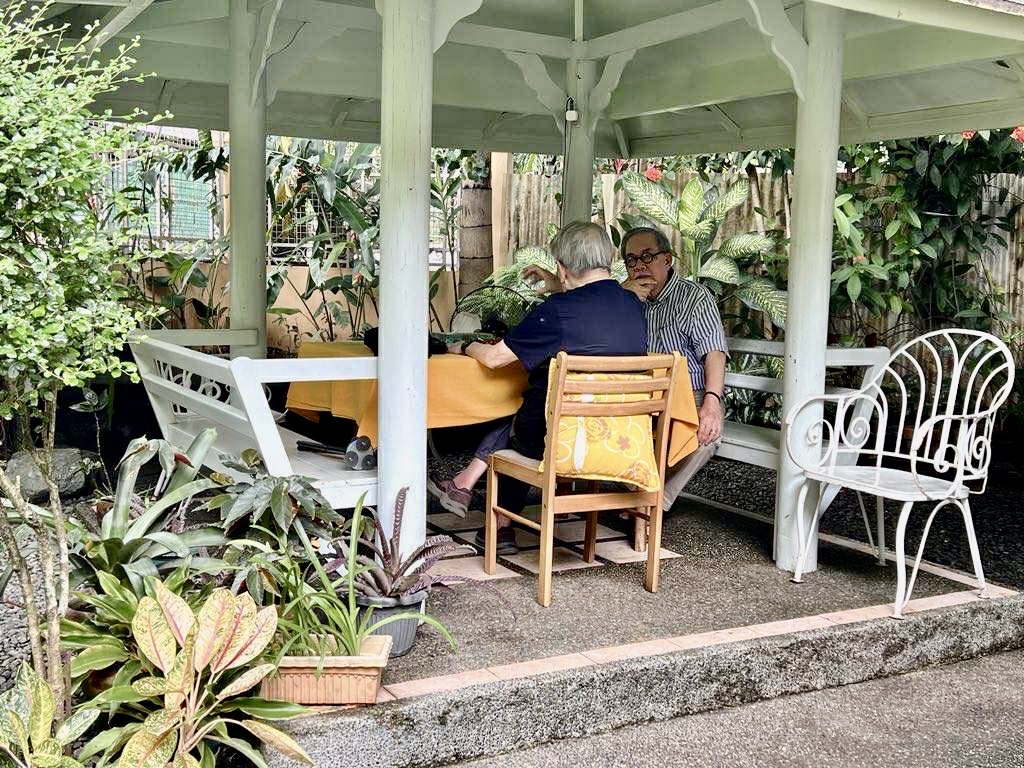
He came to the house on July 29, 2024. It was only the second—and would be the last—time for us to meet. We had a pleasant chat over a light merienda prepared by Beng in our garden gazebo in UP. I can’t recall if he even touched the food; he looked pale against his usual black shirt, but then he always seemed to be like that. We discussed the revisions I was thinking of making on my story to shade it even further. He said that he found me refreshingly easy to talk to, which I was happy to hear, but at the same time we were both aware that we were dreaming up a film neither of us would get to see. 

On October 12, 2024, I got the message I could not be surprised by. I wrote back to wish him well.

I’m sorry I have to write you this email, wherever you are. I’ve been quite sick these last two weeks. I was in the hospital for several days for a blood transfusion.

My recovery will be slow, according to my doctors. But they don’t really have to tell me that. I’ve been very weak, most probably due to a multitude of causes, foremost among them is the metastasis caused by prostate cancer. 

Needless to say, I don’t think I will be able to make a film, so you might as well know now. I even had to cancel my trip to Europe. I’m sorry that I wasted your time. I hope you understand.

Best and thank you very much

Mike

Qwertyman No. 159: No Room for Nuance

Qwertyman for Monday, August 18, 2025

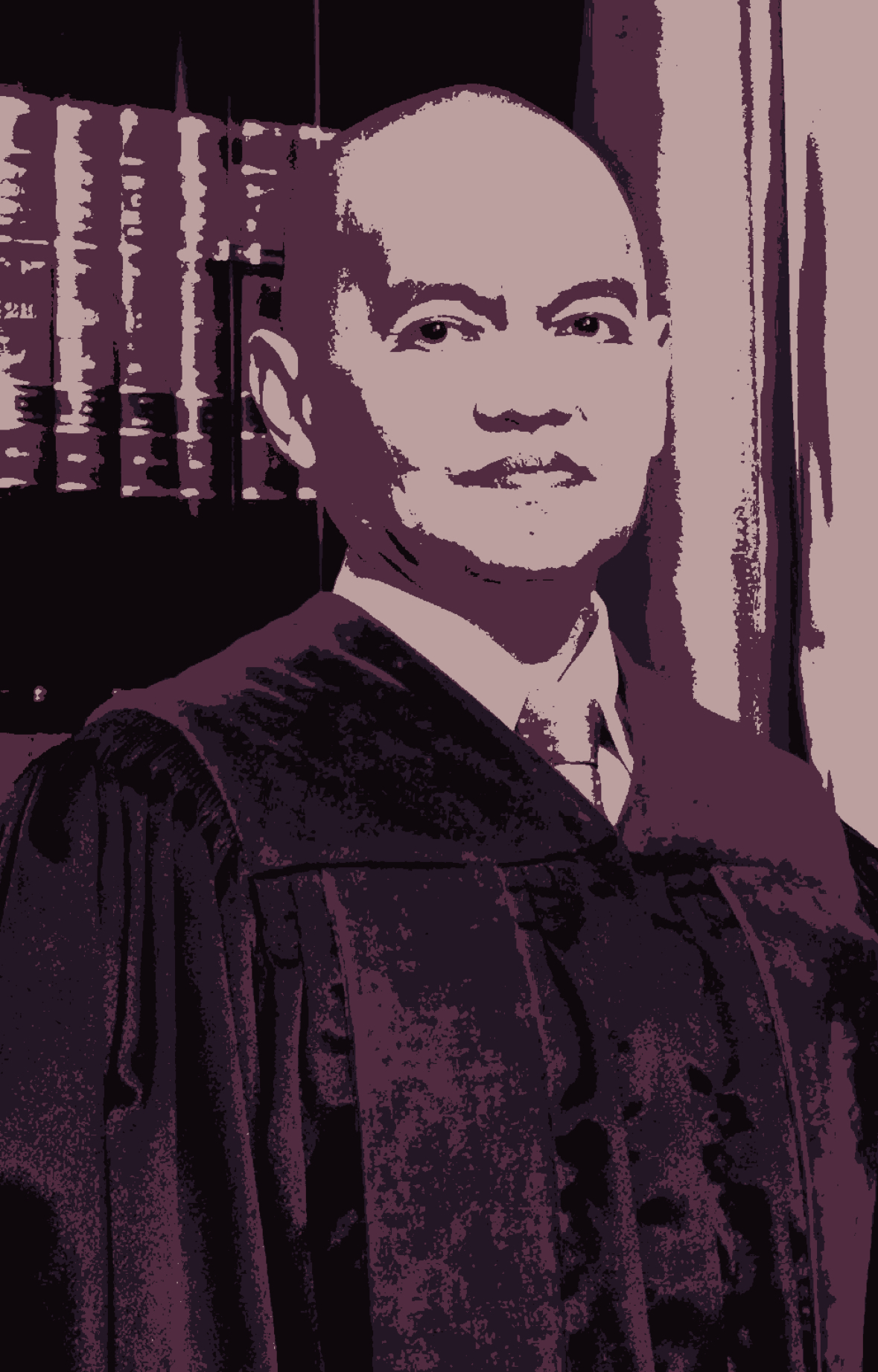
LIKE MANY of his friends from the University of the Philippines and the legal profession, I was extremely saddened last week by the events surrounding and following the announcement of Senior Associate Justice Marvic Leonen of the Supreme Court’s unanimous decision in the case of Duterte v. House of Representativesthat effectively stalled the impeachment process against Vice President Sara Duterte. As someone inclined to believe in the VP’s culpability, I was of course disappointed by the decision, and dismayed that it was Justice Leonen justifying it as the ponente. 

Scores of former justices, lawyers, editorialists, and activists have since weighed in to expound on the perceived infirmities of the decision, and on the damage it has wrought on both our political and judicial institutions. Not knowing any better than these sharper minds, I can’t add anything much to those arguments, except to observe that from my layman’s point of view, it does seem that Justice Leonen went well out of his way to make impeachment more difficult even for those deserving of it.

I was saddened, but not surprised, when Marvic—both the justice and the man—was pilloried in the press and social media for his role in the matter. Insinuations floated that Leonen had been “bought” by the Dutertes in exchange for a promise of being eventually appointed Chief Justice under a Sara presidency. Other critics pointed to supposed flaws in his character, even equating him with Senate President Chiz Escudero, under whose clever management the VP’s impeachment did not push through “forthwith,” but has instead been “archived” for at least the next sixth months.

I don’t mean or need to defend Marvic, who can very well speak for himself. He was and remains a friend—we worked together in UP administration, where he served as VP for Legal Affairs and then Dean of the College of Law and I served as VP for Public Affairs—although I don’t know him nearly as well as his own compañeros in the profession. One of them, a mutual friend, came out with a stinging rebuke of the decision, while attesting—like many who know the justice and his background closely—to his personal and intellectual integrity.

I know a bit of that background, having mentioned and quoted Marvic in my recent biography of Justice Conchita Carpio Morales. He was among the four justices who dissented when, in July 2016, the Court dismissed the plunder case against former President Gloria Macapagal-Arroyo for lack of evidence. His remark then was simple but damning: “The scheme is plain except to those who refuse to see.” Earlier, as UP Law dean, Marvic had served as chief negotiator for the Philippine government in talks with the MILF, leading to a comprehensive agreement. He had also led the call asking a sitting justice to resign for alleged plagiarism; instead, the Court cleared its colleague and got back at the complainants (Carpio Morales dissented). Even before that in 2004, as a young lawyer, Leonen had argued for indigenous peoples in the La Bugal case questioning the constitutionality of the Mining Act. The Court agreed with him, only to reverse itself later.

Marvic Leonen’s performance as a lawyer, a legal academic, an advocate for the oppressed, and a justice are a matter of public record—which understandably, most Filipinos likely don’t know or care about. The question that bothered me in the aftermath of the Duterte decision was, “Should one act—widely perceived to be wrong—occlude a lifetime of good and right deeds? Are we judging the decision, or judging the man?” (The flipside of this is the sudden elevation of heels to heroes, because of one popular stance taken, as in the Senate vote.)

I asked this only because of the increasingly personal nature of the attacks against Marvic—which of course in today’s environment he had coming, even from those of us who deplore the personalistic nature of our politics. The term “cancel culture” has been often brought up in this context, a phrase more likely to be used by those on the receiving side of it. 

There are pluses to this form of public outrage, in that it can be unequivocal, if sometimes crude and over-the-top. As a way of telling public personalities that “You’re wrong” or “You suck,” there’s nothing like a torrent of posts and memes deploring or ridiculing their actions, taking minutes to form a tsunami of public opinion. In propaganda, we might call this the art of posterization, of reducing complex issues and character traits to one clear image and message, of stripping out the nuances, the “but’s” and “maybe’s,” the kind of hand-wringing I’m doing now in an effort to understand why people do what they do. 

From this perspective, and to use one of this century’s most telling cliches, at the end of the day, only the public impact of your actions count. No one needs to know or to understand your personal motivations; no one owes you the benefit of the doubt. Public opinion can sway (Shakespeare famously called it “the vagabond flag”), can be savage and cruel, but as with bees in a swarm, it’s in the nature of the hive mind to congeal and to move as one, with no room nor time for demurrers. Social media assists the formation of that hive mind exponentially, in post after repost, seeking and gaining affirmation in numbers. 

On the other hand (a phrase you hardly ever hear online), the dramatist and fictionist in me—as opposed to the propagandist—likes to individuate the caricature, to tease out the nuances of characters and situations, to explore context and subtext. That viewpoint might appreciate Marvic as a person whose own brush with impeachment made him the ideal spokesman for eleven other gray justices, serving as both lightning rod and fall guy, putting his own hard-won reputation at risk. 

Duterte v. House of Representatives wasn’t and shouldn’t have been about Justice Leonen, and not even the judiciary itself, but rather about seeking justice over the gross misdeeds attributed to a high public official. To the extent that we’re not talking about the massive and blatant corruption that prompted the impeachment in the first place so much as we’re dwelling on our disappointment with a perceived champion of the public interest, then the dark side continues to win by distraction. Methinks we should refocus on the real crooks—there’s a few more to root out in the Senate, and they were never even the good guys to begin with.

Qwertyman No. 157: Rebalancing the UP-IRRI Partnership

Qwertyman for Monday, August 4, 2025


SINCE ITS establishment in 1960 by an agreement between the Ford and Rockefeller Foundations and the Philippine government, the International Rice Research Institute (IRRI) has been known around the world as a leader in agricultural research and a provider of much-needed and applicable solutions to global hunger. With so many people and economies dependent on rice, IRRI’s outputs—especially the famous “IR8” and similar high-yielding varieties—were hailed as gamechangers for billions, reportedly staving off famine in India in the 1960s and spurring “green revolutions” around Asia. The first President Marcos was a staunch supporter of IRRI, folding its “miracle rice” into his Masagana 99 program, which temporarily achieved self-sufficiency in rice but ultimately failed from bad credit and also proved environmentally destructive.

Headquartered in Laguna on the campus of the University of the Philippines Los Baños (UPLB), IRRI and its achievements became a source of pride for the Philippines, which not only hosted the institute but provided much of its manpower—the scientists in its labs and the farmers tilling its experimental plots, among other staff workers. (That sentiment, it should be noted, isn’t universally shared. A coalition of NGOs and individuals called MASIPAG, opposed to the kind of genetic engineering that IRRI and even UPLB does, sees IRRI as “a research arm of big agrochemical corporations in turning the food and environmental crisis into their businesses.”)

While that’s being debated, another issue has come up between IRRI and UP over the land that IRRI has been using, at the nominal rate of P1 a year for the past 65 years. IRRI’s lease on that land, totaling almost 280 hectares, expired last June 30. UP needs and wants some of that land back for its own use, especially with UPLB’s ambitious plans for the establishment of an Agro-Industrial and Information Technology Park in the area.

UP contends that IRRI has actually been using just around half of that property, so it would be good to put those idle hectares to more productive use, following UPLB’s comprehensive land use plan calling for more buildings for administration and research, housing, support services, engineering, and social sciences. It’s not simply getting land from IRRI (land that, let’s be clear, is really UP’s); according to UP’s Vice President for Legal Affairs Rey Acosta, in exchange for the land UPLB needs for its expansion, the UP System is offering IRRI new land to lease across its various campuses in Mindanao, Iloilo, Leyte, Cebu, Baguio, as well as its land grants in Quezon and Laguna, for both rice and non-rice crop research.

The land exchange was part of a new agreement that UP had proposed to IRRI to replace the expired lease. UP also wanted IRRI to pay more realistic rates for the land it was using. One key factor to consider was that since 1972, IRRI had fallen under the ambit of CGIAR (formerly the Consultative Group for International Agricultural Research), a global research network. CGIAR is apparently funded by contributions from many international agencies and countries including the Philippines, but exactly how it funds IRRI or what its legal status is in the Philippines is unclear to me. 

Under the IRRI charter, the Philippine Secretary of Agriculture and the UP President sit on its board of trustees as ex officio members, but the rest, including the Director General, are international experts nominated either by CGIAR or the outgoing board. It would have been at a board meeting that UP President Angelo Jimenez first brought up UP’s proposals over a year ago in anticipation of the end of IRRI’s lease—which, at the bottom line, UP is under no obligation to renew. Last June, IRRI submitted a counter-proposal ceding much less land than UPLB needed, asking for a much longer lease extension period (25 instead of 10) for much less money than UP deemed fair.

Negotiating in good faith, UP agreed to concessions such as giving IRRI almost 200 hectares for its use, and the possibility of a 25-year lease, subject to periodic reviews, if certain conditions were met. But instead of dealing with UP in the same spirit, IRRI went to court for a TRO, represented by one of the Philippines’ most influential (and must I add expensive) law firms. 

There are quarters in the Philippine academic and scientific community that will be happy to see IRRI go—MASIPAG might stand on the far extreme, but even more moderate voices have noted that much of the research that IRRI was known for can now be undertaken by the Philippine Rice Research Institute or PhilRice. Even so, UP’s leadership maintains that it continues to value its historic partnership with IRRI—based on a more balanced and lawful relationship. “We don’t want IRRI to leave,” said President Jimenez. “We would be happy for IRRI to stay but under fair and reasonable terms.” 

For the sake of not just the Philippines’ but the region’s and indeed the world’s food security, we should hope that this disagreement over how to best use that land in Los Baños doesn’t end up in a messy court case involving money, influence, and public relations. IRRI enjoys a generally positive reputation that, rightly or wrongly, most Filipinos still believe in. After 65 years, it’s time to renegotiate an agreement that will more directly and clearly benefit Philippine agriculture and education through its national university, ensure environmentally safe research, remunerate us fairly, and make IRRI the good global citizen an institution of its stature and intentions needs to be.

Penman No. 475: True Confessions

Penman for Sunday, July 13, 2025

AS A collector (make that a scavenger) of old books, manuscripts, and what the market generally calls “ephemera,” I inevitably come across material neither written by nor meant for kings and presidents, but rather pedestrians like myself with things to say, perhaps secrets to whisper, likely to no one but to God and posterity.

I’m talking about diaries and journals, which people of my generation used to do (and millennials are back to doing). Worse than a pack rat, I hoard other people’s memories, some in diaries that would make people turn in their graves to know I had. I come across these often as discards or stray items among people selling and buying old books, but I find them equally if not even more fascinating than published (and therefore sanitized) material.

Back then, before computers and digital journals, New Year began with the purchase of a new diary, its pristine pages waiting to be filled with birthdays, appointments, expenses—and more interestingly, interjections of love, pain, joy, and grief, life’s highest and lowest moments. 

I myself kept diaries at one time, although the entries tended to peter out around March or April, when fatigue got the better of my enthusiasm. My most interesting one has to be my martial-law diary, which I rather presumptuously began as soon as I was thrown in prison at Fort Bonifacio; I say “presumptuously” because, at seventeen, I entertained the precious thought that somehow, someday, my juvenile musings would be worth something to someone other than my mother (I had yet to find a wife then). 

When the Italian Marxist Antonio Gramsci languished in a Fascist jail in the late 1920s, presumably between a meager breakfast and gazing out into the starless night, he penned lines like “The old world is dying, and the new world struggles to be born: now is the time of monsters.” He developed his theory of hegemony and held forth on the role of intellectuals in social change, published in his seminal Prison Notebooks.

My own teenage memoirs have survived, but instead of writing about the dominance of the ruling class or about harrowing details of torture and misery—which did happen to others—I chronicled the visits of the pretty young psychologists assigned by the military to interview us; of course we assumed they were spies, but that didn’t stop us from chatting with (more like staring at) them across a table that felt much too wide.

Indeed, for most of us more interested in the personal than the political (although arguably one will always be the other), the value of diaries lies in their true confessions, in their promise of intimacy and insight—along with, let’s admit it, the wicked thrill of voyeurism.

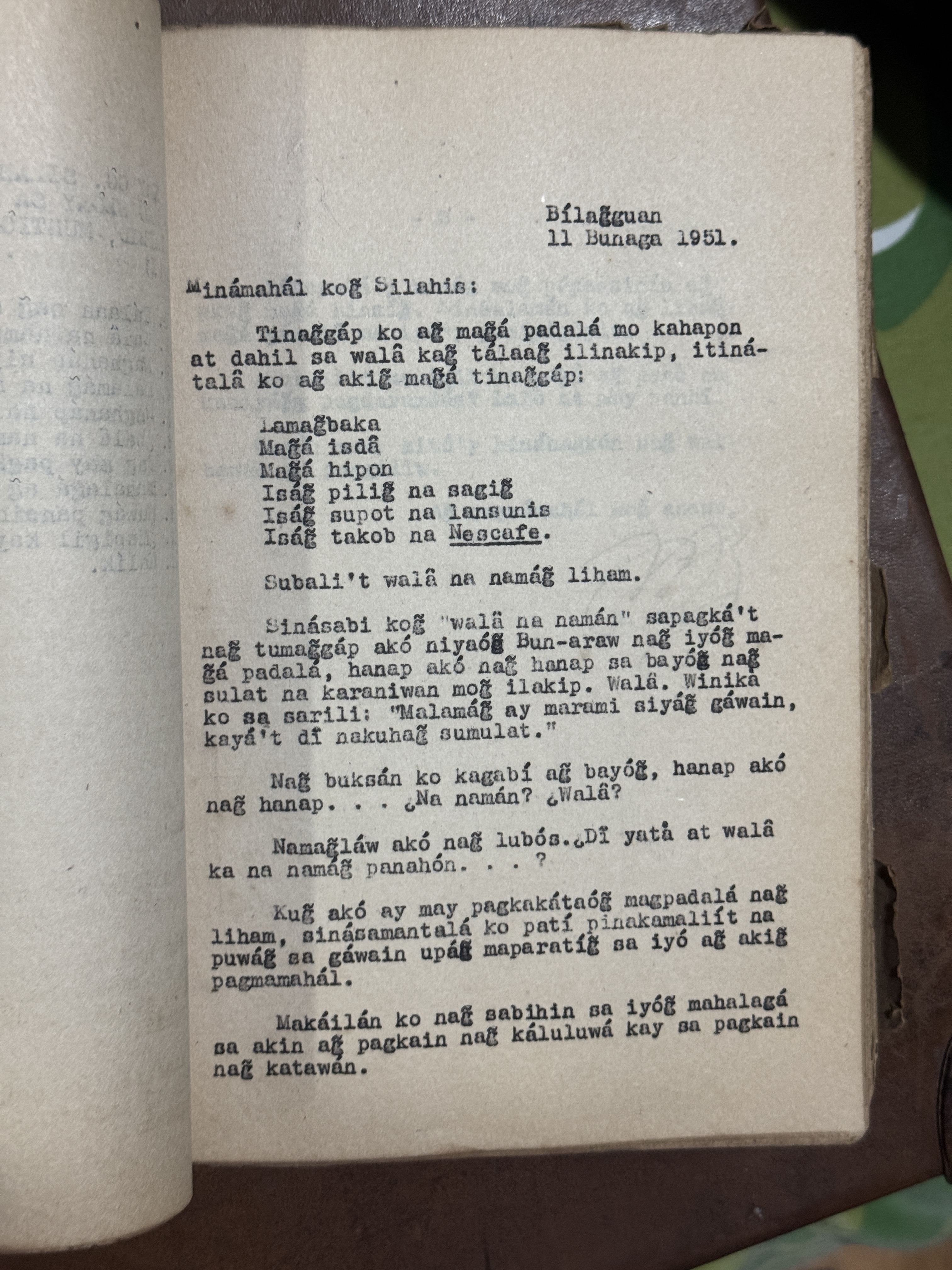
Among the most poignant of my inadvertent discoveries has been the diary—really more a scrapbook—of a once-famous and gifted writer (whose name I’ll leave out for now as he still has family around) who was imprisoned after the War for his stridently pro-Japanese sentiments and actions. In three languages, both typewritten and handwritten, he acknowledges receipt of his beloved’s supplemental rations—beef, fish, fruits, and coffee—but no letter yet again. “Nang buksan ko kagabi ang bayong, hanap ako nang hanap…. Na naman? Wala? Namanglaw ako nang lubos. Di yata at wala ka na naming panahon.” How many times do I have to tell you, he goes on to lament, that even for important to me than sustenance for my body is sustenance for my spirit?

I once came across a whole sheaf of journals in a ditch in front of our house, which I was inspecting because it had gotten clogged with what turned out to be a plastic bag full of papers. It had been carelessly thrown there by the home’s previous occupants or whoever cleaned it out—we had just moved in. They turned out to be the personal papers of a renowned UP professor, and as guilty as I felt about peeking into her life, I read a few pages, in which she confessed her admiration for a certain man (she lived and died a spinster)—only to remind herself, with what I could almost hear was a deep sigh of regret, that she considered herself wedded to God. I read no further, and decided to turn the papers over to a friend, a former and beloved student of hers who was the closest thing to a son.

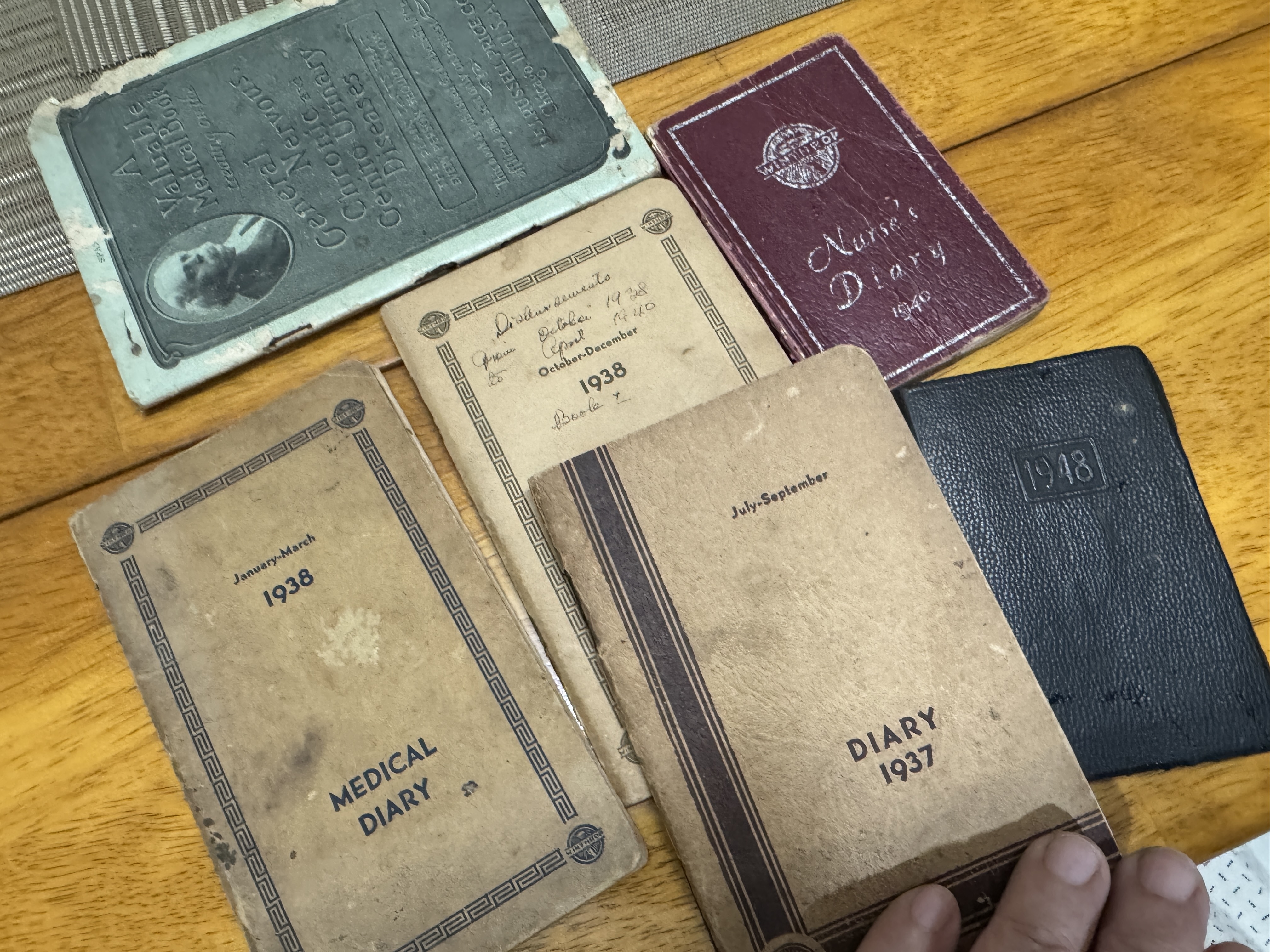
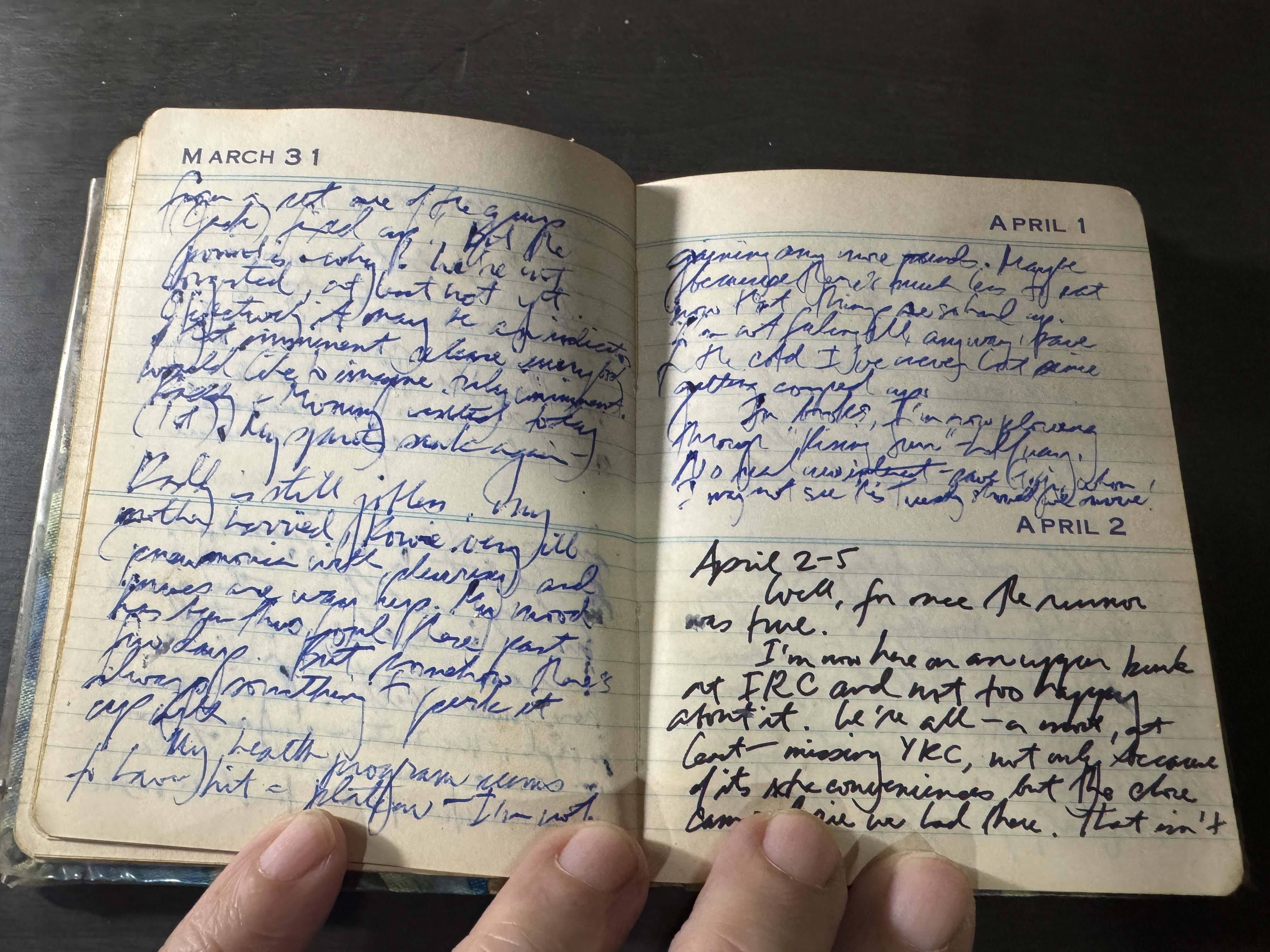
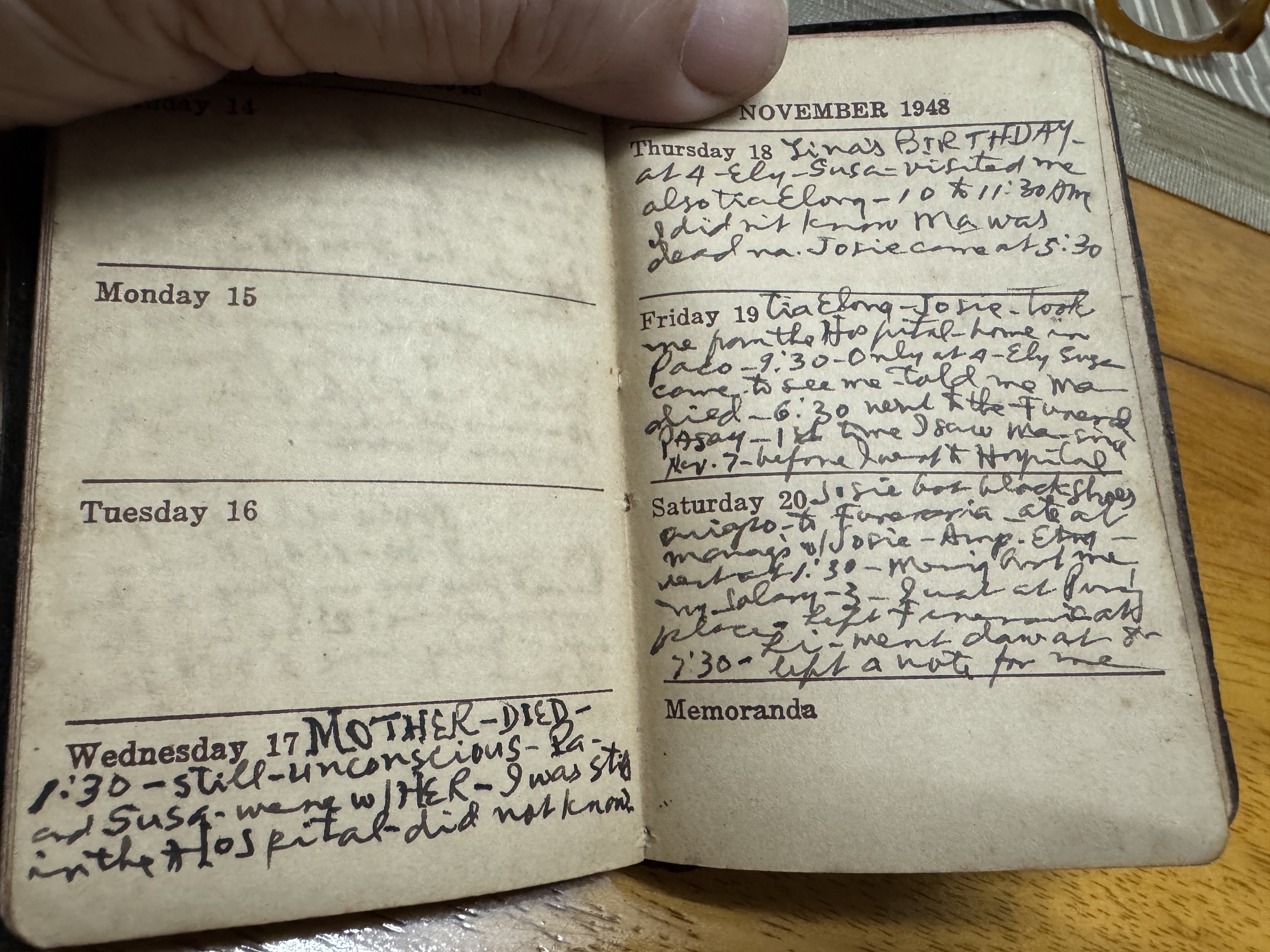
Most recently, some diaries from the late 1930s and 1940s came to me along with a medical book, and they contain nothing so revelatory, but the details of everyday life a,re always engrossing. They obviously belonged to a doctor—perhaps more than one—and while they contain medical marginalia they also carry legal notes, so the owner must have been studying to be a medico-legal person. Rather moving is the narrative in one diary of bringing a very sick mother to the hospital; I flipped a few pages and the inevitable entry appeared: “Mother died.” And there lay the stark helplessness of a doctor who could not save his own mother.

For many years now, the writer and presidential historian Manolo Quezon has been on top of an important enterprise called the Philippine Diary Project, a digitized compilation of diaries and memoirs from such notables as Jose Rizal, Ferdinand E. Marcos, Dean Worcester, and Emilio Aguinaldo all the way to the murdered activist Ericson Acosta (clearly more women need to be added to the roster).

“To me there are two holy grails,” Manolo told me. “The first is the diary of Gregorio H. Del Pilar. The diary of the American officer who led the expedition that killed him, Frederick Funston, exists but has yet to be transcribed. It was he, by all accounts, who pocketed del Pilar’s pocket diary; perhaps his papers will reveal them after a thorough search. The other is the diary of Benigno S. Aquino, Sr. The late Benito Legarda, Jr. told me that it was shown to him by one of the sisters of Ninoy, and that, in Spanish, it began, “I have been summoned to a meeting in Malacañan by the commanding general of the Japanese Military Administration…” The thing is, the last sister who had it, lost her memory and her children have not found the diary since.”

He adds that “A large portion of the Marcos diary is missing and anecdotally is said to be in the possession of a former member of his administration. For me though, what I’m seeking are diaries by Filipinos. Our own voices are woefully underrepresented. I think many were lost in Ondoy, many others have been thrown away, still more exist, but families are afraid people will take offense and so prefer to keep them secret.”

What I find from my own small collection is that whether they wrote in English or Tagalog, or used fountain pens or typewriters, our forebears recorded the smallest details such as “Auto repair 15.00” and “Won jai-alai 5-3 event.” Today we do all that with digital ink. I wonder what some digital pack rat will be remarking about us 50 years hence.

Penman No. 473: Taking Care of Emy

Penman for Friday, May 9, 2025

MY MOM Emy turns 97 today, May 9. Some years, her birthday coincides with Mothers’ Day, saving us a celebration. But that’s a bit deceptive, because when you have a parent this old living with you, every day is a blessing worth celebrating. 

It’s hard to believe that Mommy Emy is a lot healthier than she was a quarter-century ago, when we all feared that we were about to lose her, just a few years after our dad Joe Sr. passed away in 1996 from a ruptured aneurysm. After all, the stories usually went that way—one spouse dies, the other follows soon after, out of grief or a sense of life suddenly losing its purpose and meaning. Whatever caused it, Mom fell ill with tuberculosis, with the disease progressing so devastatingly that she was coughing blood and feeling terribly weak. Luckily, her doctor put her on a menu of cutting-edge pills that, over two years, miraculously banished the TB, well enough for her to secure a US visa to join my sister Elaine in California.

Over the next decade, she regained her strength, and even as she sorely missed our dad, indulged in a newfound zest for life—traveling with my sisters in the US, Canada, and Europe, visiting glaciers, going up the Tower of Pisa, and settling into in the quiet suburbs of Virginia just outside of DC with Elaine and her husband Eddie. She stayed there long enough to gain a green card, and we would visit her every now and then, sensing that, despite Elaine’s and Eddie’s loving care, she was pining for home. Eventually she did return to Manila, giving up her green card. “I want to die here,” she stated with finality, and that was that. 

One thing I love about my mom is her eminently practical sense. Since at least five years ago, she has written out clear instructions about what to do in case she was dying—no intubation, no extraordinary efforts to prolong her life, just as quiet and as painless a departure as could be managed. Last year we went out with her to the department store to pick out her funeral dress—a macabre chore to some, but for us, and especially for her, a cheerful excursion, with much discussion about this cut or that shade of blue (yes, she’s going in blue). 

She was born in Romblon a landlord’s youngest daughter, the apple of his eye, the only one to go to UP in Manila, from where she graduated with an Education degree. Growing up, she rode a horse on the farm and accompanied my Lolo Cosme on his trips to Manila. She remembers how easy and provident life was back then: “We would go to the beach and Papa would throw a net into the water, not far from shore, and it would come up teeming with fish, and the fish were everywhere, jumping in the air.” 

My father was a sharecropper’s grandson, too poor to finish college but with a sharp mind and a gift for words that must have swept Emy off her feet. Like many couples of their time and place, they decided to seek their fortune in Manila a few years after I was born. Their love was deep but often tested, given that there were five of us to raise. There was even a time when Dad was a barker for jeepneys, and Mom worked as postal clerk for minimum wage. Life sometimes felt like a soap opera, but we all pulled through, and often it was Emy’s internal toughness that made sure we were fed and ready for school.

Since her return from Virginia, my mom has been staying with us in UP Diliman, occasionally spending time with my three other siblings (Elaine is now in Canada). Still figure-conscious despite her age, she watches what she eats, but we indulge her every whim. It doesn’t take much to make her happy—almost daily Facetime calls from Elaine in Canada and our daughter Demi in the US, a weekly manicure, visits from her brood, and Tuesday Circle get-togethers with her group of neighborhood friends, among whom she is now most senior. 

What surprises people who meet her for the first time is how strong and alert she is. She uses a cane and a walker (but only because we insist), but she takes long walks daily around the yard and just outside the house. Her steps are getting slower and harder, but she marched for Leni in 2022, in gratitude for which the VP sent her a video greeting on her 95th birthday. She reads without glasses, and plays word games on her iPad with a passion; she follows Netflix, and watches the news with tart commentary. She’s as prayerful and religious as they come, but is staunchly liberal in her politics. “All my friends are dead” is her frequent complaint, quickly balanced by “But I’m so thankful for my children!” She and Beng share long meals and laughter-filled conversations. We have no doubt that as long as she takes her maintenance meds and doesn’t suffer a bad fall, she’ll live to be a happy hundred. 

Emilia Yap Dalisay’s name will never make it to the society pages, but she’s the biggest star in our small stretch of sky, and taking care of her has been our grandest privilege. Happy birthday, Mommy Emy, and may you have as many more years to come as God’s kindness will allow.

Qwertyman No. 144: A Better Fighting Chance

Qwertyman for Monday, May 5, 2025

TWO WEEKS ago, almost 18,000 young Filipinos and their parents awoke to the good news that they had qualified for admission to the University of the Philippines through the UP College Admission Test (UPCAT). Over 135,000 high school students had applied, so this year’s admission rate stood at just over 13%, almost 7% higher than last year’s outcome.

Whatever UP’s critics may think it’s become, entry into one of its eight constituent universities remains the highest of aspirations for many Filipino families, especially the poor for whom the tuition and cost of living at top private universities is impossible without a scholarship. 

UP oldtimers like to recall the days, decades ago, when the quality of public education was still high enough for public and private high school graduates to compete on fairly even terms for admission into UP. It wasn’t unusual for some provinciano wearing chinelas to step into a UP classroom or laboratory and beat the daylights out of some elite-school fellow in academic performance. Many of those provincianos—the likes of Ed Angara, Miriam Defensor, Billy Abueva, and Dodong Nemenzo—went on to stellar careers in government, education, the arts, and industry. UP was clearly doing what it was supposed to do, as its past President Rafael Palma put it: to be “the embodiment of the hopes and aspirations of the people for their cultural and intellectual progress.”

Ironically, by the time the UP Charter was revisited and revised a century after its founding in 2008, giving it the unique status of being the “national university,” UP’s student profile had changed. Jokes about UP Diliman’s parking problems began to underline the popular perception that UP was no longer a school for Filipinos across the archipelago and across income strata but one for the privileged, mainly from the big cities. The introduction of free tuition in state universities and colleges in 2017, while well intentioned, even resulted in subsidizing the children of the rich in UP, who could well have afforded going to Ateneo or La Salle.

But some good news is emerging, as this year’s UPCAT results bear out. Starting with last year’s UPCAT, there’s already been a reversal of the trend favoring graduates from private high schools, with 55% of qualifiers now coming from public and 45% from private high schools. UP President Angelo Jimenez—himself a boy from the boonies, coming out of tribal roots in Bukidnon—has pledged to do even more to give poor students outside of the big cities a better fighting chance of getting into UP.

“We started this banking on two things,” he says, “that UP will respond to the challenge of transforming the so-called common clay—the less-advantaged—into fine porcelain, and that the less-advantaged will respond to the challenge of opportunity. The task of leadership now is to set the enabling environment, structures, and systems to ensure the success of this two-pronged strategy. It’s a big bet, and it gets bigger. We still have the non-UPCAT track. This includes our Associate in Arts program, UPOU’s ODeL, talent-based modes, and finally, the UP Manila School of Health Sciences in Tarlac, Aurora, Palo, and Cotabato. We cannot solve all problems, we are not lowering standards. In fact, we must demand excellence regardless of social and economic status, and enforce it. But we are dropping rope ladders so people long staring up from the base of the fortress walls can have a better chance of scaling its sheer drop with something better than their bare hands.”

Those rope ladders include adding more UPCAT testing centers in faraway places, ultimately to have at least one in each province—a goal that will be met later this year. The testing centers are also being moved from private to public high schools. “We’ve seen that more students tend to participate when the tests are given in their national high schools,” says UP Office of Admissions director Francisco de los Reyes. Aside from more testing centers, UP is helping disadvantaged students prepare better for UPCAT through its Pahinungod volunteers, who distribute reviewers using real items from past UPCATs (these reviewers are also downloadable for UPCAT applicants) and use them for UPCAT simulations, guiding students even with such details as shading the exam oblongs. (De los Reyes reports that wrong shading has caused 20% of their machine counting errors.)

These steps are clearly paying off. Davao de Oro (formerly Compostela Valley), which previously accounted for less than 10 UPCAT qualifiers, has just produced 31, after a testing center was put up in Nabunturan. 

UP’s support for poor students doesn’t end with UPCAT. Every year, thousands of qualifiers from so-called Geographically Isolated and Disadvantaged Areas (GIDAs), even after passing UPCAT against all odds, fail to show up for enrollment after realizing that they cannot afford the costs of living on a UP campus. UP has rolled out a P50-million Lingap Iskolar program that provides such disadvantaged qualifiers who meet certain standards P165,000 a year to cover housing, meals, transportation, books, cellphone load, and other expenses. Almost 200 Lingap Iskolar grants were given out last year. In UP Manila, private donors fund daily meals for over 30 students.

I’m particularly happy to report that a dear friend of mine, Julie Hill, recently donated almost P21 million that will be used for a new Agapay Fund that will go toward the upkeep of poor students in UP’s School of Health Sciences, which has a unique ladderized program that enables rural midwives to become nurses, and nurses to become doctors. The program has already produced about 200 doctors who have served their communities back. 

Among them was Dr. Hannah Grace Pugong, who recently landed in the top 10 of the medical board exams, after placing No. 1 in the midwifery and No. 3 in the nursing exams. Dr. Pugong will soon be deployed under the Department of Health’s Doctors to the Barrios (DTTB) program, fulfilling her return service commitment. It is an obligation she willingly embraces, saying that “I have often reminded myself that how I treat my patients should reflect how I want my family members to be treated by other health workers.” 

If that’s not what being a national university should be about, I don’t know what is.

Penman No. 473: New Light on (and from) the Philippine Short Story

Penman for Sunday, April 6, 2025

FEW MAY have noticed, but this year, 2025, marks the centenary of what has been widely acknowledged to be our first classic short story in English, Paz Marquez Benitez’s deathless “Dead Stars.”

As I’ve often observed as both a writer and teacher of Philippine literature, there’s probably no literary form more popular among Filipinos than the short story and its predecessors—myths, legends, folktales, and such stories that draw on the power of narrative to tell and teach us something about human life. 

A lot of this has to do with the fact that people and cultures everywhere have made use of stories to make sense of things—to establish causality in human actions—often as a way of prescribing and also proscribing certain behaviors. Stories were there to learn from, like the biblical parables, Aesop’s fables, and the creation myths. The more exciting and entertaining the stories were, the easier the learning happened. Even the mere recognition of oneself in a story that could have taken place a thousand years ago in a place across the planet makes our lives seem more meaningful.

In the Philippines—as it did in the West, where the modern short story took form—the short story was a staple of prewar weekly magazines like the Sunday Tribune, where a story written by an American author would be matched by a local story during what our early literary scholars like Leopoldo Yabes would call our period of apprenticeship. This was in English, but the short story in Filipino (then Tagalog) and other Philippine languages had developed even earlier, and continued (as it continues) to explore new forms and material.

Why the short story and not the novel? That’s another long discussion to be had, and I’ve addressed it in a lecture titled “Novelists in Progress,” but the short of it is that, well, we Pinoys like things in small doses (think Nick Joaquin’s “heritage of smallness”), and the short story satisfies our craving for a touch of fiction and fantasy in our ordinary lives. We’re not marathoners, but great sprinters; we’re not summiteers or navel-gazers, but masters of the street and alley. 

And so, over the past century, important anthologies of the Philippine short story have been published, tracking the development of the genre and its practitioners, from Yabes’ landmark Philippine Short Stories 1925-1940 (a project continued by Gemino Abad for 1956-2008) to Isagani Cruz’s Best Philippine Short Stories of the Twentieth Century (2000). Outside of English, Mga Agos sa Disyerto edited by Efren Abueg came out in 1964, proclaiming new directions for Tagalog short fiction, and the much-needed Ulirat: Best Contemporary Stories in Translation from the Philippines was published in 2021, edited by Kristine Ong Muslim.

But the 21st century is now a quarter of the way through, and just in these past two decades or so, a fresh bumper crop of brilliant new stories has built up, awaiting harvest.

Five years ago, an American friend named Gerald “Jerry” Burns—a fellow academic and a scholar of Philippine literature in English, now Emeritus Professor at Franklin Pierce University in New Hampshire—decided to do just that: review the best of the newest Philippine short stories and produce a selection with which to introduce them to the world. He needed a collaborator, and having worked with Jerry earlier when he was a Fulbright professor at our English department in UP, I agreed to co-edit the volume with him. Because of our backgrounds, our stories would be mainly those written in English (and the excellent Ulirat had already covered much more ground in the other Philippine languages than we ever could) but Jerry wisely insisted that we should have at least some representation of non-English stories in translation in the book, if only to lead the reader to explore more in Ulirat.

The selection process was predictably long and bruising, with all the political, aesthetic, and practical considerations that go into anthologizing, but in the end we came up with 18 stories written by both familiar and fresh names, from within and beyond the Philippines, including the diaspora: Dennis Andrew Aguinaldo, Dean Francis Alfar, Mia Alvar, John Bengan, Ian Rosales Casocot, Richard Giye, Vicente Groyon, Ino Habana, Carljoe Javier, Monica Macansantos, Perry Mangilaya, Doms Pagliawan, Ma. Elena Paulma, John Pucay, Anna Sanchez, Larissa Mae R. Suarez, Lysley A. Tenorio, and Socorro Villanueva. We also found an agreeable and supportive publisher, Milflores Publishing, fortuitously run by Andrea Pasion-Flores, herself a fine fictionist who understood the need for a new anthology like this, especially on the threshold of the Philippines’ participation as Guest of Honor in this year’s Frankfurt Buchmesse.

The book’s title, What Light It Can Hold: The Philippine Short Story in the Twenty-First Century, was suggested to Jerry by an encounter with the piña weavers of Kalibo, Aklan, and a caption he saw that said: “How fragile a single thread of piña is, how delicate, but look how much light it can hold.” He explains that “What Light… is intended to recognize the limited capacity of the Philippine short story in this period to offer any widespread or definitive illumination of the nation’s life and culture. At the same time, a more expansive understanding of that title is possible. For the short story, as will be suggested in the next pages, is a signature Philippine product, too. And these slender narratives, fashioned by their makers with a skill, patience, and devotion comparable to the piña weavers’, bring what light they can hold to vital areas of contemporary Philippine and larger human experience.”

No anthology project will be without its perceived failures and omissions, and Dr. Burns and I remain fully open to criticism in that respect. But we believe the sympathetic reader still stands to profit from both the selections and the introduction, penned largely by Jerry, that makes salient observations on the changes that have taken place in this most favored literary form of ours over the past century. Happy reading! (What Light It Can Hold is available on Lazada and Shopee.)

Qwertyman No. 136: Bringing In the No-Shows

Qwertyman for Monday, March 10, 2025

EVERY YEAR, about 100,000 Filipino high school seniors take the University of the Philippines College Admission Test (UPCAT), hoping to get into one of UP’s ten campuses nationwide. It’s an annual ritual that’s been taking place since 1968, except for a brief period during the pandemic when the test was replaced by an alternative system. (I didn’t even realize until I looked these figures up that I was among the third batch of UPCAT takers in 1970; thankfully I got in.)

Of those 100,000 hopefuls, only about 13,000-15,000 make it. That passing percentage may seem cruelly if not needlessly small, but there’s good reason for it. While we’d like more students to come to UP, admissions are limited by how many incoming freshmen UP’s campuses (or “constituent universities” such as UP Manila and UP Mindanao) can optimally absorb. Classrooms, housing, teachers, and facilities all come into play. Large campuses like Diliman and Los Baños can obviously take in more, but even so there’s a limit to admissions that needs to be observed if UP is to maintain the quality of higher education that it promises.

The more troubling statistics have to do with the distribution of those “passers” (technically, no one “fails” the UPCAT, which is just one of several factors that determine admission, including high school grades; each campus also has a different qualifying standard to rationalize admissions, so you can “fail” Diliman but qualify for UP Cebu). 

Last year, according to UP’s own statistics, 44 percent of UPCAT qualifiers came from private high schools. Another 27 percent came from the country’s science high schools. (which are publicly funded, but offer a much higher standard of education). Other public high schools accounted for only 29 percent of the total. Consider these figures against the larger picture, in which around 80 percent of our students go to public high schools, and less than 20 percent to their private counterparts. 

Compounding this gross inequality, about 70 percent of UPCAT qualifiers come from the big cities, mainly in Luzon. This, of course, is no big surprise. A recent study by UP professors showed what we didn’t need a study to know (but being academics, of course they had to prove it): that “income advantage” weighed heavily on one’s chances of passing the UPCAT and getting into UP. If you went to a good private high school, you were more likely to get in than a poor student from the boonies. To top it off, with tuition now free in public universities, we actually end up subsidizing many students from affluent families who could well afford to pay their way in private colleges.

This lopsided situation has long been the cause of much concern within and beyond UP, which, as the country’s “national university,” bears the dual responsibility of aiming to be the best university in the country bar none, and yet also serve the interests of the entire Filipino nation, and not just those of the urban elite that has apparently become over-represented in its student body. Various UP administrations have sought to address this seemingly paradoxical “excellence vs. equity” argument through different methods aimed at more democratic access—without, as current UP President Angelo Jimenez emphasizes, lowering UP’s standards. This remains a work in progress, but the aim is clear: make it possible for poorer Filipinos to get into UP so it can truly be the “university for the Filipino” it was envisioned to be.

Against all odds—and this brings me to my present point—many surprisingly do. I don’t have the actual figure on hand, but they number in the low thousands, of the 13,000-15,000 in an incoming batch. Encouraging, yes? But here’s the rub: about 1,500 of them never show up—what we call “no-shows”—not for lack of ambition, but for lack of means to cover the cost of living at a UP campus. Imagine that: it’s hard enough to get a good public high school education in what are called Geographically Isolated and Disadvantaged Areas (GIDAs), and harder still to pass the UPCAT from where you are. You’re elated to learn you made it, only to realize that you’re not leaving home after all, because you can’t afford the transportation, food, housing, books, and computers that come with college.

Thankfully, UP has initiated a new Lingap-Iskolar program to help out with these expenses and bring more GIDA passers in, starting with 300-500 students. Over the next four years, P250 million has been allotted by UP for this purpose. It’s a great initiative, but it still falls far short of minimizing the no-shows so the yawning disparity between UP’s rich and poor can be more effectively reduced.

With the education budget being squeezed even more under the current GAA, this is a great opportunity for the private sector to come in and make a clear and strategic impact on the future of the Filipino mind. If you’re a corporation or philanthropist in search of a good cause to support, look no farther—make it possible for a young Filipino from our poorest and remotest regions to study in UP. Sure, democratizing UP will require much broader and deeper moves, going back to basic education; but this step is solid, immediate, and tangible. 

I’m happy to report that I made this pitch to a dear friend in the US who had spent some time here in the Philippines more than 50 years ago with her late husband, who worked to help improve Philippine education. Responding to my call, that friend, Julie Hill, sold two HR Ocampo and Ang Kiukok paintings from her collection at a recent Leon Gallery auction, the proceeds of which she will be donating to the UP Foundation for a fund to be set up along the lines of Lingap-Iskolar. Despite being away for so long, Julie remains deeply attached to the Philippines; she’s not Elon-Musk rich and lives very modestly, but has sacrificed her best pieces so some bright young Pinoys she will never meet can have a better future and serve the nation.

If a foreigner can do that, I don’t see why our homegrown billionaires can’t. Support a GIDA scholar, and make a difference right now.