Qwertyman No. 217: The Edjop Effect

Qwertyman for Monday, September 28, 2026
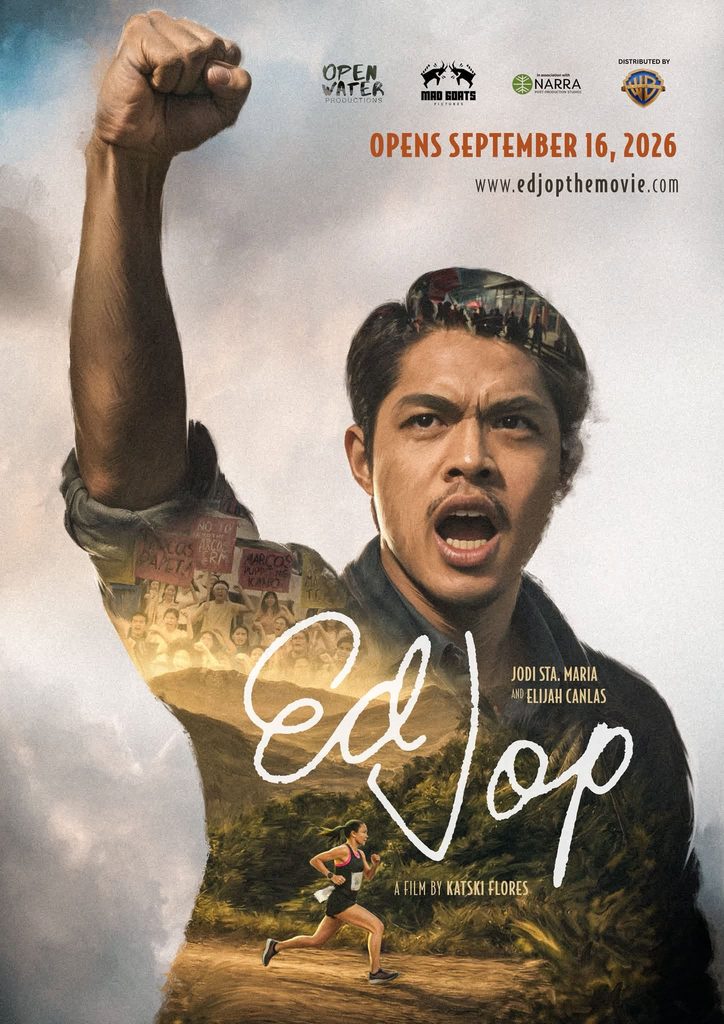
I’LL GET right to the point: my wife Beng and I, along with a younger couple, caught one of the last few screenings of the movie “Edjop”—and we all emerged so moved, albeit in different ways, that we had to spend another hour-plus over coffee just to process what we saw. 

It wasn’t even a matter of “liking” or “not liking” the movie or director Katski Flores’ and scriptwriter Jade Castro’s treatment of the life of the martyred activist Edgar “Edjop” Jopson. Grappling with the broader contours of the story, we were in no mood to quibble over details gotten wrong (and yes, there were a few) or political lines blurred, as many subsequent reviews and critiques seem to have focused on, for their own good reasons.

For Beng and me, the impact was personal, having been activists ourselves who came of age during that tumultuous First Quarter Storm that Edjop—perhaps inadvertently—helped launch. We saw “Edjop” for what it likely set out to be—the story of a young middle-class idealist’s radicalization in an environment of gross injustice, poverty, and oppression. What made it particularly poignant—and this for me represented the film’s true strength, although others may have seen it as a needless diversion—was its framing as a father-daughter story, of a younger generation’s belated understanding and acceptance of their elders’ actions and even excesses. I found it well acted, especially the major roles.

Full disclosure: director Katski had interviewed me, among many others, even while the film project was just getting started, to get my views on Edjop. (She had, of course, other excellent sources, including Bing Pimentel’s books on the man and the period and Joe Cuaresma’s documentary.) I told Katski that I could contribute very little beyond impressions gained from one brief encounter with Edjop.

That encounter happened a few days before January 26, 1970—the date of Ferdinand Marcos’ State of the Nation Address at the old Senate building (now the National Museum), for which the National Union of Students of the Philippines (NUSP), which Edjop headed, was planning a massive protest rally. An organizational meeting for that rally was held somewhere in Quezon City, and for reasons I can no longer remember except possibly that I was already an activist at the Philippine Science High School, I was there, more of a kibitzer than anything.

I had just turned 16 a few days earlier. We had rallied in high school for local demands such as a new and larger building, but January 26 was going to be our first big exposure to national issues, and we took the lead from the NUSP, the so-called “moderates,” being then deeply mistrustful of the radical Left under the Kabataang Makabayan and Samahang Demokratiko ng Kabataan (KM-SDK). I recall that meeting of senior NUSP leaders and their allies, and Edjop in a white shirt or barong. What struck me was his earnestness, his passionate belief in his cause, conveyed in an even voice and manner. 

We joined the January 26 rally, assembling on the grounds of the University of Sto. Tomas, bearing “J26M” armbands. We marched to the Senate where Marcos was speaking. I was too far from the entrance to follow everything, but I could see that the KM-SDK were also there in front, and I would later learn (though this account might yet be corrected) that Edjop had decided to terminate the rally early because things were turning ugly, but then SDK firebrand Gary Olivar, a formidable speaker, grabbed the microphone to agitate the crowd. Marcos emerged, a black cardboard coffin was thrown his way from somewhere, the security forces moved, and a melee ensued. We ran for our lives. The FQS had formally begun. 

We moderates were almost as indignant about the way the Left had hijacked the event as by the State’s brutal response; I stayed out of the January 30-31 protest rally that proved even more violent, but watched on the news as students were teargassed and truncheoned along Mendiola and Malacañang. I dreaded what lay ahead; I was due to graduate from high school that year. It should have been a time of hope, but I knew only that something was terribly wrong, that the future was going to be harsh, and that I was as confused as anyone about what to do and whom to follow.

As it turned out, history carried a very wry sense of irony—even humor, were the setting not so tragic.

Within that year, I entered UP and almost immediately joined the Nationalist Corps, the Philippine Collegian, and the Alpha Sigma fraternity. The Nationalist Corps became my entry point to the SDK, and now I saw the “clerico-fascist” moderates to be sorely misguided and wanting in revolutionary fervor. In Alpha Sigma, one of my fraternity brothers was none other than the Gary Olivar we blamed for the J26M fiasco; in the Collegian, our editor was another frat brod, Tony Tagamolila. 

As the decade moved on, I would be arrested and imprisoned, and upon my release, I would take on a writing job I needed—with the government. Tony Tagamolila would die in an encounter with the military in Panay. Gary Olivar would move to the US and study at Harvard (and much, much later would become PGMA’s spokesman).

Little did I know that Edjop himself had become radicalized and was performing far more dangerous tasks in Mindanao than most of us ever did even in Manila. His death fell like a rebuke to those who had doubted him. Meanwhile, I had resigned from my NEDA job to go back to UP to study and to teach, and by the time the Ninoy assassination and EDSA happened, I had become convinced—as I still am—that the middle road remains the most viable if not the only one forward. It seems that I’ve returned to Edjop’s NUSP. 

I don’t know what Edjop himself would think of our situation now, of another Marcos in Malacañang trying to face down a possibly even more vicious alternative, of a CPP fractured by internecine warfare, of a people too easily swayed by rumor and shadow. If the effect of Edjop—the movie and the man—is to make us think of where we ourselves stand today, then the effort of making this film will well have been worth it.
Qwertyman No. 181: Another FQS?

Qwertyman for Monday, January 19, 2026

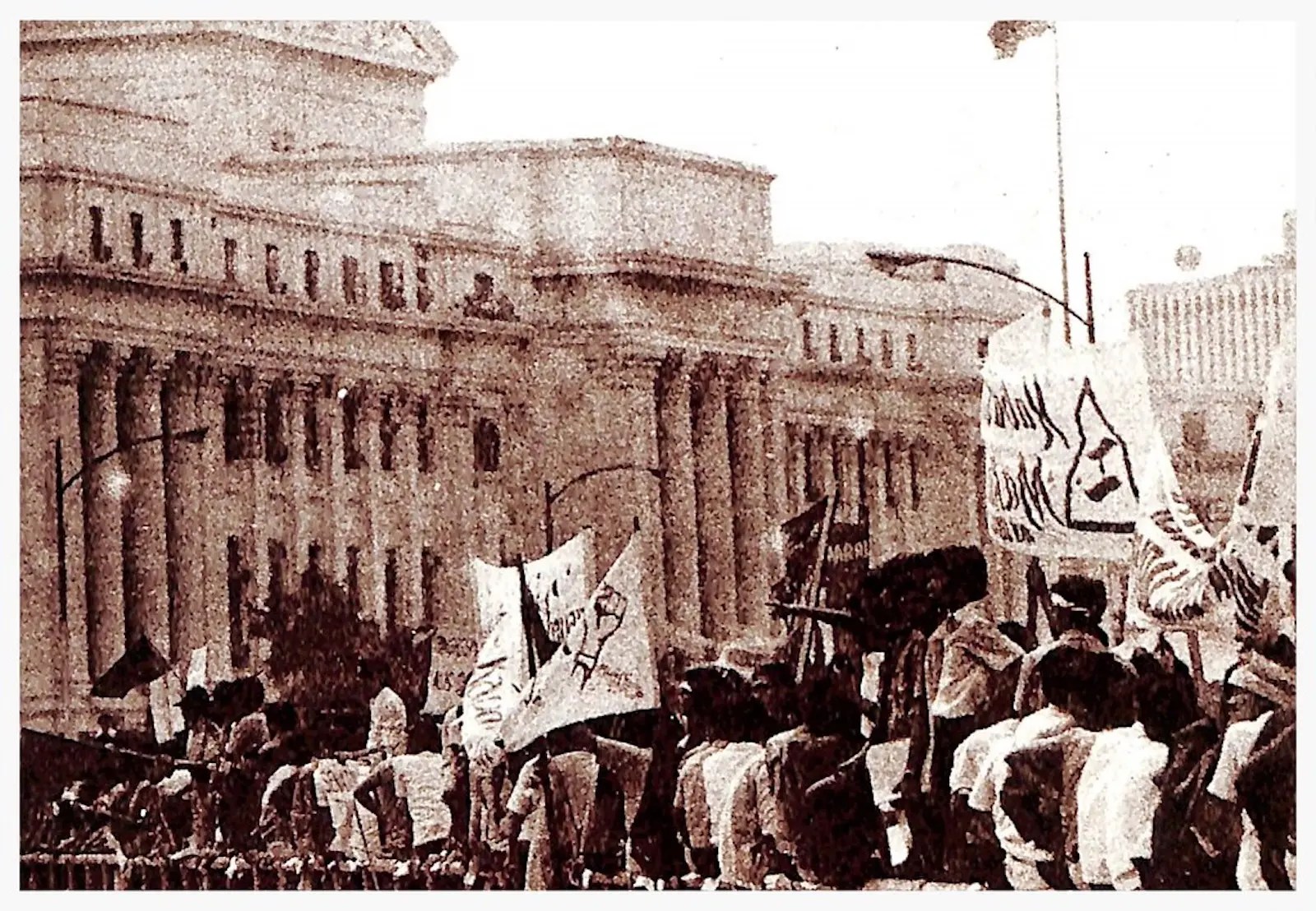
I’M WRITING this piece on my 72nd birthday, so I hope you’ll indulge me if I revert to the memory of another January 56 years ago. On the afternoon of January 26, 1970, I milled with thousands of other young students on the campus of the University of Sto. Tomas, the staging ground for a large contingent of demonstrators marching to the Legislative Building near the Luneta (now the National Museum). President Ferdinand Marcos was going to deliver his State of the Nation Address, and a mass action had been called to protest a host of issues, from Marcos’ increasingly authoritarian rule to rising prices, militarization, corruption, and Philippine subservience to American interests.

I had just turned 16, and was a senior and an activist at the Philippine Science High School. But I was no radical—not yet; I stood under the banner of the National Union of Students of the Philippines (NUSP), among so-called “moderates” led by Edgar Jopson, derided by FM as the “grocer’s son” and later to become a revolutionary martyr. Unlike the far-Left Kabataang Makabayan (KM) and the Samahang Demokratiko ng Kabataan (SDK, which I would soon join) who were railing against “imperialism, feudalism, and bureaucrat capitalism,” the NUSP’s cause sounded much more tangible albeit modest: a non-partisan 1971 Constitutional Convention.

What happened next that afternoon, when both groups of protesters converged at the Senate, would change Philippine political history. The moderates had paid for the rental of the protest mikes and loudspeakers, and wanted to pack up early, but the radicals literally seized the paraphernalia—and figuratively seized the day—launching into a verbal offensive that soon turned physical. Then a young journalist covering the event, Jose “Pete” Lacaba provides the reportage:

“Where the demonstration leaders stood, emblems of the enemy were prominently displayed: a cardboard coffin representing the death of democracy at the hands of the goonstabulary in the last elections; a cardboard crocodile, painted green, symbolizing congressmen greedy for allowances; a paper effigy of Ferdinand Marcos. When the President stepped out of Congress, the effigy was set on fire and, according to report, the coffin was pushed toward him, the crocodile hurled at him. From my position down on the street, I saw only the burning of the effigy—a singularly undramatic incident, since it took the effigy so long to catch fire. I could not even see the President and could only deduce the fact of his coming out of Congress from the commotion at the doors, the sudden radiance created by dozens of flashbulbs bursting simultaneously, and the rise in the streets of the cry: “MARcos PUPpet! MARcos PUPpet! MARcos PUPpet!”

“Things got so confused at this point that I cannot honestly say which came first: the pebbles flying or the cops charging. I remember only the cops rushing down the steps of Congress, pushing aside the demonstration leaders, and jumping down to the streets, straight into the mass of demonstrators. The cops flailed away, the demonstrators scattered. The cops gave chase to anything that moved, clubbed anyone who resisted, and hauled off those they caught up with. The demonstrators who got as far as the sidewalk that led to the Muni golf links started to pick up pebbles and rocks with which they pelted the police. Very soon, placards had turned into missiles, and the sound of broken glass punctuated the yelling: soft-drink bottles were flying, too. The effigy was down on the ground, still burning.”

The January 26 rally and the trouble that erupted would lead to the January 30-31 demos that would prove even more violent, and what would become the First Quarter Storm or the FQS was born. “First quarter” would turn out to describe not only the beginning of 1970 but of the decade itself, as the start of 1971 would prove just as incendiary, with the establishment of the Diliman Commune (and of course, now as a UP freshman, I was there). It seemed that the entire country was politically on fire, with protests mounting by the week, and it would all culminate in what everyone predicted: the declaration of martial law in September 1972. 

It took another 14 years and another “first quarter storm”—the tumultuous months of January and February 1986, following the snap election—to depose Marcos. Fifteen years later in 2001, on another January, yet another president, Joseph Estrada, would be hounded out of office over issues of corruption.

What is it about these first quarters that provoke such firestorms? And do we still have it in us to begin the year on a note of political resolve?

I’ve been worried, like many of us, that the Christmas break, the congressional recess, and intervening issues may have sucked the steam out of the public outrage that boiled over the flood-control scam last year, and lulled the government into thinking that the worst was over and that we could all just settle back into the old routine: let the Ombudsman and the courts do their job, etc. 

What’s worse is if we fall into that mindset, too. The budget deliberations, the Cabral death mystery, the Leviste files, the Barzaga antics, and even a traffic violation episode have all seemed to be distractions from our laser-sharp focus on bringing the crooks to justice. But in fact, they’re all of one piece: demanding better and honest government, the overarching issue we need to press.

And just as the radicals seized the initiative from the moderates 56 years ago, FM’s son, PBBM, can still seize the day by going against all expectations, even against his own nature, and finishing what he may have inadvertently begun: weeding out corruption in government. Never mind the motive—reviving his sagging poll numbers, saving his skin, redeeming the Marcos name, or leaving a worthy legacy behind. He has little choice, if he and his family are to survive. 

There are immediate and concrete steps he can take to achieve this:

1. Activate the Independent People’s Commission. The people are waiting for his next move in this respect; get the enabling law passed and the job done.

2. Impeach VP Sara Duterte. The grounds haven’t changed, and the urgency can only increase as 2028 approaches.

3. Revamp the Cabinet, but replace the non-performers. PBBM knows who they are as well as the public—especially the publicity-seekers whose departments haven’t delivered.

4. Find Atong Ang, Zaldy Co, Harry Roque, etc. and jail the big fish—including political allies. It’s hard to believe that with billions in intelligence funds, the administration can’t track and nail these highly visible fugitives down. Justice is perception.

Do these, and maybe we’ll avoid the generational kind of flare-up and meltdown that followed January 26, 1970.