
Qwertyman No. 217: The Edjop Effect

Qwertyman for Monday, September 28, 2026
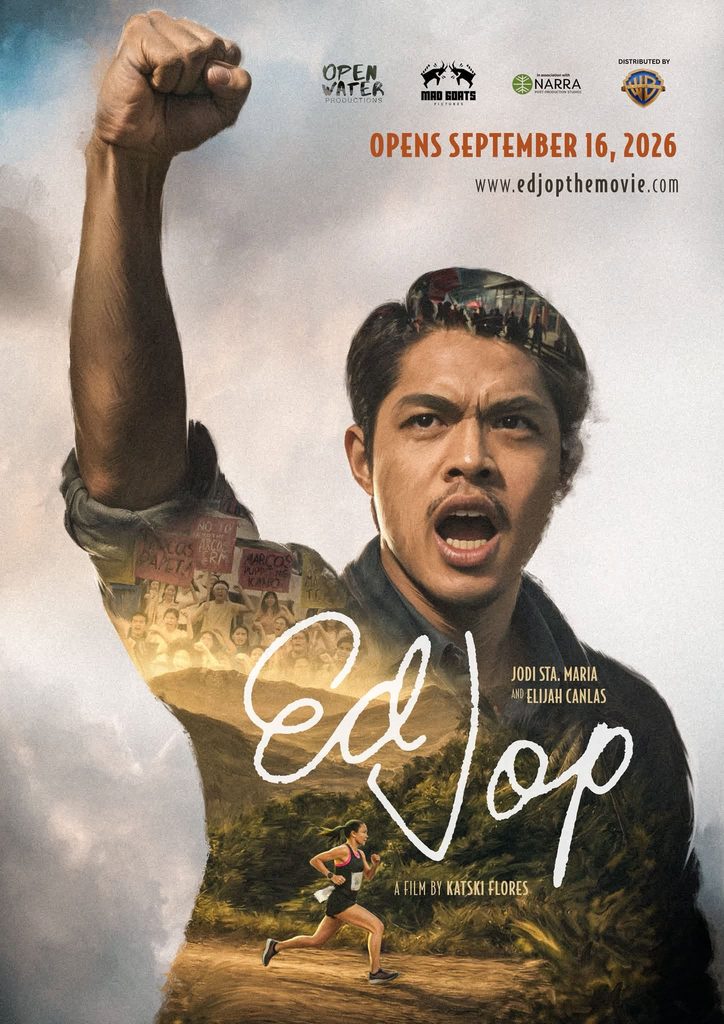
I’LL GET right to the point: my wife Beng and I, along with a younger couple, caught one of the last few screenings of the movie “Edjop”—and we all emerged so moved, albeit in different ways, that we had to spend another hour-plus over coffee just to process what we saw. 

It wasn’t even a matter of “liking” or “not liking” the movie or director Katski Flores’ and scriptwriter Jade Castro’s treatment of the life of the martyred activist Edgar “Edjop” Jopson. Grappling with the broader contours of the story, we were in no mood to quibble over details gotten wrong (and yes, there were a few) or political lines blurred, as many subsequent reviews and critiques seem to have focused on, for their own good reasons.

For Beng and me, the impact was personal, having been activists ourselves who came of age during that tumultuous First Quarter Storm that Edjop—perhaps inadvertently—helped launch. We saw “Edjop” for what it likely set out to be—the story of a young middle-class idealist’s radicalization in an environment of gross injustice, poverty, and oppression. What made it particularly poignant—and this for me represented the film’s true strength, although others may have seen it as a needless diversion—was its framing as a father-daughter story, of a younger generation’s belated understanding and acceptance of their elders’ actions and even excesses. I found it well acted, especially the major roles.

Full disclosure: director Katski had interviewed me, among many others, even while the film project was just getting started, to get my views on Edjop. (She had, of course, other excellent sources, including Bing Pimentel’s books on the man and the period and Joe Cuaresma’s documentary.) I told Katski that I could contribute very little beyond impressions gained from one brief encounter with Edjop.

That encounter happened a few days before January 26, 1970—the date of Ferdinand Marcos’ State of the Nation Address at the old Senate building (now the National Museum), for which the National Union of Students of the Philippines (NUSP), which Edjop headed, was planning a massive protest rally. An organizational meeting for that rally was held somewhere in Quezon City, and for reasons I can no longer remember except possibly that I was already an activist at the Philippine Science High School, I was there, more of a kibitzer than anything.

I had just turned 16 a few days earlier. We had rallied in high school for local demands such as a new and larger building, but January 26 was going to be our first big exposure to national issues, and we took the lead from the NUSP, the so-called “moderates,” being then deeply mistrustful of the radical Left under the Kabataang Makabayan and Samahang Demokratiko ng Kabataan (KM-SDK). I recall that meeting of senior NUSP leaders and their allies, and Edjop in a white shirt or barong. What struck me was his earnestness, his passionate belief in his cause, conveyed in an even voice and manner. 

We joined the January 26 rally, assembling on the grounds of the University of Sto. Tomas, bearing “J26M” armbands. We marched to the Senate where Marcos was speaking. I was too far from the entrance to follow everything, but I could see that the KM-SDK were also there in front, and I would later learn (though this account might yet be corrected) that Edjop had decided to terminate the rally early because things were turning ugly, but then SDK firebrand Gary Olivar, a formidable speaker, grabbed the microphone to agitate the crowd. Marcos emerged, a black cardboard coffin was thrown his way from somewhere, the security forces moved, and a melee ensued. We ran for our lives. The FQS had formally begun. 

We moderates were almost as indignant about the way the Left had hijacked the event as by the State’s brutal response; I stayed out of the January 30-31 protest rally that proved even more violent, but watched on the news as students were teargassed and truncheoned along Mendiola and Malacañang. I dreaded what lay ahead; I was due to graduate from high school that year. It should have been a time of hope, but I knew only that something was terribly wrong, that the future was going to be harsh, and that I was as confused as anyone about what to do and whom to follow.

As it turned out, history carried a very wry sense of irony—even humor, were the setting not so tragic.

Within that year, I entered UP and almost immediately joined the Nationalist Corps, the Philippine Collegian, and the Alpha Sigma fraternity. The Nationalist Corps became my entry point to the SDK, and now I saw the “clerico-fascist” moderates to be sorely misguided and wanting in revolutionary fervor. In Alpha Sigma, one of my fraternity brothers was none other than the Gary Olivar we blamed for the J26M fiasco; in the Collegian, our editor was another frat brod, Tony Tagamolila. 

As the decade moved on, I would be arrested and imprisoned, and upon my release, I would take on a writing job I needed—with the government. Tony Tagamolila would die in an encounter with the military in Panay. Gary Olivar would move to the US and study at Harvard (and much, much later would become PGMA’s spokesman).

Little did I know that Edjop himself had become radicalized and was performing far more dangerous tasks in Mindanao than most of us ever did even in Manila. His death fell like a rebuke to those who had doubted him. Meanwhile, I had resigned from my NEDA job to go back to UP to study and to teach, and by the time the Ninoy assassination and EDSA happened, I had become convinced—as I still am—that the middle road remains the most viable if not the only one forward. It seems that I’ve returned to Edjop’s NUSP. 

I don’t know what Edjop himself would think of our situation now, of another Marcos in Malacañang trying to face down a possibly even more vicious alternative, of a CPP fractured by internecine warfare, of a people too easily swayed by rumor and shadow. If the effect of Edjop—the movie and the man—is to make us think of where we ourselves stand today, then the effort of making this film will well have been worth it.
Qwertyman No. 71: A Breakthrough for Peace

Qwertyman for Monday, December 11, 2023

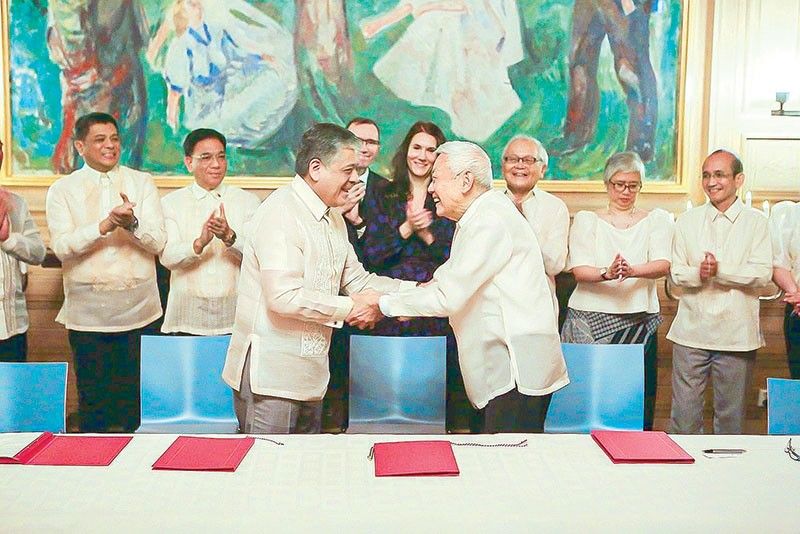
I HONESTLY didn’t know what to feel when I first read the news that a breakthrough appears imminent in peace negotiations between the Philippine government and the National Democratic Front (and behind it, the Communist Party of the Philippines), whose soldiers and partisans have been at war with each other for over half a century, in one of the world’s longest-running insurgencies.

As a student activist who fought martial law and got imprisoned for it at age 18, I didn’t expect to live past 25 because so many of my friends and comrades were giving up their lives around me in the name of freedom and justice. Instead, in a Forrest-Gumpish turn of events, I survived and even prospered for another 50 years. As I wrote in my introduction to the book SERVE (Ateneo Press, 2023), co-written with 19 other fellow stragglers from what we called the First Quarter Storm, “We celebrated our seniorhood as the ultimate victory” even as “the experience of martial law coded itself into our DNA.” That victory, of course, is a shallow one, considering that the causes we fought for remain as valid and as urgent today, and that the social cancer we sought to excise “had never left, was always there, lying cruelly in wait for a chance to ravage us again—and not only us this time, but our children and grandchildren as well.”

My reaction to the peace talks—and I would guess that of many of my peers as well—was one of joy and relief, but inevitably compounded by some doubt and apprehension. All of these responses, however disparate, have their reasons.

The joy and relief must be paramount because, however we look at it and whatever arguments may be presented by either side, the armed conflict has gone on too long, without truly positive and strategic gains to show for five decades of warfare, at the cost of innumerable lives and massive drains on our resources. This is not to say that those lives were wasted nor that everyone’s goals have been met, but that surely there must be a better way—a more humane and effective way—to resolve our differences and move forward together without having to kill yet another cadre or yet another soldier, both of them probably just farm boys looking to improve their lives. 

Ultimately and simply, it didn’t work as planned—neither the “people’s war” nor the counter-insurgency. (Curiously, they manifest a kind of symbiosis or co-dependency, with one providing the basis for the other.) The Left is as far from seizing State power as we are from achieving a FIBA championship (no matter virtue, skill, or tenacity), and the Right remains essentially as it has always been, unreformed and unrepentant in its monopoly of economic and political power. But the Right seems to have been more clever at shapeshifting, riding on and pandering to the digital consumerism of a new generation and thereby dousing its revolutionary fervor, while the Left has basically stuck to the playbook and rhetoric of 1970s Maoism.

Meanwhile, in the great section between them, the masses of our people remain largely poor and vulnerable, in desperate need of food, housing, work, and education, a significant number of them kept afloat only by the grueling sacrifices of fathers, mothers, and siblings laboring overseas. Some decline has been noted in the incidence of mass poverty in recent decades, but it has been slow and uneven; even moderate economic growth did not necessarily lead to significant poverty reduction. 

We are said to have a rising middle class—estimated by the Philippine Institute of Development Studies at 40 percent of the population—but it is a very fragile one, strongly aspirational in its longing to be rich or be like the rich, but weak in the knees, and easily crushed or co-opted. Those of us in this category spend our lives saving up for the good things and cultivating our composure, only to lose all that in one catastrophic illness or declaration of redundancy.

Politically, as well, I place myself squarely in the middle, never having trusted the Right and its compulsive greed for wealth and power and long having fallen out of love with the Left, which has shown itself to be just as capable of cynical calculation. I declare myself a liberal (with the small “L”), with all of that word’s ambiguities and contradictions. I repose my faith in no party or church or army, but trust my reason (however faulty, and with God’s grace) to lead me to the truth and to the right decisions. I draw strength from knowing, as I saw in the crowds of May 2022, that a huge wellspring of goodness and positive purpose resides in many if not most Filipinos. We cannot and will not let bad politics and bad politicians stop us from doing good, in our families, communities, and eventually our nation.

However fractured our society remains, in the very least we deserve peace, and must agree on peace, so we can banish one of the darkest specters in our national history. No more war; no more political prisoners; no more tokhang. And please, no more Leila de Limas.

But a just and lasting peace will require not only a rejection of violence as conflict resolution. It should also mean strengthening the law and the independence of the judiciary, reducing corruption, and depoliticizing the military and police. It should mean dismantling the broad and expensive State apparatus devoted solely to counter-insurgency, a factor that the National Security Council itself has declared “a dying threat” even as military budgets remain high. Deploy our soldiers to our coastal waters and boundaries, where the real dangers to our national security loom.

The irony of another President Marcos securing the peace has not escaped me, as I’m sure it will perplex others, but I grant that peacemaking will require being able to look beyond the persons for now and focus on the larger goals and processes involved; other reckonings can follow. I’m under no illusion that the GRP and the NDF will sing “Kumbaya” around a campfire and that all will be well thereafter. Neither party comes to the table with clean hands and consciences. Both come with long histories of violence, betrayal, and guilt. There will be more hope than trust to share.

But a peace agreement is not a marriage, with a pledge to love and hold hands no matter what, merely a civil agreement to live under one roof without killing each other and maybe, just maybe, have an occasional cup of coffee or a meal together. 

For this I am willing to suspend my disbelief, and wish all the parties the best of luck, with a silent prayer for this most unlikely and difficult of enterprises. Other battles and debates can follow; let’s end this one first.