Penman No. 174: What Women Remember

4510563825_5f753e970a

Penman for Monday, 16 November 2015


I WAS very pleased and much relieved—and, as one of the convenors—immensely proud for the Philippines to have successfully hosted this year’s conference of the Asia Pacific Writers and Translators (APWT) late last month in Manila.

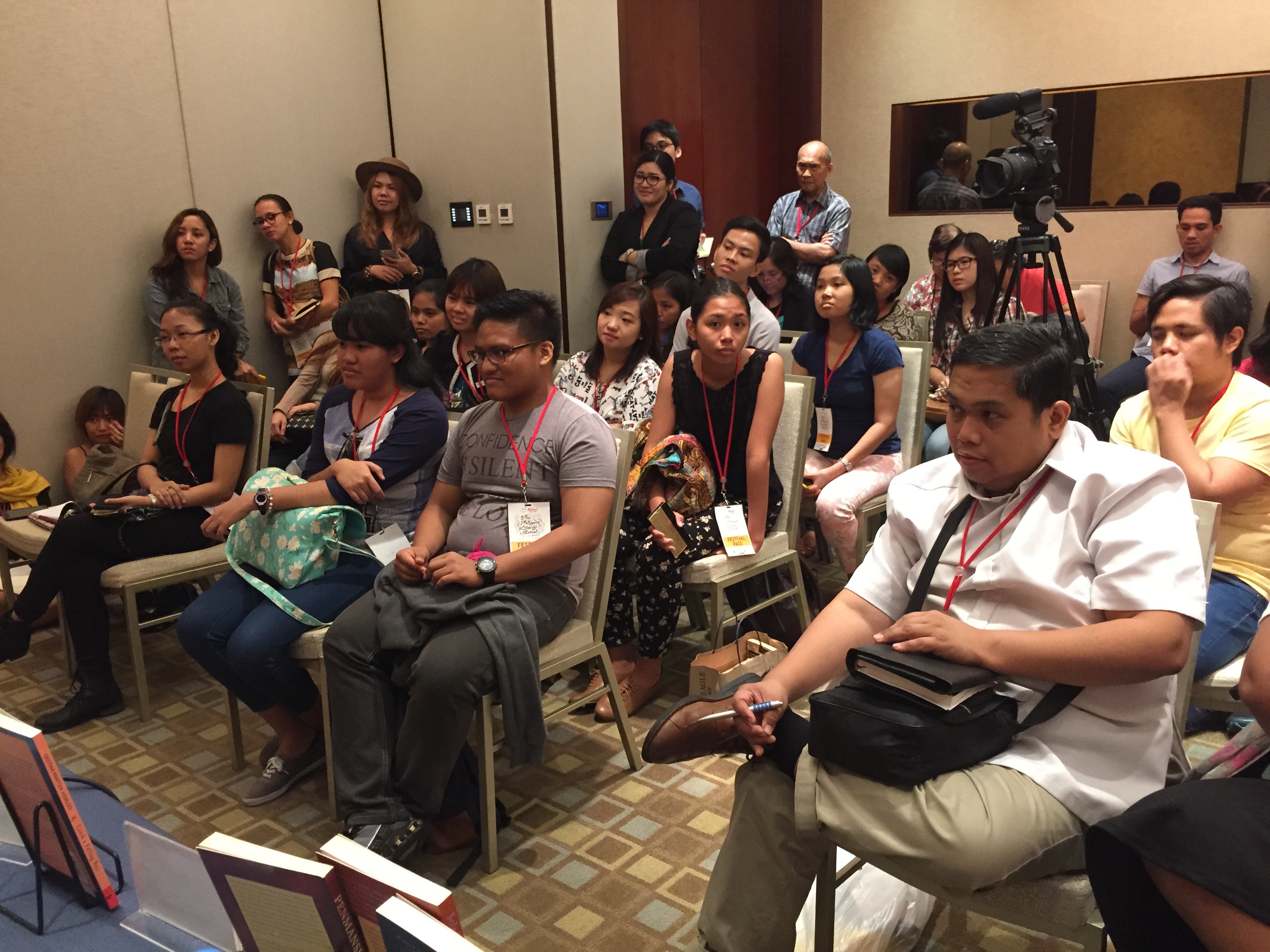
Among the highlights of the conference was a keynote talk given on the last day by none other than one of our foremost fictionists and critics, Dr. Cristina “Jing” Pantoja-Hidalgo, now the Director of UST’s Center for Creative Writing and Literary Studies, who spoke on a subject even her fellow Filipino writers like me know very little about or pay only minor attention to—the journals, memoirs, and autobiographies of Filipino women. I found her lecture (titled “The Subversive Memory: Women Tell What Happened”) so informative that I asked her permission to excerpt parts of it to share with my readers, so here:

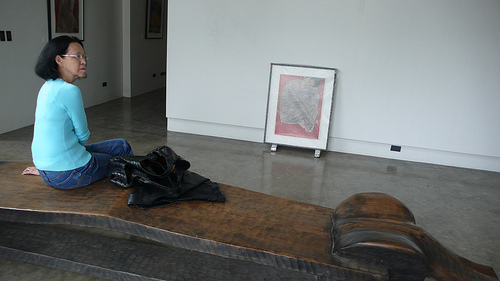
Several generations are represented in the seven women who are the subject of my new book, which I called To Remember to Remember…. t today is referred to as multi- er, is available at the UST Publshing Housee so informative that I asked her permission to exce

The oldest, Paz Policarpio-Mendez, was born in a small town in the province of Nueva Ecija in 1903, and was among the first children to enter the American public school system, and one of the first women to go all the way to college in UP. But, to get there and to stay there, she had to fight her father – who did not hesitate to beat her when he objected to her behavior or her opinions. Always painfully aware of her father’s preference for his sons, she strove to win honors in school, to merit his approval. But he never gave it. Later, she married a journalist who eventually became a diplomat, and finally the Secretary of Foreign Affairs. But Paz went right on studying and teaching, while raising a family, and attending to the duties of a diplomat’s lady.

The youngest, Rica Bolipata-Santos, was born in Manila, and educated entirely in Catholic schools, until she decided to get a PhD in Creative Writing in UP. She is sister to the three famous Bolipata brothers, musical child prodigies. This doomed her to play second fiddle to them, to grow up feeling unimportant, untalented, even ugly. Kept back from developing her own musical talent (she could sing!), not deliberately or maliciously, but through neglect, she found her voice in writing and in teaching. Now she is also an academic administrator. But the biggest trial in her life has been her special child, and her memoir is the story of her struggle to cope with anger, sorrow, sometimes despair.

In between there is Solita Camara-Besa, a woman who describes herself as a battered child – this abuse by her father did not let up even after she was married, until her husband, demanded that she choose between himself and her parents. For all this, she became one of the country’s first women doctors—though again, she experienced appalling gender discrimination in the UP College of Medicine, of all places—and was part of the heroic little band of UP faculty members who kept UP and its teaching hospital, the Philippine General Hospital – running throughout World War II.

The remaining four writers who are part of the book took for granted their right to an education and to careers of their own. But they had their own battles to fight. For Gilda Cordero-Fernando (b. 1930), maker of baby bags, keeper of antique shop, fashion designer, publisher, and one of the country’s finest writers of fiction and nonfiction, the battle was against her mother and the convent school education that she felt trapped in; against her husband who resented her writing, her writer friends, and the many worlds that her numerous gifts opened up to her, but kept a mistress for most of their life together; and against conventional ideas about what constitutes accomplishment and success.

For the prize-winning poet and academic, Merlie Alunan (b. 1943), it was the battle to hold it all together when she became a single parent, seeing herself and her children through school, teaching in college, holding workshops for struggling young writers, and picking up poetry awards along the way.

Jennifer Ortuoste (b. 1968) trained as an apprentice racehorse jockey, married a professional jockey and raised her babies in the Santa Ana Racetrack. Hers is the story of a battered wife; and the story of the collapse of her marriage is told against the backdrop of the demise of the racetrack that she loved. When her marriage fell apart, she picked herself up, became a journalist, got an M.A., and is now writing prizewinning fiction and nonfiction.

Criselda Yabes (b. 1964) chose a profession, which until the generation before hers was not considered quite respectable for women—journalism. The most independent, unconventional and alienated of the seven, her story is focused on 16 months of her life, the period after she had been abandoned by her lover of seven years. And, to keep a hold on sanity, she went to Europe, first on a scholarship, then as a war correspondent in different countries, until, in a borrowed apartment in Athens, she began to write about the year she had just lived through, and so found her way home.

In life, these women broke from the mold. They would not settle for what was expected of and from them as women. They wanted different things. In writing their memoirs, they, again, transgressed. For in the Philippines, family matters are kept private, particularly matters which will make the family lose face; one’s personal memoirs inevitably include other members of the family. They may not have been flaming radicals, marching down streets, waving banners and chanting slogans, or being hauled off to jail, being tortured and even killed, as some of their sisters were. But, in their own quiet way, they were rebels….

I read the memoirs of the three older writers as variations on a theme, the theme being the education of the modern Filipino woman, and her transformation, from sheltered schoolgirl into formidable, professional woman without relinquishing the role of wife and mother. I do not claim for this narrative that it applies to all modern Filipino women, nor even all modern Filipino women of the middle class (to which all three belong). But I do believe that it is a pattern that many Filipinas aspire to, and can therefore identify with. And I suggest that in telling their own life stories, these writers are creating a different myth, to replace the older narratives about the Filipina and her role in society….

These are the narratives that we, the next generation of Filipino women writers inherited. Most of our mothers had college degrees and careers. After they married, those who lived in extended families, or could afford reliable yayas went on working, and became quite expert at juggling their several roles, what today is referred to as multitasking, and they trained their daughters to do the same.

The memoirs of the younger writers are, in a sense, their response to these narratives. I take them as signposts. They mark the latest paths taken by Filipinas and what they reveal is the distance they have travelled, but not a change of direction. Those pioneers, some of them already so bold for their time, but working in relative obscurity, had pointed the way….

What these women have done is take the personal narrative—either the full-length autobiography or the memoir—and use it to open doors previously kept firmly locked, and to explore their own thoughts and feelings about the monsters lurking in its shadowy corners. This they have done in language both precise and elegant. Thus have they contributed to the story of their country, and the place in it of Filipino women.

(Jing Hidalgo’s new book, To Remember to Remember, is available at the UST Publishing House for P400.)


Penman No. 173: Lines and Letters

IMG_8288

Penman for Monday, November 2, 2015

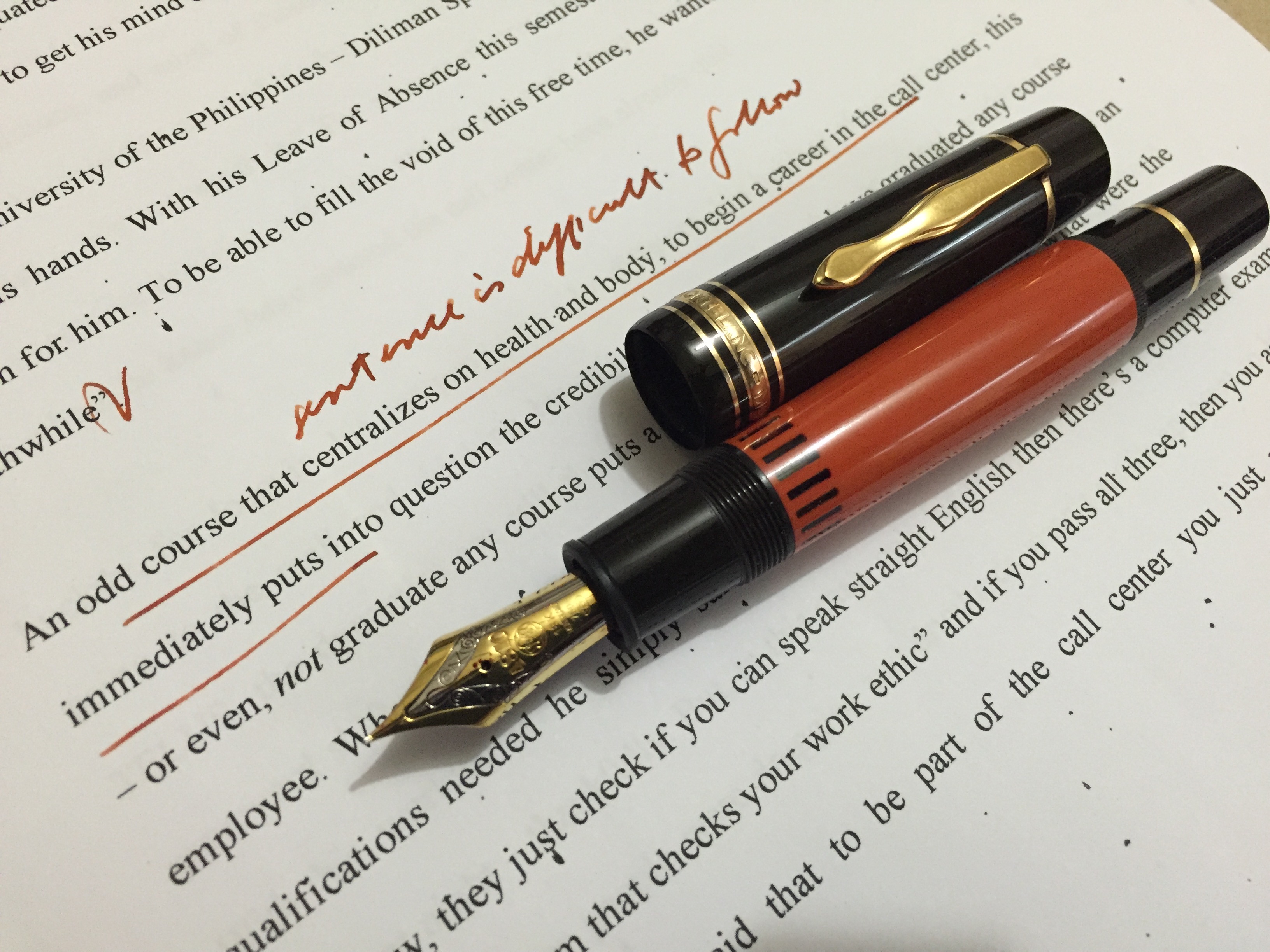
IT’S BEEN a while since I’ve written about my favorite pastime (aside from my weekly poker binges and my foot-massage-and-movie dates with Beng), so indulge me this break from the headaches of literature and politics and let me talk about those obscure objects of my writerly desire—pens and all things appurtenant thereto, as my lawyer friends would say.

We have, not incidentally, a good many lawyers among our members at the Fountain Pen Network-Philippines (FPN-P), which isn’t surprising, given how lawyers have traditionally used pens in their work, and at least in taking their bar examinations. Those pen-wielding members of the Philippine bar include Undersecretaries Albert Muyot, Ronnie Geron, and Rey Cruz; SEC Chairperson Tess Herbosa and SEC lawyer Joanne Ranada; pro-gun advocate Ticky Tabujara; former ACCRA lawyer Elsa Divinagracia; and Aboitiz lawyer Anthony Goquingco. While he hasn’t formally signed up with FPN-P, Supreme Court Justice Marvic Leonen, an avid pen user, has turned up at a meeting or two.

We also have a sizeable representation of doctors—among others, Novartis executive Aileeen Dualan, surgeons Jojo Hosaka, Joy Grace Jerusalem, and Leo Ona III, Healthway Medical head Eleanor Bengco-Tan, barrio doctors Edrie Alcanzare and Jim Lopez, Dagupan-based rehab specialist Hazel Gazmen, company physician Kristine Arabaca, and new Med graduate Mark del Rosario. Predictably, there’s a special thread in our forum devoted to providing specimens of our doctors’ handwriting—the more unreadable, the more impressive.

Alongside these professionals come teachers, writers, artists, businessmen, bankers, students, and all manner of writing enthusiast, drawn to the group if not by pens then by inks, papers, calligraphy, or drawing. What started out in my front yard in Diliman seven years ago with less than 20 people has grown to over 500 members on our dedicated website at http://www.fpn-p.org/, and more than 2,000 on our Facebook page (being FB-averse, I stay out of that group, but you’re welcome to sign up there if FB’s your thing).

Once or twice a month, we get together—typically for a long Saturday lunch in a Makati or Ortigas restaurant—to play with our pens and to doodle away in wild abandon. While we may talk politics in the corners of the meeting and devote some attention to tangential interests like watches and knives (you’d be surprised how many pen people have one or the other or even both as secondary hobbies), the focus is clearly on fountain pens, inks, and papers.

Whatever for? There’s no better way I can explain it than group therapy. As I’ve said in this column many times, it’s the sheer tactile pleasure of laying down lines and letters on a page, of watching the ink spread through the paper’s fibers, creating networks of meaning, or otherwise an impression of beauty, an entirely handmade beauty at that. This is what you can’t get from a ballpoint or a rollerball—a soft or shaped nib that can create breathtaking line variations from from extra-fine to triple-broad, that can be so sensitive to the touch that the merest tremor can betray some deep-seated emotion. With every stroke of the pen, another worldly care is banished, another rampant anxiety quelled. There’s nothing more intimate yet more revealing than that stroke, the physical commitment of thought to paper.

Fountain pen collectors (among other creatures infected by the same virus of compulsive acquisition) often speak of their “grail” pen, that one elusive, near-unattainable pen that calls to them in their dreams and shimmers like a mirage on the horizon of their consciousness. That pen could be as simple as a Parker 51 that they recall their father used, or as weighty as the Montblanc 149 favored by Supreme Court Justices, or as uncommon as a custom-made Nakaya or Hakase epitomizing the finest of Japanese craftsmanship.

Over the past 30 years of immersing myself in the hobby, I’ve had many such “grail” pens cross my fevered brain, and have actually had the good fortune of realizing most of them—a 1938 Parker Vacumatic Oversize in burgundy, a Parker “Big Red” Duofold from 1926, a Montblanc Agatha Christie from 1993, and, most recently, a Montblanc Ernest Hemingway from 1992. Almost as interesting as the pens themselves, each of these pens has a story behind it, a near-mythical chase across decades and continents.

Unlike many collectors, I don’t keep my best pens in a case, under lock and key. I rotate them for daily use, praying that I’ll never lose one, although that’s almost a statistical certainty. It isn’t ostentation that impels me to do this, but rather an acute and growing awareness of time passing—of the sense that, at my age, I probably have another ten good years left, and what a waste they would be if I let my happiest acquisitions moulder away in some dark drawer, never having kissed paper.

If all this talk of pens makes you want to reach for one—whether in memory of a long-forgotten practice or in anticipation of a novel experience—then join us this Saturday, November 7, at the Cinema VIP Lounge of Century City Mall on Kalayaan Avenue in Makati as we celebrate International Fountain Pen Day (yes, such a day exists) around the theme of “Celebrating Analog Writing in a Digital Age.”

Open to the general public, the day’s events will include a pen-and-ink art exhibit, a calligraphy workshop, a sketching session, as well as an introduction to fountain pens for children. Guests may also avail themselves of services such as vintage pen restoration, appraisals, and nib tuning.

For supporting this project, FPN-P would like to thank Manila’s leading purveyors of quality writing instruments such as Everything Calligraphy, Faber‐Castell, Lamy, Parker, Scribe Writing Essentials, Sheaffer and Wahl‐Eversharp/PenGrafik. Our special thanks go as well to Asia Brewery for their assistance.

Entrance is free, so take those leaky old pens out of your grandfather’s desk drawer and bring them to us for a cleaning and a good chat. But I warn you: fountain pen use can be highly addictive, and leave your fingers stained in the most wonderful colors.

Penman No. 172: Going Against the Grain

IMG_8272

Penman for Monday, October 26, 2015

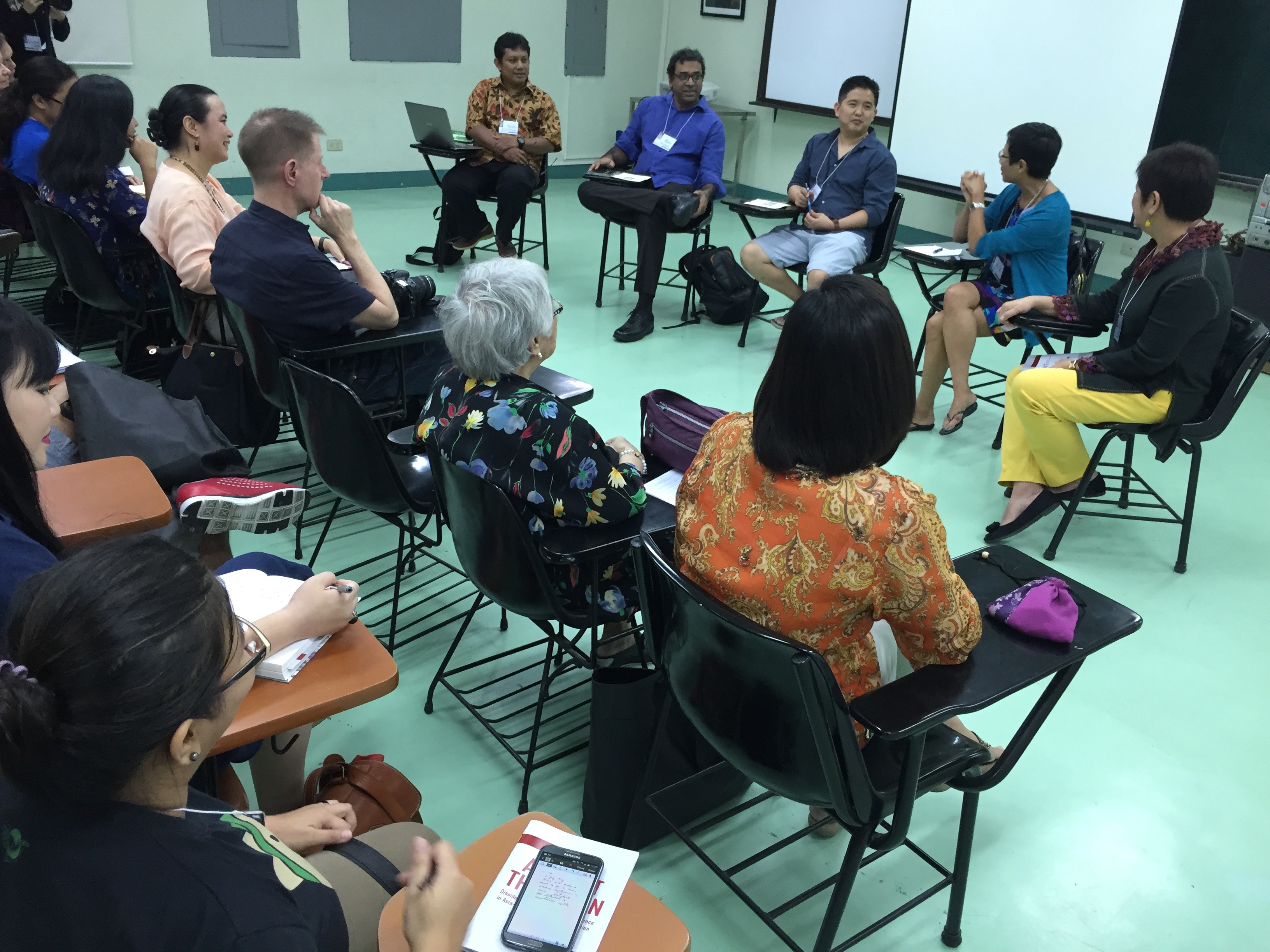
I WAS asked to give the first keynote last week at the annual meeting of the Asia Pacific Writers & Translators at the University of the Philippines, on the conference theme of “against the grain,” and here’s part of what I said:

The Filipino writer is among the freest in the world as far as self-expression is concerned; but the Philippines is also one of the deadliest countries for journalists in the world—according to the New York-based Committee to Protect Journalists, it ranked second only to Iraq in 2013.

Creative writing won’t pay you much, but you can say whatever you want and reasonably expect to stay alive and ambulant. Nobody in this country ever got killed or imprisoned in recent times because of a novel or a story. Neither has a Filipino despot been deposed because of a play or a poem. Journalism, on the other hand, can be a dangerous enterprise, especially if you live and work far away from the glare of the metropolis.

…. We have one of the region’s richest concentrations of writers, and very likely the region’s most strongly developed systems for the development of new writers; but these writers have precious few readers.

We have never lacked for writers, and likely never will. The Filipino writing community is very much alive, producing new work not only in English but in Filipino and in many regional languages.

Within the region, we can claim to have the oldest, the longest-running, and possibly the most comprehensive writing programs—not just writers’ workshops which go back 50 years, but also degree programs from the BA to the PhD in several major universities. The Palanca Awards, which are handed out every year to the best work in many categories and several languages, have been running now for 65 straight years.

New young writers will find it easier to break out and get noticed by their peers and seniors here than in many other places, because, while Filipinos respect their elders, and everyone above 40 is a “Sir” or a “Ma’am,” we do not have the kind of master-apprentice, or senior-junior relationship that exists elsewhere. You do not need a senior’s validation or sponsorship to advance; indeed you might move forward much faster by slaying a literary father or two.

But for all the literary talent we think we have, it can be argued that creative writers really don’t matter much in Philippine politics today—certainly not as much they used to—because, to be hyperbolic about it, no one reads, no one buys books, and no one understands nor cares what we’re doing.

It’s a sad fact that in a country of 100 million people, with a literacy rate of about 97%, a first printing for a new novel or book of stories will likely run to no more 1,000 copies—which will take about a year to sell, and earn the author a maximum of about P50,000 (about US$1,000) for a few years’ work—good enough for a new iPhone. There’s no such thing as a professional novelist or playwright in the Philippines, which makes it easier for writers of any worth to be sidetracked or co-opted by the government or by industry.

It’s ironic that Philippine literature’s political edge should be blunted not by timidity nor by censorship but by sheer market forces. The simplest reason many Filipinos don’t buy books has to be poverty, with the price of an average paperback being higher than the minimum daily wage.

But perhaps we writers ourselves are also to blame, for distancing ourselves from the mainstream of popular discourse. Politics is nothing if not the domain of the popular, and the very fact that many of us write in English is already the most distancing of these mechanisms. The question of language has always been a heavily political issue in multilingual Philippines, where some regionalists still resent the choice of Tagalog as the basis of the new national language Filipino in 1935, and where English is reacquiring its prominence not only as the lingua franca and the language of the elite but as our economic ticket to the burgeoning global call-center industry.

Political change in the Philippines has historically been led by the middle and upper classes, from the Revolution against Spain of 1896 to the anti-Marcos struggle of the 1970s and the 1980s to the Edsa uprisings of 1986 and 2001. Therefore, one might argue that English is, in fact, the language of reform and revolt in the Philippines in modern times.

But it is this same English-literate middle class—our potential readership—that is the strongest bastion of neocolonialism in the Philippines, blindly infatuated with Hollywood, hip-hop, and Harry Potter, keen on trading the local for the global, opportunistic in its outlook and largely unmindful of the social volcano on the slopes of which it has built its bungalows. As I often remind my fellow Filipino writers, our rivals on the bookshelves are not each other, but J. K. Rowling, Stephenie Meyer, E. L. James, Paulo Coelho, and Tom Clancy.

When I return to the two main points I raised—that we are free to speak and to write, but only in politically inconsequential forms; and that we have writers aplenty, but very few readers—I have little choice but to conclude that the main culprit is our self-marginalization through English, and the academicized, Western-oriented mindset the language encourages.

The interesting upside of this unfortunate situation is that—largely untethered from the considerations of commerce and politics—our writers have been free to write their hearts and minds out, producing poetry and fiction of a high quality that, in a double irony, might yet break through to the global market.

The triple irony would be that it sometimes takes the international spotlight for local readers to take notice of native genius. It sounds like wishful thinking, but by being here today, and connecting our literature to yours, we might do enough together to push our literatures to the forefront of our peoples’ consciousness.

But let’s face it: the margins are familiar if not comfortable territory to many of us, not only here but wherever we live and write, as they give us a clearer view of the center. Going against the grain is very much in the grain of how and why we work. And if you didn’t think so, you wouldn’t be here today.

Penman No. 171: All Systems Go for APWT 2015

APWTlogo

Penman for Monday, October 19, 2015

IT’S “ALL systems go” for this year’s edition of the annual Asia Pacific Writers and Translators (APWT) conference, which will be held in Manila later this week, from Thursday on to the weekend. As a member of the APWT Board and one of APWT 2015’s convenors, I’m particularly thrilled for the Philippines to be hosting this event, which is the literary equivalent of the APEC, the SEA Games, and let’s throw in The Amazing Race, which it could be a bit of for our foreign guests.

It’s not a competition, of course, and we won’t be signing any treaties or squabbling over territory. In fact, the way we’ve set things up, it’ll be a politician-free zone, which isn’t to say that politics will be off the menu. With topics ranging from “Sex and Sensitivities” and “Criminal Intent” to “Love in the Time of Dissonance” and “Why Publishers Prefer Outsiders,” there’ll be fireworks aplenty in the panel discussions we’ve put together for the three-day conference, which will be held at the Institute of Physics in UP Diliman on Thursday and Friday, before moving to De La Salle University and the University of Sto. Tomas on Saturday.

I’ll be one of four keynote speakers for the conference, and will speak on the conference theme, “Against the Grain,” at UP on Thursday morning, to introduce the Philippines and our culture and literature to the audience, especially our visitors. I’ll be followed the next day by Romesh Gunesekera, the UK-based, Sri Lanka-born Booker Prize finalist who partly grew up in Manila, where his father had worked for the Asian Development Bank. At La Salle on Saturday, the indigenous Australian author Philip McLaren will keynote the meeting, and Jing Hidalgo will close the conference at UST with a talk on the “subversive memory” of women writers.

These 30-minute keynotes will be the exception, however. It’s an APWT hallmark to keep presentations short (no more than 10 minutes max) and informal (no footnoted academic papers on obscure topics, please—and no PowerPoint!). The key phrase here is “writers in conversation,” so we expect easy, freewheeling discussions around the topics given to each panel, with lots of time for audience interaction.

We’re expecting at least 50 foreign participants to join around 100 local authors in APWT 2015. Filipinos have always been well represented at APWT. Its annual meetings had been previously held in Hong Kong, Bangkok, New Delhi, Perth, and Singapore, and this will be the first time it will be coming to Manila. Next year, we’re planning to hold it in Guangzhou, China.

If you want to meet with fellow writers, translators, publishers, and agents beyond our shores, you can’t do better than to sign up with APWT, a ten-year-old organization that has become the most active and visible network for writers and translators in the region. The great thing about APWT is that it was designed by and for practicing writers above all; while we have many academics, critics, and scholars among our members, theory isn’t our big thing, but practice—engagement with reading publics, dealing with shifting markets, connecting across the globe, adapting to new media, rolling with the political punches. If you’ve written what you think is a terrific novel and want to catch an agent’s or a publisher’s attention, APWT is the place to go.

Speaking of which, this year’s conference will offer six workshops that writers—both budding and accomplished ones—can sign up for, to sharpen their skills or explore new possibilities. You don’t have to attend the full conference to attend these workshops, which will be run by a sterling crew of international authors. Robin Hemley—who used to teach nonfiction at Iowa and now heads the Yale-NUS program in Singapore—will be handling one on “The Art of Memoir Writing”; Xu Xi, who directs the MFA program at the City University of Hong Kong, will teach fiction writing “with Asian characteristics”; the New Yorker Tim Tomlinson, another frequent Manila visitor, will share “Pitching Tips from the New York Writers Workshop” to help you sell your manuscript, at the same time that poet and editor Ravi Shankar will be teaching his students how to create “timeless verse”; at La Salle, Sally Breen will hold a master class in editing, to address “What Editors Want”; and simultaneously, Francesca Rendle-Short and David Carlin will employ improvisational techniques to engage participants in “Essaying Manila.”

I strongly urge those inclined among my readers to go out for one or two of these three-hour-long workshops, because you may never get the chance again to study directly with these masters, some of whom have become good friends of mine over the years and whose teaching and writing excellence I can swear to. There’s a fee to pay, but it will be well worth it, and you’ll remember the lessons you’ve learned long after you’ve forgotten how much they cost. Slots are limited, so sign up early. If you can’t pay in US dollars online, you can pay for the conference and/or the workshops at the door, in pesos (at a slightly higher rate of 50-to-1, to cover conversion and remittance charges).

Filipino citizens can attend the full three-day conference at a reduced fee of $40 or P2,000 (for students with IDs of UP, DLSU, and UST, the fee will be just P1,000); the workshops will each cost $40 or P2,000. These fees will include some meals and snacks provided by our generous sponsors and hosts, who include—aside from the three aforementioned universities—the National Commission for Culture and the Arts, the British Council, Anvil Publishing, and the Japan Foundation.

For more information and for links to the registration page (again, you can also register and pay at the door), see here: http://apwriters.org/apwt-2015-manila.

See you at the panels!

Penman No. 170: History Made Personal

Sofia+De Veyra and+Florence Harding

Penman for Monday, October 12, 2015

THE RECENT upsurge of interest in our history occasioned by runaway success of the film “Heneral Luna” is certainly welcome. While the film and its propositions may have sparked a flurry of debates among netizens about what really happened more than a hundred years ago, the important thing—as I noted in one of those “Heneral Luna” threads online—is that we’re having this discussion at all, when not too long ago, very few people cared.

(One of the most salient comments I came across was posted by a viewer who mused that—for all our newfound admiration for the hothead general’s bravery and principled stand—had we lived in Gen. Luna’s time, or were those circumstances transposed to the present—most of us middle-class Pinoys would probably side with the general’s more pragmatic enemies, arguing business to be more important than anything else. That’s a sobering thought, especially these days when many people seem to think of “nationalism” as being too old-fashioned if not downright irrelevant in this age of globalization, conveniently forgetting that globalization benefits some nations and economies more than others.)

There have been many times when I’ve wished that I’d become a historian instead of a literary person, so I could have looked into our past more deeply and more seriously to make better sense of our present. Indeed, when I returned to the University of the Philippines as a freshman after a ten-year hiatus in 1981, I chose between declaring myself as an English or a History major (I had entered UP in 1970 as a prospective industrial engineer).

Were it not for the need to take the easier path to make up for lost time, I would have chosen History in a flash, as interested as I was in stories of “what happened.” In grade school and high school, I read more books dealing with history, biography, geography, and science than fiction; to this day, when people ask me what single book has influenced me the most, I don’t think twice about answering The Forest by William Pomeroy, a lyrical account of an American’s travails as a Huk guerrilla, which I read in high school and encouraged me to become an activist.

Mine was a generation of students who grew up on the enlightened revisionism of Teodoro Agoncillo, Hernando Abaya, and Renato Constantino. I use the word “revisionism” because the standard historical texts at that time were written by such men as Gregorio F. Zaide, a mimeographed and paperbound copy of whose book—my mother’s college textbook, for sure—was as fascinating to me as a boy as any of Edgar Rice Burroughs’ Martian chronicles. In grade school in the early ‘60s, I had yet to become aware of the important qualifications and nuances to be made to telling the story of our past, such as the fact that histories unavoidably took sides, and that it was all too easy to be seduced into taking the wrong one.

These days, I content myself with writing commissioned biographies and institutional histories—which, while they pose their own literary and scholarly challenges, do not by any means qualify me as a historian. I remain ever aware that the true study of history involves an appreciation of the grand sweep of things as much as the little details, and I have to admit that it’s the details I’m more often fascinated by, leaving it to larger minds to scope out the overarching logic or the grand design of the human narrative.

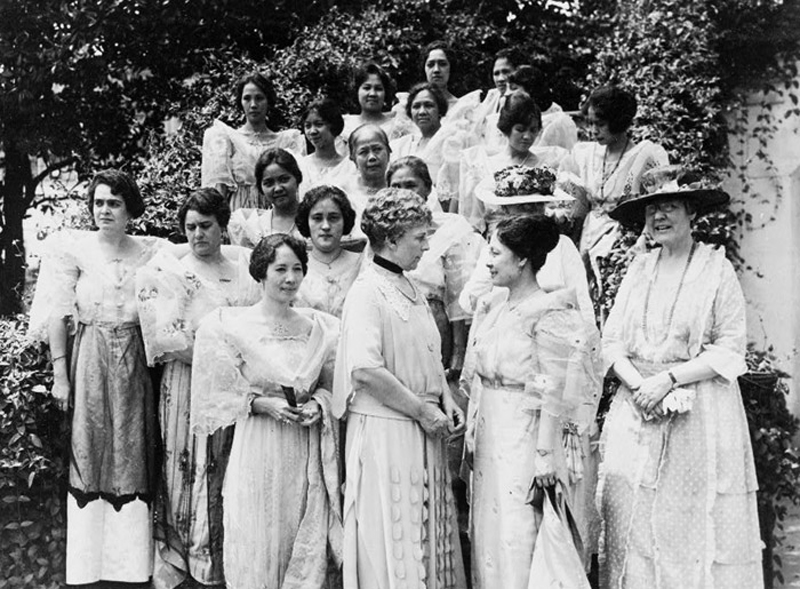
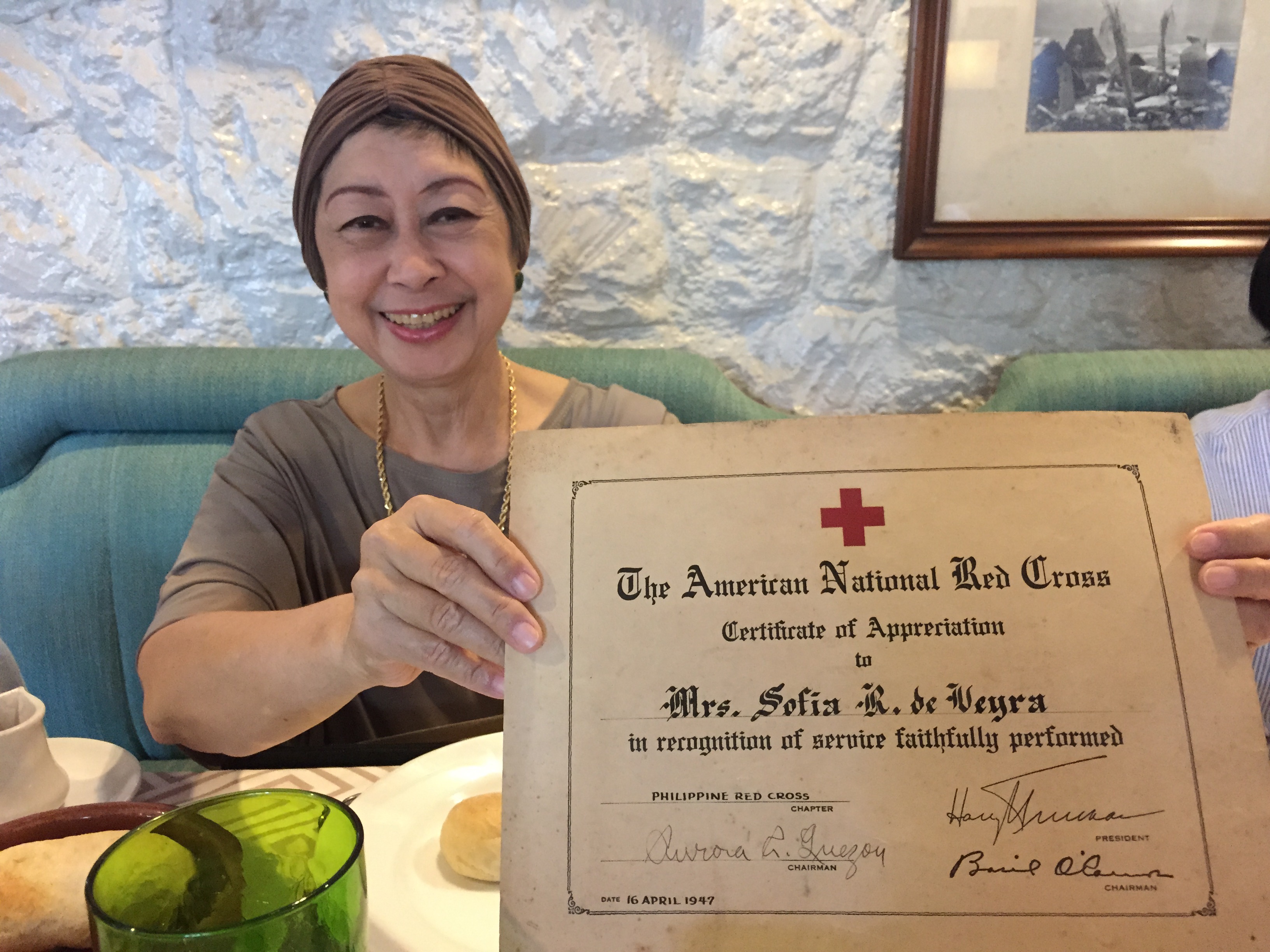
As a hopeless dabbler, hoarder, and kibitzer, I find myself irresistibly drawn to old objects and obscure information, and trade these gilded items with such fellow enthusiasts as my Washington-based friend Erwin Tiongson and his wife Titchie, who together run the Philippines on the Potomac website at popdc.wordpress.com. Erwin and Titchie were in Manila not too long ago for a vacation and a couple of lectures before the Philippine Studies Association and at the Ateneo, Erwin’s alma mater, on their most recent research into the colorful life in Washington of the remarkable Sofia de Veyra (you can read Titchie’s wonderful article on her here: http://www.positivelyfilipino.com/magazine/the-thoroughly-modern-sofia-de-veyra). My wife Beng and I had a chance to meet over lunch with the Tiongsons and with Sofia’s granddaughter Teresa “Binggay” Montilla and her aunt Rita Damian, and the look on Binggay’s face when the Tiongsons showed her pictures of her grandparents she had never seen before was priceless.

IMG_7997

Shortly afterwards, back in the US, Erwin wrote me to say that he had been able to track down an article in the May 20, 1921 issue of the Great Falls Tribune (published in Great Falls, Montana), about the protest launched by Fiipino Chinese businessmen, led by the banker Dr. Albino Z. Sycip, against a new bookkeeping law that apparently discriminated against Chinese merchants. Sycip had taken his case to the US courts, and was on his way to Washington to plead his case there. While he was in the States, on June 30, a son was born to his wife back home, a detail I recounted in a biography I wrote of the man who was that baby boy: “Albino decided to commemorate that visit by naming his new son ‘Washington.’ ‘Up to now Wash has semi-annual recurring bad dreams about what might have happened if the old man had been in Tallahassee or Vladivostok,’ the impish Alex [Wash’s brother] would write.” Erwin relayed the news item to Wash, who gratefully wrote Erwin back to say that he had never seen that article before (and another one reporting on his father’s victory in court).

More recently, Erwin and I have been exchanging clippings we’ve dig up on another outstanding Filipino, a Jesuit icon, the late Fr. Teddy Arvisu, and I’ll write up those findings one of these days (“His father wanted him to marry one of the Quezon girls,” Erwin tells me). I’d found an eloquent and impassioned speech against the rise of fascism by the young Teddy, published in a November 1940 issue of the Philippine Collegian; Teddy would become a soldier and join the Death March before achieving his dream of priesthood. At the moment, Erwin’s hot on the trail of Peyton March, the American officer who went after Gregorio del Pilar at Tirad Pass, and who lived in his last years in Washington. You better hurry, I told Erwin, as they’ll be making a “Goyong” movie soon.

Nothing of the kind of trivia that Erwin or I come across will change the big story of our past, but as avid amateurs, I’m sure we’re happy enough to help in making history more personal.

[Top image from the US Library of Congress]

Penman No. 169: I Saw Them Standing There (Almost)

Beatles

Penman for Monday, October 5, 2015

I WAS playing Texas Hold ‘Em with a bunch of younger guys a couple of weeks ago in my favorite poker joint and one of them was delivering a spirited rendition of Bruno Mars’ “Nothing on You” (yes, this old fogey knows the singer and the song)—probably to disguise a pair of Kings—and the table talk came around to our preferences in music.

“I can tell where this is going,” I thought. But then they call me “Daddy Butch” in the place—everyone above 50 is a “daddy” or a “mommy,” which is better than the monikers some other regulars sport, such as “Itlog,” “Daga,” “Paos,” and “Payat”—so my age wasn’t the issue. The young ‘uns were really interested in knowing what kind of music my generation listened to, so after everyone else had spoken in praise of pop, hip-hop, grunge, and metal, I yielded the one and only answer any soul born in 1954 can truthfully produce: “The Beatles.”

Some nodded, smiling, and then our dealer—a sweet girl in her mid- to late 20s—shuffled the cards and said, “Were they really big?”

I have to say, I almost lost it at that point.

I pride myself at the table on my poker face, a point my adversaries readily concede—“You can never tell what hand Daddy Butch is holding!”, I’d often hear. But that fearsome inscrutability more likely comes from the fact that, at the freewheeling 10-20 cash game, I’ll bet on anything from a pocket pair of Jacks to a 7-deuce off-suit. In others words, I’m what they call a “loose and aggressive player,” possibly mad, possibly idiotic, possibly serious. I lose a lot of money playing this way (I behave much better in tournaments) but it’s worth the sight of my tablemates guessing and squirming.

But again, I almost lost that carefully crafted coolness when I heard (with better emphasis) “Were THE BEATLES really big???” It was worse, to me, than those schoolkids who asked why Mabini was chairbound throughout that whole “Heneral Luna” movie. I felt a vile sourness welling up from my gut and bubbling out of my ears and nostrils. You might forget the Philippine Revolution of 1896 and I won’t even bother you with trivia like the Tydings-McDuffie Act and the Military Bases Agreement, but THE BEATLES????? (Let’s add a couple more question marks for real emphasis.)

I was too apoplectic to answer, but eventually someone on my left, a forty-something fellow who just might have been old enough to be rocked to sleep to the strains of “Ob-la-di, Ob-la-da,” said “Yes, they were big.”

“Bigger than Nirvana?” someone else chimed in.

“Yes, bigger than Nirvana.”

“Bigger than One Direction?”

“Yes, bigger than One Direction.”

“Bigger than Michael Jackson?”

“Well, maybe MJ came closest to the Beatles in popularity.”

“Actually, they even claimed to be more popular than Jesus Christ,” I finally said, “and depending on the number of Muslims and Buddhists in the world at that time, it just might have been true.”

“Really, they said that? When?

“In 1966—just before they came to the Philippines.”

“They CAME to the Philippines?”

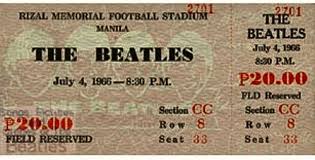
“Sure—they had a big concert here on July 4, 1966—and I ALMOST saw them!” The bile had snuck down my throat now, and I was feeling much better, given a rapt audience for one of my favorite stories.

With full relish, I recounted how the Fab Four flew into Manila, were met by screaming, fishnet-stockinged girls, offended Bongbong Marcos, and were practically chased out of the old MIA by Liberace fans who clearly believed that—at least in the Philippines—the Beatles couldn’t possibly be bigger than the Marcoses.

Somewhere in there I interjected the story of how my mother had promised a 12-year-old named Butch that they were going to see the Beatles at the Rizal Coliseum. The indulgent mother and her eager son get as far as Quiapo Boulevard from their humble abode in Pasig, whereupon she sees a new moviehouse trumpeting the wonders of Cinerama. “Let’s watch this movie instead!” the lady says, and the boy’s once-in-a-lifetime chance of seeing John, Paul, George, and Ringo standing on the stage—albeit from 1,674 feet away in the bleachers—vanish into the gutter. That afternoon, as luckier fans swoon to “Please, Please Me” and “I Wanna Hold Your Hand,” tank fire and bazookas echo in the boy’s ears, all throughout the two hours of “The Battle of the Bulge.”

My poker playmates look at me with wide-eyed wonder—I try to read their faces, like a a poker player ought to be be able to do—but I can’t tell if they can’t believe that I’m that old, or if they’re just awed to be sitting at the same table with someone who actually breathed the same jeepney-flavored air in the same politician-infested city as the lads from Liverpool.

They got nothing on you, Beatles!

Picture-'Britain's Finest' Beatles tribute band

AND IF these memories make you feel like suiting up in your collarless jackets and zippered boots and swaying to “Eight Days a Week,” you’ll get a chance to relive the Beatles experience when one of Britain’s finest Beatles tribute bands—called, well, Britain’s Finest—come to Manila for a concert on October 14, Wednesday, at the tent of the Midas Hotel and Casino on Roxas Boulevard in Pasay City.

You can get your tickets (P3,800 for the VIP and P2,800 for the gold section at all SM Tickets (470-222) and TicketWorld (891-9999) outlets or via www.ticketworld.com.ph.

I’m planning to go, but I think I’ll leave my mom at home this time.

Penman No. 168: A Lesson in Poetry

Penman for Monday, September 28, 2015

WE’VE BEEN talking about poetry in my Literature and Society class this past month, and it’s been an interesting journey, taking us everywhere from the Japanese haiku master Issa Kobayashi to the American modernist e. e. cummings and the Filipino early feminist Angela Manalang Gloria, with a bit of Sylvia Plath and Ricky de Ungria thrown in. There are many more important poets we could have taken up—in another class I might have discussed TS Eliot, Jose Garcia Villa, Denise Levertov, Edith Tiempo, and Pablo Neruda, among others—but this course is just a peek into poetry for non-Literature majors, so we’re taking examples that are sufficiently challenging and instructive but also fairly accessible, pieces that speak to common experience wherever in the world the poem may come from.

A few meetings ago we took up one of my personal favorites, a poem titled “The Blessing” (originally “A Blessing”) written by the late American poet James Wright in 1963. It’s not a very long poem, and pretty easy to visualize. As it opens, the persona (what we call the speaker in the poem, the “I”) is traveling on the road with a companion, bound for a city in Minnesota.

The mood is set with the descriptive line “Twilight bounds softly forth on the grass.” Two ponies emerge from the woods and greet the visitors. “They ripple tensely, they can hardly contain their happiness / That we have come. / They bow shyly as wet swans.” The persona feels a strong and strange attraction between himself and one of the ponies. “I would like to hold the slenderer one in my arms, / For she has walked over to me / And nuzzled my left hand.” The contact is electric, and the poem ends with the persona achieving a kind of apotheosis (a word I don’t use in class—let’s just say a climactic moment): “Suddenly I realize / That if I stepped out of my body I would break / Into blossom.”

It’s a lovely poem because of its consistency of tone and of its return to a Romanticism that seemed lost in an age of machines and pragmatism. (By Romanticism with the big R, we mean here an embrace of Nature as the source of all good things, and of the imagination over reason as the way to wisdom.) Indeed there’s a poignant optimism if not innocence in the poem that’s about to be shattered; in 1963, America stood on the verge of the Kennedy assassination and the escalation of the Vietnam War; the civil rights movement was rising to a crescendo. A darkening of the national mood—eventually affecting us half the world away—was imminent, if not inevitable.

That’s what I guide my students toward in the poem. It’s good to appreciate that glorious burst of ecstasy in the end, when the persona feels so in communion with Nature that he sees himself as a flower, but a couple of references earlier in the poem hint at another world—the “highway to Rochester, Minnesota” in the first line, and the “barbed wire” that the persona steps over to meet the ponies. Whatever “Rochester, Minnesota” might be (I’ve been to Minnesota but never to Rochester), it’s a city at the end of a long cross-country journey.

It’s the persona’s and his companion’s real destination, and the roadside encounter with the horses—as pleasant and as ennobling as it it—is just a stop. When the magical moment fades, the travelers will have to hit the road again, and lose themselves in the maw of the city.

At this point I pause to introduce a big word to my students, one of the few they’ll learn from me over the semester (as a rule, I hate big, showy words, and urge my students to do as much as they can with short, simple ones, but sometimes there’s nothing like a polysyllabic monster to wake people up). In this case, my word for the day was “prelapsarian,” referring to “the human state or time before the Fall,” in Christian belief.

The Christianity’s beside the point (we’re in UP, after all), but what’s important is the idea of a place of innocence we sometimes find ourselves wishing to go back to, especially when we feel overcome by the grime and the corruption of the modern world. We talk about the relationship (“dichotomy” would be another big word) between city and country, between a place we associate with sin and guile, and one we like to imagine as a refuge, a haven of peace and purity.

We then spend a bit of time on the image of the fence, which separates the road from the pasture. What are fences for, I ask? They keep some things out, and some things in, they’ll say. If Nature is as benign as the poem suggests, shouldn’t we knock all fences down? Let’s not be naïve, someone will say—not everything in Nature is so kind, and neither are many humans; we need to protect ourselves from each other. I bring in a quote from Robert Frost’s “Mending Wall”: “Good fences make good neighbors.” Do they, really?

We talk about the Pinoy penchant for building tall walls, topped by bubog and barbed wire, to ward off the presumptive manunungkit. Whatever happened to neighborly trust? We’re laughing, but when we go back to James Wright’s poem, everyone now understands why he gave it the title he did. Class is over, and we all step out to another late afrernoon in Diliman, finding our way home beneath the acacias and the bamboo.

PS / I don’t bring this up in class, because I don’t want “what really happened” muddling up anyone’s interpretation, but it’s interesting from a writing point of view to read what the poet Robert Bly noted down about a trip he took with his friend James (from the book James Wright: A Profile, quoted in english.illinois.edu):

“One day James and I were driving back to Minneapolis from a visit with Christina and Bill Duffy at their farm in Pine Island, Minnesota. Christina loved horses, had been a rider in Sweden, and continued to keep horses here. So horses were very much on both our minds. Just south of Rochester [Minnesota], James saw two ponies off to the left and said, “Let’s stop.” So we did, and climbed over the fence toward them. We stayed only a few minutes, but they glowed in the dusk, and we could see it. On the way to Minneapolis James wrote in his small spiral notebook the poem he later called ‘A Blessing.’”

[Image from mcleodcreek.farm.com]

Penman No. 167: The Real Value of Remembering

Penman for Monday, September 21, 2015

TODAY MARKS the 43rd anniversary of martial law, a time many Filipinos have forgotten or would rather forget. Those of us who went through it sound like a broken record when we say that—with the usual addendum that young people today have no idea what martial law means—and the phonograph gets creakier every year, the echoes fainter. It annoys us when no one else seems to make a big deal of the most centrally formative period of our sixty-something years, but it takes just a little math to realize, “Why should they?”

Forty-three years is longer than the interlude between the two World Wars, and longer even than the time between World War II and Vietnam. In the meanwhile, the world went through computers, VCRs, the collapse of the Soviet Union, cellphones, the Internet, and 9-11. Here at home, we went through EDSAs of various kinds, Pinatubo, Maguindanao, Yolanda, and Mamasapano. That’s an awfully long time, filled with mindboggling diversions and distractions, to keep your mind fixed on a scratchy black-and-white TV image of a man in a barong casting some strange voodoo hex on the the nation.

Thus I’m hardly surprised when my 19-year-old students admit to a blithe ignorance of Marcosian times. You can’t call it amnesia, because they had no memory to begin with; even the fervent clamors of today’s young activists draw on borrowed memory (but then again, isn’t that what history is, a sense-making narrative woven out of someone else’s recollections?).

I’m not a historian, but I try to do what I can to make the past come alive for my students in my Literature and Society class—not even to educate them on the nuances of specific events such as the declaration of martial law, but simply to make them aware of a life beyond the present, beyond themselves. An interest in the past can’t be forced; sometimes the best thing we can do is to open a small window on it, and then to enlarge that opening so they can see the bigger picture, and share in the excitement and the novelty of looking backward rather than forward.

Every now and then, when the urge grabs me and there’s an excuse to do so, I bring some odds and ends from my inestimably deep trove of vintage junk to class, as tinder for discussion. A 1923 Corona typewriter leads to a chat about the technology of writing, and how technology affects writing (Eliot and his typewriter, Hemingway and his pencil, computers and revision); a 1922 issue of the Philippine Collegian shows how little has changed (“Look, UP was asking for a permanent endowment even then!”); an 1830 grammar book, perhaps the oldest manmade thing these kids have ever held (yes, I pass the book around for them to get a feel of old paper), offers proof of the near-immutability of grammar (“It’s like glacial ice,” I say. “It moves, but you can’t see it.”)

A young person’s starting point very often is, “What does this have to do with me?” I try to answer that two ways: (1) “Why does it have to have anything to do with you?” Part of growing up is learning and accepting that the world isn’t your nursemaid, that it could and will often be totally indifferent to you and your little plaints. But also (2) in a gentler mood and whenever possible, we connect the dots between, say, the god Achilles and his choice of a short but glorious life and, yes, the martial-law activist who didn’t expect to live beyond 25.

Last week, I urged my class (note “urged”—I keep absolute requirements to a minimum) to watch the movie Heneral Luna—to my mind, easily one of the most significant Filipino movies of recent years. Beng and I had seen it the night before; the theater was three-quarters full, and when the movie ended, the audience applauded, the two of us included. The movie reminded me of how many gaps remained in my own appreciation of our past; if I, a full professor at UP and a self-styled history buff, didn’t know the full story of Antonio Luna, how could I expect my charges to know anything about martial law?

That leads me to think that it won’t be the textbooks or balding professors like me who will make our youth wonder about what else they missed, but the movies—or, more broadly, literature and its power to make dramatic sense of events, its humanization of history. More than four decades after the fact, not enough novels have been written and not enough movies have been made of the martial law period (Lualhati Bautista’s Dekada ‘70 being the standout in both print and film). Indeed, a definitive and comprehensive history of that time—and an independent one that kowtows neither to Marcos nor to Mao—has yet to be put together, although specific aspects of martial law (legal, economic, political, and personal) have been ventilated in various books and forums.

The real value of remembering martial law or some such national calamity, I’ll hazard, isn’t just in mouthing the oft-repeated “Never again!” I seriously doubt that even those who never experienced it will accept its repetition. Rather, it’s in looking back 43 years to take stock of what we’ve become since, as individuals and as a people—in memoir writing, we call this the difference between the remembered self and the remembering self. The very fact that they’re not the same thing should tell us something. It’s easy to say “No” to martial law ca. 1972, but what exactly will we be saying “Yes” to come 2016? The past keeps getting dimmer, but then again, some days, so does the future.

Penman No. 166: Ernest Meets Nestor

NVMEH

Penman for Monday, September 14, 2015

A COUPLE of months ago, I wrote a piece here about the Nobel prizewinning novelist Ernest Hemingway’s brief visit to Manila in February 1941. When my friend Dr. Erwin Tiongson read that, he sent me more materials about that brief encounter between the literary titan and his local readers, including a reference to a second visit by Hemingway on May 6, presumably on his way back to the US.

(Now based in Washington, DC and a professor of economics at Georgetown, Erwin was recently in Manila himself with his journalist wife Titchie for a vacation and a series of presentations about their fascinating project of historical sleuthing, which you can find online at https://popdc.wordpress.com. I’ll be writing more next time about the Tiongsons and their meeting with Teresa “Binggay” Montilla, the granddaughter of Philippine Commissioner to Washington Jaime C. de Veyra and his remarkable wife Sofia, about whom the Tiongsons unearthed a trove of interesting historical material.)

Meanwhile, I’d like to share a bit of what Erwin sent me, taken from the American Chamber of Commerce Journal of June 1941, unbylined but attributed to the journal’s publisher and editor, Walter Robb. It’s an account of Hemingway as a man and a regular guy—41 years old, 225 pounds, black-haired and black-eyed, whose Spanish “runs along like a garrulous brook… words never fail him, nor picturesque phrases. He likes singing Basque folk songs and he and the Basques seeing him off on the clipper sang them all the way from the Manila Hotel to Cavite….”

Farther down that article, the reporter notes that “It’s easy to get Hemingway’s autograph, just ask for it and have a pen handy…. He autographed many copies of his book while he was in town. The book has been pirated at Shanghai, of course; when one of these spurious copies, no royalty to Hemingway, came along for autographing, Hemingway grinned and autographed it. He likes to use a standard typewriter in his work, which he does of mornings, but For Whom the Bell Tolls was not written that way: it was written in longhand. Hemingway uses a heavy stub fountain pen and this longhand of his, as bold as sword strokes, but honestly legible and well-spelled, flows across the paper as straight as a line.”

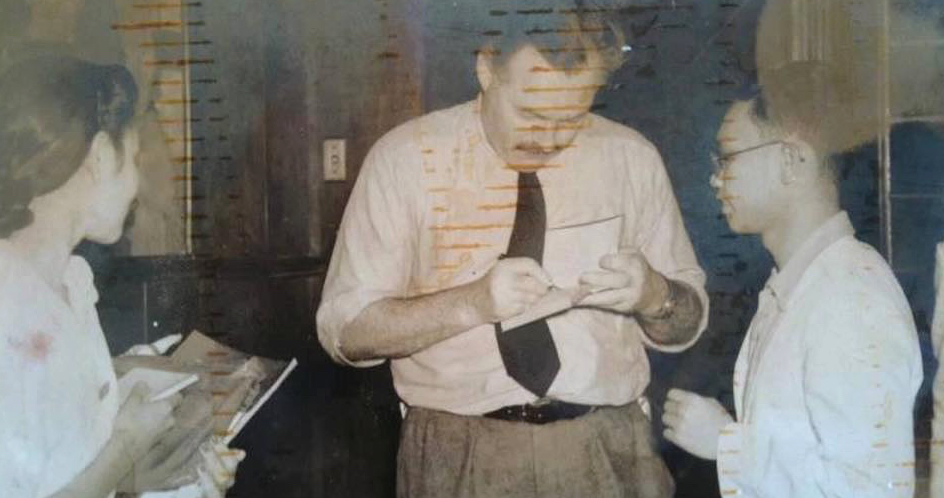
I was, of course, attracted to that passage because it particularly mentioned Hemingway’s pen, which I would have dearly loved to see; but also, it talked about Hemingway signing books, which reminded me of a photograph I adverted to in my earlier column, showing Hemingway signing a book for a young Filipino writer named Nestor Vicente Madali Gonzalez, who in early 1941 would have been no more than 25 years old. I’d seen that picture in NVM’s house in UP when he was alive, and had worried that it might have been lost when the house burned down. But after my piece came out, I was happy to hear from NVM’s youngest daughter Lakshmi that she had posted a copy of it on her Facebook page, and I hope she doesn’t mind if I repost it here—Ernest meets Nestor, you might say.

Speaking of NVM Gonzalez, the literary community marked the centenary of his birth last Tuesday, September 8, in an evening of tributes at the Executive House at the University of the Philippines in Diliman organized by Prof. Adelaida Lucero. NVM, of course, taught with UP—among many other universities here and in the United States—for many years despite the fact that he never completed his bachelor’s degree. As director of the UP Institute of Creative Writing, I was asked to say a few words at the testimonial dinner, which was attended by NVM’s widow Narita, and here’s a reconstruction of the remarks I made:

“NVM and I were born only 60 kilometers away from each other in Romblon—he on Romblon Island and I on neighboring Tablas—but also almost 40 years apart, and I never had the good fortune of being his student in UP. It’s actually my wife Beng who’s been closer to the Gonzalezes, having been Narita’s student at UP Elementary. But I had the chance to meet NVM and to enjoy his company when he returned to UP in the 1990s as International Writer-in-Residence under the auspices of what was then the UP Creative Writing Center. I had the honor of drafting his nomination as National Artist, signed by then Dean Josefina Agravante.

“Franz Arcellana was my teacher, and Bienvenido Santos and Greg Brillantes were my literary models; but it was NVM who hung out with us, whom we had fun with in our workshops in Baguio and Davao. And as advanced as he was in years, he was forward-looking and eager to learn. I remember running into him once in what was then the SM North Cyberzone, and I asked him what he was doing there. ‘I’m looking for a book on multimedia!’ he told me with that twinkle in his eyes.

“We didn’t always agree, but the one thing I can say about NVM is that he never threw his weight around, never pulled rank on us his younger associates, never thundered about how much older or more accomplished he was to suggest why he was right and we were wrong, despite his obvious seniority in age, experience, and wisdom. We appreciated that. That’s why, in the foreword to a book of essays by his friends that I edited after his death in 1999, I said that some writers are respected and admired, and others are loved. NVM was both.”

The celebration of NVM’s centenary won’t stop with that dinner—which also saw the launch, by the way, of new books on NVM: his poems, edited by Gemino Abad, and a Filipino translation of Seven Hills Away by Edgardo Maranan, published by the UP Press and the Komisyon sa Wikang Filipino, respectively. At the end of this month, the UP Department of English and Comparative Literature will hold an exhibit of photographs of and works by him. His son Myke, based in the US, is organizing a fiction-writing workshop in January, the first half to take place in Diliman and the other in Mindoro, and the UPICW will be helping Myke out with that project.

It never ceases to amaze me how a web of words (make that a Worldwide Web, these days) can bring people together across the miles and years.

[Photo courtesy of Lakshmi Gonzalez-Yokoyama]

Penman No. 165: Going for the Bestseller

IMG_8046

Penman for Monday, September 7, 2015

AUGUST AND SEPTEMBER are usually busy months in the cultural calendar, and this year’s been no exception. UMPIL—the Writers Union of the Philippines—held its annual conference toward the end of August, with the economist and columnist Solita “Winnie” Monsod delivering the customary Adrian Cristobal Lecture. On September 1st—perhaps the most important date on many a young Filipino writer’s calendar—the 65th Carlos Palanca Memorial Awards for Literature were given out, with poetry titan Gemino “Jimmy” Abad arguing eloquently for the power of literary language to create its own reality.

In that same week, National Book Store, among other sponsors, put on the Philippine Literary Festival at the Raffles Hotel in Makati, headlined by visiting authors Matthew Quick and Meg Wolitzer. I went on a panel at that festival with my friends Krip Yuson and Jing Hidalgo, with Marivi Soliven as moderator, to talk about writing the novel. I was surprised to walk into a packed room at the Raffles, despite the fact that Meg Wolitzer was holding forth in another session at the same time.

Now, I’ll admit that I’d never read Meg before, although I’d read about her recent novel Belzhar. She was advertised as a bestselling author, as was Matthew Quick, who wrote The Silver Linings Playbook.

I overheard a mild complaint in the hallway to the effect that the NBDB should have invited the powerhouse cast of Pulitzer prizewinners that Manila festivalgoers have been used to seeing (I remember hosting a chat with the wonderfully encouraging Junot Diaz a few years ago). I didn’t have the time to stop and respond to that comment, but I would’ve said, ”Hey, no problem! There’s a lot we can learn about producing bestsellers! And bestsellers can and should be well-written, too!”

Indeed, in our panel on the novel, one of the recurrent themes that came up was that we Filipinos don’t write enough novels (“We’re world-class sprinters,” I noted, “but not marathoners”), at a time when the only thing international publishers are looking for are novels, which can lead to fat Hollywood contracts and all kinds of other spin-offs.

Toward the end of that discussion, in the Q&A, a young lady in the audience asked about what we (presumably the literary Establishment, going by our senior-citizen cards) thought of newer and less traditional routes to literary fame like Wattpad. Thankfully, I’d heard of Wattpad, and had even actually registered on the site a few months earlier out of curiosity, so I could peek into what was going on there. I knew that Wattpad was generating stories that were already being adapted into commercial movies, so it was more than another digital pastime. (For my fellow 60-somethings, Wattpad’s a website where people—usually very young people—upload stories of all kinds, typically love stories, vampire stories, science fiction, and fantasy.)

I told the questioner that while it was likely that much of the material on Wattpad wouldn’t come up to conventional literary standards, I didn’t see that as a problem. What was important was that—at some level and with little or no intervention from their elders—young people were writing and reading, and that can’t ever be a bad thing. Tastes mature and change, and even within those young-adult genres, truly good work is bound to emerge and be recognized and rewarded. And even mainstream literature itself would ultimately benefit from the spillover; as Shakespeare put it, “When the tide comes in, all the ships in the harbor rise.”

But beyond supporting what younger writers were doing, I brought up another pet theme of mine, which is that we older writers write way too serious (if not sometimes inaccessible) stuff, and have thereby separated ourselves from our potential readers. Creative writing has become way too academicized—produced in, for, and by formal writing programs, with little regard for what ordinary readers are really concerned about in their daily lives. In other words, while we seek to develop our readership, or work on the demand side, we should also work on the supply side by writing material of more popular appeal, with little or no reduction in quality.

This train of conversation ran on a couple of nights later at the Palancas, where I had a chance to chat at the sidelines with Graphic fiction editor Alma Anonas-Carpio and essayist Ferdie Pisigan-Jarin. (I don’t smoke—and I would urge everyone not to—but I happen to find people who smoke usually more interesting to chat with than those who don’t, so I usually join the smokers out on the patio of the Rigodon Ballroom at these Palanca dinners, especially when the program—with my apologies to the gracious hosts and the contest winners—goes on for too long.)

I told Ferdie that I suspected that, outside of school, young readers these days didn’t really care much about author’s reputations, or about what critics or other old people say about a work. Ferdie agreed. “We undertook a survey,” he said, “and we found out that what makes young readers decide to buy a book is what they can get of the story from the back cover. They can’t even leaf through the pages, because most books these days are shrink-wrapped.”

From Alma came the astounding news that one young Filipino writer, Marian Tee, was making a regular six-figure income from the Amazon sales of her e-book novels. Though based here, Marian writes dreamy romantic comedies set in places like Greece, with titles like The Werewolf Prince and How Not to Be Seduced by Billionaires, and with covers displaying a surfeit of naked male muscle. The female protagonist may be blond, swears Alma, but she’s really Sarah Geronimo in disguise.

I’m not saying that we should all write like Marian, because we probably couldn’t even if we wanted to. But it’s good to know that there’s someone among us who knows the market and can play the global game, because there’s a lot we can learn from her—in adaptability, in audacity, in humility, and in plain hard work.

I don’t think that literature as a fine art will ever be threatened (any more than it already is); there will always be authors who won’t mind being read by a precious few, and thankfully so, because these are the writers who will keep pushing the envelope of language and exploring uncommon sensibilities. For most other writers, or most other times, it’s worth keeping in mind that “bestseller” isn’t necessarily a bad word.