Unknown's avatar

About penmanila

A Filipino collector of old fountain pens, disused PowerBooks, '50s Hamiltons, poker bad beats, and desktop lint.

Penman No. 125: A Date with the Doctrina

1024x1024-1510204Penman for Monday, December 1, 2014


NO VISIT to Washington, DC would be complete without looking into the Library of Congress, which stands behind the US Capitol, perhaps in a symbolic juxtaposition of knowledge and power. The library was, in fact, originally lodged with the Congress, but had to be rebuilt when British troops sacked and burned the Capitol in 1814, starting with the wholesale purchase of Thomas Jefferson’s personal collection of almost 7,000 books for about $24,000.

The LOC has come a long way since then; Jefferson’s volumes are still on display, but they have been joined by 36 million more books, not to mention more than 120 million more non-book items such as photographs, manuscripts, recordings, and sheet music. It’s easily the world’s largest library, adding some 12,000 new items to its roster every day, largely because of the copyright registration process. According to the LOC, half of its collections are in languages other than English—about 480 languages all in all, including nearly 3 million items from Asia.

A simple search of the LOC collections shows that there are more than 40,000 items here related to the Philippines (including, should you want to hear it, a recording of William Howard Taft talking about the Philippines shortly before he became President in 1909). The LOC has early editions of Jose Rizal’s Noli and Fili, which, along with other important Rizaliana, were put on special display at the Asian Reading Room in 2011 to commemorate Rizal’s 150th birth anniversary.

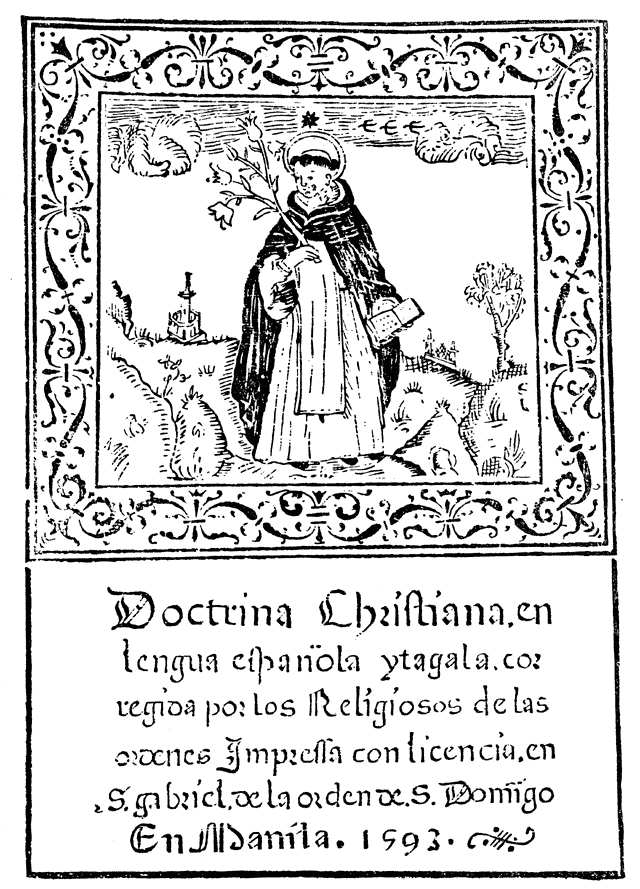
Last week, thanks to the combined efforts of the Filipino-American community in Washington and former LOC librarian and Fil-Am activist Reme Grefalda, I had the once-in-a-lifetime opportunity to see the crown jewel of the LOC’s Philippine holdings—the only known copy in the world of the 1593 Doctrina Christiana, the first book published in the Philippines.

The Doctrina is essentially a catechism, a collection of common prayers, including the Lord’s Prayer and the Hail Mary. Being basic prayer books, there had been other Doctrinas published earlier in other countries. The Philippine version was put together by Fray Juan de Plasencia, a Franciscan friar who helped found many Philippine towns, including Antipolo, Lucban, Meycauayan, and Tayabas. In 1585 he wrote King Philip II of Spain that he had already written several religious and scholarly books that could help spread the faith in the islands—including the Doctrina and studies of the Tagalog language—and asked for royal assistance in funding their publication.

But the good friar died in 1585, and it wouldn’t be until some years later, in 1593, when we see Governor General Gomez Perez Dasmariñas writing the King to present him with copies of the Doctrina in two versions—Tagalog and Chinese—and to explain that he had granted a license for the printing of these books (under Dominican auspices) because of their great value to the evangelization effort. And then, so the story goes, all copies of the Doctrina vanish, until the Tagalog one reappears—presumably the royal copy—in Paris in 1946, where it’s bought by an American dealer, who then resells it along with many other books in a lot to the American book collector and onetime Sears Roebuck chairman Lessing J. Rosenwald (1891-1979), who then bequeaths his collection, including the Doctrina, to the Library of Congress upon his death.
IMG_6183

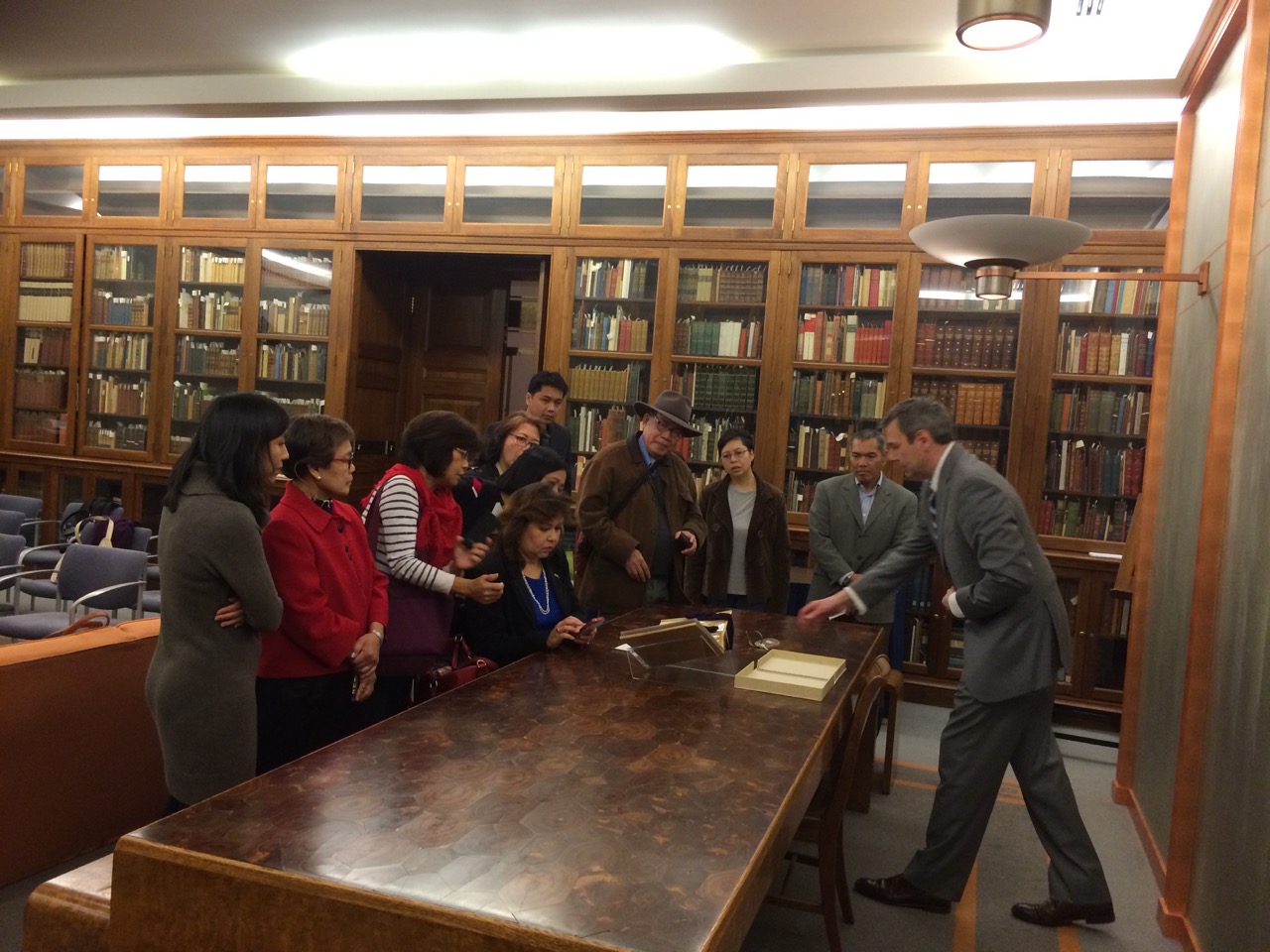
So the LOC’s copy, as far as we know, is the only one of its kind, and it was with great anticipation that Beng and I joined a group of ten Filipino and Filipino-American scholars and advocates who were kindly admitted by the LOC’s Rare Books Division to a private viewing of the Doctrina, with LOC librarian Eric Frazier doing the honors. (While waiting for our appointment, we had taken in a few of the LOC’s other prime offerings including the Gutenberg Bible, which is on permanent display near the stupendous main lobby that welcomes visitors, and the Magna Carta, on loan from the Lincoln Cathedral.)

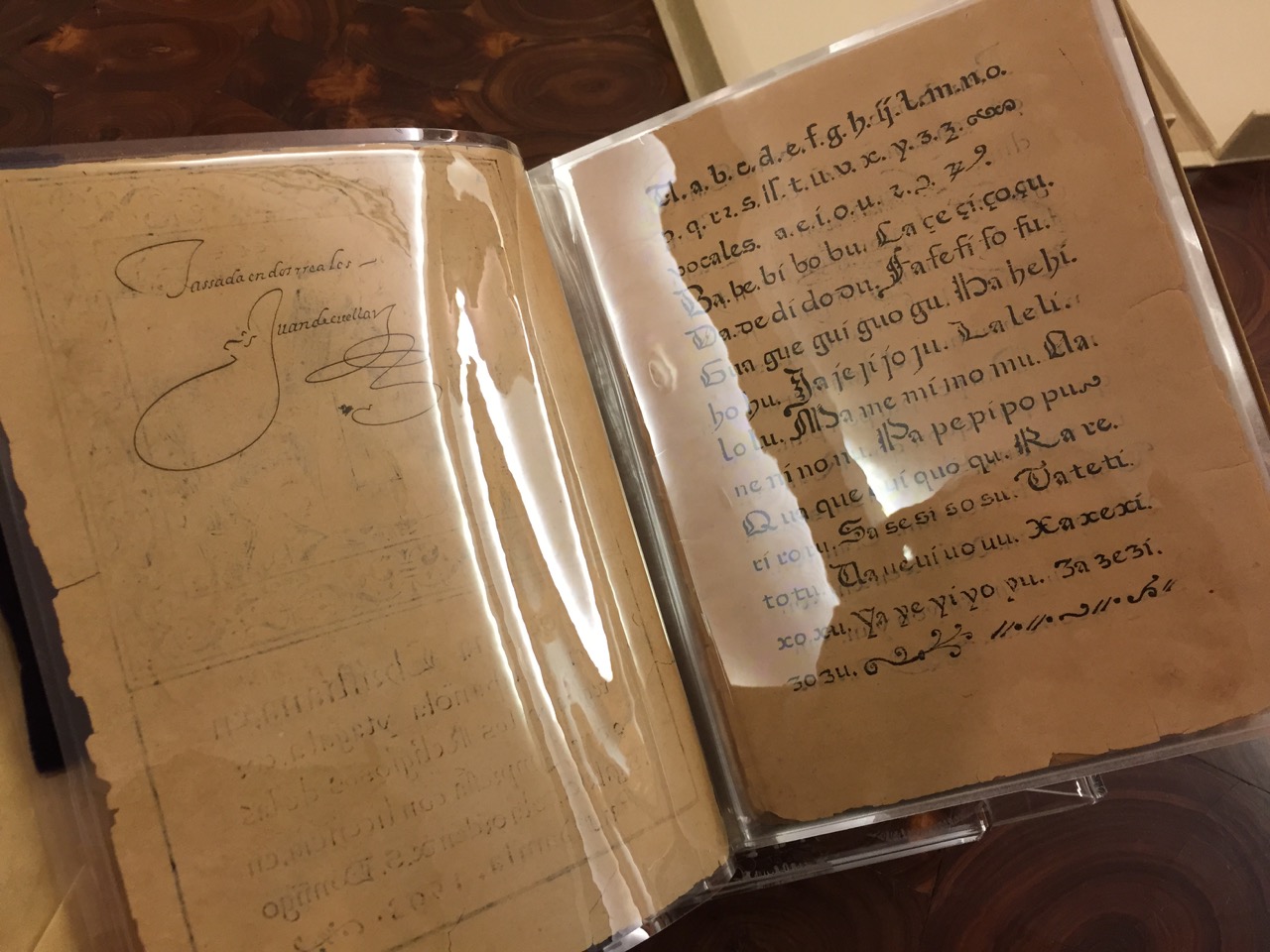
I should’ve read up more on the Doctrina before we went up there, but I was surprised by two things I realized only when I saw the book up close: its relatively small size, and the fragility of its paper. It’s only about 9 by 7 inches, not much bigger than a contemporary textbook. It was a further surprise to hear Eric say that “As far as I know, among the millions of books we have at the LOC, this is the only one whose every page is sheathed in Mylar.”
IMG_6150

I had asked Eric about the condition of the book and the paper, having seen and even handled other books from the 1600s (many of which, printed on stout, crisp linen paper, look good as new, and have survived in much better shape than the acid-lined paper of the 1800s and 1900s). The Doctrina, as it turns out, was printed xylographically—like a woodblock with the letters carved out—on mulberry paper (other sources say rice paper, although that term may have covered other papers made from mashed material). I’m not a professional historian, so I stand to be corrected on these presumptive facts by people who know vastly more about the Doctrina Christiana and about the history of books than I do (two immediately come to mind, our foremost book historians: Dr. Von Totanes and Dr. May Jurilla).

It was with the greatest of care and respect that we flipped those pages, and we saw what generations of the faithful must have seen (that is, if they saw the book at all): a syllabary, followed by prayers and other articles of faith, presented in Spanish, Tagalog, and baybayin, that pre-Hispanic script that survives in our consciousness only in the Katipunan “ka.” What’s remarkable is how fundamentally familiar the text of the prayers is: “Aba guinoo Maria matoua cana, napopono ca nang gracia. ang panginoon dios, ce, nasayyo. Bucor cang pinagpala sa babaying lahat….”

And so it went, a cry of praise and supplication across the ages, come to life again at our trembling fingertips.

I can only hope that, perhaps through an arrangement with a responsible Philippine institution, the Doctrina can be brought back to the Philippines for a special exhibition (the forthcoming Papal visit would have been the perfect occasion), or at least that more Filipinos in the US could see it, along with the other Philippine holdings at the LOC. It does take time and effort to arrange for a viewing, but in the meanwhile, the full digital copy of the book, provided by the LOC, can be found here: http://tinyurl.com/knpzkn5. For more information on the Doctrina Christiana and this particular copy, see the notes of Project Gutenberg editor Edwin Wolf at http://tinyurl.com/p6uqlvr.
Penman No. 124: Pinoys on the Potomac

cropped-logo-rizal-washington8Penman for Monday, Nov. 24, 2014


ERWIN TIONGSON and his wife Titchie are in their early 40s, successful professionals and the parents of young sons; they live in Fairfax, Virginia, a pleasantly wooded suburb just outside of Washington, DC. An Atenean from Nueva Vizcaya, Erwin teaches Econometrics at Georgetown University, while Titchie, a prizewinning writer, has chosen to stay at home to look after the children. Outwardly they might seem to be just another Filipino couple living the good American life, steadfastly focused on the present and the future. But their true passion inclines elsewhere, as Beng and I would discover in one of the most fascinating encounters we’ve had in our current American sojourn.

I’d first heard about Erwin from another new Fil-Am friend, Sonny Busa, a retired Marine, a former consul and instructor in international relations at West Point. (Sonny, in turn, had been introduced to me by upstate-NewYork-based Sharon Delmendo, who has done a lot of research on Philippine-American relations—so now you see how the academic circuit works.) Sonny had mentioned to me that there was a Filipino in the community who had taken it upon himself to chronicle the history of the Philippine presence in Washington and the surrounding area—more than a century of visits and residencies by Filipino politicians, diplomats, writers, artists, musicians, and other personages whose life and work, in one way or another, drew them to the American capital.

That’s how I found the website that contained all this information—a WordPress site titled “Philippines on the Potomac: Filipino-American Stories in Washington, D.C.” (https://popdc.wordpress.com). If you’ll take a minute to click on that link, you’ll discover what I did, with a child’s wonderment at the entrance of a carnival: short articles and accompanying photographs tracing the connections between Filipinos and Washington, DC.

As might be expected, the big political figures, especially those from the Commonwealth and postwar period, dominate the reportage: Manuel L. Quezon, Carlos P. Romulo, Sergio Osmeña, Manuel Roxas, and Jose Abad Santos. But cultural luminaries are also well represented: Juan Luna, Jose Garcia Villa, Juan Arellano, Enya Gonzalez, Fernando Amorsolo, and Bienvenido Santos, among others.

Quezon had served as Resident Commissioner—effectively our ambassador—in Washington until 1916, and when he went to the US on his wartime exile and died in New York in 1944, it was at the Cathedral of St. Matthew the Apostle in Washington—not too far from where our embassy now sits—where his funeral mass was held prior to his interment at Arlington (less than 20 years later, John F. Kennedy would follow the same route; MLQ’s remains were moved to the Philippines after the war, and now lie at the Quezon Memorial).

Carlos P. Romulo and his family lived in a home on Garfield Street for 16 years, CPR having served in many capacities, from aide de camp to Gen. Douglas MacArthur to Resident Commissioner, ambassador, and president of the United Nations General Assembly. (One of the website’s most remarkable images has an old sepia photograph of the Romulos superimposed exactly over the same spot in front of the present house, which has barely changed.)

The site provides a treasure trove of other historical facts—including, inevitably, tidbits of information that serious scholars might dismiss as trivia, but which enthusiasts like me can’t get enough of. The sculptor and National Artist Guillermo Tolentino, for example, once worked as a waiter in Washington, and somehow managed to meet President Woodrow Wilson and to present him with the gift of a small statue, which Wilson kept in his room until his death; Wilson later helped Tolentino get a scholarship to art school. We also learn that Juan Luna and Felipe Agoncillo went to Washington in 1899 to campaign against the Treaty of Paris, and stayed at the Arlington Hotel, where they were spied upon by the Secret Service. (All these stories are properly attributed and referenced, by the way.)

Better than just poking around the website, the Tiongsons invited us to lunch and show-and-tell, and I couldn’t wait. Learning of my current affiliation with the George Washington University, Erwin had pointed me to an article written by CPR’s granddaughter Liana relating how Romulo had coached a debating team from the University of the Philippines in an engagement with the GWU team, over this issue: “Resolved, That the Philippine Islands should be granted immediate and complete independence.” The debate took place on April 18, 1928 at GWU’s Corcoran Hall. “UP won,” said Erwin. “It was the team’s fifth victory, after defeating Stanford, California, Utah, and Colorado. The team would go on to defeat all their other opponents—a total of 14 universities, if I remember correctly.”

Tiongsons

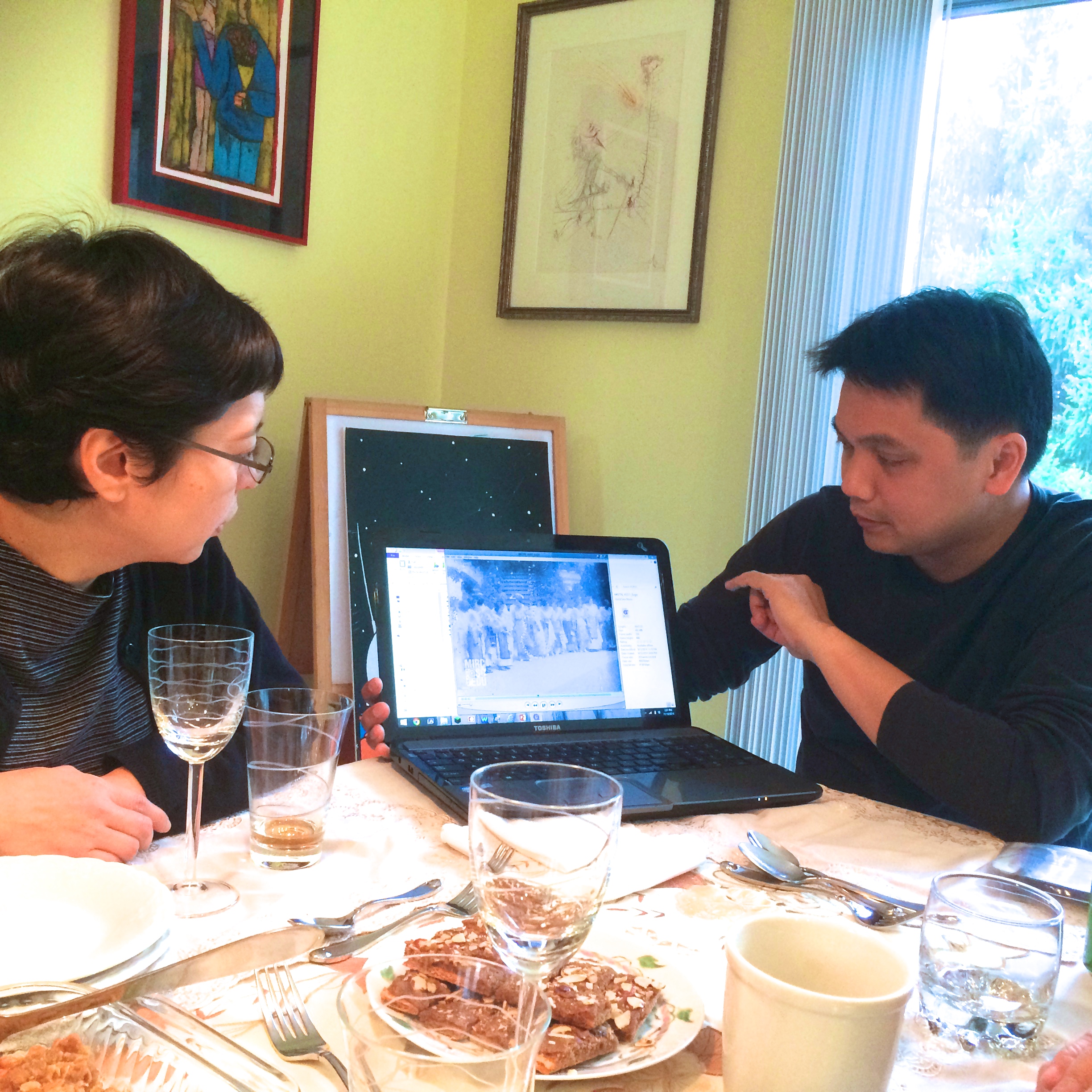
Even more interesting were the personal stories that Erwin and Titchie shared with us (after a sumptuous lunch of home-made corned beef and baked salmon, which all by itself was well worth the Sunday visit). I can’t go too deeply into the details now, but Beng and I were thrilled to share Erwin’s elation over his most recent discovery, a book that had been inscribed by Maximo Kalaw, MLQ’s private secretary, to a “Nina Thomas”—who turned out to be the American lawyer the young Quezon had been engaged to (he broke off the engagement after being advised that marrying an American was political suicide). Erwin made contact with Nina’s heirs in Virginia; she never married, but she passed on Quezon’s monogrammed walking stick and their engagement ring to her niece.

Erwin also showed us a movie poster from 1946 of Anna and the King of Siam, featuring Rex Harrison, Irene Dunne, and a little-known actress named “Chabing”—who turned out to be Isabel Rosario “Dimples” Cooper, Douglas MacArthur’s girlfriend (not mistress) between marriages; after MacArthur left her, she resumed her film career (she was notable for having recorded the first on-screen kiss in Philippine movies in 1926), assuming the single name “Chabing,” whose filmography you can look up on IMdb.

It was also a treat to listen to a radio recording of Jose Garcia Villa, made in the 1950s, of him reading his “Lyric 17” (1942) which famously begins with “First, a poem must be magical….” Most moving was the 20-minute documentary of President Quezon’s funeral—directed by no less than the renowned director John Ford—that Erwin had magically retrieved from somewhere in the many university libraries, archives, and museums that he still haunts in search of fugitive Filipiniana. He has begun a collection of war correspondence from the early 1900s and the Second World War; one 1902 letter poignantly retained a swatch of jusi, which the wife of an American official in Iloilo wanted her folks to see.

We could have stayed there the whole day, reveling in our memories of the grand old men of Philippine letters—NVM Gonzalez, Ben Santos, Nick Joaquin, Manuel Viray; I shared my own little adventures in cultural retrieval. But Beng and I had sadly had to trundle out again into the autumn chill, warmed by our imaginations, and in my ears rang a line from Viray’s poem about his old house in Washington, on Cathedral Avenue, which the Tiongsons had also located: “A streak of light aslant / On the screen door creeps up the line of dusty books.”


Penman No. 123: The Power of Panorama

Penman for Monday, November 17, 2014


I’M BY no means a professional photographer, but as a fairly frequent traveler and occasional journalist, I’ve had to take my own photographs to accompany my articles and my blog pieces. Not surprisingly, some of my pictures have been good, some bad, although I would hope that I’ve shot more of the former than the latter overall. I’ve been dabbling in photography, after all, since the 1970s, when we learned to develop and print our own black-and-white film, and were ever aware of how much film and paper cost, not to mention the SLRs and the lenses that we lugged around.

Digital photography, of course, has changed all that. I started toting a 2-megapixel Canon Ixus around 2001—costing me what a new iPhone 6 would today—and instantly I knew that there was no going back to dark rooms and smelly chemicals, at least for an amateur like me. (That Ixus, by the way, took amazingly sharp shots, one of which I still use as the wallpaper for my big iMac—proof that it isn’t all about megapixels.) Since then I’ve dealt with a train of other digital Canons, Casios, Panasonics, and Leicas, all of them rangefinders. And then, a few years ago, I switched to a Nikon DSLR, followed by the inevitable and financially excruciating lens chase that every photography enthusiast knows. Eventually I got those I really wanted—a long zoom, an ultrawide—and happily shot away in sorties to China, the US, Israel, Corregidor, Batanes, and many other places worth toting a heavy bagful of gear to.

And then the iPhone 4 came along. All of a sudden, I had a phone whose camera seemed good and sharp enough for most daily uses (night is something else). More and more, I began taking just the iPhone and leaving the bulky DSLR behind. Aside from and because of its small size, shooting with your phone’s camera has its advantages; you can shoot unobtrusively, within seconds of spotting your subject, and you won’t look like you’re begging to be mugged and to have your precious cargo carted away.

Cameraphones, conversely, have their disadvantages. They’re generally not too good for night shots, unless your subjects are brightly lit, and while the digital zoom can make your subjects bigger, the closer you get, the grainier the image becomes. In other words, for best quality and for mission-critical work, there’s really no perfect pocket substitute for the big cameras and lenses. (Other than the Nikon, my favorite standalone camera for many years was the Leica D-Lux 3, which created razor-sharp images in the 16:9 format.)

But that said, for most uses that don’t require more than a 4”x 6” printout or screen image, an iPhone’s camera will do just fine. My iPhone 5s was the only camera I brought with me on our family’s two-week jaunt across Western Europe last May, and it served us superbly in Madrid, Barcelona, San Sebastian, Venice, Florence, and Paris—all places with fabulous photographic possibilities. Sure, I missed the kind of tightly cropped detail that a telephoto lens is great for, but casual tourism is mostly about scenery, which means that wide-angle or panoramic shots are more useful.

This brings me to my topic for the week, the power of panorama. It’s a power that’s been right there in your iPhone since iOS6 (and very possibly in other smartphones as well), waiting to be unleashed. A panorama is a very wide, narrow picture that covers practically everything before you, and maybe even behind you. The built-in Camera app on the iPhone offers several options for picturetaking: time-lapse, slo-mo, video, photo, square, and pano.

We take most pictures with the “photo” option, yielding a regular rectangular frame, vertical or horizontal. If you’re happy with those pictures, fine. But you should know that, especially when you’re in a spectacular tourist spot and need or want to capture as much of that scene to bring home with you, then the “pano” or panoramic option can be your best friend.

It takes a bit of self-training, and there are many guides online to help you take a good panoramic pic (just Google “taking panoramic shots with an iPhone”). What it basically involves is choosing and standing at a good vantage point, opening the camera, choosing “pano”, pressing the button, then moving on your heels in a semi-circle from left to right, following the guide arrow until the full panorama is taken.

Your first shots will likely be misfires, full of unwanted detail, bodies with missing heads, the same person appearing in two or three different spots, very bright and then very dark bands, and so on. But over time, you’ll get the hang of it, and learn to avoid the pitfalls. For example, you’ll learn to generally avoid scenes with lots of moving figures (although the motion blur and duplication of people can also be aesthetically appealing); you’ll learn to pre-visualize the scene, deciding just how much to cover instead of the full 240-degree sweep of the app.

If you’re careful and lucky (you’ll need to be both), you can capture a scene that’s not only visually breathtaking, but also socially observant, like a Hogarth drawing with a lot of interesting detail in the little corners. That’s what I was going for in my pano shot of an afternoon in Madrid’s Plaza del Sol, where an anti-fascist rally literally marched right into the restful mood of other Madrileños in the frame. My shot of the riverfront of Cold Spring in upstate New York seeks to blend natural scenery with human habitation, and that of an early evening in Manhattan’s Bryant Park plays on light and shadow, and the city’s iconic skyline.

Don’t forget that you can and probably should crop and edit the image afterwards, to remove ragged edges up and down caused by uneven shooting (you weren’t following the arrow, tsk tsk), to go for a tighter frame, and to adjust the exposure. Consider, too, other apps like Google’s free Photo Sphere, which yields even more stunning—and seamless—360-degree pictures, for a fully immersive experience approaching virtual reality.

Whether you’re in your office or on top of the Great Wall of China, a good panoramic shot can be your best and most comprehensive reminder of where you were and what it felt like. But you’d have to remember the option. Speaking of the Great Wall, we were there a couple of Decembers ago, all by our freezing lonesome in Mutianyu. Rendered speechless by the majesty, it was only on the van back to downtown Beijing that I realized that I’d been on top of the world—and forgot to take it all in.

Penman No. 122: A Meeting in Manhattan

IMG_5861Penman for Monday, November 10, 2014


BENG AND I were in Philadelphia and New York these past two weekends, so I could do more interviews for my martial-law book project and also get in touch with a few old friends. I normally keep a very low profile and don’t tell or call people when I travel to places where friends are living, not because I’m a snob, but because I don’t want to be a bother, knowing what it’s like when somebody drops in from the blue and throws your schedule out of whack.

But there are always some friends you never mind breaking your routine for, and who never seem to mind, either, if you break theirs. And I was glad to meet up in Manhattan with two such writer-friends, the poet and essayist Luis “Luigi” Francia and the fictionist Gina Apostol, both of whom live and work in New York. Luigi teaches at Hunter College and Gina at the Fieldston School.

The first time I met Luigi, many years ago in a Malate bar on one of his visits home from New York where he has been living since 1970, I remember seeing his calling card, which described him thus beneath the name: “POET. EDITOR. PRINCE.” It seemed cheeky and chic, and I was deeply impressed, being none of the above. (I’ve since written some middling poetry and have done my share of editing chores, but remain utterly unprincely.)

IMG_5856

I had the recent pleasure of writing a blurb for Luigi’s forthcoming collection of essays titled RE: Reviews, Recollections, Reflections, to be published by the University of the Philippines Press, and this is what I said:

“Luis Francia knows New York and America better than many of the native-born, but he never loses his moorings, his critical awareness of what it means to be Filipino-American. But these essays are about far more than racial politics, as they chronicle the travails of that most blessed and in other ways most cursed of citizens—the artist, particularly the artist abroad, for whom alienation acts as a lens that magnifies and reshapes every little thing that crosses the eye. The most arresting and delightful reads are his portraits of the expatriate masters who preceded him in America—most notably Jose Garcia Villa, lover of martinis and hater of cheese. Despite the plaints, Francia has been clearly and distinctly privileged to be where he has been and to see what he has seen, and he shares that privilege with us in this well-wrought collection.”

Gina was my batchmate when I returned to finish my undergrad studies in UP in the early ‘80s; I was ten years older than everyone else, so I was kuya to all of them. It was a time when we were all dreaming of finding a way to take our graduate studies abroad—as English and writing majors, we wanted to become the next Gabriel Garcia Marquez, the next Sylvia Plath, the next Ian McEwan, the next Pablo Neruda, and so on; as Pinoys, we wanted to see America. Eventually, we just became our older selves, but we did get to see the States through one ticket-paying subterfuge or other—for me, a Fulbright grant; for Fidelito Cortes, a Wallace Stegner fellowship; for Ramon Bautista, an assistantship at Wichita. But we had to compete for these, while all the brilliant Gina had to do was to lick a few stamps and mail a couple of her typewritten stories off to John Barth, who directed the writing program at Johns Hopkins and who wrote her back forthwith to offer her an assistantship, smitten as he was with her talent. It was pure magic, in those pre-email days.

That brash young woman from Tacloban who flew off to Baltimore would go on to write several prizewinning novels. Gun Dealers’ Daughter, published by W. W. Norton, won the 2013 PEN Open Book Award given by the PEN American Center to outstanding works by authors of color to promote racial and ethnic diversity within the literary and publishing communities. (Luigi himself had won this prize in 2002, the first year it was given, for his nonfiction book The Eye of the Fish.)

Here’s what the judges said about that novel in their citation: “You will read Gun Dealers’ Daughter wondering where Gina Apostol novels have been all these years (in the Philippines, it turns out). You will feel sure (and you will be correct) that you have discovered a great fiction writer in the midst of making literary history. Gun Dealers’ Daughter is a story of young people who rebel against their parents, have sex with the wrong people, and betray those they should be most loyal to…. This is coming of age in the 1980s, Philippine dictatorship style, where college students are killed for their activism. The telling is fractured, as are the times…. Not only does this novel make an argument for social revolution, it makes an argument for the role of literature in revolution—the argument being that literature can be revolution.”

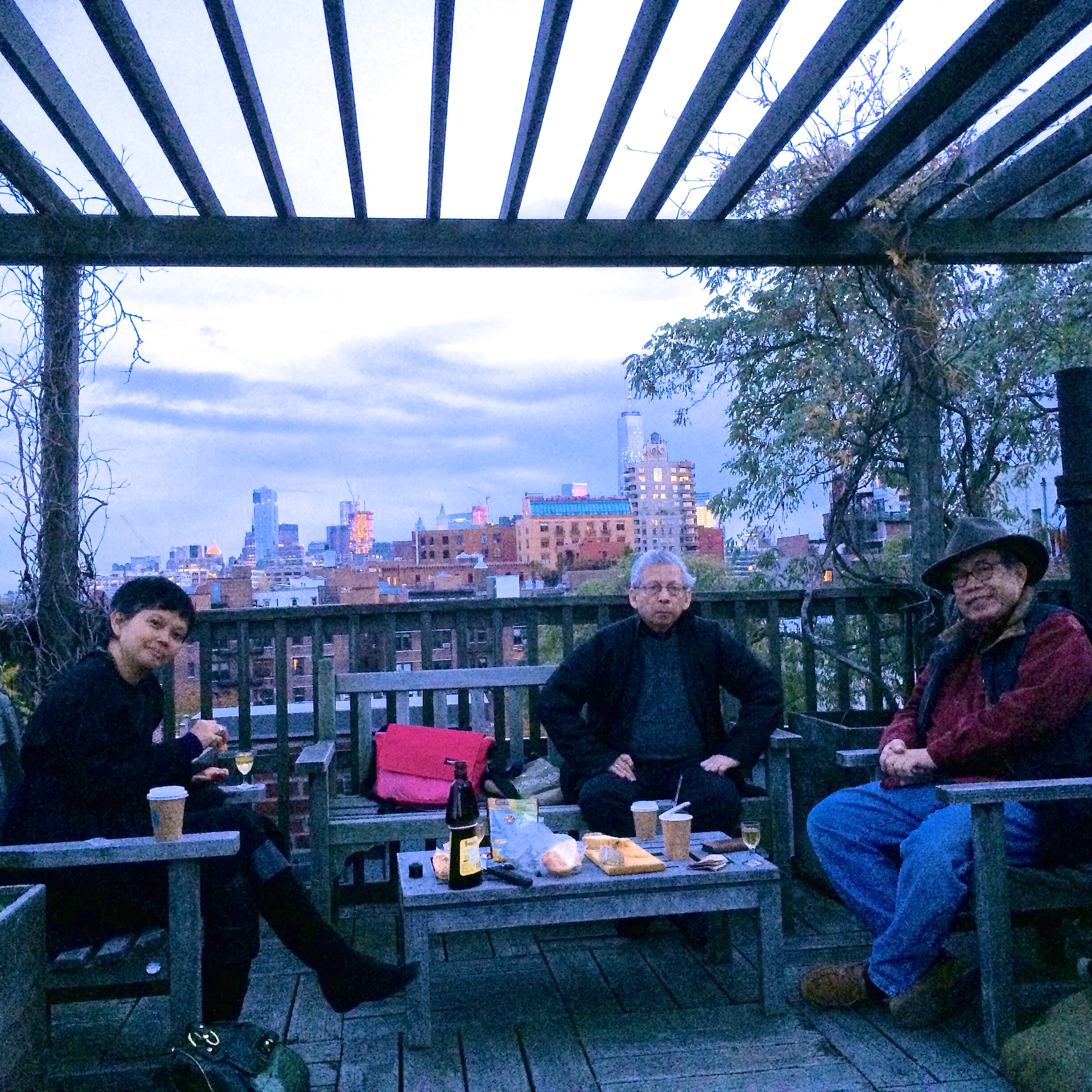
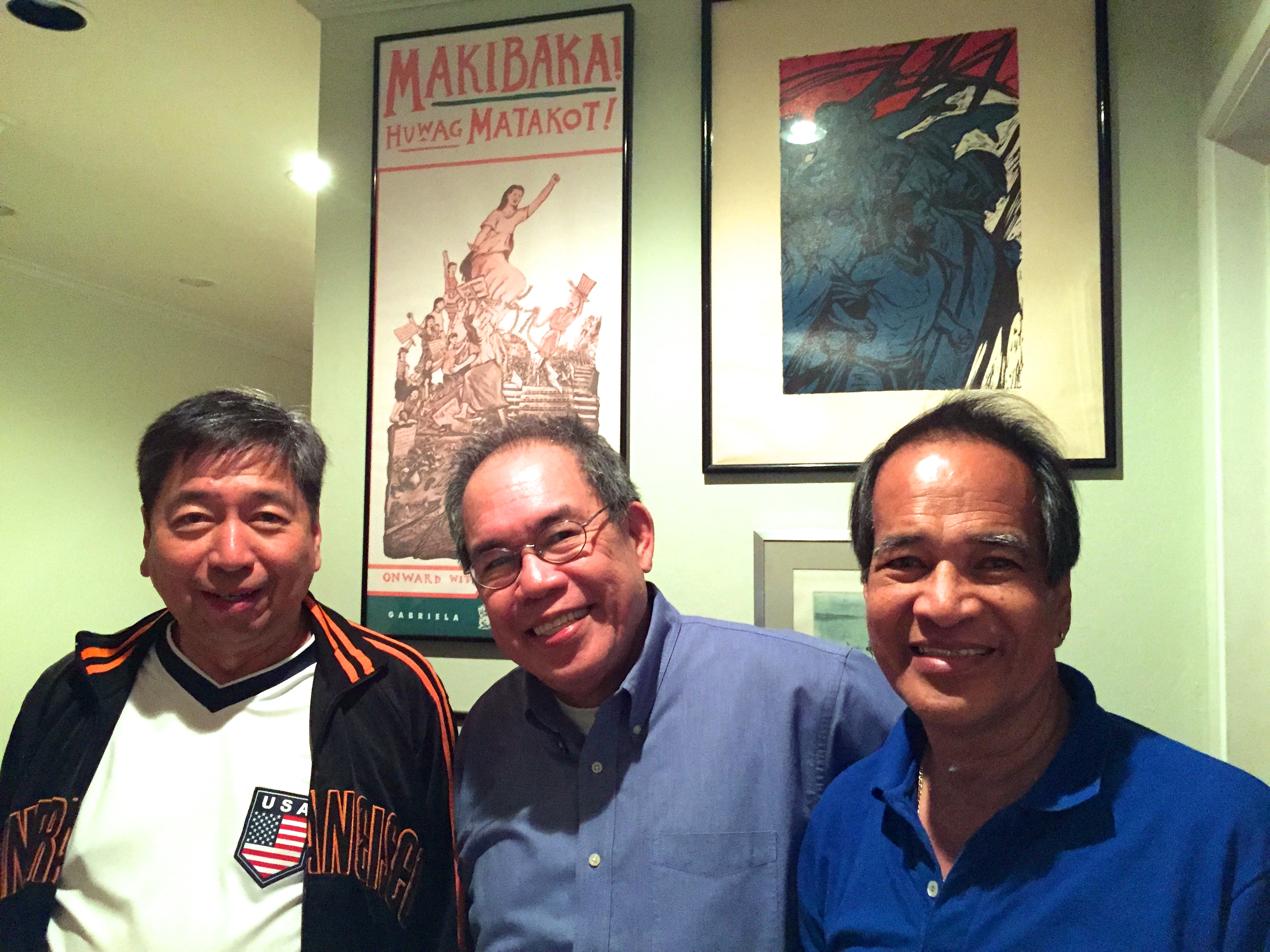
These then were the two literary luminaries who happened to be my friends (or should that be the other way around?) whom I was happy to set up a date with in a coffee shop in the West Village, near the High Line (an elevated garden and walkway that deserves its own story, among other New York landmarks). The coffee place was full, so we brought our steaming cups instead up to the roof deck of Gina’s apartment a few blocks away, pausing for a picture in front of the late Jose Garcia Villa’s old place on Greenwich Street. “This was where he held court,” said Luigi, one of Villa’s acolytes. “Nonoy Marcelo also lived in this area for many years, and I did, too, back when the rent was 65 dollars a month.” Then Gina added, “That white place is where John Lennon and Yoko Ono lived.” And I thought, if they’d stayed here instead of moving to the Dakota, he might still be alive.

We went up to the roof deck and Beng and I savored the scenery in all its 360-degree magnificence, as the sun set in the west and the full moon rose in the east, competing with the Empire State’s tricolor spire. We talked books, life, and loves over Frangelico, bread, and cheese; channeling Villa, I steered clear of the curd. Looking sharp and happy despite a recent illness, Gina said that her iPhone’s Siri had told her, in response to a question, “I’m just glad to be alive!” At that instant, we all were.

Penman No. 121: Souvenirs of Washington

SouvenirPic

Penman for Monday, November 3, 2014

A COUPLE of weeks ago, walking from my sister’s office in downtown Washington, DC to the library of the George Washington University, I paused at the corner of 19th and I (or “Eye”) Streets, and was overcome by a sense of déjà vu. I vaguely recognized the place, but something had changed—the old Presidential Hotel was no longer there, replaced by the Presidential Plaza, a grayish, nondescript commercial building replicated on a hundred other blocks in the city. It was what had stood at that spot that I suddenly missed: the hotel, built in the 1920s—and me, more than half a lifetime younger and suitcase in hand, looking up at my first American abode.

It was September 1980, I was 26 years old, and I was on my first foreign trip—to the United States, no less, thanks to a generous and visionary boss who thought that a budding writer like me could benefit from some exposure to the outside world. He arranged for a grant that would introduce me to media organizations and practices in various places in the US for three months, and within a month of being told that I was leaving, I was—all gussied up in a scratchy double-knit suit, which was what I thought any Stateside-bound traveler worthy of respect was supposed to wear.

After stops in Honolulu and San Francisco, I arrived in Washington on a nippy autumn morning. My first American mystery greeted me in a sign just outside the airport: “PED XING.” What on earth did that mean, I thought—could there be so many Chinese in Washington? I took a cab to my hotel, the Presidential on 19th and I, and was met by the doorman, who suspiciously resembled—and indeed was—a kababayan. I felt instantly relieved. He seemed happy to see me as well, and after effusive introductions and references to the motherland, he showed me to my room, up on the fifth floor.

Unable to sleep, I stepped out, still in my suit, and surveyed the streets around me. I got hungry and saw a classy-looking restaurant at the corner. I had several hundred dollars on me—partly my allowance, and partly my life savings—in cash; I felt rich. I stepped into the place, and ordered quarter of roast chicken. It cost me eight dollars, and I dutifully tacked on a 15% tip, like the guidebook said. I walked around the corner to K Street, and saw a luggage store; I walked in, and all too quickly fell in love with a saddle-leather Schlesinger briefcase. “How much?” I asked. “One hundred dollars,” the lady said. “I’ll take it!” I said, and forked the cash over; it would be eight years before I would get my first credit card, but that’s another story.

I walked back to my hotel, feeling very businesslike with that briefcase that smelled positively posh, and just outside the hotel, on the bus stop along the sidewalk, I noted my second American mystery: another sign that said “No Standing.” How was one supposed to catch a bus or a cab, I wondered, if they couldn’t stand there, and I couldn’t see any seats, either. I fell asleep that afternoon, with the Schlesinger beside me in bed, only to be woken up by a loud rap on my door. It was my kababayan the friendly doorman, and it must have been past nine in the evening. “Padre,” he whispered, “could you lend me twenty dollars? I have a hot date tonight and don’t want to disappoint her, I’m just a little short!” He winked conspiratorially, and I slipped him the twenty, and went back to bed.

Many more interesting things would happen to me during that visit, but that was the last I saw of my new kaibigan and of my twenty bucks. The next day, I went back around the street to look for a breakfast place, and saw my first McDonald’s. It was my first American fast-food experience, and I felt flustered by the array of comestibles on offer overhead. Forgetting for a second where I was, I glanced at the two Pinoy-looking ladies in the line beside me and asked, in Tagalog, “Miss, paano ba umorder dito?” and they told me how. They turned out to be secretaries at the World Bank. Later that day, when I told the cook at the cafeteria in our sponsoring institute about my eight-dollar lunch, she laughed and said, “You shoulda framed that chicken!” before serving me a full meal for $2.50.

Since I was going to be in Washington just briefly being flying onward to my main destination in East Lansing, Michigan, I resolved to make the most of my visit by touring as much of DC as I could. Our daughter Demi was just six years old, and I sent her postcards and pictures that I took of squirrels running around the White House lawn. Outside the Smithsonian, I lingered before the souvenir carts before choosing a tall ceramic (at least that’s what I thought) mug that said—what else—“Souvenir of Washington, DC” and featured the relief facade of the Capitol building. (I would later discover, back in Manila, that the mug was made of plaster, and made in Taiwan.)

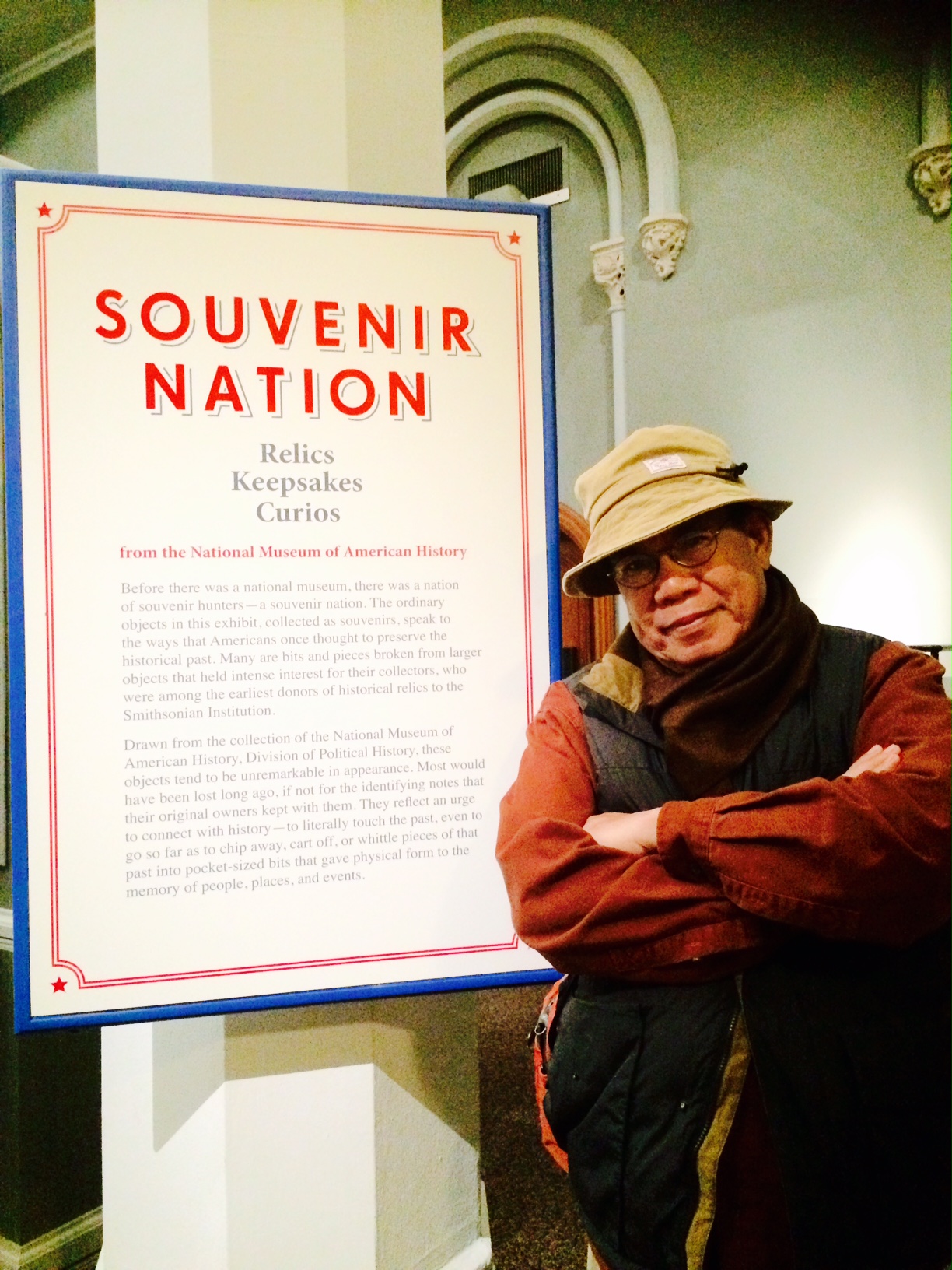
All these came back to me as I stood at that corner of 19th and I, feeling a little foolish but feeling even luckier to be alive at all and back in the same spot, much bulkier from ingesting untold hundreds of chickens and Big Macs since then, but not all that much the wiser. And as it happened, when I walked the other day into the Smithsonian Castle, on exhibit was “Souvenir Nation”—a show of how people have kept pieces of the past to form their own personal histories.

I’m over souvenir mugs, but I still keep that Taiwanese token on a shelf back in Diliman as a reminder of one’s innocence or stupidity—one or the other, although I can be fairly sure by now that there’s hugely far more of the latter in Washington than the former. And I still have the Schlesinger briefcase, all beat up as it should be after 34 years, but still handsome in a rugged way, which is more than can be said for its owner. No, I’m not over fine leather briefcases; I saw the very same case on eBay last week, selling slightly used for $25, and I snatched it up to replace the old one—as a souvenir of this great and wondrous city of Washington, DC.

Penman No. 120: Hello, Helvetica

Human2Penman for Monday, October 27, 2014

ALMOST TWENTY years ago, in a column for another paper, I said “Goodbye to Garamond,” in reference to how the world of typography—the way by which the printed word is presented to us by publishers, advertisers, and the media—was perceptibly changing.

Printed letters—like the ones you’re looking at this very instant—are shaped into what are called fonts (a term often used interchangeably with “typeface,” although some experts will insist that there’s a subtle but important difference). They’re how the letters physically look, which in turn may convey psychological, emotional, or subliminal messages to the reader. We’ll get to that in a minute.

First, here’s a bit of what I wrote back then:

“Have you ever wondered about those fonts whose letters look as though they had been scratched onto plywood with a nail by a heroin addict going through withdrawal? Remember the flickery font they used for the credits of Brad Pitt’s Seven?… These, folks, are examples of what’s been called ‘grunge’ typography and ‘degenerative’ art. The idea seems to be to produce aesthetic pleasure through severe disorientation…. Goodbye to Garamond, and all those reassuringly clean and classically balanced fonts. Hello to something like WaxTrax, which fairly drips all over your screen. And so it goes in the BraveNewWorld of cyberspace.”

Cyberspace and the Internet, of course, were still a novelty for most people back in 1996, and were full of raw and rough edges—visually and even audibly. Remember when you could count the dots on your screen and on your printout, and remember how mating modems screeched like cats in heat? Not surprisingly, the digital aesthete had all the finesse of a frontiersman, wielding his mouse like a chainsaw rather than a sable paintbrush. In other words, things looked pretty ugly—including titles and words on the computer screen, which had become the new page.

Or ugly, at least, to someone like me, who grew up with typewriters and liked the evenness of letters on a line, and the little feet (the so-called serifs) that grounded the shapely curves and angles of the A’s and M’s. That’s what I came to love about a graceful font like Garamond, which traces its origins to the 1500s, but which has been tweaked many times over the next 400 years—among others by Apple, which not surprisingly called its version Apple Garamond, used in the word ”Apple” itself by the company in its branding.

Speaking of Apple, this brings me to my little plaint for the day. Over the past month or so, Apple came out not only with the iPhone 6/6+ and with upgraded iPads and Macs; it also put out new versions of its operating systems for its devices and computers—iOS 8.1 for the portables, and MacOS 10.10 or “Yosemite” for the bigger machines.

So I dutifully upgraded to Yosemite, only to discover to my great dismay that—despite nifty new features here and there like being able to text non-iPhone numbers from your Mac and a better way of dictating text into Microsoft Word—I kept getting bothered by one small (and I mean literally small) thing: the new system font, called Helvetica Neue, which replaced the longtime, rounder Lucida Grande. You’ll see Helvetica Neue in the title bars and the bookmarks and tabs in your Safari Web browser—thin, narrow, and barely legible to my 60-year-old eyes.

What was Apple thinking? Well, certainly not about me (although we baby boomers were the original Apple faithful); “leaner and meaner” seems to be the mantra for the millennial computer user, and Apple is serving up the look in spades. And unlike what you could do with previous OSes, you can’t change or even tweak the size of the system font now, although you could enlarge individual windows in Safari and fonts in Word, probably because the system architecture would come crashing down if you had that option—the look is embedded into the package.

Why is this a big deal, at least for the fussy folk like me? Because it’s another sign—and a very visual one at that—of how the planet’s trendsetters see the present and the future, in the same way that blackletter fonts (more popularly if mistakenly called “Gothic” or “Old English”)—the kind you see in medieval Bibles—evoked an arch, elevated, not-very-accessible mindset.

Fonts and typefaces became more readable over time, and in the modern age, sans-serif (footless) fonts like Helvetica, Univers, and Futura became all the rage. Helvetica (the word itself means “Swiss”, in a tip of the hat to its origins) has been around since the 1950s, and can now be seen everywhere, along with its brethren. Being blocky, sans-serif fonts work best for titles and headlines, but can tire the eyes over long stretches; thus, older, footed fonts like Garamond, Palatino, and New York are still better for body text, because the little feet actually define the letters more sharply (try this by looking at a word like “human” in serif and sans-serif).

Lufthansa

I’ll agree: Helvetica’s a handsome font, and by now probably the world’s most popular one for signage and ads. (Just think of the logos of Lufthansa, American Airlines, Microsoft, Panasonic, Scotch, JCPenney, and The North Face, among others.) Maybe I’m actually sad in a way that Apple’s joining the pack rather than leading it as it often has—and if there was anything Steve Jobs almost literally imprinted into his designers and engineers, it was his fascination for typography.

But please, Apple, when the next upgrade comes around, give us something our aging eyes can better read, even if it isn’t Garamond.

Penman No. 119: Bulosan in the Heart

Penman for Monday, October 20, 2014


TAKING A short break from my fellowship in Washington, DC, Beng and I flew off to the West Coast a couple of weeks ago for a weekend with our daughter Demi and her husband Jerry. Demi was celebrating her 40th birthday (can you believe it?) and had sent us tickets to join them in Seattle; they live in San Diego, but they’d loved Seattle from a previous visit and wanted to share that discovery with us.

Over three days, we did the Seattle thing, and had loads of fun: the Pike Place Market, the Space Needle, a glimpse of the Chihuly glass garden, antiquing in Snohomish, and a boys’ tour of the Boeing plant in Everett. But it was an unexpected turn in the program that made it all the more worthwhile.

On the drive into the city from the airport, I had mentioned to Jerry (who had been born in Rhode Island to parents from Bicol) that two Asian-American icons—Carlos Bulosan and Bruce Lee—were buried in Seattle. Jerry’s an engineer in the aviation industry, but like Demi, he has a keen interest in culture and in his roots.

Bulosan’s name holds a special significance for our family. In high school, with some help from Beng, Demi had put together a book report on America Is in the Heart—Bulosan’s sprawling semi-autobiographical novel about the Filipino immigrant experience in America, first published by Harcourt Brace in 1946. I myself had written my undergraduate thesis at the University of the Philippines on Bulosan, fascinated by his often paradoxical appreciation of America, which he described as being at once “so kind and yet so cruel.”

Born in Pangasinan, he shipped out to Seattle in 1930, and never returned until his death from bronchopneumonia, also in Seattle, on September 11 (yes, 9/11) in 1956. (There’s some debate over the year of his birth, which has been variously listed as 1911, 1913, and 1914.) In the US, without the benefit of college, he became a voracious reader and taught himself to write, and became known both as a writer and a labor activist. Since the 1970s, many critics such as Epifanio San Juan Jr. have championed a reappreciation of Bulosan and his work; in 1973, the University of Washington Press republished America Is in the Heart, which was translated into Filipino as Nasa Puso ang Amerika by Carolina S. Malay and Paula Carolina S. Malay and published by Anvil in 2000.

When Demi and Jerry made plans to marry in 2007, I knew what I was going to give them as a wedding gift. After a long and eventful search culminating in a meeting with the seller in a Jollibee in Diliman, I had just acquired a first edition of America Is in the Heart, and carried it with me to San Diego. This copy had been inscribed by Bulosan to his friend Fred Ruiz Castro: “This story of my life will, I hope, bring me closer to you and our native land through our good friend J. C. Dionisio, with my best wishes, Carlos Bulosan, Los Angeles, 3-6-1946.”

Upon receiving the book in Manila almost a month later, Castro—who became Chief Justice in 1976—also signed it on April 4, 1946. I signed the book on a following page on April 2, 2007, and Beng and I presented it to Demi and Jerry on April 15. The book now rests proudly on their bookshelf in San Diego. (When I first wrote about this in my column—about finding that “holy grail” of a signed first edition and giving it to our only child on her wedding in America—I got a pleasant surprise upon my return: the gift of another copy of an early edition, acquired by another Filipino writer when he was in college, Greg Brillantes. That book, signed by Greg, now sits on my topmost shelf in Diliman.)

Now back to Seattle. On our last full day there, after touring the Boeing plant in the morning while our wives did their own thing downtown, Jerry and I were hit by the same brain wave in the car: why not look for Carlos Bulosan’s grave and pay our respects to our literary hero? A little Googling quickly revealed his gravesite, at the Mt. Pleasant Cemetery on Queen Anne Hill. We picked up Beng and Demi at the hotel, and located the cemetery not too far away.

GPS helped bring us there, but it couldn’t pinpoint the exact grave among the many hundreds on the site; thankfully, Google also yielded a picture of the grave itself, and the four of us spread out across the cemetery, looking for visual markers—particularly a white obelisk in the distance; it took about 20 minutes until Demi yelled “I found it!”

It was, ironically, very close to the cemetery gates, on the left side. Beng picked some flowers nearby and offered them at the foot of the marker, which read: “CARLOS BULOSAN 1914-1956 Writer Poet Activist,” followed by an epitaph that Bulosan himself had written: “Here here the tomb of Bulosan is / Here here are his words dry as the grass is.” It was a pretty spot, truth to tell, and the grass was hardly dry. After the cemetery, we visited Seattle’s International District near the waterfront, to peek at the Bulosan exhibit through the windows of the historic Eastern Hotel, where Bulosan and other Filipino cannery workers lived.

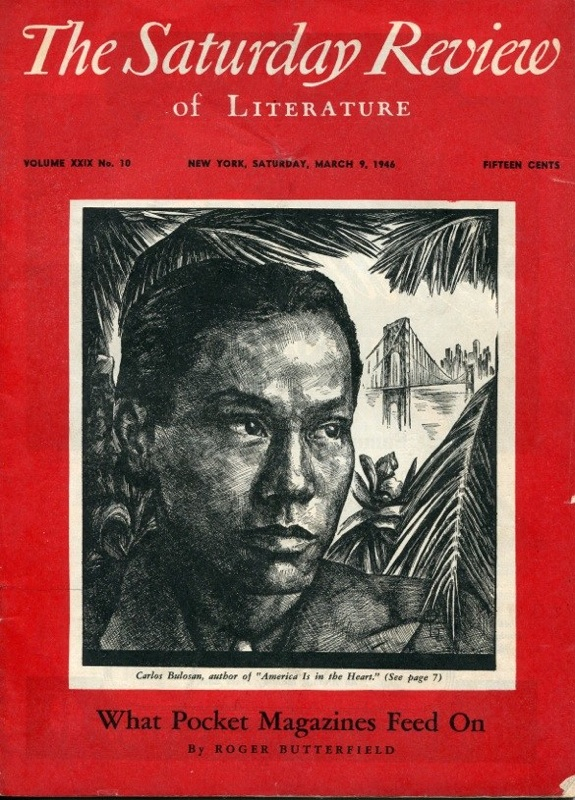
Demi and Jerry don’t know it yet, but they have another Bulosan memento coming from me: a copy of the Saturday Review of Literature from March 9, 1946, on the cover of which the famous pen-and-ink portrait of Bulosan first appeared. One of these days, I’ll pay another homage, to the Bulosan memorabilia on exhibit at the University of Eastern Pangasinan in Binalonan, where they keep copies of his letters, commemorate September 11 as Carlos Bulosan Day, and teach a 3-unit course on his life and works. There’s a trove of material on him at the University of Washington library, and perhaps on another visit to Seattle, with more time, I might look into that, too. But as every Fil-Am and indeed every Filipino should know, a pioneering voice like Carlos Bulosan’s can ring everywhere and forever, in the heart.

Bulosan

Penman No. 118: To Teach Is to Persist

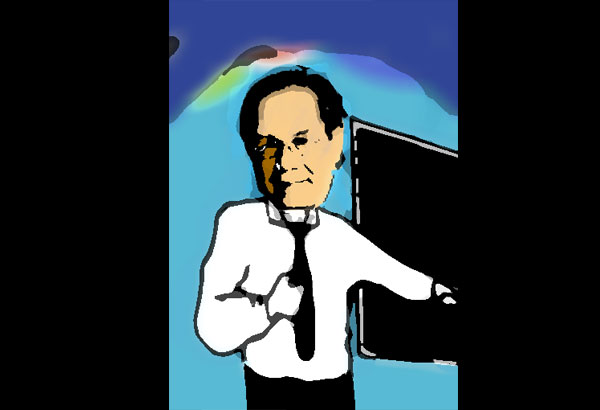
To-teach-is-to-persist-Penman-Butch-DalisayPenman for Monday, October 13, 2014


SOMEONE REMINDED me that World Teachers’ Day was celebrated earlier this month, on October 5. I forgot about it because I was—I am—overseas, on sabbatical leave until mid-2015. In our department at the University of the Philippines, we normally get just one sabbatical leave over the course of our teaching career, and typically, professors take it a few years before retirement. I’m five years away from that crossroads, so this is a good time to be away from the classroom and to recharge, which is what the sabbatical leave was originally designed for.

Wikipedia tells us that “Sabbatical (from Latin sabbaticus, from Greek sabbatikos, from Hebrew shabbat, i.e., Sabbath, literally a ‘ceasing’) is a rest from work, or a break, often lasting from two months to a year. The concept of sabbatical has a source in shmita, described several places in the Bible (Leviticus 25, for example, where there is a commandment to desist from working the fields in the seventh year). In the strict sense, therefore, a sabbatical lasts a year.”

This sabbatical, however, is shaping up to be anything but a vacation, or a rest break. I may be cool and dry in an America turning pretty with the onset of autumn, but my workload is as tropically toxic as ever, with several books to complete, columns and articles to write, faculty advising duties to perform, and sundry interests—totally and thankfully unscholarly—to pursue.

I do get a respite from the classroom, but, perhaps ironically, that’s the part of teaching I miss the most. As we celebrated World Teachers Day, I also realized that I was marking my 30th year of teaching this November, and I asked myself what three decades of teaching have taught me. After some reflection, it came down to this: to teach is to persist in the perfection of our humanity and our citizenship. That sounds awfully grand to the point of being pompous and pretentious—don’t we, after all, just grab a book, drag our feet to class, and preach bunkum for an hour to a roomful of people with the pulse rate of zombies to earn our lunch and gas money?

There are, of course, many days just like that in a teaching career, days that blur one into the other until the end of yet another semester. And at some point, it’ll get to you: your speech starts slurring and your eyes get glassy, and you can’t wait until the bell rings or the hour hand moves; you had a long rough night, the car needs new tires, the bills are piling up, your thoughts keep drifting back to Paris or Palawan, and the last thing you or your students want to talk about is disease and social order in William Carlos Williams’ “The Use of Force.”

Maybe ten years ago, I had such a day at the very start of the semester, and without realizing it, I must have been so bleary-eyed that I gave off the impression of not quite being there. To my great shock and dismay, one student later blogged about her disappointment with what she had seen; she had expected a stirring performance from her professor on Day One. It was a wake-up call, and I woke up; I promised that student that I would do my best to live up to her expectations, and I hope I did; we’re good, and she’s since gone on to a promising career in writing.

What I became acutely aware of then was that every teaching day is a performance, not unlike a show a professional actor studies and rehearses for, with the additional challenge that one simply doesn’t repeat the previous show, but keeps adding to it, improvising when possible to adapt to changes in the composition and the mood of every audience. I mutter my first lines to myself on the steps up to my classroom, ticking off the day’s main points and questions in my head; I take a deep breath, step into the door, flash a brief smile, and the day begins. And like the pro I have to be, I’ve learned to take care of myself, so I can teach well—to stay healthy, to sleep well (especially before a class day), and to think of something new to say or to bring to the next class.

So we all have our bad days, but it’s precisely on days like these when we need to remind ourselves of what a tremendous opportunity we have to make this Tuesday or Wednesday one of the most memorable in our young charges’ lives, through something we say, an idea or an experience we share, that will turn a key and open a door in their minds. Only in teaching can an ordinary, even a boring, day suddenly become indelibly special, with nothing more than thoughts and words—and the teacher’s persistence and faith in every student’s potential for transformation into someone more aware, more human, more Filipino. Perfectability? It’s more about the effort than the goal—and I’m sure that whatever we do for our students, we teachers do for ourselves as well.


SPEAKING OF teaching, my department has asked me to invite all teachers and students interested or involved in translation issues to attend the 6th Asian Translation Traditions Conference (ATT6) to be held October 23-25, 2014 at the University of the Philippines, Diliman, Quezon City.

The official flyer says that “The rationale for the ATT series is to challenge the Eurocentric emphasis of Translation Studies, which is largely due to the “unavailability of reliable data and systematic analysis of translation activities in non-European cultures” (Hung and Wakabayashi 2005). The ATT series was initiated by Professor Eva Hung of Hong Kong in 2002. A small but successful workshop was held in London that same year, followed by well-attended international conferences in India, Turkey, Hong Kong, and the United Arab Emirates. It is hoped that ATT6 will lead to theorizing on translation and developing methodologies on translation arising from the specific historical and contemporary contexts of Asia.”

Hmmm, I think that needs to be translated: this conference will explore the theory and practice of translation in an Asian context. For more details, please visit http://asiantranslation6.up.edu.ph/.

{Illustration by Igan D’Bayan of the Philippine Star.)

Penman No. 117: The Way We Were

IMG_4726Penman for Monday, October 6, 2014


I’D LIKE to thank the people who’ve given me their time and accorded me their hospitality during my current visit to the US. I’m here to do more research for a book project—an oral history of the First Quarter Storm (the story of my generation, in other words)—and so far I’ve had wonderfully productive interview sessions with some people who were either active participants in the anti-martial law movement or were on the other side of things (or simply on the roadside) at the time.

Those who’ve helped me out, either as interview subjects or facilitators, include former campus journalist and retired engineer Gerry Socco and his wife Chet; lawyer Rodel Rodis; editor Rene Ciria-Cruz; tech journalist and developer Joey Arcellana; and journalist Gemma Nemenzo and her husband, Col. Irwin Ver. All of them are conveniently based in the San Francisco Bay Area, so Beng and I flew out there from DC for a long weekend of interviews and reunions with old friends.

Rodel and I go back all the way to the Philippine Science High School, where I served as Rodel’s associate editor when he helmed The Science Scholar. It was also in high school—when I myself became editor in chief—that I first heard of Joey Arcellana from our adviser, Mrs. Agnes Banzon Vea (mother of the accomplished Doy and Rey Vea), who told me one day: “There are two young writers I’d like you to read. One of them writes for the UP Collegian, and his name is Joey Arcellana. The other is still in high school and writes for the Highlights, and his name is Gary Olivar.” Gemma, who now edits the ezine Positively Filipino, also edited the late, lamented Filipinas magazine, which I used to write a column for. Gerry I knew from the pre-martial law College Editors Guild of the Philippines, and we met again in the worst of possible circumstances—as fellow political prisoners in Bicutan; today, in our sixties, we share an unabashedly bourgeois passion for collecting vintage pens and watches.

In Washington, DC, where I’m formally based through my association with the George Washington University, I’ve been lucky to meet and to interview one of the torchbearers of the anti-Marcos resistance on the East Coast, Jon Melegrito, a retired librarian at GWU who now writes for the DC-based fortnightly Manila Mail. I’ve also been glad to gain the insights of three former State Department officials: former Ambassador John Maisto, who headed the old Office of Philippine Affairs and served in Manila in the late 1970s; his colleague Hank Hendrickson who now serves as executive director of the US-Philippines Society, of which Amb. Maisto is the president; and Santiago “Sonny” Busa, a Filipino-American who has served as consul in Manila, Addis Ababa, and Kuwait, and who has taught International Affairs at West Point. I’ll be doing a bit more traveling to see people in New York and possibly the Midwest.

So far, I’ve interviewed about 30 people for the book, which I’ve begun to write at my sister’s place in Virginia. It’s very strange in a way to write about bloody encounters in coconut groves in the Philippine South while reveling in the sight, outside my window, of bluejays and robins perched on the branches of trees just beginning to acquire an autumnal glow. But perhaps it’s precisely this physical and psychological estrangement that I need to handle such an emotional project—emotional, at least, for members of my generation.

Sometimes what I hear gets a bit too much; for the first time, after having written and published over 25 books with a very dry eye, I wept as I listened to an account of someone I knew shooting—executing—someone who had been her best friend. At the same time, events that might have been terrifyingly life-threatening 40 years ago can now sound absolutely hilarious—or deadpan ironic, such as when firebrand Fluellen Ortigas, selected as one of the Ten Outstanding Students of 1968, stands beside President Marcos at the awarding ceremonies, with a book titled The Essentials of Marxism in hand. “Join my staff,” Marcos tells him. “I can’t,” Ortigas replies. “You’re going to be a dictator!” Ortigas would later work for Ninoy Aquino, go underground in Panay, get arrested before martial law, get released in 1976, flee to the US via Sabah, get an MBA, and become a businessman in San Francisco.

I have many more stories like Flue’s to tell, each with its own highlights and insights—Elso Cabangon being ambushed on Taft Avenue and taking four bullets, one of them tearing through his cheek; Boy Camara auditioning for the role of Judas before eventually playing Jesus Christ, Superstar; a female comrade being married in the rites of the Party, one hand on her heart, and the other on Mao’s Quotations (it’s a marriage, like many in the movement, that will unravel). But they’ll have to wait until the book itself, which I hope to finish by early next year.

Even now, many old friends and comrades are probably wondering why I haven’t approached them yet or asked so-and-so to be interviewed, because they have interesting and important stories to tell. I’m sure they do, and I have to extend them my apologies in advance, simply because I just don’t have the time or space at the moment to include everything and everyone I should be covering. I’m almost certain that this oral history will lead to a sequel, all the way to EDSA (a book that someone else should begin writing soon). Some people I’ve asked haven’t replied or have declined, and I can only respect their implied wish to be left alone.

Again, this book will be about the past, and while we might bemoan the innocence we lost, or even wax romantic about the way we were, I don’t think too many of my respondents will want to relive their lives in exactly the same way, knowing what they do now. We might not regret what we did—it arguably needed to be done—but we or our children don’t have to repeat it, if it can be helped. That’s how history helps the future.

Penman No. 116: The Phabletized Future

FullSizeRenderPenman for Monday, Sept. 29, 2014


HAVING WRITTEN with dead seriousness about writing for six straight columns, I hope my readers will indulge me this digression—a periodic, practically biennial, one—having to do with utter frivolity.

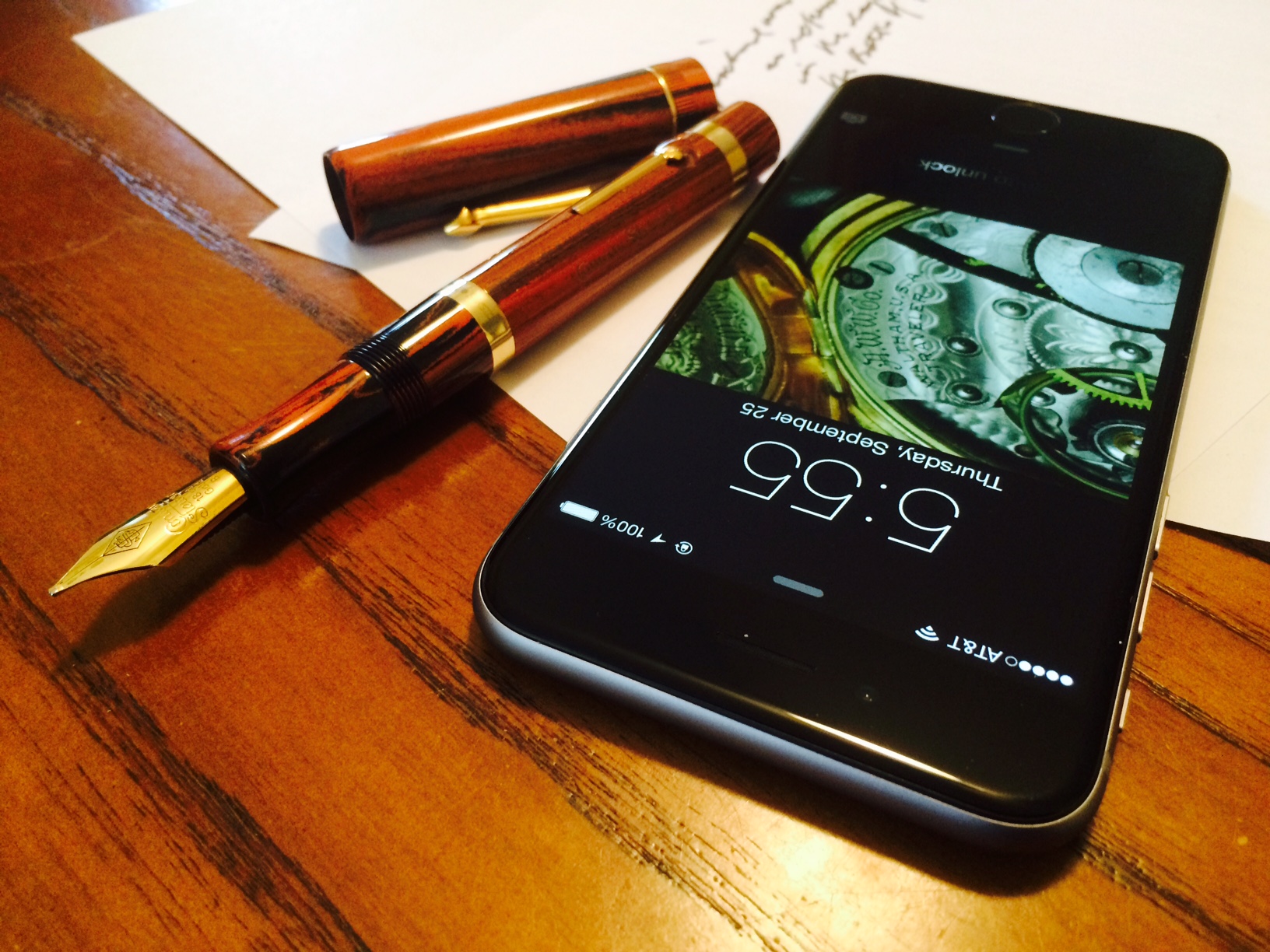
Okay, I’ll fess up: I have the new iPhone 6. Naturally. I’ve been an incorrigible Apple fanboy since the mid-1980s—practically since Apple was born—and so no one should be surprised by my prompt (I’ll say “timely”) acquisition of this new bauble, among 10 million other lunatics who snapped up the 6 and its bigger sibling, the 6+, in the gadget’s first three days of being on sale in the global market.

Like an arthritic hippie or a superannuated rebel, I should have no business, as a card-carrying senior, salivating over shiny new toys better seen on 30-somethings dashing off to work or to a dinner date. Well, maybe a little. US demographic studies from 2012 suggest that nearly one-fourth of all iPhone users are 55 and older (and a bit lower for Android and BlackBerry users), so older guys (men use it more than women, 60-40 percent) still make up a good chunk of the iPhone market. That makes sense, because these things don’t come cheap.

Along with literally millions of other people in the US and around the world, I stayed up until dawn on September 12 on the US East Coast to get my order in, and after an interminably long week during which I could only distract myself by doing honest and humorless work on my book project, a brown UPS van arrived to deliver the gadget du jour, a pristine iPhone 6 in smoke gray, 64GB, contract-free under T-Mobile. (Let’s get this out of the way: if you can’t wait for the local telcos to release the IP6 /6+ and want your US-based tita to send you one for an early Christmas, ask for a contract-free T-Mobile unit from the Apple Store—don’t get one from T-Mobile itself, or it will be network-locked.) I took my Globe nanoSIM out of the 5s and popped it into the newcomer, and voila—it was alive!

Never mind the rest of that digital drama, which can only be unremitting silliness to anyone but the most besotted geek. (And it’s only fair to say that millions of other geeks—the Android and Samsung crowd—slept soundly that night.) You can get the full specs and features of the IP6/6+ on dozens of sites online. I’ll cut to the chase with my quickie personal review, because I can just see a bunch of people asking me, “Is it worth it?”

If you’re moving from an older iPhone, the first thing you’ll notice is how thin and light it is—and yet how large. The 6 is larger than the 5/5s, and the 6+ is larger than the 6. I held and tried to like the 6+ in an Apple Store, but came away convinced that it was a cool thing to have if you’re 25, but definitely not for me. I got the 6 because, like many old guys, I prefer smaller, more discreet phones; the IP4 was perfect, but now it won’t run the newest software.

If you need an excuse to upgrade, recite this mantra: better battery, faster processor, bigger screen, thinner profile, better camera, more storage. Add them all up and you might convince yourself that it’s worth a good chunk of change. At 60, I don’t need an excuse; I’m just hopelessly curious, and the older I get, the more curious I am about what the future is going to be like, so every new gadget lets me cheat time.

After a week of playing with the new iPhone, I can say that I can best appreciate the brilliant screen, the excellent camera (I’ve done almost all of my photography with the iPhone for the past few years), and the longer battery life. I still have to get used to the slimness and the lightness of the thing; I’m using a plastic skin on it, but I keep tapping my pocket to make sure it’s still there. I’ve ordered a thick leather wallet case to lend it some heft, and then I’m sure it’ll be just fine.

I know that the so-called “bendgate” issue has come up online alleging that the big IP6+ will bend if you try hard enough (which makes me ask, who would, and why would you?). These “bend” tests are mildly interesting, but if you’re going to base your buying decisions on these, then go buy a tank, not an iPhone. I mean, how many people buy their cars based on crash tests?

What intrigues me more about the future is the new word I picked up this week: “phablet,” which the IP6+ is—a cross between phone and tablet. Frankly, all this talk of a phabletized future—where people walk around with 7- or 8-inch phones stuck to their ears—scares me. If this is the way we’re going, we might as well stick a phone into an iPad mini and call it the iPhone 9. I’ll probably hang around long enough to catch the iPhone 13, which will include telepathic commands among its features. By then, Apple and the iPhone will have gone one of two ways—the way of Godzilla, or the way of Yoda. Godzilla will have a battery life of 20 days and will be strangely reminiscent of the iPad mini; Yoda will have half the battery life but will remind some really old people of the iPhone 1.

By this time, to be fair, size will not be a problem for many people, because fashion designers (starting with Project Runway season XX) have made big pockets trendy; already, one Mafia boss (yes, the Mafia outlived Pope Francis) attributes his surviving an assassination attempt to the big iPhone he carries in his suit pocket, like a shield (it still bends, but it can stop bullets); boardrooms and Mafiosi meetings are soon full of men with bulging fronts. An ad with a digitally recycled Mae West says, “Is that an iPhone, or are you just happy to see me?”

Heck, I’m just happy to see this iPhone now.