Penman No. 197: Why the Arts Should Matter

IMG_7956.jpg

Penman for Monday, April 25, 2016


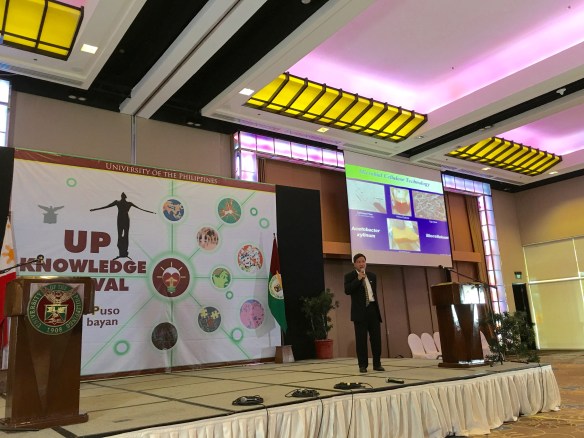
FOR THE first time ever, the University of the Philippines held a Knowledge Festival in Tagaytay last week, showcasing the most significant and interesting projects being undertaken by UP scientists, artists, and researchers, with an emphasis on interdisciplinarity. I was asked to present a keynote talk on “Why the Arts Should Matter.” Herewith, some excerpts:

It has become practically a cliché to say that our lives, and certainly our learning, would not be complete without some appreciation of the humanities. Our tradition of liberal education has primed us to the necessity of cultivating the “well-rounded individual” schooled in the basics of various disciplines.

Within my own field, I often find myself arguing for the importance of being able to adopt a rationalist outlook, of grounding our artistic judgments and perceptions on a concrete appreciation of our economic, social, and political realities. I’ve always urged my creative writing students to take an active interest in history, technology, business, and public policy as a means of broadening their vision and enriching their material as writers.

But conversely, let me ask: Why indeed are the arts and humanities important? I’ll turn to conventional wisdom and quote what should already be obvious, from the Massachusetts Foundation for the Humanities:

“The humanities enrich and ennoble us, and their pursuit would be worthwhile even if they were not socially useful. But in fact, the humanities are socially useful. They fulfill vitally important needs for critical and imaginative thinking about the issues that confront us as citizens and as human beings…. We need the humanities. Without them we cannot possibly govern ourselves wisely or well.”

What strikes me here is the word “govern,” which seems to me to be of utmost importance to us at this juncture of our history, and which is key to our topic today. The role of the humanities in our intellectual and cultural life is to enable us to govern ourselves wisely and well. They deal with issues and value judgments, with defining the commonalities and differences of human experience, hopefully toward an affirmation of our most positive human traits, such as the need to work together as families, communities, and societies. In sum, they help us agree on a common stake, based on which we can make plans, make decisions, and take action.

That notion of a common stake is crucial, especially on this eve of one of the most contested elections in our history. Despite all the predictable rhetoric (and the real need) for national unity, we find it difficult to unite beyond short-term political expediency because we remain unable to agree on our most common ideals—the national dream, as it were, or the direction of the national narrative. What is our story? Who is its hero? Are we looking at an unfolding tragedy, a realist drama, or a romantic myth? To go further, what is important to us as a people? Where do we want to go? What price are we willing to pay to get there?

These are questions that are answerable less by scientific research and inquiry than by artistic imagination and insight. It will be mainly the humanities and the social sciences that will provide that vision, in all its clarities and ambiguities, as it will be science and technology that will provide the means.

This does not mean that scientists and engineers will have little or nothing to contribute to the crafting of this vision; I firmly believe they should, and that one of our worst mistakes has been the fact that we have largely left national policy to the politicians, the priests, the lawyers, the soldiers, and the merchants. Scientists have had little say—and artists even less—in the running of this country and in plotting its direction. We may canonize our boxing champions and beauty queens—and even elect them senator—while our National Scientists and National Artists languish in obscurity and indifference.

Ours is an appallingly innumerate society. Most of our people do not know the simplest numbers that describe our lives, and much less what they mean. We are raised on concepts like the national flower and the national bird and the national tree, but even in college we are hard put to say what the national population, the national birth rate, or the Gross Domestic Product is, and why they matter. This innumeracy is balanced, sadly, by cultural illiteracy. Our notion of culture often consists of pretty images, pleasant melodies, theatrical gestures, and desirable objects.

We have much to do by way of cultural education, and artistic expression is a vital means by which this can be achieved. The arts are the key to those parts of us that reason and logic alone cannot reach.

But I came here this morning to go beyond the obvious, and to present an aspect of the arts that few national and even academic policymakers ever think about, and it’s this: the arts should matter not only because they’re good for the soul, but because they’re good for the body as well—taking the body to mean our economic and material well-being. In simple words, and moving from the philosophical to the practical sphere, the arts can mean big business.

The arts underlie what have been called “creative industries,” and these industries have made tremendous contributions to the economies of countries as diverse as the US, the UK, China, Japan, Brazil, and Thailand.

In 2009, when the Joint Foreign Chambers of the Philippines initiated a focus group discussion on creative industries in the Philippines, they defined the sector as embracing “a wide array of subsectors including advertising, animation, architecture, broadcast arts, crafts, culinary arts, cultural/heritage activities, design, film, literature, music, new media, performing arts, publishing, and visual arts.”

In 2010—the last year for which I have solid figures—copyright-based industries or CBIs contributed more than P661.23 billion to the economy, according to the Intellectual Property Organization of the Philippines. In GDP terms, the economic contribution of CBIs climbed from 4.82 percent in 2006 to 7.34 percent in 2010. Core CBIs comprising companies in the arts, media, and advertising largely accounted for this surge. A corresponding rise in employment occurred in the sector, from 11.1 percent of the total number of jobs in 2006 to 14.14 percent four years later.

There seems to be a greater awareness on the Philippine government’s part of the economic utility of our artistic talent. In 2012, for example, RA 10557 was passed to promote a “national design policy” highlighting “the use of design as a strategic tool for economic competitiveness and social innovation.”

However, culture as a whole remains a low priority, often subsumed to other activities like tourism, entertainment, and sports. And it’s getting worse; very recently, cultural funding by the NCCA—the largest source of government funding for the arts—practically dried up because of onerous conditions imposed on cultural organizations in the wake of the pork-barrel scam, requiring them to undergo a tedious accreditation process by, of all things, the DSWD. Unlike many progressive countries, we do not even see it fit to have a standalone Department of Culture, so the DBM and even the DSWD can push the NCCA around.

We need to see the arts as more than a frivolous diversion that keeps on drawing funds without producing appreciable pay-offs, like an exotic and expensive pet you keep around the house, but rather as an area of strategic and profitable investment that will yield both moral and material dividends. Just as we need to develop more PhD-level scientists and researchers, we need to support advanced practitioners and theorists in the arts, as they have every capability to achieve world-class status, with the right incentives.

Let me end with a message—perhaps even a plea—to those who hold the purse-strings of our institutions. That journal, that play, that exhibit, that concert, or that workshop is always more than a line-item expense. Supporting and patronizing these artistic endeavors is the price we pay to understand ourselves in all our complex, and wondrously unquantifiable, humanity—and also, in ways you may never expect, to create new knowledge and new wealth in many forms.


Penman No. 196: A Frenchman in Jalajala

Gironiere1.jpg

Penman for Monday, April 18, 2016


I USUALLY ask my wife Beng to ride out with me on a day trip during the Holy Week break, and this year our destination was rather unusual, in that it never figures in the travel plans of Manileños, although it’s a short and pleasant drive from Quezon City or Ortigas. We took the scenic route from Diliman via Antipolo, Teresa, and Morong, and soon found ourselves following the lakeshore of Laguna de Bay on the peninsula of Jalajala, Rizal, described by the guidebook as “a fourth-class municipality with a population of 30,074 people.”

We were there on the trail of an extraordinary author and adventurer who, nearly two centuries ago, had lived in Jalajala, and had written about his sojourn in a book that had been a favorite of mine for 40 years.

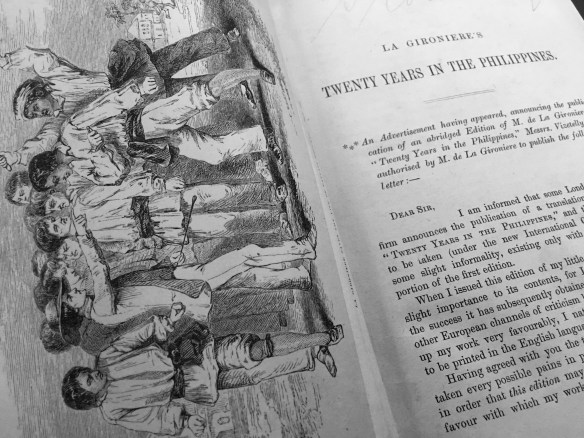
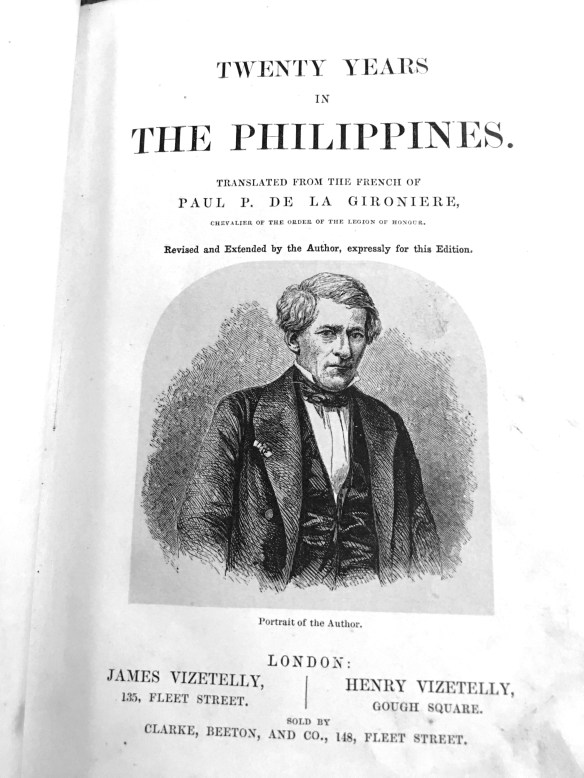
The book was Paul Proust de la Gironiere’s Twenty Years in the Philippines (subsequently expanded under the title of Adventures of a Frenchman in the Philippines), and I had recently acquired a copy on eBay, all the way from the UK—the first English edition published by James and Henry Vizetelly, undated but very likely from 1853, a year ahead of the American edition published by Harper & Bros. in 1854. The copy was far from mint, but it was in its original binding and still very readable, and wonderfully illustrated with engravings of local scenes.

Gironiere2.jpg

Gironiere was an adventurer from France who came to the Philippines in 1819 in his early 20s as a ship’s surgeon and stayed on for the next two decades, establishing himself as a landlord and farmer in what today is Jalajala, Rizal. His travails begin shortly after his arrival on the ship Cultivateur, and his account of a massacre shows why his book is—in that awful word coined by book reviewers—“unputdownable”:

I had only resided a short time at Cavite when that terrible scourge, the cholera, broke out at Manilla, in September, 1820, and quickly ravaged the whole island. Within a few days of its first appearance the epidemic spread rapidly; the Indians succumbed by thousands; at all hours of the day and of the night the streets were crowded with the dead-carts. Next to the fright occasioned by the epidemic, quickly succeeded rage and despair. The Indians said, one to another, that the strangers poisoned the rivers and the fountains, in order to destroy the native population and possess themselves of the Philippines.

On the 9th October, 1820 … a dreadful massacre commenced at Manilla and at Cavite…Almost all the French who resided at Manilla were slain, and their houses pillaged and destroyed. The carnage only ceased when there were no longer any victims. 

…Four hundred Indians surrounded me; the only way of dealing with them was by audacity. I said in Tagaloc to the Indian who had attempted to stab the captain: “You are a scoundrel.” The Indian sprang towards me; he raised his arm: I struck him on the head with a cane which I held in my hand; he waited in astonishment for a moment, and then returned towards his companions to excite them. Daggers were drawn on every side; the crowd formed a circle around me, which gradually concentrated. Mysterious influence of the white man over his coloured brother! Of all these four hundred Indians, not one dared attack me the first; they all wished to strike together. Suddenly a native soldier, armed with a musket, broke through the crowd; he struck down my adversary, took away his dagger, and holding his musket by the bayonet end, he swung it round and round his head, thus enlarging the circle at first, and then dispersing a portion of my enemies. “Fly, sir!” said my liberator; “now that I am here, no one will touch a hair of your head.” In fact the crowd divided, and left me a free passage. I was saved, without knowing by whom, or for what reason, until the native soldier called after me: “You attended my wife who was sick, and you never asked payment of me. I now settle my debt.”

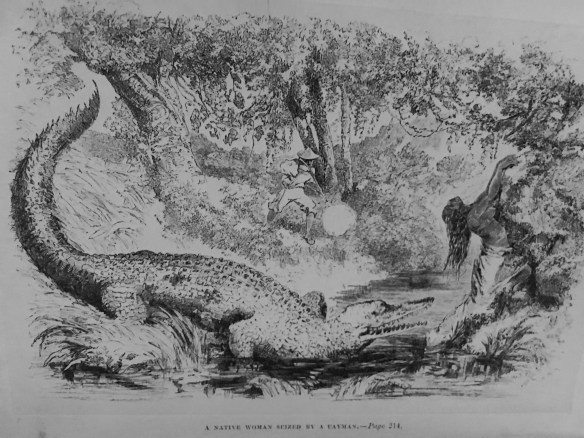
I had first read the book a long time ago, and kept my copy of Adventures, in a Filipiniana Book Guild edition reprinted locally in paperback by Burke-Miailhe in 1972, with a foreword by the eminent historian and economist Benito J. Legarda. In his foreword, Dr. Legarda says that Gironiere’s book was “probably the best seller among books about the Philippines in the 19th century,” noting that “What attracted the 19th century reader was of course the narration of several adventures, at that time considered unusual or bizarre. Among them may be enumerated the killing of man-eating crocodiles, the hunting of wild carabaos, the exploration of caves, the customs of pagan tribes, and the adventures of those caught in captivity by Moro pirates.”

IMG_8257.jpg

While granting that Gironiere’s accounts may have taken certain fanciful liberties, Legarda also considers the many real contributions the Frenchman made to his adopted soil, particularly as an agricultural pioneer who planted coffee, abaca, indigo, and rice on his 2,400-hectare estate in Jalajala, then part of Morong. Of Jalajala, Gironiere would write that it was “the greatest game preserve in the island: wild boars, deer, buffaloes, fowls, quail, snipe, pigeons of fifteen or twenty different varieties, parrots in short all sorts of birds abound in them.”

Gironiere returned to France in 1839, crushed by the deaths of his son, daughter, and wife, and he eventually remarried, and yet nothing, he said, “could induce me to forget my Indians, Jala-Jala, and my solitary excursions in the virgin forests. The society of men reared in extreme civilisation could not efface from my memory my past modest life.”

IMG_8124

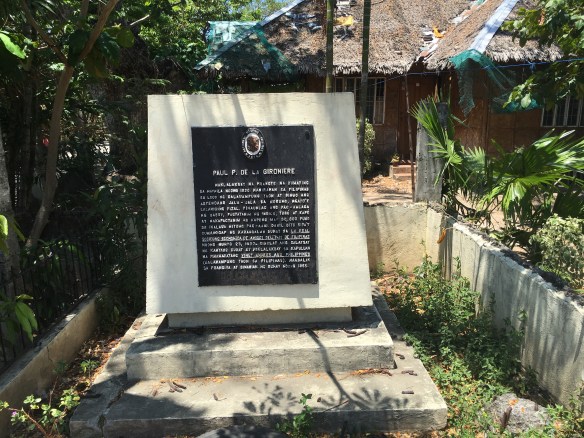
Was there anything left of Gironiere’s vast estate? All I could find on the Internet was a marker put up by the National Historical Institute in 1978 on what presumably had been his property, so I resolved to find at least that. We were there on the Wednesday of Holy Week, so I knew I had to catch someone at the municipio before it closed for the half-day, and fortunately a kind gentleman from the agriculturist’s office recognized the marker and offered to lead us there. And a short drive later, there it was, on a lot in the shade of towering acacia trees.

Nothing else would have suggested Gironiere’s presence, except possibly a stump of bricks in a corner of the lot. Not too far away was the water’s edge, and the slim profile of Talim Island, which Gironiere would have seen out his window. I struggled to imagine this spot as the center of a visiting Frenchman’s adopted life and holdings, his pursuit of bats and lizards, crocodiles and gold dust.

I didn’t feel let down; I was looking at an empty stage, but I knew the play, and I could hear the lead actor’s parting words: “Overwhelmed by the weight of troubles and of the laborious works I had executed, there was only one wish to excite me, and that was, to see France again; and yet my recollections took me continually back to Jala-Jala. Poor little corner of the globe… where my best years were spent in a life of labour, of emotions, of happiness, and of bitterness! Poor Indians! who loved me so much! I was never to see you again! We were soon to be separated by the immensity of the ocean.”

Penman No. 195: In the Afterglow

IMG_8194.jpeg

Penman for Sunday, April 10, 2016


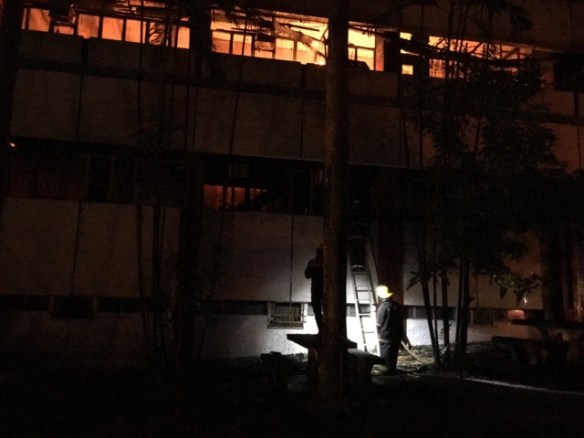
AS MANY of you know by now, in the early hours of April 1st, a Friday, the UP Faculty Center went up in smoke. I was playing poker at my usual haunt, the Metro Card Club in Pasig, when I got a flurry of text messages from Krip Yuson, who had just heard of the fire on Facebook. Distraught, Krip sent me pictures of the unfolding scene—flames were billowing out of the FC’s upper floors, and it was clear that nothing and no one could possibly survive such a catastrophic event. I thanked Krip for the heads-up, put my cards down, and drove off to UP to see the fire for myself.

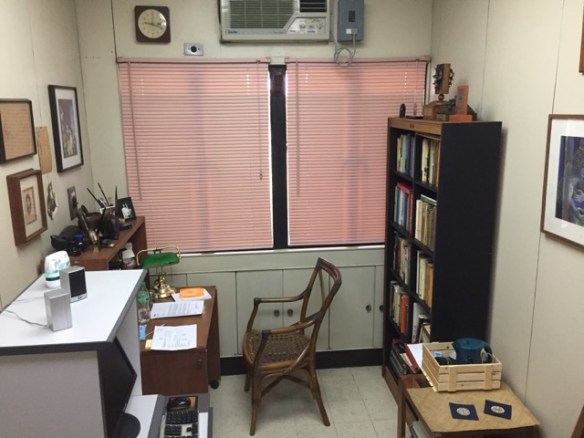
We live on campus, in a faculty bungalow on Juan Luna Street, a ten-minute walk from the FC, so UP was literally home for me. But I also held office at the FC, in the English Department, and the FC had been my official address for over 30 years since I began teaching in 1984. As I drove to Diliman I thought of my room, FC 1036, which I had had to myself since I came home from graduate school in 1991; before that, I’d shared FC 1012 with the late Angelito Santos and Ernie Bitonio, who became a lawyer and labor official.

Anyone who’s studied at UP Diliman would have gone through the FC at one point or another, and the place was rife with tales not only of intellectual and political adventure, but also of mischief of a baser, if more entertaining, nature. My favorite one, possibly apocryphal, had to do with an eminent lady professor going out on the window ledge and hanging on for dear life to spy on a neighbor whom she suspected of having an assignation with a student. Another hand-me-down scene involved two feuding scholars—one delivering a professorial chair lecture in CM Recto Hall while her nemesis handed out a vitriolic flyer at the door to anyone coming in.

It’s funny how the tragic can provoke the comic—and the professorial life certainly doesn’t lack for evidence of human frailty and folly—but it’s as good a response as any to personal loss, which was what the FC fire was really about. True, we lost a campus landmark and an academic institution. But buildings can be rebuilt—and the half-century-old FC was long overdue, anyway, for a massive renovation.

The FC’s subdivision into departments and then into individual rooms and cubicles guaranteed that each little corner would become treasured (and jealously guarded) personal space—not just mini-offices but mini-libraries and mini-galleries, showcases of both tradition and individual talent. Aside from the usual family pictures and diplomas (of which I actually saw precious few on display, perhaps in tacit admission of the silliness of flaunting one’s PhD in a boatload of them), shelves full of precious books and walls hung with choice art described the typical FC room, and each room’s state of order or chaos indelibly imprinted the tenant’s character on the visitor’s mind.

In UP, with historically low salaries and precious few incentives, a room of one’s own is an earned privilege. Professors are kings, and their offices are their castles and citadels, open to students and colleagues but impregnable to the unwelcome (except during martial law, when the military marched into the FC willy-nilly in search of Redheads). During the Diliman Commune in 1971, we’d renamed the place “Amado Guerrero Hall,” after the nom de guerre of Joma Sison, who had been an instructor with the English department.

Once aflame with revolution, now it was literally on fire, and three hours after the fire began, I watched as an eerie orange glow illuminated its interior. The text messages had shown tongues of fire curling out the windows, but the blaze had mellowed down a bit when I got there. Had I arrived at its peak, I would have been too excited to feel pain, but its muted state invited contemplation, which invited melancholy. I stood outside the building facing our department, facing my corridor, and understood that very little, if anything, would survive. (And of course the scene was not without its black—or should I say its blackened—humor; I overheard an exhausted fireman asking, “Does anyone have a cigarette?” I can’t write this account without thanking the dozens of firemen from all over who battled that inferno—you all deserved a good puff afterward.)

As my fellow FC denizens would do in the coming days, I began taking stock of what I was losing even as I watched: a Joya nude (one of two that Beng had saved from her days at Fine Arts; thankfully we had given one to our daughter Demi); a large giclée print of lilies gifted to us by Jaime Zobel; two paintings we had bought from a young Jason Moss; a National Book Award trophy by Agnes Arellano in the shape of a typewriter, my favorite among all my illustrious paperweights; my TOYM trophy by Napoleon Abueva, which, meaning no disrespect, did double duty as a hat rack; two of Beng’s serene waterscapes, which I had commandeered from her exhibitions; and a drypoint portrait that I had made myself (in another life as a printmaker) of her whom I was yet courting.

There were the books: among many others, a first edition of Without Seeing the Dawn, signed by its first owner, the novelist Zoilo Galang; a signed copy of Villa Magdalena by Bienvenido Santos; more first editions of NVM Gonzalez, Nick Joaquin, and F. Sionil Jose; and a copy of Ninoy Aquino’s prison testament, which Cory Aquino had signed and gifted to me in thanks for some speeches I had happily done for her pro bono.

And then of course there were my own books and papers—file copies of nearly all my books, and assorted publications, including 20 copies of the first printing of Penmanship, whose special paper I treasured and therefore hoarded; and my only copy of my dissertation. Luckily I had left only one of my fountain pens in the office, a Conklin desk set from around 1925, and a handsome crystal inkwell from Barcelona. Most of these could be replaced, but not the letters of friends and students over 30 years, nor the cane chair handmade by my late father-in-law, on which I took many a siesta.

IMG_6542.jpeg

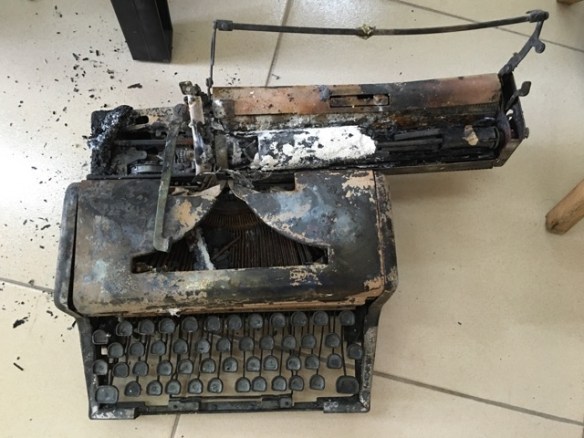
In the end, I found myself mumbling, “It’s all just things,” but of course it wasn’t. Men don’t grieve well, and over the next few days I grew increasingly sullen and irritable. Last Monday I joined a supervised foray into the burnt-out premises, just to see what we could recover. Almost everything we knew and owned had turned to mounds of char, which remained warm and smoky beneath our booted feet. From my blighted corner I picked up a ceramic mug that had lost its bottom. I also rescued a porcelain guan yin that belonged to Jing Hidalgo, and the ravaged hulk of a Royal typewriter I had given Isabel Mooney two decades earlier. We staggered out with our loot, laughing, and then the desolation hit us.

IMG_8243.jpeg

My grandmother Mamay used to sing us a lullaby which Ilonggos will recognize, about how life and sweet things will simply drift up and away in bitter smoke, and that weekend some of that life and some of that sweetness rose up into the air.

“We Pinoys are disaster-proof,” I tweeted at some point, mindful of how small our plaints seemed compared to a Yolanda. I do believe that, and we literary types have probably used up all our phoenix metaphors in the fire’s afterglow. But I’ve also always believed in proper goodbyes, so before we haul in the new furniture into the inevitable new FC, here’s mine, to ash-covered memory.

(If you want to tour the aftermath of the FC fire with me, see the video here.)

Penman No. 194: A Tree Grows at the Met

IMG_8118.jpg

Penman for Monday, April 4, 2016


THE FIRST and last time I saw a show at the Manila Metropolitan Theater must have been in the 1990s, for a production of Nick Joaquin’s “Portrait of the Artist as Filipino.” The theater was in fine shape then, and I recall being as enthralled by the place itself as by the spectacle onstage.

As a young boy in the early ‘60s, my father had worked at the old Department of Public Works building across Plaza Lawton (before they became the Post Office and Liwasang Bonifacio), and I had often tagged along to play with his red-and-blue pencils and his swivel chair. The most entrancing element in that locale, truth to tell, was the giant pot above the old Insular Ice Plant that spewed what seemed to be a steady stream of boiling water into a waiting coffee cup; but my eyes would stray to the strange pinkish building in the distance and I would wonder what went on there and what it held.

I got my answer, thanks to Nick Joaquin, but a few Sundays ago, I had an even more amazing opportunity to know the Met more intimately than I would ever have imagined. Sadly the intimacy was that which might exist between a doctor and a patient, like a probe of cold steel into some tubercular organ.

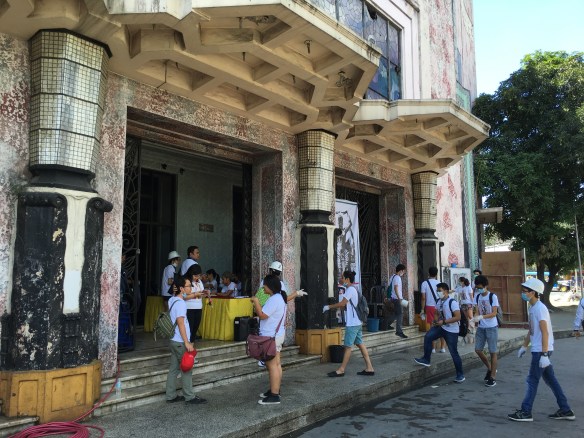
My wife Beng belongs to Kasibulan, a group of women artists, and they had been invited to do a sketching session at the old theater that Sunday morning, alongside a cleanup operation to be undertaken by volunteers. Did I want to come along, perhaps to take pictures, or at least hold bags and run errands for the ladies as they drew arches and vanishing points? Of course I did.

But before I go any further, especially for the benefit of our millennial readers, let me give a backgrounder on the Met and its sorry fate.

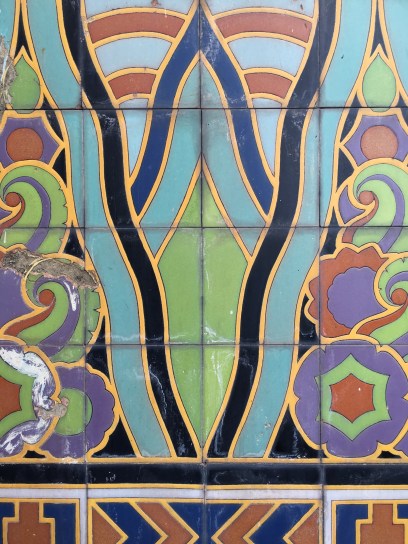
When the Manila Metropolitan Theater opened on December 10, 1931, it was an architectural wonder to behold and to step into—an Oriental palace in pink coral, crowned by exquisite minarets, statues, sculpture, and tilework. The overall style was Art Deco, the rage at the time, spilling over from the West but adapted to its new setting in the East. It could seat almost 1,700 people, and it had been put together and adorned by some of Manila’s finest architectural and artistic talents—designed by Juan Marcos Arellano, built by Pedro Siochi and Co., and decorated by the Italian sculptor Francesco Riccardo Monti, the sculptor Isabelo Tampinco, the future National Artist Fernando Amorsolo, and by Juan Arellano’s brother Arcadio.

IMG_8086.jpg

Erected near the site of its predecessor, the Teatro del Principe Alfonso XII which burned down in 1867, the Metropolitan was meant to be the city’s premier cultural venue, a showcase of the Filipino artistic genius. In its heyday, it hosted celebrated singers such as Jovita Fuentes and Atang de la Rama; from highbrow opera to the more popular zarzuela and vaudeville, the Met had the best to offer. Though damaged during the war, it was rebuilt and continued to be a haven for artists and entertainers until it began to decline in the 1960s, as other venues—and the growth of moviehouses in such places as Avenida Rizal, Escolta, and Cubao, followed by the establishment of the posh and modern Cultural Center—gained primacy among audiences.

At one point or other in its slide to abject decrepitude, the Met became a boxing arena, a movie set, a martial arts studio, a gay bar, an ice cream parlor, a TV stage, and a refuge for the homeless, among other incarnations. In 1978, Imelda Marcos took an interest and had the theater restored to its old glory, but then it fell again into disrepair, and was shut down in 1996 in a wrangle over ownership between the city government and the GSIS. Gloria Macapagal Arroyo and Mayor Fred Lim renovated and reopened it in 2010, when it was declared a “National Treasure” by the National Museum, but yet again it succumbed to politics, bureaucracy, and benign neglect; after a concert by the rock band Wolfgang in mid-2011, it was locked up by the GSIS.

In July last year, the ownership question was finally settled with the GSIS selling the property off to the National Commission for Culture and the Arts (NCCA), and shortly after the NCCA received P270 million from the Department of Budget and Management (DBM) for a fourth and hopefully final restoration, which the NCCA expects to complete by 2017.

It was this Met that we entered that Sunday. We were greeted by my UP colleague and one of the restoration project’s consultant-architects, Gerard Lico, who assigned two young but very capable juniors to guide our group on an all-access tour of the building. The lobby was buzzing with the enthusiasm of student volunteers from National University who, after an orientation and a safety briefing, filed into the structure behind their team leaders.

We followed them into a dark and cavernous hulk (the electricity had yet to be brought back), and encountered a touching mix of fragility and resilience. The Met had to be cleaned prior to restoration, and thus we were being privileged to see it at its most hapless state. There was dust and rust everywhere, and the wooden floorboards, reduced to a pulp, were crumbling beneath our feet.

Even so it demanded attention and respect, and we trod slowly, reverentially. Through the squalor emanated a lingering magnificence—the echoes of long-stilled operas, the footfalls of performers scurrying down the corridors. In one room was a tangled mass of costumes—a sailor outfit unmistakably from The Sound of Music—and when we stepped out onto the broad stage, you almost expected the spotlights to burst into life and the phantom audience to roar in approval. There was a hole in the stage floor and water in the orchestra pit, but nothing, it seemed, beyond repair, beyond human care.

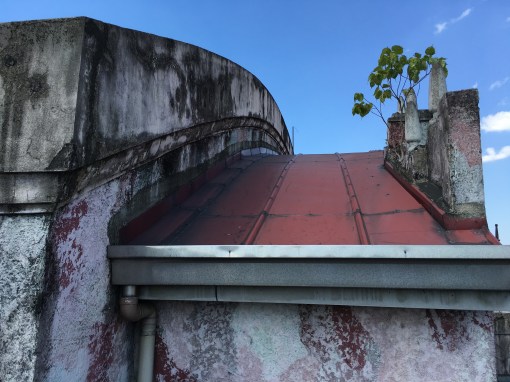
Out on the roofdeck, beneath the Moorish spires and the batik-inspired tiles, a small tree had sunk its rope-like roots into the masonry. I found myself hoping that it would be spared the restorer’s saw. Reprieves beget reprieves, and it would provide a fine organic testament to the Metropolitan’s endurance. (See more pics from our walking tour here.)

IMG_8072.jpg


Penman No. 193: Knowledge as Capital

2171790476_7c4dfcd25a

Penman for Monday, March 28, 2016


THE UNIVERSITY of the Philippines (UP) campus in Cebu City hosted the second presidential debate a couple of Sundays ago, and with education on the debate agenda, the setting couldn’t have been more appropriate. UP—so far, our only “national university” so designated—may be more than a hundred years old, but it continues to grow, particularly in places like the Visayas, Mindanao, and Central Luzon, where the demand for quality higher education is as great as ever.

Not too many people may have been aware of it, but in preparation for the debate—and indeed for the next national administration—UP President Alfredo E. Pascual commissioned a study by the university’s think tank, the Center for Integrative Development Studies (CIDS), to look into where we are in the regional scheme of things and how we can expect to catch up and compete with our more advanced neighbors.

Copies of the paper—titled “Knowledge-Based Development and Governance: Challenges and Recommendations to the 2016 Presidential Candidates”—were provided by UP to the staffs of the presidential candidates in advance of the Cebu debate. But knowing most politicians’ propensity to go for the sound bite and dwell on the personal, I tend to doubt if more than one or two of the candidates or their staffs found the time and the focus to read it.

It would be a pity if that indeed were the case, not only because of all the work that UP put into the paper (CIDS was backstopped by the offices of the President and the Vice President for Academic Affairs), but because of all the opportunities for development that we will likely miss, again, if our political leaders don’t heed what our top academic minds are saying.

The full text of the paper can be found here: http://www.up.edu.ph/wp-content/uploads/2016/03/20160315-UP-Knowledge-Paper-Final.pdf. For the benefit of our readers (and maybe the odd politician who will read this), I’ll unpack the technical jargon and get to the core of what the paper says and proposes.

It opens with an indisputable premise: Education is indispensable for economic development. More education means less poverty and income inequality, because it drives innovation and productivity, and helps people adjust to new challenges and opportunities.

But of course we already knew that. In a society like ours, we all look to education as the way out and the way forward, which is why our people slave for years overseas to put their kids through college. So sacred is education to the Filipino family that every candidate for public office, especially the Presidency, feels duty-bound to extol its virtues.

To be fair to the present administration, it’s put its money where its mouth is, for the most part. The study notes that “Since Benigno S. Aquino III assumed the presidency, government expenditure on public education has enjoyed annual increases. Out of the education sector‘s PHP364.9 billion budget for 2015, PHP43.3 billion was given to state universities and colleges—a 13.8 percent increase over the 2014 allotment…. Over PHP3 billion was made available for scholarships under SUCs and more than PHP2 billion for scholarships administered by the Commission on Higher Education. A total of PHP316 million (roughly 0.09 percent) was earmarked to fund research.”

That sounds good, but sadly it’s still not enough. The rest of our ASEAN neighbors spend an average of 5 to 6 percent of their GDP on education, but we try to make do with 3 percent. That’s why even our best universities lag behind their global and regional counterparts. The study notes that “In 2014, the University of the Philippines ranked only 8th out of the top 10 universities in ASEAN. In 2010, the Philippines ranked 89th in the global Knowledge Economy Index, far behind Singapore, which placed 19th.”

With all the new phones, computers, and call centers we see around us, we might be led to believe that the Philippines has become a high-tech haven, but that just isn’t so. (“We may be No. 1 in voice operations,” I once heard President Pascual say in relation to BPOs, “but were just around No. 9 in non-voice, which is where there’s more value-added. We need not just call center agents, but software engineers!”)

In its summary, the study observes that “Our level of technology remains low in quality and scale, and concentrated in low-productivity sectors. To catch up and move ahead faster, we need to raise our scientific and technological skills, which only better and more focused education can achieve.

“This calls for massive government investments in high-level knowledge capital—the so-called ‘suprastructure’ of economic growth. This human capital will create a knowledge-based economy driven not just by brawn but brains, tapping into one of our richest but least developed resources.”

In other words, and to put it plainly, we need more brainpower—more nerds, if you will—of the kind who can innovate, produce, do trailblazing research, and network with their global peers. That kind of knowledge can reap sizeable benefits for our economy, as it’s done for Singapore, China, Korea, and a host of other countries who’ve invested in their “suprastructure.”

But PhDs don’t come easy and don’t come cheap. UP argues that our government should have a plan to produce them systematically. The object of our educational system shouldn’t just be producing hordes of college graduates who can’t find good jobs, but graduates in fields and with skills that the economy actually needs. The best of them should be sent abroad for advanced degrees, and then brought home with sufficient incentives and an environment conducive to research. The UP paper goes even farther and recommends that in areas where we lack expertise, world-class professors and researchers should be enticed to teach here and work with their local counterparts, in the same way that Singapore was able to considerably shorten its learning curve.

While much of this will occur in science and technology, the paper wisely notes that “Because values are important in setting the right path to growth, the promotion of science and engineering should be closely integrated with the social sciences, the arts, and the humanities to ensure the holistic development of the Filipino.”

To spread the work and its benefits, the UP paper envisions a hubs-and-spokes model of development anchored on regional centers of excellence in certain fields—possibly even other national universities beyond UP.

There’s a lot more to be found in the study that was UP’s gift to the candidates—and thereby to the nation—but whether any practical good comes out of it will depend on the political leaders who govern our fortunes, and, ultimately, on us who vote them into office.

(Kindly note that as a “think paper” subject to further discussion, the study mentioned here does not necessarily reflect the position of the UP academic community as a whole, but rather of the researchers and offices involved.)


Penman No. 192: Reveling in the Risqué

IMG_7981.JPG

Penman for Monday, March 21, 2016


ONE THING I always knew but have seen more evidence of lately is that fact that when women get together, wonderful and even magical things happen. I suppose it has to do with the female predisposition to cooperate (versus the male impulse to compete). Case in point: the hugely successful literary reading billed as “Wordello,” which I plugged in this corner last month.

It had been conceived as a fund-raising project by the ladies of the Likhaan Creative Writing Foundation for the benefit of, among others, the UP Institute of Creative Writing (which I head, so I have a million reasons to be appreciative). But it turned out to be much more than just another reading of poetry and prose, mindful of how such events rarely go beyond sedate, even solemn undertakings where people stand up and mumble before politely attentive audiences.

This was one evening devoted to reveling in the risqué, to pushing the boundaries of the acceptable in a way that brought us back to the freer, more spirited Sixties. Remarkably, it had been organized by a group of middle-aged women as proper and as pedigreed as they come, people you’d normally associate with golf and afternoon tea. But the Likhaan ladies are also very fine writers in their own right, mentored by no less than Jing Hidalgo, and quite a few of them have taken classes with us in UP, so it was no surprise to find them indulging their subversive side.

I’d never been to the venue at the Green Sun on Chino Roces Avenue Extension, and when Beng and I got there last March 5, we expected to walk into just another hotel-and-restaurant lobby setup. Instead, a large corner of the place had been transformed, just for the evening, into a virtual bordello, with ladies in bare backs and slinky black lingerie well, slinking around. When I found my bearings, I was glad to run into and to chat with old friends like writers Charlson Ong, JB Capino (on a home visit from Illinois, where he’s been based), Carla Pacis, Cecille Lopez Lilles, Mabek Kawsek, Linda Panlilio, Bambi Harper, and Cesar Aljama, as well as BenCab and Annie Sarthou.

Most of the readings proved appropriately racy, and I had to explain that I had come as a bashful patron, choosing to read something fairly short and chaste. But elsewhere in the room, something smoky and sexy was going on. We had to leave a little early for another commitment that evening, so I asked Likhaan Foundation’s Chichi Lizot, the writer-translator busybody behind the project, to tell us what happened next, and how they put on such a good show in the first place. Here’s Chichi’s summing-up:

“We had heard of ‘poetry brothels,’ not only in New York and Paris, but also in other parts of the world. Were we ready for it here? The idea of presenting poetry, bordello-style, in a land of taboos was both daunting and exciting. It was then that ‘Wordello,’ coined by a poet and friend who joins some of us for drinks every so often, RayVi Sunico, was born.

“Working on the concept, pinning down sponsors, inviting poets, and finding a venue accessible to all began six months ago. Creating and feeding our social media sites got going in December. A handful of active members found friends along the way willing to help, spurred by the untrodden approach towards literature. There is something about the forbidden that excites.

IMG_7972.JPG

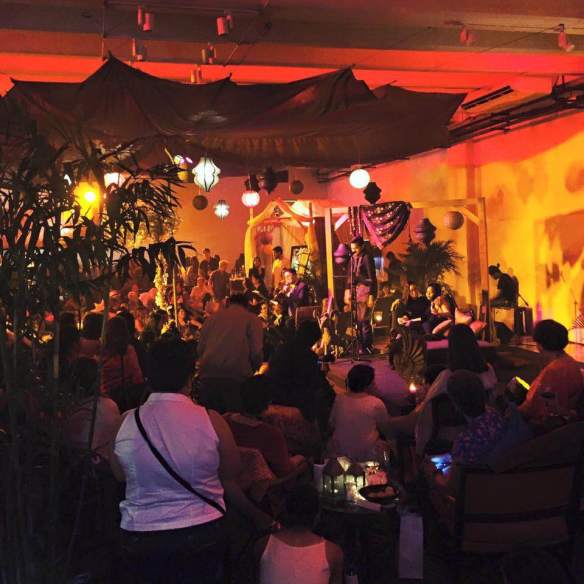
“Then came the evening of Wordello. Stepping into its entrance of beaded curtains after going through the ultra-modern corridors of Green Sun was like being transported into a secret world—of red, orange and magenta, of incense, alcohol, and erotica. It was a den of iniquity. It was Moulin Rouge—and much more. There were candles and Persian lamps. Carpets. Palm trees. Griffins standing guard. And in a cage, a masked executioner wielding an axe.

“The youngest in the audience must have been fifteen, the oldest, ninety-two. Some came in their chauffeur-driven imports, the others in jeepneys—any clothed, or rather, unclothed, comme il fallait. And as they hobnobbed with friends and strangers alike, they discovered a tarot reader of a monk in a nook somewhere. In a tent draped in extravagant silk, a body calligrapher was engrossed in a woman’s back, oblivious to spectators. Books and art pieces were up for grabs in different corners, incongruous yet fitting. The lively activity at the bar provided no respite to bartenders only eager to please. Omnipresent conversations thrived.

“And then from nowhere, a young poet delivered a line. Loud and clear. A male voice cried out from another corner. The room was stunned into silence. Yet another demanded attendance—this time female—delivering utterances from across the expanse of subdued light. Fifteen poets in a flash mob of sorts embarked us on a journey, harbingers all, of what was about to unfold. Their words were tame in comparison to the almost three hours of poetry, skits and the performing arts—mostly unbridled and unafraid. One or two in the audience left after the fifth number, scandalized. Most stayed, to either endure or embrace the words spoken by the inimitable and the sans pareil, and the fledgling.
IMG_7974.JPG

“The place was packed, denying access to waiters serving bar-chow. Seated comfortably in deep couches were the elderly. Many were happily relaxed on intricate pillows, risers, and carpets on the floor. Chairs had to be added in every space possible for the weary, but quite a few were content standing behind the bar or around divans, mesmerized.

“Sensei Shinobi, who performed the Japanese art of bondage on a defenseless but willing wisp of a woman, was saved for last. As we turned into voyeurs, watching with awe the dexterity with which Shinobi beautifully and artfully crafted rope around the young woman’s body, no one dared breathe. It was art in the sublime. And as he hoisted his model on a single metal ring that dangled from a scaffolding, and then twirled her around, a pin could have been dropped and heard.”

Bravo, Chichi, and merci beaucoup! Until the next iteration of what now deserves to be the year’s sauciest literary event.

IMG_7973.JPG


(Photos by Vidal Lim)


Penman No. 191: For Love of Art and Artists

FullSizeRender-4.jpg

Penman for Monday, March 14, 2016


MUCH AS I’d want, I can’t possibly go to all the literary and arts events I get invited to, so I’ve occasionally had to deputize my wife Beng (June Mercy Dalisay to others)—a painter and an art restorer—to do the kibitzing for me. Or, I should really say, for herself, because, as president of the Erehwon Art Foundation, she often has more immediate reasons than I do to meet with artist-friends and luminaries from the arts world.

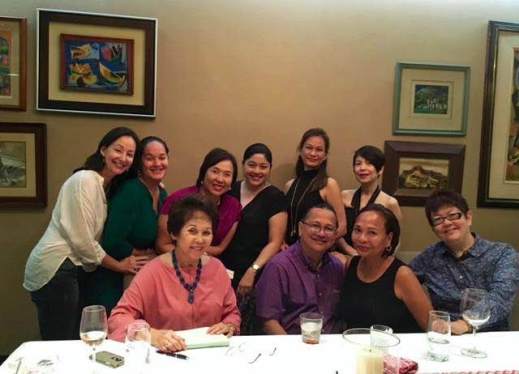
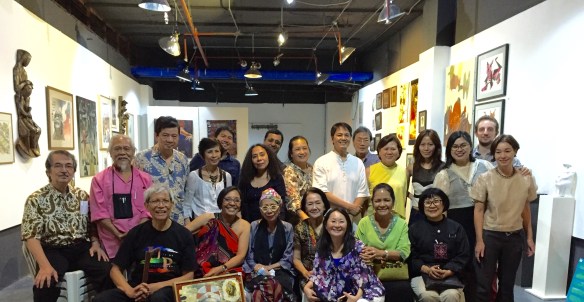
One recent event I was truly sorry to miss was a special raffle and auction held last February 27 for the benefit of Beng’s dear friend Norma Liongoren, doyenne of the Liongoren Gallery, sister, mother, and confidant of artists young and old. The Church Café, a Bible study group founded by Norma, initiated a fund-raising project for her, called “For Love of Norma.” The group was composed of writers Alma and Mario Miclat, painter Imelda Cajipe-Endaya, writers Fe and Roger Mangahas, sculptor Julie Lluch, and Magel Cadapan, Norma’s gallery assistant and curator.

Norma’s artist friends donated almost 150 artworks to the cause, and Simoun Balboa, manager of the Sining Kamalig gallery in Cubao, lent the venue. A mini-concert and performance was put together by pastor Ed Lapiz, together with the Day by Day Ministry, Kaloob Dance Group, and Jerry Dadap’s Andres Bonifacio Concert Chorus.

The event proved a resounding success, with the spirited bidding raising a substantial sum for Norma, who very graciously and bravely left her hospital bed to join the party with her husband Fred to personally give thanks. The audience—all deeply moved by Norma’s gesture—included writers Gilda Cordero-Fernando, Menchu Sarmiento, and Wilson Lee Flores, gallery owner Silvana Diaz, artists Junyee, Gus Albor, Adie Baens Santos, Anna Fer, and Ato Habulan, diplomat Al Vicente, Quezon City busybody Ruby Palma, pulmonologists Rene Cheng and Julius Dalupang, activist Princess Nemenzo, GSIS museum head Ryan Palad, and journalist Jenny Juan, who emceed the event. Beng helped organize the auction-raffle, which lasted well into the evening, along with businessman and art collector Sonny Go.

IMG_8407.jpeg

A few weeks earlier, Beng also attended a media event organized by her friend Ricky Francisco, an independent curator and fellow conservator, at the Fundacion Sanso in San Juan. This time I’ll let Beng’s words speak for themselves:

“It was a sunny afternoon when I walked up the steps of the new and modern building of the Fundacion Sanso. I passed through a lobby with minimal furniture but glimpsed lovely watercolor paintings that filled the walls.

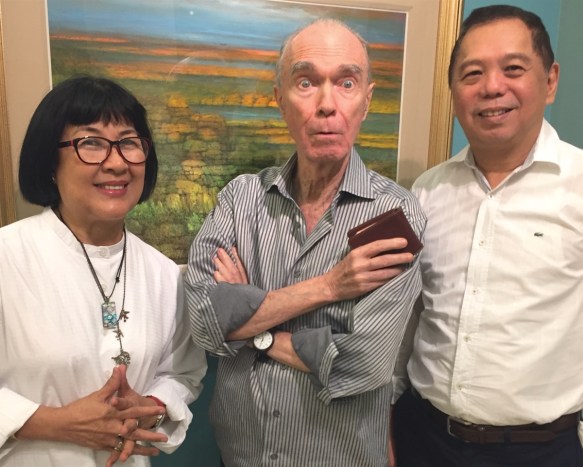
“I was late and the media event had started. I tried to be inconspicuous and sat between sculptor Toym Imao and a dignified elderly gentleman who turned out to be the artist himself, Juvenal Sanso. He looked at me and smiled. I smiled back and said a few words. He didn’t say anything and just nodded his head. Later I would know why.

“Gilda Socorro Salita, managing director of Fundacion, briefed the guests and media people on the series of events for the celebration of Sanso’s 70th year as an artist. The retrospective includes art exhibits at the Ateneo Art Gallery, the Vargas Museum, and the Lopez Museum. By the time this report comes out, the first in a series of exhibitions will have started, entitled ‘Other: Zobel and Sanso,’ an exhibition of prints and drawings at the Ateneo Gallery. This exhibition is free and runs until May 20. As a memento of the afternoon, the media kits given to everyone included a charming bookmark lifted from an old plate and printed on cream paper by Pandy Aviado.

“The guests began to leave but I decided to stay behind so I could talk to Sanso some more. But it was Ricky Francisco and gallery owner Jack Teotico whom I found myself with. Jack was one of the founders of the Fundacion, which serves as a repository of Sanso’s personal collection of artworks, books, and other mementos representing seven decades not only of creative work but also of travels and lasting friendships nurtured and preserved despite great distances. An old friend from our UP days, Jack invested not only funds but also much time and effort in gathering good people to run the gallery and museum.

“When I asked Jack why the artist seemed to have a hard time hearing, Jack told me the story of how, during the Second World War and when there was heavy fighting between the Japanese and Americans in Manila, a bomb landed just a few feet away from Sanso. He sustained injuries on his arm and still has tiny bits of shrapnel embedded under his skin. However, his hearing was greatly affected, and he remains practically deaf on the left side.

“The afternoon settled quietly into dusk as I was transported to many places and events from stories Jack and Ricky narrated—Sanso as a child of an affluent family in Spain, his country of birth; the blue-eyed Sanso as a young boy in Sta. Ana, Manila speaking fluent Tagalog, playing with boys of his age and forging strong friendships with his playmates, especially one with Henry Sy; Sanso as he diligently worked on his drawings with his teacher Alejandro Celis; Sanso as a student at the UP College of Fine Arts in Padre Faura and his friendship with artists Araceli Dans and Larry Alcala; and his entry ‘Incubus’ winning first prize in a competition held in the 1950s and sponsored by the Art Association of the Philippines then headed by Purita Kalaw-Ledesma.

“It was time to leave but before I did, I treated myself to the mesmerizing display of visual delights that represented Sanso’s beautiful watercolors from the Brittany series as well as the paintings representing memories of Parañaque and Cavite. Sanso’s haunting and mysterious images in the retrospective Elogio de Agua or Hymns to Water keep running like a lovely brook in a quiet corner of my heart. The exhibit can be viewed until October 1st at Fundacion Sanso, 32 V. Cruz St., San Juan City, Metro Manila.”

Many thanks, Beng, for that glowing report, which makes we wish I had been there to chat with the artist (and now I’ll know to stay on his right side). I’d always been engrossed by Sanso’s dark waterscapes and their vegetal inhabitants, made even more intriguing by the total absence of human figures.

IMG_8042.jpg

I did, however, tag along on a day trip up to Baguio last week with the folks of the Erehwon Art Foundation led by Beng and the foundation’s chairman, Boysie Villavicencio, on a very special mission: to receive the donation of an etching press to the foundation by none other than National Artist Benedicto Cabrera. I’ve been a frequent guest of Bencab’s at his museum because UP’s summer writers’ workshops have always begun with a visit with Ben (except this May, when we move to Los Baños), and I’ve watched that museum grow from a few stakes in the ground to the breathtaking complex and tourist attraction that it’s become.

Bencab was as gracious as ever in meeting us, and his donation of one of his two etching presses will be a great boost to Erehwon and to other Filipino printmakers. The press used to belong to National Artist Arturo Luz, who gave it to Ben in the 1990s. Erehwon is now planning a printmaking workshop with Fil de la Cruz, Ambie Abano, and other noted printmakers leading novices into the art.

As a former printmaker myself, I just might reignite this old passion, this fascinating interplay of paper, ink, and metal. It was at the old Printmakers Association of the Philippines (PAP) workshop and gallery on Jorge Bocobo in Ermita that I met Beng in the early 1970s, so without art and a shared love of it, we’d never have married, and this column-piece would never have happened.

Penman No. 190: A Makati Staycation

IMG_7988

Penman for Monday, March 7, 2016


THE WORD “staycation” must have been invented for people like my wife Beng and me, who now and then like to laze around in a hotel away from home, though not too far away that we’d have to book a flight or take a long bus ride. For those who’ve been living under a rock, a “staycation” is defined as “a holiday spent in one’s home country rather than abroad, or one spent at home and involving day trips to local attractions.”

For us Pinoys, a staycation is halfway to heaven. It’s neither home nor Hawaii; usually, it means parking the car and one’s brood in a local hotel, then spending the weekend pigging out on restaurant fare and TV marathons, scouting the nearby shops, and flopping around in the pool. So it’s not free, but it won’t break the bank, either.

Of course, there will be people who—for perfectly good reasons—will ask, “Why even bother? Why not just stay at home?” Yes, sure, home won’t cost you a thing, but that won’t do what a staycation does, which is to play and pretend for a blessed couple of days that you’re somewhere or someone else, like a tourist in your own country. A fancy word critics might use for the experience is “defamiliarization,” which is looking at the same old things with new eyes, producing unexpected effects.

Well, Beng and I got a pleasant dose of defamiliarization a couple of weekends ago when a friend generously passed us a staycation package that she and her husband couldn’t avail themselves of, and we found ourselves at the door of a hotel that we’d never really noticed before, in a neighborhood we’d never really lived in before.

The neighborhood, of all places, was Makati. Both steadfast northerners, Beng and I have lived in Quezon City nearly all our adult lives, and crossing Guadalupe Bridge—despite the many thousands of times we’ve done it for business and pleasure sorties to the south—still means crossing a psychological barrier. Makati was always just a place for shopping or for work, or otherwise for attending some bash at a big hotel. And I realized that until that weekend, it had probably been at least 15 years when we last slept over in Makati, thanks to our daughter Demi who was then working for a big hotel chain.

So it was about time we got a bit cozier with our southern metropolis, and off we went to the City Garden Grand Hotel at the corner of Makati and Kalayaan Avenues, a 33-storey, 300-room structure that I vaguely remembered seeing rising but had never stepped into. (An older and smaller cousin, the City Garden—minus the “grand”—was just across the street, and I almost mixed up the two.) The drive up the parking ramp was a bit steep and the elevator could have used a shot of adrenaline in its pulleys, but that would turn out to be the first and last of our complaints.

We were booked into a junior suite on the 30th floor, with a spacious living room and entertainment area (and a large sofa that could have easily slept one more) plus a bedroom with a king-size bed; the suite also contained one big bathroom and two toilets, two TVs, a full-size fridge, a microwave, and a coffeemaker—plus, let’s not forget that most essential of today’s amenities, free wi-fi. In other words, it was a hotel easily at par with its four-star counterparts in Hong Kong or Singapore in terms of creature comforts. We were on the north side of the building, so throwing our curtains open revealed a vista we weren’t used to seeing—our part of the city, stretching from the Pasig to the hills of Antipolo.

IMG_7958.jpg

An even better view could be had just two floors up, as we soon discovered. The City Garden Grand’s piece de resistance is arguably its 32nd-floor Firefly roofdeck bar, which offers a nearly 360-degree perspective of Manila and its environs. (A terrace on the 33rd floor is used for weddings and other special events.) Looking southward at sunset, Laguna de Bay shimmered on the left and Manila Bay glowed on the right, while behind us the darkening north soon lit up like a bed of stars. With a cold beer in hand, the swimming pool bubbling in a corner of the roofdeck, a barbecue on the grill casting its savory spell, and the city twinkling at our feet, we felt utterly transported. The sense of estrangement was enhanced by the preponderance of foreigners in the hotel’s clientele—Australians, Brits, and Germans, it seemed to me, who were leveling up from backpacking.

Beng’s a huge fan of breakfast buffets, and even more than dinner, we both look forward to a hearty breakfast to start the day with, and will often judge a hotel by its breakfast buffet; we’d rather live with a smaller room than a skimpy spread. In this respect, the City Garden Grand passed with flying colors, offering a range wide enough to please everyone, from mushroom with truffles to crispy dangguit (and the menu rotated from one day to the next, providing even more variety).

But the best was yet to come, as we were to discover at dinner. Beng and I usually prefer to go Chinese, but as a set dinner at the hotel’s Spice restaurant on the 7th floor was included in the “Love and Luck” package, we decided to give it a try, despite my well-known and admittedly strange aversion to fine dining. Dinner proved a pleasant shock to my pedestrian palate, from the organic mixed salad of shrimp toast and edible flower in strawberry vinaigrette to the broccoli and garlic soup with beetroot foam and focaccia bread to the entrée of beef wellington with bone marrow sauce (Beng’s choice) or sous vide of New Zealand salmon with brown butter asparagus (mine). (I may be a culinary philistine, but I’m addicted to food and cooking shows, so I knew at least what sous vide involved and meant—in short, scrumptious.) The dessert of deconstructed strawberry shortcake with berry coulis and chocolate marble proved too much, on top of everything—we ordered just one and happily had the other taken out.

IMG_8001.jpg

We were so impressed that we asked to see the chef, and were even more floored when he turned out to be no imported Frenchman or Swiss but an entirely homegrown 24-year-old, Ariel “Yeye” dela Umbria, a proud graduate of NCBA’s HRM program.

The surroundings of a hotel are always part of the package, and Beng and I were glad to spend the weekend exploring Century City Mall (just a couple of blocks away) and the Greenbelt-Glorietta area (a longer 20-minute walk, but good for the exercise). Of course, the entire Kalayaan-Jupiter district is a prime restaurant and entertainment zone, which we’ll revisit at greater leisure one of these days.

Meanwhile, our warmest thanks to that friend for the weekend break and for giving us more reasons to enjoy the metropolis; 30 floors up, it never looked so good.

IMG_7991


Penman No. 189: Hearing the Mermaids Singing

TS-Eliot-by-flickr-user-Burns-Library-Boston-College-e1390926344763.jpg

Penman for Monday, February 29, 2016


I GAVE my undergraduate class in Contemporary American Literature (English 42) a special treat the other week. Luckily for them, while moving things around the house, I came across a book that I’d picked up at a sidewalk sale in San Francisco several years ago—very probably one of the best bargain books I’d ever bought, at $6.99. It was a big, fat book titled Poetry Speaks, and it included 3 CDs containing nearly 150 poems by authors ranging from Alfred Lord Tennyson, Walt Whitman, and T. S. Eliot to Langston Hughes, Allen Ginsberg, and Sylvia Plath.

Now, there are many such compilations of poetry you can find online, but what makes this collection unique is that most of the poems are read by the poets themselves—yes, including Tennyson, Whitman, and Eliot, from the earliest days of sound recording. I thought that by sharing the recordings with my students, I would give them a unique opportunity to hear not only some of the world’s greatest and best loved poems but also how their authors actually sounded.

And while—like the children we sire into this world—a poem is on its own once it’s published, subject to the reader’s interpretation, a poet reading his or her own work gives us a privileged insight into the poet’s mind and sensibility. We listen for the general tone, the pace, the emphasis the poet gives to certain words and turns of phrase, even the way he or she ends a line and segues to the next. These inflections personalize the poem, and turn it from lines on a page to a breath in the air.

Let’s not forget that poetry preceded writing, and that, in our ancient past, poetry was meant to be recited, not read. It performed both a ritual and an entertainment function. The old epics contained and transmitted the story of the race, and elevated everyday speech to something close to magical (all of Shakespeare’s plays, when you take a closer look, were written in iambic pentameter). Even in more modern times, some poets still wrote mainly to be heard. The book’s introduction quotes William Butler Yeats as saying that “I wanted all of my poetry to be spoken in a stage or sung…. I have spent my life in clearing out of poetry every phrase written for the eye, and bringing all back to syntax that is for the ear alone.”

Sadly, poetry’s public aspect has diminished over the past century. Not only are today’s poems mainly meant for the printed page; their messages are also much more private, to the point of inscrutability. The study and appreciation of poetry has become an essentially academic exercise.

This disjunction between performance and privacy probably explains why poetry readings can become boring, with readers failing to connect with the audience, who can’t figure out what the poets are saying. It’s difficult enough to understand the poems on the page, and harder still to understand them while being mumbled.

I’ve often noted, with some dismay, how many of today’s readers of poetry bleed the life out of poems by mouthing the words with a mewling preciousness or otherwise in a mechanical march, without an understanding of the sense of the piece itself. Most poems are infused with vigor, with an attitude that the poet has taken toward the work and perhaps even its presentation to the world. Critics will argue with this proposition, but it stands to reason that no one should understand a poem better than the poet himself or herself.

Understanding and public presentation, however, are two different things, and not every poet can give their poems the intensity or the nuancing they deserve. That applies even to some poets in the CDs: forgivably, Tennyson sounds phlegmatic in his rendition of what should have been a rousing “Charge of the Light Brigade,” but he was already 80 when Thomas Edison recorded him in 1889.

By contrast, Robert Frost (reading “The Road Not Taken” and “Stopping by Woods on a Snowy Evening”) and Sylvia Plath (reading “Daddy” and “Lady Lazarus”) sound resonantly clear and confident. T. S. Eliot reads all eight minutes of “The Love Song of J. Alfred Prufrock” in a thin, reedy voice—now totally British, a complete transformation of the former American born in Missouri who moved to England at 25—but somehow it’s what you expect of the man and the poem. I was in the bathroom as I listened to Eliot over the speakers at full volume, and found myself following along: “I have heard the mermaids singing, each to each…”

ACTIVITIES LIST.jpg

And if you’d like to hear more such mermaids, I’d like to invite you to “Wordello,” a very special and unique literary reading hosted by the Likhaan Creative Writing Foundation to benefit writing scholarships and other worthwhile literary projects. The Likhaan Foundation has been the UP Institute of Creative Writing’s steadfast partner in many an undertaking, and we can’t endorse Wordello strongly enough.

Inspired by the Poetry Brothel in New York, Wordello will happen on Saturday, March 5, 2016 in Green Sun, 2285 Chino Roces Ave. Ext., Makati. Doors open at 5 PM. Tickets will be sold for P1,000 (students with IDs come in at half-price), which will cover the show, drinks, bar chow, and special presentations. I was told to expect “a rope bondage presentation, calligraphy writing on the back of a woman, tarot card readings”, and so on, which all sound positively intriguing, but before your imagination runs riot, let me assure the prayerful that the good ladies of the Likhaan Foundation are as convent-bred as they come, but thankfully with a wicked sense of humor.

The invited readers include Krip Yuson, Jing Hidalgo, Marne Kilates, Vim Nadera, RayVi Sunico, Neil Garcia, Ramil Digal-Gulle, Alma Anonas-Carpio, Peachy Paderna, Asha Macam, Danton Remoto, Juan Labella, Mii Marci, Franz Pantaleon, Eliza Victoria, Karen Kunawicz,
Claire Miranda, Monique Obligacion, Maxine Syjuco, Trix Syjuco, Cesare Syjuco, and myself.

For more information, please check out https://www.facebook.com/wordelloph/info?tab=page_info or contact Chichi Lizot at chichilizot@gmail.com.

See you all on March 5 at Wordello—let’s make the spoken word rock!

[Image from jubilee-centre.org]


Penman No. 188: Risk and Reward in the Collectibles Market

14314401260_4553a0384a_b

Penman for Monday, February 22, 2016


I’M GOING to be talking a lot about pens in the next paragraphs, so you might think of turning away if they hold no interest for you, but this is really about collecting and purchasing decisions as a whole, and could just as well apply to cars, watches, Star Wars figurines, and whatever else people hoard in their inner sanctums. If you’ve been bitten by the collecting bug, do read on.

Dr. Jonathon Deans is an Australian economist who specializes in the study of energy and commodity markets, and who teaches economics at the University of Newcastle. But away from his day job, Jonathon pursues a hobby with equal passion: collecting fountain pens. And unlike most of his fellow stylophiles (the fancy word for the addiction) who simply chase after and gloat over their inky toys, Dr. Deans has managed to merge his two interests by running a highly regarded blog on “Pen Economics” (www.peneconomics.com), tracking and discussing the vicissitudes of the global market for writing instruments.

Jonathon happened to be in town these past two months to accompany his partner Lisa, a Colombo Plan fellow and Development Economics student at De La Salle University, whose Economics department is headed by Dr. Gerardo “Bombit” Largoza—by uncanny coincidence, another fountain-pen collector and fellow member of Fountain Pen Network-Philippines (www.fpn-p.org). This happy confluence led to DLSU sponsoring a well-attended lecture two Saturdays ago by Dr. Deans at La Salle on “Adventures in the Fountain Pen Economy.” (He’s left for now, but will be back in April.)

Jonathon explained that central to the economics of the matter is the idea of price vs. value, and where value (how strongly we desire the product) exceeds price, a purchase will likely be made. I listened with great interest and some amusement to his observation that many buyers of modern pens are risk-averse. He admitted that he was one such person himself, and noted further that he valued a close relationship with his favorite pen dealer—even at the cost of paying a certain premium over regular prices—because of the many benefits afforded by such relationships, chiefly personalized service and unparalleled solicitude.

dgxBJDT

I couldn’t agree more with Jonathon (who gave a brilliantly comprehensive and insightful overview of the global fountain pen industry and particularly of our behavior as consumers). My amusement, however, came from my realization that while we thought alike on many important things (like our shared love of the Montblanc Ernest Hemingway, a pen considered a “holy grail” by many collectors), we differed in a few basic respects, particularly my greater willingness to take risks, to navigate the choppy waters of eBay to fish for rare species of vintage pens. But then, of course, I’m a poker player, so am more comfortable with taking calculated risks (and losing as well, because of over-optimistic calculations). My collection contains mostly vintage Parkers and modern Montblancs, so I found myself asking, what makes consumers favor one over the other?

The risks in buying, say, a 1928 Parker Duofold vs. a brand-new Parker Premier seem obvious. The modern pen should be shiny and trouble-free, and if it shows any problems or defects will be replaced under warranty. Being older than your grandfather, a vintage pen could be broken, leaky, warped, or missing parts, or otherwise difficult to operate, maintain, and repair.

So why do vintage buyers and collectors seem more willing to take more risks, and even court them? One trade-off is a generally lower cost. If the items work or if you can make them work, then they will likely be well worth their price. But there are also unquantifiable values to be added to vintage objects, values that help account for their allure: the cachet of age and relative scarcity or even rarity, the history of the object itself and its provenance, and materials and workmanship you won’t find on the modern factory floor.

In buying vintage collectibles, risk can be reduced by knowledge. For the highly knowledgeable buyer or collector, who will be aware of the common pitfalls of the vintage trade, the opportunity of acquiring a rare object at low or reasonable cost far outweighs the risk of receiving an object not as described, with no return option, or needing service. (Those risks will be even more diminished in direct physical sales, not online. But even online, the risks of buying pens long-distance—whether vintage or modern—are drastically reduced by eBay’s built-in money-back guarantee: if you don’t get the product as advertised, your money will be refunded.)

Indeed this ratio of risk to reward forms a great part of the thrill and satisfaction of vintage acquisition. While buying a new car from a dealership can be pleasurable, it’s hard to equal the excitement of finding, say, a 1952 Volkswagen Hebmuller tucked away in an old garage. While these two buyers will likely be two different people buying for different motives, many collectors will weigh both options, anticipating and investing in the collectibles of the future as shrewdly as they assemble the best pieces from the past.

With very few exceptions, vintage pens can only be bought on the second-hand market, where warranties and returns normally don’t apply. They are often sourced by enthusiasts and pickers in the wild, from estate sales, yard sales, resale shops, pawnshops, and small, out-of-the way antique shops. Eventually many get aggregated by dealers who sell online, on eBay and in their Web stores. The transition from a sale at the flea market to one concluded via PayPal is important, because here a certain measure of security can be afforded the buyer, not to mention the possibility of paying less for a prized pen at auction. (I’d typically pick up a $200 pen for $50, and resell it for $100 to finance other purchases.)

In fact, as far as eBay is concerned, I’ve probably had 1,000 transactions on eBay these past 19 years, and in the two or three times I’ve had to avail myself of its money-back guarantee, it worked without a hitch. This leaves just the risk of being disappointed and of being inconvenienced by the refund process.

Knowing this, the knowledgeable eBay buyer can take even more risks with the pen itself—that poorly photographed Vacumatic could be a sought-after Oversize, and therefore worth paying $50 more for. While the eBay guarantee will not refund the buyer in case the pen turns out not to be the desired Oversize (if it wasn’t advertised as such), it can give the buyer an extra boost of confidence to make a purchase, any purchase, in the way that gamblers may tend to play more aggressively in comfortable and well-secured casinos.

So yes, there are indeed more risks involved in buying vintage, and buying online; but the rewards, both physical and psychic, are also potentially great, and as Dr. Deans emphasized in his talk, when the buyer perceives value exceeding price, a purchase will be most likely happen, to the dismay of our bank accounts and hapless partners.

[Photo of Jonathon by Chito Gregorio]