Qwertyman No. 172: They Chose to Act

Qwertyman for Monday, November 17, 2025

AS A professional writer and editor, I take on many jobs that the other side of me—the fictionist, journalist, and teacher—usually wouldn’t get to do. I write biographies, speeches, and feature stories, among others, and while I do them to the best of my ability and to my clients’ satisfaction, they don’t always coincide with my personal interests, nor necessarily inspire me to think or act a certain way.

These past two years, however, I’ve been proud and privileged to perform a very special assignment that I’ve come to look forward to, because it renews my faith in people and my hopes for a better future—phrases that would otherwise just roll off the tongue like so many other tired and meaningless clichés. At 71, I’d like to believe that I’ve pretty much seen it all and can afford to be cynical, as even Gen Z’ers can affect—a bit prematurely, I think, but understandably so in this sad and sordid world of ours.

So it often comes as a surprise to be reminded that some good people persist at doing good if not great deeds, and that’s what this unique responsibility I’ve taken on is all about—writing the citations for the year’s Ramon Magsaysay Awards laureates, a task I inherited from RMAF stalwart Jim Rush and National Artist Resil Mojares. (Before I go any further I should clarify that I have nothing to do with the selection process, I am covered by an NDA—not even my wife gets to know the winners ahead of everyone else—and I cannot and do not cozy up to the likes of Hayao Miyazaki for selfies and signatures.)

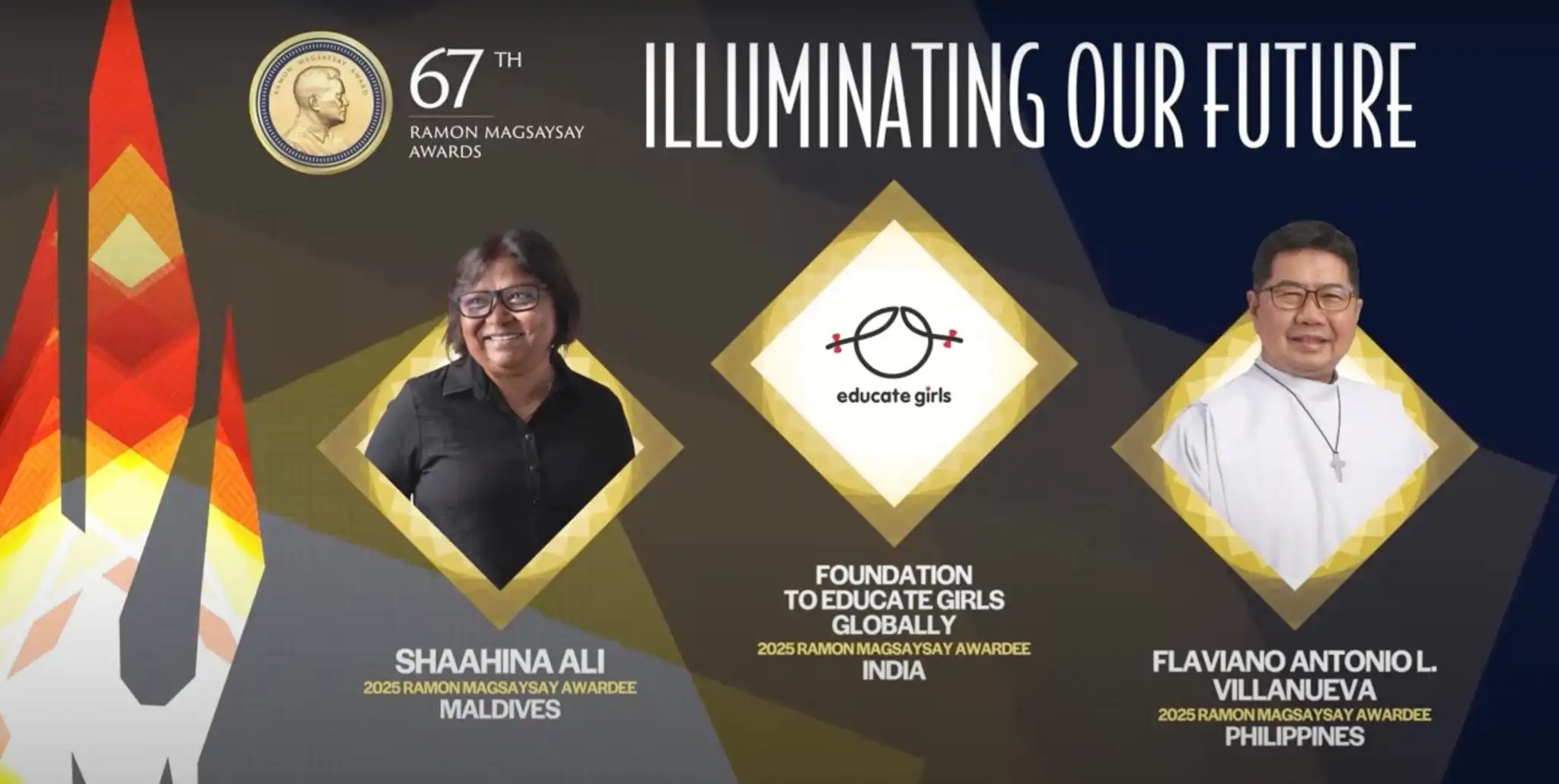
This year only three laureates were chosen, but again the range and the depth of their accomplishments tell us that ordinary people can achieve extraordinary successes—not just for themselves but for society at large—with vision, faith, and perseverance, or what the Ramon Magsaysay Awards Foundation calls “greatness of spirit,” the common element among its 356 winners from 23 countries since 1957.

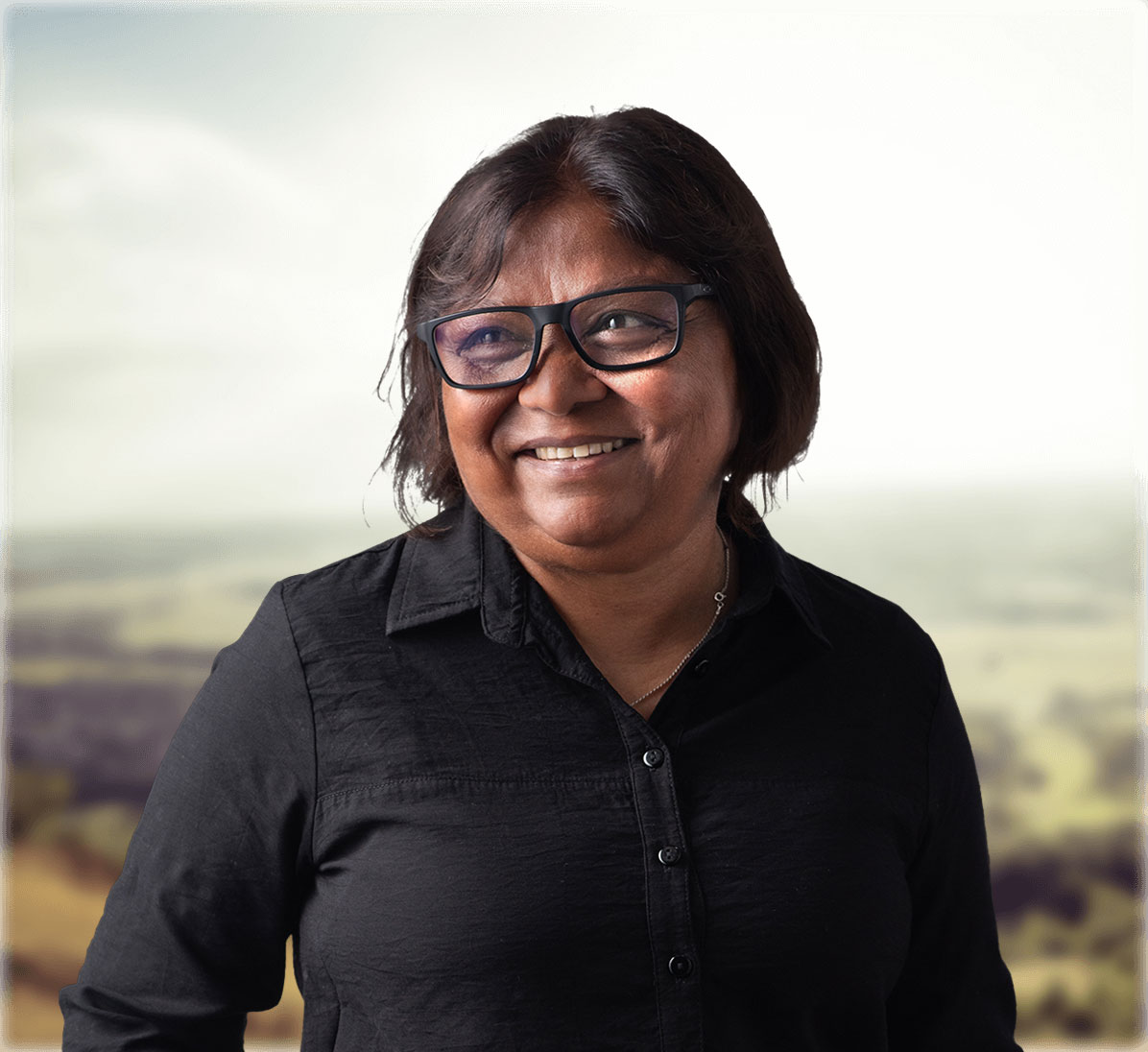
They included Shaheena Ali from the Maldives, an island-country that often appears in tourist brochures and websites as a tropical island paradise, surrounded by aquamarine waters ideal for snorkeling and fishing. Behind this idyllic façade, however, lies a murkier and unpleasant truth. Plastic pollution has befouled the island chain’s crystalline waters, threatening the marine ecosystem, the economy, and the health of its residents. Waste is either burned or tossed into the ocean, producing harmful smoke and microplastics. As a diver, photojournalist, and diving instructor herself, Ali often came literally face to face with the tides of trash clouding up the once-pristine waters of her beloved islands.

In 2015, deciding to fight back, Ali linked up with an NGO, Parley for the Oceans, to frame a comprehensive program to save the country’s waters from pollution and to turn plastic waste into a useful source of livelihood for the people. Today, as executive director of Parley Maldives, she oversees the implementation of their signature strategy: Avoid, Intercept, and Redesign (AIR) plastics for a better environment. With Ali, Parley has introduced plastic interception and collection sites in island communities and over seventy schools, leading over 700 collaborative cleanups along affected coastlines. Ali has also worked with the government to address climate change. “I go there to clean up with hope,” she says, “hope that my grandchildren will see whales in the ocean in their lifetime as I did growing up.”

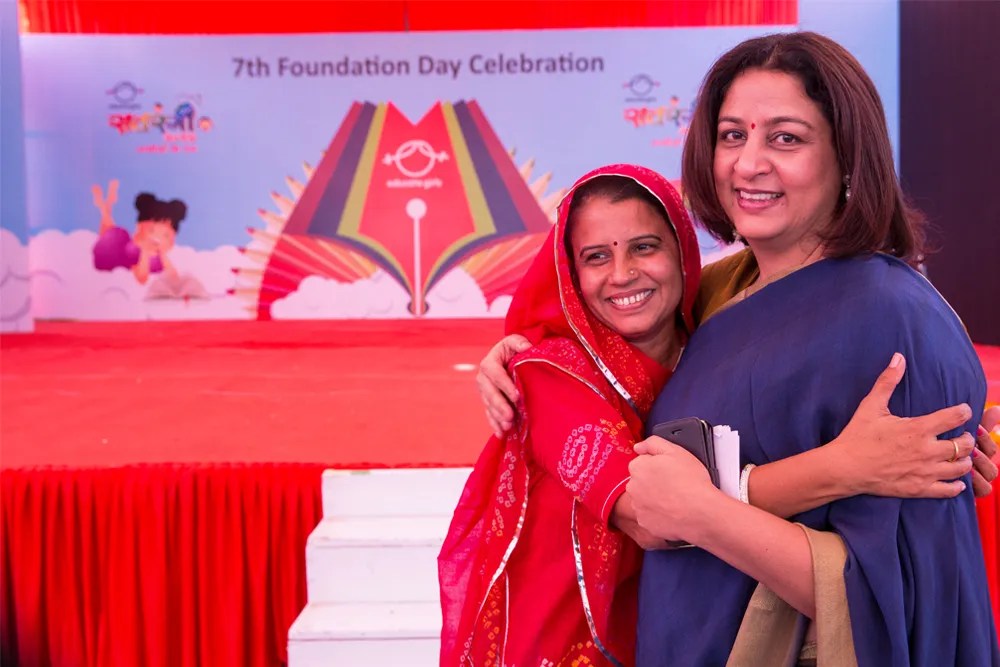
For its part, India has become both an economic and political powerhouse, with many visible signs of its rising affluence. Despite the overall surge in growth, however, many rural and tribal girls have had no access to an adequate education. Because of this disparity, illiterate girls are forced to marry early, have children, and work—while culturally privileged males go to school. 

In 2005, a young graduate of the London School of Economics decided to return home to India to take on this challenge. Safeena Husain established the Foundation to Educate Girls Globally (FEGG) or “Educate Girls.” Starting out in Rajasthan, Educate Girls identified the neediest communities, brought unschooled or out-of-school girls into the classroom, and worked to keep them there until they were able to acquire credentials for higher education and gainful employment. 

The results were dramatic. What began with fifty pilot village schools reached over 30,000 villages across India’s most underserved regions, involving over two million girls, with a retention rate of over 90%. Educate Girls also launched Pragati, an open-schooling program that allows young women aged 15-29 to complete their education and avail themselves of lifelong opportunities. Its initial cohort of 300 learners has grown to over 31,500. “Girls’ education is the closest thing we have to a silver bullet to solve some of the world’s most difficult problems,” says Husain. “It is one of the best investments a country can make, impacting nine of the seventeen Sustainable Development Goals, including health, nutrition, and employment. By scaling our programs, deepening government partnerships, and embedding community-led solutions, we strive to create a brighter, more equitable future—one girl at a time.” 

The third awardee was no stranger to those of us long aware of his special ministry. Flaviano Antonio L. Villanueva or simply “Father Flavie” belongs to that breed of socially committed clergy for whom godliness is to be found not in the halls of influence and wealth but in the streets, among the poorest and the most forgotten. 

In 2015, he founded the Arnold Janssen Kalinga Center in Manila to provide “dignified care and service” to thousands of poor and marginalized Filipinos. Kalinga works to recreate the poor’s self-image, reclaim their self-respect, and restore their self-worth. Villanueva also led the effort to locate the bodies of victims of the government’s “war on drugs” where thousands of Filipinos were summarily executed. Often, their impoverished families could not secure permanent graves for them. Villanueva found the funds to exhume, cremate, inurn, and relocate the bodies to a proper resting place. This Paghilom program brought comfort to widows and orphans and allowed them to continue leading productive lives. “Justice can take many forms—among them, the recovery of one’s self-confidence, and forgiving oneself,” he says. Following the late Pope Francis’ example, he initiated showers for the homeless as both a literal and symbolic act of cleansing, to prepare them for a fresh start in life.

I always end up doing more than writing up these people’s stories—I learn from them, and am reminded that instead of just mouthing slogans and railing at the universe—at all the evil, the injustice, and the ugliness we have to live with—we can choose to act and to fight back, like these avatars of social action did. 

Qwertyman No. 171: “Quezon” as Theater

Qwertyman for Monday, November 10, 2025

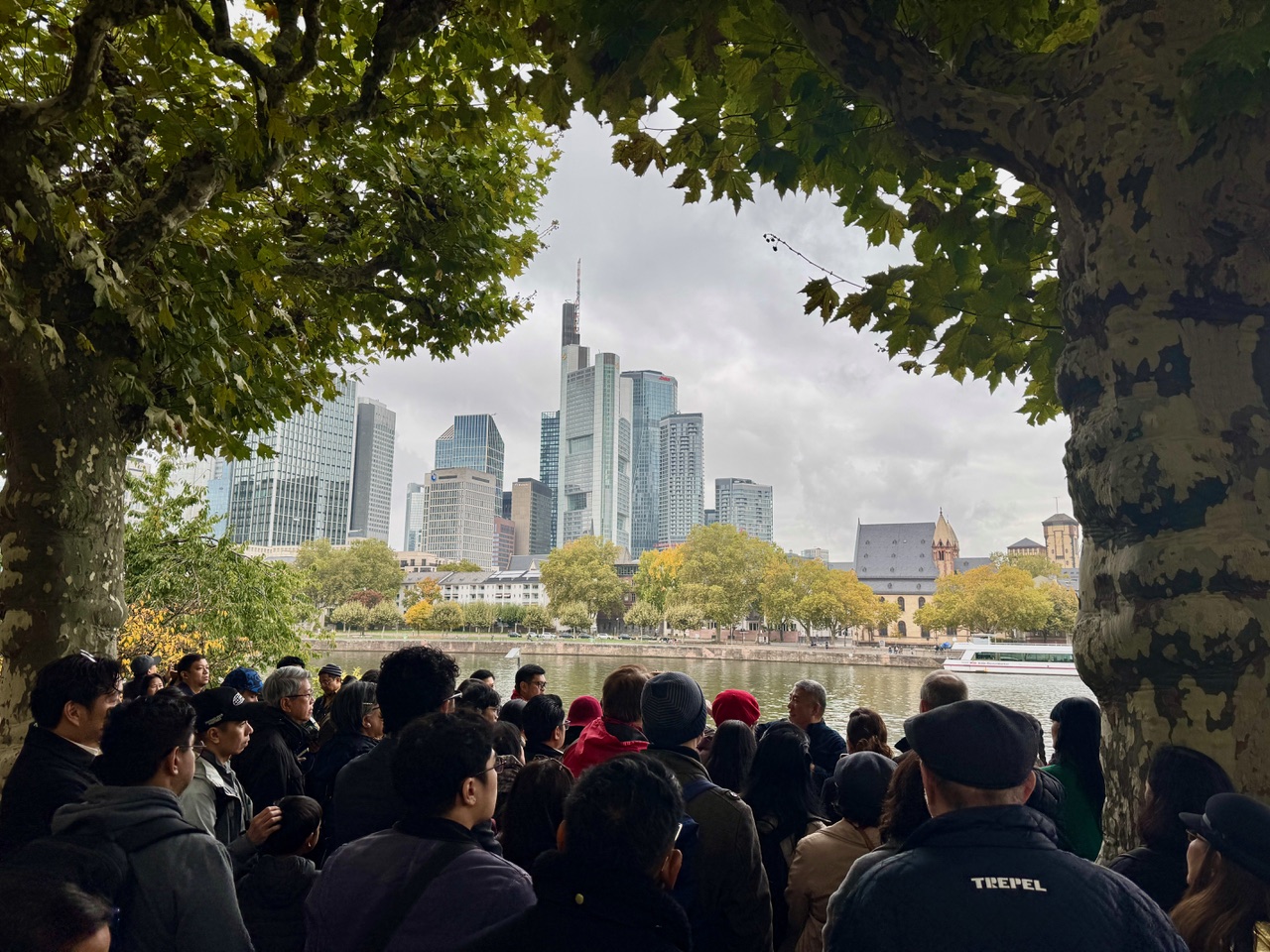
I’M COMING late to the party, having been away for a couple of weeks, but even in faraway Frankfurt, I was itching to come home to see what the brouhaha over the “Quezon” movie was all about.

Rarely does a Pinoy movie stir a hornet’s nest like this one did, and even without seeing it, I took that as a good sign for our film industry, especially big-ticket projects which sometimes leave people wondering why they were even made.

What especially piqued my interest, of course, was the reaction of Quezon family members and friends who thought the old man’s cartoonish depiction as a womanizing, scheming, and power-hungry politician despicable.

Now, my own grandfathers led pretty quiet lives, so I’m sure that if anyone called them womanizing, scheming, and power-hungry, I’d be mighty upset, too.

The difference is, unlike my lolos and going by what the historians suggest, Manuel Luis Quezon seems to have been all of the above—which isn’t to say he wasn’t much more than all those negatives put together. It was apparently that “much more” that the Quezonistas were looking for—MLQ the patriot and freedom fighter—to balance out the picture, especially since most young Filipinos know nothing of the man except as a place-name. Had that been shown, the outrage might arguably have been muted, the image softened.

But of course that wasn’t what the movie’s makers were going for. As has already been noted by dozens of reviewers before me, “Quezon” is no documentary (and let’s not forget that even documentaries can be biased—just watch Leni Riefenstahl’s adoring portrayal of Hitler and his Nazis in her bizarrely beautiful “Triumph of the Will”). From the outset, it declares that it is mixing up history with “elements of fiction,” which is just as good as using that old commercial come-on, “based on a true story.”

I’m no historian—I’ll confess to being an enthusiast—but as it so happens, I’ve been a playwright, screenwriter, biographer, and fictionist at various points of my otherwise uneventful life, so I can probably speak to these issues with some experience. I can attest, for example, having written some biographies of the rich and famous, that families and descendants can inherit myths about their patriarchs, and treat and pr0pagate them as God’s own truth. 

My take is, I don’t think we should receive “Quezon” as history, biography, fiction, or even film. It’s theater (captured on film), and it declares itself as such right from the beginning, as I’ll shortly explain. This may be due to the fact that the script was co-written by one or our most accomplished playwrights, Rody Vera, alongside director Jerrold Tarog. His approach was explicitly stylized and non-realistic, from the use of silent-movie title cards, ghoulish makeup, and painted backdrops in the black-and-white sequences (including that almost balletic choreography of the young MLQ rising from the floor of his prison cell) to the conception and blocking of such scenes as those of Quezon working the floor of the House and the capitalist bosses gathering round the table. (If all this seems obvious and elementary, dear reader, my apologies—in these days of TikTok, I don’t know what people are looking at anymore).

So what if the movie is theater disguised as film? Does that explain or excuse its supposed excesses and exaggerations?

Well, theater is, almost by nature, exaggeration—movements and motives get simplified and magnified, the easier to get them across. Theater is agitational—it aims to provoke emotion, to bring people to their feet, clapping in delight or screaming in rage.

And that’s what “Quezon” did, didn’t it? It got its message across, effectively and efficiently, like a train on schedule, and taking it as theater, I found it roundly entertaining. By and large, the actors carried themselves off with aplomb, from Jericho Rosales’ masterful Quezon, Romnick Sarmenta’s comic-cool Osmeña (his was actually the most difficult role to play, to my mind), Mon Confiado’s aggrieved Aguinaldo, and Karylle’s restrained Aurora. The employment of the fictional journalist Joven Hernando was what a smart scriptwriter would do, to weave the narrative threads together. (Teaser: Quezon and Aguinaldo figure in the novel I’ve been writing about prewar Manila.)

My quibbles have to do with minor complaints like (don’t be surprised) “Wrong period fountain pens again, all of them—why don’t they ever ask me?” (Quezon did hold his pen that odd way, though) and “Does every movie chess scene have to end with a checkmate?” I could have added “Why does everyone’s shirt and pants look fresh in a period movie?” but we’ll excuse those as theatrical costumes.

If there was anything I would have added to the content, it would have been a quiet moment of self-reflection, in which we realize just how Quezon sees himself. That alone might have lifted up his character from caricature.

The real Quezon seems to have been every bit as petty as the movie shows him to be, but also every bit as great, as it seems to have taken for granted.

Quezon had something of a history with the University of the Philippines, whose protesting students (one of them a young buck named Ferdinand Marcos, who accused Quezon of “frivolity” over all the dance parties in Malacañang) led him to ride into UP’s Padre Faura campus astride a white horse to either charm or intimidate them.

He had a long-running tiff with then UP President Rafael Palma over the Hare-Hawes-Cutting Act, and when Palma retired after ten hard years in the hot seat, citing a technicality, the government denied Palma the gratuity that was his due. When Palma died, however, Quezon reportedly went to his wake to deliver a eulogy worthy of the man.

You didn’t see that Quezon in the movie—and then again, maybe you did.

(Image from banknoteworld.com)

Penman No. 479: Postscript to Frankfurt

Penman for Sunday, November 2, 2025

IT WILLl be remembered as one of the largest, most complex, possibly most impactful—and yes, also most expensive and controversial—showcases of Filipino cultural and intellectual talent overseas, and above and beside all else, that fact alone will ensure that few things will remain the same for Philippine literature after Frankfurt 2025: it will be remembered.

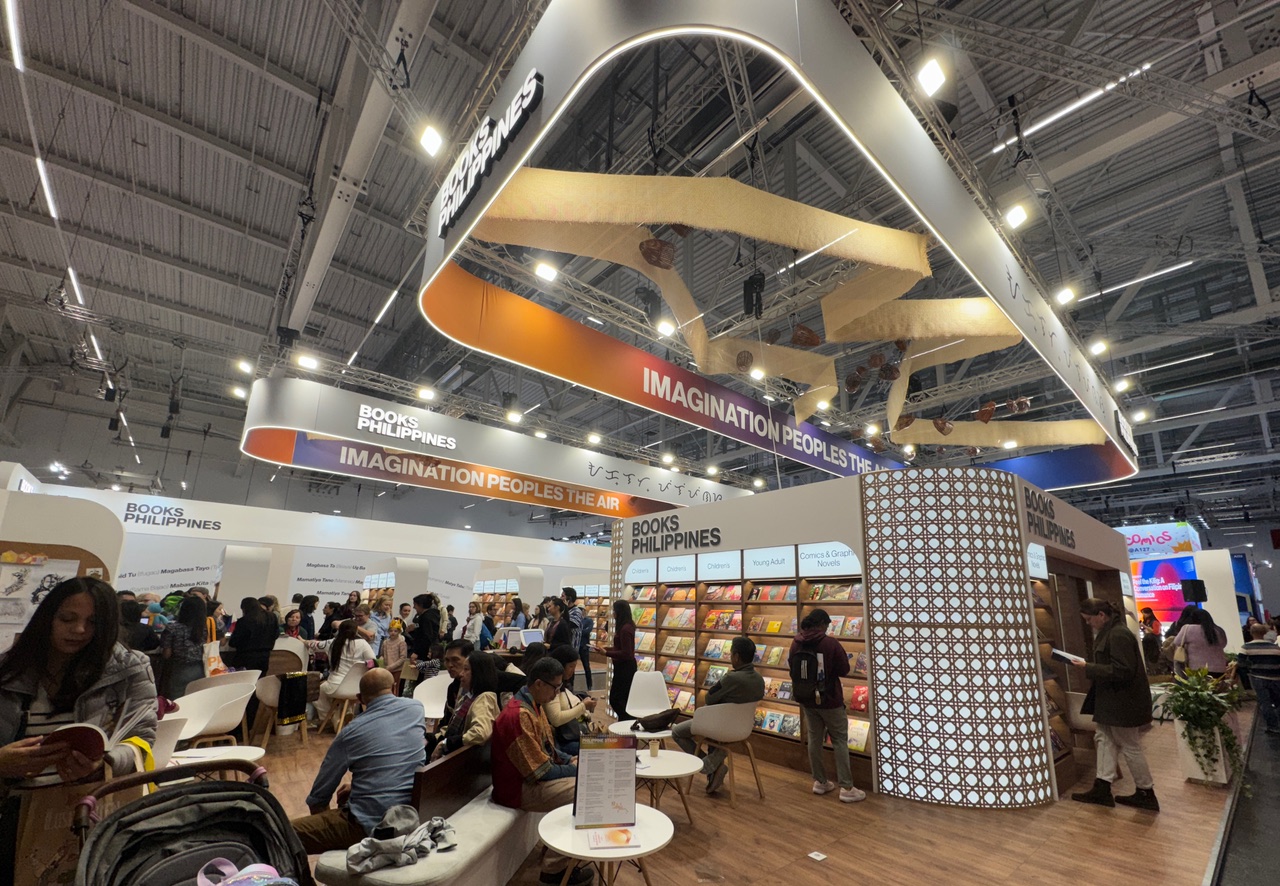
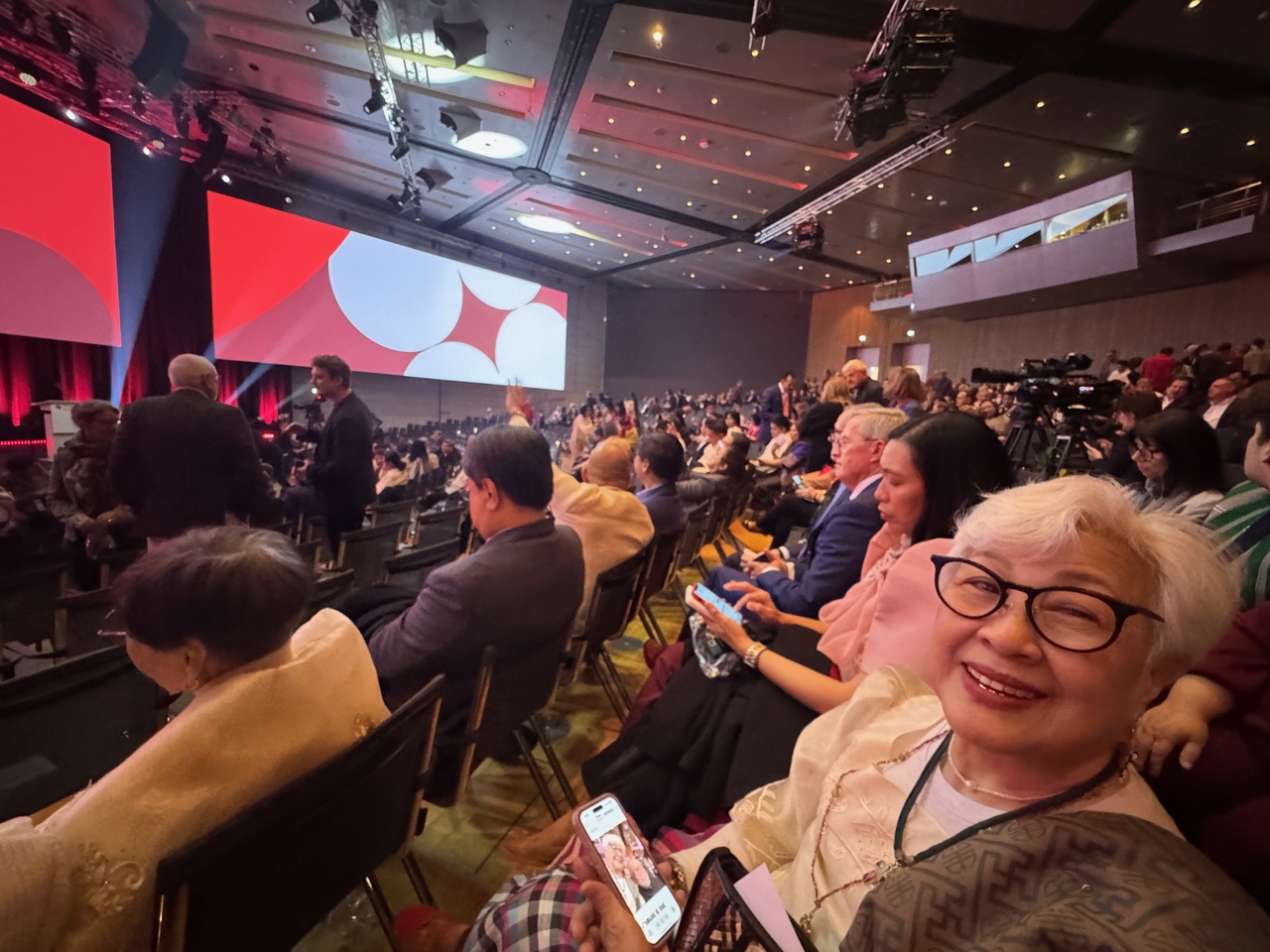
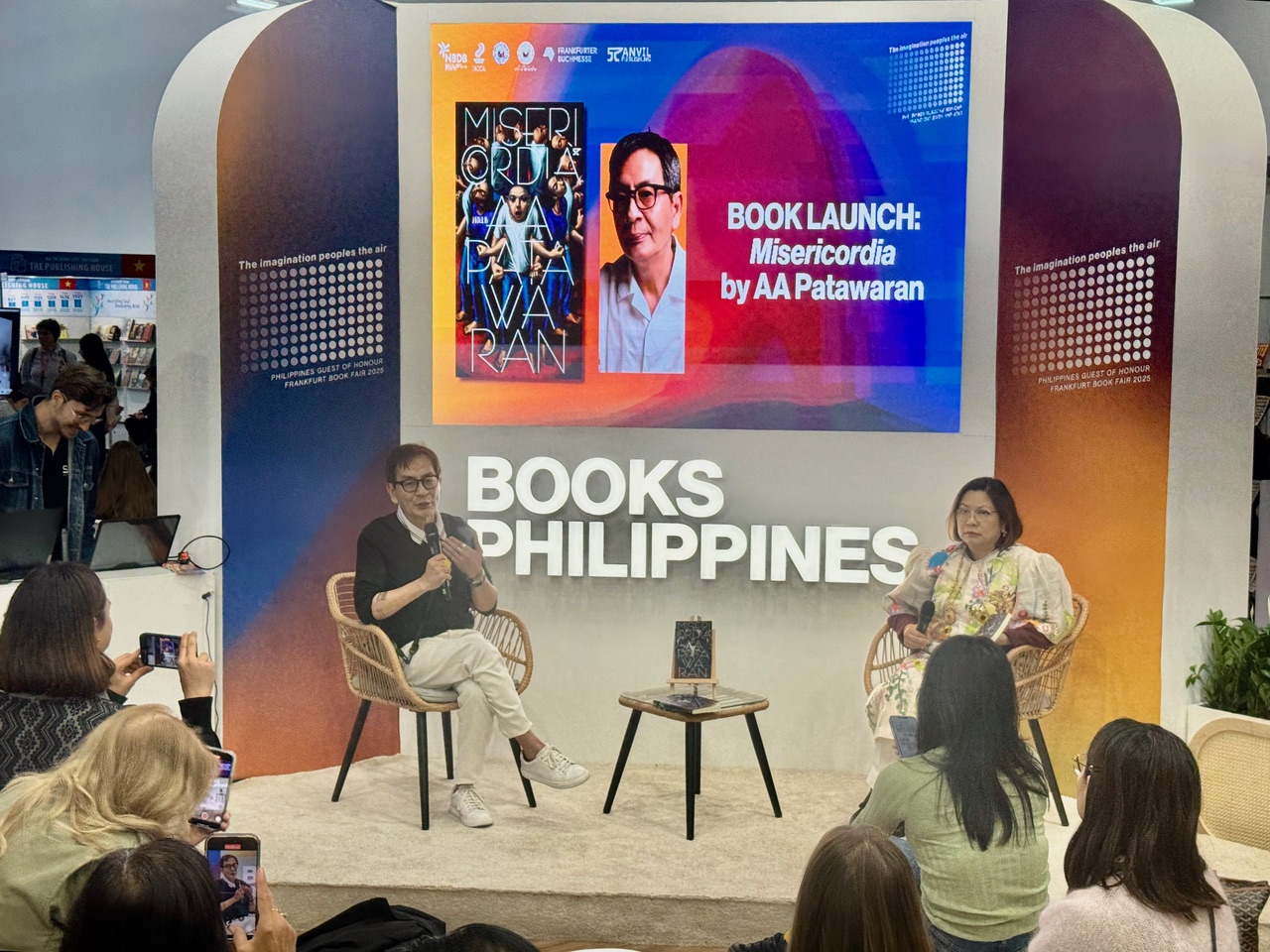
Last month—officially from October 14 to 19, but with many other related engagements  before and after—the Philippines attended the 77th Frankfurter Buchmesse or FBM, better known as the Frankfurt Book Fair, in a stellar role as its Guest of Honor or GOH. Accorded yearly to a country with the talent, the energy, and the resources to rise to the challenge, GOH status involves setting up a national stand showcasing the best of that country’s recent publications, filling up a huge national pavilion with exhibits covering not only that country’s literature but also its music, visual art, film, food, and other cultural highlights, presenting a full program of literary discussions, book launches, off-site exhibits, and lectures, and, of course, bringing over a delegation of the country’s best writers and artists. 

It’s as much a job as it is an honor. Past honorees have predictably come mainly from the West, such as France (2017), Norway (2019), Spain (2022), and Italy (2024); only once before was Asia represented, by Indonesia in 2016. Little known to many then, Sen. Loren Legarda—the chief advocate for the arts and culture in the government—had already broached the idea of pushing for the Philippines as GOH in 2015. It took ten years, with a pandemic and two changes of government intervening, but Legarda finally secured the funds—coursed through the National Commission for Culture and the Arts and the National Book Development Board—for us to serve as GOH this year, announced a year earlier.

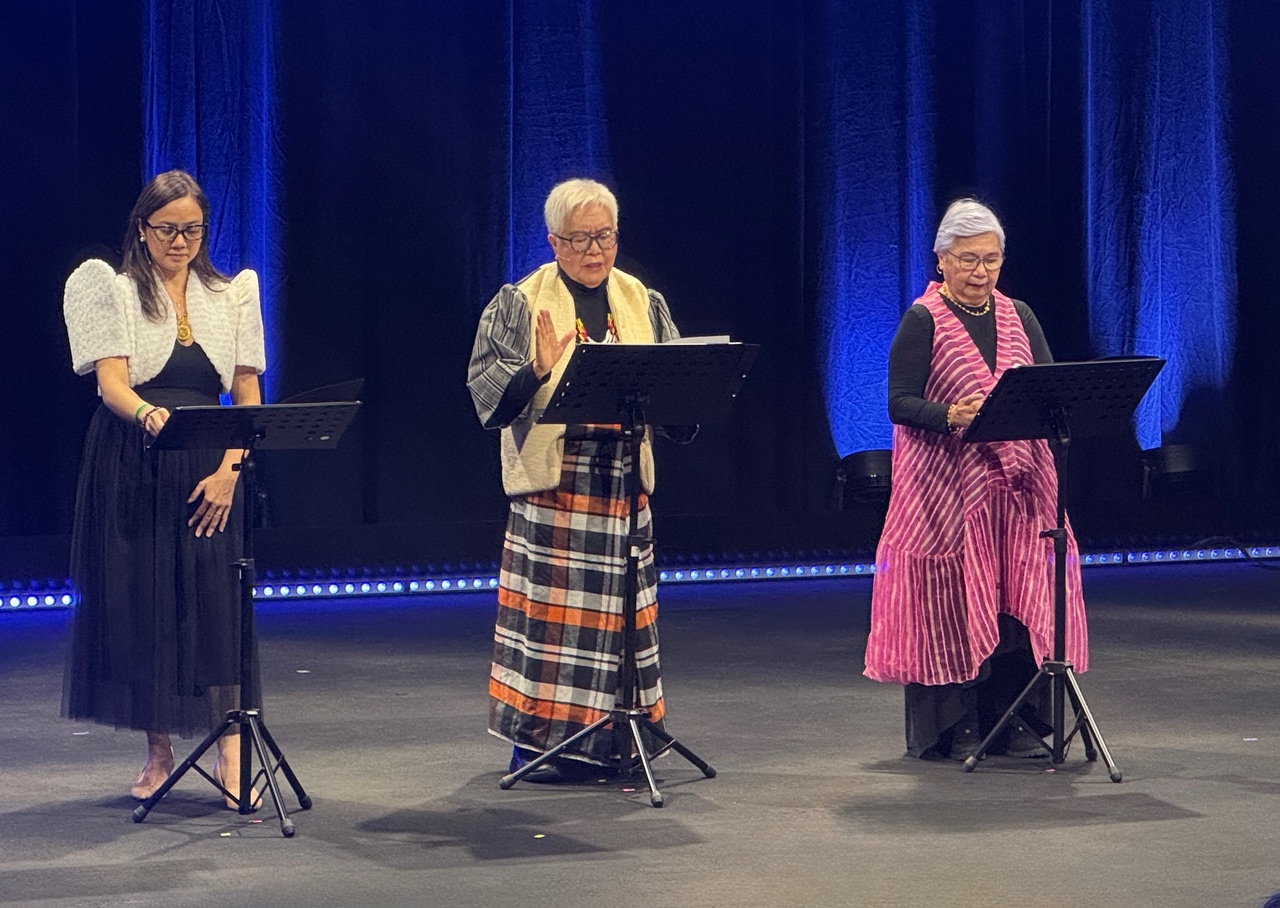
The Filipino delegates, over a hundred writers and creatives and as many publishers and journalists, took part in a program of about 150 events—talks, panel discussions, demonstrations, book launches, and performances—and ranged from Nobel Peace Prize winner and journalist Maria Ressa and National Artists Virgilio Almario, Ramon Santos, and Kidlat Tahimik to feminist humorist Bebang Siy, graphic novelist Jay Ignacio, poet Mookie Katigbak Lacuesta, and fellow STAR columnist AA Patawaran.

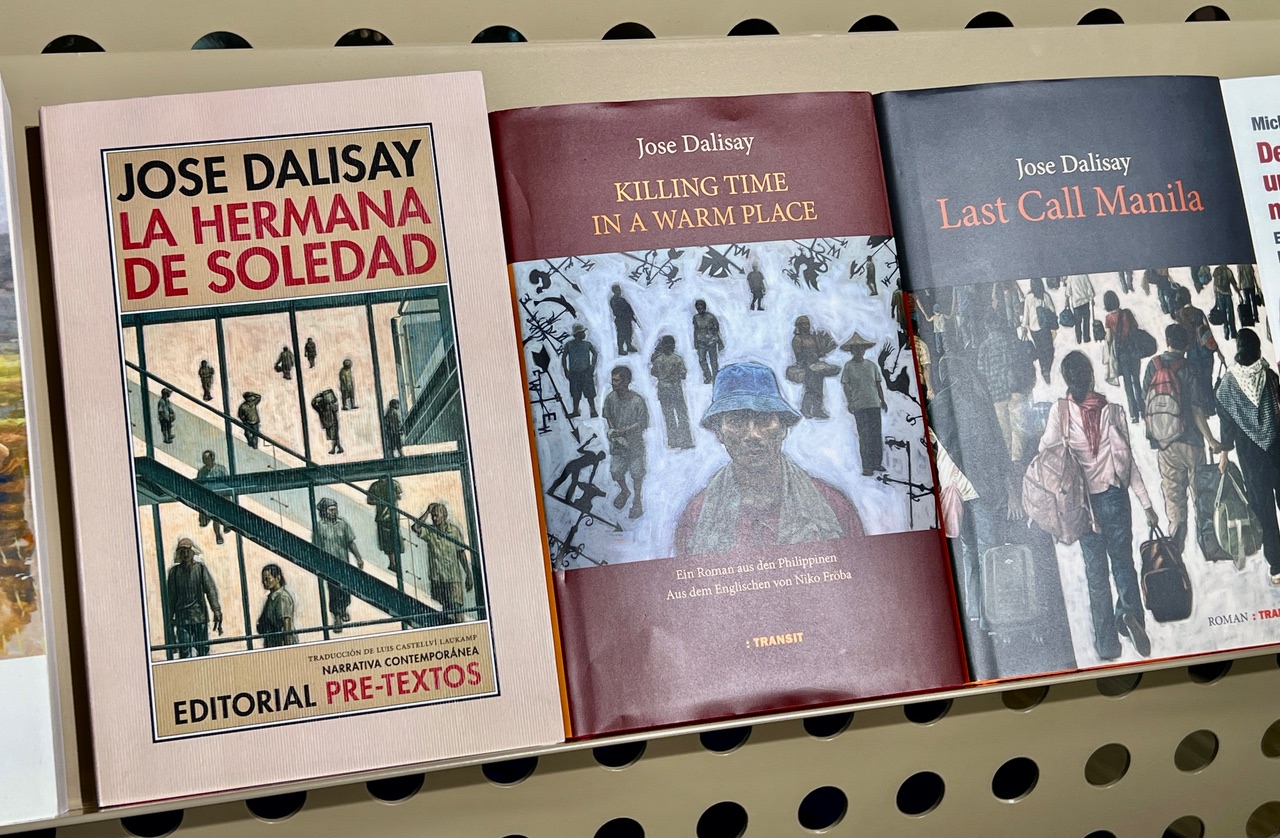
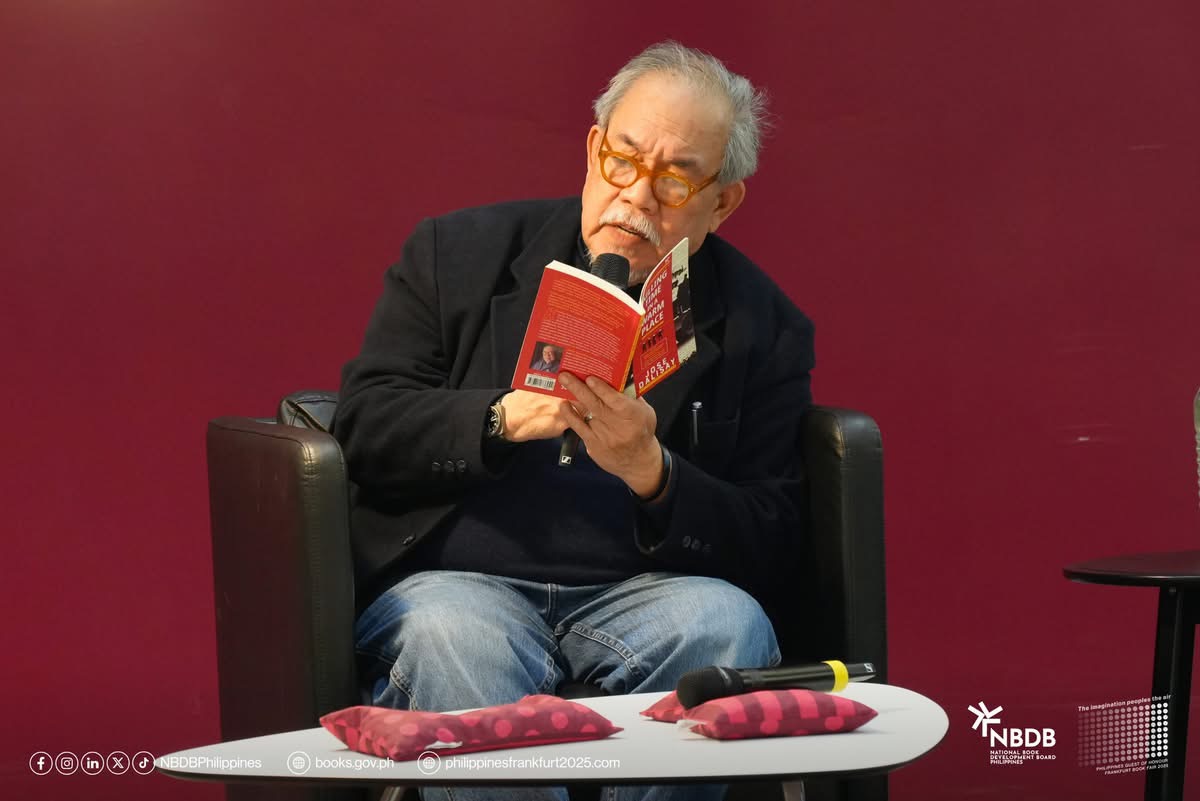
It was my third FBM, having gone for the first time in 2016 and then again last year, when the German translations of my novels Killing Time in a Warm Place and Soledad’s Sister were launched. This year, it was the Spanish translation of Soledad that was set to be launched at Frankfurt’s Instituto Cervantes. 

Those two previous exposures allowed me to appreciate our GOH role for what it was—a once-in-a-lifetime opportunity to put our best foot forward on the global stage. What began in the 1980s as a tiny booth with a few dozen books—which it still was when I first visited nine years ago—had become a full-on promotional campaign, not for the government (which did not object to outspoken critics of authoritarianism being on the delegation) and not even just for Philippine books and writers but for the Filipino people themselves. 

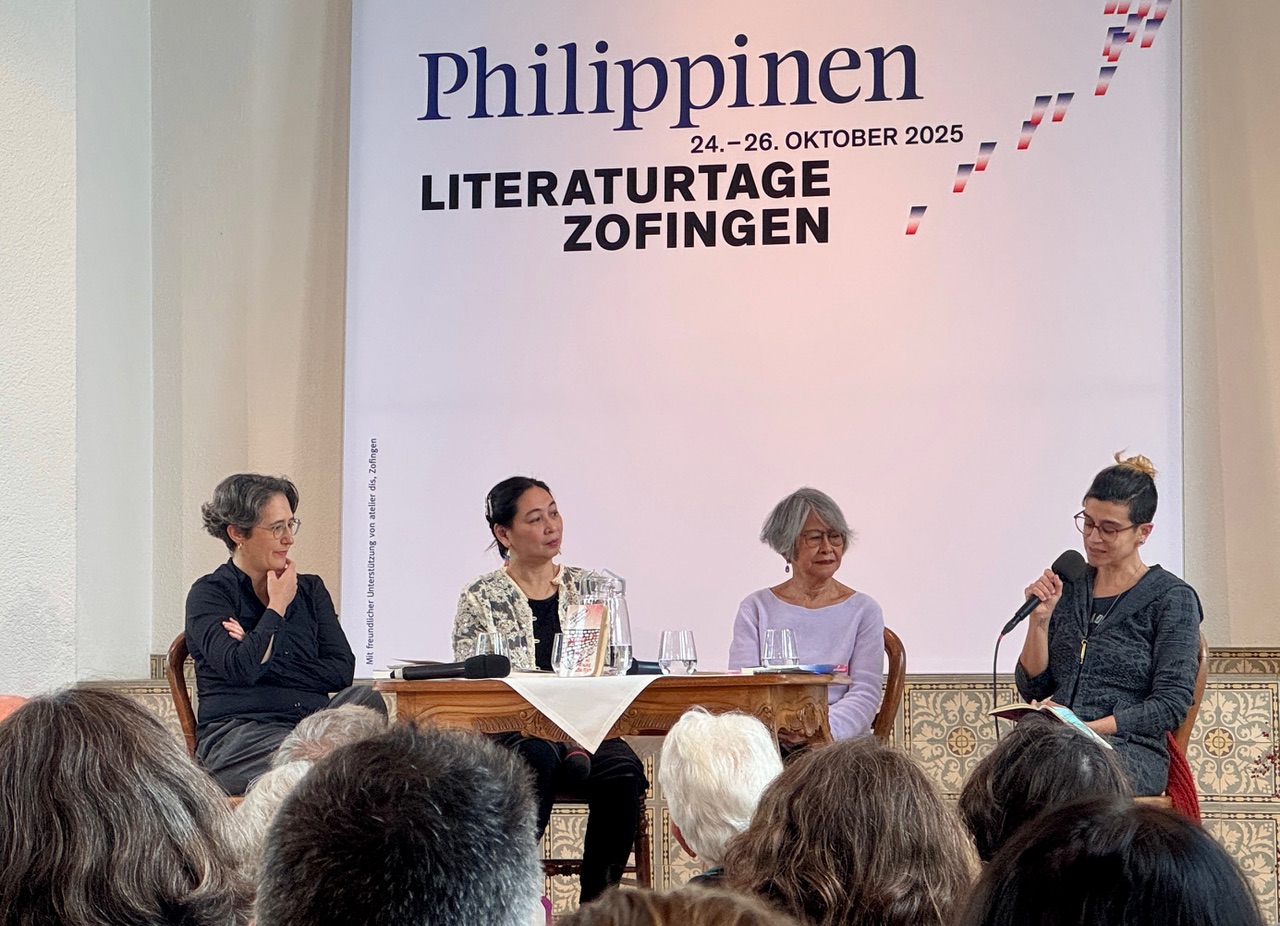
Six out of my eight events took place outside the FBM—two of them involving side-trips to Bad Berleburg in Germany and Zofingen in Switzerland—to bring us closer to local communities interested in what Filipinos were writing and thinking. Indeed my most memorable interactions were those with local Pinoys and with ordinary Germans and Swiss who asked us about everything from the current state of affairs (the resurgence of the Right in both the Philippines and Europe, Marcos and Duterte, the threat from China, the corruption scandal) to Filipino food and culture, the diaspora, the aswang, and inevitably, Jose Rizal, who completed the Noli in Germany and in whose tall and broad shadow we all worked.

Everywhere we went, in Frankfurt and beyond, the local Pinoy community embraced us, eager for news from home and proud to be represented, to hear their stories told in words they themselves could not articulate. “I’ve been living a hard life working here as a nurse in Mannheim,” Elmer Castigador Grampon told me, “and it brings tears to my eyes to see our people here, and to be seen differently.” 

A German lady accosted me on the street outside the exhibition hall and asked if I was the Filipino she had seen on TV explaining the Philippines, and we had our picture taken. A German author in his seventies, Dr. Rainer Werning, recounted how he had been in Manila during the First Quarter Storm and the Diliman Commune, had co-authored two books with Joma Sison since the late 1980s, and had described the Ahos purge in Mindanao and similar ops in other parts of the islands as the most tragic and saddest chapter in the history of the Philippine Left . A sweet and tiny Filipina-Swiss lady, Theresita Reyes Gauckler, brought trays of ube bread she had baked to our reception in Zofingen (the trays were wiped out). Multiply these connections by the hundreds of other Filipinos who participated in the FBM, and you have an idea of the positive energy generated by our visit.

From our indefatigable ambassador in Berlin, Susie Natividad, I learned about how Filipino migrant workers have to learn and pass a test in German to find jobs in Germany, a task even harder in Switzerland, where Swiss German is required. Despite these challenges, our compatriots have done us proud, as the maiden issue of Filipino Voices (The Ultimate Guide to Filipino Life in Switzerland) bears out. 

The FBM was as much a learning as it was a teaching experience for us, for which we all feel deeply grateful. By the time our group took our final bows on the stage in Zofingen—a small Swiss city that hosts writers from the GOH after the FBM as part of its own Literaturtage festival—I felt teary-eyed as well, amazed by how a few words exchanged across a room could spark the laughter of recognition that instantly defined our common humanity. 

I am under no illusion that GOH participation will dramatically expand our global literary footprint overnight, but it has created many new opportunities and openings for our younger writers to pursue in the years to come. It is a beginning and a means, not an end. The greater immediate impact will be to spur domestic literary production and publishing, to have a keener sense of readership, and to encourage the development of new forms of writing.

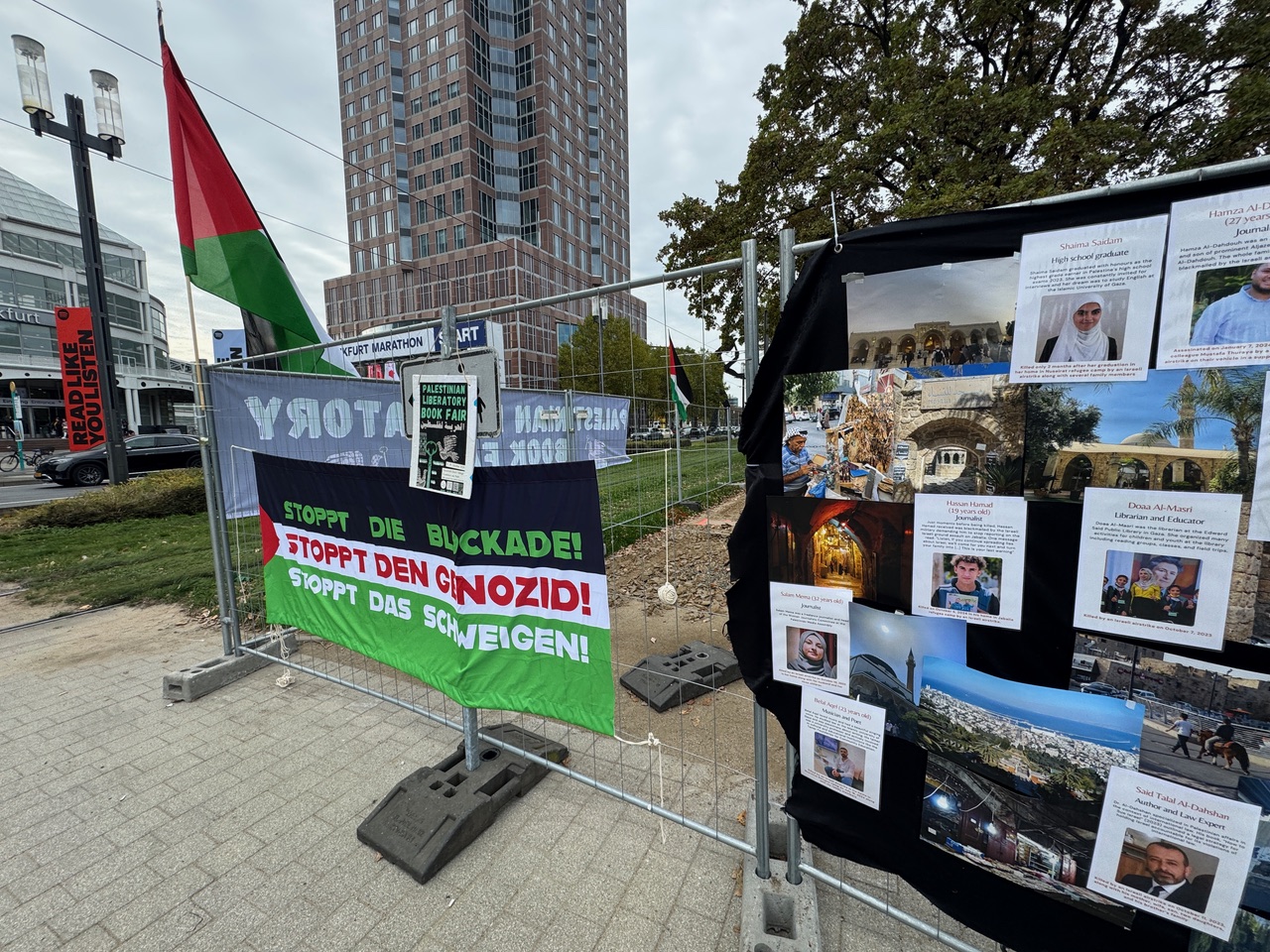
Sadly, a move to boycott the FBM by Filipino writers protesting what they saw to be Germany’s complicity with Israel’s genocidal war in Gaza has also impacted our literary community. (For the record, there were Palestinian writers—and even an Iranian. delegation—at the FBM, with whom Filipino writers interacted in a forum. There was also a Palestinian book fair across the fairgrounds.)

I have long taken it as my mission to promote an awareness of our work overseas and had opposed the boycott from the very beginning for reasons I have already given many times elsewhere. Many hurtful words have been spoken and many friendships frayed or broken, to which I will add no more, except to quote the Palestinian-Ukrainian refugee Zoya Miari, who visited the Philippine pavilion and sent our delegates this message afterward:

“I’m on my way from Frankfurt back to Zurich, and I’m filled with so much love that I can’t stop thinking about the love I felt in the Philippine Pavilion. I came back today to the Pavilion to say goodbye, not to a specific person, but to the whole community. This space became a safe space for me, one where I deeply felt a sense of belonging.

“I’m writing these words to thank you and your people for creating a space where

I, where we, felt heard and seen. That in itself is such a powerful impact. I know some people decided to stay in the Philippines to show support for the Palestinians, and I want to say that I hear and see them, and I thank them. And to those who decided to come, to resist by existing, by speaking up, by showing up, by connecting the dots, by being present and by sharing stories, I also hear you, see you, and deeply thank you.

“We all share the same intention: to stand for justice, to fight against injustice, and we’re all doing it in the best way we know how. I truly believe that the first step to changing the world is to create safe spaces where people are deeply heard and seen. When stories are heard and seen, we begin to share our vulnerabilities and showing that side of ourselves is an act of love. Through this collectiveness, this solidarity, we fight for collective liberation.”

Qwertyman No. 157: Rebalancing the UP-IRRI Partnership

Qwertyman for Monday, August 4, 2025


SINCE ITS establishment in 1960 by an agreement between the Ford and Rockefeller Foundations and the Philippine government, the International Rice Research Institute (IRRI) has been known around the world as a leader in agricultural research and a provider of much-needed and applicable solutions to global hunger. With so many people and economies dependent on rice, IRRI’s outputs—especially the famous “IR8” and similar high-yielding varieties—were hailed as gamechangers for billions, reportedly staving off famine in India in the 1960s and spurring “green revolutions” around Asia. The first President Marcos was a staunch supporter of IRRI, folding its “miracle rice” into his Masagana 99 program, which temporarily achieved self-sufficiency in rice but ultimately failed from bad credit and also proved environmentally destructive.

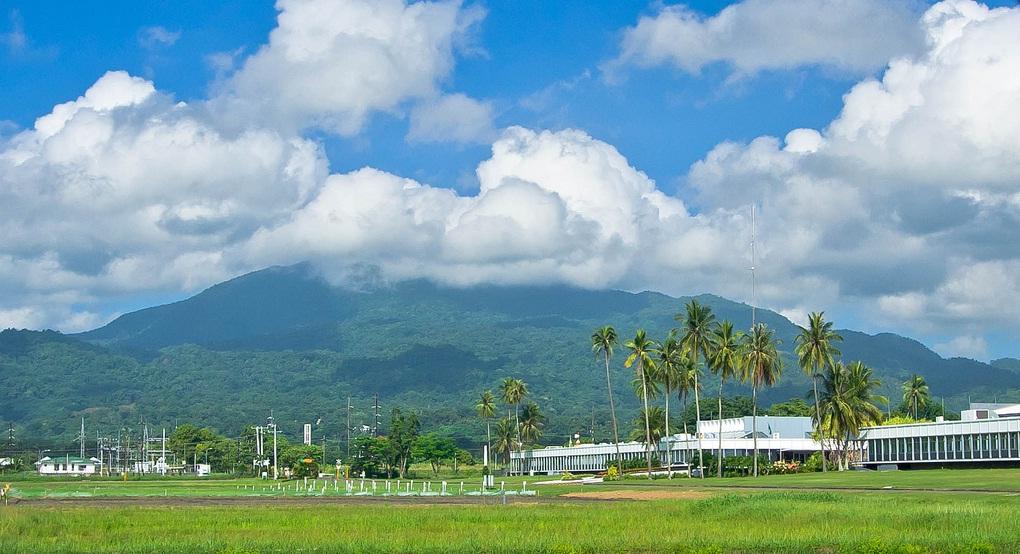
Headquartered in Laguna on the campus of the University of the Philippines Los Baños (UPLB), IRRI and its achievements became a source of pride for the Philippines, which not only hosted the institute but provided much of its manpower—the scientists in its labs and the farmers tilling its experimental plots, among other staff workers. (That sentiment, it should be noted, isn’t universally shared. A coalition of NGOs and individuals called MASIPAG, opposed to the kind of genetic engineering that IRRI and even UPLB does, sees IRRI as “a research arm of big agrochemical corporations in turning the food and environmental crisis into their businesses.”)

While that’s being debated, another issue has come up between IRRI and UP over the land that IRRI has been using, at the nominal rate of P1 a year for the past 65 years. IRRI’s lease on that land, totaling almost 280 hectares, expired last June 30. UP needs and wants some of that land back for its own use, especially with UPLB’s ambitious plans for the establishment of an Agro-Industrial and Information Technology Park in the area.

UP contends that IRRI has actually been using just around half of that property, so it would be good to put those idle hectares to more productive use, following UPLB’s comprehensive land use plan calling for more buildings for administration and research, housing, support services, engineering, and social sciences. It’s not simply getting land from IRRI (land that, let’s be clear, is really UP’s); according to UP’s Vice President for Legal Affairs Rey Acosta, in exchange for the land UPLB needs for its expansion, the UP System is offering IRRI new land to lease across its various campuses in Mindanao, Iloilo, Leyte, Cebu, Baguio, as well as its land grants in Quezon and Laguna, for both rice and non-rice crop research.

The land exchange was part of a new agreement that UP had proposed to IRRI to replace the expired lease. UP also wanted IRRI to pay more realistic rates for the land it was using. One key factor to consider was that since 1972, IRRI had fallen under the ambit of CGIAR (formerly the Consultative Group for International Agricultural Research), a global research network. CGIAR is apparently funded by contributions from many international agencies and countries including the Philippines, but exactly how it funds IRRI or what its legal status is in the Philippines is unclear to me. 

Under the IRRI charter, the Philippine Secretary of Agriculture and the UP President sit on its board of trustees as ex officio members, but the rest, including the Director General, are international experts nominated either by CGIAR or the outgoing board. It would have been at a board meeting that UP President Angelo Jimenez first brought up UP’s proposals over a year ago in anticipation of the end of IRRI’s lease—which, at the bottom line, UP is under no obligation to renew. Last June, IRRI submitted a counter-proposal ceding much less land than UPLB needed, asking for a much longer lease extension period (25 instead of 10) for much less money than UP deemed fair.

Negotiating in good faith, UP agreed to concessions such as giving IRRI almost 200 hectares for its use, and the possibility of a 25-year lease, subject to periodic reviews, if certain conditions were met. But instead of dealing with UP in the same spirit, IRRI went to court for a TRO, represented by one of the Philippines’ most influential (and must I add expensive) law firms. 

There are quarters in the Philippine academic and scientific community that will be happy to see IRRI go—MASIPAG might stand on the far extreme, but even more moderate voices have noted that much of the research that IRRI was known for can now be undertaken by the Philippine Rice Research Institute or PhilRice. Even so, UP’s leadership maintains that it continues to value its historic partnership with IRRI—based on a more balanced and lawful relationship. “We don’t want IRRI to leave,” said President Jimenez. “We would be happy for IRRI to stay but under fair and reasonable terms.” 

For the sake of not just the Philippines’ but the region’s and indeed the world’s food security, we should hope that this disagreement over how to best use that land in Los Baños doesn’t end up in a messy court case involving money, influence, and public relations. IRRI enjoys a generally positive reputation that, rightly or wrongly, most Filipinos still believe in. After 65 years, it’s time to renegotiate an agreement that will more directly and clearly benefit Philippine agriculture and education through its national university, ensure environmentally safe research, remunerate us fairly, and make IRRI the good global citizen an institution of its stature and intentions needs to be.

Qwertyman No. 153: Our Literary Fathers

Qwertyman for Monday, July 7, 2025

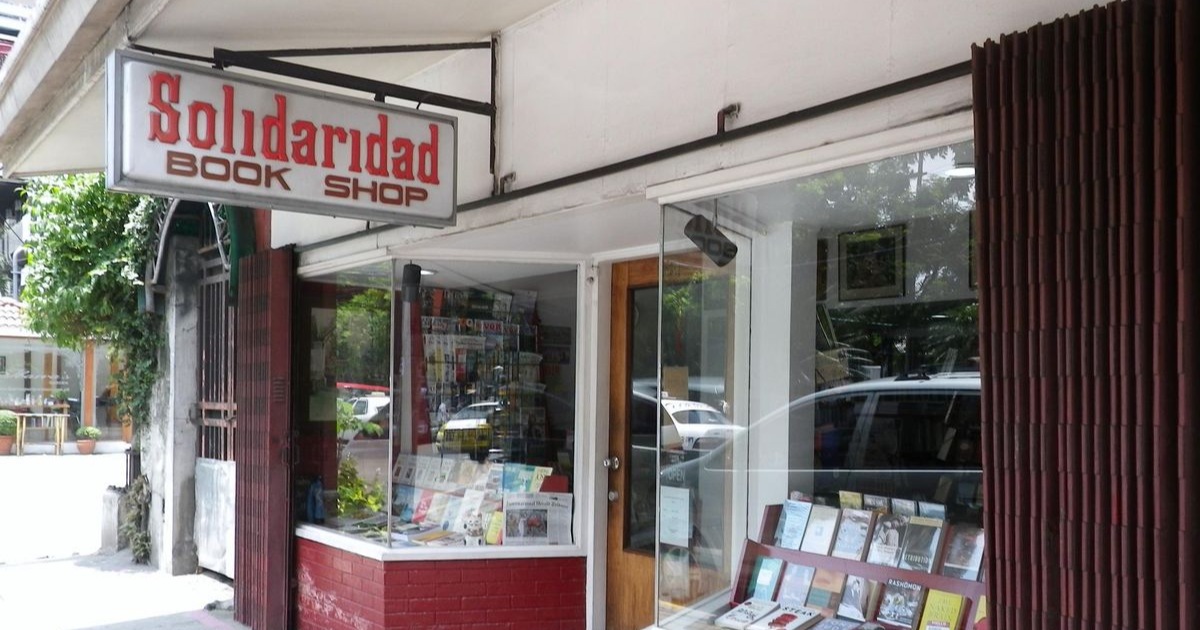
THE RECENT announcement of the impending sale of the Solidaridad bookshop in Ermita owned and run by the family of the late National Artist F. Sionil Jose understandably triggered a wave of nostalgia for the place, the old man, his dear wife Tessie, and for a bygone era when people strolled into book stores over their lunch break or after work to browse and pick up an Updike, a Le Guin, or a Garcia Marquez—and, of course, a Sionil Jose, and get it signed by the man himself if he was luckily around. Five decades ago, as a writer for the National Economic and Development Authority just a couple of blocks away on the same street, that browser would have been me, for whom Solidaridad and the equally legendary Erehwon nearby were a godsend, an unlisted perk. 

Indeed Solidaridad and FSJ (or Manong Frankie, as we his juniors called him) were inseparably conjoined in the public’s imagination of a man who was not only our most productive and best-known novelist but also an indefatigable purveyor of great literature and critical if occasionally controversial thinking, through his journal Solidarity and his long-running column “Hindsight,” this very space I was honored to have inherited.

Like many others—even those with whom he had quarreled fiercely—I was deeply saddened when Manong Frankie passed away three years ago. It was particularly bittersweet for me because we had become quite close in his last years, after having been somewhat estranged for the longest time. 

He had taken me under his wing on a writers’ conference in Bali in 1983, in a group of young, aspiring writers finding their way in a broadening literary world. But shortly after, in an interview with National Public Radio in America where I had gone to study, I offered my rather injudicious opinion of his prose—not mine alone—which he must have gotten wind of and found disparaging, because he gave me the cold shoulder afterwards. Like other younger writers, I would bristle at his hectoring moods—which I would better understand as I myself got older—during which he lamented the seeming alienation of the Filipino writer from his or her own social and political reality. 

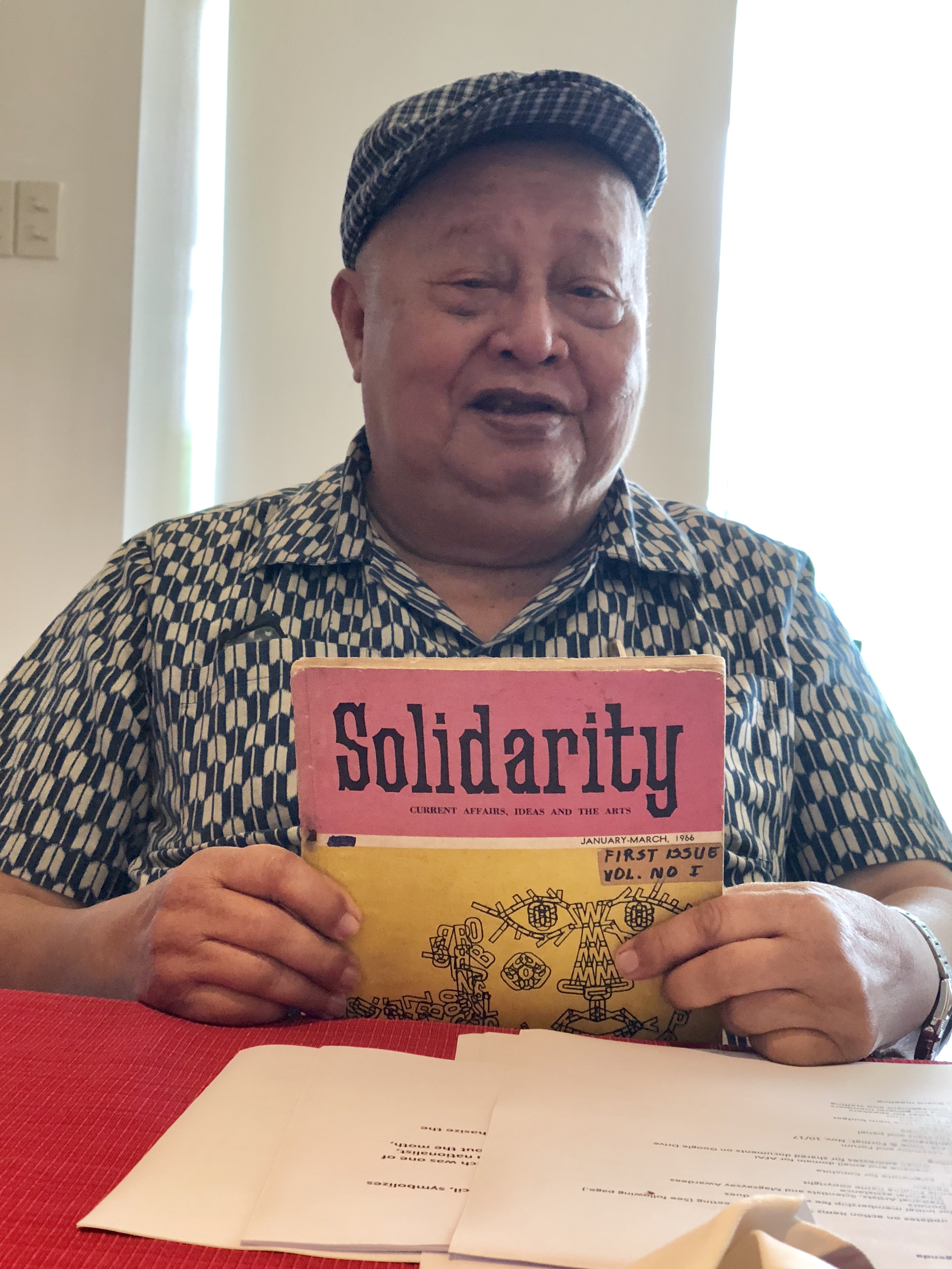
It was a concern we happened to share, and he began to know and appreciate me as someone who eschewed academic snobbery as much as he did, having transitioned to fiction from a background in journalism rather than the writers’ workshop system that he was deeply dubious of. In other words, we had more in common than each of us thought, and our work in the Akademyang Filipino brought us closer together. At one time I gifted him with the very first issue of Solidarity—Vol. I, No. 1—which I had found, and which he had not seen for ages; he was happy. After my speech at the Palancas in 2017, he came up to shake my hand.

Ironically, this happened at a time when FSJ, ever strongly opinionated, turned off many of his readers with his pro-Duterte sentiments, his putdowns of Nobel prizewinner Maria Ressa and others he thought undeserving of their fame, and his acerbic loathing of certain families he considered oligarchs despite their long having been supplanted by new and far more ravenous overlords. I did not share these views, and he knew that, but I think we had quietly decided that our friendship was more important than our politics. Shortly before he died, he sent me a brief letter that will be a cherished secret to keep until I myself pass on.

I didn’t learn writing from Manong Frankie; rather, I observed and admired his persistence and perseverance, literally writing to the last on what turned out to be his deathbed. I enjoyed his stories more than his novels, but in the end my own preferences don’t matter. He left a sprawling, robust, and indelible body of work that for many readers here and overseas will define Philippine literature in English for the latter 20th century. He led what our mutual friend the novelist Charlson Ong called “a well-managed life,” building a legacy partly through Solidaridad, Solidarity, and Philippine PEN which he led for a long time, apart of course from his work, and making sure he was heard when he spoke. 

His passing reminded me of the other members of his generation—his seniors and juniors by a decade or so—whom my generation in turn looked up to and at the same time, in that perpetual cycle of revolt and renewal, sought to depose. Nick Joaquin we adored as much for his prose as for his prodigious drinking (and seriously, for putting as much of his heart and craft into his journalism as into his fiction). NVM Gonzalez, who happened to have been born in Romblon (and not in Mindoro as many think) several kilometers away and forty years ahead of me, had that common touch many citified writers lost. Edilberto Tiempo I owe for urging me to return to school and devote my life to studying and writing rather than to bureaucratic servitude. 

Bienvenido Santos, twinkly-eyed and gently smiling, was my favorite of them all in terms of the quietude but also the emotional resonance of his stories, so graceful and yet so powerful. If I were to think of a literary father, it would have been Franz Arcellana, whose work may have been so vastly different from mine and yet, as my mentor in school, was the one I sought to please, slipping my story drafts under his office door and praying for his approval. Gregorio Brillantes, the youngest of them and perhaps more properly belonging to the next generation along with Gemino Abad, has been my writing hero for his superlative technique and unfailing sense of character. All these men (and women as well, for whom a separate story should be told) have taught me and my peers much, not just about the craft of writing but just as importantly the writing life, this vocation of books and words we have ddevote ourselves to for the bliss and yet also often the anguish of finding meaning in life through language.

Manong Frankie has passed on and soon so will his fabled bookshop, but his words, as well as ours, now have a life of their own.

Qwertyman No. 149: American Idiocracy

Qwertyman for Monday, June 9, 2025

IN HIS controversial but surprisingly popular 1987 book The Closing of the American Mind, the philosopher Allan Bloom lamented what he saw to be the decline of intellectual inquiry in America, indicting its universities for failing their students by promoting “relativism” over the time-honored values embodied by the “Great Books” of Western thought. “The consequences of the abandonment of the quest for the best are far-reaching and destructive,” Bloom intoned. 

Bloom was no flaming liberal; in fact, he was anything but—a true conservative who disdained rock music for its overtly sexual messages and its narcotic effects on the young (imagine what he would have said about TikTok). But his book and its arguments struck a responsive chord in many Americans—half a million of them bought hardcover copies—who were worried that the counterculture that had crept across American society since the tumultuous 196os had weakened it from within and had dulled the blade of American exceptionalism—the rock-solid article of faith that America was, or had to be, No. 1 in everything, because of its unique history and attributes.

That sounds a lot like “Make America Great Again,” although MAGA wasn’t driven by a longing to study Plato, but by deep-seated, grassroots-level grievances and prejudices. One wonders how Allan Bloom, who died in 1992, would respond to the political situation today, which on the surface mirrors some of his concerns, but only just so: a conservative President has declared war on America’s liberal universities, for all the wrong reasons, leading up to the “far-reaching and destructive consequences” that Bloom bewailed. 

Of course, Donald Trump is no Bloomian or even Reaganite conservative; all he seems to be about is unbridled power and money, and testing the limits to where they can go. “Trumpism” has been described as a mash of nationalism, populism, and industrialism, with a generous dollop of pettiness and egotism. 

Sometime last April, messaging on Truth Social (with a shift key typically gone berserk), Trump attacked Harvard University, claiming that “Harvard is an Anti-Semitic, Far Left Institution, as are numerous others, with students being accepted from all over the World that want to rip our Country apart. The place is a Liberal mess, allowing a certain group of crazed lunatics to enter and exit the classroom and spew fake ANGER AND HATE.” 

Shortly after, he ordered the federal government to withdraw more than $2 billion in funding for research grants to Harvard, and sought to cancel its ability to enroll international students. Trump wasn’t alone in declaring war on American academia. Years earlier, his VP-to-be JD Vance had told the National Conservatism Convention that “Universities in our country are fundamentally corrupt and dedicated to deceit and lies, not to the truth…. We have to honestly and aggressively attack (them).”

Not surprisingly, Harvard and a cohort of other leading universities have fought back, taking the administration’s tack as a frontal assault on academic freedom—and, more strategically, on America’s albeit waning intellectual leadership.

MAGAworld’s anti-intellectualism is interesting, because it draws on a long and dark tradition of tyrants from Franco’s Spain to Pol Pot’s Cambodia waging war on scholars—to cite only the most visibly horrifying examples under which hundreds of thousands of intellectuals were massacred. Mass murder makes the withdrawal of grants and visas seem benign, but they come from the same deep mistrust of critical thinking, contrary opinion, and the alien element. Dictatorships thrive on herd mentality and unquestioning obedience, both anathema to academia.

It’s not as if Trump and Vance never went to good schools. Trump went to Wharton and Vance to Yale Law; whether they learned something worth their tuition is another matter. Political instinct, not intellect, drives these men. 

Right now, that instinct is telling them that culture (or its reversal) is more important than anything else—specifically “woke” culture, the greatest threat to the hegemony of straight white men: civil rights, women’s empowerment, abortion rights, gay and gender rights, minority representation, affirmative action, Black heritage, environmental protection, and internationalism, among other values espoused by the liberal Establishment and its bastions like Harvard. 

The collateral damage of this insane and reckless urge to reshape America in Trump’s own image has included truthfulness, justice, accountability, sound science, and, ironically, America’s own long-term economic and academic well-being. MAGA’s success will be America’s diminution from the intellectual powerhouse that has accounted for more than 70 percent of all Nobel Prize winners (about 30 percent of them immigrants to the US) to the fools’ paradise contemplated in the 2006 movie Idiocracy—a comedy that won’t be so funny when it materializes.

Trump’s insistence on characterizing foreign students as potential terrorists and troublemakers will be particularly counterproductive, as it will banish many of the world’s best young minds to more receptive climates, and erode America’s influence on global thinking. 

That may not necessarily be a bad thing, as it reminds everyone that the US has no monopoly on excellence, and never really did. But as a two-time Fulbrighter who, like thousands of other pensionados to America, look back with gratitude and not a little pride on that opportunity to imbibe not just new knowledge but America at its welcoming best, I cannot imagine anything stupider than this willful squandering of American goodwill and soft power for the price of a few missiles. 

It will not even be Donald Trump & Co. who will pay that price, but generations of Americans down the road who will recall this period of infectious lunacy with bewilderment and regret. They will have no one to blame but their red-capped grandparents, who thought that trusting a despotic dunce with all that power was a bright idea. (And I know how much that statement smacks of the elitism that Trumpers hate, but tell me it isn’t true.)

Qwertyman No. 144: A Better Fighting Chance

Qwertyman for Monday, May 5, 2025

TWO WEEKS ago, almost 18,000 young Filipinos and their parents awoke to the good news that they had qualified for admission to the University of the Philippines through the UP College Admission Test (UPCAT). Over 135,000 high school students had applied, so this year’s admission rate stood at just over 13%, almost 7% higher than last year’s outcome.

Whatever UP’s critics may think it’s become, entry into one of its eight constituent universities remains the highest of aspirations for many Filipino families, especially the poor for whom the tuition and cost of living at top private universities is impossible without a scholarship. 

UP oldtimers like to recall the days, decades ago, when the quality of public education was still high enough for public and private high school graduates to compete on fairly even terms for admission into UP. It wasn’t unusual for some provinciano wearing chinelas to step into a UP classroom or laboratory and beat the daylights out of some elite-school fellow in academic performance. Many of those provincianos—the likes of Ed Angara, Miriam Defensor, Billy Abueva, and Dodong Nemenzo—went on to stellar careers in government, education, the arts, and industry. UP was clearly doing what it was supposed to do, as its past President Rafael Palma put it: to be “the embodiment of the hopes and aspirations of the people for their cultural and intellectual progress.”

Ironically, by the time the UP Charter was revisited and revised a century after its founding in 2008, giving it the unique status of being the “national university,” UP’s student profile had changed. Jokes about UP Diliman’s parking problems began to underline the popular perception that UP was no longer a school for Filipinos across the archipelago and across income strata but one for the privileged, mainly from the big cities. The introduction of free tuition in state universities and colleges in 2017, while well intentioned, even resulted in subsidizing the children of the rich in UP, who could well have afforded going to Ateneo or La Salle.

But some good news is emerging, as this year’s UPCAT results bear out. Starting with last year’s UPCAT, there’s already been a reversal of the trend favoring graduates from private high schools, with 55% of qualifiers now coming from public and 45% from private high schools. UP President Angelo Jimenez—himself a boy from the boonies, coming out of tribal roots in Bukidnon—has pledged to do even more to give poor students outside of the big cities a better fighting chance of getting into UP.

“We started this banking on two things,” he says, “that UP will respond to the challenge of transforming the so-called common clay—the less-advantaged—into fine porcelain, and that the less-advantaged will respond to the challenge of opportunity. The task of leadership now is to set the enabling environment, structures, and systems to ensure the success of this two-pronged strategy. It’s a big bet, and it gets bigger. We still have the non-UPCAT track. This includes our Associate in Arts program, UPOU’s ODeL, talent-based modes, and finally, the UP Manila School of Health Sciences in Tarlac, Aurora, Palo, and Cotabato. We cannot solve all problems, we are not lowering standards. In fact, we must demand excellence regardless of social and economic status, and enforce it. But we are dropping rope ladders so people long staring up from the base of the fortress walls can have a better chance of scaling its sheer drop with something better than their bare hands.”

Those rope ladders include adding more UPCAT testing centers in faraway places, ultimately to have at least one in each province—a goal that will be met later this year. The testing centers are also being moved from private to public high schools. “We’ve seen that more students tend to participate when the tests are given in their national high schools,” says UP Office of Admissions director Francisco de los Reyes. Aside from more testing centers, UP is helping disadvantaged students prepare better for UPCAT through its Pahinungod volunteers, who distribute reviewers using real items from past UPCATs (these reviewers are also downloadable for UPCAT applicants) and use them for UPCAT simulations, guiding students even with such details as shading the exam oblongs. (De los Reyes reports that wrong shading has caused 20% of their machine counting errors.)

These steps are clearly paying off. Davao de Oro (formerly Compostela Valley), which previously accounted for less than 10 UPCAT qualifiers, has just produced 31, after a testing center was put up in Nabunturan. 

UP’s support for poor students doesn’t end with UPCAT. Every year, thousands of qualifiers from so-called Geographically Isolated and Disadvantaged Areas (GIDAs), even after passing UPCAT against all odds, fail to show up for enrollment after realizing that they cannot afford the costs of living on a UP campus. UP has rolled out a P50-million Lingap Iskolar program that provides such disadvantaged qualifiers who meet certain standards P165,000 a year to cover housing, meals, transportation, books, cellphone load, and other expenses. Almost 200 Lingap Iskolar grants were given out last year. In UP Manila, private donors fund daily meals for over 30 students.

I’m particularly happy to report that a dear friend of mine, Julie Hill, recently donated almost P21 million that will be used for a new Agapay Fund that will go toward the upkeep of poor students in UP’s School of Health Sciences, which has a unique ladderized program that enables rural midwives to become nurses, and nurses to become doctors. The program has already produced about 200 doctors who have served their communities back. 

Among them was Dr. Hannah Grace Pugong, who recently landed in the top 10 of the medical board exams, after placing No. 1 in the midwifery and No. 3 in the nursing exams. Dr. Pugong will soon be deployed under the Department of Health’s Doctors to the Barrios (DTTB) program, fulfilling her return service commitment. It is an obligation she willingly embraces, saying that “I have often reminded myself that how I treat my patients should reflect how I want my family members to be treated by other health workers.” 

If that’s not what being a national university should be about, I don’t know what is.

Qwertyman No. 143: I or AI?

Qwertyman for Monday, April 27, 2025

I’VE RECENTLY been asked to talk about literature in the time of artificial intelligence (AI) in a couple of conferences in Dumaguete and Manila. What that tells me is that, with AI’s emergence and growing popularity, there’s been much uncertainty, anxiety, and fear—even outright hostility—generated by the seemingly unstoppable intrusion of artificial intelligence not just into literature but into almost every aspect of human life and society. As I’ve said before, depending on how you see and use it, AI is either God’s gift to humanity or the destroyer of civilizations. 

While it has been hailed for its contributions to such fields as medicine and criminology—shortening diagnostic procedures and sharpening digital forensics—AI’s application to less mechanical endeavors is more fraught with both ethical and technical questions. Studio Ghibli’s Hayao Miyazawa, for one, has forsworn the use of AI in his work, calling it “an insult to life itself.” 

For writers and other creatives, the big questions are: Will and can AI replace the author? Is AI capable of artistic imagination? Should writers, publishers, and readers feel threatened by its future development? Might there be a positive role for AI in literary creation? 

Now, we can be very brave and declare that the worst piece of writing or art done by a human is still better than the best of what AI can produce. I’ve heard many authors proudly insist that “AI can never replace me!” But do you honestly think that’s true, and will the readers of the future—say, the consumers of popular fiction—care? The sobering fact is that there is so much bad art and bad writing done by real humans that it shouldn’t be too hard to artificially produce something better, for which people will gladly pay. 

I know that this will strike some of us as being crassly commercial, but it would be naïve to deny that much of what know to be culture today has been commodified—produced and sold as entertainment, whether it be a book, a movie, a concert, a computer program, or the hardware with which to access them. These are all media in which AI is already playing an increasingly important role—initially, perhaps, merely as a facilitator, a simplifier of complex or difficult tasks, or as an aid to the imagination, but also as a co-creator or collaborator, such as in the generation and animation of images. 

Given the fact that most of us produce art to sell—and why shouldn’t we, especially when we promote the idea of “creative industries”—the entry of AI into our thought processes and methods of work could be a matter of survival for many. The question is, will it improve the mediocre, or degrade the excellent? Can we excel without it, or because of it?

Early AI’s clumsy mistakes or “hallucinations” are worth a laugh, but I’m not sure how long we’ll be laughing; AI’s present ineptitude simply means it has a lot to learn—and it will, with the kind of training it’s being fed off our books, our texts, our manner of writing. It will only be a matter of time—I’d say less than a decade—before AI can mimic the best of global writing especially as literary texts get digitized and tossed into the meatgrinder, until it can produce a decent if not impressive approximation of certain styles and approaches. 

(For AI professionals, the next phases of the AI revolution will move into Artificial General Intelligence or AGI, at which point AI can match human intelligence, and ASI or Artificial Super Intelligence, when AI becomes self-aware enough to improve and replicate itself without human intervention and possibly beyond human control. These scary scenarios will not take, they say, a century to happen—some experts predict that AGI could be realized as early as 2027.)

What’s going for us is that while literary styles can be copied, the human imagination is far richer and stranger than we think. AI tends to homogenize; the human artist strives to be unique. Even so, researchers are already talking about algorithmic imagination and experimental humanities as “true collaborations with culture machines.”

Given that it’s inescapable, I propose that instead of fearing it, ignoring it, or maligning it as I’m sure many of us are inclined to do, we study AI and use for what it might be able to offer in aid of the imagination—as unsettling or unappetizing as that proposition sounds.

We’re already tapping AI every time we use Google, and no one seems to mind. I don’t mind admitting that I have used AI—not in fiction but in creative nonfiction or CNF, specifically in writing the biography, where I ask AI to summarize and organize biographical material that I would have eventually found on my own, anyway—in days rather than seconds. 

I suspect that the use of AI in CNF is much less troubling for writers and theorists than its employment in, say, writing the novel or the poem, which we have been trained to think of as more personal, more “us,” than nonfiction. We will yield CNF to AI, but draw the line at fiction and poetry, where we feel we should resist the intrusion of the beast or the machine into the recesses of our imagination. 

I wonder, however, how long this fortress will hold, or what the first crack in the wall will be, if it isn’t there already. I’m pretty sure that somewhere out there, a plodding novelist is already using AI to chart a tree of plot possibilities—What will happen if Maria marries Oscar? What if they decide to live in Davao instead of Baguio? And so on. I wouldn’t do this myself, because the fun of writing for me is in working out the future of my characters in my head. 

And then again I write fiction for the love of it—unlike almost all other kinds of writing that I do for a living. But if I were a novelist under contract to produce a novel a year, I’m not so sure that I wouldn’t seek AI’s help to lighten my load and get the job done. So is AI OK for money but not for love? Is that what it all comes down to?

So right now we have many more questions than answers, and at the pace the world is changing, most answers we come up with will soon be obsolete anyway. But the basic questions will remain, the most vital of which could be, when we say “I am,” is that “I” me, or is it AI speaking?

Qwertyman No. 140: The City of Stories

Qwertyman for Monday, April 7, 2025

THIS PAST weekend, I was down in Dumaguete City with National Artist for Literature Resil Mojares, historian Ambeth Ocampo, and scores of other writers for the 2nd Dumaguete Literary Festival. At my age, I’ve frankly tired of going to literary festivals, conferences, and workshops, preferring to work quietly at home—Dr. Mojares apparently feels the same way—but we couldn’t resist the allure of Dumaguete, a city central to the development of Philippine postwar literature, and always well worth visiting on its own for its gentle charms.

I personally have much to thank Dumaguete for, for what it contributed to my own budding literary and academic career. Early in 1981, shortly after I had returned from my first visit to the US, I received an invitation from Dr. Edilberto Tiempo to join the Silliman Writers Workshop which he and his wife Edith—the poet and future National Artist—had started two decades earlier upon their own homecoming from America. 

I had dropped out of college for a decade by then, and was working at NEDA, which had sent me to the US for an observation tour. What that trip to the American Midwest—mainly the campus of Michigan State in East Lansing—did for me was to rekindle my interest in learning. Dr. Tiempo’s invitation could not have come at a better time: a summer devoted to talking about poetry and fiction at Silliman University felt dreamlike, and by the time the workshop ended, my head spinning with magical lines from Robert Graves, I had resolved to quit my job, go back to UP, and just study, write, and teach for the rest of my life. And that’s what happened.

I wasn’t alone in that kind of transformative experience; as the country’s oldest writers’ workshop, the Silliman summer workshop became a virtual rite of passage for young writers, especially in English (some writers in Filipino have also attended, with works in translation). Silliman itself (older than UP by several years) has produced many of the Philippines’ finest writers, aside from the elder Tiempos—among them Ricaredo Demetillo, Aida Rivera-Ford, Merlie Alunan, Leoncio Deriada, Cesar Ruiz Aquino, Elsie Coscolluela, Rowena Tiempo-Torrevillas, Marjorie Evasco, Lakambini Sitoy, Artemio Tadena, and Myrna Peña-Reyes. It also has a strong performing arts tradition, contributing the likes of National Artist Eddie Romero, Gilopez Kabayao, Amiel Leonardia, Junix Inocian, and Elmo Makil, among others.

For all these, Dumaguete has been formally nominated to be designated as a UNESCO City of Literature—one of many such distinctions listed under UNESCO’s Creative Cities Network program that was launched in 2004 to recognize and celebrate cities around the world—350 of them form more than 90 countries to date—for their signal achievements in Crafts & Folk Art, Design, Film, Gastronomy, Literature, Music, and Media Arts. So far, 53 cities in 39 countries have been named Cities of Literature—among them Barcelona, Heidelberg, Iowa City, Lahore, and Norwich. (Iloilo has already been named a City of Gastronomy, and Quezon City is vying to be designated a City of Film.) With the Philippines serving as this year’s Guest of Honor at the Frankfurt Book Fair, Dumaguete’s recognition as a UNESCO City of Literature will raise our global cultural profile even higher, and let the Philippines be known for more than Boracay, Manny Pacquiao, and Imelda’s shoes.

Leading that charge for Dumaguete is Silliman University literature professor Ian Rosales Casocot, one of our best fictionists and co-director of the festival with Gayle Acar. Working with the Dumaguete City government, the Department of Trade and Industry, and the Buglas Writers Guild which Ian heads, Ian notes that aside from developing writers, “Dumaguete itself has been a constant subject of many literary works, from novels to poetry, from essays to plays. It is high time that Dumaguete is recognized for its role in shaping literature in our corner of the world.” The well-attended Dumaguete Literary Festival, now on its second edition, offers proof positive of that city’s continuing centrality to our literary life and culture. 

We had been invited to share our views on various aspects of Philippine literature in this age of artificial intelligence. I joined a panel of writers dedicated to that specific topic—or, as they put it, “Can AI Win a Nobel Prize for Literature?”—which happened to be something I’ve given much thought to.

Understandably, there’s been a lot of fear and anxiety—even outright hostility—generated by the emergence of AI in nearly every aspect of human life and society. Studio Ghibli’s Hayao Miyazawa, for example, has forsworn the use of AI in his work, calling it “an insult to life itself.” While it has been hailed for its contributions to such fields as medicine and criminology—shortening diagnostic procedures and sharpening digital forensics—AI’s application to less mechanical endeavors is more fraught with both ethical and technical questions. 

In previous lectures and again in Dumaguete, I showed how—at this point—AI poses little threat to the writer of truly good and imaginative literature, by yielding execrable responses to such prompts as “Write a paragraph about a summer night in Spanish Manila in the style of Nick Joaquin.” It’s worth a laugh, but I’m not sure how long we’ll be laughing; AI’s present ineptitude simply means it has a lot to learn—and it will, with the kind of training it’s being fed off our books, our texts, our manner of writing. It will only be a matter of time—I’d say less than a decade—before AI can mimic the best of global writing. For me, the best response is neither to hate nor to ignore it, but to understand it and employ it for helpful uses we have yet to find. (We’re already tapping AI every time we use Google, and no one seems to mind.) It should even be possible for authors to creatively interact with AI in what I’m calling a game of prompts.

What we can reasonably certain of is that while literary styles can be copied, the human imagination is far richer and stranger than we think. AI tends to homogenize; the good creative writer strives to be unique. Like Dumaguete, there’s a whole city, a labyrinthine cosmopolis, of stories in every writer’s mind to be discovered and explored.

Qwertyman No. 136: Bringing In the No-Shows

Qwertyman for Monday, March 10, 2025

EVERY YEAR, about 100,000 Filipino high school seniors take the University of the Philippines College Admission Test (UPCAT), hoping to get into one of UP’s ten campuses nationwide. It’s an annual ritual that’s been taking place since 1968, except for a brief period during the pandemic when the test was replaced by an alternative system. (I didn’t even realize until I looked these figures up that I was among the third batch of UPCAT takers in 1970; thankfully I got in.)

Of those 100,000 hopefuls, only about 13,000-15,000 make it. That passing percentage may seem cruelly if not needlessly small, but there’s good reason for it. While we’d like more students to come to UP, admissions are limited by how many incoming freshmen UP’s campuses (or “constituent universities” such as UP Manila and UP Mindanao) can optimally absorb. Classrooms, housing, teachers, and facilities all come into play. Large campuses like Diliman and Los Baños can obviously take in more, but even so there’s a limit to admissions that needs to be observed if UP is to maintain the quality of higher education that it promises.

The more troubling statistics have to do with the distribution of those “passers” (technically, no one “fails” the UPCAT, which is just one of several factors that determine admission, including high school grades; each campus also has a different qualifying standard to rationalize admissions, so you can “fail” Diliman but qualify for UP Cebu). 

Last year, according to UP’s own statistics, 44 percent of UPCAT qualifiers came from private high schools. Another 27 percent came from the country’s science high schools. (which are publicly funded, but offer a much higher standard of education). Other public high schools accounted for only 29 percent of the total. Consider these figures against the larger picture, in which around 80 percent of our students go to public high schools, and less than 20 percent to their private counterparts. 

Compounding this gross inequality, about 70 percent of UPCAT qualifiers come from the big cities, mainly in Luzon. This, of course, is no big surprise. A recent study by UP professors showed what we didn’t need a study to know (but being academics, of course they had to prove it): that “income advantage” weighed heavily on one’s chances of passing the UPCAT and getting into UP. If you went to a good private high school, you were more likely to get in than a poor student from the boonies. To top it off, with tuition now free in public universities, we actually end up subsidizing many students from affluent families who could well afford to pay their way in private colleges.

This lopsided situation has long been the cause of much concern within and beyond UP, which, as the country’s “national university,” bears the dual responsibility of aiming to be the best university in the country bar none, and yet also serve the interests of the entire Filipino nation, and not just those of the urban elite that has apparently become over-represented in its student body. Various UP administrations have sought to address this seemingly paradoxical “excellence vs. equity” argument through different methods aimed at more democratic access—without, as current UP President Angelo Jimenez emphasizes, lowering UP’s standards. This remains a work in progress, but the aim is clear: make it possible for poorer Filipinos to get into UP so it can truly be the “university for the Filipino” it was envisioned to be.

Against all odds—and this brings me to my present point—many surprisingly do. I don’t have the actual figure on hand, but they number in the low thousands, of the 13,000-15,000 in an incoming batch. Encouraging, yes? But here’s the rub: about 1,500 of them never show up—what we call “no-shows”—not for lack of ambition, but for lack of means to cover the cost of living at a UP campus. Imagine that: it’s hard enough to get a good public high school education in what are called Geographically Isolated and Disadvantaged Areas (GIDAs), and harder still to pass the UPCAT from where you are. You’re elated to learn you made it, only to realize that you’re not leaving home after all, because you can’t afford the transportation, food, housing, books, and computers that come with college.

Thankfully, UP has initiated a new Lingap-Iskolar program to help out with these expenses and bring more GIDA passers in, starting with 300-500 students. Over the next four years, P250 million has been allotted by UP for this purpose. It’s a great initiative, but it still falls far short of minimizing the no-shows so the yawning disparity between UP’s rich and poor can be more effectively reduced.

With the education budget being squeezed even more under the current GAA, this is a great opportunity for the private sector to come in and make a clear and strategic impact on the future of the Filipino mind. If you’re a corporation or philanthropist in search of a good cause to support, look no farther—make it possible for a young Filipino from our poorest and remotest regions to study in UP. Sure, democratizing UP will require much broader and deeper moves, going back to basic education; but this step is solid, immediate, and tangible. 

I’m happy to report that I made this pitch to a dear friend in the US who had spent some time here in the Philippines more than 50 years ago with her late husband, who worked to help improve Philippine education. Responding to my call, that friend, Julie Hill, sold two HR Ocampo and Ang Kiukok paintings from her collection at a recent Leon Gallery auction, the proceeds of which she will be donating to the UP Foundation for a fund to be set up along the lines of Lingap-Iskolar. Despite being away for so long, Julie remains deeply attached to the Philippines; she’s not Elon-Musk rich and lives very modestly, but has sacrificed her best pieces so some bright young Pinoys she will never meet can have a better future and serve the nation.

If a foreigner can do that, I don’t see why our homegrown billionaires can’t. Support a GIDA scholar, and make a difference right now.