Penman No. 225: Sayang in Singapore

IMG_9764.jpg

Penman for Monday, November 11


TO US Filipinos, sayang has one meaning and one meaning only: a regrettable loss, something that causes us to shake our heads or hold our palms to our hearts and say, “Oh, that’s too bad.” But elsewhere in the region, from some sultry corner of which the word worked its way up our archipelago, sayang means that and more: the love which may have been that which was lost, love as both a noun and a verb, or even an endearment, depending on the nuances of its intonation. So love and loss—the former all too often trailed by the latter—coexist in this wonderfully complex word, through which we Filipinos can at least claim some vestigial connection to the heart of Asia.

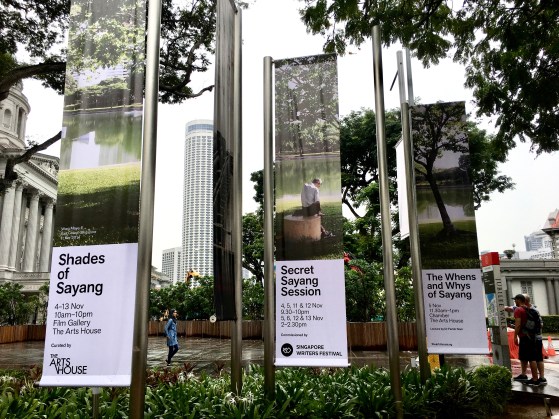
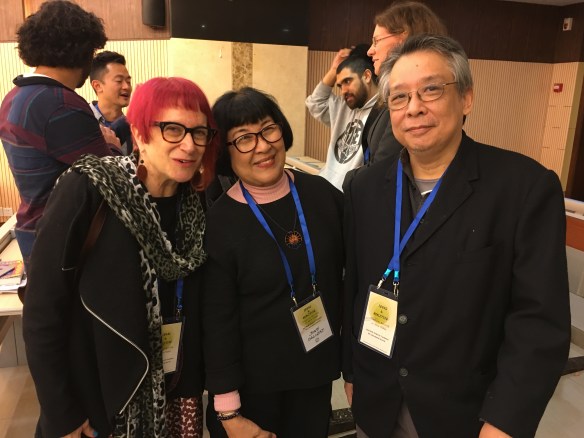
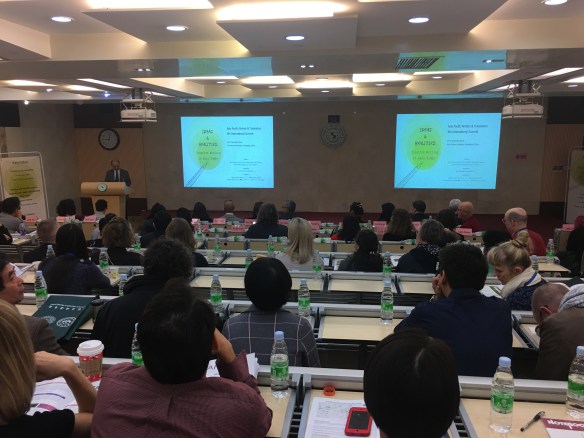
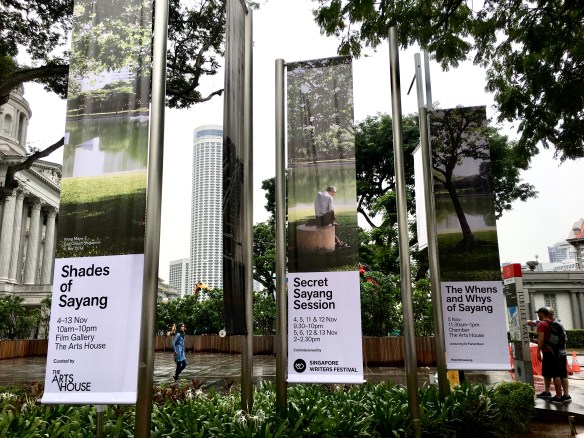
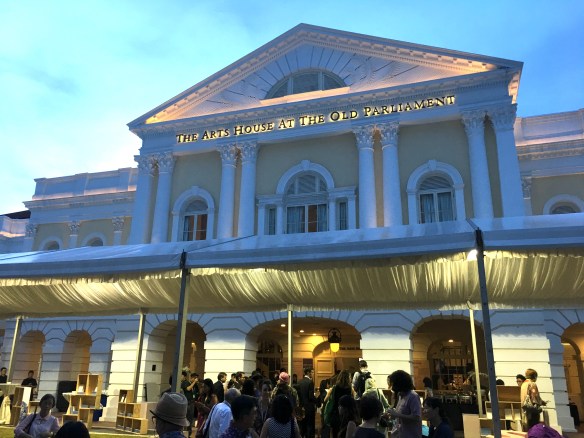
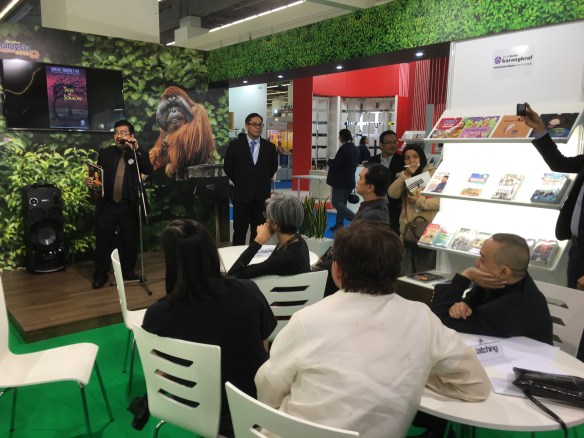
Sayang was very much on people’s lips in Singapore last week—you would have thought a lovefest was going on, and in a sense, it was. But the love was for books and literature, the occasion being the Singapore Writers Festival, which I was visiting for the third time after a hiatus of five years. Sayang had been chosen as the festival’s theme, and the word was festooned against a suitably floral backdrop all over the Arts House area where most of the festival events took place.

IMG_9754.jpg

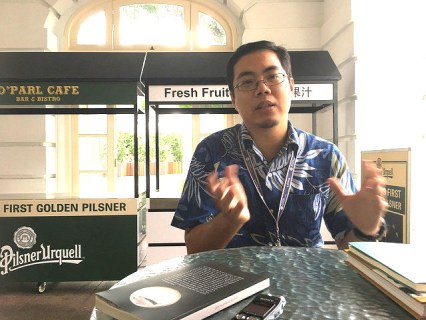
Now on its 19th edition, the SWF began in 1986 as a biennial event, but it has since become a fixture on the regional cultural calendar (alongside the Singapore Arts Festival), cementing the city-state’s reputation—like its iconic Merlion—as the fountain of artistic endeavor in this part of the world. (I know what you’re thinking: “Shouldn’t that be us, the Philippines, with our long tradition of cultural expression and our bountiful artistic talents?” But I’ll tell you what festival director Yeow Kai Chai—himself a poet and journalist—told me over lunch: “I can’t believe you Filipinos have yet to establish a Department of Culture!”)

It was clear, from the minute I stepped out into Changi’s arrival area, that the National Arts Council, under Singapore’s Ministry of Culture, had once again pulled all the stops to guarantee a pleasant and efficiently managed experience for all SWF attendees, expected to number about 20,000. I was here as a journalist on coverage for the Star (I had attended the SWF as a participant in 2008, and returned to cover it in 2011) and I knew what to expect, but like they say, you never cross the same river twice, and this year’s festival offered a steady stream of 300 events spread out over ten days from November 4 to 13. There were over 300 official participants registered, with a hundred of them coming from overseas.

That makes the SWF one of the world’s largest and longest festivals of its kind, if not probably the most multilingual one, with its support for literature not just in English but also in Bahasa, Chinese, and other Asian languages. According to Yeow, the goal was to be as inclusive as possible in the SWF’s programming, going so far as to offer facilities for the hearing-impaired.

The fullness of the festival programme required selectivity, so I cherry-picked my way through the three days of my stay there, paying special attention to literary developments in Singapore itself. I’ve often remarked—most recently at a reading in Diliman featuring authors brought over by Ethos Books, one of Singapore’s most energetic presses—that the Philippines and Singapore have enjoyed a longstanding “bromance” going down the generations: between F. Sionil Jose and Edwin Thumboo, for example, followed by Krip Yuson and Kirpal Singh, then Joel Toledo and Alvin Pang, to name a few. We’ve published books together; not too long ago, Isabel Mooney and Lily Rose Tope worked with their Singaporean academic counterparts to edit a landmark anthology of Southeast Asian writing in English. So I wanted to see where things were at.

IMG_9762.JPG

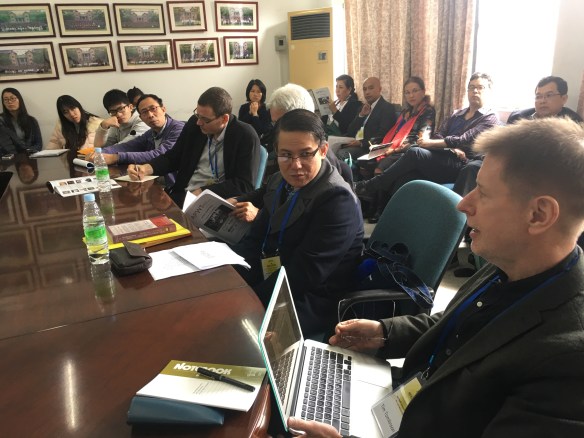
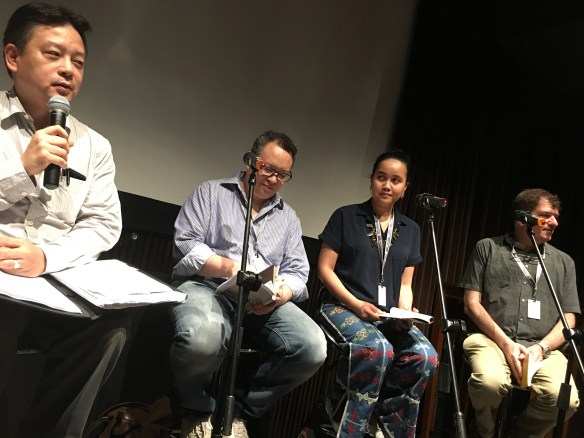
The first session I attended addressed the diasporic element in Singaporean literature—but unlike our exodus of workers and writers to the far reaches of the planet, this diaspora was inbound, and a voluntary one. Moderated by the Filipino expat poet Eric Tinsay Valles, the panel comprised the Eurasian short story writer Jon Gresham, who had come to Singapore via the UK and Australia; the Filipino fictionist and diplomat Cathy Torres, who had moved from her posting in Singapore to Germany; and the American creative nonfiction expert Robin Hemley, who’s married to a Filipina and who now teaches in Singapore.

They discussed how, in the words of Eric, the diaspora could be “a creative space” within which the experience of estrangement could create some positive value. Being away from one’s home, the three agreed, made new impressions and expressions possible. The writer’s struggle to adjust and adapt was in itself the story. Jon spoke about how “It isn’t so much about roots as routes—the journey, the getting there” for the diasporic writer. Adverting to the title story of her debut collection, Mariposa Gang and Other Stories, Cathy observed how “Diasporic stories are like butterflies. They may look alike but no two are truly the same. I try to catch them and send them out into the world.”

But the it was the keynote talk by Farish Noor, a Malaysian political scientist and historian who’s become something of an intellectual rock star in the region, that both charmed and alarmed the packed chamber where the Singaporean parliament used to meet. Dr. Noor introduced his talk thus:

“How a word can have multiple meanings at the same time, and have their meanings change over time, is an interesting mirror to the unfolding of history. This lecture looks at one word in particular, sayang, charting its path of adaptation from pre-colonial and colonial histories to the post-colonial present; and considering how the changes in its meanings and applications—from fables to novels to cinema and pop culture—tells us more about ourselves, like how our own sensibilities and worldviews have evolved, leading to the postmodern present which we inhabit today. The word remains the same, but do we sayang today as our ancestors did?”

Looking back on how concepts of love evolved over time in the region—including love across species in folklore, and love for the colonial master—Farish noted how “Words are what we have left of the past, and the past is far more complicated—more rich, more deep—than the present. Today, in the age of Facebook, ‘love’ has been reduced to clicking a ‘Like’ button.”

During his turn in the chamber, Singapore’s unofficial poet laureate Edwin Thumboo looked back on a lifetime of literature in his country thus: “Young poets no longer write about nation because the nation has been constructed for them. It’s no longer a problem….. It’s so easy now to get published but I don’t think there’s enough revision going on. People are anthologizing like mad. Be patient. Always think you can do better.”

The renowned American critic Marjorie Perloff spoke at the last event I attended, and she closed SWF 2016 for me with a rousing challenge: “Avant-garde poetry has crossed the boundaries between the verbal and the visual, but poetry hasn’t changed in 70 years the way painting and music have. We need another kind of revolution!”

Many thanks again to my hosts and to my SWF friends—it was all sayang and yet no sayang for me this past weekend. In a coming column, I’ll digest two interviews I conducted with Singaporean poet Aaron Lee and our very own Eric Tinsay Valles on what it’s like to be a poet in Singapore.

Penman No. 224: Fantastic, Frenetic Frankfurt (2)

IMG_9577.JPG

Penman for Monday, November 7, 2016


GOING TO the Frankfurt Book Fair was a great opportunity to renew old friendships and make new ones within both the global and Philippine publishing community. While we authors count publishers among our closest and most valuable friends, I realized in Frankfurt that we really don’t talk about their side of the business that much, as engrossed as we often are by our own fabulations.

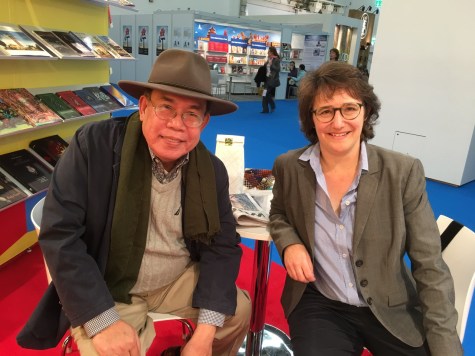
I was particularly happy to finally meet Renuka Chatterjee, who had been India’s premier literary agent when she worked for the big Osian’s cultural conglomerate in New Delhi. As my first literary agent, Renuka had been instrumental in getting my second novel, Soledad’s Sister, translated and published in Italy; but more than that, she guided me through my first textual revisions, through which I began to learn how international publishing worked. When Osian’s shut down its literary operation, I passed on to another very capable agent in New York, and Renuka eventually joined another leading publishing house in India, Speaking Tiger. We had corresponded by email over the years, but Frankfurt gave us an excuse and a venue for a long-overdue face-to-face.

Another acquaintance lost and found was the dynamic and groundbreaking Malaysian publisher Amir Muhammad, whom I had first met at a conference in Penang in 1992; Amir gifted me with a new trilogy of Southeast Asian stories he had just published, featuring the works of some of our best young Filipino authors. (Those books—like many others I’ve gathered on my travels—are now lodged at the Gonzalo Gonzalez Reading Room in UP, where we keep a repository of contemporary Southeast Asian literature.) Indeed, and not surprisingly, the Malaysians became the Philippine delegation’s best buddies at the fair; we frequented their booth to partake of the nasi lemak and to trade notes on the writing life. The Indonesians were equally hospitable, and our troop of visitors enjoyed a chat and the inevitable selfie with their star, the novelist Eka Kurniawan, whose Man Tiger made the 2016 Man Booker International Prize long list.

IMG_9554.JPG

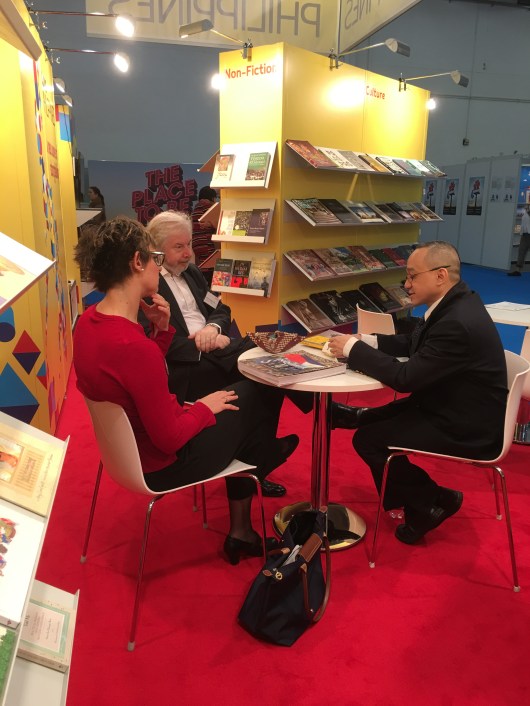
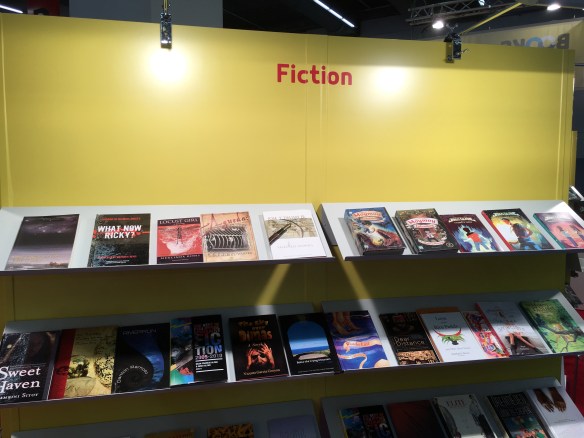
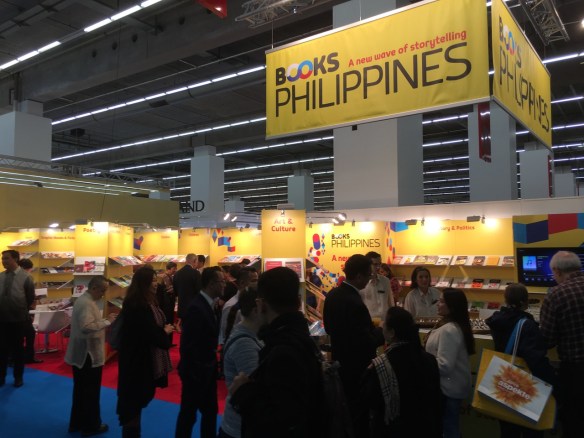
Neither were the long hours at our own booth wasted, as a steady stream of visitors curious about our books and our culture came by to browse, to converse, and to do business. Business, after all, was what most people went to the book fair for, and while some of us minded the store, our delegates were often out meeting with their counterparts from the US, the UK, Europe, and the rest of Asia. (I had a very productive conversation with a gentleman from Montenegro who runs a kind of global blog of blogs—expect “Penman” to appear there soon, but only after it’s published here, of course.)

IMG_9583.JPG

It was the Ateneo University Press’ new boss Karina Bolasco’s third straight year at the fair, which she had previously attended representing Anvil Publishing. University presses don’t generally look at their books as profit-makers, reducing the financial pressure somewhat, but Karina still had a full schedule of meetings with academic publishers, especially longtime Philippine partners such as the University of Wisconsin Press. “Our job is to negotiate for reprint rights,” Karina told me. “We try to find material already published abroad that will be interesting to Filipino readers, and we also offer other presses the rights to reprint Filipino works with a global appeal.”

One of the most visited displays in the Philippine booth this year was that of Mandaluyong-based OMF Literature, Inc., which has published religious and inspirational books since 1957. OMF CEO Alexander Tan told me that their market was big and growing—extending even to OFWs in the Middle East—and that it had developed its own local stars such as pastor Ronald Molmisa, who draws huge crowds to his lectures on love and relationships. “I realized that by breaking the rules and letting people like Ronald use Taglish in their books, we could reach more readers,” Alex said.

On the other hand, literary agents like Andrea Pasion-Flores, who now works with the Singapore-based Jacaranda agency, assume the task of representing Filipino authors abroad and finding publishers to buy their works (and who then assign editors to work closely with the authors on revising their text for publication). Andrea—an accomplished author in her own right who also happens to be a lawyer and the former executive director of the National Book Development Board—is the first and, so far, the only literary agent working actively in the Philippines. Jacaranda has already sold the rights for such distinguished Filipino writers as the late Nick Joaquin, Charlson Ong, Isagani Cruz, and Ichi Batacan (whose Smaller and Smaller Circles will be a movie soon).

IMG_9563.jpg

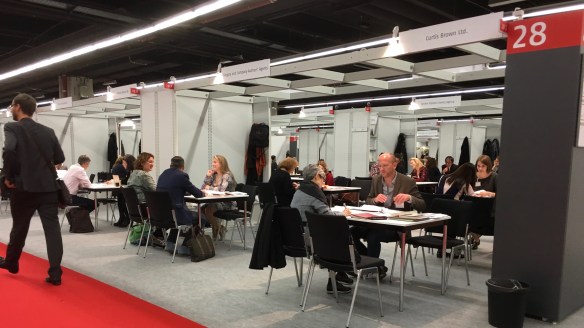
Andrea and her Jacaranda colleagues Jayapriya Vasudevan and Helen Mangham spent long working days in Frankfurt at the exclusive Literary Agents section upstairs, which only registered agents (who paid a hefty price for table space) and publishers could theoretically access. But Andrea secured a pass for me so I could observe the frenetic 30-minute “speed-dating” sessions that took place in hundreds of cubicles. “You’re probably the only author in this room,” Andrea told me. When I asked her what international publishers were looking for from Filipino authors, her response was quick and to the point: “The big novel, more genre fiction, and more high-quality literary fiction—and less ego, please, as Filipino authors generally aren’t used to revising their work!”

Back downstairs the next day, my companions at the Philippine booth were surprised to see me in animated conversation in Filipino with a Caucasian lady, whom I was happy to introduce to everyone. Our visitor was Annette Hug, a novelist and translator who had come from her home in Zurich to meet with me and with her publisher at the book fair. Annette—who took her MA in Women’s Studies in UP and regularly practices her Filipino with an OFW friend—had just translated a piece I had published last month in the Philippine edition of Esquire magazine, a piece on extrajudicial killings that had somehow gone viral; Annette’s translation had come out that same day in a Swiss newspaper and she brought me my copies, fresh off the press. But apart from that sad topic, Annette had also just published a novel in German, Wilhelm Tell in Manila, based on Jose Rizal’s work on that Swiss hero’s life, and the UP Press will now explore the possibility of publishing a translation of her novel in the Philippines.

IMG_9597.jpeg

Another visitor was children’s book author and Palanca Hall of Famer Eugene Evasco, who just happened to be in Munich on a three-month research fellowship, so he took the three-hour train ride to Frankfurt to visit the fair and to take in the mind-blowing displays at the children’s literature section.

Of such providential encounters, magnified into the thousands, was the Frankfurt Book Fair made, and while I was there less on business than as a roving cultural ambassador of sorts, I was glad and privileged to tick another item off my bucket list. I’ve run out of space to talk about an excursion some of us took to trace the footsteps of that quintessential Filipino writer, Jose Rizal, in nearby Heidelberg, so I’ll save that for another column soon.

IMG_9567.JPG

Penman No. 223: Fantastic, Frenetic Frankfurt (1)

IMG_9550.jpeg

Penman for Monday, October 31, 2016


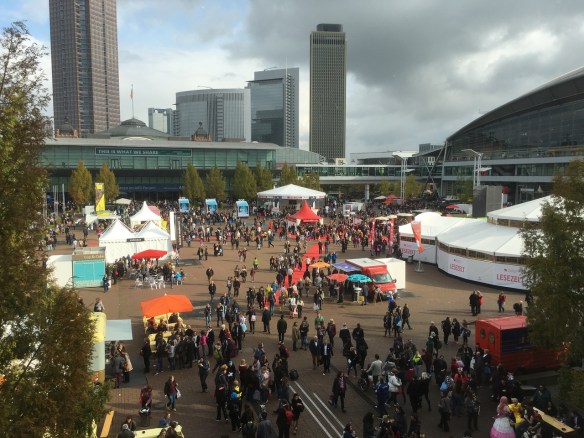
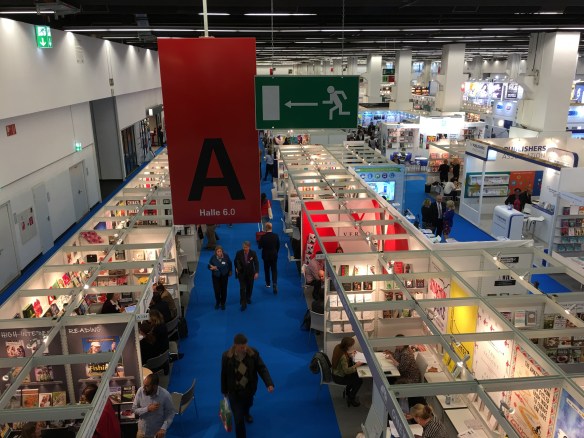
I’VE BEEN to mammoth meetings before—the Modern Languages Association in Chicago, MacWorld in San Francisco, Comic-con in San Diego, for instance—but nothing comes close to the Frankfurt Book Fair in size and scope. Covering over ten hectares of exhibition space spread out over several buildings and many floors, it’s certainly the world’s biggest and best-known book fair, gathering participants from nearly 200 countries.

Unlike author-focused literary festivals, the vast majority of those participants are publishers, booksellers, editors, literary agents, and printing industry representatives, all looking to make a pitch and a sale of their wares across the globe. That globe may have been made much smaller by the Internet, but nothing still beats a face-to-face transaction with one’s possible partners, and that’s where a book fair like Frankfurt’s comes in, as a week-long physical marketplace where the world’s publishers, from the biggest to the smallest ones, all go.

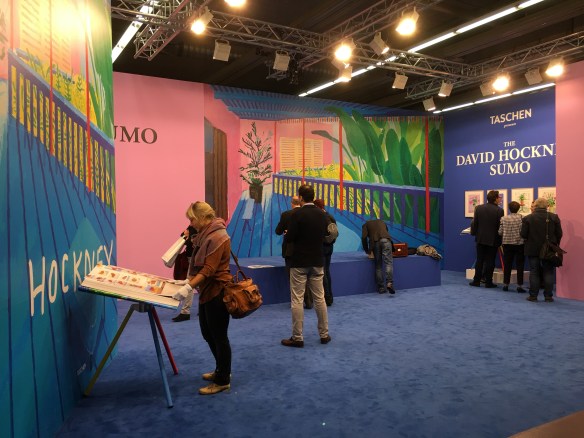
Inevitably a few writers and artists stray into the mix (we spotted David Hockney through a crack in the wall being interviewed at the Taschen booth by German TV), and this year I was one of those lucky few, with some help from the National Commission for Culture and the Arts and the University of the Philippines. Spearheaded by the National Book Development Board and invaluably assisted by the prime advocate of culture and the arts in the Senate, Sen. Loren Legarda, the Philippines expanded and upgraded its representation at FBF 2016, with a much larger booth and an impressive array of books from all our major commercial and academic publishers. The NCCA also sponsored one of our top graphic artists, Manix Abrera, and it didn’t hurt that National Artist Virgilio Almario came along in his private capacity to accompany his wife Lyn and daughters Asa and Ani who were representing Adarna Books and the Book Developers Association of the Philippines.

IMG_9720.jpeg

While Filipinos have attended the FBF in dribbles for some time now, it was only this year that we went all out, helped incalculably by our bigger booth. Last year, publishers had to chip in P100,000 each to rent a tiny plot of real estate at the fair, which starts at 400 euros per square meter. Sen. Legarda’s timely intervention meant that publishers could put their rental money into bringing more representatives and more books, and our 2016 delegation hit a historic high at over 40 members.

Though not yet quite the pavilion that countries like China and Singapore could afford, our corner booth was colorful and visually attractive—a plus in a fair with thousands of such offerings, all competing for the passing viewer’s eye. Through the Ateneo University Press (now headed by Karina Bolasco, formerly of Anvil Publishing), the Philippines also had another albeit smaller booth in another hall as part of the FBF’s invitational program, an affirmative-action project that brings in and sponsors selected publishers from developing countries. Predictably, China’s exhibit occupied a whole city block (for the price of which they could have gotten a better English editor for their signs, which proclaimed “Chinese Publication”).

On the other end of publishing pomp and circumstance, the FBF annually invites and celebrates a Guest of Honor, and this year it was the Netherlands and Flanders, which decked out an enormous hall as a haunting landscape reminiscent of the Dutch flatlands. The Guest of Honor status focuses attention not only on that country’s literature but its entire culture and society, providing an opportunity to put one’s best foot forward (Dutch royalty attended the opening ceremonies, lending a touch of glamor to the event—and ratcheting up security for everyone). The Guest of Honor also gets to choose a theme for its exhibit, which this year was “This Is What We Share” (last year, New Zealand—on the other side of the world, for Europeans—whimsically chose “While You Were Sleeping”). My fancy tickled, I asked what the Philippines needed to be named Guest of Honor—one can both apply or be invited—and received an unequivocal answer: “Millions of dollars.” I shut up.

Its cultural import aside, the book fair means big business for Frankfurt, which, in partnership with the private sector, leases out the fair grounds to such clients as the publishers’ association which directly runs the book fair; at other times the venue hosts other big events such as automotive fairs and a forthcoming Justin Bieber concert. Last year the FBF brought in 250,000 participants, a figure the organizers expect to rise to 280,000 in 2016.

IMG_9573.JPG

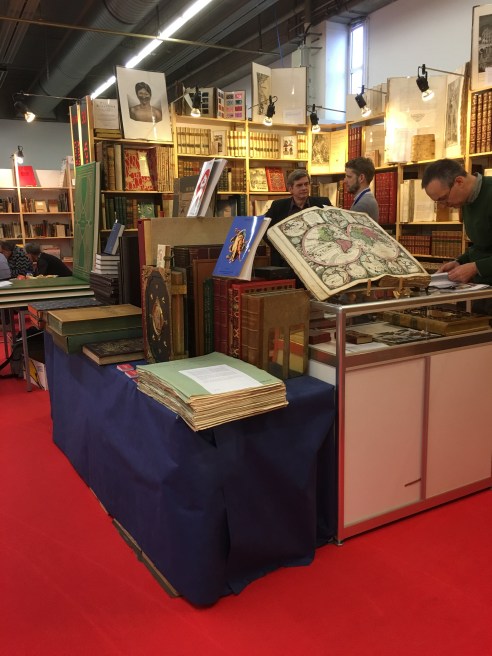
This year’s edition of the Frankfurt Book Fair is officially the 68th, but it traces its lineage much farther back to medieval times, when friars traded pages of illuminated Biblical manuscripts. There’s still a special section of the FBF devoted to the antiquarian trade, to which I gravitated naturally, being interested in all things ancient. Other than this parchment-heavy and leather-bound corner, the FBF dwells and thrives on nothing but new, newer, and newest—new books, new ideas, new authors, new media, new technologies, new markets, new connections, new networks.

Exhibits are grouped by geographic region, by language, and by theme, so one has to roam far and wide to get the full scale of things and to zero in on specific interests. Much of the business at Frankfurt, however, is pre-planned; with table space at a premium, publishers and agents would have emailed each other months or weeks in advance to set up meetings for specific dates and times in Frankfurt.

IMG_9584.JPG

The publishers of so-called “trade books”—novels, cookbooks, children’s books, etc. aimed at the general public—showcase their works to attract attention from international publishers and booksellers who may want to translate them into another language, or to sell the books on consignment in other countries. Academic publishers—this year we were represented by the UP Press, Ateneo de Manila University Press, and UST Press—negotiate among each other for reprint rights, which can make costly works more easily available to local readers.

Led by NBDB Chair Neni Sta. Romana-Cruz, the Philippines launched its exhibit with a reception at its booth on the fair’s formal opening on October 19, a well-attended event graced by Ambassador Melita Sta. Maria-Thomeczek (who was happy to recall that she had once been an employee in Rio Almario’s Adarna Books and had been a student of Rio’s wife Lyn at Maryknoll) and by First Secretary and Consul Cathy Rose Torres, who herself happens to be a prizewinning fictionist. The reception was catered by Maite Hontiveros, who laid out a scrumptious spread that featured lumpia, spoonfuls of adobo on rice, mango juice, and Philippine chocolate, which were clearly a hit among our foreign guests.

IMG_9536.jpg

Filipino books, of course, remained on top of the menu, and for the next week, we took turns at the booth to entertain visitors and book buyers from other countries, while occasionally slipping out to survey the vast array of exhibits and inevitably to marvel at the scope, vitality, and quality of global publishing in the 21st century. I came away even more convinced that culture is a global battleground, and that books are weapons—of mass instruction, if you will.

Next week, I’ll share the highlights of my conversations with key people at the book fair, and report on retracing Rizal’s footsteps in Heidelberg.

IMG_9564.JPG

Penman No. 222: An Education for the Well-Rounded Filipino

1094625733_b065e8bc1c_z

Penman for Monday, October 24, 2016


IN A few weeks’ time, several hundred professors at the University of the Philippines’ Diliman campus will gather together for an important vote on UP Diliman’s General Education program—long seen to be the hallmark of a UP education. It’s important because what happens there will determine, to a great extent, what “tatak UP” will mean for the next generation or two, and what being “the national university,” as its charter defines it, entails as far as the quality and the breadth of its offerings are concerned.

The raging battle seems to be over how many units (or class-hours a week) to allot to General Education subjects, which have traditionally covered basic and compulsory courses in such areas as language (English and Filipino), history, math, science, and philosophy.

There’s a menu of options on the table, ranging from a formidable 45 units to a scant 21, and an emerging compromise of 30-36 units in between; the mix of courses in these totals is also under negotiation. Those who want more want to ensure that every UP undergraduate—whether he or she plans to become a lawyer, an engineer, a surgeon, or a painter—can talk intelligently as a well-rounded citizen about the Katipunan and mitosis and perspective and Sophocles and interstellar travel. Those who prefer less want students to graduate from their programs sooner, for UP to remain competitive with other schools, and suggest that students can imbibe some GE skills both from their K-12 add-ons and from their higher-level classes.

I don’t mind saying that I put myself squarely on the 30+ side. We can’t keep complaining that young Filipinos can’t write or speak in proper sentences or don’t know who Apolinario Mabini was—without doing enough to fix the problem, given the chance. Sure, some of these learning points can be addressed in senior high; but subjects like History, English, and Philosophy will still be different when taught in UP’s staunchly secular context and pitched as adult concerns.

But never mind me—let’s give a listen to one of our most accomplished writers, the Leyte-born but now New York-based Gina Apostol, whose novels have won the 2013 PEN America/Open Book Award and National Book Awards in the Philippines. Some time ago, Gina wrote UP Diliman Chancellor Michael Tan to plead for the strengthening of UP’s GE program, and I got her permission to quote from that letter here:

I am writing as a graduate of the UP English department, 1980-1984, a former teacher at the department, and as a novelist whose work has been indelibly shaped by my education at UP—in particular, by its General Education program, to which I look back daily in my own work as a teacher and a writer.

My three published novels owe their genesis to that program. My current novel, William McKinley’s World, about the Philippine American War, began in a PI 101 class in a classroom at Palma Hall Annex, where my professor taught me about a war I never knew about.

In those first two years at UP, I learned to think. The General Education program made me into a writer. I went to a private high school in Leyte that certainly taught me well (arguably just as rounded as the current K-12 program); but I needed the General Education program at UP to make me whole—a critical consumer, a nationalist thinker, a global reader, and finally, it gave me ground to think honestly and seriously about what education means, it gave breadth of thought to allow me to become who I am—a novelist whose work is absolutely grounded in the questions that UP had asked of me in my first two years at the school.

It is my misfortune (though some call it luck) that I have ended up teaching in the States, living among an extremely lucky group of students: the wealthy enclave of Manhattan’s private schools. But every day, teaching my very privileged, very wealthy students who can enroll in any school they want, I can compare what they have to my education at Diliman, and I am daily impressed by the foundational, long view of knowledge grounded in the breadth of UP’s General Education curriculum.

My experience as an educator and an artist here in America is that the education I gained at the University of the Philippines is equal to and (given the state of America) too often exceeds the quality of education abroad. This is true of my fellow alumni who come to America: we understand how well we were prepared.

I cannot underline this enough: I know that UP provided me with an incalculable, a priceless education. I am writing to state emphatically that the General Education program at UP should be enriched, not reduced.

Even today, having been to and taught at several schools considered the best of their kind in America—so acculturated and mired in the world of the privileged as I am here in America—every day, in my classroom, I still marvel at the amazing comprehensive education I got at the University of the Philippines.

Here in Manhattan, these kids are killing themselves to get into colleges with the kind of education I got at UP. My own daughter went to the University of Chicago, and I will say that I was proud (and fascinated) to know my education as a freshman and sophomore was equal to her own rigorous coursework in the General Education program of the University of Chicago, where highly able freshmen have to go through the GE program. As you know, Chicago’s program still stands as a beacon of higher education in America today.

At UP, as my daughter was at Chicago, I was required to take philosophy, maths, history, sciences, and four rigorous courses in English that made me read across cultures (the stories of Akutagawa and D.H. Lawrence, Marquez and Achebe)—to read across time (Machiavelli and Madariaga, Rizal and Homer)—and to read across disciplines. I noted that just as at the UP in my time, the University of Chicago does not stint its students—my daughter was required to do the full two years of humanities reading before she did her majors, reading Hegel and Homer as a freshman and sophomore, as I was asked to do in Diliman. In my case, much of the knowledge that has stayed with me came in one packet (Dadufalza’s primer). The way UP taught its students to think then remains an incalculable benefit, equal to the best in America.

I repeat: I learned to think at UP, and the General Education curriculum made me into a novelist. It made me into a writer who can hold her own anywhere. It distresses me to think that the university will fail even one child, one student from the provinces, like me, who arrives at the university not knowing exactly who she could be—but now without the bulwark of its tough and extended humanities curriculum to point her to the myriad possibilities that creates not only engineers but also artists, not only scientists but also philosophers. The rigorous General Education program of UP is a boon to the country.

UP should strengthen its GE curriculum, not reduce it.

Please let me know how we, alumni across the world, can help to strengthen our alma mater. We love UP, we love our education, we would love to help.

Gina Apostol, AB English 1984


Penman No. 221: Teaching the Millennials

L1090932.JPG

Penman for Monday, October 17, 2016


THERE WERE no marching bands, greeting cards, or fireworks to mark the event, but World Teachers’ Day was celebrated last October 5. As unofficial or secular holidays like Mothers’ or Grandparents’ Day go, it’s a relatively new one, proclaimed by UNESCO in 1994 to draw attention to the key role teachers play in molding the citizens of every country. My calendar shows that I did nothing remarkable that Wednesday, my day off from teaching, so I very likely spent it on a foot-massage-movie-and-dinner date with Beng. But surely teaching would have crossed my mind, as it does every day, because we keep preparing for our next class even in our idle hours, wondering how we can make our students’ encounters with us more interesting and memorable.

I’ve been thinking about teaching a lot more lately, first because of the recent deaths of some valued mentors and colleagues. Just over the past month, our department lost two of its stalwarts—Professors Sylvia Ventura and Magelende “May” Flores. I’ve written quite a bit in this corner about Sylvia, my Shakespeare teacher, who fired up my enthusiasm for Elizabethan drama and poetry. May was an English-language specialist and textbook author, a sweet, imperturbable lady with a caring smile for everyone. (Continuing the tradition, May’s son Emil also teaches with the department and has become one of our prime experts on science fiction and creative nonfiction.)

The second reason is my own impending retirement, less than three years hence. It’s hard to believe that it’s been more than three decades since I gave up my PR job at a government agency to devote the rest of my life—as I told myself then—to studying, writing, and teaching. I never did become much of a scholar—I guess I did become the writer I wanted to be—but even this close to the end of an active career, the teacher in me is still a work in progress.

That’s because every teaching day is a new performance, even if—like it would be for a theater actor—the script may essentially be the same for courses you’ve taught for years. Every new batch of students brings with it a new mix of challenges—even, over the decades, a generational drift to adjust to. For example, a teacher can’t simply blame millennials for their lack of a historical memory, which we helped create; I try to get them interested in the past not for the past’s sake, but to show them how an appreciation of the past can help their future.

Teachers, in other words, have to keep learning about their students and their interests, so lessons remain fresh and relevant, rather than boring incantations regurgitated from ages past. We need to relate the lesson to the student’s present realities, which may seem daunting if you’re talking about, say, a 19th-century short story about the French bourgeoisie, but which can be done with a little imagination (in this case, I’d begin by talking about the Filipino middle class and its aspirations—“Where do you see yourself ten years from now?”).

But as vital as it is to connect directly with millennials, it’s just as important to remind them that there are many things in this world that may seem to have little or nothing to do with them that will still affect their lives—in other words, that we’re still motes in the grand scheme of things, and that Nature can be profoundly indifferent to our noisome plaints and woes.

That’s a harder lesson to impart, even to older students—to any person who hasn’t encountered something much larger than himself or herself, like a World War, or martial law, or a terrorist attack. In a me-centered universe, no one wants to feel disempowered, so I then have to challenge them into getting out of themselves and enlarging the sphere of personal actions they can take to improve not only their own future, but also that of their fellowmen.

Back when we ourselves were freshmen and sophomores in the early 1970s, this message came down to us in the exhortatory slogan “Serve the people!” Exactly how seemed a lot simpler to figure out back then, when a predatory dictatorship was looming over everything and everyone (a dreadful specter I thought I’d escaped forever). Today a young person’s options are far richer and more complex, with all manner of personal advocacies, NGOs, weekend CSR programs, and Facebook groups competing for one’s political attention.

But whatever the chosen means may be, the overriding need for building empathy remains, for leading young urban, middle-class Filipinos to see, to appreciate, and to grow their stake in a future that they share with the millions of others who live unlike them, many without the opportunities that they enjoy. We can’t truly be a nation—much less a Christian one—if we continue to dismiss the bullet-riddled bodies of the poor as trash because we find nothing in common with them.

A teacher’s job is to help students draw the line between two points, including and especially the most seemingly disparate ones. That includes the line between teacher and student, between student and student, and between student and society. If that’s all I’ve done these past three decades, I can retire happy.


AND NOW for something liberative. According to the exhibit notes, “Ebarotika! (You are Erotic, Eve) follows the story of Eve who dared venture into the forbidden. Her defiant act opened knowledge’s connection with sexuality, the knowledge of one’s sexual and erotic desire. But it also resulted in shame and punishment. Thus, many of us cover and hide our sexual and erotic life. Those who are bold enough to come into the open are subjected to stigma, discrimination, and death. Sexuality and the erotic are a source of life, joy, and pleasure. They are not objects of fear, horror, and anxiety. They must be opened, shared, and celebrated instead of being censored, concealed, and criminalized.”

Curated by Lia Torralba, Ebarotika! features 19 Kasibulan artists: Yasmin Almonte, Lot Arboleda, Chie Cruz, Cecil de Leon Escobar, Imelda Cajipe Endaya, Anna Fer, Lorna Fernandez, Kristin Garanchon, Lorna Israel, Amihan Jumalon, Nina Libatique, Eden Ocampo, Jonabelle Operio, Fel Plata, Rebie Ramoso, Benay Reyes, Doris Rodriguez, Christine Sioco, and Lia Torralba.

It opened last Saturday, but will run until November 23 at the Sining Kamalig Art Gallery located on the Upper Ground Floor of Ali Mall in Cubao, Quezon City. See you there!


Penman No. 218: History and Irony

11884866_supreme-court-extends-status-quo-ante-order_e9546b1e_m.jpg

Penman for Monday, September 26, 2016


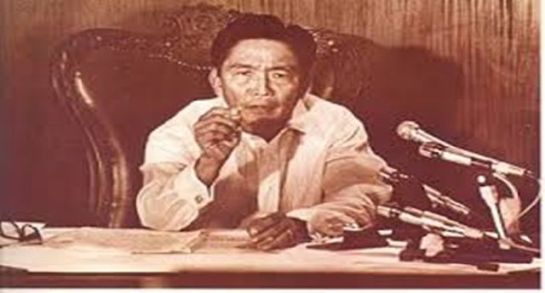
I’D NEVER heard of Ramon Cualoping III and Marco Angelo Cabrera until their names were linked to the recent flap involving the use of no less than the Official Gazette in an apparent effort to sanitize the memory of Ferdinand E. Marcos by removing any reference to martial law—you know, the martial law that Marcos invoked to impose his dictatorial rule on his people from 1972 until he was deposed by a popular revolt in 1986. (Yes, he technically lifted martial law in 1981 but he continued to rule with a rubber-stamp legislature.)

Some Googling revealed that Cualoping was an Ateneo Communication Arts graduate, batch 2004, while Cabrera graduated from San Beda in 2013 and interned briefly with the Department of Foreign Affairs; he had also worked for Sen. Bongbong Marcos. Those are both fine backgrounds for jobs at the Presidential Communications Operations Office—just the kind of posting on which many young writers and lawyers aspiring for a political future have cut their teeth—and I can surmise from the dates provided that Messrs. Cualoping and Cabrera must be in their mid-30s and mid-20s, respectively—too young, therefore, to have personally known what the Gazette expunged.

In the interest of full disclosure, I was a government propagandist myself at an even younger age—19, fresh out of martial law prison. Having dropped out of UP and having worked for the Philippines Herald and Taliba just before martial law, I got a job with the PR section of the National Economic and Development Authority. The irony of going from writing incendiary flyers to trumpeting such new government projects as Pantabangan Dam wasn’t lost on me. But I was getting married and needed a job, and all the old media jobs were gone save for the Express and the Bulletin, so I was thankful for whatever came my way. (I would much later write hundreds of speeches for FVR, among other Presidents and political clients—mostly to pay the rent, occasionally for the sheer privilege—so don’t look at me as some crusading journalist.)

I don’t know what drove Messrs. Cualoping and Cabrera to the Palace; I’m assuming their motives were loftier than mine. I also don’t know what made them officially forget (hey, it’s the Official Gazette, right?) that FM declared martial law. I suspect they knew what happened, but chose to ignore the most salient fact about Marcos’ life, for reasons only they can tell. To his credit, Communications Secretary Martin Andanar effectively reprimanded his staff for the deliberate oversight and corrected the record.

I’ll leave further chastisement of these two gentlemen to the netizens who broke the story. From one PR pro to another, what I can tell them is this: I understand the job you have to do and even your private allegiances, but there are things—very big things much bigger than yourselves—that you just can’t sweep under the rug. Denying martial law or its disastrous effects on our society and economy is like telling Jews that the Holocaust never happened, or was actually a good thing. I salute you for your cheek, but what on earth were you thinking?

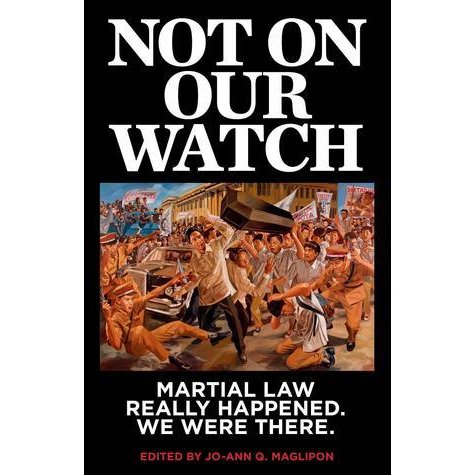
There’s a book I’d like to recommend to these two, one which I and a dozen other writers—all students during martial law—put out four years ago on the 40th anniversary of Proclamation 1081, titled Not on Our Watch: Martial Law Really Happened, We Were There. (For more on that book, see here: http://www.philstar.com/sunday-life/806191/lest-we-forget.) I wasn’t too enamored of the long title at that time, but now I appreciate the emphatic clarity of the thing; it’s just the sort of book martial law amnesiacs and deniers need to read.

16136602._UY475_SS475_.jpg

But even as we review history, there’s one thing that seems to have escaped many: the current debate about how to look at martial law and where to bury Ferdinand Marcos isn’t about the past; it’s about the future, and what kind of people we are and want to be.

I know that millennials tend to get beat up on because they don’t know enough about martial law, which is hardly their fault since we didn’t teach them enough about it. But it isn’t just them. When people my age express bewilderment over how Bongbong Marcos came so close to becoming Vice President despite his dad’s misdeeds, and how the Marcoses have survived so handsomely, I have to remind them that even under martial law, those of us who opposed Marcos were in the distinct minority. Most Filipinos supported martial law, actively or passively, or it wouldn’t have lasted so long. Like the Germans who supported Hitler, most Filipinos stood by while we faced the truncheons and firehoses—and even applauded 1081, early on, as the antidote to Communism (1972’s “war on drugs”). So what should we be so surprised about?

That’s why I’ve never referred to EDSA 1 as a revolution, because it wasn’t one in terms of changing anything fundamental in the structures and workings of our society. It was a popular uprising, a street revolt led by another faction of the ruling class, with broad support from the metropolitan middle class. That doesn’t mean I didn’t feel euphoric that February, and I still get teary-eyed when I remember the moment; I guess the poignancy comes from knowing what came afterward.

I have no doubt that if the Palace incumbent were to declare martial law today for whatever reason, a majority of Filipinos would support him, although a noisy few of us would be up in arms. Martial law ca. 1972 was also like that, and remained popular for many more years, especially among amoral businessmen who sang its praises until it hit them in the pocket. And then it all went downhill.

Contrary to what you might expect, I don’t see Marcos as a one-eyed ogre, but rather as a calculating Macbeth, keenly aware of his actions and perhaps even troubled by them. In my own turn with revisionism, I’ve even managed to convince myself—as I told the BBC in a recent interview on EDSA (a part which never got aired for lack of time)—that Ferdinand Marcos may have done us a final act of kindness by leaving without ordering a bloodbath. It’s an arguable notion (one I wouldn’t put on the Official Gazette) and it doesn’t change the fact that his regime took what it could until we bled, but as a fictionist and playwright, I like to imagine characters to be more complex than they seem.

A couple of years ago, at a cultural function in Quezon City, Mrs. Marcos preceded me by a few steps down a narrow staircase. She was clearly having a hard time navigating the stairs, and she looked back at me apologetically to say, “Hijo, I’m very sorry I’m keeping you.” I smiled and said, “It’s all right, Ma’am, please take your time.” I felt amused and strangely triumphant.

History is sometimes best seen as a series of comic and tragic ironies, which straight journalism and certainly government tabloids can’t dispense. Come to think of it, who gives a hoot about the Official Gazette? If you want to lie and get away with it, try fiction. I’d be happy to see Messrs. Cualoping and Cabrera in my graduate workshop.


Penman No. 217: We Were Young Together

PSHS10.jpg

Penman for Monday, September 18, 2016


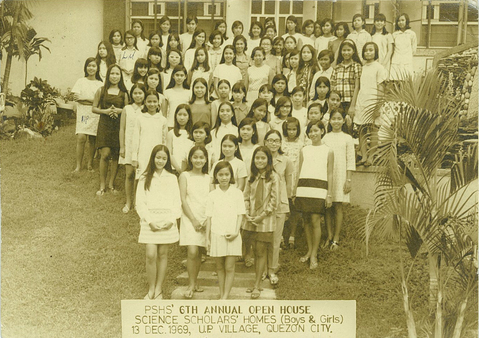
I HAD the honor of being asked to speak at the 50th anniversary reunion of my Philippine Science High School batch (we chose to celebrate our entrance year, 1966, fearing that there’d be fewer of us to gather in five years). It was, I joked, the valedictory I never got to deliver, for reasons that will be shortly obvious. You’ll forgive the chest-thumping; every high school has a right to think it’s the best on the planet—perhaps some more so than others. Herewith, an excerpt:

I’ll begin with a shameless boast, and the boast is that over these past four decades, I’ve won quite a few awards and prizes for my work as a writer and teacher. But none of them has given me as much pride and pleasure as the knowledge that once upon a time in 1966, for one brief shining moment and for some miraculous reason, I topped the entrance exam to the Philippine Science High School.

It was a fleeting glory, and if I ever imagined myself a real genius I would be quickly disabused, because as you all know, after our first year, my grade in English was 1.0 and my grade in Math was 5.0. Only the kindness or perhaps the embarrassment of our administrators persuaded them that I was worth giving another chance and putting on probation, a break I’m forever thankful for.

I have never felt in more distinguished company than yours. Individually and collectively, you are the smartest people I have ever known, and it has nothing to do with PhDs or awards or high positions in government and business or least of all material wealth—although I’m sure we could all use a little more money. I know that I can sit with anyone of you and have an intelligent and funny conversation about anything from interstellar travel and Dutertean diplomacy to hugot lines and Pokémon—well, maybe not Pokémon.

Long before buzzwords like “world-class” and “globally competitive” came into fashion, there were smart kids who passed an entrance exam that decimated whole regiments of lesser beings, leaving a few good boys and girls standing after the slaughter, calmly noting the distinction between cousins and cosines, avocados and Avogadro, halitosis and mitosis.

PSHS2.jpg

Hey, these kids were us—gangly, smelly (after a good day’s work at the biology garden, or the agawan-base arena), cocksure in the classroom, and curious as hell about the opposite sex. Not surprisingly, boy-girl questions dominated the school’s philosophical life.

“What Is a PSHS Boy?” asked the Science Scholar ca. 1969, and the soul-searching answer came (courtesy of someone who should have known—a PSHS girl): “A PSHS boy is a new sociological specimen of the human race… a hardworking nekti achiever [who keeps] a well-tended garden near the bio pond…. a longhaired mod swinger around the campus [who] wears kooky sunglasses, stylish baggy pants, and necklaces… He crams love letters in his notebooks. When Mr. Mozrah asks him ‘What is social interaction?’, he recites his lovelorn adventures with Jennifer, Corrine, Paulette, etc….”

PSHS11.jpg

This penetrating study naturally occasioned a companion piece, published a year later under the thought-provoking title of “What Is a PSHS Girl?”, written by an expert on the subject, a PSHS boy.

“A PSHS girl,” this savant said, “is a rare biological specimen… She is only emotional, temperamental and irrational sometimes (well, half of the time… would you believe almost always?). Anger is not a word in her dictionary. You see, her dictionary starts with ‘boy’… A PSHS girl is the reading type. She reads Emily Loring and the like.”

PSHSGirlsDorm.jpg

It didn’t take too long for a PSHS girl—uhm, PSHS young woman activist—to trash that silly, bourgeois, sexist view. “Now is the time for awakening,” this budding feminist would write in the same Science Scholar just a year later. “Do you realize that today you are a mere tool of the man?… Our bourgeois-oriented society adds insult to injury by picking up things for you and opening doors for you—reminders of sexual disparity—the very chains you should set out to break.”

We don’t know how many chains were broken; some precious objects certainly were (er, windows, petri dishes, innocence, and rules). Talk about rules! A famous one—dated September 29, 1970, and issued by the PSHS Board of Trustees—decreed that PSHS scholars “remain single and be discreet about their boy-girl relationships in order to continue their studies at the PSHS.”

Perhaps another topic of passionate discussion—“Should Smut Movies Be Allowed?”—had something to do with this heated  state of affairs.

The guidance counselor warned: “If they only display the human body for art’s sake, then there’s nothing wrong.  But if what they show are the acts sacred to man and woman, and those which arouse man’s sexual instincts and cause him to do something about it, then definitely, smut movies should be banned!”

Not too definitely, a freshman objected: “In European countries, especially in Scandinavia, sex movies have become so ordinary that they now seem to be part of the people’s lives.  In the Philippines, there is indifference towards these movies.  The Board of Censors should allow more of them and let us see what the attitude of the public toward them will be in the future.” [Brilliantly said, young man, an answer truly worthy of a science scholar—we’re not watching smut movies, here, we’re watching popular attitudes!]

Ah, the times, they were a-changing.  “The opening of the intramurals ushered in a new sight on our campus,” reported a sports columnist (a distraught boy) in the Science Scholar in 1970.  “Where once only boys were seen, girls have materialized…. The girls’ presence cannot be ignored…. In so short a period, many can be said to equal the boys at their own game. Complaints have been heard from the girls that the boys have been monopolizing both the basketball court and the ping-pong tables.”

That should’ve told us that the days of the Young Gentlemen’s Club and the Girls’ Club—no one had the gumption then to set up a Young Gay and Lesbian Club—were coming to an end. Some brazen soul in our freshman class organized the UBAG (United Boys Against Girls), but that didn’t last too long. Biology would teach boys that uniting with girls instead of fighting them was the more natural and pleasurable thing to do.

For a few of us after high school, life may have been a breeze, but for most, I’m sure it’s been an uphill climb, full of rough patches, and you were just as astonished as I was to find that a high IQ did not guarantee happiness or prosperity or success and may even have made things worse because of our more acute awareness of the meaning of things. We learned that the smartest people can make the dumbest mistakes in love, money, and politics, and that sometimes we just don’t know squay about the things that truly matter. I even learned that you could be happily married to someone from UP High.

Most important of all lessons and legacies, we learned to serve the people. Whether we grew up to be NPA cadres or CEOs or lab rats or barrio doctors, we knew that our high school scholarship had to be repaid in faithful service to community and humanity, employing the scientific, rationalist outlook that even those of us who strayed from S&T never quite lost.

We were young together, and we will grow old together. As we’ve all learned from life, it isn’t who leads at the start of the race but who finishes first at the end who wins—although again I suspect that in the race of life, we’d rather finish last.

PSHS6671.jpg


Penman No. 214: Soon, Another Presidential Race

2013DoctorofLawsUP.JPG

Penman for Monday, August 29, 2016


NO, NOT for President of the Republic of the Philippines, but, for some Filipinos, an almost equally significant post—that of President of the University of the Philippines System, who will be chosen by the UP Board of Regents in a meeting in mid-November. Standing at the forefront of Philippine higher education, UP—recognized by its new Charter as “the national university”—very often sets the standards and the tone for other Philippine universities, especially State-funded ones, to follow. Thus, the position is much more than honorific or ceremonial; the UP President is expected to be a visionary, an executive, a manager, a motivator, a mentor, a democrat, a disciplinarian, a nationalist, and an internationalist all at once.

UP Presidents have been known to surprise their constituencies. The very first one, Dr. Murray Simpson Bartlett, was an American and, of all things, a Protestant pastor—and yet he envisaged the new institution as a “University for Filipinos.”

Edgardo J. Angara was a successful lawyer and a budding politician, having served as a delegate to the 1971 Constitutional Convention, when he was asked by outgoing UP President Onofre D. Corpuz to consider taking over in 1981. The reluctant nominee and non-academic turned out to be one of UP’s best presidents, restructuring the university’s organization, boosting faculty salaries, and reforming its curricula.

Francisco Nemenzo was a professed Marxist who modernized the university’s facilities and mindset, revitalizing UP’s core General Education program, and making better commercial use of UP’s vast landholdings. Emerlinda R. Roman broke barriers as UP’s first woman president, after having served twice as Chancellor of UP Diliman. A management expert, she was able to harness considerable resources on the crest of UP’s centennial in 2008 and to employ those to the UP community’s benefit.

Incumbent President Alfredo E. Pascual’s ascendancy to the presidency came as a surprise to nearly everyone—perhaps including Pascual himself—when the BOR elected him in 2010 on the first ballot, reportedly by a one-vote margin (by tradition, the BOR members agree on a unanimous vote after the fact). A Chemistry and MBA graduate who later spent many years in the private sector and with the Asian Development Bank, Pascual was seen to be an outsider and went off to a rocky start. But he proved to be a quick study, and has worked hard to raise UP’s international profile and its connections, to raise performance incentives for UP’s professors and researchers, and to expand the UP System’s reach.

Their successor, according to search guidelines recently released by the BOR, must meet the following basic standards: (1) hold a master’s degree, with a doctorate preferred; (2) have substantial academic experience at the tertiary level; (3) be able to serve the full term of six years before reaching the age of 70; and (4) have no conviction for administrative and criminal offenses.

Additionally, and just as importantly, they should demonstrate (1) a commitment to academic excellence and national development; (2) the political will and the skills to defend and promote academic freedom and the University’s institutional autonomy; (3) a commitment to democratic governance in the University based on collegiality, representation, accountability, transparency, and active participation of constituents; and (4) a commitment to preserve the public and secular character of the University. (There are more requirements, which you can check out in the guidelines here: http://www.up.edu.ph/call-for-nominations-for-the-next-u-p-president/.)

This early, several prominent academics and personalities have been heard or rumored to be interested in running for the presidency. They include UP Law Dean and popular radio host Danilo Concepcion; former UP Diliman Chancellor and physicist Caesar Saloma; current UP Diliman Chancellor, anthropologist, and newspaper columnist Michael Tan; current Vice President for Academic Affairs and marine biologist Gisela Concepcion; and former Senator and now Representative and UP Law alumna Pia Cayetano. The names of former Vice President for Academic Affairs and now National Historical Commission chief Maris Diokno and of former CSSP Dean Cynthia Bautista have also been mentioned. (My information, mind you, is based on coffeeshop chatter, and could very well be denied by any of these eminent persons tomorrow.)

In practical terms, and despite and away from all the spirited rhetoric we can expect of the campaign process, it will all come down to a matter of securing six votes among the 11 members of the BOR. The composition of that board is provided for by the new UP Charter, RA 9500 (which, as Dodong Nemenzo’s Vice President for Public Affairs, I among others had the privilege of lobbying for in the Senate before it passed under Emer Roman in 2008, perhaps the government’s greatest gift to UP on its centennial).

The BOR comprises the chairperson of the Commission on Higher Education, who also serves as the BOR’s chair; the incumbent UP President, who serves as co-chair; the chairs of the Senate and House committees on education; the president of the UP Alumni Association; the elected representatives of the UP faculty, staff, and student sectors; and three regents appointed at large by the President of the Philippines (the BOR will recommend a shortlist of persons chosen for their academic and professional accomplishments—at least two of them have to be UP alumni—but the President can technically make other selections). Effectively, therefore—considering that the two representatives from the Senate and the House will likely be Malacañang allies—the Philippine President can exercise tremendous influence in selecting the UP President.

Before the new Charter defined an odd-numbered BOR, a tie was possible. In 2004, the then 12-person BOR was deadlocked 6-6 between Emer Roman and the Palace candidate, then Ambassador to the UK Edgardo Espiritu. The tie was broken 7-5 in a second vote a week later.

It’s a critical choice for both the Palace and the University because UP’s history is replete with instances when the two presidents have clashed bitterly, with sometimes brutal consequences. Rafael Palma fought Manuel L. Quezon over political issues, including free speech at UP, as a result of which the government cut UP’s budget and denied Palma a gratuity upon his retirement in 1933 after a decade of service. (Upon Palma’s death in 1939, however, Quezon praised him as “a patriot, a scholar, and one of the noblest characters that ever lived,” and even had Palma’s interment delayed so he could personally attend.) Bienvenido Gonzalez and Elpidio Quirino also warred over academic freedom. Salvador Lopez stood up to his fraternity brother Ferdinand Marcos in defense of civil liberties.

Bearing these presidents and precedents in mind, if you have a candidate whom you feel should lead UP onward, take note that nominations will close on September 23; the BOR election will be held November 15; and the incoming UP President will take office on February 10, 2017.

I myself will be retiring from full-time teaching in three years and so will see only half of the next President’s term through, but whoever gets chosen should have an impact less on the outgoing profs like me than on the incoming freshmen of Batch 2017. Admittedly, UP could always do better at basketball, but choosing the next coach of the UP System could prove just as important to the shaping of the Filipino mind as the one that 16 million of us made just a few months ago.

1091857175_807c3b9981_z.jpg


Penman No. 212: A Lovely Place to Be

IMG_8775.JPG

Penman for Monday, August 15, 2016


IT WAS a few Sundays ago when I joined a group of artists and friends for lunch at a place that has to be on the must-see list of any Filipino art lover, especially those within driving range of Antipolo. We had been invited for lunch by Dr. Joven Cuanang, whose Pinto Art Museum we had visited once before, but this time it was the founder himself who was going to walk us around the place, so we all looked forward eagerly to meeting him and having a chat.

For those who’ve never heard of it or never been there, the best way to describe the Pinto (people, including myself, have been heard pronouncing it as PIN-to, but it’s really Pin-TO as in “door”) is to call it an art complex—mostly gallery, but also museum, restaurant, theater, library, and, apparently, research center. It’s also, quite simply, just a lovely place to be, with its buildings and galleries set on seemingly terraced hillsides leading naturally from one to the other, offering spectacular panoramas of the metropolitan skyline from every high point. Not surprisingly, it can get very busy on weekends, with as many as a thousand visitors streaming in through the gate (admission fees range from about P100 to P200).

IMG_8097.JPG

The Mediterranean-styled complex has that pleasing, thoughtfully curated ambience, the visual and sensory assurance of a well-managed experience. But of course, it wasn’t always so. The place began as a rough and weedy wilderness, which a young but visionary Dr. Cuanang bought up, patch by patch, more than four decades ago. “I started in 1972 with 1,000 square meters,” he reminisced. “Real estate prices fell after martial law and I was gradually able to acquire more land in the area.”

After EDSA, Joven fell in with a committee of prominent Antipolo residents and community leaders eager to spearhead the town’s cultural renaissance, but the good doctor soon decided to go it alone after an unpleasant brush with government corruption. He must have seen art and nature as the best cleansing agents, and he began supporting a posse of local artists, buying their work when they needed cash. Those artists later became the Salingpusa group, which considers Pinto its physical and spiritual home. “We didn’t have much then so the artists first exhibited their work by hanging them on a clothesline, and that practice became known as Sampayan,” said Cuanang.

Today that clothesline spans six buildings spread over 1.2 hectares, operated by the Silangan Foundation for Arts, Culture, and Ecology. Designed by Tony Leaño, the buildings blend effortlessly into the landscape, which is no accident because they were built around natural objects like the huge rocks that dotted the hillside. “We observed three principles in designing the place,” Cuanang noted. “First, don’t cut any trees. Second, follow the landscape. And third, minimal maintenance.”

As much as possible, Pinto’s buildings also employ natural ventilation, a notable exception being the air-conditioned library (where I was secretly pleased to find a couple of my books on the shelves). You’re never too far away from being reminded, however, that human whimsy is at work on Nature here, with oversized sculptures of mythological figures such as Icarus, Sisyphus, and Ariadne scattered about the greenery or soaring on rooftops.

While some come specifically for the scenic grounds, which are often rented for wedding shoots, most visitors flock to Pinto, understandably, for the art, which represents many of the most vibrant and brilliant works of our younger if lesser known artists. “You won’t see a single National Artist here,” Dr. Cuanang said, smiling and gesturing at the paintings and sculptures around him. “I keep my Bencabs at home!”

It’s refreshing and encouraging, in a way, not to see the usual parade of Amorsolos, Manansalas, Ocampos, and Botongs on display, and instead to find works by the likes of Elmer Borlongan, Jason Moss, Plet Bolipata, Tony Leaño, and Rodel Tapaya—at no diminution of quality, as these names could well be those of the National Artists of tomorrow. Salingpusa’s breathtaking 40 x 12-foot mural “Karnabal” is arguably the centerpiece of collection.

IMG_8049.JPG

Despite the plenitude of art offerings at Pinto and his obvious passion for art, Dr. Cuanang won’t think of himself a collector, the kind who spots and buys fine new work on the cheap for future profit. “I’m not here for the business,” he emphasized. “Too much art and discussion about art today is centered on the market.”

What truly interests the Harvard-trained neurologist, who still practices medicine after serving for many years as medical director of St. Luke’s, is wholeness of mind, body, and spirit, which he hopes to promote through the Pinto Academy of Arts and Sciences, a complex of facilities in a corner of the compound that comprises a large indoor theater, an amphitheater, a library, a function room, open decks, and gardens.

In a manifesto of sorts, Cuanang explained that “In medicine, healing is currently dominated by pharmaceuticals and technology, oftentimes to the detriment of the wholeness of a human being: mind, body, and soul. This perception is pervasive in our society. Fortunately, new knowledge in neuroscience research is affirming that the Arts and Sciences are in fact interconnected and mutually useful in preserving our wholeness, and together are powerful in the relief of our maladies.” The Academy, he added, “was built to promote conversation across disciplines to create, innovate and to pursue activities that celebrate this thought.”

The bridge between medicine and art, he pointed out, is neuroaesthetics, a branch of study that fascinates Dr. Cuanang. One of its chief proponents, Dr. Anjan Chatterjee of the University of Pennsylvania, poses its main concerns thus: “What in the brain triggers aesthetic experiences? And how does knowledge of basic brain mechanisms inform our understanding of these experiences? These questions are at the heart of an emerging discipline dedicated to exploring the neural processes underlying our appreciation and production of beautiful objects and artwork, experiences that include perception, interpretation, emotion, and action…. Neuroaesthetics is both descriptive and experimental, with qualitative observations and quantitative tests of hypotheses, aimed at advancing our understanding of how humans process beauty and art.”

It’s a lot to think about, for sure—but there’s no better place to ponder the glorious if sometimes dark mysteries of the human imagination than Joven Cuanang’s hilltop sanctuary.

Pinto Art Museum can be found on Sierra Madre Street in Grandheights Subdivision, Antipolo, and is open Tuesdays-Sundays, 9 am-6 pm.

IMG_8774.JPG

Penman No. 209: Coming: An American Museum of Philippine Art

OnglaoStudy1.jpg

Penman for Monday, July 25, 2016


AS YOU read this, I’ll be winging home with my wife Beng from California where we’ve spent the past two weeks engaged in a pioneering project that should bring the best of Philippine art to a broader American audience, if ongoing plans work out over the next few years.

Have you heard of the American Museum of Philippine Art? Probably not, since it’s still something of a pipe dream, but some people on both sides of the Pacific are blowing very hard on their pipes to make it happen. Those people include businessman Raffy Benitez, president of the Quezon City-based Erehwon Arts Center, and University of the Philippines professor and art expert Dr. Reuben Cañete, who developed the idea late last year after Erehwon’s successful involvement in a binational mural project at Chicago’s Field Museum sponsored by the John D. and Catherine T. MacArthur Foundation through Dr. Almira Astudillo-Gilles, a Chicago based Fil-Am writer and cultural advocate.

I reported on that project in this column last November 25, noting the warm response received by the participating Filipino and Filipino-American artists for their works—two murals, one at Erehwon and another at the Field—depicting the flows of Philippine culture and history from pre-Hispanic times to the present.

That positive experience encouraged Raffy and Reuben to conceive of a bigger and more enduring project that would bring Philippine art even closer to Americans—not just the huge and broadly dispersed Filipino community in the US, but the American public at large. Raffy and Reuben noted that the Mexicans and the Chinese, among other immigrant groups in America, both had their art museums, but that Filipinos—among the largest and fastest-growing minorities in America—did not.

Reuben recalled the long tradition of Filipino artists going over to the US to study and to work—such as Guillermo Tolentino, Victorio Edades, and Alfonso de Ossorio, among others—and observed that while strong cultural ties remained between the two countries, the connection was overwhelmingly one-way, with Philippine art (and music and literature, for that matter) being little known and appreciated in the US.

“In this age of globalization, art is now a global commodity that is exhibited and collected by various international venues, such as Art Basel Miami. Philippine Art, both in its historical as well as contemporary manifestations, must now be aggressively promoted in the United States, which is a major area of collection and promotion of global art,” Dr. Cañete would say in a concept paper on AMPA.

Karlota I. Contreras-Koterbay, a prizewinning Fil-Am sculptor and Director of the Slocumb Galleries at East Tennessee State University, agrees, writing that “There is a rich and dynamic art practice by Filipino-Americans in the US. However, there is a huge discrepancy in the visibility and recognition with regards to the idea and form of ‘Philippine Art’.

“The Philippines is the second highest Asian country whose citizens migrate to the US. The Filipinos have a long, complex history of immigration and residency in America, yet ‘Philippine Art’ is not as accessible nor recognizable in popular culture nor in the global art world. This statement does not claim that there is lack of talent nor creativity; on the contrary, there are thriving communities of artists, art groups and cultural workers who are making a difference in their respective locales, as well as receiving recognitions for their work in the field of arts.”

To take the first steps toward turning vision into reality, Raffy, Reuben, Beng, and I flew to LA to meet up with some prominent Filipino-American community leaders and artists to set up a foundation that would start the spadework on the museum. The American Museum of Philippine Art Foundation, Inc. (AMPAFI) was formally launched July 12 at the Holiday Inn in Diamond Bar, California, in a day-long meeting attended by a couple of dozen participants from all over the US.

Raffy Benitez will serve as chairman and president, and Reuben and I are joining him on the board, but we know that this project can’t be run from Manila, so the directors will also include art curator Karlota Contreras-Koterbay, physician Jose Botor Regullano, and engineer Ricardo Real Almonte. The officers include Fil-Am standouts Rafael Maniago, Art Zamora, Sal Budz Floriano, Rosie Vinluan Muñoz, Connie Buenaventura, Daniel Gutierrez Bassig, Dennis Martinez, Bobby Halili, Jess Española, Jun Sison, Ninette Tenza Umali, Ernan Ebreo, and Bernadette Escalona-Cooper. During the launch, a group of Fil-Am Artists headed by Paeng Maniago also rolled out a mural that they had executed to celebrate the occasion.

AMPAFIFound.jpg

We all realize that this project will take many years, enormous resources, and tremendous effort and optimism to realize. (Being Filipinos, we expect a lot of naysaying, and I’ve been Raffy’s chief buzzkiller whenever I think someone needs to pull his feet back to earth, but I have to admire the man’s guts and what he’s done at Erehwon, which you can preview here: http://erehwonartfoundation.org.) The museum as Raffy and Reuben envisage it is a mini-CCP, with enough spaces for exhibitions and performances (and even classes in Pinoy cooking), and the renowned architect Conrado Onglao was motivated and generous enough to contribute a prospective design for the building. That may be years down the road, but in the meanwhile, AMPAFI is taking early and doable steps toward building a countrywide arts community—a virtual museum, as it were—in cooperation with other groups such as Bernadette Escalona-Cooper’s Silicon Valley-based Global Artists’ Creative Collaboration for Empowerment (GACCE), whose leaders also attended the launch.

Karlota reports that “Our first two official projects are: ‘Nandito N Ako’ by 11 emerging Filipinx artists from the School of Art Institute of Chicago (SAIC) and possible community mural headed by NY-based artist Art Zamora with the Phil-Am organization and ETSU organized by Slocumb Galleries in the Northeast. This will be early October 2016 in time for Filipino Heritage Month. Also on the same month on the West Coast is the proposed Indie Film Showing in LA by special committee on fundraising head Ernan Ebreo. Both are curated programming for awareness campaign and fundraising efforts.”

(Wait a minute, did I read “Filipinx?” Indeed I did—and this trip was the first time I encountered the term myself, which seems to be gaining currency among young Fil-Ams, who define “Filipinx”—which I’ve heard pronounced as “Filipinics”—as an effort “to make the community more inclusive—we changed the O in ‘Filipino’ to an X to remain gender-neutral and recognize all genders that exist in the Filipinx community. There’s apparently been a lot of debate on this issue, which we’ll deal with some other time.)

The AMPA website is up at http://www.ampafi.org. Contributions and donations are, of course, very welcome, but more than that, we need goodwill, prayers, and strength of spirit to see this vision through. Mabuhay at salamat sa lahat!

AMPALogo2.jpg