Penman No. 227: The Southern Lights Shine Brightly

IMG_9859 2.jpeg

Penman for Monday, November 28, 2016


A RECENT gallbladder operation and the stitches in four corners of my belly couldn’t stop me from flying down to Iloilo City last week to catch the tail-end of VIVA Excon 2016, which I’d plugged here some time ago but just had to see for myself. The personal reason was that my wife Beng was one of the scheduled speakers, for a session on “Art Conservation and Restoration,” but I’d also heard that VIVA Excon was one of the most successful events of its kind in the country (“probably the only surviving and longest-running Filipino biennale,” VIVA Excon stalwart and chronicler Cecilia Locsin-Nava would emphasize to me). Here’s what I found.

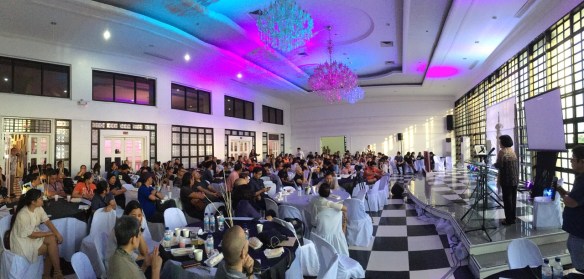
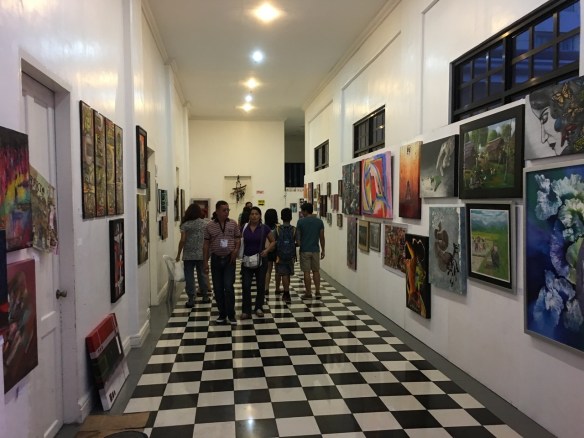
From November 17 to 20, more than 250 artists, speakers, and guests from the Visayas, Mindanao, and Manila gathered at Casa Real in the old provincial capitol of Iloilo to celebrate, interrogate, and propagate art in all its splendorous variety—the important qualifier being that this was new art produced south of Manila. It’s been around since 1990, moving around the major capitals of the Visayas such as Cebu, Bacolod, Dumaguete, and of course Iloilo. Surprisingly, it was only the second time that Iloilo hosted VIVA Excon, after a 20-year hiatus, so the local organizers made up for lost time by mounting one of its most vibrant editions ever.

When it started—spurred by the need to create a southern antipode for the arts, given the emergence of such bright new talents as the Negrense painter-sculptor Charlie Co—VIVA Excon had to be funded by the artists themselves, but this year Iloilo’s provincial and city government pitched in to guarantee the event’s success, with help from a host of sponsors led by the National Commission for Culture and the Arts (NCCA). On top of the local planning was painter Rock Drilon, assisted by a corps of wizards and elves who made sure that the dozens of events on the program went off like clockwork. VIVA Excon originals Ed Defensor, Charlie Co, Peewee Roldan, and Cecilia Nava were also around to lend their wisdom and support.

IMG_9862.jpeg

As its name suggests, VIVA Excon (the “VIVA” stands for Visayas Islands Visual Arts) was at once both an exhibition and a conference. As someone who has helped to organize quite a few literary conferences myself, I was much impressed by the scope and depth of the topics taken up at the conference and by the expertise of the speakers engaged for the occasion, some of them coming from as far as the US, Singapore, and Hong Kong. I missed most of the earlier sessions, but I would have loved to listen to Ma. Victoria “Boots” Herrera speak on “Museum Practices: What Artists Need to Know”; Silvana Diaz on “Creative Economics: Art Management and Economic Viability”; Elvert Bañares on “Creative Crossover: From Visual Art to Cinema and Back—The Visayan Artists’ Experience”; Rex Aguado on “Art, the Artist, and the Art Collector”; and Patrick Flores on “Art Criticism—Its Value to the Artist and the Artworld.”

Fortunately, I came in time to catch UP art theorist Lisa Ito address issues in writing about the arts—“for what and for whom,” she would say, “beyond the popular writing geared toward the art market, and the academic writing produced by scholars and theorists.” Lisa felt that more writing should be undertaken to “connect artistic production to social contexts and current realities, and developing publics and communities that validate the vitality of art and culture” as well as to “document design practices and projects and to record transient cultural events for future generations—how communities adapt, such as by using tricycles as mobile galleries and by putting up makeshift museums.”

She was followed by New York-based Carina Evangelista whose lecture on “When Forces Shape Form” led the audience to where art has gone far beyond and outside the museum, in performative gestures—often deeply and manifestly political—that emphasized process over product, transience over permanence, and repurposing over originality. (One example: the banknotes that Brazilian artist Cildo Meireles stamped with a political message and circulated in 1970 as a form of mobile graffiti, which nervous recipients couldn’t pass on quickly enough, thereby abetting its purpose.) It was truly a semester’s worth of material packed into 45 minutes on new forms of art from body mutilation to sound and video installation, reminding me of Marjorie Perloff’s lecture on avant-garde poetry just a couple of weeks earlier in Singapore; sometimes you learn the most wonderful things in the oddest places.

Of course, I was happiest and proudest to see Beng onstage walking the audience through the various stages of restoring Amorsolos and Botong Franciscos, and it was clear from the flurry of questions she fielded after her presentation that conservation and restoration were two of the least understood concerns of the art world, yet also two of the most vital if not inevitable. (Sculptor and installation artist Martin Genodepa graciously emceed the presentations.)

Outside the conference hall, three art exhibits were held: a curated one on “Contemporary Art of the Islands” at the UP Visayas Art Gallery, the more freewheeling Visayas Art Fair at Casa Real, and a special retrospective of the late Ilonggo sculptor Timoteo Jumayao at the Museo Iloilo.

IMG_9867.JPG

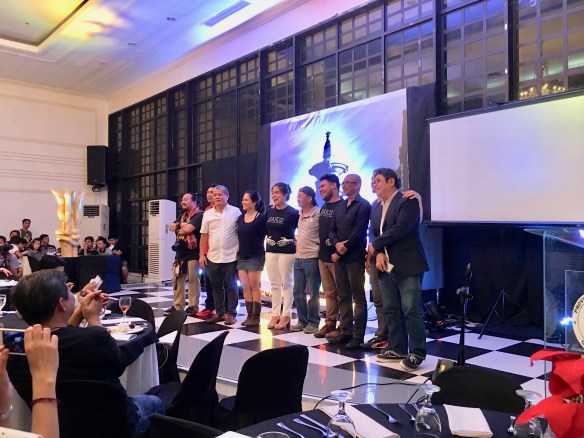
The culminating activity of VIVA Excon was the presentation of the Garbo sa Bisaya award to eight outstanding Visayan artists for excellence in their respective fields: painter Antonio Alcoseba (Cebu); scholar and painter Dulce Cuna Anacion (Leyte); film artist Elvert Bañares (Iloilo); film animator Oliver Exmundo (Iloilo); painter Allain Hablo (Iloilo); multimedia artist Manny Montelibano (Negros Occidental); painter Javy Villacin (Cebu); and painter and scholar Reuben Cañete (Cebu).

IMG_9887.jpg

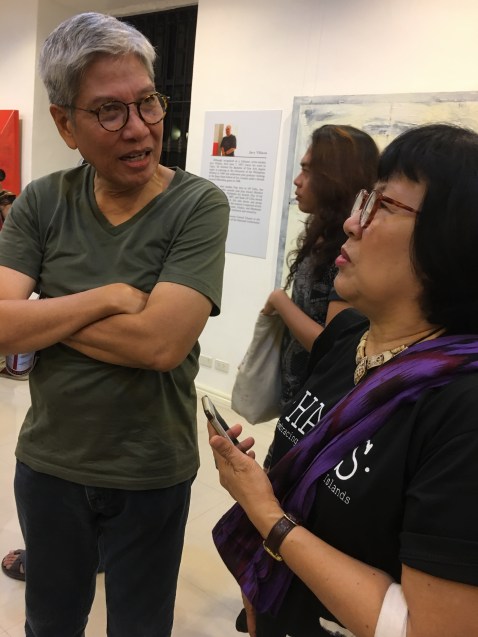
But I’m sure that all the attendees will agree if I suggest that the best part of VIVA Excon was, ultimately, the company of fellow artists, a fraternity forged over beer and music as much as over linseed oil and plaster. Even if I was little more than an onlooker at the event, I was glad to meet up with old friends and acquaintances like Rock Drilon, whose Mag:Net bar and gallery on Katipunan Avenue used to be one of our favorite hangouts. He moved to Iloilo years ago to take care of his ailing mom, and found himself drawn inextricably into the local art scene, until he realized that he was truly home. “Viva should last beyond the Excon,” Rock told me, “so an artists’ cooperative has been organized to sustain the energy sparked by VIVA Excon.”

IMG_9881.JPG

Two years from now, the event will be hosted by Roxas City in Capiz. Iloilo could be hard to top, but these Visayans are full of surprises.

Penman No. 223: Fantastic, Frenetic Frankfurt (1)

IMG_9550.jpeg

Penman for Monday, October 31, 2016


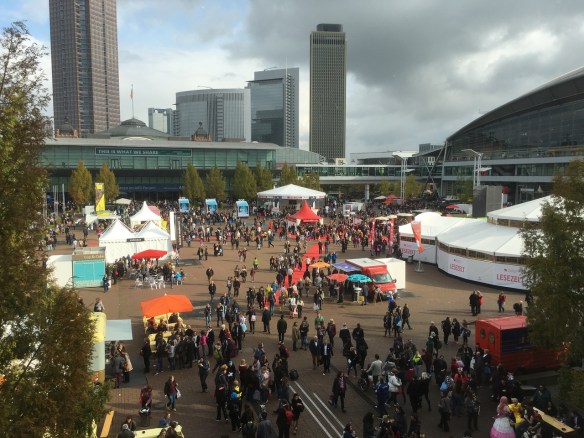
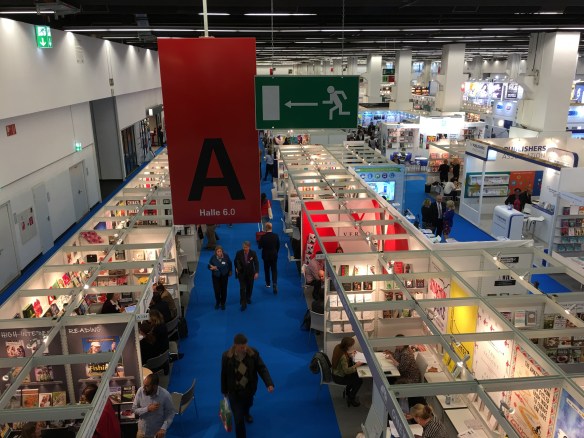
I’VE BEEN to mammoth meetings before—the Modern Languages Association in Chicago, MacWorld in San Francisco, Comic-con in San Diego, for instance—but nothing comes close to the Frankfurt Book Fair in size and scope. Covering over ten hectares of exhibition space spread out over several buildings and many floors, it’s certainly the world’s biggest and best-known book fair, gathering participants from nearly 200 countries.

Unlike author-focused literary festivals, the vast majority of those participants are publishers, booksellers, editors, literary agents, and printing industry representatives, all looking to make a pitch and a sale of their wares across the globe. That globe may have been made much smaller by the Internet, but nothing still beats a face-to-face transaction with one’s possible partners, and that’s where a book fair like Frankfurt’s comes in, as a week-long physical marketplace where the world’s publishers, from the biggest to the smallest ones, all go.

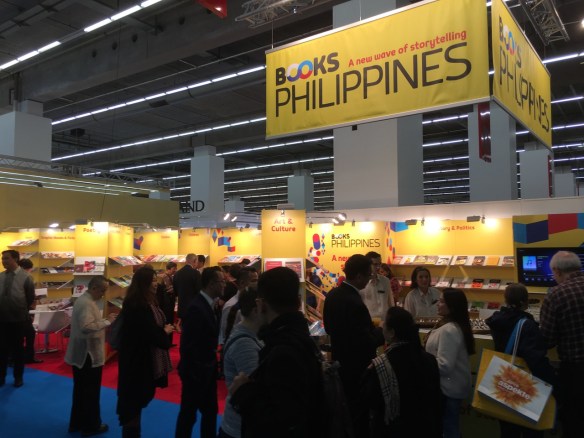
Inevitably a few writers and artists stray into the mix (we spotted David Hockney through a crack in the wall being interviewed at the Taschen booth by German TV), and this year I was one of those lucky few, with some help from the National Commission for Culture and the Arts and the University of the Philippines. Spearheaded by the National Book Development Board and invaluably assisted by the prime advocate of culture and the arts in the Senate, Sen. Loren Legarda, the Philippines expanded and upgraded its representation at FBF 2016, with a much larger booth and an impressive array of books from all our major commercial and academic publishers. The NCCA also sponsored one of our top graphic artists, Manix Abrera, and it didn’t hurt that National Artist Virgilio Almario came along in his private capacity to accompany his wife Lyn and daughters Asa and Ani who were representing Adarna Books and the Book Developers Association of the Philippines.

IMG_9720.jpeg

While Filipinos have attended the FBF in dribbles for some time now, it was only this year that we went all out, helped incalculably by our bigger booth. Last year, publishers had to chip in P100,000 each to rent a tiny plot of real estate at the fair, which starts at 400 euros per square meter. Sen. Legarda’s timely intervention meant that publishers could put their rental money into bringing more representatives and more books, and our 2016 delegation hit a historic high at over 40 members.

Though not yet quite the pavilion that countries like China and Singapore could afford, our corner booth was colorful and visually attractive—a plus in a fair with thousands of such offerings, all competing for the passing viewer’s eye. Through the Ateneo University Press (now headed by Karina Bolasco, formerly of Anvil Publishing), the Philippines also had another albeit smaller booth in another hall as part of the FBF’s invitational program, an affirmative-action project that brings in and sponsors selected publishers from developing countries. Predictably, China’s exhibit occupied a whole city block (for the price of which they could have gotten a better English editor for their signs, which proclaimed “Chinese Publication”).

On the other end of publishing pomp and circumstance, the FBF annually invites and celebrates a Guest of Honor, and this year it was the Netherlands and Flanders, which decked out an enormous hall as a haunting landscape reminiscent of the Dutch flatlands. The Guest of Honor status focuses attention not only on that country’s literature but its entire culture and society, providing an opportunity to put one’s best foot forward (Dutch royalty attended the opening ceremonies, lending a touch of glamor to the event—and ratcheting up security for everyone). The Guest of Honor also gets to choose a theme for its exhibit, which this year was “This Is What We Share” (last year, New Zealand—on the other side of the world, for Europeans—whimsically chose “While You Were Sleeping”). My fancy tickled, I asked what the Philippines needed to be named Guest of Honor—one can both apply or be invited—and received an unequivocal answer: “Millions of dollars.” I shut up.

Its cultural import aside, the book fair means big business for Frankfurt, which, in partnership with the private sector, leases out the fair grounds to such clients as the publishers’ association which directly runs the book fair; at other times the venue hosts other big events such as automotive fairs and a forthcoming Justin Bieber concert. Last year the FBF brought in 250,000 participants, a figure the organizers expect to rise to 280,000 in 2016.

IMG_9573.JPG

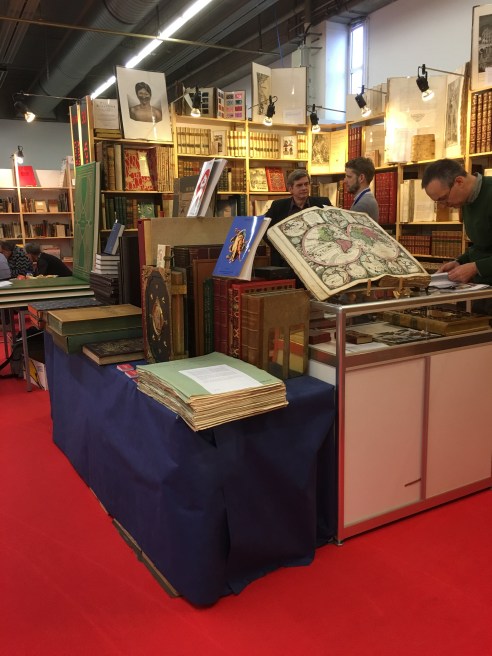
This year’s edition of the Frankfurt Book Fair is officially the 68th, but it traces its lineage much farther back to medieval times, when friars traded pages of illuminated Biblical manuscripts. There’s still a special section of the FBF devoted to the antiquarian trade, to which I gravitated naturally, being interested in all things ancient. Other than this parchment-heavy and leather-bound corner, the FBF dwells and thrives on nothing but new, newer, and newest—new books, new ideas, new authors, new media, new technologies, new markets, new connections, new networks.

Exhibits are grouped by geographic region, by language, and by theme, so one has to roam far and wide to get the full scale of things and to zero in on specific interests. Much of the business at Frankfurt, however, is pre-planned; with table space at a premium, publishers and agents would have emailed each other months or weeks in advance to set up meetings for specific dates and times in Frankfurt.

IMG_9584.JPG

The publishers of so-called “trade books”—novels, cookbooks, children’s books, etc. aimed at the general public—showcase their works to attract attention from international publishers and booksellers who may want to translate them into another language, or to sell the books on consignment in other countries. Academic publishers—this year we were represented by the UP Press, Ateneo de Manila University Press, and UST Press—negotiate among each other for reprint rights, which can make costly works more easily available to local readers.

Led by NBDB Chair Neni Sta. Romana-Cruz, the Philippines launched its exhibit with a reception at its booth on the fair’s formal opening on October 19, a well-attended event graced by Ambassador Melita Sta. Maria-Thomeczek (who was happy to recall that she had once been an employee in Rio Almario’s Adarna Books and had been a student of Rio’s wife Lyn at Maryknoll) and by First Secretary and Consul Cathy Rose Torres, who herself happens to be a prizewinning fictionist. The reception was catered by Maite Hontiveros, who laid out a scrumptious spread that featured lumpia, spoonfuls of adobo on rice, mango juice, and Philippine chocolate, which were clearly a hit among our foreign guests.

IMG_9536.jpg

Filipino books, of course, remained on top of the menu, and for the next week, we took turns at the booth to entertain visitors and book buyers from other countries, while occasionally slipping out to survey the vast array of exhibits and inevitably to marvel at the scope, vitality, and quality of global publishing in the 21st century. I came away even more convinced that culture is a global battleground, and that books are weapons—of mass instruction, if you will.

Next week, I’ll share the highlights of my conversations with key people at the book fair, and report on retracing Rizal’s footsteps in Heidelberg.

IMG_9564.JPG

Flotsam & Jetsam No. 47: Fountain Pen Day Nov. 5-6 at SM Aura

I1Ptaxz.jpg

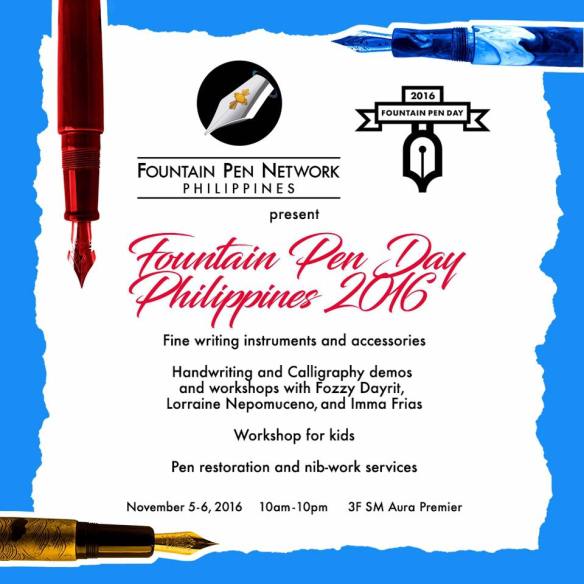
 IN CELEBRATION of Fountain Pen Day—marked globally every first Friday of November—Manila’s foremost dealers of pens and inks will set up shop on November 5 and 6 at SM Aura Premier in Bonifacio Global City near Toby’s Estate on the 3rd floor.

Scribe Writing Essentials, Pen Grafik, Everything Calligraphy, Faber Castell, National Book Store, and Lamy will be showcasing some of the finest brands of pens and inks from Europe, the United States, and Asia.

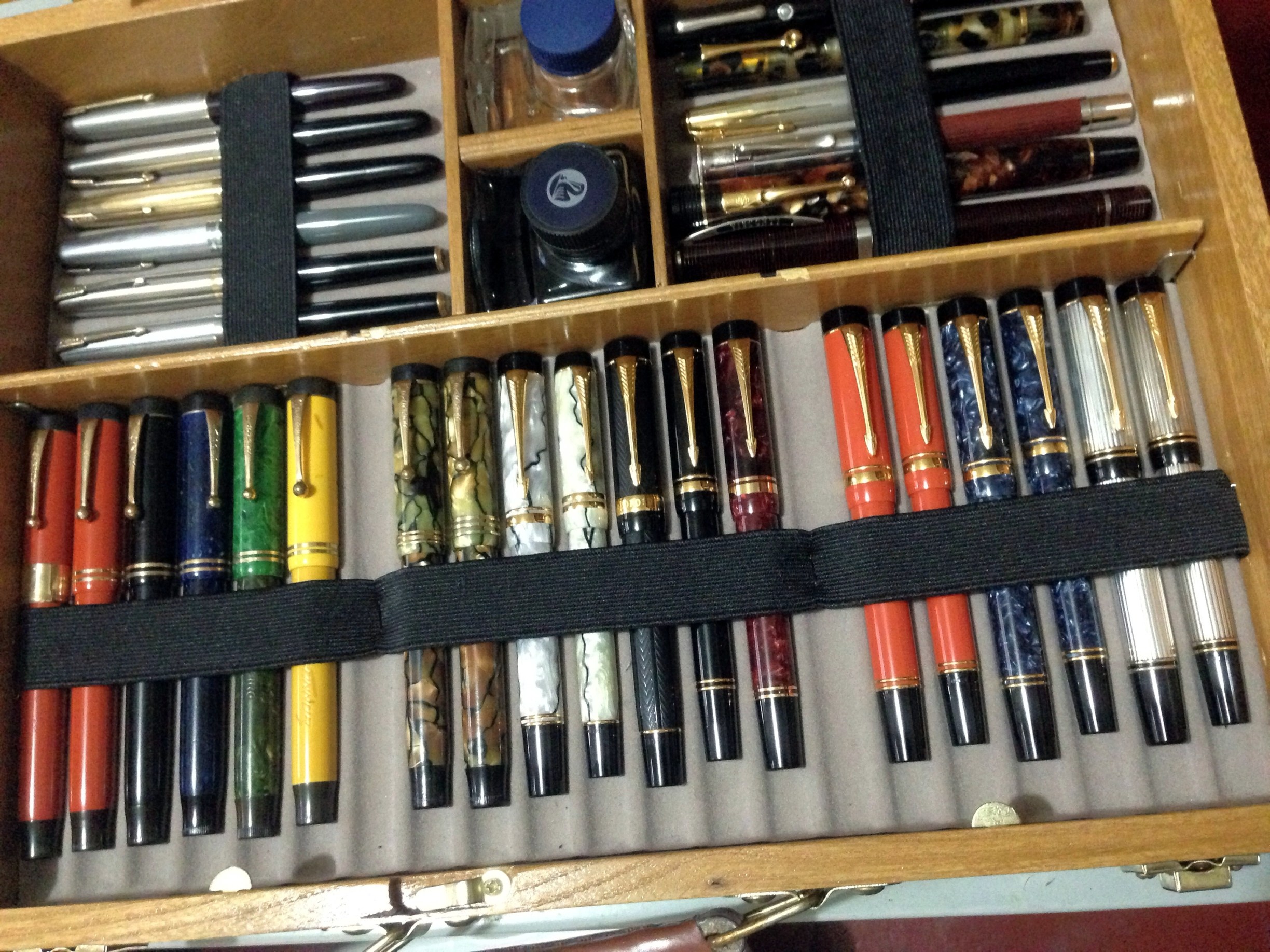
Handwriting workshops have also been lined up over the weekend. Kids wanting to discover the joy of handwriting can sign up for demonstrations guided by children who themselves use fountain pens for writing and illustration. Local pen restorers and nibmeisters will be present to tune, repair, and appraise pens. Pen lovers wishing to learn more about both vintage and modern pens can pick the brains of seasoned collectors, and students of the ornamental word can interact with expert calligraphers.  An art exhibit will feature works rendered in pen and ink by some of the country’s best artists. (Some of my best vintage pens will be on display, as will those of other FPN-P members.)

9461223955_cfe9b4d40b_o.jpg

Fountain Pen Day was started in 2012 by American pen collector Cary Yeager. In the Philippines, the Fountain Pen Network-Philippines (www.fpn-p.org) organizes this festival. With over 2,000 members in its Facebook group, FPN-P is a diverse community bound by a shared love for the written word in an increasingly digital age. Its members include writers, lawyers, doctors, teachers, artists, tech professionals, civil servants, and students.

Fountain Pen Day Philippines 2016 is also made possible by the support of SM Aura Premier, PNB Savings Bank and Asia Brewery. For more updates on Fountain Pen Day, go to Instagram and follow @fountainpenday and @fpnph, or interact using hashtag #fpdph2016.

Penman No. 220: Viva Visayan Artists

Kat1.jpg

Penman for Monday, October 10, 2013


JUST LIKE the city itself, which has undergone a refreshing makeover these past few years under the watchful eye of its chief political patron, former Senate President Franklin M. Drilon, Iloilo’s artists have been brimming with a new vitality that art lovers beyond the region have begun to appreciate.

I know that, because a few months ago, my wife Beng—herself an Ilongga artist and conservator who’d gone briefly back to Iloilo on family business—came home with the news that while in Iloilo, she had found and purchased a large painting by one of the city’s brightest young talents. The word “large” pricked my ears because it somehow sounded like “expensive” to me, but then she said she was paying for it herself, so I asked no further.

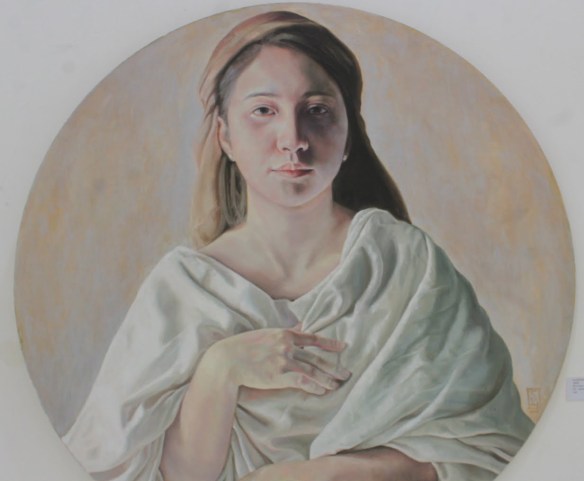
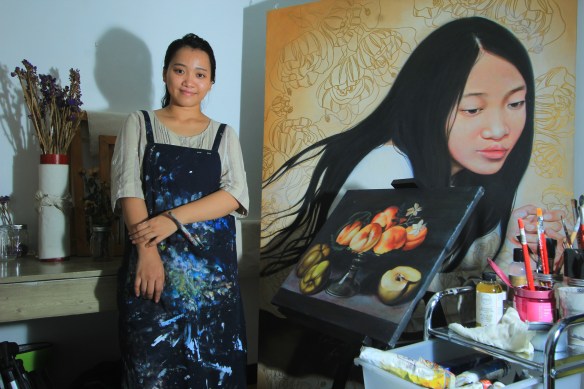
But I had to find out who the artist was, and Beng—who regularly tends to Amorsolos, Manansalas, Botongs, and Ocampos in her line of work—began gushing like a fangirl about a young painter she’d met while touring the Iloilo art scene with her old friend Rock Drilon. Rock, himself a painter of no mean stature (a recent exhibit at West Gallery displayed a penchant for organic, microbial forms), has been based in his home city for many years now, and has been a guru of sorts to younger artists there. So it was Rock who took Beng around to introduce her to his wards and their work, which was how this haunting painting of a young woman in white drapery found its way to our home in Quezon City. (It was too large to fly home with Beng and had to be professionally packed and shipped; I didn’t get to see it until months later.)
That’s when I first heard of Kat Malazarte, whose first solo exhibit Beng had seen at Casa Real de Iloilo, where Beng’s chosen work titled “Purity” (an apt choice for anyone surnamed Dalisay) had been the centerpiece. Just 20 at the time, she had already won the Vision Petron National Student Art Competition in 2015 for her video entry “Tingnan nang Malapitan, Damhin nang Malaliman” (Examine Closely, Feel Deeply). Indeed there’s a classical composure and pensiveness to Kat’s work, uncommon in artists of her age more prone to wanton kineticism. Her self-avowed themes of “purity, innocence, chastity, modesty, inner silence, contemplation, and state of nothingness” are monastic notions one might associate more closely with a nunnery (Kat’s a Fine Arts cum laude graduate of the University of San Agustin), and her subject’s luminous hands might have been rendered by a Renaissance master.

IMG_9403.JPG

So it was with much delight that Beng dragged me a couple of weekends ago to a three-day show at the Gallery at A Space on Legazpi Street in Makati, where a unique concept was being tried out by a pair of young and enterprising creatives, Karen Nomorosa and Prim Paypon. On show were the works of none other than Kat Malazarte and another rising Ilonggo star, the sculptor Harry Mark Gonzales. Dedicated to the theme of “The Quiet Strength of a Woman,” the show of Kat’s paintings and Harry’s sculptures proved a perfect pairing—much like the show’s instigators themselves, who both have outstanding corporate and science backgrounds (both are summas—she in CS, he in Biology) but who’ve taken on the more daunting challenge of promoting Filipino art through their startup venture, Curious Curator.

Kat Malazarte.JPG

“Curious Curator was conceptualized in order to help budding and potential artists from outside Metro Manila, especially from the Visayas and Mindanao, penetrate the mainstream art scene,” said Karen and Prim. “Keeping the welfare of the artist front and center, Curious Curator manages the financial, marketing and sales aspect of the collaboration so that the artist can focus on the creation process. Curated and conceptual art exhibitions are held in non-traditional venues to reach a wider audience. This enables the startup to promote the evolving Filipino artistry while diversifying and simplifying ways that budding art collectors can secure original but affordable art pieces.”

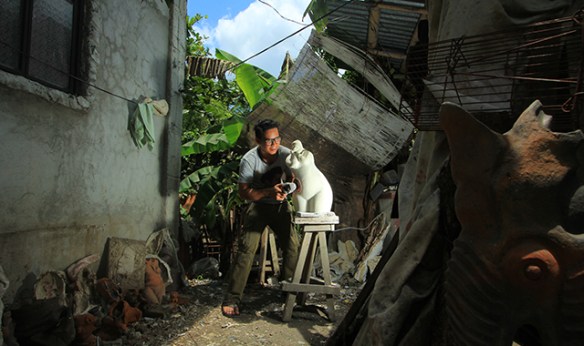
The two-person exhibit at A Space realized that mission. While we had already seen Kat’s work, Harry’s cold-cast marble figures, more than vaguely reminiscent of Henry Moore’s sinuous women, were another revelation. Coming from a background in IT and with a large brood of siblings to help support (he once drove a sikad around the city), this carpenter’s son put his faith in his vision and his hands, and began sculpting pieces that quickly won local collectors over. The self-taught artist won a Metrobank Art and Design Excellence Award in 2007 for a terracotta sculpture he crafted to protest an oil spill in Guimaras. “My main inspiration for these pieces is my mother,” he told me as we surveyed his pieces, whose exaggerated torsos suggested an overflowing fullness of all good things.

harrymark640.jpg

It was too bad the show ran for only three days, from September 30 to October 2, but with rentals at a premium, Karen and Prim have had to be more creative in their marketing, aggressively promoting the featured artists and their work online and selling a good number of them even before the show opened.

As for myself, I got the best part of the deal when Beng generously agreed to lend me Kat’s signature work “Purity” to hang in my new office at the UP Institute of Creative Writing (after the Faculty Center fire last April, we’ve found a new home in Room 3200 of Pavilion 3 at Palma Hall in Diliman).

But there are even more exciting events on the Iloilo art calendar to look forward to, chiefly the Visayas Islands Visual Arts Exhibit and Conference (VIVA Excon) which will be held from November 17 to 21 in Iloilo City. The event will take place in four different venues: the University of the Philippines Visayas (UPV) Art Gallery for the Garbo Sa Bisaya Awardees Exhibit; the Museo Iloilo for the Romeo Tabuena Tribute Exhibition; the UPV Auditorium for Turns in Form (Curated Contemporary Art from the Visayas); and the Visayas Art Fair.

VIVA Excon will also feature lectures on contemporary art practices, talks by artists, and workshops; an art conservator named June Poticar Dalisay, aka Beng, has been invited to talk about art conservation and restoration, and I’m going to do my darnedest best, my schedule permitting, to tag along. Left to herself, Beng just might drag home another local discovery—not that I’d mind too much.


Penman No. 217: We Were Young Together

PSHS10.jpg

Penman for Monday, September 18, 2016


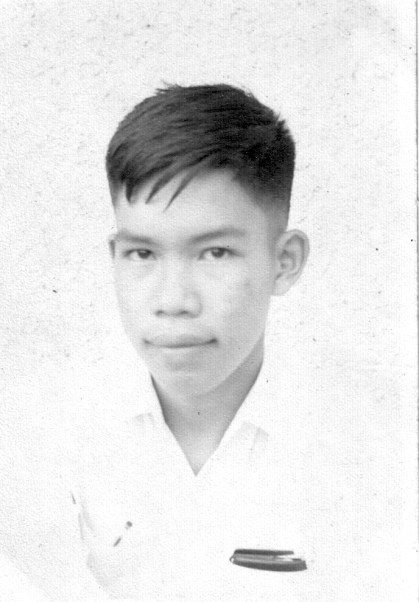
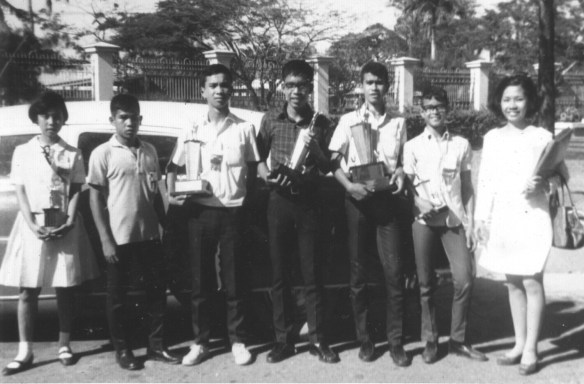
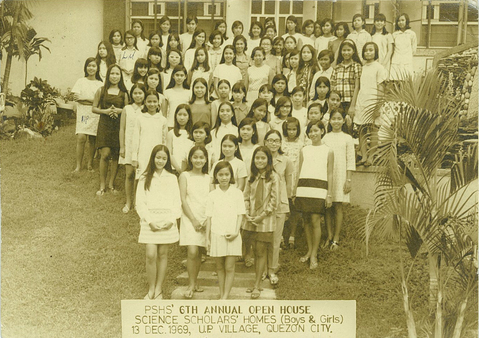
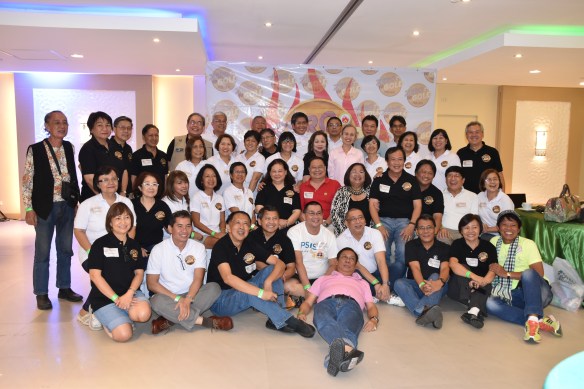
I HAD the honor of being asked to speak at the 50th anniversary reunion of my Philippine Science High School batch (we chose to celebrate our entrance year, 1966, fearing that there’d be fewer of us to gather in five years). It was, I joked, the valedictory I never got to deliver, for reasons that will be shortly obvious. You’ll forgive the chest-thumping; every high school has a right to think it’s the best on the planet—perhaps some more so than others. Herewith, an excerpt:

I’ll begin with a shameless boast, and the boast is that over these past four decades, I’ve won quite a few awards and prizes for my work as a writer and teacher. But none of them has given me as much pride and pleasure as the knowledge that once upon a time in 1966, for one brief shining moment and for some miraculous reason, I topped the entrance exam to the Philippine Science High School.

It was a fleeting glory, and if I ever imagined myself a real genius I would be quickly disabused, because as you all know, after our first year, my grade in English was 1.0 and my grade in Math was 5.0. Only the kindness or perhaps the embarrassment of our administrators persuaded them that I was worth giving another chance and putting on probation, a break I’m forever thankful for.

I have never felt in more distinguished company than yours. Individually and collectively, you are the smartest people I have ever known, and it has nothing to do with PhDs or awards or high positions in government and business or least of all material wealth—although I’m sure we could all use a little more money. I know that I can sit with anyone of you and have an intelligent and funny conversation about anything from interstellar travel and Dutertean diplomacy to hugot lines and Pokémon—well, maybe not Pokémon.

Long before buzzwords like “world-class” and “globally competitive” came into fashion, there were smart kids who passed an entrance exam that decimated whole regiments of lesser beings, leaving a few good boys and girls standing after the slaughter, calmly noting the distinction between cousins and cosines, avocados and Avogadro, halitosis and mitosis.

PSHS2.jpg

Hey, these kids were us—gangly, smelly (after a good day’s work at the biology garden, or the agawan-base arena), cocksure in the classroom, and curious as hell about the opposite sex. Not surprisingly, boy-girl questions dominated the school’s philosophical life.

“What Is a PSHS Boy?” asked the Science Scholar ca. 1969, and the soul-searching answer came (courtesy of someone who should have known—a PSHS girl): “A PSHS boy is a new sociological specimen of the human race… a hardworking nekti achiever [who keeps] a well-tended garden near the bio pond…. a longhaired mod swinger around the campus [who] wears kooky sunglasses, stylish baggy pants, and necklaces… He crams love letters in his notebooks. When Mr. Mozrah asks him ‘What is social interaction?’, he recites his lovelorn adventures with Jennifer, Corrine, Paulette, etc….”

PSHS11.jpg

This penetrating study naturally occasioned a companion piece, published a year later under the thought-provoking title of “What Is a PSHS Girl?”, written by an expert on the subject, a PSHS boy.

“A PSHS girl,” this savant said, “is a rare biological specimen… She is only emotional, temperamental and irrational sometimes (well, half of the time… would you believe almost always?). Anger is not a word in her dictionary. You see, her dictionary starts with ‘boy’… A PSHS girl is the reading type. She reads Emily Loring and the like.”

PSHSGirlsDorm.jpg

It didn’t take too long for a PSHS girl—uhm, PSHS young woman activist—to trash that silly, bourgeois, sexist view. “Now is the time for awakening,” this budding feminist would write in the same Science Scholar just a year later. “Do you realize that today you are a mere tool of the man?… Our bourgeois-oriented society adds insult to injury by picking up things for you and opening doors for you—reminders of sexual disparity—the very chains you should set out to break.”

We don’t know how many chains were broken; some precious objects certainly were (er, windows, petri dishes, innocence, and rules). Talk about rules! A famous one—dated September 29, 1970, and issued by the PSHS Board of Trustees—decreed that PSHS scholars “remain single and be discreet about their boy-girl relationships in order to continue their studies at the PSHS.”

Perhaps another topic of passionate discussion—“Should Smut Movies Be Allowed?”—had something to do with this heated  state of affairs.

The guidance counselor warned: “If they only display the human body for art’s sake, then there’s nothing wrong.  But if what they show are the acts sacred to man and woman, and those which arouse man’s sexual instincts and cause him to do something about it, then definitely, smut movies should be banned!”

Not too definitely, a freshman objected: “In European countries, especially in Scandinavia, sex movies have become so ordinary that they now seem to be part of the people’s lives.  In the Philippines, there is indifference towards these movies.  The Board of Censors should allow more of them and let us see what the attitude of the public toward them will be in the future.” [Brilliantly said, young man, an answer truly worthy of a science scholar—we’re not watching smut movies, here, we’re watching popular attitudes!]

Ah, the times, they were a-changing.  “The opening of the intramurals ushered in a new sight on our campus,” reported a sports columnist (a distraught boy) in the Science Scholar in 1970.  “Where once only boys were seen, girls have materialized…. The girls’ presence cannot be ignored…. In so short a period, many can be said to equal the boys at their own game. Complaints have been heard from the girls that the boys have been monopolizing both the basketball court and the ping-pong tables.”

That should’ve told us that the days of the Young Gentlemen’s Club and the Girls’ Club—no one had the gumption then to set up a Young Gay and Lesbian Club—were coming to an end. Some brazen soul in our freshman class organized the UBAG (United Boys Against Girls), but that didn’t last too long. Biology would teach boys that uniting with girls instead of fighting them was the more natural and pleasurable thing to do.

For a few of us after high school, life may have been a breeze, but for most, I’m sure it’s been an uphill climb, full of rough patches, and you were just as astonished as I was to find that a high IQ did not guarantee happiness or prosperity or success and may even have made things worse because of our more acute awareness of the meaning of things. We learned that the smartest people can make the dumbest mistakes in love, money, and politics, and that sometimes we just don’t know squay about the things that truly matter. I even learned that you could be happily married to someone from UP High.

Most important of all lessons and legacies, we learned to serve the people. Whether we grew up to be NPA cadres or CEOs or lab rats or barrio doctors, we knew that our high school scholarship had to be repaid in faithful service to community and humanity, employing the scientific, rationalist outlook that even those of us who strayed from S&T never quite lost.

We were young together, and we will grow old together. As we’ve all learned from life, it isn’t who leads at the start of the race but who finishes first at the end who wins—although again I suspect that in the race of life, we’d rather finish last.

PSHS6671.jpg


Penman No. 216: From Bali Song to Balisong

IMG_8436.JPGPenman for Monday, September 12, 2016


I’D BEEN meaning to write this up for the past few months, but more pressing subjects kept getting in the way—and “pressing” is the word, because this is about the complete opposite: total relaxation with no fixed schedules or time limits.

It was sometime this past summer when I accompanied my wife Beng and a group of her UP High batchmates on a day trip to Batangas to scout some places as possible sites for their upcoming golden anniversary reunion next February. Beng already had one such place in mind—Cintai Corito’s Garden in Balete, not too far from Lipa, which we had already visited with the family a few months earlier, and had been much impressed by.

Like many Manileños, we’d long been looking for day-trip or weekend alternatives to Tagaytay, especially for bringing our foreign visitors and balikbayan relatives to. Frankly, as a bulalo and ukay-ukay addict, I myself never tire of Tagaytay for a quick break from Manila’s madness. But lately, on our sorties to Mindoro and Romblon via the Batangas ferry, Beng and I have been taking the STAR tollway a lot and have often found ourselves wanting to stop over in one of the many towns on the way.

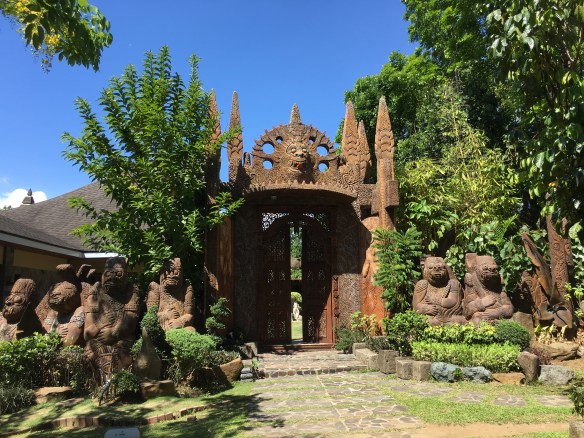
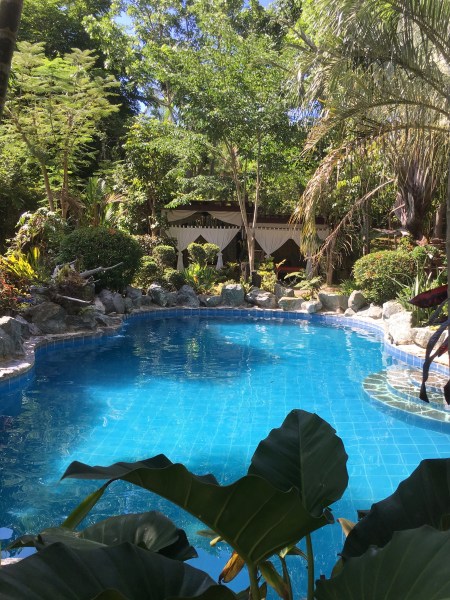
The Balete exit is one those innocuous detours that you’d take only if you really knew where you were going, and the narrow road that you get on leading to Cintai promises little beyond the shops selling honey along the roadside. Cintai itself doesn’t look like much from the outside—until you drive down the winding entranceway. The point of this long prelude is that you’d never imagine such a magical place to arise out of the Batangas countryside—a virtual Balinese-inspired Eden carved out of a rolling landscape that once might have been dotted by coconut and coffee.

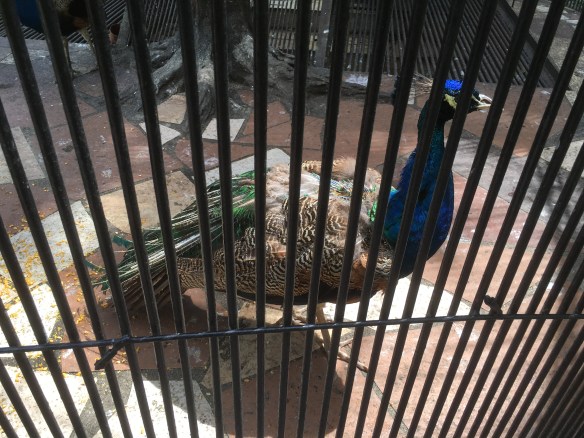
Cintai (which means “love” in Bahasa and is pronounced Chin-TAI) is a love offering to the late Corito of the place’s original name, the lady who inspired this outburst of Indonesian exotica in Southern Tagalog. It would be easy to think of the place as a theme park or resort—there are three swimming pools, and you’ll find peacocks, alpacas, roosters, and dwarf horses roaming the grounds—but other such places imply loudness, both literally and architecturally.

IMG_8415.JPG

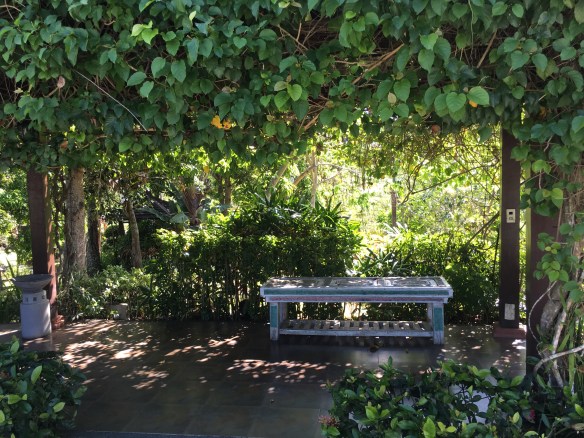
Cintai is anything but loud—visually impressive, for certain, but just on the right side of tastefulness. Given the easy temptation to go over the top, Cintai’s designer wisely decided to make just enough of a statement, but also to take care of the fine details and of their consistent employment, even the patterning of the rocks on the walkways and the Balinese carvings in the bathrooms.

In other words, as in Bali itself (which I had the pleasure of visiting 30 years ago), the appeal of the place is in its soulful serenity. The management could have hyped up the atmosphere by piped-in gamelan music, but they resisted even that, for better effect: the gamelan will tinkle in your mind. (One interesting discovery: the Balinese statues, figures, and accents in the complex were mostly made by Batangueño craftsmen.)

IMG_8784.JPG

The complex comprises 18 villas with variable capacities, two large halls, a spa, and a restaurant, among other facilities (for more details, visit http://coritosgarden.com). Beng and her UP High batchmates plan to have the place to themselves for an overnight stay, an ideal set-up for a big group, but walk-in day trippers are welcome, for a very reasonable rate that includes a sumptuous lunch.

IMG_8419.jpg

And that’s what we did on this scouting trip—tour Cintai and have lunch with its amiable manager Francis Salanguit—but I had another suggestion for the group, which they gamely took up: go a bit farther down the highway to Taal, about a 40-minute drive away, to give everyone (especially the balikbayans) a special treat of history and heritage. I’d also been to Taal before and had visited one of its fabled heritage houses and its cathedral; I wanted to see more. So we set out after lunch and were in Taal shortly after.

The historicity of Taal was immediately apparent in the old Spanish-era houses lining the approach to the town. But what also accentuated (I was going to say “sharpened”) Taal’s uniqueness were the shops hawking a fearsome array of bladed weapons—specifically the balisong, the fan knife of many a boyhood fancy, ranging from the mini to the outsized version. Batangas, of course, and Taal in particular can look back to a proud revolutionary tradition, and the balisong seems to exemplify that don’t-mess-with-me attitude Batangueños are famous for.

IMG_8809.JPG

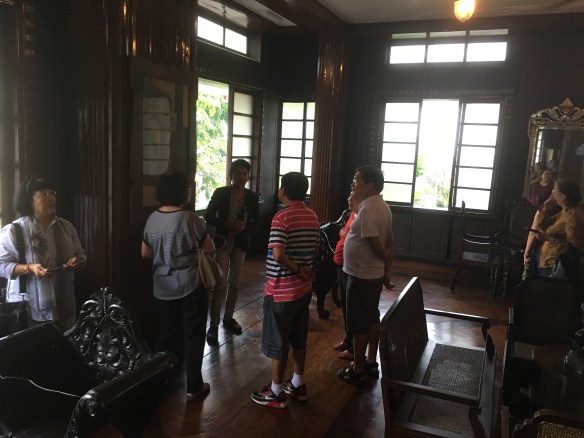
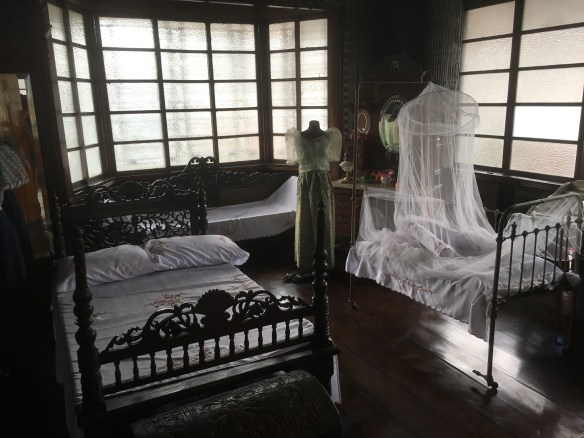
We didn’t stop that day to buy any knives—imagine the alarms they’d trigger if someone forgot about them on the plane ride Stateside—but we pressed on to our main destinations: the Apacible and Agoncillo heritage houses, both of which can be found on Agoncillo Street. I’d seen the Apacible house on my previous visit and had been charmed by its wonderfully preserved furnishings, but I was pleasantly surprised to see how the National Historical Commission, which manages the two historic houses, had taken pains to provide visitors with a more enlightening and rewarding experience.

Guests (who may come in for free, but are encouraged to leave a donation) are met and led by a knowledgeable guide; the AV show that introduces the place, its previous owners, and its history was one of the most artistic and professionally produced I’d ever seen. Markers, captions, and child-friendly installations were provided where necessary, and additional information was contributed freely by our young guide. The Apacible brothers—Leon and Galicano—were cousins and confederates of Jose Rizal, who came to their house to talk revolution; Leon was a lawyer and soldier and Galicano a doctor and propagandist, and though less known in the pantheon of Filipino heroes, they come alive in the exhibits that pay due homage to their contributions.

IMG_8812.JPG

The Marcela Marino Agoncillo Museum and Monument a couple of blocks down the street was just as well kept and well introduced with its own AV production (my kudos to Dr. Maris Diokno, whose dual backgrounds as teacher and historian—not to mention her own proud lineage as the descendant of true heroes—can be seen working here to best effect). Marcela was the wife of diplomat Felipe Agoncillo, but came to be known on her own as the co-creator of the first Philippine flag while on exile in Hong Kong.

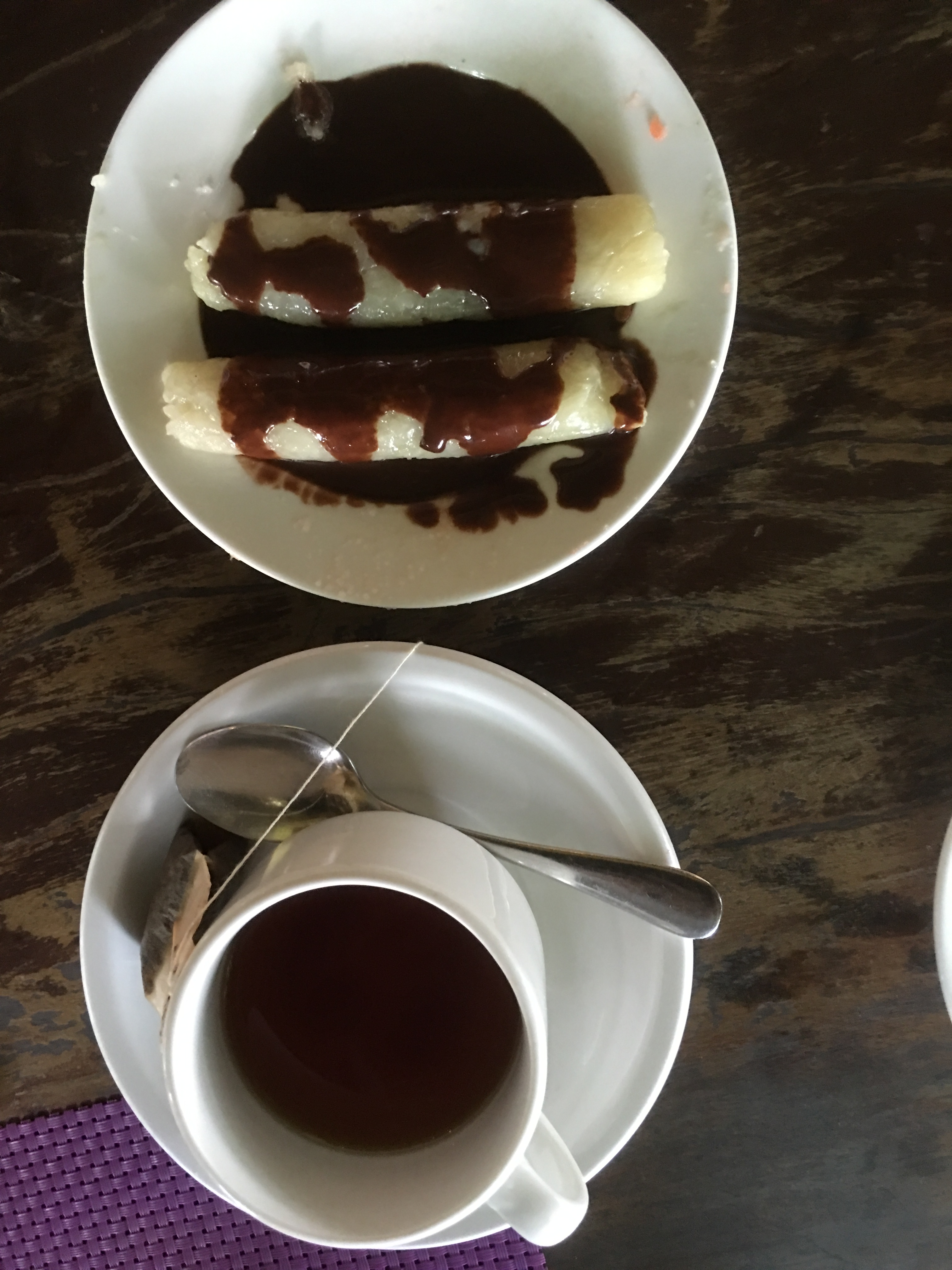
Just as Cintai’s gardens had appealed to the spirit, Taal’s heritage houses touched both heart and mind—and it took just a few mouthfuls of the local suman, washed down with barako coffee, to complete our Batangas experience with a boost to our famished stomachs. I’m not knocking Tagaytay, but one of these days, you just may want to go a little farther down the road and try a bit of the best that Batangas has to offer.

IMG_8802.JPG

Penman No. 209: Coming: An American Museum of Philippine Art

OnglaoStudy1.jpg

Penman for Monday, July 25, 2016


AS YOU read this, I’ll be winging home with my wife Beng from California where we’ve spent the past two weeks engaged in a pioneering project that should bring the best of Philippine art to a broader American audience, if ongoing plans work out over the next few years.

Have you heard of the American Museum of Philippine Art? Probably not, since it’s still something of a pipe dream, but some people on both sides of the Pacific are blowing very hard on their pipes to make it happen. Those people include businessman Raffy Benitez, president of the Quezon City-based Erehwon Arts Center, and University of the Philippines professor and art expert Dr. Reuben Cañete, who developed the idea late last year after Erehwon’s successful involvement in a binational mural project at Chicago’s Field Museum sponsored by the John D. and Catherine T. MacArthur Foundation through Dr. Almira Astudillo-Gilles, a Chicago based Fil-Am writer and cultural advocate.

I reported on that project in this column last November 25, noting the warm response received by the participating Filipino and Filipino-American artists for their works—two murals, one at Erehwon and another at the Field—depicting the flows of Philippine culture and history from pre-Hispanic times to the present.

That positive experience encouraged Raffy and Reuben to conceive of a bigger and more enduring project that would bring Philippine art even closer to Americans—not just the huge and broadly dispersed Filipino community in the US, but the American public at large. Raffy and Reuben noted that the Mexicans and the Chinese, among other immigrant groups in America, both had their art museums, but that Filipinos—among the largest and fastest-growing minorities in America—did not.

Reuben recalled the long tradition of Filipino artists going over to the US to study and to work—such as Guillermo Tolentino, Victorio Edades, and Alfonso de Ossorio, among others—and observed that while strong cultural ties remained between the two countries, the connection was overwhelmingly one-way, with Philippine art (and music and literature, for that matter) being little known and appreciated in the US.

“In this age of globalization, art is now a global commodity that is exhibited and collected by various international venues, such as Art Basel Miami. Philippine Art, both in its historical as well as contemporary manifestations, must now be aggressively promoted in the United States, which is a major area of collection and promotion of global art,” Dr. Cañete would say in a concept paper on AMPA.

Karlota I. Contreras-Koterbay, a prizewinning Fil-Am sculptor and Director of the Slocumb Galleries at East Tennessee State University, agrees, writing that “There is a rich and dynamic art practice by Filipino-Americans in the US. However, there is a huge discrepancy in the visibility and recognition with regards to the idea and form of ‘Philippine Art’.

“The Philippines is the second highest Asian country whose citizens migrate to the US. The Filipinos have a long, complex history of immigration and residency in America, yet ‘Philippine Art’ is not as accessible nor recognizable in popular culture nor in the global art world. This statement does not claim that there is lack of talent nor creativity; on the contrary, there are thriving communities of artists, art groups and cultural workers who are making a difference in their respective locales, as well as receiving recognitions for their work in the field of arts.”

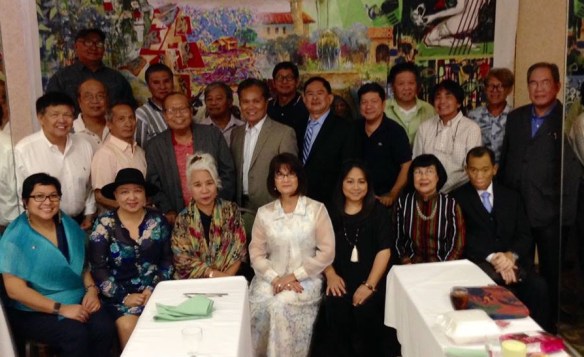
To take the first steps toward turning vision into reality, Raffy, Reuben, Beng, and I flew to LA to meet up with some prominent Filipino-American community leaders and artists to set up a foundation that would start the spadework on the museum. The American Museum of Philippine Art Foundation, Inc. (AMPAFI) was formally launched July 12 at the Holiday Inn in Diamond Bar, California, in a day-long meeting attended by a couple of dozen participants from all over the US.

Raffy Benitez will serve as chairman and president, and Reuben and I are joining him on the board, but we know that this project can’t be run from Manila, so the directors will also include art curator Karlota Contreras-Koterbay, physician Jose Botor Regullano, and engineer Ricardo Real Almonte. The officers include Fil-Am standouts Rafael Maniago, Art Zamora, Sal Budz Floriano, Rosie Vinluan Muñoz, Connie Buenaventura, Daniel Gutierrez Bassig, Dennis Martinez, Bobby Halili, Jess Española, Jun Sison, Ninette Tenza Umali, Ernan Ebreo, and Bernadette Escalona-Cooper. During the launch, a group of Fil-Am Artists headed by Paeng Maniago also rolled out a mural that they had executed to celebrate the occasion.

AMPAFIFound.jpg

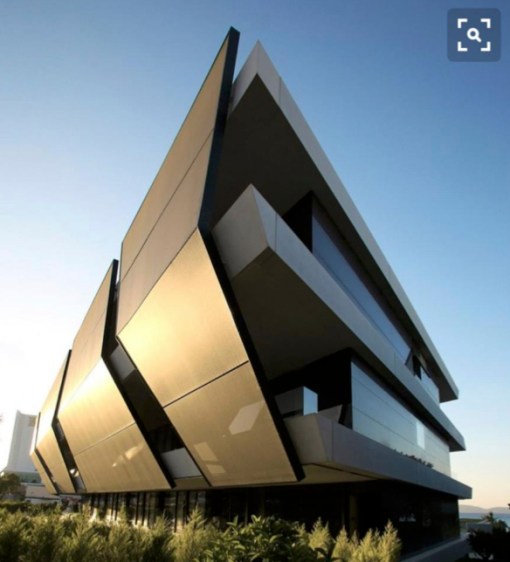
We all realize that this project will take many years, enormous resources, and tremendous effort and optimism to realize. (Being Filipinos, we expect a lot of naysaying, and I’ve been Raffy’s chief buzzkiller whenever I think someone needs to pull his feet back to earth, but I have to admire the man’s guts and what he’s done at Erehwon, which you can preview here: http://erehwonartfoundation.org.) The museum as Raffy and Reuben envisage it is a mini-CCP, with enough spaces for exhibitions and performances (and even classes in Pinoy cooking), and the renowned architect Conrado Onglao was motivated and generous enough to contribute a prospective design for the building. That may be years down the road, but in the meanwhile, AMPAFI is taking early and doable steps toward building a countrywide arts community—a virtual museum, as it were—in cooperation with other groups such as Bernadette Escalona-Cooper’s Silicon Valley-based Global Artists’ Creative Collaboration for Empowerment (GACCE), whose leaders also attended the launch.

Karlota reports that “Our first two official projects are: ‘Nandito N Ako’ by 11 emerging Filipinx artists from the School of Art Institute of Chicago (SAIC) and possible community mural headed by NY-based artist Art Zamora with the Phil-Am organization and ETSU organized by Slocumb Galleries in the Northeast. This will be early October 2016 in time for Filipino Heritage Month. Also on the same month on the West Coast is the proposed Indie Film Showing in LA by special committee on fundraising head Ernan Ebreo. Both are curated programming for awareness campaign and fundraising efforts.”

(Wait a minute, did I read “Filipinx?” Indeed I did—and this trip was the first time I encountered the term myself, which seems to be gaining currency among young Fil-Ams, who define “Filipinx”—which I’ve heard pronounced as “Filipinics”—as an effort “to make the community more inclusive—we changed the O in ‘Filipino’ to an X to remain gender-neutral and recognize all genders that exist in the Filipinx community. There’s apparently been a lot of debate on this issue, which we’ll deal with some other time.)

The AMPA website is up at http://www.ampafi.org. Contributions and donations are, of course, very welcome, but more than that, we need goodwill, prayers, and strength of spirit to see this vision through. Mabuhay at salamat sa lahat!

AMPALogo2.jpg


Penman No.205: Sojourn in Seoul (2)

IMG_8666.jpg

Penman for Monday, June 27, 2016


HAVING PLANNED our trip to Seoul months in advance, I made a point of touching base with some local contacts for possible meetings—something I usually don’t do, wary of disturbing people with my unseasonable presence. But with a week to kill in one city and with some longstanding connections in place, I thought it would be even more ill-mannered if I didn’t at least tell them that I was going to be in town.

One of those connections was Dr. Sukjoo Sohn, who teaches English at Dong-a University in Busan, Korea’s big industrial center four hours by train from Seoul. Sukjoo—a specialist in world literature—happens to be married to Catherine Rose Torres, one of our bright new young fictionists who now serves as First Secretary and Consul at our embassy in Berlin. I’d first met Catherine in 2011 when I attended the Singapore Writers Festival and she was with our embassy there, and I was later very happy to write a blurb for her first book, Mariposa Gang and Other Stories (UST, 2015).

It’s really these personal connections that make for global literary networking, the value of which I can’t overemphasize. In 2014, Sukjoo translated one of my stories for publication in Global World Literature, which is put out by some of Korea’s foremost literary scholars and critics in that area. Through Sukjoo, I was also able to contribute an article to the Korea-based journal Asia, in which I wrote about some of our most gifted and exciting younger writers. As a result of that article, one of our best young non-fictionists, Sandra Nicole Roldan, will be visiting Seoul this week to attend the 2016 Asia Literature Creative Workshop.

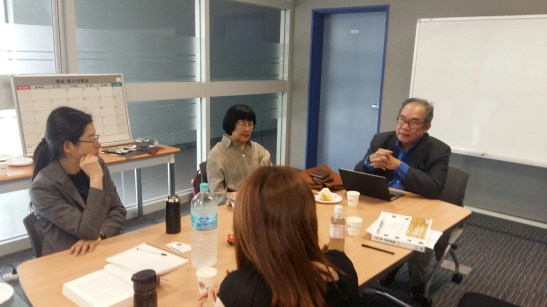
And so our connections continue and deepen. When they learned that I was visiting Korea, Sukjoo’s organization invited me to a special meeting, so I could tell them more about Philippine literature. That gathering took place at Seoul National University toward the end of our visit, and a very fruitful and engaging encounter it turned out to be. Perhaps I shouldn’t have been surprised, but their very first question had nothing to do with lyric poetry: “What do you think of your new President, Rodrigo Duterte?”

It will take more than this column to share my answer with you, but suffice it to say for now that we talked about our colonial history, our Catholic predisposition to suffering, the two Joses (not me) by which our literature is best known overseas, class as the key divisor in our literature and society, Korea’s and the Philippines’ shared experience of dictatorship, and the irony of having to deal with a resurgent Park and a resurgent Marcos, and our younger writers’ affinity with Gaiman, Murakami, and Wattpad.

We discussed my translated story, “In the Garden,” which I’d written in the 1980s about militarization in the countryside and the moral duty of a teacher caught in the crossfire. While the topics were unavoidably contentious, our meeting itself was thoroughly pleasant and mutually informative, capped by dinner, shop talk, and, yes, chatter about Lee Min-ho.

meeting 2.jpg

The second highlight of our visit—away from the malls and the flea markets—was a meeting with the Filipino community in Seoul, which had also been pre-arranged by Catherine through her Seoul colleague, the very capable Third Secretary and Vice Consul Ella Mitra.

It was a Sunday—our last full day in Korea—and much to our surprise, the embassy was open and bustling with people, with a wedding taking place right in Ella’s office. (“We can officiate at weddings,” Ella told us, “as long as the two parties are both Filipino citizens. We’re open on Sundays because that’s when most of the community can come.”) There were over 40,000 Filipinos in Korea, Ella informed me, many employed as factory workers in jobs that the locals themselves prefer not to do.

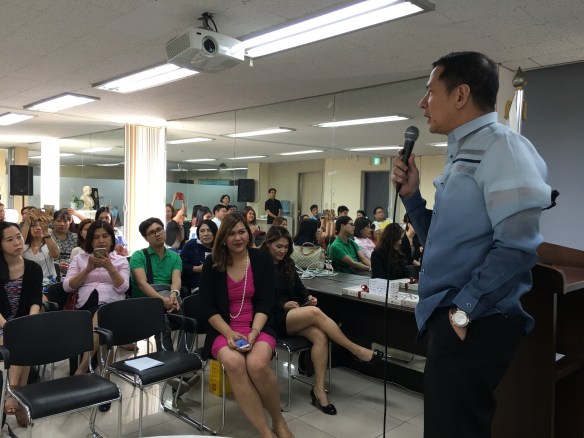
I’d been asked by the embassy to give a reading for the community—something I love to do whenever I’m abroad, as it puts me in touch with ordinary Filipinos striving to do their best in often very challenging circumstances. The Filipino, I like to say whenever the opportunity arises, is the modern-day Ulysses, roaming recklessly to the farthest reaches of the globe, but imbued with an unfailing sense of home. Now here they were, a crowd that filled the room beyond our most generous expectations—professionals, teachers, graduate students, Filipino-Korean couples, even the Ambassador himself, the dapper and articulate Raul Hernandez.

IMG_8681.jpg

The embassy had calendared my reading as its second Sentro Rizal activity, and with June 12 coming up, it seemed a good time to remind ourselves of the things that both divided and united us, and of the need to hang together as Filipinos, at a time and in a region of revived nationalisms. Even so I chose to do a very light reading, one that made fun of my own social ineptitude in cross-cultural situations, and thankfully it went over well with the audience. More than the reading, it was the ensuing Q&A and freewheeling chat over pancit and puto that proved most gratifying. I could sense the community’s strength of spirit, its determination to master a new cultural terrain.

I was especially happy to see a former student, Tech Apognol, now doing an MA in International Relations and speaking Korean. She’s hardly alone; the association of Filipino grad students in Korea now numbers 500, I was told, and there were plenty of masteral and doctoral scholarships for those inclined. “We can take classes in English,” one student named Eve told me.

Another grad student named RJ solved a mystery that had been bugging me for 40 years. Back then, I told him, I was a young writer employed by the National Economic and Development Authority, and one of my tasks was to help edit the Five-Year Development Plan, which was thicker than an encyclopedia because of its bloated prose. On the other hand, I recalled, the South Korean development plan that I used as a reference was no bigger and fatter than a paperback novel—and look, I told RJ, where Korea was now. “Ah, that’s easy,” RJ said. “It’s because the Koreans value brevity, and memos are expected to be no more than a page. The higher up the ladder papers go, the more concise they’re expected to be.”

The shopping was fun—just the flea markets for us, please, not the high-end shops—and the streetcorner food delicious, but it was, ultimately, our encounters with the people that added the most value to our visit. Kamsahamnida, Sukjoo, Cathy, Ella, and Tech for these memorable exchanges.

Penman No. 200: Memoirs of a Teenage Maoist

e13-644.jpg

Penman for Monday, May 23, 2016


A SMALL item in the foreign news caught my eye last week: a note that the 50th anniversary of China’s Cultural Revolution had gone unnoticed—in China itself, with no parades or ceremonies to mark the historic event. For those of us too young to remember, the Cultural Revolution was launched by Chairman Mao Zedong on May 16, 1966, to consolidate his power and purge his rivals within the Communist Party in the guise of doing away with old ways of thinking. To fight the old, Mao rallied the young—millions of “Red Guards” who turned on their parents, teachers, and superiors, feeling suddenly empowered to reject authority and traditional learning and to see themselves as the vanguards of a new age.

Over the decade that the Cultural Revolution ran its course until Mao’s death in 1976, many millions died—from executions and from famine. While Mao’s legacy would live on, there’s firm consensus both within and outside China that the Cultural Revolution was an unmitigated man-made disaster, something the Party itself in 1981 blamed for “the most serious setback and loss for the Party, the country and the people since the founding of China.”

What did this have to do with us and with me? Well, to put it as simply as I can, I was a teenage Maoist, and for a while back there, I and quite a number of like-minded comrades saw ourselves as the local chapter of the Red Guards. Call it madness, but we saw Mao as a demigod, and looked to his China as a beacon of hope and a model for other countries like ours—also beset by centuries of feudalism and colonial rule—to follow.

How did that happen? I had joined the student activist movement and had gone to my first demonstrations in high school, and as soon as I entered college in 1970, I signed up with the Nationalist Corps. It wasn’t a communist organization, but it was a short step from reading Renato Constantino to reading Mao. Mao’s teachings (in contrast to the heavy-duty theorizing of Marx and Lenin) were attractive in their seeming simplicity, in their pithiness, in their rosy optimism. It was chicken congee for the soul.

Until today, you’ll hear 60-somethings from my cadre recite gems, chapter and verse, from Mao’s Quotations (better known as the LRB, or the Little Red Book) like “A revolution is not a dinner party, “Political power grows out of the barrel of a gun,” “Dare to struggle, dare to win,” “Wherever there is struggle there is sacrifice, and death is a common occurrence…. All men must die, but death can vary in its significance.” Among my favorites—music to my 17-year-old ears—was “The world is yours, as well as ours, but in the last analysis, it is yours. You young people, full of vigor and vitality, are in the bloom of life, like the sun at eight or nine in the morning. Our hope is placed on you. The world belongs to you.”

It wasn’t too different from what Rizal or the Desiderata said, especially about the youth as the fair hope of the fatherland, but I think what drew us to Mao at that point and to his brand of Marxism was his emphasis on classes and class analysis, his awareness of society as one divided between rich and poor (with the rich collaborating with foreign powers to keep themselves in place), and the fact (or the fantasy) that in China, things were actually going according to the socialist plan. Very few of us had ever been to China then (famously, of course, three senior activists would get stranded there—Eric Baculinao, Chito Sta. Romana, and Jimi FlorCruz), but we accepted it as an article of faith that Chairman Mao was doing right by his own people.

In Manila, we did our best to copy the flag-waving strokes of Peking Opera (eg, “Taking Tiger Mountain by Strategy”), learned about obscure heroes like Norman Bethune, and wore the LRB like a talisman in the breast pockets of our army fatigue jackets. (Procured from US military surplus stores in Dau, it was the closest we could get to the Mao—actually the Sun Yat-sen—jackets that the Red Guards adopted as a uniform, with the red star on the matching cap; but we at least wore genuine “Ho Chi Minh” sandals fashioned out of rubber tires.) At dawn, we tuned our transistor radios to the faint and crackly signal of Radio Peking, for our regular dose of socialist top tunes like the “Internationale,” “Sailing the Seas Depends Upon the Helmsman,” and “The East Is Red”—plus, of course, the daily rundown of the news from the global war on US imperialism. An enterprising fellow even then, I corresponded with a Hong Kong bookseller who seemed only too happy to mail me copies of the Peking Review, even if I had no money to pay him.

Only years later did the failings of Mao’s experiment and the horrors of the Cultural Revolution emerge, revealed not so much by Western propaganda as by the Chinese themselves, who had suffered the most from its excesses. It would take time—and, indeed, a personal visit to China—to appreciate this disconnect between our long-distance romance with Mao’s socialist paradise and cold reality.

It was in July 1987 when I was finally able to set foot on hallowed ground—Tiananmen Square in Beijing, where I was doing a cultural exchange visit along with writer-friends Krip Yuson, Ricky de Ungria, Eric Gamalinda, and Timmy Lim. We had been assigned a translator and a minder, whom we’ll call Chang—a tall wisp of a man who spoke decent English and who was working, he said, on a translation of a biography of Elvis Presley in his spare time. (Had he ever listened to Elvis? No. We sent him a cassette of Elvis from Manila.)

Standing just meters away from Mao’s mausoleum—there seemed to be thousands of Chinese visitors waiting in line to go in—I asked Chang if he could help me see Chairman Mao. “What you want to do that for?” he asked incredulously. “He killed my grandfather in the Cultural Revolution!” Ooops—I tried to say that I was sorry to hear about his angkong, but I had to tell him that I was once a Mao fanboy and just had to meet the man, even his current state of embalmed repose. Chang still didn’t seem ready to believe me, so I sang him the first few lines of the “Helmsman” song: “Sailing the seas depends upon the helmsman, life and growth depend on the sun, rain and dewdrops nourish the crops, making revolution depends on Mao Tsetung Thought!” Chang shushed me up before a crowd could gather: “Okay, okay, I bring you inside, but hurry, okay?”

And so I filed past my fallen idol, awash in conflicting emotions; frankly Mao’s waxen face did little to exude revolutionary vitality, and in just two more years that same square would be bathed in fresh young blood.

I would return to China many times since then as both tourist and writer, and at one point I would chance upon a Mao jacket in a backstreet shop in Shanghai—you’ll never find them in the glitzy stores—and some days I wear it to remind me of what people today will surely say was a youthful folly. Sometimes I’ll stick a most unproletarian Montblanc into the breast pocket, but then again, it’s where the real Chinese revolution led—the freedom to shop for baubles on Nanjing Road.

IMG_8493.jpg

[Image from chineseposters.net]

Penman No. 199: A Bell from Bauang

IMG_3136.JPG

Penman for Monday, April 25, 2016


SANTIAGO “SONNY” Busa is one of the most remarkable people I’ve met. I was introduced to him when I spent some time in Washington, DC on a fellowship a couple of years ago, and from the very first time we sat down for a chat in the backyard of his home in the DC suburb of Annandale, Virginia, we hit it off. He possesses a hilarious, self-deprecating wit, is fascinated by history, and speaks, among other languages, Spanish, Ethiopian and Chinese. Ironically, though born in Eastern Samar—he was practically just a baby when his family moved to the US—Sonny doesn’t speak Filipino (or, we keep joking, pretends not to, so he can listen in on what everyone is saying).

IMG_3148.JPG

A retired diplomat who served as consul general at the American embassy in Manila, among other postings some years ago, Sonny had also been a US Army Ranger and parachutist, and taught International Relations at his alma mater, West Point. For all that, he’s a flaming liberal (like me), doesn’t believe in keeping an armory or packing a .45 to feel masculine or secure, and devotes much of his time to promoting the Philippines and Philippine concerns in America along with his lovely wife Ceres. Last year, he was a key figure in the commemoration of the Bataan Death March in New Mexico, where 5,000 soldiers and civilians marched across the desert for more than 26 miles—and they’ve been doing this for 27 years now!

But Sonny’s recent messages gave me a special reason to smile. He’s been a staunch advocate for the return of the three bells taken as war trophies by American troops from Balangiga, Samar in 1901—two bells remain in a “Trophy Park” in a military base in Wyoming, and another is in a military museum in South Korea. Despite the strenuous efforts of both Filipino and American activists to have those bells returned, it hasn’t happened yet.

As it turns out, the Balangiga bells weren’t alone. In 1899, during the Philippine-American War (which the Americans insisted on calling an “insurgency” for the longest time), a Lieutenant Tom Berry took a bell from the Church of St. Peter and Paul in Bauang, La Union and shipped it to America, where it languished for over three decades in some Army warehouse. In 1933, the same soldier—now General Berry, the superintendent of West Point—had the bell taken out of storage to be displayed at the Catholic chapel of the academy.

Last January, acting on an inquiry from Fr. Ronald Raymund Chan of the Diocese of San Fernando, Lt. Gen. Robert Caslen, Jr.—the current superintendent of West Point and a friend of Sonny’s—wrote Fr. Chan back to say that “The bell currently displayed on the grounds of our Catholic Chapel here is apparently the bell in question. According to our own records, the markings on the bell itself matches all the descriptions you provided. While we have been honored to guard and display this bell for the past several decades, we would be glad to return the bell to its rightful home. We are currently in the process of making arrangements for the return of the bell to your Parish.”

IMG_3179.JPG

Aside presumably from Fr. Chan and the people of Bauang, no one was happier about this outcome than Sonny Busa, who had married Ceres in that chapel in 1977 in a military wedding, and had looked with fondness at the bell every time he visited the academy. He alerted me and some friends about the San Pedro bell last February, but asked us to keep quiet about it for the meanwhile until the return arrangements were finalized, fearing that Americans opposed to the return of any war booty—especially the Balangiga bells—would torpedo the move.

Last month, on the 29th, the send-off finally took place at West Point, with Sonny Busa, Philippine Consul General in New York Mario de Leon, and prominent members of the Filipino community in attendance. Another good friend of Sonny and mine, the Filipino-American historian Sharon Delmendo, stood as both proud witness and photographer. Another special participant was Filipino exchange Cadet Don Dalisay—to whom I would be glad to claim a relation, because Sonny says that he’s at the top of all his classes at West Point.

Dalisay Bell.jpg

In his message to me, Sonny—who had been put in charge of the turnover ceremony—emphasized that Gen. Caslen had “ordered the bell returned to La Union because it belongs in its rightful home. West Point above all stands for high morals in all that it does and teaches and keeping looted war booty is not part of its ethic. The people of La Union are hyper-excited and have already built a display stand. Once the bell arrives it will be big news in the whole of the Philippines as you can imagine.”

That truly is wonderful news, Sonny, and many thanks from your kababayans for your tireless efforts to help right the wrongs of the past and to remind us of our precious heritage.

IMG_3112.JPG

But sadly—as I write this on the eve of one of the most important and contentious elections of our modern history—I fear that too many of us have forgotten how valuable our democracy is, and what artifacts like the San Pedro bell stand for. At war with ourselves and with foreign invaders long gone, we seem far too willing to squander our votes on mindless whimsy and puerile petulance.

I so desperately pray we can prove ourselves deserving of that bell, Sonny. How hollow its ring would be otherwise—a death knell for sanity and decency, rather than the vibrant peal of freedom.

(Photos by Sharon Delmendo and Sonny Busa)