Penman No. 175: Filipinos at the Field Museum

IMG_8116.jpg

Penman for Monday, November 23, 2015


AS MANILA got busy with preparations and lockdowns for the Asia-Pacific Economic Cooperation summit, Beng and I flew out to Chicago for the culmination of a cross-continental initiative of another kind: the Art and Anthropology project hosted by the Field Museum and funded by the John D. and Catherine T. MacArthur Foundation.

A few months ago, sometime in August, five Filipino-American artists (Jennifer Buckler, Elisa Racelis Boughner, Cesar Conde, Joel Javier, and Trisha Oralie Martin) came over to Manila to work with their homegrown counterparts on a large mural (technically a free-standing painting) featuring objects from the Field Museum’s vast collection of Philippine anthropological artifacts. That phase was hosted locally by the Erehwon Art Center in Quezon City, on the board of whose foundation Beng (aka June Poticar Dalisay, the painter and art conservator) sits as Vice President.

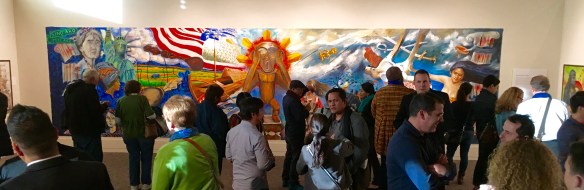
This October, the five Filipino artists (Leonardo Aguinaldo, Florentino Impas, Jr., Emmanuel Garibay, Jason Moss, and Othoniel Neri) went to Chicago to do the same thing—working collaboratively with the Fil-Ams on a 28’ x 7’ mural at the Field Museum, locating ancient Filipino artifacts in a more contemporary and inevitably globalized context.

The moving spirit behind this project was the indefatigable Dr. Almira Astudillo Gilles, a Chicago-based Filipino-American cultural scholar and activist who also happens to be a prizewinning writer and presidential awardee for her work as an overseas Filipino. Inspired by the Philippine artifacts at the Field Museum, Almi—the only Filipino research associate at the Field—had secured a grant from the prestigious MacArthur Foundation for the project, which both the foundation and the museum acknowledged to be groundbreaking in many ways.

Better known for its so-called “genius grants” awarded to outstanding individuals, the MacArthur Foundation rarely provides funding for large institutions like the Field Museum, Almi says, but they saw in her proposal an opportunity to spur not just a trans-Pacific collaboration among artists but also a dialogue with the past. And there was no better host in the US for this project than the venerable Field Museum, whose collection of indigenous Philippine archaeological and ethnographic materials—numbering around 10,000 objects, most of them brought over by museum expeditions to the islands at the early part of the 20th century—is one of the world’s most comprehensive.

The mural produced by the artists in Chicago—which will be on display at the Field for six months since its formal unveiling last November 7—is both a celebration and indictment of our rich and complicated history, invoking all manner of element from the archetypal bulol and the revolutionary KKK (a symbol that predictably sparked some controversy, given its American context) to McDonald’s and Tito, Vic & Joey.

For the artists themselves, the collaboration was a rich, if sometimes unavoidably difficult, learning experience—learning about themselves, about each other, about art-making, about the mutable meanings of “Filipino” over time and space. Prior to the project, some of the Fil-Ams had never been to the Philippines, and some of the Filipinos had never been to America; that alone ensured sufficient provocation in their approach to the task at hand. The collaborative aspect itself was a challenge, given the need to manage and balance each artist’s individuality with some overarching purpose or design. But in the end, as Joel Javier would tell me, despite all the dialectics involved, it was “a once-in-a-lifetime experience” that every participant—chosen by a jury in each country—would have signed up for.

Our sortie into the Field Museum—a place I’ve visited quite a few times over the past two decades, but can never exhaust, like the Smithsonian—was made even more special by a private tour arranged for us by Almi Gilles into the heart of the Philippine collection itself, in the underground vaults of the Field. As a certified museum rat and armchair adventurer, I took it as an invitation to die and go to heaven; the closest I hope to get to Indiana Jones was to wear his hat, which I wore on the appointed day.

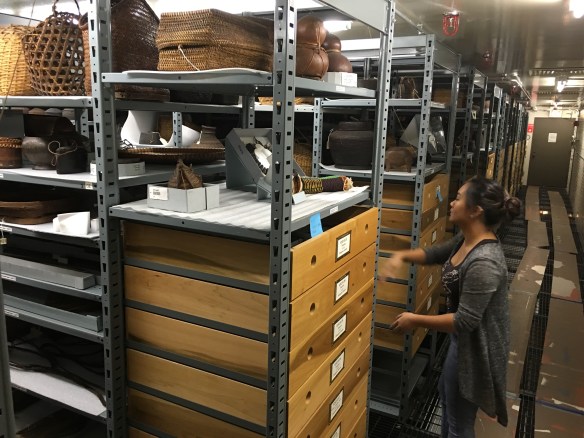
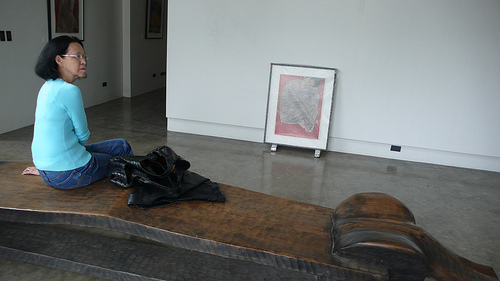
We were met at the museum by co-curator Alpha Sadcopen, a young Filipino-American woman with roots in the northern highlands; she held the key to the collection, and led us into a large room where shelf upon shelf of tribal and cultural artifacts—baskets, textiles, weapons, utensils, body decorations, etc.—were preserved, most of them never likely to be put on display outside. “I could feel a shiver down my spine,” Beng would tell me later, and I certainly did myself, walking past the priceless objects, and discerning in each one of them a pair of hands, a face, a story.

IMG_7418.jpg

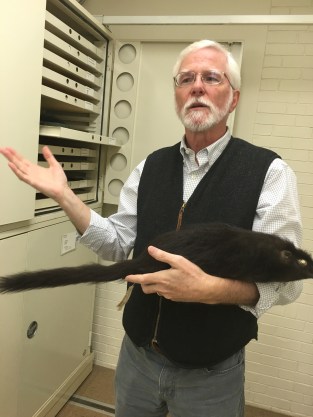
As if that peek into our material past wasn’t a treat enough, Almi then led us down a few more corridors to meet with another titan of Philippine studies—the renowned zoologist Dr. Lawrence Heaney, curator and head of the museum’s Division of Mammals. Larry began studying the wildlife of the Philippines in 1981, a lifelong passion that has resulted in the discovery of dozens of previously unknown mammalian species, in many landmark publications, and in the establishment, with Larry’s Filipino colleagues, of the Wildlife Conservation Society of the Philippines.

We often think of world-class scientists as surly, self-absorbed individuals who can’t relate to anything beyond what they see in their microscopes and telescopes, but Larry defies that stereotype. You couldn’t have met a nicer man, and one who chose not only to sound the usual alarm about our threatened environment, but also to emphasize the positive and the possible. “Hectare for hectare, the Philippines is the world’s richest place for endemism,” he told us, cradling what seemed to be a huge rat saved from a 1946 expedition to Luzon, “and there certainly are serious threats to Philippine wildlife, but we’ve also noticed some bright spots. For example, the growth of overseas jobs for many Filipinos—despite its social costs—has also eased the pressures on the environment and on wildlife in many rural communities.” Dr. Heaney is coming over to Manila next year to launch another book, and I’ll be sure to be there.

IMG_7448.jpg

And what’s next for Almi Gilles? She’s looking skyward, into the connections between Philippine anthropology and astronomy. Her colleagues at the museum seem thrilled by the idea, and so are we.

For more pictures of the Philippine collection at the Field Museum, see here: https://www.flickr.com/photos/penmanila/albums/72157660699359089.


Penman No. 174: What Women Remember

4510563825_5f753e970a

Penman for Monday, 16 November 2015


I WAS very pleased and much relieved—and, as one of the convenors—immensely proud for the Philippines to have successfully hosted this year’s conference of the Asia Pacific Writers and Translators (APWT) late last month in Manila.

Among the highlights of the conference was a keynote talk given on the last day by none other than one of our foremost fictionists and critics, Dr. Cristina “Jing” Pantoja-Hidalgo, now the Director of UST’s Center for Creative Writing and Literary Studies, who spoke on a subject even her fellow Filipino writers like me know very little about or pay only minor attention to—the journals, memoirs, and autobiographies of Filipino women. I found her lecture (titled “The Subversive Memory: Women Tell What Happened”) so informative that I asked her permission to excerpt parts of it to share with my readers, so here:

Several generations are represented in the seven women who are the subject of my new book, which I called To Remember to Remember…. t today is referred to as multi- er, is available at the UST Publshing Housee so informative that I asked her permission to exce

The oldest, Paz Policarpio-Mendez, was born in a small town in the province of Nueva Ecija in 1903, and was among the first children to enter the American public school system, and one of the first women to go all the way to college in UP. But, to get there and to stay there, she had to fight her father – who did not hesitate to beat her when he objected to her behavior or her opinions. Always painfully aware of her father’s preference for his sons, she strove to win honors in school, to merit his approval. But he never gave it. Later, she married a journalist who eventually became a diplomat, and finally the Secretary of Foreign Affairs. But Paz went right on studying and teaching, while raising a family, and attending to the duties of a diplomat’s lady.

The youngest, Rica Bolipata-Santos, was born in Manila, and educated entirely in Catholic schools, until she decided to get a PhD in Creative Writing in UP. She is sister to the three famous Bolipata brothers, musical child prodigies. This doomed her to play second fiddle to them, to grow up feeling unimportant, untalented, even ugly. Kept back from developing her own musical talent (she could sing!), not deliberately or maliciously, but through neglect, she found her voice in writing and in teaching. Now she is also an academic administrator. But the biggest trial in her life has been her special child, and her memoir is the story of her struggle to cope with anger, sorrow, sometimes despair.

In between there is Solita Camara-Besa, a woman who describes herself as a battered child – this abuse by her father did not let up even after she was married, until her husband, demanded that she choose between himself and her parents. For all this, she became one of the country’s first women doctors—though again, she experienced appalling gender discrimination in the UP College of Medicine, of all places—and was part of the heroic little band of UP faculty members who kept UP and its teaching hospital, the Philippine General Hospital – running throughout World War II.

The remaining four writers who are part of the book took for granted their right to an education and to careers of their own. But they had their own battles to fight. For Gilda Cordero-Fernando (b. 1930), maker of baby bags, keeper of antique shop, fashion designer, publisher, and one of the country’s finest writers of fiction and nonfiction, the battle was against her mother and the convent school education that she felt trapped in; against her husband who resented her writing, her writer friends, and the many worlds that her numerous gifts opened up to her, but kept a mistress for most of their life together; and against conventional ideas about what constitutes accomplishment and success.

For the prize-winning poet and academic, Merlie Alunan (b. 1943), it was the battle to hold it all together when she became a single parent, seeing herself and her children through school, teaching in college, holding workshops for struggling young writers, and picking up poetry awards along the way.

Jennifer Ortuoste (b. 1968) trained as an apprentice racehorse jockey, married a professional jockey and raised her babies in the Santa Ana Racetrack. Hers is the story of a battered wife; and the story of the collapse of her marriage is told against the backdrop of the demise of the racetrack that she loved. When her marriage fell apart, she picked herself up, became a journalist, got an M.A., and is now writing prizewinning fiction and nonfiction.

Criselda Yabes (b. 1964) chose a profession, which until the generation before hers was not considered quite respectable for women—journalism. The most independent, unconventional and alienated of the seven, her story is focused on 16 months of her life, the period after she had been abandoned by her lover of seven years. And, to keep a hold on sanity, she went to Europe, first on a scholarship, then as a war correspondent in different countries, until, in a borrowed apartment in Athens, she began to write about the year she had just lived through, and so found her way home.

In life, these women broke from the mold. They would not settle for what was expected of and from them as women. They wanted different things. In writing their memoirs, they, again, transgressed. For in the Philippines, family matters are kept private, particularly matters which will make the family lose face; one’s personal memoirs inevitably include other members of the family. They may not have been flaming radicals, marching down streets, waving banners and chanting slogans, or being hauled off to jail, being tortured and even killed, as some of their sisters were. But, in their own quiet way, they were rebels….

I read the memoirs of the three older writers as variations on a theme, the theme being the education of the modern Filipino woman, and her transformation, from sheltered schoolgirl into formidable, professional woman without relinquishing the role of wife and mother. I do not claim for this narrative that it applies to all modern Filipino women, nor even all modern Filipino women of the middle class (to which all three belong). But I do believe that it is a pattern that many Filipinas aspire to, and can therefore identify with. And I suggest that in telling their own life stories, these writers are creating a different myth, to replace the older narratives about the Filipina and her role in society….

These are the narratives that we, the next generation of Filipino women writers inherited. Most of our mothers had college degrees and careers. After they married, those who lived in extended families, or could afford reliable yayas went on working, and became quite expert at juggling their several roles, what today is referred to as multitasking, and they trained their daughters to do the same.

The memoirs of the younger writers are, in a sense, their response to these narratives. I take them as signposts. They mark the latest paths taken by Filipinas and what they reveal is the distance they have travelled, but not a change of direction. Those pioneers, some of them already so bold for their time, but working in relative obscurity, had pointed the way….

What these women have done is take the personal narrative—either the full-length autobiography or the memoir—and use it to open doors previously kept firmly locked, and to explore their own thoughts and feelings about the monsters lurking in its shadowy corners. This they have done in language both precise and elegant. Thus have they contributed to the story of their country, and the place in it of Filipino women.

(Jing Hidalgo’s new book, To Remember to Remember, is available at the UST Publishing House for P400.)


Penman No. 173: Lines and Letters

IMG_8288

Penman for Monday, November 2, 2015

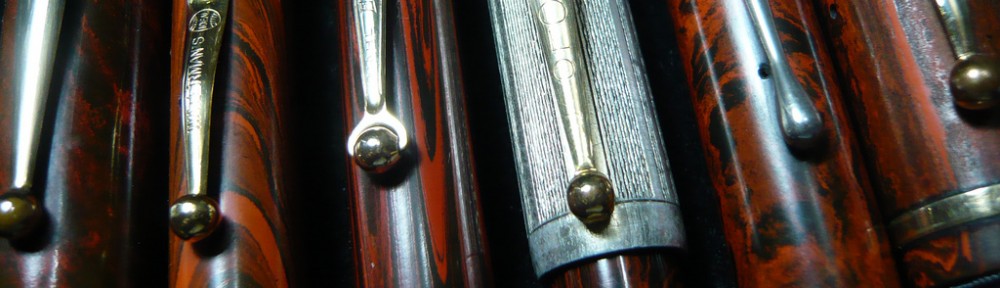
IT’S BEEN a while since I’ve written about my favorite pastime (aside from my weekly poker binges and my foot-massage-and-movie dates with Beng), so indulge me this break from the headaches of literature and politics and let me talk about those obscure objects of my writerly desire—pens and all things appurtenant thereto, as my lawyer friends would say.

We have, not incidentally, a good many lawyers among our members at the Fountain Pen Network-Philippines (FPN-P), which isn’t surprising, given how lawyers have traditionally used pens in their work, and at least in taking their bar examinations. Those pen-wielding members of the Philippine bar include Undersecretaries Albert Muyot, Ronnie Geron, and Rey Cruz; SEC Chairperson Tess Herbosa and SEC lawyer Joanne Ranada; pro-gun advocate Ticky Tabujara; former ACCRA lawyer Elsa Divinagracia; and Aboitiz lawyer Anthony Goquingco. While he hasn’t formally signed up with FPN-P, Supreme Court Justice Marvic Leonen, an avid pen user, has turned up at a meeting or two.

We also have a sizeable representation of doctors—among others, Novartis executive Aileeen Dualan, surgeons Jojo Hosaka, Joy Grace Jerusalem, and Leo Ona III, Healthway Medical head Eleanor Bengco-Tan, barrio doctors Edrie Alcanzare and Jim Lopez, Dagupan-based rehab specialist Hazel Gazmen, company physician Kristine Arabaca, and new Med graduate Mark del Rosario. Predictably, there’s a special thread in our forum devoted to providing specimens of our doctors’ handwriting—the more unreadable, the more impressive.

Alongside these professionals come teachers, writers, artists, businessmen, bankers, students, and all manner of writing enthusiast, drawn to the group if not by pens then by inks, papers, calligraphy, or drawing. What started out in my front yard in Diliman seven years ago with less than 20 people has grown to over 500 members on our dedicated website at http://www.fpn-p.org/, and more than 2,000 on our Facebook page (being FB-averse, I stay out of that group, but you’re welcome to sign up there if FB’s your thing).

Once or twice a month, we get together—typically for a long Saturday lunch in a Makati or Ortigas restaurant—to play with our pens and to doodle away in wild abandon. While we may talk politics in the corners of the meeting and devote some attention to tangential interests like watches and knives (you’d be surprised how many pen people have one or the other or even both as secondary hobbies), the focus is clearly on fountain pens, inks, and papers.

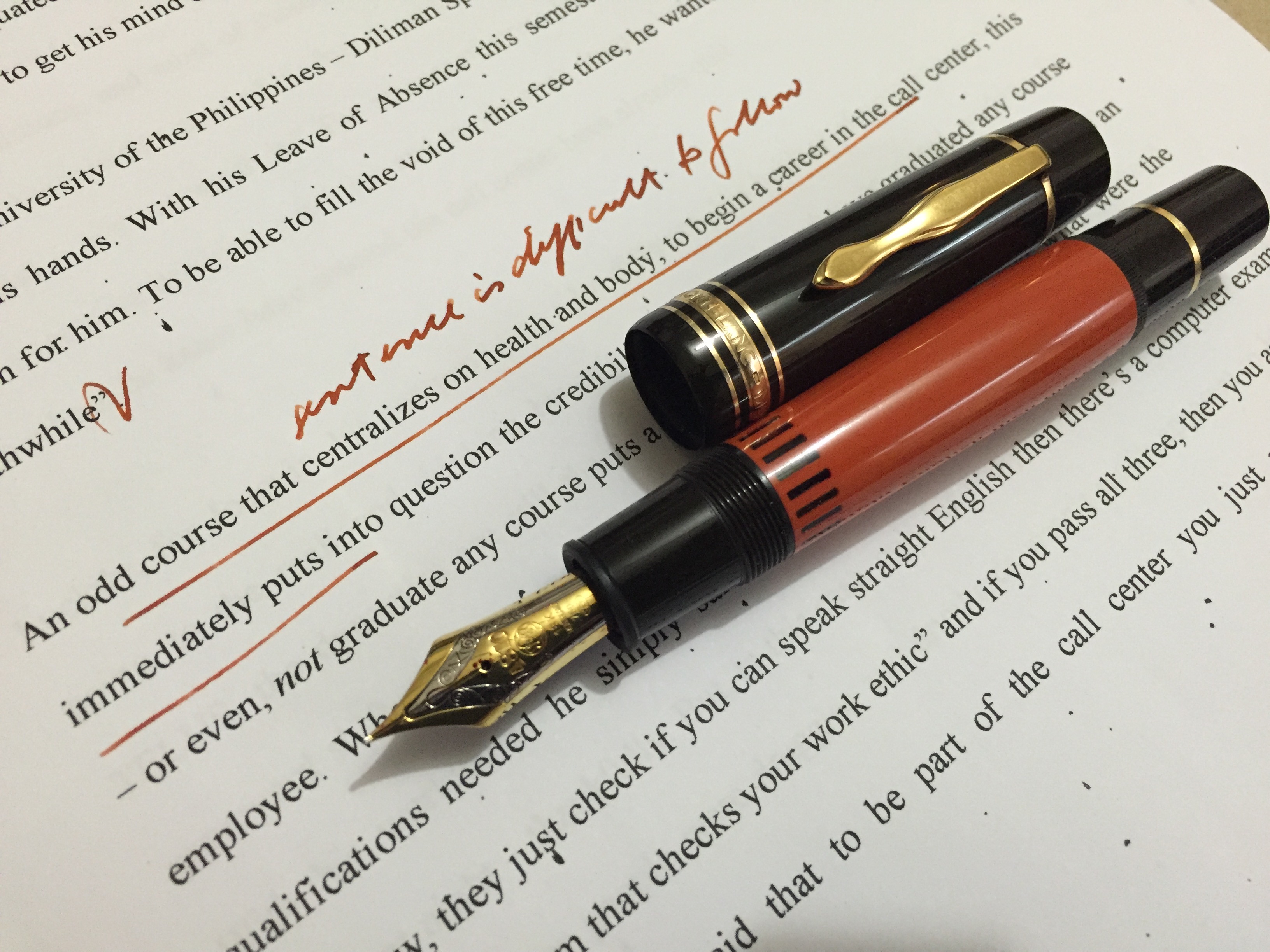
Whatever for? There’s no better way I can explain it than group therapy. As I’ve said in this column many times, it’s the sheer tactile pleasure of laying down lines and letters on a page, of watching the ink spread through the paper’s fibers, creating networks of meaning, or otherwise an impression of beauty, an entirely handmade beauty at that. This is what you can’t get from a ballpoint or a rollerball—a soft or shaped nib that can create breathtaking line variations from from extra-fine to triple-broad, that can be so sensitive to the touch that the merest tremor can betray some deep-seated emotion. With every stroke of the pen, another worldly care is banished, another rampant anxiety quelled. There’s nothing more intimate yet more revealing than that stroke, the physical commitment of thought to paper.

Fountain pen collectors (among other creatures infected by the same virus of compulsive acquisition) often speak of their “grail” pen, that one elusive, near-unattainable pen that calls to them in their dreams and shimmers like a mirage on the horizon of their consciousness. That pen could be as simple as a Parker 51 that they recall their father used, or as weighty as the Montblanc 149 favored by Supreme Court Justices, or as uncommon as a custom-made Nakaya or Hakase epitomizing the finest of Japanese craftsmanship.

Over the past 30 years of immersing myself in the hobby, I’ve had many such “grail” pens cross my fevered brain, and have actually had the good fortune of realizing most of them—a 1938 Parker Vacumatic Oversize in burgundy, a Parker “Big Red” Duofold from 1926, a Montblanc Agatha Christie from 1993, and, most recently, a Montblanc Ernest Hemingway from 1992. Almost as interesting as the pens themselves, each of these pens has a story behind it, a near-mythical chase across decades and continents.

Unlike many collectors, I don’t keep my best pens in a case, under lock and key. I rotate them for daily use, praying that I’ll never lose one, although that’s almost a statistical certainty. It isn’t ostentation that impels me to do this, but rather an acute and growing awareness of time passing—of the sense that, at my age, I probably have another ten good years left, and what a waste they would be if I let my happiest acquisitions moulder away in some dark drawer, never having kissed paper.

If all this talk of pens makes you want to reach for one—whether in memory of a long-forgotten practice or in anticipation of a novel experience—then join us this Saturday, November 7, at the Cinema VIP Lounge of Century City Mall on Kalayaan Avenue in Makati as we celebrate International Fountain Pen Day (yes, such a day exists) around the theme of “Celebrating Analog Writing in a Digital Age.”

Open to the general public, the day’s events will include a pen-and-ink art exhibit, a calligraphy workshop, a sketching session, as well as an introduction to fountain pens for children. Guests may also avail themselves of services such as vintage pen restoration, appraisals, and nib tuning.

For supporting this project, FPN-P would like to thank Manila’s leading purveyors of quality writing instruments such as Everything Calligraphy, Faber‐Castell, Lamy, Parker, Scribe Writing Essentials, Sheaffer and Wahl‐Eversharp/PenGrafik. Our special thanks go as well to Asia Brewery for their assistance.

Entrance is free, so take those leaky old pens out of your grandfather’s desk drawer and bring them to us for a cleaning and a good chat. But I warn you: fountain pen use can be highly addictive, and leave your fingers stained in the most wonderful colors.

Penman No. 170: History Made Personal

Sofia+De Veyra and+Florence Harding

Penman for Monday, October 12, 2015

THE RECENT upsurge of interest in our history occasioned by runaway success of the film “Heneral Luna” is certainly welcome. While the film and its propositions may have sparked a flurry of debates among netizens about what really happened more than a hundred years ago, the important thing—as I noted in one of those “Heneral Luna” threads online—is that we’re having this discussion at all, when not too long ago, very few people cared.

(One of the most salient comments I came across was posted by a viewer who mused that—for all our newfound admiration for the hothead general’s bravery and principled stand—had we lived in Gen. Luna’s time, or were those circumstances transposed to the present—most of us middle-class Pinoys would probably side with the general’s more pragmatic enemies, arguing business to be more important than anything else. That’s a sobering thought, especially these days when many people seem to think of “nationalism” as being too old-fashioned if not downright irrelevant in this age of globalization, conveniently forgetting that globalization benefits some nations and economies more than others.)

There have been many times when I’ve wished that I’d become a historian instead of a literary person, so I could have looked into our past more deeply and more seriously to make better sense of our present. Indeed, when I returned to the University of the Philippines as a freshman after a ten-year hiatus in 1981, I chose between declaring myself as an English or a History major (I had entered UP in 1970 as a prospective industrial engineer).

Were it not for the need to take the easier path to make up for lost time, I would have chosen History in a flash, as interested as I was in stories of “what happened.” In grade school and high school, I read more books dealing with history, biography, geography, and science than fiction; to this day, when people ask me what single book has influenced me the most, I don’t think twice about answering The Forest by William Pomeroy, a lyrical account of an American’s travails as a Huk guerrilla, which I read in high school and encouraged me to become an activist.

Mine was a generation of students who grew up on the enlightened revisionism of Teodoro Agoncillo, Hernando Abaya, and Renato Constantino. I use the word “revisionism” because the standard historical texts at that time were written by such men as Gregorio F. Zaide, a mimeographed and paperbound copy of whose book—my mother’s college textbook, for sure—was as fascinating to me as a boy as any of Edgar Rice Burroughs’ Martian chronicles. In grade school in the early ‘60s, I had yet to become aware of the important qualifications and nuances to be made to telling the story of our past, such as the fact that histories unavoidably took sides, and that it was all too easy to be seduced into taking the wrong one.

These days, I content myself with writing commissioned biographies and institutional histories—which, while they pose their own literary and scholarly challenges, do not by any means qualify me as a historian. I remain ever aware that the true study of history involves an appreciation of the grand sweep of things as much as the little details, and I have to admit that it’s the details I’m more often fascinated by, leaving it to larger minds to scope out the overarching logic or the grand design of the human narrative.

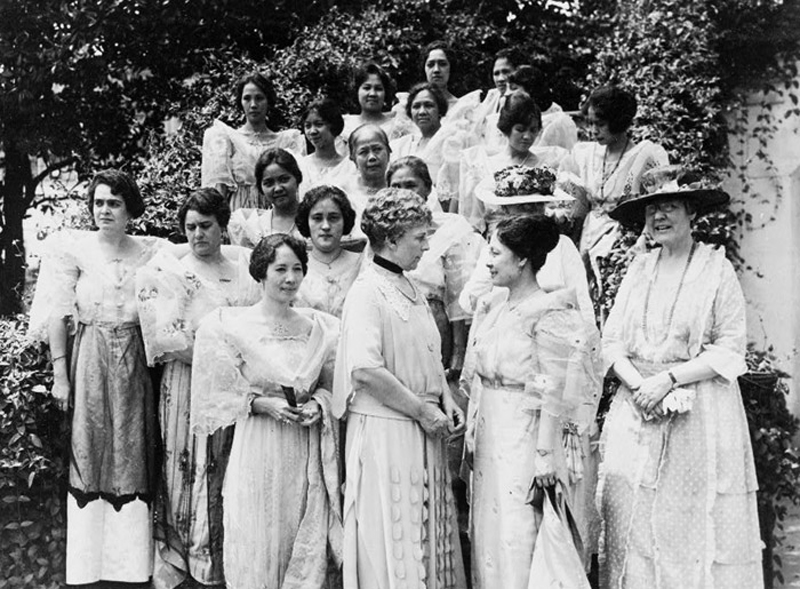
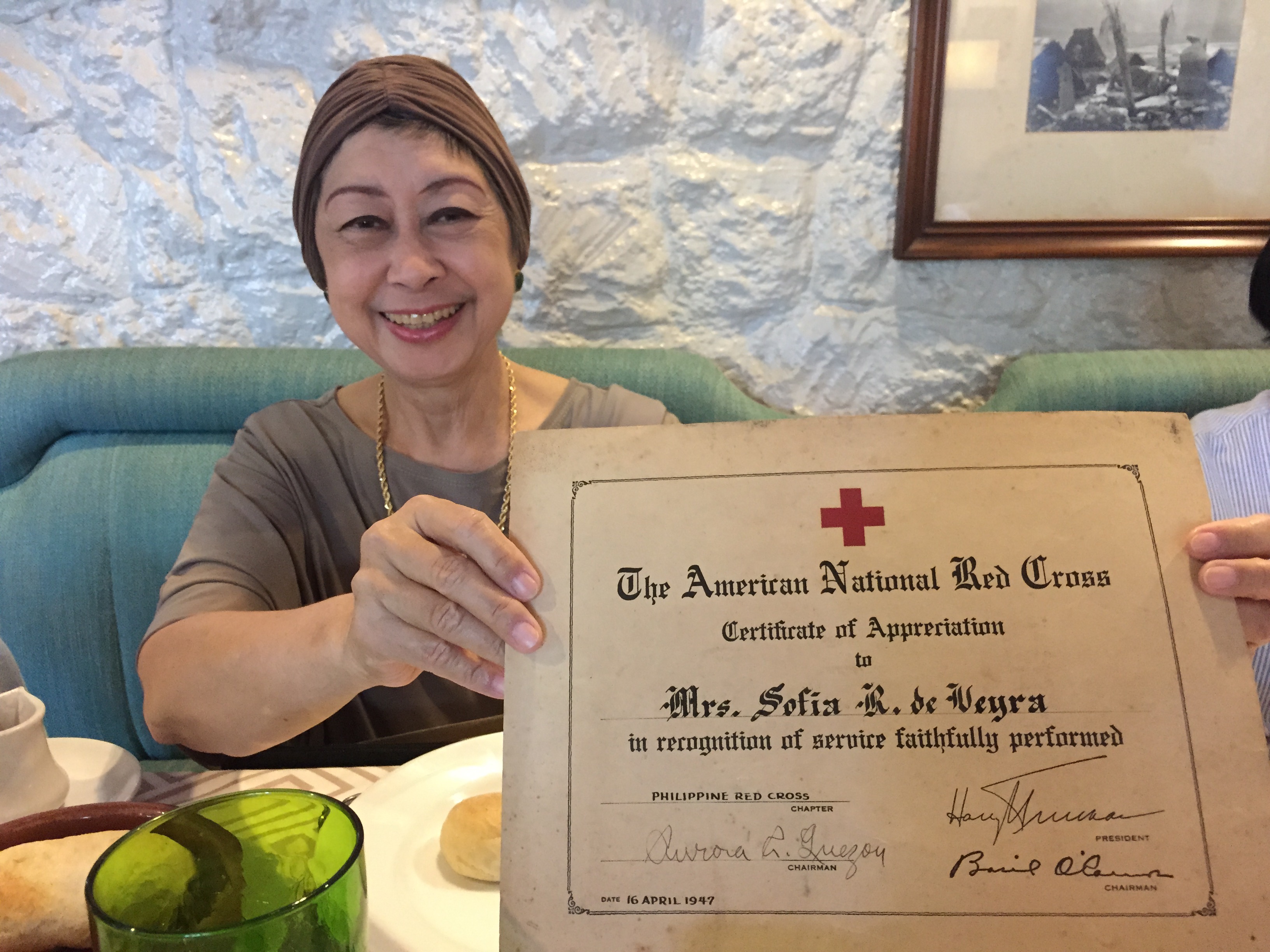
As a hopeless dabbler, hoarder, and kibitzer, I find myself irresistibly drawn to old objects and obscure information, and trade these gilded items with such fellow enthusiasts as my Washington-based friend Erwin Tiongson and his wife Titchie, who together run the Philippines on the Potomac website at popdc.wordpress.com. Erwin and Titchie were in Manila not too long ago for a vacation and a couple of lectures before the Philippine Studies Association and at the Ateneo, Erwin’s alma mater, on their most recent research into the colorful life in Washington of the remarkable Sofia de Veyra (you can read Titchie’s wonderful article on her here: http://www.positivelyfilipino.com/magazine/the-thoroughly-modern-sofia-de-veyra). My wife Beng and I had a chance to meet over lunch with the Tiongsons and with Sofia’s granddaughter Teresa “Binggay” Montilla and her aunt Rita Damian, and the look on Binggay’s face when the Tiongsons showed her pictures of her grandparents she had never seen before was priceless.

IMG_7997

Shortly afterwards, back in the US, Erwin wrote me to say that he had been able to track down an article in the May 20, 1921 issue of the Great Falls Tribune (published in Great Falls, Montana), about the protest launched by Fiipino Chinese businessmen, led by the banker Dr. Albino Z. Sycip, against a new bookkeeping law that apparently discriminated against Chinese merchants. Sycip had taken his case to the US courts, and was on his way to Washington to plead his case there. While he was in the States, on June 30, a son was born to his wife back home, a detail I recounted in a biography I wrote of the man who was that baby boy: “Albino decided to commemorate that visit by naming his new son ‘Washington.’ ‘Up to now Wash has semi-annual recurring bad dreams about what might have happened if the old man had been in Tallahassee or Vladivostok,’ the impish Alex [Wash’s brother] would write.” Erwin relayed the news item to Wash, who gratefully wrote Erwin back to say that he had never seen that article before (and another one reporting on his father’s victory in court).

More recently, Erwin and I have been exchanging clippings we’ve dig up on another outstanding Filipino, a Jesuit icon, the late Fr. Teddy Arvisu, and I’ll write up those findings one of these days (“His father wanted him to marry one of the Quezon girls,” Erwin tells me). I’d found an eloquent and impassioned speech against the rise of fascism by the young Teddy, published in a November 1940 issue of the Philippine Collegian; Teddy would become a soldier and join the Death March before achieving his dream of priesthood. At the moment, Erwin’s hot on the trail of Peyton March, the American officer who went after Gregorio del Pilar at Tirad Pass, and who lived in his last years in Washington. You better hurry, I told Erwin, as they’ll be making a “Goyong” movie soon.

Nothing of the kind of trivia that Erwin or I come across will change the big story of our past, but as avid amateurs, I’m sure we’re happy enough to help in making history more personal.

[Top image from the US Library of Congress]

Penman No. 161: To Be a Journalist

Image-1

Penman for Monday, August 10, 2015

I WAS very sad to hear of the recent passing of an old colleague from my first foray into journalism—Nemesio Dacanay, who was then the City Editor of the Philippines Herald, one of the pre-martial law period’s smaller but pre-eminent newspapers. A relative of his texted me about his death and interment, but I was out of town and felt bad that I couldn’t even pay my respects in person, so I’ll do it here.

Five years ago, in this column, I had to issue an apology—and I was happy to do so—having inadvertently suggested in a previous piece that “Dac” had passed on to the hereafter. As it turned out, he was still very much alive, as his daughter Christine reminded me. This time, unfortunately, the news was real.

The story of my connection to Dac and of how I got into the newspapers is something I may have told before in bits and pieces, but here it is in full. The time was early 1972, and I had just turned 18. I was already a full-time activist, having dropped out of my classes in UP, a lanky, chain-smoking lad who was already a veteran of many a Plaza Miranda march and of the Diliman Commune.

In UP, I hung out with a group of older Journalism majors who were close to graduating and who would, very shortly after, begin to make a name for themselves as reporters—people like Wilson Bailon, Rolly Fernandez, Jun Engracia, Efren Cabrera, Rod Cabrera, and Val Abelgas, among others. I had great respect and admiration for these guys, but at the same time, it annoyed me to know that they were soon going to find and land jobs, while I—technically still a freshman, with but 21 completed units to my name (3 of them good for a “5.0” in Math, the consequence of absenteeism)—was going to be left behind.

I should explain that at 18, I had no greater ambition than to become a journalist. I’d written some stories, poems, and plays, but I had no plans of becoming a creative writer, and might even have thought journalism superior to poetry (and why not?). I had been editor in chief of the school paper at Philippine Science High (following in the gargantuan footsteps of Rey Vea, Mario Taguiwalo, and Rodel Rodis), and I found that I savored the romance of printers’ ink and hot lead (that’s “lead” with a short E for you young ones, the molten metal that magically turned into letters in reverse).

As soon as I stepped into UP, at 16, I did the three things I’d put on my agenda, after enrollment: join the Nationalist Corps (and later the Samahang Demokratiko ng Kabataan, or SDK), join the Alpha Sigma Fraternity (to which high school heroes like my Physics teacher Vic Manarang and firebrand Gary Olivar belonged), and join the staff of the Philippine Collegian.

It was in the nationalist movement and those long nights of proofreading at Liwayway Press that my desire to become a reporter flourished. Never mind poetry and fiction; I wanted to feel and to record the ground shaking beneath my feet from the steps of a thousand marchers, to trace the arc of tear gas canisters flying across the plaza, to bear witness to what we were all convinced was the forging of a bright new future, with all the sparks and all the smoke that came with the process. To be a reporter at that time was to be in the very womb of history, and I thought nothing was more thrilling and more important than to be there on the frontlines, notebook and ballpoint in hand and a barely stifled battle cry rising up my throat: “Pierce the enemy with your pens!” (That was the slogan silkscreened on my jacket.)

As you can see, as a teenage Maoist, I had no idea of and no patience for “objective” and “dispassionate” journalism. I hadn’t even taken one formal unit of Journalism in UP (I was an Industrial Engineering major, and still plowing through my GE subjects) and had embraced the notion that journalism was and had to be a partisan activity, convinced that Malacañang had bought 90% of the Philippine press, with the notable exception of progressives like Tony Zumel, Satur Ocampo, and Rolly Fadul, and young blood like Roz Galang and Millet Martinez. We were going to be the vanguard of what we called the Second Propaganda Movement.

But I didn’t want to be stuck on campus; it was a wide-open arena beyond Diliman, so when my friends began applying for jobs with the newspapers shortly before graduation in early 1972, I tagged along, hoping to land something, anything. (I’d already written and sold a teleplay to the TV drama anthology Balintataw in 1970, when I was 16, so I didn’t lack in self-esteem.) I remember walking up to the editor of the Manila Chronicle, Amando Doronila, and boldly announcing that I wanted to apply as a reporter. “How old are you?” the man asked in all reasonableness. “Eighteen,” I said. “Come back in a few years,” he suggested, not unkindly.

It was like that, one prospect after another, until my path led to the old Philippines Herald office in Intramuros, sometime in March or April. It was must have been around one in the afternoon, because the only person in the newsroom was Nemesio “Dac” Dacanay, whose name I didn’t even know at that point. He had a groovy look about him: dark shades, a colorful, open-necked shirt, and an impish grin. I told him what I was there for, and I can’t recall how long I begged to be given a chance, but finally, if only to get rid of the pesky walk-in, he said: “Where do you live?” I said, “Quezon City.” He said, “Okay. Go back to Quezon City, then come back in three days with a story. Understood?”

I stepped out of the Herald on a floating cloud—I was positive I would deliver as directed. Over the next three days, not knowing anything about real newswriting, I walked around the Quezon Memorial, waiting for some dreadful accident to happen that I could breathlessly report on. The world remained blissfully peaceful, and the only thing that came crashing down was my dream of becoming a journalist. On the third day, I was so tired and depressed that I took a jeepney to the Delta Theater, and decided to cool off in the moviehouse. I watched the screen. The movie was so awful I can’t even remember its title. When it was over, I went home, collected my thoughts, and pulled out my typewriter.

Then I took a bus to Intramuros, and handed Dac my story—a movie review. Damn—I could hear him mutter, and I could see him sizing me up through his shades—okay ka, kid. “I’ll pass this on to Nestor,” he said, referring to the venerable Nestor Mata, who handled the features page. “He’ll take care of you.”

And so I was hired at 18 as a general assignments reporter, the greenest of greenhorns in a roomful of veterans that included editor in chief Oscar Villadolid, news editor Joe Pavia, reporter Lito Catapusan (who took me under his wing), and a deskman who moonlighted as a songwriter named George Canseco. Over the next few months, I would make the rounds of the police, sports, and City Hall beats, cramming three more years of college into a semester. Thanks to a guy who humored me named Dac, I had achieved my ambition of becoming a journalist. (By July, in a flash of activist fervor, I would resign in solidarity with striking workers, and move over to Taliba as a correspondent right up to martial law, when we all lost our jobs and the press as we knew it vanished overnight. But that’s another story.)

Penman No. 156: Why I’ll Never Become Ambassador

Penman for Monday, July 6, 2015

IN MY early middle age, around 40, I nursed an ambition of becoming an ambassador, an official representative of the Republic of the Philippines. Some of my friends and schoolmates were on their way to becoming one—Vicky Bataclan, now in Belgium, and Libran Cabactulan, now at the UN, were just two of them—and I imagined that I might carve out a new career in my seniorhood in the grand tradition of writer-diplomats such as Pablo Neruda, Octavio Paz, and our own Manuel Viray and S. P. Lopez. I’ve met a few real and truly worthy ambassadors and have been much impressed by their demeanor—Cesar Bautista, Delia Albert, and Joey Cuisia, for example.

With a background in literature and economics, and having written a slew of speeches for Presidents, senators, and CEOs, I thought that I had acquired enough political savvy and possessed the language to be able to craft an intelligent and suitably tart or nuanced response to any issue from island-grabbing in the West Philippine Sea to the Chinese in all of us. I also happen to like wearing suits and to be driven around, and I can say “Good morning” in six languages, so I have the externals covered. If I were serious about my ambassadorial plans two decades ago, all I needed to do (if I didn’t want to go the career route and take the FSO exams) was to hitch my wagon to some political star, which is apparently how one too many stragglers like me get to be called “Ambassador” for life, their diplomatic skills be damned.

But I suppose I’ve always had at least two strikes going against my being posted to some swanky European capital: my incipient misanthropy, and my culinary incorrectness.

The older I get, the more reclusive I tend to be, shying even farther away from the frenzy of Facebook and the emoji-enabled spontaneity of many online “friendships.” It’s not that I actively dislike people; I think most strangers will find me friendly, and I warm up easily once we get a real conversation going. (With the exception, I must say, of telephone conversations; having grown up without a phone, I have always disliked—loathed would be the better word—talking on the phone, especially for anything longer than three minutes.)

It’s just that, past 60, I’ve come to seek out human company less and less, preferring to keep to myself and family, and a few close friends who wouldn’t mind not hearing from me for months or years and picking up where we left off, which is my gauge of a true friendship. Over the past five years or so, I’ve become such a homebody (my poker nights excepted) that Beng feels like she has to ask me now and then, “Don’t you have any friends?” She means, of course, people other than herself, because she knows that I’ve been perfectly happy to just have her for company, at home or on the road, and that, in our sixties, our need and desire to socialize as a couple has diminished considerably.

Beng compensates for this by being a Facebook fiend, and aside from her snoring bedmate, Facebook’s the first thing she sees in the morning and the last thing she sees at night. Like I wrote here not too long ago, I’m not even on FB, and obstinately stay out of it, because I think it’s cheapened the meaning of “friend.”

Diplomacy, of course, requires not only meeting with a lot of people, but people you hate, and who very likely feel likewise—sort of like the online world, only it’s face to face. Now, I can fake pleasantness as well as anyone else—except maybe Beng, who’d lose our house and car at poker within five minutes—but I know, from practice, that while they say it takes just 17 muscles to smile and 42 to frown, smiling can be a lot more tiring than frowning, especially if you don’t mean it.

The more important reason I’ll never head an embassy is the mess I would likely make of our foreign relations by my equally boneheaded refusal to acquire a more catholic or at least a more cosmopolitan palate, despite Beng’s entreaties for us to try menus more complicated than Chow King’s. Nothing flusters me more than the prospect of “fine dining.” (I recall how, many years ago, I begged off from joining a very exclusive and epic feast prepared by ten of Manila’s top chefs—much to the dismay of a fellow professor who had wangled the invitation—precisely because all that good food would have been wasted on me.)

That’s also why I’ve declined dinner invitations, especially from people I don’t know or who don’t know me and my curious preferences, to spare us the mutual embarrassment of my shying away from anything with cheese, or oregano (I can sniff out one part in a million), or the aforementioned curry, which effectively leaves out much of Italian, French, Greek, Indian, and Mexican cuisine. No pizzas, thank you! But I’ll take pancit, lechon, adobong pusit, Ligo sardines, chicken mami, and KFC anytime—I’m actually easy to please.

Ambassadors should be able to eat anything with anyone, and not just gorge like a hungry peon (someone called my rice-and-pancit combo “pagkaing obrero”) but dine intelligently, knowledgeably, with the ability to make off-the-cuff remarks like “Don’t you just love the tanginess and the fruitiness of this Dréan d’Auvergne? It’s a bit more complex than the St. Nectaire, don’t you agree?” (Thanks to cheesenotes.com for the technical details.)

The only place I can imagine not having this culinary quandary would be China—where I’ve gone pretty often because, as I told Beng, I was sure to find a lot of yummy Chinese food there—but I’d hate to tell my Chinese hosts what I really thought of the nine-dash line, and I’d hate to have to explain, on the rebound, why bright kids with Chinese names can create such a fuss on Pinoy Facebook.

Penman No. 152: Writing the Stories of Your Life

Studio5

Penman for Monday, June 8, 2015

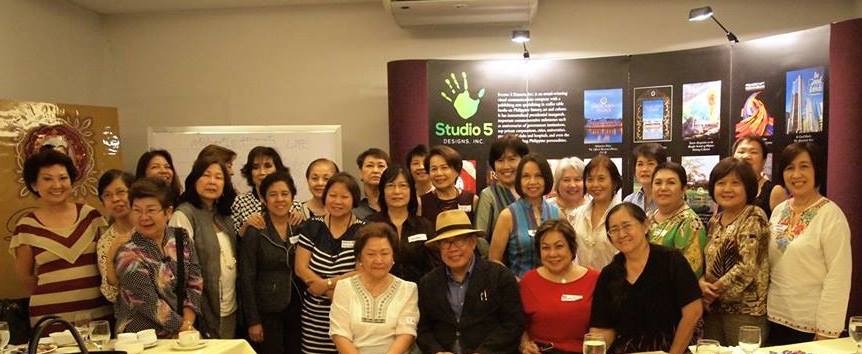
TWICE OVER the past three months, I’ve been giving workshops to medium-sized groups of people in my general age range (let’s put that at 50 to 70), people who came together because they had stories to tell, but needed some guidance on how to tell them. These workshops were arranged by the publisher and writer Marily Orosa, who had come up with very engaging book ideas to which these potential writers could contribute, and who thought that it would be a good idea to have a practicing writer give them a bit of coaching before they plunged into the actual task of writing.

I was glad that Marily put these workshops together, first because I’ve always believed that every person has at least one good story in him or her, and that it’s my job as a writing teacher to get that story out of the person. Second, being a senior myself, I’m happy when older people get an opportunity to express themselves in this obsessively youth-centered world.

Many if not most members of my audience were retirees or approaching retirement after many decades of productive work in their professions. One was a former Cabinet secretary and another a university president, among other luminaries, but in the end, it wasn’t one’s position that mattered as much as one’s experiences, which seniors have in spades.

I couldn’t cram a semester’s worth of lessons into a Saturday afternoon, but I did what I could to give them a framework, an approach, and some tools with which to get their stories out of their memories and onto the digital page. First, we talked about the basic difference between life (their life experience, the raw material) and art (the finished product they were expected to come up with).

What do artists—writers, painters, musicians, and so on—do to and with their materials to make works of art? What do artists see in the things around them that most other people don’t? In this way, we try to get people to see their own lives and experiences as matter to be structured and shaped—not to distort the truth (the object, I think, of all honest art) but precisely to get at it and to bring it out, even if it may not always be pleasant—and indeed much art out there is meant to disturb.

We talk about selection, and how the writer or artist chooses material to use directly in the artwork (the text) and leaves other things out (the context), given that you can’t possibly use everything out there. We talk about how artists work with concrete images and objects to suggest ideas, rather than the grand abstractions that, say, editorial writers and philosophers use.

When we consider life experiences, we then talk about distances in space and time, and about physical and emotional distance. Many participants at these workshops, for example, want to talk about travels they undertook to interesting places, and what I try to do is to get them to write something beyond the verbal equivalent of a posed snapshot in front of the Eiffel Tower or the Golden Gate. A trip to Paris isn’t just ever about Paris, but also, implicitly, about Tagbilaran or Bayombong, wherever it was the narrator or protagonist came from, and it’s that perspective that makes this particular experience of Paris unique.

Writing about the past really involves two protagonists (taking a page from Thomas Larson): the remembered self and the remembering self. Writing about a journey involves not just traversing physical territory, but also that internal space within which the character grows—so the physical journey is always paralleled by an internal, often spiritual, one.

After clarifying these fundamental concepts, I then introduce them to some basic tools of the trade—the elements of fiction which, when carried over to nonfiction, liven up the narrative and make both writing and reading a more engaging experience. We talk about plot, character, theme, point of view, dialogue, description, and setting—how to employ time, how to bring scenes to life, what to say and what to leave out.

I remind them what a lonely and (for most people) unremunerative occupation writing is, but going beyond the money or the lack of it, how important it is to write one’s stories down before the memory deserts or defeats us. It’s especially important for the young to know about how their elders lived and thought. It might take them another 20 years to become receptive readers, but the record will be there, and they’ll be surprised to find, as we ourselves did, how the past anticipated the future in so many ways.

I feel drained at the end of these three-hour workshops, faced with a flood of eager questions, but I also feel elated by all the creative energy I seem to have unleashed among my fellow seniors, and I can only begin to imagine what a touch of art can do to that rich lode of memories lying deep in their many-chambered brains.

Treasures

AND NOW’s as good a time as any to draw attention to the good work done by Marily Orosa’s Studio 5 Designs, which has been in the business of producing not just books but prizewinning ones, lauded both for their design and their substance. I’ve had the pleasure of working with Marily on a couple of coffeetable book projects, most notably De La Salle University’s centennial volume, The Future Begins Here, which I edited and wrote for, and which won a Quill and an Anvil Award (the Quill, Anvil, and National Book Awards are the local publishing and PR industry’s measures of excellence).

Studio 5 has also won NBAs for In Excelsis (The Martyrdom of Jose Rizal) by Felice P. Sta. Maria and The Tragedy of the Revolution (The Life of Andres Bonifacio) by Adrian Cristobal. Malacañan Palace (The Official Illustrated History) by Manuel Quezon III and Jeremy Barns also won a host of local and international awards, as did the magnificent Treasures of the Philippine Wild. Freundschaft/Pagkakaibigan (celebrating 60 years of friendship between Germany and the Philippines) will be included in the prestigious international design annual, Graphis.

Beyond being visual treats, these are all significant books, and their creators and publisher deserve high praise and encouragement.

Penman No. 148: Why I’m Not on Facebook

Penman for Monday, May 11, 2015

FOR THE umpteenth time, last week, another person asked me, with profound astonishment, why I wasn’t on Facebook. I told him that, in my seniorhood, I wanted to lead a quiet and peaceful life, and that Facebook was antithetical to that ambition.

From what I hear, Facebook is this century’s Colosseum, and that a fracas on Facebook can be far more entertaining than the event in real life. I knew that it had been a busy week, to say the least, on that website (or, I should say, in those millions of websites). There was that “literary tempest” that my fellow STAR columnist Scott Garceau adverted to in a recent piece, the Pacquiao-Mayweather fight, and the Save-Mary-Jane-Veloso movement, among other contentious causes.

I learned about these things not because I’m on Facebook, but because my wife Beng is. She’s up in bed before me every morning, pecking away at her iPhone in the gathering light, responding to the planetary call for “likes” and “tags” and “status updates” and whatever else goes on in the FB universe. When she senses me stirring awake, she gives me the lowdown on the state of the world, leaving the less interesting and less important matters to CNN and the BBC.

That world would be much happier and more peaceful if more of humanity were like my bedmate, but it’s not. “Avoid loud and aggressive persons, for they are vexatious to the spirit,” counsels the albeit apocryphally attributed Desiderata—which is as good as saying, avoid Facebook, for it is the Republic of Vexation, the domain of loud and aggressive persons who would like nothing better than to get a rise out of you and spoil your day.

Of course I’m told it also exists for friendship and global harmony—the spirit in which Beng and some of her friends upload quotations from the Dalai Lama and such peaceable people—but I’m convinced that they’re in the distinct minority, for which a separate Facebook might as well exist. While we’re at it, let’s do a bit of taxonomy and map out the possible sub-Facebook realms out there, the establishment of which could lead to a more tolerable era of co-existence all around.

Facebook Lambs (or should that be Facebook Koi, for a more Asian touch?) could include everyone like Beng—the tree-huggers, the lifesavers, the Kumbaya singers, the people who will find goodness in the worst of places. Easy to please, they’re also easy to hurt, and when they hurt, they bleed.

Facebook Monkeys do what monkeys do: screech and thump their chests a lot, to say: “Look at me and at what I’m doing! Am having XXX brand of cornflakes and YYY brand of yogurt for breakfast, folks, and here’s five pics to prove it! Isn’t that interesting???”

Facebook Vipers do what vipers do: strike and bite at anything that moves, especially anything that gets within a whisker of their precious scales. Some days I imagine Facebook brimming with reptilian malice, filling me as well with illiquid emotions, until Beng pulls me over to show a child singing a heavenly carol on her FB page.

So why do I shun FB? (I’ve been told, by the way, that there’s a “Butch Dalisay” FB page, but I have nothing to do with it, and have no idea what it contains.) I’ve been asked this question many times before, and my serious and rather ironic answer has always been that I can’t abide using the word “friend” for people who really aren’t that. I do believe that one of the worst things that Facebook has done to language and to human relationships has been to cheapen the meaning of “friend” and, corollarily, introducing the notion of “unfriending” someone with a keypress, just like that.

I still prefer to make my friends over coffee, on a bus or a boat trip, laughing at the same silly movie, pulling for the same desperate cause, arguing the merits and demerits of some poem or passage of prose. And when you stop being my friend, I won’t even waste a sliver of bandwidth on it; a cosmic silence is all you’ll get (although my deepest friendships can endure years of stasis).

I said “ironic,” because it’s a bit odd that I find myself arguing for more human contact when, at this stage of my life, I actually want and seek less of it for myself. I’m not misanthropic, but I feel happy to keep company with just a very few people I can trust and relax with, mainly family. I hardly attend parties or big social events unless required to do so by work or inescapable obligation. I dread making and taking phone calls, especially any call beyond three minutes. (You’ll best get a response from me by email.)

But never mind me; I do recognize Facebook’s matchless utility for most people. I know that serendipitous connections can be made online that would have been impossible otherwise, and if you’re tracking down that crush you last saw in the 1970s—or 50 pounds in the blissful past—there’s nothing like FB to make that happen. Like a loaded gun, Facebook all by itself isn’t evil; it’s people who are, or can be, and FB is just another enabler of the dark side, as well as of its sunnier converse.

So it’s not even the malice I’m evading, because you’ll find that elsewhere anyway, or perhaps I should say, it’ll find you. It’s more likely the way Facebook—in all its goodness and badness, for better or for worse—can take over people’s lives, basically by engrossing them in the issues of the day (as in this hour, this minute) rather than troubling them with historical hindsight and such corn. (And who needs a lengthy editorial and well-considered opinion when you can offer up your precious gut feelings, along with your barangay’s, as a workable and certainly more credible substitute?)

There’s a facebookhaters.com, but I don’t see myself signing up with those folks. Facebookhaters.com is completely serious but unironic—I can just see it devising and promoting a 12-step withdrawal program—which isn’t the way to grapple with a hyper-sophisticated Hydra like FB.

I can’t and don’t actively hate Facebook, knowing how vital it is to the lives of millions; what would I do with Beng all those hours she won’t be on FB? As it is, I can play poker all night, knowing she’ll never be alone and idle, as long as she has her phone (a tip for spouses—get your mate an unlimited data connection, and you’ll never have to babysit them again). That’s one thing to thank FB for.

Penman No. 145: Another Watch to Watch

Penman for Monday, April 20, 2016

KNOWING WHAT an Apple diehard I am, friends have been asking me about the forthcoming Apple Watch, and if I’m going to get one. So I’m going to make another little digression today to answer that question—although, arguably, technology is art and culture in contemporary society, particularly when it’s something close and familiar enough to wear on your person.

As half the planet now knows, Apple announced the Apple Watch last September 9 in a splashy event helmed by the company’s new and nimble CEO, Tim Cook. It’s due to be released this Sunday in the US, and preorders opened last April 10; within six hours, most models—about a million units—were sold out.

That’s the kind of first-day frenzy and manic marketing that Apple might as well take out a patent on, because no other company even comes close in making people line up on the sidewalk a week before the store doors open. It’s also what turns Apple haters—and there are more than a few—apoplectic, refusing to understand how the mere whiff of a new toy from Cupertino, California could leave a fourth of humanity in a hypnotic trance.

Well, the Apple Watch is finally here, heralding Apple’s entry into the fashion market—make that high-fashion, with its top-of-the-line, solid-gold model selling for a toe-curling $17,000 (base models start at $349, or about P15,500). It comes in two sizes and a number of finishes, with an array of attractive watchbands (attractive to most people, anyway, who sadly don’t include old leather-loving codgers like me.)

Given those numbers, it’s safe to conclude that the Apple Watch was made to do more than tell the time. While hardly in the same stratosphere of high-end watch brands such as Patek Philippe and Rolex, Apple hasn’t done too badly as a horological upstart. Designed to work best with an iPhone, the Apple Watch can receive your email and text messages, and show incoming calls. It can do Facebook and Twitter, and perhaps most hyped of all, it can track your health stats. It can play your favorite tunes, and store some of your favorite pics. You can still use it without an iPhone for neat little tricks like Apple Pay (if and when that comes to our shores).

What are its downsides? It doesn’t have built-in GPS; you’ll need your iPhone for that. And with its touted 18-hour battery life, you’ll probably need to recharge it every night.

Many of these features, I should point out—except for the Apple-specific apps—were and are available on other smart watches, for a lot less than what Apple is charging for their sum total. Before the Apple Watch, Beng and I had some fun with our his-and-hers Pebble watches, which basically told the time and displayed our email and SMS messages on a monochrome screen. Eventually, we both got tired of charging the buzzing beasties, and went back to our analog Hamiltons.

Which brings me to my answer to my friends’ question. Am I getting an Apple Watch? Heck, no—and this will probably be the first Apple rollout since the Newton that I’ll be passing on. But why not?

I’ll admit that the price is a factor—the Pebble didn’t cost me more than $100, and it’s way below that now (feature-wise, of course, the Pebble can’t hold a candle to the Apple Watch). But in truth, cost never did turn back the Apple masses, who seem convinced that the pricier and sleeker something with an Apple logo is, the more compelling it must be to possess.

It certainly isn’t for any lack of features, either, that I’m not in the buyers’ queue (where I was for the iPhone 6; I had ordered mine as soon as the online counters opened, and received it via UPS last September 19, the first day of delivery in the US). The Apple Watch is abundantly capable and versatile, and we’ve only seen the barest suggestion of all the lively apps that are going to be developed for this device.

Instead, I may have to admit, as I’ll do now, to the onset of what we might call digital fatigue—that awful sensation of drowning under an onrushing wave of 1’s and 0’s. I’ve never felt this before, and it must be my biological age showing, but it took the Apple Watch and its kaleidoscope of colors to tell me that I’ve had enough. Please, not another device to tether and feed like a pet goat, and one that will bleat mightily when some silly text message comes in selling a condo I can’t possibly afford, and one that will remind me with a smug chirp about how overweight I am.

I know that I can talk to the Apple Watch, which will be the coolest thing for my students to see since I stepped into class with a Nokia the size of a shoe strapped to my waist in the early ‘90s. But I have trouble enough talking to my phone; I hate making and taking phone calls, because they usually mean problems to deal with. My iPhone is, first of all, a camera, a jukebox, a browser, and a datebook; and then it’s a phone (come to think of it, it’s also and already a watch, and a damn good one).

As it is, I don’t even use my iPad often enough, and I have to remember to charge it after letting it idle for a couple of weeks in solitary stupor. There’s a nest of charging cables at the foot of my bed, with phones, power banks, and digital recorders huddled like suckling pigs; I can just see the Apple Watch joining that blue- and red-eyed menagerie—but again, I’d rather not.

The ultimate reason for my self-denial is, I guess, the romantic one. I love my vintage and my two-handed watches too much to trade them for some blingy upstart. I believe a watch’s first and only duty is to tell the time. I believe a watch should have a clear, round, and honest face, from which I can read the time at a glance, without breaking my train of thought. I believe a watch should have a soft and pliant strap, like good leather; it should be beautiful, but quiet and undemanding, except for the occasional turn of the crown.

Appwatch95

Kind of like the original Apple watch from 1995—I think the happiest watch ever designed—which everyone seems to have forgotten about in the mad rush to get the new one. I dusted mine off the other day, put a new battery in, and gave it to Beng. It tells the time, and puts a smile on your face. What more can you ask for?

[Apple Watch pic from wired.co.uk]

Penman No. 143: A Foray into Fairyland (2)

IMG_7281Penman for Monday, April 6, 2015

LAST WEEK’S piece on “Fairlyand”—the mountain of Calatong in my home province of Romblon—elicited quite a bit of interest among my readers, and I was very pleased with the response until my mother, who grew up around the place, called my attention to a potentially lethal mistake I’d made in my retelling of my cousins’ and aunts’ stories about that enchanted kingdom. (I’m thinking that “lethal” might depend on whether you believe in spirits or not, and I don’t, but talk like this always reminds me of a conversation I had with a sharp old nun whom I met in one of my Italian sojourns, who said: “The question isn’t “Do you believe in God?’ but rather ‘Does God believe in you?’”)

The mistake I’d apparently made was in saying that eating quinta, or black mountain rice, was an antidote to fairy spells. “It actually works the other way around,” my mother told me in our little garden in Diliman. “They’ll offer you black rice, and if you eat even a handful of it, they’ll take you to Calatong and you’ll never be seen again.” So folks, be so advised; beware of strangers offering black rice, although it’s not very likely you’ll be seeing any soon. The last time I saw truly black rice was in an American grocery store in the Midwest, where it was being sold as Indian wild rice, and cost considerably more than any other exotic variety on the shelf. But then maybe that preciousness implies more than a smidgen of magic. If black rice banishes people to oblivion, I’d like to buy a sack of it, whatever the cost, to feed to certain politicians before 2016.

Which returns us to the more prosaic realities of modern-day Romblon. Not too many people, even Filipinos, know about Romblon, which if they ever board a ship for Panay they’re likely to pass unseen in the night, after Mindoro. It’s composed of three main islands—Tablas, Sibuyan, and Romblon—and was a sub-province of Capiz during Spanish times. As Philippine provinces go, it’s a pretty small one, with less than 300,000 people (excluding encantos), and my favorite quote about it comes from Jose Rizal via NVM Gonzalez (who was born in Romblon in 1915), who passed it on his way back to Manila from exile in Dapitan, remarking that it was “muy hermosa pero muy triste.”

Much of the hermosa part remains. On this first long visit home in two decades, we took an SUV around Tablas, a day trip I’d never taken before, and I was awestruck by how lovely the place was, fringed by one emerald cove after another. I lost no time in telling my friends to consider Romblon as a vacation alternative to Batanes, Palawan, and Boracay.

Indeed, Boracay’s a short hop away by motorized banca, and being on the other side of the same oceanic basin, Romblon is also blessed with many white beaches, most of them yet undiscovered. (All these islands and their people belong to one ecosystem, as it were, their languages familiar to one another, though subtly different; my paternal grandfather must have come from the Dalisays of Ibajay, Aklan, where a playwright named Marianito Dalisay Calizo wrote moro-moros in the mid-1700s.)

Some of these natural getaways have been found out, and the developers and entrepreneurs have begun streaming in, and foreigners with Filipino wives have been buying up prime beachfront property for a fraction of Boracay prices. (The best fish catch in Romblon still goes to Boracay, where it can fetch two to three times as much.)

One happy discovery we made was just a 15-minute ride from my hometown of Alcantara: Aglicay Beach, owned and managed by an affable balikbayan doctor, which offers a white-sand beach, great snorkeling, and spectacular hilltop views, all within a resort with the usual amenities, including conference facilities and wi-fi. You’ll have to pay the admission fee, though—all of 30 pesos. (To know more, check out www.aglicaybeachresort.com.)

The triste part, I don’t know. There’s certainly enough to be sad about, as much of Romblon remains painfully poor. On the other hand, the tougher things get, the harder many Romblomanons work, with their brains if not with their hands. I was puzzled by the knot of schoolchildren who gathered in front of our beachside house at dawn every morning—they carried their shoes rather than wore them—until I realized that they had walked over barefoot from a nearby island at low tide. I would later learn that one child, barely nine, had drowned this way when the tide came back in too quickly. But there was no fear in these survivors’ faces, only an insistent resolve that now and then would fracture into laughter.

We were roused one morning by the thump-thump-thump of techno music in the plaza. “They’re just testing the sound system,” said our host. “It’ll be fiesta soon.” They called the uncanny practice of waking every one up pag-di-diana, and I thought that it might have had something to do with Paul Anka’s karaoke staple.

A few other discoveries I learned on this trip were rather more personal. I had always wondered why I had spent such a long summer there as a ten-year-old in 1964—an experience I recounted in my first novel, Killing Time in a Warm Place—and I learned that it was because we were then so hard up in Manila that we children had to be farmed out, as it were, to save some money. My aunts recalled me as a smart but prissy boy who wore long-sleeved shirts in a seaside village and who would recite long poems in English at the drop of a hat.

We also solved the mystery of why my grandmother Pinang left my Lolo Tolio in the mid-1920s shortly after marrying him and giving birth to my father Jose. It had been something of a forced marriage to begin with, and Pinang was a headstrong woman, but the story we heard was that she hated being made to serve hot chocolate when some constables came visiting one day, and took that as the last straw and left. (They would live a kilometer apart for the next 60 years, and would inevitably run into each other in town but never speak.) Now it emerged that Tolio was having a saucy little affair—an explanation that makes Lola Pinang much less petulant than the chocolate story would make her out to be.

Whether sad or funny, it felt good to hear and to understand these stories again in Romblomanon without having to defer to my wife’s more widely spoken Hiligaynon, to say udi instead of diri, basi instead of ngaa; it’s still palangga in both languages. I felt at home.