Penman No. 225: Sayang in Singapore

IMG_9764.jpg

Penman for Monday, November 11


TO US Filipinos, sayang has one meaning and one meaning only: a regrettable loss, something that causes us to shake our heads or hold our palms to our hearts and say, “Oh, that’s too bad.” But elsewhere in the region, from some sultry corner of which the word worked its way up our archipelago, sayang means that and more: the love which may have been that which was lost, love as both a noun and a verb, or even an endearment, depending on the nuances of its intonation. So love and loss—the former all too often trailed by the latter—coexist in this wonderfully complex word, through which we Filipinos can at least claim some vestigial connection to the heart of Asia.

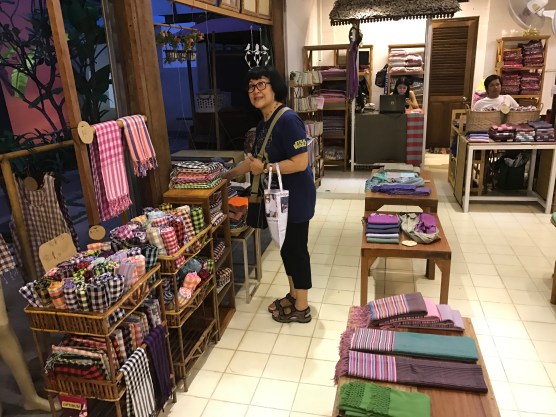
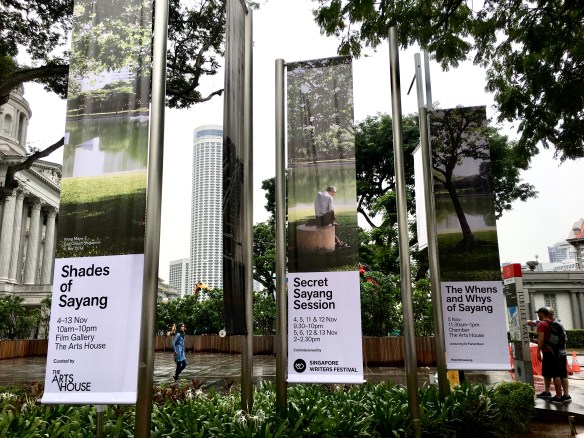
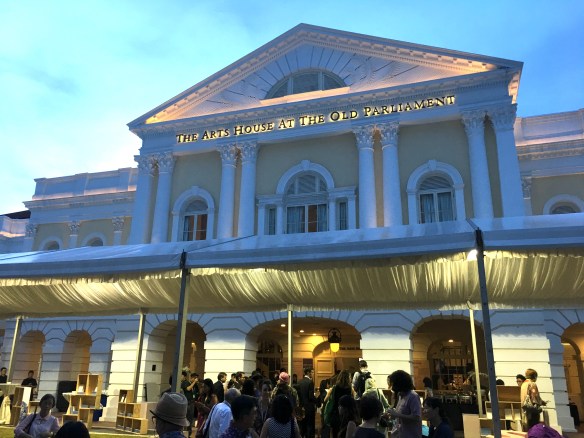
Sayang was very much on people’s lips in Singapore last week—you would have thought a lovefest was going on, and in a sense, it was. But the love was for books and literature, the occasion being the Singapore Writers Festival, which I was visiting for the third time after a hiatus of five years. Sayang had been chosen as the festival’s theme, and the word was festooned against a suitably floral backdrop all over the Arts House area where most of the festival events took place.

IMG_9754.jpg

Now on its 19th edition, the SWF began in 1986 as a biennial event, but it has since become a fixture on the regional cultural calendar (alongside the Singapore Arts Festival), cementing the city-state’s reputation—like its iconic Merlion—as the fountain of artistic endeavor in this part of the world. (I know what you’re thinking: “Shouldn’t that be us, the Philippines, with our long tradition of cultural expression and our bountiful artistic talents?” But I’ll tell you what festival director Yeow Kai Chai—himself a poet and journalist—told me over lunch: “I can’t believe you Filipinos have yet to establish a Department of Culture!”)

It was clear, from the minute I stepped out into Changi’s arrival area, that the National Arts Council, under Singapore’s Ministry of Culture, had once again pulled all the stops to guarantee a pleasant and efficiently managed experience for all SWF attendees, expected to number about 20,000. I was here as a journalist on coverage for the Star (I had attended the SWF as a participant in 2008, and returned to cover it in 2011) and I knew what to expect, but like they say, you never cross the same river twice, and this year’s festival offered a steady stream of 300 events spread out over ten days from November 4 to 13. There were over 300 official participants registered, with a hundred of them coming from overseas.

That makes the SWF one of the world’s largest and longest festivals of its kind, if not probably the most multilingual one, with its support for literature not just in English but also in Bahasa, Chinese, and other Asian languages. According to Yeow, the goal was to be as inclusive as possible in the SWF’s programming, going so far as to offer facilities for the hearing-impaired.

The fullness of the festival programme required selectivity, so I cherry-picked my way through the three days of my stay there, paying special attention to literary developments in Singapore itself. I’ve often remarked—most recently at a reading in Diliman featuring authors brought over by Ethos Books, one of Singapore’s most energetic presses—that the Philippines and Singapore have enjoyed a longstanding “bromance” going down the generations: between F. Sionil Jose and Edwin Thumboo, for example, followed by Krip Yuson and Kirpal Singh, then Joel Toledo and Alvin Pang, to name a few. We’ve published books together; not too long ago, Isabel Mooney and Lily Rose Tope worked with their Singaporean academic counterparts to edit a landmark anthology of Southeast Asian writing in English. So I wanted to see where things were at.

IMG_9762.JPG

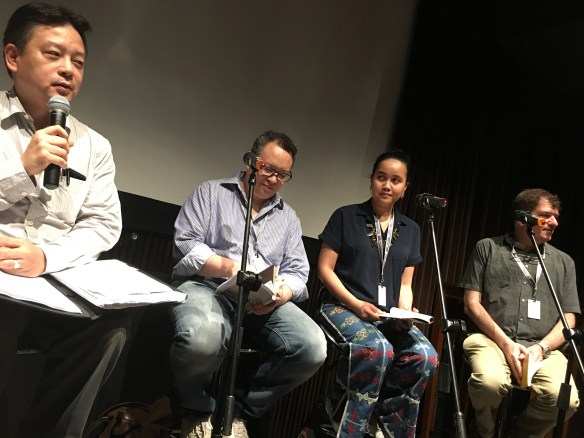
The first session I attended addressed the diasporic element in Singaporean literature—but unlike our exodus of workers and writers to the far reaches of the planet, this diaspora was inbound, and a voluntary one. Moderated by the Filipino expat poet Eric Tinsay Valles, the panel comprised the Eurasian short story writer Jon Gresham, who had come to Singapore via the UK and Australia; the Filipino fictionist and diplomat Cathy Torres, who had moved from her posting in Singapore to Germany; and the American creative nonfiction expert Robin Hemley, who’s married to a Filipina and who now teaches in Singapore.

They discussed how, in the words of Eric, the diaspora could be “a creative space” within which the experience of estrangement could create some positive value. Being away from one’s home, the three agreed, made new impressions and expressions possible. The writer’s struggle to adjust and adapt was in itself the story. Jon spoke about how “It isn’t so much about roots as routes—the journey, the getting there” for the diasporic writer. Adverting to the title story of her debut collection, Mariposa Gang and Other Stories, Cathy observed how “Diasporic stories are like butterflies. They may look alike but no two are truly the same. I try to catch them and send them out into the world.”

But the it was the keynote talk by Farish Noor, a Malaysian political scientist and historian who’s become something of an intellectual rock star in the region, that both charmed and alarmed the packed chamber where the Singaporean parliament used to meet. Dr. Noor introduced his talk thus:

“How a word can have multiple meanings at the same time, and have their meanings change over time, is an interesting mirror to the unfolding of history. This lecture looks at one word in particular, sayang, charting its path of adaptation from pre-colonial and colonial histories to the post-colonial present; and considering how the changes in its meanings and applications—from fables to novels to cinema and pop culture—tells us more about ourselves, like how our own sensibilities and worldviews have evolved, leading to the postmodern present which we inhabit today. The word remains the same, but do we sayang today as our ancestors did?”

Looking back on how concepts of love evolved over time in the region—including love across species in folklore, and love for the colonial master—Farish noted how “Words are what we have left of the past, and the past is far more complicated—more rich, more deep—than the present. Today, in the age of Facebook, ‘love’ has been reduced to clicking a ‘Like’ button.”

During his turn in the chamber, Singapore’s unofficial poet laureate Edwin Thumboo looked back on a lifetime of literature in his country thus: “Young poets no longer write about nation because the nation has been constructed for them. It’s no longer a problem….. It’s so easy now to get published but I don’t think there’s enough revision going on. People are anthologizing like mad. Be patient. Always think you can do better.”

The renowned American critic Marjorie Perloff spoke at the last event I attended, and she closed SWF 2016 for me with a rousing challenge: “Avant-garde poetry has crossed the boundaries between the verbal and the visual, but poetry hasn’t changed in 70 years the way painting and music have. We need another kind of revolution!”

Many thanks again to my hosts and to my SWF friends—it was all sayang and yet no sayang for me this past weekend. In a coming column, I’ll digest two interviews I conducted with Singaporean poet Aaron Lee and our very own Eric Tinsay Valles on what it’s like to be a poet in Singapore.

Penman No. 218: History and Irony

11884866_supreme-court-extends-status-quo-ante-order_e9546b1e_m.jpg

Penman for Monday, September 26, 2016


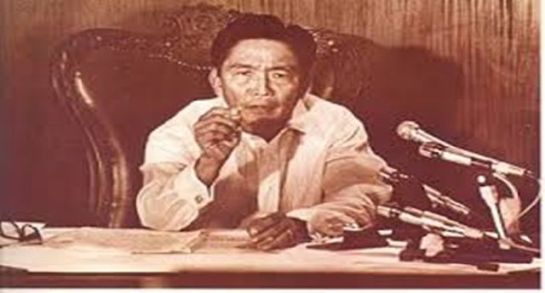
I’D NEVER heard of Ramon Cualoping III and Marco Angelo Cabrera until their names were linked to the recent flap involving the use of no less than the Official Gazette in an apparent effort to sanitize the memory of Ferdinand E. Marcos by removing any reference to martial law—you know, the martial law that Marcos invoked to impose his dictatorial rule on his people from 1972 until he was deposed by a popular revolt in 1986. (Yes, he technically lifted martial law in 1981 but he continued to rule with a rubber-stamp legislature.)

Some Googling revealed that Cualoping was an Ateneo Communication Arts graduate, batch 2004, while Cabrera graduated from San Beda in 2013 and interned briefly with the Department of Foreign Affairs; he had also worked for Sen. Bongbong Marcos. Those are both fine backgrounds for jobs at the Presidential Communications Operations Office—just the kind of posting on which many young writers and lawyers aspiring for a political future have cut their teeth—and I can surmise from the dates provided that Messrs. Cualoping and Cabrera must be in their mid-30s and mid-20s, respectively—too young, therefore, to have personally known what the Gazette expunged.

In the interest of full disclosure, I was a government propagandist myself at an even younger age—19, fresh out of martial law prison. Having dropped out of UP and having worked for the Philippines Herald and Taliba just before martial law, I got a job with the PR section of the National Economic and Development Authority. The irony of going from writing incendiary flyers to trumpeting such new government projects as Pantabangan Dam wasn’t lost on me. But I was getting married and needed a job, and all the old media jobs were gone save for the Express and the Bulletin, so I was thankful for whatever came my way. (I would much later write hundreds of speeches for FVR, among other Presidents and political clients—mostly to pay the rent, occasionally for the sheer privilege—so don’t look at me as some crusading journalist.)

I don’t know what drove Messrs. Cualoping and Cabrera to the Palace; I’m assuming their motives were loftier than mine. I also don’t know what made them officially forget (hey, it’s the Official Gazette, right?) that FM declared martial law. I suspect they knew what happened, but chose to ignore the most salient fact about Marcos’ life, for reasons only they can tell. To his credit, Communications Secretary Martin Andanar effectively reprimanded his staff for the deliberate oversight and corrected the record.

I’ll leave further chastisement of these two gentlemen to the netizens who broke the story. From one PR pro to another, what I can tell them is this: I understand the job you have to do and even your private allegiances, but there are things—very big things much bigger than yourselves—that you just can’t sweep under the rug. Denying martial law or its disastrous effects on our society and economy is like telling Jews that the Holocaust never happened, or was actually a good thing. I salute you for your cheek, but what on earth were you thinking?

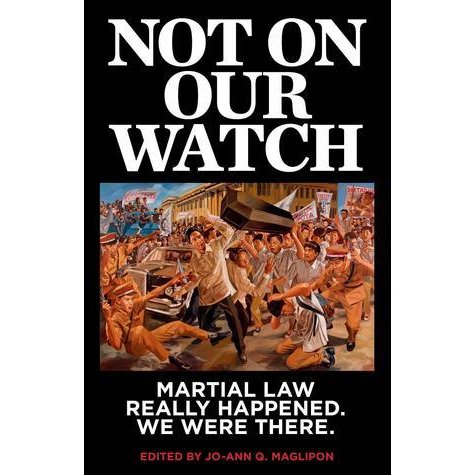
There’s a book I’d like to recommend to these two, one which I and a dozen other writers—all students during martial law—put out four years ago on the 40th anniversary of Proclamation 1081, titled Not on Our Watch: Martial Law Really Happened, We Were There. (For more on that book, see here: http://www.philstar.com/sunday-life/806191/lest-we-forget.) I wasn’t too enamored of the long title at that time, but now I appreciate the emphatic clarity of the thing; it’s just the sort of book martial law amnesiacs and deniers need to read.

16136602._UY475_SS475_.jpg

But even as we review history, there’s one thing that seems to have escaped many: the current debate about how to look at martial law and where to bury Ferdinand Marcos isn’t about the past; it’s about the future, and what kind of people we are and want to be.

I know that millennials tend to get beat up on because they don’t know enough about martial law, which is hardly their fault since we didn’t teach them enough about it. But it isn’t just them. When people my age express bewilderment over how Bongbong Marcos came so close to becoming Vice President despite his dad’s misdeeds, and how the Marcoses have survived so handsomely, I have to remind them that even under martial law, those of us who opposed Marcos were in the distinct minority. Most Filipinos supported martial law, actively or passively, or it wouldn’t have lasted so long. Like the Germans who supported Hitler, most Filipinos stood by while we faced the truncheons and firehoses—and even applauded 1081, early on, as the antidote to Communism (1972’s “war on drugs”). So what should we be so surprised about?

That’s why I’ve never referred to EDSA 1 as a revolution, because it wasn’t one in terms of changing anything fundamental in the structures and workings of our society. It was a popular uprising, a street revolt led by another faction of the ruling class, with broad support from the metropolitan middle class. That doesn’t mean I didn’t feel euphoric that February, and I still get teary-eyed when I remember the moment; I guess the poignancy comes from knowing what came afterward.
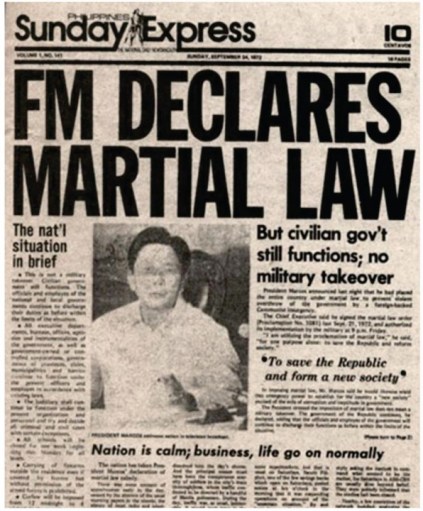
I have no doubt that if the Palace incumbent were to declare martial law today for whatever reason, a majority of Filipinos would support him, although a noisy few of us would be up in arms. Martial law ca. 1972 was also like that, and remained popular for many more years, especially among amoral businessmen who sang its praises until it hit them in the pocket. And then it all went downhill.

Contrary to what you might expect, I don’t see Marcos as a one-eyed ogre, but rather as a calculating Macbeth, keenly aware of his actions and perhaps even troubled by them. In my own turn with revisionism, I’ve even managed to convince myself—as I told the BBC in a recent interview on EDSA (a part which never got aired for lack of time)—that Ferdinand Marcos may have done us a final act of kindness by leaving without ordering a bloodbath. It’s an arguable notion (one I wouldn’t put on the Official Gazette) and it doesn’t change the fact that his regime took what it could until we bled, but as a fictionist and playwright, I like to imagine characters to be more complex than they seem.

A couple of years ago, at a cultural function in Quezon City, Mrs. Marcos preceded me by a few steps down a narrow staircase. She was clearly having a hard time navigating the stairs, and she looked back at me apologetically to say, “Hijo, I’m very sorry I’m keeping you.” I smiled and said, “It’s all right, Ma’am, please take your time.” I felt amused and strangely triumphant.

History is sometimes best seen as a series of comic and tragic ironies, which straight journalism and certainly government tabloids can’t dispense. Come to think of it, who gives a hoot about the Official Gazette? If you want to lie and get away with it, try fiction. I’d be happy to see Messrs. Cualoping and Cabrera in my graduate workshop.


Penman No. 216: From Bali Song to Balisong

IMG_8436.JPGPenman for Monday, September 12, 2016


I’D BEEN meaning to write this up for the past few months, but more pressing subjects kept getting in the way—and “pressing” is the word, because this is about the complete opposite: total relaxation with no fixed schedules or time limits.

It was sometime this past summer when I accompanied my wife Beng and a group of her UP High batchmates on a day trip to Batangas to scout some places as possible sites for their upcoming golden anniversary reunion next February. Beng already had one such place in mind—Cintai Corito’s Garden in Balete, not too far from Lipa, which we had already visited with the family a few months earlier, and had been much impressed by.

Like many Manileños, we’d long been looking for day-trip or weekend alternatives to Tagaytay, especially for bringing our foreign visitors and balikbayan relatives to. Frankly, as a bulalo and ukay-ukay addict, I myself never tire of Tagaytay for a quick break from Manila’s madness. But lately, on our sorties to Mindoro and Romblon via the Batangas ferry, Beng and I have been taking the STAR tollway a lot and have often found ourselves wanting to stop over in one of the many towns on the way.

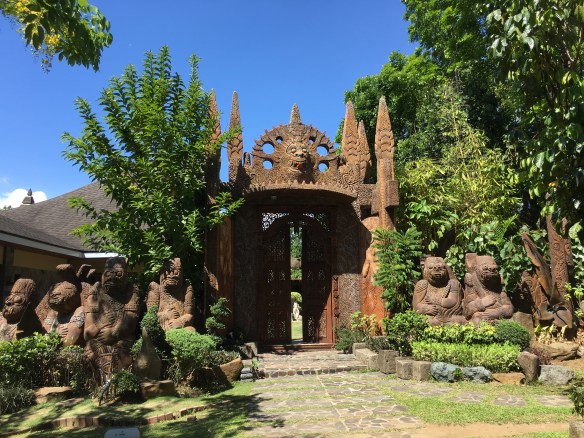
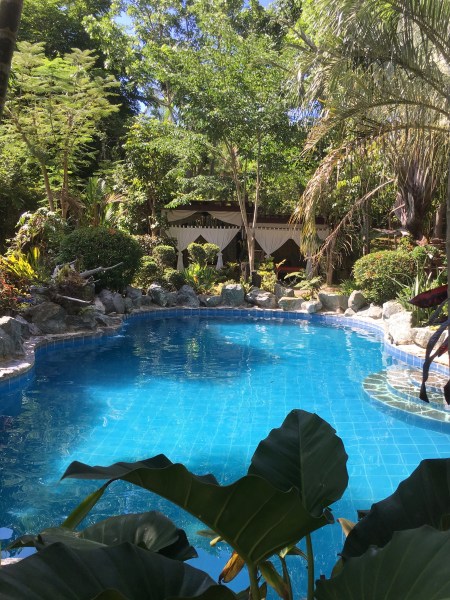
The Balete exit is one those innocuous detours that you’d take only if you really knew where you were going, and the narrow road that you get on leading to Cintai promises little beyond the shops selling honey along the roadside. Cintai itself doesn’t look like much from the outside—until you drive down the winding entranceway. The point of this long prelude is that you’d never imagine such a magical place to arise out of the Batangas countryside—a virtual Balinese-inspired Eden carved out of a rolling landscape that once might have been dotted by coconut and coffee.

Cintai (which means “love” in Bahasa and is pronounced Chin-TAI) is a love offering to the late Corito of the place’s original name, the lady who inspired this outburst of Indonesian exotica in Southern Tagalog. It would be easy to think of the place as a theme park or resort—there are three swimming pools, and you’ll find peacocks, alpacas, roosters, and dwarf horses roaming the grounds—but other such places imply loudness, both literally and architecturally.

IMG_8415.JPG

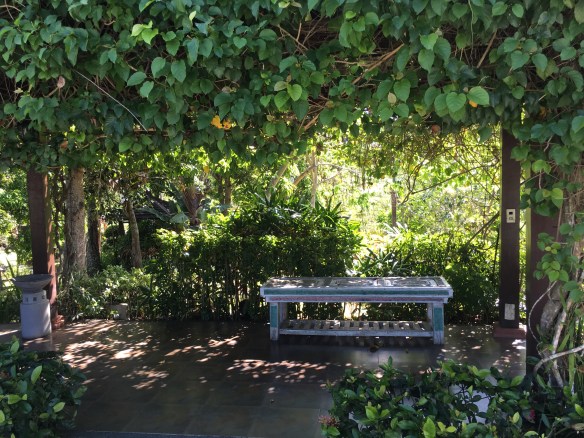
Cintai is anything but loud—visually impressive, for certain, but just on the right side of tastefulness. Given the easy temptation to go over the top, Cintai’s designer wisely decided to make just enough of a statement, but also to take care of the fine details and of their consistent employment, even the patterning of the rocks on the walkways and the Balinese carvings in the bathrooms.

In other words, as in Bali itself (which I had the pleasure of visiting 30 years ago), the appeal of the place is in its soulful serenity. The management could have hyped up the atmosphere by piped-in gamelan music, but they resisted even that, for better effect: the gamelan will tinkle in your mind. (One interesting discovery: the Balinese statues, figures, and accents in the complex were mostly made by Batangueño craftsmen.)

IMG_8784.JPG

The complex comprises 18 villas with variable capacities, two large halls, a spa, and a restaurant, among other facilities (for more details, visit http://coritosgarden.com). Beng and her UP High batchmates plan to have the place to themselves for an overnight stay, an ideal set-up for a big group, but walk-in day trippers are welcome, for a very reasonable rate that includes a sumptuous lunch.

IMG_8419.jpg

And that’s what we did on this scouting trip—tour Cintai and have lunch with its amiable manager Francis Salanguit—but I had another suggestion for the group, which they gamely took up: go a bit farther down the highway to Taal, about a 40-minute drive away, to give everyone (especially the balikbayans) a special treat of history and heritage. I’d also been to Taal before and had visited one of its fabled heritage houses and its cathedral; I wanted to see more. So we set out after lunch and were in Taal shortly after.

The historicity of Taal was immediately apparent in the old Spanish-era houses lining the approach to the town. But what also accentuated (I was going to say “sharpened”) Taal’s uniqueness were the shops hawking a fearsome array of bladed weapons—specifically the balisong, the fan knife of many a boyhood fancy, ranging from the mini to the outsized version. Batangas, of course, and Taal in particular can look back to a proud revolutionary tradition, and the balisong seems to exemplify that don’t-mess-with-me attitude Batangueños are famous for.

IMG_8809.JPG

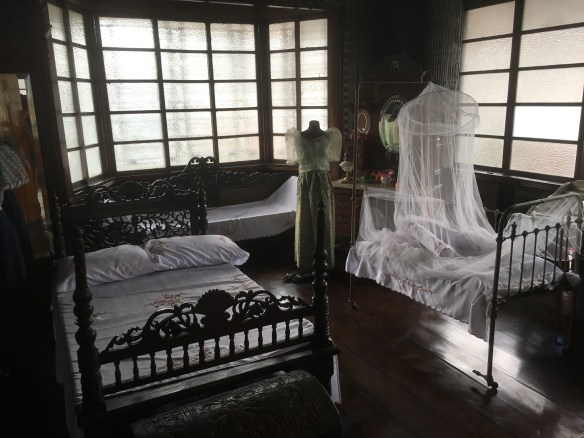
We didn’t stop that day to buy any knives—imagine the alarms they’d trigger if someone forgot about them on the plane ride Stateside—but we pressed on to our main destinations: the Apacible and Agoncillo heritage houses, both of which can be found on Agoncillo Street. I’d seen the Apacible house on my previous visit and had been charmed by its wonderfully preserved furnishings, but I was pleasantly surprised to see how the National Historical Commission, which manages the two historic houses, had taken pains to provide visitors with a more enlightening and rewarding experience.

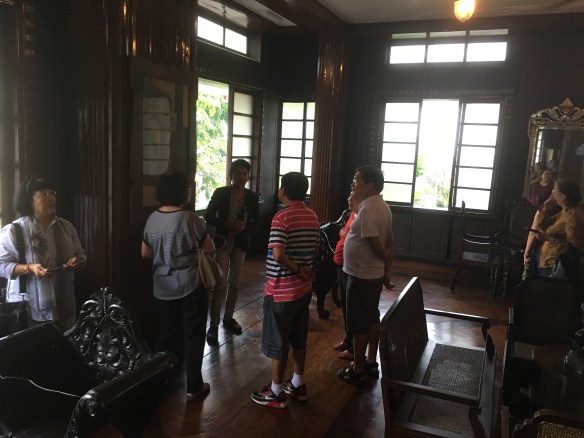
Guests (who may come in for free, but are encouraged to leave a donation) are met and led by a knowledgeable guide; the AV show that introduces the place, its previous owners, and its history was one of the most artistic and professionally produced I’d ever seen. Markers, captions, and child-friendly installations were provided where necessary, and additional information was contributed freely by our young guide. The Apacible brothers—Leon and Galicano—were cousins and confederates of Jose Rizal, who came to their house to talk revolution; Leon was a lawyer and soldier and Galicano a doctor and propagandist, and though less known in the pantheon of Filipino heroes, they come alive in the exhibits that pay due homage to their contributions.

IMG_8812.JPG

The Marcela Marino Agoncillo Museum and Monument a couple of blocks down the street was just as well kept and well introduced with its own AV production (my kudos to Dr. Maris Diokno, whose dual backgrounds as teacher and historian—not to mention her own proud lineage as the descendant of true heroes—can be seen working here to best effect). Marcela was the wife of diplomat Felipe Agoncillo, but came to be known on her own as the co-creator of the first Philippine flag while on exile in Hong Kong.

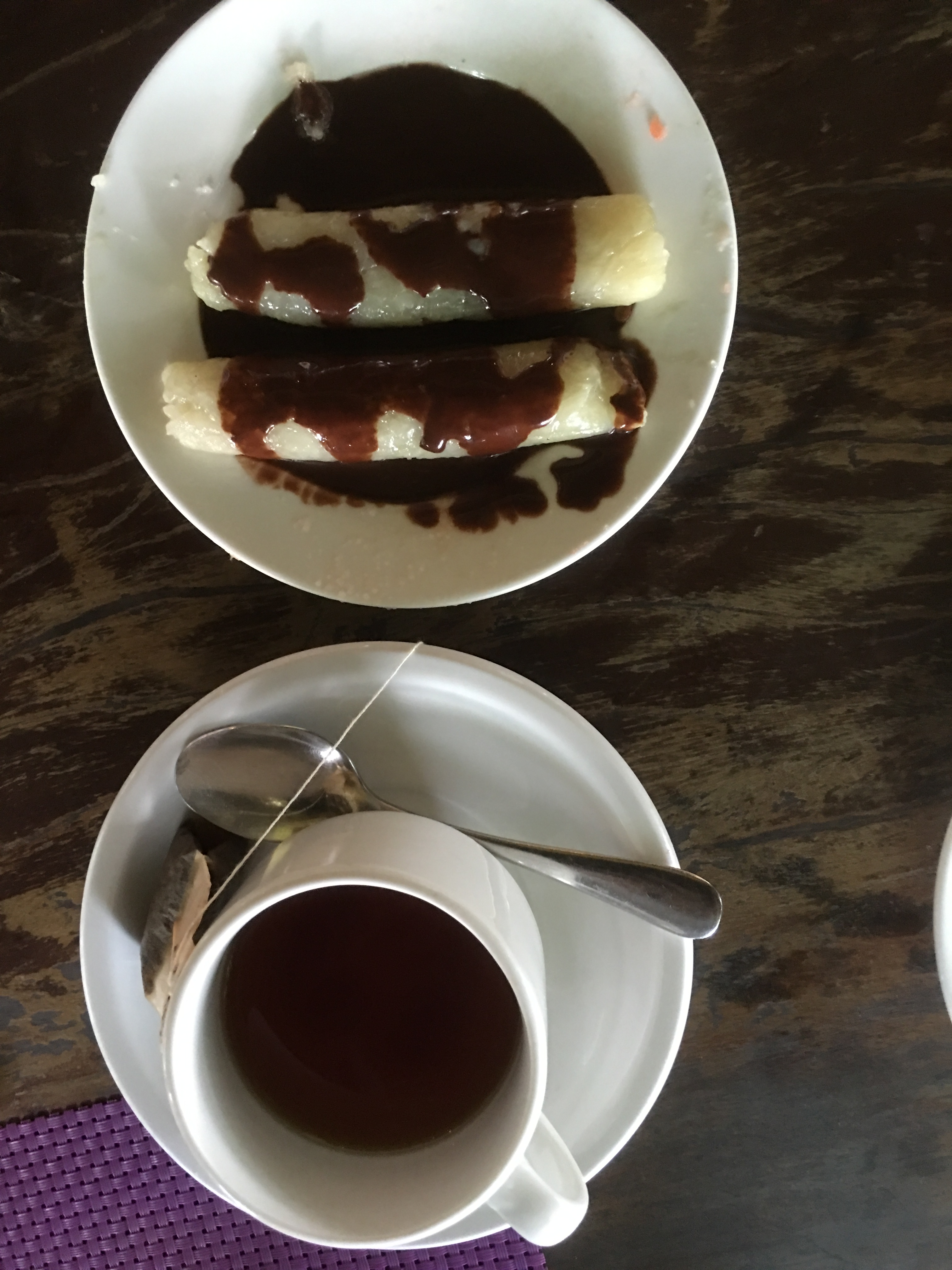
Just as Cintai’s gardens had appealed to the spirit, Taal’s heritage houses touched both heart and mind—and it took just a few mouthfuls of the local suman, washed down with barako coffee, to complete our Batangas experience with a boost to our famished stomachs. I’m not knocking Tagaytay, but one of these days, you just may want to go a little farther down the road and try a bit of the best that Batangas has to offer.

IMG_8802.JPG

Penman No. 200: Memoirs of a Teenage Maoist

e13-644.jpg

Penman for Monday, May 23, 2016


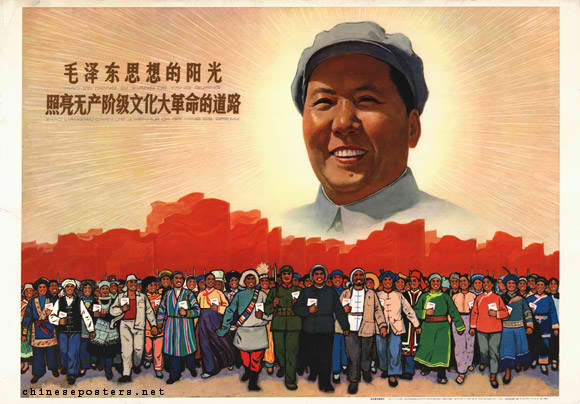
A SMALL item in the foreign news caught my eye last week: a note that the 50th anniversary of China’s Cultural Revolution had gone unnoticed—in China itself, with no parades or ceremonies to mark the historic event. For those of us too young to remember, the Cultural Revolution was launched by Chairman Mao Zedong on May 16, 1966, to consolidate his power and purge his rivals within the Communist Party in the guise of doing away with old ways of thinking. To fight the old, Mao rallied the young—millions of “Red Guards” who turned on their parents, teachers, and superiors, feeling suddenly empowered to reject authority and traditional learning and to see themselves as the vanguards of a new age.

Over the decade that the Cultural Revolution ran its course until Mao’s death in 1976, many millions died—from executions and from famine. While Mao’s legacy would live on, there’s firm consensus both within and outside China that the Cultural Revolution was an unmitigated man-made disaster, something the Party itself in 1981 blamed for “the most serious setback and loss for the Party, the country and the people since the founding of China.”

What did this have to do with us and with me? Well, to put it as simply as I can, I was a teenage Maoist, and for a while back there, I and quite a number of like-minded comrades saw ourselves as the local chapter of the Red Guards. Call it madness, but we saw Mao as a demigod, and looked to his China as a beacon of hope and a model for other countries like ours—also beset by centuries of feudalism and colonial rule—to follow.

How did that happen? I had joined the student activist movement and had gone to my first demonstrations in high school, and as soon as I entered college in 1970, I signed up with the Nationalist Corps. It wasn’t a communist organization, but it was a short step from reading Renato Constantino to reading Mao. Mao’s teachings (in contrast to the heavy-duty theorizing of Marx and Lenin) were attractive in their seeming simplicity, in their pithiness, in their rosy optimism. It was chicken congee for the soul.

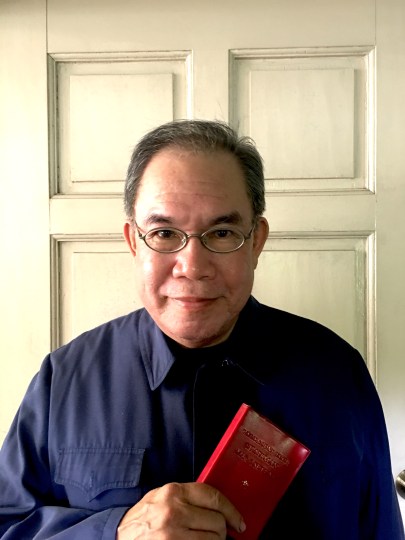
Until today, you’ll hear 60-somethings from my cadre recite gems, chapter and verse, from Mao’s Quotations (better known as the LRB, or the Little Red Book) like “A revolution is not a dinner party, “Political power grows out of the barrel of a gun,” “Dare to struggle, dare to win,” “Wherever there is struggle there is sacrifice, and death is a common occurrence…. All men must die, but death can vary in its significance.” Among my favorites—music to my 17-year-old ears—was “The world is yours, as well as ours, but in the last analysis, it is yours. You young people, full of vigor and vitality, are in the bloom of life, like the sun at eight or nine in the morning. Our hope is placed on you. The world belongs to you.”

It wasn’t too different from what Rizal or the Desiderata said, especially about the youth as the fair hope of the fatherland, but I think what drew us to Mao at that point and to his brand of Marxism was his emphasis on classes and class analysis, his awareness of society as one divided between rich and poor (with the rich collaborating with foreign powers to keep themselves in place), and the fact (or the fantasy) that in China, things were actually going according to the socialist plan. Very few of us had ever been to China then (famously, of course, three senior activists would get stranded there—Eric Baculinao, Chito Sta. Romana, and Jimi FlorCruz), but we accepted it as an article of faith that Chairman Mao was doing right by his own people.

In Manila, we did our best to copy the flag-waving strokes of Peking Opera (eg, “Taking Tiger Mountain by Strategy”), learned about obscure heroes like Norman Bethune, and wore the LRB like a talisman in the breast pockets of our army fatigue jackets. (Procured from US military surplus stores in Dau, it was the closest we could get to the Mao—actually the Sun Yat-sen—jackets that the Red Guards adopted as a uniform, with the red star on the matching cap; but we at least wore genuine “Ho Chi Minh” sandals fashioned out of rubber tires.) At dawn, we tuned our transistor radios to the faint and crackly signal of Radio Peking, for our regular dose of socialist top tunes like the “Internationale,” “Sailing the Seas Depends Upon the Helmsman,” and “The East Is Red”—plus, of course, the daily rundown of the news from the global war on US imperialism. An enterprising fellow even then, I corresponded with a Hong Kong bookseller who seemed only too happy to mail me copies of the Peking Review, even if I had no money to pay him.

Only years later did the failings of Mao’s experiment and the horrors of the Cultural Revolution emerge, revealed not so much by Western propaganda as by the Chinese themselves, who had suffered the most from its excesses. It would take time—and, indeed, a personal visit to China—to appreciate this disconnect between our long-distance romance with Mao’s socialist paradise and cold reality.

It was in July 1987 when I was finally able to set foot on hallowed ground—Tiananmen Square in Beijing, where I was doing a cultural exchange visit along with writer-friends Krip Yuson, Ricky de Ungria, Eric Gamalinda, and Timmy Lim. We had been assigned a translator and a minder, whom we’ll call Chang—a tall wisp of a man who spoke decent English and who was working, he said, on a translation of a biography of Elvis Presley in his spare time. (Had he ever listened to Elvis? No. We sent him a cassette of Elvis from Manila.)

Standing just meters away from Mao’s mausoleum—there seemed to be thousands of Chinese visitors waiting in line to go in—I asked Chang if he could help me see Chairman Mao. “What you want to do that for?” he asked incredulously. “He killed my grandfather in the Cultural Revolution!” Ooops—I tried to say that I was sorry to hear about his angkong, but I had to tell him that I was once a Mao fanboy and just had to meet the man, even his current state of embalmed repose. Chang still didn’t seem ready to believe me, so I sang him the first few lines of the “Helmsman” song: “Sailing the seas depends upon the helmsman, life and growth depend on the sun, rain and dewdrops nourish the crops, making revolution depends on Mao Tsetung Thought!” Chang shushed me up before a crowd could gather: “Okay, okay, I bring you inside, but hurry, okay?”

And so I filed past my fallen idol, awash in conflicting emotions; frankly Mao’s waxen face did little to exude revolutionary vitality, and in just two more years that same square would be bathed in fresh young blood.

I would return to China many times since then as both tourist and writer, and at one point I would chance upon a Mao jacket in a backstreet shop in Shanghai—you’ll never find them in the glitzy stores—and some days I wear it to remind me of what people today will surely say was a youthful folly. Sometimes I’ll stick a most unproletarian Montblanc into the breast pocket, but then again, it’s where the real Chinese revolution led—the freedom to shop for baubles on Nanjing Road.

IMG_8493.jpg

[Image from chineseposters.net]

Penman No. 199: A Bell from Bauang

IMG_3136.JPG

Penman for Monday, April 25, 2016


SANTIAGO “SONNY” Busa is one of the most remarkable people I’ve met. I was introduced to him when I spent some time in Washington, DC on a fellowship a couple of years ago, and from the very first time we sat down for a chat in the backyard of his home in the DC suburb of Annandale, Virginia, we hit it off. He possesses a hilarious, self-deprecating wit, is fascinated by history, and speaks, among other languages, Spanish, Ethiopian and Chinese. Ironically, though born in Eastern Samar—he was practically just a baby when his family moved to the US—Sonny doesn’t speak Filipino (or, we keep joking, pretends not to, so he can listen in on what everyone is saying).

IMG_3148.JPG

A retired diplomat who served as consul general at the American embassy in Manila, among other postings some years ago, Sonny had also been a US Army Ranger and parachutist, and taught International Relations at his alma mater, West Point. For all that, he’s a flaming liberal (like me), doesn’t believe in keeping an armory or packing a .45 to feel masculine or secure, and devotes much of his time to promoting the Philippines and Philippine concerns in America along with his lovely wife Ceres. Last year, he was a key figure in the commemoration of the Bataan Death March in New Mexico, where 5,000 soldiers and civilians marched across the desert for more than 26 miles—and they’ve been doing this for 27 years now!

But Sonny’s recent messages gave me a special reason to smile. He’s been a staunch advocate for the return of the three bells taken as war trophies by American troops from Balangiga, Samar in 1901—two bells remain in a “Trophy Park” in a military base in Wyoming, and another is in a military museum in South Korea. Despite the strenuous efforts of both Filipino and American activists to have those bells returned, it hasn’t happened yet.

As it turns out, the Balangiga bells weren’t alone. In 1899, during the Philippine-American War (which the Americans insisted on calling an “insurgency” for the longest time), a Lieutenant Tom Berry took a bell from the Church of St. Peter and Paul in Bauang, La Union and shipped it to America, where it languished for over three decades in some Army warehouse. In 1933, the same soldier—now General Berry, the superintendent of West Point—had the bell taken out of storage to be displayed at the Catholic chapel of the academy.

Last January, acting on an inquiry from Fr. Ronald Raymund Chan of the Diocese of San Fernando, Lt. Gen. Robert Caslen, Jr.—the current superintendent of West Point and a friend of Sonny’s—wrote Fr. Chan back to say that “The bell currently displayed on the grounds of our Catholic Chapel here is apparently the bell in question. According to our own records, the markings on the bell itself matches all the descriptions you provided. While we have been honored to guard and display this bell for the past several decades, we would be glad to return the bell to its rightful home. We are currently in the process of making arrangements for the return of the bell to your Parish.”

IMG_3179.JPG

Aside presumably from Fr. Chan and the people of Bauang, no one was happier about this outcome than Sonny Busa, who had married Ceres in that chapel in 1977 in a military wedding, and had looked with fondness at the bell every time he visited the academy. He alerted me and some friends about the San Pedro bell last February, but asked us to keep quiet about it for the meanwhile until the return arrangements were finalized, fearing that Americans opposed to the return of any war booty—especially the Balangiga bells—would torpedo the move.

Last month, on the 29th, the send-off finally took place at West Point, with Sonny Busa, Philippine Consul General in New York Mario de Leon, and prominent members of the Filipino community in attendance. Another good friend of Sonny and mine, the Filipino-American historian Sharon Delmendo, stood as both proud witness and photographer. Another special participant was Filipino exchange Cadet Don Dalisay—to whom I would be glad to claim a relation, because Sonny says that he’s at the top of all his classes at West Point.

Dalisay Bell.jpg

In his message to me, Sonny—who had been put in charge of the turnover ceremony—emphasized that Gen. Caslen had “ordered the bell returned to La Union because it belongs in its rightful home. West Point above all stands for high morals in all that it does and teaches and keeping looted war booty is not part of its ethic. The people of La Union are hyper-excited and have already built a display stand. Once the bell arrives it will be big news in the whole of the Philippines as you can imagine.”

That truly is wonderful news, Sonny, and many thanks from your kababayans for your tireless efforts to help right the wrongs of the past and to remind us of our precious heritage.

IMG_3112.JPG

But sadly—as I write this on the eve of one of the most important and contentious elections of our modern history—I fear that too many of us have forgotten how valuable our democracy is, and what artifacts like the San Pedro bell stand for. At war with ourselves and with foreign invaders long gone, we seem far too willing to squander our votes on mindless whimsy and puerile petulance.

I so desperately pray we can prove ourselves deserving of that bell, Sonny. How hollow its ring would be otherwise—a death knell for sanity and decency, rather than the vibrant peal of freedom.

(Photos by Sharon Delmendo and Sonny Busa)

Penman No. 196: A Frenchman in Jalajala

Gironiere1.jpg

Penman for Monday, April 18, 2016


I USUALLY ask my wife Beng to ride out with me on a day trip during the Holy Week break, and this year our destination was rather unusual, in that it never figures in the travel plans of Manileños, although it’s a short and pleasant drive from Quezon City or Ortigas. We took the scenic route from Diliman via Antipolo, Teresa, and Morong, and soon found ourselves following the lakeshore of Laguna de Bay on the peninsula of Jalajala, Rizal, described by the guidebook as “a fourth-class municipality with a population of 30,074 people.”

We were there on the trail of an extraordinary author and adventurer who, nearly two centuries ago, had lived in Jalajala, and had written about his sojourn in a book that had been a favorite of mine for 40 years.

The book was Paul Proust de la Gironiere’s Twenty Years in the Philippines (subsequently expanded under the title of Adventures of a Frenchman in the Philippines), and I had recently acquired a copy on eBay, all the way from the UK—the first English edition published by James and Henry Vizetelly, undated but very likely from 1853, a year ahead of the American edition published by Harper & Bros. in 1854. The copy was far from mint, but it was in its original binding and still very readable, and wonderfully illustrated with engravings of local scenes.

Gironiere2.jpg

Gironiere was an adventurer from France who came to the Philippines in 1819 in his early 20s as a ship’s surgeon and stayed on for the next two decades, establishing himself as a landlord and farmer in what today is Jalajala, Rizal. His travails begin shortly after his arrival on the ship Cultivateur, and his account of a massacre shows why his book is—in that awful word coined by book reviewers—“unputdownable”:

I had only resided a short time at Cavite when that terrible scourge, the cholera, broke out at Manilla, in September, 1820, and quickly ravaged the whole island. Within a few days of its first appearance the epidemic spread rapidly; the Indians succumbed by thousands; at all hours of the day and of the night the streets were crowded with the dead-carts. Next to the fright occasioned by the epidemic, quickly succeeded rage and despair. The Indians said, one to another, that the strangers poisoned the rivers and the fountains, in order to destroy the native population and possess themselves of the Philippines.

On the 9th October, 1820 … a dreadful massacre commenced at Manilla and at Cavite…Almost all the French who resided at Manilla were slain, and their houses pillaged and destroyed. The carnage only ceased when there were no longer any victims. 

…Four hundred Indians surrounded me; the only way of dealing with them was by audacity. I said in Tagaloc to the Indian who had attempted to stab the captain: “You are a scoundrel.” The Indian sprang towards me; he raised his arm: I struck him on the head with a cane which I held in my hand; he waited in astonishment for a moment, and then returned towards his companions to excite them. Daggers were drawn on every side; the crowd formed a circle around me, which gradually concentrated. Mysterious influence of the white man over his coloured brother! Of all these four hundred Indians, not one dared attack me the first; they all wished to strike together. Suddenly a native soldier, armed with a musket, broke through the crowd; he struck down my adversary, took away his dagger, and holding his musket by the bayonet end, he swung it round and round his head, thus enlarging the circle at first, and then dispersing a portion of my enemies. “Fly, sir!” said my liberator; “now that I am here, no one will touch a hair of your head.” In fact the crowd divided, and left me a free passage. I was saved, without knowing by whom, or for what reason, until the native soldier called after me: “You attended my wife who was sick, and you never asked payment of me. I now settle my debt.”

I had first read the book a long time ago, and kept my copy of Adventures, in a Filipiniana Book Guild edition reprinted locally in paperback by Burke-Miailhe in 1972, with a foreword by the eminent historian and economist Benito J. Legarda. In his foreword, Dr. Legarda says that Gironiere’s book was “probably the best seller among books about the Philippines in the 19th century,” noting that “What attracted the 19th century reader was of course the narration of several adventures, at that time considered unusual or bizarre. Among them may be enumerated the killing of man-eating crocodiles, the hunting of wild carabaos, the exploration of caves, the customs of pagan tribes, and the adventures of those caught in captivity by Moro pirates.”

IMG_8257.jpg

While granting that Gironiere’s accounts may have taken certain fanciful liberties, Legarda also considers the many real contributions the Frenchman made to his adopted soil, particularly as an agricultural pioneer who planted coffee, abaca, indigo, and rice on his 2,400-hectare estate in Jalajala, then part of Morong. Of Jalajala, Gironiere would write that it was “the greatest game preserve in the island: wild boars, deer, buffaloes, fowls, quail, snipe, pigeons of fifteen or twenty different varieties, parrots in short all sorts of birds abound in them.”

Gironiere returned to France in 1839, crushed by the deaths of his son, daughter, and wife, and he eventually remarried, and yet nothing, he said, “could induce me to forget my Indians, Jala-Jala, and my solitary excursions in the virgin forests. The society of men reared in extreme civilisation could not efface from my memory my past modest life.”

IMG_8124

Was there anything left of Gironiere’s vast estate? All I could find on the Internet was a marker put up by the National Historical Institute in 1978 on what presumably had been his property, so I resolved to find at least that. We were there on the Wednesday of Holy Week, so I knew I had to catch someone at the municipio before it closed for the half-day, and fortunately a kind gentleman from the agriculturist’s office recognized the marker and offered to lead us there. And a short drive later, there it was, on a lot in the shade of towering acacia trees.

Nothing else would have suggested Gironiere’s presence, except possibly a stump of bricks in a corner of the lot. Not too far away was the water’s edge, and the slim profile of Talim Island, which Gironiere would have seen out his window. I struggled to imagine this spot as the center of a visiting Frenchman’s adopted life and holdings, his pursuit of bats and lizards, crocodiles and gold dust.

I didn’t feel let down; I was looking at an empty stage, but I knew the play, and I could hear the lead actor’s parting words: “Overwhelmed by the weight of troubles and of the laborious works I had executed, there was only one wish to excite me, and that was, to see France again; and yet my recollections took me continually back to Jala-Jala. Poor little corner of the globe… where my best years were spent in a life of labour, of emotions, of happiness, and of bitterness! Poor Indians! who loved me so much! I was never to see you again! We were soon to be separated by the immensity of the ocean.”