Penman No. 185: Wired for Fun

IMG_7932.jpg

Penman for Monday, February 1, 2016


SOME INTERESTING changes took place in my home-office environment over the recent Christmas break. First, as a gift to the household, especially my movie-loving mom, I got a multi-user subscription to Netflix. Second, because of Netflix, I signed up with a lifetime Virtual Private Network (VPN) service, which, among other benefits, allows users to watch US-based offerings (like Netflix, which very recently opened a limited Philippine operation, largely dispensing with the need for VPN). Third and perhaps most importantly for the long run, I ramped up our Internet connection, from the old 5 Mbps to a whopping 100 Mbps fiber-optic line that had just become available in our Diliman neighborhood. The setup then prompted me to acquire an Apple TV unit, which streams Netflix shows, among others, from the Internet to your HDTV set, completing the home-movie experience (well, throw in some popcorn and Coke for the full effect).

If you’re not too tech-savvy and if I’ve left you hopelessly confused by that exasperatingly jargon-laden paragraph, let me unpack it for you, as I’d explain it to someone like my mom. (I should add that my mother is unlike most 87-year-olds. She doesn’t have a computer, but she’s otherwise glued to four devices—her TV, her iPhone, her iPad, and her Android tablet. She loves playing vocabulary and bubble-type games, which keep her brain cells humming, on top of the 20-minute walk she takes every afternoon.)

“Home office” refers to the fact that over the past three decades, with the rise of the Internet and indeed its indispensability to modern living, more people have been able to work at home, or to bring much of their work home. I teach at the university, but most of my writing is done at home. My wife Beng also has her art-restoration studio at home. This means that we have to invest in equipment and technology that will allow us to get our work done, and done well, right where we are.

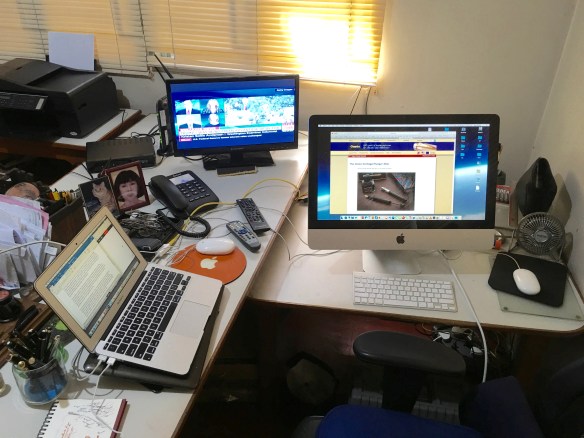
For me, that means several computers—I use a small MacBook Air as my main workhorse, portable but powerful, with a very fast processor and a large hard drive; for a backup, I have an older, larger MacBook Air, a bit slower, but good to have around just in case the main machine falters or is in repair; I also keep an iMac on another desk for when I need to see larger images, or to have fun surfing (or playing online poker) while I work. Yet another screen is almost always open at my desk: a tabletop TV, on which I keep up with the news.

All that hardware would be of little use without a fast and reliable Internet connection, and here I was lucky to be living in an area now covered by PLDTFibr, which ran a promo over the Christmas break offering a 100 Mbps service for six months (it’ll slide back down to 50 after six months, but you can’t sneeze at 50 Mbps either—and no, I’m not getting anything from the company for this plug, not even a coffee mug).

What does “100 Mbps” mean for the consumer? Webpages load in a snap, instead of crawling down the screen as some circular icon keeps spinning; you can download a 1-gigabyte software update in minutes rather than hours or overnight, as I used to be resigned to; and you can upload large files, say to DropBox or YouTube, without having to knit a doily while it loads. Is it expensive? It cost me only P500 more to level up from my old 5 Mbps service from another provider, which I had been a faithful client of for over ten years.

The best beneficiary of a fast Internet connection, however, is streaming, which is the way those who sell movies and music, like the iTunes Store and Netflix send you their material over the air—in one continuous flow, like you were watching a movie at the theater. But that’s more hopeful than achieved for most Pinoy consumers, because, as of a year ago, the Philippines had the third-slowest average Internet speed, at about 2.8 Mbps, in Asia, according to the folks at Akamai, who keep tabs on these things (No. 1 Korea averages 23.6 Mbps).

That means that your screen will very likely freeze just when things get really interesting in the movie, as your provider struggles to bring up the rest, like those guys who ran reels between theaters in the old days. (Lilia Ramos Shahani wrote a great piece on this for the Star, “Why Is Our Internet So Slow?” last August.)

And there’s nothing better to do with streaming than watch movies and TV shows from where they’re stored—the servers of US-based Netflix, for example, which we used to be able to access only through VPN. (Netflix didn’t want people in countries it didn’t serve—like the Philippines, until recently—to see Netflix shows. The Internet being what it is, some smart folks found a workaround, VPN, which tricks the Internet into thinking that you’re in Tampa, Florida instead of Tuguegarao, Cagayan.) There’s been a lot of argument over whether VPN-enabled Netflix is illegal, but it isn’t piracy—you still pay for Netflix, but are simply diverting its stream to your barong-barong. (I pay about $12 or less than P600 a month for a four-user license.)

That argument is now moot, as Netflix has officially added the Philippines to its serviced countries, albeit with a thinner menu; you’d still need to turn on your VPN to get the full US package (Netflix, however, has rethought its toleration of VPN, so that option might not last. I’m not too bothered, as I value VPN more for the PBS documentaries I like to watch on my iPhone in some traffic jam or over long, boring meetings. VPN is also good for your digital security, masking your real IP address from snoopers.)

The piece de resistance in this upgraded setup is the Apple TV, a small black box that uses wi-fi and your TV’s HDMI port to let you enjoy Netflix, YouTube, and other Internet video—even your own library of movies, music, and photos—on your big TV, instead of squinting at them on your phone or laptop. It isn’t cheap—the gadget costs a bit less than P9,000 for the basic fourth-generation model—but there are alternatives. Chromecast, a thumb-sized thingy made by Google and marketed by Globe for about P2,000, will hook you up to Google Play Movies, YouTube, Spotify, and other entertainment fare.

I’ll admit, it’s hard to think of work when you’re this wired for fun, but you can also say that this what makes all that work worth it—digital Disneyland at the click of a remote-control button.



Penman No. 148: Why I’m Not on Facebook

Penman for Monday, May 11, 2015

FOR THE umpteenth time, last week, another person asked me, with profound astonishment, why I wasn’t on Facebook. I told him that, in my seniorhood, I wanted to lead a quiet and peaceful life, and that Facebook was antithetical to that ambition.

From what I hear, Facebook is this century’s Colosseum, and that a fracas on Facebook can be far more entertaining than the event in real life. I knew that it had been a busy week, to say the least, on that website (or, I should say, in those millions of websites). There was that “literary tempest” that my fellow STAR columnist Scott Garceau adverted to in a recent piece, the Pacquiao-Mayweather fight, and the Save-Mary-Jane-Veloso movement, among other contentious causes.

I learned about these things not because I’m on Facebook, but because my wife Beng is. She’s up in bed before me every morning, pecking away at her iPhone in the gathering light, responding to the planetary call for “likes” and “tags” and “status updates” and whatever else goes on in the FB universe. When she senses me stirring awake, she gives me the lowdown on the state of the world, leaving the less interesting and less important matters to CNN and the BBC.

That world would be much happier and more peaceful if more of humanity were like my bedmate, but it’s not. “Avoid loud and aggressive persons, for they are vexatious to the spirit,” counsels the albeit apocryphally attributed Desiderata—which is as good as saying, avoid Facebook, for it is the Republic of Vexation, the domain of loud and aggressive persons who would like nothing better than to get a rise out of you and spoil your day.

Of course I’m told it also exists for friendship and global harmony—the spirit in which Beng and some of her friends upload quotations from the Dalai Lama and such peaceable people—but I’m convinced that they’re in the distinct minority, for which a separate Facebook might as well exist. While we’re at it, let’s do a bit of taxonomy and map out the possible sub-Facebook realms out there, the establishment of which could lead to a more tolerable era of co-existence all around.

Facebook Lambs (or should that be Facebook Koi, for a more Asian touch?) could include everyone like Beng—the tree-huggers, the lifesavers, the Kumbaya singers, the people who will find goodness in the worst of places. Easy to please, they’re also easy to hurt, and when they hurt, they bleed.

Facebook Monkeys do what monkeys do: screech and thump their chests a lot, to say: “Look at me and at what I’m doing! Am having XXX brand of cornflakes and YYY brand of yogurt for breakfast, folks, and here’s five pics to prove it! Isn’t that interesting???”

Facebook Vipers do what vipers do: strike and bite at anything that moves, especially anything that gets within a whisker of their precious scales. Some days I imagine Facebook brimming with reptilian malice, filling me as well with illiquid emotions, until Beng pulls me over to show a child singing a heavenly carol on her FB page.

So why do I shun FB? (I’ve been told, by the way, that there’s a “Butch Dalisay” FB page, but I have nothing to do with it, and have no idea what it contains.) I’ve been asked this question many times before, and my serious and rather ironic answer has always been that I can’t abide using the word “friend” for people who really aren’t that. I do believe that one of the worst things that Facebook has done to language and to human relationships has been to cheapen the meaning of “friend” and, corollarily, introducing the notion of “unfriending” someone with a keypress, just like that.

I still prefer to make my friends over coffee, on a bus or a boat trip, laughing at the same silly movie, pulling for the same desperate cause, arguing the merits and demerits of some poem or passage of prose. And when you stop being my friend, I won’t even waste a sliver of bandwidth on it; a cosmic silence is all you’ll get (although my deepest friendships can endure years of stasis).

I said “ironic,” because it’s a bit odd that I find myself arguing for more human contact when, at this stage of my life, I actually want and seek less of it for myself. I’m not misanthropic, but I feel happy to keep company with just a very few people I can trust and relax with, mainly family. I hardly attend parties or big social events unless required to do so by work or inescapable obligation. I dread making and taking phone calls, especially any call beyond three minutes. (You’ll best get a response from me by email.)

But never mind me; I do recognize Facebook’s matchless utility for most people. I know that serendipitous connections can be made online that would have been impossible otherwise, and if you’re tracking down that crush you last saw in the 1970s—or 50 pounds in the blissful past—there’s nothing like FB to make that happen. Like a loaded gun, Facebook all by itself isn’t evil; it’s people who are, or can be, and FB is just another enabler of the dark side, as well as of its sunnier converse.

So it’s not even the malice I’m evading, because you’ll find that elsewhere anyway, or perhaps I should say, it’ll find you. It’s more likely the way Facebook—in all its goodness and badness, for better or for worse—can take over people’s lives, basically by engrossing them in the issues of the day (as in this hour, this minute) rather than troubling them with historical hindsight and such corn. (And who needs a lengthy editorial and well-considered opinion when you can offer up your precious gut feelings, along with your barangay’s, as a workable and certainly more credible substitute?)

There’s a facebookhaters.com, but I don’t see myself signing up with those folks. Facebookhaters.com is completely serious but unironic—I can just see it devising and promoting a 12-step withdrawal program—which isn’t the way to grapple with a hyper-sophisticated Hydra like FB.

I can’t and don’t actively hate Facebook, knowing how vital it is to the lives of millions; what would I do with Beng all those hours she won’t be on FB? As it is, I can play poker all night, knowing she’ll never be alone and idle, as long as she has her phone (a tip for spouses—get your mate an unlimited data connection, and you’ll never have to babysit them again). That’s one thing to thank FB for.

Penman No. 100: The Digital Tourist (1)

L1090980Penman for Monday, June 9, 2014


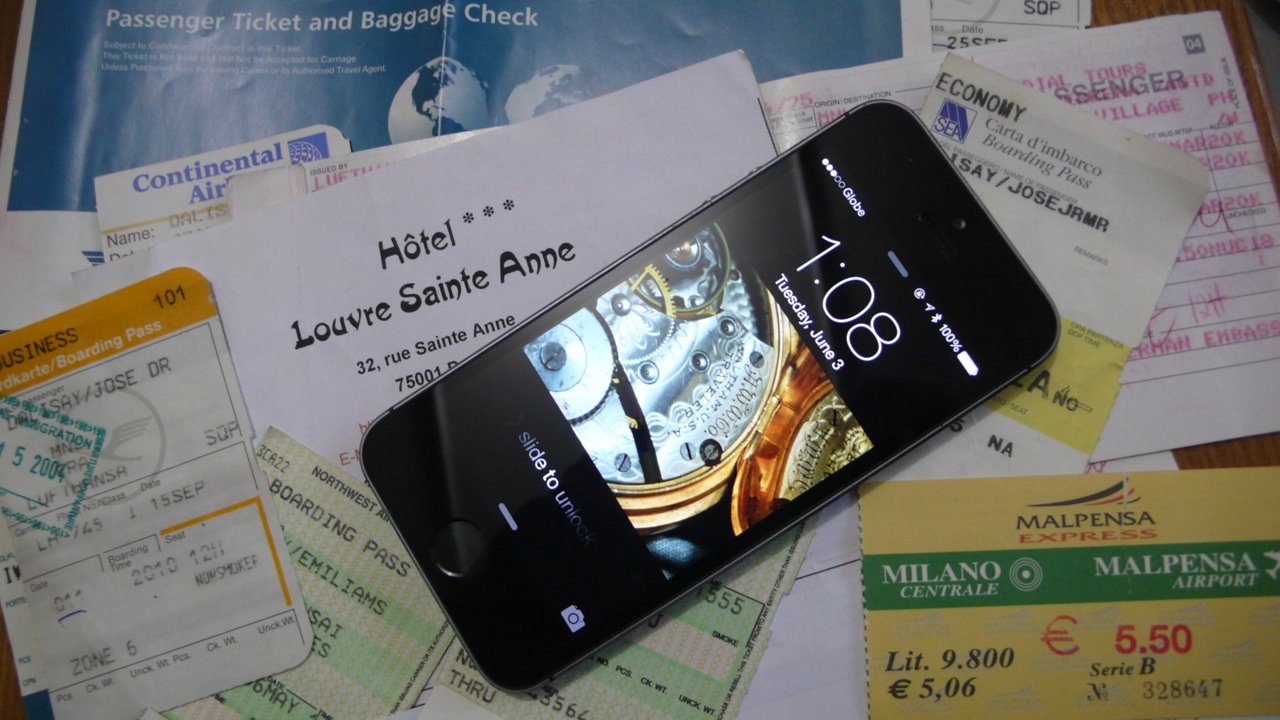
SOME FRIENDS who perhaps still miss the days when you dressed up for plane flights (even if it was only to Hong Kong) and carried your paper ticket in a cardboard sleeve asked me upon our recent return from Europe to draw up a digital roadmap for tourists. In other words, what kind of digital resources can tourists and travelers avail themselves of to ensure better, cheaper, and safer travel? By “digital resources,” we mean things that you can find online on the Internet, like hotels and their rates, or carry around with you on your mobile phone or laptop, like travel apps that can record and remind you of your bookings.

It used to be that all you needed in your carry-on was an alarm clock, the kind with two brass bells that roused you like your mother from your jetlagged slumber (if you remembered to set the alarm the night before). But now we travel with smartphones, laptops, tablets, and a raft of batteries, chargers, and adapters, the better to maintain that indispensable virtue, connectivity, also known as your digital tether to home, office, and social network. (All this should make us want to ask why we even left home and what a vacation is supposed to mean, but as everyone knows all too well these days, leaving home means bringing as much of it with you.)

So herewith, some of my favorite digital-travel tips and tricks:

Where to go. While our destinations are often chosen for us (a conference here, a wedding there), sometimes we actually have that rare and precious option of deciding where to go, budgets and schedules permitting. Everyone will have his or her own bucket list—I’d still like to visit South America, Scandinavia, and Eastern Europe someday—but Beng and I prefer to go around Asia for quick, cheap holidays, and are always on the lookout for special deals from regional airlines. Sign up with Cebu Pacific and Philippine Airlines, among others, for regular advisories on their packages. This way, we’ve visited Beijing, Kota Kinabalu, Hanoi, Shanghai and many other places nearby at giveaway fares (about P5,000 round-trip, all-in, for two of us to Beijing). Be open and adventurous, and be ready to book a trip months in advance to get the lowest fares. That also allows you to reconfigure your calendar around those trips.

How to get there. Again, check out airline offers, as well as travel agency packages. Make sure to factor in taxes and surcharges, which can bloat the final bill. What you want to get is the “all-in” price. Factor in baggage allowance; some airlines will charge you even for your first checked bag, especially on local flights. Budget airlines can offer aggressively low fares, especially off-season (that’s why we went to Beijing in December—freezing, but fewer fellow tourists to nudge you around), but it won’t hurt to check as many rates as you can. There are many online guides where you can check prices and book flights—Expedia, Orbitz, Travelocity, etc.—but I use SkyScanner (skyscanner.com.ph) a lot; it gives you the price in pesos, and immediately identifies the lowest price, with many other options. Sometimes it’s also good to check directly with the airline; recently, I found that Air France, on its own website, was offering a flight from Paris to Madrid that was lower than anyone else’s. Also, sometimes, cheapest may not always be the best for you. Cebu Pacific has great regional fares, but they often mean arriving in your destination around midnight, costing you a day and some anxiety in a strange airport. Adding a little more could also mean extras like a better plane and a better layover (we chose to fly BA to Madrid and back via Heathrow, to try out the new A380 and even marginally revisit London, one of our favorite cities). For local travel, don’t forget to explore your train and bus options—ground travel may be slower and not always cheaper, but you’ll see a lot more of the country.

Where to stay. Beng and I are lucky to get special rates from the Starwood chain (Westin, Sheraton, Le Meridien, etc.) because our daughter works there, but when we have to find other hotels, then TripAdvisor and Booking.com are our best friends. As a rule, I never book a hotel (even a Starwood one) without checking the TripAdvisor reviews, which can reveal problems like “great hotel, but terrible location” or uncover pluses like “free, strong wi-fi, two minutes’ walk from the Metro.” TripAdvisor can rank hotels according to your budget and other preferences, assigning one to five stars. Once, on a lark, Beng and I decided to go slumming in Hong Kong and stay in the cheapest dive we could find, so I reversed TripAdvisor’s rankings and found a one-star place on Nathan Road. It was cheap—and fun; we survived! Booking.com is another great guide to hotels and bed-and-breakfast places; they allow you to book often without any downpayment, cancellable without penalty within 24 hours of your stay. I booked our Venice hotel in Mestre and our Madrid airport hotel on this site. (A tip about Venice and Mestre—hotels in prime tourist spots like Venice can cost a fortune, but staying in places like Mestre, a very short train ride from Venice, can save you precious euros better spent on food and sightseeing.)

What to do. Every destination will have scores of travel guides online, but again, TripAdvisor’s thousands of reviews will give you a good sense of what’s worth visiting and what you can forego, especially on a tight budget and schedule (we passed up going to Halong Bay in Vietnam—pretty pictures, but a very pricey day trip). Like I wrote in a recent column, this is where we often let Serendipity take us by the hand and just let one streetcorner lead to another. Unlike many others, travel for us isn’t racking up a series of posed shots before famous landmarks; it’s about seeing what most other people will miss, or doing what most other tourists won’t. I don’t necessarily mean “going native,” which no one can honestly do on a three-day parachute tour, but finding or straying into unusual places, like that dusty, forgotten museum in Shanghai filled with dinosaurs and ancient, mummified Aryans, or that bookshop in Hanoi selling bright purple ink for 20 pesos a bottle.

Before I forget, and even before you begin your digital tour, scan, save, and upload (to one of your own email accounts) copies of your passport, visas, and travel insurance. (Yes, you can and should book travel insurance online—it’s one of those things you’ll be happy to never need.)

Next time, I’ll list and discuss specific apps—WorldMate, Metro, and FlightBoard, among others—and other tools (maps, photos, currency exchange) to help make that next trip of yours a more pleasant and fulfilling experience—as long as you don’t lose your tablet or smartphone.

Penman No. 32: Ten Tips for the eBay Newbie

ebayPenman for Monday, February 4, 2013

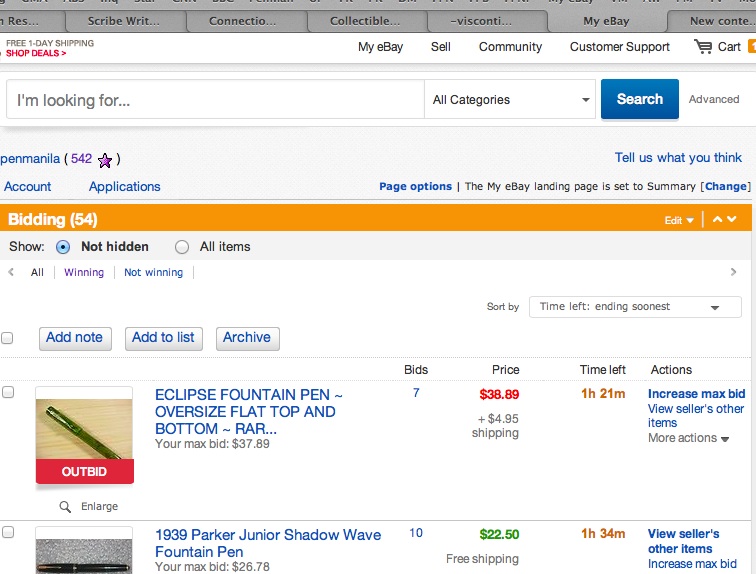
BEEN LOOKING for a DVD copy of the 1973 Hollywood musical Lost Horizon, a 1954 Omega Seamaster, a pair of Johnny Depp’s Moscot Lemtosh shades, an 11200-mAh power bank for your iPhone, or a 1988 Stipula Baracca limited-edition fountain pen? Well, I have—and I found them all, not in my neighborhood mall or ukay-ukay, but in that largest of global marketplaces, eBay.

I’ve been buying and occasionally selling on eBay almost from the very beginning, since December 1997, and now have a feedback of 520+ (thankfully 100 percent positive). In all those hundreds of transactions, I’ve had maybe three or four bum cases of sellers not delivering, or sending me bad stuff. All of those cases were sorted out and I was refunded, so I do believe eBay to be a generally safe place to shop, with lots of wonderful bargains to be had, but as with any marketplace physical or digital, it can be tricky for the unwary.

I thought of writing up this brief guide to shopping on eBay because, thanks to my recent articles featuring fountain pens, papers, and inks, I’ve been deluged with inquiries about where to find these items and for how much. In particular, vintage and premium pens seem to be in great demand—pens like the Montblanc 149 and 146, the Parker Duofold, Parker Vacumatic, and Parker 75, and 1920s Waterman pens with flexible nibs.

I’ve sold quite a few of these pens myself, having made a pledge (a pitifully weak one) to trim down my collection of about 200 pens by half. My recent acquisitions have tended to be more expensive, so to help assuage my wallet and my conscience, I’ve had to dispose some of my loot, if only to make room for more. That means that I have to find a steady and reliable source for pens both to resell and to keep, and that can only be eBay—where, at any given moment, there will be about 40,000 pens of all kinds to compete for my attention and my credit card.

So I’ve been telling my pen-seeking friends that they could save themselves a chunk of change by bypassing me and going straight to the source—where a slightly used Montblanc 149 (which sells new on Amazon for $810) might go for around $400. But I’ve also warned them that it’s going to be a slippery slope, fraught with dangers and risks—not to mention the biggest risk of all, which is to get infected with eBay shopaholia.

Even if you care nothing about pens, there are literally a million more things to be found on eBay.com and on its local site, eBay.ph—everything from a mummified monkey’s paw (which you can buy without bidding for $13.00) and an 1864 autograph of Abraham Lincoln (bidding starts at $4,995.00) to a 2012 Lamborghini Aventador (yours for $469,991.00). Very likely, they’ll be things you don’t need but will soon want—and want badly, so mind the following tips if you plan on shopping on eBay without risking your children’s inheritance or your marriage. I’m going to use pens to illustrate my points, but these tips can apply as well to cameras, shoes, bags, bikes, or whatever floats your boat.

1. Know what you’re looking for—know the product and its current market value. Do some research beforehand and establish what possible issues there might be with the item. For example, if you’re looking for a Montblanc, understand that vintage celluloid ones in good shape could command more than new ones in “precious resin”—but also that the 149 and 146 are the most faked pens in the world (along with the Parker Sonnet); eBay actually has a guide to determining fake MBs (which means, know your way around eBay as well). EBay’s “completed listings” is a great way to determine market value—look for the median price (discard lowest and highest prices) for a better sense of what you can expect to pay. Check other websites (Amazon, BestBuy, etc.) as well, because their special deals and offers could undercut eBay. I do most of my gadget shopping, for example, on dealmac.com.

2. Condition, condition, condition. In your enthusiasm for an item, you might forget to probe its condition. Read the description very well and look out for any flaws. Especially scrutinize all the pictures. (This also allows me to spot special features that others might miss—a broad stub on a nib, for example). I think I know pens well enough that I can tell make, model, year, and approximate value for most major brands on sight, but every pen is still unique once it’s up for sale. Keep an eye out for cracks, glue, broken tines, mismatched caps and barrels, discoloration, etc.

3. Set up a PayPal account. It will make your life a whole lot easier on the Internet, since PayPal has become a global standard for electronic payments. I’ve tied my PayPal to a specific bank account I use only for eBay transactions. Is it safe? Of course you’ll hear a horror story here and there, but in my own experience, eBay and PayPal have served me very well, settling questions and disputes and sending refunds very quickly in the rare cases of non-delivery I’ve encountered.

4. Keep looking. Since I now buy and sell pens, I check out eBay many times a day—I have it on my phone—and have set up search terms for my favorite items, like Parker Vacumatics. This enables me to find what I like quickly, in a marketplace where millions of items are up for sale at any given moment. Some of my best bargains have come when buyers in the US—my chief competitors—are literally asleep. I also check out ebay.uk and ebay.ca (the UK and Canada) and have found some of my best bargains there. The first thing I check is “newly listed”, further narrowed down to “buy it now”—this way I can catch the real bargains before anyone else does. Then I check “ending soonest.” You can also refine your searches, for example by looking just for “149” under “Montblanc” under “fountain pens.”

5. Check the seller’s feedback. I’d be wary of a seller with less than 95% positive feedback. He or she may not be a cheat, but has a poor service record (delayed mailings, no response, etc.)

6. Establish your bidding threshold early on. Don’t get caught in a bidding war with another bidder. These days, since I could be bidding on 20 items at any given moment (expecting to win maybe two or three), I just bid my maximum and forget about it until the last two minutes, which are really all that matters on eBay. Some people use sniping programs that let the computer make a last-second automated bid for them; I should, but have been too lazy to set one up, and I rather like the excitement of making the last-minute bid myself.

7. Figure out and factor in your shipping options. Since most of my purchases are made in the US, I use a US shipping address (my sister’s in Virginia) and aggregate my purchases there. When I’ve gathered a boxful, I ask my sister to ship them to Johnny Air Cargo in NYC, which forwards them to me in Manila a week later. I’m sure many of you have US relatives who can do this for you (just make sure that they’re willing—be very nice to them at Christmas). I’ve educated my sister on pens so she’ll know how to check out a pen when it arrives and how to handle and package them properly; and yes, I’ve given her a nice pen or two.

8. Pay promptly, and leave feedback. You’ll see how your own feedback will improve once you become a good eBay netizen.

9. If and when you encounter a problem, report it to eBay. They have mechanisms for dealing with problems like getting a defective item (unless it was so described) or not receiving an item you paid for at all. Take note that there’s a time window (45 days, I believe) within which complaints can be filed.

10. Don’t lose hope. I’ve lost out on bids for items that I’d coveted for years, but then found another one a week later, for cheaper. If you can’t find it on eBay, it probably doesn’t exist, or is illegal to own. For me, it’s fountain pen paradise, and another reason to wake up in the morning for.

Flashback No. 3: The Anti-Rant Rant

Penman for Monday, August 6, 2007 

(This went viral when I first came out with it five years ago, and I’m republishing it here to show that, hey, we haven’t changed one bit!)

IT COULD be that I’m just getting old, but lately I’ve been dismayed and depressed by the state of manners on the Internet. I help moderate a message board (www.philmug.ph) that now has over 9,000 members, and I’m a member myself of several more such virtual hangouts devoted to everything from electronic gadgets like iPods and Palm PDAs to fountain pens and heritage conservation. (The one thing I avoid, perhaps surprisingly, is any public forum made up of writers and wannabe writers, for reasons you’ll find shortly.)

Our Apple users and fans club (that’s basically what it is) has been a generally pleasant and helpful group, ever ready to dispense free and quick advice about everything from the difference between SATA and PATA drives and between FireWire 400 and USB 2.0 (and, of course, between Mac OS X and Windows Whatever). But some weeks on the board can be more vexatious than others, and last week was one of those, with an inordinate number of people, it seemed to me, venting their assorted resentments, rages, and anxieties, caring little if their rants produced or provoked similarly negative vibes in others.

Never mind what those specific issues were; they matter little to anyone but geeks. It wasn’t the questions or issues that disturbed me so much as the way they were raised and pursued—often with undisguised meanness, if not malice aforethought, and with no concessions to diplomacy, compromise, and good-natured humor. Indeed, what used to be the domain and the art of ironic humor has been taken over by sarcasm and verbal battery.

It isn’t just on this message board I moderate, either; it’s all over the Internet, this creeping outbreak of ill will and gutter behavior that ironically seems to afflict those with the money and the education to buy computers and get DSL service. Over at another forum I frequent—devoted to the arcane pursuit of fountain pen collecting—two grown men were bashing each other a couple of weeks ago over, believe it or not, the exact configuration of solid-gold 1940s Sheaffer pens. Here’s how part of that discussion went:

“I would be most interested in your assertion that in general, a sample size of 0.1% of the subject population cannot produce a statistically significant result. Merely characterizing a survey’s characteristics as ‘lunacy’ without providing a shred of supporting math is, to put it mildly, uncompelling, and your embedded assertion that the ratio of sample size to population is the determinant of statistical significance calls into question your grasp of statistical theory.”

That, at least, was an intelligent and even illuminating if occasionally pungent debate. (The other side responded: ‘Your penchant for avoiding the issue being discussed and branching off on some tangent is pretty typical of your discourse. Try and stay focused.”) Most “flame wars”—as these long-distance quarrels are called—employ considerably blunter language, chiefly because, I suspect, the antagonists possess the linguistic skills of ten-year-olds, and in many cases are just a bit older. Endearments like “Moron!” routinely get exchanged in these flame wars, which erupt with the spontaneity of a scuffle in the schoolyard during recess, usually between boys trying to sound like men, and also usually over the presumption of some exotic expertise, although I’ve yet to witness a flame war over prescriptions to end global hunger.

It’s in the nature of the Internet, of course, to host these brutal and often unrefereed skirmishes. Some surfers see the Internet as an open and wide frontier where no rules obtain and manners don’t matter. The Web’s anonymity encourages boorishness, recklessness, and other behavior that might land you in court, in jail, or in the hospital in the real world. People tend to shoot their mouths off and say the cruelest things online because there’s no sense of public accountability. Slinging mud from behind an alias, you can’t get sued, you can’t get slugged, and your mother won’t even know.

Some people mistakenly presume that what’s said on the Internet will stay there. (Well, here’s proof that it won’t; there’s no such thing as an online whisper—and, surprise, print still matters.) I’ll bet anything that the people in my forum who feel alluded to in this piece will be caterwauling again tomorrow, to screech that I dragged their private plaints and torments out into the open—as if posting a message that could reach 9,000 members weren’t public enough.

Now, we didn’t need the Internet to realize that the world is full of idiots and bigots, and that most of us, yours truly included, will occasionally be a bit of both, given the right astral configuration and the way we wake up in the morning. One thing I happen to be openly and proudly biased about is Apple and nearly anything that rolls out of its Cupertino, CA plant. (And yes, friends, I’ll be first in line for the iPhone when they release it here next year.) But when Apple drops the ball—as, like any other big company, it will from time to time—there will be no louder complainers than we the faithful, who should justly feel abandoned and betrayed. So admittedly we’re not immune to these seizures of what will seem to others a silly passion, and now and then we might even raise our voices in defense of a block of plastic.

But that’s entertainment, and it has little to do with the witless vitriol that I’ve been catching around the Web—again, not only here, and not only now. Years ago, almost when the Internet was just beginning to take root in this country, I joined an online group of Filipino writers based here and in the US, and for a time that exchange proved useful and cordial. But as the group grew in size and variety, the chemistry changed; one day I found myself being savaged by a fellow I’d never met and never heard of, for some strange reason I couldn’t figure out. It wasn’t worth the aggravation; I had better things to do than to explain or defend my writing and myself to complete strangers, and I swore from then on to limit my Web time to things I could enjoy as a respite from literature, which I reserved to my private practice.

But even in literature—and especially in its newest form, the blog—it seems that ranting has taken over prose and poetry. Many blogs are amusing, a few are highly informative and thought-provoking, but a vast multitude barely get beyond retching, whining, venting, cursing, and putting everybody else down.

Aside from the pervasive meanness, I’ve been bothered by another recurrent note in the message traffic: the brazen sense of entitlement that many young people seem to possess and brandish, almost like a weapon. Over at PhilMUG, we’ve had an 18-year-old brashly demanding that someone give him/her (on the Web, where people use pseudonymous nicknames or “handles”, you never know) a free computer. “Gimme a Mac!” cried this newbie in his/her very first post. “I damn need one!”

In this “gimme, gimme, gimme” culture, the world owes everyone a Lamborghini, and people don’t need to work or suffer for the things they want. All they have to do is scream like they did for their baby food, and the object of their desire should appear at their feet and make mewling sounds. If it doesn’t, then that’s good enough reason for another rant.

Forgive me if I suspect that these are people—many of them in their surly mid-twenties—who’ve never been truly whacked by life over the head, who’ve never laid their lives on the line for a cause larger than themselves, who’ve never stared into the barrel of a gun, who’ve never spent a day in jail, and whose daily crises consist of having to choose between the mocha latte and the cappuccino.

Thankfully, some of them grow up. I once had a student who kept loudly complaining that the Palanca Awards for Literature were rigged, because he joined them year after year and never won a thing. Surely there was some grand conspiracy to deny him his due. When I could no longer stand his whining, I lost my temper in public (think of it as doing a Pinatubo after 600 years of dormancy) and suggested to him, perhaps a bit too sharply, that the simpler reason for his spectacular string of losses was to be found in himself. (I could’ve added—meaning no offense to the generous Palancas—that with the number of prize categories open at that time, any fool and his dog was bound to win one sooner or later, if you just submitted enough entries with the consistency of a parking-ticket dispenser.) Well, either my sermon challenged his spirit or his number was up, but he soon won a Palanca, and I was truly happy for him; I doubt that he’ll be thinking the same sullen thoughts now.

A few weeks ago, I had occasion to discuss the poetry of Anne Sexton in class, and if you know anything about her—apart from her plaintively powerful poetry—it would be the inescapable fact that she committed suicide, in 1974. A beautiful and brilliant woman, Sexton had grappled with her demons all her life, and took to poetry as a means of taming them. She would even write that “Poetry, after all, is the opposite of suicide.” That she ultimately took her own life doesn’t detract from the quality and the legacy of her poetry. (In “Wanting to Die,” she would say that “… Suicides have a special language. / Like carpenters they want to know which tools. / They never ask why build.”) This leads me to think that those who can write poetry, do; those who can’t, rant.

Can’t the world use a little kvetching, however inartistic? Sure, it can—it had better, or otherwise we’ll end up wallowing in treacly (and very possibly shallow) good feelings. But there’s a difference between the ranter who just rants, and the ranter who disses the world then picks up a chisel or a compass to change it—or a pen, to write beautifully and even blissfully of one’s pain, ultimately to transform it into something more valuable and enduring than this season’s hemline or tomorrow’s gadget.