Penman No. 320: On Academic Freedom

Avatars.png

Penman for Monday, September 24, 2018


Let me dwell this week on the idea of academic freedom, which has been in focus again recently in the light of controversies involving conflicting ideologies on campus. It’s important because universities are the natural home of ideas, and therefore for clashes of ideas, which then take various forms of political and cultural expression.

Modern (and especially secular) universities stand on the bedrock of academic freedom, which at its simplest means one’s freedom to choose what to study and what to teach, and giving value to knowledge—not power, not money, not superstition—as our best guide to the way forward. That knowledge can be gained through research and reason, through experimentation, debate, and creative intuition. Hopefully that knowledge will yield better options for a thinking citizen.

That’s the basic concept, and while it sounds like something no one should quarrel with, the fact is that academic freedom has been under constant threat and attack over the past century, precisely because knowledge and its free expression can be dangerous to those in power. The challenges understandably often come from the Right, but even the Left—preternaturally imbued with a sense of moral righteousness—has not hesitated to throttle academic freedom when it feels justified, such as when neo-Nazis appear on campus in the US and Europe.

Two specific cases come to mind to illustrate both sides of this argument. The first (drawn from an unpublished history of UP) shows State power brazenly applied to stifle freedom of expression at the University of the Philippines.

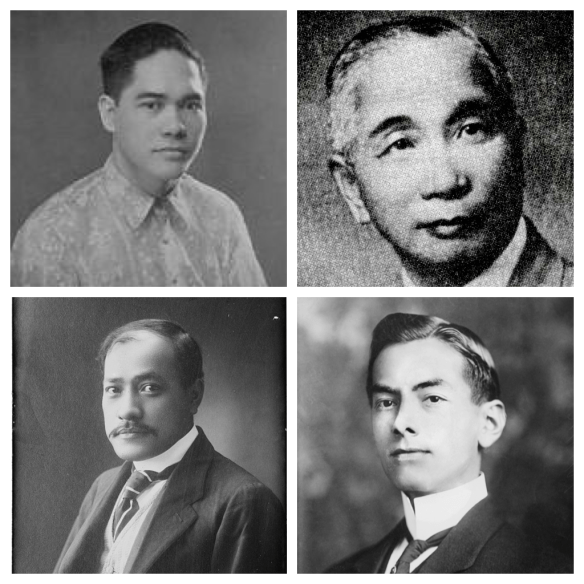
In the early 1930s, law student and Collegian editor Arturo Tolentino got into a fight with Law Dean Jorge Bocobo over whether he could write about the Hare-Hawes-Cutting Law, which then-Senate President Manuel Quezon and Bocobo himself opposed. When the Collegian published a news item seeming to support the bill, Bocobo backed the Collegian adviser’s decision to stop printing the Collegian and to burn the 900 copies already printed, on the grounds that the Collegian was not supposed to publish political material. Tolentino appealed to President Palma, who upheld Tolentino on the basis of free speech. But Bocobo appealed to the Board of Regents, which was filled with Quezon allies, and they overturned Palma.

Dean Bocobo reprimanded Tolentino and threatened him with suspension and even expulsion if he kept violating the BOR ruling. But it was Quezon who was most infuriated by the whole affair, and his ire was unmistakably vented on Palma.

Only days after Palma upheld the Collegian’s right to discuss the HHC, the legislature came down hard on the university and imposed a new system of appropriation requiring an itemized budget. Quezon commended the Lower House for probing the finances of UP, stressing that the move was “a distinct service” to the university. Things got worse between Palma and Quezon, and when Palma finally resigned in fatigue after ten years of service, the BOR denied him a gratuity on some technicality, and denied him an honorarium as well. (When Palma died in 1939, however, Quezon stopped everything to be able to attend his funeral, at which he offered generous words of praise for his former adversary.)

The second case involves an aborted debate at Yale University in April 1974, which featured Dr. William Shockley, a Nobel prizewinner for Physics, who had openly proposed that blacks were racially inferior, and that intelligence could be measured by the percentage of one’s Caucasian blood. So repugnant was the notion to many Yale professors and students that they effectively stopped Shockley from speaking, in a fracas that resulted in some suspensions. (And here I have to thank Fareed Zakaria for bringing this to my attention in a recent CNN program.)

A committee was later set up to investigate and assess the incident, and the report of that committee is instructive in what it concluded: “The primary function of a university is to discover and disseminate knowledge by means of research and teaching. To fulfill this function a free interchange of ideas is necessary not only within its walls but with the world beyond as well. It follows that the university must do everything possible to ensure within it the fullest degree of intellectual freedom. The history of intellectual growth and discovery clearly demonstrates the need for unfettered freedom, the right to think the unthinkable, discuss the unmentionable, and challenge the unchallengeable. To curtail free expression strikes twice at intellectual freedom, for whoever deprives another of the right to state unpopular views necessarily also deprives others of the right to listen to those views.”

The committee quoted Justice Oliver Wendell Holmes, Jr., who wrote in U.S. v. Schwimmer,1928, that “If there is any principle of the Constitution that more imperatively calls for attachment than any other it is the principle of free thought—not free thought for those who agree with us but freedom for the thought that we hate.”

That’s a sobering reminder for anyone who professes to uphold academic freedom and human rights: knowledge moves forward not by silencing the other side, but by presenting superior arguments—not always the easiest thing to do, especially without screaming your head off.
Penman No. 318: Mysteries of Fish

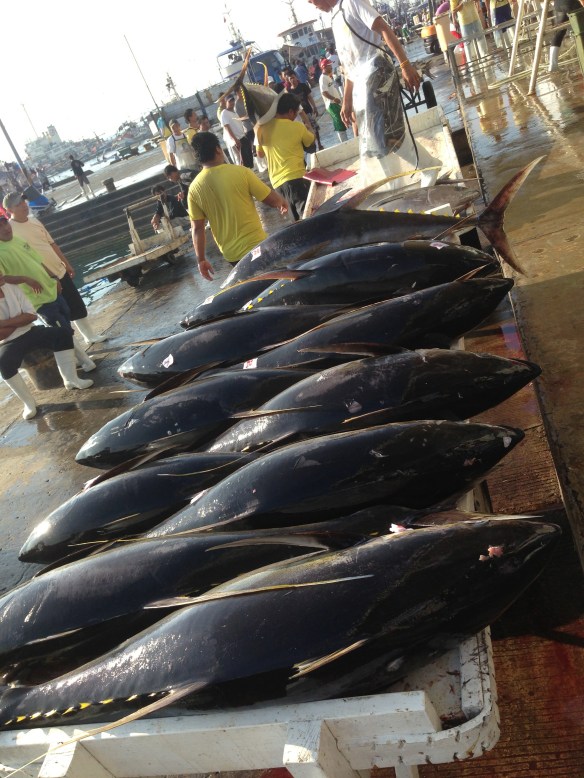
GenSanTuna.jpg

Penman for Monday, September 10, 2018


I’VE OFTEN written and spoken about how—despite the fact that we inhabit an archipelago of over 7,000 islands, bordered on all sides by the sea, and comprising one of the longest coastlines in the world—we seem to have very little by way of a maritime literature. By this I mean novels, stories, poems, and plays that have the sea as a central element, beyond serving as a romantic backdrop.

There’s a whole economy and culture to be found in our relationship with the sea, but much of this has been lost to a metropolitan generation bred on canned tuna and Starbucks coffee. Even among my students, I can count on my fingers the number of people who’ve taken a boat ride longer than a spin around a lake or the short hop from Caticlan to Boracay.

I myself was born in a house a stone’s throw from the beach, in a village on an island far from Manila, so the sea has never been far from my mind and imagination. I dream about it constantly, with recurrent images of huge waves rolling and breaking on the shore, and I as a boy walking on the sand with my father, now long gone.

But I too have to admit that save for a few scenes and the opening chapter of my novel in progress, the sea has figured minimally in my fiction. That’s probably because I feel responsible for creating credible characters whose lives are inextricably waterbound, and haven’t felt confident enough to do justice to the task. The fact is, we’ve lost touch with our marine heritage, which is supremely ironic given how Filipinos have distinguished themselves as seafarers, and how many Filipinos depend on the sea for a living.

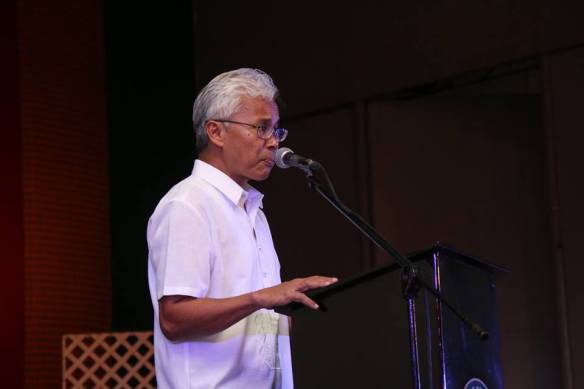
This was much on my mind two weeks ago when I flew to Iloilo to attend the formal investiture of Dr. Ricardo P. Babaran as the tenth Chancellor of the University of the Philippines-Visayas. A fisheries expert and nautical engineer, Ric recounted how, as a young boy far up north in Cagayan, he enjoyed going out to sea and to the river to fish.

“My fishing buddies generally used earthworms as bait, but they sometimes used live crickets using different fishing gear. As a young fisher, I observed that using either crickets or earthworms yielded different outcomes—certain fish seemed to prefer one or the other—but my fisher friends were never able to explain to me why. This mystery bothered me for a long time,” he told us.

RBabaran.jpg

Ric left Cagayan to study Fisheries in UP Diliman, and had to deal with the derision of other people who wondered “why Fisheries students needed four years just to learn how to capture fish with hook and line.” Even now, he says, this misappreciation of Fisheries partly explains why “fish-based industries are faring poorly in the Philippines.” (Indeed, an economist I know has pointed out that the recent spike in prices can be traced to some degree to a shortage of fish.)

Ric went on to take an MS in naval architecture and ocean engineering at the University of Washington, and then his PhD in Fisheries Science at Kagoshima University. It was in Japan where, Ric says, he finally found the answer to his childhood mystery: “I learned that catfish and mudfish responded differently to earthworms and crickets because of a process called chemo-reception.”

Dr. Babaran’s investiture was attended by many guests, including many academic officials and luminaries, but several of them stood out, for different reasons. Among them was Dr.  Loel Losanes, a UPV alumnus and the Filipino head of Japan’s Hikari Corporation, probably the largest producer of South Sea pearls in the world.

Just as significant was the presence of members of the Kamamado fishers group from Guimaras, many of them elderly women who, Ric noted, “supplement their daily income with the P40 they get from selling the equivalent of two-liter-sized containers of captured cardinal fish. Through this group, we will undertake a program that will promote responsible fisheries, which I believe will position the Philippines more strategically in the relation to the ornamental fish industry that generates $7 to 8 billion annually.”

I’m confident that the programs of Chancellor Babaran and UPV will improve the livelihoods of millions of our shore-dwelling countrymen, but I’m even more hopeful that a deeper and broader awareness of the importance of the sea in our lives will soon emerge, if only because of the crisis now roiling in the waters around us. (“About a third of our fish catch comes from the West Philippine Sea,” Ric told me.)

And I’m especially happy that a place like UPV exists to mind our waters. A young PhD in UPV, Noel Ferriols, recalled how he was convinced to study in UPV instead of Manila when he and his mother visited the campus in Miag-ao, which specializes in fisheries. “I was amazed when the security guard told me the scientific name of a certain kind of fish,” Noel said. “I thought to myself, if this is a place where even security guards can recite the genus and species of a fish, then it’s where I want to be.”


Penman No. 317: Bringing the Minor Masters Home

IMG_7340.jpeg

Penman for Monday, August 28, 2018


I’VE WRITTEN a few pieces recently about my self-assigned mission of finding and bringing home, from various sources overseas, masterpieces of Philippine publishing and literature, from early texts in Spanish to travel books about the Philippines and first editions or first publications of notable literary works.

This week I’m going to extend that to another burgeoning interest of mine—the recovery and repatriation of Filipino art pieces abroad, particularly those of painters who may never have quite achieved the status of a Juan Luna or Fernando Amorsolo, but whose works have their own charms to recommend them.

I may be luckier than most art fanciers in that I happen to know someone who restores the masters, so I get to see more than my fair share of Manansalas, Ocampos, Botongs, Magsaysay-Hos, and Luzes, up close, warts and all. But unless I win the Nobel Prize, I’m never going to own one of these masterworks, so I’ve learned to moderate my ambitions and aim for something both significant and reasonably attainable within a professor’s means.

Those goals crystallized for me when I attended, some months ago, an exhibit titled “Fascination with Filipiniana: The Vargas Collection,” curated by my friend and fellow UP prof Dr. Patrick Flores, who walked me through the show and pointed out how interesting (and not quite so seamless) the transition was between tradition and modernism, sometime in the past midcentury. I could see the tensions between the two, occasionally manifesting in the same artist’s earlier and later work (I don’t recall that he was in this Met exhibit, but Constancio Bernardo, who left the Philippines as an ardent follower of his teacher Amorsolo and came home a committed modernist, much to Amorsolo’s dismay, provides a good example.)

Many of the paintings on exhibit belonged to the school of “Mabini art,” a term often and unfairly used in the pejorative sense, suggesting cheap art done in haste for the tourist market. Indeed there’s a lot of that (and the purposes may not have changed; they’ve just become more pretentious, pitched toward buyers with deeper pockets), but these pioneering Mabini artists were talented in their own right, persistently romantic in a time of gloomy realism.

I was particularly drawn to the work of Gabriel Custodio (1912-1993), another student of Amorsolo and Fabian de la Rosa. I had earlier acquired two small paintings of his from the late 1950s, restful vignettes depicting rice fields and bamboo groves. The Tanza, Cavite native had produced larger seascapes that I admired, but the art market had caught on to him and I couldn’t possibly afford him at auction—at least not here.

I’ve long been convinced that in the United States—languishing in bedrooms, barns, garages, and resale shops—must be scores of Filipino art works brought over by American servicemen and diplomats after World War II and the Vietnam War, surfacing only recently with the passing of these veterans and being disposed of at auction by their heirs.

IMG_5767.PNG

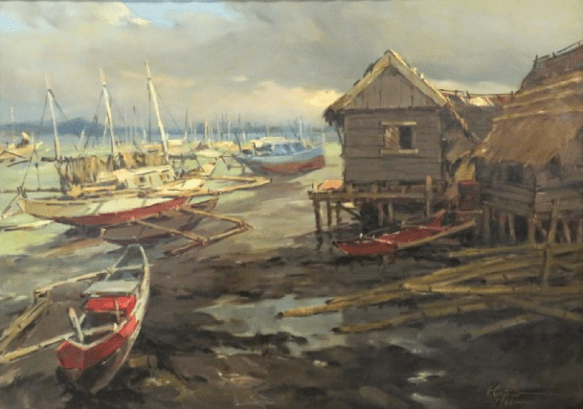
A few months ago, a large painting by Custodio, about 2’ x 3’, turned up in, of all places, a Goodwill Store in Spokane, Washington—and I happily snagged that, and rolled it up in a tube for bringing home to Manila when I visited the US last month. Characteristically, Custodio signed it front and back, dated 1966; I’m calling it “Tanza Shore” in honor of his hometown and of its economic and cultural affinity to the water.

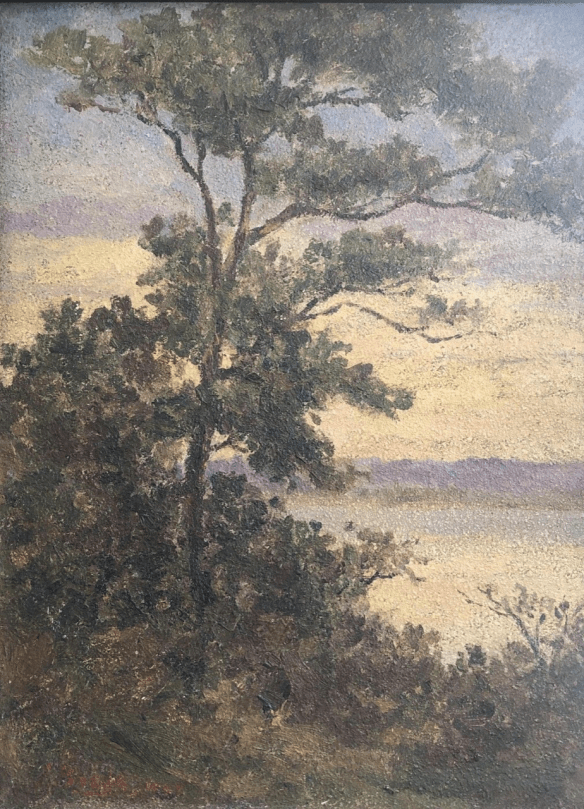
It was also on that trip when I secured and repatriated two other smaller but no less interesting pieces. One, shipped out of the East Coast, was an oil painting of a tree at sunset, more than anything an evocation of mood, an impressionist play of mauves, pinks, and oranges. It had been done by Jorge Pineda in 1937 and was still in its presumably original frame; the browned and crusty paper backing was beginning to crumble, but I plan to preserve it that way, as it bears the sticker of its framer: the Henry Schultheis Company, well known framers and gallery owners in New York City (Schultheis died in 1948). Pineda (1879-1946) himself was no mean painter, having won a prize for his work at the 1904 St. Louis World’s Fair and later becoming a teacher to Amorsolo.

Pineda1937 copy.png

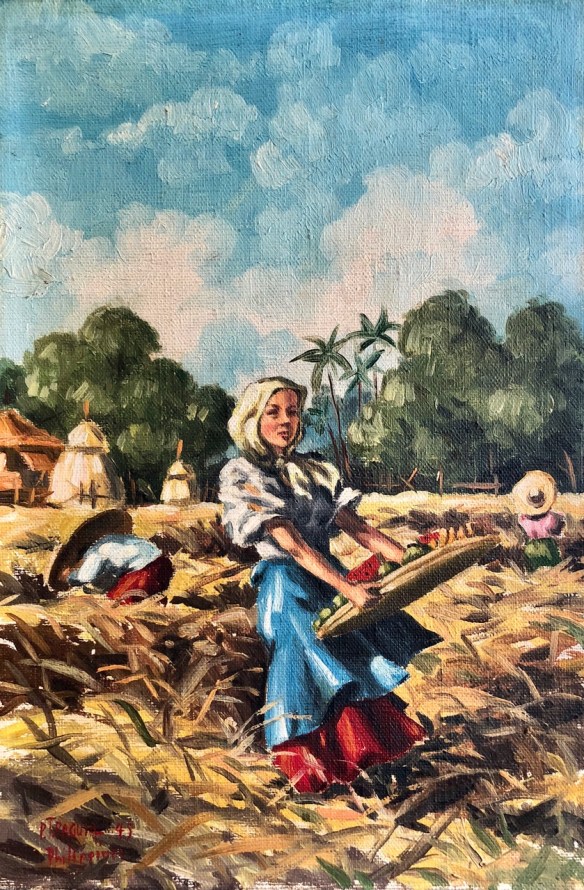
The third piece I brought home—sold by an antiques dealer in Connecticut—caught my eye not just because of its subject but also because of its symbolic use of color. It’s an oil-on-paperboard depiction of Filipino farmers harvesting rice—pretty typical enough, and unremarkable of itself. But this work had been done by one P. T. Paguia in 1945, at the end of the war and in a season of new hope—a patriotic optimism exuded by the red, blue, and white in the dress of the woman bearing a bilao of fruits in the foreground, echoed by the other farmer and the brilliant sky. (Patrick Flores reminded me that Amorsolo had done a similar work in these colors, Palay Maiden, in 1920.) Sadly I could find nothing on P. T. Paguia, except a reference to Pedro T. Paguia being the illustrator of a 1952 book by Ramon Tapales, Singing and Growing for the Primary Grades.

Whether by established or obscure artists, these paintings from decades ago bring me joy and relief from the vexations of our time. Of course I could resell them, but frankly they probably won’t make too much, and just looking at them makes me happier than wondering what they may be worth, which I suppose is what amateur collecting should be about. Call them escapist, but they fortify my spirit by reminding me of the need to fight for beauty and plenitude for all.


Penman No. 314: Sourcing the Pinoy Crowd

IMG_7312

Penman for Monday, August 6, 2018


ART CRITICS often like to write about the Pinoy penchant to fill up vacant spaces—our horror vacui, evident in everything from our front yards to our jeepneys and desktops. And when there’s nothing to fill up a nice big void like an empty hall or open street with, heck, we fill them up with our own bodies, to form a healthy crowd.

We Pinoys usually don’t think too much about being caught in a crush at the LRT, the ballgame, or the rally. Indeed, students of crowd psychology will point out that while they may be uncomfortable, crowds can also generate positive synergies, and that even in the most seemingly unruly mob, an inner logic eventually emerges and prevails.

But we also know that crowds can turn ugly and deadly pretty quickly, as the stampedes that every and then convulse English football show. Even much less than that, there’s nothing funny about people fainting in a queue or in a surging mass of bodies desperate for one thing, whether it’s a glance from a rock star or a little slip of paper that could be a ticket to a first-rate college education.

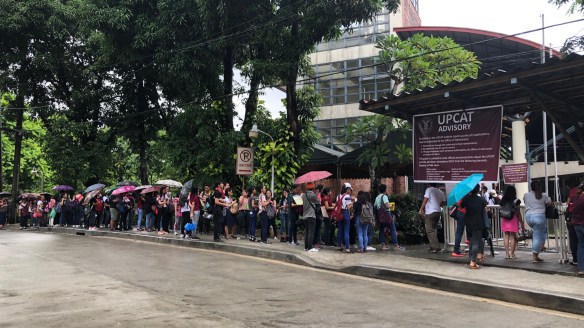
All this was on my mind last Monday as I dealt with one of my busiest days as a school administrator at the University of the Philippines, where an estimated 40,000 people converged at the Office of Admissions in Diliman in one day to submit their applications to take the UPCAT, UP’s entrance exam, in mid-September. To wrap your head around that figure, Diliman has 25,000 students on a normal day. But my guess is that at least half of those 40,000 were anxious parents taking a day off from work to accompany their kids.

It was actually the extended deadline for students of private high schools in Metro Manila (not public as erroneously reported—a lot of fake or unverified news went out that day and after, and a woman presenting herself as a network news reporter even urged the crowd to chant for an extension as her camera rolled). As a torrent of tweets soon reported, the lines kept growing longer, tempers flared, and panic seized more than a few people in the area. The media calls came soon after, and—as UP’s equivalent of, uhm, Harry Roque—I spent the rest of the day and part of the evening fielding questions.

Did we expect the size of the crowd? Well, yes and no. The surge in applications was unprecedented—in years past, we’d get something like 80,000 applications; last year it was 103,000, and this year, our estimate runs to about 167,000. What accounted for the sudden bulge? Free tuition, for one, and K-12, for another. (The actual number of qualified exam takers could be about 20 percent less, and the admission rate—those who “pass,” although there’s no fixed passing grade—about 17 percent of all takers, which is a function of UP’s carrying capacity.)

We did see that coming, but I guess what we didn’t anticipate was how many students (and/or parents) would choose to appear and line up in person, rather than avail themselves of other less stressful options clearly stated on the application webpage—to submit applications online, or by mail or courier, or in bulk with the help of their school. (UP provided the extra option of a drop box when it saw how large the crowd was.) That was probably because queuing up guaranteed—if all your papers were in order—a test permit at the end of the line. But that also meant that the line could take all day.

So we Pinoys are seguristas, willing to sacrifice comfort for the certitude of paper in hand. We still mistrust electronic processing, and can’t wait a couple of weeks to know our fate. I went onsite to see for myself what was going on, and was told by one exasperated guard that “They won’t listen! There’s a drop box right there, and we’ve told them they can courier the forms, but they’d rather line up for hours!”

You’d also have to wonder why Pinoys like to wait for deadlines to do the inevitable; July 30 was already an extension from July 27, and applications had been open for three weeks. But to be fair to the students and their parents, it wasn’t entirely their fault to have waited so late in the day to submit their papers. Some told me that their high schools had held their papers up; some were charging rather stiff fees for handling UPCAT forms.

And was there a class factor at play? When the turn of the public high school applicants came, the huge crowds dwindled, and the lines got shorter—and far fewer parents appeared, because they probably couldn’t afford a day off, or trusted their children to fend for themselves. Things moved more smoothly.

There are lessons for everyone to be learned here—by the students, by the parents, and by us, most of all—and we’ll continue seeking ways to ease procedures for everyone in the years ahead. Eventually, I foresee a time when all submissions will be made online, like visa applications—something we can’t enforce until every Filipino has access to the Internet, and overcomes his or her mistrust of information technology. Until then, we’ll all have to learn better crowd management, provide lots of water and Portalets, exercise patience, take the media brickbats, and soldier on.

Maybe this was a crowd that didn’t really need to be there, but on the other hand, and to put it positively, it was a stark visual reminder of the intensity of our people’s aspirations for a good college education. The best way to disperse it long-term would be to meet those needs, in UP and beyond.

Penman No. 313: A Life-Affirming Mission

UPCMPic.jpeg

Penman for Monday, July 30, 2018


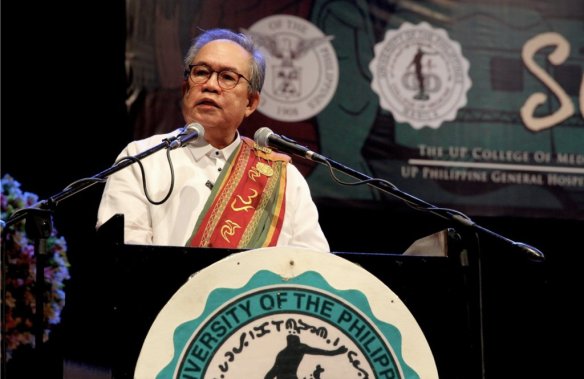
TWO SUNDAYS ago, I had the privilege of serving as commencement speaker before the 2018 graduating class of the University of the Philippines College of Medicine. You’d have to ask them why they chose to invite a writer and professor of English to speak to a corps of medical professionals, but I was happy to accept. It was likely the last time I would wear my sablay as a UP official, as I will be retiring six months hence after 35 years of service to the university. So this, too, was my valedictory, my final opportunity to share with the audience some insights gleaned from my life in UP as student, teacher, and administrator.

Here’s a brief excerpt, about a third, from that talk. Email me if you want a copy of the full text.

Thirty-six years ago, as a young and aspiring writer, I wrote a story about a doctor. The story was set in the Philippine Revolutionary War, and it dealt with an old, cynical doctor named Ferrariz who had made a mess of his life and, seeing few other options, had signed up to become a doctor with the Spanish army, fighting the Filipino insurgents up in the mountains. His unit is taking heavy losses, but one day they capture a rebel—a fifteen-year-old boy named Makaraig, who is badly wounded. Ferrariz’s superior, a major, orders Ferrariz to save the boy’s life.

Let me quote briefly from the story:

… For three days he worked like a driven man, cleaning out and dressing the boy’s wounds, setting the arm, packing cold compresses upon the swellings. He felt godlike in that mission. He unpacked his books from their mildewed boxes, brushed off the fungi and reviewed and relived the passion of the way of healing. He watched miracles work themselves upon the boy and stood back amazed at his own handiwork. When he was through, when he faced nothing more than that penance of waiting for the boy to revive, Ferrariz realized that his eyes were wet. Not since he stepped into the University, knowing nothing, had he felt as much of an honest man.

In other words, this doctor, who had lost faith in his talents and in his hands, suddenly finds himself revived and redeemed by his mission of curing a battered boy. By saving Makaraig, he saves himself.

But the story doesn’t end there. The major has his own reasons for bringing a rebel back to life—to torture and interrogate him, and eventually to kill him, and that’s where the story closes, in a long scream that pierces the doctor’s newly awakened soul.

That story, titled “Heartland,” went on to win in the 1982 Palanca Awards for Literature. But why did I write a story about a doctor who saves a patient, only to have him murdered by others? Why did I write a story about self-redemption?

The story behind the story was that while I was only 28, I felt like Ferrariz, an old man who had gone adrift and who was just going from job to job with mechanical indifference. It was martial law, and despite the fact that I became a political prisoner at 18 and spent seven months in a camp in what we now call Bonifacio Global City, I had been working as a government propagandist for the past eight years, churning out press releases, speeches for President Marcos, and glowing articles about his New Society.

I needed to remind myself that I could write good fiction (what I was writing for work was bad fiction), that somewhere in me was truth waiting to be said.

… For the past 110 years, that has been part of the mission of the University of the Philippines, our national university, the bearer and champion of our people’s hopes. Through our general education program, we try to produce graduates who can be as conversant about Greek tragedy as about the Law of the Sea and thermodynamics. The premise is that a well-rounded, well-educated student will elevate not only himself or herself but also his or her community and society, bringing people together in common cause.

At least, that’s the noble intention. We know that, in practice, while UP has produced scores of such exemplars as Wenceslao Vinzons, Fe del Mundo, Jovito Salonga, Manuel and Lydia Arguilla, and Juan Flavier, and while we graduated 29 summa cum laudes from Diliman this year, we also know that many UP students and alumni have flunked, and flunked badly, especially in the moral department.

In other words—and it saddens me as a UP professor to say this—intelligence never guaranteed moral discernment or rectitude, and as proud as we may be of our nationalist traditions and contributions to national leadership, much remains to be done to ensure that we imbue our students not only with skills but with principles. In other words, just as we ask physicians to heal themselves, we educators first have to teach ourselves.

This is why I began this talk with my story about Dr. Ferrariz and his seemingly futile gesture. What that story really wants to ask is: What is life without freedom? What is knowledge without values?

What does a cum laude mean or matter if it will not be used to relieve human suffering but only to enrich oneself and one’s family? Of what use is a glittering GWA of 1.25 if your moral GWA is a murky 3.0? How can you study to save lives and yet remain silent in the face of its wanton loss—not even by disease or accident, but by willful human policy?

There is, indeed, no more life-affirming mission or profession than yours, and in a season of slaughter, to affirm life can be a radical and even dangerous proposition.

Penman No. 312: Recovering Fil-Am History

IMG_6999

Penman for Monday, July 23, 2018


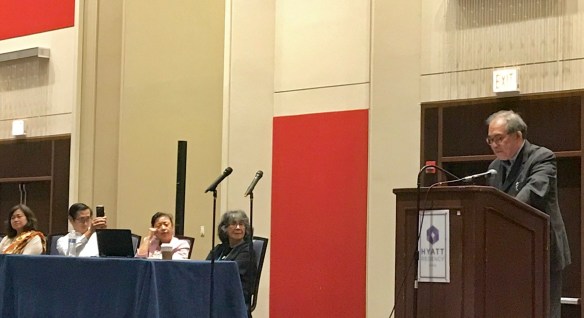
I WAS in Chicago two weeks ago to keynote the 17thBiennial Conference of the Filipino American National Historical Society (FANHS), and it was an opportunity not only to catch up with old friends from my time as a graduate student in the American Midwest but also, and more importantly, to have a sense of where the study of Filipino-American history is going.

With 33 chapters now spanning the US from Hawaii to the East Coast, FANHS has become one of the most visible and important Fil-Am organizations (we typically still hyphenate the term but many Filipino Americans no longer do), devoted to recovering, preserving, and promoting the history of Filipinos and their descendants all over that vast country.

It’s a history that dates back to at least October 1587, when the Nuestra Señora de Buena Esperanza dropped anchor off what’s now known as Morro Bay, midway between San Francisco and Los Angeles. On its crew were several luzones indios; today they would simply be called Filipinos. Some men went onshore, and one Filipino was killed by Indians.

Since then, over three million Filipinos have either made that journey, or were born in America to Filipino parents, and in each one of them is inscribed a history of struggle, adaptation, acceptance, resistance, and all degrees of complex responses in between. And as the Filipino population in America has expanded, so have Filipino communities, such as that seminal one that was started by runaway Filipino sailors in New Orleans in the 1760s, which grew into a “Manila Village” that was sadly wiped out by a hurricane in 1915.

IMG_7007

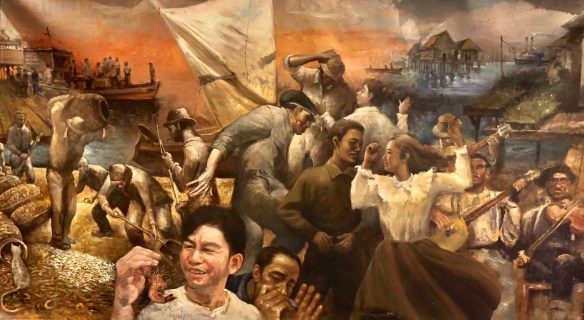
I’d first heard about the Lousiana Pinoys from Jim and Isabel Kenny who produced a fascinating documentary about them in 1992 titled “Dancing the Shrimp” (a reference to the way Filipinos dried shrimp—and grew the shrimp industry—in Louisiana by stepping or dancing on them to music). In Chicago, I was happy to meet Marina Estrella Espina, a pioneering researcher, librarian, and author whose 1988 book Filipinos in Louisiana (New Orleans: AF LaBorde & Sons, 1988) laid much of the groundwork for further studies as the Kennys’ and that of younger scholars like the poet Randy Gonzales, who also grew up in New Orleans but lived for many years in Dubai. Now in her 80s, Marina excited the audience by announcing that she had found proof that Filipinos had settled in Louisiana even earlier than previously thought, and that she was working on a book chronicling Filipino journeys around the world.

From Alameda, California and local historian and Boholano Bob Balandra came the story of the Bohol Circle, a club formed there in 1936 by 16 Filipino immigrants seeking and providing support for each other in a difficult time. Some later joined the 2ndFilipino Infantry Regiment, which fought in the Pacific. Bob and his compatriots are trying to get that historic club and its clubhouse recognized with an official street name.

Elsewhere, the 300 participants in the FAHNS conference spoke on and listened to such topics as community-university partnerships in Alaska; Filipina-American marriages in the Philippine-American War; getting out the Fil-Am vote; the sakadas of Hawaii; Filipino nurses in Illinois; and decolonization and visual art. Film screenings by the noted filmmaker Nick Deocampo and the “Dreamland” team of Claire Miranda, Katrin Escay, and Moshe Ladanga complemented the lectures. Dr. Dorothy Cordova, one of the society’s founders along with her late husband Fred, graced the event. I was particularly glad to meet old friends from the University of Michigan, Dr. Romy Aquino and his wife Necie, and from the University of Wisconsin-Milwaukee, Princess Emraida Kiram, whom I hadn’t seen in years.

IMG_3237

A special feature was the unveiling of a mural depicting the Louisiana experience, produced by the Durian Collective composed of artists Leonard Aguinaldo, Darby Alcoseba, Manny Garibay, Jun Impas, Otto Neri, Orley Ypon, and Art Zamora, who were assisted by Fil-Am cultural advocate Almi Astudillo-Gilles.

Over more than 30 years, FAHNS has become a true community of shared personal, academic, and cultural interests, and has the potential to become a formidable force in American politics, especially at a time when immigration and human rights have become threatened once again by the new regime. But as with many communities, unity of vision and purpose is always a challenge, which was why this year’s conference focused on the theme of “Community for Cohesion and Collaboration.”

In my keynote, I suggested that “The only community that will last for our country and people will be one based on an appreciation and acceptance of a common stake in the Filipino future, based on truth, reason, and fairness or inclusivity.

“Under normal circumstances, you and I would not even think twice about this idea, which is almost a motherhood statement. But these are times in which truth, reason, and fairness seem to be in precariously short supply, and the notion of ‘a common stake’ an increasingly nebulous one.

“If we lack a sense of a common stake in a shared future, it may be because we lacked a sense of a common stake in the past. We like to think that we share a history, but the history of our poor is very different from that of our rich.”

And so the conference went, looking back into our past for a glimpse of the future.

Penman No. 311: A Trove of Printed Delights

BigBooks

Penman for Monday, July 18, 2018


A FEW months ago, I wrote about picking up some wonderful books online that I plan to add to my retirement library—books that I’ll be poring over at leisure, for no more compelling or more urgent reason than enjoying the stories they contain, or even just the way they were printed, illustrated, and bound. I won’t be writing any papers about them (well, maybe a column or two), and I’ll leave myself the option of reselling some of them to share the fun and feel better about buying some more.

Most of these books come from the USA, chiefly from eBay, where I’ve been actively trading for more than 20 years. You’d be amazed by the Philippine treasures—not just books but paintings and other artifacts—that made their way overseas and eventually turn up on eBay. I’ve made it my personal mission (of course my wife Beng calls it my excuse) to recover these precious objects as much as I can afford on my professor’s salary—important or interesting Filipiniana, for example, such as the first US publications of Manuel Arguilla’s stories, and early editions of Carlos Bulosan’s books.

I’ve sourced books and paintings from as far away as France, Spain, and Portugal, and have successfully had them shipped to me in Manila by regular air mail. To save on shipping, however, I typically accumulate all my US purchases at our daughter Demi’s place in San Diego, California, and then have them couriered to me when they’re enough to fill a box, or wait for our next visit to Demi and her husband Jerry to cart them home.

That opportunity happened last week, on my annual vacation leave. We came too early for Comic Con this year, but I had stranger things than, well, Stranger Things in mind. I was eager to plow through and pack away about a hundred pounds of books and paintings that had been piling up at Demi’s over the past six months.

The paintings—which include a large and marvelous Gabriel Custodio seascape from 1966 that I found at a resale store in Spokane, Washington—will be worth another story, but for now, let me share some of the most interesting publications from the pile.

NoliEtc

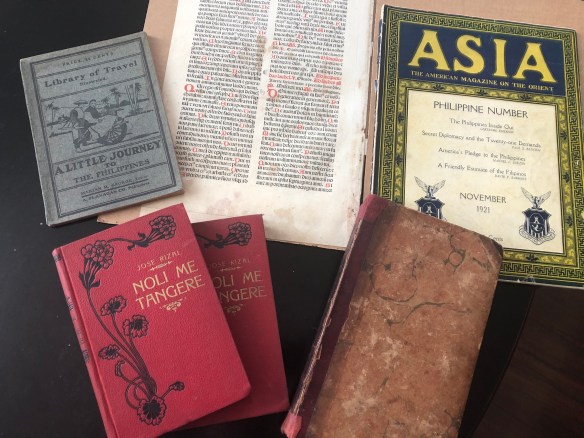
Old editions of the Noli and Fili are always desirable objects of study, and to complement the rather eccentric 1911 Fili I acquired last year, I received a two-volume 1909 Noli from Madrid (also published by Maucci in Barcelona), with annotations by Ramon Sempau. It’s interesting how, scarcely a decade after his execution, Rizal is hailed as a patriot by the Spaniards. This edition contains the Last Farewell and an account of his trial. (Another later edition in the pile, a Noli retitled and published by Norton in 11961 as The Lost Eden, is introduced by James Michener, who describes the novel as “a nineteenth-century Gothic melodrama, filled with eery churches, flashes of lightning, ominous strangers, premonitory whisperings, and almost unacceptable coincidences.”)

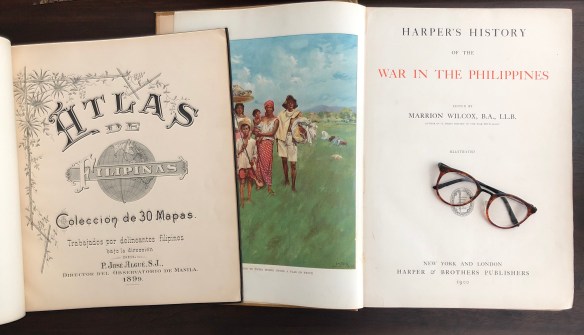
I try to collect old books that have something to do or say about the Philippines, but of course that becomes more difficult the farther back you go. In my office, I display a page from a German book on geography from 1578 that talks about “den Philippinischen Insuln,” and I’m sure other collectors have much earlier material. But sometimes I pick up antiquarian documents just to be able to show my students what truly old texts looked like, and in this batch is a page from a Latin breviary published in Augsburg in 1490—an example of true incunabula, or something printed roughly within 50 years of Gutenberg’s 1455 Bible.

There’s an extensive and rather grisly account of a “Massacre at Manilla” in my 1822 copy of Vol. X of The Atheneum, a Boston-based compilation of highlights from imported contemporary English magazines (the “magazine” as we know it today grew popular in England in the 1700s). The article is an unattributed eyewitness account, reported by a victim of a brutal massacre of foreigners—English French, Danish, Spanish, and Chinese, among others—following a false report that they were responsible for fomenting a cholera epidemic that had decimated the natives by giving out poisoned medicine (shades of today’s Dengvaxia hysteria). It occurred to me that I had read about this same massacre before from Paul P. de la Gironiere, who was serving as a doctor aboard a French ship in Cavite at the time, and who claims to have performed great deeds of daring in the emergency.

More congenial is A Little Journey to the Philippines (Chicago: A. Flanagan, 1900), edited by Marian M. George, filled with observations of a pleasant nature: “Our boat is anchored, and we start off with a guide for the Enchanted Lake. We pass ponds filled with fragrant pink pond lilies, and shortly begin to climb the crater of an extinct volcano.” It also remarks, perhaps presciently, that “There is no Philippine nation. Instead there are numerous governments; the people are divided into over eighty different tribes; and there are over seventy-five different languages spoken among them.”

If I had more space in my baggage and my house, I would buy tons more of these books, which remind me how we keep drifting back to the past, despite the GPS in our iPhones.


Penman No. 310: Tacloban’s Worthier Wonders

Merlie

Penman for Monday, July 9, 2018


ONE OF the pleasures of our recent visit to Tacloban was meeting up with two friends—the cultural scholar and UP Tacloban Humanities Division head Joycie Dorado Alegre, and the poet and Professor Emeritus Merlie M. Alunan. Beng and I made sure to spend an extra day in Leyte to see the UP Health Sciences campus in Palo, the fabulous Palo Cathedral, and other landmarks close to Tacloban. We’d already visited the Sto. Niño (ie, the Marcos) Shrine and the next-door Public Library—both of them in a rather sorry state, as I reported last week. But going around town with longtime locals like Joycie and Merlie revealed worthier wonders.

We made sure to visit other tourist staples such as the Macarthur Landing Memorial Park in Palo—an impressive work by the late sculptor Anastacio Caedo, better known for his plaster busts of a pensive Jose Rizal, one of which I keep in my home office as a kind of conscience. (Though no blushing fan of the famously vainglorious general, I’d been intrigued enough by MacArthur’s Philippine connections to visit his museum and tomb in Norfolk, Virginia.) I tried hard to recreate the tableau of ships massing on Leyte Gulf, only to have my musings spoiled by a tourist and his girlfriend wading into the pool in mock fatigues and rubber boots, posing with fake firearms.

But this was tragedy on a diminutive note compared to what no one visiting Tacloban can escape—the howling hell that was supertyphoon Yolanda and the many thousands of deaths it left in its wake. As we passed one traffic island after another—with the grass almost strangely manicured and impeccably garbage-free—Joycie or Merlie would tell us, “Those islands became mass graves. There are people buried there.”

A more formal and movingly expressive memorial to the lost lay farther on in Tanauan, in artist Kublai Millan’s sculpture built on yet another mass grave. Everywhere we drove on that coastal plain, the surging sea had swept people and whole families away, and while the city seemed to have regained its equanimity and was bravely soldiering on five years after, there was a hole in its heart still aching to be filled.

Merlie herself had gone through a recent personal tragedy, with the sudden passing of her beloved son Ebeb. Even as Yolanda had spared her, living as she did on higher ground, she couldn’t have foreseen this dark turn down the road. (She had lost her father and five other family members in the Ormoc City flood of 1991.) She was still clearly grieving, but had gone out of her way to entertain us, and perhaps thereby also entertain herself.

Nothing can ever compensate for the loss of family, but Merlie was threading a way forward, in that way uniquely accessible to artists. Every true work of art is an affirmation of life, and in Merlie’s case, she has art aplenty to affirm life with. To begin with, there’s nothing literally closer to life than food, and for almost two decades now, Merlie and her enterprising children have built up one of Tacloban’s best-loved restaurant chains, headlined by the now-iconic Ayo Café along Ninoy Aquino Avenue.

Ayo (the name derives from the Visayan term for “good”) serves food as familiar as Spanish sardines, lumpia, roast chicken, and burgers at prices that won’t make you weep, but with a twist—the twist being that it’s cooked and presented just scrumptiously right, with the choicest ingredients, in servings large enough for take-home leftovers. I’d heard about Ayo before from friends who’d been there (Merlie proudly keeps a guest book signed by writers and artists), and while I may have initially accepted her invitation out of friendship, I’ll be seeking it out on my own on my next Tacloban sortie (and I insisted on paying for our merienda to emphasize my patronage).

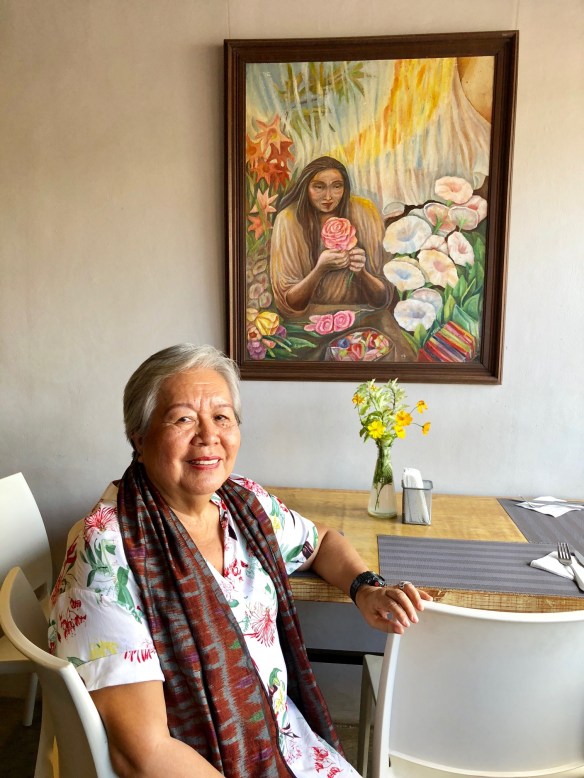
The Ayo interlude also allowed us to discover another of Merlie’s less-known talents as a visual artist who paints and also does plant sculptures. I asked her to pose for a picture beside one of her works, and learned that this was something she had been doing since her years in Dumaguete, perhaps again as a refuge or respite of sorts from the travails of daily life.

Of course it’s her poetry that Merlie Alunan is best appreciated for (one of her poems, “Young Man in a Jeepney,” has been a perennial on my syllabus), and her sixth poetry collection, Running with Ghosts (Ateneo de Naga University Press, 2017) is understandably heavy with waterborne death. But as she points out at the close of her title poem, life will go on, in all its bewildering indifference:

Grass sow their seeds over the turned earth,

The graves are greening in the seasonal rain.

Everyday we run with ghosts by our side.

God is silent. as ever blameless and inscrutable.

Penman No. 309: A Breakthrough in Tacloban

IMG_6876.JPG

Penman for Monday, July 2, 2018


LATE JUNE is graduation season under the new academic calendar of the University of the Philippines, and since the UP System is made up of eight constituent universities spread out over 17 campuses, that’s a lot of graduations to attend for officials like me. Since the President can’t possibly be at all the ceremonies—which are sometimes scheduled on the same day, or just a day apart—we VPs decide early on where we want to go to represent the System administration.

Diliman is a given, being basically home. I also attend the rites of UP Manila, partly because I’m fascinated by the number and variety of degrees we hand out under the health sciences (culminating this year in the combined MD/PhD—a physician who’s also a researcher, the very top of the heap). But also, UP Manila—harking back to an earlier tradition—still requires its graduates to wear togas instead of the now-ubiquitous sablay or sash, which means I get to drag my US-university toga, or what I call my clown costume, out of the mothballs.

Last year I chose to go to UP Baguio, only to realize, the night before the ceremony, that not only was I on the roster of visitors, but was also the commencement speaker—a little detail that no one had remembered to tell me. A faster commencement speech was never written. (I’ll admit it—I was thrilled to get the job done.)

This June, I selected UP Tacloban—not yet a constituent university but a college under the supervision of UP Visayas. I picked Tacloban because I hadn’t been there for at least 15 years since the early 2000s, and I wanted to see how the campus and the city had recovered from Yolanda’s devastation. I imagined that It was still scarred by the catastrophe five years after; instead, as soon as we landed, I was impressed by how quickly the place had gotten back on its feet, abuzz with tricycles and new construction.

With a morning to spare, I walked about town with Beng (who had come along at her own expense to see old friends) and toured the still-sequestered Sto. Niño Shrine (always more a shrine to the Marcoses), badly ravaged by the storm and by neglect. An even sorrier sight was the adjacent People’s Center and Public Library, which had been converted to a Japanese surplus store. I don’t bemoan the humbling of excess, but as Beng reminded me, “This was the people’s money.”

One happy discovery I did not expect was Tacloban as a food paradise. Wherever we went and at whatever price point—the surf and turf combo and the grilled marlin at the hotel, the fish tinola, the grilled scallops, and bulalo at the Acacia restaurant, more tinola and nilagang carabeef at the unli-rice Pinutos at the mall, and the lemongrass roasted chicken at the now-iconic Ayo restaurant—the food was fresh and flavorful, the beef amazingly tender and the tinola divinely laced with lemongrass and ginger.

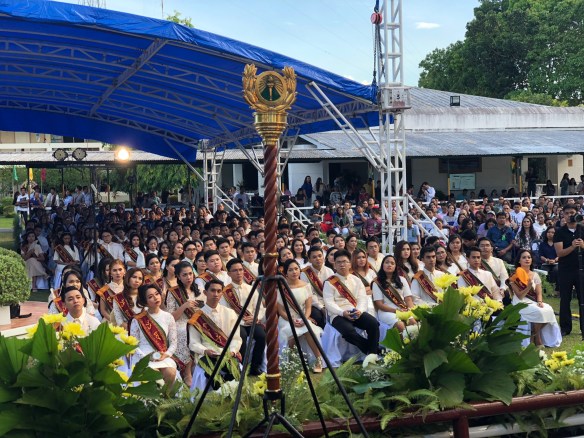
All that fortified us for the graduation, which was fairly small as UP graduations go, with just about 200 graduates, two of them finishing magna cum laude, from such fields as Accountancy, Management, Communication Arts, Biology, Computer Science, and Political Science. Tacloban Dean Dr. Dodong Sabalo, a management expert, introduced me to the commencement speaker, Ms. Debbie D. Namalata, San Miguel Brewery’s National Sales Manager and Vice President for Sales, and a UPV alumna, who gave a stirring talk about how her family overcame poverty to achieve professional success against all odds. It was a theme echoed by the valedictorian, Kim Decolongon Limosnero, whose mother had sold chicharon to put him and his siblings through school.

You’d think that I would get bored going to these graduations and witnessing the endless parade of young people coming up the stage in their Sunday best with their parents in tow, but I honestly never do, especially when I listen to such stories as Debbie’s and Kim’s, and see fathers wearing denims and sneakers not because they want to look hip but because it’s the best outfit they can afford. There wasn’t a dry eye in the house when Kim addressed his widowed mother—who had never finished college—as “my summa cum laude,” and I recalled my own parents who had similarly labored mightily to send all five of us to school.

And as I sat onstage, I received the saddest message on my phone, about another UP student named Jemima Faye Dangase, who was supposed to graduate cum laude in Agribusiness Economics from UP Mindanao. The daughter of very poor parents—her diabetic father was a municipal utility worker and her mother was unemployed—Jemima was clearly her family’s hope. She submitted all her requirements for graduation, went home, then crumbled in pain—pain she had borne quietly for months without complaint, apparently so as not to trouble her already beleaguered parents. She was brought to the hospital, where doctors discovered her organs ravished by cancer; and there she died.

I know it borders on melodrama, but this is, truly, the story of Philippine education and why it’s so crucial to social transformation. For every Jemima who stumbles on the very last steps, there must be a Kim who breaks through. This is why going to such places as Tacloban revives my faith in the Filipino future, despite the dark travails of the present, in this moral equivalent of a Yolanda, which—reposing our faith in a God wiser than all despots—we will survive.

Penman No. 308: A Respite in Luang Prabang

27677144927_4dbfae4e9c_k

Penman for Monday, June 25, 2018


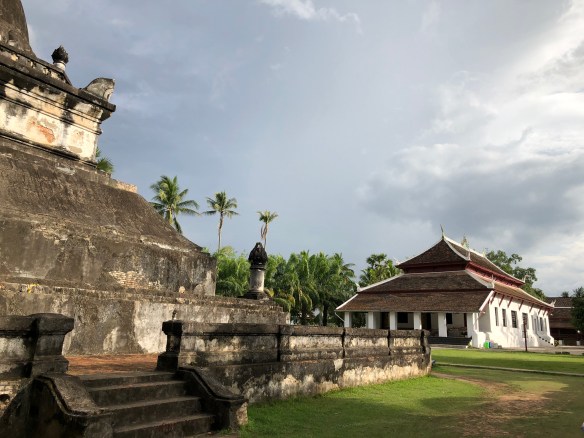
I TRY to give my wife Beng a birthday treat abroad every year—a small price to pay for her manifold acts of kindness and generosity, not to mention her 44 years of patience in sharing a bed with a snorer—so early this June, we flew out to Luang Prabang in Laos. Why Luang Prabang? Because I couldn’t think of a place with a more musical name, and because we’d never been to Laos, and because it had come highly recommended by a dear friend Julie Hill, who’s been all over the planet but who considers Luang Prabang one of her favorite haunts.

With atypical optimism, I’d booked our trip eight months earlier. There are no straight flights from Manila to Luang Prabang, so we spent a night in Kuala Lumpur before making the short hop to LP.

Street

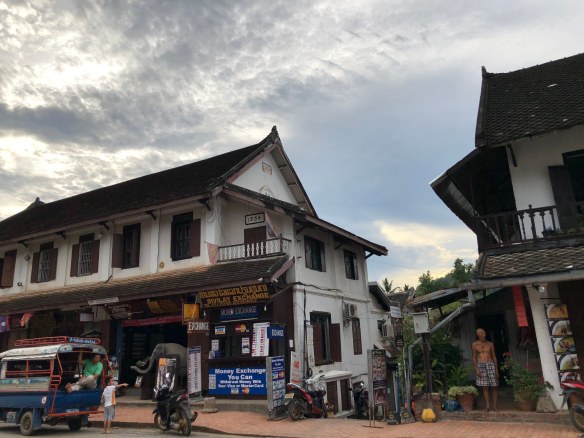
As in much of Southeast Asia, things were cheap, easy, and infinitely interesting the moment we landed. The local currency is the kip, of which you’ll need about 8,400 to buy one US dollar, but for the princely sum of 50,000 kip or $6, we were brought by an airconditioned van to our digs, the comfortable, two-story Villay Vanh Guest House about 15 minutes away. Like many lodging houses in LP, the Villay Vanh was a largely wooden house—shoes off, please—that had been converted into a hotel, and it maintained that homey ambience without sacrificing modern necessities like airconditioning, hot water, and wi-fi.

Of course, you don’t really go to Luang Prabang for the airconditioning, the hot water, and the wi-fi. As it happened, our hotel was a few steps away from a large Buddhist temple on the left, and a river on the right. And should I say that our four-night stay, including breakfast with about a dozen choices from pancakes to beef fried rice, cost all of $52 (that’s for all four nights)?

Market

Beng, of course, made a beeline for the night market, which was also just a short walk away, but not before we made the obligatory climb up nearby Phousi Hill, which offered a 360-degree view of the city, the Mekong River, and the misty mountains in the distance. We love to travel around Asia for the markets, the museums, and the food, and LP delivered wonderfully on all accounts.

The night market, where lavishly woven textiles abound, stands right in front of the museum, which is also right next to the food stalls in the public market. I know that many travelers are queasy about eating with the locals, but that’s what Beng and I did, stuffing ourselves on broiled chicken, mudfish, and the sticky rice that’s a staple in Laos, for another 50,000 kip (that’s 300 pesos to us, including a soft drink). Over the next few days, we would discover that Laos has some of the sweetest and smoothest mangoes, which could well put ours to shame. (As well as Laos’ worst-kept secret: all wi-fi passwords are the same anywhere you go.)

The National Museum used to be the palace of the Laotian kings, the last one of whom was deposed in a communist takeover in the mid-1970s. Amid the slightly musty regalia hangs an unspoken horror, that the king and his family, much like the Russian Romanovs, were murdered a few years after they gave up power.

Shrine

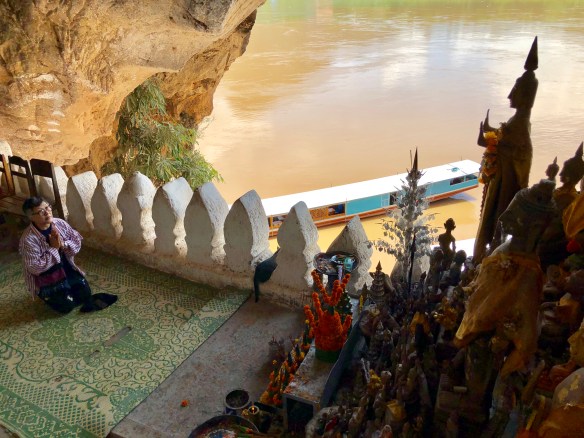
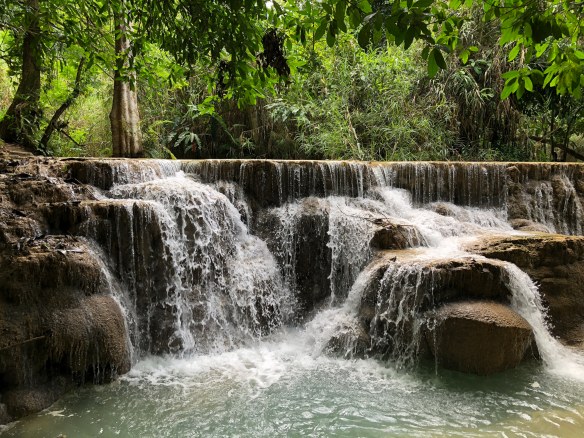
More uplifting was the tour I truly wanted to take—a day trip involving cruising down the Mekong, visiting a Buddhist shrine up a mountainside, having lunch at an elephant sanctuary, then taking in the fabulous Kuang Si waterfalls. At just $40 per person, including a nourishing lunch, it was a bargain.

The Mekong in Laos is the same immutable, undulating, coffee brown that it is in Thailand and Cambodia, but the boats are long and narrow, often painted in pink and blue, somewhat echoing the Laotian flag. Stately villas and temples overlook the river, and now and then elephants peek through the bushes along the banks.

Falls

Luang Prabang stands at the confluence of two rivers, one that started out in China and the other in Vietnam. So far from the ocean, it thrives on water—and tourists like us, willing to go the extra mile from Bangkok and KL.

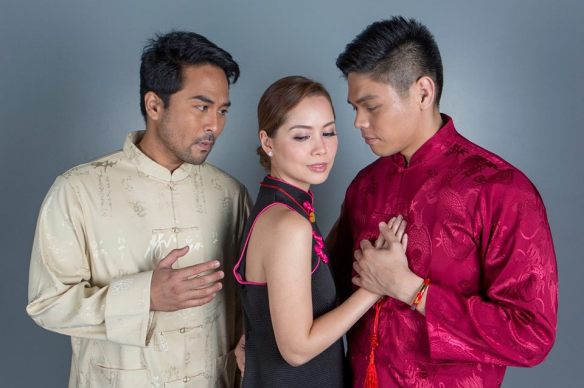
BINONDO 1 - FLOYD TENA, SHIELA VALDERRAMA MARTINEZ, ARMAN FERRER

Speaking of China, my wife Beng and I were having lunch at a Megamall restaurant a week ago when we suddenly heard mellifluous operatic voices singing in the lobby nearby. I took a peek and discovered that it was a mall tour to preview Binondo, a Tsinoy musical that’s opening on June 29, Friday, and July 1, Sunday, 8 pm at the Theatre in Solaire.

I got curious enough to seek out its publicist, Toots Tolentino, who told me that this was a love story, set in Manila’s Chinatown ca. 1971, involving a love triangle consisting of Lily, a night club singer and hopeless romantic; Ah Tiong, a scholarly cynic; and Carlos, a childhood friend. With book and lyrics by Ricky Lee and directed by Joel Lamangan, I can predict only good things for this musical, which is being produced by Synergy 88 Digital and Rebecca Chuaunsu Film Production. Rebecca, a theater artist in her own right, also wrote the original story.

I’ll take Chinese love triangles over Chinese island-hoppers anytime!