Penman No. 128: Sense by Sondheim

51xVXvpXz-LPenman for Monday, December 22, 2014

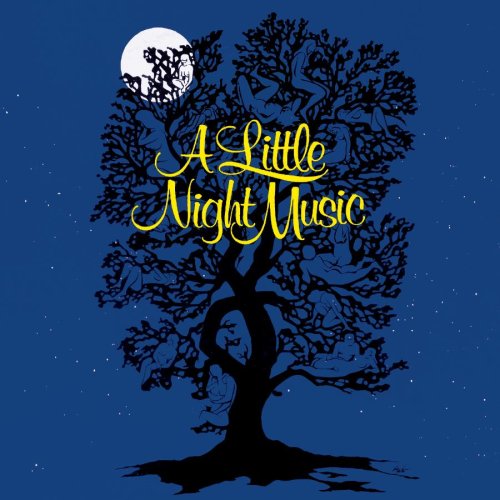
LAST WEEK, I mentioned having twice seen the HBO documentary on the life and work of the Broadway composer Stephen Sondheim, perhaps best known for the song “Send in the Clowns” from his hit 1973 musical A Little Night Music. Directed by James Lepine, Six by Sondheim walks us through the conceptualization and the composition of six of Sondheim’s most important songs: “Something’s Coming” (West Side Story); “Opening Doors” (Merrily We Roll Along); “Send in the Clowns” (A Little Night Music); “I’m Still Here” (Follies); “Being Alive” (Company); and “Sunday” (Sunday in the Park With George).

I’d have to admit that I didn’t know three of these songs; I knew and liked “Something’s Coming” as a big West Side Story fan, and “Send in the Clowns” and “Being Alive” from Barbra Streisand’s Broadway album, but the others were unfamiliar to me, which was just as well, as they were a pleasant discovery of other aspects of Sondheim’s craft.

That craft and the attitude that shaped it was something nurtured by Sondheim from a young age. When his parents broke up, the boy sought a sense of regularity and order, and surprisingly responded well to the routine of a military school. He found a hero in a family friend, the lyricist and librettist Oscar Hammerstein II, to whom he presented his early attempts at composition, only to receive a coldly professional—and cutting—assessment.

That didn’t faze Stephen, who went on to write the lyrics for West Side Story at age 25—and was unhappy about it, wanting to have written the music instead (Leonard Bernstein did). This was one of Sondheim’s (and any aspiring theater person’s) first and most important lessons: when you’re starting out, you learn to play the part you’re given. And Stephen did, exceedingly well: in the documentary, he talks about writing “Something’s Coming” using a succession of baseball metaphors that emphasized forward motion: “cannonballing down through the sky… catch the moon, one-handed catch!”

Sounds like poetry, but Sondheim is very clear about the difference between poetry and songwriting. While some lyrics may be poetic, songs, he says, have to be understood as they are sung; songs have to advance the dramatic situation, and help the listener grasp what’s at stake in the unfolding drama. Readers can go back and mull over the lines of a poem, but a song has to be instantly comprehensible.

Even so, Sondheim doesn’t succumb to the easy rhyme (the kind of song where you know “remember” will be followed by “September”). The words may be simple, but the ideas complex, as in “Being Alive”: “Make me confused / Mock me with praise / Let me be used / Vary my days.” His collaborators and directors like Hal Prince would agree that Sondheim doesn’t go for the simply hummable tune: he challenges norms, uses his music to put people not at ease, but at odds with oneself, as his characters often are.

His approach seems deceptively easy: “I scour the dialogue for lines. Or I might take a title line, then use its inflections to get the rhythm of the melody.” He likes to write lying down, taking a stiff drink now and then to loosen up. His love of word games (“It’s a very short road from the pinch and the punch / to the paunch and the pouch and the pension,” goes one of his lyrics) is mirrored in his collection of vintage board games and puzzles.

Also surprisingly, some of his best songs came as “throwaways” or space fillers, songs written to fill a gap in the drama or to wrap more tension around a character. “Send in the Clowns” was one such song—but here, for all that he maintained about the difference between songwriting and poetry, the poet prevailed. Director Hal Prince had asked Stephen to write the song for the character Desiree, played by Glynis Johns, and Sondheim had initially demurred, believing that the scene was properly the male character Fredrik’s. But he relented after seeing what Hal had in mind, and wrote the song in two days. Glynis would later say that as soon as they heard the first few notes, something stirred in the air and in their bones: they knew that they were hearing the birth of a great song. (The documentary presents it in a lovely montage headlined by Audra MacDonald and featuring, among others, Barbra Streisand, Glenn Close, Patti Labelle, Cher, and Judi Dench.)

But what did “Send in the Clowns” mean? Frank Sinatra, who sang it hundreds of times, professed that he didn’t really know. When I first mentioned the song in this column a few months ago, reader Ivy Cosio wrote in from LA to contribute this interpretation, for which I (and surely many readers and karaoke crooners) can only thank her:

“It’s basically a song of deep regret, irony, even anger but with a reference to the theater rather than the circus. Desiree (an actress) and Fredrik are former lovers who meet again after many years, and after many other men for Desiree. Fredrik is now married, but during a weekend in the country, he and Desiree spend the night together and she realizes that he has always been the one she wanted. She proposes marriage, but Fredrik refuses to be unfaithful. The tables have been turned—now Desiree is at last ‘on the ground’ and Fredrik ‘in midair,’ in love with his young wife. Desiree declares there’s no need to ‘send in the clowns’ to cover up a bad situation: looking at Fredrik, she sings, ‘Don’t bother. They’re here.’ It’s heartbreaking, because the truth is that Fredrik is still in love with Desiree. Stephen Sondheim, in an interview, revealed that the song came together for him when he wrote those two lines. He clarified that he used ‘clowns’ because that call—“Send in the clowns!’—was originally used in the circus to divert the audience’s attention when something went horribly wrong, e.g. when the lion tamer literally lost his head. But he meant it in the context of ‘fools” and for a brief moment considered changing the lyrics. It was a good thing he didn’t, because somehow ‘Send in the Fools’ doesn’t quite cut it!”

If you want to hear the rest of Sondheim and all the music that should go with this piece, look up Six by Sondheim on YouTube, and enjoy what I did.

Penman No. 127: Some Inflight Education

IMG_0231Penman for Monday, December 16, 2014


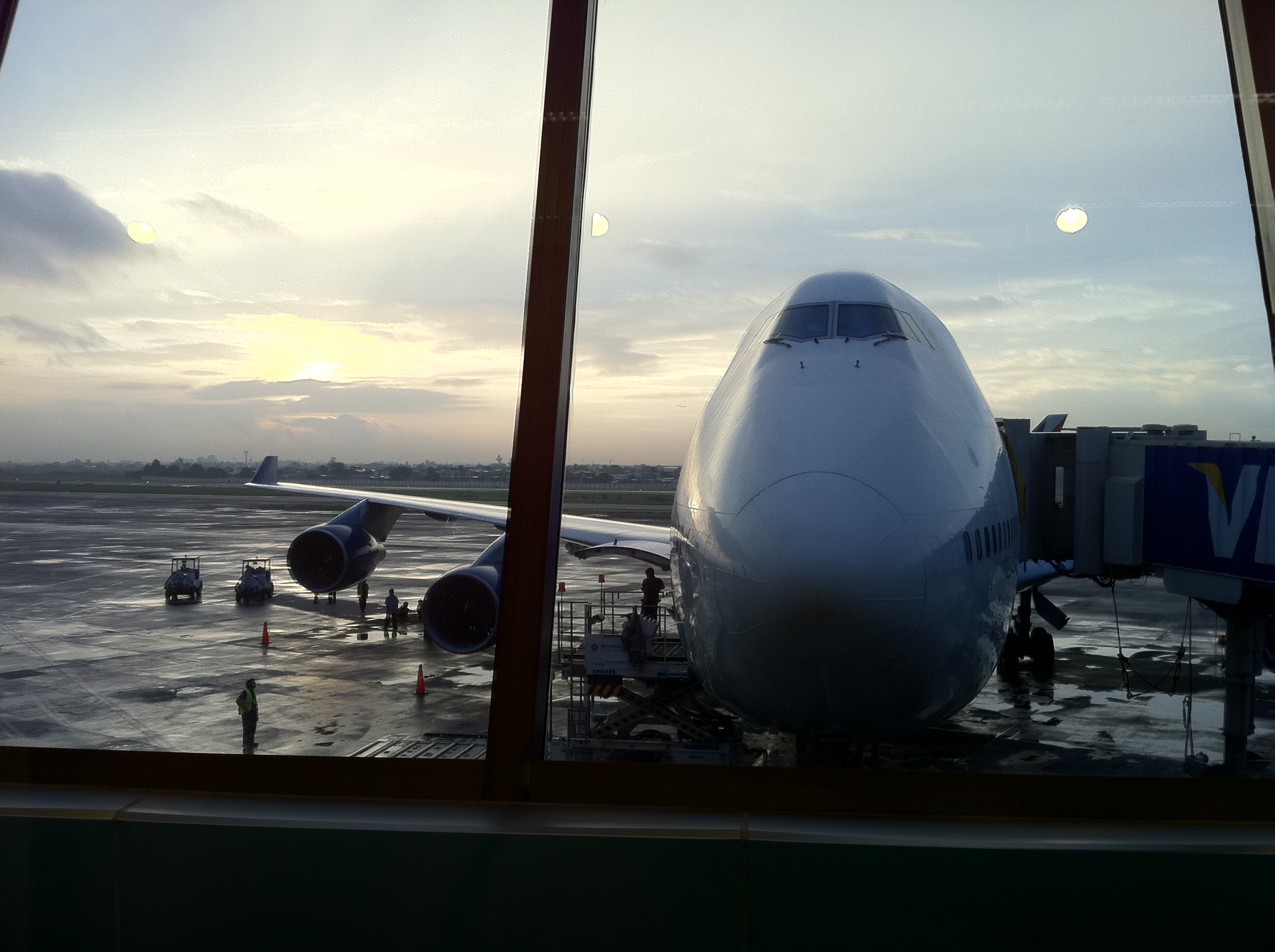
ONE OF the things I like about flying is the onboard fun that I can look forward to—the movies and the music, to be more specific. At my age, and with all the mucking about that I’ve done, I should be sick of these things and ply myself insensible with the free beer or wine somewhere between Anchorage and Nagoya, but the honest truth is, I’m not. I’m eager for entertainment, which is the only way I can forget the fact that I’m going to be up in the air for the better part of a 24-hour day. I don’t have a fear of flying; it’s boredom I can’t abide.

Being up there means that I can catch up on all the movies I never saw and didn’t even know existed. Beng and I almost always take in a movie after our weekly foot massage (such is life in the 60s), but we’re slaves to what’s out there, and not being too much of a cinephile I’m positive I’m missing out on the good stuff by sticking to the mall fare.

That changed last week when I flew home from Dulles airport outside of Washington, DC to Terminal 3 on the fringes of Pasay—a distance of 8,548 miles, according to Google. That meant 11:30 hours of self-amusement to contemplate, but I think I hit the jackpot—a trifecta in sporting terms—by watching three great movies on one long trip (I actually saw four, but I don’t think Hercules: The Thracian Wars is going to win the Palme D’Or).

I can’t get enough of documentaries, and I actually watched this one twice—the first time on the inbound flight last September, and again coming home. It was an HBO special titled Six by Sondheim, about the life and work of the lyricist-composer perhaps best known for that song everyone loves to sing but nobody really seems to understand, “Send in the Clowns.” (Reader Ivi Avellana-Cosio finally made sense of it for me.)

I just enjoyed the presentation the first time I saw it, but this second time, I was furiously scribbling away on my notebook with a fountain pen in the half-light, as Stephen Sondheim spoke about the creative process behind six of his best songs. Anytime you see me taking notes, it has to be that good, so I’m going to save the best of Sondheim for another column, which the material richly deserves. But just for starters, this was the man who wrote the lyrics and libretto for West Side Story when he was 25—a task he chafed at, wanting to do the music instead—but it proved to be a great learning experience, and Sondheim would go on to become a master teacher himself, like his mentor Oscar Hammerstein II and West Side Story collaborator Leonard Bernstein.

It was Bernstein, come to think of it, who once said that “Music is the only art incapable of malice,” which makes a good segue to my second choice, a film suffused with malice but whose central character, played by the Briton Tom Hardy, exudes an odd naivete. I’ll spare you the spoiler, but The Drop is as quiet and as deliberate a murder mystery as they come. Set in a bar in Brooklyn, The Drop has no car chases, no photogenic panoramas, and co-star Noomi Rapace puts it best when she squirms and says “I don’t want to be here.” We don’t, either, but we can’t help staying and looking, because we fear for the safety and the happiness of our unlikely hero, a quietish bartender who seems intent only on saving damsels and dogs in distress—at least until he draws a severed arm out of a bag; but I’ve already said too much.

And Tom Hardy makes a good segue to the last item on my playlist, which I watched on the Tokyo-Manila leg. He doesn’t appear in it, but is quoted—or I should say more than quoted, because we hear his voice again, speaking like a head in a paper bag, coming out of the mouth of someone who looks nothing like Tom Hardy, the British comedian and mimic Rob Brydon.

The movie was the rather tepidly titled The Trip to Italy, and the only reason I bothered to click on it was because I mistook it for a travelogue that would take me back to some postcard-worthy renditions of Tuscany and Umbria. Of course—away from the neorealism of Fellini and his crew—nearly anything in Italy is worth a postcard and indeed a book. That’s the burden of Brydon and his fellow comedian and travel companion Steve Coogan, who get sent on assignment as their real selves to trace the footsteps of Byron and Shelley in Italy while feasting on veal and artichokes and an endless parade of smart brunettes.

It’s a road movie and a buddy movie all at once, but it’s not Easy Rider or Butch Cassidy and the Sundance Kid. Real men don’t tool around the countryside in a Mini Cooper, twirling pasta on their forks while quoting the Romantics (“romantic poetry” to most guys comes with a small “r” and is best represented by Kenny Rogers and Michael Bolton).

The Trip to Italy is the kind of talky romp that fans of that taciturn trio of Seagal, Stallone, and Schwarzenneger would absolutely hate. Ninety percent of the movie is conversation—make that intelligent, hilariously intelligent conversation, and 50 percent of that 90 percent is comic impersonation, with the two guys doing their irrepressible impressions of Michael Caine and Marlon Brando, making Coogan and Brydon the Dwayne Johnson and Vin Diesel of roadside repartee. But for all the silly banter, there’s a poignance that underscores this movie that seems to be going nowhere, except deeper and deeper into the male psyche.

I thought I was up there for a load of entertainment, but instead I got a dose of inflight education. I can think of far worse ways of killing time.

(Posters from imdb.com and wegotthiscovered.com)

Penman No. 126: Friendships Old and New

IMG_5878Penman for Monday, December 8, 2014


OUR THREE-MONTH American sojourn has come to a close, and by the time you read this we should be back in Manila, a bit wobbly in the knees but glad to be home. I’ve gained back too much weight—the price to pay for all that scrumptiously greasy diner food and the cold spells that excused me from my daily walks—and I’ve begun to miss my morning tinapa and my suppertime tinola. But I’ve hit my research targets and more, and am eager to hunker down to writing the book that should come out of all this. I know that in a couple of weeks this vacation will be another happy memory, and I’ll be stuck in Christmas traffic on EDSA, sweltering and muttering why the heck I didn’t stay out there for another month or two.

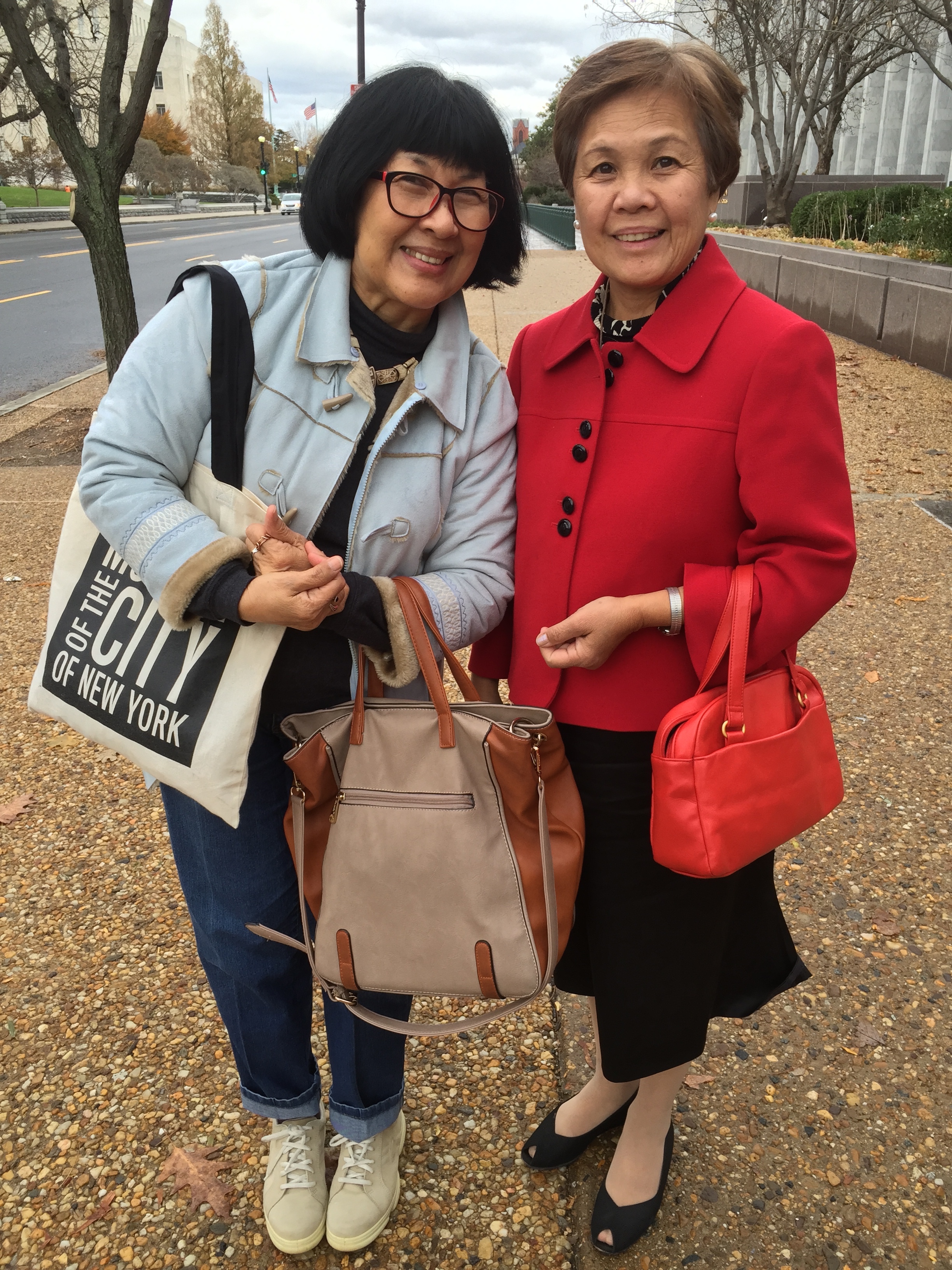
Before that happens, let me thank some very fine people we met during this visit, which apart from the work was marked by new friendships made, existing friendships strengthened, and old friendships revived. I’ve already thanked my interview subjects in a previous piece, but there were others behind the scenes who made this particular journey pleasant and memorable. They include Sonny and Ceres Busa, Nomer and Camille Obnamia, Erwin and Titchie Tiongson, and Jun and Myrna Medina.

They may just be names to those who’ve never met them, and indeed they’re not the kind of A-listers you’d find in the glossy magazines that make virtual libraries of Metro Manila’s beauty salons. Even among Filipino-Americans, just a few names keep recurring in the social registers, either titans of industry or doyennes of fashion—leading one to wonder, where’s everybody else and what are they doing? Surely the rich and famous have no monopoly on everything that’s interesting and important? So let me introduce these friends to the world at large, by way of celebrating the non-celebrity whose quiet deeds lend substance to the sparkle of those better known.

IMG_5703

IMG_6134

Sonny and Ceres hosted us twice at their postcard-pretty home in Annandale, Virginia and introduced us to the satisfying simplicity of Ethiopian food. The Waray-born Sonny had been a US consul in Addis Ababa, among other places, and his hilarious but spot-on insights into the American mind enlivened our every conversation. Ceres helps oversee a caregiving company for seniors in Virginia, a job eased by her patience and cheerful disposition, of which Sonny is luckily the prime beneficiary.

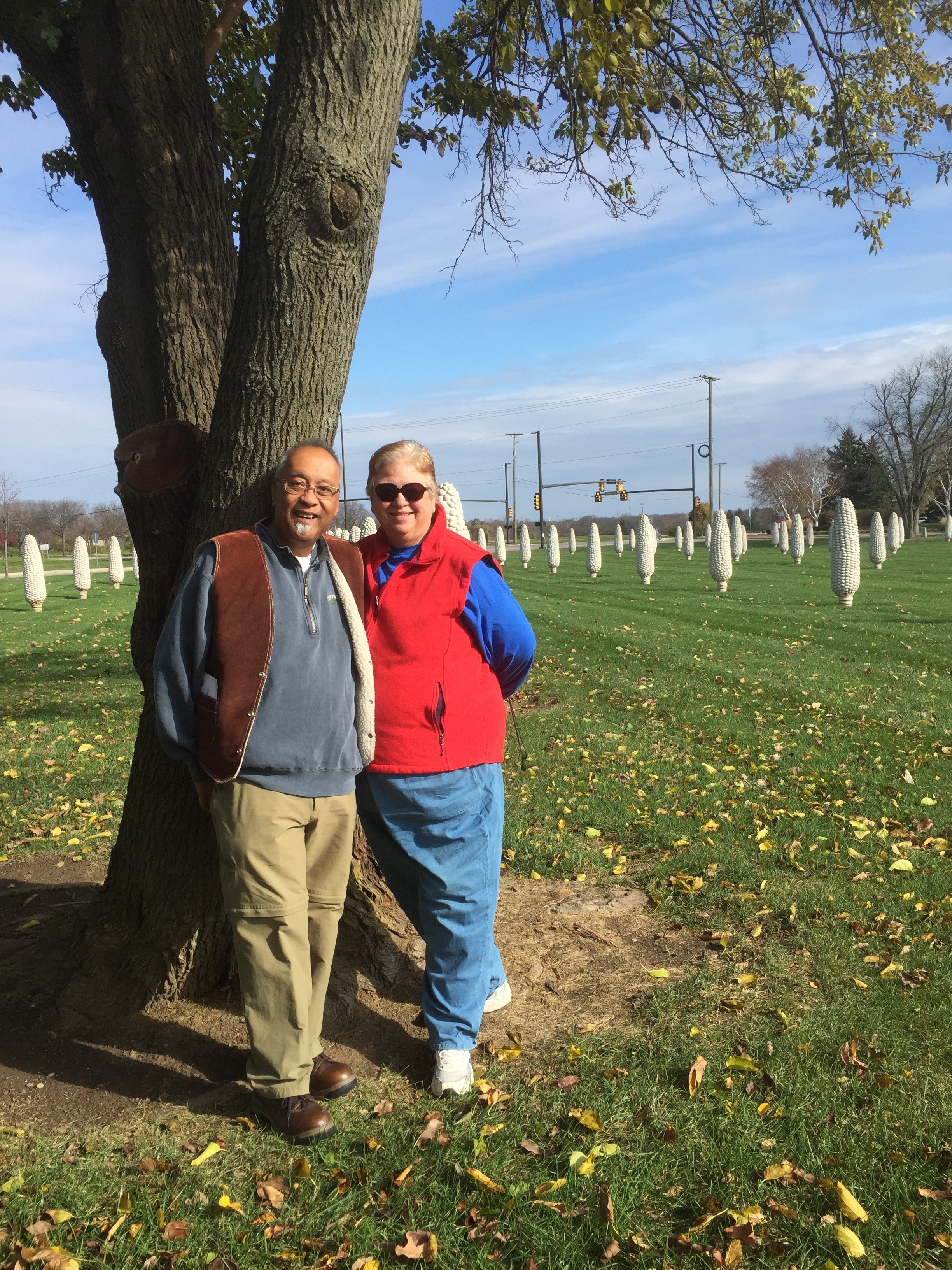
Nomer had been born in Sampaloc, Quezon and joined the Navy, where he met Camille in Hawaii; they’ve settled down in Columbus, Ohio, and our friendship began in the most unlikely circumstances. A committed conservative, Nomer had responded sharply to a column I wrote here years ago on artistic license, and our email conversation turned into a more gentle exchange of ideas and gestures. An expert in government procurement, Nomer had freely offered his counsel to our agencies and opinion-makers many times on ways of curbing corruption, but much to his dismay, his letters didn’t even merit the courtesy of a reply; I sadly felt obliged to tell him why. He and Camille took us into their home in the American heartland, where again I was reminded of the complexity and yet also the civility of much of American society, the challenges of Ferguson notwithstanding.

IMG_5951

As I wrote in this column two weeks ago, Eric and Titchie showed us, through their documentation of the Filipino presence in the capital area, that remembering the past need not be the preoccupation of the old, but has to be a continuing project for future generations to appreciate. A freelance journalist who’s been recognized for her work, Titchie wrote a fascinating article (http://www.oovrag.com/essays/essay2013b-3.shtml) about how a pretty stretch along the Potomac River was inspired by the Luneta, thanks to First Lady Helen Taft, who wanted the new park to mimic what she had seen in Manila, where her husband had served as Governor-General.

IMG_6089

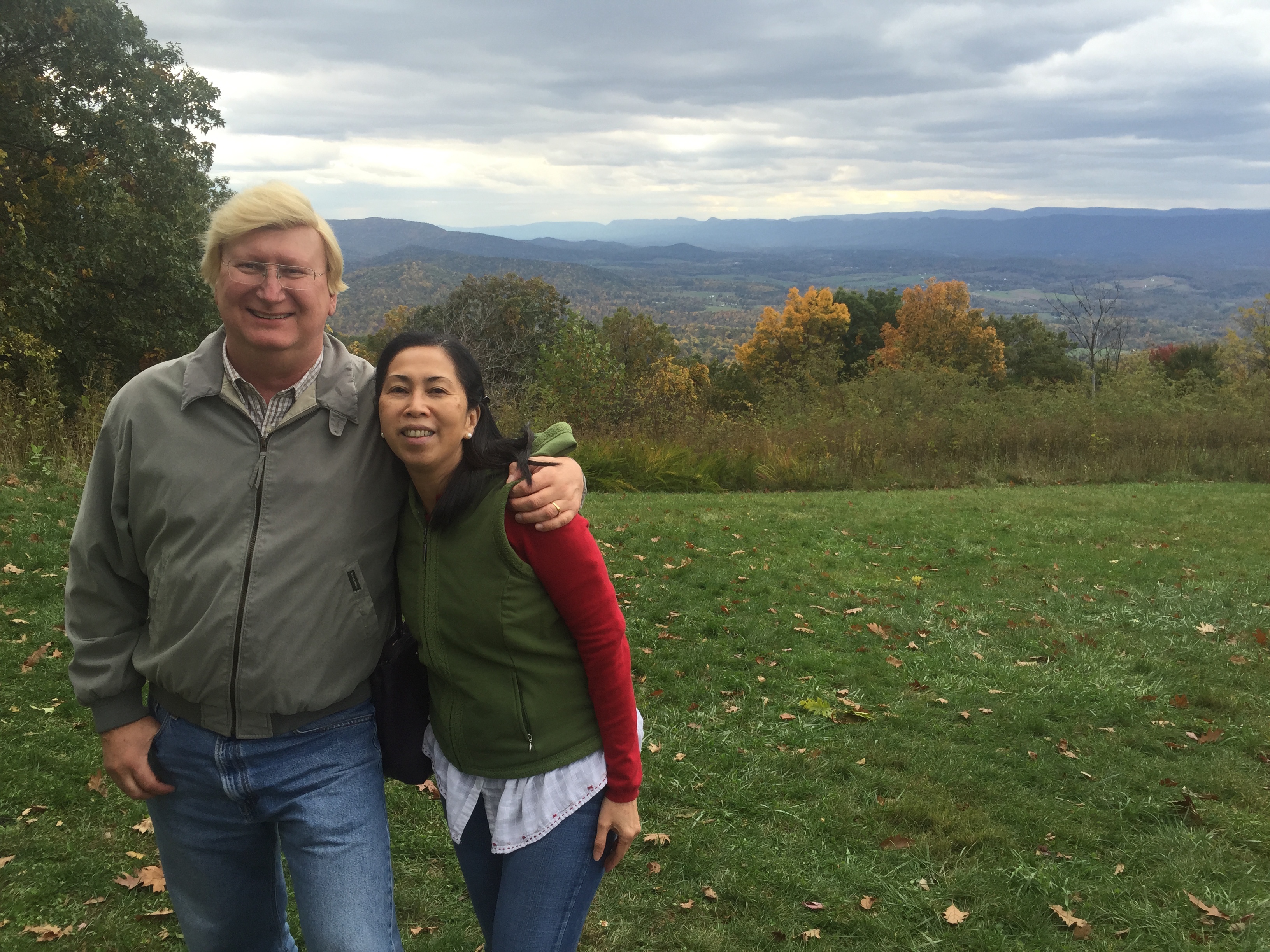
Jun and Myrna Medina are old friends from the early 1970s, married four days after Beng and I got hitched. When I met Jun after being released from martial-law prison, he literally emptied his wallet for me, and later helped me get a job, a favor that in turn allowed me to propose marriage to Beng. Jun had also been a newspaperman and a fellow activist before martial law, but what many of his friends didn’t know was that he had eagerly volunteered to join a group of cadres bound for the Visayas, only to be turned down because his Capampangan origins would have marked him instantly as an outsider and gotten him killed (as, tragically, would befall everyone else in that posse). Another spin of the wheel of life took Jun to America, where he and Myrna have devoted themselves to their charismatic ministry. I hadn’t seen Jun in at least 20 years—only to discover that the Medinas had been living barely ten minutes away from my sister’s place in Centreville, Virginia, my virtual second home.

IMG_6132

Of course, let me add our family—Elaine and Eddie Sudeikis in Virginia, Jana and Senen Ricasio in New York, and Demi and Jerry Ricario in San Diego—to our list of hosts and sponsors (led primarily by the Philippine American Educational Foundation, the Fulbright folks). Other friends new and old like Mitzi Pickard, Reme Grefalda, Susan Brooks, and Moira Madrid-Spahr also contributed their time and attention to my visit.

IMG_5392

IMG_6386

IMG_5240

I was hosted by the George Washington University, and from GWU I have to thank English Department chairman Robert McRuer, creative writing program head Lisa Page, and old Manila hand and law professor Ralph Steinhardt. Ralph helped prosecute the Marcoses in Hawaii for human rights abuses when he was a young lawyer, and I’ll always remember his story about the response of a plaintiff whom he warned against the rigors and the costs of fighting the Marcoses: “I just want to be believed.”

In the end, that’s all we can hope for, and may my forthcoming book be worthy of all these good people’s graciousness and generosity.

Penman No. 124: Pinoys on the Potomac

cropped-logo-rizal-washington8Penman for Monday, Nov. 24, 2014


ERWIN TIONGSON and his wife Titchie are in their early 40s, successful professionals and the parents of young sons; they live in Fairfax, Virginia, a pleasantly wooded suburb just outside of Washington, DC. An Atenean from Nueva Vizcaya, Erwin teaches Econometrics at Georgetown University, while Titchie, a prizewinning writer, has chosen to stay at home to look after the children. Outwardly they might seem to be just another Filipino couple living the good American life, steadfastly focused on the present and the future. But their true passion inclines elsewhere, as Beng and I would discover in one of the most fascinating encounters we’ve had in our current American sojourn.

I’d first heard about Erwin from another new Fil-Am friend, Sonny Busa, a retired Marine, a former consul and instructor in international relations at West Point. (Sonny, in turn, had been introduced to me by upstate-NewYork-based Sharon Delmendo, who has done a lot of research on Philippine-American relations—so now you see how the academic circuit works.) Sonny had mentioned to me that there was a Filipino in the community who had taken it upon himself to chronicle the history of the Philippine presence in Washington and the surrounding area—more than a century of visits and residencies by Filipino politicians, diplomats, writers, artists, musicians, and other personages whose life and work, in one way or another, drew them to the American capital.

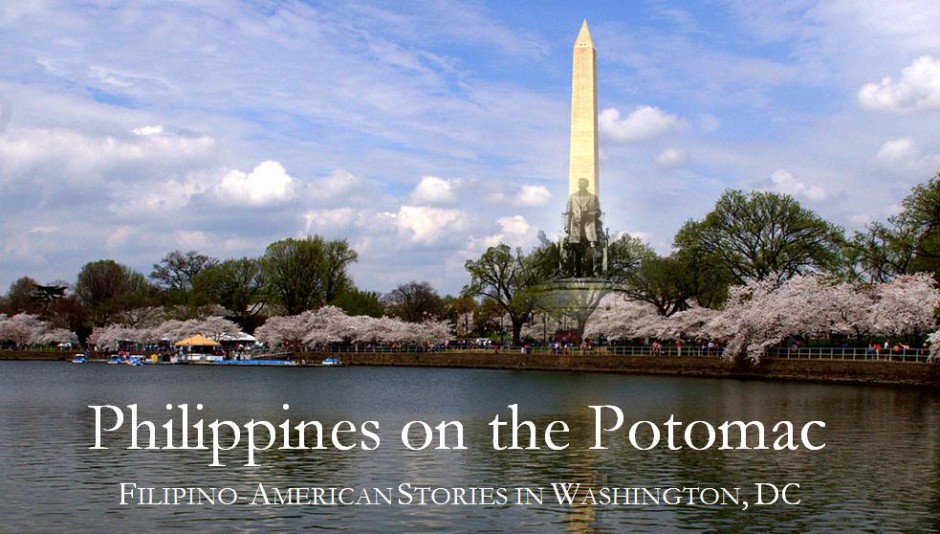
That’s how I found the website that contained all this information—a WordPress site titled “Philippines on the Potomac: Filipino-American Stories in Washington, D.C.” (https://popdc.wordpress.com). If you’ll take a minute to click on that link, you’ll discover what I did, with a child’s wonderment at the entrance of a carnival: short articles and accompanying photographs tracing the connections between Filipinos and Washington, DC.

As might be expected, the big political figures, especially those from the Commonwealth and postwar period, dominate the reportage: Manuel L. Quezon, Carlos P. Romulo, Sergio Osmeña, Manuel Roxas, and Jose Abad Santos. But cultural luminaries are also well represented: Juan Luna, Jose Garcia Villa, Juan Arellano, Enya Gonzalez, Fernando Amorsolo, and Bienvenido Santos, among others.

Quezon had served as Resident Commissioner—effectively our ambassador—in Washington until 1916, and when he went to the US on his wartime exile and died in New York in 1944, it was at the Cathedral of St. Matthew the Apostle in Washington—not too far from where our embassy now sits—where his funeral mass was held prior to his interment at Arlington (less than 20 years later, John F. Kennedy would follow the same route; MLQ’s remains were moved to the Philippines after the war, and now lie at the Quezon Memorial).

Carlos P. Romulo and his family lived in a home on Garfield Street for 16 years, CPR having served in many capacities, from aide de camp to Gen. Douglas MacArthur to Resident Commissioner, ambassador, and president of the United Nations General Assembly. (One of the website’s most remarkable images has an old sepia photograph of the Romulos superimposed exactly over the same spot in front of the present house, which has barely changed.)

The site provides a treasure trove of other historical facts—including, inevitably, tidbits of information that serious scholars might dismiss as trivia, but which enthusiasts like me can’t get enough of. The sculptor and National Artist Guillermo Tolentino, for example, once worked as a waiter in Washington, and somehow managed to meet President Woodrow Wilson and to present him with the gift of a small statue, which Wilson kept in his room until his death; Wilson later helped Tolentino get a scholarship to art school. We also learn that Juan Luna and Felipe Agoncillo went to Washington in 1899 to campaign against the Treaty of Paris, and stayed at the Arlington Hotel, where they were spied upon by the Secret Service. (All these stories are properly attributed and referenced, by the way.)

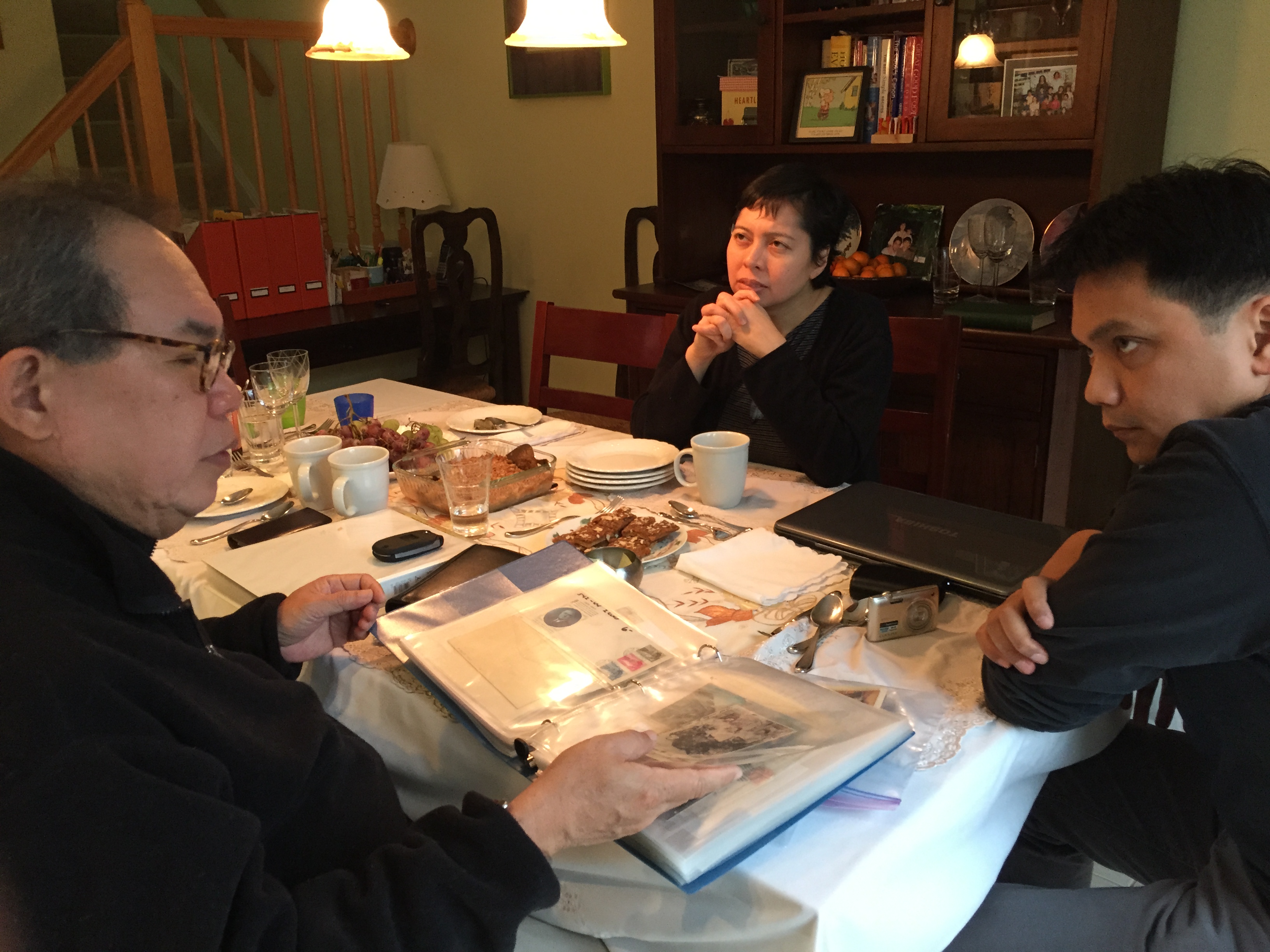
Better than just poking around the website, the Tiongsons invited us to lunch and show-and-tell, and I couldn’t wait. Learning of my current affiliation with the George Washington University, Erwin had pointed me to an article written by CPR’s granddaughter Liana relating how Romulo had coached a debating team from the University of the Philippines in an engagement with the GWU team, over this issue: “Resolved, That the Philippine Islands should be granted immediate and complete independence.” The debate took place on April 18, 1928 at GWU’s Corcoran Hall. “UP won,” said Erwin. “It was the team’s fifth victory, after defeating Stanford, California, Utah, and Colorado. The team would go on to defeat all their other opponents—a total of 14 universities, if I remember correctly.”

Tiongsons

Even more interesting were the personal stories that Erwin and Titchie shared with us (after a sumptuous lunch of home-made corned beef and baked salmon, which all by itself was well worth the Sunday visit). I can’t go too deeply into the details now, but Beng and I were thrilled to share Erwin’s elation over his most recent discovery, a book that had been inscribed by Maximo Kalaw, MLQ’s private secretary, to a “Nina Thomas”—who turned out to be the American lawyer the young Quezon had been engaged to (he broke off the engagement after being advised that marrying an American was political suicide). Erwin made contact with Nina’s heirs in Virginia; she never married, but she passed on Quezon’s monogrammed walking stick and their engagement ring to her niece.

Erwin also showed us a movie poster from 1946 of Anna and the King of Siam, featuring Rex Harrison, Irene Dunne, and a little-known actress named “Chabing”—who turned out to be Isabel Rosario “Dimples” Cooper, Douglas MacArthur’s girlfriend (not mistress) between marriages; after MacArthur left her, she resumed her film career (she was notable for having recorded the first on-screen kiss in Philippine movies in 1926), assuming the single name “Chabing,” whose filmography you can look up on IMdb.

It was also a treat to listen to a radio recording of Jose Garcia Villa, made in the 1950s, of him reading his “Lyric 17” (1942) which famously begins with “First, a poem must be magical….” Most moving was the 20-minute documentary of President Quezon’s funeral—directed by no less than the renowned director John Ford—that Erwin had magically retrieved from somewhere in the many university libraries, archives, and museums that he still haunts in search of fugitive Filipiniana. He has begun a collection of war correspondence from the early 1900s and the Second World War; one 1902 letter poignantly retained a swatch of jusi, which the wife of an American official in Iloilo wanted her folks to see.

We could have stayed there the whole day, reveling in our memories of the grand old men of Philippine letters—NVM Gonzalez, Ben Santos, Nick Joaquin, Manuel Viray; I shared my own little adventures in cultural retrieval. But Beng and I had sadly had to trundle out again into the autumn chill, warmed by our imaginations, and in my ears rang a line from Viray’s poem about his old house in Washington, on Cathedral Avenue, which the Tiongsons had also located: “A streak of light aslant / On the screen door creeps up the line of dusty books.”


Penman No. 123: The Power of Panorama

Penman for Monday, November 17, 2014


I’M BY no means a professional photographer, but as a fairly frequent traveler and occasional journalist, I’ve had to take my own photographs to accompany my articles and my blog pieces. Not surprisingly, some of my pictures have been good, some bad, although I would hope that I’ve shot more of the former than the latter overall. I’ve been dabbling in photography, after all, since the 1970s, when we learned to develop and print our own black-and-white film, and were ever aware of how much film and paper cost, not to mention the SLRs and the lenses that we lugged around.

Digital photography, of course, has changed all that. I started toting a 2-megapixel Canon Ixus around 2001—costing me what a new iPhone 6 would today—and instantly I knew that there was no going back to dark rooms and smelly chemicals, at least for an amateur like me. (That Ixus, by the way, took amazingly sharp shots, one of which I still use as the wallpaper for my big iMac—proof that it isn’t all about megapixels.) Since then I’ve dealt with a train of other digital Canons, Casios, Panasonics, and Leicas, all of them rangefinders. And then, a few years ago, I switched to a Nikon DSLR, followed by the inevitable and financially excruciating lens chase that every photography enthusiast knows. Eventually I got those I really wanted—a long zoom, an ultrawide—and happily shot away in sorties to China, the US, Israel, Corregidor, Batanes, and many other places worth toting a heavy bagful of gear to.

And then the iPhone 4 came along. All of a sudden, I had a phone whose camera seemed good and sharp enough for most daily uses (night is something else). More and more, I began taking just the iPhone and leaving the bulky DSLR behind. Aside from and because of its small size, shooting with your phone’s camera has its advantages; you can shoot unobtrusively, within seconds of spotting your subject, and you won’t look like you’re begging to be mugged and to have your precious cargo carted away.

Cameraphones, conversely, have their disadvantages. They’re generally not too good for night shots, unless your subjects are brightly lit, and while the digital zoom can make your subjects bigger, the closer you get, the grainier the image becomes. In other words, for best quality and for mission-critical work, there’s really no perfect pocket substitute for the big cameras and lenses. (Other than the Nikon, my favorite standalone camera for many years was the Leica D-Lux 3, which created razor-sharp images in the 16:9 format.)

But that said, for most uses that don’t require more than a 4”x 6” printout or screen image, an iPhone’s camera will do just fine. My iPhone 5s was the only camera I brought with me on our family’s two-week jaunt across Western Europe last May, and it served us superbly in Madrid, Barcelona, San Sebastian, Venice, Florence, and Paris—all places with fabulous photographic possibilities. Sure, I missed the kind of tightly cropped detail that a telephoto lens is great for, but casual tourism is mostly about scenery, which means that wide-angle or panoramic shots are more useful.

This brings me to my topic for the week, the power of panorama. It’s a power that’s been right there in your iPhone since iOS6 (and very possibly in other smartphones as well), waiting to be unleashed. A panorama is a very wide, narrow picture that covers practically everything before you, and maybe even behind you. The built-in Camera app on the iPhone offers several options for picturetaking: time-lapse, slo-mo, video, photo, square, and pano.

We take most pictures with the “photo” option, yielding a regular rectangular frame, vertical or horizontal. If you’re happy with those pictures, fine. But you should know that, especially when you’re in a spectacular tourist spot and need or want to capture as much of that scene to bring home with you, then the “pano” or panoramic option can be your best friend.

It takes a bit of self-training, and there are many guides online to help you take a good panoramic pic (just Google “taking panoramic shots with an iPhone”). What it basically involves is choosing and standing at a good vantage point, opening the camera, choosing “pano”, pressing the button, then moving on your heels in a semi-circle from left to right, following the guide arrow until the full panorama is taken.

Your first shots will likely be misfires, full of unwanted detail, bodies with missing heads, the same person appearing in two or three different spots, very bright and then very dark bands, and so on. But over time, you’ll get the hang of it, and learn to avoid the pitfalls. For example, you’ll learn to generally avoid scenes with lots of moving figures (although the motion blur and duplication of people can also be aesthetically appealing); you’ll learn to pre-visualize the scene, deciding just how much to cover instead of the full 240-degree sweep of the app.

If you’re careful and lucky (you’ll need to be both), you can capture a scene that’s not only visually breathtaking, but also socially observant, like a Hogarth drawing with a lot of interesting detail in the little corners. That’s what I was going for in my pano shot of an afternoon in Madrid’s Plaza del Sol, where an anti-fascist rally literally marched right into the restful mood of other Madrileños in the frame. My shot of the riverfront of Cold Spring in upstate New York seeks to blend natural scenery with human habitation, and that of an early evening in Manhattan’s Bryant Park plays on light and shadow, and the city’s iconic skyline.

Don’t forget that you can and probably should crop and edit the image afterwards, to remove ragged edges up and down caused by uneven shooting (you weren’t following the arrow, tsk tsk), to go for a tighter frame, and to adjust the exposure. Consider, too, other apps like Google’s free Photo Sphere, which yields even more stunning—and seamless—360-degree pictures, for a fully immersive experience approaching virtual reality.

Whether you’re in your office or on top of the Great Wall of China, a good panoramic shot can be your best and most comprehensive reminder of where you were and what it felt like. But you’d have to remember the option. Speaking of the Great Wall, we were there a couple of Decembers ago, all by our freezing lonesome in Mutianyu. Rendered speechless by the majesty, it was only on the van back to downtown Beijing that I realized that I’d been on top of the world—and forgot to take it all in.

Penman No. 122: A Meeting in Manhattan

IMG_5861Penman for Monday, November 10, 2014


BENG AND I were in Philadelphia and New York these past two weekends, so I could do more interviews for my martial-law book project and also get in touch with a few old friends. I normally keep a very low profile and don’t tell or call people when I travel to places where friends are living, not because I’m a snob, but because I don’t want to be a bother, knowing what it’s like when somebody drops in from the blue and throws your schedule out of whack.

But there are always some friends you never mind breaking your routine for, and who never seem to mind, either, if you break theirs. And I was glad to meet up in Manhattan with two such writer-friends, the poet and essayist Luis “Luigi” Francia and the fictionist Gina Apostol, both of whom live and work in New York. Luigi teaches at Hunter College and Gina at the Fieldston School.

The first time I met Luigi, many years ago in a Malate bar on one of his visits home from New York where he has been living since 1970, I remember seeing his calling card, which described him thus beneath the name: “POET. EDITOR. PRINCE.” It seemed cheeky and chic, and I was deeply impressed, being none of the above. (I’ve since written some middling poetry and have done my share of editing chores, but remain utterly unprincely.)

IMG_5856

I had the recent pleasure of writing a blurb for Luigi’s forthcoming collection of essays titled RE: Reviews, Recollections, Reflections, to be published by the University of the Philippines Press, and this is what I said:

“Luis Francia knows New York and America better than many of the native-born, but he never loses his moorings, his critical awareness of what it means to be Filipino-American. But these essays are about far more than racial politics, as they chronicle the travails of that most blessed and in other ways most cursed of citizens—the artist, particularly the artist abroad, for whom alienation acts as a lens that magnifies and reshapes every little thing that crosses the eye. The most arresting and delightful reads are his portraits of the expatriate masters who preceded him in America—most notably Jose Garcia Villa, lover of martinis and hater of cheese. Despite the plaints, Francia has been clearly and distinctly privileged to be where he has been and to see what he has seen, and he shares that privilege with us in this well-wrought collection.”

Gina was my batchmate when I returned to finish my undergrad studies in UP in the early ‘80s; I was ten years older than everyone else, so I was kuya to all of them. It was a time when we were all dreaming of finding a way to take our graduate studies abroad—as English and writing majors, we wanted to become the next Gabriel Garcia Marquez, the next Sylvia Plath, the next Ian McEwan, the next Pablo Neruda, and so on; as Pinoys, we wanted to see America. Eventually, we just became our older selves, but we did get to see the States through one ticket-paying subterfuge or other—for me, a Fulbright grant; for Fidelito Cortes, a Wallace Stegner fellowship; for Ramon Bautista, an assistantship at Wichita. But we had to compete for these, while all the brilliant Gina had to do was to lick a few stamps and mail a couple of her typewritten stories off to John Barth, who directed the writing program at Johns Hopkins and who wrote her back forthwith to offer her an assistantship, smitten as he was with her talent. It was pure magic, in those pre-email days.

That brash young woman from Tacloban who flew off to Baltimore would go on to write several prizewinning novels. Gun Dealers’ Daughter, published by W. W. Norton, won the 2013 PEN Open Book Award given by the PEN American Center to outstanding works by authors of color to promote racial and ethnic diversity within the literary and publishing communities. (Luigi himself had won this prize in 2002, the first year it was given, for his nonfiction book The Eye of the Fish.)

Here’s what the judges said about that novel in their citation: “You will read Gun Dealers’ Daughter wondering where Gina Apostol novels have been all these years (in the Philippines, it turns out). You will feel sure (and you will be correct) that you have discovered a great fiction writer in the midst of making literary history. Gun Dealers’ Daughter is a story of young people who rebel against their parents, have sex with the wrong people, and betray those they should be most loyal to…. This is coming of age in the 1980s, Philippine dictatorship style, where college students are killed for their activism. The telling is fractured, as are the times…. Not only does this novel make an argument for social revolution, it makes an argument for the role of literature in revolution—the argument being that literature can be revolution.”

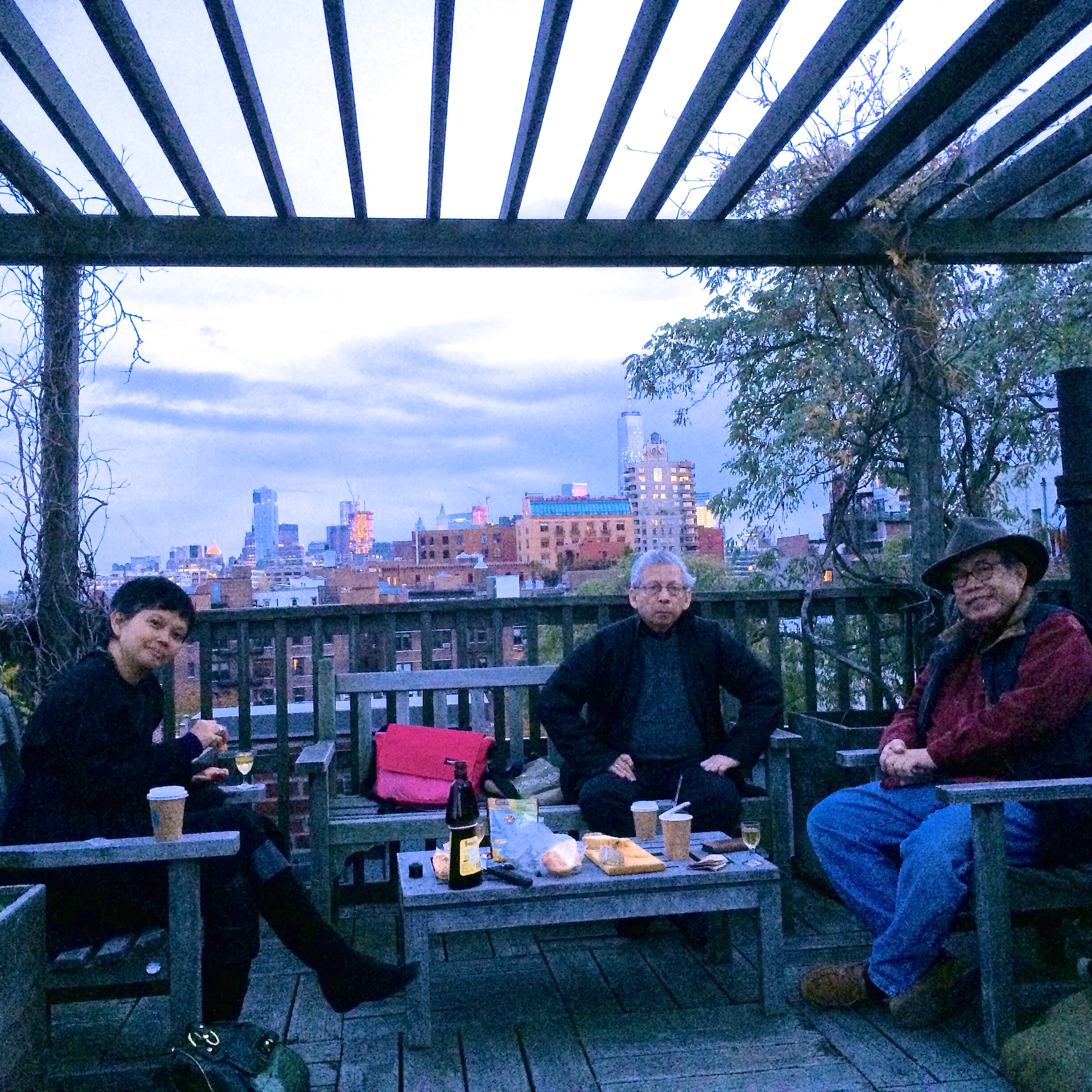
These then were the two literary luminaries who happened to be my friends (or should that be the other way around?) whom I was happy to set up a date with in a coffee shop in the West Village, near the High Line (an elevated garden and walkway that deserves its own story, among other New York landmarks). The coffee place was full, so we brought our steaming cups instead up to the roof deck of Gina’s apartment a few blocks away, pausing for a picture in front of the late Jose Garcia Villa’s old place on Greenwich Street. “This was where he held court,” said Luigi, one of Villa’s acolytes. “Nonoy Marcelo also lived in this area for many years, and I did, too, back when the rent was 65 dollars a month.” Then Gina added, “That white place is where John Lennon and Yoko Ono lived.” And I thought, if they’d stayed here instead of moving to the Dakota, he might still be alive.

We went up to the roof deck and Beng and I savored the scenery in all its 360-degree magnificence, as the sun set in the west and the full moon rose in the east, competing with the Empire State’s tricolor spire. We talked books, life, and loves over Frangelico, bread, and cheese; channeling Villa, I steered clear of the curd. Looking sharp and happy despite a recent illness, Gina said that her iPhone’s Siri had told her, in response to a question, “I’m just glad to be alive!” At that instant, we all were.

Penman No. 121: Souvenirs of Washington

SouvenirPic

Penman for Monday, November 3, 2014

A COUPLE of weeks ago, walking from my sister’s office in downtown Washington, DC to the library of the George Washington University, I paused at the corner of 19th and I (or “Eye”) Streets, and was overcome by a sense of déjà vu. I vaguely recognized the place, but something had changed—the old Presidential Hotel was no longer there, replaced by the Presidential Plaza, a grayish, nondescript commercial building replicated on a hundred other blocks in the city. It was what had stood at that spot that I suddenly missed: the hotel, built in the 1920s—and me, more than half a lifetime younger and suitcase in hand, looking up at my first American abode.

It was September 1980, I was 26 years old, and I was on my first foreign trip—to the United States, no less, thanks to a generous and visionary boss who thought that a budding writer like me could benefit from some exposure to the outside world. He arranged for a grant that would introduce me to media organizations and practices in various places in the US for three months, and within a month of being told that I was leaving, I was—all gussied up in a scratchy double-knit suit, which was what I thought any Stateside-bound traveler worthy of respect was supposed to wear.

After stops in Honolulu and San Francisco, I arrived in Washington on a nippy autumn morning. My first American mystery greeted me in a sign just outside the airport: “PED XING.” What on earth did that mean, I thought—could there be so many Chinese in Washington? I took a cab to my hotel, the Presidential on 19th and I, and was met by the doorman, who suspiciously resembled—and indeed was—a kababayan. I felt instantly relieved. He seemed happy to see me as well, and after effusive introductions and references to the motherland, he showed me to my room, up on the fifth floor.

Unable to sleep, I stepped out, still in my suit, and surveyed the streets around me. I got hungry and saw a classy-looking restaurant at the corner. I had several hundred dollars on me—partly my allowance, and partly my life savings—in cash; I felt rich. I stepped into the place, and ordered quarter of roast chicken. It cost me eight dollars, and I dutifully tacked on a 15% tip, like the guidebook said. I walked around the corner to K Street, and saw a luggage store; I walked in, and all too quickly fell in love with a saddle-leather Schlesinger briefcase. “How much?” I asked. “One hundred dollars,” the lady said. “I’ll take it!” I said, and forked the cash over; it would be eight years before I would get my first credit card, but that’s another story.

I walked back to my hotel, feeling very businesslike with that briefcase that smelled positively posh, and just outside the hotel, on the bus stop along the sidewalk, I noted my second American mystery: another sign that said “No Standing.” How was one supposed to catch a bus or a cab, I wondered, if they couldn’t stand there, and I couldn’t see any seats, either. I fell asleep that afternoon, with the Schlesinger beside me in bed, only to be woken up by a loud rap on my door. It was my kababayan the friendly doorman, and it must have been past nine in the evening. “Padre,” he whispered, “could you lend me twenty dollars? I have a hot date tonight and don’t want to disappoint her, I’m just a little short!” He winked conspiratorially, and I slipped him the twenty, and went back to bed.

Many more interesting things would happen to me during that visit, but that was the last I saw of my new kaibigan and of my twenty bucks. The next day, I went back around the street to look for a breakfast place, and saw my first McDonald’s. It was my first American fast-food experience, and I felt flustered by the array of comestibles on offer overhead. Forgetting for a second where I was, I glanced at the two Pinoy-looking ladies in the line beside me and asked, in Tagalog, “Miss, paano ba umorder dito?” and they told me how. They turned out to be secretaries at the World Bank. Later that day, when I told the cook at the cafeteria in our sponsoring institute about my eight-dollar lunch, she laughed and said, “You shoulda framed that chicken!” before serving me a full meal for $2.50.

Since I was going to be in Washington just briefly being flying onward to my main destination in East Lansing, Michigan, I resolved to make the most of my visit by touring as much of DC as I could. Our daughter Demi was just six years old, and I sent her postcards and pictures that I took of squirrels running around the White House lawn. Outside the Smithsonian, I lingered before the souvenir carts before choosing a tall ceramic (at least that’s what I thought) mug that said—what else—“Souvenir of Washington, DC” and featured the relief facade of the Capitol building. (I would later discover, back in Manila, that the mug was made of plaster, and made in Taiwan.)

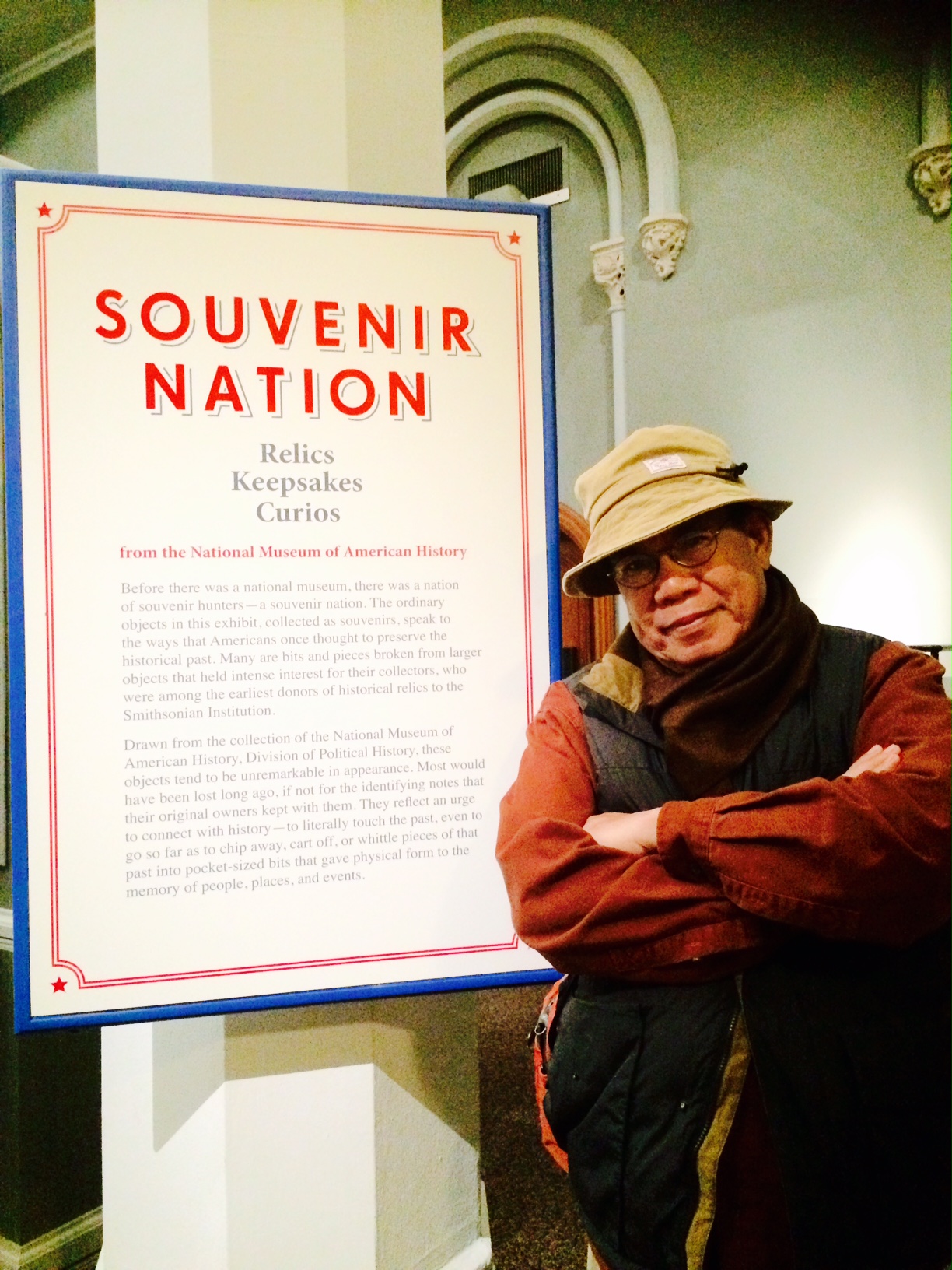
All these came back to me as I stood at that corner of 19th and I, feeling a little foolish but feeling even luckier to be alive at all and back in the same spot, much bulkier from ingesting untold hundreds of chickens and Big Macs since then, but not all that much the wiser. And as it happened, when I walked the other day into the Smithsonian Castle, on exhibit was “Souvenir Nation”—a show of how people have kept pieces of the past to form their own personal histories.

I’m over souvenir mugs, but I still keep that Taiwanese token on a shelf back in Diliman as a reminder of one’s innocence or stupidity—one or the other, although I can be fairly sure by now that there’s hugely far more of the latter in Washington than the former. And I still have the Schlesinger briefcase, all beat up as it should be after 34 years, but still handsome in a rugged way, which is more than can be said for its owner. No, I’m not over fine leather briefcases; I saw the very same case on eBay last week, selling slightly used for $25, and I snatched it up to replace the old one—as a souvenir of this great and wondrous city of Washington, DC.

Penman No. 119: Bulosan in the Heart

Penman for Monday, October 20, 2014


TAKING A short break from my fellowship in Washington, DC, Beng and I flew off to the West Coast a couple of weeks ago for a weekend with our daughter Demi and her husband Jerry. Demi was celebrating her 40th birthday (can you believe it?) and had sent us tickets to join them in Seattle; they live in San Diego, but they’d loved Seattle from a previous visit and wanted to share that discovery with us.

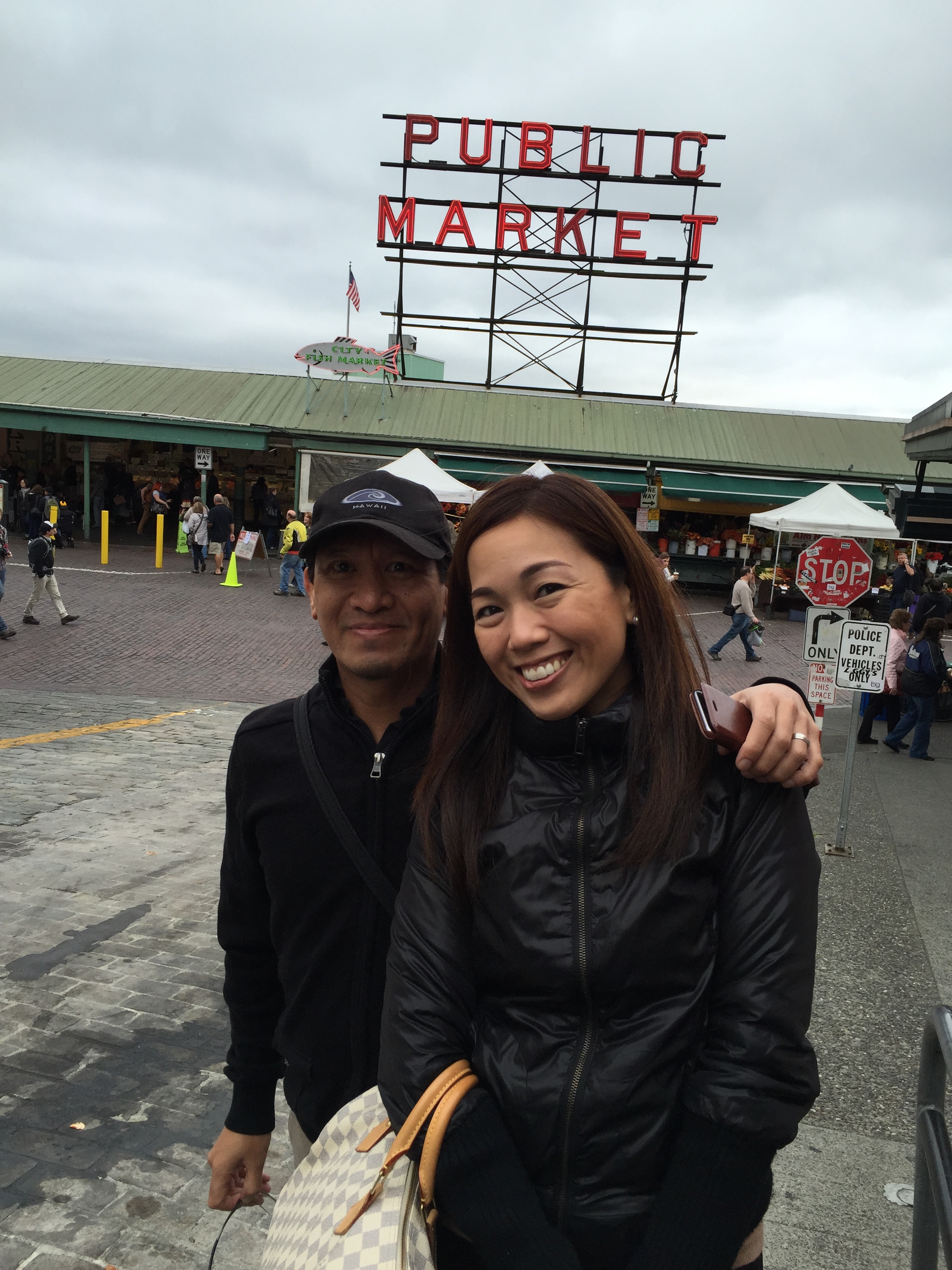
Over three days, we did the Seattle thing, and had loads of fun: the Pike Place Market, the Space Needle, a glimpse of the Chihuly glass garden, antiquing in Snohomish, and a boys’ tour of the Boeing plant in Everett. But it was an unexpected turn in the program that made it all the more worthwhile.

On the drive into the city from the airport, I had mentioned to Jerry (who had been born in Rhode Island to parents from Bicol) that two Asian-American icons—Carlos Bulosan and Bruce Lee—were buried in Seattle. Jerry’s an engineer in the aviation industry, but like Demi, he has a keen interest in culture and in his roots.

Bulosan’s name holds a special significance for our family. In high school, with some help from Beng, Demi had put together a book report on America Is in the Heart—Bulosan’s sprawling semi-autobiographical novel about the Filipino immigrant experience in America, first published by Harcourt Brace in 1946. I myself had written my undergraduate thesis at the University of the Philippines on Bulosan, fascinated by his often paradoxical appreciation of America, which he described as being at once “so kind and yet so cruel.”

Born in Pangasinan, he shipped out to Seattle in 1930, and never returned until his death from bronchopneumonia, also in Seattle, on September 11 (yes, 9/11) in 1956. (There’s some debate over the year of his birth, which has been variously listed as 1911, 1913, and 1914.) In the US, without the benefit of college, he became a voracious reader and taught himself to write, and became known both as a writer and a labor activist. Since the 1970s, many critics such as Epifanio San Juan Jr. have championed a reappreciation of Bulosan and his work; in 1973, the University of Washington Press republished America Is in the Heart, which was translated into Filipino as Nasa Puso ang Amerika by Carolina S. Malay and Paula Carolina S. Malay and published by Anvil in 2000.

When Demi and Jerry made plans to marry in 2007, I knew what I was going to give them as a wedding gift. After a long and eventful search culminating in a meeting with the seller in a Jollibee in Diliman, I had just acquired a first edition of America Is in the Heart, and carried it with me to San Diego. This copy had been inscribed by Bulosan to his friend Fred Ruiz Castro: “This story of my life will, I hope, bring me closer to you and our native land through our good friend J. C. Dionisio, with my best wishes, Carlos Bulosan, Los Angeles, 3-6-1946.”

Upon receiving the book in Manila almost a month later, Castro—who became Chief Justice in 1976—also signed it on April 4, 1946. I signed the book on a following page on April 2, 2007, and Beng and I presented it to Demi and Jerry on April 15. The book now rests proudly on their bookshelf in San Diego. (When I first wrote about this in my column—about finding that “holy grail” of a signed first edition and giving it to our only child on her wedding in America—I got a pleasant surprise upon my return: the gift of another copy of an early edition, acquired by another Filipino writer when he was in college, Greg Brillantes. That book, signed by Greg, now sits on my topmost shelf in Diliman.)

Now back to Seattle. On our last full day there, after touring the Boeing plant in the morning while our wives did their own thing downtown, Jerry and I were hit by the same brain wave in the car: why not look for Carlos Bulosan’s grave and pay our respects to our literary hero? A little Googling quickly revealed his gravesite, at the Mt. Pleasant Cemetery on Queen Anne Hill. We picked up Beng and Demi at the hotel, and located the cemetery not too far away.

GPS helped bring us there, but it couldn’t pinpoint the exact grave among the many hundreds on the site; thankfully, Google also yielded a picture of the grave itself, and the four of us spread out across the cemetery, looking for visual markers—particularly a white obelisk in the distance; it took about 20 minutes until Demi yelled “I found it!”

It was, ironically, very close to the cemetery gates, on the left side. Beng picked some flowers nearby and offered them at the foot of the marker, which read: “CARLOS BULOSAN 1914-1956 Writer Poet Activist,” followed by an epitaph that Bulosan himself had written: “Here here the tomb of Bulosan is / Here here are his words dry as the grass is.” It was a pretty spot, truth to tell, and the grass was hardly dry. After the cemetery, we visited Seattle’s International District near the waterfront, to peek at the Bulosan exhibit through the windows of the historic Eastern Hotel, where Bulosan and other Filipino cannery workers lived.

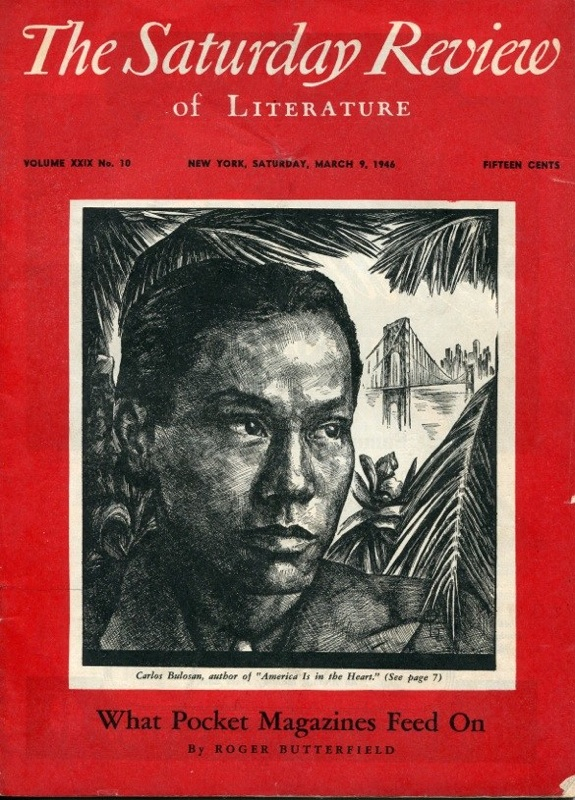
Demi and Jerry don’t know it yet, but they have another Bulosan memento coming from me: a copy of the Saturday Review of Literature from March 9, 1946, on the cover of which the famous pen-and-ink portrait of Bulosan first appeared. One of these days, I’ll pay another homage, to the Bulosan memorabilia on exhibit at the University of Eastern Pangasinan in Binalonan, where they keep copies of his letters, commemorate September 11 as Carlos Bulosan Day, and teach a 3-unit course on his life and works. There’s a trove of material on him at the University of Washington library, and perhaps on another visit to Seattle, with more time, I might look into that, too. But as every Fil-Am and indeed every Filipino should know, a pioneering voice like Carlos Bulosan’s can ring everywhere and forever, in the heart.

Bulosan

Penman No. 110: Witnessing the World

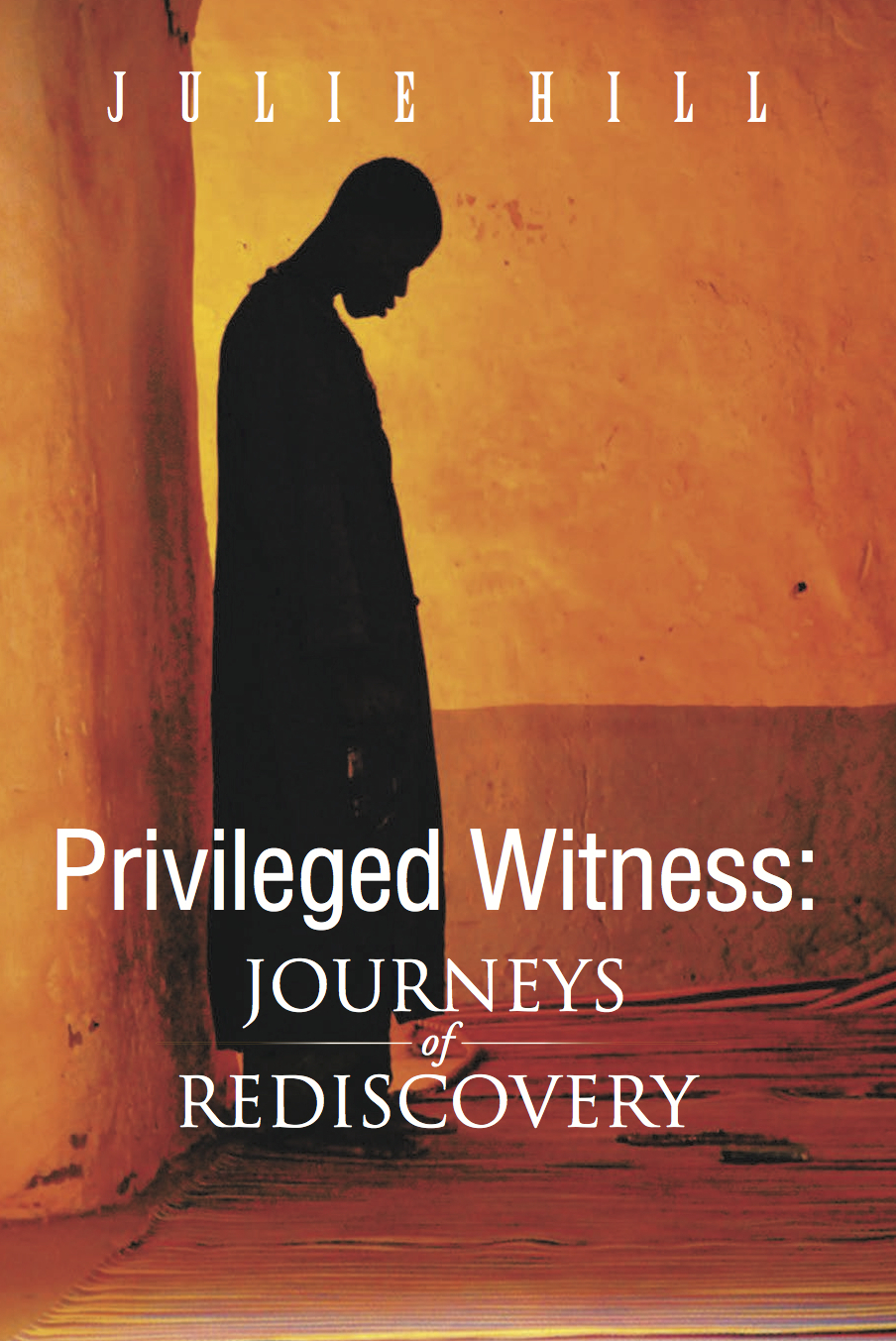
HillCoverPenman for Monday, August 18, 2014


IN MY other role as an editor rather than a writer of books, I take raw manuscripts from Iclients and friends and transform them into something publishable and popularly readable. I’ll write more about editing as a profession one of these days, because it’s an art unto itself that bears all the challenges but very little of the glamor and rewards of authorship. In the meanwhile, I’d like to talk about one of my most recent editing projects, a book about travels around the world by someone who has to be the most happily peripatetic (that’s a fancy word for “footloose”) person I know.

Julie Hill was a client before she became a friend. We were introduced to each other more than ten years ago by Jimmy Laya, who knew Julie and her late husband Arthur back from when the Hills lived in the Philippines, where Arthur represented the Ford Foundation. Then based in Southern California, Julie wanted to write a book about her life and travels with Arthur, who had just died of cancer; together, the couple had journeyed around the world, from Australia to Afghanistan, from Bangkok to Minnesota, from Samoa to China. Julie—born an Alexandrian Greek, trained in chemistry, and later a telecommunications executive—had all these stories to tell, and she needed an editor to help her tell them.

Jimmy put us together, and Julie’s first book, Promises to Keep: The Travels of Arthur and Julie Hill, came out in 2003, published by XLibris. This was followed a few years later by her second book, The Silk Road Revisited: Markets, Merchants, and Minarets (Author House, 2006). Not one to spend her widowhood moping, Julie has been actively engaged in all manner of civic pursuits, especially in her patronage of the Scripps Research Institute. Just last month, she published her third book, again with me as editor, Privileged Witness: Journeys of Rediscovery (Author House, 2014).

Julie retains a special place in her heart for the Philippines, to which she returns every now and then to visit with old friends. (In turn, Beng and I pay Julie a visit in her lovely home in Rancho Sta. Fe every time we see our daughter Demi in San Diego; Julie knows I love chocolate cake and always has a scrumptious slice of it waiting for me.)

There’s a wonderful anecdote from Julie’s first book about an encounter that she and Arthur had with then UP President Carlos P. Romulo, whom she describes as “a great raconteur.” They told each other stories about how they traveled to America, all of them being foreign graduate students, and when Julie said that she traveled by steamship, CPR asked her about, of all things, the cutlery. Julie recalls:

“’What was the cutlery like?’ asked Romulo. I was dumbfounded. Why did he take an interest in cutlery? He proceeded to tell us that he crossed the continent from Vancouver to New York on the Canadian Pacific Railway. During his journey, he systematically ‘acquired’ a set of cutlery. ‘What a better way to regale my professors at Columbia University than with cutlery embossed with my own initials: CPR!’”

In her new book, Julie takes us in hand on her journeys to around 20 countries, from Asia to Africa, to places such as Papua New Guinea, Mali, Bhutan, Botswana, and Ethiopia. She doesn’t take just the well-trodden tourist paths, but goes to the heart of the native culture, engaging with the locals to do what all good travelers (more than tourists) do: discover and reaffirm the universality of humanity. Not everyone has the ability and the resources to do the kind of traveling that Julie does, so I suggested the book title to her (taken from one of her essays), to take “privilege” in both senses of the word: as the ability to afford things, but also as the unique opportunity to see things few others could. And with that privilege comes the responsibility of witnessing and reporting.

In her introduction to the book, she writes:

“The art of adventure is the art of being bold enough to enjoy it. On a safari I must have spent hours tracking the footprints of wild animals; for other travelers the hours were too long and boring; after having seen one giraffe the others seemed all the same to them. But for me the tracking process was a fascinating adventure and locating that pride of 13 lions was an unparalleled reward, a golden joy. I could hear the muezzin in the Middle East (so much more inspiring when it is not a recording) calling the faithful to evening devotion. To me, the muezzin’s call—whether in a remote Central Asia bazaar or resounding among the tufa walls and spires of Timbuktu—is like a congregation of mountains praying.

“In my travels I have discerned a similarity among people who bear the same universal aspirations: all want their children to lead a better life and have a better future than theirs; they all cry, laugh, eat, worry, and die. We share so much, but still have to work at understanding one another…. On my travels, I have been privileged to spend time in the privacy of people’s homes and to learn of their rituals, such as the jewelry handed to the eldest daughter from generation to generation in Mali’s Djennè. An impromptu invitation at a village up in the mountains of the Caucasus brought me to a wedding, sipping vodka and dancing in a circle with other women…. Every time I was treated by my hosts as a friend, as a confessor, and I have tried to vindicate their trust by bringing their stories to life.”

In a message to her after the book was published, I told Julie that I had just watched a TV documentary about Aleppo in Syria—the subject of one of her best essays—and about the destruction that Syria’s current civil war had wrought on the ancient wonders of the place. I was almost in tears, I said, to see the Krak des Chevaliers being bombarded; without even having been there, I felt more invested in the world and in humanity, thanks to her book, for which I—in turn, as editor—was the privileged witness.

(Privileged Witness: Journeys of Rediscovery is available on Amazon.com.)