Qwertyman No. 97: The City That Works

Qwertyman for Monday, June 10, 2024

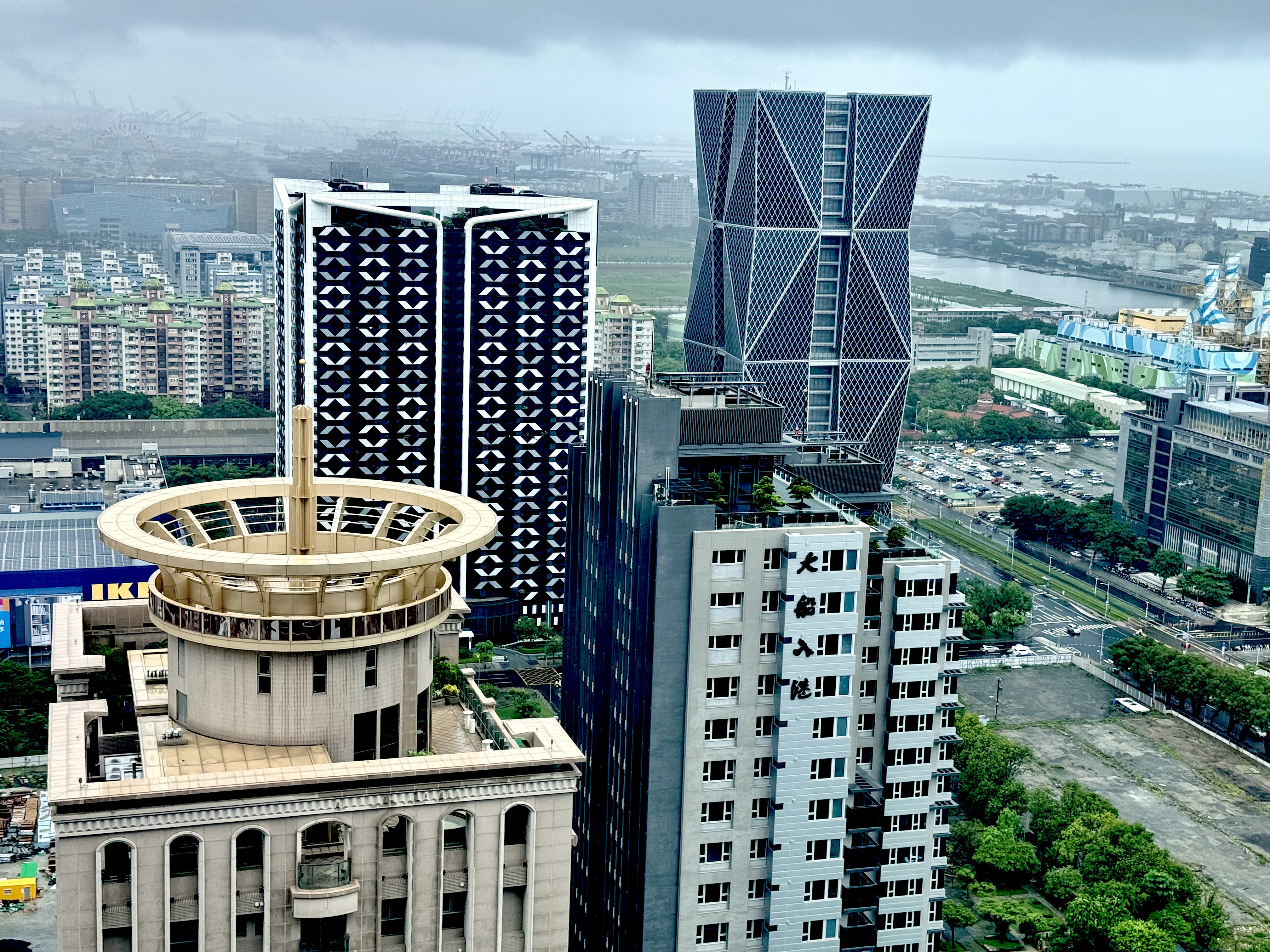
I WAS back last week in the city of Kaohsiung in Taiwan with a group of writers from the University of the Philippines Institute of Creative Writing, at the invitation of Dr. Eing Ming Wu of the Edu-Connect Southeast Asia Association, an education NGO seeking to establish stronger ties between Taiwanese universities and their counterparts south of Taiwan. We were there to meet with our literary and academic counterparts, but also to acquaint ourselves with contemporary Taiwanese society and culture. What we found along the way was a city and a government that works—a model we have much to learn from.

It was my second time in Kaohsiung and my sixth in Taiwan since my first visit in 2010, but those earlier sorties were either for tourism or for attending meetings and conferences, so we never really got to immerse ourselves in the place and its people. This time, Dr. Wu made sure that we went beyond casual handshakes and pleasantries with city and university officials to engage our hosts in in-depth conversations.

The first thing that usually strikes visitors about Taiwan is how modern it looks, especially when flying in through Taipei—the High Speed Rail (HSR), the wide roads, the skyscrapers (think Taipei 101, once the world’s tallest), the late-model cars. For quick comparisons, consider this: Taiwan’s population, at 24 million, is about a fifth of ours; in terms of land area, we are almost ten times larger; its nominal per capita GDP, however, is almost ten times larger than ours at US$35,000. Not surprisingly, Taiwan now ranks around 20th in the world in terms of its economic power.

That power came out of decades of dramatic transformation from an agricultural to a highly industrialized economy, starting with massive land reform and the adoption of policies that spurred export-driven growth. Industrialization itself went through key phases from the production of small, labor-intensive goods to heavy industry, electronics, software, and now AR/VR and AI tools and applications.

At a briefing at the Linhai Industrial Park by Dr. Paul Chung, a US-trained engineer who was one of the architects of this economic miracle, we learned how Taiwan built up the right environment for economic growth through such strategies as the creation of industrial parks (there are now 67 of them covering more than 32,000 hectares, with 13,000 companies employing 730,000 people and generating annual revenues of more than US$260 billion—almost eight times what all our OFWs contribute to the economy). The Taiwanese government has also implemented a one-stop-shop approach to investments, bringing together the approvals of many ministries and local governments under one roof.

Consistently, in modern times, the private sector has led the way forward, with the government acting as facilitator. This was much in evidence in Kaohsiung, Taiwan’s southern industrial hub that was, until relatively recently, a virtual cesspool, the prime exemplar of industrialization gone amuck. A strategic seaport, Kaohsiung grew out of the need to export Taiwanese sugar during the Japanese occupation (1895-1945); the sugar industry gave rise to railways that went far up north to Keelung and became the backbone of the country’s transport system. After the war, the Kuomintang who displaced the Japanese did little to improve things until a visionary mayor undertook reforms that cleaned up the place. Industry also achieved important synergies by adopting policies toward carbon neutrality and reducing waste—for example, one company’s blast furnace slag is being used to pave roads, and harmful carbon monoxide emissions have been rerouted as inputs to chemical companies.

Kaohsiung today is a city of 2.8 million people, a showcase of how runaway industrialization and urban blight can be reversed through good governance and political will. “People need responsible, responsive, and accountable government,” says Dr. Wu, a public-administration expert who worked for 15 years with five Kaohsiung mayors and who now serves as a visiting professor at UP’s National College of Public Administration and Governance (NCPAG). 

A longtime visitor to the Philippines, Dr. Wu has made it his personal mission to promote Philippine-Taiwanese people-to-people relations—a concept he calls “taiwanihan”—in the conviction that the two countries have much to learn from each other and form a natural geographical, economic, and cultural partnership. “We are each other’s closest neighbor,” Wu says. “Taipei is 96 minutes away by train from Kaohsiung, but Kaohsiung is only 90 minutes away by air from the Philippines.” 

Wu and his colleagues at NCPAG have been exploring the possibilities of developing a corridor of cooperation between Southern Taiwan and Northern Philippines, given their proximity. “We have the technology, you have the resources like biomass,” he adds, pointing out as well that taiwanihan doesn’t just mean a one-way relationship, but that the Philippines can also assist Taiwan with its growing needs, such as engineering talent and manpower. Some 8,000 Filipinos now work in Taiwanese factories, but Taiwan’s demand for highly skilled workers will only get higher as it moves into the next phase of its development, which will be heavily dependent on AI.

Artificial intelligence already takes care of many of Kaohsiung’s more mundane needs such as remote traffic monitoring and even the paid parking of vehicles, which has been outsourced by the government to a private entity. “We buy services, not things,” explains Dr. Wu. “The government provides the land for the parking, the private sector supplies the technology and the hardware. This is our version of public-private partnership: the government listens to the private sector, which can use the city as its lab.” 

E-governance and decentralization led us to an unusual sight: we visited City Hall on a weekday and saw very few people in the lobby, unlike its Philippine counterparts. That doesn’t mean that government is distant from the citizens, as a “1999” complaints center receives and fields calls online or in person, employing the disabled to man its booths. 

And even as AI has taken the forefront, it was abundantly clear that human intelligence and human priorities remained important. Good community governance, for one thing, was key to clean and peaceful neighborhoods (their village officials are appointed rather than elected, eliminating vote-buying). Their libraries alone show how and why the Taiwanese are succeeding: they not only have hundreds of thousands of books available to their citizens, but they have innovations such as the “Adopt-a-Book” program by which you borrow a book just based on a previous reader’s recommendation, and books in both Braille and regular text, so that sighted readers can read along with the blind and enjoy a story together. A city that goes that far to meet its people’s needs can’t fail.

Penman No. 463: Masters of the Old and New

Penman for Sunday, June 10, 2024

THE WORK of two outstanding Filipino artists drew my attention last month, in events that could be considered retrospectives of remarkable if somewhat divergent careers. 

The first was the exhibition “Looking Back” mounted by Fernando Modesto at the Galerie Hans Brumann in Makati, running until June 30, which gathers some of the painter’s best work over the past five decades, many of them from the private collection of the longtime Manila resident Brumann himself. That Brumann—now 83, and also a renowned artist and jeweler—was letting go of these pieces struck me much less as a disposal of worthy objects than a bequeathal, an opportunity to share the best of Modesto with other collectors. Laid low by a stroke some years ago, “Mode” as his friends know him remains mentally as sprightly and mischievous as ever; and he has striven and managed to produce new work despite his condition, taking off from the Mode we knew.

That Mode was irrepressibly bright, witty, and playful. In contrast to the somber and even dismal realism of many of his contemporaries from the 1970s onwards, Mode made light of things, opening up a world of freedom and delight in an oppressive universe. 

The playfulness, at one point, was literal. In 2018, writing in Frieze magazine, Cristina Sanchez-Kozyreva reported on the Ateneo Art Gallery’s recreation of an early Modesto installation from 1974 titled Dyolens(Marbles) that involved laying out thousands of marbles on the floor for visitors to kick around. That was about the time I first met him during my days as a printmaker in Ermita; Mode had already gained fame—or notoriety if you will—for his depictions of pendant penises, which even then were clearly meant not to offend but to make one smile.

The Brumann exhibit documents Mode’s progression from tongue-in-cheek wit to transcendent wisdom, opening a door into a world we can only hope to inhabit, where angels reach for a shimmering sun (or are they playing volleyball?) in an iridescent haze, or float face-up in a cosmic pool. His most recent work such as King of the Islands II (2021) retains that rare equanimity in the cool blue gaze of its subject.

If Fernando Modesto is a master of the modern, the second painter who caught my eye reminded me of how much richness remains to be discovered in our artistic past. May 24 saw the launching of Matayog na Puno: The Life and Art of Hugo C. Yonzon, Jr. (published by Onyx Owl, 248 pages), on the centennial birthdate of Yonzon. Authored by Hugo’s son Boboy and the late Neal Cruz, the book chronicles the life and work of a man for whom art was both a passion and a living. Hugo’s career harkened back to a time when the line between fine and commercial art was blurry and perhaps not all that important, for as long as the artist gave the work his all. 

Yonzon had to leave school early to take a job—just the first of one or many—and he would go on to become much more of a journeyman, one viscerally engaged in the trade, than an aesthete or academic. “Yonzon was always invited to the various sessions held by the Saturday Group and other weekday groups that tried to establish their name and weight in the art scene,” says the book. “But he never stayed long nor drew enough on-the-spot sketches; although he had an eye for women, nude sketching did not interest him. He would rather banter and drink a cup of coffee, then return promptly to his favorite themes in his perpetually makeshift studio.”

He was friends with some of the best artists and illustrators of his time, including Mauro “Malang” Santos and Larry Alcala. Having worked as an illustrator and as an art director for an advertising agency, Hugo wielded an extremely versatile brush, adjusting his style and treatment to the client’s needs. It got to the point that visitors to his one-man show became confused, seeing so many different styles on display, but that range was a great part of the reason for Hugo’s popularity. 

But he kept returning to his favorite themes—the pastoral, the folk, the heroic, the visual representation of what he imagined Filipinos at their best and most essential to be. This appealed to the sensibilities of patrons such as First Lady Imelda Marcos, who generously supported Yonzon. Hugo was tireless in his painting and gave his friends huge discounts to the point that his wife Betty felt compelled to manage his financial affairs.

His lifestyle was appropriately flamboyant. “Dad was a loud but chic dresser,” recalls his eldest daughter Minnie. “When psychedelic colors and prints were in vogue, his long-sleeved shirts were in paisleys and reds and greens. Why, he even painted the air scoop of our brand-new Beetle in paisley!”

The life depicted in the book is fascinating, full of struggle and drama, but ultimately it is the art that imprints itself in our consciousness—one full of vigor, color, inventiveness, and variety, celebratory in every way of the near-mythic Filipino. The writer and art critic Lisa Nakpil would say that Yonzon, who died in 1994, was the “underrated master of heroic Filipino iconography,” and this book clearly shows us why.

Qwertyman No. 94: Artificial Intelligence

Qwertyman for Monday, May 20, 2024

DR. CHICHOY Carabuena had a problem. He wanted the school he owned and ran—the Generoso Carabuena Academy of Pedagogy in Santa Vicenta—to place higher in both national and international rankings, partly so he could raise tuition fees, and also so he could claim bragging rights among his university-president friends and drinking buddies. He had inherited the school from his grandfather; Generoso Carabuena was a banker who had collaborated with the Japanese and stolen the money they left behind to open a school for teachers, which was his wife’s dream, becoming a war hero in the process for outsmarting the enemy. 

The school had done well enough to the point that Chichoy’s dad Ramoncito could buy a Mercury Capri that he regularly drove to Manila to carouse in its nightclubs. Chichoy was the product of one of Ramoncito’s dalliances with the agreeable ladies, and it fell on him to rescue both the business and the family name from ruin and disrepute. He had been managing a carinderia for Pinoy workers in Dubai when the call came, and always wanting to become someone of substance, he returned to Sta. Vicenta to turn the daughters and sons of hog butchers and vegetable growers into teachers, like he imagined himself to be. Surely higher education wasn’t all that different from running a restaurant and coming up with the right menu at the right price for your customers. He had secretly dreamed of becoming a mayor, a congressman, or even governor, but first, he had to make a name for himself and make money.

Somewhere along the way he picked up a “Dr.” from a diploma mill and dressed the part, coming to his office even in the warmest of days in coat and tie. “More than anything else,” he would lecture his new recruits, “first impressions count, so before you even become a teacher, you have to look like a teacher, walk like a teacher, and sound like a teacher!” He had a faux marble statue made of his grandfather to greet visitors at the school entrance, and another one of Jose Rizal standing behind Generoso, as if looking on in approval. 

But lest people think he was beholden to the past, Chichoy Carabuena peppered his speeches with 21st-century mantras like “disruption,” “innovation,” “sustainability,” “customer-centric,” and, yes, “21st-century.” “The great challenge to higher education today,” he would often declaim, “is to produce graduates attuned to a global climate of disruption and innovation, mindful of evolving needs and opportunities in the marketplace of ideas while seeking sustainable and synergistic 21st-century solutions to problems rooted in our feudal and neocolonial history.”

Those speeches were written for him by his former executive assistant named Mildred, a UP graduate whom he had to fire when his wife discovered them smooching in his office—an act he vehemently insisted to be no more than a paternal gesture, much like  former President’s public bequeathal of a kiss on a married woman, a defense that gained no ground. His wife personally chose his next EA, a former SAF commando named Dogbert; making the best of the situation, Chichoy paraded Dogbert around as his bodyguard, spreading the rumor that his life was under threat from unspecified enemies determined to keep the quality of Philippine education down. “We can give them no quarter,” he declared at the last CHED event he attended. “We must resist, with all impunity, those who aim to keep our poor people shackled to the twin pillars of ignorance and idiocy!” He missed Mildred in those moments, but he felt quite pleased with his growing self-sufficiency in speechwriting, thanks to his new discovery, ChatGPT. Of course it never quite came up to his standards, so he tweaked the prose here and there, like that reference to Samson that he hoped would bring the house down.

But now, reading the reports of top Philippine universities slipping in their rankings in the usual Times Higher Education and Quacquarelli-Symonds surveys, Dr. Carabuena saw an opportunity for his modest HEI to rise. “As their mystique diminishes, so our aura will grow,” he informed an indifferent Dogbert. “We just need to come up with sustainable innovations that will disrupt the status quo.” Dogbert handed him a slim folder. “Sir, someone wants to see you, to apply for the position of Academic Vice President.” It was a position that Chichoy himself had held concurrently to save on salaries, but now he felt obliged to pass it on to a real expert. He flipped the folder open and saw the picture of a cute Chinese-looking woman going by the name of “Dr. Alice Kuan.” Chichoy was mesmerized. “Send her in—and get out!”

When Dr. Alice Kuan stepped into Chichoy’s office, he felt himself enveloped in a miasma of jasmine, peonies, and five spices—everything good he remembered from his only visit to China many years ago. Her lips were lotus-pink, her skin ivory-white, and here and there dumplings suggested themselves to his imagination. “Good morning, Dr. Kuan! Please, have a seat! You’re here to apply for the AVP job?”

“Yes, Mr. President,” she said with a quarter-moon smile, “and I come with many ideas for both improving your curriculum and raising revenues through academic innovations.”

“Innovations! I like that! Like what?”

“Why artificial intelligence, of course! We could use AI to teach many of our courses, reducing costs. Also, we could bring in more foreign students from—uhm—friendly neighboring countries, while creating part-time employment opportunities for them in—uhm—online entertainment, for which we could even lease out some of your campus property. It would create a huge economic boost for Sta. Vicenta!” 

Temple bells rang in Chichoy’s mind. Not only was she fetching; she was smart! Suddenly he could see his political future brightening. He wanted to know more about this adorable avatar, and only then did he notice how patchy her resume was. 

“Your birth certificate was filed when you were…. 17?”

“Was it? I don’t remember.”

“Which elementary school did you go to?”

“I don’t remember. Maybe homeschooling?” She threw him an exasperated sigh. “Look, Dr. Carabuena, does it matter? I can have AI do a perfect resume if that’s what you want. If not, I can take my ideas to the Fontebello Institute of Technology in San Bonito just an hour away, and maybe they’ll be more receptive to disruptive innovations—”

“No, no, no! Disruptive, I like disruptive! Please, Dr. Kuan, stay in your seat! I’ll have somebody prepare your contract. Dogbert!”

(Image generated by AI.)

Qwertyman No. 91: 1968 Redux

Qwertyman for Monday, April 29, 2024

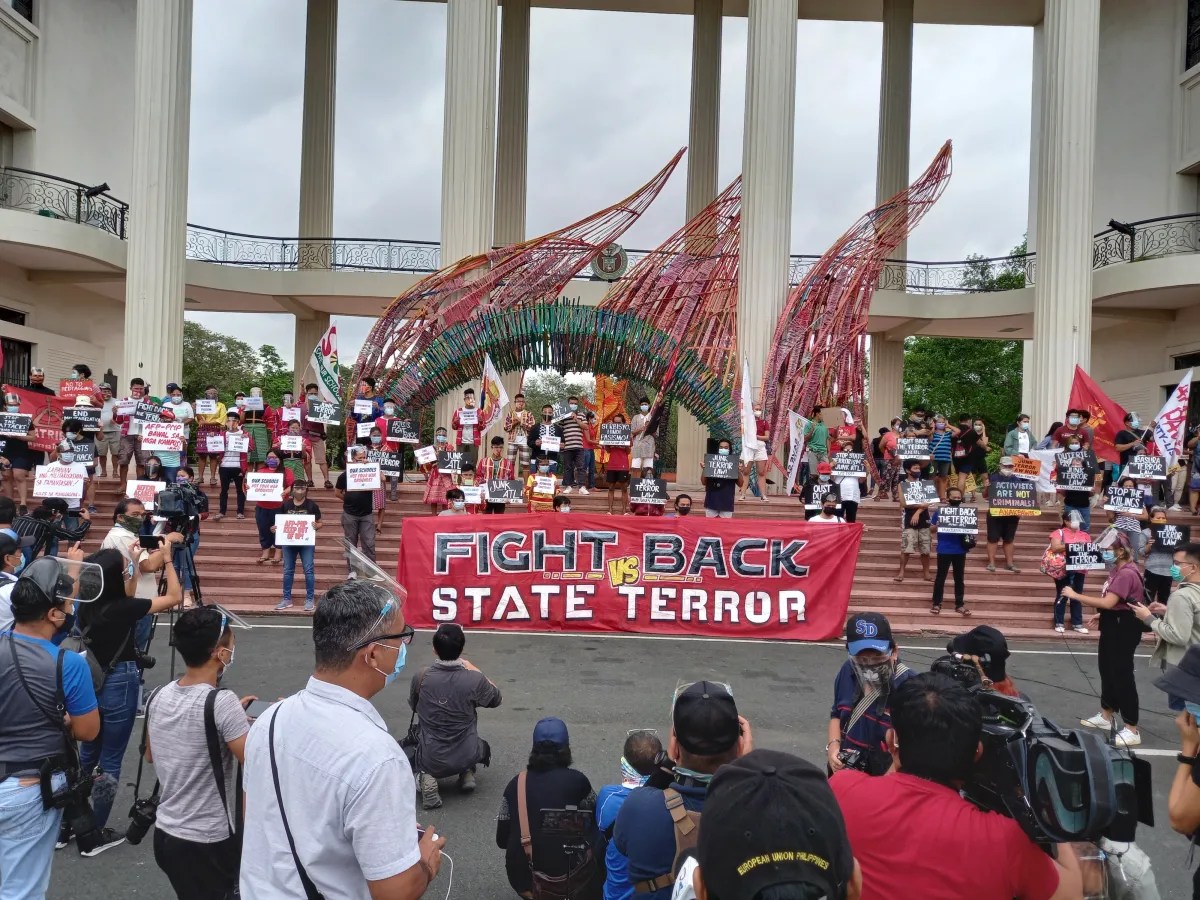
A WAVE of pro-Palestinian protests has been sweeping American college campuses, prompting academic administrators and political leaders to push back and invoke their powers—including calling in the police—to curtail the demonstrations. 

House Speaker Mike Johnson—a Trump ally and staunch supporter of Israel—probably spoke for his ilk when he told protesting students at Columbia to “Go back to class! Stop wasting your parents’ money!” He also called on Columbia University president Minouche Shafik—an Oxford Economics PhD and English baroness who also happens to have been born in Alexandria, Egypt to Muslim parents—to resign for not moving strongly enough against antisemitism on the Columbia campus, despite Shafik’s controversial suspension of pro-Palestine student groups earlier and her resort to police action, resulting in mass arrests.

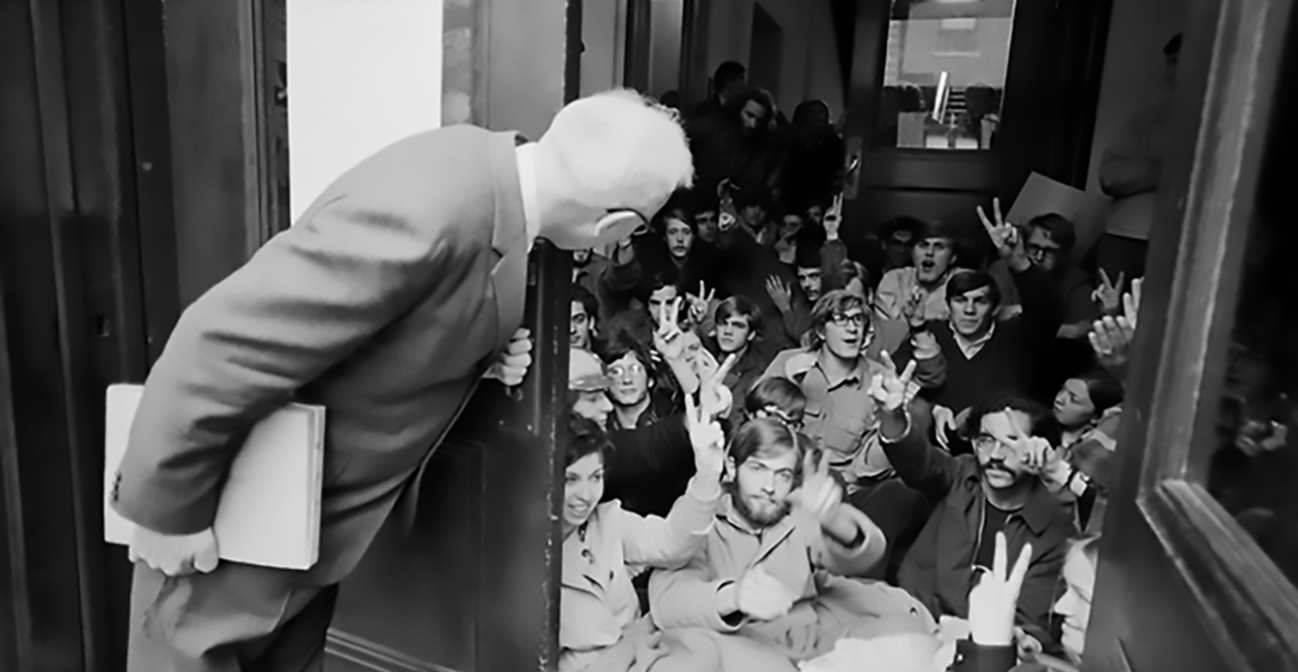
The protests and the violent response to them threw me back to 1968, when the world’s streets from Chicago to Paris shook from the boots of students and workers marching against the Vietnam War, for civil rights, and for women’s liberation. In the Philippines, student organizations such as the SCAUP and the newly formed SDK took up the same causes, on top of a resurgent nationalism. I was too young to have been part of these great movements then, although we marched in high school for “student power,” whatever that meant. I would get deeply involved as the decade turned, infected by the inescapable ferment in the air; in 1973 I would realize that protest had a price when I spent seven months in martial-law prison.

I’ve tried hard to think what it would be like to be 18 and a student today, what cause would drive me to the streets and to pitch a tent on the campus grass. While we Pinoys have our sympathies, Gaza seems too distant for us to mobilize for, and certainly we don’t lack for domestic issues to be bothered by, although our level of tolerance appears to have risen over time. In 1971, a 10-centavo increase in oil prices was enough for us to trigger the Diliman Commune; today we routinely wait for Tuesday’s inevitable announcement of gas price hikes and sigh.

Perhaps time and age do bring about shifts in perspective; some leftist firebrands of my youth have now become darlings of the right, and I myself have moved much closer to the center, ironically morphing from student activist to university official at the time of my retirement.

As that administrator—at a university where protesting is practically part of the curriculum—I can appreciate the bind Dr. Shafik now finds herself in, hemmed in from both left and right, with the complexity of her thinking and the brilliance of her own achievements reduced to a single issue: how to deal with students who won’t “go back to class and stop wasting their parents’ money,” as Speaker Johnson would have it, and will instead insist on their right to self-expression, whatever the cost. Aggressiveness, audacity, and even insolence will come with the territory. Persons in authority become natural targets of one’s rejection of things as they are; the preceding two generations are to be held immediately responsible for things gone wrong. 

I recalled a time when UP students barged into Quezon Hall to interrupt a meeting of the Board of Regents to plead their cause. Some furniture was scuffed, but the president sat down with the students and discussed their demands. No one left happy, of course, but what had to be said on both sides was said. At another meeting later, someone asked if the students involved should have been sanctioned for what they did. I had to butt in to pour cold water on that notion, knowing that any punitive action would just worsen the problem. Open doors, I said, don’t shut them; this is UP—that kind of protest is what makes us UP, and our kind of engaged response is also what makes us UP.

Some will say that these outbursts are but cyclical, and that young people never learn, in repeating what their now-jaded seniors did way back when. But then the State never learns either, by responding to student protests today the way they did back in 1968, with shields and truncheons, effectively affirming everything the young suspect about elderly authority.

The Israel-Hamas war—now magnified, through many lenses, into an Israeli war on Palestinians—is a particularly thorny issue for American academia and for a public habituated to looking at the Jewish people as biblical heroes and historical victims. Gaza has turned that perception around for many, with the aggrieved now seen as the aggressors. In my column two weeks ago, I agreed with that re-evaluation, although I was careful to take the middle road and to condemn the excesses—committed for whatever reason—on both sides. 

Not surprisingly, I quickly got blowback from both my pro-Israel and pro-Palestinian friends. War is always ugly, one said, and Israel has to do what it must to save itself; the Hamas attack on October 7 was overblown by propaganda, said another, and it was something that Israel had coming. 

I still accept neither extreme; call me naïve and even Pollyannish, but I stand not with Israel nor with Palestine, but for peace and justice, which are not exclusive to one side, and can only be achieved by both working and living together. You can argue all the politics and the history you want, but there is absolutely no humane rationalization for the rape of women, the murder of children, and yes, even the killing of innocent men—not even the prospect of potentially saving more lives, the very argument behind the incineration of 200,000 Japanese in Hiroshima and Nagasaki, an act of war we all benefited from, but cannot call guiltless.

In a conflict as brutal and as polarizing as this one, “middle” never quite cuts it, and the excess of one will always be justified by the excess of the other. (To complicate my ambivalence, some issues do seem to have no middle, like Ukraine.) There have been no mass protests or demonstrations to advance my kind of moderation, and I don’t expect students, whether in Columbia or UP, to take to the streets flashing “peace” signs. 

And in mentioning that, I think I’ve put a finger on one difference between 1968 and 2024: “peaceniks” were neither pro-Saigon nor pro-Hanoi, although her critics were quick to paint Jane Fonda red; they just wanted America out of a war that was none of its business. There was an innocence to that that seems to have been lost in our hyper-informed and over-analyzed century. We feel compelled to choose with passion and precision, and are defined by our choices, from politics to sneakers.

Qwertyman No. 87: A French Sojourn

Qwertyman for Monday, April 1, 2024

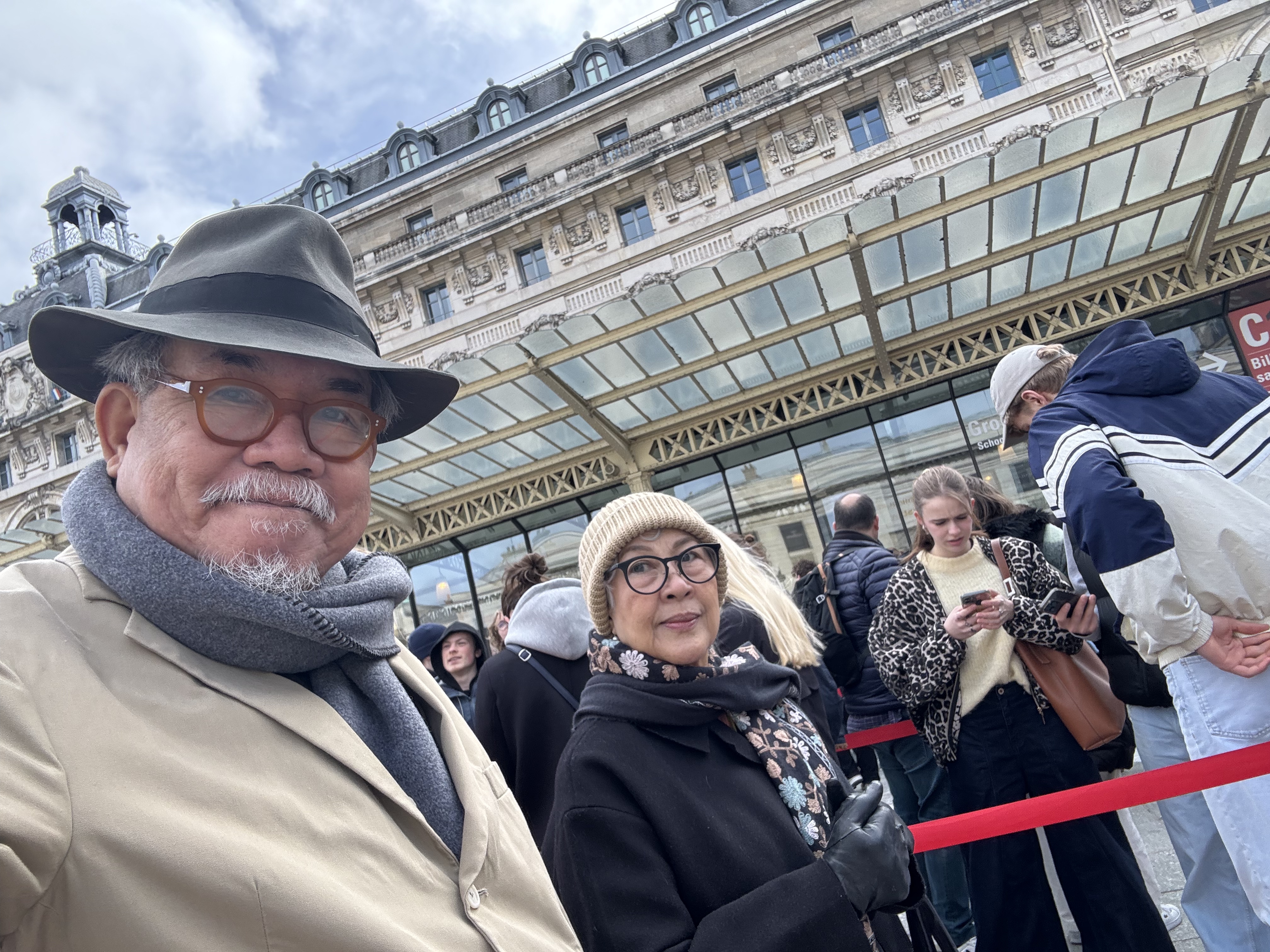
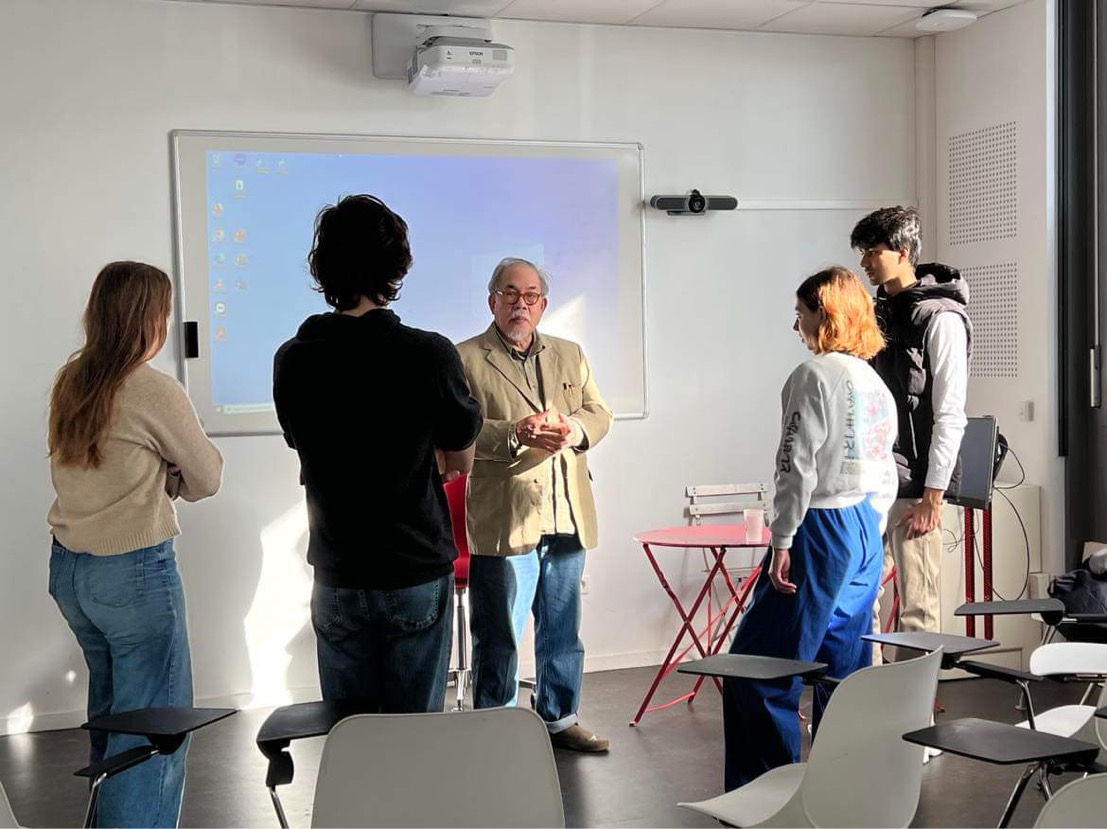
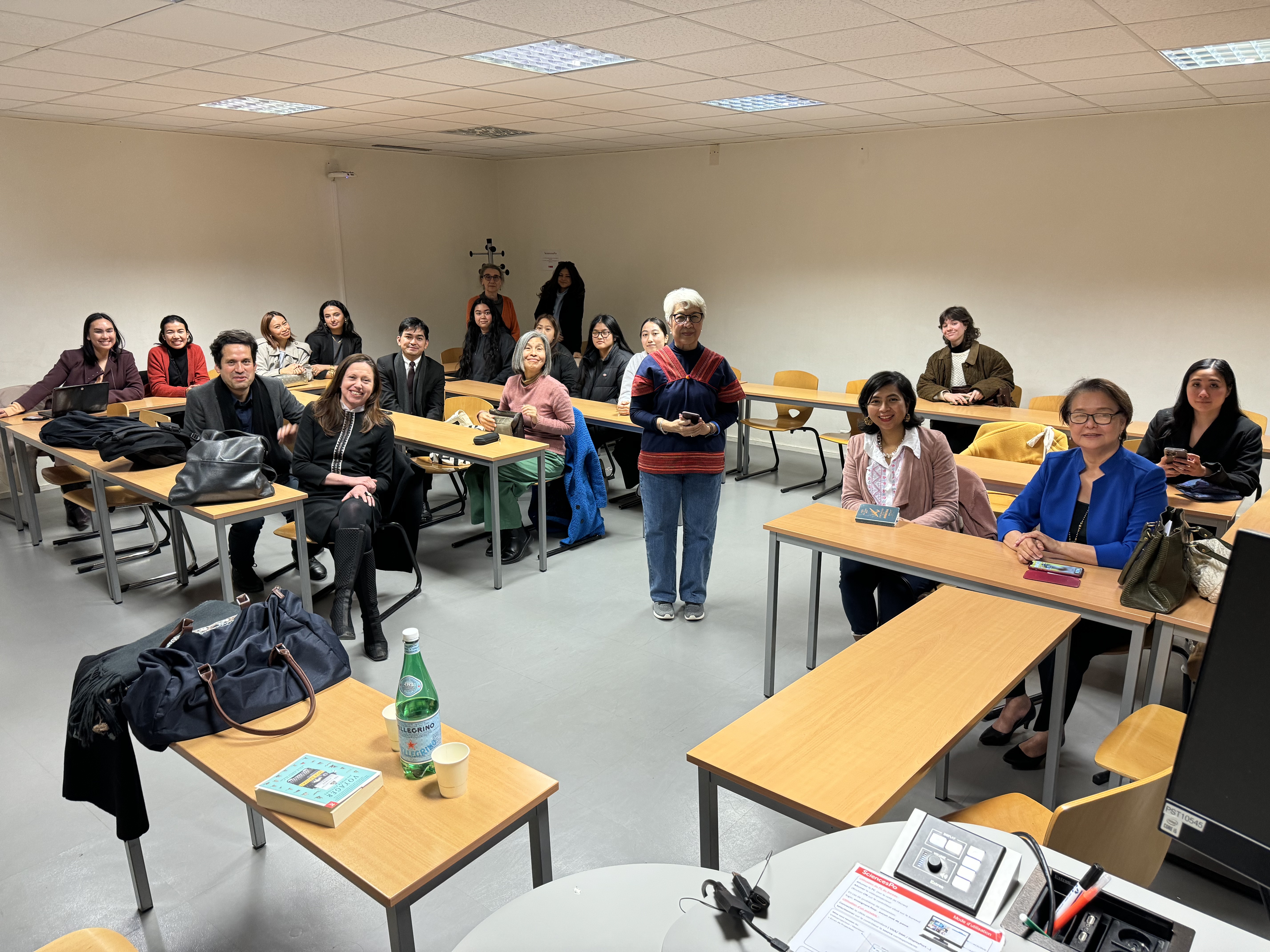
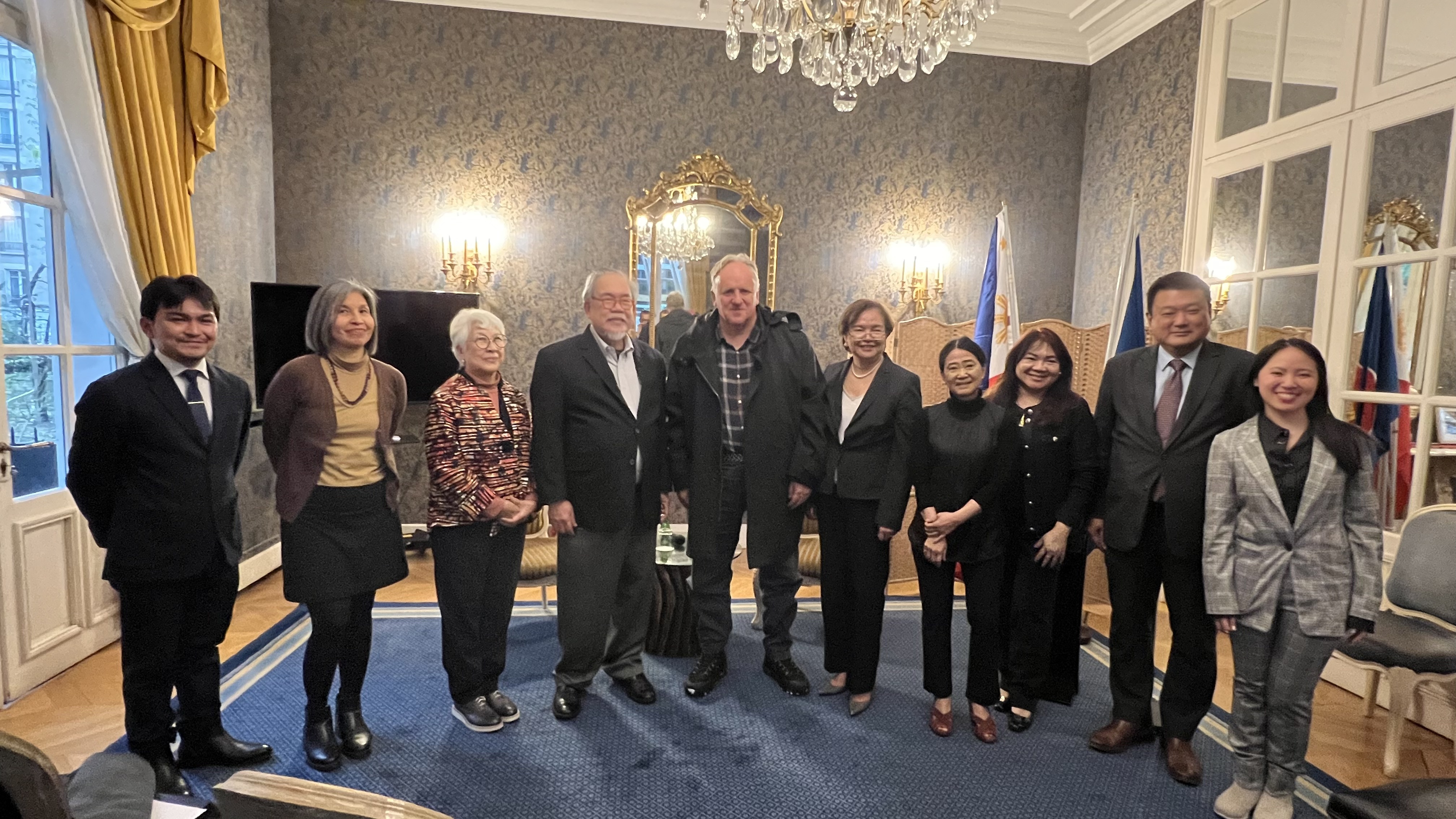
MY WIFE Beng and I were in France last week to give a series of lectures at the invitation of the Paris Institute of Political Studies, better known as SciencesPo. They don’t formally observe Holy Week in France (nor, for that matter, do many Filipinos to whom it’s simply come to mean “long weekend”). So we thought that it was the best time to come over and share some of our insights into Philippine literature, art, and politics with young French students as well as our countrymen in Paris, for whom I and fellow writer Cris Yabes, who’s based in France, gave a special reading at the Philippine embassy.

For those who’ve never heard of it—which won’t be too surprising given our Pinoy fixation on top American and British universities—SciencesPo (pronounced SEE-ansPO) is France’s leading university in the social sciences. It now has 14,000 students spread out over seven campuses across the country. Only 4,000 of those students are undergraduates; the rest are graduate students, including 350 taking their PhD. Unlike our universities, SciencesPo’s undergrads can finish in only three years, with their last year spent abroad. I was told that there are about 20 Filipino students currently enrolled at SciencesPo, and about half of its students come from overseas. As a public research university, SciencesPo is supported by the government through a private foundation, an arrangement that gives it a high degree of autonomy.

Founded in 1872, the university has served as the training ground for France’s political elite, producing five out of France’s eight presidents: Pompidou, Mitterand, Chirac, Hollande, and the incumbent Macron. Marcel Proust studied here for a year, and Christian Dior was a graduate.

With that kind of elite status comes criticism and controversy, and SciencesPo has had its share over the years. Nevertheless, it remains high on the list of desirable universities, especially for students with plans of joining the French civil service, after further studies at the Ecole Nationale d’Administration. (At Inalco, another Fremch university, we were surprised to find eight Filipino-French students studying Filipino for their degree under Prof. Elisabeth Luquin, who studied in UP and speaks Filipino like a local.)

Beng and I gave presentations on the Philippines at SciencePo’s main campus in Paris—a sprawling complex comprising ten buildings in some of Paris’ most precious real estate—and I had an additional three sessions in Le Havre, where SciencePo’s campus focuses on Asian studies. Wherever we went, we could see signs of intellectual and political ferment; like their predecessors at the Sorbonne whom we admired for their militancy 60 years ago, SciencesPo students have protested and rallied over many causes from domestic violence to Gaza.

To be fair, these concerns have occupied much of the rest of France as well. In a country where street protests are a time-honored tradition that have a real bearing on political outcomes, differences of opinion can run deep and long, and controversy stalks nearly every issue, from the wearing of religious headgear to the extension of the retirement age. To “liberté, egalité, fraternité,” we must now add “identité,” the subject of identity so central to political discourse in many countries today, especially those with large and strong immigrant populations like America and France.

“Over the last few years, France has been torn by culture wars—a shift that was less the effect of American concepts imported into French universities, as many on France’s right claim, than of the long-term decline, beginning in the early 1980s, of class politics and alternatives to capitalism. In a post-ideological France, class struggle has been displaced onto the terrain of identity,” noted sociologist Daniel Zamora in an article for Catalyst in 2021. “Despite Macron’s professed disdain for identity politics, his alternative can scarcely be construed as anti-identitarian. Building on what we have in common, Macron argued, meant finding an answer to the question, ‘What does it mean to be French?’”

Identity, at least, was not in question when Cris Yabes and I gave our reading at the Philippine embassy, thanks to the invitation of Ambassador Junever “Jones” Mahilum-West, one of the most amiable, gracious, and artistically inclined ambassadors I’ve ever met. (She was very game as well, happy to hoist an IPA beer with my wife Beng after our talks.) To a fairly sizeable group from the Filipino community in Paris, Cris and I read pieces that had to do with our foreign relations, particularly in my case with our diaspora, which my second novel Soledad’s Sister (which has been published in French by Mercure de France) dealt with. 

In the conversations that followed, I learned that there are around 26,000 documented Filipinos in France, with perhaps just as many existing belowground, most of them domestic helpers. One of them, Zita Cabais, was a victim of human trafficking more than two decades ago, having been enticed to come to Europe with the promise of a visa and a good job. Instead she was brought to Hungary, from where she was led on foot through Europe to finally reach France, whereupon her employer confiscated her passport, effectively holding her hostage. But unlike many other DH’s, Zita fought back, sued her employer, and succeeded. Since legalized, she now works for organizations devoted to fighting human trafficking. (The path to legalization is reportedly shorter in France, but knowing the French language is a prerequisite.)

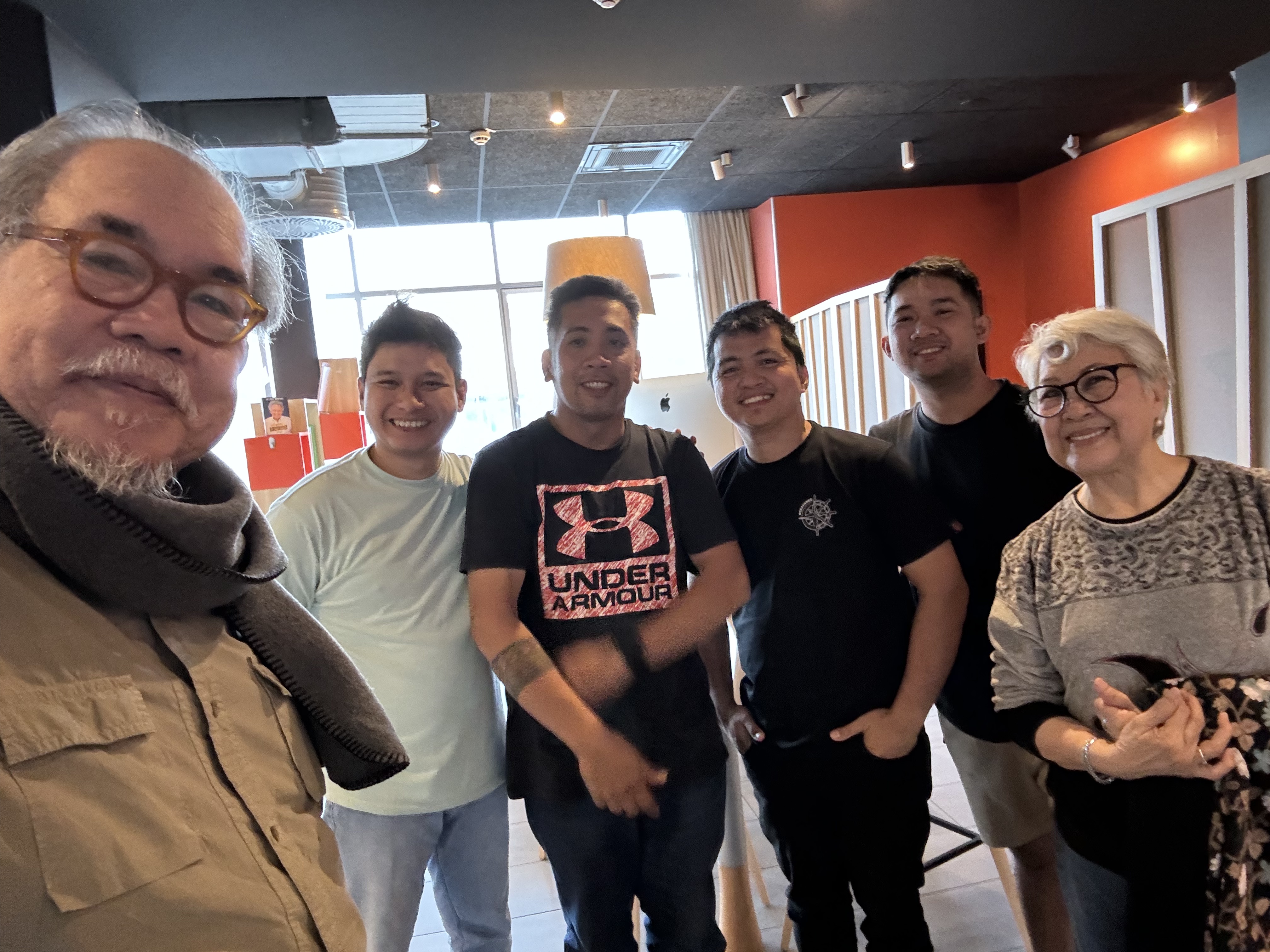
One unexpected highlight of our visit was running into a group of Filipino seamen in our hotel in Le Havre, prior to my lecture. Beng and I had just come down for breakfast when we heard the familiar chatter of Filipinos at a nearby table. We came up to them and introduced ourselves, and we had a lively conversation during which they explained that they were still waiting for their ship to dock because of the bad weather. I’d met and chatted with seamen like them before in Hamburg and in Christchurch, among other places; as a writer and as a Filipino, I take it as a pleasant obligation.

Competition, they said, was driving them to accept shorter four-month stints at sea. “We barely break even, and it’s a tough life at sea, but we have no choice, since our families depend on us.” Part of my lecture that day was going to be about our Filipino notion of the hero as martyr, of Christ-like sacrifice for the common good. I suddenly realized that it was Good Friday. We had our smiling selfies taken, and they seemed proud to stand with UP professors, but it was Beng and I who felt honored to be there with them.

Qwertyman No. 82: How Young Filipinos See Their Future

Qwertyman for Monday, February 26, 2024

THIS SEMESTER, I’m teaching an undergraduate class in UP called “Professional Writing,” a course I designed more than twenty years ago to help English and Creative Writing majors (and other seniors in search of interesting electives) get a handle on what the “real world” out there expects of them, in the kind of everyday jobs they’re likely to land. Not Shakespeare, not Jose Garcia Villa, not lyric poetry and neither the full-length play, but rather the more mundane assignments you get paid a salary for: business letters, press releases, feature articles, AVP scripts, brochures, and speeches. 

I find myself telling my students that, in a way, what I’ll be teaching them—which is basically how to conform to organizational or institutional standards and norms—is counter-intuitive to what’s been thought of as the UP way of asserting oneself and even questioning authority. This mythified UP “yabang” or “angas” could be one reason why UP graduates don’t rank at the top of employable prospects for corporations. 

So I feel like I have to teach my students the virtues of humility and sufferance, of sticking with a job and doing it well even if it’s not the coziest or smartest thing in the world to do, and of the importance of execution and delivery with no excuses, no (audible) complaints, on time, and against all odds. Before they break the rules, they should know the rules, so they’ll know exactly what they’re breaking and why (I bring up how Picasso was a realist before he turned to Cubism).

Of course, I also tell them that the door swings both ways—they can also walk out of a job they can no longer take (like I’ve done a few times in my own career), but not before thinking through the consequences and figuring out one’s options. Innovation and initiative are great to show on the job—but they can also backfire if not handled well, given people’s (and many managers’) ingrained resistance to change. In other words, prepare for and learn how to deal with adversity, which can be a better teacher than I’ll ever be.

It’s going to be an interesting semester, seeing how the students are responding to my provocations. One of those provocations was our first in-class writing exercise, which was a “visioning” of sorts, where I asked them to look 20 years ahead (preparatory to their next task, which is to write a job application letter). I’m sharing some of their responses below (excerpted here with their authors’ permission) to give readers an idea of how young Filipinos see themselves in their own future. There’s a palpable strain of pessimism in these responses—and that’s understandable, but it worries me. We shouldn’t saddle our successors with the notion that things can only get worse. So I’m making a note to myself: teach reality, teach adversity, but above all, teach hope. Having survived this long, despite everything we had to go through, should yield a useful lesson or two.

Student A: I remember telling myself upon entering college, “If I end up becoming one of those people I despise—a heartless doctor, a vain lawyer, all in the name of shameless success—I’d rather not enter UP.” Twenty years from now, the Philippines—and by extension, me included—will probably still be trying to heal from all the abuse that accumulated through time. In my dejection, I see the country still having a hard time distinguishing the morally right from wrong. Yet I hope that it would be otherwise. My hope sees differently from my rational musings, my hope sees the tide calming, a time I no longer have to convince my father of a reality so transparent it bites us in the face like a serpent.

Student B: I struggle to think of what the future holds for me. Truth be told, I struggle to think of a future with me in it at all. I find that thinking of the future brings with it a wave of dread, because even if the state of the country miraculously improves, there will always be a bigger power that inevitably ruins things for everyone else. However, if I somehow manage to be present still, (through either sheer luck or spite), I will likely be working at an office or a school somewhere. I’ll have a cat or two if the landlord allows it. Who knows if I’ll ever get married. The only thing I’m sure of is that I won’t have children—I can’t, in good conscience, bring someone else into this mess of a world.

This all sounds pessimistic, but in reality, I would actually call myself an optimist in day-to-day life. I want to think the best of people, and I believe that people are inherently kind. There is still a chance for things to improve, for everything to work out, but I can’t ignore the sinking feeling that it’ll only get worse from here. It might seem like we’ve already hit rock bottom, but somewhere, some world leader has brought a shovel and they’re ready to dig.

Student C: In many ways the country is a better place. People are more free to be who they are and love who they love, without fear. We have made leaps and bounds of progress in research and development. Science creates new technology, and we artists learn new ways to create, adapt, and keep toe-to-toe. Because I’ll be damned before I let the machines win. Yes, life is better. For those who can afford it. I want to afford it. But those braver than me fight for a future where everyone need not to. Because that’s the thing about human nature. Fighting is instinctual. Through war, poverty, and inequality, there will always be people fighting for something better. Many because they have no choice but to fight or die—fight to survive. Others because they owe it to someone, maybe themselves, to be the source of hope they want to see or have seen before. 

The country is far from perfect in 2044. Those selfish, like myself, have found a good life amidst a rotten core. We have survived. I have survived. Now it’s time to finally be brave. In 20 years, I know I’ve learned so much. Let me teach what I can. 

Qwertyman No. 80: Bringing UP to the People

Qwertyman for Monday, February 12, 2024

SINCE IT was established in 1908 as a “university for Filipinos,” the University of the Philippines has grown into a system of eight “constituent universities,” each with a certain degree of autonomy but all of them unified by a common vision, shared practices, and high academic standards. UP began in Manila, followed by Los Baños and then Diliman, which became UP’s flagship campus after the war. 

Of course, as the country’s premier public university and with its relatively hefty budget, there was pressure on UP to go out even farther, especially beyond Luzon, to become truly more representative of the Filipino people. In the past, that form of democratization was achieved to some extent by UP’s old policy of accepting valedictorians and salutatorians from high schools all over the country; once in UP, these provincianos did well, and many went on to positions of national leadership. 

But the general decline in public education and UP’s more stringent admissions policy have changed all that, so that the majority of successful UPCAT applicants now come from private high schools in the big cities. As nearly everyone agrees, that’s not what a presumably “national” university is supposed to do—meaning, giving quality education to the children of the affluent at the expense of ordinary taxpayers (I say “nearly,” because there are a few on the “excellence” side of this “excellence vs. equity” argument who also argue that the State’s best strategy going forward is simply to fund and support the country’s best minds, no matter where they come from—kind of Singapore-style, but then we’re no Singapore). 

Also, a UP education doesn’t happen just with a student’s admission. Even now that the law has made public university education free (ironically, again, subsidizing rich metro kids), many UPCAT passers from the regions never show up, or drop out early on, because of the prohibitive costs of living and studying in Manila, especially. They could have gone to UP if it were closer to where they were, pointing to the continuing need for more UP units to be opened in our far-flung regions. (To this day, for example, no UP has been established in Bicol, although to be fair, that region is already being served by many excellent universities.)

The traditional reluctance by the UP Board of Regents to open UPs here and there has been based on sound academic reasoning: building and opening a physical school is easy, but establishing academic programs with qualified faculty is much harder, especially in so-called “hardship” posts, to which presumably Manila-based faculty will have to be enticed to relocate until enough local capability is built up. A UP education should come with a guarantee that a degree earned, say ,in Baguio or Iloilo is equivalent in quality and efficacy to one earned in Diliman or Manila. 

There were early attempts to “democratize” UP by setting up teaching outposts as far north as Vigan, where a UP Northern Luzon Junior College was opened in 1930, complementing a similar Junior College in Cebu. (That college in Cebu, interestingly enough, was almost shut down shortly after it opened for lack of funding. Then UP President Jorge Bocobo was too proud and proper to accept a P5,000 donation from Cebuano UP alumni, because it had been raised from sweepstakes. Politicians jumped into the fray, with some arguing that Cebu needed support as a “moral alternative” to Manila, only to be reminded that Cebu was no prelapsarian paradise, with at least “three cabarets and five moviehouses,” according to an unofficial history of UP. The day was saved only when Gov. Mariano Cuenco threw P8,000 into the pot.)

In the late 1950s, President Vicente Sinco set up a Department of Extramural Studies to undertake extension classes in Iloilo, Davao, Zamboanga, San Pablo, Subic, and Clark Airforce Base. 

Thus were the seeds sown for today’s full-blown UP System, which has Diliman, Los Baños, Manila, Visayas, Mindanao, Cebu, Baguio, and the Open University among its constituents.

Each of these CUs has its own specific strengths, history, and traditions—Manila is also UP’s and the country’s health sciences center, with the Philippine General Hospital as its crown jewel; Los Baños celebrates Loyalty Day, which began in honor of faculty and students who took part in World War I (yes, I). UPOU is a regional leader in distance learning, providing a UP education even to OFWs abroad.

A particularly bright spot in this stellar array is UP Mindanao, which is marking its 29th anniversary later this month. When it was established by RA 7889 on February 20, 1995 under President Fidel V. Ramos, it was met with much skepticism even from within UP, and there were dire predictions that it would fail within a few years. The indifference was caused by the fact that UPMin was the first CU to come into being through legislative fiat, rather than the usual process of study and approval by the Board of Regents. What had happened was that UP alumni from Mindanao had banded together to demand a UP on their island, given its economic and political importance. Mindanao’s political leaders led by Reps. Prospero Nograles and Elias B. Lopez rallied to their cause, and UPMin was born.

Almost three decades later, it’s clear that that decision was the right one to make. Despite many teething problems—the path to UPMin’s hilly campus in Mintal was so rough that people took to calling it “Abortion Road”—UP Min has gone on to become an educational powerhouse in the region, particularly in such specializations as Agribusiness Economics. On the cultural front, UPMin leads in such studies as “Mindanao epics as pre-colonial roots of Philippine nationalism” and “Planning and architecture from the vernacular dwellings of Mindanao.” Its writers such as poet and former Chancellor Ricardo M. de Ungria and fictionist and Dean Jhoanna Lynn Cruz are nationally renowned. 

It was no accident that, when he was choosing a site for his investiture last September as UP’s 22nd president, Atty. Angelo A. Jimenez—UP’s first Mindanawon and lumad president, having been born a Manobo in Butuan City—chose UP Mindanao. Keenly conscious of his opportunity to make historic changes, Jimenez has pledged to improve access to a UP education even further, especially for the poor and the underrepresented. 

We look forward to a time when the children of farmers, fisherfolk , and factory workers can walk UP’s hallways again with their heads held high—if not in Diliman, then in a capital city closer to home. It will go a long way toward making UP a truly “national university,” and help build a stronger and more cohesive nation.

.

Qwertyman No. 77: Taylor Swift 101

Qwertyman for Monday, January 22, 2024

THERE WAS a lot of snickering around the local Internet a couple of weeks ago when the University of the Philippines announced that it was going to offer a course on the American megastar Taylor Swift. “Why???” seemed to be the most common hair-trigger response, expressing consternation over the need or rationale for such a course. “This is where your taxes go,” lamented another netizen.

The clear suggestion was that spending a semester—that’s 16 weeks—on a pop phenomenon like Taylor Swift was a grandiose and frivolous waste of teaching time and people’s money, scarce resources better allocated to studying worthier topics like, say, Gomburza, the South China Sea, endemic species, and sovereign wealth funds. (Not incidentally, all these other topics are already covered in other UP courses, so no one need worry that they’re being sacrificed for in-depth analyses of “Cruel Summer” or “You Need to Calm Down.”)

Before we go any further, I have to declare that I’m no Swiftie, as her adoring fans call themselves, and I had to look up and listen to those two titles I just mentioned. At my age, my idea of a diva I’d pay good money to listen to is Barbra Streisand, Laura Fygi, Lisa Ono, and Dionne Warwick, none of them below 60. I have to admit that the only Swift song I was aware of before she exploded into global stardom was “You Belong with Me,” which my then-teener niece Eia used to bounce her head to (an effect that, I’ve since discovered, many Swift pieces tend to induce). 

Still, my instinctive reaction to the announcement of the UP Swift course wasn’t “Why?” but what I suppose is the academic’s default of “Why not?” When I looked into how the course was going to be taught by its instructor—Cherish Aileen Brillon, a mass communications specialist who had previously published a paper on, among others, “Darna and Intellectual Property Rights”—I could see that this wasn’t going to be just party time for 15 kids listening through Taylor Swift’s ten albums (yes, I counted) over a semester, but serious study connecting material from the singer’s songs and of course from her life as a 21st century celebrity to our reception of her and whatever she represents, as Filipinos. 

The course—an elective under the BA Broadcast and Media Studies program of the Colle of Mass Communication—will focus on “the conception, construction, and the performance of Taylor Swift as a celebrity and how she can be used to explain our and, of course, media’s relationship with class, politics, gender, race, and fantasies of success and mobility…. Gender should be part of the discussion because Taylor is a woman operating in a highly patriarchal and misogynist entertainment industry,” Brillon told the STAR in an earlier interview. “Transnationality is also a large part of the discussion,” she added, defining the term as a “media-driven flow of goods, products and services from various nations” in this globalized age. “Celebrities have always been transnational anyway. The class will look into the transnationality of Taylor and how Filipinos are appropriating their relationships with celebrities.” 

If you know anything about what’s being taken up in universities worldwide today as media and cultural studies, that mouthful I quoted above is heavy-duty academic work of the kind I myself may not be too keen to undertake, but the results of which I’d be deeply interested to find out. And that because there’s nothing more pervasive and influential in our world today than the media, which includes the Internet, TV, radio, and newspapers, plus all the advertising, the tweets, the Facebook feeds, the Spotify music, and the Amazons, Lazadas, Shopees, and eBays you find in them. How the media draws our attention and often subliminally persuades us into buying certain products and ideas can’t be worthier of academic research and investigation. 

And it’s not as if this hasn’t been done before. New York University, Stanford, Arizona State University, the Berklee College of Music, Rice University, UC Berkeley, the University of Florida, the University of Delaware, and Brigham Young University are among the American universities offering Taylor Swift courses from different approaches ranging from the music itself to social psychology, marketing, and literature.

So, okay, they’re Americans—why us Filipinos? Because the singer has a huge Pinoy fan base, despite the slight that local Swifties felt when she left the Philippines out of her 2024 Southeast Asian “Eras” tour, for which well-heeled Pinoys then rushed online to book expensive ticket packages for her shows in Singapore. (She’s been here twice before, in 2011 and 2014.)

But never mind Taylor Swift. Back in 1995, scholars attending the first International Conference on Elvis Presley at the University of Mississippi’s Center for the Study of Southern Culture got academia “all shook up,” according to reports, with papers bearing titles like “A Revolutionary Sexual Personae: Elvis Presley and the Acquiescence of Black Rhythms,” which discussed sensuality and spirituality in Elvis’s acts.

And then, of course, there are all the college courses on Frank Sinatra at Suffolk University, and on the Beatles at MIT and Oxford, among many other places. At Carnegie Mellon University, flautist and Prof. Stephen Schultz alternates teaching 18th-century Baroque music with a class on the Beatles; guess which class attracts 200 students a semester.

I’m sure that, despite these precedents and rationales, there will remain many skeptics who’ll still believe that all this academic mumbo-jumbo is just an excuse for both professor and student to kill an hour and a half doing nothing but nodding their heads to pop tunes and chatting about which song’s lyrics were cooler. (Don’t be too surprised, but that’s also basically what happens when we discuss poetry and fiction, sans the rhythmic nodding.)

But then you could be talking about Taylor Swift and her songs—or you could be talking about how Adolf Hitler and his deadly message were packaged and sold to the German people, not to mention Donald Trump and other despots closer to our time and place. This is what media and cultural studies are ultimately about—the power of media and other cultural forces to shape our minds, our purchases, our votes, and therefore our history. 

Perhaps our students can even learn more from a semester of Taylor Swift, BTS, and Justin Bieber than the Shakespeare they’ll merely turn to AI to write papers on. Like I told one naysayer, “We keep studying history, religion, law, etc., and yet we seem to learn nothing—just look at how a former human rights lawyer suddenly justifies EJKs.” So there may yet be more to Taylor Swift 101 than meets the eye. As another Swift—Jonathan—put it, “Vision is the art of seeing what is invisible to others.”

(Image from Sky News)

Qwertyman No. 67: Business with Culture in Iloilo

Qwertyman for Monday, November 13, 2023

OVER THE past year, still eagerly emerging from our post-pandemic stupor, my wife Beng and I have been traveling up a storm, limiting ourselves to local destinations such as Bacolod, Virac, Davao, Roxas City, and Iloilo City. We chose these places because we’d never been there before—such as Virac and Roxas—or hadn’t visited for many years.

We were most impressed by the progress shown by Iloilo, whose transformation into a rapidly urbanizing metropolis I had begun to observe well before the pandemic. City and provincial officials, under the initial leadership and with the strong support of former Sen. Franklin Drilon, had managed to unite behind the key objectives of a continuing comprehensive development plan that has straddled several local and national administrations. 

All over the country, you hear about politicians achieving national prominence and power, even to the point of aspiring for the presidency—except that back in their home provinces, they did little or nothing for their constituents, and may even have lost the local vote to an outsider as a result. Drilon never ran for President—a job I think he would have performed excellently, if our voters were thinking rationally—but if he did then he could have counted on a near-solid Iloilo vote for never forgetting where he came from and ensuring Iloilo’s emergence as a model of city planning.

Any visitor to Iloilo cannot fail to be impressed by its dynamic growth, from the minute he or she steps off the plane in the city’s airport in Cabatuan, about 20 kilometers from downtown Iloilo. The long drive to the city down the wide, smooth highway is a virtual introduction to the city’s progress, with new malls, office buildings, car dealerships, hotels, construction depots, hospitals, and housing lining both sides of the road; new bridges and overpasses were rising here and there. A Grab car service just opened this year, our driver said, happy to be lifted by that rising economic tide.

The crown jewel of Iloilo’s renaissance is clearly the Iloilo River Esplanade, now stretching nine kilometers along both banks of the river in its expanded form. Designed by the celebrated architect Paulo Alcazaren, the Esplanade is what we Manileños want our Pasig riverbank to look like, in our dreams, but here in Iloilo, it’s been a reality for over a decade now. From early morning until after sunset, the Esplanade is filled with joggers, couples, families, and tourists who can also duck for a drink or a meal into one of the restaurants and cafes lining the walk. The river itself, once described as a septic tank into which the effluents of the city’s factories, slaughterhouse, and beer gardens drained, is clean and clear, fringed by a healthy belt of mangrove where we spotted egrets taking refuge. 

There’s a point of view that sees malls as the bane of urbanization and the death of small, artisanal businesses, and that’s been true in many places. It’s abundantly obvious that malls and mall culture have invaded Iloilo, with some negative consequences down the road. But so strong is local culture and tradition that it’s almost inconceivable that Iloilo will lose Tatoy’s, Breakthrough, Ted’s La Paz Batchoy, Panaderia de Molo, pancit molo, KBL, diwal, and all the other little things that make the city what it is. Indeed, instead of being pushed out, many of these institutions are now in the malls. At the plaza in front of Molo Cathedral, after a 3-km walk from our hotel via the Esplanade, we had breakfast of mini-bibingkas baked right before us the way they’d been done for decades.

It was a happy coincidence that, during our visit, UNESCO named Iloilo as the country’s first Creative City of Gastronomy, in recognition of its outstanding culinary culture and heritage. This was achieved by the city government under Mayor Jerry Treñas with the assistance of a team from UP Visayas’ College of Management that facilitated a workshop for the city’s food-industry leaders last May. Education remains one of the city’s strengths; its West Visayas State University College of Medicine is now one of the country’s top-ranked medical schools, aside from UPV’s commanding role in the region.

It was UPV Chancellor Clement Camposano who, after dinner in one of the many seafood restaurants that have cropped up in Leganes on the city’s outskirts, drove us around so we could appreciate the city by night. On our way to Molo, we passed through the new Megaworld/Festive Walk business district and were blown away by how smartly designed everything was; it was almost as if we were in Singapore or some such country. It was hard to believe that not too long ago, this was the old Iloilo airport in Mandurriao, and that the road we were traveling on had once been a runway. This is also where the Iloilo Convention Center is located, where the APEC 2015 summit was held (Drilon had negotiated the donation of the site from Andrew Tan, in exchange for the ICC’s being built there).

We returned to this place in the daytime to visit one of Iloilo’s most recent and also most impressive attractions: the Iloilo Museum of Contemporary Art or Ilomoca, a three-story showcase of both local and national talent. Ilomoca’s establishment in the middle of one of Iloilo’s CBDs demonstrates what seems to be the local formula for sustainability, the merging of the modern with the traditional, of business with culture. You can best see this in the majestic Consing mansion in front of the Molo Cathedral, which was bought by SM but tastefully renovated and transformed into its Kultura shop. There’s no doubt that modernization is coming to Iloilo in a big way, but its leaders are smart enough to know that the city’s appeal lies in what it has built over the past two centuries, which no money can buy.

You’d think that Iloilo has gotten this far just because of political patronage from Manila, but Iloilo was one of the 15 provinces that went for Leni Robredo in 2022. The city’s former mayor, Jed Mabilog, was hounded out of office by threats of tokhang under the previous administration, but the city seems to have weathered the political storms under Treñas, returning to his old job under the National Unity Party. What this tells me is that good local governance matters, whatever may be happening elsewhere. 

Email me at jose@dalisay.ph and visit my blog at http://www.penmanila.ph.

Qwertyman No. 66: Beyond Reportage

Qwertyman for Monday, November 6, 2023

IT WAS probably fitting that I finished reading Patricia Evangelista’s highly acclaimed account of “murder in my country,” Some People Need Killing (Random House, 2023), over a holiday devoted to remembering the souls of the departed. I had received a pre-publication review copy from the publisher months ago under a strict embargo not to talk about it until its formal launch. As it happened, it lay under a pile of other books to be read until a flurry of posts and reviews reminded me that it was out in the open, and that the secret—not just the book, but also what it contained—could now be shared.

I can still recall the day—May 15, 2004—while we were celebrating Pahiyas in Lucban when I got the news on my phone that our representative to the English Speaking Union’s annual public speaking competition in London—a bright and pretty wisp of a teenager named Patricia Evangelista—had won the top prize. We were new to the ESU—subsequently we would produce two more global champions—and it was a grand way to announce to the world that we Filipinos could produce more than boxing heroes and beauty queens. Here was 18-year-old Patricia who could think on her feet and speak to issues of international importance, the poster child of Filipino intelligence and audacity, whose command of the English language led her to meeting no less than Prince Philip, the Duke of Edinburgh, in what amounted to a mini-coronation in recognition of her talent.

As magical as that moment was, I can only imagine how, in the months and years following, it must have begun to grate on the young Patricia to be asked to deliver her prizewinning speech in public forums over and over again, like a wind-up doll, and suffer the fate of prodigies who peak too soon. Surely that was just a beginning; surely there was more she could do—had to do—to outlive her Cinderella-like debut in London. 

I would see some of that when she enrolled in my undergraduate Fiction Writing class in UP. I knew who she was and made sure to give her no special treatment—indeed to lean even a little harder on her, knowing she had what it took—but she got a “1.0” all the same, one of the few I ever gave. I can’t claim to have taught her much how to write imaginatively—her own reading had likely primed her for that—but I can’t pretend not to be proud of what she turned out to be, my pride tempered only by fatherly concern.

Today, almost 20 years later, the sometime ingénue returns to the global stage as a hard-bitten, chain-smoking investigative reporter—a “trauma journalist,” in her own words, very possibly one of the world’s best yet again. But there is no real prize, no princely reward, for this kind of distinction, only pain and sorrow which—subdued too many times as a matter of professional discipline—exact their toll on the body and spirit. Patricia has had to suffer that to be able to tell her story as clearly as she could, unimpeded by the hand-wringing and the preachiness that often accompany such exposés of grave misconduct. 

This is not a review of the book’s explosive investigation into the thousands of extrajudicial killings that happened under the Duterte regime—that’s been done very capably by others, and is already the subject of international inquiry. The book will deserve all the journalistic accolades coming its way as an exemplar of excellent reportage. 

I will not even quote from the book, as there are simply too many quotable paragraphs to choose from. Rather, I want to note, from my privileged perspective and for the benefit of younger writers, how Patricia works with language to best serve the truth. Quite apart from its journalistic merits, Some People Need Killing is one of the best textbooks out there for what we now call “creative nonfiction,” a compound of reportage, memoir, history, and fictional technique. Indeed, beyond reportage, the book is a long personal essay in which the author is inextricably part of the story, a significant step away from the impersonal and largely mythic “objectivity” that we associate with traditional journalism.

Probing murder after ghastly murder—sometimes even coming on-scene to prevent one—Patricia is both chronicler and agent, witness perhaps not to the killing itself but to the larger crime of its planning and the exoneration of its perpetrators. Handling the most sensitive and dangerous of material, she draws on more than skill to tell her story; she demonstrates raw courage, an increasingly rare quality among journalists easily seduced and silenced by pragmatism. She names names, which surely will bear consequences both ways. 

I’ve often remarked in my lectures that the most endangered writers in this country are neither the poets nor the novelists, but the journalists who cannot hide behind metaphor and simile to tell the truth. We fictionists make artful lies which governments rarely have the intelligence or the patience to grapple with. Journalists live in the literal world inhabited as well by cops and crooks; what’s interesting is how the flimsy but oft-repeated fictions of “killed while resisting arrest,” so pervasive in this book, emerge from that reality.

Evangelista’s overarching technique is one of narrative restraint, informed by an English major’s awareness of how language and reality shape each other. She constantly parses the perversions of language—how words like disappearsalvageencounterverification, and even her own name assume different uses and meanings over time, in specific contexts. She knows—as I remind my students—that for dramatic effect, less is often more, that short sentences and blunt, single-syllable Anglo-Saxon words rather than the long, Latinate ones favored by lawyers hit closer to the gut and heart.

She is keenly aware of the power of irony—of professed liberals supporting EJK, of a morally ascendant Noynoy Aquino showing little empathy for ordinary folk, of her own journalist-grandfather affixing his signature to a petition supporting the older Marcos, and of communal complicity in the reign of terror. She uses people’s own words against them, quoting from the record. She avoids direct editorializing, or speaking in lofty generalizations like “justice” and “civil liberties,” and instead, in the best noir tradition, sees “sagging two-story tenement buildings (that) opened into dirt roads layered with garbage and last week’s rotten Happy Meal.”

After I had finished the book, I woke up at 4 am from a nightmare about running shirtless down a wet, earthen road. I was lucky. Patricia Evangelista lived through it, and I don’t even know if she’s woken up yet. Have we?

(Image from Rappler.com)