
Penman No. 125: A Date with the Doctrina

1024x1024-1510204Penman for Monday, December 1, 2014


NO VISIT to Washington, DC would be complete without looking into the Library of Congress, which stands behind the US Capitol, perhaps in a symbolic juxtaposition of knowledge and power. The library was, in fact, originally lodged with the Congress, but had to be rebuilt when British troops sacked and burned the Capitol in 1814, starting with the wholesale purchase of Thomas Jefferson’s personal collection of almost 7,000 books for about $24,000.

The LOC has come a long way since then; Jefferson’s volumes are still on display, but they have been joined by 36 million more books, not to mention more than 120 million more non-book items such as photographs, manuscripts, recordings, and sheet music. It’s easily the world’s largest library, adding some 12,000 new items to its roster every day, largely because of the copyright registration process. According to the LOC, half of its collections are in languages other than English—about 480 languages all in all, including nearly 3 million items from Asia.

A simple search of the LOC collections shows that there are more than 40,000 items here related to the Philippines (including, should you want to hear it, a recording of William Howard Taft talking about the Philippines shortly before he became President in 1909). The LOC has early editions of Jose Rizal’s Noli and Fili, which, along with other important Rizaliana, were put on special display at the Asian Reading Room in 2011 to commemorate Rizal’s 150th birth anniversary.

Last week, thanks to the combined efforts of the Filipino-American community in Washington and former LOC librarian and Fil-Am activist Reme Grefalda, I had the once-in-a-lifetime opportunity to see the crown jewel of the LOC’s Philippine holdings—the only known copy in the world of the 1593 Doctrina Christiana, the first book published in the Philippines.

The Doctrina is essentially a catechism, a collection of common prayers, including the Lord’s Prayer and the Hail Mary. Being basic prayer books, there had been other Doctrinas published earlier in other countries. The Philippine version was put together by Fray Juan de Plasencia, a Franciscan friar who helped found many Philippine towns, including Antipolo, Lucban, Meycauayan, and Tayabas. In 1585 he wrote King Philip II of Spain that he had already written several religious and scholarly books that could help spread the faith in the islands—including the Doctrina and studies of the Tagalog language—and asked for royal assistance in funding their publication.

But the good friar died in 1585, and it wouldn’t be until some years later, in 1593, when we see Governor General Gomez Perez Dasmariñas writing the King to present him with copies of the Doctrina in two versions—Tagalog and Chinese—and to explain that he had granted a license for the printing of these books (under Dominican auspices) because of their great value to the evangelization effort. And then, so the story goes, all copies of the Doctrina vanish, until the Tagalog one reappears—presumably the royal copy—in Paris in 1946, where it’s bought by an American dealer, who then resells it along with many other books in a lot to the American book collector and onetime Sears Roebuck chairman Lessing J. Rosenwald (1891-1979), who then bequeaths his collection, including the Doctrina, to the Library of Congress upon his death.
IMG_6183

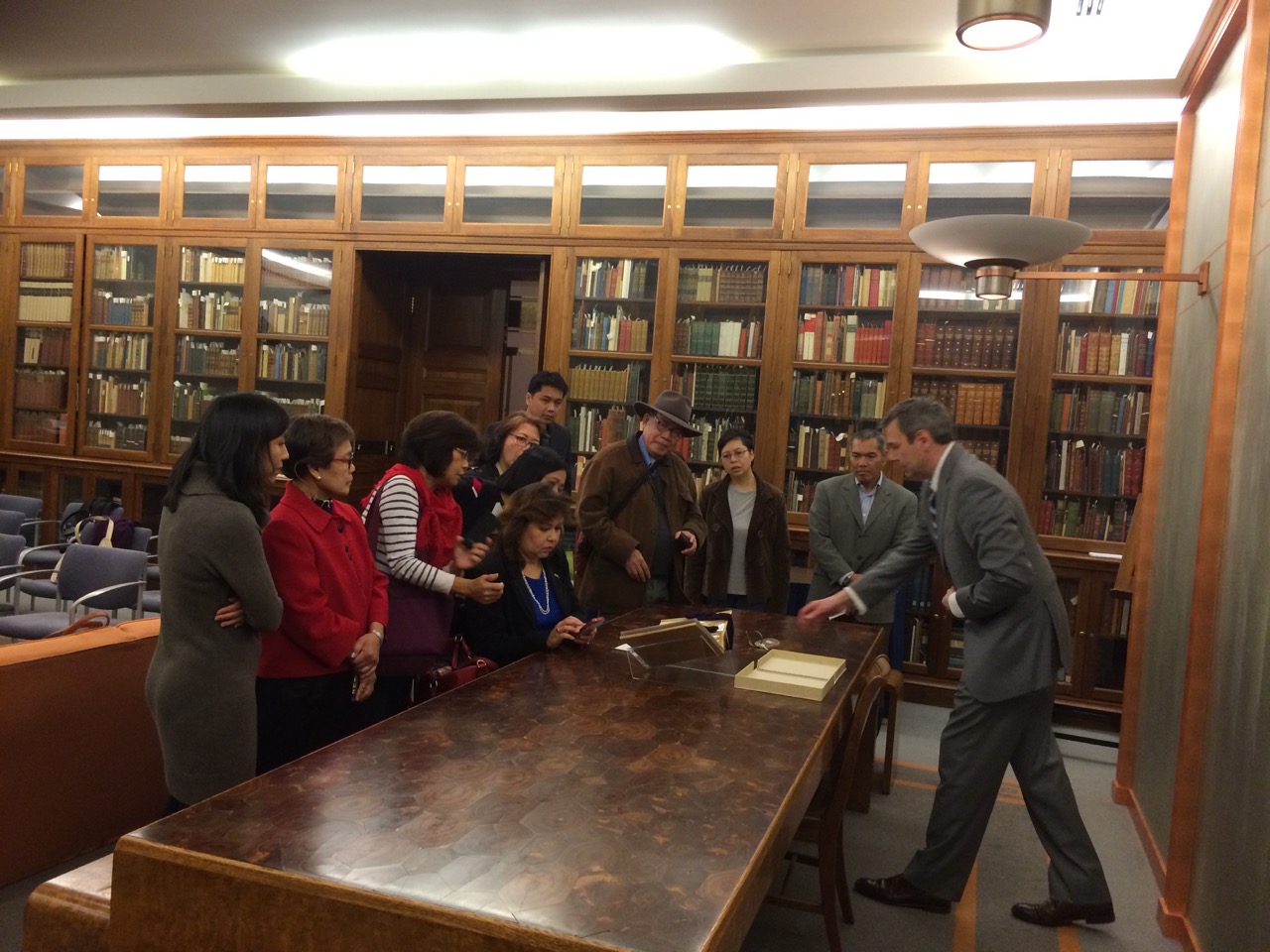
So the LOC’s copy, as far as we know, is the only one of its kind, and it was with great anticipation that Beng and I joined a group of ten Filipino and Filipino-American scholars and advocates who were kindly admitted by the LOC’s Rare Books Division to a private viewing of the Doctrina, with LOC librarian Eric Frazier doing the honors. (While waiting for our appointment, we had taken in a few of the LOC’s other prime offerings including the Gutenberg Bible, which is on permanent display near the stupendous main lobby that welcomes visitors, and the Magna Carta, on loan from the Lincoln Cathedral.)

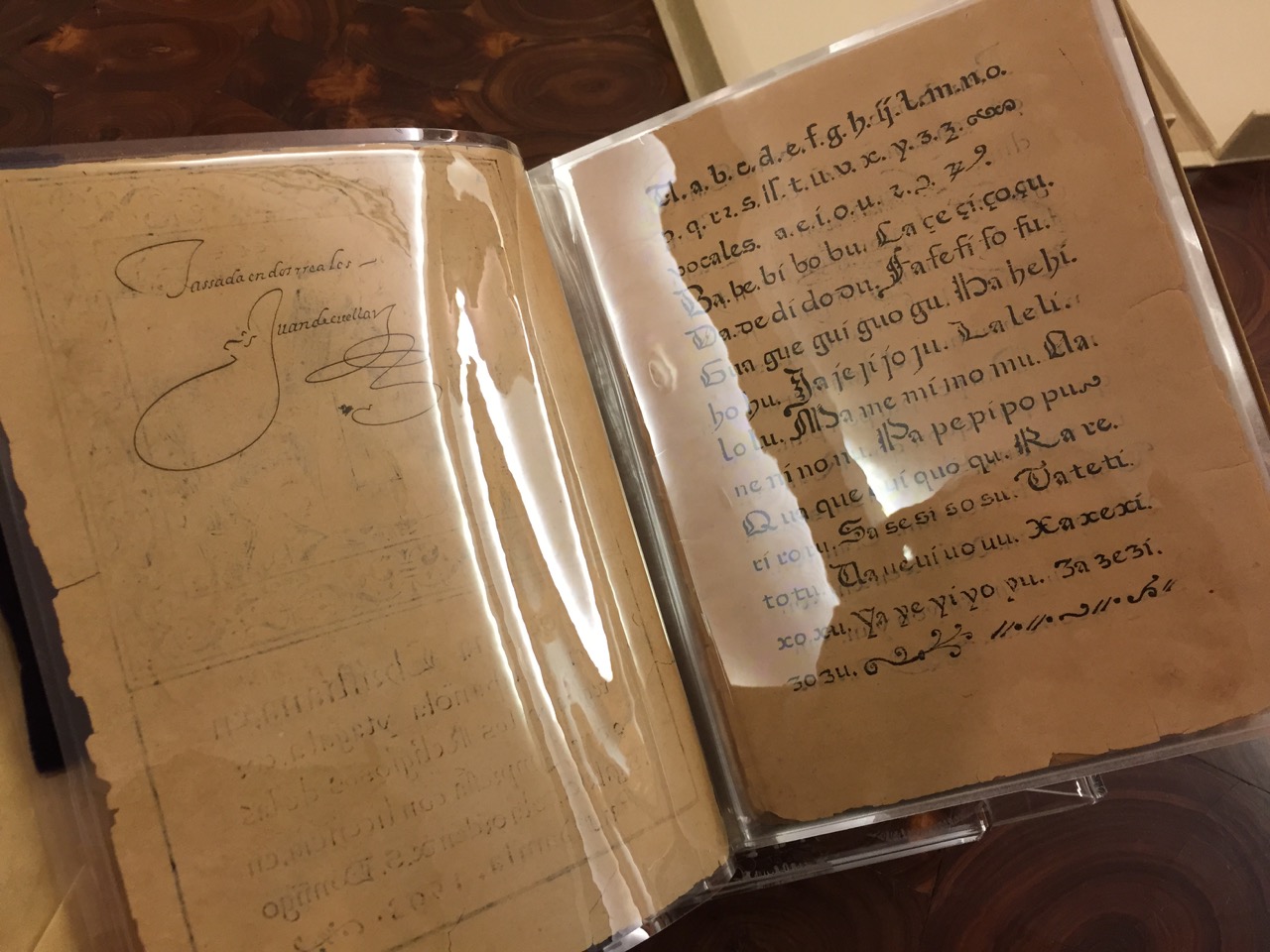
I should’ve read up more on the Doctrina before we went up there, but I was surprised by two things I realized only when I saw the book up close: its relatively small size, and the fragility of its paper. It’s only about 9 by 7 inches, not much bigger than a contemporary textbook. It was a further surprise to hear Eric say that “As far as I know, among the millions of books we have at the LOC, this is the only one whose every page is sheathed in Mylar.”
IMG_6150

I had asked Eric about the condition of the book and the paper, having seen and even handled other books from the 1600s (many of which, printed on stout, crisp linen paper, look good as new, and have survived in much better shape than the acid-lined paper of the 1800s and 1900s). The Doctrina, as it turns out, was printed xylographically—like a woodblock with the letters carved out—on mulberry paper (other sources say rice paper, although that term may have covered other papers made from mashed material). I’m not a professional historian, so I stand to be corrected on these presumptive facts by people who know vastly more about the Doctrina Christiana and about the history of books than I do (two immediately come to mind, our foremost book historians: Dr. Von Totanes and Dr. May Jurilla).

It was with the greatest of care and respect that we flipped those pages, and we saw what generations of the faithful must have seen (that is, if they saw the book at all): a syllabary, followed by prayers and other articles of faith, presented in Spanish, Tagalog, and baybayin, that pre-Hispanic script that survives in our consciousness only in the Katipunan “ka.” What’s remarkable is how fundamentally familiar the text of the prayers is: “Aba guinoo Maria matoua cana, napopono ca nang gracia. ang panginoon dios, ce, nasayyo. Bucor cang pinagpala sa babaying lahat….”

And so it went, a cry of praise and supplication across the ages, come to life again at our trembling fingertips.

I can only hope that, perhaps through an arrangement with a responsible Philippine institution, the Doctrina can be brought back to the Philippines for a special exhibition (the forthcoming Papal visit would have been the perfect occasion), or at least that more Filipinos in the US could see it, along with the other Philippine holdings at the LOC. It does take time and effort to arrange for a viewing, but in the meanwhile, the full digital copy of the book, provided by the LOC, can be found here: http://tinyurl.com/knpzkn5. For more information on the Doctrina Christiana and this particular copy, see the notes of Project Gutenberg editor Edwin Wolf at http://tinyurl.com/p6uqlvr.
Penman No. 124: Pinoys on the Potomac

cropped-logo-rizal-washington8Penman for Monday, Nov. 24, 2014


ERWIN TIONGSON and his wife Titchie are in their early 40s, successful professionals and the parents of young sons; they live in Fairfax, Virginia, a pleasantly wooded suburb just outside of Washington, DC. An Atenean from Nueva Vizcaya, Erwin teaches Econometrics at Georgetown University, while Titchie, a prizewinning writer, has chosen to stay at home to look after the children. Outwardly they might seem to be just another Filipino couple living the good American life, steadfastly focused on the present and the future. But their true passion inclines elsewhere, as Beng and I would discover in one of the most fascinating encounters we’ve had in our current American sojourn.

I’d first heard about Erwin from another new Fil-Am friend, Sonny Busa, a retired Marine, a former consul and instructor in international relations at West Point. (Sonny, in turn, had been introduced to me by upstate-NewYork-based Sharon Delmendo, who has done a lot of research on Philippine-American relations—so now you see how the academic circuit works.) Sonny had mentioned to me that there was a Filipino in the community who had taken it upon himself to chronicle the history of the Philippine presence in Washington and the surrounding area—more than a century of visits and residencies by Filipino politicians, diplomats, writers, artists, musicians, and other personages whose life and work, in one way or another, drew them to the American capital.

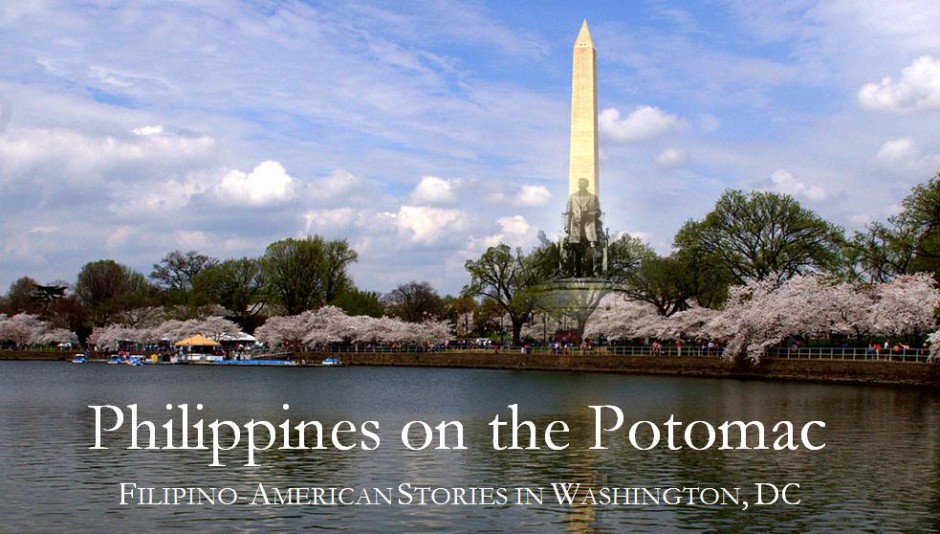
That’s how I found the website that contained all this information—a WordPress site titled “Philippines on the Potomac: Filipino-American Stories in Washington, D.C.” (https://popdc.wordpress.com). If you’ll take a minute to click on that link, you’ll discover what I did, with a child’s wonderment at the entrance of a carnival: short articles and accompanying photographs tracing the connections between Filipinos and Washington, DC.

As might be expected, the big political figures, especially those from the Commonwealth and postwar period, dominate the reportage: Manuel L. Quezon, Carlos P. Romulo, Sergio Osmeña, Manuel Roxas, and Jose Abad Santos. But cultural luminaries are also well represented: Juan Luna, Jose Garcia Villa, Juan Arellano, Enya Gonzalez, Fernando Amorsolo, and Bienvenido Santos, among others.

Quezon had served as Resident Commissioner—effectively our ambassador—in Washington until 1916, and when he went to the US on his wartime exile and died in New York in 1944, it was at the Cathedral of St. Matthew the Apostle in Washington—not too far from where our embassy now sits—where his funeral mass was held prior to his interment at Arlington (less than 20 years later, John F. Kennedy would follow the same route; MLQ’s remains were moved to the Philippines after the war, and now lie at the Quezon Memorial).

Carlos P. Romulo and his family lived in a home on Garfield Street for 16 years, CPR having served in many capacities, from aide de camp to Gen. Douglas MacArthur to Resident Commissioner, ambassador, and president of the United Nations General Assembly. (One of the website’s most remarkable images has an old sepia photograph of the Romulos superimposed exactly over the same spot in front of the present house, which has barely changed.)

The site provides a treasure trove of other historical facts—including, inevitably, tidbits of information that serious scholars might dismiss as trivia, but which enthusiasts like me can’t get enough of. The sculptor and National Artist Guillermo Tolentino, for example, once worked as a waiter in Washington, and somehow managed to meet President Woodrow Wilson and to present him with the gift of a small statue, which Wilson kept in his room until his death; Wilson later helped Tolentino get a scholarship to art school. We also learn that Juan Luna and Felipe Agoncillo went to Washington in 1899 to campaign against the Treaty of Paris, and stayed at the Arlington Hotel, where they were spied upon by the Secret Service. (All these stories are properly attributed and referenced, by the way.)

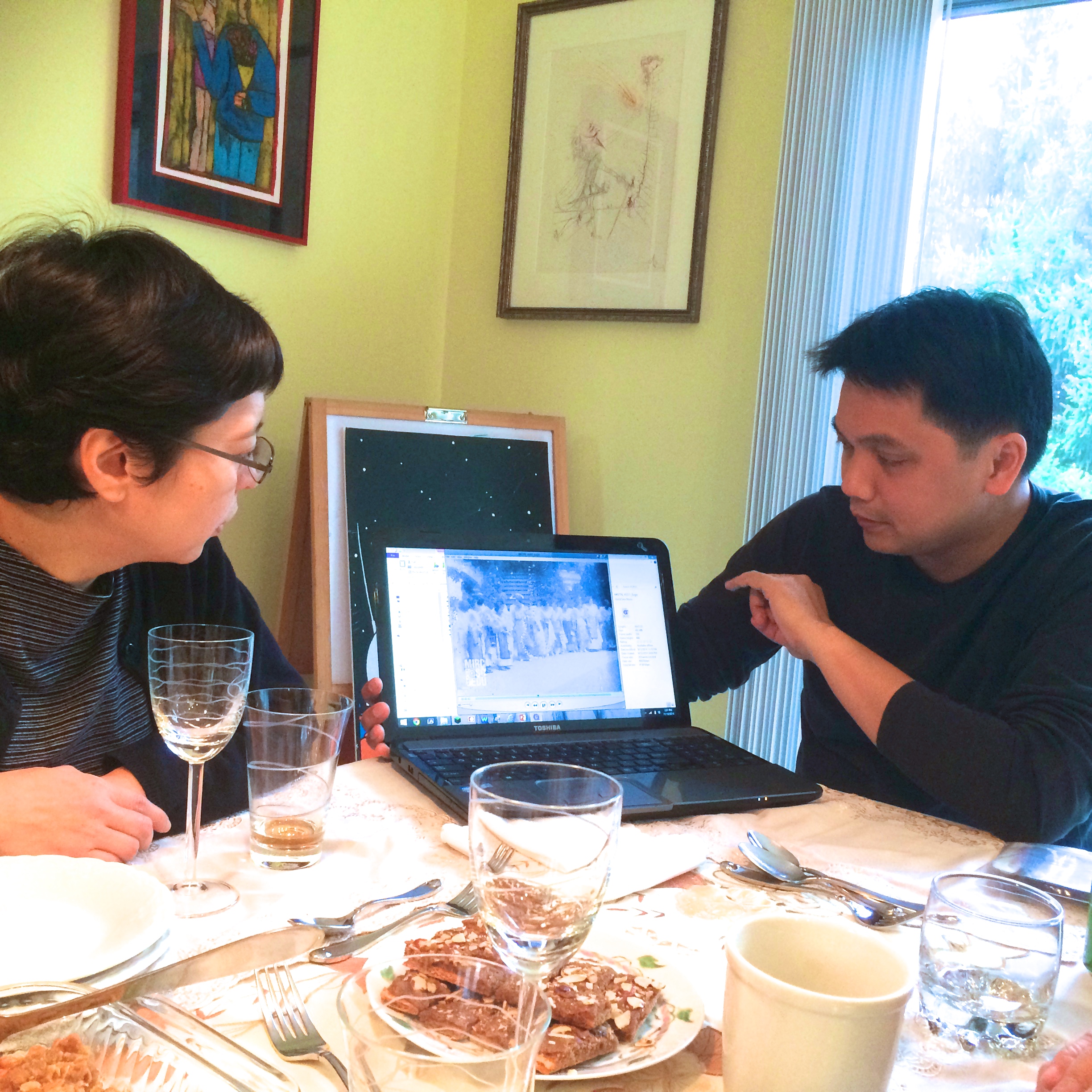
Better than just poking around the website, the Tiongsons invited us to lunch and show-and-tell, and I couldn’t wait. Learning of my current affiliation with the George Washington University, Erwin had pointed me to an article written by CPR’s granddaughter Liana relating how Romulo had coached a debating team from the University of the Philippines in an engagement with the GWU team, over this issue: “Resolved, That the Philippine Islands should be granted immediate and complete independence.” The debate took place on April 18, 1928 at GWU’s Corcoran Hall. “UP won,” said Erwin. “It was the team’s fifth victory, after defeating Stanford, California, Utah, and Colorado. The team would go on to defeat all their other opponents—a total of 14 universities, if I remember correctly.”

Tiongsons

Even more interesting were the personal stories that Erwin and Titchie shared with us (after a sumptuous lunch of home-made corned beef and baked salmon, which all by itself was well worth the Sunday visit). I can’t go too deeply into the details now, but Beng and I were thrilled to share Erwin’s elation over his most recent discovery, a book that had been inscribed by Maximo Kalaw, MLQ’s private secretary, to a “Nina Thomas”—who turned out to be the American lawyer the young Quezon had been engaged to (he broke off the engagement after being advised that marrying an American was political suicide). Erwin made contact with Nina’s heirs in Virginia; she never married, but she passed on Quezon’s monogrammed walking stick and their engagement ring to her niece.

Erwin also showed us a movie poster from 1946 of Anna and the King of Siam, featuring Rex Harrison, Irene Dunne, and a little-known actress named “Chabing”—who turned out to be Isabel Rosario “Dimples” Cooper, Douglas MacArthur’s girlfriend (not mistress) between marriages; after MacArthur left her, she resumed her film career (she was notable for having recorded the first on-screen kiss in Philippine movies in 1926), assuming the single name “Chabing,” whose filmography you can look up on IMdb.

It was also a treat to listen to a radio recording of Jose Garcia Villa, made in the 1950s, of him reading his “Lyric 17” (1942) which famously begins with “First, a poem must be magical….” Most moving was the 20-minute documentary of President Quezon’s funeral—directed by no less than the renowned director John Ford—that Erwin had magically retrieved from somewhere in the many university libraries, archives, and museums that he still haunts in search of fugitive Filipiniana. He has begun a collection of war correspondence from the early 1900s and the Second World War; one 1902 letter poignantly retained a swatch of jusi, which the wife of an American official in Iloilo wanted her folks to see.

We could have stayed there the whole day, reveling in our memories of the grand old men of Philippine letters—NVM Gonzalez, Ben Santos, Nick Joaquin, Manuel Viray; I shared my own little adventures in cultural retrieval. But Beng and I had sadly had to trundle out again into the autumn chill, warmed by our imaginations, and in my ears rang a line from Viray’s poem about his old house in Washington, on Cathedral Avenue, which the Tiongsons had also located: “A streak of light aslant / On the screen door creeps up the line of dusty books.”


Penman No. 122: A Meeting in Manhattan

IMG_5861Penman for Monday, November 10, 2014


BENG AND I were in Philadelphia and New York these past two weekends, so I could do more interviews for my martial-law book project and also get in touch with a few old friends. I normally keep a very low profile and don’t tell or call people when I travel to places where friends are living, not because I’m a snob, but because I don’t want to be a bother, knowing what it’s like when somebody drops in from the blue and throws your schedule out of whack.

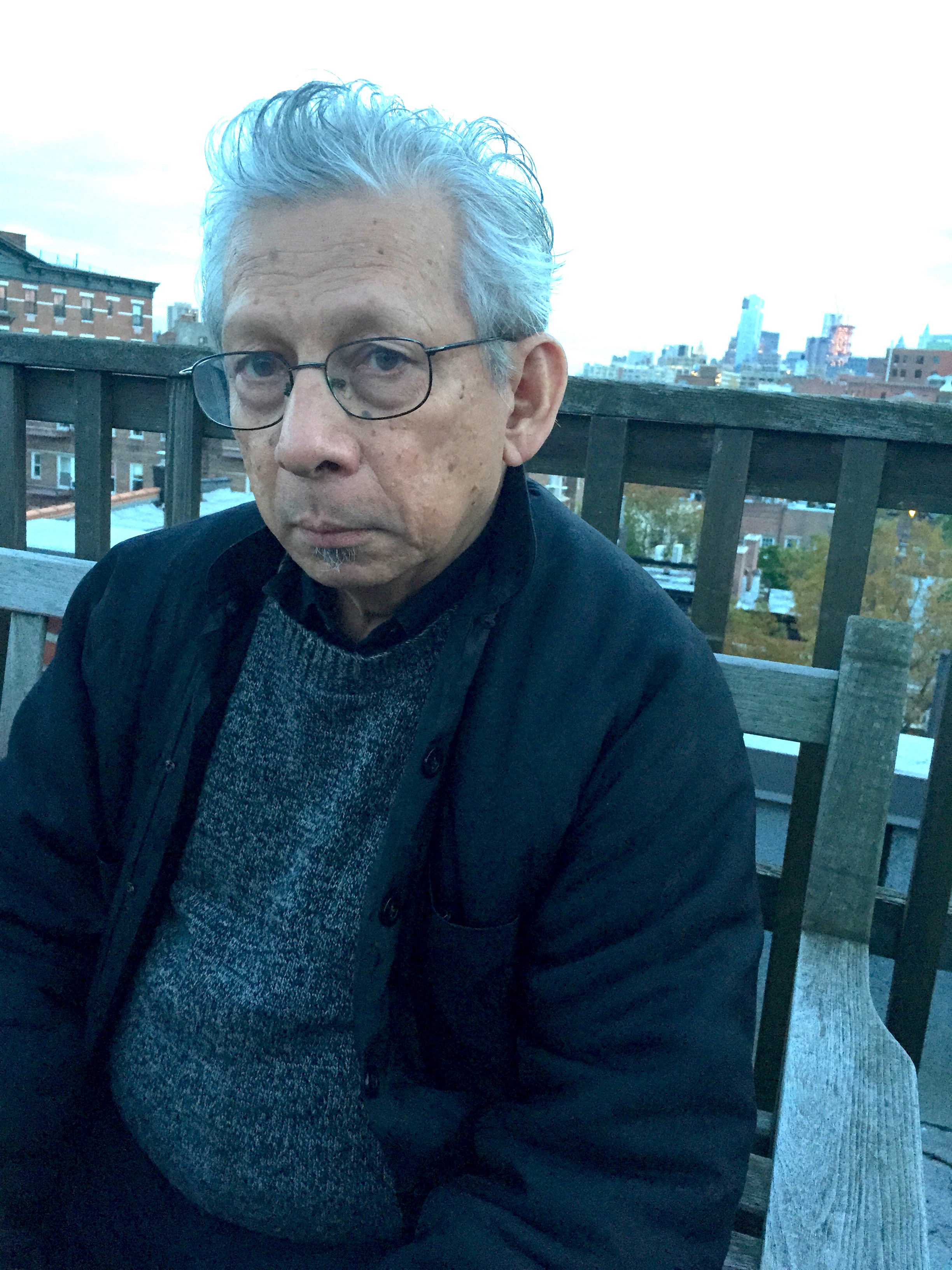
But there are always some friends you never mind breaking your routine for, and who never seem to mind, either, if you break theirs. And I was glad to meet up in Manhattan with two such writer-friends, the poet and essayist Luis “Luigi” Francia and the fictionist Gina Apostol, both of whom live and work in New York. Luigi teaches at Hunter College and Gina at the Fieldston School.

The first time I met Luigi, many years ago in a Malate bar on one of his visits home from New York where he has been living since 1970, I remember seeing his calling card, which described him thus beneath the name: “POET. EDITOR. PRINCE.” It seemed cheeky and chic, and I was deeply impressed, being none of the above. (I’ve since written some middling poetry and have done my share of editing chores, but remain utterly unprincely.)

IMG_5856

I had the recent pleasure of writing a blurb for Luigi’s forthcoming collection of essays titled RE: Reviews, Recollections, Reflections, to be published by the University of the Philippines Press, and this is what I said:

“Luis Francia knows New York and America better than many of the native-born, but he never loses his moorings, his critical awareness of what it means to be Filipino-American. But these essays are about far more than racial politics, as they chronicle the travails of that most blessed and in other ways most cursed of citizens—the artist, particularly the artist abroad, for whom alienation acts as a lens that magnifies and reshapes every little thing that crosses the eye. The most arresting and delightful reads are his portraits of the expatriate masters who preceded him in America—most notably Jose Garcia Villa, lover of martinis and hater of cheese. Despite the plaints, Francia has been clearly and distinctly privileged to be where he has been and to see what he has seen, and he shares that privilege with us in this well-wrought collection.”

Gina was my batchmate when I returned to finish my undergrad studies in UP in the early ‘80s; I was ten years older than everyone else, so I was kuya to all of them. It was a time when we were all dreaming of finding a way to take our graduate studies abroad—as English and writing majors, we wanted to become the next Gabriel Garcia Marquez, the next Sylvia Plath, the next Ian McEwan, the next Pablo Neruda, and so on; as Pinoys, we wanted to see America. Eventually, we just became our older selves, but we did get to see the States through one ticket-paying subterfuge or other—for me, a Fulbright grant; for Fidelito Cortes, a Wallace Stegner fellowship; for Ramon Bautista, an assistantship at Wichita. But we had to compete for these, while all the brilliant Gina had to do was to lick a few stamps and mail a couple of her typewritten stories off to John Barth, who directed the writing program at Johns Hopkins and who wrote her back forthwith to offer her an assistantship, smitten as he was with her talent. It was pure magic, in those pre-email days.

That brash young woman from Tacloban who flew off to Baltimore would go on to write several prizewinning novels. Gun Dealers’ Daughter, published by W. W. Norton, won the 2013 PEN Open Book Award given by the PEN American Center to outstanding works by authors of color to promote racial and ethnic diversity within the literary and publishing communities. (Luigi himself had won this prize in 2002, the first year it was given, for his nonfiction book The Eye of the Fish.)

Here’s what the judges said about that novel in their citation: “You will read Gun Dealers’ Daughter wondering where Gina Apostol novels have been all these years (in the Philippines, it turns out). You will feel sure (and you will be correct) that you have discovered a great fiction writer in the midst of making literary history. Gun Dealers’ Daughter is a story of young people who rebel against their parents, have sex with the wrong people, and betray those they should be most loyal to…. This is coming of age in the 1980s, Philippine dictatorship style, where college students are killed for their activism. The telling is fractured, as are the times…. Not only does this novel make an argument for social revolution, it makes an argument for the role of literature in revolution—the argument being that literature can be revolution.”

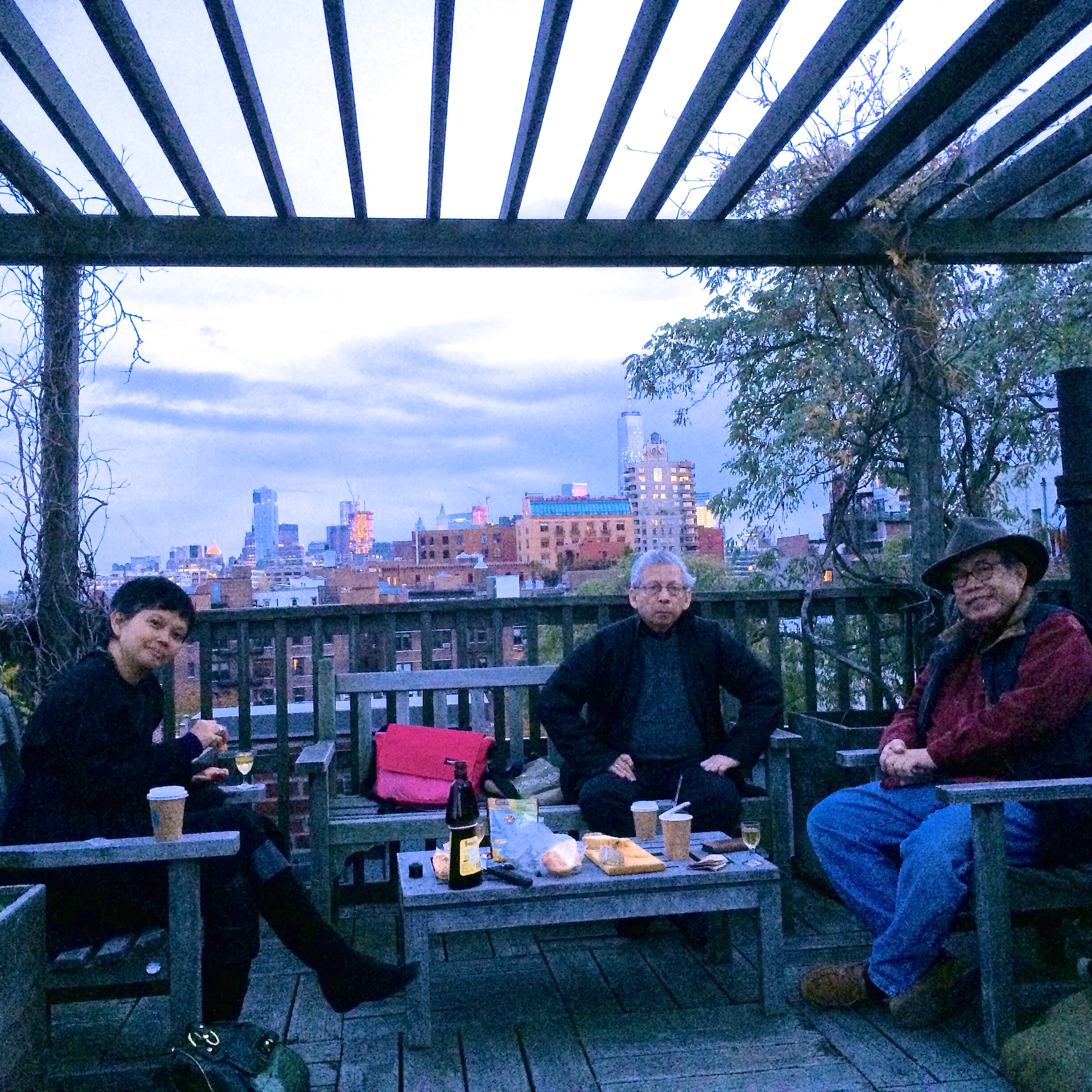
These then were the two literary luminaries who happened to be my friends (or should that be the other way around?) whom I was happy to set up a date with in a coffee shop in the West Village, near the High Line (an elevated garden and walkway that deserves its own story, among other New York landmarks). The coffee place was full, so we brought our steaming cups instead up to the roof deck of Gina’s apartment a few blocks away, pausing for a picture in front of the late Jose Garcia Villa’s old place on Greenwich Street. “This was where he held court,” said Luigi, one of Villa’s acolytes. “Nonoy Marcelo also lived in this area for many years, and I did, too, back when the rent was 65 dollars a month.” Then Gina added, “That white place is where John Lennon and Yoko Ono lived.” And I thought, if they’d stayed here instead of moving to the Dakota, he might still be alive.

We went up to the roof deck and Beng and I savored the scenery in all its 360-degree magnificence, as the sun set in the west and the full moon rose in the east, competing with the Empire State’s tricolor spire. We talked books, life, and loves over Frangelico, bread, and cheese; channeling Villa, I steered clear of the curd. Looking sharp and happy despite a recent illness, Gina said that her iPhone’s Siri had told her, in response to a question, “I’m just glad to be alive!” At that instant, we all were.

Penman No. 120: Hello, Helvetica

Human2Penman for Monday, October 27, 2014

ALMOST TWENTY years ago, in a column for another paper, I said “Goodbye to Garamond,” in reference to how the world of typography—the way by which the printed word is presented to us by publishers, advertisers, and the media—was perceptibly changing.

Printed letters—like the ones you’re looking at this very instant—are shaped into what are called fonts (a term often used interchangeably with “typeface,” although some experts will insist that there’s a subtle but important difference). They’re how the letters physically look, which in turn may convey psychological, emotional, or subliminal messages to the reader. We’ll get to that in a minute.

First, here’s a bit of what I wrote back then:

“Have you ever wondered about those fonts whose letters look as though they had been scratched onto plywood with a nail by a heroin addict going through withdrawal? Remember the flickery font they used for the credits of Brad Pitt’s Seven?… These, folks, are examples of what’s been called ‘grunge’ typography and ‘degenerative’ art. The idea seems to be to produce aesthetic pleasure through severe disorientation…. Goodbye to Garamond, and all those reassuringly clean and classically balanced fonts. Hello to something like WaxTrax, which fairly drips all over your screen. And so it goes in the BraveNewWorld of cyberspace.”

Cyberspace and the Internet, of course, were still a novelty for most people back in 1996, and were full of raw and rough edges—visually and even audibly. Remember when you could count the dots on your screen and on your printout, and remember how mating modems screeched like cats in heat? Not surprisingly, the digital aesthete had all the finesse of a frontiersman, wielding his mouse like a chainsaw rather than a sable paintbrush. In other words, things looked pretty ugly—including titles and words on the computer screen, which had become the new page.

Or ugly, at least, to someone like me, who grew up with typewriters and liked the evenness of letters on a line, and the little feet (the so-called serifs) that grounded the shapely curves and angles of the A’s and M’s. That’s what I came to love about a graceful font like Garamond, which traces its origins to the 1500s, but which has been tweaked many times over the next 400 years—among others by Apple, which not surprisingly called its version Apple Garamond, used in the word ”Apple” itself by the company in its branding.

Speaking of Apple, this brings me to my little plaint for the day. Over the past month or so, Apple came out not only with the iPhone 6/6+ and with upgraded iPads and Macs; it also put out new versions of its operating systems for its devices and computers—iOS 8.1 for the portables, and MacOS 10.10 or “Yosemite” for the bigger machines.

So I dutifully upgraded to Yosemite, only to discover to my great dismay that—despite nifty new features here and there like being able to text non-iPhone numbers from your Mac and a better way of dictating text into Microsoft Word—I kept getting bothered by one small (and I mean literally small) thing: the new system font, called Helvetica Neue, which replaced the longtime, rounder Lucida Grande. You’ll see Helvetica Neue in the title bars and the bookmarks and tabs in your Safari Web browser—thin, narrow, and barely legible to my 60-year-old eyes.

What was Apple thinking? Well, certainly not about me (although we baby boomers were the original Apple faithful); “leaner and meaner” seems to be the mantra for the millennial computer user, and Apple is serving up the look in spades. And unlike what you could do with previous OSes, you can’t change or even tweak the size of the system font now, although you could enlarge individual windows in Safari and fonts in Word, probably because the system architecture would come crashing down if you had that option—the look is embedded into the package.

Why is this a big deal, at least for the fussy folk like me? Because it’s another sign—and a very visual one at that—of how the planet’s trendsetters see the present and the future, in the same way that blackletter fonts (more popularly if mistakenly called “Gothic” or “Old English”)—the kind you see in medieval Bibles—evoked an arch, elevated, not-very-accessible mindset.

Fonts and typefaces became more readable over time, and in the modern age, sans-serif (footless) fonts like Helvetica, Univers, and Futura became all the rage. Helvetica (the word itself means “Swiss”, in a tip of the hat to its origins) has been around since the 1950s, and can now be seen everywhere, along with its brethren. Being blocky, sans-serif fonts work best for titles and headlines, but can tire the eyes over long stretches; thus, older, footed fonts like Garamond, Palatino, and New York are still better for body text, because the little feet actually define the letters more sharply (try this by looking at a word like “human” in serif and sans-serif).

Lufthansa

I’ll agree: Helvetica’s a handsome font, and by now probably the world’s most popular one for signage and ads. (Just think of the logos of Lufthansa, American Airlines, Microsoft, Panasonic, Scotch, JCPenney, and The North Face, among others.) Maybe I’m actually sad in a way that Apple’s joining the pack rather than leading it as it often has—and if there was anything Steve Jobs almost literally imprinted into his designers and engineers, it was his fascination for typography.

But please, Apple, when the next upgrade comes around, give us something our aging eyes can better read, even if it isn’t Garamond.

Penman No. 119: Bulosan in the Heart

Penman for Monday, October 20, 2014


TAKING A short break from my fellowship in Washington, DC, Beng and I flew off to the West Coast a couple of weeks ago for a weekend with our daughter Demi and her husband Jerry. Demi was celebrating her 40th birthday (can you believe it?) and had sent us tickets to join them in Seattle; they live in San Diego, but they’d loved Seattle from a previous visit and wanted to share that discovery with us.

Over three days, we did the Seattle thing, and had loads of fun: the Pike Place Market, the Space Needle, a glimpse of the Chihuly glass garden, antiquing in Snohomish, and a boys’ tour of the Boeing plant in Everett. But it was an unexpected turn in the program that made it all the more worthwhile.

On the drive into the city from the airport, I had mentioned to Jerry (who had been born in Rhode Island to parents from Bicol) that two Asian-American icons—Carlos Bulosan and Bruce Lee—were buried in Seattle. Jerry’s an engineer in the aviation industry, but like Demi, he has a keen interest in culture and in his roots.

Bulosan’s name holds a special significance for our family. In high school, with some help from Beng, Demi had put together a book report on America Is in the Heart—Bulosan’s sprawling semi-autobiographical novel about the Filipino immigrant experience in America, first published by Harcourt Brace in 1946. I myself had written my undergraduate thesis at the University of the Philippines on Bulosan, fascinated by his often paradoxical appreciation of America, which he described as being at once “so kind and yet so cruel.”

Born in Pangasinan, he shipped out to Seattle in 1930, and never returned until his death from bronchopneumonia, also in Seattle, on September 11 (yes, 9/11) in 1956. (There’s some debate over the year of his birth, which has been variously listed as 1911, 1913, and 1914.) In the US, without the benefit of college, he became a voracious reader and taught himself to write, and became known both as a writer and a labor activist. Since the 1970s, many critics such as Epifanio San Juan Jr. have championed a reappreciation of Bulosan and his work; in 1973, the University of Washington Press republished America Is in the Heart, which was translated into Filipino as Nasa Puso ang Amerika by Carolina S. Malay and Paula Carolina S. Malay and published by Anvil in 2000.

When Demi and Jerry made plans to marry in 2007, I knew what I was going to give them as a wedding gift. After a long and eventful search culminating in a meeting with the seller in a Jollibee in Diliman, I had just acquired a first edition of America Is in the Heart, and carried it with me to San Diego. This copy had been inscribed by Bulosan to his friend Fred Ruiz Castro: “This story of my life will, I hope, bring me closer to you and our native land through our good friend J. C. Dionisio, with my best wishes, Carlos Bulosan, Los Angeles, 3-6-1946.”

Upon receiving the book in Manila almost a month later, Castro—who became Chief Justice in 1976—also signed it on April 4, 1946. I signed the book on a following page on April 2, 2007, and Beng and I presented it to Demi and Jerry on April 15. The book now rests proudly on their bookshelf in San Diego. (When I first wrote about this in my column—about finding that “holy grail” of a signed first edition and giving it to our only child on her wedding in America—I got a pleasant surprise upon my return: the gift of another copy of an early edition, acquired by another Filipino writer when he was in college, Greg Brillantes. That book, signed by Greg, now sits on my topmost shelf in Diliman.)

Now back to Seattle. On our last full day there, after touring the Boeing plant in the morning while our wives did their own thing downtown, Jerry and I were hit by the same brain wave in the car: why not look for Carlos Bulosan’s grave and pay our respects to our literary hero? A little Googling quickly revealed his gravesite, at the Mt. Pleasant Cemetery on Queen Anne Hill. We picked up Beng and Demi at the hotel, and located the cemetery not too far away.

GPS helped bring us there, but it couldn’t pinpoint the exact grave among the many hundreds on the site; thankfully, Google also yielded a picture of the grave itself, and the four of us spread out across the cemetery, looking for visual markers—particularly a white obelisk in the distance; it took about 20 minutes until Demi yelled “I found it!”

It was, ironically, very close to the cemetery gates, on the left side. Beng picked some flowers nearby and offered them at the foot of the marker, which read: “CARLOS BULOSAN 1914-1956 Writer Poet Activist,” followed by an epitaph that Bulosan himself had written: “Here here the tomb of Bulosan is / Here here are his words dry as the grass is.” It was a pretty spot, truth to tell, and the grass was hardly dry. After the cemetery, we visited Seattle’s International District near the waterfront, to peek at the Bulosan exhibit through the windows of the historic Eastern Hotel, where Bulosan and other Filipino cannery workers lived.

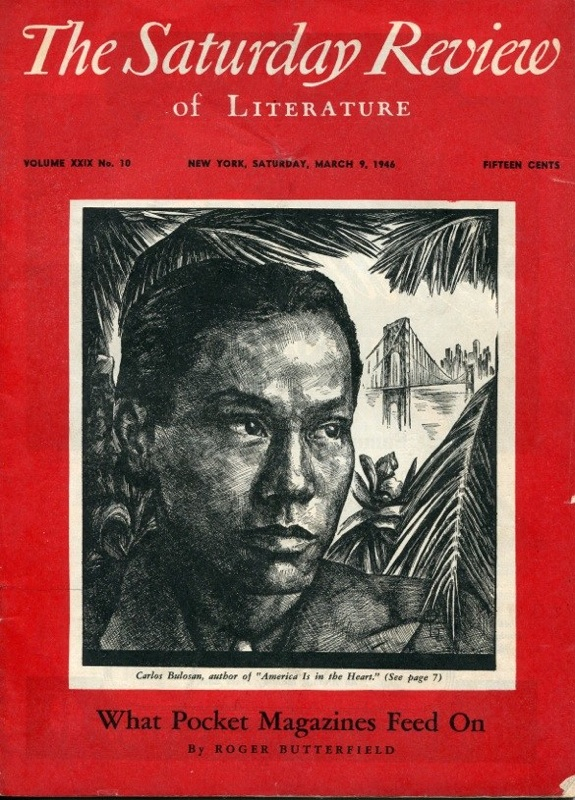
Demi and Jerry don’t know it yet, but they have another Bulosan memento coming from me: a copy of the Saturday Review of Literature from March 9, 1946, on the cover of which the famous pen-and-ink portrait of Bulosan first appeared. One of these days, I’ll pay another homage, to the Bulosan memorabilia on exhibit at the University of Eastern Pangasinan in Binalonan, where they keep copies of his letters, commemorate September 11 as Carlos Bulosan Day, and teach a 3-unit course on his life and works. There’s a trove of material on him at the University of Washington library, and perhaps on another visit to Seattle, with more time, I might look into that, too. But as every Fil-Am and indeed every Filipino should know, a pioneering voice like Carlos Bulosan’s can ring everywhere and forever, in the heart.

Bulosan

Penman No. 117: The Way We Were

IMG_4726Penman for Monday, October 6, 2014


I’D LIKE to thank the people who’ve given me their time and accorded me their hospitality during my current visit to the US. I’m here to do more research for a book project—an oral history of the First Quarter Storm (the story of my generation, in other words)—and so far I’ve had wonderfully productive interview sessions with some people who were either active participants in the anti-martial law movement or were on the other side of things (or simply on the roadside) at the time.

Those who’ve helped me out, either as interview subjects or facilitators, include former campus journalist and retired engineer Gerry Socco and his wife Chet; lawyer Rodel Rodis; editor Rene Ciria-Cruz; tech journalist and developer Joey Arcellana; and journalist Gemma Nemenzo and her husband, Col. Irwin Ver. All of them are conveniently based in the San Francisco Bay Area, so Beng and I flew out there from DC for a long weekend of interviews and reunions with old friends.

Rodel and I go back all the way to the Philippine Science High School, where I served as Rodel’s associate editor when he helmed The Science Scholar. It was also in high school—when I myself became editor in chief—that I first heard of Joey Arcellana from our adviser, Mrs. Agnes Banzon Vea (mother of the accomplished Doy and Rey Vea), who told me one day: “There are two young writers I’d like you to read. One of them writes for the UP Collegian, and his name is Joey Arcellana. The other is still in high school and writes for the Highlights, and his name is Gary Olivar.” Gemma, who now edits the ezine Positively Filipino, also edited the late, lamented Filipinas magazine, which I used to write a column for. Gerry I knew from the pre-martial law College Editors Guild of the Philippines, and we met again in the worst of possible circumstances—as fellow political prisoners in Bicutan; today, in our sixties, we share an unabashedly bourgeois passion for collecting vintage pens and watches.

In Washington, DC, where I’m formally based through my association with the George Washington University, I’ve been lucky to meet and to interview one of the torchbearers of the anti-Marcos resistance on the East Coast, Jon Melegrito, a retired librarian at GWU who now writes for the DC-based fortnightly Manila Mail. I’ve also been glad to gain the insights of three former State Department officials: former Ambassador John Maisto, who headed the old Office of Philippine Affairs and served in Manila in the late 1970s; his colleague Hank Hendrickson who now serves as executive director of the US-Philippines Society, of which Amb. Maisto is the president; and Santiago “Sonny” Busa, a Filipino-American who has served as consul in Manila, Addis Ababa, and Kuwait, and who has taught International Affairs at West Point. I’ll be doing a bit more traveling to see people in New York and possibly the Midwest.

So far, I’ve interviewed about 30 people for the book, which I’ve begun to write at my sister’s place in Virginia. It’s very strange in a way to write about bloody encounters in coconut groves in the Philippine South while reveling in the sight, outside my window, of bluejays and robins perched on the branches of trees just beginning to acquire an autumnal glow. But perhaps it’s precisely this physical and psychological estrangement that I need to handle such an emotional project—emotional, at least, for members of my generation.

Sometimes what I hear gets a bit too much; for the first time, after having written and published over 25 books with a very dry eye, I wept as I listened to an account of someone I knew shooting—executing—someone who had been her best friend. At the same time, events that might have been terrifyingly life-threatening 40 years ago can now sound absolutely hilarious—or deadpan ironic, such as when firebrand Fluellen Ortigas, selected as one of the Ten Outstanding Students of 1968, stands beside President Marcos at the awarding ceremonies, with a book titled The Essentials of Marxism in hand. “Join my staff,” Marcos tells him. “I can’t,” Ortigas replies. “You’re going to be a dictator!” Ortigas would later work for Ninoy Aquino, go underground in Panay, get arrested before martial law, get released in 1976, flee to the US via Sabah, get an MBA, and become a businessman in San Francisco.

I have many more stories like Flue’s to tell, each with its own highlights and insights—Elso Cabangon being ambushed on Taft Avenue and taking four bullets, one of them tearing through his cheek; Boy Camara auditioning for the role of Judas before eventually playing Jesus Christ, Superstar; a female comrade being married in the rites of the Party, one hand on her heart, and the other on Mao’s Quotations (it’s a marriage, like many in the movement, that will unravel). But they’ll have to wait until the book itself, which I hope to finish by early next year.

Even now, many old friends and comrades are probably wondering why I haven’t approached them yet or asked so-and-so to be interviewed, because they have interesting and important stories to tell. I’m sure they do, and I have to extend them my apologies in advance, simply because I just don’t have the time or space at the moment to include everything and everyone I should be covering. I’m almost certain that this oral history will lead to a sequel, all the way to EDSA (a book that someone else should begin writing soon). Some people I’ve asked haven’t replied or have declined, and I can only respect their implied wish to be left alone.

Again, this book will be about the past, and while we might bemoan the innocence we lost, or even wax romantic about the way we were, I don’t think too many of my respondents will want to relive their lives in exactly the same way, knowing what they do now. We might not regret what we did—it arguably needed to be done—but we or our children don’t have to repeat it, if it can be helped. That’s how history helps the future.

Penman No. 115: The Clarity of Prose

Penman for Monday, Sept. 22, 2014


“THE CLARITY of Things” is the title of the new short story I finished a few weeks ago, which will soon be coming out in the Australian literary journal Westerly. The phrase has been ringing in my ears and suggested this piece about the value of clarity in prose—an element whose importance seems so obvious but which still escapes many writers, especially those who remain unsure of what it is exactly they want to produce.

I was thinking of this the other day as I was reading, with much delight, an old essay by the New York-based Luis Francia on Jose Garcia Villa, which begins thus: “Loved New Yorker cartoons. Hated its poetry. ‘Prose,’ he’d sniff.” The essay (in which I happily discovered that I shared with Villa not just a first name but an aversion to French food and cheese) went on to describe Villa’s fabled workshops, where he decried, Luis recalls, “the prose or narrative mentality. Anathema to the poet’s creed. He urged us not to read fiction, to purify ourselves, our poems, and have that lyric spirit fly unfettered.” There was, Villa and Francia agreed, too much bad prose going around, passing itself off as poetry.

It’s an admirable and entirely understandable stance, coming from a consummate aesthete like Villa. I don’t think there’s a real writer alive who won’t concede that, in the hierarchy of letters, poetry sits at the topmost tier; I often remind students too eager to proclaim themselves poets that there’s nothing harder to do well and easier to do badly than poetry. I’ve published a book of what I offer to be poems and I’ve won a couple of prizes for poetry, but I wouldn’t for one minute describe myself as a poet; I am not worthy.

That said, the writing of good and great prose—whether fiction or nonfiction—poses its own challenges, heedless of poetry’s demands for complexity, compactness, and layered meanings. For me, the charm of prose is precisely in its accessibility—or at least, in its seeming accessibility—and then, like stepping into a roomful of riches, in its delivery of even more than the view from the doorway may have suggested.

At its most basic, and also at its best, prose should be unflinchingly clear, which means it should be written with certainty and precision, if not efficiency, from physical description to philosophical musing. (I keep hearing the imaginary voice—ironically, he was a chronic stammerer—of W. Somerset Maugham, one of my early models, intoning in one of his treatises on writing: “Clarity, clarity, clarity!”) A blue sky should come off as blue, or shade into its proper variant; a crowded room should suffocate the reader. Clarity does not imply a singularity or inevitability of meaning, especially in fiction, which thrives on ambiguity; I don’t have to understand what I’m seeing, not right away, but I should know what I’m looking at—a wet street, an orange jacket, an old man’s face. Witness the prudish Miss Mijares in Kerima Polotan’s “The Virgin”: “Secret, short-lived thoughts flitted through her mind in the jeepneys she took to work when a man pressed down beside her and through her dress she felt the curve of his thigh”; she wished she were “in the movies, to sink into a seat as into an embrace, in the darkness with a hundred shadowy figures about her and high on the screen, a man kissing a woman’s mouth while her own fingers stole unconsciously to her unbruised lips.”

Some works, like popular songs, are best understood right away to be fully enjoyed.

On our flight to the US earlier this month, I gorged on the onboard entertainment, and dwelt in particular on an HBO documentary on the life and work of the lyricist-composer Stephen Sondheim, who reminded his audience that the difference between the poem and the song lyric is that the listener has to get the song on the spot, whereas the poem’s meaning can be teased out at leisure. (And sometimes meaning doesn’t matter as much as the music: try figuring out “Send in the Clowns.”)

Clarity often comes with concrete objects, but can be even more valuable when dealing with abstractions—ideas, feelings, complex notions often more surely grasped by the many-fingered poem. I’ve found that the most complex notions are best served by the simplest language. Clarity and simplicity are not always the same thing, but can’t be too far apart. There’s a much-quoted passage from C. S. Lewis’ The Four Loves that illustrates how simple words—with a few exceptions like “irredeemable”—can reach at the most complex of meanings:

“To love at all is to be vulnerable. Love anything, and your heart will certainly be wrung and possibly be broken. If you want to make sure of keeping it intact, you must give your heart to no one, not even to an animal. Wrap it carefully round with hobbies and little luxuries; avoid all entanglements; lock it up safe in the casket or coffin of your selfishness. But in that casket—safe, dark, motionless, airless—it will change. It will not be broken; it will become unbreakable, impenetrable, irredeemable. The alternative to tragedy, or at least to the risk of tragedy, is damnation. The only place outside of Heaven where you can be perfectly safe from all the dangers of love is Hell.”

This also reminds us that good, clear writing begins with good, sharp thinking, which is perhaps the hardest task of all.


Penman No. 114: Still Nothing Better than Good Writing

Penman for Monday, Sept. 15, 2014


FIRST OF all, my belated thanks to those readers who sent in their responses to the editing exercises I put out in this column a few weeks ago. In no particular order, they included Ed Maranan, Adrian Laserna, Vince Mendoza, Ver del Valle, Crisma Mina, Fely Claviolo, Renz Felipe, Ronita Dacula, Louie Recillo, Jenny Llaguno, Lydia Chan, Razielle Esguerra, and Lawrence Bernabe.

I had no time to critique each response individually, so what I’ll do is to publish, below, what I thought were the best responses, and everyone can then match their answers against this list. Just take note that, as with anything having to do with language, these answers aren’t graven in stone and could accept another word here and there.

Exercise I (Wordiness)

1.  I managed to traverse the thoroughfare without jeopardizing my safety.

I crossed the road safely.

2. The people of the Philippines have a great liking for festive occasions.

Filipinos love fiestas.

3. Society as a whole, as well as the individual persons in it, should practice the virtue of honesty.

Let’s be honest.

4. In my personal opinion, it is my idea that a prohibition on pistols, revolvers and rifles should be implemented.

Ban guns.

5. His actuations produced a profound surprise in the very depths of me.

 He shocked me.

6. We have insufficient information with regard to this state of events.

We need to know more about this.

7. Let us satisfy the requirements of our bodies for nourishment.

 Let’s eat.

8. The outbreak of hostilities was within the realm of possibility.

War was imminent.

9. I give you my permission to continue doing whatever it was you were doing.

 Carry on.

10. He was a uniformed enforcer of the law.

He was a cop.

Exercise II (Modulation)

1a. (nice) Filipinos are a hardworking people who can rise above their poverty through resourcefulness and strength of spirit.

1b. (nasty) The Philippines is a nation of beggars.

2a. (neutral) The Philippine economy depends greatly on the remittances of overseas workers.

2b. (nasty) The Philippine economy would collapse without the remittances of millions of Filipinos forced to work overseas by the lack of good-paying jobs at home.

3a. (neutral) Your proposal needs improvement.

3b. (nice) Your proposal shows promise and, with some changes here and there, can rise to its full potential.

Strictly speaking, the second exercise really no longer belongs to the realm of editing, which most often involves rendering a piece of text in its simplest, clearest, and most accurate form possible, but rather to editorializing, which is the art (some would say the nefarious art) of introducing an emotional or political slant into a statement to influence the reader’s opinion. PR specialists and propagandists (including editorial writers) do this all the time. I worked years ago as an editorial writer for a now-defunct newspaper, and one of these days I’ll do a separate piece on that experience.

I was also pleased to receive a message from a reader we’ll call Mike, who works as a content editor for the Cebu-based self-publishing arm of Penguin Random House, and who started his editing career as a copywriter for the marketing department of a Japanese vehicle-exporting firm, also in Cebu. Mike shared his experience with me, and I got his permission to quote a bit from it:

“I foolishly believed back then that, since I already had significant copywriting experience, editing would be a cinch for me. Instead, I learned the hard way that writing and editing involved two completely different kinds of skill sets and mindsets; junior copy editors in the company undergo rigorous training in the Chicago Manual of Style, and I struggled at first. I’m glad that I eventually got the hang of it, but the experience was a huge eye-opener for me. I worked as a copy editor for a couple of years (editing and indexing manuscripts submitted to us by authors looking to self-publish their work), then eventually got pulled back into the Marketing Department again, but this time as a content editor in charge of our in-house copywriters. I now edit marketing and promotional copy: website content; mailer and newsletter copy; and copy for brochures, flyers, PR kits, and other marketing and promotional materials.”

I’m taking note of Mike’s message not just because it was a pleasant surprise to me to learn that Penguin Random House had a back-office in Cebu, offering jobs to editors, but also because Mike sent me a link to a provocative article on gawker.con by Hamilton Nolan, titled “Against Editors,” which reminds us that while good editing can save a badly written draft, there’s still nothing better than good writing to begin with. Nolan says:

“This is not to say that editing is not a legitimate job. It is. It is also a necessary step in the writing process. But it is not the most important role in the writing process. That would be writing, which any honest editor will tell you is much harder than editing. (An editor who will not admit this is not worth listening to.) Reporting is a difficult chore. Writing is a psychologically agonizing struggle. Editing is not easy, but not as onerous as either of the two tasks that precede it. You would never know that, though, by looking at the relative salaries of the people who do the work.

“Good editors are valuable. They are also rare. If we simply kept the good ones and dismissed the bad ones, the ranks of editors would immediately shrink to saner levels. Editors are an important part of writing—a subordinate part. Their role in the industry should be equally subordinate…. To hire a new editor instead of a new writer is to give up actual stories in favor of… some marginal improvements, somewhere, or perhaps nothing at all.”

Penman No. 113: The Discipline of Words

Penman for Monday, September 8, 2014


LET ME acknowledge, first of all, the readers who responded to last week’s column, “Exercises for the editorially minded,” where I shared some exercises that I give my class in Professional Writing to help rid my students of their wordiness and show them how to say the same thing in different ways. It was gratifying to see so many people coming out of the woodwork and professing an interest in the discipline of words. (For lack of space and to give that topic its due, I’ll save the responses to the exercises for next week.)

That’s what this business is all about, ultimately—discipline and practice, more than just loose talk, especially talking about writing. Some folks keep talking about writing all the time—about their plans for their novel or their epic poem—but they never get around to doing it. Sometimes writers—especially when they’ve had one too many drinks—have a tendency to run off at the mouth, or to pontificate endlessly on matters they know next to nothing about. I myself will gladly admit to these occasional displays of verbal excess, which are as inevitable as an old car coughing up a foulness of black smoke.

But when all the bluster is done and we retire to our fortresses of solitude, armed with a steaming cup of coffee (and, for incorrigible holdouts like my friends Krip Yuson and Jimmy Abad, a lighted cigarette), it all comes down to a date and a duel with the blinking cursor, and to the rules of engagement of writing, a code defined far more by discipline than by license, more by routine than romance. (See what I mean about running off at the mouth?) And what are those rules? To me, they all boil down to this: shut up and write.

Just recently, a friend asked how it was possible for me to be working on seven book projects all at once—a company history, the biographies of two political leaders and two business families, an oral history of the First Quarter Storm, and my third novel; these aside from my weekly column and the occasional short story and magazine article and blog entry.

I told him that I’m no genius or superman, but I do work as hard as I can, acutely aware of time passing, and of the need to tell stories (and to make a decent living from the telling) while I can. Some years ago I realized that life was too short to wait to finish one book before starting the next one. I felt inspired by something I had read about Isaac Asimov, who reputedly had a row of typewriters in one room, on each one of which a different project was afoot. Thankfully computers now make it possible to squeeze those typewriters into an iPhone (on which, not incidentally, I’m writing this column using the Notes app, while playing in a poker tournament). I also look up to the example and the work ethic of the late Nick Joaquin, whose prodigious beer drinking was matched by his copious writing. Not only was he superbly versatile, producing stories, novels, essays, poems, journalistic pieces, and commissioned biographies. He was also thoroughly professional, and no matter how much drinking or partying he did, he was known to submit his manuscript on the dot, on the appointed deadline.

We writers like to bitch about how little time we have to write what we really want to write—which for me is that novel or that story that keeps whining like some neglected waif in a corner of my mind. It’s true; real life has a way of crushing the good fiction out of you, and there are days I get up from my desk dazed after completing a book draft or grading my students’ papers and commenting on their work, dispirited by fatigue, and wishing I was working on one of my own stories instead. (I don’t forget for one minute that we gents have it easier than the ladies, who give up so much more of their life and liberty so we can pursue our happiness.) So what do I do? I stop kvetching about how unfair it is that some other guy can earn zillions more while I’m slaving away at a piece few will read and much less care about, consider myself lucky that I can work with my fingertips instead of my arms, think about my parents, and then I shut up and write.

Last week, in the midst of frantic preparations for a three-month stay in the US (where I’ll be by the time you read this), I put everything aside for a day and focused on finishing a short story I had promised to contribute to an Australian literary journal. This was a sad love story that I had begun in 1998 (I have unfinished stories in computer files going back to 1990, in a folder optimistically labeled “Ongoing”); like my characters, I lost my way in the plot, and recovered my bearings only when the Australians asked for a story and gave me a deadline.

My deadline was a Sunday; that Saturday morning I took a six-kilometer walk around the UP Oval and thought the story through; I was halfway in it, and approaching a critical turn in the plot. A line kept insinuating itself in my head: “the clarity of things,” begging to become the title. When I felt my characters beginning to speak on their own behalf without much prodding from their puppetmaster, I knew it was time to sit down and write. That afternoon until early the next morning, I wrote in a white heat, laying down over 2,500 words in what eventually became a 6,000-word story. (At this point in the tournament, I’ve just lost to someone’s pocket aces, but strangely I feel relieved, wanting instead to tell this story of a story.)

“The Clarity of Things” is the first long story I’ve finished in years, and whether or not the Australians take it, I’m happy to remind myself that I can still play with raw emotions and describe places I’ve never seen on the digital page. I enjoy the cool and calm precision of nonfiction, the seeming unimpeachability of fact; but it’s the terrific and also terrifying ambiguity of fiction that makes me want to be a writer all over again, to feel like one, and to work like one.

Penman No. 112: Exercises for the Editorially Minded

Penman for Monday, September 1, 2014


TO MY pleasant surprise, last week’s piece on what editors do drew a stream of positive responses—I never imagined that so many readers would find the thankless and dimly illuminated job of editing so fascinating—but my biggest surprise after the column came out was to realize that I’d already written not just one but two columns on editing, back in 2010. Thankfully, I didn’t repeat myself too much, and since I’ve already written dozens of pieces on, say, fiction and nonfiction, I don’t see why I can’t do a fourth one on editing, focusing this time on how an editor thinks or should think.

But before I go one step further into the trenches, let me just point out another important fact about the editor’s job. Particularly in a journalistic context, where some element of public interest is presumably involved (as opposed to literary publishing, which comes down to very personal tastes), “editing” involves much more than dotting I’s or finding better substitutes for problem words. Editing in journalism inevitably involves matters of policy—the publication’s policy in respect of the treatment of, say, political and social issues. What newspaper and magazine editors worry or should worry about are spelled out in a textbook titled Creative Editing by Bowles and Border (Wadsworth, 2000), which says, in a chapter on Situational Ethics:

“Copy editors are likely to be concerned with decisions involving the writing, editing and production processes: Is the use of profane language or obscene photographs ever justified? When? Are the implicit biases of the editor or the newspaper as a cultural institution evident in the selection of 
stories and photos? Should they be? Do certain people groups or institutions receive more play than others? Conversely, are some people groups or institutions ignored? Are headlines and captions fair and accurate? Are stories edited to eliminate bias and opinion? Are subjective words or words suggesting a viewpoint 
given thoughtful consideration?

“Managing editors and other senior editors are likely to be concerned with questions of policy: Should victims of crimes be identified? If so, when? In stories about rape? About incest? About battering? In stories involving juveniles? Should suspects in crimes be identified? If so, when? At their arrest? When they are charged? At the time
of trial? Should the cause of death be listed in obituaries involving victims of suicide or AIDS? Who in the newsroom should know the identity of confidential sources? Just the reporter? The supervising editor? The managing editor? The publisher? If a reporter pledges confidentiality to a source, are editors
bound by the same promise? How involved should newsroom employees be in writing and editing special sections that promote 
consumer products? How should corrections and clarifications be handled?”

Frankly, when I contemplate questions like these, I’m glad to be in the classroom rather than the newsroom, knowing how tricky these situations can get. It would seem that they should have clear and easy answers, but they rarely do, especially given the realities of Philippine publishing and politics—but that’s a story for another day.

Today, let’s do something more elementary—elementary enough to be among the very first exercises I give my students in CW198, Professional Writing. (I don’t care if my future students see this here, because they’ll still be hard put to cough up the answers. As all my students know, I always give open-book exams.) You might know if you have an editor lurking inside you if you can do these exercises reasonably well. Just for fun, I’ll respond to the first 10 responses emailed to me—if you don’t hear back from me, that means you were No. 11.

The first exercise has to do with the bane of Filipinos who love English too much, to the point of using 30 words where three will do, and of using a P1,000 word where a five-peso one will do. Cut. Simplify. Ruthlessly.

The second exercise is rather more advanced, and involves matters of judgment, nuance, and vocabulary—in other words, style. This is something that an editorial or opinion writer (which I was, way back when) would specialize in. I tell my students that they can express the same idea in three ways—nice, neutral, and nasty—depending on their specific purpose. I don’t mean for anyone to be nasty, of course, but just like learning karate or shooting, you never know when you might need it. Let’s have some fun!

I. Wordiness: Simplify and shorten the following sentences without changing their meaning.

  1. I managed to traverse the thoroughfare without jeopardizing my safety.
  2. The people of the Philippines have a great liking for festive occasions.
  3. Society as a whole, as well as the individual persons in it, should practice the virtue of honesty.
  4. In my personal opinion, it is my idea that a prohibition on pistols, revolvers and rifles should be implemented.
  5. His actuations produced a profound surprise in the very depths of me.
  6. We have insufficient information with regard to this state of events.
  7. Let us satisfy the requirements of our bodies for nourishment.
  8. The outbreak of hostilities was within the realm of possibility.
  9. I give you my permission to continue doing whatever it was you were doing.
  10. He was a uniformed enforcer of the law.

II. Modulation: Rewrite the following statements in the “nice-normal-nasty” modes, as required:

  1. (neutral) The Philippines is a country whose people are predominantly poor. (turn into nice and nasty)
  1. (nice) Heroic overseas workers contribute greatly to the health of the Philippine economy. (turn into neutral and nasty)
  1. (nasty) Your proposal is almost totally bereft of intelligence and originality, and is unacceptable in its present form. (turn into neutral and nice)