Penman No. 202: A Workshop on Mt. Makiling (2)

IMG_8512.jpg

Penman for Monday, June 6, 2016


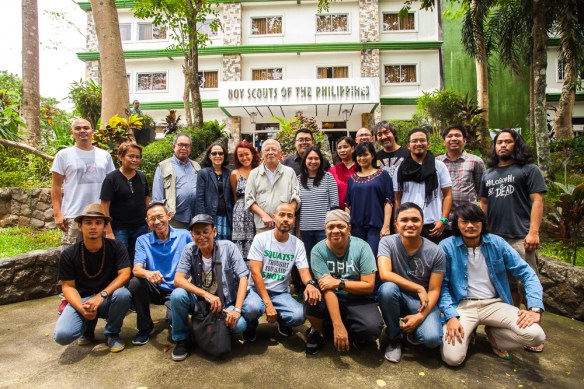
AS I noted last Monday, this year’s UP National Writers Workshop—which we held from May 22 to 29 on Mt. Makiling in Laguna—was one of our best in recent years, with a new batch of vibrant literary talents emerging to stake their claim on our attention.

Aside from the three women writers I mentioned last week—Elena Paulma, Mina Esguerra, and Celine Fabie—we had nine other fellows presenting fine, exciting work: new projects in various stages of completion, submitted for review and comment by their peers and seniors for possible improvements in both design and execution. These works were accompanied by a brief presentation of the writers’ “poetics”—their own appreciation of how and why they write what they write. While very few outside the workshop will ever get to read them, those poetics are often gems of creative insight, a rare look into the minds of writers trying to understand their own process of writing.

Poet Vijae Alquisola, for example, grounds his collection titled “Paglasa sa Pansamantala” (which I’ll loosely translate as “Savoring the Temporary”) on painful personal experience (and here again I’ll translate what he wrote, as I will other texts in Filipino): “Temporary was the answer my siblings and I held on to over the long stay overseas of our mother. Even if I didn’t know how many nights of sleep or days of waking temporary meant—and even if it was never clear what stretch of months or days it occupied on the calendar—we had no choice but to accept it. She had to go to Hong Kong to feed us. She had to leave so we could live, just for the time being.”

Novelist RM Topacio Aplaon (Topograpiya ng Lumbay, The Topography of Loneliness): “I feel liberated by the very act of writing because this is the only place where I can be true to myself, the only way I can freely say anything I want, can do anything I may have no right to do in real life, can chronicle moments I wish never to forget: place, feeling, image, sensibility.”

Poet Vincent A. Dioquino (“we never understood proximity”): “Language is that space where the imagined thrives, where the imagined is held closer to the body, saying what the body cannot speak of. It is that consciousness by which feeling and thought are evoked, a mediation from the abstract to the more concrete., or from a plurality of concrete and particular objects (that is to say: texts, or a set of inscriptions aspiring towards the textual). Language is being made immanent and tangible, threatened with decipherment. It is this specific occurrence of language that is rendered visible and visceral in poetry.”

Poet Francisco Arias Montesena (“Iluminado”): “I write poetry as a part of my being, as an attempt at things I cannot achieve in reality. Often I have to find time and space for poetry in the midst of my work as a teacher, but I have to do myself this favor, knowing that I have to share what I have, even if I have much to learn, despite my shortcomings. How can we begin to fill this need if we cannot mine words for love?”

Novelist Rolly Rude Ortega (Rajah Muda): “I write the stories that I want to read, and I want to read more stories about the Moros, specifically the Maguindanaos, and the lumads, specifically the Dulangan Manobos. The Ilonggos of Mindanao, the Maguindanaos, and the Dulangan Manobos are all significant to me because these people had been part of my life even before I decided to become a writer. Growing up in Kulaman Plateau, I saw firsthand that while the Ilonggos and other Christian tribes were poor, the Manobos were poorer still, which should not have been the case, for they had been living in the resource-rich land long before the migrants came.”

Writer for children Cheeno Marlo Sayuno (“Super Boyong Wears a Malong”): “I love writing for children and (writing about) culture. I would like to share with the children the beauty of our cultural heritage. While the advent of modernization is nothing but inevitable and even if cultures change and evolve, I want the children to still see the colorful costumes, dances, and songs from the past, hoping that it would help in developing a sense of nationalism and appreciation for Indigenous communities.”

Poet Melecio F. Turao (“The Antimodel”): “I have a soft spot for the outsider, for things on the periphery, the ignored, the unrecognized. In my silent heroic moments, I tell myself that I champion the cause of second fiddles. I remember that Cirilo Bautista gave up writing poetry in 2000, saying we live in a prosaic world. I tend to agree so far as our predictable lives go. But a poet should be able to see through appearances. So I pushed myself to try to understand what compels me to write. And it hit me that I would have been a good student of psychology or cognitive science because I amplify awkwardness, alienation, resentment, loathing, desire and failure. I trivialize the hypocritically serious and structured. Thus, The Antimodel.”

Playwright Visconde Carlo Vergara (“Hula Hoop”): “Since I work in comics and plays, writing description isn’t my strongest suit, but people have complimented me on how natural my dialogue sounds, or reads. This I credit to being used to listening and mirroring, ever since I was a kid, as well as having that stint as a theatre actor in the nineties. I would write my drafts purely in dialogue, and simply imagine what it would look like when played out. In acting out the play in my mind, I would also do the acting myself by reading the dialogue out loud in the personalities of every character, just to test if the words rolled off the tongue well enough, and if the sentences had good rhythm.”

Poet Enrique S. Villasis (“Manansala”): “A solution I saw (for the collection) was to bring the poems closer to the times when the paintings were executed. As historical artifacts, Manansala’s many-layered lights and colors could be seen as signifiers of the disturbances, dangers, sufferings, dreams, and desires of his age. This collection is my attempt as a poet to explore the relationship between an artwork and its period, as well as an attempt of the poet to assume the mask of a critic, historian, and curator.”

It was a pleasure and a challenge taking up these writers on their given premises and seeing how closely their grasp matched their reach. (And it was no huge problem if they didn’t: in a workshop, everything is negotiable, even one’s original design, although no one is under duress to accept alternative suggestions.)

I’d like to thank my fellow panelists—National Artists Bien Lumbera and Virgilio Almario, and fellow UP professors and faculty members Jimmy Abad, Jing Hidalgo, Neil Garcia, Vim Nadera, Jun Cruz Reyes, Luna Sicat, Eugene Evasco, Issy Reyes, and Vlad Gonzales—our hosts at UP Los Baños, the National Arts Center, and the BP International Hotel, and of course the UP Diliman and UP System administration for another worthwhile effort at enriching the future of Philippine literature.
Penman No. 201: A Workshop on Mt. Makiling (1)

_MG_6720.jpg

Penman for Monday, May 30, 2016


FOR THE first time in ages, the UP National Writers Workshop—a project sustained without fail by the University of the Philippines since 1965—is being held away from its traditional venue in Baguio, this time on the foothills of Mt. Makiling in Los Baños, where UP has another major campus. The UPNWW has risen to become the premier workshop for mid-career writers in both English and Filipino, and by “mid-career” we mean writers who have published or are in the process of publishing their first book. Typically these are writers in their 30s and 40s who may be employed in jobs having little or nothing to do with creative writing, who may be teaching, or who may be simply stuck in a rut waiting for that push or kick to resume a stalled love affair with letters.

Toward December every year, we—meaning the UP Institute of Creative Writing, which runs the workshop and which I head as director—put out a call for applications for qualified writers to join the week-long workshop. No one gets a free pass—no matter how good you are or how many books you’ve published, you have to go through the application process and submit an excerpt from a work in progress and a short essay on your poetics (in other words, why you write what you write).

I could tell, even from the applications, that this year’s batch was one of the best we’ve put together in recent years. In it are Vijae Orquia Alquisola (poetry, Filipino), Celine Beatriz Fabie (CNF, English), Rolly Jude M. Ortega (novel, English), RM Topacio Aplaon (novel, Filipino), Vincent Abejuela Dioquino (poetry, English), Francisco Montesena (poetry, Filipino), Melecio Turao (poetry, English), Ma. Elena Paulma (CNF, English), Mina V. Esguerra (fiction, English), Cheeno Sayuno (children’s fiction, English), Enrique Villasis (poetry, Filipino), and Visconde Carlo Vergara (drama, Filipino).

We’re midway through the workshop as I write this, and already I’ve been impressed by what I’ve been reading and listening to. In particular, three women we brought into the workshop (sorry, guys, but ladies first) ably demonstrated the range and quality of the work at hand.

Celine Beatriz Fabie is an actress and singer by training, but her biography of her grandmother, the actress Mona Lisa, won for her the Madrigal Gonzalez Best First Book Award last year, and her continuing foray into creative nonfiction yielded a poignant recollection of her father’s passing:

“When dad went, a nurse came in and started cleaning his body, a body which hadn’t been moving anymore.  I asked her if I could do it.  I started wiping him and asked the nurse, my mom, and my uncle if he could be left there for a little while, if it’s okay that they didn’t take him away just yet, if I could just be given a moment to be with him a little more.  I crawled in bed with my dad, who clearly wasn’t there any longer.  I took his face in my hands, stayed there for an hour that seemed to me a fraction of second, and told him I loved him.  Just that I loved him.  There were no last promises, no saying goodbyes.  I knew for a fact that there was no time and place in this lifetime that I would find myself ready.  I was back to being his little girl in an instant, forever, and the little girl, I’m afraid, will never be ready to say goodbye.”

Elena Paulma spent a few years as a Cenacle nun before teaching Literature at Xavier University. I was especially proud when a short story she wrote for my class won First Prize at the Palancas in 2011. For the workshop, Elena submitted a meditation on the Sendong disaster that ravaged parts of Mindanao, which she and a friend also from Cagayan de Oro, Jeena Rani Marquez, are writing a book about. Elena recalls:

“And the raindrops just keep coming, now in torrents sweeping across the land, flowing down from mountains laid bare by chainsaws, waves of it now from the raging river washing onto the darkened houses in the subdivisions, in the main thoroughfares, along the highways, and falling riverbanks.

“Later, there will be hundreds of feet lined on the streets, dangling from trucks, hanging from roofs and treetops. Many of the houses will be no more, the whispered words and laughter silenced by the whirlpooling waters that the rains had become.

“Much later, even years later, there are those who will shiver when a single drop of rain hits the tin roof in the night. They will want to get up from their beds, gather the things   that survived the demon floods that devoured houses, cars, friends, dogs, and families, and run far away from the mere sound of rain.

“It will take a long time, a very long time, before the darkness that gathers in every household each time it rains will be cleansed away.”

Mina V. Esguerra comes from a background in Communications, which she has deftly employed to become a pioneer in digital publishing, selling thousands of copies of her romance novels online. She firmly believes that Filipino authors can break through to the global market, and that romance novels offer a viable way forward. Not surprisingly, her novels carry an upscale, millennial vibe. In her workshop piece, two characters find themselves trapped in an elevator:

“We both backed away from the speaker and… had nowhere else to go. It was hard to not look at each other, though, because all four walls of the elevator were reflective surfaces. If I looked one way, I would see his eyes, the nice shape of his lips. The sweep of his hair up and to the left, revealing a worried forehead. The other wall reflected an image of his broad back, straight and rigid because he was looking up, waiting for the display to change. A little lower down that wall and I could check out how his butt curved in his jeans, and…

“No no no, don’t go there, Iris.”

 Next week, I’ll share snippets of new work from some other workshoppers, to display the range of material and treatments that we’re dealing with. The important thing is to show and to see that Philippine literature is very much alive and advancing on many fronts, assuming a variety of voices, styles, and approaches.

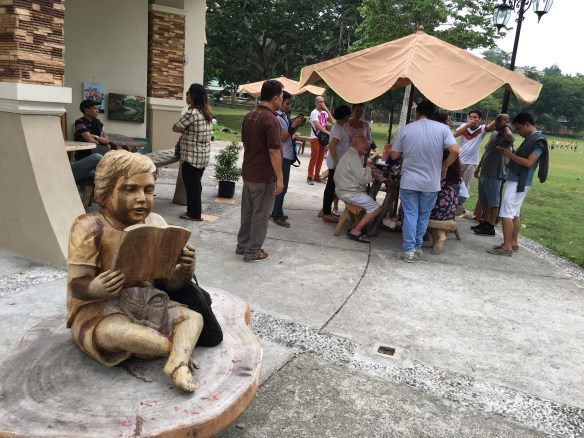
Another benefit of this reacquaintance with Los Baños is discovering how the campus has changed and grown since I first visited it as a freshman on the staff of the Philippine Collegian to attend the College Editors Guild of the Philippines conference in 1971. Among my most pleasant encounters this week has been that with a former student from way back, Yvette Co, who now runs the Ginhawa Craft Studio Café in a dome-shaped kiosk in one corner of the sprawling UPLB Alumni Plaza.

IMG_8519.jpg

As its name suggests, it’s a studio, gallery, performance space, and café all in one, a new and natural convergence point for lovers of the arts in Los Baños. Yvette—a Philosophy major who shifted to Interior Design and who now sculpts and paints—leased the space to breathe new life into a campus more known for agricultural studies, and her works and those of other guest artists blend in with that environment, utilizing scraps of wood and other natural objects as might be found in the area.

So thank you, Los Baños, for the warm welcome.

Penman No. 200: Memoirs of a Teenage Maoist

e13-644.jpg

Penman for Monday, May 23, 2016


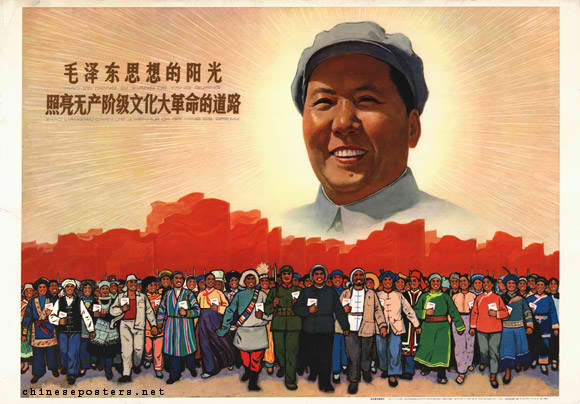
A SMALL item in the foreign news caught my eye last week: a note that the 50th anniversary of China’s Cultural Revolution had gone unnoticed—in China itself, with no parades or ceremonies to mark the historic event. For those of us too young to remember, the Cultural Revolution was launched by Chairman Mao Zedong on May 16, 1966, to consolidate his power and purge his rivals within the Communist Party in the guise of doing away with old ways of thinking. To fight the old, Mao rallied the young—millions of “Red Guards” who turned on their parents, teachers, and superiors, feeling suddenly empowered to reject authority and traditional learning and to see themselves as the vanguards of a new age.

Over the decade that the Cultural Revolution ran its course until Mao’s death in 1976, many millions died—from executions and from famine. While Mao’s legacy would live on, there’s firm consensus both within and outside China that the Cultural Revolution was an unmitigated man-made disaster, something the Party itself in 1981 blamed for “the most serious setback and loss for the Party, the country and the people since the founding of China.”

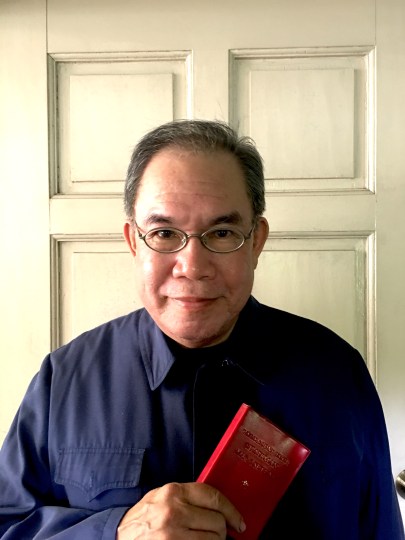
What did this have to do with us and with me? Well, to put it as simply as I can, I was a teenage Maoist, and for a while back there, I and quite a number of like-minded comrades saw ourselves as the local chapter of the Red Guards. Call it madness, but we saw Mao as a demigod, and looked to his China as a beacon of hope and a model for other countries like ours—also beset by centuries of feudalism and colonial rule—to follow.

How did that happen? I had joined the student activist movement and had gone to my first demonstrations in high school, and as soon as I entered college in 1970, I signed up with the Nationalist Corps. It wasn’t a communist organization, but it was a short step from reading Renato Constantino to reading Mao. Mao’s teachings (in contrast to the heavy-duty theorizing of Marx and Lenin) were attractive in their seeming simplicity, in their pithiness, in their rosy optimism. It was chicken congee for the soul.

Until today, you’ll hear 60-somethings from my cadre recite gems, chapter and verse, from Mao’s Quotations (better known as the LRB, or the Little Red Book) like “A revolution is not a dinner party, “Political power grows out of the barrel of a gun,” “Dare to struggle, dare to win,” “Wherever there is struggle there is sacrifice, and death is a common occurrence…. All men must die, but death can vary in its significance.” Among my favorites—music to my 17-year-old ears—was “The world is yours, as well as ours, but in the last analysis, it is yours. You young people, full of vigor and vitality, are in the bloom of life, like the sun at eight or nine in the morning. Our hope is placed on you. The world belongs to you.”

It wasn’t too different from what Rizal or the Desiderata said, especially about the youth as the fair hope of the fatherland, but I think what drew us to Mao at that point and to his brand of Marxism was his emphasis on classes and class analysis, his awareness of society as one divided between rich and poor (with the rich collaborating with foreign powers to keep themselves in place), and the fact (or the fantasy) that in China, things were actually going according to the socialist plan. Very few of us had ever been to China then (famously, of course, three senior activists would get stranded there—Eric Baculinao, Chito Sta. Romana, and Jimi FlorCruz), but we accepted it as an article of faith that Chairman Mao was doing right by his own people.

In Manila, we did our best to copy the flag-waving strokes of Peking Opera (eg, “Taking Tiger Mountain by Strategy”), learned about obscure heroes like Norman Bethune, and wore the LRB like a talisman in the breast pockets of our army fatigue jackets. (Procured from US military surplus stores in Dau, it was the closest we could get to the Mao—actually the Sun Yat-sen—jackets that the Red Guards adopted as a uniform, with the red star on the matching cap; but we at least wore genuine “Ho Chi Minh” sandals fashioned out of rubber tires.) At dawn, we tuned our transistor radios to the faint and crackly signal of Radio Peking, for our regular dose of socialist top tunes like the “Internationale,” “Sailing the Seas Depends Upon the Helmsman,” and “The East Is Red”—plus, of course, the daily rundown of the news from the global war on US imperialism. An enterprising fellow even then, I corresponded with a Hong Kong bookseller who seemed only too happy to mail me copies of the Peking Review, even if I had no money to pay him.

Only years later did the failings of Mao’s experiment and the horrors of the Cultural Revolution emerge, revealed not so much by Western propaganda as by the Chinese themselves, who had suffered the most from its excesses. It would take time—and, indeed, a personal visit to China—to appreciate this disconnect between our long-distance romance with Mao’s socialist paradise and cold reality.

It was in July 1987 when I was finally able to set foot on hallowed ground—Tiananmen Square in Beijing, where I was doing a cultural exchange visit along with writer-friends Krip Yuson, Ricky de Ungria, Eric Gamalinda, and Timmy Lim. We had been assigned a translator and a minder, whom we’ll call Chang—a tall wisp of a man who spoke decent English and who was working, he said, on a translation of a biography of Elvis Presley in his spare time. (Had he ever listened to Elvis? No. We sent him a cassette of Elvis from Manila.)

Standing just meters away from Mao’s mausoleum—there seemed to be thousands of Chinese visitors waiting in line to go in—I asked Chang if he could help me see Chairman Mao. “What you want to do that for?” he asked incredulously. “He killed my grandfather in the Cultural Revolution!” Ooops—I tried to say that I was sorry to hear about his angkong, but I had to tell him that I was once a Mao fanboy and just had to meet the man, even his current state of embalmed repose. Chang still didn’t seem ready to believe me, so I sang him the first few lines of the “Helmsman” song: “Sailing the seas depends upon the helmsman, life and growth depend on the sun, rain and dewdrops nourish the crops, making revolution depends on Mao Tsetung Thought!” Chang shushed me up before a crowd could gather: “Okay, okay, I bring you inside, but hurry, okay?”

And so I filed past my fallen idol, awash in conflicting emotions; frankly Mao’s waxen face did little to exude revolutionary vitality, and in just two more years that same square would be bathed in fresh young blood.

I would return to China many times since then as both tourist and writer, and at one point I would chance upon a Mao jacket in a backstreet shop in Shanghai—you’ll never find them in the glitzy stores—and some days I wear it to remind me of what people today will surely say was a youthful folly. Sometimes I’ll stick a most unproletarian Montblanc into the breast pocket, but then again, it’s where the real Chinese revolution led—the freedom to shop for baubles on Nanjing Road.

IMG_8493.jpg

[Image from chineseposters.net]

Penman No. 199: A Bell from Bauang

IMG_3136.JPG

Penman for Monday, April 25, 2016


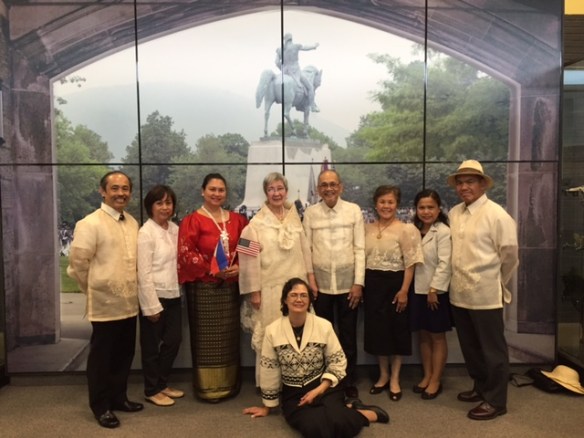
SANTIAGO “SONNY” Busa is one of the most remarkable people I’ve met. I was introduced to him when I spent some time in Washington, DC on a fellowship a couple of years ago, and from the very first time we sat down for a chat in the backyard of his home in the DC suburb of Annandale, Virginia, we hit it off. He possesses a hilarious, self-deprecating wit, is fascinated by history, and speaks, among other languages, Spanish, Ethiopian and Chinese. Ironically, though born in Eastern Samar—he was practically just a baby when his family moved to the US—Sonny doesn’t speak Filipino (or, we keep joking, pretends not to, so he can listen in on what everyone is saying).

IMG_3148.JPG

A retired diplomat who served as consul general at the American embassy in Manila, among other postings some years ago, Sonny had also been a US Army Ranger and parachutist, and taught International Relations at his alma mater, West Point. For all that, he’s a flaming liberal (like me), doesn’t believe in keeping an armory or packing a .45 to feel masculine or secure, and devotes much of his time to promoting the Philippines and Philippine concerns in America along with his lovely wife Ceres. Last year, he was a key figure in the commemoration of the Bataan Death March in New Mexico, where 5,000 soldiers and civilians marched across the desert for more than 26 miles—and they’ve been doing this for 27 years now!

But Sonny’s recent messages gave me a special reason to smile. He’s been a staunch advocate for the return of the three bells taken as war trophies by American troops from Balangiga, Samar in 1901—two bells remain in a “Trophy Park” in a military base in Wyoming, and another is in a military museum in South Korea. Despite the strenuous efforts of both Filipino and American activists to have those bells returned, it hasn’t happened yet.

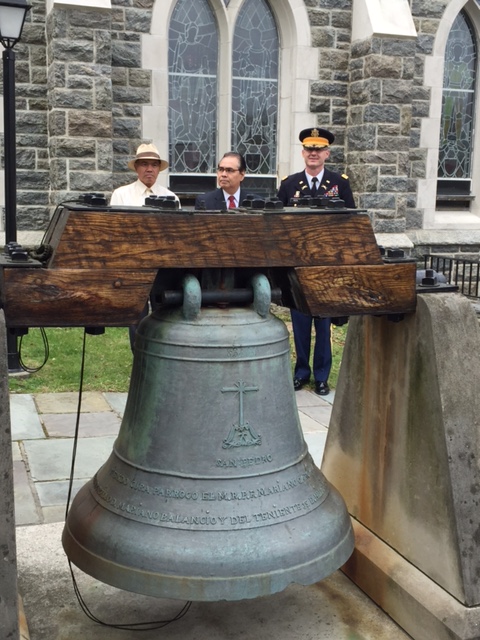
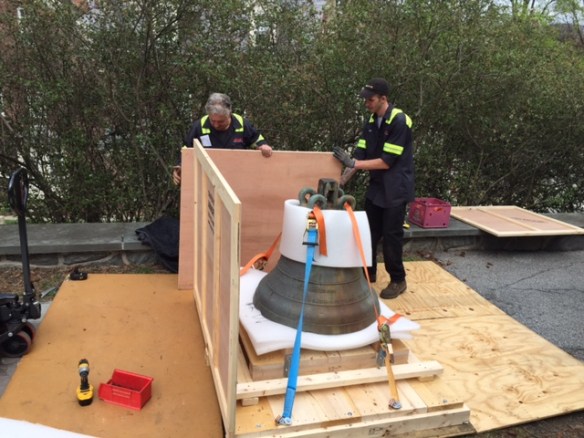
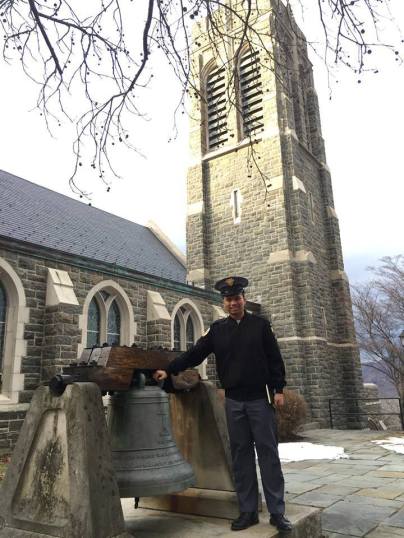
As it turns out, the Balangiga bells weren’t alone. In 1899, during the Philippine-American War (which the Americans insisted on calling an “insurgency” for the longest time), a Lieutenant Tom Berry took a bell from the Church of St. Peter and Paul in Bauang, La Union and shipped it to America, where it languished for over three decades in some Army warehouse. In 1933, the same soldier—now General Berry, the superintendent of West Point—had the bell taken out of storage to be displayed at the Catholic chapel of the academy.

Last January, acting on an inquiry from Fr. Ronald Raymund Chan of the Diocese of San Fernando, Lt. Gen. Robert Caslen, Jr.—the current superintendent of West Point and a friend of Sonny’s—wrote Fr. Chan back to say that “The bell currently displayed on the grounds of our Catholic Chapel here is apparently the bell in question. According to our own records, the markings on the bell itself matches all the descriptions you provided. While we have been honored to guard and display this bell for the past several decades, we would be glad to return the bell to its rightful home. We are currently in the process of making arrangements for the return of the bell to your Parish.”

IMG_3179.JPG

Aside presumably from Fr. Chan and the people of Bauang, no one was happier about this outcome than Sonny Busa, who had married Ceres in that chapel in 1977 in a military wedding, and had looked with fondness at the bell every time he visited the academy. He alerted me and some friends about the San Pedro bell last February, but asked us to keep quiet about it for the meanwhile until the return arrangements were finalized, fearing that Americans opposed to the return of any war booty—especially the Balangiga bells—would torpedo the move.

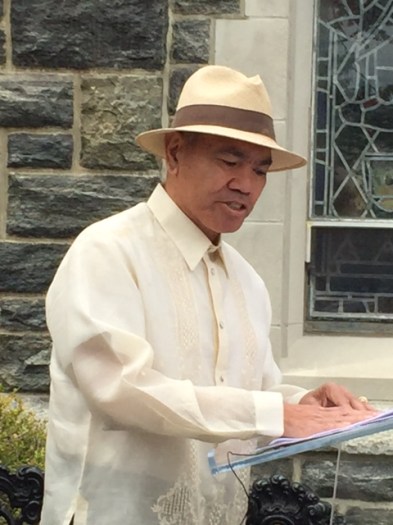
Last month, on the 29th, the send-off finally took place at West Point, with Sonny Busa, Philippine Consul General in New York Mario de Leon, and prominent members of the Filipino community in attendance. Another good friend of Sonny and mine, the Filipino-American historian Sharon Delmendo, stood as both proud witness and photographer. Another special participant was Filipino exchange Cadet Don Dalisay—to whom I would be glad to claim a relation, because Sonny says that he’s at the top of all his classes at West Point.

Dalisay Bell.jpg

In his message to me, Sonny—who had been put in charge of the turnover ceremony—emphasized that Gen. Caslen had “ordered the bell returned to La Union because it belongs in its rightful home. West Point above all stands for high morals in all that it does and teaches and keeping looted war booty is not part of its ethic. The people of La Union are hyper-excited and have already built a display stand. Once the bell arrives it will be big news in the whole of the Philippines as you can imagine.”

That truly is wonderful news, Sonny, and many thanks from your kababayans for your tireless efforts to help right the wrongs of the past and to remind us of our precious heritage.

IMG_3112.JPG

But sadly—as I write this on the eve of one of the most important and contentious elections of our modern history—I fear that too many of us have forgotten how valuable our democracy is, and what artifacts like the San Pedro bell stand for. At war with ourselves and with foreign invaders long gone, we seem far too willing to squander our votes on mindless whimsy and puerile petulance.

I so desperately pray we can prove ourselves deserving of that bell, Sonny. How hollow its ring would be otherwise—a death knell for sanity and decency, rather than the vibrant peal of freedom.

(Photos by Sharon Delmendo and Sonny Busa)

Penman No. 198: Mind-blowers and Eye-openers

IMG_8289.jpg

Penman for Monday, May 2, 2016


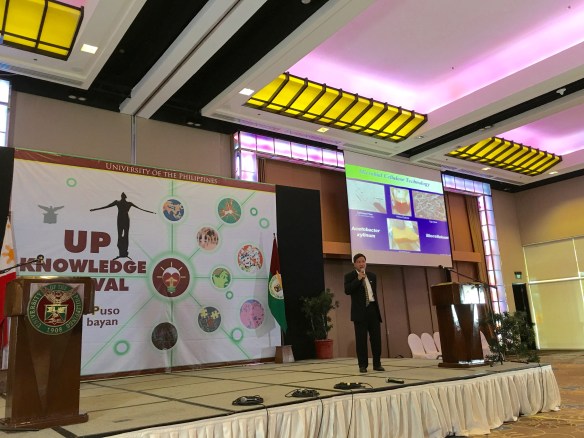
THE FIRST-EVER Knowledge Festival held by the University of the Philippines in Tagaytay City a couple of weekends ago proved true to its promise and offered mind-blowing, eye-opening discoveries galore, shoring up not only UP’s reputation as the country’s leading university but also that of the Filipino genius as a whole.

Part academic conference and part science fair, the festival brought together over 200 of UP’s top scientists and artists from the university’s many campuses all over the country to showcase the best and most promising products of their ongoing research. The festival also featured talks by experts on key academic and research issues (I excerpted my own keynote here last week), and presented the university’s expansion plans and the latest publications of the UP Press. A roundtable with members of the media had UP President Alfredo E. Pascual exchanging views with some of the country’s top journalists on future directions in Philippine higher education.

But it was the exhibits themselves that formed the living heart of the festival. Most were focused on science and technology, but UP’s most advanced endeavors in the arts, education, and mass communications were on display as well. What unified them was the element of interdisciplinarity, of crossing traditional academic turfs and boundaries to arrive at better solutions to age-old problems, or better products for the 21st century. Most of the projects were being financed by the university’s Emerging Interdisciplinary Research fund (EIDR), an ambitious program which has funneled many hundreds of millions of pesos into projects cutting across disciplines and with a positive impact on the government’s Key Result Areas (KRAs).

(I know—I get fidgety myself whenever I step on the road to Acronymia, but like I said in the open forum after my talk, artists—especially those in public life—have to learn to speak bureaucratese and to do the math if they want to engage outside their comfort zones, which is also key to getting grants.)

The exhibits were organized into six clusters: (1) agri/aquaculture, food, and nutrition; (2) health and wellness; (3) disaster risk management and climate change; (4) energy, environment and ecotourism; (5) technology, new materials and other products; and (6) progressive teaching and learning.

As a frustrated scientist (I entered UP as an Industrial Engineering major fresh out of Philippine Science High), I’m always fascinated by what goes on in S&T, and touring the science booths gave me an overview of the research and development in the field within UP. Among the dozens of projects on show, I lingered longest on a few: an analysis of the use of Twitter to keep track of typhoon events; the development of the Philippine Scientific Earth Observation Microsatellite (better known as Diwata-1, which is now in orbit) for disaster risk reduction; an ecosystem assessment of Laguna de Bay, a study aimed at finding ways to revive a dying lake; and a study on the use of microbes from shipworms (tamilok) as potential sources of enzymes for biofuel production. (I’ve had tamilok wriggling down my gullet on a dare during trips to Palawan, where they’re a delicacy, and I’d happily give them up to biofuels.)

In the health and wellness cluster were a flurry of projects ranging from a dengue detection kit to the development of best-practice guidelines for the better management of prevalent community diseases and the use of social media for promoting healthcare. In agriculture, a product called BioN promised to replace 30-50% of chemical fertilizers while increasing yields by 11%, keeping plants “healthy and green even in drought and in the presence of pests.”

Although it was a tucked away in a corner of the learning cluster, what especially caught my eye was a little black box called VISSER—short for “Versatile Instrumentation System for Science Education and Research,” a highly portable science kit which can do over 120 experiments in biology, chemistry, physics, engineering and environmental science. As it turned out, VISSER had been developed by a team headed by a fraternity brother of mine, physicist Dr. Giovanni Tapang, originally with some support from the University of Maryland. The argument for VISSER is compelling: more than a third of the country’s 13,000 high schools—catering to about 7 million students—have no labs, and of those that do, only 2,800 have access to digital tools. The VISSER kit isn’t cheap at over P40,000 per unit—about the price of a laptop—but its potentials are huge, with a total market value estimated at almost P60 billion. It isn’t just good science, but good business as well for technopreneurs.

And speaking of technopreneurship, few Pinoys can be more inspiring than Dr. Gonzalo “Al” Serafica, a much sought-after consultant on technology commercialization who also spoke in Tagaytay on how he developed new uses for microbial cellulose—known to most of us as the lowly nata de coco—for the global medical market as brain patches and artificial skin. A chemical engineer and also a PSHS alumnus like Dr. Tapang, Al Serafica holds 10 US and 20 international patents and co-founded Xylos Corporation in 1996, proving that crossing over from the lab to the boardroom isn’t only possible but, in many cases, necessary.

On the whole, the Knowledge Festival offered ample proof that with the right support and incentives, Filipino scientists, artists, and researchers can be right up there with their international counterparts, but we have a lot of catching up to do. As a UP study notes, we spend about half of what our ASEAN neighbors spend on education, and even less on R&D. But just showing ourselves what’s possible is a good start, and UP will soon be touring key exhibits not just around the UP system but to other universities as well.

And UP itself will keep growing, as I was mighty impressed to see in the display that featured ongoing and upcoming expansion projects: the UP Clark Green City that will include, among others, a new College of the Natural Environment and College of Designed Environments; the soon-to-open UP Bonifacio Global City that will host classes in law, engineering, business, architecture, labor and industrial relations, urban and regional planning, statistics, and distance education; the UP Professional Schools-South Road Properties in Cebu; the Philippine Genome Center in Diliman; the new UP Diliman Sports Complex rising out of the rubble of the old track oval; and an upcoming UP Cavite incubator campus.

If we can shoot satellites up into the cosmos and turn a coconut dessert into brain implants, you’d have to believe that the sky’s the limit for the Filipino genius—as long as we don’t get sidetracked by personality politics and medieval mindsets.

timpeake-20160427-diwata-1-deployment-001_FD3086695C6E4EA699A3E0129B0153AD.jpg

[Diwata-1 photo courtesy of ESA/Tim Peake]

Penman No. 197: Why the Arts Should Matter

IMG_7956.jpg

Penman for Monday, April 25, 2016


FOR THE first time ever, the University of the Philippines held a Knowledge Festival in Tagaytay last week, showcasing the most significant and interesting projects being undertaken by UP scientists, artists, and researchers, with an emphasis on interdisciplinarity. I was asked to present a keynote talk on “Why the Arts Should Matter.” Herewith, some excerpts:

It has become practically a cliché to say that our lives, and certainly our learning, would not be complete without some appreciation of the humanities. Our tradition of liberal education has primed us to the necessity of cultivating the “well-rounded individual” schooled in the basics of various disciplines.

Within my own field, I often find myself arguing for the importance of being able to adopt a rationalist outlook, of grounding our artistic judgments and perceptions on a concrete appreciation of our economic, social, and political realities. I’ve always urged my creative writing students to take an active interest in history, technology, business, and public policy as a means of broadening their vision and enriching their material as writers.

But conversely, let me ask: Why indeed are the arts and humanities important? I’ll turn to conventional wisdom and quote what should already be obvious, from the Massachusetts Foundation for the Humanities:

“The humanities enrich and ennoble us, and their pursuit would be worthwhile even if they were not socially useful. But in fact, the humanities are socially useful. They fulfill vitally important needs for critical and imaginative thinking about the issues that confront us as citizens and as human beings…. We need the humanities. Without them we cannot possibly govern ourselves wisely or well.”

What strikes me here is the word “govern,” which seems to me to be of utmost importance to us at this juncture of our history, and which is key to our topic today. The role of the humanities in our intellectual and cultural life is to enable us to govern ourselves wisely and well. They deal with issues and value judgments, with defining the commonalities and differences of human experience, hopefully toward an affirmation of our most positive human traits, such as the need to work together as families, communities, and societies. In sum, they help us agree on a common stake, based on which we can make plans, make decisions, and take action.

That notion of a common stake is crucial, especially on this eve of one of the most contested elections in our history. Despite all the predictable rhetoric (and the real need) for national unity, we find it difficult to unite beyond short-term political expediency because we remain unable to agree on our most common ideals—the national dream, as it were, or the direction of the national narrative. What is our story? Who is its hero? Are we looking at an unfolding tragedy, a realist drama, or a romantic myth? To go further, what is important to us as a people? Where do we want to go? What price are we willing to pay to get there?

These are questions that are answerable less by scientific research and inquiry than by artistic imagination and insight. It will be mainly the humanities and the social sciences that will provide that vision, in all its clarities and ambiguities, as it will be science and technology that will provide the means.

This does not mean that scientists and engineers will have little or nothing to contribute to the crafting of this vision; I firmly believe they should, and that one of our worst mistakes has been the fact that we have largely left national policy to the politicians, the priests, the lawyers, the soldiers, and the merchants. Scientists have had little say—and artists even less—in the running of this country and in plotting its direction. We may canonize our boxing champions and beauty queens—and even elect them senator—while our National Scientists and National Artists languish in obscurity and indifference.

Ours is an appallingly innumerate society. Most of our people do not know the simplest numbers that describe our lives, and much less what they mean. We are raised on concepts like the national flower and the national bird and the national tree, but even in college we are hard put to say what the national population, the national birth rate, or the Gross Domestic Product is, and why they matter. This innumeracy is balanced, sadly, by cultural illiteracy. Our notion of culture often consists of pretty images, pleasant melodies, theatrical gestures, and desirable objects.

We have much to do by way of cultural education, and artistic expression is a vital means by which this can be achieved. The arts are the key to those parts of us that reason and logic alone cannot reach.

But I came here this morning to go beyond the obvious, and to present an aspect of the arts that few national and even academic policymakers ever think about, and it’s this: the arts should matter not only because they’re good for the soul, but because they’re good for the body as well—taking the body to mean our economic and material well-being. In simple words, and moving from the philosophical to the practical sphere, the arts can mean big business.

The arts underlie what have been called “creative industries,” and these industries have made tremendous contributions to the economies of countries as diverse as the US, the UK, China, Japan, Brazil, and Thailand.

In 2009, when the Joint Foreign Chambers of the Philippines initiated a focus group discussion on creative industries in the Philippines, they defined the sector as embracing “a wide array of subsectors including advertising, animation, architecture, broadcast arts, crafts, culinary arts, cultural/heritage activities, design, film, literature, music, new media, performing arts, publishing, and visual arts.”

In 2010—the last year for which I have solid figures—copyright-based industries or CBIs contributed more than P661.23 billion to the economy, according to the Intellectual Property Organization of the Philippines. In GDP terms, the economic contribution of CBIs climbed from 4.82 percent in 2006 to 7.34 percent in 2010. Core CBIs comprising companies in the arts, media, and advertising largely accounted for this surge. A corresponding rise in employment occurred in the sector, from 11.1 percent of the total number of jobs in 2006 to 14.14 percent four years later.

There seems to be a greater awareness on the Philippine government’s part of the economic utility of our artistic talent. In 2012, for example, RA 10557 was passed to promote a “national design policy” highlighting “the use of design as a strategic tool for economic competitiveness and social innovation.”

However, culture as a whole remains a low priority, often subsumed to other activities like tourism, entertainment, and sports. And it’s getting worse; very recently, cultural funding by the NCCA—the largest source of government funding for the arts—practically dried up because of onerous conditions imposed on cultural organizations in the wake of the pork-barrel scam, requiring them to undergo a tedious accreditation process by, of all things, the DSWD. Unlike many progressive countries, we do not even see it fit to have a standalone Department of Culture, so the DBM and even the DSWD can push the NCCA around.

We need to see the arts as more than a frivolous diversion that keeps on drawing funds without producing appreciable pay-offs, like an exotic and expensive pet you keep around the house, but rather as an area of strategic and profitable investment that will yield both moral and material dividends. Just as we need to develop more PhD-level scientists and researchers, we need to support advanced practitioners and theorists in the arts, as they have every capability to achieve world-class status, with the right incentives.

Let me end with a message—perhaps even a plea—to those who hold the purse-strings of our institutions. That journal, that play, that exhibit, that concert, or that workshop is always more than a line-item expense. Supporting and patronizing these artistic endeavors is the price we pay to understand ourselves in all our complex, and wondrously unquantifiable, humanity—and also, in ways you may never expect, to create new knowledge and new wealth in many forms.


Penman No. 196: A Frenchman in Jalajala

Gironiere1.jpg

Penman for Monday, April 18, 2016


I USUALLY ask my wife Beng to ride out with me on a day trip during the Holy Week break, and this year our destination was rather unusual, in that it never figures in the travel plans of Manileños, although it’s a short and pleasant drive from Quezon City or Ortigas. We took the scenic route from Diliman via Antipolo, Teresa, and Morong, and soon found ourselves following the lakeshore of Laguna de Bay on the peninsula of Jalajala, Rizal, described by the guidebook as “a fourth-class municipality with a population of 30,074 people.”

We were there on the trail of an extraordinary author and adventurer who, nearly two centuries ago, had lived in Jalajala, and had written about his sojourn in a book that had been a favorite of mine for 40 years.

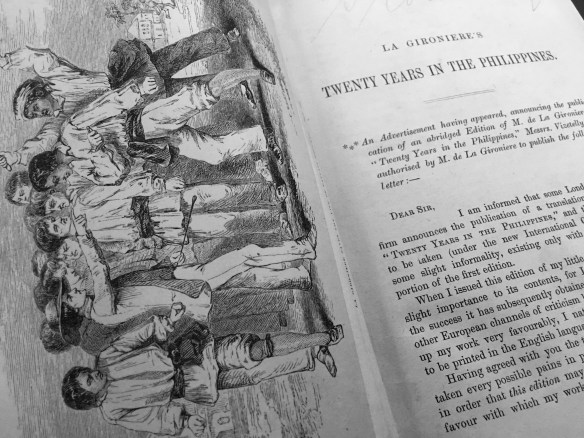
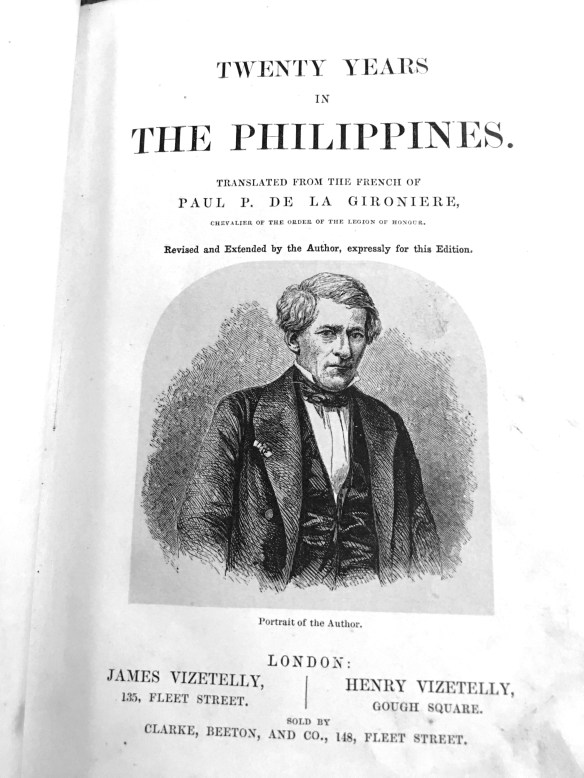
The book was Paul Proust de la Gironiere’s Twenty Years in the Philippines (subsequently expanded under the title of Adventures of a Frenchman in the Philippines), and I had recently acquired a copy on eBay, all the way from the UK—the first English edition published by James and Henry Vizetelly, undated but very likely from 1853, a year ahead of the American edition published by Harper & Bros. in 1854. The copy was far from mint, but it was in its original binding and still very readable, and wonderfully illustrated with engravings of local scenes.

Gironiere2.jpg

Gironiere was an adventurer from France who came to the Philippines in 1819 in his early 20s as a ship’s surgeon and stayed on for the next two decades, establishing himself as a landlord and farmer in what today is Jalajala, Rizal. His travails begin shortly after his arrival on the ship Cultivateur, and his account of a massacre shows why his book is—in that awful word coined by book reviewers—“unputdownable”:

I had only resided a short time at Cavite when that terrible scourge, the cholera, broke out at Manilla, in September, 1820, and quickly ravaged the whole island. Within a few days of its first appearance the epidemic spread rapidly; the Indians succumbed by thousands; at all hours of the day and of the night the streets were crowded with the dead-carts. Next to the fright occasioned by the epidemic, quickly succeeded rage and despair. The Indians said, one to another, that the strangers poisoned the rivers and the fountains, in order to destroy the native population and possess themselves of the Philippines.

On the 9th October, 1820 … a dreadful massacre commenced at Manilla and at Cavite…Almost all the French who resided at Manilla were slain, and their houses pillaged and destroyed. The carnage only ceased when there were no longer any victims. 

…Four hundred Indians surrounded me; the only way of dealing with them was by audacity. I said in Tagaloc to the Indian who had attempted to stab the captain: “You are a scoundrel.” The Indian sprang towards me; he raised his arm: I struck him on the head with a cane which I held in my hand; he waited in astonishment for a moment, and then returned towards his companions to excite them. Daggers were drawn on every side; the crowd formed a circle around me, which gradually concentrated. Mysterious influence of the white man over his coloured brother! Of all these four hundred Indians, not one dared attack me the first; they all wished to strike together. Suddenly a native soldier, armed with a musket, broke through the crowd; he struck down my adversary, took away his dagger, and holding his musket by the bayonet end, he swung it round and round his head, thus enlarging the circle at first, and then dispersing a portion of my enemies. “Fly, sir!” said my liberator; “now that I am here, no one will touch a hair of your head.” In fact the crowd divided, and left me a free passage. I was saved, without knowing by whom, or for what reason, until the native soldier called after me: “You attended my wife who was sick, and you never asked payment of me. I now settle my debt.”

I had first read the book a long time ago, and kept my copy of Adventures, in a Filipiniana Book Guild edition reprinted locally in paperback by Burke-Miailhe in 1972, with a foreword by the eminent historian and economist Benito J. Legarda. In his foreword, Dr. Legarda says that Gironiere’s book was “probably the best seller among books about the Philippines in the 19th century,” noting that “What attracted the 19th century reader was of course the narration of several adventures, at that time considered unusual or bizarre. Among them may be enumerated the killing of man-eating crocodiles, the hunting of wild carabaos, the exploration of caves, the customs of pagan tribes, and the adventures of those caught in captivity by Moro pirates.”

IMG_8257.jpg

While granting that Gironiere’s accounts may have taken certain fanciful liberties, Legarda also considers the many real contributions the Frenchman made to his adopted soil, particularly as an agricultural pioneer who planted coffee, abaca, indigo, and rice on his 2,400-hectare estate in Jalajala, then part of Morong. Of Jalajala, Gironiere would write that it was “the greatest game preserve in the island: wild boars, deer, buffaloes, fowls, quail, snipe, pigeons of fifteen or twenty different varieties, parrots in short all sorts of birds abound in them.”

Gironiere returned to France in 1839, crushed by the deaths of his son, daughter, and wife, and he eventually remarried, and yet nothing, he said, “could induce me to forget my Indians, Jala-Jala, and my solitary excursions in the virgin forests. The society of men reared in extreme civilisation could not efface from my memory my past modest life.”

IMG_8124

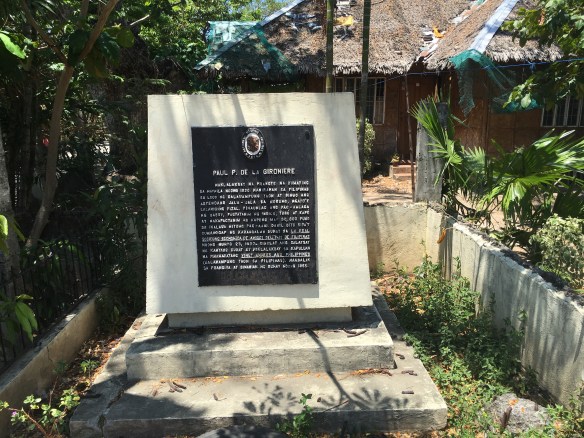
Was there anything left of Gironiere’s vast estate? All I could find on the Internet was a marker put up by the National Historical Institute in 1978 on what presumably had been his property, so I resolved to find at least that. We were there on the Wednesday of Holy Week, so I knew I had to catch someone at the municipio before it closed for the half-day, and fortunately a kind gentleman from the agriculturist’s office recognized the marker and offered to lead us there. And a short drive later, there it was, on a lot in the shade of towering acacia trees.

Nothing else would have suggested Gironiere’s presence, except possibly a stump of bricks in a corner of the lot. Not too far away was the water’s edge, and the slim profile of Talim Island, which Gironiere would have seen out his window. I struggled to imagine this spot as the center of a visiting Frenchman’s adopted life and holdings, his pursuit of bats and lizards, crocodiles and gold dust.

I didn’t feel let down; I was looking at an empty stage, but I knew the play, and I could hear the lead actor’s parting words: “Overwhelmed by the weight of troubles and of the laborious works I had executed, there was only one wish to excite me, and that was, to see France again; and yet my recollections took me continually back to Jala-Jala. Poor little corner of the globe… where my best years were spent in a life of labour, of emotions, of happiness, and of bitterness! Poor Indians! who loved me so much! I was never to see you again! We were soon to be separated by the immensity of the ocean.”

Penman No. 195: In the Afterglow

IMG_8194.jpeg

Penman for Sunday, April 10, 2016


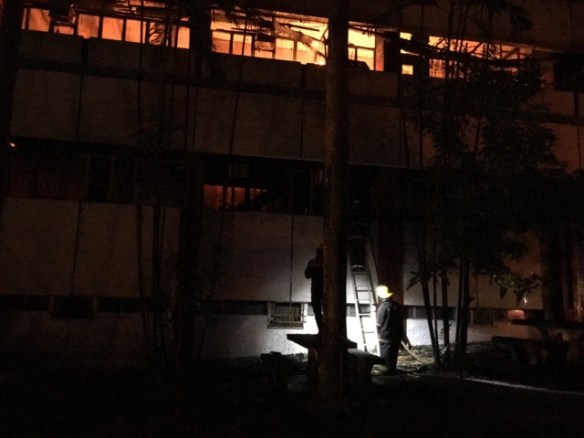
AS MANY of you know by now, in the early hours of April 1st, a Friday, the UP Faculty Center went up in smoke. I was playing poker at my usual haunt, the Metro Card Club in Pasig, when I got a flurry of text messages from Krip Yuson, who had just heard of the fire on Facebook. Distraught, Krip sent me pictures of the unfolding scene—flames were billowing out of the FC’s upper floors, and it was clear that nothing and no one could possibly survive such a catastrophic event. I thanked Krip for the heads-up, put my cards down, and drove off to UP to see the fire for myself.

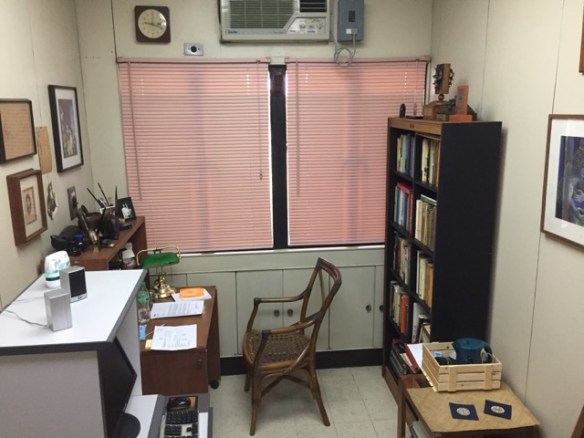
We live on campus, in a faculty bungalow on Juan Luna Street, a ten-minute walk from the FC, so UP was literally home for me. But I also held office at the FC, in the English Department, and the FC had been my official address for over 30 years since I began teaching in 1984. As I drove to Diliman I thought of my room, FC 1036, which I had had to myself since I came home from graduate school in 1991; before that, I’d shared FC 1012 with the late Angelito Santos and Ernie Bitonio, who became a lawyer and labor official.

Anyone who’s studied at UP Diliman would have gone through the FC at one point or another, and the place was rife with tales not only of intellectual and political adventure, but also of mischief of a baser, if more entertaining, nature. My favorite one, possibly apocryphal, had to do with an eminent lady professor going out on the window ledge and hanging on for dear life to spy on a neighbor whom she suspected of having an assignation with a student. Another hand-me-down scene involved two feuding scholars—one delivering a professorial chair lecture in CM Recto Hall while her nemesis handed out a vitriolic flyer at the door to anyone coming in.

It’s funny how the tragic can provoke the comic—and the professorial life certainly doesn’t lack for evidence of human frailty and folly—but it’s as good a response as any to personal loss, which was what the FC fire was really about. True, we lost a campus landmark and an academic institution. But buildings can be rebuilt—and the half-century-old FC was long overdue, anyway, for a massive renovation.

The FC’s subdivision into departments and then into individual rooms and cubicles guaranteed that each little corner would become treasured (and jealously guarded) personal space—not just mini-offices but mini-libraries and mini-galleries, showcases of both tradition and individual talent. Aside from the usual family pictures and diplomas (of which I actually saw precious few on display, perhaps in tacit admission of the silliness of flaunting one’s PhD in a boatload of them), shelves full of precious books and walls hung with choice art described the typical FC room, and each room’s state of order or chaos indelibly imprinted the tenant’s character on the visitor’s mind.

In UP, with historically low salaries and precious few incentives, a room of one’s own is an earned privilege. Professors are kings, and their offices are their castles and citadels, open to students and colleagues but impregnable to the unwelcome (except during martial law, when the military marched into the FC willy-nilly in search of Redheads). During the Diliman Commune in 1971, we’d renamed the place “Amado Guerrero Hall,” after the nom de guerre of Joma Sison, who had been an instructor with the English department.

Once aflame with revolution, now it was literally on fire, and three hours after the fire began, I watched as an eerie orange glow illuminated its interior. The text messages had shown tongues of fire curling out the windows, but the blaze had mellowed down a bit when I got there. Had I arrived at its peak, I would have been too excited to feel pain, but its muted state invited contemplation, which invited melancholy. I stood outside the building facing our department, facing my corridor, and understood that very little, if anything, would survive. (And of course the scene was not without its black—or should I say its blackened—humor; I overheard an exhausted fireman asking, “Does anyone have a cigarette?” I can’t write this account without thanking the dozens of firemen from all over who battled that inferno—you all deserved a good puff afterward.)

As my fellow FC denizens would do in the coming days, I began taking stock of what I was losing even as I watched: a Joya nude (one of two that Beng had saved from her days at Fine Arts; thankfully we had given one to our daughter Demi); a large giclée print of lilies gifted to us by Jaime Zobel; two paintings we had bought from a young Jason Moss; a National Book Award trophy by Agnes Arellano in the shape of a typewriter, my favorite among all my illustrious paperweights; my TOYM trophy by Napoleon Abueva, which, meaning no disrespect, did double duty as a hat rack; two of Beng’s serene waterscapes, which I had commandeered from her exhibitions; and a drypoint portrait that I had made myself (in another life as a printmaker) of her whom I was yet courting.

There were the books: among many others, a first edition of Without Seeing the Dawn, signed by its first owner, the novelist Zoilo Galang; a signed copy of Villa Magdalena by Bienvenido Santos; more first editions of NVM Gonzalez, Nick Joaquin, and F. Sionil Jose; and a copy of Ninoy Aquino’s prison testament, which Cory Aquino had signed and gifted to me in thanks for some speeches I had happily done for her pro bono.

And then of course there were my own books and papers—file copies of nearly all my books, and assorted publications, including 20 copies of the first printing of Penmanship, whose special paper I treasured and therefore hoarded; and my only copy of my dissertation. Luckily I had left only one of my fountain pens in the office, a Conklin desk set from around 1925, and a handsome crystal inkwell from Barcelona. Most of these could be replaced, but not the letters of friends and students over 30 years, nor the cane chair handmade by my late father-in-law, on which I took many a siesta.

IMG_6542.jpeg

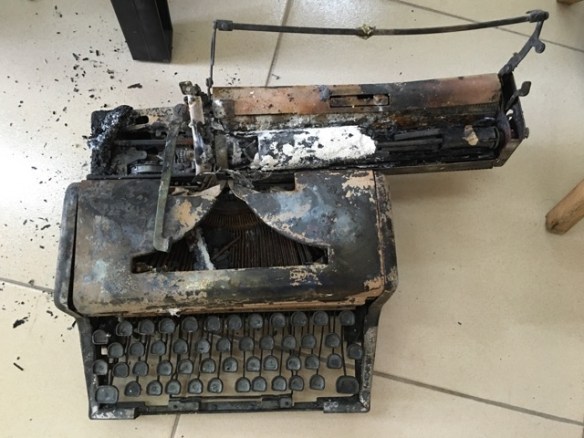
In the end, I found myself mumbling, “It’s all just things,” but of course it wasn’t. Men don’t grieve well, and over the next few days I grew increasingly sullen and irritable. Last Monday I joined a supervised foray into the burnt-out premises, just to see what we could recover. Almost everything we knew and owned had turned to mounds of char, which remained warm and smoky beneath our booted feet. From my blighted corner I picked up a ceramic mug that had lost its bottom. I also rescued a porcelain guan yin that belonged to Jing Hidalgo, and the ravaged hulk of a Royal typewriter I had given Isabel Mooney two decades earlier. We staggered out with our loot, laughing, and then the desolation hit us.

IMG_8243.jpeg

My grandmother Mamay used to sing us a lullaby which Ilonggos will recognize, about how life and sweet things will simply drift up and away in bitter smoke, and that weekend some of that life and some of that sweetness rose up into the air.

“We Pinoys are disaster-proof,” I tweeted at some point, mindful of how small our plaints seemed compared to a Yolanda. I do believe that, and we literary types have probably used up all our phoenix metaphors in the fire’s afterglow. But I’ve also always believed in proper goodbyes, so before we haul in the new furniture into the inevitable new FC, here’s mine, to ash-covered memory.

(If you want to tour the aftermath of the FC fire with me, see the video here.)

Penman No. 194: A Tree Grows at the Met

IMG_8118.jpg

Penman for Monday, April 4, 2016


THE FIRST and last time I saw a show at the Manila Metropolitan Theater must have been in the 1990s, for a production of Nick Joaquin’s “Portrait of the Artist as Filipino.” The theater was in fine shape then, and I recall being as enthralled by the place itself as by the spectacle onstage.

As a young boy in the early ‘60s, my father had worked at the old Department of Public Works building across Plaza Lawton (before they became the Post Office and Liwasang Bonifacio), and I had often tagged along to play with his red-and-blue pencils and his swivel chair. The most entrancing element in that locale, truth to tell, was the giant pot above the old Insular Ice Plant that spewed what seemed to be a steady stream of boiling water into a waiting coffee cup; but my eyes would stray to the strange pinkish building in the distance and I would wonder what went on there and what it held.

I got my answer, thanks to Nick Joaquin, but a few Sundays ago, I had an even more amazing opportunity to know the Met more intimately than I would ever have imagined. Sadly the intimacy was that which might exist between a doctor and a patient, like a probe of cold steel into some tubercular organ.

My wife Beng belongs to Kasibulan, a group of women artists, and they had been invited to do a sketching session at the old theater that Sunday morning, alongside a cleanup operation to be undertaken by volunteers. Did I want to come along, perhaps to take pictures, or at least hold bags and run errands for the ladies as they drew arches and vanishing points? Of course I did.

But before I go any further, especially for the benefit of our millennial readers, let me give a backgrounder on the Met and its sorry fate.

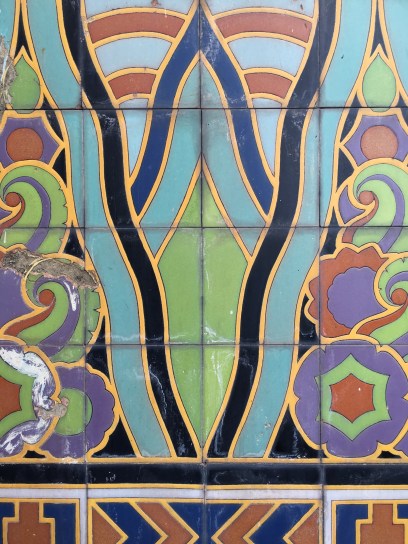
When the Manila Metropolitan Theater opened on December 10, 1931, it was an architectural wonder to behold and to step into—an Oriental palace in pink coral, crowned by exquisite minarets, statues, sculpture, and tilework. The overall style was Art Deco, the rage at the time, spilling over from the West but adapted to its new setting in the East. It could seat almost 1,700 people, and it had been put together and adorned by some of Manila’s finest architectural and artistic talents—designed by Juan Marcos Arellano, built by Pedro Siochi and Co., and decorated by the Italian sculptor Francesco Riccardo Monti, the sculptor Isabelo Tampinco, the future National Artist Fernando Amorsolo, and by Juan Arellano’s brother Arcadio.

IMG_8086.jpg

Erected near the site of its predecessor, the Teatro del Principe Alfonso XII which burned down in 1867, the Metropolitan was meant to be the city’s premier cultural venue, a showcase of the Filipino artistic genius. In its heyday, it hosted celebrated singers such as Jovita Fuentes and Atang de la Rama; from highbrow opera to the more popular zarzuela and vaudeville, the Met had the best to offer. Though damaged during the war, it was rebuilt and continued to be a haven for artists and entertainers until it began to decline in the 1960s, as other venues—and the growth of moviehouses in such places as Avenida Rizal, Escolta, and Cubao, followed by the establishment of the posh and modern Cultural Center—gained primacy among audiences.

At one point or other in its slide to abject decrepitude, the Met became a boxing arena, a movie set, a martial arts studio, a gay bar, an ice cream parlor, a TV stage, and a refuge for the homeless, among other incarnations. In 1978, Imelda Marcos took an interest and had the theater restored to its old glory, but then it fell again into disrepair, and was shut down in 1996 in a wrangle over ownership between the city government and the GSIS. Gloria Macapagal Arroyo and Mayor Fred Lim renovated and reopened it in 2010, when it was declared a “National Treasure” by the National Museum, but yet again it succumbed to politics, bureaucracy, and benign neglect; after a concert by the rock band Wolfgang in mid-2011, it was locked up by the GSIS.

In July last year, the ownership question was finally settled with the GSIS selling the property off to the National Commission for Culture and the Arts (NCCA), and shortly after the NCCA received P270 million from the Department of Budget and Management (DBM) for a fourth and hopefully final restoration, which the NCCA expects to complete by 2017.

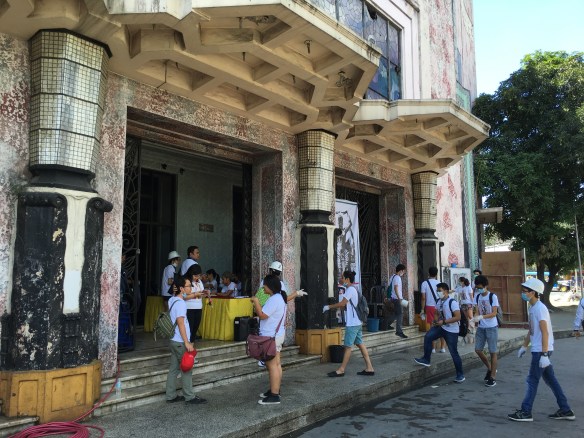
It was this Met that we entered that Sunday. We were greeted by my UP colleague and one of the restoration project’s consultant-architects, Gerard Lico, who assigned two young but very capable juniors to guide our group on an all-access tour of the building. The lobby was buzzing with the enthusiasm of student volunteers from National University who, after an orientation and a safety briefing, filed into the structure behind their team leaders.

We followed them into a dark and cavernous hulk (the electricity had yet to be brought back), and encountered a touching mix of fragility and resilience. The Met had to be cleaned prior to restoration, and thus we were being privileged to see it at its most hapless state. There was dust and rust everywhere, and the wooden floorboards, reduced to a pulp, were crumbling beneath our feet.

Even so it demanded attention and respect, and we trod slowly, reverentially. Through the squalor emanated a lingering magnificence—the echoes of long-stilled operas, the footfalls of performers scurrying down the corridors. In one room was a tangled mass of costumes—a sailor outfit unmistakably from The Sound of Music—and when we stepped out onto the broad stage, you almost expected the spotlights to burst into life and the phantom audience to roar in approval. There was a hole in the stage floor and water in the orchestra pit, but nothing, it seemed, beyond repair, beyond human care.

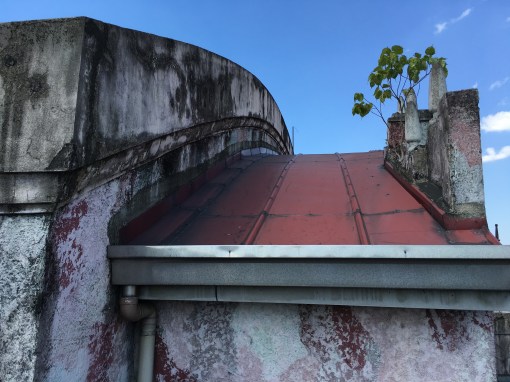
Out on the roofdeck, beneath the Moorish spires and the batik-inspired tiles, a small tree had sunk its rope-like roots into the masonry. I found myself hoping that it would be spared the restorer’s saw. Reprieves beget reprieves, and it would provide a fine organic testament to the Metropolitan’s endurance. (See more pics from our walking tour here.)

IMG_8072.jpg


Penman No. 193: Knowledge as Capital

2171790476_7c4dfcd25a

Penman for Monday, March 28, 2016


THE UNIVERSITY of the Philippines (UP) campus in Cebu City hosted the second presidential debate a couple of Sundays ago, and with education on the debate agenda, the setting couldn’t have been more appropriate. UP—so far, our only “national university” so designated—may be more than a hundred years old, but it continues to grow, particularly in places like the Visayas, Mindanao, and Central Luzon, where the demand for quality higher education is as great as ever.

Not too many people may have been aware of it, but in preparation for the debate—and indeed for the next national administration—UP President Alfredo E. Pascual commissioned a study by the university’s think tank, the Center for Integrative Development Studies (CIDS), to look into where we are in the regional scheme of things and how we can expect to catch up and compete with our more advanced neighbors.

Copies of the paper—titled “Knowledge-Based Development and Governance: Challenges and Recommendations to the 2016 Presidential Candidates”—were provided by UP to the staffs of the presidential candidates in advance of the Cebu debate. But knowing most politicians’ propensity to go for the sound bite and dwell on the personal, I tend to doubt if more than one or two of the candidates or their staffs found the time and the focus to read it.

It would be a pity if that indeed were the case, not only because of all the work that UP put into the paper (CIDS was backstopped by the offices of the President and the Vice President for Academic Affairs), but because of all the opportunities for development that we will likely miss, again, if our political leaders don’t heed what our top academic minds are saying.

The full text of the paper can be found here: http://www.up.edu.ph/wp-content/uploads/2016/03/20160315-UP-Knowledge-Paper-Final.pdf. For the benefit of our readers (and maybe the odd politician who will read this), I’ll unpack the technical jargon and get to the core of what the paper says and proposes.

It opens with an indisputable premise: Education is indispensable for economic development. More education means less poverty and income inequality, because it drives innovation and productivity, and helps people adjust to new challenges and opportunities.

But of course we already knew that. In a society like ours, we all look to education as the way out and the way forward, which is why our people slave for years overseas to put their kids through college. So sacred is education to the Filipino family that every candidate for public office, especially the Presidency, feels duty-bound to extol its virtues.

To be fair to the present administration, it’s put its money where its mouth is, for the most part. The study notes that “Since Benigno S. Aquino III assumed the presidency, government expenditure on public education has enjoyed annual increases. Out of the education sector‘s PHP364.9 billion budget for 2015, PHP43.3 billion was given to state universities and colleges—a 13.8 percent increase over the 2014 allotment…. Over PHP3 billion was made available for scholarships under SUCs and more than PHP2 billion for scholarships administered by the Commission on Higher Education. A total of PHP316 million (roughly 0.09 percent) was earmarked to fund research.”

That sounds good, but sadly it’s still not enough. The rest of our ASEAN neighbors spend an average of 5 to 6 percent of their GDP on education, but we try to make do with 3 percent. That’s why even our best universities lag behind their global and regional counterparts. The study notes that “In 2014, the University of the Philippines ranked only 8th out of the top 10 universities in ASEAN. In 2010, the Philippines ranked 89th in the global Knowledge Economy Index, far behind Singapore, which placed 19th.”

With all the new phones, computers, and call centers we see around us, we might be led to believe that the Philippines has become a high-tech haven, but that just isn’t so. (“We may be No. 1 in voice operations,” I once heard President Pascual say in relation to BPOs, “but were just around No. 9 in non-voice, which is where there’s more value-added. We need not just call center agents, but software engineers!”)

In its summary, the study observes that “Our level of technology remains low in quality and scale, and concentrated in low-productivity sectors. To catch up and move ahead faster, we need to raise our scientific and technological skills, which only better and more focused education can achieve.

“This calls for massive government investments in high-level knowledge capital—the so-called ‘suprastructure’ of economic growth. This human capital will create a knowledge-based economy driven not just by brawn but brains, tapping into one of our richest but least developed resources.”

In other words, and to put it plainly, we need more brainpower—more nerds, if you will—of the kind who can innovate, produce, do trailblazing research, and network with their global peers. That kind of knowledge can reap sizeable benefits for our economy, as it’s done for Singapore, China, Korea, and a host of other countries who’ve invested in their “suprastructure.”

But PhDs don’t come easy and don’t come cheap. UP argues that our government should have a plan to produce them systematically. The object of our educational system shouldn’t just be producing hordes of college graduates who can’t find good jobs, but graduates in fields and with skills that the economy actually needs. The best of them should be sent abroad for advanced degrees, and then brought home with sufficient incentives and an environment conducive to research. The UP paper goes even farther and recommends that in areas where we lack expertise, world-class professors and researchers should be enticed to teach here and work with their local counterparts, in the same way that Singapore was able to considerably shorten its learning curve.

While much of this will occur in science and technology, the paper wisely notes that “Because values are important in setting the right path to growth, the promotion of science and engineering should be closely integrated with the social sciences, the arts, and the humanities to ensure the holistic development of the Filipino.”

To spread the work and its benefits, the UP paper envisions a hubs-and-spokes model of development anchored on regional centers of excellence in certain fields—possibly even other national universities beyond UP.

There’s a lot more to be found in the study that was UP’s gift to the candidates—and thereby to the nation—but whether any practical good comes out of it will depend on the political leaders who govern our fortunes, and, ultimately, on us who vote them into office.

(Kindly note that as a “think paper” subject to further discussion, the study mentioned here does not necessarily reflect the position of the UP academic community as a whole, but rather of the researchers and offices involved.)