Penman No. 167: The Real Value of Remembering

Penman for Monday, September 21, 2015

TODAY MARKS the 43rd anniversary of martial law, a time many Filipinos have forgotten or would rather forget. Those of us who went through it sound like a broken record when we say that—with the usual addendum that young people today have no idea what martial law means—and the phonograph gets creakier every year, the echoes fainter. It annoys us when no one else seems to make a big deal of the most centrally formative period of our sixty-something years, but it takes just a little math to realize, “Why should they?”

Forty-three years is longer than the interlude between the two World Wars, and longer even than the time between World War II and Vietnam. In the meanwhile, the world went through computers, VCRs, the collapse of the Soviet Union, cellphones, the Internet, and 9-11. Here at home, we went through EDSAs of various kinds, Pinatubo, Maguindanao, Yolanda, and Mamasapano. That’s an awfully long time, filled with mindboggling diversions and distractions, to keep your mind fixed on a scratchy black-and-white TV image of a man in a barong casting some strange voodoo hex on the the nation.

Thus I’m hardly surprised when my 19-year-old students admit to a blithe ignorance of Marcosian times. You can’t call it amnesia, because they had no memory to begin with; even the fervent clamors of today’s young activists draw on borrowed memory (but then again, isn’t that what history is, a sense-making narrative woven out of someone else’s recollections?).

I’m not a historian, but I try to do what I can to make the past come alive for my students in my Literature and Society class—not even to educate them on the nuances of specific events such as the declaration of martial law, but simply to make them aware of a life beyond the present, beyond themselves. An interest in the past can’t be forced; sometimes the best thing we can do is to open a small window on it, and then to enlarge that opening so they can see the bigger picture, and share in the excitement and the novelty of looking backward rather than forward.

Every now and then, when the urge grabs me and there’s an excuse to do so, I bring some odds and ends from my inestimably deep trove of vintage junk to class, as tinder for discussion. A 1923 Corona typewriter leads to a chat about the technology of writing, and how technology affects writing (Eliot and his typewriter, Hemingway and his pencil, computers and revision); a 1922 issue of the Philippine Collegian shows how little has changed (“Look, UP was asking for a permanent endowment even then!”); an 1830 grammar book, perhaps the oldest manmade thing these kids have ever held (yes, I pass the book around for them to get a feel of old paper), offers proof of the near-immutability of grammar (“It’s like glacial ice,” I say. “It moves, but you can’t see it.”)

A young person’s starting point very often is, “What does this have to do with me?” I try to answer that two ways: (1) “Why does it have to have anything to do with you?” Part of growing up is learning and accepting that the world isn’t your nursemaid, that it could and will often be totally indifferent to you and your little plaints. But also (2) in a gentler mood and whenever possible, we connect the dots between, say, the god Achilles and his choice of a short but glorious life and, yes, the martial-law activist who didn’t expect to live beyond 25.

Last week, I urged my class (note “urged”—I keep absolute requirements to a minimum) to watch the movie Heneral Luna—to my mind, easily one of the most significant Filipino movies of recent years. Beng and I had seen it the night before; the theater was three-quarters full, and when the movie ended, the audience applauded, the two of us included. The movie reminded me of how many gaps remained in my own appreciation of our past; if I, a full professor at UP and a self-styled history buff, didn’t know the full story of Antonio Luna, how could I expect my charges to know anything about martial law?

That leads me to think that it won’t be the textbooks or balding professors like me who will make our youth wonder about what else they missed, but the movies—or, more broadly, literature and its power to make dramatic sense of events, its humanization of history. More than four decades after the fact, not enough novels have been written and not enough movies have been made of the martial law period (Lualhati Bautista’s Dekada ‘70 being the standout in both print and film). Indeed, a definitive and comprehensive history of that time—and an independent one that kowtows neither to Marcos nor to Mao—has yet to be put together, although specific aspects of martial law (legal, economic, political, and personal) have been ventilated in various books and forums.

The real value of remembering martial law or some such national calamity, I’ll hazard, isn’t just in mouthing the oft-repeated “Never again!” I seriously doubt that even those who never experienced it will accept its repetition. Rather, it’s in looking back 43 years to take stock of what we’ve become since, as individuals and as a people—in memoir writing, we call this the difference between the remembered self and the remembering self. The very fact that they’re not the same thing should tell us something. It’s easy to say “No” to martial law ca. 1972, but what exactly will we be saying “Yes” to come 2016? The past keeps getting dimmer, but then again, some days, so does the future.
Penman No. 166: Ernest Meets Nestor

NVMEH

Penman for Monday, September 14, 2015

A COUPLE of months ago, I wrote a piece here about the Nobel prizewinning novelist Ernest Hemingway’s brief visit to Manila in February 1941. When my friend Dr. Erwin Tiongson read that, he sent me more materials about that brief encounter between the literary titan and his local readers, including a reference to a second visit by Hemingway on May 6, presumably on his way back to the US.

(Now based in Washington, DC and a professor of economics at Georgetown, Erwin was recently in Manila himself with his journalist wife Titchie for a vacation and a series of presentations about their fascinating project of historical sleuthing, which you can find online at https://popdc.wordpress.com. I’ll be writing more next time about the Tiongsons and their meeting with Teresa “Binggay” Montilla, the granddaughter of Philippine Commissioner to Washington Jaime C. de Veyra and his remarkable wife Sofia, about whom the Tiongsons unearthed a trove of interesting historical material.)

Meanwhile, I’d like to share a bit of what Erwin sent me, taken from the American Chamber of Commerce Journal of June 1941, unbylined but attributed to the journal’s publisher and editor, Walter Robb. It’s an account of Hemingway as a man and a regular guy—41 years old, 225 pounds, black-haired and black-eyed, whose Spanish “runs along like a garrulous brook… words never fail him, nor picturesque phrases. He likes singing Basque folk songs and he and the Basques seeing him off on the clipper sang them all the way from the Manila Hotel to Cavite….”

Farther down that article, the reporter notes that “It’s easy to get Hemingway’s autograph, just ask for it and have a pen handy…. He autographed many copies of his book while he was in town. The book has been pirated at Shanghai, of course; when one of these spurious copies, no royalty to Hemingway, came along for autographing, Hemingway grinned and autographed it. He likes to use a standard typewriter in his work, which he does of mornings, but For Whom the Bell Tolls was not written that way: it was written in longhand. Hemingway uses a heavy stub fountain pen and this longhand of his, as bold as sword strokes, but honestly legible and well-spelled, flows across the paper as straight as a line.”

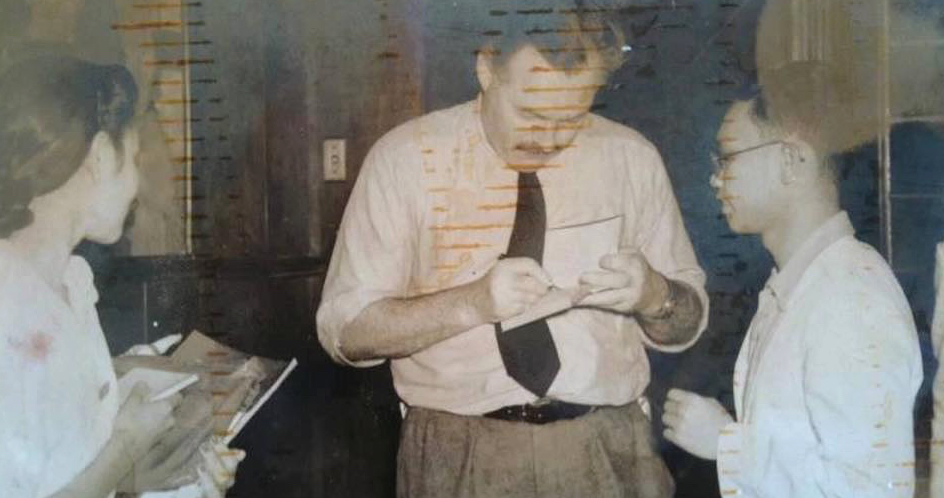
I was, of course, attracted to that passage because it particularly mentioned Hemingway’s pen, which I would have dearly loved to see; but also, it talked about Hemingway signing books, which reminded me of a photograph I adverted to in my earlier column, showing Hemingway signing a book for a young Filipino writer named Nestor Vicente Madali Gonzalez, who in early 1941 would have been no more than 25 years old. I’d seen that picture in NVM’s house in UP when he was alive, and had worried that it might have been lost when the house burned down. But after my piece came out, I was happy to hear from NVM’s youngest daughter Lakshmi that she had posted a copy of it on her Facebook page, and I hope she doesn’t mind if I repost it here—Ernest meets Nestor, you might say.

Speaking of NVM Gonzalez, the literary community marked the centenary of his birth last Tuesday, September 8, in an evening of tributes at the Executive House at the University of the Philippines in Diliman organized by Prof. Adelaida Lucero. NVM, of course, taught with UP—among many other universities here and in the United States—for many years despite the fact that he never completed his bachelor’s degree. As director of the UP Institute of Creative Writing, I was asked to say a few words at the testimonial dinner, which was attended by NVM’s widow Narita, and here’s a reconstruction of the remarks I made:

“NVM and I were born only 60 kilometers away from each other in Romblon—he on Romblon Island and I on neighboring Tablas—but also almost 40 years apart, and I never had the good fortune of being his student in UP. It’s actually my wife Beng who’s been closer to the Gonzalezes, having been Narita’s student at UP Elementary. But I had the chance to meet NVM and to enjoy his company when he returned to UP in the 1990s as International Writer-in-Residence under the auspices of what was then the UP Creative Writing Center. I had the honor of drafting his nomination as National Artist, signed by then Dean Josefina Agravante.

“Franz Arcellana was my teacher, and Bienvenido Santos and Greg Brillantes were my literary models; but it was NVM who hung out with us, whom we had fun with in our workshops in Baguio and Davao. And as advanced as he was in years, he was forward-looking and eager to learn. I remember running into him once in what was then the SM North Cyberzone, and I asked him what he was doing there. ‘I’m looking for a book on multimedia!’ he told me with that twinkle in his eyes.

“We didn’t always agree, but the one thing I can say about NVM is that he never threw his weight around, never pulled rank on us his younger associates, never thundered about how much older or more accomplished he was to suggest why he was right and we were wrong, despite his obvious seniority in age, experience, and wisdom. We appreciated that. That’s why, in the foreword to a book of essays by his friends that I edited after his death in 1999, I said that some writers are respected and admired, and others are loved. NVM was both.”

The celebration of NVM’s centenary won’t stop with that dinner—which also saw the launch, by the way, of new books on NVM: his poems, edited by Gemino Abad, and a Filipino translation of Seven Hills Away by Edgardo Maranan, published by the UP Press and the Komisyon sa Wikang Filipino, respectively. At the end of this month, the UP Department of English and Comparative Literature will hold an exhibit of photographs of and works by him. His son Myke, based in the US, is organizing a fiction-writing workshop in January, the first half to take place in Diliman and the other in Mindoro, and the UPICW will be helping Myke out with that project.

It never ceases to amaze me how a web of words (make that a Worldwide Web, these days) can bring people together across the miles and years.

[Photo courtesy of Lakshmi Gonzalez-Yokoyama]

Penman No. 165: Going for the Bestseller

IMG_8046

Penman for Monday, September 7, 2015

AUGUST AND SEPTEMBER are usually busy months in the cultural calendar, and this year’s been no exception. UMPIL—the Writers Union of the Philippines—held its annual conference toward the end of August, with the economist and columnist Solita “Winnie” Monsod delivering the customary Adrian Cristobal Lecture. On September 1st—perhaps the most important date on many a young Filipino writer’s calendar—the 65th Carlos Palanca Memorial Awards for Literature were given out, with poetry titan Gemino “Jimmy” Abad arguing eloquently for the power of literary language to create its own reality.

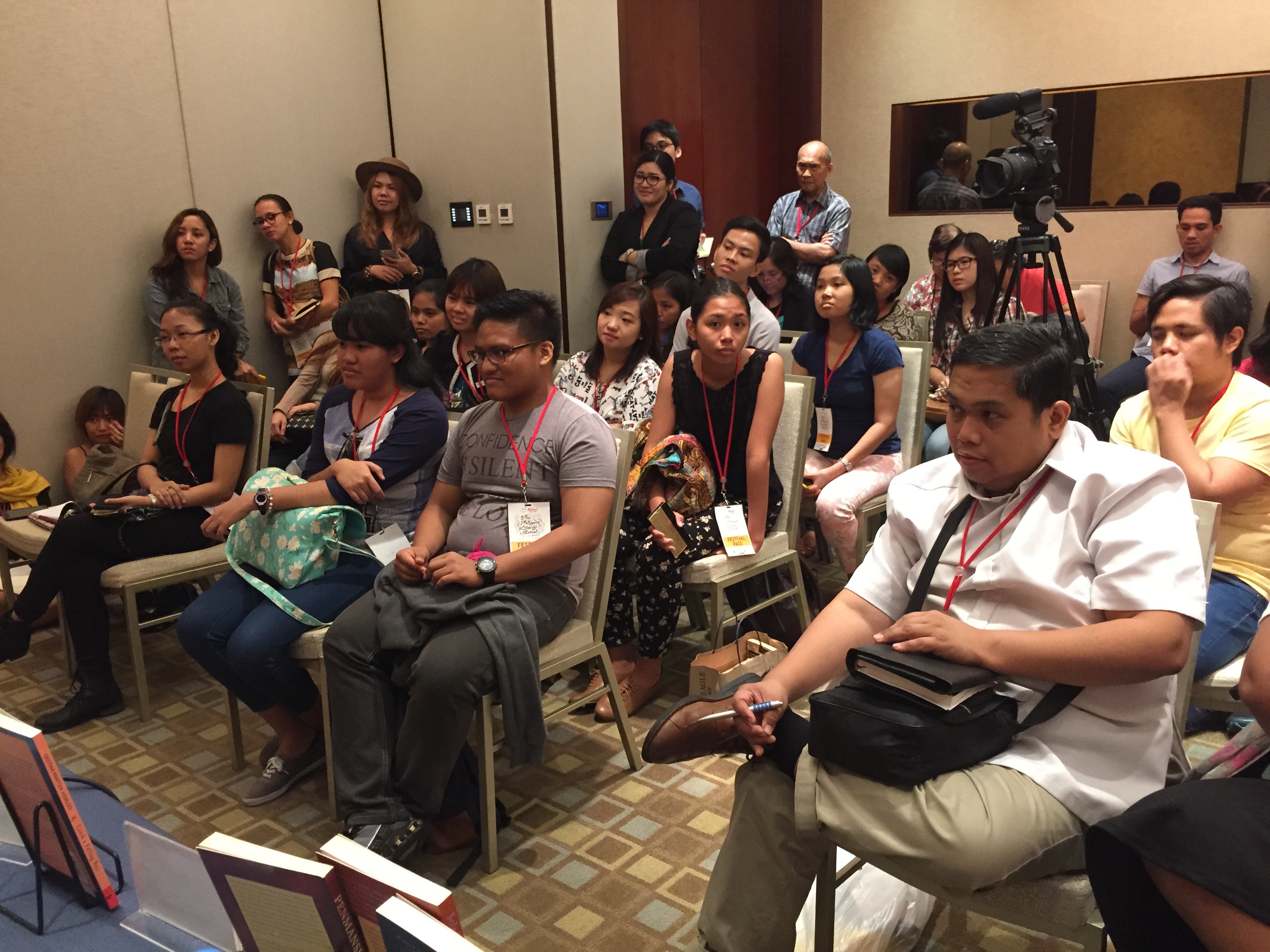
In that same week, National Book Store, among other sponsors, put on the Philippine Literary Festival at the Raffles Hotel in Makati, headlined by visiting authors Matthew Quick and Meg Wolitzer. I went on a panel at that festival with my friends Krip Yuson and Jing Hidalgo, with Marivi Soliven as moderator, to talk about writing the novel. I was surprised to walk into a packed room at the Raffles, despite the fact that Meg Wolitzer was holding forth in another session at the same time.

Now, I’ll admit that I’d never read Meg before, although I’d read about her recent novel Belzhar. She was advertised as a bestselling author, as was Matthew Quick, who wrote The Silver Linings Playbook.

I overheard a mild complaint in the hallway to the effect that the NBDB should have invited the powerhouse cast of Pulitzer prizewinners that Manila festivalgoers have been used to seeing (I remember hosting a chat with the wonderfully encouraging Junot Diaz a few years ago). I didn’t have the time to stop and respond to that comment, but I would’ve said, ”Hey, no problem! There’s a lot we can learn about producing bestsellers! And bestsellers can and should be well-written, too!”

Indeed, in our panel on the novel, one of the recurrent themes that came up was that we Filipinos don’t write enough novels (“We’re world-class sprinters,” I noted, “but not marathoners”), at a time when the only thing international publishers are looking for are novels, which can lead to fat Hollywood contracts and all kinds of other spin-offs.

Toward the end of that discussion, in the Q&A, a young lady in the audience asked about what we (presumably the literary Establishment, going by our senior-citizen cards) thought of newer and less traditional routes to literary fame like Wattpad. Thankfully, I’d heard of Wattpad, and had even actually registered on the site a few months earlier out of curiosity, so I could peek into what was going on there. I knew that Wattpad was generating stories that were already being adapted into commercial movies, so it was more than another digital pastime. (For my fellow 60-somethings, Wattpad’s a website where people—usually very young people—upload stories of all kinds, typically love stories, vampire stories, science fiction, and fantasy.)

I told the questioner that while it was likely that much of the material on Wattpad wouldn’t come up to conventional literary standards, I didn’t see that as a problem. What was important was that—at some level and with little or no intervention from their elders—young people were writing and reading, and that can’t ever be a bad thing. Tastes mature and change, and even within those young-adult genres, truly good work is bound to emerge and be recognized and rewarded. And even mainstream literature itself would ultimately benefit from the spillover; as Shakespeare put it, “When the tide comes in, all the ships in the harbor rise.”

But beyond supporting what younger writers were doing, I brought up another pet theme of mine, which is that we older writers write way too serious (if not sometimes inaccessible) stuff, and have thereby separated ourselves from our potential readers. Creative writing has become way too academicized—produced in, for, and by formal writing programs, with little regard for what ordinary readers are really concerned about in their daily lives. In other words, while we seek to develop our readership, or work on the demand side, we should also work on the supply side by writing material of more popular appeal, with little or no reduction in quality.

This train of conversation ran on a couple of nights later at the Palancas, where I had a chance to chat at the sidelines with Graphic fiction editor Alma Anonas-Carpio and essayist Ferdie Pisigan-Jarin. (I don’t smoke—and I would urge everyone not to—but I happen to find people who smoke usually more interesting to chat with than those who don’t, so I usually join the smokers out on the patio of the Rigodon Ballroom at these Palanca dinners, especially when the program—with my apologies to the gracious hosts and the contest winners—goes on for too long.)

I told Ferdie that I suspected that, outside of school, young readers these days didn’t really care much about author’s reputations, or about what critics or other old people say about a work. Ferdie agreed. “We undertook a survey,” he said, “and we found out that what makes young readers decide to buy a book is what they can get of the story from the back cover. They can’t even leaf through the pages, because most books these days are shrink-wrapped.”

From Alma came the astounding news that one young Filipino writer, Marian Tee, was making a regular six-figure income from the Amazon sales of her e-book novels. Though based here, Marian writes dreamy romantic comedies set in places like Greece, with titles like The Werewolf Prince and How Not to Be Seduced by Billionaires, and with covers displaying a surfeit of naked male muscle. The female protagonist may be blond, swears Alma, but she’s really Sarah Geronimo in disguise.

I’m not saying that we should all write like Marian, because we probably couldn’t even if we wanted to. But it’s good to know that there’s someone among us who knows the market and can play the global game, because there’s a lot we can learn from her—in adaptability, in audacity, in humility, and in plain hard work.

I don’t think that literature as a fine art will ever be threatened (any more than it already is); there will always be authors who won’t mind being read by a precious few, and thankfully so, because these are the writers who will keep pushing the envelope of language and exploring uncommon sensibilities. For most other writers, or most other times, it’s worth keeping in mind that “bestseller” isn’t necessarily a bad word.

Penman No. 164: Art Meets Anthropology

Field

Penman for Monday, August 31, 2015

FACTOR 1: For the past 45 years, the Chicago-based John D. and Catherine T. MacArthur Foundation has been giving out grants to meritorious individuals and organizations for a variety of causes that fall within its stated mission of supporting “creative people and effective institutions committed to building a more just, verdant, and peaceful world.” In the US, the individual MacArthur fellowships are known as the “genius grants.”

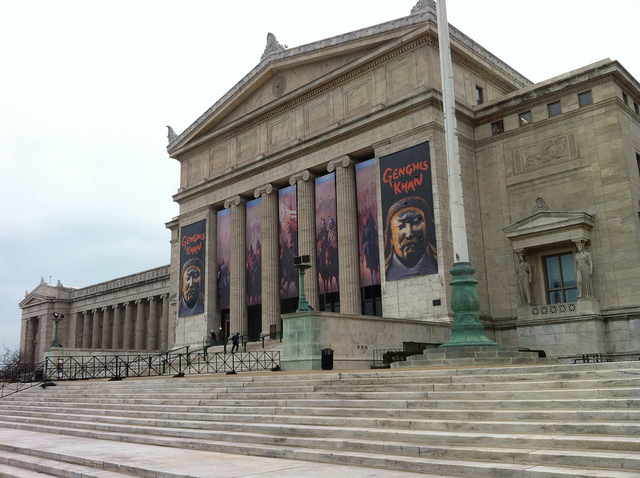
Factor 2: Chicago also happens to be the home of the 120-year-old Field Museum of Natural History, a venerable institution housing over 20 million specimens from all around the world—including an impressive collection of 10,000 Philippine artifacts, many gathered from American expeditions to the Philippines in the early 1900s, very few of which ever go on display.

Factor 3: Dr. Almira Astudillo Gilles—a Filipino-American social scientist and prizewinning writer who now lives in the Chicago area—put the MacArthur Foundation, the Field Museum, and the Philippines together in her head and hit upon the idea of seeking a grant from the foundation to fund a project that would help showcase the museum’s priceless Philippine collections before a larger global audience.

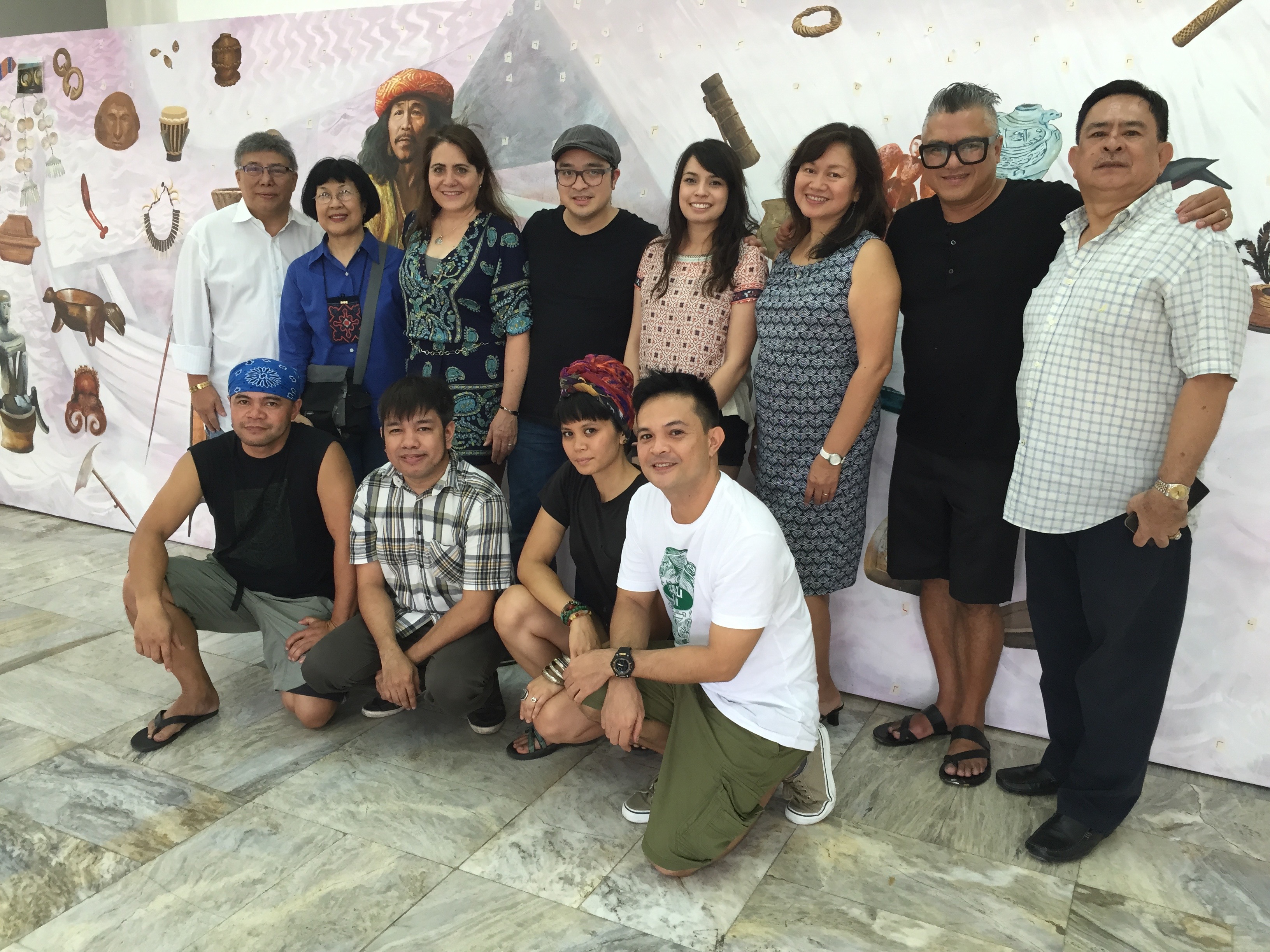
That initiative soon materialized in the form of the Art & Anthropology Project, conceived by Almi Gilles, sponsored by the two institutions, and supported in the Philippines by the Erehwon Arts Foundation. It involves bringing together five Filipino and five Filipino-American artists to work collaboratively on two huge paintings (mural-size at 7 by 28 feet, but technically not murals or wall paintings as they are free standing, on canvas)—one in the Philippines and one in Chicago—over three months from mid-August to early November.

I had a chance to mingle with these artists last week, twice—the first time, on a weekend run to Baguio, during which they visited National Artist Bencab at his museum, and then at the Quezon City domicile of the Erehwon Arts Foundation (which, aside from paintings, also hosts an orchestra and a dance studio). It was good to see Almi again, whom I’d first met in Michigan about 30 years ago when she was doing her graduate work in East Lansing and I (and her brother Jun) in Ann Arbor. I introduced Almi to my wife Beng, the vice-chair and a trustee of the Erehwon Arts Foundation, and along with Erehwon heads Raffy Benitez and Boysie Villavicencio, Almi and Beng helped crystallize the Philippine phase of the project.

The ten chosen artists went through a rigorous and juried application process on both sides of the Pacific. No one—not even established and well-known artists—got a free pass. This opened the door to young, vibrant talents—most of them under 40—representing a range of artistic styles and persuasions, from the realist to the abstract. While the Fil-Am artists come from around the Midwest, the Filipinos range in their origins from Baguio and Manila to Cebu and Cotabato.This August, the five Fil-Am artists arrived in Manila to work with their homegrown counterparts at the Erehwon Center; this October, the five Pinoys will fly to Chicago to do the same. The finished paintings will be on exhibit in their respective venues, and will feature artifacts the artists have chosen from the Field collections, recontextualized in the present. This way, the project’s as much a celebration of our continuing ties as global Filipinos—arguably one of our richest cultural resources—as it is of our pre-Hispanic wealth.

The artists involved are among the best of their generation. Herewith, excerpts from their profiles:

Leonardo Aguinaldo was born in Baguio City in 1967, and currently lives in La Trinidad, Benguet. Aguinaldo’s style is highly illustrational and graphic, derived from his experiences as a printmaker. He utilizes the rubbercut and acrylic paint to achieve highly dense and detailed designs derived from his traditional Cordillera background.

Jennifer Buckler was born in Dover, Ohio in 1986. She received her BA in Art from The Ohio State University in 2009 and her MA in Art Therapy Counseling from Marylhurst University near Portland, Oregon in 2011. In 2013, Buckler joined a Chicago-based Filipino artists’ collective known as the Escolta St. Snatchers Social Club, where she has explored her Filipino roots more deeply.

Elisa Racelis Boughner was born in the United States and raised in Mexico, and studied art in America and Europe. Her work reflects the influence of each of these cultures, and of a range of painting styles from Impressionist and German Expressionist to Cubist. The result is a unique and highly personal style that brings extraordinary vibrance to often ordinary subjects.

Cesar Conde is a contemporary painter who employs Old World techniques on modern materials to paint realistic portraits. He is a Filipino-American artist based in Chicago who studied with master painters in Italy and France. He counts Caravaggio, Rembrandt, and Goya among his influences.

Florentino Impas, Jr. was born in 1970 in Danao City, Cebu, ands graduated from the Surigao del Norte School of Arts & Trade. A consistent competition finalist and winner and a member of the Portrait Society of America, Jun was a former president of Cebu Artists Inc. (CAI) as well as a former president of the Portrait Artists Society of the Philippines.

Joel Javier earned a BFA in Painting and Drawing at Murray State University in 1999, then pursued a career in studio art which led to a career in art education, receiving an MA in Art Education in 2011 from the School of the Art Institute of Chicago. Joel is currently the Education Manager at Intuit: The Center for Intuitive and Outsider Art in Chicago.

Emmanuel Garibay was born in 1962 in Kidapawan, Cotabato. With degrees in sociology, fine arts, and divinity, the many-talented Manny has mounted at least 19 solo exhibitions, and is well known for his expressionist figurative style as for the content of many of his works, which often express a keen social and political consciousness.

Trisha Oralie Martin is an interdisciplinary book and paper artist currently living, working, and teaching in Chicago. Trisha envisions her art as a catalyst that can convey important social issues across diverse communities. Inspired by her cultural heritage, her highly patterned works are pulped and printed with native Filipino designs.

Jason Moss was born in 1976 in Manila. He finished a BFA, Major in Advertising, at the University of Santo Tomas in 1997. An award-winning book illustrator, animator, and filmmaker, Jason is also a painter who has mounted 28 solo exhibitions since 1993. Jason’s work blends grotesquerie—his manifest suspicion that our world is beset by demons of one kind or other, some of them within the self.

Othoniel Neri was born in 1985 in Manila, and began drawing at a very young age. In 2003 he studied Fine Arts by mail through the International Correspondence School, and received several awards in international and local competitions. Being a figurative and portrait artist, Otho paints with a very sharp eye and a flair for detail, employing a palette of explosive colors.

The project has been a rich learning experience for the artists on both sides, so far, in terms of exchanging viewpoints, experiences, and techniques. Beng and I look forward to seeing what they’ll do in Chicago for the project’s US phase—whatever its content, surely a triumph of cultural kinship across the miles and the millennia.

IMG_8024

Penman No. 163: The Gentler Path

IMG_7998

Penman for Monday, August 24, 2015

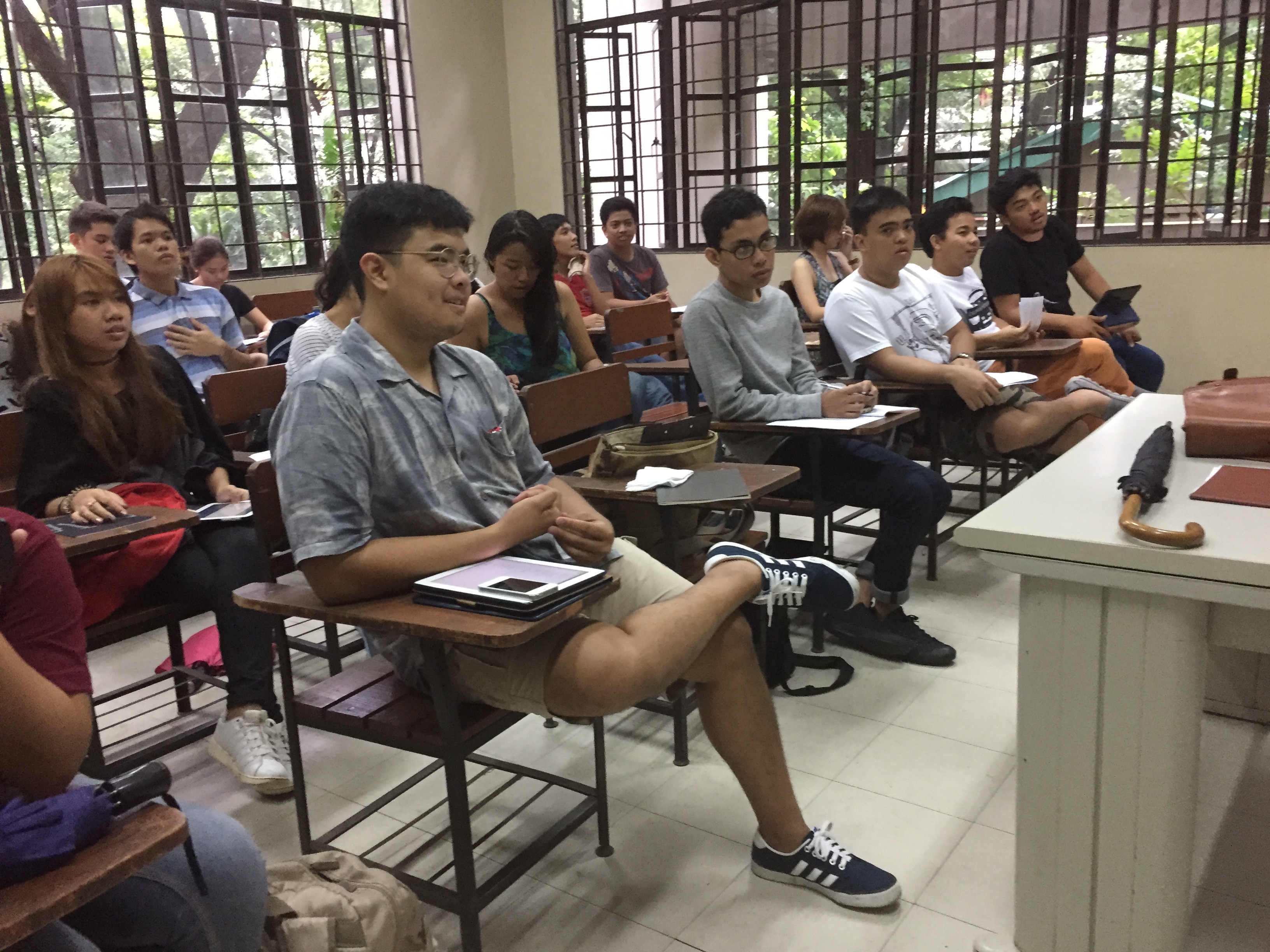
FOR THE first time in something like 20 years, I’m teaching two undergraduate classes this semester. I usually teach one graduate and one undergrad class, but thanks to what I’m taking as a glitch in the registration process, my graduate fiction writing class—which is usually oversubscribed—had zero enrollees this term, forcing its cancellation and my reassignment to a course usually reserved for young instructors, English 11 or “Literature and Society.”

I should make it clear that I’ve always insisted on teaching at least one undergrad class every semester, and have done so unfailingly since I returned from my own graduate studies abroad in 1991. The benefits go both ways—young students get to learn from more experienced professors, and senior profs get to know how young people think. With four years of active teaching left before retirement (it’s hard to believe, but I’m getting there), these encounters with some of the country’s brightest young minds will only become more precious, and as with every class I take on, I can only hope that, many years from now, my former students will remember something useful that they picked up from me.

I haven’t taught English 11 in ages, so it was with some trepidation that I entered the classroom on our first day a couple of weeks ago, under UP’s new academic calendar. Students don’t realize this, but professors can be just as full of anxiety at the start of the semester as they are. As I scan the roomful of faces, I’m already wondering who will likely give me problems and who will make it worth the effort of preparing for every day’s lesson as if I myself were taking an exam. Thankfully, most of these mutual apprehensions soon retreat as I reassure my students that I know what I’m talking about—and that I won’t scream at them if they don’t—and as I begin to understand what exactly I’m working with, which is always a welcome challenge.

This semester, I was glad to discover that my English 11 class of about 30 students was composed of mainly science and engineering majors. You’d think that teaching the humanities to them would pose problems, but I see it as a unique opportunity to lead smart people on an adventure they might have missed out on otherwise. Of course, UP’s General Education program makes sure that our graduates acquire a balanced outlook on life, so my students didn’t really have any choice, but I see my job as making them see Literature as much less an imposed subject than a welcome relief from everything else—in other words, fun. When you disguise labor as discovery, and emphasize incentives over penalties, the students—and you yourself—can feel more relaxed.

English 11 is what used to be English 3 in my time—an introduction to literature—and while some teachers see this as a chance to pile on the heavy stuff like The Brothers Karamazov (and I can understand why), I prefer to take the gentler path to literary enlightenment, and begin with things the students know or can apprehend. That way you can lead them to stranger and more intriguing discoveries about the way language works to convey human experience.

Last week, for example, one of the first poems we took up in class was “Southbound on the Freeway,” a poem published in 1963 by the American poet May Swenson. We could’ve done something like T. S. Eliot’s “The Wasteland,” but unless you train lay people to look at poetry a certain way—to see it as a puzzle or a riddle to be solved, for example—it’s often very hard for them to get a handle on what some poets do on a high and abstracted level of language and idea, much like the way Picasso’s departure into Cubism (think of his women-figures with their eyes looking this way and their noses pointing that way) can be better appreciated if you first consider what goes into a traditional portrait like the Mona Lisa.

“Southbound on the Freeway” reads like a rather simple and even funny poem, in which alien visitors on a spaceship look down at the Earth, and see creatures “made of metal and glass…. They have four eyes. / The two in the back are red. / Sometimes you can see a 5-eyed / one, his red eye turning / on the top of his head.” It doesn’t take much for the student to see that the aliens, hovering above a freeway, have concluded that the cars themselves are Earthlings, and even that some cars—like the “5-eyed” police car—are more special than others.

In literature, this is a familiar device we call “defamiliarization,” by which poets and other artists take something we see everyday and present it to us in fresh and unexpected ways, revealing facets and insights we never really thought about before. The Swenson poem seems like all it does is show us how perspective can change our perception of things, but it goes beyond that eye-trick and asks a very intriguing question at the end: “Those soft shapes, / shadowy inside / the hard bodies—are they / their guts or their brains?”

At this point, I ask the class, what’s this poem really about? Is it just about aliens and humans, or about cars on the road? Inevitably, someone spits out the magic word: technology! So what is it about technology that’s so important, I press on, and what does it have to do with our lives? Why, everything, the class exclaims in a chorus—we’d die without our cell phones and iPads!

We go into a brief and engaging discussion about what exactly technology means, and whether it has benefited human society—or not. We talk about mechanization, automation, better and easier ways of doing things, products that were invented to improve human life, and inventions that did the opposite. We talk about armaments, and about Eli Whitney’s cotton gin and how it actually helped to encourage more slavery in the American South. I tell them that at some point, later in the semester, I’ll talk to them some more about the legend of Dr. Faust and how it led to the stereotype of the mad scientist, all the way to Dr. Strangelove, Lex Luthor, and Doc Ock. I can see that the class is listening, and I’m happy.

I ask them what the real question is that the Swenson poem is posing, and they get it. It’s been a good day in school for Literature and Society.

Penman No. 162: To Be a Journalist (2)

Byline

Penman for Monday, August 17, 2015

LAST WEEK’S look back at my early days as a journalist brought back a flood of memories that hadn’t crossed my mind in ages, so I’ll beg my reader’s indulgence with this extended reminiscence of what it was like to be a young newspaper reporter just before martial law was declared in September 1972.

Come to think of it, that first stint in journalism didn’t last too long, from April to September of that fateful year. (I keep saying “first” because I would return to newspapering more than 20 years later in 1993, as an editorial writer and then Lifestyle columnist for the late, lamented newspaper TODAY.) To recap, I was 18, and my bosses at the Philippines Herald had taken a chance on a college dropout who barely knew a thing about professional newspapering but who seemed to be able to string sentences together decently enough—and fast.

Man, was I fast—I was so eager to impress my editors that I jumped at assignments the way a dog goes after a ball, and when my editors found out about the new boy in the room, they assigned me to fill up half of Page 5—the features page—every day. The topic was up to me. That sounded like the most wonderful thing in the world—imagine, my own corner of the newspaper, all mine to fill up!—for about three days. I took stories out of history books and turned them into features; I wrote about the latest crazes like fun houses and pool halls; and when, inevitably, I ran out of ideas, I took a bus out to Tagaytay, got off, and looked around for anything that I could weave a feature story from (I saw a drug rehab center in the distance and got a story out of that; I did the same thing in Muntinlupa another day and interviewed a Death Row convict).

Thankfully my editors pulled me out of Page 5 and designated me a general assignments reporter—meaning, I would report for work every morning and take on whatever odd assignment they tossed me. But before I could do that, and to give me some training, they had me spend a few weeks each on a specific beat—police, sports, and City Hall. On each beat, a senior Herald reporter took me under his wing, and while they may not have been too happy to babysit me, I soaked up their streetsmarts and tried not to be a nuisance (not always successfully—we were covering a MICAA basketball game when Jun Pantig saw that I was cheering for one team at courtside. “Stop cheering!” he shushed me. “You’re a reporter, you shouldn’t be taking sides!”)

Of all the beats I was assigned to, the most exciting and instructive was police. I took the graveyard shift at the old Manila Police Department headquarters and from there covered mayhem at its worst—an 18-year-old American girl who shot herself in the mouth at the Dutch Inn; a nighttime fire that razed a hospital in Dapitan (I can still recall the sickening thud of falling patients who jumped off the roof in desperation; my specific task, early that morning, was to count all the bodies in the morgues); demonstrations at the US Embassy where I could see the police preparing for an assault on the rallyists, many of whom happened to be my friends (prompting me, again, to break journalistic protocol by picking up the injured in our service jeep and bringing them to the hospital).

I grew inured to the sight and smell of blood, and I can say, today, that I had no better preparation for the kind of realist fiction that I would come to write than those weeks on the police beat, confronting death by the day (which didn’t make me feel any braver, but rather more aware and respectful of the finitude of life).

It was all very exhilarating, even in the most difficult and trying of moments; sometimes the toughest tests took place in the newsroom itself—once, for example, I was driven close to tears by having to rewrite a story half a dozen times to please an editor who, I now realize, was teaching me a valuable lesson in verbal economy.

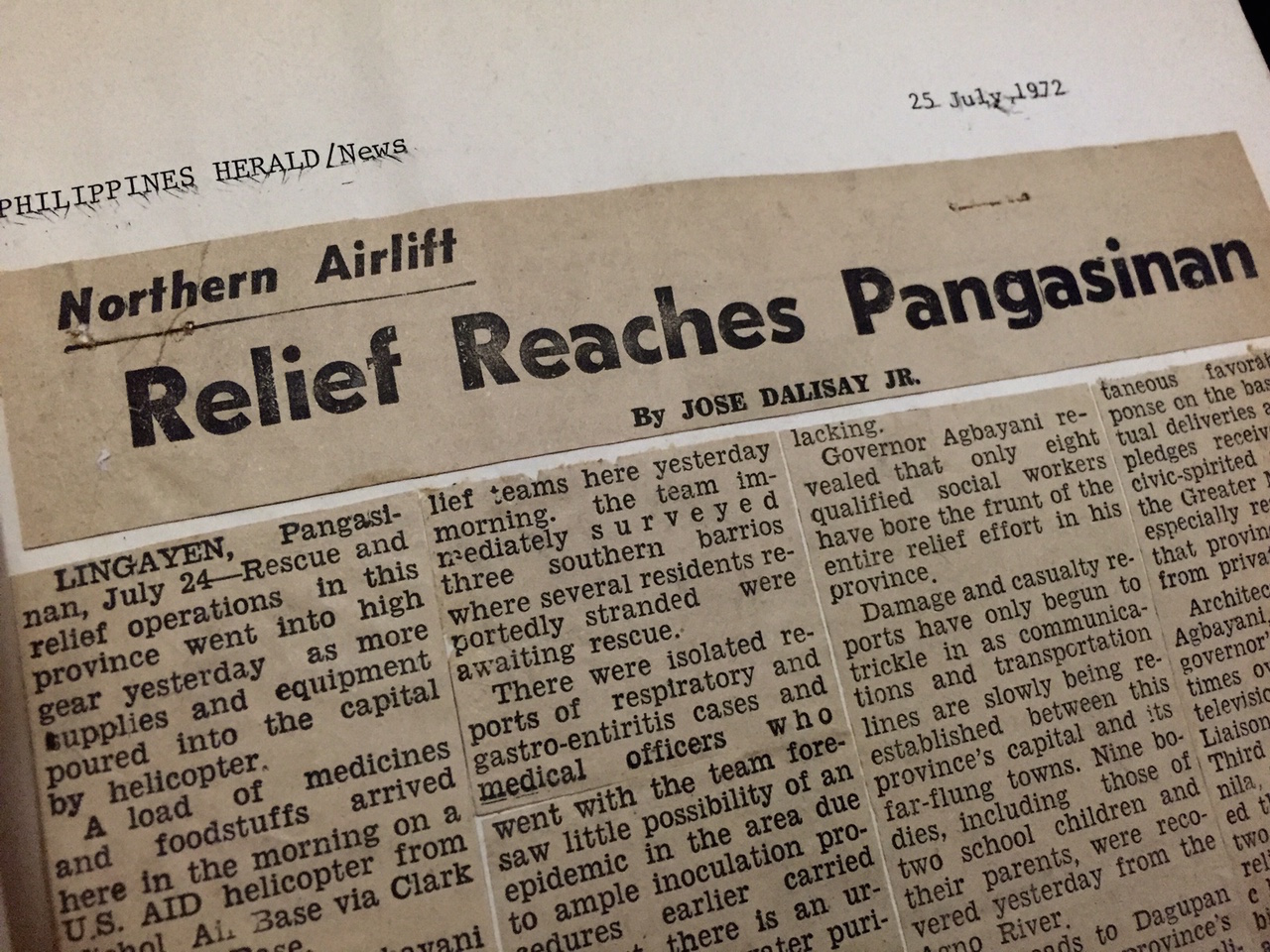
Coming off the beats as a general assignments reporter, I looked forward to and did get some assignments that no other teenager would have experienced. At the onset of the biblically catastrophic July-August floods of 1972, I was put on board an amphibious ship that sailed in the night from Manila to Lingayen Gulf, and I covered rescue operations in Pangasinan, riding rubber rafts and flying out in a US Army helicopter that dropped us off at Clark Air Base, then still busy with the Vietnam War. Also at about that time, I volunteered to go to Isabela to cover the reported landing of a shipload of arms by the CPP-NPA, convinced (wrongly—it turned out to be the MV Karagatan episode) that it was a military hoax that I could heroically unmask; sensibly, my bosses told me that I was too young—they didn’t say too foolish—to undertake the mission. Instead, I stayed in Manila, and interviewed Mrs. Marcos in Malacañang about her relief efforts in front of a mountain of Nutribuns.

Like I said last week, I soon resigned in solidarity with a union strike at the Herald, and was half-surprised when management accepted my resignation. I finagled my way to a spot at Taliba (in the Manila Times organization that it had been my dream to join one way or the other) as suburban correspondent, and it was in that capacity—albeit outside my assigned zone in Makati—that I filed, or at least called in, the last story of my brief reportorial career. It was the night of September 22, 1972, and I was on the UP campus, not as a journalist but as an off-hours activist hanging out with comrades and fraternity brothers to denounce the imminence of martial law.

I should’ve sensed something when I saw my brod Bobby Crisol, son of the Defense Undersecretary, suddenly being spirited away by his dad’s security men. Shortly after, we heard gunshots in the distance. I ran for the nearest phone and called the night desk: “I have a scoop!” I said breathlessly. “I can hear gunfire—UP is under attack!” (It later turned out that the Iglesia ni Cristo radio station was being taken over by the military.) What should have been the biggest story of my young life fizzled out with a laconic reply on the other end of the line. “So are we,” said the fellow I spoke to. “There are soldiers in the office. It’s martial law!”

Within four months, I would be in prison, still aged 18. Another year later, I would get married, on my 20th birthday. Life seemed terribly short, and I was in an awful hurry, hardly imagining I would last on to seniorhood.

Today, I tell my Creative Writing majors that they may think of themselves as God’s gift to literature, but until they’ve spent a week or two as a reporter, sniffing out a story, they should shut up and be happy they can write odes to the moonlight without an editor screaming at them for a tighter rewrite.

Penman No. 161: To Be a Journalist

Image-1

Penman for Monday, August 10, 2015

I WAS very sad to hear of the recent passing of an old colleague from my first foray into journalism—Nemesio Dacanay, who was then the City Editor of the Philippines Herald, one of the pre-martial law period’s smaller but pre-eminent newspapers. A relative of his texted me about his death and interment, but I was out of town and felt bad that I couldn’t even pay my respects in person, so I’ll do it here.

Five years ago, in this column, I had to issue an apology—and I was happy to do so—having inadvertently suggested in a previous piece that “Dac” had passed on to the hereafter. As it turned out, he was still very much alive, as his daughter Christine reminded me. This time, unfortunately, the news was real.

The story of my connection to Dac and of how I got into the newspapers is something I may have told before in bits and pieces, but here it is in full. The time was early 1972, and I had just turned 18. I was already a full-time activist, having dropped out of my classes in UP, a lanky, chain-smoking lad who was already a veteran of many a Plaza Miranda march and of the Diliman Commune.

In UP, I hung out with a group of older Journalism majors who were close to graduating and who would, very shortly after, begin to make a name for themselves as reporters—people like Wilson Bailon, Rolly Fernandez, Jun Engracia, Efren Cabrera, Rod Cabrera, and Val Abelgas, among others. I had great respect and admiration for these guys, but at the same time, it annoyed me to know that they were soon going to find and land jobs, while I—technically still a freshman, with but 21 completed units to my name (3 of them good for a “5.0” in Math, the consequence of absenteeism)—was going to be left behind.

I should explain that at 18, I had no greater ambition than to become a journalist. I’d written some stories, poems, and plays, but I had no plans of becoming a creative writer, and might even have thought journalism superior to poetry (and why not?). I had been editor in chief of the school paper at Philippine Science High (following in the gargantuan footsteps of Rey Vea, Mario Taguiwalo, and Rodel Rodis), and I found that I savored the romance of printers’ ink and hot lead (that’s “lead” with a short E for you young ones, the molten metal that magically turned into letters in reverse).

As soon as I stepped into UP, at 16, I did the three things I’d put on my agenda, after enrollment: join the Nationalist Corps (and later the Samahang Demokratiko ng Kabataan, or SDK), join the Alpha Sigma Fraternity (to which high school heroes like my Physics teacher Vic Manarang and firebrand Gary Olivar belonged), and join the staff of the Philippine Collegian.

It was in the nationalist movement and those long nights of proofreading at Liwayway Press that my desire to become a reporter flourished. Never mind poetry and fiction; I wanted to feel and to record the ground shaking beneath my feet from the steps of a thousand marchers, to trace the arc of tear gas canisters flying across the plaza, to bear witness to what we were all convinced was the forging of a bright new future, with all the sparks and all the smoke that came with the process. To be a reporter at that time was to be in the very womb of history, and I thought nothing was more thrilling and more important than to be there on the frontlines, notebook and ballpoint in hand and a barely stifled battle cry rising up my throat: “Pierce the enemy with your pens!” (That was the slogan silkscreened on my jacket.)

As you can see, as a teenage Maoist, I had no idea of and no patience for “objective” and “dispassionate” journalism. I hadn’t even taken one formal unit of Journalism in UP (I was an Industrial Engineering major, and still plowing through my GE subjects) and had embraced the notion that journalism was and had to be a partisan activity, convinced that Malacañang had bought 90% of the Philippine press, with the notable exception of progressives like Tony Zumel, Satur Ocampo, and Rolly Fadul, and young blood like Roz Galang and Millet Martinez. We were going to be the vanguard of what we called the Second Propaganda Movement.

But I didn’t want to be stuck on campus; it was a wide-open arena beyond Diliman, so when my friends began applying for jobs with the newspapers shortly before graduation in early 1972, I tagged along, hoping to land something, anything. (I’d already written and sold a teleplay to the TV drama anthology Balintataw in 1970, when I was 16, so I didn’t lack in self-esteem.) I remember walking up to the editor of the Manila Chronicle, Amando Doronila, and boldly announcing that I wanted to apply as a reporter. “How old are you?” the man asked in all reasonableness. “Eighteen,” I said. “Come back in a few years,” he suggested, not unkindly.

It was like that, one prospect after another, until my path led to the old Philippines Herald office in Intramuros, sometime in March or April. It was must have been around one in the afternoon, because the only person in the newsroom was Nemesio “Dac” Dacanay, whose name I didn’t even know at that point. He had a groovy look about him: dark shades, a colorful, open-necked shirt, and an impish grin. I told him what I was there for, and I can’t recall how long I begged to be given a chance, but finally, if only to get rid of the pesky walk-in, he said: “Where do you live?” I said, “Quezon City.” He said, “Okay. Go back to Quezon City, then come back in three days with a story. Understood?”

I stepped out of the Herald on a floating cloud—I was positive I would deliver as directed. Over the next three days, not knowing anything about real newswriting, I walked around the Quezon Memorial, waiting for some dreadful accident to happen that I could breathlessly report on. The world remained blissfully peaceful, and the only thing that came crashing down was my dream of becoming a journalist. On the third day, I was so tired and depressed that I took a jeepney to the Delta Theater, and decided to cool off in the moviehouse. I watched the screen. The movie was so awful I can’t even remember its title. When it was over, I went home, collected my thoughts, and pulled out my typewriter.

Then I took a bus to Intramuros, and handed Dac my story—a movie review. Damn—I could hear him mutter, and I could see him sizing me up through his shades—okay ka, kid. “I’ll pass this on to Nestor,” he said, referring to the venerable Nestor Mata, who handled the features page. “He’ll take care of you.”

And so I was hired at 18 as a general assignments reporter, the greenest of greenhorns in a roomful of veterans that included editor in chief Oscar Villadolid, news editor Joe Pavia, reporter Lito Catapusan (who took me under his wing), and a deskman who moonlighted as a songwriter named George Canseco. Over the next few months, I would make the rounds of the police, sports, and City Hall beats, cramming three more years of college into a semester. Thanks to a guy who humored me named Dac, I had achieved my ambition of becoming a journalist. (By July, in a flash of activist fervor, I would resign in solidarity with striking workers, and move over to Taliba as a correspondent right up to martial law, when we all lost our jobs and the press as we knew it vanished overnight. But that’s another story.)

Penman No. 160: Hemingway in Manila

HemingwayManilaPenman for Monday, August 3, 2015

THE LAST time I thought about Ernest Hemingway, it was a few weeks ago when I was teaching his controversial 1927 short story “Hills Like White Elephants,” one of my all-time favorites for its compactness and subtlety, not to mention its grasp of human psychology.

Coincidentally, when I was giving that lecture, one of the pens in my pocket was an Ernest Hemingway—the first in a series that Montblanc called its Writers Edition pens, issued in 1993. Considered one of the “holy grails” of pen collectors, it had been generously given to me by a fellow member of the Fountain Pen Network-Philippines (www.fpn-p.org); we had a small business arrangement, but the cost of my own service was so negligible that the pen was practically a gift, most thankfully accepted.

My pen’s inscribed with Hemingway’s signature, but ironically, I don’t think Hemingway was ever much of a fountain-pen person, and being the practical, outdoorsy person he was, would probably have disdained carrying anything fancier than a Parker Jotter. He was actually known to favor pencils and typewriters—Angelina Jolie bought his 1926 Underwood as a wedding gift to Brad Pitt—and he wrote this down to explain why:

“When you start to write you get all the kick and the reader gets none. So you might as well use a typewriter because it is much easier and you enjoy it that much more. After you learn to write your whole object is to convey everything, every sensation, sight, feeling, place and emotion to the reader. To do this you have to work over what you write. If you write with a pencil you get three different sights at it to see if the reader is getting what you want him to. First when you read it over; then when it is typed you get another chance to improve it, and again in the proof. Writing it first in pencil gives you one-third more chance to improve it. That is .333 which is a damned good average for a hitter. It also keeps it fluid longer so that you can better it easier.”

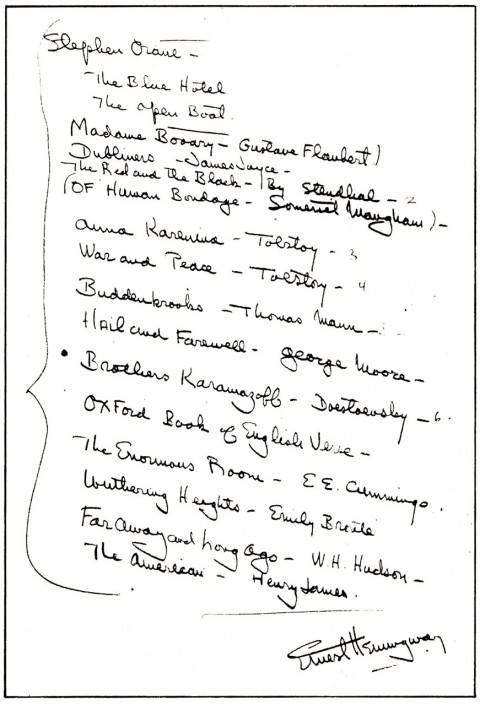
I’ve since located an online sample of Hemingway’s handwriting—likely in pencil—which has him drawing up a list of recommended readings for young writers (among them, Stephen Crane’s short stories, Madame Bovary, The Brothers Karamazov, and The Oxford Book of English Verse). It’s comforting to know that his penmanship is a lot like mine—cramped, stiff, and generally ugly.

HemNote

One of the things that I forgot to mention to my audience—a group of English teachers—was that Hemingway once visited Manila, in February 1941, with the clouds of war already hovering above Europe, where the young Ernest had served as an ambulance driver in World War I. (Ambulance driving seemed to be strangely attractive to young men who would soon make a name for themselves in the arts and letters. Aside from Hemingway, these illustrious WWI volunteers included the writers John Dos Passos, E. E. Cummings, W. Somerset Maugham, and Archibald MacLeish, the composer Maurice Ravel, and the filmmakers Jean Cocteau and Walt Disney.)

In another uncanny connection to fountain pens, Hemingway and Dos Passos served in Italy close to the factory of the Montegrappa fountain pen company, as Montegrappa continues to recall on its website: “Close to the Elmo-Montegrappa factory was situated the Villa Azzalin, which during the conflict. was converted into a field hospital. Two volunteer ambulance drivers for the Italian Red Cross at that time were the famous writers Ernest Hemingway and John Dos Passos, both of whom spent many happy hours visiting the factory and experimenting and testing various Montegrappa fountain pens, and availing themselves of the Company’s after-sales service.”

But back to Hemingway in Manila.

An article by Brown University Prof. George Monteiro in The Hemingway Review (Fall 2010) talks about Hemingway’s short 1941 visit, a stopover on his longer assignment to China as a journalist. Accompanying Hemingway then was his third wife Martha Gellhorn, herself a distinguished writer, a novelist and a war correspondent. (Annoyed by her frequent absences—she would be the only woman to land with the Allied troops on D-Day—Ernest wrote her to ask, “Are you a war correspondent, or wife in my bed?” She led a long and colorful life after her divorce from Hemingway, and tragically, like Ernest, died by her own hand at the age of 89 in 1998.)

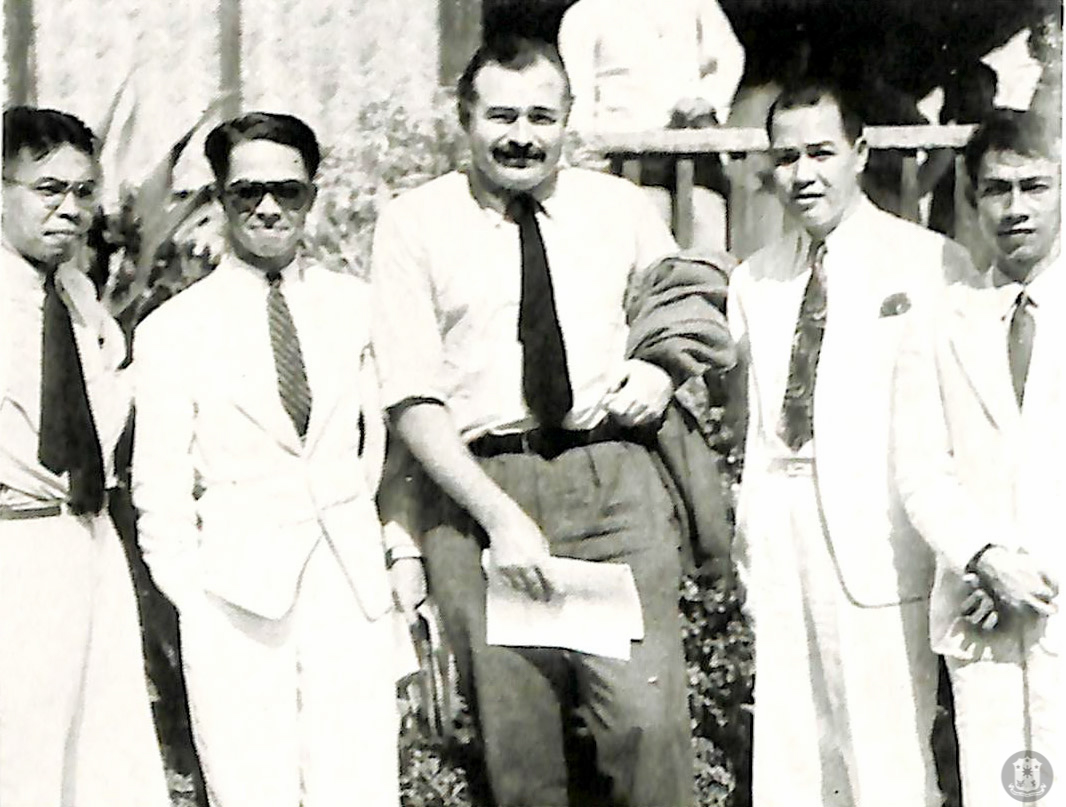
Flying to Hong Kong by Pan Am Clipper from San Francisco via Honolulu and Guam, Ernest and Martha stopped by in Manila for a few days and stayed at the Manila Hotel, and managed to meet with representatives of the Philippine Writers League, which was then led by Federico Mangahas. There’s a picture in the Flickr photo gallery maintained by Malacañang’s Presidential Museum and Library (whose Director, Edgar Ryan Faustino, just happens to be a member of FPN-P), taken from A.V.H. Hartendorp’s Philippine Magazine, showing Hemingway meeting with Filipino writers.

Seeing it reminded me of a similar picture of the big white Ernest looming over a small brown young Filipino named Nestor—a picture that NVM Gonzalez himself showed me in the 1990s, which sadly may have been lost in the fire that later razed the Gonzalez home in Diliman. Monteiro’s account mentions that Hemingway shared this bit of wisdom with his Filipino counterparts: “I think a writer’s gravest problem, always, is to write the truth and still eat regularly.”

Unfortunately I couldn’t access the rest of the Monteiro article online (you need membership access to Project MUSE), but I read enough of it to understand that brief as it was, Hemingway’s stopover created quite an impact, enough for the Manila Hotel to use a quote from the big guy as one of its taglines: “If the story’s any good, it’s like Manila Hotel.” The bayside hotel, founded in 1912, has of course hosted other luminaries such as Douglas MacArthur, John Wayne, John F. Kennedy, and the Beatles, aside from another popular postwar writer, James Michener.

As we all know, Hemingway killed himself with his favorite shotgun in July 1961, seven years after receiving the Nobel Prize for literature, in a fit of depression. It was a sad ending to a many-splendored life that we were privileged to glimpse, however briefly.

Penman No. 159: Border Insecurity

Penman for Monday, July 27, 2015

I’M NOT as big a TV fan as I used to be—I haven’t seen a single episode of Game of Thrones—but I can’t get enough of certain types of reality shows. I’ve been strangely attracted to Project Runway, and despite being a culinary philistine who hates cheese, I’m a sucker for food shows. I don’t care much for Survivor-type formats, believing that living in Manila beats sharing an island with snakes and monkeys anytime. I reserve my highest praise and deepest fascination for junk-o-ramas like American Pickers and Pawn Stars, being the kind of ukay-ukay addict who flew to Barcelona not for Gaudi’s Sagrada Familia but for the Encants flea market.

But there’s another kind of show I’m fixated on, in the same odd way that I hate even the prospect of surgery—I shrink like a schoolboy at the sight of a needle—but can be engrossed by medical documentaries, where other people get cut up. It’s the airport immigration and customs show, like Border Security Australia and Border Security Canada, where incoming passengers go through a gauntlet of questions and searches meant to find out if they’re drug dealers or food smugglers or people pretending to be tourists but are either (a) jobseekers; (b) international terrorists; or (c) fugitives from justice in disguise.

I cringe whenever a passenger—usually an Asian, sometimes a Pinoy—is loudly asked a dozen times, in clear, slow English, “Are you carrying any food?” The passenger looks stricken and bewildered, but ultimately decides to feign ignorance and/or linguistic incompetence and shakes his or her head, immediately upon which the customs officer opens the passenger’s bags to reveal enough meats, cooked dishes, condiments, and desserts for a wedding feast. The officer points to the customs form in which the passenger has boldly checked “No,” which occasions even more vigorous head-shaking, or the groan of discovery, or the wheezy laughter of surrender. The culprit is then fined, or given a stern warning, and the illegal edibles are confiscated, presumably for incineration (in this country, I think we know where they’ll end up—it’s a bigger crime to waste good food!).

As a frequent traveler myself to places out West, I shouldn’t rejoice at these embarrassing encounters between cat and mouse, but I’d have to shamefully admit that I do, which is why I keep watching these shows, for more of the same thing. I suppose it’s what the Germans call schadenfreude—the strange but delectable pleasure we get from the misfortunes of others, if only because it happens to them and not to us. Or at least that’s what we’d like to think.

I remember how, just a couple of years ago and after having made dozens of trips across the Pacific and gone through countless immigration lines, I foolishly “forgot” that I’d bought a few packets of chicharon—the deadlier bituka version, mind you, not the more innocent-looking rinds—at a planeside shop in NAIA, thinking that I would munch on them on the flight to San Francisco in the long stretch between meals. I must’ve fallen asleep instead, because they were still in my carry-on bag when Beng and I arrived in SFO, and had the misfortune of being singled out for random inspection (I think they read the vibes I must have subliminally emanated: “This guy is carrying chicharon. Arrest him.”) I speeded through the immigration process like the veteran I’d thought I was, chatting up the border agent in my best Midwestern-accented English, only to find myself in a special customs queue for secondary inspection. OK, I thought with a minor shrug of annoyance, no problem, let’s get this over and done with, shall we?

The immigration gods didn’t desert me completely, however, assigning me to a customs agent who was obviously Fil-Am, and who just as obviously knew how to deal with sneaky kababayans like me. “Magandang umaga po,” she said sweetly in Filipino as she took hold of my bag. “May pagkain po ba kayong dala ngayon—bagoong, chicharon, mangga?” I was all set to harrumph and put on my foulest professorial airs when I suddenly remembered—at her mention of the usual suspects—the packets of chicharon that I’d stuffed into the side pocket of my bag.

For a millisecond I toyed with gambling on her missing them—the chicharon bulaklak seemed even more delicious, being forbidden, and now I was never going to get a taste of it—but decided to come clean. Decades earlier (you see how these things have histories), an immigration beagle had sniffed out a stash of dubious comestibles in Beng’s luggage, meant for lonesome me in Milwaukee; now I was sure that they had 21st-century detectors and X-ray profiles of bagoong, chicharon, etc. in some secret room behind a nearby wall.

Ay, may chicharon bulaklak pala ako!” I exclaimed, throwing my hands up. “I meant to eat it on the plane, but forgot,” I added, grinning sheepishly. The agent reached in, felt for, and fished out the offending packets, and tossed them into a trash bin that seemed about to overflow with other people’s confiscated contraband. “I’m glad you told me, sir,” the Fil-Am agent said, with the barest hint of regret. “I would have fined you $300 if you didn’t!” I shuddered at the thought of having to fork over $300—the price of a fancy fountain pen—for three packets of pork innards that I didn’t even get a bite of. There, I thought, but for the grace of a kind Pinay go I.

So whenever I watch those poor, guilty souls trudging toward the immigration and customs agents on the TV shows, I silently scream at them, “Confess! Reveal the sausages and the century eggs! Resistance is futile!” Of course they never do, and I feel rewarded with my minute of smug satisfaction at having narrowly escaped the clutches of Western justice. (And it’s just them, right? Nobody but nobody ever asks incoming Americans, Canadians, or Australians, “Excuse me, sir, but do you have hotdogs, burgers, or French fries in your luggage?” Perhaps our immigration people should be better trained.)

SPEAKING OF overseas Pinoys, a fraternity brother in Toronto, Fred Postrado, emailed me to ask for some help in reaching out to his batchmates from the Manila High School Class of 1973, which is planning to hold a reunion during the last week of February 2016. Those interested may contact organizers Zen Alcantara Cabaluna at 0908-8849190 and goldland_zen@yahoo.com, Mario Bulatao at 0917-5215739 and supermcb55@yahoo.com or Virgie Nudalo Calimag at 0932-8615484 and vncalimag@yahoo.com.

Penman No. 158: A Biographer’s Advice

CuencaCover

Penman for Monday, July 20, 2015

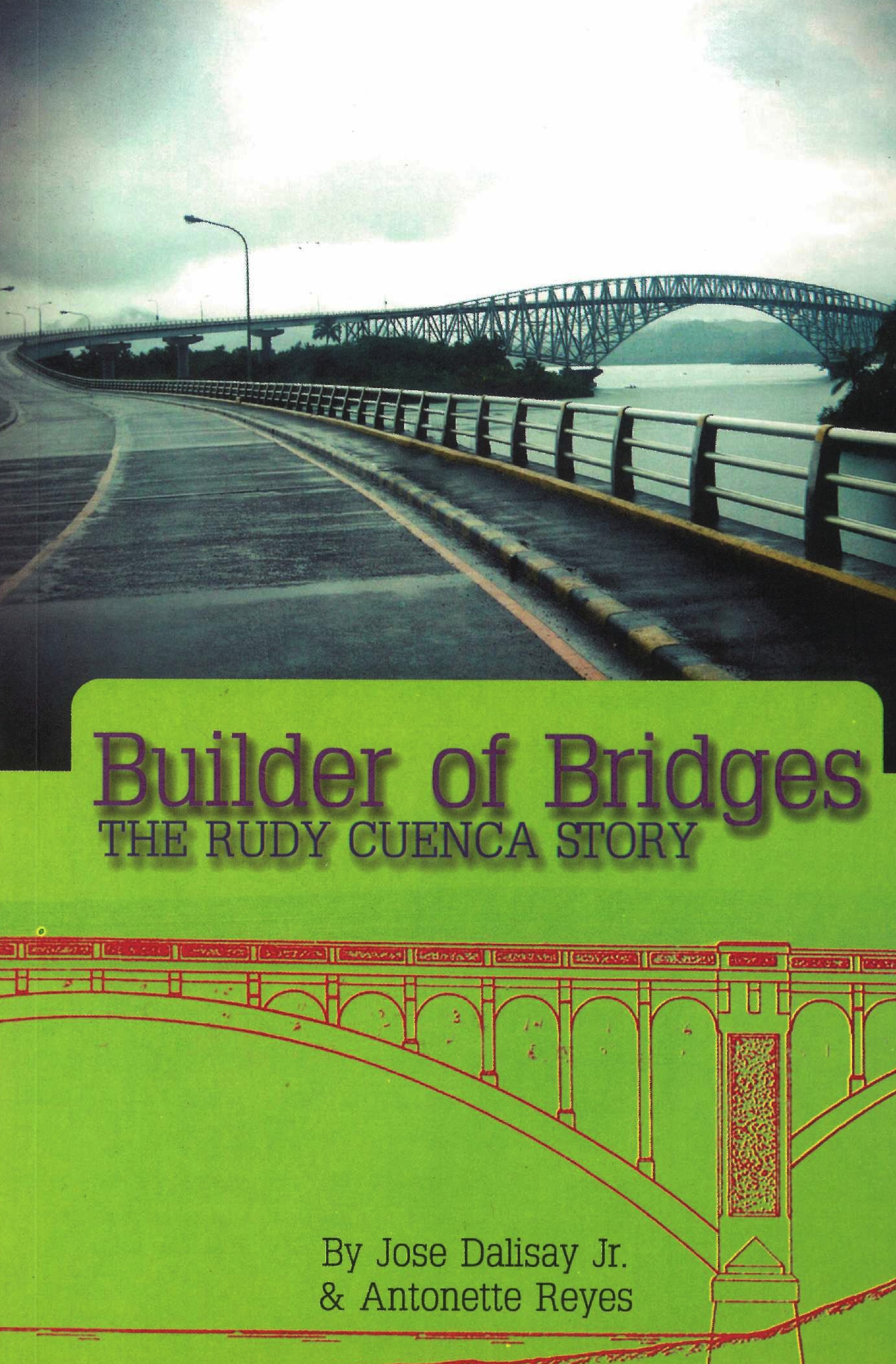
OVER THE past 20 years or so, I’ve been privileged to be asked to write the biographies of many notable Filipinos, an unexpected but interesting digression from writing the stories, novels, plays, and screenplays that used to occupy me. As it is, these days, I spend far more time on other people’s book projects than on my own—not that I mind, as it’s become a second career for me, and as it’s also introduced me to some of the most remarkable people in our country and to their life stories, which can be very instructive and inspiring.

To put things in context, I’m in the business (yes, it is one) of writing commissioned (I call them “sympathetic”) biographies, and as I’ve discussed here before, that creates a unique set of impositions on the writer. Commissioned writers might otherwise be dismissed as paid hacks; I’ve never flinched at being called one (which has happened), because I’m aware of my givens and also of what I can achieve within and despite those limitations.

I’ve often been asked by my students and by other writers thinking of going into biographical writing what it takes to get into this line of work—aside, obviously, from the language skills every professional writer should be assumed to have. I might devote a full column to this one of these days, but for now, let me jot down some notes at random.

Know why you’re doing this. Curiosity will be part of it, and that’s always a good thing, and possibly earning a good sum of money will be, too, but you also have to tell yourself that you’re contributing to social and political history by putting new information on the table.

No, you won’t be telling the whole truth and nothing but the truth. You should make a solemn vow to yourself not to lie or to be a conscious party to a lie, but don’t be under any illusion that you will uncover and reveal everything there is to know about your client. Most clients will either forget, disregard, or downplay the negative aspects of their lives—it’s a natural human impulse. I do advise my clients to be as forthright as possible for the biography’s own good (see below), but the bottom line is, you’re not an independent journalist, so your client will have final editorial approval over what you write. The upside is, even if you’re presenting a half-filled glass at best, it’s still substance for serious scholars and critics to interrogate, so you’re contributing to a hopefully more productive discourse.

You don’t have to like or to admire your client to do a good job. It helps, and I often end up liking and admiring my clients, but I maintain enough distance to allow me to write without gushing, or without sounding like an apologist. I let my clients speak for themselves—especially in instances where I might hold different views; I quote them directly and represent them as fairly as possible, but I also try to raise difficult questions that most informed and intelligent readers will raise anyway.

Be thoroughly professional. Get a signed contract specifying outputs, schedules, and fees. Be prepared to issue official receipts, and pay your taxes.

You can always say no. No matter the money, there are some jobs you just know you have to refuse for one reason or other, and I’ve done that quite a few times.

Clients, too, need some sound advice, even before the project gets off the ground. I get many calls from people planning to have their biographies or that of someone they know written, and this is part of what I tell them.

Don’t go the first-person route. Using the first person (with an “I” talking all the time) gets tiring and tiresome pretty quickly, and almost inevitably sounds self-serving and defensive in its tone. This doesn’t mean that great, honest, and well-modulated autobiographies and memoirs don’t get written; but that takes enormous self-awareness and (ironically) self-effacement. Most people can’t resist thumping their chests. Again, that’s natural, but if you’re truly praiseworthy, it’s best to let others (not your writer, either) point that out. First person limits the number of people who can talk about you to one: you. It blocks out other perspectives—even contrary ones—which can be useful, and which every biography needs for credibility’s sake. You can always be quoted at length, anyway, for more personal insights.

Tell me the truth. Don’t expect me to lie for you. Like a lawyer, I can understand the necessity of nuancing the presentation of certain situations, but I will not deliberately misrepresent the facts. I don’t need or expect to know all your secrets, but I need to be told as much as you can let on, so I can tell your story fairly. If you choose to deliberately leave out entire episodes that could prove embarrassing, that’s your call, but be aware that people will spot the omission, and your credibility will suffer. A biography is your chance to present your side of a controversy, and quite frankly it’s what readers will look for, beyond the predictable catalog of one’s achievements. No one leads a perfect life, and fractures are almost always more interesting than surface sheen.

Be kind, and try not to use your book to settle scores. Like it or not, most big people acquire enemies, and a book’s a tempting opportunity to take potshots at everyone in range. Some of that may be called for, especially when some grave injustice has been sustained, but I counsel my clients to be very sparing with their arrows, which tend to be fired back. I’ve actually walked away from a nearly-finished book project (and from half my fee) when the client insisted on launching a savage attack on a business partner he’d had a recent falling-out with. “Look,” I told him frankly, “you’re XX years old, a born-again Christian, and close to dying. Are you sure you want to be remembered as this vengeful person?” The book never came out, and he died shortly afterward.

Trust me, trust my storytelling. Some clients insist on playing up their virtues to the nth degree, to the point of overwhelming if not nauseating the reader with self-laudatory information. Others want me to accentuate the theatrics of an already dramatic situation. As a fictionist, I rely on the power of selectivity, suggestion, and understatement, and I know how to trigger the desired effect in readers. Trust me; I hardly ever brag, but this is what I’ve won prizes for. If you want a rah-rah publicist, there are many others you can hire for a lot less. Know when to stop, when to let go of the text, and when to say “That’s enough for one book. We can always write another one.”