Qwertyman No. 79: Hymns of Repentance

Qwertyman for Monday, February 5, 2024

A CERTAIN senator was quoted some time ago as saying that Filipinos supporting the intentions of the International Criminal Court to probe the Duterte administration’s bloody tokhang campaign should be made to sing the national anthem 1,000 times to regain their sense of patriotism. The clear message was that, if you were in favor of an international body looking into local crimes and liabilities, you were being anti-Filipino. 

It wasn’t surprising, of course, given that the good senator was among those prominently mentioned as possible defendants in the case. In jest, he said that if he were found guilty, he would miss his grandchildren if he were incarcerated in the Hague. And just to be sure, he added that not all people in jail are guilty—he certainly wasn’t.

Without commenting on the merits or demerits of a hypothetical ICC case against officials of the previous administration—something we have enough lawyers on both sides to perorate upon—I’ll just observe that the quality of justice the senator and his likely dock mates can expect from the ICC will surely be far better than that received by the victims of summary and extrajudicial executions under the regime of tokhang. In the very least, guilty or not, they will be alive and reasonably comfortable, although they might temporarily miss the company of family and friends, as those bereaved by tokhang have come to experience for all eternity.

I was intrigued by the suggestion that repeated singing of “Lupang Hinirang” would make a better Filipino out of me, or at least make me think of the ICC as some kind of fire-breathing Godzilla threatening to incinerate the Filipino race off the face of the earth.

There are far more effective songs  for instilling love of country. Yoyoy Villame’s “Philippine Geography” will teach us more about the country we say we’re dying for than our anthem, which must have been sung hundreds of times in the halls of Congress without much palpable effect on the patriotism of some occupants. At least I’m assuming it’s regularly sung there; if not, then perhaps our senator can start a little closer to home.

(As for professing one’s innocence, oldtimers will remember Diomedes Maturan’s “Huwag Kang Manalig sa Bulong-Bulungan” (remade by Victor Wood). Even Billy Joel warbled that “Although this is a fight I can lose, the accused is an innocent man!”)

On a more serious tangent, let me swipe a page from a recent talk given by UP President Angelo A. Jimenez, himself a lawyer, at a seminar of police officials on the thorny topic of national security and human rights:

“Our police officers should be commended for the seizure of a total of P6.2 billion worth of illegal drugs in the first half of 2023. The PNP’s Intensified Cleanliness Program, aligned with the Philippine Anti-Illegal Drugs Strategy, has employed a coordinated approach among government agencies to create drug-free communities. This shows that a serious and successful war on drugs can be undertaken without any needless loss of life, for as long as we observe the law, fight corruption, and remember the need for compassion in a just society. Even drug suspects have rights—indeed, even convicted prisoners—and we maintain our moral superiority by respecting those rights, even as we dispense justice. Only then and only thus can we regain our people’s trust.

“Ours is a society that operates on leadership by example. If people see their public officials and law enforcers doing the right thing, they will follow suit. If they see the law being flouted by these very same people—such as unauthorized government SUVs using the bus lanes along EDSA—they feel entitled and emboldened to do wrong themselves. Exemplary behavior at the top will create and strengthen the moral foundation for a responsible and law-abiding citizenry. We cannot demand what we ourselves cannot supply or enforce.”

Frankly, I myself doubt that a full-blown ICC investigation will prosper under the present dispensation, which reportedly promised the senator that not a hair of his (but then, where’s the hair?) would be touched by the ICC, back when the two camps were—just to use an idiomatic expression, and meaning no malice—as thick as thieves.

Now that the knives are out between the erstwhile allies, the ICC card seems to be in play again, teasing us with the possibility of justice being done, but I’m not holding my breath. It’s just too big a risk for those in power to take, too wide a door to open—like Cha-cha for ostensibly just economic provisions. Who knows what other crimes the ICC will unearth, who else they will indict, and how far back they will go? Once you give people a taste of respect for human rights, why, they’d be at it like potato chips—they’ll keep wanting more. There’d be chaos in the streets and no, sir, we can’t have any of that, just when we need law and order.

For this reason alone, I don’t think our good-humored senator has anything to worry about, neither from the Palace nor from the Hague. He can finish his term, retire to his farm in peace, shoot the breeze (or something else) with his old boss, and have his memoirs ghost-written. Unless, of course, a certain lady succeeds in clawing her way to the top, in which case the senator—still fairly young as senior politicos go—can expect a new lease on his public life and serve afresh, perhaps in the Cabinet, where men and women of action belong, rather than in the Senate, where they’re reduced to preening and tweaking their moustaches.

Someone with far greater and indisputable jurisdiction will take over this case and pronounce ultimate judgment; he will need no rapporteur, no investigating party, no authorization, no earthly prison; his verdict will be unappealable. His brand of justice will make the ICC look like talent-show judges by comparison. Those found guilty will be killing lots of time in a very warm place. Some people better start learning and singing hymns of repentance.

Qwertyman No. 56: The Rule of Rules

Qwertyman for Monday, August 28, 2023

HAVE A problem? No worries—the Philippine government will make a rule to fix it (maybe). Don’t have a problem? No matter—the Philippine government will make a rule to give you one.

Some days it feels like all that government exists for is to make new rules, because, well, it’s the government, and so it has to look and sound like one. Never mind what the preamble to our Constitution states, imploring the aid of Almighty God to “establish a Government that shall embody our ideals and aspirations, promote the common good, conserve and develop our patrimony, and secure to ourselves and our posterity, the blessings of independence and democracy under the rule of law and a regime of truth, justice, freedom, love, equality, and peace.” Forget the rule of law and all that jazz; all hail the rule of rules.

Two pronouncements by our hallowed poohbahs caught our attention in recent weeks. 

The first was an order from the Vice President and Secretary of Education, DepEd Order No. 21,  directing in its implementing guidelines that all public schools must ensure that “school grounds, classrooms and all their walls and other school facilities are clean and free from unnecessary artwork, decorations, tarpaulins, and posters at all times…. Classroom walls shall remain bare and devoid of posters, decorations, or other posted materials. Classrooms should not be used to stockpile materials and should be clear of other unused items or items for disposal.”

Why? Because these were distractions to learning, explained the good secretary, presumably including in her edict the pictures of past presidents, national heroes, posters of Philippine birds and plants, TV-movie idols, Mama Mary, cellphone and softdrink advertisements, half-naked women, CPP-NPA recruitment posters, the periodic table of elements, weapons of Moroland, and the winking Jesus. 

I actually found myself agreeing with the removal of some of these popular items of wall décor, especially the pictures of politicians, which doubtlessly produce anxiety and despair in those who might contemplate them seriously. The good presidents will make you ask, “Where did all that goodness go?” The bad ones will invite only dismay and even self-loathing: “How did these jokers even make it to Malacañang? So you can still be that kind of person and become President? What on earth were we thinking?” This leads to even more profound and troublesome questions about the nature and practice of democracy, which a poorly trained and underpaid sixth-grade teacher will be hard put to answer, undermining whatever little authority she still exerts over her students. (To her credit, Sec. Sara reportedly removed her own picture from a classroom she visited.)

But Rizal, Bonifacio, Mabini, Tandang Sora, and the usual pantheon of Philippine heroes decking our classroom walls? Will removing their visages encourage students to think more deeply about their Science or Math problems, or will young minds simply drift off to Roblox, Taylor Swift, and Spongebob Squarepants? Will making our classrooms look as bare as prisons (and even prisons have calendars and pinups) lead to a spike in student attentiveness and performance? What does it say of DepEd—with all the academic resources and intelligence funds at its disposal—that directives like this are issued apparently on a whim and without prior and proper study? Where was the attention to science and education that the secretary was aiming for?

The other new rule that sent us screaming to our group chats was the imposition of new guidelines for foreign travel by the Inter-Agency Council Against Trafficking, announced by the Department of Justice, supposedly to curb the incidence of human trafficking, which we all acknowledge t0 be a serious problem. But is this a serious solution?

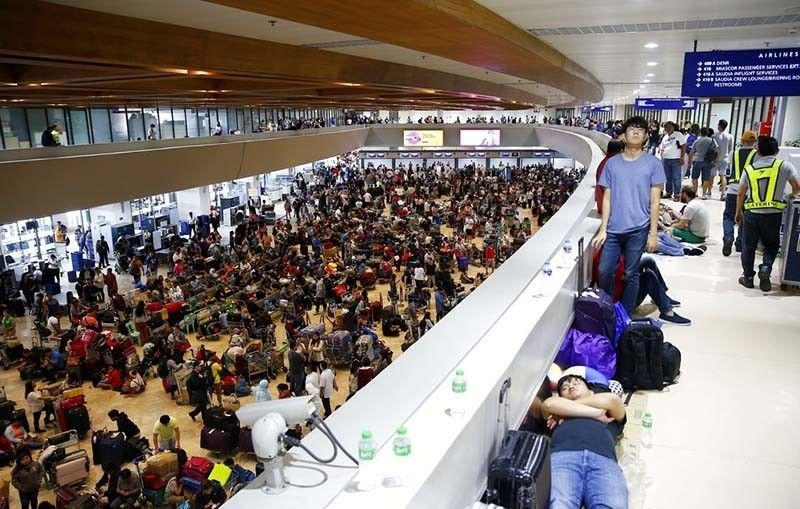
Under the new guidelines, Pinoys going abroad to see the sakura in Tokyo or to watch the New Year’s Eve ball drop in Manhattan won’t get past NAIA immigration without showing their flight and hotel bookings, proof of their financial capacity to afford their trip, and proof of employment. That’s a lot of paperwork to bring along, and if you’ve seen how long the queues can get at NAIA even without these papers in the way, you can imagine what they’re going to be like with each single document having to be scrutinized by an immigration officer. There’s an even longer list of additional requirements for people traveling under sponsorship and for OFWs—including a requirement for a child traveling with his or her parents to present a PSA-issued birth certificate, which was already a requirement for that child to have been issued a passport.

Exactly what this rigmarole adds to the reduction of trafficking is unclear to my muddled mind, because it seems to me that any good trafficker worth his or her illegal fees will be smart enough to produce the fake documents their wards will need to slip through airport security. As experience has shown, it isn’t even fake documentation but corruption and connivance that have greased the wheels of trafficking. 

Which reminds me, I received a letter some time ago from an expat Briton and a longtime Philippine resident named Thomas O’Donnell, complaining about such unnecessary requirements as the filing of annual reports by foreigners in this country. The Philippines has a reciprocity agreement with other countries such as the UK, Thomas says, but the UK doesn’t require Philippine residents there to do the same thing. So was it—like many of our other rules—just something to keep our bureaucrats occupied (or possibly, profitably occupied)? Where was the fun in the Philippines, Thomas lamented, and how was a fellow like him supposed to love it? 

Having lived here for 23 years, Thomas clearly has found other, countervailing reasons for staying on, but he has a point. Despite an anti-red tape law in the books, we still invent ways to complicate the simplest things. And answer me this: if the DepEd chief thinks that bare walls can lead to clearer thinking, shouldn’t we declutter our travel processes as well, so we can all sit in the departure lounge in peace with an hour to spare, waiting for our flight (that will likely be delayed, but that’s another story)?

Qwertyman No. 46: The Writer as Liberator

Qwertyman for Monday, June 19, 2023

AS PART of its Independence Day celebration, the J. Amado Araneta Foundation asked me to give a talk on “The Writer as Liberator” last Saturday, and today being Jose Rizal’s birthday, I’m very happy to share that talk in full (a shorter version appeared as my Qwertyman column in the Star):

When I was first asked to talk about “The Writer as Liberator,” the first thought that went through my mind was probably the thought that’s now going through yours, which was that of the writer as political revolutionary or dissident, in the mold of Jose Rizal, Marcelo H. del Pilar, Lorraine Hansberry, Alexander Solzhenitsyn, Nadine Gordimer, Wole Soyinka, and so many others of their caliber and stature.

That presumption, of course, is certainly valid and reasonable. Indeed, human history is fraught with examples of writers who fought colonialism, slavery, racial prejudice, and feudal and capitalist oppression and exploitation in India, South Africa, and the United States, particularly the American South, among many if not most other countries in the world. Wherever evil has reared its head, writers have arisen to call it out by name in all its forms—overweening pride among the ancient Greeks, blind ambition in Shakespeare’s time, lust and greed everywhere down the ages. 

The Philippines has been no exception. Decades before Rizal, Francisco Baltazar or Balagtas employed allegory in Florante at Laura to depict suffering and denounce injustice. Rizal and the whole Propaganda Movement followed, in a story of resistance and revolution that many of us already know. It’s a high climactic point that we could talk about all day but I won’t, because I’d rather talk about other things that most of us don’t know about writers and liberation. 

Again, to deal with the obvious, writers of all kinds have been at the forefront of political and social change. They included poets, playwrights, novelists, journalists, screenwriters, and today we would have to count bloggers and comic book script writers.

Our heroes and champions of freedom were poets—Rizal’s Mi Ultimo Adios and Bonifacio’s Pag-Ibig sa Tinubuang Lupa spring to mind, but they were also followed by the likes of Claro M. Recto, Francisco “Soc” Rodrigo, Carlos P. Garcia, and Diosdado Macapagal. These men—sadly, our political and even our cultural life was dominated then by the patriarchy—came from a generation when there was a very thin line between journalism and creative writing, when an opinion column could appear in verse, and when senators were expected to be literate and eloquent.

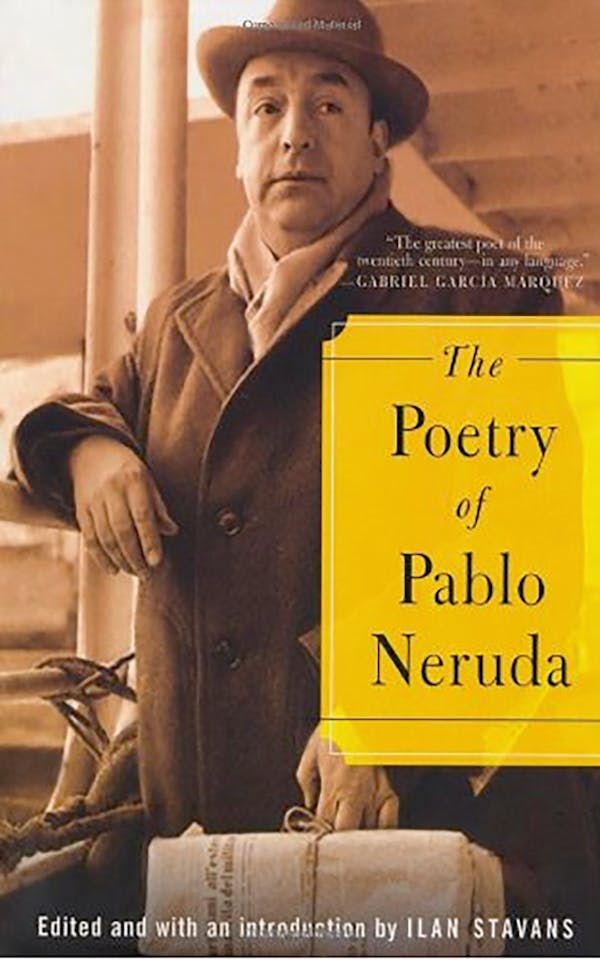
As I mentioned earlier, this was true of many countries around the world where people were fighting for freedom and justice. In South America, Simon Bolivar—who was known as The Liberator or El Libertador—led the fight for independence from Spain of what are now his native Venezuela, Colombia, Bolivia, Peru, Ecuador, and Panama, but he was also a poet, alongside the Cuban Jose Marti, among others. The Chilean poet and Nobel Prize winner Pablo Neruda wrote a poem in tribute to Bolivar, titled “A Song for Bolivar,” which I will read to you:

Our Father thou art in Heaven,
in water, in air
in all our silent and broad latitude
everything bears your name, Father in our dwelling:
your name raises sweetness in sugar cane
Bolívar tin has a Bolívar gleam
the Bolívar bird flies over the Bolívar volcano
the potato, the saltpeter, the special shadows,
the brooks, the phosphorous stone veins
everything comes from your extinguished life
your legacy was rivers, plains, bell towers
your legacy is our daily bread, oh Father.

The line “everything comes from your extinguished life” might as well have applied go Neruda himself, who was murdered by the fascist Pinochet government he opposed. Many writers have died for what they have written—and again we go back to Rizal—but others fought, lived on, and even succeeded in their struggles for national liberation. Two of the most prominent were Ho Chi Minh and Mao Zedong, who led long and ferocious wars against both local and foreign oppressors.

Imprisoned in China during the war, Ho Chi Minh wrote this poem in 1943 upon reading a book called the Anthology of a Thousand Poets:

The ancients liked to sing about natural beauty:
Snow and flowers, moon and wind, mists, mountains and rivers.
Today we should make poems including iron and steel,
And the poet should also know how to lead an attack.

In 1950, shortly after the Communists took over in China, Mao wrote this poem in reply to another poet named Liu Yazi:

The night was long and dawn came slow to the Crimson Land.

For a century demons and monsters whirled in a wild dance,

And the five hundred million people were disunited.

Now the rooster has crowed and all under heaven is bright,

Here is music from all our peoples, even from Yutian,

And the poet is inspired as never before. 

Note how, in these two poems, Ho and Mao locate the poet at the center of a collective struggle. This idea is developed even more strongly by Jose Ma. Sison—who by the way was an English major in UP—in his poem from the 196os titled “The Guerilla is Like a Poet”:

The guerilla is like a poet 
Keen to the rustle of leaves 
The break of twigs 
The ripples of the river 
The smell of fire 
And the ashes of departure. 

The guerilla is like a poet. 
He has merged with the trees 
The bushes and the rocks 
Ambiguous but precise 
Well-versed on the law of motion 
And master of myriad images. 

The guerilla is like a poet. 
Enrhymed with nature 
The subtle rhythm of the greenery 
The inner silence, the outer innocence 
The steel tensile in-grace 
That ensnares the enemy. 

The guerilla is like a poet. 
He moves with the green brown multitude 
In bush burning with red flowers 
That crown and hearten all 
Swarming the terrain as a flood 
Marching at last against the stronghold. 

An endless movement of strength 
Behold the protracted theme: 
The people’s epic, the people’s war. 

Given the aesthetics of the Philippine Left at that time, you could actually reverse this proposition to read “The poet is like a guerilla,” which Emman Lacaba certainly was, as was Ma. Lorena Barros, whose poem “Sampaguita” follows:

This morning Little Comrade

gave me a flower’s bud

I look at it now

remembering you, Felix,

dear friend and comrade

and all the brave sons and daughters

of our suffering land

whose death

makes our blades sharper

gives our bullets

surer aim.

How like this pure white bud

are our martyrs

fiercely fragrant with love

for our country and people!

With what radiance they should still have unfolded!

But sadness should not be

their monument.  

Whipped and lashed desperately

by bombed-raised storms

has not our Asian land

continued to bloom?

Look how bravely our ranks

bloom into each gap.

With the same intense purity and fragrance

we are learning to overcome.

Decades later, her namesake Kerima Lorena Tariman would write “Pagkilos,” a poem that celebrates motion in both nature and society:

Ang lahat ng bagay ay tila kitikiti,
Palagiang kumikilos at hindi mapakali.
Ang paggalaw ay kakambal ng bawat bagay,
Likas na kaugnay at hindi maihihiwalay.

Ang mga bagay-bagay ay kay hirap isipin,
Kung walang paggalaw, kung kaya, gayundin,
Ang paggalaw mismo ay di natin matatanto,
Kung wala ang mga bagay dito sa mundo.

Sa daigdig, halimbawa, nagpapahinga man ang pagod,
Matikas man ang estatwa at patay-malisya ang tuod,
Sila’y hindi naliligtas sa paggalaw ng planeta,
Ang pag-ikid at pag-inog ang palagiang sistema.

Kung kaya ang masa na akala mo’y walang imik,
Kapag natutong lumaban ay nagiging matinik!
May mga kasama man na natitigil sa pagkilos,
Ang rebolusyon sa daigdig ay hindi natatapos!

A, lahat ng bagay ay saklaw ng ating kilusan,
Katotohanan ito na di maaaring iwasan.
Kung kaya’t habang tayo ay may lakas at talino,
Sa pagkilos natin ialay ang ating bawat segundo!

Tragically, both Lorenas—and Emman Lacaba before them—would be killed in the struggle that they took on, and be hallowed as revolutionary martyrs.

Now, all this may sound like an open invitation for our favorite red-taggers to call all poets rebels, and all rebels communists. That would be ridiculous. Most poets are still happy and perfectly within their rights to write about the moon and the stars and undying love. Some rebel-poets were proud and self-admitted communists, at a time when the word was invested with a sheen of holiness. But the abject failure of communism to set up a truly free and egalitarian society and its appropriation in both China and Russia by new and autocratic elites has shed much of that romantic mystique, and it is supremely ironic that those writers and artists now fighting for civil liberties in both countries are considered enemies of the state.

“The Writer as Liberator” was an easier concept to deal with when we had a foreign occupier like Spain, America, or Japan. Today, our oppressors are internal, lodged within our society, and within our hearts and minds. The liberation we need today is from our worst selves, which is often the hardest enemy to face. Bad leadership has enabled and encouraged that side of us that accepts extrajudicial killing and unjust imprisonment as normal. 

The minds of so many of our people remain shackled by ignorance, falsehood, prejudice, superstition, fear, and a crippling dependency on the old and familiar, however self-destructive they may be. In an increasingly polarized and intolerant world, people everywhere face racial violence and discrimination, gender inequality, economic exploitation, and political repression.

The writers who will battle this chimera have many weapons at their disposal—not just books and the traditional press but social media, a universe of communication unto itself that Rizal and his contemporaries never dreamed of. Journalists fight with the truth, creative writers fight with the truth dressed up as artistic lies. 

I have often said that the best antidote to fake news is true fiction. By this I mean that it often takes artistry and good storytelling, more than a mere recitation of facts, to show people what is true.

Long before there were newspapers, writers gave voice to their people’s hopes and fears through what today would be called fiction: through myths, legends, tales, epics. These stories transported people from the crushing routine of their everyday lives to the realm of the gods, to a romantic past cloaked in the mists of fable and fancy. Indeed, these stories came even earlier than literacy itself, transmitted orally from one generation to the next. Creation myths validated and gave meaning to a tribe’s or a people’s existence; tragic drama reminded them of the consequences of our moral choices. 

When I started my Qwertyman column in the Philippine Star and began writing what I called “editorial fiction,” a columnist in another newspaper immediately cried “Foul!”, claiming that fiction cannot possibly be taken as opinion. I responded that all fiction is opinion, if you know how to read it closely enough. Like the mirror Perseus used to kill Medusa, we employ fiction to deal with truths we cannot bear to face.


I am under no illusion that the next revolution, whatever it may be against or when, will be sparked by a novel or a poem. Very likely, it will be a viral video that will ignite that flame. I pray it will not be violent, but rather a comprehensive conversion of our people’s minds and spirits for the good. But there will always be a place for the writer in the offices, kitchens, and workshops of democracy, on the bunkbeds where we lie dreaming of justice and prosperity for all. 

Let me close with a short poem that I wrote last year, titled “Freedom Is When”:

Freedom is when 

We don’t think about it

But it’s there like air

We seek only in its absence

When we’re gasping for breath.

Freedom is when

We can choose whom to love

Or whom or what to believe 

Without any fear

Of punishment or death.

Freedom is when

We can sleep without guilt

And dream without ghosts

Waking up to the aroma

Of steaming rice and stewed fish.

Ang kalayaan ay kung

Hindi natin ito iniisip

Tulad ng hangin

Hanggat ito’y mawala

At tayo’y maghingalo.

Ang kalayaan ay kung

Malaya tayong pumili

Ng iibigin, o paniniwalaan

Nang walang katatakutang

Parusa o kamatayan.

Ang kalayaan ay kung

Mahimbing tayong makakatulog

At managinip nang di minimulto

Hanggang tayo’y pukawin ng halimuyak

Ng bagong saing na kanin at pinangat.

Qwertyman No. 13: Something Good

Qwertyman for October 31, 2022

MINISTER QUAQUA was having a bad day—a very bad day, probably the worst since he was appointed to his post by President Ongong after they had finished two bottles of Balvenie Portwood, with boiled peanuts and chicharon bituka on the side. Quaqua had brought the chicharon bituka to the Palace as a gift to the President, ostensibly as a sample of his company’s latest R&D. A self-professed man of science, the President was known to be interested in cutting-edge research. 

Pork was highly coveted by Kawefans, but was now considered contraband, because of a longstanding ban on pork and pork products forced by the great swine flu epidemic of 1986. Some Kawefan families, including the Quaquas, had made fortunes by creating and marketing fake pork—veggie-based substitutes for adobo, barbecue, and sisig. Pork smuggling was therefore big business, and naturally the Quaquas had a finger in that pie, too. The anti-pork law allowed for a tiny sample of real pork to be imported for research purposes, for producers of the fake stuff to run taste tests of their bogus bolognas against. The rumor was that pork was coming into Kawefo by the ton, and even more alarmingly, that the Quaquas kept a top-secret pig farm in the distant province of Suluk-sulukan under armed guard, producing Chinese ham, chicharon bituka, and tocinofor the most select clients, including the First Family. 

Quaqua had come to the Palace not just to share some pulutan with an old friend, but to advise him against yielding to the strong pro-pork lobby, which argued for the legalization of pork, so every Kawefan could enjoy his or her rightful taste of inihaw na baboy. It was a popular initiative, certain to gain the ruling party more votes in the next election. But Quaqua had a strong counter-argument: legalizing banned substances not only negated decades of established jurisprudence (he was a lawyer, after all), but would put legitimate producers of healthy substitutes out of business—and, he didn’t need to add, abolish the black market in pork altogether. 

“Just look at what those fools in Bukolandia did with drugs,” he told Ongong as he poured the Balvenie. “To take care of the drug problem, they legalized drugs, so not only is the whole country now on a high, but the economy is down because there’s no business to be made, with people planting weed and cooking up meth in their own backyards. We can’t allow that to happen—imagine, if people bred their own pigs, how common the taste of lechon and chicharon would be. Fake pork can take care of that demand without turning our country into a stinking pigsty. True pork has to remain—” and here he munched on a morsel of bituka—“a restricted commodity.”

There must have been something more than MSG in what Quaqua fed the President, because he was appointed Minister of Justice on the spot, as he had been praying novenas for. Now, he could tell the Kawefan Bureau of Investigation (KBI) to spend its time on worthier pursuits like chasing after subversive authors and professors instead of bothering with peripheral issues like pork smuggling.

But barely had he warmed his seat when his first crisis exploded. One of the President’s peskiest critics, Dr. Fofo, a radio broadcaster from way down south, had been shot dead by two men on a motorcycle. That wasn’t the problem—after all, presidential critics died all the time. They should’ve read the news and shut up if they knew what was good for them. The problem was that Dr. Fofo’s killers stupidly got caught when a piglet sprang from out of nowhere—likely an escapee from an illegal farm—and enticed the duo to chase it, until their motorcycle hit a post. In police custody, the two boasted of their connections and were threatening to out their mastermind if they weren’t released soon. Social media was on their case.

“We can’t let these idiots cause a fuss,” Quaqua told his assistant, Vice Minister for Public Affairs Zhuzhu. “They screw up, they pay the consequences. That’s justice!… Hoy, are you listening? I just said—”

“Sir, Mr. Minister, we have a bigger problem!” The assistant was on his mobile phone and looked deeply worried.

“Why? What happened?”

“Sir—your wife—Mrs. Quaqua was just arrested!”

“What? Where? Why?”

“At the airport. They booked her for—uhm—stealing the silverware in business class. They say they found several pairs of spoons and forks in her handbag.”

“Are they crazy? Does that airline want its landing rights revoked? Taking home spoons and forks from airplanes is an old Kawefan custom! Get me the airport manager—”

“Uh, it wasn’t in our airport, sir,” said Zhuzhu. “Your wife just landed in Paris, to attend Fashion Week—”

Oooh, that’s right, said Quaqua to himself—they’d had a spat over his latest mistress Gigi, and he’d given her the usual blank check to placate her. Still, it was embarrassing.

“Then get me the French ambassador! Let’s see if they’ll risk diplomatic relations on account of some—some stupid cutlery!”

“Uhm, the spoons and forks are innocent, sir—they’re not sentient beings,” said Zhuzhu, his eyes downcast. “I learned that in our Employee Development Seminar on Eastern Philosophy, sir.”

“Tell them to have seminars on gun cleaning and pest control!” Quaqua made a note to himself: “I swear, Zhuzhu, as soon as this blows over, I’m going to get me a retired general to take your place.”

Zhuzhu held up his phone to show his boss a news clip from CNN. “It’s on CNN now, sir. They’ve even posted a mug shot of Mrs. Quaqua holding up the forks and spoons.”

“What?!” The justice minister fell back into his chair and looked out the window. “They didn’t even blur her face? The inhumanity, the incivility…. What has mankind come to? Where’s understanding and tolerance when you need them? Whatever did my dear wife do to deserve this?”

“According to the great masters, sir, we sow what we reap, our past actions affect our present ones, so Mrs. Quaqua did something, like for example, she married you—”

Just then Zhuzhu’s phone rang again and Quaqua couldn’t wait to hear the news. “Did they release her? Did they come to their senses? What’s up?”

Zhuzhu looked sad. “I’m afraid it’s about something else, sir. About those two suspects in the murder of Dr. Fofo? I’ve just been told that they’re both dead. They had an argument and—well, they strangled each other to death in their cell.”

Quaqua’s eyes lit up. There was a God. “Then I must have done something good in my past life, Zhuzhu!”

“What about the madame, sir?”

“Alas, it’s beyond our jurisdiction,” Quaqua sighed, thinking of Gigi’s perfume. “Let French justice take its course.”

(Image from eatlikepinoy.com)

Penman No. 13: Random Reflections on Martial Law

HBD

Penman for Monday, Sept. 24, 2012

LAST FRIDAY marked the 40th anniversary of the imposition of martial law in the Philippines by Ferdinand Marcos, and the occasion gave rise to much reminiscing among those of us who went through that dark period. I myself was interviewed by a TV station and asked to speak at a forum at the University of the Philippines about my experience with martial law, which I fictionalized in my first novel, Killing Time in a Warm Place (Anvil, 1992).

Of course I’ve never really stopped thinking about martial law all these years, but not until this anniversary did I force myself to sit down and write what martial law really meant to me and what it taught me—the “me” being no longer the 18-year-old boy who was arrested for “subversion” and detained for seven months in Fort Bonifacio, but the 58-year-old man who managed to live far longer and to see more things than he expected.

What I will write down here are entirely my own impressions and conclusions as a private citizen. I am not a political scientist or an ideologue, although I did work as a journalist, and, ironically, as a government PR man in the late 1970s, when there were few other jobs to be had, after my release from detention. I’m sure that some readers and even my friends will find something to quarrel with in these observations, which will be good, because I don’t think we ever really sat down and summed up what that period meant to us, beyond saying—as we should—“Never again!” So, herewith, my random reflections on martial law:

1. It wasn’t as bad as what the Argentines and Chileans went through in their darkest days of state terror. But that comparison’s pointless and even cruel when it’s your body or that of someone you love being laid out in the interrogation room, when it’s your family desperately seeking an abductee, running from prison to prison. The government called it “smiling martial law,” but don’t be fooled—horrific things happened to ordinary citizens in those camps and prisons. It may have been good for business—at least at first—but it was an unmitigated nightmare for designated enemies of the state.

2. An armed forces cannot be at war with its own people. Martial law irreversibly politicized if not corrupted the military, so that it has had to be re-indoctrinated to support the people rather than the ruling elite. I don’t know how far it’s come along in this respect.

3. America can be a great friend, but it will always look out for its own interests first, and those interests don’t always coincide with ours. American politics is coldly opportunistic; the rhetoric of freedom and democracy can easily be used as window dressing for American commercial policy. Ferdinand Marcos and martial law wouldn’t have lasted that long without America’s imprimatur; even though some insist that it was the Americans themselves who took him out—that EDSA was a CIA plot—it was American support that entrenched him in the first place.

4. It takes a people to build a nation—not one leader, certainly not one despot and his cohort. Martial law turned us into blind followers, trusting the leader to make crucial decisions for the rest of us. Except for those who resisted the dictatorship, the rest of us were complicit in it; we wanted it to work and gave it our tacit approval, because it seemed to offer a simple and efficient solution to age-old problems. It also takes a thorough process—not quick fixes like martial law, street revolts, or coups—to secure deep and enduring change.

5. The Church can be a potent and progressive political force when it wants to. Much as I may be dismayed by the intransigence of the Church on social issues such as the RH bill—and indeed I no longer consider myself a practicing Catholic because of this—I acknowledge the contributions and sacrifices of many religious workers to the fight for freedom.

6. We all have our weaknesses and our limits. I saw how people who spoke big words could fall silent at the merest hint of torture, and how even the toughest ones could break at the edge of the unendurable. I have since learned not to demand of others what I could not demand of myself. At the same time, I saw that ordinary people can also be capable of extraordinary courage. Their heroism has made me wonder if I who survived was worthy of it.

7. On a purely personal level, one of post-martial law life’s most awful discoveries was that, incredibly, there were worse things than martial law, worse pains that one could receive, or inflict on oneself and on other people. A government can do only so much evil; the rest you can do yourself. But redemption is always possible for the self-aware, and I suppose that’s what many of us have been striving for these past 40 years.

* * * * *

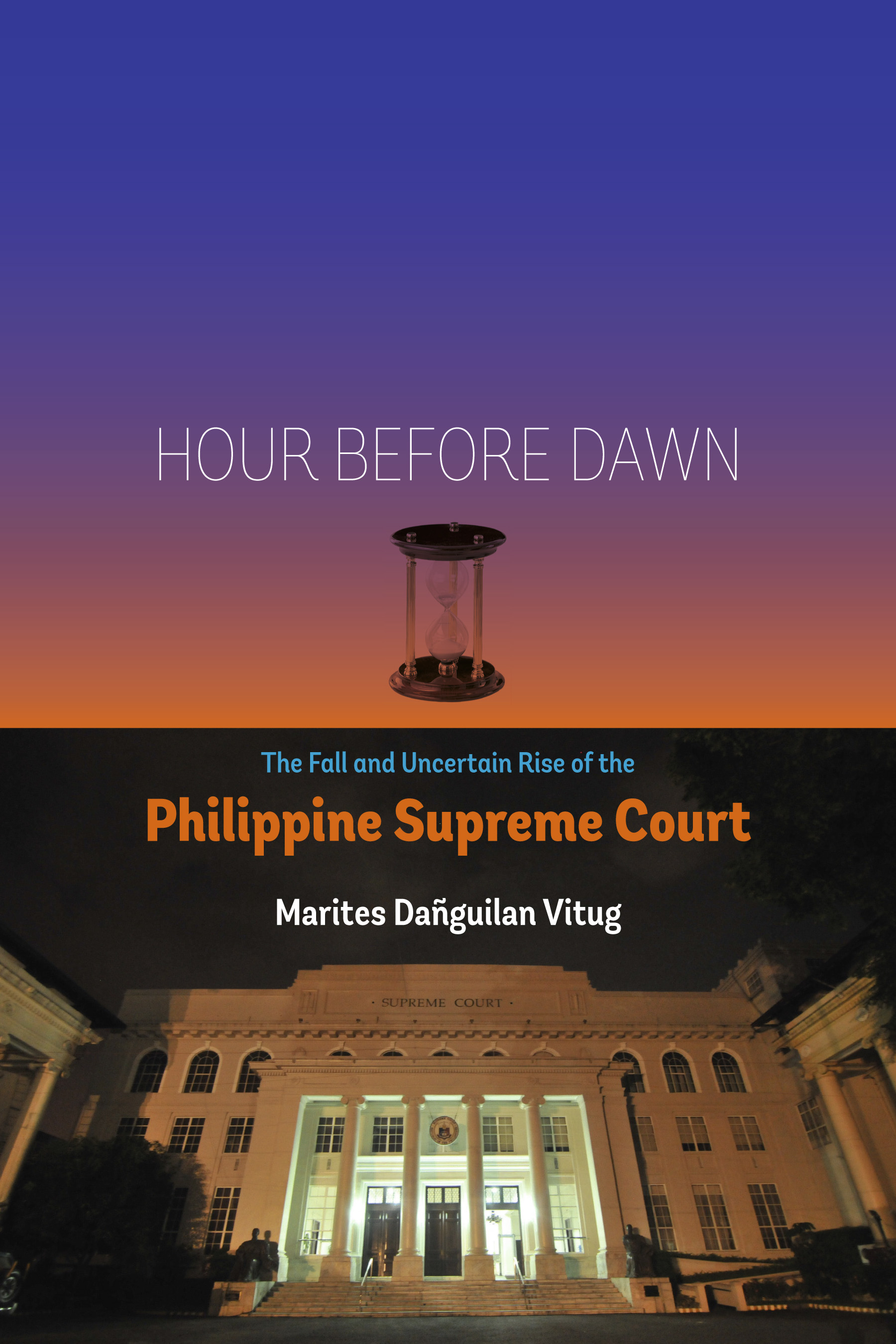
SPEAKING OF September 21, that was also the day last week when I failed to attend an important book launching in Makati because I was teaching my graduate class in Diliman at that same time. The book was Marites Danguilan Vitug’s Hour Before Dawn: The Fall and Uncertain Rise of the Philippine Supreme Court (Clever Heads Publishing, 2012), which I copyedited, along with its predecessor, the acclaimed and bestselling Shadow of Doubt: Probing the Supreme Court (Newsbreak, 2010).

It’s a copyeditor’s great privilege to read a book—and even reshape it to some extent—before anyone else does, aside from the author and the book designer. With Marites—with whom I worked for many years on Newsbreak—I always know that I’m in for a political junkie’s treat, as she will patiently go behind the scenes to reveal the inner workings of our most important yet also most inscrutable institutions, like the Supreme Court.

Without spoiling the suspense, here’s what I can say about Hour Before Dawn and why you should grab it before they run out of copies: if you’ve ever really wondered why Chief Justice Renato Corona had to be impeached and what the Supreme Court was like under his watch, read this book. If you’ve also wondered what Lourdes Sereno is really like and what kind of Chief Justice she’s going to be, read this book.

As its full title suggests, Hour Before Dawn offers both darkness and light, ample cause for both dismay and hope. It demystifies the Supreme Court and the Justices who preside over our fates, showing them to be as fallibly human as the rest of us, and yet also mindful of the higher judgment of history.

I don’t know if this book is going to earn its author another slew of death threats and libel suits, but I think it should be required reading for every law student, lawyer, and judge in this country—make that every citizen-at-large who hasn’t given up hoping for impartial justice.