Penman No. 460: The Fil-Canadians Speak

Penman for Sunday, March 10, 2024
WE’VE BECOME quite familiar by now with the writings of our Filipino-American brethren across the Pacific, thanks to the success of such breakthrough works as Jessica Hagedorn’s Dogeaters, Ninotchka Rosca’s State of War, R. Zamora Linmark’s Rolling the R’s, Marivi Soliven’s Mango Bride, and Gina Apostol’s Insurrecto, and to the bridging efforts of such literary stalwarts as Luis Francia, Alfred Yuson, and Cecilia Manguerra Brainard. Of course, they had many antecedents, going back to at least Carlos Bulosan, followed by Jose Garcia Villa, Bienvenido Santos, NVM Gonzalez, and Alberto Florentino, among many other expatriates. 

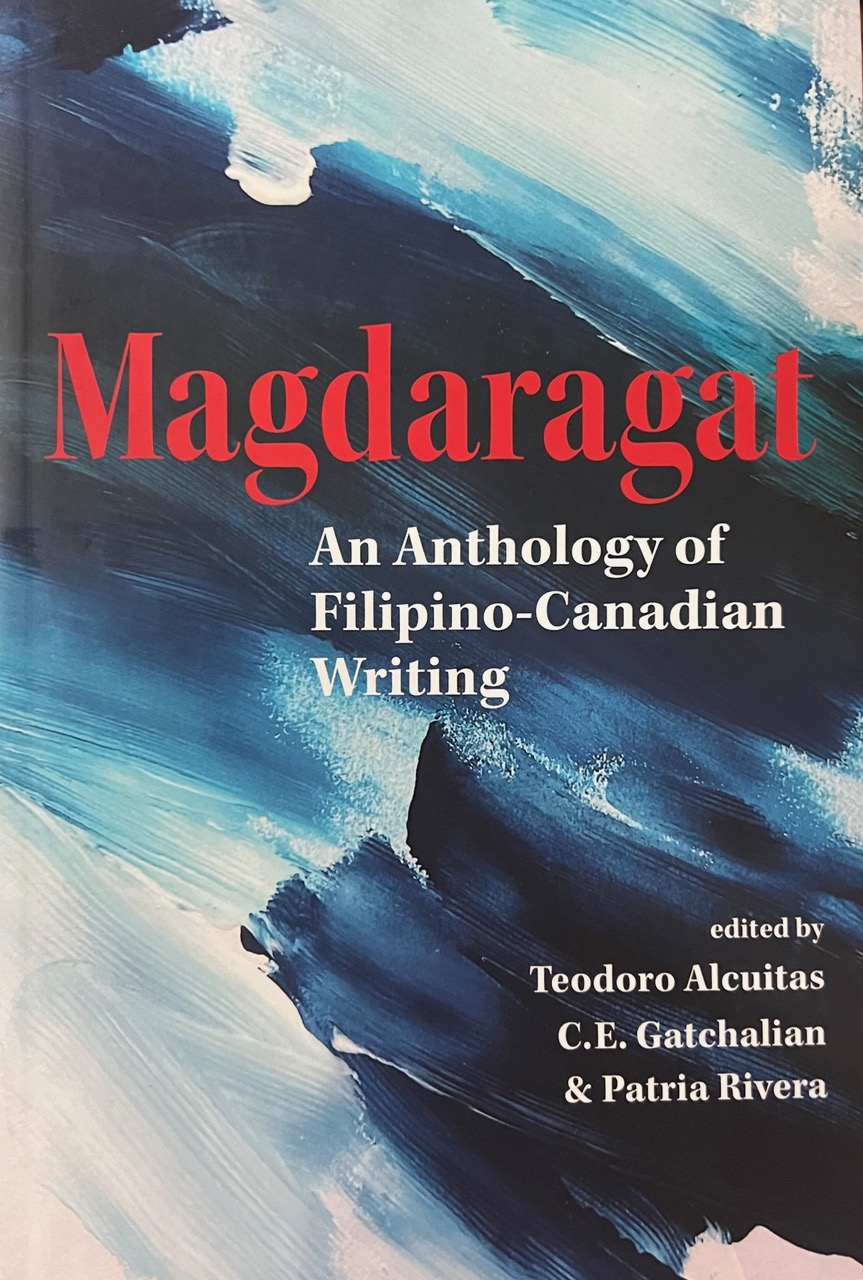
But hardly a whisper has been heard from our Filipino-Canadian cousins, as if their experience—whatever it’s been—were simply an extension or an echo of their southern compatriots, with no distinguishing qualities. There’s a reason for that, which we’ll get into shortly, but first let me announce, with both joy and relief, that the long silence is over. Filipino-Canadian literature is introducing itself to the world—and to us in particular—with the publication of the landmark Magdaragat: An Anthology of Filipino-Canadian Writing (Toronto: Cormorant, 2023), edited by Teodoro Alcuitas, C. E. Gatchalian, and Patria Rivera.

I was first alerted to this hefty 390-page volume by one of the editors, Patty Rivera, an old friend from way back who developed into a fine, prizewinning poet when she, her husband Joe, and their family migrated to Canada decades ago. Arriving in Canada in late July 1987, Patty recalls that moment pregnant with both hope and not a little dread that every FOB immigrant seems fated to step into: 

“The air steamed with purpose when summer meant another life to live. From every corner, a mirror to reflect on. Outside our window, the children’s park, though trees, appeared bruised from the dark slits on the windowpanes. Thorny Vineway. Did our new street name augur of tomorrows yet to come? Would our life in this new country lead to a path laid with thorns? We were young at the time, and everything looked promising. We were alive in this new country and were no longer afraid, the years in the future distant and to be savored. We were ready to be every person we chose or wanted to be.”

Today there are nearly one million Filipinos in Canada, which itself is inching close to 40 million. Some years ago, Filipinos edged out the Chinese as the largest group of immigrants in Canada. Many are highly educated, and many work in health care, leading perhaps to a kind of stereotyping of the Fil-Can as caregiver. To be fair, that’s probably how we home-based Pinoys ourselves imagine our Canuck brethren to be, followed inevitably by “Now why did they go to Canada and not America?”

Magdaragat’s editors try to answer that: “It’s the American Dream, after all, that Filipinos chase; Canada is the consolation prize if America, for whatever reason, doesn’t pan out. While, according to historical records, the first Filipinos arrived in what would eventually become the United States in 1587, Filipinos didn’t arrive on Canadian shores (Bowen Island, BC, to be exact) until close to three centuries later, in 1861. In addition, Canada’s population is a tenth of the United States’. Filipino-Canadian history is, thus, of a smaller scope than Filipino-American history. But within that scope are issues unique to Filipinos in Canada that makes Fil-Can history a distinct subject in its own right, not merely an ancillary of Fil-Am history.”

There are, we discover, subtle but important nuances to the Filipino-Canadian experience:

“Another, more insidious, survival issue Filipinos in Canada have to navigate: the passive-aggressive racism of white Canadians. The brazenness of white American racism is well documented (and spotlighted and hyper scrutinized because of the United States’ status as an imperial power); in contrast, white Canadian racism often slips under the radar because it is more typically characterized by microaggressions. The favorite Canadian refrain vis-à-vis racism—‘We’re not as bad as Americans’—constitutes what might be called “maple-washing”: the relentless washing over of all instances of Canadian racism with the claim that it’s still not as horrible as what has transpired in the United States. Accordingly, the racism Filipinos in Canada experience—and which makes its way into some of the pieces in this anthology—is more insidious than its American counterpart and is characterized by shocking ruptures in a strenuously maintained politesse.”

But what about the literature of that experience? Magdaragat provides ample and eloquent proof of the Filipino-Canadian’s desire to reconnect with the homeland while charting their own course in the new country, as this passage from Deann Louise Nardo’s “Where Do You Come From” illustrates:

“I come from dirt and sand, the scribbled writing of an ancestor in a trance, the sound of droplets on skylights, unopened buds on trees, and the sleep dust in my mama’s eyes. I come from cacao beans and the callouses on fishermen’s hands, the arthritic crackle of my grandmother’s hands as she tends to the garden and mends nets. I come from the silver iridescence of stretch marks, the swirl pattern inside tree barks, the razor-thin whiskers of cats, and eerie creaking of Maplewood floors. I come from lengthwise half-cut bamboo wall sheathing, river mud and buried shards of broken glass, of broken tsinelas and confused roosters singing tik-ti-la-ok at three in the morning.”

There’s a long story by Nathalie de los Santos that alone may be worth the price of the book for its sweeping, multigenerational narrative of the immigrant experience from Bohol to New Brunswick, and from Filipino to Filipinx. The young Kay laments that “Even my relatives can be like this, they remind me how I’m not Filipino enough when I don’t know something about our culture. But then some people here believe I’m not Canadian just by looking at me. When I’m asked, ‘Where you from?’ it implies that. Who am I then?… But, maybe all of this is coming from the same place of hurt?” 

The Fil-Cans have spoken, and theirs are voices worth listening to.
Qwertyman No. 46: The Writer as Liberator

Qwertyman for Monday, June 19, 2023

AS PART of its Independence Day celebration, the J. Amado Araneta Foundation asked me to give a talk on “The Writer as Liberator” last Saturday, and today being Jose Rizal’s birthday, I’m very happy to share that talk in full (a shorter version appeared as my Qwertyman column in the Star):

When I was first asked to talk about “The Writer as Liberator,” the first thought that went through my mind was probably the thought that’s now going through yours, which was that of the writer as political revolutionary or dissident, in the mold of Jose Rizal, Marcelo H. del Pilar, Lorraine Hansberry, Alexander Solzhenitsyn, Nadine Gordimer, Wole Soyinka, and so many others of their caliber and stature.

That presumption, of course, is certainly valid and reasonable. Indeed, human history is fraught with examples of writers who fought colonialism, slavery, racial prejudice, and feudal and capitalist oppression and exploitation in India, South Africa, and the United States, particularly the American South, among many if not most other countries in the world. Wherever evil has reared its head, writers have arisen to call it out by name in all its forms—overweening pride among the ancient Greeks, blind ambition in Shakespeare’s time, lust and greed everywhere down the ages. 

The Philippines has been no exception. Decades before Rizal, Francisco Baltazar or Balagtas employed allegory in Florante at Laura to depict suffering and denounce injustice. Rizal and the whole Propaganda Movement followed, in a story of resistance and revolution that many of us already know. It’s a high climactic point that we could talk about all day but I won’t, because I’d rather talk about other things that most of us don’t know about writers and liberation. 

Again, to deal with the obvious, writers of all kinds have been at the forefront of political and social change. They included poets, playwrights, novelists, journalists, screenwriters, and today we would have to count bloggers and comic book script writers.

Our heroes and champions of freedom were poets—Rizal’s Mi Ultimo Adios and Bonifacio’s Pag-Ibig sa Tinubuang Lupa spring to mind, but they were also followed by the likes of Claro M. Recto, Francisco “Soc” Rodrigo, Carlos P. Garcia, and Diosdado Macapagal. These men—sadly, our political and even our cultural life was dominated then by the patriarchy—came from a generation when there was a very thin line between journalism and creative writing, when an opinion column could appear in verse, and when senators were expected to be literate and eloquent.

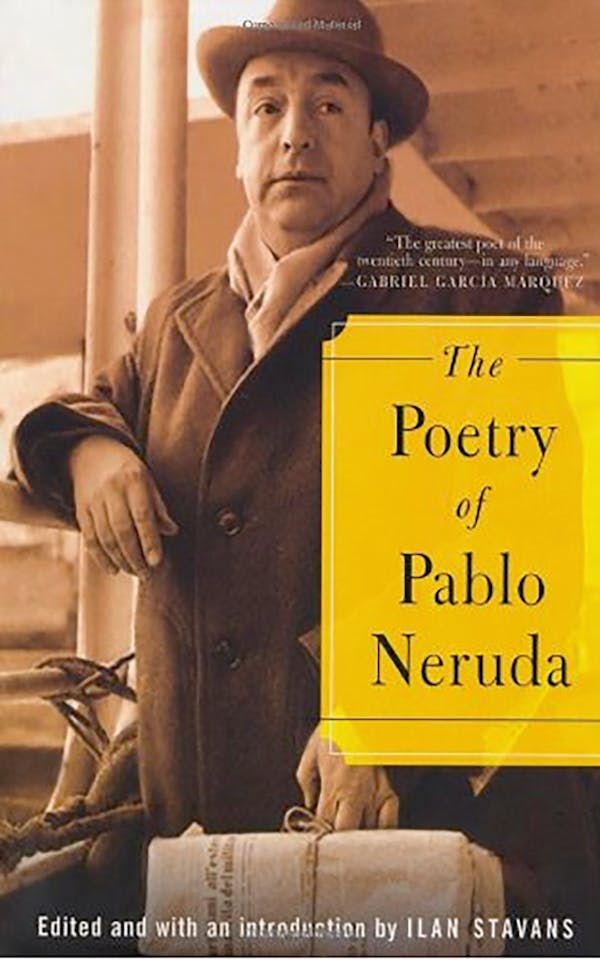
As I mentioned earlier, this was true of many countries around the world where people were fighting for freedom and justice. In South America, Simon Bolivar—who was known as The Liberator or El Libertador—led the fight for independence from Spain of what are now his native Venezuela, Colombia, Bolivia, Peru, Ecuador, and Panama, but he was also a poet, alongside the Cuban Jose Marti, among others. The Chilean poet and Nobel Prize winner Pablo Neruda wrote a poem in tribute to Bolivar, titled “A Song for Bolivar,” which I will read to you:

Our Father thou art in Heaven,
in water, in air
in all our silent and broad latitude
everything bears your name, Father in our dwelling:
your name raises sweetness in sugar cane
Bolívar tin has a Bolívar gleam
the Bolívar bird flies over the Bolívar volcano
the potato, the saltpeter, the special shadows,
the brooks, the phosphorous stone veins
everything comes from your extinguished life
your legacy was rivers, plains, bell towers
your legacy is our daily bread, oh Father.

The line “everything comes from your extinguished life” might as well have applied go Neruda himself, who was murdered by the fascist Pinochet government he opposed. Many writers have died for what they have written—and again we go back to Rizal—but others fought, lived on, and even succeeded in their struggles for national liberation. Two of the most prominent were Ho Chi Minh and Mao Zedong, who led long and ferocious wars against both local and foreign oppressors.

Imprisoned in China during the war, Ho Chi Minh wrote this poem in 1943 upon reading a book called the Anthology of a Thousand Poets:

The ancients liked to sing about natural beauty:
Snow and flowers, moon and wind, mists, mountains and rivers.
Today we should make poems including iron and steel,
And the poet should also know how to lead an attack.

In 1950, shortly after the Communists took over in China, Mao wrote this poem in reply to another poet named Liu Yazi:

The night was long and dawn came slow to the Crimson Land.

For a century demons and monsters whirled in a wild dance,

And the five hundred million people were disunited.

Now the rooster has crowed and all under heaven is bright,

Here is music from all our peoples, even from Yutian,

And the poet is inspired as never before. 

Note how, in these two poems, Ho and Mao locate the poet at the center of a collective struggle. This idea is developed even more strongly by Jose Ma. Sison—who by the way was an English major in UP—in his poem from the 196os titled “The Guerilla is Like a Poet”:

The guerilla is like a poet 
Keen to the rustle of leaves 
The break of twigs 
The ripples of the river 
The smell of fire 
And the ashes of departure. 

The guerilla is like a poet. 
He has merged with the trees 
The bushes and the rocks 
Ambiguous but precise 
Well-versed on the law of motion 
And master of myriad images. 

The guerilla is like a poet. 
Enrhymed with nature 
The subtle rhythm of the greenery 
The inner silence, the outer innocence 
The steel tensile in-grace 
That ensnares the enemy. 

The guerilla is like a poet. 
He moves with the green brown multitude 
In bush burning with red flowers 
That crown and hearten all 
Swarming the terrain as a flood 
Marching at last against the stronghold. 

An endless movement of strength 
Behold the protracted theme: 
The people’s epic, the people’s war. 

Given the aesthetics of the Philippine Left at that time, you could actually reverse this proposition to read “The poet is like a guerilla,” which Emman Lacaba certainly was, as was Ma. Lorena Barros, whose poem “Sampaguita” follows:

This morning Little Comrade

gave me a flower’s bud

I look at it now

remembering you, Felix,

dear friend and comrade

and all the brave sons and daughters

of our suffering land

whose death

makes our blades sharper

gives our bullets

surer aim.

How like this pure white bud

are our martyrs

fiercely fragrant with love

for our country and people!

With what radiance they should still have unfolded!

But sadness should not be

their monument.  

Whipped and lashed desperately

by bombed-raised storms

has not our Asian land

continued to bloom?

Look how bravely our ranks

bloom into each gap.

With the same intense purity and fragrance

we are learning to overcome.

Decades later, her namesake Kerima Lorena Tariman would write “Pagkilos,” a poem that celebrates motion in both nature and society:

Ang lahat ng bagay ay tila kitikiti,
Palagiang kumikilos at hindi mapakali.
Ang paggalaw ay kakambal ng bawat bagay,
Likas na kaugnay at hindi maihihiwalay.

Ang mga bagay-bagay ay kay hirap isipin,
Kung walang paggalaw, kung kaya, gayundin,
Ang paggalaw mismo ay di natin matatanto,
Kung wala ang mga bagay dito sa mundo.

Sa daigdig, halimbawa, nagpapahinga man ang pagod,
Matikas man ang estatwa at patay-malisya ang tuod,
Sila’y hindi naliligtas sa paggalaw ng planeta,
Ang pag-ikid at pag-inog ang palagiang sistema.

Kung kaya ang masa na akala mo’y walang imik,
Kapag natutong lumaban ay nagiging matinik!
May mga kasama man na natitigil sa pagkilos,
Ang rebolusyon sa daigdig ay hindi natatapos!

A, lahat ng bagay ay saklaw ng ating kilusan,
Katotohanan ito na di maaaring iwasan.
Kung kaya’t habang tayo ay may lakas at talino,
Sa pagkilos natin ialay ang ating bawat segundo!

Tragically, both Lorenas—and Emman Lacaba before them—would be killed in the struggle that they took on, and be hallowed as revolutionary martyrs.

Now, all this may sound like an open invitation for our favorite red-taggers to call all poets rebels, and all rebels communists. That would be ridiculous. Most poets are still happy and perfectly within their rights to write about the moon and the stars and undying love. Some rebel-poets were proud and self-admitted communists, at a time when the word was invested with a sheen of holiness. But the abject failure of communism to set up a truly free and egalitarian society and its appropriation in both China and Russia by new and autocratic elites has shed much of that romantic mystique, and it is supremely ironic that those writers and artists now fighting for civil liberties in both countries are considered enemies of the state.

“The Writer as Liberator” was an easier concept to deal with when we had a foreign occupier like Spain, America, or Japan. Today, our oppressors are internal, lodged within our society, and within our hearts and minds. The liberation we need today is from our worst selves, which is often the hardest enemy to face. Bad leadership has enabled and encouraged that side of us that accepts extrajudicial killing and unjust imprisonment as normal. 

The minds of so many of our people remain shackled by ignorance, falsehood, prejudice, superstition, fear, and a crippling dependency on the old and familiar, however self-destructive they may be. In an increasingly polarized and intolerant world, people everywhere face racial violence and discrimination, gender inequality, economic exploitation, and political repression.

The writers who will battle this chimera have many weapons at their disposal—not just books and the traditional press but social media, a universe of communication unto itself that Rizal and his contemporaries never dreamed of. Journalists fight with the truth, creative writers fight with the truth dressed up as artistic lies. 

I have often said that the best antidote to fake news is true fiction. By this I mean that it often takes artistry and good storytelling, more than a mere recitation of facts, to show people what is true.

Long before there were newspapers, writers gave voice to their people’s hopes and fears through what today would be called fiction: through myths, legends, tales, epics. These stories transported people from the crushing routine of their everyday lives to the realm of the gods, to a romantic past cloaked in the mists of fable and fancy. Indeed, these stories came even earlier than literacy itself, transmitted orally from one generation to the next. Creation myths validated and gave meaning to a tribe’s or a people’s existence; tragic drama reminded them of the consequences of our moral choices. 

When I started my Qwertyman column in the Philippine Star and began writing what I called “editorial fiction,” a columnist in another newspaper immediately cried “Foul!”, claiming that fiction cannot possibly be taken as opinion. I responded that all fiction is opinion, if you know how to read it closely enough. Like the mirror Perseus used to kill Medusa, we employ fiction to deal with truths we cannot bear to face.


I am under no illusion that the next revolution, whatever it may be against or when, will be sparked by a novel or a poem. Very likely, it will be a viral video that will ignite that flame. I pray it will not be violent, but rather a comprehensive conversion of our people’s minds and spirits for the good. But there will always be a place for the writer in the offices, kitchens, and workshops of democracy, on the bunkbeds where we lie dreaming of justice and prosperity for all. 

Let me close with a short poem that I wrote last year, titled “Freedom Is When”:

Freedom is when 

We don’t think about it

But it’s there like air

We seek only in its absence

When we’re gasping for breath.

Freedom is when

We can choose whom to love

Or whom or what to believe 

Without any fear

Of punishment or death.

Freedom is when

We can sleep without guilt

And dream without ghosts

Waking up to the aroma

Of steaming rice and stewed fish.

Ang kalayaan ay kung

Hindi natin ito iniisip

Tulad ng hangin

Hanggat ito’y mawala

At tayo’y maghingalo.

Ang kalayaan ay kung

Malaya tayong pumili

Ng iibigin, o paniniwalaan

Nang walang katatakutang

Parusa o kamatayan.

Ang kalayaan ay kung

Mahimbing tayong makakatulog

At managinip nang di minimulto

Hanggang tayo’y pukawin ng halimuyak

Ng bagong saing na kanin at pinangat.

Penman No. 451: A Harvest of Books

Penman for Sunday, June 4, 2023

IF YOU’RE reading this on this Sunday morning, then it’s not yet too late for you to find a cab and get yourself over to the World Trade Center in Pasay City to catch the last day of the Philippine Book Festival, and have your favorite Filipino authors sign their books for you.

Organized by the National Book Development Board (NBDB) in partnership with the National Library and other agencies and organizations, the PBF will showcase the best of new Philippine writing and publishing, with the bonus of having most of the authors around for signings, chats, and the now-obligatory selfies.

Since the Internet took off thirty years ago, people have been declaring that “Books are dead!” (And even before that, “The Author is dead!”—although, of course, not quite in that almost literal sense). Well, guess what—both are very much alive, whole new generations of them, as if the Internet never happened. I don’t have the hard figures to show—I’m sure the NBDB has them—but just from what I’ve seen at the past Manila International Book Fairs (the next one of which will be held in September), there’s much more new writing and publishing happening now than there was before the Internet. 

There are many drivers for that, one of which has to be the proliferation of writing programs and workshops, whose graduates really succeed only when they come out with books. (Like I often remind Creative Writing grad students who take forever to “perfect” their thesis projects, “You’re writing for no more than five readers—your dissertation committee—and when you’re done, your thesis will be sitting on a solitary shelf. Just do what you need to pass the damned defense and focus on producing your first book out of that draft! Your real examiners will be your readers.”) 

Another factor is the growth of the publishing industry, which has become much more diversified in terms of ownership, material, and audience. The long years of martial law drove much creative output underground, so to speak, with few available venues for literary publishing and only competitions like the Palancas providing incentives for continued production. (On the other hand, the government presses kept churning out books on the First Couple’s abounding wisdom.) Post-EDSA, the pent-up dam broke, and literature flourished, but still hardly on the scale we’re seeing today.

I suspect that’s because many new players have gone into publishing, finding niche markets for everything from religious and self-help books to graphic novels and high-end coffee-table books. Among these, I’d count Milflores Publishing, founded by the late Tony Hidalgo and now in the hands of the very capable Andrea Pasion-Flores. Balangay Books, focused on local literature, has been opening doors for new young authors, and belongs to the Indie Pub Collab PH, a group of independent publishers. Down south, Savage Mind Bookshop and the Ateneo de Naga University Press have made great strides in literary publishing not just in the Bicol region but well beyond. Emerging in the wake of the Pink Revolution, San Anselmo Publications has made a name for itself as a purveyor of progressive thought. A recent visit to OMF Literature’s bookshop and office along Boni Avenue showed me how Christian literature is flourishing, attracting both new authors and readers. 

Let’s not forget self-publishing, which with such new technologies as print-on-demand and e-books has outgrown the stigma of “vanity” publishing and has produced both commercial and critical successes. While overall quality remains highly variable, the free Internet has empowered and enabled a new generation of young people to feel like they can become “writers” by posting on such sites as Wattpad—and some of them will be. (The irony here is that, as on Amazon, writers who succeed in their e-book debuts then get picked up by publishers of physical books.) Professional design and editorial outfits such as Studio 5 and Perez NuMedia also exist to help individuals and institutions turn their ideas into prizewinning books.

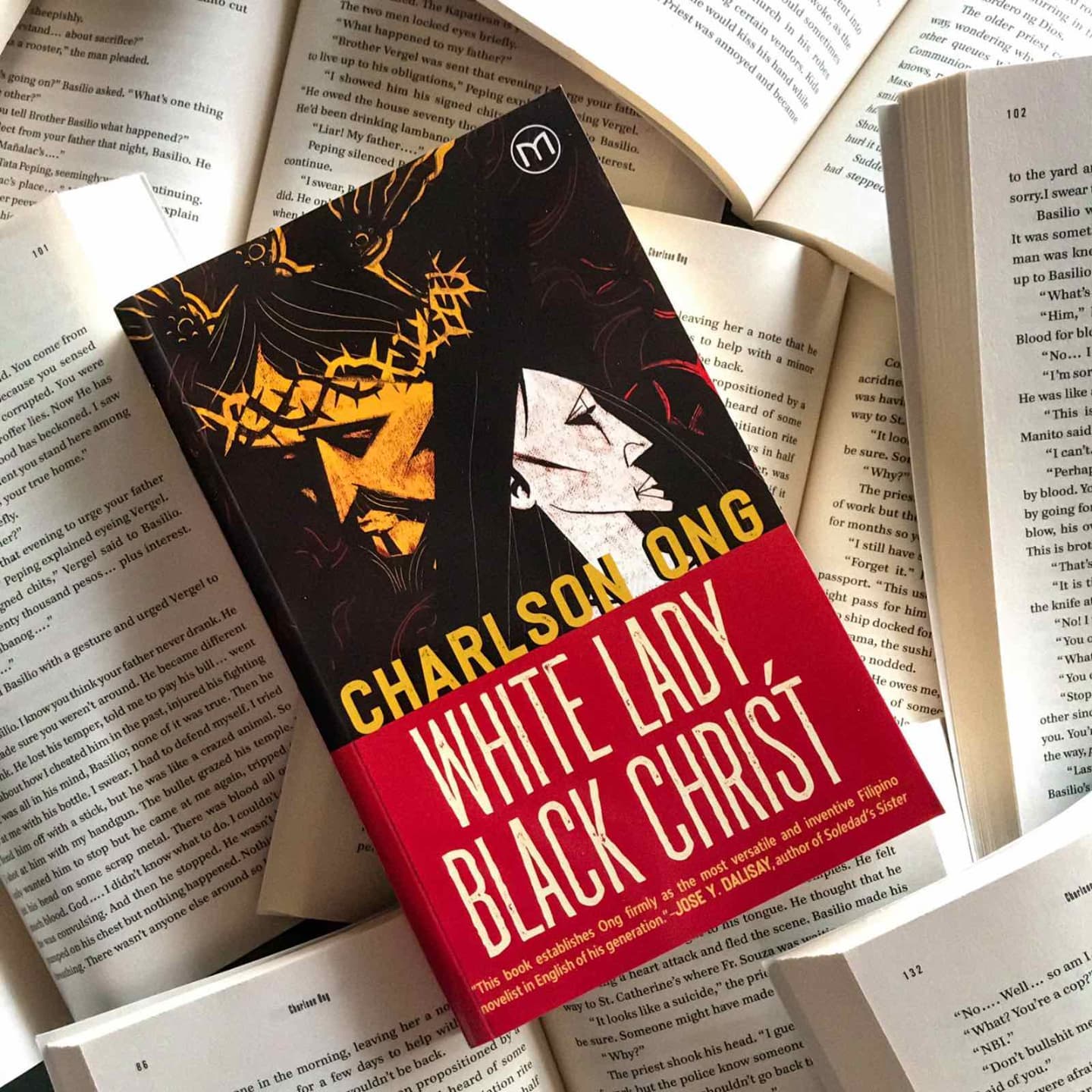
And then of course the long-established big-name publishers and academic publishers are still around: Anvil Publishing, UP Press, Ateneo de Manila University Press, UST Publishing House, and the University of San Carlos Press, among others. Vibal Publishing has produced impressive and sumptuously printed historical books—as has, let’s not forget, the National Historical Commission. They remain the publishers of choice for what might generally be considered prestigious but non-commercial projects, although their marketing savvy has vastly improved, from book design to distribution (much of the bookselling has moved online, to Shopee and Lazada). But since the wait at these publishing houses tends to be long, even established Filipino authors like novelist Charlson Ong (White Lady, Black Christ) have gone with such alternatives as Milflores (as did I, in its previous incarnation), which can often provide speedier results with no sacrifice of quality.

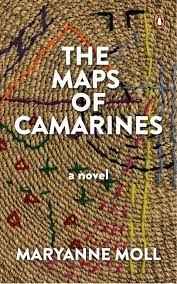
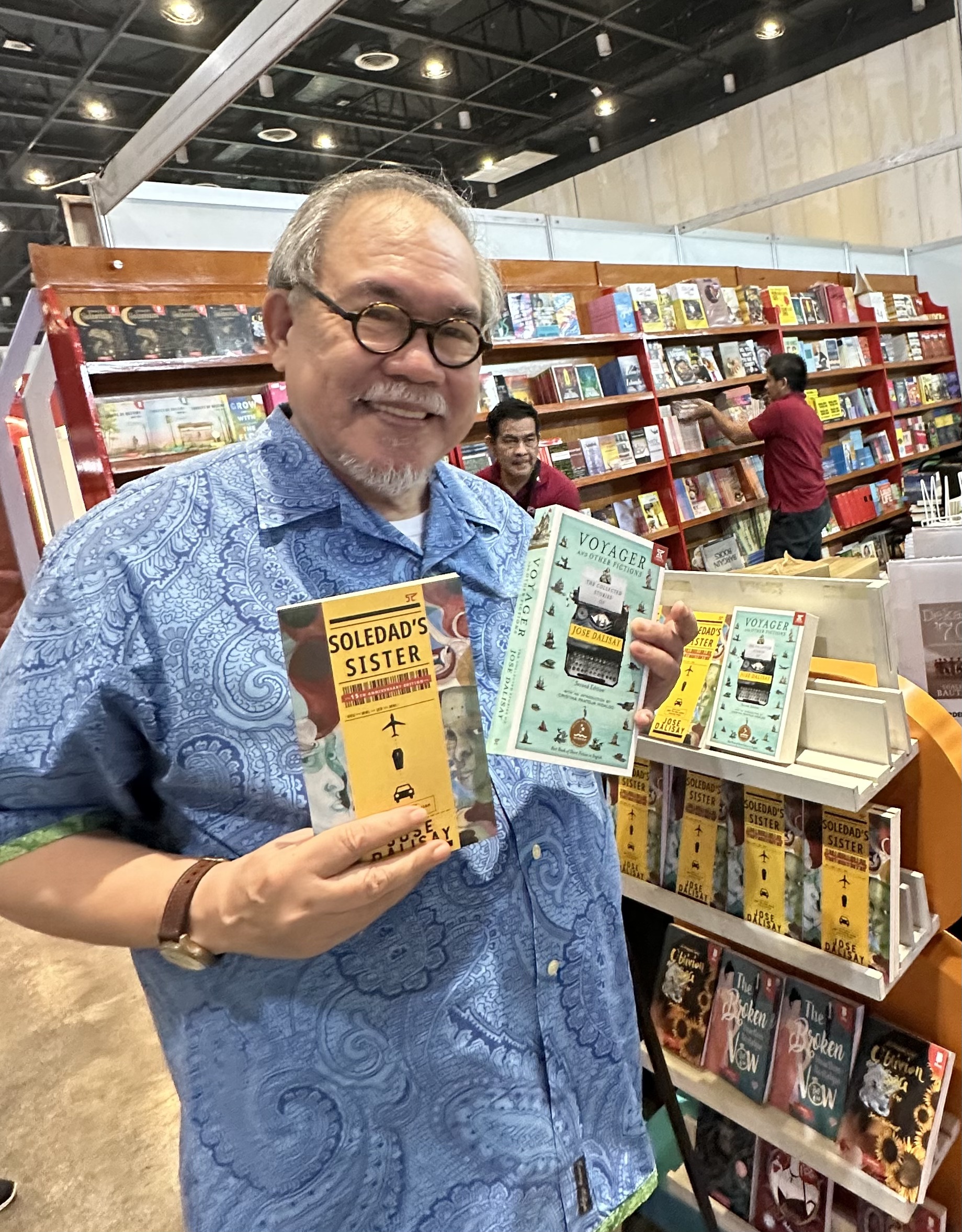
One more thing: more Filipino authors have begun to get published and noticed abroad, beyond America. Note the recent publication of Ulirát: The Best Contemporary Stories in Translation from the Philippines, edited by Tilde Acuña et al., and the South Africa-based Jim Pascual Agustin’s Waking Up to the Pattern Left by a Snail Overnight, both by Gaudy Boy in Singapore. Singapore is also where Penguin Random House SEA is based, and from where it published Danton Remoto’s novel Riverrun and his book of stories The Heart of Summer(aside from his translations of our classic works in Filipino), and Maryanne Moll’s novel The Maps of Camarines. I’m also happy to report that my novel Soledad’s Sister just came out in a German hardcover edition (as Last Call Manila) from Transit Buchverlag, following earlier editions in Italy, France, and the US. A 15th-anniversary edition of the novel, along with a new edition of my Voyager collected stories, are on sale at PFB—as are almost all of the books I mentioned here, with their authors on hand to sign them.

So wait no further and grab that ride to the WTC, for your share of this bountiful harvest of Filipino books. (Did I say that entrance is free?)

Penman No. 441: The Mystery of the Word

Penman for July 31, 2022

TO BEGIN with a small personal note: this week marks my 22nd anniversary writing Penman for the Philippine STAR, an adventure that began on August 5, 2000 with a piece about my recent writing fellowship in Norwich, England, working on the novel that eventually became Soledad’s Sister (Anvil Publishing, 2008). I’ve kept every column I’ve written since then in my digital files, now numbering over 1,100 pieces; a couple of years ago, I selected what I thought were the ones worth reading again (not every column is, to be perfectly honest) and put 110 of them together in a book titled A Richness of Embarrassments and Other Easy Essays (UP Press, 2020, still available on Shopee and Lazada). 

It’s hard to believe that 22 years and 1,100 columns later, I’m still at it, and perhaps even harder yet to believe that I’m enjoying it with the same sense of discovery and delight, looking forward to seeing my text in print with a cub reporter’s enthusiasm. Much of that I should credit to my editors, Millet Mananquil, along with Igan D’Bayan and now Scott Garceau, who have been extremely supportive, sometimes to the point of indulgence (such as when I stray far beyond the normal bounds of art and culture). I’ve since learned to moderate myself, to stay within the zone, and to proactively seek out less known but worthy cultural endeavors to publicize. (The eager beaver in me has made sure that my editors never have to worry about my meeting deadlines; my columns are usually done the week before.)

I began reporting and writing for the old Philippines Herald at age 18, in 1972; at 68, I still remind myself that writing for a national broadsheet, even in this age of Facebook, is a tremendous privilege, so I still respect my editors, my deadlines, and my readers’ intelligence. I can only hope that our younger writers—who now have the freedom and capability to write whatever they like whenever they want on their blogs—will understand that journalism is also a community of shared values (by which I don’t simply mean pakikisama, although there’s a lot of that), and that no matter how brilliant you may think you are, you still have to earn your union card, so to speak, to gain the goodwill and respect of others (and if those things don’t matter to you, then you have a problem, and good luck with that). 

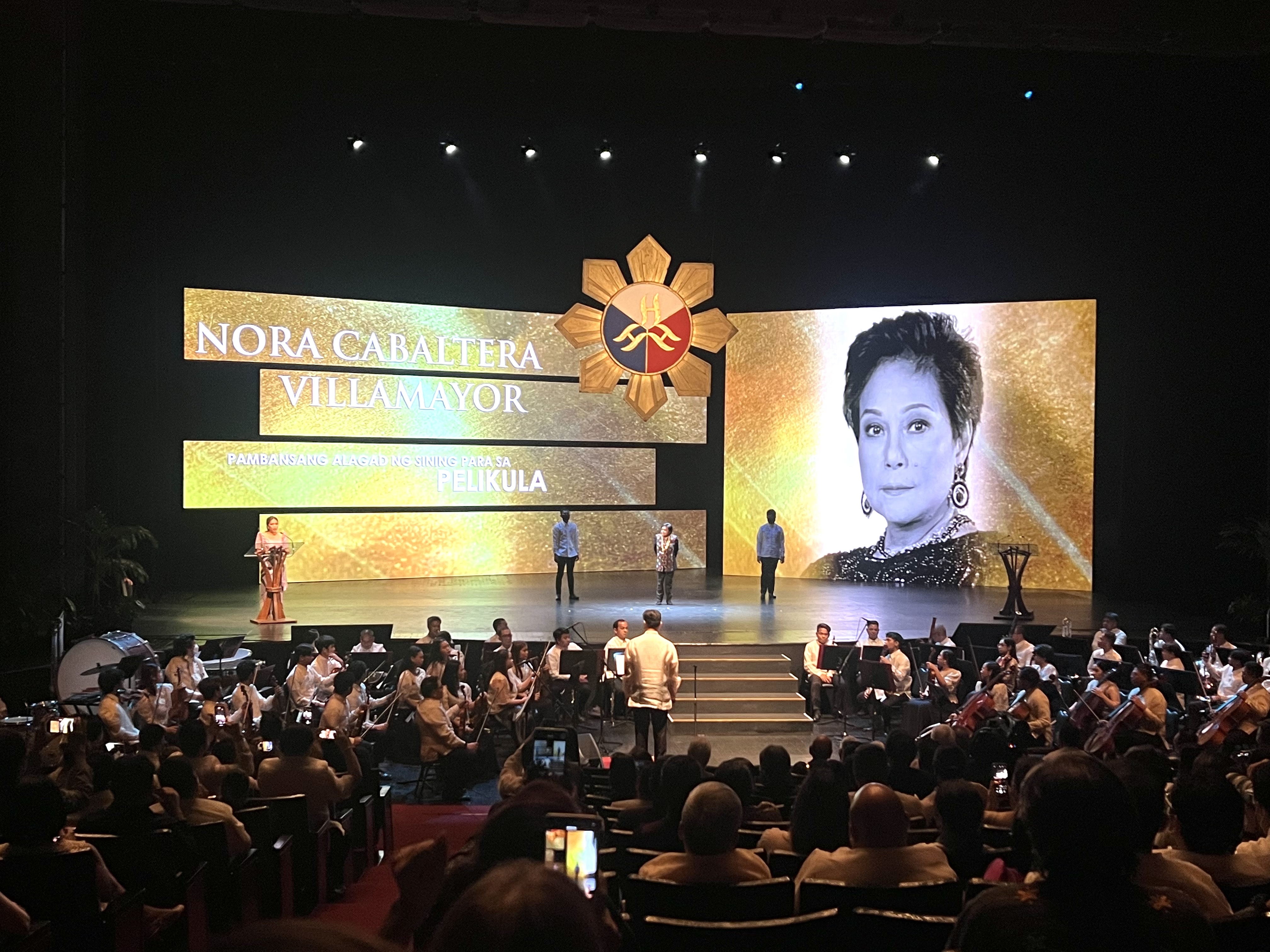
Moving on to other fruitful friendships and associations, I was elated to attend the Parangal for our newest National Artists at the CCP Main Theater last month. The eight new laureates were Agnes Locsin for Dance; Nora Villamayor (aka Nora Aunor) and Ricardo “Ricky” Lee for Film and Broadcast Arts; Gemino Abad for Literature; Fides Cuyugan-Asensio for Music; and posthumously, Antonio “Tony” Mabesa for Theater, Salvacion Lim Higgins for Fashion Design, and Marilou Diaz-Abaya for Film and Broadcast Arts.

I was proud to note that I had worked with or for many of them, and was well aware of their exceptional talent and dedication to their craft. I had never met Nora Aunor, but had written a script for her, “Ina Ka ng Anak Mo,” directed by the late (and also National Artist) Lino Brocka. Lino regaled me with stories about how amazingly good a natural actress Nora was, and I thought so myself, watching her onscreen. I had many issues with former President Rodrigo Duterte’s governance, but I have to credit him for not interfering—unlike many of his predecessors—with the National Artist selection process, particularly in Nora’s case, which everyone knew had been previously held up because of her alleged drug use.

I had worked with directors Tony Mabesa and Marilou Diaz-Abaya, sadly both of them now gone. Tony directed several of my plays and always managed to get just the right tone I wanted to come across. Marilou directed my script which eventually became “Ika-11 Utos: Mahalin Mo Asawa Mo” (someone else always made up these more marketable titles, for which I had absolutely no talent), a crime and domestic drama that received respectable reviews but didn’t win any prizes. But what I observed in Marilou was her work ethic and her methodical approach to the material. I had been used to churning out one-week wonders for Lino, but with Marilou, the scripting process took months, because she would pause and analyze every scene and snippet of dialogue for its political and philosophical implications. 

I was gratified to have made the right call in the cases of Jimmy Abad and Ricky Lee; I had privately predicted, before the results were announced (and with no inside information whatsoever) that the two would be very strong contenders (I also mentioned Lualhati Bautista and Pete Lacaba, among those still living; for the record, I was also nominated, but it was more to make my 94-year-old mom proud and happy, which she was, and so I was). I had known Ricky for a long time, both of us being Lino Brocka’s go-to’s when he needed a script done fast. Ricky, of course, was more than fast; he was good. And while I wandered off into many other kinds of writing, Ricky turned screenwriting into the art and profession it deserved to be, not just for himself but for scores of acolytes. We used to ask each other, half-jokingly, why Pete seemed to get all the choice, festival-bound assignments; and we decided that it was because, by his own admission, Pete was the slowest scriptwriter among us, and therefore got to work on the long-gestating projects.

But I was happiest of all for my former professor and dear friend Jimmy Abad, whom I felt should have received this honor at least ten years earlier, given his elevated poetry, outstanding scholarship, and generous mentorship to generations of writers. For someone who began by studying to be a farmer at UP Los Baños and who then entered the Jesuit seminary (when he left after three years, he recalls, “The first thing I did was to look for a store and smoke a cigarette!”), Jimmy found his true calling in unraveling the Mystery of The Word, of language and how it shapes our view of life. I can think of no writer more purely dedicated to his art than Jimmy, the classic absent-minded professor who drives up one-way streets and whom I had to remind of his exact age. When it comes to words and their meanings, he is ever-aware, ever-present, and ever-caring. A true National Artist, indeed. Heartiest congratulations to all!

Hindsight No. 1: A Time for Telling

Hindsight for Monday, January 17, 2022

IT WAS with great shock and sadness that I received the news of Manong Frankie Sionil Jose’s passing two Fridays ago; my recollections of him appeared online later that day. But just as jarring a surprise was a call I later received from Millet Mananquil, my editor in the Lifestyle section, and then from Doreen Yu, our Op-Ed editor, informing me that I had been chosen to take over FSJ’s column-space on this page.

It was a great privilege, of course, and I accepted it gratefully. But it also carried with it an awesome responsibility—to be honest, to be fair, to know enough about an issue to speak with some legitimacy about it, and also to be modest and open-minded enough to remember one’s inescapable fallibility. I don’t think that last one’s going to be a problem, because I’ve made mistakes often enough to know that—well, I make mistakes, some of which may have hurt people badly.

But last Saturday I turned 68, and with that age comes a keener sense of doing right, of accountability for one’s choices and judgments, as well as a greater tolerance for the shortcomings of others, though not of evil or of wrong itself. I intend to maintain those bearings in this new capacity.

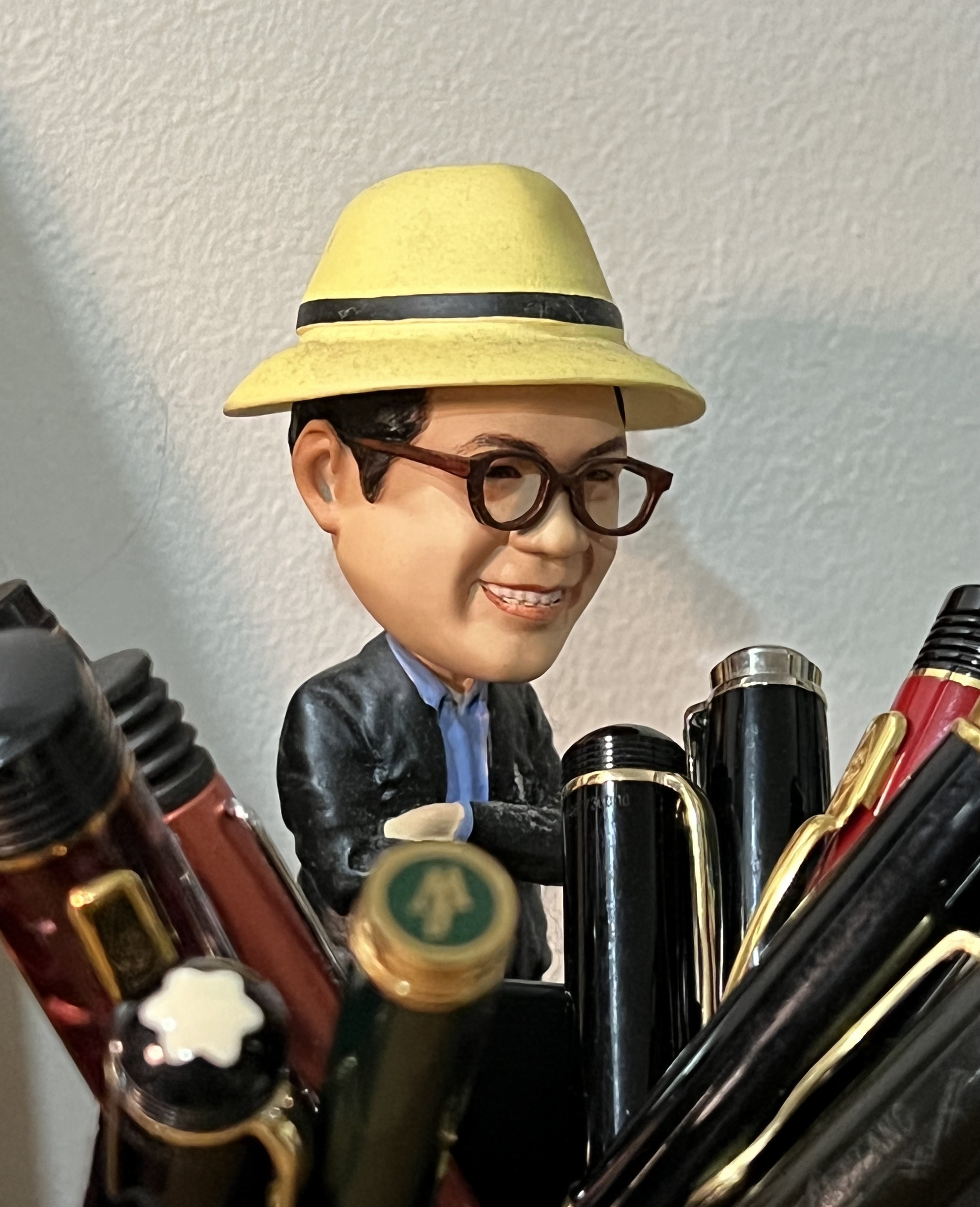
Some readers may wonder how a Lifestyle writer like me—obsessed with fountain pens, old books, Broadway showtunes, and digital gadgetry—ends up doing op-ed, which seems a far more serious and consequential calling. A brief self-introduction might be in order.

I dropped out of UP as an engineering freshman in 1971 and, against all odds (not having spent one day in Journalism class, and being all of 18), landed a job as a features writer and general assignments reporter with the Philippines Herald in 1972. My first task was to fill up half the Features page every day—something that schooled me forever on the importance of deadlines and of resourcefulness, because I had to come up with the topics on my own. I moved to Taliba as a suburban correspondent; was arrested for my activism shortly after martial law was declared; spent seven months in prison; and upon my release joined the information staff of the National Economic and Development Authority, where I would work for the next ten years, picking up a diploma in Development Economics along the way.

I returned to school, finished up my academics all the way to a PhD (more for teaching than for my writing), and taught full-time while writing stories and film scripts. In the mid-1990s, thanks to my friend and now fellow-columnist Jarius Bondoc, I was hired as an editorial writer for the newly opened newspaper TODAY. Being busy with other aspects of management, our boss Teddyboy Locsin trusted me to do about three editorials a week, including the newspaper’s very first one. 

I discovered that opinion writing was exhilarating—but also, again, fraught with responsibility. It got to the point that I found myself wishing I could write something less driven by analysis and conscience—small things like my rickety VW Beetle, double-knit pants, and my love of crabs, instead of ponderous topics like prison reform, the defense budget, and Philippines 2000. (I still have 113 editorials that I wrote on my hard drive.) So I asked for—and got—a Lifestyle column called “Barfly” on the back page, which helped me decompress and kept me sane, reminding me that life was much more than politics and that beauty and fun were as important as anything else to happiness.

I’m going to keep that escape valve open—I’ve promised Millet that I’ll continue contributing my “Penman” column every now and then—but I’ll approach this new task with the loftiness of mind that it deserves (although you’ll excuse me if I sometimes prefer to take a more comic tack, as the best criticism is often served up with a smile). 

Unfortunately I’m not a political insider; I don’t make the rounds of kapihans and have become something of a happy recluse over the Covid lockdowns. You’ll see my politics soon enough—unabashedly liberal (with a small L), middle-force, intensely uncomfortable with both Right and Left extremes. (I came out of the Left and worked briefly for the Right as a sometime speechwriter for five Presidents—but not the last two.) I thank God every night for my family’s safety and for our blessings and for the well-being of others, but I’ve had my differences with Church dogma and would rather spend my Sundays reflecting on human frailty and redemption by reading a book or writing a story.

But I do have a deep and abiding love of history, of which I have so much more to learn. This is why I’m keeping FSJ’s “Hindsight” for this column’s title. (When I returned to UP to resume my undergraduate studies, I dithered between English and History, and chose English only because I was likely to finish it sooner). I agree with Manong Frankie, among many others, that one of the greatest obstacles to our nationhood is the fact that we have a very poor memory—much less an understanding—of our past. We’re reaping the bitter fruit of that amnesia now, in the prospect of electing a dictator’s son to the presidency, a full half-century after the father plunged this country into political and moral darkness by declaring martial law to perpetuate himself in power.

There—it’s when vexatious thoughts like that cross my mind that my fingers begin to itch and I want to editorialize, the complete opposite of my impulse as a fictionist to show and not tell. (I often begin my fiction-writing classes by comparing an editorial on, say, justice for the poor with a short story dealing with the same concern, but without once mentioning “justice,” “poverty,” and such abstractions.) But even as I remain a fictionist at heart, there’s a time for telling, for gathering up the threads of an unfolding narrative and declaring, in plain language, what they mean. That’s what I hope to do.

Penman No. 432: In memoriam, FSJ

Penman for Friday, January 7, 2022

TO THE chorus of voices mourning the passing of Manong Frankie Sionil Jose, let me add my own.

For a very long time, Manong Frankie and I were not what could honestly be called friends. I had said hurtful things about him and his work, and I could feel that he took that to heart. 

But we did begin on a very high and encouraging note. In 1983, he selected me and a few other Filipino writers—Rey Duque, Marj Evasco, and Fanny Llego among them, as far as I can remember—to attend a writer’s seminar in Bali that he and his friend the late Takdir Alisjabanah had organized to bring young Southeast Asian writers together. It was my first big international conference, and it was exhilarating to be talking literature on the fringe of a crater lake. I deeply appreciated that gesture on Manong Frankie’s part; through him I met such luminaries as Edwin Thumboo, Shirley Lim, and Cecil Rajendra. At that point I had read and appreciated The Pretenders and many of FSJ’s short stories.

Some years later, I was in America studying for my MFA in Michigan and then my PhD in Wisconsin, and at some point I was interviewed by National Public Radio about Philippine literature—I can’t recall why, or why me (it was probably just after EDSA, when the world’s eyes were upon us, and I was conveniently available)—and when FSJ’s name came up I indelicately repeated what I thought was the prevalent opinion then (and until much later) of his work among my fellow writers in English: that while he wrote about all the right things, his prose was far too plain and lacking in certain qualities. (It was an opinion that would understandably provoke a backlash from FSJ’s supporters who valued his substance more than his style.)

That must’ve gotten back to Frankie because—whether I just imagined it or not—I felt that I got the cold shoulder from him from then on. It didn’t help that he seemed to have a bone to pick with UP and creative writing workshops, and held the notion that we were out to create clones of our snooty selves, detached from the harsh realities of life on the ground. I (and many others) continued to be exasperated by his cantakerousness (I even called him “cranky Frankie”) and groaned at his propensity to lecture young writers to the point of scolding them for one shortcoming or other.

But even so no one could deny his massive and meaningful contributions to our literature and to the idea of a literature grounded on history and social reality. When I happened to serve on the preliminary committee vetting candidates for the National Artist Award the year he eventually won it, I had no problem putting my minor misgivings aside and voting for him.

I’m not sure when the thaw in our relationship began, but it must have been when we were both invited in 2017 to an NCCA-sponsored seminar in La Union where I was asked to give a talk on Manuel Arguilla. I knew he was going to be listening, and I have to admit that I wrote my lecture with him specifically in mind, wanting to reassure him that I wasn’t some city-boy snob who didn’t know one end of a carabao from the other and who couldn’t write about anything but professors sipping cappuccinos at Starbucks. Through Arguilla, I wanted him to know that I felt and understood—and indeed wrote about—his concern for common and unarticulated lives.

Later that year, when I spoke at the annual Palanca Awards dinner about how writers in our society often have to write for others for a living but also need to redeem themselves through their art, he approached me from below the podium and extended his hand to congratulate me, and I knew we had reconciled.

We were brought even closer when he and the late Sen. Edgardo J. Angara founded the Akademyang Filipino, asking me to serve as a trustee along with such stalwarts of civil liberties as former Justices Antonio Carpio and Conchita Carpio Morales. He would remind me, among the most junior members of that board, to make sure the Akademya survived him, pleading his age. (His daughter Jette, who sadly died just weeks before Frankie, was our very capable executive secretary.)

He and Manang Tess would invite me and Beng for dinner, and he was very happy and surprised when I presented him once with a copy of the maiden issue of Solidarity, which he had lost. In private, he told me something that assured me that we had, again, become friends.

Still, for all that, his mercurial politics continued to confound me. Separated by the Covid lockdown, our meetings stopped, although even if we had met I probably would not have been able to ask him to his face how he could reconcile his loathing of dictatorship with his approval for Marcos’ successor. Not I nor anyone else could have changed his mind. It was sad to see him savagely reviled for his contentious remarks about ABS-CBN and Maria Ressa, among other issues, but I suspect that there was a part of him that courted and reveled in the notoriety.

And that was what I learned about F. Sionil Jose: you had to take him as he was, all of a package, or reject him outright, which would also be a pity. Nearly all great writers had their quirks and imperfections, but it’s their work that survives and surpasses all our momentary misgivings.

Farewell, Manong!

Penman No. 419: Pages from the Past

Penman for Monday, July 19, 2021

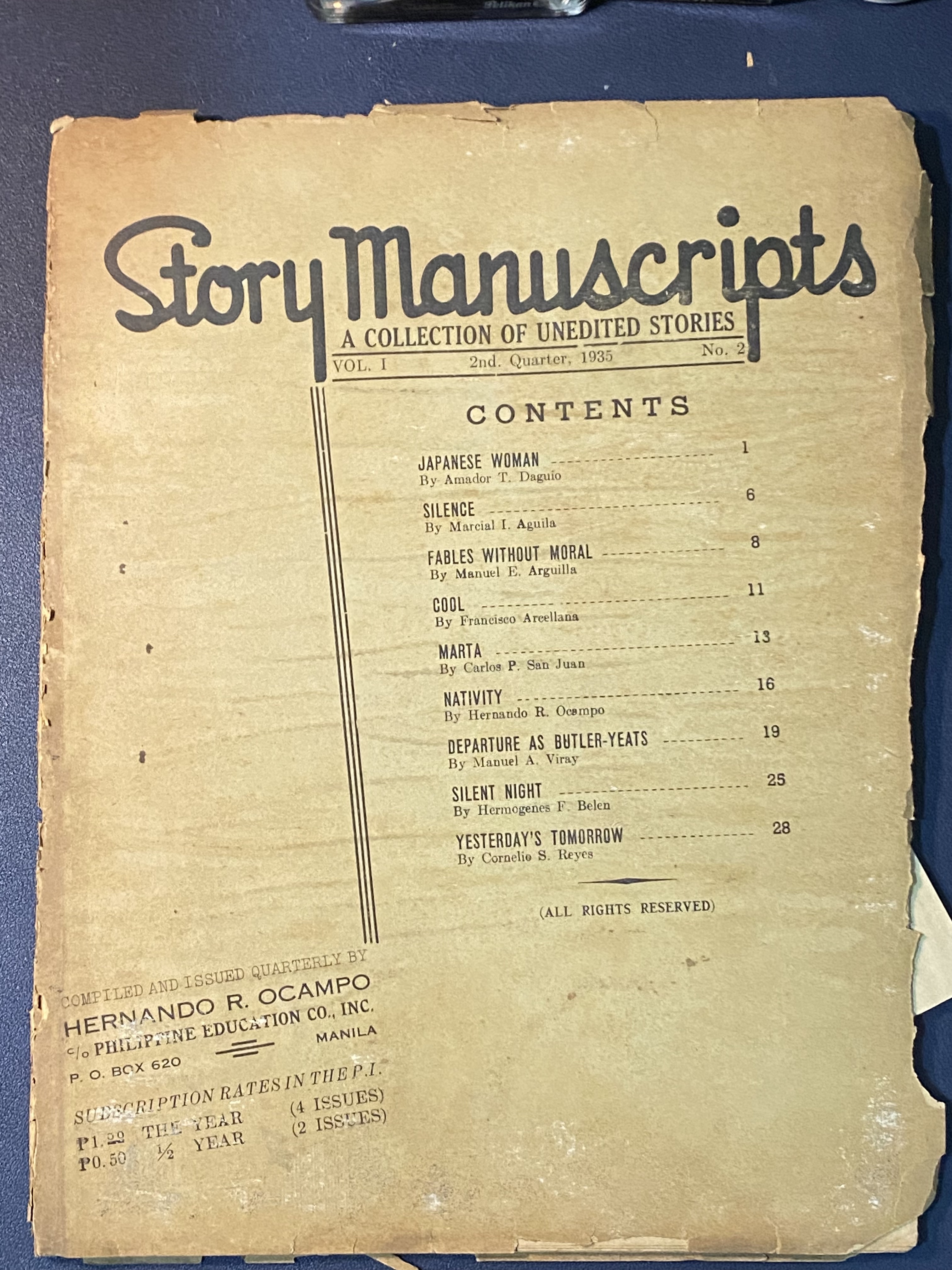
LAST MONTH, two precious documents came my way. The first was a magazine with a unique idea behind it. It was a copy of Story Manuscripts, “a collection of unedited stories,” Vol. 1, No. 2, from February 1935. No more than mimeographed copies of the authors’ typewritten manuscripts between two hard covers, this issue brought together stories from Amador Daguio, Manuel Arguilla, Francisco Arcellana, Manuel Viray, and H. R. Ocampo, among others. 

Ocampo’s presence was especially interesting. I knew that National Artist Hernando Ruiz Ocampo (1911-1978) was a short story writer before he turned to painting, but he was this magazine’s publisher as well. What was exciting for me (as a writer and literary editor, especially of Arguilla) is that I’d never come across these stories before under these titles, so they’re very likely undiscovered stories or early drafts of later ones, being “unedited,” as the Story Manuscripts tagline claims. 

Arguilla’s three “Fables Without Moral”—I have to check if they appeared in the book of fables that his wife Lyd published after his death and credited him for as co-author—are a surprise. They all have to do with, uhm, procreation, rendered in a mock-mythic tone. I would have to revise my introduction to the Arguilla anthology I edited three years ago to account for these risqué diversions. Here’s a sample:

“But soon he awoke for an earthquake shook his newly-found home and a storm tossed the forest of hair and a groaning and moaning filled the air. Then a downpour such as he had never before known drenched him, buried him in its thick flood.” (Hint: “he” is a vagabond ant.)

The Arcellana story, “Cool,” is quintessentially Franz—the young and ardent admirer (the author himself was just 18 then) watching his beloved from a distance, chanting over and over again, “I see her but I do not want to see her looking at me.”

H. R. Ocampo’s “Nativity” is, unsurprisingly, visual: “The big round eye floated gently upward and upward. Then it ceased floating upward. It ceased floating and winging upward and was suspended in space. Then it was dark. Darkness all around. Darkness for a brief one millionth second.

“After the brief one millionth second the big round eye came back seeing everything and nothing in a whirling sphere of soft jelly-like mass of white and black and red and green and orange and blue and violet.”

There’s an interesting biographical footnote to the Ocampo story: “Hernando R. Ocampo was born on April 28, 1911 in Sta. Cruz, Manila. Began writing two years ago on a dare and thought that writing was ‘just like that’ when his first effort was immediately accepted by Mr. A.V.H. Hartendorp of the PHILIPPINE MAGAZINE, but a series of rejection slips from the same and other local editors later toned down his ultra-optimistic viewpoint—so much so that he actually considered giving up writing ‘for good.’ Fortunately he met Manuel E. Arguilla who through patient coaching gave him courage to try anew.”

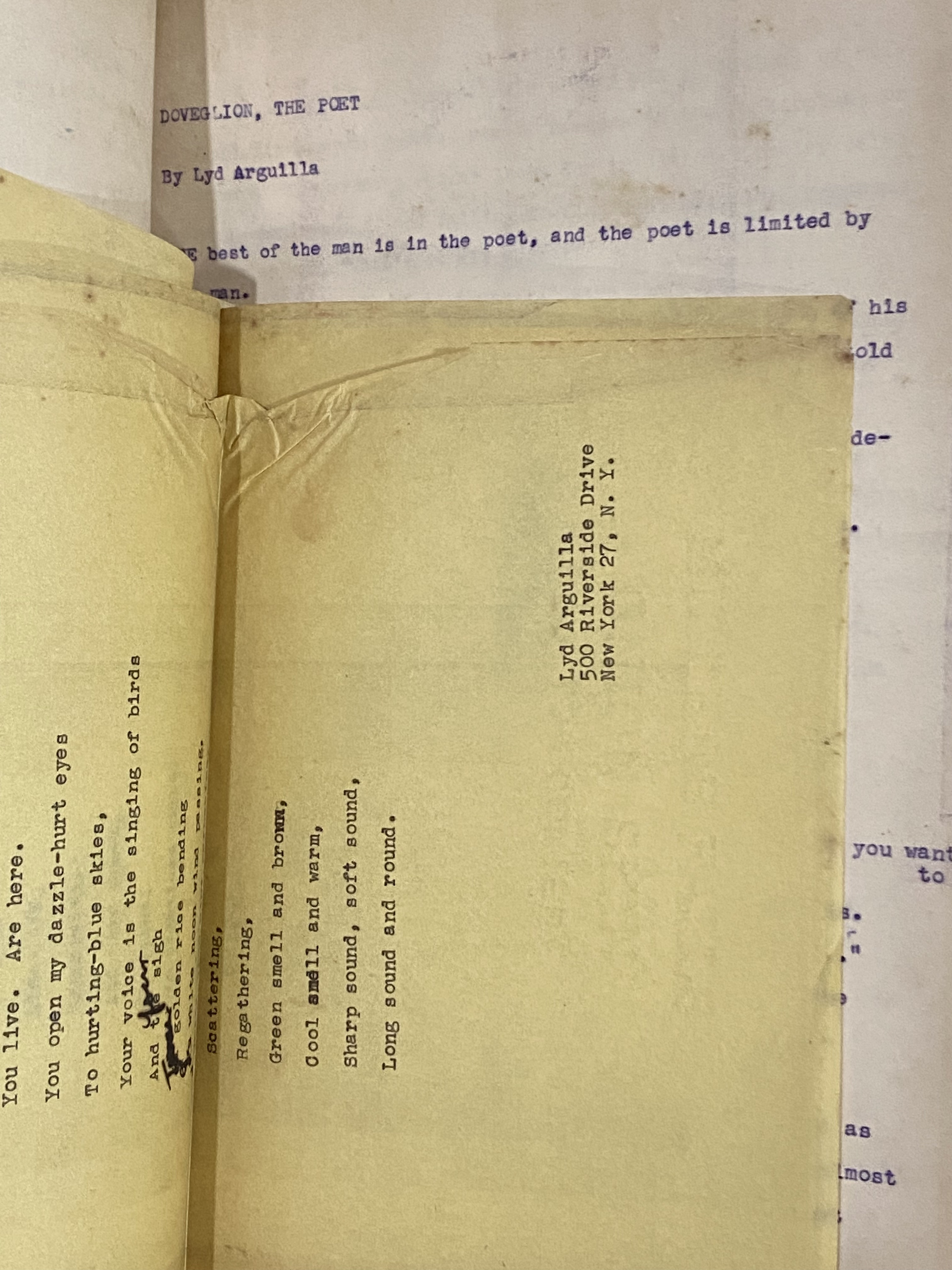
The other document I felt extremely lucky to acquire was a plain black folder, rather worn, with about 60 to 70 pages in it of what was obviously a carbon paper copy. It was also clear, however, that the author of these pages had used this copy to make handwritten revisions on. 

It was a collection of essays written by Lyd Arguilla—and I’m not sure if they were ever published—during a sojourn to the United States in the early 1950s, when she received a grant for further studies in New York. This was just a few years after the war; in 1944, she had lost her husband Manuel, who was executed by the Japanese for his guerrilla activities. Lyd had been active in the resistance herself, and was away when Manuel was arrested. We can only imagine the pain she went through on discovering his loss. By the time she writes about the experience, she has composed herself, but she leaves it to Manuel’s fellow prisoner, a Major Moran, to relate what happened:

“On a tip from Pete Mabanta, Manuel E. Arguilla had already escaped with us out of the city. Friends and fellow members of our guerrilla unit had helped: the Lansang brothers, Ramon Estela, S.P. and Mary Lopez, Koko and Lina Trinidad. But Manuel sneaked back into the city to destroy or put in a safer place some records. He was able to protect the lives of his associates, but did not escape with his own.

“‘Arguilla was accused of being a major in Marking’s guerrillas, of heading an espionage and propaganda unit against the Japanese. Liling (Rafael R.) Roces was charged with publishing Free Philippines and various other acts against the Japanese military.’

“‘Arguilla had enough material, according to him, for two books. All he asked was to be able to live through to write them.

“‘It was on August 29th, early in the morning, about seven o’clock, maybe earlier, that the prisoners in Bilibid were given old clothes to put on (we all wore our underwear), put in handcuffs, and blindfolded. The blindfold was either green or white. The 28 men wore white bands. I thought, being most of them influential men that they would be given better treatment than those of us who were given green bands. I was wrong of course. For I and others were taken to Muntinlupa where we were finally liberated, and the 28, as we learned later, were beheaded at the Chinese cemetery.’

I could imagine Lyd typing those words on a chilly morning in New York and running that awful moment through her imagination. Elsewhere in the folder, she tucked away a love poem she had written for Manuel. Holding those pages, I felt myself in the presence of something close to sacred.

Penman No. 412: CPR and the Art of Autobiography

Penman for Monday, April 26, 2021

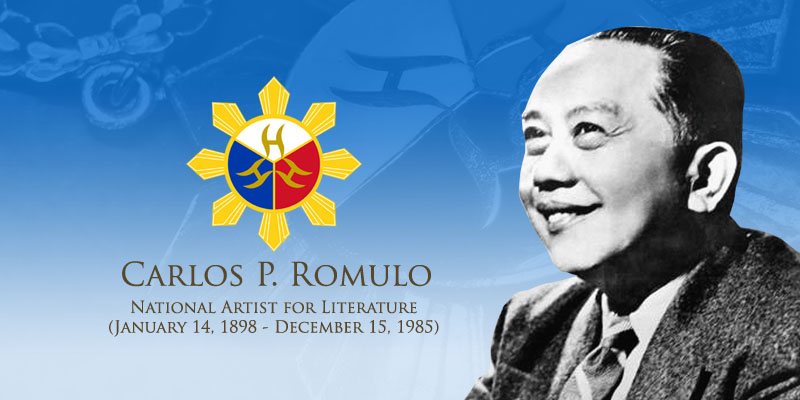
TWO WEEKS ago, I gave an online lecture sponsored by the National Commission for Culture and the Arts (NCCA) and the University of the Philippines Baguio on the subject of Carlos P. Romulo as a National Artist for Literature. I was frankly surprised to have been asked to speak on CPR, or “the General” as he preferred to be addressed. I am no expert on Romulo, and while our lifetimes coincided for about 30 years, I never had a chance to meet the man, not even at the University of the Philippines, which he served as President from 1962 to 1968.

I did have a brush with Romulo’s writing in grade school when, for reasons I now forget, my declamation piece was his exuberant essay “I Am a Filipino.” Of course I already learned from our Social Studies class that he had been the President of the United Nations General Assembly, so I had a sense of the man as a Filipino who had proudly made a name for himself and for his country in the world.

Like many of you I also remembered Romulo as the diminutive figure sloshing through the surf in Leyte Gulf behind the hulking Douglas MacArthur. But indeed he was someone whose physical stature, at five-foot-four, was often preceded and magnified by his towering reputation. 

Romulo’s was unquestionably a long and stellar life, stretching from the start of the American occupation in 1899 to the last year of Marcosian rule in 1985. He was a participant in and witness to many of the most dramatic moments of the 20th century. Even his association with President Marcos in his later years as Foreign Minister—an appointment clearly meant to lend credence to the martial-law regime, as CPR himself realized and later regretted—has now largely been overlooked by scholars and critics. 

But of all the tributes paid to CPR, the one that seems to have escaped the public imagination is that of Carlos P. Romulo as National Artist for Literature—a fact that many Filipinos, including writers, appear to be ignorant of. I must confess to wondering myself how Romulo’s literary achievements stack up alongside those of Nick Joaquin, F. Sionil Jose, Jose Garcia Villa, Virgilio Almario, Amado Hernandez, and so on.

Romulo was declared a National Artist, along with the film director Gerardo de Leon, by virtue of Presidential Proclamation No. 2207, signed by President Marcos on June 10, 1982. He was only the third awardee for literature, following Amado Hernandez in 1972 and Nick Joaquin in 1976.

We are not privy to the deliberations of the awards committee for that year and to what procedures were followed. But somehow there arose the suspicion that CPR was summarily given the National Artist Award by Marcos, whom he served as Foreign Minister from 1978 to 1984, as a political favor or reward. Putting politics aside for the time being, the niggling question remains: what exactly should Carlos P. Romulo be recognized as a National Artist for Literature for? What can he teach contemporary Filipino writers?

That Romulo was a prodigious and talented writer cannot be disputed. He is on record as having published 22 books, including one novel (The United, 1951) and a book of plays, but comprising mostly what we would today call creative nonfiction—autobiography, biography, and historical reportage. While his novel—set in the US, with American characters—achieved some success, I strongly doubt that this was or could be the main foundation on which his literary reputation rests. 

Rather, I propose that it is Romulo’s nonfiction reportage that distinguishes him most strongly as a writer of and about his time, and one of the most articulate chroniclers and propagandists of the Philippine midcentury. 

Much of this achievement has to do with Romulo’s uncanny ability to position himself in our history as witness and party to some of its most momentous events. He lived an extraordinary life that led him from Camiling, Tarlac to Columbia University and then back to the Philippines, where he became a teenage reporter, then editor, then university professor, presidential adviser, aide-de-camp to Gen. MacArthur, US Army general, “the last man off Bataan” as one of his book titles says, postwar diplomat, presidential candidate, university president, foreign secretary, and international statesman. 

That life and his encounters with the world became the raw material for his books and his reportage, which won him the Pulitzer Prize for Correspondence in 1942. If you want to know Romulo and his times, look no farther than his 1961 autobiography, I Walked with Heroes. It best displays him as a master of what could be a vanishing literary form in these days of Twitter, Instagram, and generally abbreviated and instantaneous commentary.

I was not expecting to appreciate the book and its author as much as I eventually did. It is a pleasurable, engaging, and instructive read, written by someone who has a story to tell and knows how to tell it. The problem with Romulo, to be plain about it, is, well, Romulo. Like most people whose reputations precede them, he invited the impression of possessing a well-nourished ego, which the armchair psychoanalyst might say was likely a form of overcompensation for his short stature. 

What we get at the end of I Walked with Heroes is, to be sure, a varnished portrait of CPR and his contemporaries, but not incidentally we also follow a nation in progress, emerging from colonialism to a fragile postwar independence. And therein, I suggest, lies its value and Romulo’s strongest claim to literary fame, in his ability to interweave the personal with the public—not on the tiny frame of selective memoir but on the wall-sized tapestry of comprehensive autobiography, a diminishing art for many reasons. Our writing has become increasingly smaller in scope and ambition. Accustomed to tweets and Facebook tags, our writers and readers today think of time in terms of fleeting seconds, and lack the memory and capacity for historical reflection.

And then again perhaps we simply lack the kind of larger-than-life personas (pun intended) that CPR and his contemporaries represented. With or without ghostwriters, our Presidents no longer write their autobiographies, or even their memoirs, as Quezon and Elpidio Quirino did. Perhaps they fear that the written word will return to haunt them. But then again why should autobiographies be expected to tell the whole truth and nothing but?

Subjected to scholarly interpellation, Romulo’s reportage on himself and the history swirling around him will surely raise many questions about whether this and that really happened the way he recalls it. But he is a master of narrative, and as fastidious as he was about his suits and uniforms, he clearly sought to portray a positive image of himself as the avatar of his people—“a small man from a small country”—for which no autobiographer in his position can be faulted for attempting.

Penman No. 402: The Brain That Will Not Sleep

Penman for Monday, December 7, 2020

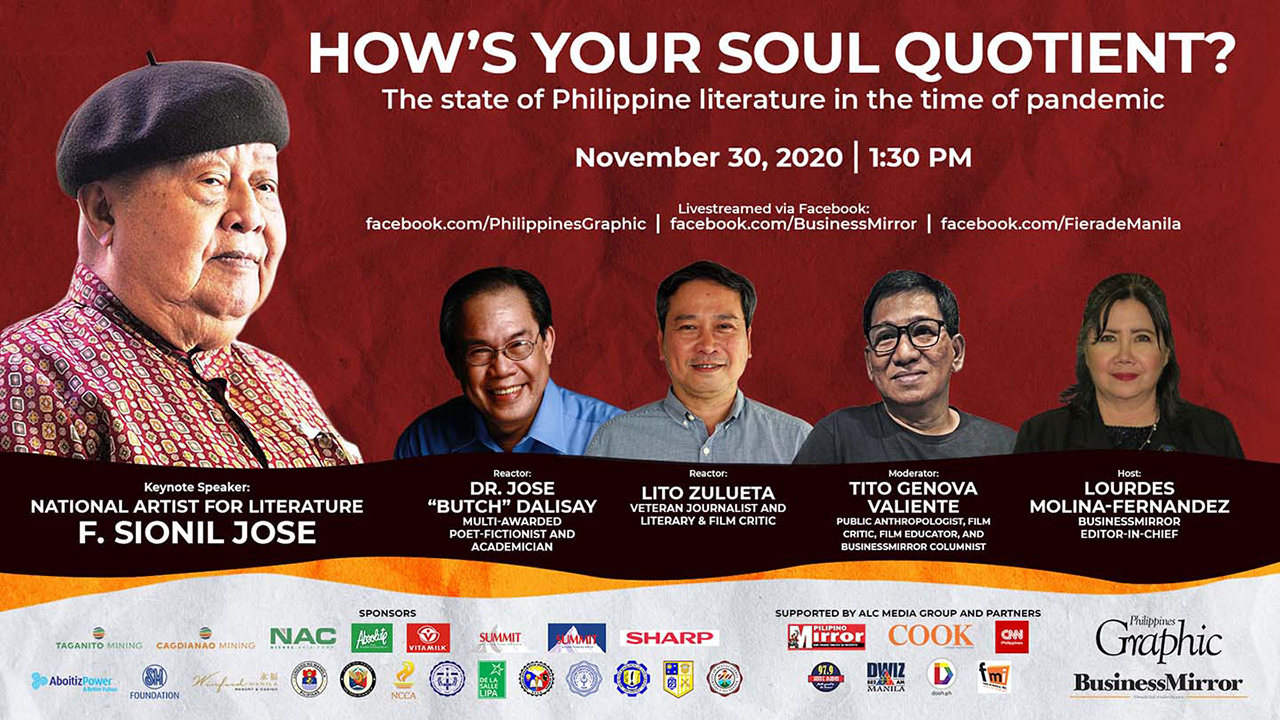
I APPEARED last Monday at a webinar sponsored by the Philippines Graphic and the BusinessMirror to react to a paper delivered by National Artist and fellow Philippine STAR columnist F. Sionil Jose on “Philippine Literature in the Time of Pandemic,” along with the essayist and critic Lito Zulueta. We had a lively discussion, with over a thousand students listening in, so it was a great opportunity to do some teaching (or preaching, of you will) about how writers work during great upheavals—in this case, the raging fire of a global pandemic. Here’s part of what I said:

Literature goes on. Literature cannot be locked down. It is a tongue that cannot be silenced, a brain that will not sleep, a nerve that will keep twitching even when hammered a thousand times. 

But the best literature about this pandemic will very likely not emerge for many more years, if not decades, to come. What we know is that the best writing is not produced in the heat of the moment. It takes a long time after a calamity or a period of deep distress, like a plague or a war, to write capably and insightfully about it. It requires distance and reflection.

Take, for example, three of the best-known works associated with the idea of a plague. Daniel Defoe’s A Journal of the Plague Year, which was about the bubonic plague that hit London in 1665, when Defoe himself was only five years old, was written more than half a century later, and published only in 1722. Edgar Allan Poe’s short story “The Masque of the Red Death,” which was published in 1842, was not even based on an actual plague but was rather highly allegorical. Albert Camus’ novel The Plague came out in 1947 but looked back to an actual outbreak of cholera in Algeria in 1849, almost a century earlier.

And the fact is that the plague itself is never the real subject of literature—it is what it does to people, to bring out both the best and the worst in them. The plague is merely the backdrop or the trigger for the exposure of human greed, corruption, and indifference, as much as it can provoke nobility, heroism, and humility. This is also how literature has dealt with war, beyond journalism and history, which are concerned with chronicling and interpreting the facts. The best war stories, from the Iliad onward, deal with human character under pressure.

I have no doubt that the time will come when we will see a substantial body of Philippine literature emerge out of this pandemic—novels, stories, poems, essays, and screenplays—that will remind readers of the future of what it was like to live in 2020, and it won’t just be about Covid and lockdowns, but OFWs, tokhang, Netflix, K-drama, Lalamove, and Donald Trump. 

In his talk, Manong Frankie spoke of “the need to be true to one’s self, to be engaged with self, our time and our place,” and it’s something with which I totally agree, because this is how literature refreshes and revitalizes itself over time, with each generation grappling with its own demons. Each generation is defined by a particular challenge—for my parents, it was the Japanese occupation; for mine, it was martial law; for my daughter’s, it was EDSA; for today, it is Covid and its political context.

The young writers of today are writing very differently—in content and treatment—from Manong Frankie’s generation and from mine—and they should. Writers should write about their times, for their times, in their own voice and manner, and if they write well and insightfully enough, their work will have meaning and value for generations yet to come.

I mentioned the political context of Covid, by which I mean that this pandemic has been accompanied and aggravated by the politics of ignorance, fear, and populism. All around the world, it has been used by politicians to aggrandize power and suppress opposition, and this is something literature will also have to confront. 

Thanks to the slippery pervasiveness of social media, the truth is being replaced with insistent assertion, and control of the narrative is on top of the political agenda. If you claim “I won!” and “He’s bad!” a thousand times, some people will begin to believe it.

In a sense, the most daring kind of fiction now is out of the hands of creative writers like me. It is being created by political propagandists who are spinning their own versions of the truth, and who expect the people to believe them. The short story and the novel are no longer the best media for this type of fiction, but the tweet, the Facebook feed, the YouTube video, and even the press conference. The conspiracy has emerged as the most popular genre of fiction—the idea that people are out to fool you or cheat you, but they can’t, because you have a more clever version of the truth.

Covid and fake news may be the most dangerous combination yet. But as I’ve been saying these past few years, the best antidote to fake news is true fiction, which will be up to you and me to write.

Penman No. 390: Faulkner in Manila

Penman for Monday, June 22, 2020


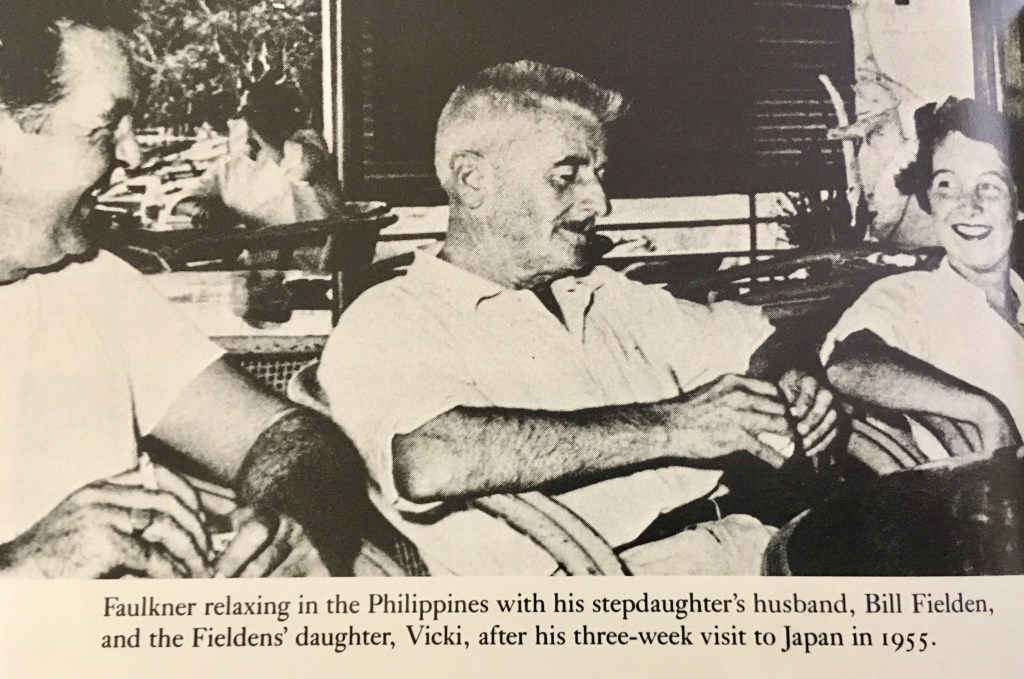
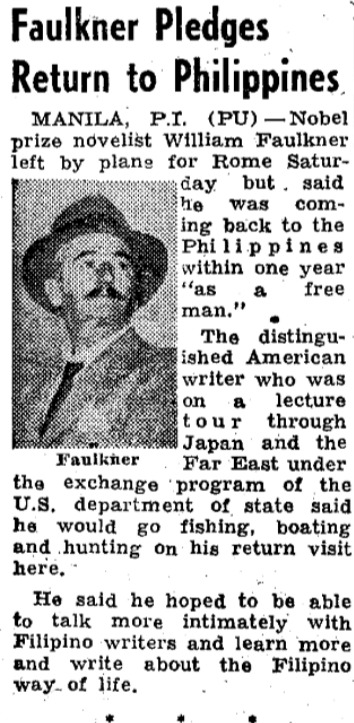
A FEW weeks ago, I wrote about the visit to Manila in 1951 of the American writer Wallace Stegner, mentioning that ten years earlier, he had been preceded by the even more celebrated Ernest Hemingway. I also said that they were followed in August 1955 by yet another titan of American literature, the 1949 Nobel Prize laureate William Faulkner—a visit I’d first learned about by staring at a small poster from that event on the wall of the old Creative Writing Center in UP back in the 1980s.

That poster, wall, and center sadly burned down with the Faculty Center fire four years ago, but I’ve always been intrigued by what brought these big-name authors over to our shores, and what they possibly could have told their local counterparts (there’s a picture somewhere of a very young and very short NVM Gonzalez getting the autograph of a hulking Hemingway).

Hemingway was stopping over on his way to China; Stegner was brought over by the Rockefeller Foundation; and—thanks to a clipping and other materials sent by my Washington, DC-based friend, Dr. Erwin Tiongson—we know now that Faulkner came here courtesy of the US Department of State, which sent their prize author on a tour of Asia, presumably to foster peace and goodwill during the Cold War. (Interestingly, Faulkner’s wife Estelle had visited Manila the year before, and would write:  “The artificially induced gaiety of the Far East is very pronounced here—a feverish clutching at nothing that is little short of terrifying—As I sit here now, looking out on Manila Bay with its warships and carriers—every one of them ready for instant action—I feel insecurity verging on panic.”)

William Faulkner may have been a giant in his time, but to young readers today weaned on Gaiman and Murakami, he might as well be as remote a figure as W. Somerset Maugham or Henry James. Some may have come across his classic short story “A Rose for Emily,” and a luckier few his novels The Sound and the FuryAs I Lay Dying, and Light in August. As a fictionist, he was chiefly known for his use of the “stream of consciousness” technique that gave even his lowliest characters an ability to articulate their deepest and most complex thoughts and emotions.

But what did Faulkner have to say to his Filipino audience? I found the answer by locating the book Lion in the Garden: Interviews with William Faulkner 1926-1962 (New York: Random House, 1968, edited by James Meriwether and Michael Milgate), which has a whole chapter on “Faulkner in Manila,” based on transcripts of Faulkner’s talks published earlier by the Philippine Writers League. 

There’s a short but charming documentary on YouTube  where you can see him at home in Oxford, Mississippi in 1952 and listen to his soft, somewhat cigar-burnt voice, and you can imagine yourself sitting in the audience in Manila in 1955, as he imparts these notions, among many others:

“I think that there is a great deal of beauty in any national language, national literature. But that tradition of literature must still be furthered more so that it can meet and can give and take from other national literary traditions. But by all means develop one’s own because there is a certain portion in the legends, the customs of any people, that are valuable, and the best way to get them into a universal literature is to bring them first into a national literature…. Nobody should turn his back on his own tradition, his own language, his own culture, to assume a foreign one. Let his own and the foreign meet and produce a universal one.”

“The writer must believe always in people, in freedom; he must believe that man must be free in order to create the art; and art is in my opinion one of the most important factors in human life because it has been art, literature, folklore, music, painting which have been the record of man’s rise from his beginnings. It is the writer’s duty to show that man has an immortal soul…. A writer’s job is not simply to get books printed but to find the truth, the fundamental truth…. I think that the setting of a novel is just incidental, that the novelist is writing about truth. I mean by truth the things that are true to all people, which are love, friendship, courage, fear, greed; that he writes in the tongue which he knows, which happens to be the tongue of his own native land…. I write about American Mississippi simply because that is what I know best.”

“There is a responsibility that goes with the privilege of saying what one thinks. One must have integrity to know the truth, to believe the truth, to speak the truth, for the sake of truth, not for the sake of aggrandizement or profit or policy, but the truth because it is true.”

Faulkner2