Penman No. 227: The Southern Lights Shine Brightly

IMG_9859 2.jpeg

Penman for Monday, November 28, 2016


A RECENT gallbladder operation and the stitches in four corners of my belly couldn’t stop me from flying down to Iloilo City last week to catch the tail-end of VIVA Excon 2016, which I’d plugged here some time ago but just had to see for myself. The personal reason was that my wife Beng was one of the scheduled speakers, for a session on “Art Conservation and Restoration,” but I’d also heard that VIVA Excon was one of the most successful events of its kind in the country (“probably the only surviving and longest-running Filipino biennale,” VIVA Excon stalwart and chronicler Cecilia Locsin-Nava would emphasize to me). Here’s what I found.

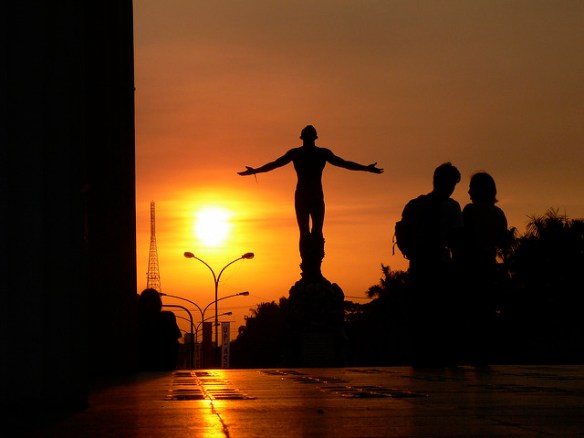
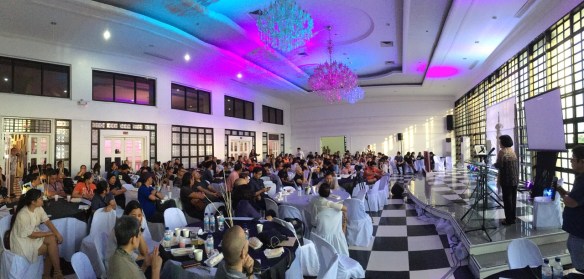
From November 17 to 20, more than 250 artists, speakers, and guests from the Visayas, Mindanao, and Manila gathered at Casa Real in the old provincial capitol of Iloilo to celebrate, interrogate, and propagate art in all its splendorous variety—the important qualifier being that this was new art produced south of Manila. It’s been around since 1990, moving around the major capitals of the Visayas such as Cebu, Bacolod, Dumaguete, and of course Iloilo. Surprisingly, it was only the second time that Iloilo hosted VIVA Excon, after a 20-year hiatus, so the local organizers made up for lost time by mounting one of its most vibrant editions ever.

When it started—spurred by the need to create a southern antipode for the arts, given the emergence of such bright new talents as the Negrense painter-sculptor Charlie Co—VIVA Excon had to be funded by the artists themselves, but this year Iloilo’s provincial and city government pitched in to guarantee the event’s success, with help from a host of sponsors led by the National Commission for Culture and the Arts (NCCA). On top of the local planning was painter Rock Drilon, assisted by a corps of wizards and elves who made sure that the dozens of events on the program went off like clockwork. VIVA Excon originals Ed Defensor, Charlie Co, Peewee Roldan, and Cecilia Nava were also around to lend their wisdom and support.
IMG_9862.jpeg

As its name suggests, VIVA Excon (the “VIVA” stands for Visayas Islands Visual Arts) was at once both an exhibition and a conference. As someone who has helped to organize quite a few literary conferences myself, I was much impressed by the scope and depth of the topics taken up at the conference and by the expertise of the speakers engaged for the occasion, some of them coming from as far as the US, Singapore, and Hong Kong. I missed most of the earlier sessions, but I would have loved to listen to Ma. Victoria “Boots” Herrera speak on “Museum Practices: What Artists Need to Know”; Silvana Diaz on “Creative Economics: Art Management and Economic Viability”; Elvert Bañares on “Creative Crossover: From Visual Art to Cinema and Back—The Visayan Artists’ Experience”; Rex Aguado on “Art, the Artist, and the Art Collector”; and Patrick Flores on “Art Criticism—Its Value to the Artist and the Artworld.”

Fortunately, I came in time to catch UP art theorist Lisa Ito address issues in writing about the arts—“for what and for whom,” she would say, “beyond the popular writing geared toward the art market, and the academic writing produced by scholars and theorists.” Lisa felt that more writing should be undertaken to “connect artistic production to social contexts and current realities, and developing publics and communities that validate the vitality of art and culture” as well as to “document design practices and projects and to record transient cultural events for future generations—how communities adapt, such as by using tricycles as mobile galleries and by putting up makeshift museums.”

She was followed by New York-based Carina Evangelista whose lecture on “When Forces Shape Form” led the audience to where art has gone far beyond and outside the museum, in performative gestures—often deeply and manifestly political—that emphasized process over product, transience over permanence, and repurposing over originality. (One example: the banknotes that Brazilian artist Cildo Meireles stamped with a political message and circulated in 1970 as a form of mobile graffiti, which nervous recipients couldn’t pass on quickly enough, thereby abetting its purpose.) It was truly a semester’s worth of material packed into 45 minutes on new forms of art from body mutilation to sound and video installation, reminding me of Marjorie Perloff’s lecture on avant-garde poetry just a couple of weeks earlier in Singapore; sometimes you learn the most wonderful things in the oddest places.

Of course, I was happiest and proudest to see Beng onstage walking the audience through the various stages of restoring Amorsolos and Botong Franciscos, and it was clear from the flurry of questions she fielded after her presentation that conservation and restoration were two of the least understood concerns of the art world, yet also two of the most vital if not inevitable. (Sculptor and installation artist Martin Genodepa graciously emceed the presentations.)

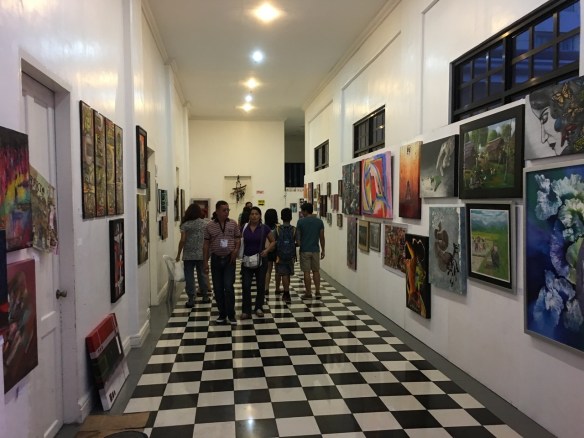
Outside the conference hall, three art exhibits were held: a curated one on “Contemporary Art of the Islands” at the UP Visayas Art Gallery, the more freewheeling Visayas Art Fair at Casa Real, and a special retrospective of the late Ilonggo sculptor Timoteo Jumayao at the Museo Iloilo.

IMG_9867.JPG

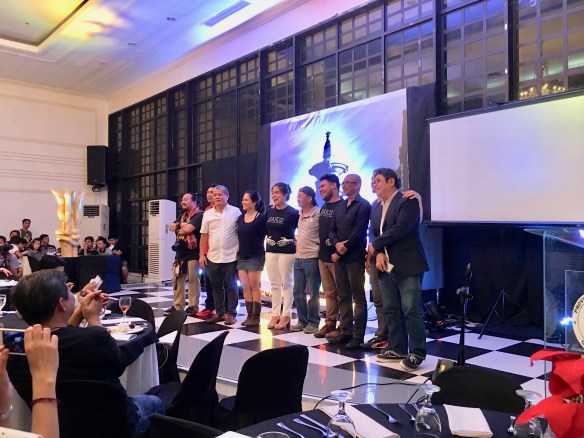
The culminating activity of VIVA Excon was the presentation of the Garbo sa Bisaya award to eight outstanding Visayan artists for excellence in their respective fields: painter Antonio Alcoseba (Cebu); scholar and painter Dulce Cuna Anacion (Leyte); film artist Elvert Bañares (Iloilo); film animator Oliver Exmundo (Iloilo); painter Allain Hablo (Iloilo); multimedia artist Manny Montelibano (Negros Occidental); painter Javy Villacin (Cebu); and painter and scholar Reuben Cañete (Cebu).
IMG_9887.jpg

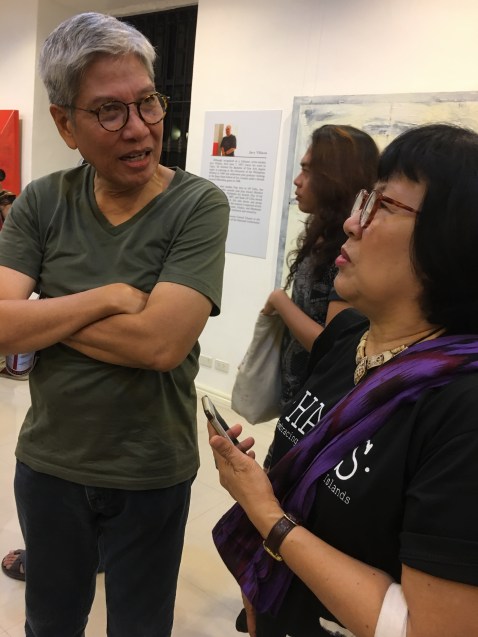
But I’m sure that all the attendees will agree if I suggest that the best part of VIVA Excon was, ultimately, the company of fellow artists, a fraternity forged over beer and music as much as over linseed oil and plaster. Even if I was little more than an onlooker at the event, I was glad to meet up with old friends and acquaintances like Rock Drilon, whose Mag:Net bar and gallery on Katipunan Avenue used to be one of our favorite hangouts. He moved to Iloilo years ago to take care of his ailing mom, and found himself drawn inextricably into the local art scene, until he realized that he was truly home. “Viva should last beyond the Excon,” Rock told me, “so an artists’ cooperative has been organized to sustain the energy sparked by VIVA Excon.”
IMG_9881.JPG

Two years from now, the event will be hosted by Roxas City in Capiz. Iloilo could be hard to top, but these Visayans are full of surprises.
Link

IMG_9635.jpg

Penman for Monday, November 17, 2016


IT WASN’T on the official itinerary, but I have to report that the personal highlight of our recent participation at the Frankfurt Book Fair didn’t happen at the fair itself, or even in Frankfurt, but about an hour and a half away by train and bus. This was a plan that a few of us had hatched even before we left Manila: we’d do our jobs and put in our hours in the Philippine booth, then take a day off in pursuit of a pilgrimage that any Pinoy in Frankfurt shouldn’t forgo: a visit to Jose Rizal’s haunts in Heidelberg and neighboring Wilhelmsfeld.

I’ve been a lifelong fan of Pepe, not just for his writing skills and love of country (I won’t mention his charming ways with the ladies) but also his wanderlust which made him, in my book, the first truly global Filipino. Considering that he didn’t live very long, he was still able to do more and see more than most of us do in a full lifetime. The intensity of that life and the excellence he sought at every turn have been enduring inspirations for me, and I’ve realized that sometimes by design and sometimes by serendipity, I’ve been tracking his footsteps around the world.

In 2009, my wife Beng and I, along with our daughter Demi and her husband Jerry, had booked ourselves into the Palace Hotel on Market Street in San Francisco, where it took a waiter (a fellow Pinoy, of course) to inform us that Rizal had stayed there during his only visit to America in May 1888, an event commemorated by a marker just outside the hotel, which we had missed.

PalaceHotel.jpg

Two years later, Beng and I visited Rizal’s well-kept shrine in Dapitan, where he had spent four fruitful years in exile before being transported back to Manila. How poignant it must have been to catch the sunset along the bay with Josephine Bracken, inflamed and torn by two of the strongest passions to afflict any writer—love and revolution.

Dapitan.jpeg

And then in 2014, again with Beng, Demi, and Jerry, I sought out some of Rizal’s locales in Spain, from Plaza Mayor in Madrid to the Castell de Montjuic in Barcelona, where Rizal had been detained before being shipped back to Manila for trial and eventual execution. (The castle has designated a room, Sala Rizal, in his honor and in memory of the many political prisoners who had spent time in that place—ironically, one of the best spots from which to appreciate the city’s beauty.)

Montjuic.jpg

There was no question, therefore, that I would make that sortie to Heidelberg, given the once-in-a-lifetime opportunity. Five other sojourners made up our group: National Artist Virgilio “Rio” Almario and his wife Lyn, their daughter Ani and her husband, the geologist CP David, and the poet and Inquirer staff writer Ruey de Vera. Lyn and Ani were attending the book fair on behalf of Adarna House and the Book Development Association of the Philippines, but we all agreed that a visit to Heidelberg was well worth a day off.

Rizal had stayed in various places in Heidelberg and Wilhelmsfeld for much of 1886, marking his 25th birthday there, studying ophthalmology with tutors like Dr. Otto Becker while improving his command of German. When he moved to Wilhelmsfeld—a 12-kilometer walk through the forest that Rizal essayed and even today a 30-minute bus ride from downtown Heidelberg—Rizal boarded with Pastor Karl Ullmer and his family, and it was there that he completed the manuscript of Noli Me Tangere (a feat that, achieved at 25, still astonishes me when I consider the juvenilia most of us still produce at that age).

Rio Almario had visited Heidelberg once before but not Wilhelmsfeld, and the rest of us were total newcomers to the area (I had traveled around Germany and reported on it extensively in 2004, but hadn’t gone this far). So it was with giddy enthusiasm that we assembled at the Frankfurt Bahnhof and boarded the 9:20 train to Heidelberg. About an hour later, we were in Heidelberg, where we made a beeline for the information kiosk just outside the train station to buy bus tickets to Wilhelmsfeld. “Filipinos?” asked a clerk at the kiosk, apparently familiar with posses of brown-skinned Asians asking about Jose Rizal, and he whipped out a xeroxed guide to Rizal’s known habitations in Heidelberg and Wilhelmsfeld. There were about six of these sites in Heidelberg alone, so we decided to go for Wilhelmsfeld first, given our limited time.

After a pleasant ride along the Neckar River and the lovely autumn scenery (punctuated only by an unexpected stop during which two European bison appeared fairytale-like out of the woods), we reached Wilhelmsfeld, which announced itself in a most unusual way, with a Filipino flag flying abreast of its German counterpart in front of the Rathaus, or town hall (Wilhelmsfeld and Calamba are sister cities). We were in search specifically of the statue that sculptor Anastacio Caedo had made of Rizal in a special park devoted to him. An initial query led us astray, to the wrong church and into a drizzle of hail (magical story elements we couldn’t have invented to accentuate our pilgrim status), until a kind lady pointed us in the right direction.

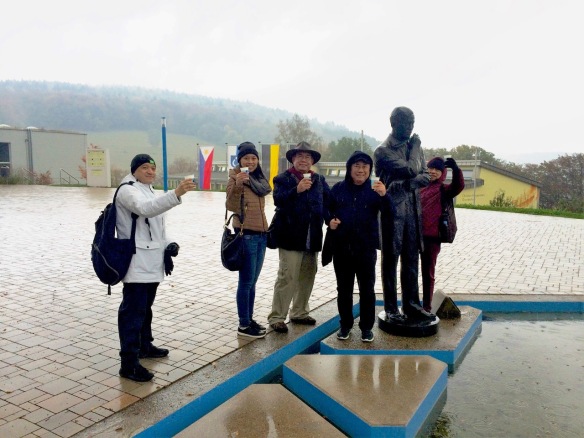
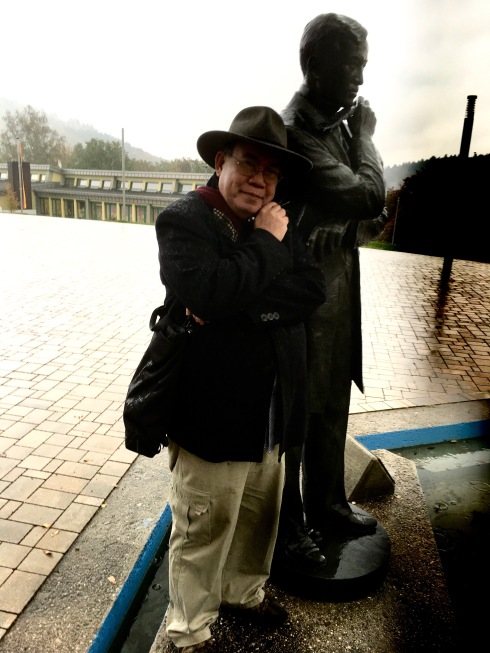
Many shuddering steps later, we arrived at a park overlooking the valley, in the center of which stood Rizal’s figure, easily a foot larger than life, as it deserved to be. We celebrated by opening a bottle of Potsdamer beer which CP had brought along for the occasion, and raising a toast to the great wanderer who had preceded us by 130 years but who yet challenged us, as it were, to write a Noli for our own times. After lunch back in Heidelberg, we prepared for another long trek to find his clinic at Bergeimherstrasse, only to realize that we had gotten off on exactly that street, and were only steps away.

Wilhelmsfeld.JPG

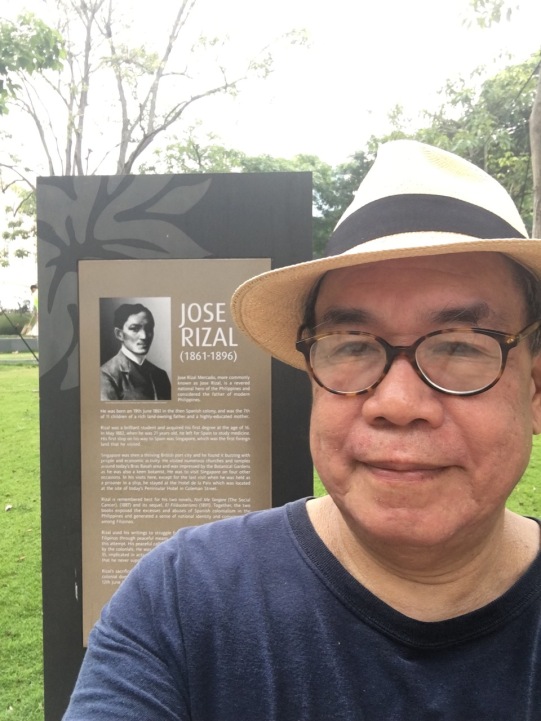
Weeks later, a totally unexpected bonus followed. I was in Singapore covering the Writers Festival when fictionist Cathy Torres—a diplomat who was serving with the Philippine Embassy in Berlin after a stint in Singapore, and had also joined us in Frankfurt—casually mentioned to me that Rizal had taken note in his letters of the black elephant statue beside the old Parliament House where the festival was being held. As it turned out, Rizal had visited Singapore four times—the first time in 1882, on what also happened to be the 21-year-old’s first trip abroad. The tip prompted me to look up Rizal’s Singaporean connections—immortalized in a marker near the Cavenagh Bridge, beside the likes of Ho Chi Minh, Jawaharlal Nehru, and Deng Xiaoping—but what floored me was discovering that he had once stayed at the old Hotel de la Paix at the corner of Coleman and Hill Streets—long gone, but since replaced by the Peninsula-Excelsior Hotel, where I was staying. I felt like I was no longer following Rizal, but he was following me.

IMG_9813.jpeg

In Dapitan, he had written: “I left, scarcely a youth, my land and my affections, and vagrant everywhere, with no qualms, with no terrors, squandered in foreign lands the April of my life.” If this was squandering one’s youth, what a glorious waste it was.


Penman No. 224: Fantastic, Frenetic Frankfurt (2)

IMG_9577.JPG

Penman for Monday, November 7, 2016


GOING TO the Frankfurt Book Fair was a great opportunity to renew old friendships and make new ones within both the global and Philippine publishing community. While we authors count publishers among our closest and most valuable friends, I realized in Frankfurt that we really don’t talk about their side of the business that much, as engrossed as we often are by our own fabulations.

I was particularly happy to finally meet Renuka Chatterjee, who had been India’s premier literary agent when she worked for the big Osian’s cultural conglomerate in New Delhi. As my first literary agent, Renuka had been instrumental in getting my second novel, Soledad’s Sister, translated and published in Italy; but more than that, she guided me through my first textual revisions, through which I began to learn how international publishing worked. When Osian’s shut down its literary operation, I passed on to another very capable agent in New York, and Renuka eventually joined another leading publishing house in India, Speaking Tiger. We had corresponded by email over the years, but Frankfurt gave us an excuse and a venue for a long-overdue face-to-face.

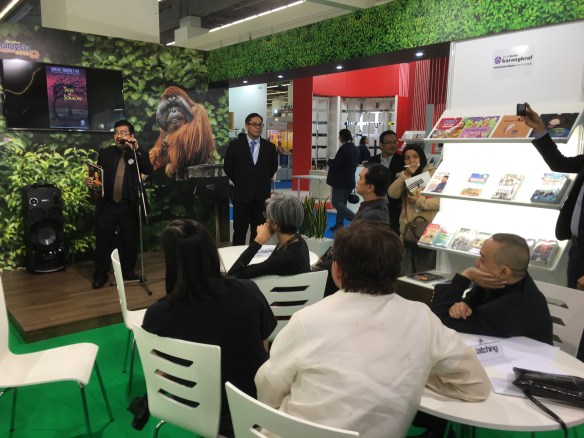
Another acquaintance lost and found was the dynamic and groundbreaking Malaysian publisher Amir Muhammad, whom I had first met at a conference in Penang in 1992; Amir gifted me with a new trilogy of Southeast Asian stories he had just published, featuring the works of some of our best young Filipino authors. (Those books—like many others I’ve gathered on my travels—are now lodged at the Gonzalo Gonzalez Reading Room in UP, where we keep a repository of contemporary Southeast Asian literature.) Indeed, and not surprisingly, the Malaysians became the Philippine delegation’s best buddies at the fair; we frequented their booth to partake of the nasi lemak and to trade notes on the writing life. The Indonesians were equally hospitable, and our troop of visitors enjoyed a chat and the inevitable selfie with their star, the novelist Eka Kurniawan, whose Man Tiger made the 2016 Man Booker International Prize long list.

IMG_9554.JPG

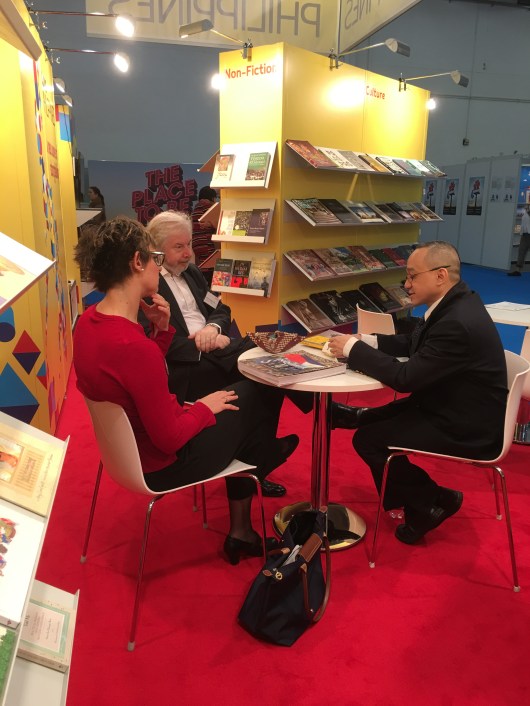
Neither were the long hours at our own booth wasted, as a steady stream of visitors curious about our books and our culture came by to browse, to converse, and to do business. Business, after all, was what most people went to the book fair for, and while some of us minded the store, our delegates were often out meeting with their counterparts from the US, the UK, Europe, and the rest of Asia. (I had a very productive conversation with a gentleman from Montenegro who runs a kind of global blog of blogs—expect “Penman” to appear there soon, but only after it’s published here, of course.)

IMG_9583.JPG

It was the Ateneo University Press’ new boss Karina Bolasco’s third straight year at the fair, which she had previously attended representing Anvil Publishing. University presses don’t generally look at their books as profit-makers, reducing the financial pressure somewhat, but Karina still had a full schedule of meetings with academic publishers, especially longtime Philippine partners such as the University of Wisconsin Press. “Our job is to negotiate for reprint rights,” Karina told me. “We try to find material already published abroad that will be interesting to Filipino readers, and we also offer other presses the rights to reprint Filipino works with a global appeal.”

One of the most visited displays in the Philippine booth this year was that of Mandaluyong-based OMF Literature, Inc., which has published religious and inspirational books since 1957. OMF CEO Alexander Tan told me that their market was big and growing—extending even to OFWs in the Middle East—and that it had developed its own local stars such as pastor Ronald Molmisa, who draws huge crowds to his lectures on love and relationships. “I realized that by breaking the rules and letting people like Ronald use Taglish in their books, we could reach more readers,” Alex said.

On the other hand, literary agents like Andrea Pasion-Flores, who now works with the Singapore-based Jacaranda agency, assume the task of representing Filipino authors abroad and finding publishers to buy their works (and who then assign editors to work closely with the authors on revising their text for publication). Andrea—an accomplished author in her own right who also happens to be a lawyer and the former executive director of the National Book Development Board—is the first and, so far, the only literary agent working actively in the Philippines. Jacaranda has already sold the rights for such distinguished Filipino writers as the late Nick Joaquin, Charlson Ong, Isagani Cruz, and Ichi Batacan (whose Smaller and Smaller Circles will be a movie soon).

IMG_9563.jpg

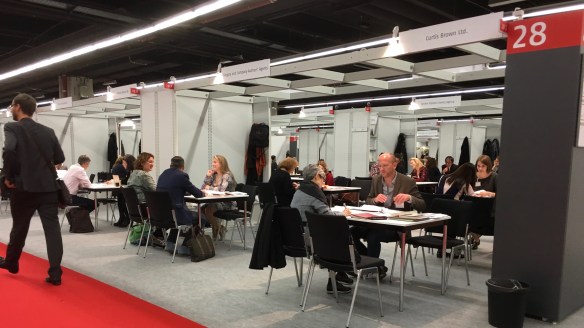
Andrea and her Jacaranda colleagues Jayapriya Vasudevan and Helen Mangham spent long working days in Frankfurt at the exclusive Literary Agents section upstairs, which only registered agents (who paid a hefty price for table space) and publishers could theoretically access. But Andrea secured a pass for me so I could observe the frenetic 30-minute “speed-dating” sessions that took place in hundreds of cubicles. “You’re probably the only author in this room,” Andrea told me. When I asked her what international publishers were looking for from Filipino authors, her response was quick and to the point: “The big novel, more genre fiction, and more high-quality literary fiction—and less ego, please, as Filipino authors generally aren’t used to revising their work!”

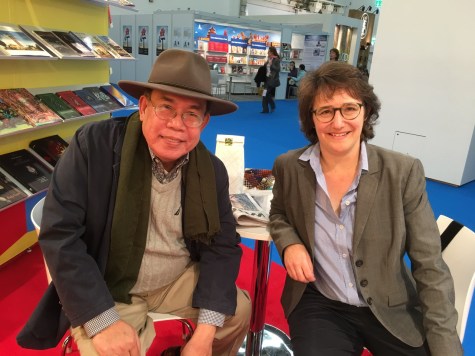
Back downstairs the next day, my companions at the Philippine booth were surprised to see me in animated conversation in Filipino with a Caucasian lady, whom I was happy to introduce to everyone. Our visitor was Annette Hug, a novelist and translator who had come from her home in Zurich to meet with me and with her publisher at the book fair. Annette—who took her MA in Women’s Studies in UP and regularly practices her Filipino with an OFW friend—had just translated a piece I had published last month in the Philippine edition of Esquire magazine, a piece on extrajudicial killings that had somehow gone viral; Annette’s translation had come out that same day in a Swiss newspaper and she brought me my copies, fresh off the press. But apart from that sad topic, Annette had also just published a novel in German, Wilhelm Tell in Manila, based on Jose Rizal’s work on that Swiss hero’s life, and the UP Press will now explore the possibility of publishing a translation of her novel in the Philippines.

IMG_9597.jpeg

Another visitor was children’s book author and Palanca Hall of Famer Eugene Evasco, who just happened to be in Munich on a three-month research fellowship, so he took the three-hour train ride to Frankfurt to visit the fair and to take in the mind-blowing displays at the children’s literature section.

Of such providential encounters, magnified into the thousands, was the Frankfurt Book Fair made, and while I was there less on business than as a roving cultural ambassador of sorts, I was glad and privileged to tick another item off my bucket list. I’ve run out of space to talk about an excursion some of us took to trace the footsteps of that quintessential Filipino writer, Jose Rizal, in nearby Heidelberg, so I’ll save that for another column soon.

IMG_9567.JPG

Penman No. 223: Fantastic, Frenetic Frankfurt (1)

IMG_9550.jpeg

Penman for Monday, October 31, 2016


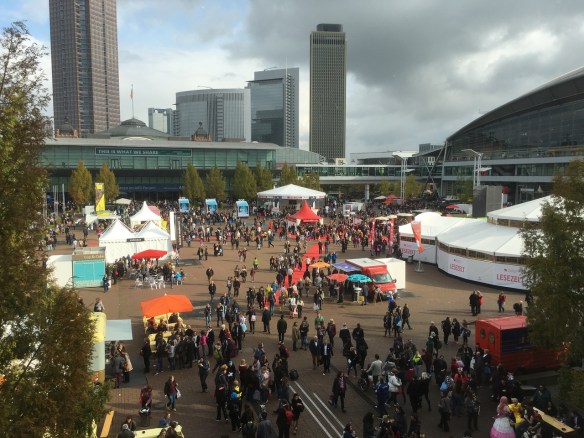
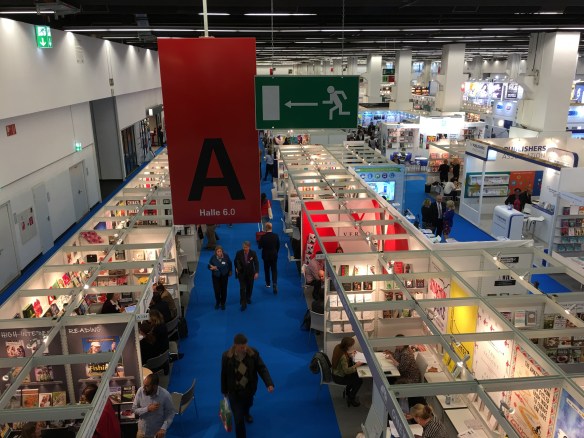
I’VE BEEN to mammoth meetings before—the Modern Languages Association in Chicago, MacWorld in San Francisco, Comic-con in San Diego, for instance—but nothing comes close to the Frankfurt Book Fair in size and scope. Covering over ten hectares of exhibition space spread out over several buildings and many floors, it’s certainly the world’s biggest and best-known book fair, gathering participants from nearly 200 countries.

Unlike author-focused literary festivals, the vast majority of those participants are publishers, booksellers, editors, literary agents, and printing industry representatives, all looking to make a pitch and a sale of their wares across the globe. That globe may have been made much smaller by the Internet, but nothing still beats a face-to-face transaction with one’s possible partners, and that’s where a book fair like Frankfurt’s comes in, as a week-long physical marketplace where the world’s publishers, from the biggest to the smallest ones, all go.

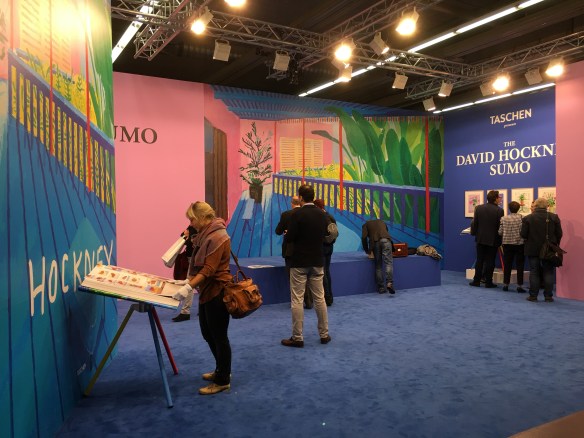
Inevitably a few writers and artists stray into the mix (we spotted David Hockney through a crack in the wall being interviewed at the Taschen booth by German TV), and this year I was one of those lucky few, with some help from the National Commission for Culture and the Arts and the University of the Philippines. Spearheaded by the National Book Development Board and invaluably assisted by the prime advocate of culture and the arts in the Senate, Sen. Loren Legarda, the Philippines expanded and upgraded its representation at FBF 2016, with a much larger booth and an impressive array of books from all our major commercial and academic publishers. The NCCA also sponsored one of our top graphic artists, Manix Abrera, and it didn’t hurt that National Artist Virgilio Almario came along in his private capacity to accompany his wife Lyn and daughters Asa and Ani who were representing Adarna Books and the Book Developers Association of the Philippines.

IMG_9720.jpeg

While Filipinos have attended the FBF in dribbles for some time now, it was only this year that we went all out, helped incalculably by our bigger booth. Last year, publishers had to chip in P100,000 each to rent a tiny plot of real estate at the fair, which starts at 400 euros per square meter. Sen. Legarda’s timely intervention meant that publishers could put their rental money into bringing more representatives and more books, and our 2016 delegation hit a historic high at over 40 members.

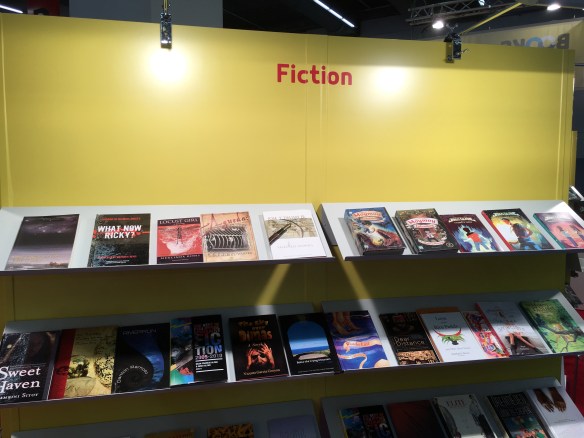
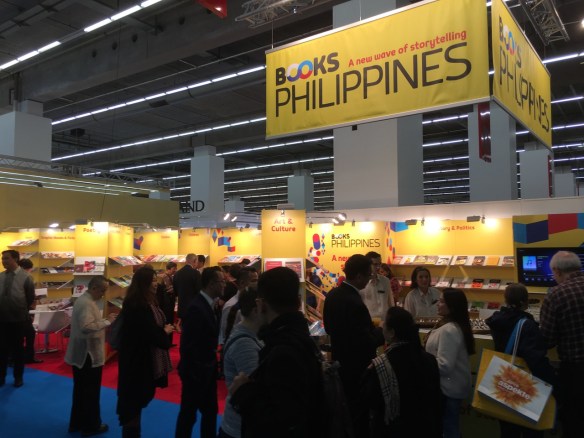
Though not yet quite the pavilion that countries like China and Singapore could afford, our corner booth was colorful and visually attractive—a plus in a fair with thousands of such offerings, all competing for the passing viewer’s eye. Through the Ateneo University Press (now headed by Karina Bolasco, formerly of Anvil Publishing), the Philippines also had another albeit smaller booth in another hall as part of the FBF’s invitational program, an affirmative-action project that brings in and sponsors selected publishers from developing countries. Predictably, China’s exhibit occupied a whole city block (for the price of which they could have gotten a better English editor for their signs, which proclaimed “Chinese Publication”).

On the other end of publishing pomp and circumstance, the FBF annually invites and celebrates a Guest of Honor, and this year it was the Netherlands and Flanders, which decked out an enormous hall as a haunting landscape reminiscent of the Dutch flatlands. The Guest of Honor status focuses attention not only on that country’s literature but its entire culture and society, providing an opportunity to put one’s best foot forward (Dutch royalty attended the opening ceremonies, lending a touch of glamor to the event—and ratcheting up security for everyone). The Guest of Honor also gets to choose a theme for its exhibit, which this year was “This Is What We Share” (last year, New Zealand—on the other side of the world, for Europeans—whimsically chose “While You Were Sleeping”). My fancy tickled, I asked what the Philippines needed to be named Guest of Honor—one can both apply or be invited—and received an unequivocal answer: “Millions of dollars.” I shut up.

Its cultural import aside, the book fair means big business for Frankfurt, which, in partnership with the private sector, leases out the fair grounds to such clients as the publishers’ association which directly runs the book fair; at other times the venue hosts other big events such as automotive fairs and a forthcoming Justin Bieber concert. Last year the FBF brought in 250,000 participants, a figure the organizers expect to rise to 280,000 in 2016.

IMG_9573.JPG

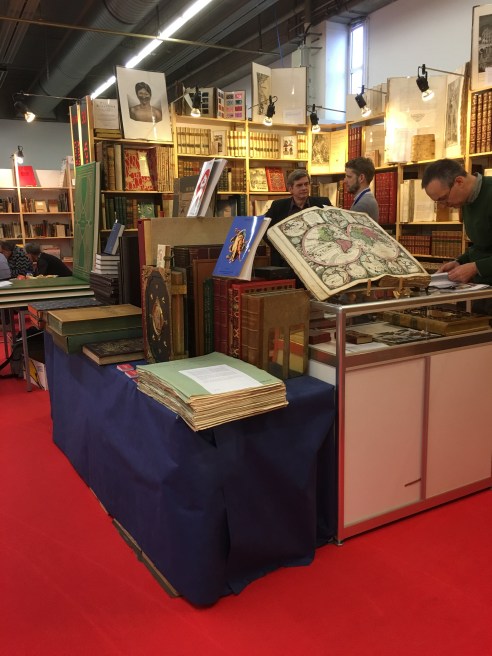
This year’s edition of the Frankfurt Book Fair is officially the 68th, but it traces its lineage much farther back to medieval times, when friars traded pages of illuminated Biblical manuscripts. There’s still a special section of the FBF devoted to the antiquarian trade, to which I gravitated naturally, being interested in all things ancient. Other than this parchment-heavy and leather-bound corner, the FBF dwells and thrives on nothing but new, newer, and newest—new books, new ideas, new authors, new media, new technologies, new markets, new connections, new networks.

Exhibits are grouped by geographic region, by language, and by theme, so one has to roam far and wide to get the full scale of things and to zero in on specific interests. Much of the business at Frankfurt, however, is pre-planned; with table space at a premium, publishers and agents would have emailed each other months or weeks in advance to set up meetings for specific dates and times in Frankfurt.

IMG_9584.JPG

The publishers of so-called “trade books”—novels, cookbooks, children’s books, etc. aimed at the general public—showcase their works to attract attention from international publishers and booksellers who may want to translate them into another language, or to sell the books on consignment in other countries. Academic publishers—this year we were represented by the UP Press, Ateneo de Manila University Press, and UST Press—negotiate among each other for reprint rights, which can make costly works more easily available to local readers.

Led by NBDB Chair Neni Sta. Romana-Cruz, the Philippines launched its exhibit with a reception at its booth on the fair’s formal opening on October 19, a well-attended event graced by Ambassador Melita Sta. Maria-Thomeczek (who was happy to recall that she had once been an employee in Rio Almario’s Adarna Books and had been a student of Rio’s wife Lyn at Maryknoll) and by First Secretary and Consul Cathy Rose Torres, who herself happens to be a prizewinning fictionist. The reception was catered by Maite Hontiveros, who laid out a scrumptious spread that featured lumpia, spoonfuls of adobo on rice, mango juice, and Philippine chocolate, which were clearly a hit among our foreign guests.

IMG_9536.jpg

Filipino books, of course, remained on top of the menu, and for the next week, we took turns at the booth to entertain visitors and book buyers from other countries, while occasionally slipping out to survey the vast array of exhibits and inevitably to marvel at the scope, vitality, and quality of global publishing in the 21st century. I came away even more convinced that culture is a global battleground, and that books are weapons—of mass instruction, if you will.

Next week, I’ll share the highlights of my conversations with key people at the book fair, and report on retracing Rizal’s footsteps in Heidelberg.

IMG_9564.JPG

Penman No. 222: An Education for the Well-Rounded Filipino

1094625733_b065e8bc1c_z

Penman for Monday, October 24, 2016


IN A few weeks’ time, several hundred professors at the University of the Philippines’ Diliman campus will gather together for an important vote on UP Diliman’s General Education program—long seen to be the hallmark of a UP education. It’s important because what happens there will determine, to a great extent, what “tatak UP” will mean for the next generation or two, and what being “the national university,” as its charter defines it, entails as far as the quality and the breadth of its offerings are concerned.

The raging battle seems to be over how many units (or class-hours a week) to allot to General Education subjects, which have traditionally covered basic and compulsory courses in such areas as language (English and Filipino), history, math, science, and philosophy.

There’s a menu of options on the table, ranging from a formidable 45 units to a scant 21, and an emerging compromise of 30-36 units in between; the mix of courses in these totals is also under negotiation. Those who want more want to ensure that every UP undergraduate—whether he or she plans to become a lawyer, an engineer, a surgeon, or a painter—can talk intelligently as a well-rounded citizen about the Katipunan and mitosis and perspective and Sophocles and interstellar travel. Those who prefer less want students to graduate from their programs sooner, for UP to remain competitive with other schools, and suggest that students can imbibe some GE skills both from their K-12 add-ons and from their higher-level classes.

I don’t mind saying that I put myself squarely on the 30+ side. We can’t keep complaining that young Filipinos can’t write or speak in proper sentences or don’t know who Apolinario Mabini was—without doing enough to fix the problem, given the chance. Sure, some of these learning points can be addressed in senior high; but subjects like History, English, and Philosophy will still be different when taught in UP’s staunchly secular context and pitched as adult concerns.

But never mind me—let’s give a listen to one of our most accomplished writers, the Leyte-born but now New York-based Gina Apostol, whose novels have won the 2013 PEN America/Open Book Award and National Book Awards in the Philippines. Some time ago, Gina wrote UP Diliman Chancellor Michael Tan to plead for the strengthening of UP’s GE program, and I got her permission to quote from that letter here:

I am writing as a graduate of the UP English department, 1980-1984, a former teacher at the department, and as a novelist whose work has been indelibly shaped by my education at UP—in particular, by its General Education program, to which I look back daily in my own work as a teacher and a writer.

My three published novels owe their genesis to that program. My current novel, William McKinley’s World, about the Philippine American War, began in a PI 101 class in a classroom at Palma Hall Annex, where my professor taught me about a war I never knew about.

In those first two years at UP, I learned to think. The General Education program made me into a writer. I went to a private high school in Leyte that certainly taught me well (arguably just as rounded as the current K-12 program); but I needed the General Education program at UP to make me whole—a critical consumer, a nationalist thinker, a global reader, and finally, it gave me ground to think honestly and seriously about what education means, it gave breadth of thought to allow me to become who I am—a novelist whose work is absolutely grounded in the questions that UP had asked of me in my first two years at the school.

It is my misfortune (though some call it luck) that I have ended up teaching in the States, living among an extremely lucky group of students: the wealthy enclave of Manhattan’s private schools. But every day, teaching my very privileged, very wealthy students who can enroll in any school they want, I can compare what they have to my education at Diliman, and I am daily impressed by the foundational, long view of knowledge grounded in the breadth of UP’s General Education curriculum.

My experience as an educator and an artist here in America is that the education I gained at the University of the Philippines is equal to and (given the state of America) too often exceeds the quality of education abroad. This is true of my fellow alumni who come to America: we understand how well we were prepared.

I cannot underline this enough: I know that UP provided me with an incalculable, a priceless education. I am writing to state emphatically that the General Education program at UP should be enriched, not reduced.

Even today, having been to and taught at several schools considered the best of their kind in America—so acculturated and mired in the world of the privileged as I am here in America—every day, in my classroom, I still marvel at the amazing comprehensive education I got at the University of the Philippines.

Here in Manhattan, these kids are killing themselves to get into colleges with the kind of education I got at UP. My own daughter went to the University of Chicago, and I will say that I was proud (and fascinated) to know my education as a freshman and sophomore was equal to her own rigorous coursework in the General Education program of the University of Chicago, where highly able freshmen have to go through the GE program. As you know, Chicago’s program still stands as a beacon of higher education in America today.

At UP, as my daughter was at Chicago, I was required to take philosophy, maths, history, sciences, and four rigorous courses in English that made me read across cultures (the stories of Akutagawa and D.H. Lawrence, Marquez and Achebe)—to read across time (Machiavelli and Madariaga, Rizal and Homer)—and to read across disciplines. I noted that just as at the UP in my time, the University of Chicago does not stint its students—my daughter was required to do the full two years of humanities reading before she did her majors, reading Hegel and Homer as a freshman and sophomore, as I was asked to do in Diliman. In my case, much of the knowledge that has stayed with me came in one packet (Dadufalza’s primer). The way UP taught its students to think then remains an incalculable benefit, equal to the best in America.

I repeat: I learned to think at UP, and the General Education curriculum made me into a novelist. It made me into a writer who can hold her own anywhere. It distresses me to think that the university will fail even one child, one student from the provinces, like me, who arrives at the university not knowing exactly who she could be—but now without the bulwark of its tough and extended humanities curriculum to point her to the myriad possibilities that creates not only engineers but also artists, not only scientists but also philosophers. The rigorous General Education program of UP is a boon to the country.

UP should strengthen its GE curriculum, not reduce it.

Please let me know how we, alumni across the world, can help to strengthen our alma mater. We love UP, we love our education, we would love to help.

Gina Apostol, AB English 1984


Penman No. 221: Teaching the Millennials

L1090932.JPG

Penman for Monday, October 17, 2016


THERE WERE no marching bands, greeting cards, or fireworks to mark the event, but World Teachers’ Day was celebrated last October 5. As unofficial or secular holidays like Mothers’ or Grandparents’ Day go, it’s a relatively new one, proclaimed by UNESCO in 1994 to draw attention to the key role teachers play in molding the citizens of every country. My calendar shows that I did nothing remarkable that Wednesday, my day off from teaching, so I very likely spent it on a foot-massage-movie-and-dinner date with Beng. But surely teaching would have crossed my mind, as it does every day, because we keep preparing for our next class even in our idle hours, wondering how we can make our students’ encounters with us more interesting and memorable.

I’ve been thinking about teaching a lot more lately, first because of the recent deaths of some valued mentors and colleagues. Just over the past month, our department lost two of its stalwarts—Professors Sylvia Ventura and Magelende “May” Flores. I’ve written quite a bit in this corner about Sylvia, my Shakespeare teacher, who fired up my enthusiasm for Elizabethan drama and poetry. May was an English-language specialist and textbook author, a sweet, imperturbable lady with a caring smile for everyone. (Continuing the tradition, May’s son Emil also teaches with the department and has become one of our prime experts on science fiction and creative nonfiction.)

The second reason is my own impending retirement, less than three years hence. It’s hard to believe that it’s been more than three decades since I gave up my PR job at a government agency to devote the rest of my life—as I told myself then—to studying, writing, and teaching. I never did become much of a scholar—I guess I did become the writer I wanted to be—but even this close to the end of an active career, the teacher in me is still a work in progress.

That’s because every teaching day is a new performance, even if—like it would be for a theater actor—the script may essentially be the same for courses you’ve taught for years. Every new batch of students brings with it a new mix of challenges—even, over the decades, a generational drift to adjust to. For example, a teacher can’t simply blame millennials for their lack of a historical memory, which we helped create; I try to get them interested in the past not for the past’s sake, but to show them how an appreciation of the past can help their future.

Teachers, in other words, have to keep learning about their students and their interests, so lessons remain fresh and relevant, rather than boring incantations regurgitated from ages past. We need to relate the lesson to the student’s present realities, which may seem daunting if you’re talking about, say, a 19th-century short story about the French bourgeoisie, but which can be done with a little imagination (in this case, I’d begin by talking about the Filipino middle class and its aspirations—“Where do you see yourself ten years from now?”).

But as vital as it is to connect directly with millennials, it’s just as important to remind them that there are many things in this world that may seem to have little or nothing to do with them that will still affect their lives—in other words, that we’re still motes in the grand scheme of things, and that Nature can be profoundly indifferent to our noisome plaints and woes.

That’s a harder lesson to impart, even to older students—to any person who hasn’t encountered something much larger than himself or herself, like a World War, or martial law, or a terrorist attack. In a me-centered universe, no one wants to feel disempowered, so I then have to challenge them into getting out of themselves and enlarging the sphere of personal actions they can take to improve not only their own future, but also that of their fellowmen.

Back when we ourselves were freshmen and sophomores in the early 1970s, this message came down to us in the exhortatory slogan “Serve the people!” Exactly how seemed a lot simpler to figure out back then, when a predatory dictatorship was looming over everything and everyone (a dreadful specter I thought I’d escaped forever). Today a young person’s options are far richer and more complex, with all manner of personal advocacies, NGOs, weekend CSR programs, and Facebook groups competing for one’s political attention.

But whatever the chosen means may be, the overriding need for building empathy remains, for leading young urban, middle-class Filipinos to see, to appreciate, and to grow their stake in a future that they share with the millions of others who live unlike them, many without the opportunities that they enjoy. We can’t truly be a nation—much less a Christian one—if we continue to dismiss the bullet-riddled bodies of the poor as trash because we find nothing in common with them.

A teacher’s job is to help students draw the line between two points, including and especially the most seemingly disparate ones. That includes the line between teacher and student, between student and student, and between student and society. If that’s all I’ve done these past three decades, I can retire happy.


AND NOW for something liberative. According to the exhibit notes, “Ebarotika! (You are Erotic, Eve) follows the story of Eve who dared venture into the forbidden. Her defiant act opened knowledge’s connection with sexuality, the knowledge of one’s sexual and erotic desire. But it also resulted in shame and punishment. Thus, many of us cover and hide our sexual and erotic life. Those who are bold enough to come into the open are subjected to stigma, discrimination, and death. Sexuality and the erotic are a source of life, joy, and pleasure. They are not objects of fear, horror, and anxiety. They must be opened, shared, and celebrated instead of being censored, concealed, and criminalized.”

Curated by Lia Torralba, Ebarotika! features 19 Kasibulan artists: Yasmin Almonte, Lot Arboleda, Chie Cruz, Cecil de Leon Escobar, Imelda Cajipe Endaya, Anna Fer, Lorna Fernandez, Kristin Garanchon, Lorna Israel, Amihan Jumalon, Nina Libatique, Eden Ocampo, Jonabelle Operio, Fel Plata, Rebie Ramoso, Benay Reyes, Doris Rodriguez, Christine Sioco, and Lia Torralba.

It opened last Saturday, but will run until November 23 at the Sining Kamalig Art Gallery located on the Upper Ground Floor of Ali Mall in Cubao, Quezon City. See you there!


Penman No. 220: Viva Visayan Artists

Kat1.jpg

Penman for Monday, October 10, 2013


JUST LIKE the city itself, which has undergone a refreshing makeover these past few years under the watchful eye of its chief political patron, former Senate President Franklin M. Drilon, Iloilo’s artists have been brimming with a new vitality that art lovers beyond the region have begun to appreciate.

I know that, because a few months ago, my wife Beng—herself an Ilongga artist and conservator who’d gone briefly back to Iloilo on family business—came home with the news that while in Iloilo, she had found and purchased a large painting by one of the city’s brightest young talents. The word “large” pricked my ears because it somehow sounded like “expensive” to me, but then she said she was paying for it herself, so I asked no further.

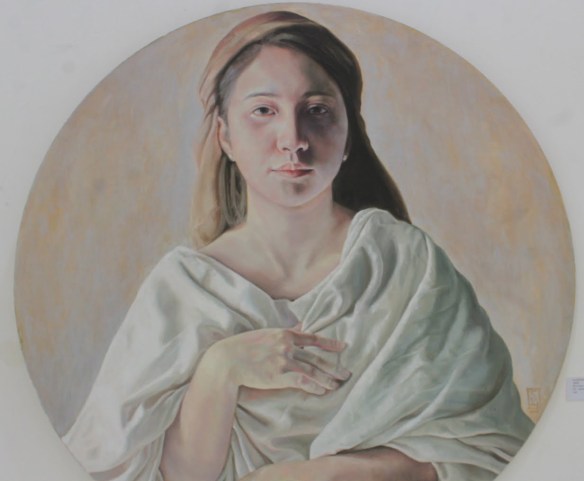
But I had to find out who the artist was, and Beng—who regularly tends to Amorsolos, Manansalas, Botongs, and Ocampos in her line of work—began gushing like a fangirl about a young painter she’d met while touring the Iloilo art scene with her old friend Rock Drilon. Rock, himself a painter of no mean stature (a recent exhibit at West Gallery displayed a penchant for organic, microbial forms), has been based in his home city for many years now, and has been a guru of sorts to younger artists there. So it was Rock who took Beng around to introduce her to his wards and their work, which was how this haunting painting of a young woman in white drapery found its way to our home in Quezon City. (It was too large to fly home with Beng and had to be professionally packed and shipped; I didn’t get to see it until months later.)
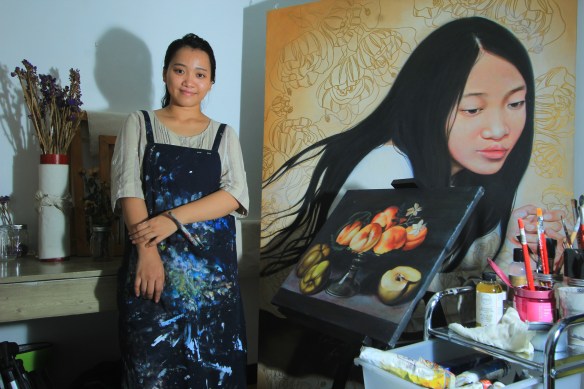
That’s when I first heard of Kat Malazarte, whose first solo exhibit Beng had seen at Casa Real de Iloilo, where Beng’s chosen work titled “Purity” (an apt choice for anyone surnamed Dalisay) had been the centerpiece. Just 20 at the time, she had already won the Vision Petron National Student Art Competition in 2015 for her video entry “Tingnan nang Malapitan, Damhin nang Malaliman” (Examine Closely, Feel Deeply). Indeed there’s a classical composure and pensiveness to Kat’s work, uncommon in artists of her age more prone to wanton kineticism. Her self-avowed themes of “purity, innocence, chastity, modesty, inner silence, contemplation, and state of nothingness” are monastic notions one might associate more closely with a nunnery (Kat’s a Fine Arts cum laude graduate of the University of San Agustin), and her subject’s luminous hands might have been rendered by a Renaissance master.

IMG_9403.JPG

So it was with much delight that Beng dragged me a couple of weekends ago to a three-day show at the Gallery at A Space on Legazpi Street in Makati, where a unique concept was being tried out by a pair of young and enterprising creatives, Karen Nomorosa and Prim Paypon. On show were the works of none other than Kat Malazarte and another rising Ilonggo star, the sculptor Harry Mark Gonzales. Dedicated to the theme of “The Quiet Strength of a Woman,” the show of Kat’s paintings and Harry’s sculptures proved a perfect pairing—much like the show’s instigators themselves, who both have outstanding corporate and science backgrounds (both are summas—she in CS, he in Biology) but who’ve taken on the more daunting challenge of promoting Filipino art through their startup venture, Curious Curator.

Kat Malazarte.JPG

“Curious Curator was conceptualized in order to help budding and potential artists from outside Metro Manila, especially from the Visayas and Mindanao, penetrate the mainstream art scene,” said Karen and Prim. “Keeping the welfare of the artist front and center, Curious Curator manages the financial, marketing and sales aspect of the collaboration so that the artist can focus on the creation process. Curated and conceptual art exhibitions are held in non-traditional venues to reach a wider audience. This enables the startup to promote the evolving Filipino artistry while diversifying and simplifying ways that budding art collectors can secure original but affordable art pieces.”

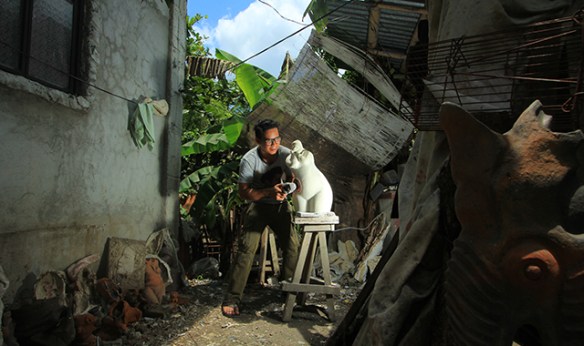
The two-person exhibit at A Space realized that mission. While we had already seen Kat’s work, Harry’s cold-cast marble figures, more than vaguely reminiscent of Henry Moore’s sinuous women, were another revelation. Coming from a background in IT and with a large brood of siblings to help support (he once drove a sikad around the city), this carpenter’s son put his faith in his vision and his hands, and began sculpting pieces that quickly won local collectors over. The self-taught artist won a Metrobank Art and Design Excellence Award in 2007 for a terracotta sculpture he crafted to protest an oil spill in Guimaras. “My main inspiration for these pieces is my mother,” he told me as we surveyed his pieces, whose exaggerated torsos suggested an overflowing fullness of all good things.

harrymark640.jpg

It was too bad the show ran for only three days, from September 30 to October 2, but with rentals at a premium, Karen and Prim have had to be more creative in their marketing, aggressively promoting the featured artists and their work online and selling a good number of them even before the show opened.

As for myself, I got the best part of the deal when Beng generously agreed to lend me Kat’s signature work “Purity” to hang in my new office at the UP Institute of Creative Writing (after the Faculty Center fire last April, we’ve found a new home in Room 3200 of Pavilion 3 at Palma Hall in Diliman).

But there are even more exciting events on the Iloilo art calendar to look forward to, chiefly the Visayas Islands Visual Arts Exhibit and Conference (VIVA Excon) which will be held from November 17 to 21 in Iloilo City. The event will take place in four different venues: the University of the Philippines Visayas (UPV) Art Gallery for the Garbo Sa Bisaya Awardees Exhibit; the Museo Iloilo for the Romeo Tabuena Tribute Exhibition; the UPV Auditorium for Turns in Form (Curated Contemporary Art from the Visayas); and the Visayas Art Fair.

VIVA Excon will also feature lectures on contemporary art practices, talks by artists, and workshops; an art conservator named June Poticar Dalisay, aka Beng, has been invited to talk about art conservation and restoration, and I’m going to do my darnedest best, my schedule permitting, to tag along. Left to herself, Beng just might drag home another local discovery—not that I’d mind too much.


Penman No. 218: History and Irony

11884866_supreme-court-extends-status-quo-ante-order_e9546b1e_m.jpg

Penman for Monday, September 26, 2016


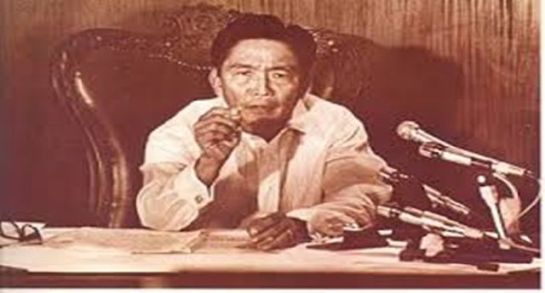
I’D NEVER heard of Ramon Cualoping III and Marco Angelo Cabrera until their names were linked to the recent flap involving the use of no less than the Official Gazette in an apparent effort to sanitize the memory of Ferdinand E. Marcos by removing any reference to martial law—you know, the martial law that Marcos invoked to impose his dictatorial rule on his people from 1972 until he was deposed by a popular revolt in 1986. (Yes, he technically lifted martial law in 1981 but he continued to rule with a rubber-stamp legislature.)

Some Googling revealed that Cualoping was an Ateneo Communication Arts graduate, batch 2004, while Cabrera graduated from San Beda in 2013 and interned briefly with the Department of Foreign Affairs; he had also worked for Sen. Bongbong Marcos. Those are both fine backgrounds for jobs at the Presidential Communications Operations Office—just the kind of posting on which many young writers and lawyers aspiring for a political future have cut their teeth—and I can surmise from the dates provided that Messrs. Cualoping and Cabrera must be in their mid-30s and mid-20s, respectively—too young, therefore, to have personally known what the Gazette expunged.

In the interest of full disclosure, I was a government propagandist myself at an even younger age—19, fresh out of martial law prison. Having dropped out of UP and having worked for the Philippines Herald and Taliba just before martial law, I got a job with the PR section of the National Economic and Development Authority. The irony of going from writing incendiary flyers to trumpeting such new government projects as Pantabangan Dam wasn’t lost on me. But I was getting married and needed a job, and all the old media jobs were gone save for the Express and the Bulletin, so I was thankful for whatever came my way. (I would much later write hundreds of speeches for FVR, among other Presidents and political clients—mostly to pay the rent, occasionally for the sheer privilege—so don’t look at me as some crusading journalist.)

I don’t know what drove Messrs. Cualoping and Cabrera to the Palace; I’m assuming their motives were loftier than mine. I also don’t know what made them officially forget (hey, it’s the Official Gazette, right?) that FM declared martial law. I suspect they knew what happened, but chose to ignore the most salient fact about Marcos’ life, for reasons only they can tell. To his credit, Communications Secretary Martin Andanar effectively reprimanded his staff for the deliberate oversight and corrected the record.

I’ll leave further chastisement of these two gentlemen to the netizens who broke the story. From one PR pro to another, what I can tell them is this: I understand the job you have to do and even your private allegiances, but there are things—very big things much bigger than yourselves—that you just can’t sweep under the rug. Denying martial law or its disastrous effects on our society and economy is like telling Jews that the Holocaust never happened, or was actually a good thing. I salute you for your cheek, but what on earth were you thinking?

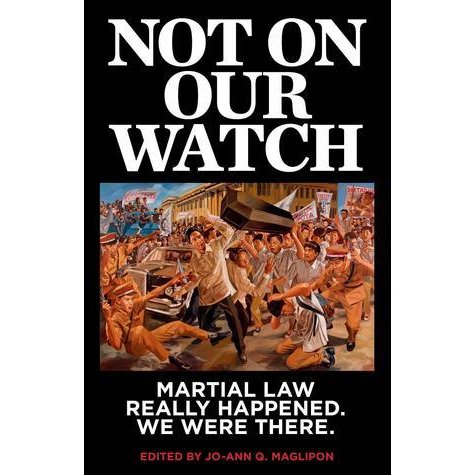
There’s a book I’d like to recommend to these two, one which I and a dozen other writers—all students during martial law—put out four years ago on the 40th anniversary of Proclamation 1081, titled Not on Our Watch: Martial Law Really Happened, We Were There. (For more on that book, see here: http://www.philstar.com/sunday-life/806191/lest-we-forget.) I wasn’t too enamored of the long title at that time, but now I appreciate the emphatic clarity of the thing; it’s just the sort of book martial law amnesiacs and deniers need to read.

16136602._UY475_SS475_.jpg

But even as we review history, there’s one thing that seems to have escaped many: the current debate about how to look at martial law and where to bury Ferdinand Marcos isn’t about the past; it’s about the future, and what kind of people we are and want to be.

I know that millennials tend to get beat up on because they don’t know enough about martial law, which is hardly their fault since we didn’t teach them enough about it. But it isn’t just them. When people my age express bewilderment over how Bongbong Marcos came so close to becoming Vice President despite his dad’s misdeeds, and how the Marcoses have survived so handsomely, I have to remind them that even under martial law, those of us who opposed Marcos were in the distinct minority. Most Filipinos supported martial law, actively or passively, or it wouldn’t have lasted so long. Like the Germans who supported Hitler, most Filipinos stood by while we faced the truncheons and firehoses—and even applauded 1081, early on, as the antidote to Communism (1972’s “war on drugs”). So what should we be so surprised about?

That’s why I’ve never referred to EDSA 1 as a revolution, because it wasn’t one in terms of changing anything fundamental in the structures and workings of our society. It was a popular uprising, a street revolt led by another faction of the ruling class, with broad support from the metropolitan middle class. That doesn’t mean I didn’t feel euphoric that February, and I still get teary-eyed when I remember the moment; I guess the poignancy comes from knowing what came afterward.

I have no doubt that if the Palace incumbent were to declare martial law today for whatever reason, a majority of Filipinos would support him, although a noisy few of us would be up in arms. Martial law ca. 1972 was also like that, and remained popular for many more years, especially among amoral businessmen who sang its praises until it hit them in the pocket. And then it all went downhill.

Contrary to what you might expect, I don’t see Marcos as a one-eyed ogre, but rather as a calculating Macbeth, keenly aware of his actions and perhaps even troubled by them. In my own turn with revisionism, I’ve even managed to convince myself—as I told the BBC in a recent interview on EDSA (a part which never got aired for lack of time)—that Ferdinand Marcos may have done us a final act of kindness by leaving without ordering a bloodbath. It’s an arguable notion (one I wouldn’t put on the Official Gazette) and it doesn’t change the fact that his regime took what it could until we bled, but as a fictionist and playwright, I like to imagine characters to be more complex than they seem.

A couple of years ago, at a cultural function in Quezon City, Mrs. Marcos preceded me by a few steps down a narrow staircase. She was clearly having a hard time navigating the stairs, and she looked back at me apologetically to say, “Hijo, I’m very sorry I’m keeping you.” I smiled and said, “It’s all right, Ma’am, please take your time.” I felt amused and strangely triumphant.

History is sometimes best seen as a series of comic and tragic ironies, which straight journalism and certainly government tabloids can’t dispense. Come to think of it, who gives a hoot about the Official Gazette? If you want to lie and get away with it, try fiction. I’d be happy to see Messrs. Cualoping and Cabrera in my graduate workshop.


Penman No. 217: We Were Young Together

PSHS10.jpg

Penman for Monday, September 18, 2016


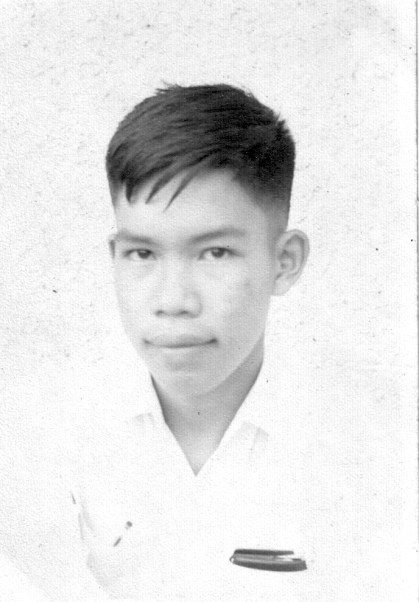
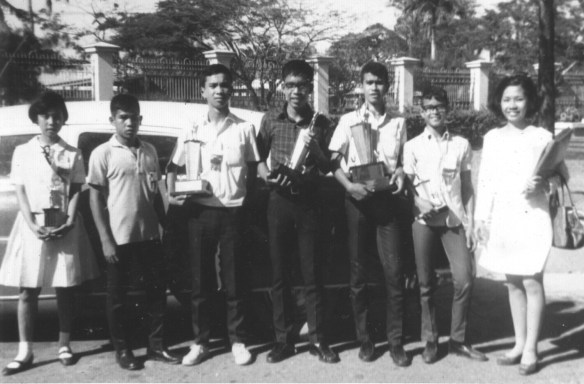
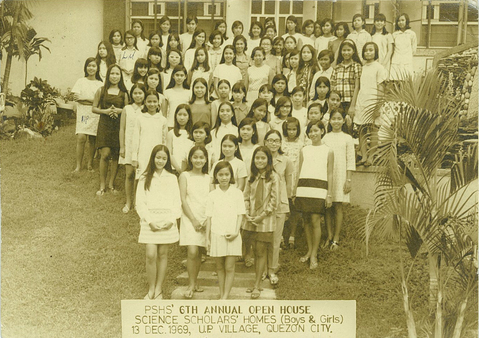
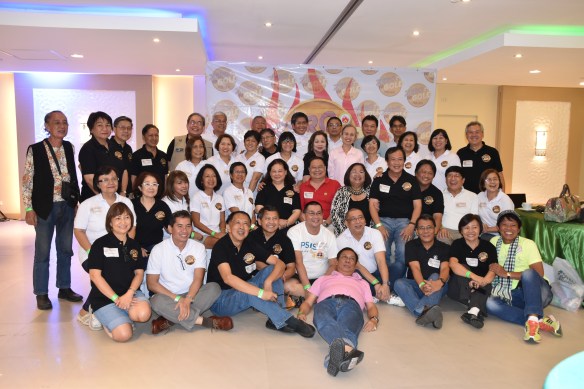
I HAD the honor of being asked to speak at the 50th anniversary reunion of my Philippine Science High School batch (we chose to celebrate our entrance year, 1966, fearing that there’d be fewer of us to gather in five years). It was, I joked, the valedictory I never got to deliver, for reasons that will be shortly obvious. You’ll forgive the chest-thumping; every high school has a right to think it’s the best on the planet—perhaps some more so than others. Herewith, an excerpt:

I’ll begin with a shameless boast, and the boast is that over these past four decades, I’ve won quite a few awards and prizes for my work as a writer and teacher. But none of them has given me as much pride and pleasure as the knowledge that once upon a time in 1966, for one brief shining moment and for some miraculous reason, I topped the entrance exam to the Philippine Science High School.

It was a fleeting glory, and if I ever imagined myself a real genius I would be quickly disabused, because as you all know, after our first year, my grade in English was 1.0 and my grade in Math was 5.0. Only the kindness or perhaps the embarrassment of our administrators persuaded them that I was worth giving another chance and putting on probation, a break I’m forever thankful for.

I have never felt in more distinguished company than yours. Individually and collectively, you are the smartest people I have ever known, and it has nothing to do with PhDs or awards or high positions in government and business or least of all material wealth—although I’m sure we could all use a little more money. I know that I can sit with anyone of you and have an intelligent and funny conversation about anything from interstellar travel and Dutertean diplomacy to hugot lines and Pokémon—well, maybe not Pokémon.

Long before buzzwords like “world-class” and “globally competitive” came into fashion, there were smart kids who passed an entrance exam that decimated whole regiments of lesser beings, leaving a few good boys and girls standing after the slaughter, calmly noting the distinction between cousins and cosines, avocados and Avogadro, halitosis and mitosis.

PSHS2.jpg

Hey, these kids were us—gangly, smelly (after a good day’s work at the biology garden, or the agawan-base arena), cocksure in the classroom, and curious as hell about the opposite sex. Not surprisingly, boy-girl questions dominated the school’s philosophical life.

“What Is a PSHS Boy?” asked the Science Scholar ca. 1969, and the soul-searching answer came (courtesy of someone who should have known—a PSHS girl): “A PSHS boy is a new sociological specimen of the human race… a hardworking nekti achiever [who keeps] a well-tended garden near the bio pond…. a longhaired mod swinger around the campus [who] wears kooky sunglasses, stylish baggy pants, and necklaces… He crams love letters in his notebooks. When Mr. Mozrah asks him ‘What is social interaction?’, he recites his lovelorn adventures with Jennifer, Corrine, Paulette, etc….”

PSHS11.jpg

This penetrating study naturally occasioned a companion piece, published a year later under the thought-provoking title of “What Is a PSHS Girl?”, written by an expert on the subject, a PSHS boy.

“A PSHS girl,” this savant said, “is a rare biological specimen… She is only emotional, temperamental and irrational sometimes (well, half of the time… would you believe almost always?). Anger is not a word in her dictionary. You see, her dictionary starts with ‘boy’… A PSHS girl is the reading type. She reads Emily Loring and the like.”

PSHSGirlsDorm.jpg

It didn’t take too long for a PSHS girl—uhm, PSHS young woman activist—to trash that silly, bourgeois, sexist view. “Now is the time for awakening,” this budding feminist would write in the same Science Scholar just a year later. “Do you realize that today you are a mere tool of the man?… Our bourgeois-oriented society adds insult to injury by picking up things for you and opening doors for you—reminders of sexual disparity—the very chains you should set out to break.”

We don’t know how many chains were broken; some precious objects certainly were (er, windows, petri dishes, innocence, and rules). Talk about rules! A famous one—dated September 29, 1970, and issued by the PSHS Board of Trustees—decreed that PSHS scholars “remain single and be discreet about their boy-girl relationships in order to continue their studies at the PSHS.”

Perhaps another topic of passionate discussion—“Should Smut Movies Be Allowed?”—had something to do with this heated  state of affairs.

The guidance counselor warned: “If they only display the human body for art’s sake, then there’s nothing wrong.  But if what they show are the acts sacred to man and woman, and those which arouse man’s sexual instincts and cause him to do something about it, then definitely, smut movies should be banned!”

Not too definitely, a freshman objected: “In European countries, especially in Scandinavia, sex movies have become so ordinary that they now seem to be part of the people’s lives.  In the Philippines, there is indifference towards these movies.  The Board of Censors should allow more of them and let us see what the attitude of the public toward them will be in the future.” [Brilliantly said, young man, an answer truly worthy of a science scholar—we’re not watching smut movies, here, we’re watching popular attitudes!]

Ah, the times, they were a-changing.  “The opening of the intramurals ushered in a new sight on our campus,” reported a sports columnist (a distraught boy) in the Science Scholar in 1970.  “Where once only boys were seen, girls have materialized…. The girls’ presence cannot be ignored…. In so short a period, many can be said to equal the boys at their own game. Complaints have been heard from the girls that the boys have been monopolizing both the basketball court and the ping-pong tables.”

That should’ve told us that the days of the Young Gentlemen’s Club and the Girls’ Club—no one had the gumption then to set up a Young Gay and Lesbian Club—were coming to an end. Some brazen soul in our freshman class organized the UBAG (United Boys Against Girls), but that didn’t last too long. Biology would teach boys that uniting with girls instead of fighting them was the more natural and pleasurable thing to do.

For a few of us after high school, life may have been a breeze, but for most, I’m sure it’s been an uphill climb, full of rough patches, and you were just as astonished as I was to find that a high IQ did not guarantee happiness or prosperity or success and may even have made things worse because of our more acute awareness of the meaning of things. We learned that the smartest people can make the dumbest mistakes in love, money, and politics, and that sometimes we just don’t know squay about the things that truly matter. I even learned that you could be happily married to someone from UP High.

Most important of all lessons and legacies, we learned to serve the people. Whether we grew up to be NPA cadres or CEOs or lab rats or barrio doctors, we knew that our high school scholarship had to be repaid in faithful service to community and humanity, employing the scientific, rationalist outlook that even those of us who strayed from S&T never quite lost.

We were young together, and we will grow old together. As we’ve all learned from life, it isn’t who leads at the start of the race but who finishes first at the end who wins—although again I suspect that in the race of life, we’d rather finish last.

PSHS6671.jpg


Penman No. 216: From Bali Song to Balisong

IMG_8436.JPGPenman for Monday, September 12, 2016


I’D BEEN meaning to write this up for the past few months, but more pressing subjects kept getting in the way—and “pressing” is the word, because this is about the complete opposite: total relaxation with no fixed schedules or time limits.

It was sometime this past summer when I accompanied my wife Beng and a group of her UP High batchmates on a day trip to Batangas to scout some places as possible sites for their upcoming golden anniversary reunion next February. Beng already had one such place in mind—Cintai Corito’s Garden in Balete, not too far from Lipa, which we had already visited with the family a few months earlier, and had been much impressed by.

Like many Manileños, we’d long been looking for day-trip or weekend alternatives to Tagaytay, especially for bringing our foreign visitors and balikbayan relatives to. Frankly, as a bulalo and ukay-ukay addict, I myself never tire of Tagaytay for a quick break from Manila’s madness. But lately, on our sorties to Mindoro and Romblon via the Batangas ferry, Beng and I have been taking the STAR tollway a lot and have often found ourselves wanting to stop over in one of the many towns on the way.

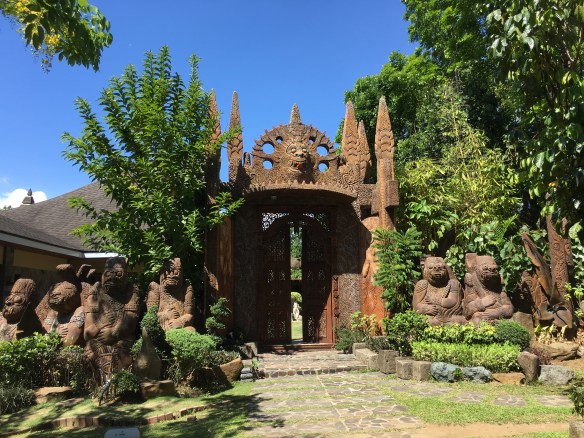
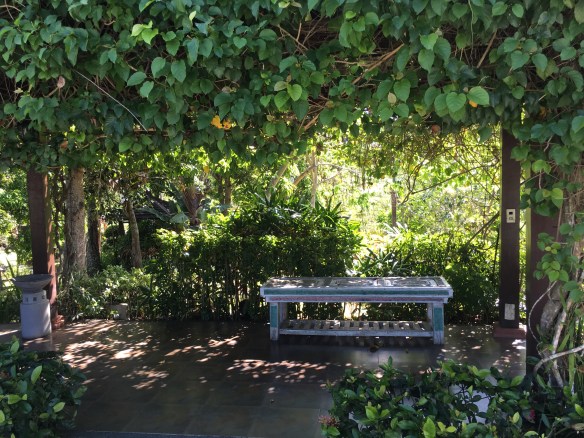
The Balete exit is one those innocuous detours that you’d take only if you really knew where you were going, and the narrow road that you get on leading to Cintai promises little beyond the shops selling honey along the roadside. Cintai itself doesn’t look like much from the outside—until you drive down the winding entranceway. The point of this long prelude is that you’d never imagine such a magical place to arise out of the Batangas countryside—a virtual Balinese-inspired Eden carved out of a rolling landscape that once might have been dotted by coconut and coffee.

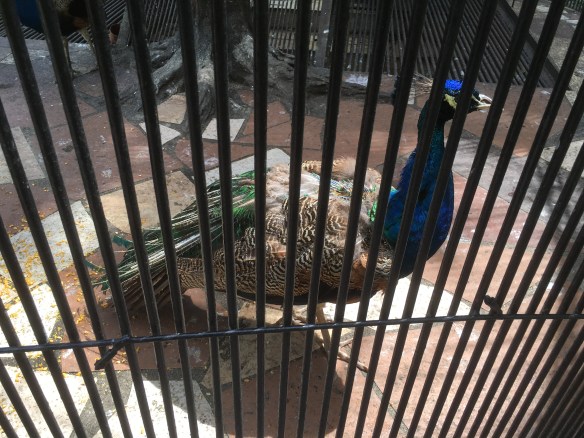
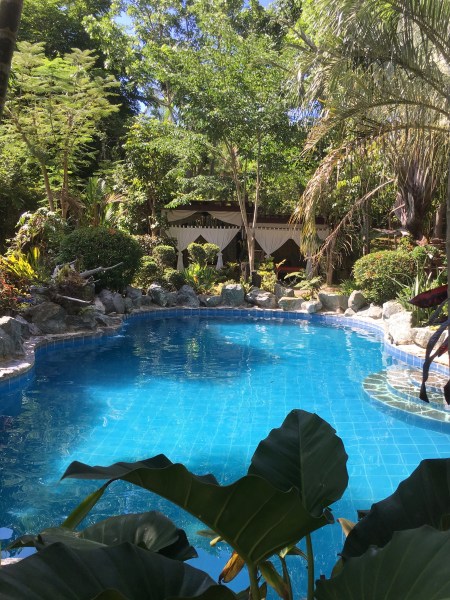
Cintai (which means “love” in Bahasa and is pronounced Chin-TAI) is a love offering to the late Corito of the place’s original name, the lady who inspired this outburst of Indonesian exotica in Southern Tagalog. It would be easy to think of the place as a theme park or resort—there are three swimming pools, and you’ll find peacocks, alpacas, roosters, and dwarf horses roaming the grounds—but other such places imply loudness, both literally and architecturally.

IMG_8415.JPG

Cintai is anything but loud—visually impressive, for certain, but just on the right side of tastefulness. Given the easy temptation to go over the top, Cintai’s designer wisely decided to make just enough of a statement, but also to take care of the fine details and of their consistent employment, even the patterning of the rocks on the walkways and the Balinese carvings in the bathrooms.

In other words, as in Bali itself (which I had the pleasure of visiting 30 years ago), the appeal of the place is in its soulful serenity. The management could have hyped up the atmosphere by piped-in gamelan music, but they resisted even that, for better effect: the gamelan will tinkle in your mind. (One interesting discovery: the Balinese statues, figures, and accents in the complex were mostly made by Batangueño craftsmen.)

IMG_8784.JPG

The complex comprises 18 villas with variable capacities, two large halls, a spa, and a restaurant, among other facilities (for more details, visit http://coritosgarden.com). Beng and her UP High batchmates plan to have the place to themselves for an overnight stay, an ideal set-up for a big group, but walk-in day trippers are welcome, for a very reasonable rate that includes a sumptuous lunch.

IMG_8419.jpg

And that’s what we did on this scouting trip—tour Cintai and have lunch with its amiable manager Francis Salanguit—but I had another suggestion for the group, which they gamely took up: go a bit farther down the highway to Taal, about a 40-minute drive away, to give everyone (especially the balikbayans) a special treat of history and heritage. I’d also been to Taal before and had visited one of its fabled heritage houses and its cathedral; I wanted to see more. So we set out after lunch and were in Taal shortly after.

The historicity of Taal was immediately apparent in the old Spanish-era houses lining the approach to the town. But what also accentuated (I was going to say “sharpened”) Taal’s uniqueness were the shops hawking a fearsome array of bladed weapons—specifically the balisong, the fan knife of many a boyhood fancy, ranging from the mini to the outsized version. Batangas, of course, and Taal in particular can look back to a proud revolutionary tradition, and the balisong seems to exemplify that don’t-mess-with-me attitude Batangueños are famous for.

IMG_8809.JPG

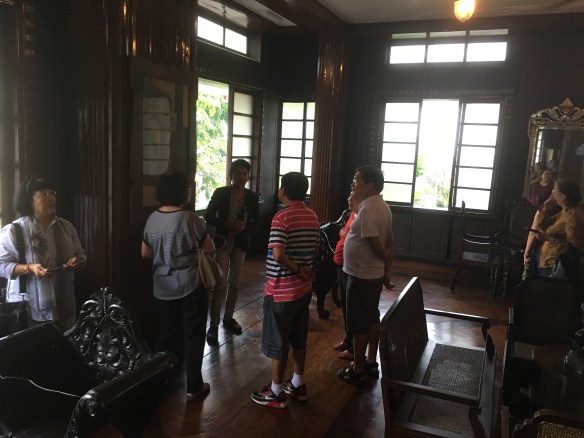
We didn’t stop that day to buy any knives—imagine the alarms they’d trigger if someone forgot about them on the plane ride Stateside—but we pressed on to our main destinations: the Apacible and Agoncillo heritage houses, both of which can be found on Agoncillo Street. I’d seen the Apacible house on my previous visit and had been charmed by its wonderfully preserved furnishings, but I was pleasantly surprised to see how the National Historical Commission, which manages the two historic houses, had taken pains to provide visitors with a more enlightening and rewarding experience.

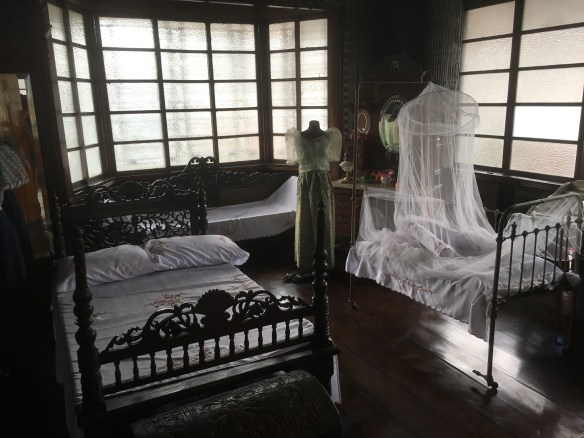
Guests (who may come in for free, but are encouraged to leave a donation) are met and led by a knowledgeable guide; the AV show that introduces the place, its previous owners, and its history was one of the most artistic and professionally produced I’d ever seen. Markers, captions, and child-friendly installations were provided where necessary, and additional information was contributed freely by our young guide. The Apacible brothers—Leon and Galicano—were cousins and confederates of Jose Rizal, who came to their house to talk revolution; Leon was a lawyer and soldier and Galicano a doctor and propagandist, and though less known in the pantheon of Filipino heroes, they come alive in the exhibits that pay due homage to their contributions.

IMG_8812.JPG

The Marcela Marino Agoncillo Museum and Monument a couple of blocks down the street was just as well kept and well introduced with its own AV production (my kudos to Dr. Maris Diokno, whose dual backgrounds as teacher and historian—not to mention her own proud lineage as the descendant of true heroes—can be seen working here to best effect). Marcela was the wife of diplomat Felipe Agoncillo, but came to be known on her own as the co-creator of the first Philippine flag while on exile in Hong Kong.

Just as Cintai’s gardens had appealed to the spirit, Taal’s heritage houses touched both heart and mind—and it took just a few mouthfuls of the local suman, washed down with barako coffee, to complete our Batangas experience with a boost to our famished stomachs. I’m not knocking Tagaytay, but one of these days, you just may want to go a little farther down the road and try a bit of the best that Batangas has to offer.

IMG_8802.JPG