Penman No. 142: A Foray into Fairyland

IMG_7223

Penman for Monday, March 30, 2015

LIKE I promised to do after an all-too-brief overnight sortie last January, I returned to my birth province of Romblon a couple of weeks ago—my first real visit home in almost 20 years—for a full week of catching up with a barangay of cousins, uncles, and aunts, some of whom hadn’t seen me since I was a boy.

But the family reunions and the endless festivities aside, what stood out on this trip was a foray into Fairyland—a highly unusual detour for this hardcore skeptic, who nevertheless went gamely along for the ride, and who came out richly rewarded with fairy tales if not with actual encounters with the other kind.

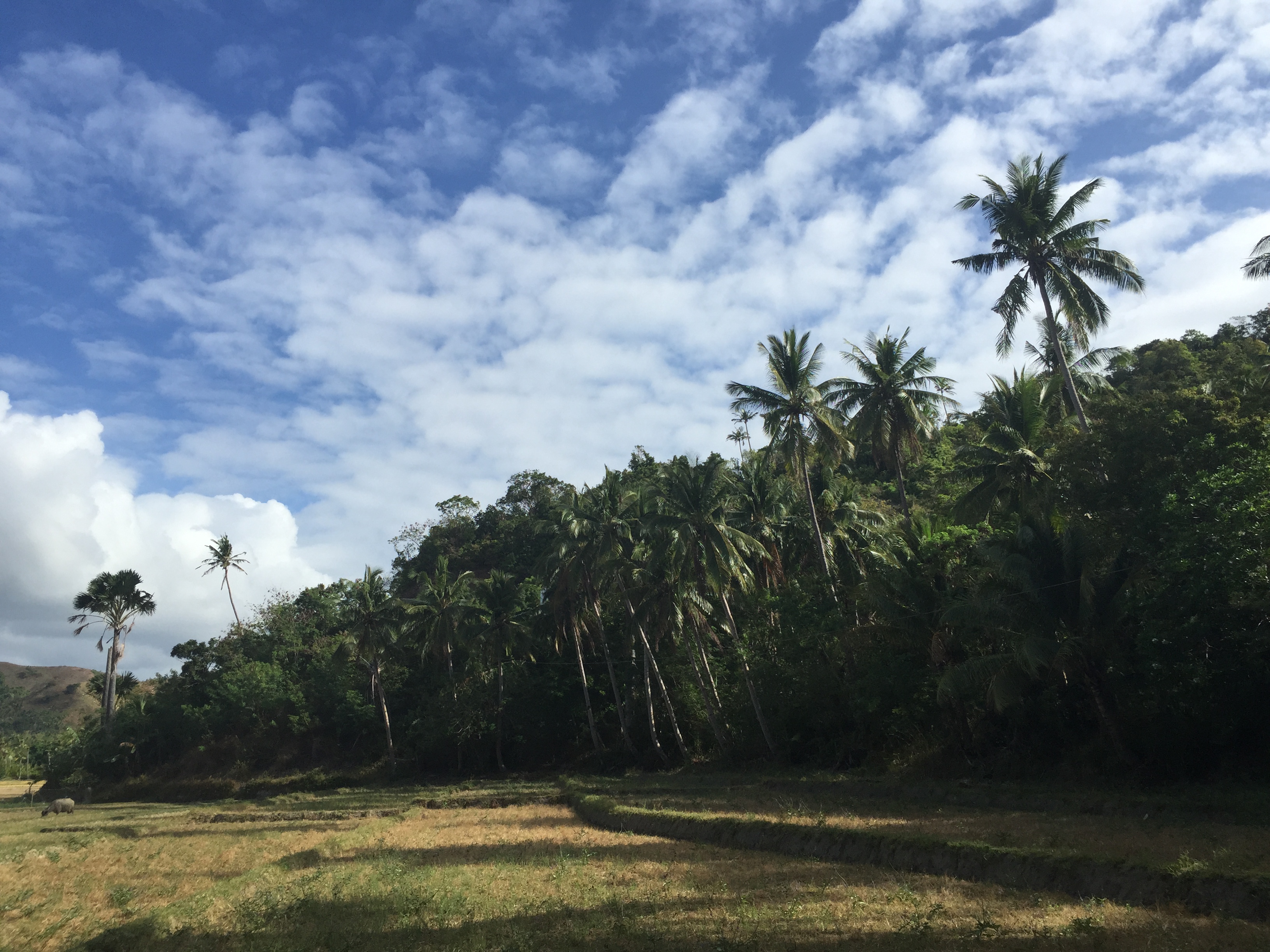
You won’t see it in any of the tourist guidebooks, and you might need to know the cousin of a cousin to navigate safely around the place. They call it Calatong—a word for which, in the local dialect of Guinbiraynon, there seems to be no precise translation, but it’s otherwise known even to the place’s youngsters as fairyland, the mountain inhabited by encantos, the enchanted ones. It dominates this corner of Romblon’s largest island of Tablas, both physically and culturally; from far at sea, Calatong’s tall hump offers an unmistakable landmark; by land, along the winding dirt road from Alcantara to Guinbirayan, it rises on your left, a massive mystery, although it might take some time and tuba to get the stories about Calatong flowing through the conversation.

I had seen and known about Calatong from my earliest years in Guinbirayan—my mother’s hometown—and even on this most recent visit, it was the first thing I would see outdoors when I stepped out of the house at daybreak, because the sun would emerge from behind it like a glowing crown above a dark and brooding head.

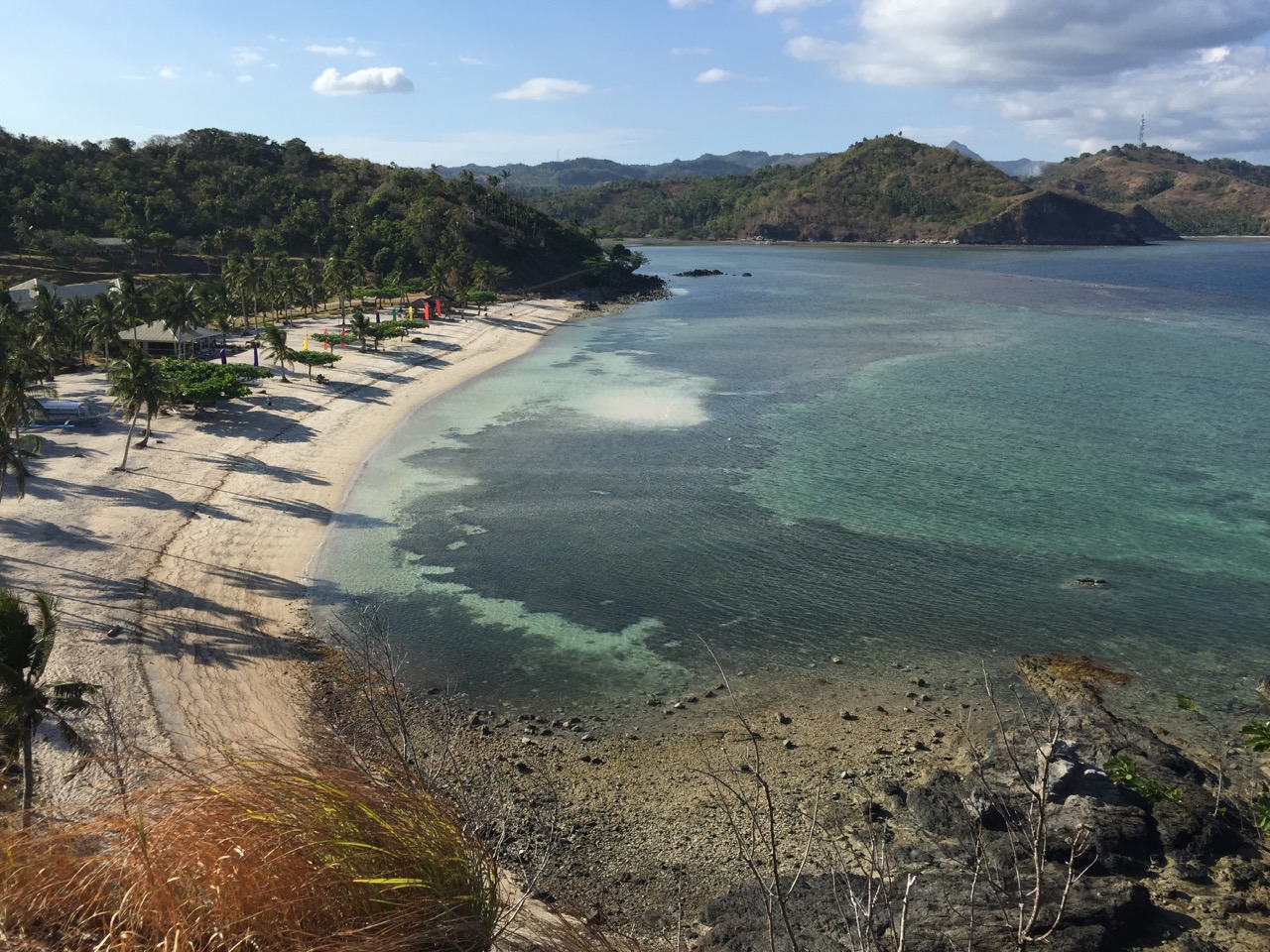
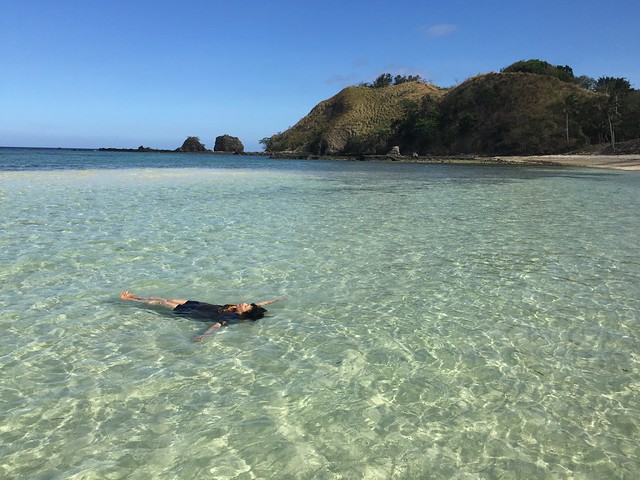
But I had never gone out there, although it seemed close enough to walk from where I stood on the shore. On this trip, at age 61, I told myself that it was now or never, and on the appointed morning we rode out to Calatong, but not before Letty, the retired schoolteacher who kindly hosted us, armed each one of us with a sliver of ginger. My mother Emy, now 86, had not been back to Calatong since she was a nine-year-old schoolgirl on a field trip with her class. “My teacher never let me out of her sight the whole time we were here,” my mother said as we parked the SUV as far up the dirt road as it could go. We walked up to the shore and took a banca over the glassine water—now turquoise, now emerald—to view the mountain from the sea, turning back only when the waves grew choppy.

IMG_7267

It’s said that during the War, when the Japanese flew over Calatong, they saw a brightly lit city, but then found nothing on the ground. This gave rise to the legend of Calatong as a ciudad, the name by which many of the locals still call it.

Somewhere in that sylvan cosmopolis was a waterfalls or a spring they called Labhang Dalaga, or “where the maidens washed,” from which flowed bubbly water, fragrant as if it had carried soap. We didn’t venture far enough inland to catch this frothy spectacle, but the rocks did sparkle in the sun in Calatong, as we were told they would; it was easy to see that the rocks were granitic, and contained liberal inclusions of quartz and mica, among other shiny minerals.

The mountain resists poachers and souvenir-hunters unless they’re locals who respectfully ask permission. They say that a woman who picked up a black rock and brought it home was horrified to find that the rock, left in her bathroom, had turned into a snake. A man who reportedly dug up oil and brought it out would find his precious discovery turning to water. There’s talk of siphoning water from Calatong to serve the nearby barangays, but already there’s grumbling about irregularities in the process, and about the likely consequences of displeasing the spirits.

The encantos, our cousins said, were fair-skinned, and one way of ascertaining who they were was to note the absence of a philtrum—that depression in the skin on your upper lip beneath your nose. The encantos liked to come to town to join the dances during the fiesta, when beautiful strangers typically appeared from nowhere, enjoying themselves and charming the locals. The encantos seemed to particularly favor the pretty nurses from far away who came to serve in Romblon as part of their martial-law-era YCAP duties. The antidote to their charms was to eat quinta, or black mountain rice; marriage to a local boy also seemed to ward off any further claims by the spirits—so swore my cousin Fred, who thereby met and married his wife Nanette.

You had to be careful about whom you made friends with, as a boy would realize when he accompanied his new friend home, and made the Sign of the Cross to be on the safe side of things—only to suddenly find himself hanging from the limbs of a tree. The townspeople would also see their neighbors jumping out their windows—and these neighbors would later return with fantastic stories about riding golden chariots over the mountaintops.

IMG_7245

The most persistent story also happens to be the most fantastic one, its incredibility only magnified by the insistence of the storytellers upon its veracity. Among those storytellers was an aunt-figure we’ve always known as Manang Munday, who recounted her story at the dining table, thusly:

One mid-afternoon in 1942, when she was in the fourth grade, Manang Munday heard a large commotion brewing and joined a throng of people rushing to the Guinbirayan shore. There, she says, she and the others saw a light-colored ship—the kind that plied the Romblon-Manila route—with the name “COSME YAP” brightly emblazoned in gold letters on its side. It sailed behind Calatong, but when the people tried to follow it and view it from afar, it was nowhere to be found. Years later the villagers would swear that they had heard the sound of an anchor chain being unwound in the night from the direction of Calatong.

Cosme Yap was my maternal grandfather, a merchant and a goldsmith, one of the richest citizens of Guinbirayan in his time. Lolo Cosme did own a sailboat, a batel as they call it in those parts, but it rather dramatically sank in a storm on its maiden voyage, Titanic-like (his wealth survived the catastrophe, but how it eventually vanished is another novel unto itself, albeit an unimaginatively prosaic one). The boat and the gold probably explain the persistence of this tale, and of its variations. Relatives say that when my Aunt Nieves was close to death, she had a vision of Lolo Cosme coming to fetch her in a golden airplane.

Again, unlike my sweet Beng who’s wired to the Universe, I don’t believe in spirits—but if something golden flashes before my eyes in my final hour, at least I’d have an inkling where that was coming from.

Penman No. 137: The Other Filipino Values

Penman for Monday, February 23, 2015


DURING THIS most recent US visit, I had a chance to have a chat over a few beers with Ray Ricario, the older brother of our daughter Demi’s husband Jerry, and with some of Ray’s friends. Born in the US to parents from Albay, Ray’s a retired naval officer and an entrepreneur. He and his family are registered albeit moderate Republicans—as you might expect of Filipino immigrants steeped in a proud military tradition—and Ray knows that Beng and I are passionate liberals, so we have a lively but always civil conversation going about current events in the US, the Philippines, and around the world.

More often than not we end up agreeing on more things than we disagree on, especially when it comes to strengthening ties between Filipinos and Americans, and raising the profile of the Philippines in America. I always look forward to meeting with Ray, not the least because he and his wife Lorie are unfailingly gracious hosts and we both love beer and barbecue.

Our last conversation revolved around a common concern: the preservation of Filipino values and their transmission to the next generation of Filipinos and Filipino-Americans. As the father of three children, Ray feels strongly about the need for them to have some vital cultural connection to the old country, even as they join—as they should and inevitably will—the American mainstream. The others around our table lamented how Filipino values seemed to be eroding among the Filipino-American youth, but were rightfully proud at the same time of their efforts to preserve them. One of the ways mentioned was the practice of taking the hand of one’s elder to one’s forehead in a gesture of respect—our famous and unique “mano po.”

That was fine and laudable, I said, but it also got me thinking about what other values we seek to pass on to our young, aside from the respect we expect and sometimes demand of them. I had to wonder what a young Filipino-American, told by his dad or mom to do mano to an older Filipino stranger entering the room, would be feeling at that moment of contact—would that be genuine respect, or a grudging sense of obligation, accompanied by a shudder at the external silliness of the deed?

The mano po is a wonderful tradition (even though, to be honest, you hardly see it being done anymore even in Manila), and those of us who still practice it know and understand that the value it embodies is respect for one’s elders. But how well is that value valued in such a place as America, where the native-born young—without necessarily meaning to be disrespectful or impertinent—might see things (such as authority) differently? How well can values and traditions carry over in another context—or sometimes, without the context that gave them meaning in the first place?

I suggested that perhaps “respect for elders” could itself be revisited and explained in a way that young people today (as we ourselves were, not too long ago) could better understand and accept. Having been social rebel in my own youth, I refuse to see “respect for elders” as the blind acceptance of the authority of the old; that will only ingrain resentment and resistance. I’d rather take and present it as a willingness to listen, an acceptance of the possibility (however remote it may seem to a 16-year-old) that this older person might actually have something sensible and useful to share with you. When I do the mano po, I accept you—in all my youthful arrogance—as my equal.

That brought me to other Filipino values—both of a philosophical and practical sort—that I don’t think we emphasize enough, whether in America or at home. I’d argue that principled resistance is one of them. We’ve had a long tradition of protest and rebellion against tyranny, injustice, and bondage, as our many revolutionary heroes will bear out—but instead we seem to emphasize acceptance and acquiescence, in the desire not to give offense or to create conflict. That’s why we wear our crown of thorns with misguided pride, sometimes reveling more in our capacity for suffering rather than addressing its causes.

Our table talk didn’t get this far, but I could have proposed two more—and truly practical values—to push among the young today on both sides of the Pacific.

The first is respect for food—especially in America, where so much of it goes around, and goes to waste. This can be one of the most personal and practical applications of a social conscience—don’t take or order more than what you can eat, and finish what’s on your plate. For Beng and me, that especially applies to rice, having which we always take as a privilege. If we can’t finish our meal at a restaurant, we have it wrapped up—even that half cupful of rice—and bring it home, or hand it over to some needier person on the street.

The second is cleanliness and tidiness. We Filipinos like to keep ourselves and our surroundings clean and neat, and it’s important that we do this by ourselves. Growing up as children, our day literally began by folding our mats and mosquito nets; even if we didn’t have much, we never saw poverty as an excuse for becoming slovenly. Want to promote democracy? Teach the señorito to clean up after himself; forget any thoughts of achieving national greatness if we can’t even discipline ourselves.

Knowing Ray and seeing what a wonderful family he has, I know that I’m not shouting in the wind when I bring up these notions. I wish he’d vote for Hillary, but that’s another topic for another day.

Penman No. 133: Revolution in the Time of Facebook

B75xPtWCIAEFJJ4Penman for Monday, January 26, 2015
 

I’M BACK in the US for a few weeks, to give a series of lectures on Philippine culture and politics as a Pacific Leadership Fellow with the Center on Emerging and Pacific Economies at the School of International Relations and Pacific Studies (IR/PS) of the University of California, San Diego. The PLF is a post usually reserved for senior government officials and business leaders engaged in economic and political affairs, and it’s the first time they’re bringing over someone from the humanities; some years ago, I was preceded in this fellowship by former Central Bank Governor and NCCA Chairman Jimmy Laya.

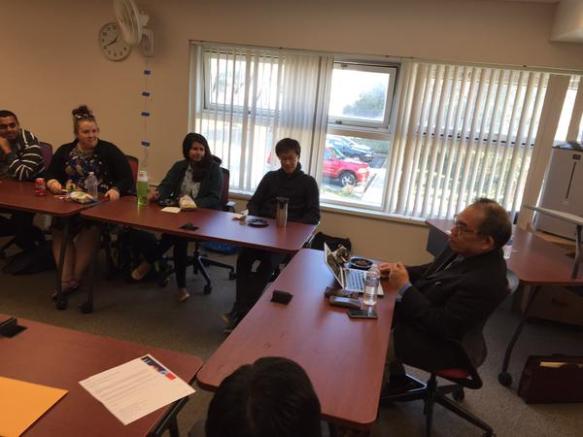
I have a major talk coming up this week on the ponderous topic of “Democracy and Cultural Expression: Confronting the Challenge of Modernization in the Philippines,” but last Wednesday, I sat down with a group of graduate students from IR/PS for a more personal chat. The general topic was “The Youth and Social Reform,” and I decided to share some of my experiences as a former student activist in the 1970s and to observe how protest movements and actions have changed since then.

I began by talking about the First Quarter Storm—our own version of Tiananmen, to use a metaphor more familiar to my audience, and the subject of my current research—my arrest and imprisonment in 1973, and the novel that I wrote about that experience. I recalled the many friends and comrades I lost, remarking on the ironic truth that “If I hadn’t been arrested that cold January evening, I probably wouldn’t be here, or be writing novels; I’d very likely have long been dead,” because I would have gone up to the hills and, being totally unprepared for the life of a guerrilla, would have made an easy target for the military. Here’s part of the rest of my short talk:

It would be nice to think that these horrors belong to the distant past, that the world has become more civilized in this new century of Facebook and social media. Indeed, authors like Steven Pinker (The Better Angels of Our Nature: Why Violence Has Declined) have argued that the world is actually a much safer place today than it was centuries ago, in terms of casualties of war and homicides, among other indices. That may be statistically true, but our street-level perception must surely be different.

It may be bright and sunny here in Southern California, but the world is full of dark and dangerous corners where bombs get strapped to ten-year-old girls who then get blown up in public places. I didn’t even need to tell you that, because it’s all over the evening news, before it all too quickly—and with much relief—gets brushed aside by the latest antics of Kim Kardashian and the latest gadgets from the Consumer Electronics Show. And why not? It seems grossly unfair in a way to be burdened by the misdeeds of others, by the ideological and ethical quandaries of a world one didn’t create, or even wanted to be a part of.

I’m not suggesting that young people today necessarily have it easier. Each generation has to confront its own demons, and those demons can be as large and as fearsome as you want them to be. You don’t have to live in Afghanistan with the Taliban or in Nigeria with the Boko Haram or in the Philippines with the Abu Sayyaf to know what terror is; you could be living in LA, New York, Columbine, or Ferguson to understand what fear or loss or danger means. In other words, we can never trivialize what other people may be going through.

But in another sense, youth and student activism today is rather different from what it was in my time, in my place. Today, people can pick their causes, instead of taking on the whole world. The starting point is the self, and what the self needs or wants, in a social and cultural climate that’s keenly focused on the here and now, with a very short attention span. Facebook promotes the self; Twitter and Instagram capture the unfolding present. We respond instantly to what we see, and do not necessarily work out of a comprehensive agenda for regime or global change. We don’t seek to save the world, but parts or aspects of it we care strongly about, whether it be whales and redwood trees or indigenous peoples or immigration reform or renewable energy.

In the Philippines, I’ve long maintained that the Communist Party lost much of the ground it had held back in the 1970s and 1980s not so much because of the success of the Philippine military on the battlefield, or even because of the collapse of the Soviet Union and its satellites, but because of the emergence of workable options for idealistic young people desiring social and political change, not necessarily by violent means. With almost 70,000 registered NGOs, Filipinos have a lot of causes to choose from.

For my generation, for all its flaws, we had only Marxism, which gave us a comprehensive world-view. Even though we felt in constant danger, that danger in itself was a comfort, an odd assurance or validation that we were on the right path, doing the right thing. It’s chilling to think that, while they may be very different in many ways, the young men and women joining ISIS today may be moved by a kindred spirit. There’s a frightening coherence and consistency to extremism, an inexorable logic strange to everyone else.

I ultimately opted out of Marxism because while we were convinced that everything was political, I came around to realizing that politics wasn’t everything. Also, as a creative writer, I could no longer abide by the need to observe the Party line.

What have I learned from all that?

First, compromise can be good and necessary. Second, I would not ask others to do what I could not do myself. Third, silence and reflection can result in better outcomes than strident shouting. Fourth, despair or cynicism is easy; hope is more difficult, and therefore the worthier challenge.

Indeed the darker aspects of life have never surprised me. It came as a deep disappointment to find comrades breaking under torture or other forms of duress, or even embracing outright betrayal for comfort and coinage—but that did not surprise me. It may have seemed very strange when I myself took up a job with the government shortly after my release from prison—but that, too, was almost inevitable, since all the old media offices had been shut down and the only real employer in town was the government. When people take the path of least resistance and adjust to new conditions to survive, I can understand that, having done it myself.

What keeps surprising me is courage, hope, goodness, and perseverance, which seem such old-fashioned notions but such necessary imperatives in these times. One no longer has to die for the things one values, but to live for them.

Even though, unlike most of my countrymen, I stopped going to church many years ago in protest of the Catholic Church’s position on many social issues, I was deeply moved, almost to tears, by the recent visit of Pope Francis to the Philippines, particularly to the areas ravaged by Typhoon Haiyan. His affection for the poor was palpable, but equally moving was the strength and faith manifested by the poor—one young woman who had lost her right arm in the storm had walked many miles to see him, and what she said with a smile stuck with me: “I am often sad, because I cannot find a job, but life cannot be all sadness all the time.”

For your generation, in your time and in your place, you will have to find your own pathways to social reform, which may have to begin, first of all, with a clarification of your own goals, although a deeper personal transformation will surely take place within the process of social engagement itself. Studying for professional success cannot ever be a bad thing; but it can only be better when all that sharpness of intellect can mean something to the lives of others.

Penman No. 129: Autographs and Memories

Jose_Rizal's_signaturePenman for Monday, December 29, 2014


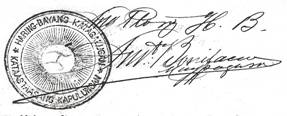
WE AFFIX our signatures to documents everyday—to checks, memoranda, requests, receipts, and felicitations—with nary a thought to where those signatures will go, those hurried scribbles that say “I was here,” “I saw this,” or “I caused this,” and, therefore, “I matter.” For most of us, those signatures will go the way of the documents that occasioned them—to some vault, shredder, or rubbish heap—their practical purposes having been served, and bearing no other value otherwise. That is, unless you’re a George Washington, or a Paul McCartney, or a Princess Diana; and then you might sign a table napkin and turn that into pile of dollars.

I’ve always been fascinated by signatures and autographs (the commonly held difference being that signatures meet legal requirements, while autographs satisfy emotional needs). My earliest model, of course, was my father’s signature, written with that flourish typical of his generation, with an understandable hint of self-magnification. Impressive signatures took time and care to practice and to write, so my father’s attention to his own left me awed and respectful. Even if he was only a clerk in his office, he signed his name as presidents did.

Mine, alas, is completely undistinguished—illegible, to be more accurate, something once likened by a curious onlooker to a paper clip pulled from both ends. I know that some people seek to cultivate a mystique by designing unreadable signatures, but I never meant to, and find the practice pretentious. My father’s signature seemed larger than life, but before and beyond anything else, it proclaimed his name, which (especially in this avatar- and alias-driven present) is probably the most honest thing you can do.

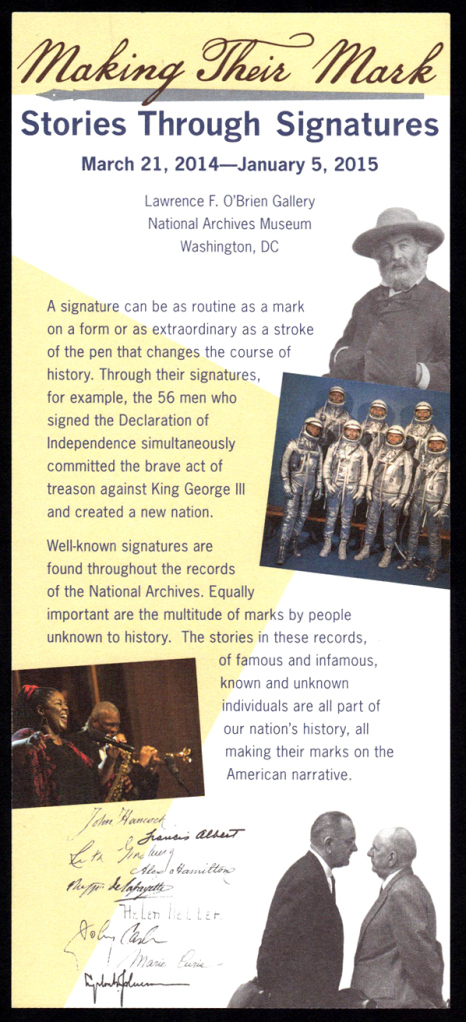
I had these thoughts in mind when—among the last things we did before flying home from Washington—I took Beng to a very special exhibition at the National Archives Museum on “Making Their Mark: Stories Through Signatures” (still on until January 5). It promised to showcase the signatures of both prominent and obscure figures and their contributions (positive and otherwise) to the shaping of history, and the exhibition did not disappoint. Being something of a history buff and museum rat, I had previously come across the most well-known ones in facsimile and in other exhibits—Washington, Jefferson, Lincoln, Kennedy, and, of course, John Hancock—but here was an opportunity to appreciate them in context, appended to actual documents that should have, but not always, mattered.

ArchivesCard

Albert Einstein’s ends a long letter passionately—and, in hindsight, poignantly—arguing for the peaceful use of nuclear energy. Adolf Hitler’s—accompanying a large sheet attesting to his marriage to Eva Braun—is surprisingly small. Another unexpected twist comes courtesy of the poet Ezra Pound, who can masterfully edit his friend TS Eliot and yet, it turns out, can barely spell, as when he pleads in 1914 with the American consul in London on behalf of his fiancée, and here I quote him verbatim: “As an american about to mary and english woman, I write to you….” The Hopi Indians petition for their land in 1894, signing their names as pictographs of rainclouds, fish, and birds. Their voices are as lost and as forgotten as the letters of ordinary citizens writing to the President for various causes, none more futile than an appeal by the children of convicted spies Julius and Ethel Rosenberg for their parents’ lives to be spared.

As we left the museum, Beng and I wondered aloud why we couldn’t come up with a similar exhibition of historic signatures—say, of our national heroes and National Artists and National Scientists—by way of introducing our younger citizens to the story of our nation, as told by individuals in letters and other interesting and important memorabilia. This is, of course, a generation that writes messages, not letters; that tweets, not corresponds. The value of a signature—think of Manny Pacquiao’s on a boxing glove, or a porn star’s on a T-shirt—is what it will fetch on eBay.

Bonifacio

Some people collect autographs for fun and profit, and like any hobby involving demand and supply, a thriving business has grown around the pursuit and acquisition of scarce signatures, especially from people who will never write another one. Sometimes context is everything; a woman who got JFK to sign her newspaper just before he boarded that fateful car in Dallas made $30,000 out of that grim memento. The most sought-after signatures today, according to one listing on the Web, are those of the Beatles, the Apollo 11 crew, Marilyn Monroe, and—no, not JFK, or Churchill, or Hitler, who all follow this curious entry—the Sex Pistols with Sid Vicious. For what it’s worth, George Washington remains the star of the show, his signature on the Acts of Congress earning that book’s owner close to $10 million because of the confluence of the man and the material.

I’d be happy to run into a sheaf of yellowing papers at an antique shop or an old library and to find these signed by Rizal, Bonifacio, Juan Luna, Gregorio del Pilar, Paz Marquez Benitez, Angela Manalang-Gloria, Manuel Quezon, Jose Garcia Villa, Botong Francisco, or some such person. I doubt that I’ll be ever so lucky, precisely because we don’t value old books, especially those that have been scribbled on. As a literary tourist of sorts, I’ve been fortunate to have books signed by Joseph Heller, Kazuo Ishiguro, JM Coetzee, Junot Diaz, Frank McCourt, and Edward Jones, among others, but I’d trade most of them for any one of the above.

Quezon

Because our daughter Demi still understands what documents mean, she will be inheriting—aside from a trove of leaky pens—a passel of books and letters signed by many of our finest writers, her dad’s friends and mentors. I’ve been quite shameless about soliciting these signatures and autographs, fully expecting that the time will come, sooner than later, when our scrawls will be replaced by digital thumbprints, already a reality with Apple’s TouchID.

Maybe that’s how digital books will be signed in the future—with the press of a thumb or a forefinger on a touchpad—and it will simplify my life as an author, but take me even farther away from the verifiable veracity of the written word, and the written name.

Penman No. 124: Pinoys on the Potomac

cropped-logo-rizal-washington8Penman for Monday, Nov. 24, 2014


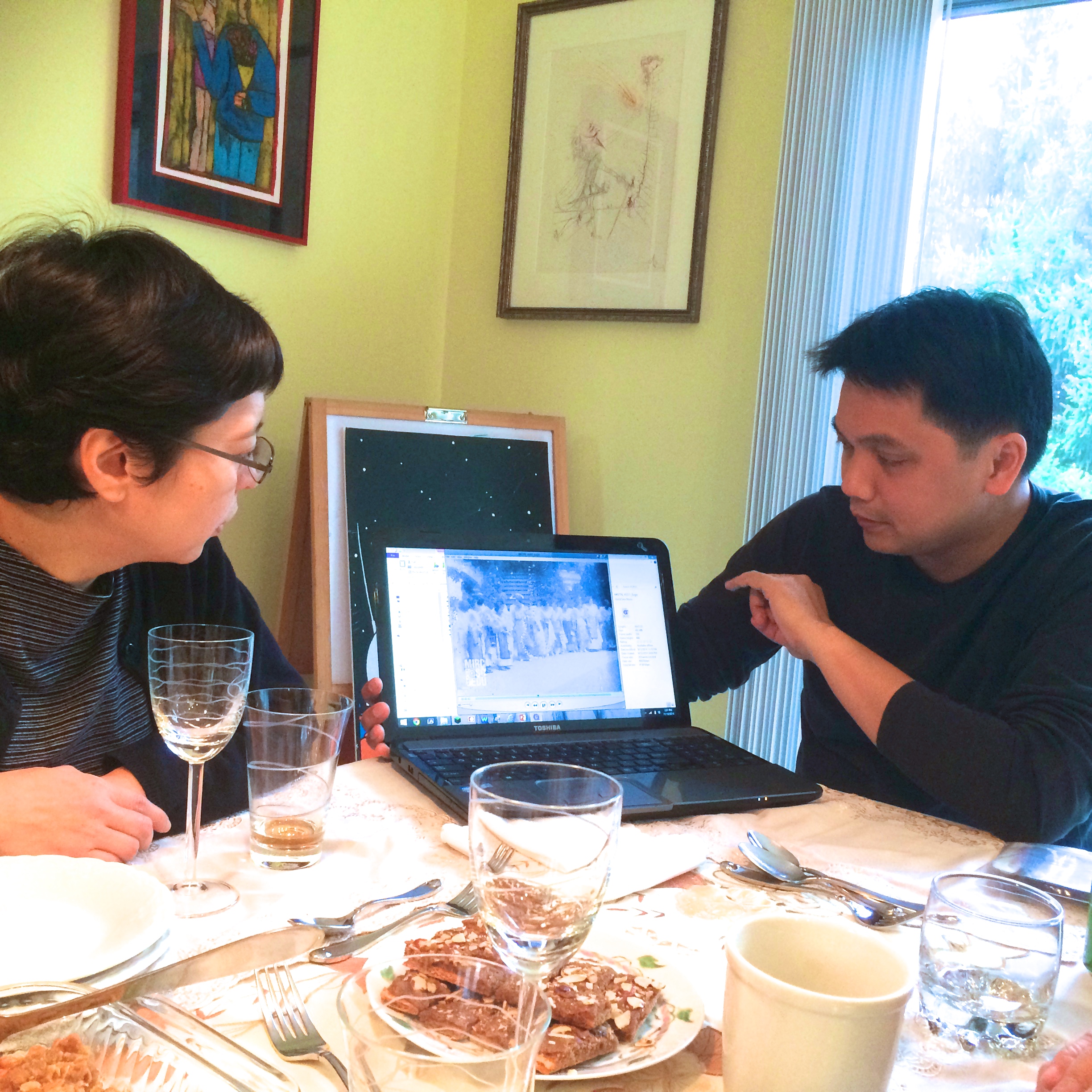
ERWIN TIONGSON and his wife Titchie are in their early 40s, successful professionals and the parents of young sons; they live in Fairfax, Virginia, a pleasantly wooded suburb just outside of Washington, DC. An Atenean from Nueva Vizcaya, Erwin teaches Econometrics at Georgetown University, while Titchie, a prizewinning writer, has chosen to stay at home to look after the children. Outwardly they might seem to be just another Filipino couple living the good American life, steadfastly focused on the present and the future. But their true passion inclines elsewhere, as Beng and I would discover in one of the most fascinating encounters we’ve had in our current American sojourn.

I’d first heard about Erwin from another new Fil-Am friend, Sonny Busa, a retired Marine, a former consul and instructor in international relations at West Point. (Sonny, in turn, had been introduced to me by upstate-NewYork-based Sharon Delmendo, who has done a lot of research on Philippine-American relations—so now you see how the academic circuit works.) Sonny had mentioned to me that there was a Filipino in the community who had taken it upon himself to chronicle the history of the Philippine presence in Washington and the surrounding area—more than a century of visits and residencies by Filipino politicians, diplomats, writers, artists, musicians, and other personages whose life and work, in one way or another, drew them to the American capital.

That’s how I found the website that contained all this information—a WordPress site titled “Philippines on the Potomac: Filipino-American Stories in Washington, D.C.” (https://popdc.wordpress.com). If you’ll take a minute to click on that link, you’ll discover what I did, with a child’s wonderment at the entrance of a carnival: short articles and accompanying photographs tracing the connections between Filipinos and Washington, DC.

As might be expected, the big political figures, especially those from the Commonwealth and postwar period, dominate the reportage: Manuel L. Quezon, Carlos P. Romulo, Sergio Osmeña, Manuel Roxas, and Jose Abad Santos. But cultural luminaries are also well represented: Juan Luna, Jose Garcia Villa, Juan Arellano, Enya Gonzalez, Fernando Amorsolo, and Bienvenido Santos, among others.

Quezon had served as Resident Commissioner—effectively our ambassador—in Washington until 1916, and when he went to the US on his wartime exile and died in New York in 1944, it was at the Cathedral of St. Matthew the Apostle in Washington—not too far from where our embassy now sits—where his funeral mass was held prior to his interment at Arlington (less than 20 years later, John F. Kennedy would follow the same route; MLQ’s remains were moved to the Philippines after the war, and now lie at the Quezon Memorial).

Carlos P. Romulo and his family lived in a home on Garfield Street for 16 years, CPR having served in many capacities, from aide de camp to Gen. Douglas MacArthur to Resident Commissioner, ambassador, and president of the United Nations General Assembly. (One of the website’s most remarkable images has an old sepia photograph of the Romulos superimposed exactly over the same spot in front of the present house, which has barely changed.)

The site provides a treasure trove of other historical facts—including, inevitably, tidbits of information that serious scholars might dismiss as trivia, but which enthusiasts like me can’t get enough of. The sculptor and National Artist Guillermo Tolentino, for example, once worked as a waiter in Washington, and somehow managed to meet President Woodrow Wilson and to present him with the gift of a small statue, which Wilson kept in his room until his death; Wilson later helped Tolentino get a scholarship to art school. We also learn that Juan Luna and Felipe Agoncillo went to Washington in 1899 to campaign against the Treaty of Paris, and stayed at the Arlington Hotel, where they were spied upon by the Secret Service. (All these stories are properly attributed and referenced, by the way.)

Better than just poking around the website, the Tiongsons invited us to lunch and show-and-tell, and I couldn’t wait. Learning of my current affiliation with the George Washington University, Erwin had pointed me to an article written by CPR’s granddaughter Liana relating how Romulo had coached a debating team from the University of the Philippines in an engagement with the GWU team, over this issue: “Resolved, That the Philippine Islands should be granted immediate and complete independence.” The debate took place on April 18, 1928 at GWU’s Corcoran Hall. “UP won,” said Erwin. “It was the team’s fifth victory, after defeating Stanford, California, Utah, and Colorado. The team would go on to defeat all their other opponents—a total of 14 universities, if I remember correctly.”

Tiongsons

Even more interesting were the personal stories that Erwin and Titchie shared with us (after a sumptuous lunch of home-made corned beef and baked salmon, which all by itself was well worth the Sunday visit). I can’t go too deeply into the details now, but Beng and I were thrilled to share Erwin’s elation over his most recent discovery, a book that had been inscribed by Maximo Kalaw, MLQ’s private secretary, to a “Nina Thomas”—who turned out to be the American lawyer the young Quezon had been engaged to (he broke off the engagement after being advised that marrying an American was political suicide). Erwin made contact with Nina’s heirs in Virginia; she never married, but she passed on Quezon’s monogrammed walking stick and their engagement ring to her niece.

Erwin also showed us a movie poster from 1946 of Anna and the King of Siam, featuring Rex Harrison, Irene Dunne, and a little-known actress named “Chabing”—who turned out to be Isabel Rosario “Dimples” Cooper, Douglas MacArthur’s girlfriend (not mistress) between marriages; after MacArthur left her, she resumed her film career (she was notable for having recorded the first on-screen kiss in Philippine movies in 1926), assuming the single name “Chabing,” whose filmography you can look up on IMdb.

It was also a treat to listen to a radio recording of Jose Garcia Villa, made in the 1950s, of him reading his “Lyric 17” (1942) which famously begins with “First, a poem must be magical….” Most moving was the 20-minute documentary of President Quezon’s funeral—directed by no less than the renowned director John Ford—that Erwin had magically retrieved from somewhere in the many university libraries, archives, and museums that he still haunts in search of fugitive Filipiniana. He has begun a collection of war correspondence from the early 1900s and the Second World War; one 1902 letter poignantly retained a swatch of jusi, which the wife of an American official in Iloilo wanted her folks to see.

We could have stayed there the whole day, reveling in our memories of the grand old men of Philippine letters—NVM Gonzalez, Ben Santos, Nick Joaquin, Manuel Viray; I shared my own little adventures in cultural retrieval. But Beng and I had sadly had to trundle out again into the autumn chill, warmed by our imaginations, and in my ears rang a line from Viray’s poem about his old house in Washington, on Cathedral Avenue, which the Tiongsons had also located: “A streak of light aslant / On the screen door creeps up the line of dusty books.”


Penman No. 118: To Teach Is to Persist

To-teach-is-to-persist-Penman-Butch-DalisayPenman for Monday, October 13, 2014


SOMEONE REMINDED me that World Teachers’ Day was celebrated earlier this month, on October 5. I forgot about it because I was—I am—overseas, on sabbatical leave until mid-2015. In our department at the University of the Philippines, we normally get just one sabbatical leave over the course of our teaching career, and typically, professors take it a few years before retirement. I’m five years away from that crossroads, so this is a good time to be away from the classroom and to recharge, which is what the sabbatical leave was originally designed for.

Wikipedia tells us that “Sabbatical (from Latin sabbaticus, from Greek sabbatikos, from Hebrew shabbat, i.e., Sabbath, literally a ‘ceasing’) is a rest from work, or a break, often lasting from two months to a year. The concept of sabbatical has a source in shmita, described several places in the Bible (Leviticus 25, for example, where there is a commandment to desist from working the fields in the seventh year). In the strict sense, therefore, a sabbatical lasts a year.”

This sabbatical, however, is shaping up to be anything but a vacation, or a rest break. I may be cool and dry in an America turning pretty with the onset of autumn, but my workload is as tropically toxic as ever, with several books to complete, columns and articles to write, faculty advising duties to perform, and sundry interests—totally and thankfully unscholarly—to pursue.

I do get a respite from the classroom, but, perhaps ironically, that’s the part of teaching I miss the most. As we celebrated World Teachers Day, I also realized that I was marking my 30th year of teaching this November, and I asked myself what three decades of teaching have taught me. After some reflection, it came down to this: to teach is to persist in the perfection of our humanity and our citizenship. That sounds awfully grand to the point of being pompous and pretentious—don’t we, after all, just grab a book, drag our feet to class, and preach bunkum for an hour to a roomful of people with the pulse rate of zombies to earn our lunch and gas money?

There are, of course, many days just like that in a teaching career, days that blur one into the other until the end of yet another semester. And at some point, it’ll get to you: your speech starts slurring and your eyes get glassy, and you can’t wait until the bell rings or the hour hand moves; you had a long rough night, the car needs new tires, the bills are piling up, your thoughts keep drifting back to Paris or Palawan, and the last thing you or your students want to talk about is disease and social order in William Carlos Williams’ “The Use of Force.”

Maybe ten years ago, I had such a day at the very start of the semester, and without realizing it, I must have been so bleary-eyed that I gave off the impression of not quite being there. To my great shock and dismay, one student later blogged about her disappointment with what she had seen; she had expected a stirring performance from her professor on Day One. It was a wake-up call, and I woke up; I promised that student that I would do my best to live up to her expectations, and I hope I did; we’re good, and she’s since gone on to a promising career in writing.

What I became acutely aware of then was that every teaching day is a performance, not unlike a show a professional actor studies and rehearses for, with the additional challenge that one simply doesn’t repeat the previous show, but keeps adding to it, improvising when possible to adapt to changes in the composition and the mood of every audience. I mutter my first lines to myself on the steps up to my classroom, ticking off the day’s main points and questions in my head; I take a deep breath, step into the door, flash a brief smile, and the day begins. And like the pro I have to be, I’ve learned to take care of myself, so I can teach well—to stay healthy, to sleep well (especially before a class day), and to think of something new to say or to bring to the next class.

So we all have our bad days, but it’s precisely on days like these when we need to remind ourselves of what a tremendous opportunity we have to make this Tuesday or Wednesday one of the most memorable in our young charges’ lives, through something we say, an idea or an experience we share, that will turn a key and open a door in their minds. Only in teaching can an ordinary, even a boring, day suddenly become indelibly special, with nothing more than thoughts and words—and the teacher’s persistence and faith in every student’s potential for transformation into someone more aware, more human, more Filipino. Perfectability? It’s more about the effort than the goal—and I’m sure that whatever we do for our students, we teachers do for ourselves as well.


SPEAKING OF teaching, my department has asked me to invite all teachers and students interested or involved in translation issues to attend the 6th Asian Translation Traditions Conference (ATT6) to be held October 23-25, 2014 at the University of the Philippines, Diliman, Quezon City.

The official flyer says that “The rationale for the ATT series is to challenge the Eurocentric emphasis of Translation Studies, which is largely due to the “unavailability of reliable data and systematic analysis of translation activities in non-European cultures” (Hung and Wakabayashi 2005). The ATT series was initiated by Professor Eva Hung of Hong Kong in 2002. A small but successful workshop was held in London that same year, followed by well-attended international conferences in India, Turkey, Hong Kong, and the United Arab Emirates. It is hoped that ATT6 will lead to theorizing on translation and developing methodologies on translation arising from the specific historical and contemporary contexts of Asia.”

Hmmm, I think that needs to be translated: this conference will explore the theory and practice of translation in an Asian context. For more details, please visit http://asiantranslation6.up.edu.ph/.

{Illustration by Igan D’Bayan of the Philippine Star.)

Penman No. 107: Small Loans for Big Dreams

WS-Butch-1Penman for Monday, July 28, 2014


IT HAD been a few years since I last sat down for a chat with the accounting and business guru Washington SyCip, whose biography (Wash: Only a Bookkeeper, published in 2009) I had been privileged to write, so I was only too happy to oblige when our mutual friend Marlu Balmaceda asked if I could spend some time last week to shoot the breeze with Wash.

Both Wash and I had aged a bit since we started working on his book back in 2006—I more so than he, who last month turned 93. Having just gotten my senior card in January, I’ve been feeling entitled to some relaxation, but Wash SyCip was right at his desk in his old 14th floor office where I last saw him, working away, surrounded by a growing menagerie of owls, turtles, and roosters, the gifts of friends. On the wall was a Chinese painting of a dignitary, perhaps the Emperor himself, seeking the counsel of a wizened turtle. Wash caught me looking at it and told me what the turtle’s sage advice was: “Take it easy.”

As cool and dapper as he is, Wash makes it look like he’s taken it easy all his life, but I know for a fact—having chronicled that life—that it just isn’t so. No slouch could’ve put up and sustained what became the regional accounting giant SGV.

But this time, Wash wasn’t talking about himself, but about a new program for education that he and a friend began three years ago, called the Zero Dropout Education Scheme, which seeks to put and keep poor Filipino kids in school. “The country’s biggest problem remains poverty and the wide gap between the rich and the poor,” Wash says. “For me, education is key to alleviating poverty, but ironically, the poorer you are, the more children you have, so half go to school and half don’t. Those who don’t will stay illiterate, and will be resigned to poverty all their lives.”

Seeing that illiteracy still afflicted millions of Filipinos, Wash resolved to do something about it and committed US$1 million of his own money to a fund aimed at the problem. Helping him along was his friend, the Armenian-American businessman and philanthropist Paul Kazarian, who pledged to match Wash’s contribution dollar for dollar. But even with that funding, Wash was modest and realistic enough to know that he couldn’t do the job by himself. “I don’t really know the poor, and how best to reach them,” he admits. “So I got in touch with CARD-MRI, which has been a leader in Philippine microfinance, to help us out.” Radiowealth Finance Corporation has also geared its CSR program toward the Zero Dropout scheme, and committed to provide P30 million.

The Center for Agriculture and Development-Mutually Reinforcing Institutions or CARD-MRI goes all the way back to 1986 when Dr. Jaime Aristotle Alip and 14 other rural development practitioners got together to set up CARD specifically to help empower women in poor communities. In 2008, it received the Ramon Magsaysay Award for Public Service. “With over 1,400 units all over the country, CARD had a network in place we could tap for our program,” Wash says.

Initially available to CARD members, the Zero Dropout scheme offers small renewable loans ranging from P1,500 to P3,000, at a monthly interest rate of 1 percent. “Basic education may be free,” Wash acknowledges. “But families still need money for school supplies, slippers, clothes, and other expenses. That’s where we come in. We’d like to provide not just the money, but an easy way of getting it, with as little red tape as possible.”

As of March this year, the program had supported over 46,000 students through loans totaling over P160 million, out of which P130 million in principal and P6.5 million in interest has already been paid back. They expect to hit 100,000 beneficiaries by year’s end.

While most beneficiaries come from Region IV-A (the Calabarzon area), the program has expanded to the ARMM in Mindanao, where the dropout rates are the highest. Typical beneficiaries include Lucena native Lilia Fernandez, a mother of nine who works as a manicurist alongside her husband, a construction worker; her son Erick dreams of becoming an engineer.

Unlike the government’s conditional cash transfer program, which gives cash direct to poor beneficiaries, Zero Dropout is a loan program. “They repay the loan through microfinance, by increasing their income with a loan for a store, a tricycle, and so on,” adds Wash.

If you think poor borrowers can’t or won’t repay their loans, think again. CARD has made a name for itself making sure its system works, basically because it’s led by people from the very grassroots it serves. Wash tells this story: “I had CARD’s management people over for dinner at my house once, and discovered that none of them were from Makati or Manila. They were all from the rural areas, and they were mostly women, very bright women. I was very impressed with their dedication. CARD knows its clientele. It works with groups of 20 women who guarantee each other. I’ve attended meetings with these groups and I can see that our poor communities are full of people with initiative and drive.”

I came away most impressed by an incident that Wash related: “When Yolanda hit, 8,000 students under the program were affected in Leyte and other places. My first reaction was to cancel their loans, as the least we could do to help. But Dr. Alip said, Wash, no—the poor are more honest than the rich. And as reconstruction took off, the loans also began to be repaid, even if the borrowers had lost their homes.” If that’s not inspiring—in the context of billions lost to crooks and scammers—I don’t know what is.

Penman No. 103: Too Much Drama

Penman for Monday, June 30, 2014

IN MY other life as a dramatist, which came to an end some years ago, I wrote about a dozen plays for the stage and more than twice as many television plays and screenplays, mostly for the late Lino Brocka. Lino and I happily turned out double-hanky tearjerkers with such rousingly commercial titles (which someone presumably from the marketing department thought up) as Kailan Mahuhugasan ang Kasalanan, Ano ang Kulay ng Mukha ng Diyos, Maging Akin Ka Lamang, Miguelito, ang Batang Rebelde, and my very first one, back in 1977, Tahan Na, Empoy, Tahan.

I may have stopped writing drama to focus on fiction and nonfiction, but now and then the old skills get a workout. I’ve always said that there’s no better training for a writer of fiction than to have been a playwright, because playwriting teaches dramatic economy—how to set up a scene, how to get the most out of your characters, how to use dialogue effectively (meaning, at its most complex, how to get your characters to say things they don’t mean, or to mean things they can’t say).

Last week, I said as much again to a group of writers and program analysts from a TV network who wanted to see how writers think. I told them that drama’s to be found not only in filmscripts or on the set—it’s all around us, taking place quietly in some fastfood joint or some bus stop or some hospital ward; the writer’s task is to see that drama, to palpate it from the tedium of everyday life, and to sharpen and brighten its edges so others can see the extraordinary in otherwise ordinary moments.

We’ll save the rest of the drama lesson for another day; I bring this up only to establish my bona fides when it comes to talking about drama, and about my thesis today, which is that—even for a writer of melodrama, for which I make no excuses—there seems to be entirely too much drama around us these days, or theater if you will. (There’s a subtle difference, if you think of drama as the situation and of theater as its enactment on some kind of stage.)

Case in point: I’m sure I’m not the only one who’s sick not only of Senator Bong Revilla’s whinings about the heat in his room at the “custodial center” (it’s not even a real prison, for Pete’s sake), but also of how the media has fussed over it like it was a real news story (“Can Congresswoman Lani make it back from Greenhills in 15 minutes with the air cooler? That’s all the time she has before visiting hours end!” said one radio reporter breathlessly.) My totally un-PC prescription? Give him the fan, give him whatever creature comfort he wants, but reduce his cell to about a third of its size and keep that one window, from which I hope he sees a mall, or something with lots of people and traffic in it. There’s no better reminder of what prison means than limited space and movement, no matter what you may have with you. (I remember watching a Marlboro neon sign blink at me on the far side of martial law prison, back in 1973; that was torture.)

Senator Jinggoy Estrada’s departure for the custodial center was only slightly less theatrical, thanks again to the media who couldn’t get enough of the father-and-son story being played out in all of its bitter if obvious irony. Of course we expected the family to bond around Jinggoy, and for tears to be shed; that’s any family’s natural privilege, and its natural response. Indeed what underwhelmed me, from my dramatist’s standpoint, was how predictable everything was from start to finish, especially the inevitable “Mayor Erap, ano’ng nararamdaman ninyo sa pagkakakulong ng inyong anak?” I wanted to scream, “E ano pa?”

I can just see the video highlights from these staged “surrenders” figuring in these politicos’ next campaigns: the prayers in church, the mug shots, the hugs and waves from distraught spouses, parents, and kids; the cell doors closing, as the music goes up and under, before we hear a murmured voice-over: “May bukas pa….”

Case in point Number 2: Sometimes silence is drama; when your wife refuses to explain why she doesn’t want to talk to you, that’s drama. When the Palace refuses to explain why it dropped Nora Aunor from the list of National Artist awardees, that’s drama. All President Noynoy’s spokesmen could say was “It’s the President’s prerogative….”, which is exactly what we heard from President Gloria’s spokesmen a few years ago, the only difference being that she made dagdag, while Noynoy made bawas. I did read something about Nora’s exclusion being “in the national interest,” but it boggles the mind to figure out exactly what that means. I can understand defending the Spratlys and Scarborough Shoal as being “in the national interest”; I can even understand rooting for Manny Pacquiao on fight day—temporarily setting all his other quirks and antics aside—as being “in the national interest.” But dropping Nora?

As I wrote in this corner a few months ago, I was on a large, multidisciplinary, second-level committee that endorsed Nora Aunor to a higher body (the NCCA and CCP Boards plus the National Artists); we endorsed Dolphy as well, and if I remember right, he and Nora got the same highest votes across the board. Granted that our recommendations were just that and subject to final approval upstairs, I feel among many others in the arts that we at least deserve a full and cogent explanation for all these pluses and minuses that take place in Malacañang. The Palace—and I don’t mean just the present occupant—has never been known to be a bulwark of artistic support and sensibility, if you look at funding for the arts in relation to everything else; if it never cared for or about the arts, why should it suddenly care—negatively at that—about Nora Aunor, whom the arts community clearly feels is deserving of its highest accolade? If you can’t help, at least don’t get in the way.

I’d been told by some Palace contacts that questions came up about Nora’s alleged drug use. OK, I said, it’s fair enough to raise these questions which presumably involve moral turpitude. But since when has it been fair to use morality as a standard for artistic excellence? We’ve had National Artists whose personal lives were hardly spotless, but whose art precisely may have been deepened and enriched by those encounters with their darker side. (Conversely, we’ve had National Artists who may present themselves as moral exemplars and accuse everyone else of some fatal shortcoming, but whose work is unremittingly mediocre and soporific.) Edgar Allan Poe, Salvador Dali, Jean-Michel Basquiat, and Miles Davis, among many others, would never qualify for state honors in their countries (not that they ever cared) if our Malacañang’s standards were employed.

Last case in point: I wholeheartedly agreed with the NCCA when it protested the Palace snub of Ms. Aunor, but also wholeheartedly disagreed with the NCCA when it reportedly protested allowing the use of our national heroes’ names for such popular products as beer. (Think “Cerveza Rizal” or “Mabini Beer.”) The reason given by objectors was that it would be a sign of disrespect for these heroes to associate something as morally undesirable as alcohol with them.

Really? Which planet are we on? Didn’t our heroes drink beer and stiffer forms of alcohol—in spite (or dare I say because) of which they performed heroic deeds, anyway? Rizal complained that his fellow ilustrados in Spain drank and womanized too much, but that hardly meant that he was completely abstemious in either department. He didn’t care much for hard liquor, but drank beer (like me, on whom single malt would be a total waste). George Washington was a beer guy as well, and even famously left a handwritten recipe for his own brew (later marketed in an “Ales of the Revolution” line). So will the moral police please lighten up? If Nora’s good enough to be a National Artist, then Jose Rizal should be good enough to go on a beer bottle, and I’ll hoist many a cold Rizal in his own honor.

Heroes aren’t heroes because they’re perfect human beings; they’re heroes because—despite some truly terrible character flaws and peccadilloes (one of them even shot his wife, remember?)—they left something indelible to the national spirit and imagination, enough for us to think of ourselves as a nation. Heroes and National Artists (the real ones and the best ones) can do that; politicians—whether in prison or in the Palace—can’t.

Penman No. 83: A Bag of Bread

IMG_20140110_155634Penman for Monday, January 27, 2014

ONE OF the most delightful gifts that Beng and I got a couple of weeks ago for my 60th birthday and our 40th wedding anniversary was a bag of oven-fresh bread, accompanied by a handwritten letter. I found the bread so literally warm, and the letter and its contents so unique, that I secured the permission of the sender to reproduce it for this column. It’s a testament to the persistence of good things and good intentions—and, of course, of good people in a world too often and too crassly ruled by the bottom line.

In part, the letter said: “I’m sending traditional pan de suelo breads which are pugon-baked on the suelo or floor of the 75-year-old wood-fired oven of Kamuning Bakery. The crust is crunchier and it should be reheated with a toaster and not with a microwave oven. Nick Joaquin, NVM Gonzalez, and others of past generations have written about this pan de suelo bread of the Philippines.

“I bought Kamuning Bakery just before Christmas, and have kept the old owners as minority shareholders so they can continue the traditions and tastes of this bakery. I also bought the land and old building. I invested here because I believe in the old owners, the pugon bakers who are artists and the staff with their unique commitment to their craft and vocation. I want to support this independent pugon bakery with their traditional no-preservative and no-additive Filipino breads, despite the huge challenges of this era of big multinationals, bakery chains and supermarkets and their mass-produced factory or industrial breads.”

2014-01-16 22.41.53

The sender of the bread and the letter was none other than my fellow STAR columnist Wilson Lee Flores, business chronicler extraordinaire and confidant of Filipino taipans. Wilson may move in those lofty circles, but his feet remain solidly on the ground—in this case, Kamuning and the oven floor on which pan de suelo is baked, unlike the more familiar pan de sal, which comes to life on metal trays. (Incidentally, many young Filipinos probably don’t know that kamuning—like the kamias that lends its name to the same street across EDSA—is a plant, Murraya paniculata, with tiny and fragrant white flowers.)

The Kamuning district is one of Quezon City’s oldest—in fact, the bakery was put up in its present location in 1939, when the city itself was established—and while modernization has inexorably overtaken many other parts of the city, Kamuning has managed to retain some of its 1940s charm and character, an effect assisted by the proliferation of antique and resale shops and even a vintage-car restoration outfit in the neighborhood.

You can’t get more original than Kamuning Bakery, which has stayed pretty much as it was when it opened. It’s been kept alive by the seventy-ish Ted Javier and his sister Beth Javier Africa, the son and daughter of the late Atty. Leticia “Letty” Bonifacio Javier, who co-founded the bakery with her husband Lt. Marcelo Javier.  Wilson tells the rest of the story: “It was President Quezon’s close ally Alejandro Roces, Sr. who suggested to the Bonifacio family of Los Baños Bakery that they open the new city’s first bakery. So they sent their newly-married daughter Atty. Leticia Bonifacio Javier and her husband Marcelo, who founded Kamuning Bakery.” Sadly, however, Marcelo, his father-in-law Major Miguel Bonifacio, and another of Ted’s uncles were killed by the Japanese during the Second World War.

So it fell to Letty to keep the bakery going with the help, in time, of her three young children, producing pan de suelo, described by Wilson as the “fist-sized version of pan de sal with a hard and crisp crust,” and of which Nick Joaquin wrote “colegialas got their gums toughened on their segundo almuerzo in the morning and, with hot chocolate, their meriendas in the afternoon.”

Indeed it was all the crunchy goodness that Wilson and Mang Nick promised, but don’t take it just from me. Just last month, a blogger named Tummy Traveler reported, after receiving her own gift bag of the bread, that “The pan de suelo was toasted just right. Just the right amount of crunch on the outside yet the bread still had that delicious moistness and softness on the inside. It had a faint hint of sweetness that went well with the salty corned beef together with my freshly brewed coffee and sausage.”

If all this sounds like a shameless plug, it is. Let’s help Wilson Lee Flores help keep a family and Pinoy tradition alive. I’m already planning a sortie there this weekend with Beng to stock up on the good stuff, and to visit an antique shop or two while we’re in the area. Kamuning Bakery can be found on 43 Judge Jimenez corner K-1st Street, one street inward on the left somewhere between EDSA and Tomas Morato, telephone 929-2216. They also have a Facebook page at https://www.facebook.com/kamuningbakery1939.

IMG_6589

WHILE I’M writing about bread and giving thanks to friends, let me thank another fantastic baker, Theresa Juguan, who with her family and husband Herwig hosted me and Beng in their home in Puerto Princesa over the post-Christmas break. A few months earlier, we had been first-time guests at their seaside villa just outside Puerto, and we struck up such a rapport that Theresa and Beng now call each other “sister.” I’ve also urged Theresa to write her cookbook-cum-autobiography, with her life-story being as remarkable as her cooking and baking.

What I most enjoyed about this second visit, though, was playing “Tito Butch” to Theresa’s granddaughters, particularly five-year-old Zanique and her elder sister Zitroenne and cousin Zantelle, who amazed me with their precociousness. Since the in-house wifi was down, my MacBook Air—hooked up to cellular Internet—became the center of the girls’ attention. “Tito Butch,” they cried, “we want to play! Can we use your computer?” “Sure,” I said, “where do you want to go?” And here’s what floored me: these girls knew what a URL was and could recite it by heart: “W-W-W-dot-Y-8-dot-com!”

So I keyed in the address and sure enough, a website for online games popped up. “Go to Games for Girls!” shrieked the kids, and so we did, and they quickly zoomed in on “Cooking Games,” which featured the step-by-step cooking and baking of everything from spicy corn and shrimp salad to tiramisu. “You cook this,” said Zanique, “and I’ll cook this!” And so they did, in all earnestness, arguing over the sequencing and the measuring of the ingredients. (Beng and I had watched Zanique stick by her grandma in the kitchen, helping with the making of fresh lumpia and admonishing a tita who was going about it the wrong way.)

Thus are great cooks and bakers and great traditions made.


Penman No. 78: My FQS Project

CEGP Penman for Monday, December 23, 2013

FOR SEVERAL weeks now, some friends from way back—more than 40 years back—have been getting private messages from me, inviting them to take part in what could be an important historical project—important not only to our generation, but more especially to those who have come after us, who know so little about their past.

I’ve just begun what I consider to be my lifelong dream project: The First Quarter Storm: An Oral History. It’s not as if I don’t have enough books to write; at the moment, I’m working on five books in various stages (two nearly done, two halfway through, and this one just started), not to my mention my third novel, which has had to sit on the back burner. I’m no Superman, but I write books for a living, and take on every engagement as a privilege and a responsibility. Still, this one’s a special self-assignment.

After writing biographies and histories for such varied personalities as the Lava brothers, the business icon Washington SyCip, and the former Marcos associate Rudy Cuenca, I felt the time had come for me to do something for my own generation, whose political awakening came about in the late 1960s and early 1970s.

That was one of the most politically charged periods in recent Philippine history, a time many Filipinos my age call the “First Quarter Storm” or FQS, referring to the tumultuous years just before and after the declaration of martial law by President Ferdinand Marcos on September 21, 1972.

Those few months around martial law were both frightening and exhilarating, murderous and ennobling, challenging a generation of young Filipinos to offer themselves up to the altar of revolutionary resistance. The martial law regime would last for 14 years and claim thousands of lives, and cause deep damage to Philippine democratic institutions. By the time a peaceful street revolt restored democracy in 1986, the course of Philippine history and the complexion of that FQS generation had been irreversibly changed.

And yet today, 40 years later, many principals from the martial law regime remain entrenched in power along with pretty much the same ruling elite that prospered under martial law. Despite more democratic space, the same deep-seated problems of poverty and injustice remain. It is as if nothing has been learned—most Filipinos born after 1986 have no inkling of what happened before them—which is not surprising, because a definitive history of martial law and the FQS has yet to be written.

I’d like to help in redressing that amnesia by writing an oral history of the First Quarter Storm, a project that will involve conducting in-depth interviews with many of the surviving principals from that period—from the resistance, the government, the military, the religious, and ordinary citizens—while they are still alive and accessible. My interest in the subject is both personal and professional. As many readers know, I myself was imprisoned for seven months as an 18-year-old student activist in 1973, an experience that became the basis for my first novel, Killing Time in a Warm Place (Anvil Publishing, 1992).

I’ll focus less on the broad sweep of policy than on personal narratives, contextualizing these against particular flash points of the FQS. These personal accounts, I think, will reach deeper into the consciousness of Filipinos today and allow them to grasp the realities and implications of martial law more effectively than an academic paper could.

I’ll be looking for personal stories—including but not limited to or focused on the most harrowing cases of torture and imprisonment (although we’ll certainly have those, unavoidably and necessarily). I’ll be looking for stories of everyday life both aboveground and in the underground; of people preparing for demonstrations and for war, of dealing with separation from family and loved ones, of watching from the sidelines (or even the other side of the barricades), of trying to live an ordinary life amid the chaos, of achieving some kind of balance between the personal and the political. I want stories of courage, of doubt, of heroism, of betrayal, of commitment, of guilt, of loss, of survival. I’ll also be looking for funny, poignant, ironic stories. And then I’ll have an update on everyone interviewed—what they did and what they became after the FQS—for a brief epilogue.

I have no overarching agenda for this book, just an honest recording of people’s memories (as flawed or as self-serving as they may turn out to be), before those participants in and witnesses to history vanish. I don’t mean for this book to be a manifesto or an indictment or any kind of political treatise; I will maintain strict journalistic and scholarly neutrality, endeavoring to gather a multitude and a variety of voices. I will be contextualizing what people say with some factual background, but I will not editorialize or romanticize or make judgmental commentary. Rather than take an obvious stance, I will let the book’s stories speak for themselves, and will leave it to the professional historians and political scientists to use the book as material for their critical evaluations. (In the interest of full disclosure, let me acknowledge a grant from the National Historical Commission of the Philippines, which kindly offered their assistance after hearing about my project, as part of their own project for the documentation of the martial-law period.)

I’ve begun with a small group of people I know, which I expect to enlarge over the next year that I will devote to this project. (So far, they’ve included former SDK and later GMA spokesman Gary Olivar; former UP Vanguard and UPSCAn Ed Maranan; UP activist stalwart Rey Vea; former Makibaka member Sylvia Mesina; Cebu firebrand and now Judge Meinrado Paredes; colegiala-turned-activist Joy Jopson Kintanar; former UP Student Council Chairman and Upsilonian Manny Ortega; and Jesus Christ Superstar and Afterbirth mainstay Boy Camara, among others.) Of course, I’ll remain open to suggestions about whom else to reach out to. I’m particularly interested in stories from the military and the police, as well as from government officials, businessmen and ordinary citizens who may have vivid memories of that period. I’m interviewing people who were active in the Visayas and Mindanao. Sometime next year, on a visit to the US, I will also be interviewing US-based former activists and other principals.

If you think you have an interesting first-person story from that period that you can share with others—whatever your political position was then, or may be now—send me a message at my email at jdalisay@mac.com. (I’m not surprised—I do feel doubly responsible—when some interviewees tell me that “I’m telling you my story so my children will know what really happened and what I did.”) I can’t promise to include everyone’s story in the final manuscript, which will be subject to space and other editorial limitations (I’ll be sending everyone whose story will be included a copy of the text, for their final revisions and approval); but I can promise to be fair, and to render what people tell me as faithfully as possible.

By so doing, I hope that this book can contribute to a deeper understanding of how democracy has been challenged and has survived in the Philippines, and to continuing efforts at national reconciliation, by bringing out the human and more personal aspects of a nation in crisis and a society under stress. This way, it might also provide guideposts for the thinking and behavior of young 21st century Filipinos facing their own choices and challenges as individuals and as citizens. Wish me luck!