Penman No. 223: Fantastic, Frenetic Frankfurt (1)

IMG_9550.jpeg

Penman for Monday, October 31, 2016


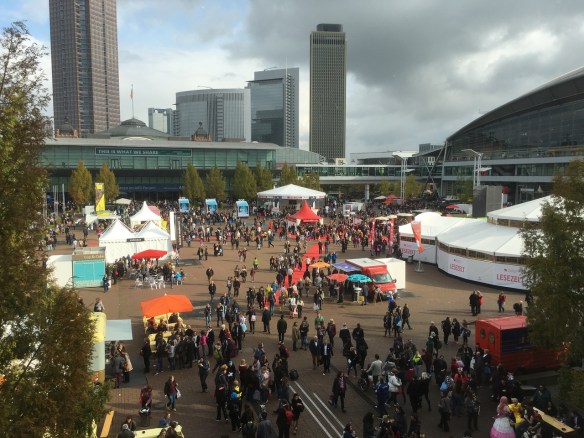
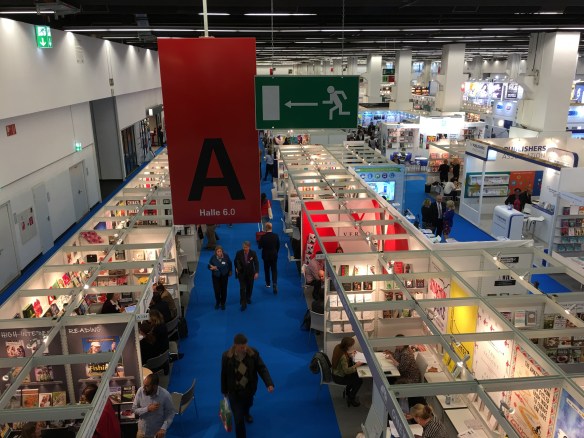
I’VE BEEN to mammoth meetings before—the Modern Languages Association in Chicago, MacWorld in San Francisco, Comic-con in San Diego, for instance—but nothing comes close to the Frankfurt Book Fair in size and scope. Covering over ten hectares of exhibition space spread out over several buildings and many floors, it’s certainly the world’s biggest and best-known book fair, gathering participants from nearly 200 countries.

Unlike author-focused literary festivals, the vast majority of those participants are publishers, booksellers, editors, literary agents, and printing industry representatives, all looking to make a pitch and a sale of their wares across the globe. That globe may have been made much smaller by the Internet, but nothing still beats a face-to-face transaction with one’s possible partners, and that’s where a book fair like Frankfurt’s comes in, as a week-long physical marketplace where the world’s publishers, from the biggest to the smallest ones, all go.

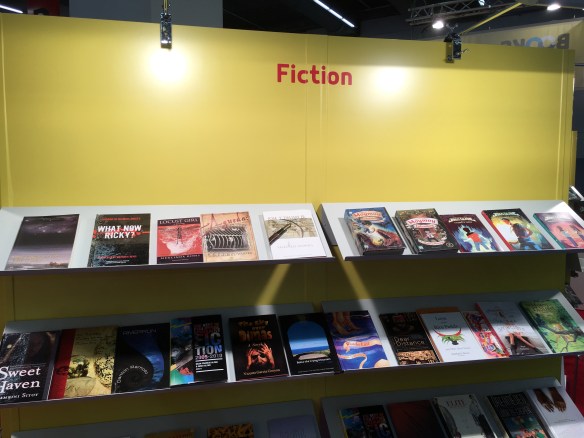
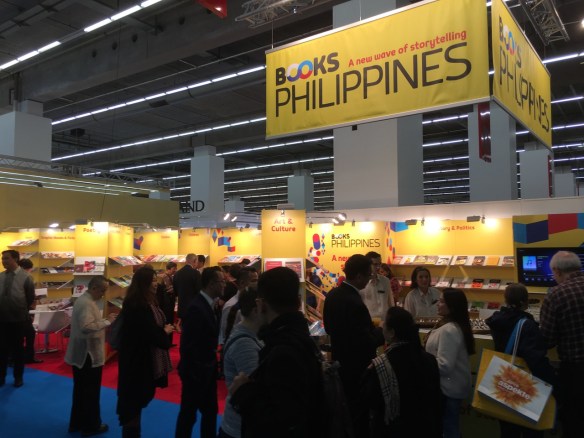
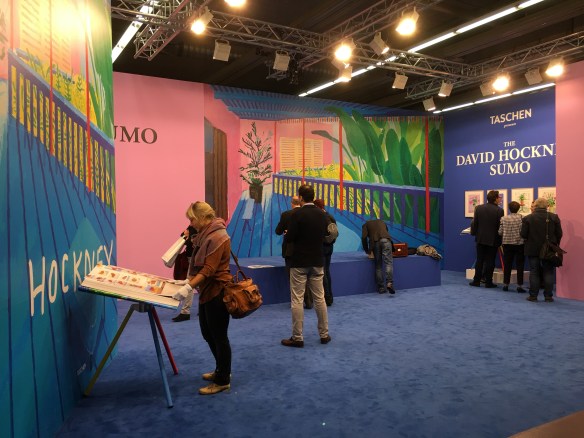
Inevitably a few writers and artists stray into the mix (we spotted David Hockney through a crack in the wall being interviewed at the Taschen booth by German TV), and this year I was one of those lucky few, with some help from the National Commission for Culture and the Arts and the University of the Philippines. Spearheaded by the National Book Development Board and invaluably assisted by the prime advocate of culture and the arts in the Senate, Sen. Loren Legarda, the Philippines expanded and upgraded its representation at FBF 2016, with a much larger booth and an impressive array of books from all our major commercial and academic publishers. The NCCA also sponsored one of our top graphic artists, Manix Abrera, and it didn’t hurt that National Artist Virgilio Almario came along in his private capacity to accompany his wife Lyn and daughters Asa and Ani who were representing Adarna Books and the Book Developers Association of the Philippines.

IMG_9720.jpeg

While Filipinos have attended the FBF in dribbles for some time now, it was only this year that we went all out, helped incalculably by our bigger booth. Last year, publishers had to chip in P100,000 each to rent a tiny plot of real estate at the fair, which starts at 400 euros per square meter. Sen. Legarda’s timely intervention meant that publishers could put their rental money into bringing more representatives and more books, and our 2016 delegation hit a historic high at over 40 members.

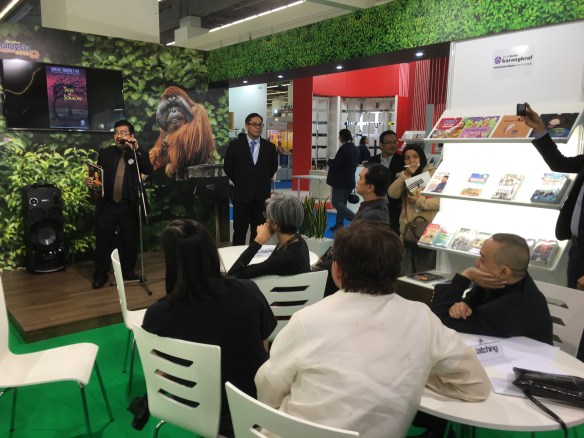
Though not yet quite the pavilion that countries like China and Singapore could afford, our corner booth was colorful and visually attractive—a plus in a fair with thousands of such offerings, all competing for the passing viewer’s eye. Through the Ateneo University Press (now headed by Karina Bolasco, formerly of Anvil Publishing), the Philippines also had another albeit smaller booth in another hall as part of the FBF’s invitational program, an affirmative-action project that brings in and sponsors selected publishers from developing countries. Predictably, China’s exhibit occupied a whole city block (for the price of which they could have gotten a better English editor for their signs, which proclaimed “Chinese Publication”).

On the other end of publishing pomp and circumstance, the FBF annually invites and celebrates a Guest of Honor, and this year it was the Netherlands and Flanders, which decked out an enormous hall as a haunting landscape reminiscent of the Dutch flatlands. The Guest of Honor status focuses attention not only on that country’s literature but its entire culture and society, providing an opportunity to put one’s best foot forward (Dutch royalty attended the opening ceremonies, lending a touch of glamor to the event—and ratcheting up security for everyone). The Guest of Honor also gets to choose a theme for its exhibit, which this year was “This Is What We Share” (last year, New Zealand—on the other side of the world, for Europeans—whimsically chose “While You Were Sleeping”). My fancy tickled, I asked what the Philippines needed to be named Guest of Honor—one can both apply or be invited—and received an unequivocal answer: “Millions of dollars.” I shut up.

Its cultural import aside, the book fair means big business for Frankfurt, which, in partnership with the private sector, leases out the fair grounds to such clients as the publishers’ association which directly runs the book fair; at other times the venue hosts other big events such as automotive fairs and a forthcoming Justin Bieber concert. Last year the FBF brought in 250,000 participants, a figure the organizers expect to rise to 280,000 in 2016.

IMG_9573.JPG

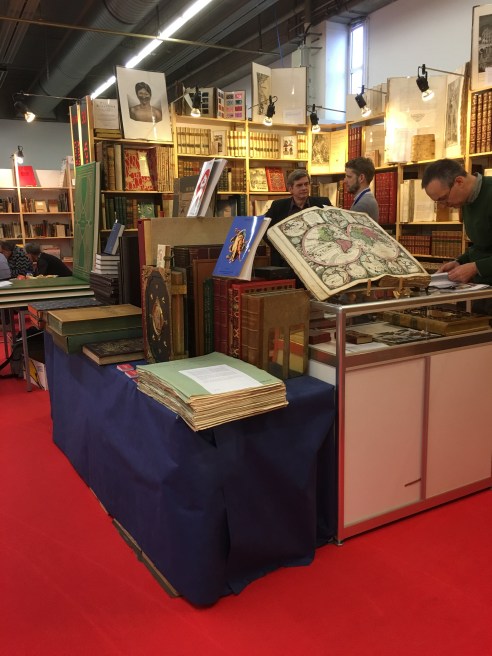
This year’s edition of the Frankfurt Book Fair is officially the 68th, but it traces its lineage much farther back to medieval times, when friars traded pages of illuminated Biblical manuscripts. There’s still a special section of the FBF devoted to the antiquarian trade, to which I gravitated naturally, being interested in all things ancient. Other than this parchment-heavy and leather-bound corner, the FBF dwells and thrives on nothing but new, newer, and newest—new books, new ideas, new authors, new media, new technologies, new markets, new connections, new networks.

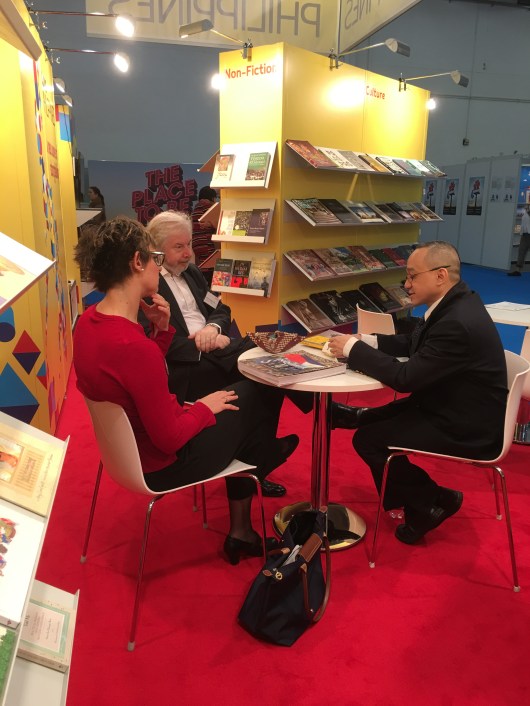
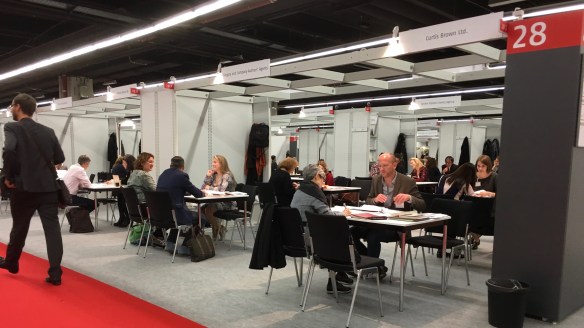
Exhibits are grouped by geographic region, by language, and by theme, so one has to roam far and wide to get the full scale of things and to zero in on specific interests. Much of the business at Frankfurt, however, is pre-planned; with table space at a premium, publishers and agents would have emailed each other months or weeks in advance to set up meetings for specific dates and times in Frankfurt.

IMG_9584.JPG

The publishers of so-called “trade books”—novels, cookbooks, children’s books, etc. aimed at the general public—showcase their works to attract attention from international publishers and booksellers who may want to translate them into another language, or to sell the books on consignment in other countries. Academic publishers—this year we were represented by the UP Press, Ateneo de Manila University Press, and UST Press—negotiate among each other for reprint rights, which can make costly works more easily available to local readers.

Led by NBDB Chair Neni Sta. Romana-Cruz, the Philippines launched its exhibit with a reception at its booth on the fair’s formal opening on October 19, a well-attended event graced by Ambassador Melita Sta. Maria-Thomeczek (who was happy to recall that she had once been an employee in Rio Almario’s Adarna Books and had been a student of Rio’s wife Lyn at Maryknoll) and by First Secretary and Consul Cathy Rose Torres, who herself happens to be a prizewinning fictionist. The reception was catered by Maite Hontiveros, who laid out a scrumptious spread that featured lumpia, spoonfuls of adobo on rice, mango juice, and Philippine chocolate, which were clearly a hit among our foreign guests.

IMG_9536.jpg

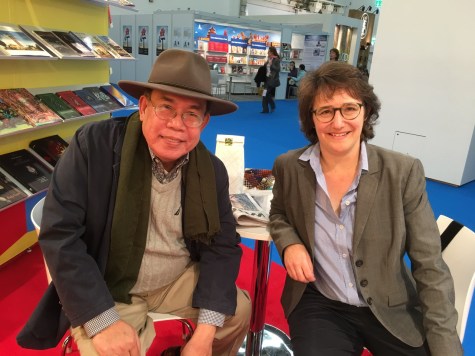
Filipino books, of course, remained on top of the menu, and for the next week, we took turns at the booth to entertain visitors and book buyers from other countries, while occasionally slipping out to survey the vast array of exhibits and inevitably to marvel at the scope, vitality, and quality of global publishing in the 21st century. I came away even more convinced that culture is a global battleground, and that books are weapons—of mass instruction, if you will.

Next week, I’ll share the highlights of my conversations with key people at the book fair, and report on retracing Rizal’s footsteps in Heidelberg.

IMG_9564.JPG

Penman No. 216: From Bali Song to Balisong

IMG_8436.JPGPenman for Monday, September 12, 2016


I’D BEEN meaning to write this up for the past few months, but more pressing subjects kept getting in the way—and “pressing” is the word, because this is about the complete opposite: total relaxation with no fixed schedules or time limits.

It was sometime this past summer when I accompanied my wife Beng and a group of her UP High batchmates on a day trip to Batangas to scout some places as possible sites for their upcoming golden anniversary reunion next February. Beng already had one such place in mind—Cintai Corito’s Garden in Balete, not too far from Lipa, which we had already visited with the family a few months earlier, and had been much impressed by.

Like many Manileños, we’d long been looking for day-trip or weekend alternatives to Tagaytay, especially for bringing our foreign visitors and balikbayan relatives to. Frankly, as a bulalo and ukay-ukay addict, I myself never tire of Tagaytay for a quick break from Manila’s madness. But lately, on our sorties to Mindoro and Romblon via the Batangas ferry, Beng and I have been taking the STAR tollway a lot and have often found ourselves wanting to stop over in one of the many towns on the way.

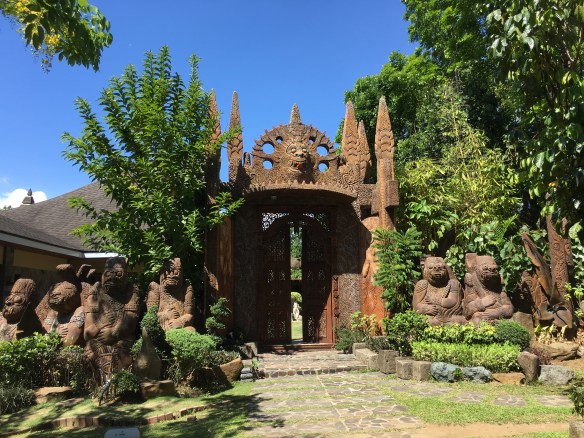
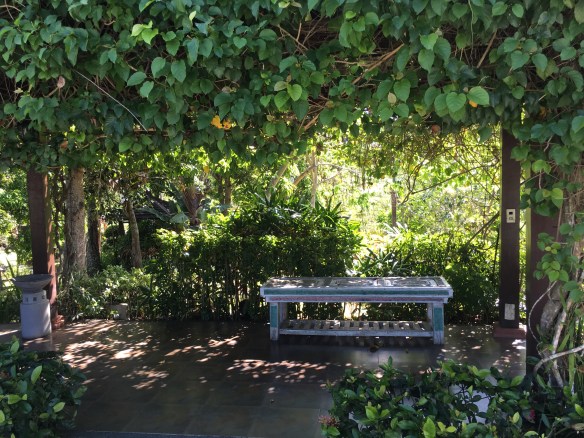
The Balete exit is one those innocuous detours that you’d take only if you really knew where you were going, and the narrow road that you get on leading to Cintai promises little beyond the shops selling honey along the roadside. Cintai itself doesn’t look like much from the outside—until you drive down the winding entranceway. The point of this long prelude is that you’d never imagine such a magical place to arise out of the Batangas countryside—a virtual Balinese-inspired Eden carved out of a rolling landscape that once might have been dotted by coconut and coffee.

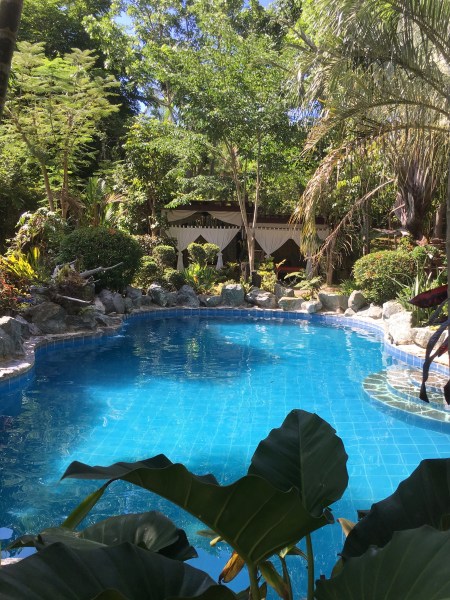
Cintai (which means “love” in Bahasa and is pronounced Chin-TAI) is a love offering to the late Corito of the place’s original name, the lady who inspired this outburst of Indonesian exotica in Southern Tagalog. It would be easy to think of the place as a theme park or resort—there are three swimming pools, and you’ll find peacocks, alpacas, roosters, and dwarf horses roaming the grounds—but other such places imply loudness, both literally and architecturally.

IMG_8415.JPG

Cintai is anything but loud—visually impressive, for certain, but just on the right side of tastefulness. Given the easy temptation to go over the top, Cintai’s designer wisely decided to make just enough of a statement, but also to take care of the fine details and of their consistent employment, even the patterning of the rocks on the walkways and the Balinese carvings in the bathrooms.

In other words, as in Bali itself (which I had the pleasure of visiting 30 years ago), the appeal of the place is in its soulful serenity. The management could have hyped up the atmosphere by piped-in gamelan music, but they resisted even that, for better effect: the gamelan will tinkle in your mind. (One interesting discovery: the Balinese statues, figures, and accents in the complex were mostly made by Batangueño craftsmen.)

IMG_8784.JPG

The complex comprises 18 villas with variable capacities, two large halls, a spa, and a restaurant, among other facilities (for more details, visit http://coritosgarden.com). Beng and her UP High batchmates plan to have the place to themselves for an overnight stay, an ideal set-up for a big group, but walk-in day trippers are welcome, for a very reasonable rate that includes a sumptuous lunch.

IMG_8419.jpg

And that’s what we did on this scouting trip—tour Cintai and have lunch with its amiable manager Francis Salanguit—but I had another suggestion for the group, which they gamely took up: go a bit farther down the highway to Taal, about a 40-minute drive away, to give everyone (especially the balikbayans) a special treat of history and heritage. I’d also been to Taal before and had visited one of its fabled heritage houses and its cathedral; I wanted to see more. So we set out after lunch and were in Taal shortly after.

The historicity of Taal was immediately apparent in the old Spanish-era houses lining the approach to the town. But what also accentuated (I was going to say “sharpened”) Taal’s uniqueness were the shops hawking a fearsome array of bladed weapons—specifically the balisong, the fan knife of many a boyhood fancy, ranging from the mini to the outsized version. Batangas, of course, and Taal in particular can look back to a proud revolutionary tradition, and the balisong seems to exemplify that don’t-mess-with-me attitude Batangueños are famous for.

IMG_8809.JPG

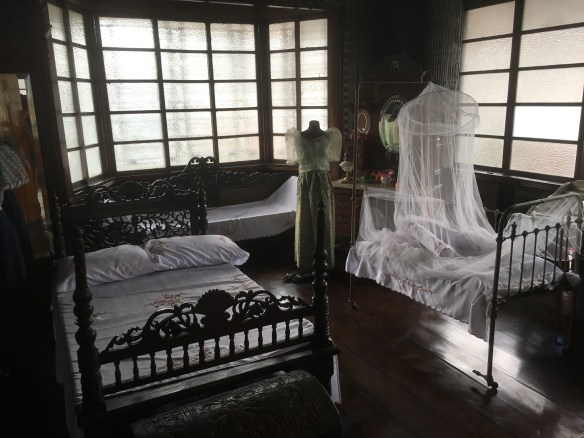
We didn’t stop that day to buy any knives—imagine the alarms they’d trigger if someone forgot about them on the plane ride Stateside—but we pressed on to our main destinations: the Apacible and Agoncillo heritage houses, both of which can be found on Agoncillo Street. I’d seen the Apacible house on my previous visit and had been charmed by its wonderfully preserved furnishings, but I was pleasantly surprised to see how the National Historical Commission, which manages the two historic houses, had taken pains to provide visitors with a more enlightening and rewarding experience.

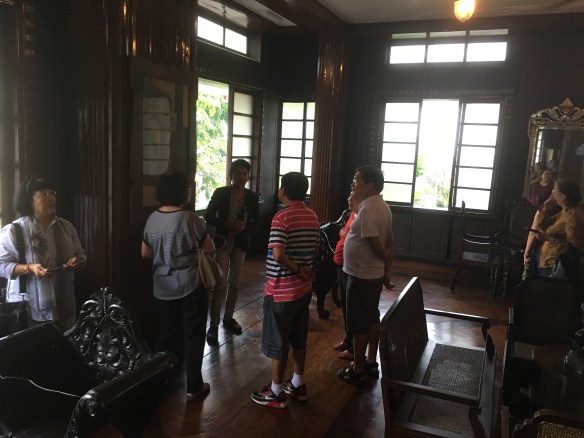
Guests (who may come in for free, but are encouraged to leave a donation) are met and led by a knowledgeable guide; the AV show that introduces the place, its previous owners, and its history was one of the most artistic and professionally produced I’d ever seen. Markers, captions, and child-friendly installations were provided where necessary, and additional information was contributed freely by our young guide. The Apacible brothers—Leon and Galicano—were cousins and confederates of Jose Rizal, who came to their house to talk revolution; Leon was a lawyer and soldier and Galicano a doctor and propagandist, and though less known in the pantheon of Filipino heroes, they come alive in the exhibits that pay due homage to their contributions.

IMG_8812.JPG

The Marcela Marino Agoncillo Museum and Monument a couple of blocks down the street was just as well kept and well introduced with its own AV production (my kudos to Dr. Maris Diokno, whose dual backgrounds as teacher and historian—not to mention her own proud lineage as the descendant of true heroes—can be seen working here to best effect). Marcela was the wife of diplomat Felipe Agoncillo, but came to be known on her own as the co-creator of the first Philippine flag while on exile in Hong Kong.

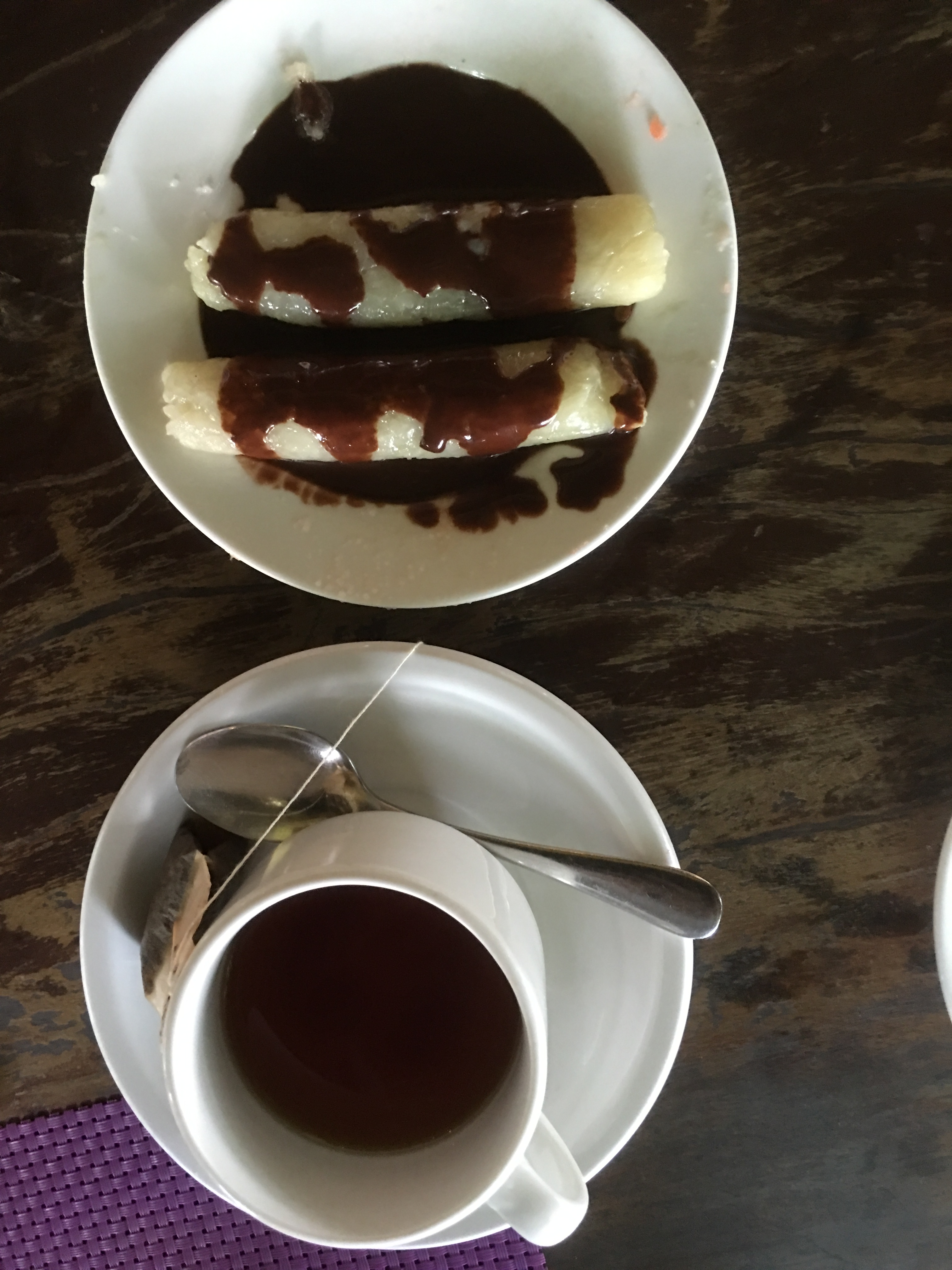
Just as Cintai’s gardens had appealed to the spirit, Taal’s heritage houses touched both heart and mind—and it took just a few mouthfuls of the local suman, washed down with barako coffee, to complete our Batangas experience with a boost to our famished stomachs. I’m not knocking Tagaytay, but one of these days, you just may want to go a little farther down the road and try a bit of the best that Batangas has to offer.

IMG_8802.JPG

Penman No. 213: Artisanal Delights at Salcedo

IMG_9208.JPG

Penman for August 22, 2016


LIKE MANY Manileños, my wife Beng and I had heard of the famous and fabulous Salcedo Weekend Market in Makati but had never gone there, being staunch northerners who refuse to brave the EDSA traffic, even on weekends, if we could avoid it. But curiosity and circumstance finally forced us to relent a few Saturdays ago, the circumstance being a friend’s offer of a room at a nearby hotel that she and her husband weren’t going to be using.

That sounded to us like “Staycation!” so we jumped at the chance. This same friend—she’s in the travel business and gets around—had done us a similar favor a few months earlier as a Valentines’ Day treat for a pair of arthritic lovebirds. Since the room was huge and free, Beng promptly called her sister Mimi and Mimi’s kids and granddaughter Sophie to share the day with us, the idea being to walk a couple of blocks to the Salcedo Market, pick out whatever we wanted for lunch, then lay it all out on the long table and dive in.

IMG_9209.JPG

And that’s exactly what happened. The Salcedo Market opens at 6 and closes at 2, so Beng and I decided to take a sneak peek right after breakfast, before the rest of the family arrived all the way from Tierra Pura. Sure enough, even at that hour and with a slight drizzle threatening, scores of vendors had already set up shop under canvas tents spread out on what, on weekdays, is a parking lot close to the Makati Sports Club.

As I often point out in this corner, I’m no foodie—I’m an instant-ramen and canned-sardines sort of fellow for whom a trip to a food market might be like that of a heathen to the Vatican—but I’m addicted to food shows on TV the way some people can’t get their fill of horror movies, and am always curious to see what’s out there. Beng, on the other hand, will try and eat anything short of the rotten shark that seems to be all the rage in Iceland, and she has to catch me in a good mood so I can graciously agree to step into a restaurant where they serve pizza (I hate cheese), so the Salcedo Market sortie was, for her, sheer, exultant liberation.

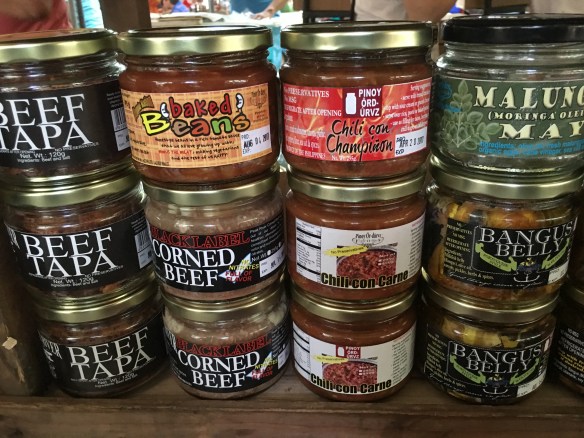
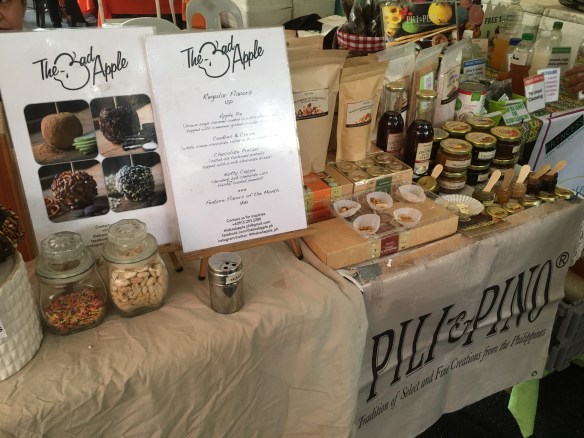
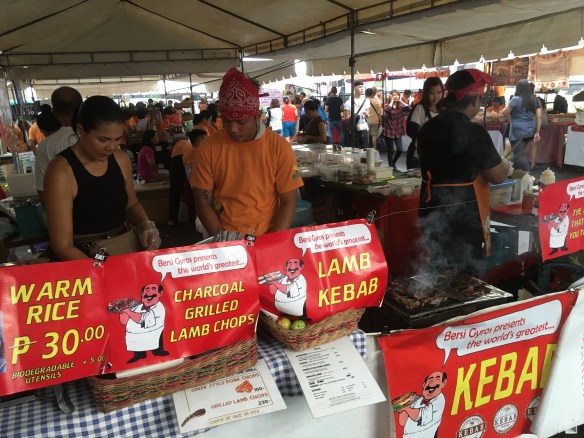
What immediately struck me, despite what I just said about my aversion for fine dining, was how many options there were for plain-food folks like me on offer—burgers, lechon, smoked fish, pancit, siopao, barbecue, and such familiar staples. What lifted them above the ordinary was the freshness and sometimes uniqueness of the ingredients—many were cooked on the spot—and the assurance that you weren’t going to make hourly runs to the bathroom later in the day. Knowing that I had a mound of work waiting for me in our hotel, I loaded up on lechon, corn on the cob, fresh jackfruit, and breadsticks to nibble on, while Beng chose the fresh Chinese lumpia. Mimi and her brood arrived, and I let the sisters drool over the fish curry, the lamb kebab, the laing with daing, the vodka tinapa, the malunggay pesto, and the other more exotic fare.

That was the Salcedo market scene for the most part—good food done well (and whether I liked it or not was irrelevant; seeing Beng’s eyes light up at the culinary pageant was well worth the trip), and home-cooked and artisanal food you just can’t order from a fastfood joint. I hate to think about what had to happen to produce my take-home kilo of tapang usa—Beng didn’t appreciate my Bambi jokes—but it was heaven on the tongue.

This was where a short walk back to the dinner table rounded out our Salcedo experience. There’s a cluster of tables in the center of the weekend market where you can gorge instantly on your selections, but given how many of us there were and how much food we’d amassed, we appreciated the luxury of a long table with complete cutlery in our lodgings just minutes away.

IMG_9222.JPG

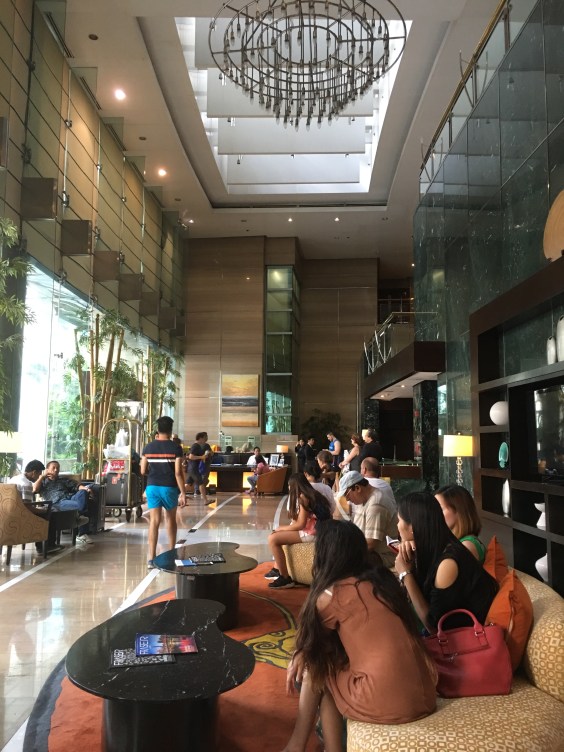
That abode, not incidentally, was Fraser Place Manila—and to call it a “hotel” frankly wouldn’t do it justice. Sometimes you just want a room, any room, to crash into for the night. Some other times, you want more than just a hotel—a place not just to stay but to actually live in, for a few days to weeks to months, maybe even years. (I’d learn from the staff that a couple upstairs checked in ten years ago—and liked the place so much they never left!)

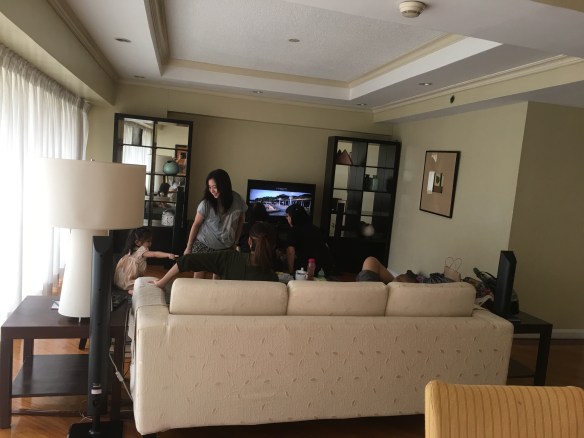
The Fraser—part of a Singapore-based global chain—calls itself a “serviced apartment,” and as soon as we stepped into our two-bedroom suite, we could see why: the 180-sqm enclave was really a virtual house, with a complete kitchen, laundry, three toilets and baths plus another john for guests, and quarters for a housekeeper or caregiver. All your needs were attended to by the staff, the wi-fi was free and strong, and aside from the Salcedo Weekend Market, a host of other restaurants and facilities could easily be accessed in the neighborhood.

But who needs restaurants when, like us, you could bring in loads of choice take-out meals and groceries? It made me smile to see a guest cross the lobby with a bag of veggies and what could have been fresh fish—as only a hotel with a full kitchen could allow. (I also heard dogs yapping faintly in the hallways—the Fraser is pet-friendly, but no cobras please.)

IMG_9221.JPG


There were a couple of downsides to consider, and it’s best to put them out front. Fraser Place Manila isn’t exactly located in what you’d call Makati’s trendiest corner. It stands across a row of office buildings, separated from them by a parking lot. It doesn’t have a penthouse bar or restaurant with a 360-degree view where you can party with your gang until the wee hours. (Cravings does operate a restaurant on the 33rd floor, beside the pool.)

But it’s these very “minuses” that guarantee peace and quiet, which Beng and I appreciated later that evening after our visitors had left and as I typed away on a book project and Beng worked on a painting for a forthcoming exhibit. It also means (of course I had to ask) that we could’ve gotten our princely suite for less than what we recently paid for a small room at an airport hotel near LAX.

Some days, Makati might as well be as far as LAX for us Dilimanians, but we’ll be sure to be back for more of Salcedo. Watch out, Bambi!


IMG_9203.JPG

Penman No. 212: A Lovely Place to Be

IMG_8775.JPG

Penman for Monday, August 15, 2016


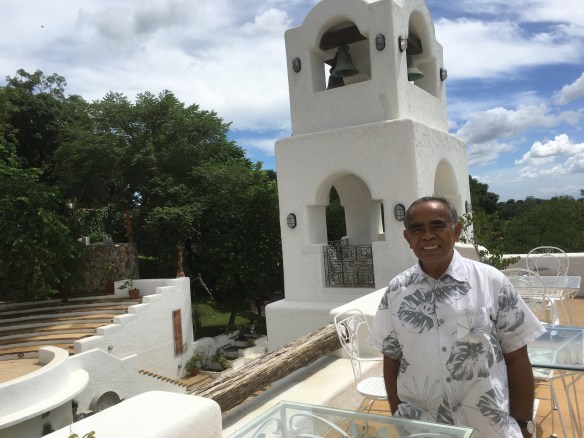
IT WAS a few Sundays ago when I joined a group of artists and friends for lunch at a place that has to be on the must-see list of any Filipino art lover, especially those within driving range of Antipolo. We had been invited for lunch by Dr. Joven Cuanang, whose Pinto Art Museum we had visited once before, but this time it was the founder himself who was going to walk us around the place, so we all looked forward eagerly to meeting him and having a chat.

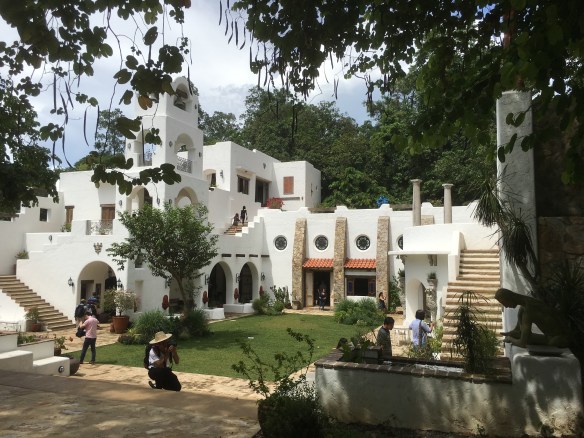
For those who’ve never heard of it or never been there, the best way to describe the Pinto (people, including myself, have been heard pronouncing it as PIN-to, but it’s really Pin-TO as in “door”) is to call it an art complex—mostly gallery, but also museum, restaurant, theater, library, and, apparently, research center. It’s also, quite simply, just a lovely place to be, with its buildings and galleries set on seemingly terraced hillsides leading naturally from one to the other, offering spectacular panoramas of the metropolitan skyline from every high point. Not surprisingly, it can get very busy on weekends, with as many as a thousand visitors streaming in through the gate (admission fees range from about P100 to P200).

IMG_8097.JPG

The Mediterranean-styled complex has that pleasing, thoughtfully curated ambience, the visual and sensory assurance of a well-managed experience. But of course, it wasn’t always so. The place began as a rough and weedy wilderness, which a young but visionary Dr. Cuanang bought up, patch by patch, more than four decades ago. “I started in 1972 with 1,000 square meters,” he reminisced. “Real estate prices fell after martial law and I was gradually able to acquire more land in the area.”

After EDSA, Joven fell in with a committee of prominent Antipolo residents and community leaders eager to spearhead the town’s cultural renaissance, but the good doctor soon decided to go it alone after an unpleasant brush with government corruption. He must have seen art and nature as the best cleansing agents, and he began supporting a posse of local artists, buying their work when they needed cash. Those artists later became the Salingpusa group, which considers Pinto its physical and spiritual home. “We didn’t have much then so the artists first exhibited their work by hanging them on a clothesline, and that practice became known as Sampayan,” said Cuanang.

Today that clothesline spans six buildings spread over 1.2 hectares, operated by the Silangan Foundation for Arts, Culture, and Ecology. Designed by Tony Leaño, the buildings blend effortlessly into the landscape, which is no accident because they were built around natural objects like the huge rocks that dotted the hillside. “We observed three principles in designing the place,” Cuanang noted. “First, don’t cut any trees. Second, follow the landscape. And third, minimal maintenance.”

As much as possible, Pinto’s buildings also employ natural ventilation, a notable exception being the air-conditioned library (where I was secretly pleased to find a couple of my books on the shelves). You’re never too far away from being reminded, however, that human whimsy is at work on Nature here, with oversized sculptures of mythological figures such as Icarus, Sisyphus, and Ariadne scattered about the greenery or soaring on rooftops.

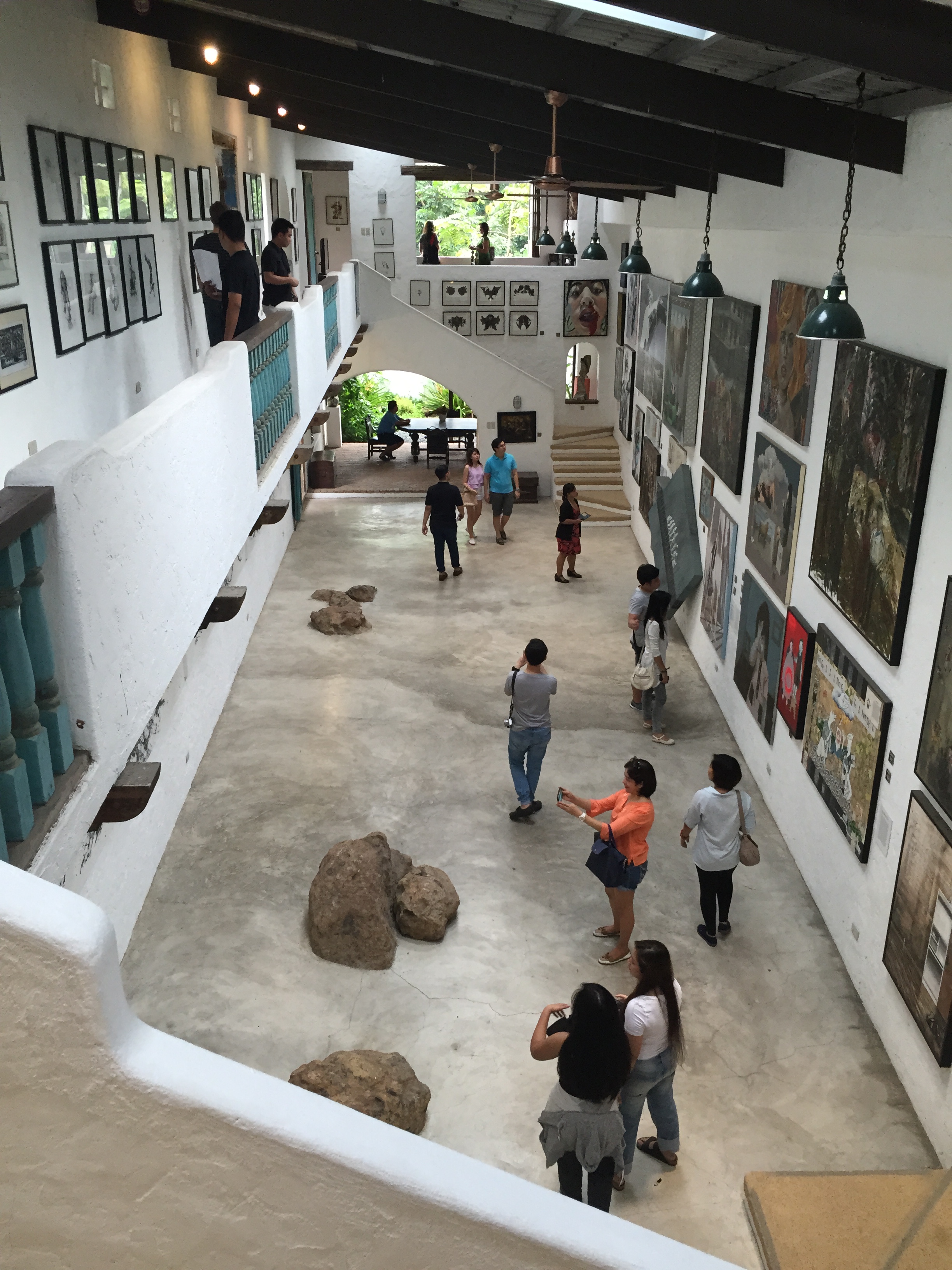
While some come specifically for the scenic grounds, which are often rented for wedding shoots, most visitors flock to Pinto, understandably, for the art, which represents many of the most vibrant and brilliant works of our younger if lesser known artists. “You won’t see a single National Artist here,” Dr. Cuanang said, smiling and gesturing at the paintings and sculptures around him. “I keep my Bencabs at home!”

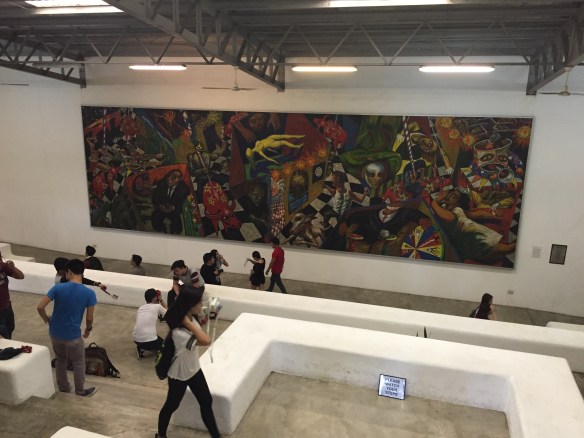
It’s refreshing and encouraging, in a way, not to see the usual parade of Amorsolos, Manansalas, Ocampos, and Botongs on display, and instead to find works by the likes of Elmer Borlongan, Jason Moss, Plet Bolipata, Tony Leaño, and Rodel Tapaya—at no diminution of quality, as these names could well be those of the National Artists of tomorrow. Salingpusa’s breathtaking 40 x 12-foot mural “Karnabal” is arguably the centerpiece of collection.

IMG_8049.JPG

Despite the plenitude of art offerings at Pinto and his obvious passion for art, Dr. Cuanang won’t think of himself a collector, the kind who spots and buys fine new work on the cheap for future profit. “I’m not here for the business,” he emphasized. “Too much art and discussion about art today is centered on the market.”

What truly interests the Harvard-trained neurologist, who still practices medicine after serving for many years as medical director of St. Luke’s, is wholeness of mind, body, and spirit, which he hopes to promote through the Pinto Academy of Arts and Sciences, a complex of facilities in a corner of the compound that comprises a large indoor theater, an amphitheater, a library, a function room, open decks, and gardens.

In a manifesto of sorts, Cuanang explained that “In medicine, healing is currently dominated by pharmaceuticals and technology, oftentimes to the detriment of the wholeness of a human being: mind, body, and soul. This perception is pervasive in our society. Fortunately, new knowledge in neuroscience research is affirming that the Arts and Sciences are in fact interconnected and mutually useful in preserving our wholeness, and together are powerful in the relief of our maladies.” The Academy, he added, “was built to promote conversation across disciplines to create, innovate and to pursue activities that celebrate this thought.”

The bridge between medicine and art, he pointed out, is neuroaesthetics, a branch of study that fascinates Dr. Cuanang. One of its chief proponents, Dr. Anjan Chatterjee of the University of Pennsylvania, poses its main concerns thus: “What in the brain triggers aesthetic experiences? And how does knowledge of basic brain mechanisms inform our understanding of these experiences? These questions are at the heart of an emerging discipline dedicated to exploring the neural processes underlying our appreciation and production of beautiful objects and artwork, experiences that include perception, interpretation, emotion, and action…. Neuroaesthetics is both descriptive and experimental, with qualitative observations and quantitative tests of hypotheses, aimed at advancing our understanding of how humans process beauty and art.”

It’s a lot to think about, for sure—but there’s no better place to ponder the glorious if sometimes dark mysteries of the human imagination than Joven Cuanang’s hilltop sanctuary.

Pinto Art Museum can be found on Sierra Madre Street in Grandheights Subdivision, Antipolo, and is open Tuesdays-Sundays, 9 am-6 pm.

IMG_8774.JPG

Penman No. 210: From Fantasy to Reality: Comic-Con (1)


IMG_8370.JPGPenman for Monday, August 1, 2016


IT WAS a millennial geek’s fantasy come true, except that it happened to a doddering senior with the good luck to be in the right place at the right time. As I reported last week, Beng and I were in the US last month to attend the launch of the foundation behind the prospective American Museum of Philippine Art (AMPA) in Los Angeles, and also to visit our unica hija Demi in nearby San Diego, where she’s been living and working with her husband Jerry for the past nine years.

We save up for these visits, which usually take place every year sometime in October during what used to be our semestral breaks. But with the shift in our academic calendar to the international (okay, the US) model, we timed this year’s trip for July in conjunction with the AMPA event, the sum of which was that we found ourselves in Southern California during the third week of July.

And what’s so special about that week—one marked by 90-degree-plus temperatures, water shortages, and brush fires in California’s sunbaked hinterlands? Well, as every pop-culture-savvy 30-year-old from Pandacan to Pasadena knows, it’s the time when Comics Convention International—better known as Comic-Con—takes place in San Diego, where it began 46 years ago.

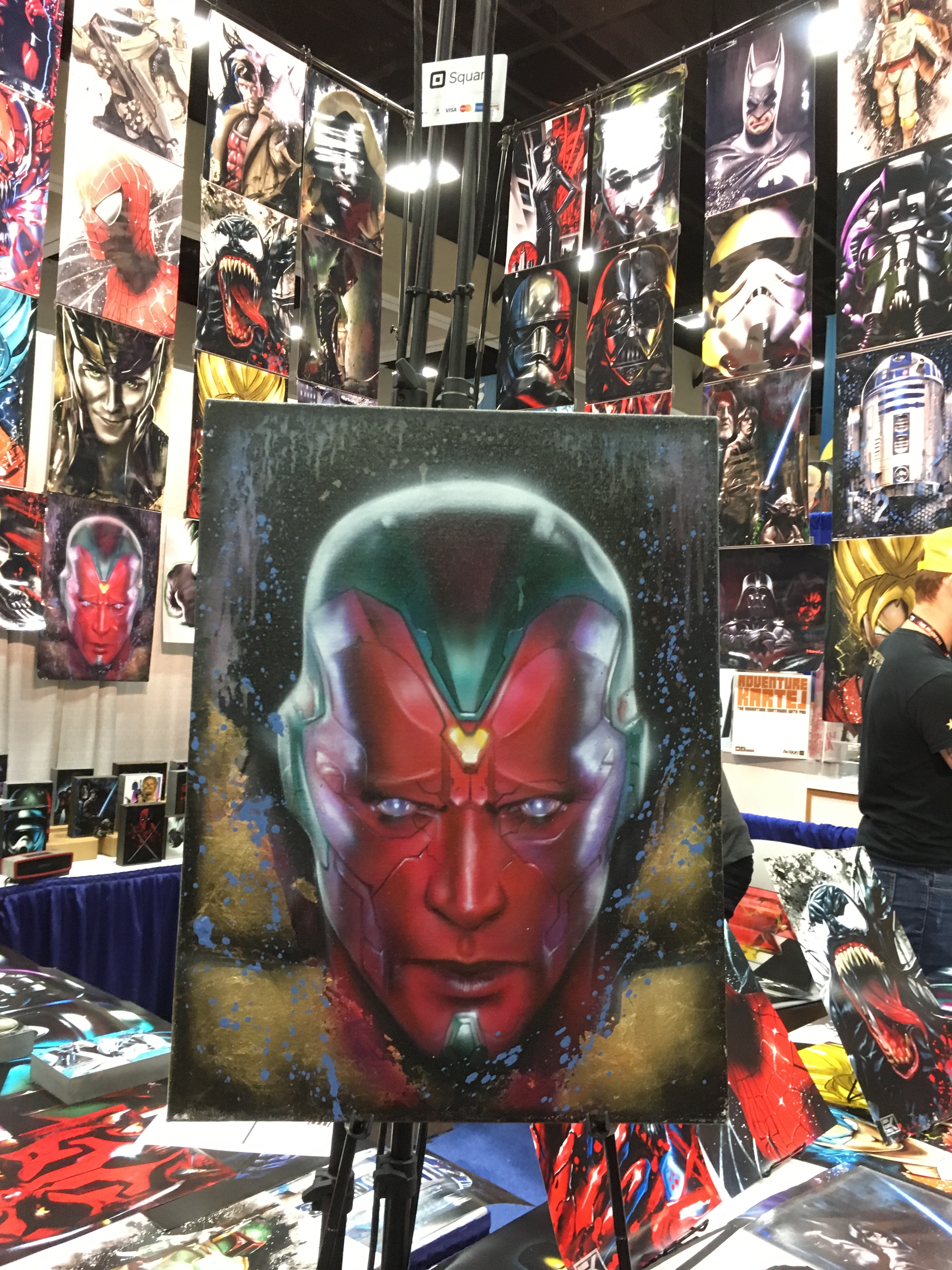
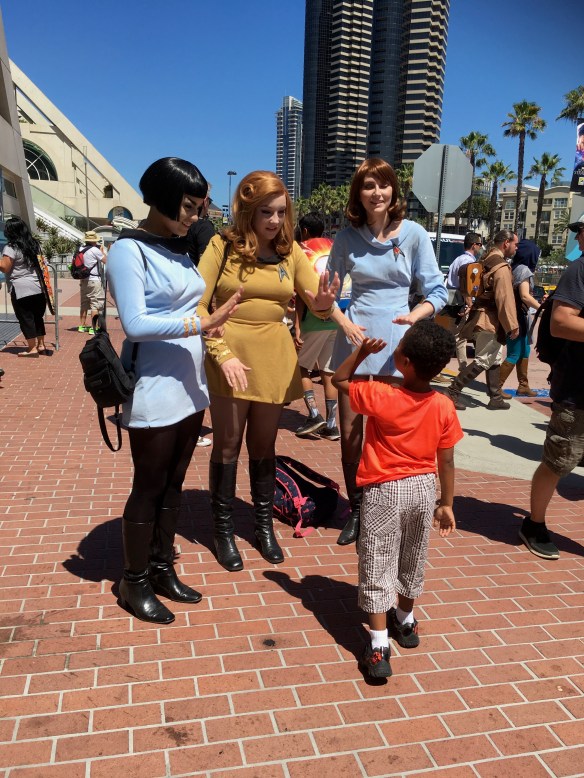
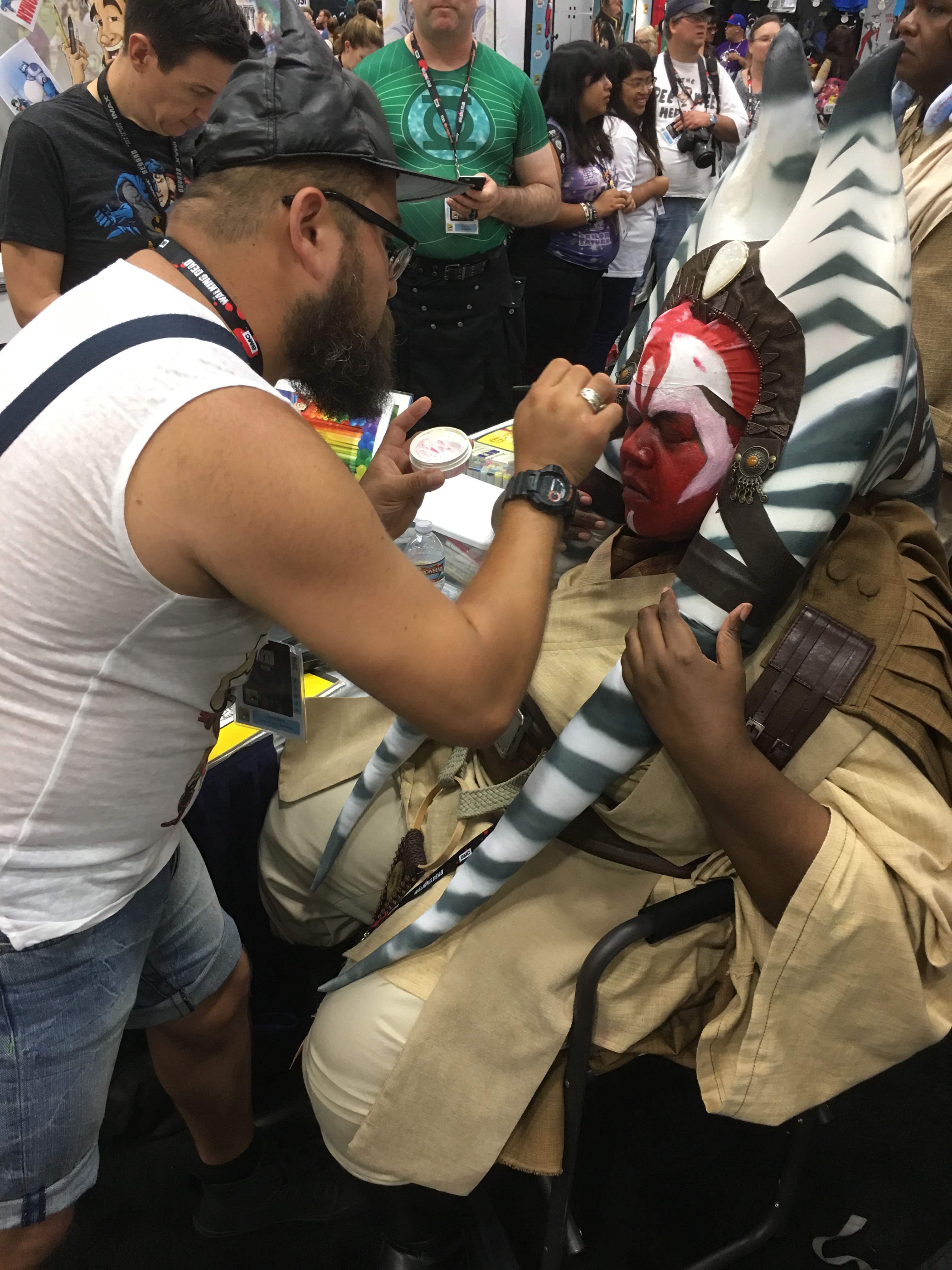
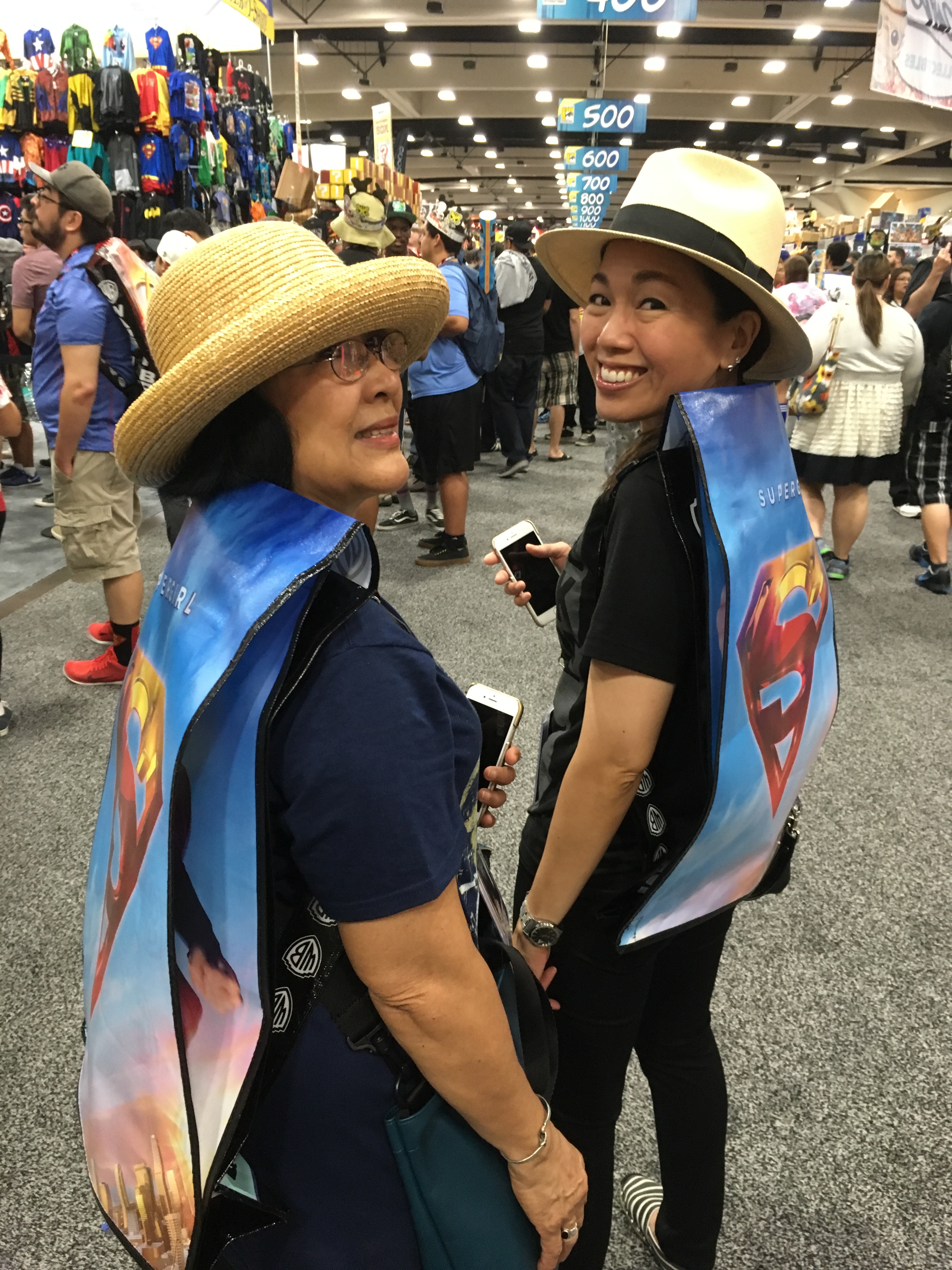
So what exactly is Comic-Con, and what’s all the fuss about this annual pilgrimage attended by hordes of Earthlings, as well as presumptive superheroes and extraterrestials? It’s an exhibition, a convention, an academic conference, a parade, a pageant, a marketplace, and a film festival all at once—the world’s largest and best-known pop-cultural mecca.

IMG_8349.jpg

You might say that at 62, I had no right to be there at all, and I wouldn’t have argued, even if I’d been a staunch DC Comics fan in the ’60s who battled the Marvel masses in lunchtime chalk fights. I could easily think of half a dozen people just in my department in UP who would’ve given their right arms to be in my place, having followed every twist and turn of “Game of Thrones” and having memorized the names of every Jedi Master and Sith Lord in the Star Wars universes (the official and the expanded). These guys (and gals) take their fantasy seriously, and some of them go on from buying every issue of Batman to writing ponderous academic essays for such tomes as It Happens at Comic-Con: Ethnographic Essays on a Pop Culture Phenomenon, edited by Ben Bolling and Matthew J. Smith (Jefferson, NC: McFarland & Co., 2014).

In his foreword to that book, Matthew Pustz would recall that “When I got off the trolley in downtown San Diego, I knew just how to find it: follow the guy in the Green Lantern t-shirt. After a short walk, there it was—Comic-Con International, with the huge convention center sitting in the sun. Waiting to enter were tens of thousands of fans—all with their own strategies for making the most of what has become one of the largest popular culture events in the world. This was the summer of 2007, and I had traveled to San Diego all the way from Boston to attend something that I had dreamed about for a long time. I had attended comic book conventions before, in Chicago, Columbus, Ohio, and St. Louis. But San Diego was different, bigger, more important. This was San Diego—the Super Bowl of comic book conventions—and I was on the comic book fan’s holy pilgrimage, the trip that all fans must make at least once in their lives. This was the Gathering of the Nerd Tribes, Fanboy Woodstock.”

“Comic-Con is a fan event, but it is also a money-making extravaganza where all manner of creators, artists, and corporate owners of media products can sell and promote them to their exact target market. And this target market is one that can be virtually guaranteed to take the ‘buzz’ of Comic-Con back with them to to Iowa or Boston or Tokyo so they can ‘sell’ those products to their friends back home. Comic-Con is the ultimate merging of culture and commerce, and that makes it the perfect place to study how popular culture works in the twenty-first century.”

IMG_8380.JPG

While there are many other fantasy and pop-culture conventions—Dragon Con, for example, is a big cosplay event that takes place every year in Atlanta, Georgia on Labor Day weekend—Comic-Con is a San Diego original, run by “a nonprofit educational corporation dedicated to creating awareness of, and appreciation for, comics and related popular artforms, primarily through the presentation of conventions and events that celebrate the historic and ongoing contribution of comics to art and culture.” WonderCon, a comic-book-focused event, is held in Los Angeles.

The first Comic-Con—then known as the Golden State Comic Book Convention—was held in August 1970 at the US Grant Hotel (the grande dame of San Diego hotels, where our daughter Demi works), but it’s since moved on to the sprawling San Diego Convention Center (where Hall H alone, reserved for the biggest events, fills up its 6,000 seats) and to nearby hotels.

IMG_9048.JPG

Over its four-day run, Comic-Con 2016 was projected to draw 130,000 attendees from all over the world (and the galaxy), each of whom was also likely to spend at least $1,000 in San Diego, making it the city’s top annual grosser. Movie stars fly in to promote their projects and some celebrities like Conan O’Brien have made Comic-Con a regular item on their calendar.

Getting into Comic-Con used to be a matter of flying into San Diego and walking in through the convention door, but not anymore. According to the organizers, “Although we strive to make attending our show as easy as possible, obtaining a Comic-Con badge can require the persistence of Superman, the patience of a Watcher, the ingenuity of Tony Stark, and the readiness of Batman.” It’s hard to think of any other conference where the rules include the following:

  • All costume props and weapons must conform to state and federal law.
  • Projectile costume props and weapons must be rendered inoperable. Functional (real) arrows must have their tips removed and be bundled and zip-tied to a quiver.

Tickets to Comic-Con were sold out months ago, as were all hotel rooms in San Diego, at peak prices (“Comic-Con attendees book their rooms for next year before they leave,” Demi told us.) You don’t really buy a Comic-Con ticket but a “badge,” and to get a badge you have to pre-register online for a membership ID, with which you can then apply for a badge using a code that entitles you to a slot—well, you get the idea.

So how exactly did we get in? All I’ll say is, it pays to have a daughter in a hotel in San Diego in July. It wasn’t really in our vacation plans, but Demi decided to give a pair of seniors a special treat one morning by announcing that she could get the three of us into Comic-Con. Were we interested? You bet we were!

IMG_8362.JPG


Penman No.205: Sojourn in Seoul (2)

IMG_8666.jpg

Penman for Monday, June 27, 2016


HAVING PLANNED our trip to Seoul months in advance, I made a point of touching base with some local contacts for possible meetings—something I usually don’t do, wary of disturbing people with my unseasonable presence. But with a week to kill in one city and with some longstanding connections in place, I thought it would be even more ill-mannered if I didn’t at least tell them that I was going to be in town.

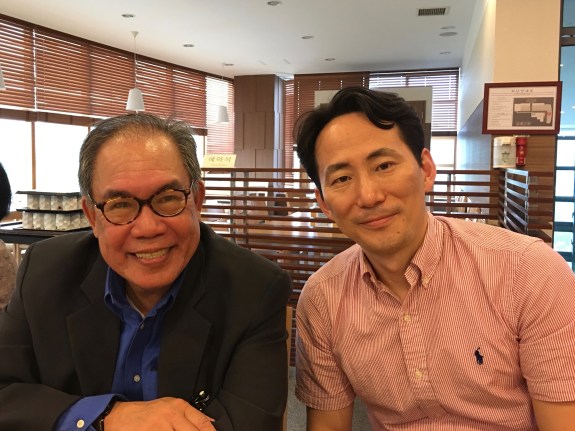
One of those connections was Dr. Sukjoo Sohn, who teaches English at Dong-a University in Busan, Korea’s big industrial center four hours by train from Seoul. Sukjoo—a specialist in world literature—happens to be married to Catherine Rose Torres, one of our bright new young fictionists who now serves as First Secretary and Consul at our embassy in Berlin. I’d first met Catherine in 2011 when I attended the Singapore Writers Festival and she was with our embassy there, and I was later very happy to write a blurb for her first book, Mariposa Gang and Other Stories (UST, 2015).

It’s really these personal connections that make for global literary networking, the value of which I can’t overemphasize. In 2014, Sukjoo translated one of my stories for publication in Global World Literature, which is put out by some of Korea’s foremost literary scholars and critics in that area. Through Sukjoo, I was also able to contribute an article to the Korea-based journal Asia, in which I wrote about some of our most gifted and exciting younger writers. As a result of that article, one of our best young non-fictionists, Sandra Nicole Roldan, will be visiting Seoul this week to attend the 2016 Asia Literature Creative Workshop.

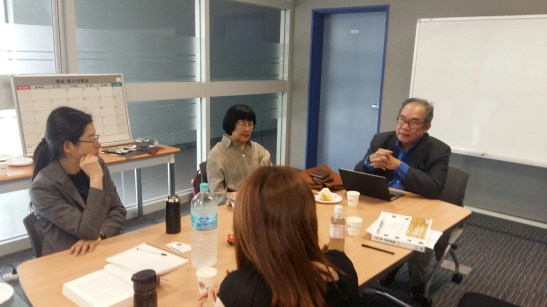
And so our connections continue and deepen. When they learned that I was visiting Korea, Sukjoo’s organization invited me to a special meeting, so I could tell them more about Philippine literature. That gathering took place at Seoul National University toward the end of our visit, and a very fruitful and engaging encounter it turned out to be. Perhaps I shouldn’t have been surprised, but their very first question had nothing to do with lyric poetry: “What do you think of your new President, Rodrigo Duterte?”

It will take more than this column to share my answer with you, but suffice it to say for now that we talked about our colonial history, our Catholic predisposition to suffering, the two Joses (not me) by which our literature is best known overseas, class as the key divisor in our literature and society, Korea’s and the Philippines’ shared experience of dictatorship, and the irony of having to deal with a resurgent Park and a resurgent Marcos, and our younger writers’ affinity with Gaiman, Murakami, and Wattpad.

We discussed my translated story, “In the Garden,” which I’d written in the 1980s about militarization in the countryside and the moral duty of a teacher caught in the crossfire. While the topics were unavoidably contentious, our meeting itself was thoroughly pleasant and mutually informative, capped by dinner, shop talk, and, yes, chatter about Lee Min-ho.

meeting 2.jpg

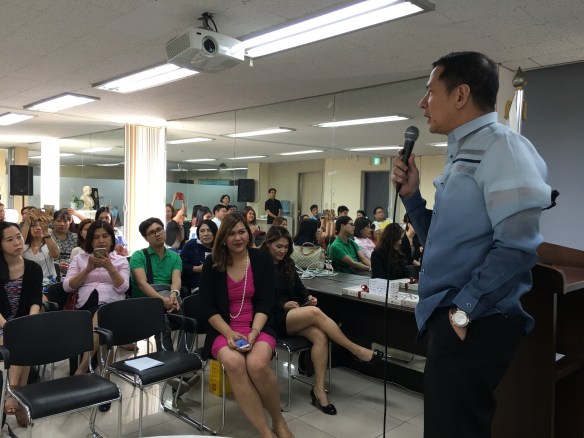
The second highlight of our visit—away from the malls and the flea markets—was a meeting with the Filipino community in Seoul, which had also been pre-arranged by Catherine through her Seoul colleague, the very capable Third Secretary and Vice Consul Ella Mitra.

It was a Sunday—our last full day in Korea—and much to our surprise, the embassy was open and bustling with people, with a wedding taking place right in Ella’s office. (“We can officiate at weddings,” Ella told us, “as long as the two parties are both Filipino citizens. We’re open on Sundays because that’s when most of the community can come.”) There were over 40,000 Filipinos in Korea, Ella informed me, many employed as factory workers in jobs that the locals themselves prefer not to do.

I’d been asked by the embassy to give a reading for the community—something I love to do whenever I’m abroad, as it puts me in touch with ordinary Filipinos striving to do their best in often very challenging circumstances. The Filipino, I like to say whenever the opportunity arises, is the modern-day Ulysses, roaming recklessly to the farthest reaches of the globe, but imbued with an unfailing sense of home. Now here they were, a crowd that filled the room beyond our most generous expectations—professionals, teachers, graduate students, Filipino-Korean couples, even the Ambassador himself, the dapper and articulate Raul Hernandez.

IMG_8681.jpg

The embassy had calendared my reading as its second Sentro Rizal activity, and with June 12 coming up, it seemed a good time to remind ourselves of the things that both divided and united us, and of the need to hang together as Filipinos, at a time and in a region of revived nationalisms. Even so I chose to do a very light reading, one that made fun of my own social ineptitude in cross-cultural situations, and thankfully it went over well with the audience. More than the reading, it was the ensuing Q&A and freewheeling chat over pancit and puto that proved most gratifying. I could sense the community’s strength of spirit, its determination to master a new cultural terrain.

I was especially happy to see a former student, Tech Apognol, now doing an MA in International Relations and speaking Korean. She’s hardly alone; the association of Filipino grad students in Korea now numbers 500, I was told, and there were plenty of masteral and doctoral scholarships for those inclined. “We can take classes in English,” one student named Eve told me.

Another grad student named RJ solved a mystery that had been bugging me for 40 years. Back then, I told him, I was a young writer employed by the National Economic and Development Authority, and one of my tasks was to help edit the Five-Year Development Plan, which was thicker than an encyclopedia because of its bloated prose. On the other hand, I recalled, the South Korean development plan that I used as a reference was no bigger and fatter than a paperback novel—and look, I told RJ, where Korea was now. “Ah, that’s easy,” RJ said. “It’s because the Koreans value brevity, and memos are expected to be no more than a page. The higher up the ladder papers go, the more concise they’re expected to be.”

The shopping was fun—just the flea markets for us, please, not the high-end shops—and the streetcorner food delicious, but it was, ultimately, our encounters with the people that added the most value to our visit. Kamsahamnida, Sukjoo, Cathy, Ella, and Tech for these memorable exchanges.

Penman No. 204: Sojourn in Seoul (1)

IMG_8594.jpg

Penman for Monday, June 13, 2016


AS MY regular readers well know by now, I have a habit of taking off to parts unknown with my wife Beng at the slightest excuse, and one such occasion came up three weeks ago when Beng marked her birthday (her 36th, it seemed to me—as it seemed to me last year as well, and the year before). Of course I’d known for months ahead that her birthday was coming up, so as early as January, I booked us a flight to and a hotel in Seoul, for the first week of June. (That’s how Beng and I get our kicks—we jump on early-bird budget fares and commit ourselves to travel months in advance, the better to plot the year ahead.)

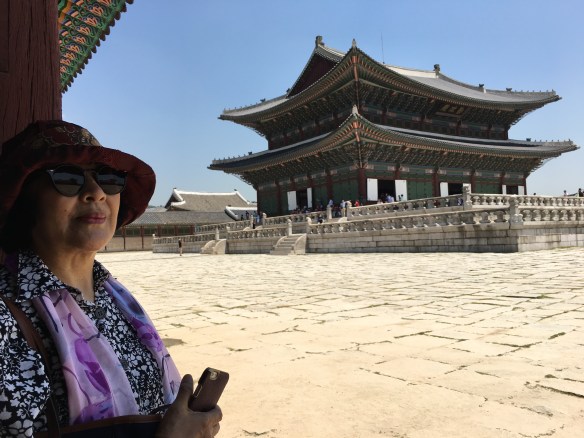
Why Seoul? Simply because Beng had never been to Korea, except for stopovers in Incheon, and I’d pledged years ago to take her everywhere I’d ever been. I visited Korea in 2007 on assignment for the STAR, to cover Hyundai’s shipbuilding and carmaking operations, and we stayed for a day or two in Seoul before moving on to Busan and Jeju, but I could hardly remember anything of Seoul except for the stately palaces and the enormous beef-barbecue dinners. I could do with another and more relaxed visit, on my own time and schedule, and Beng’s birthday in early June seemed perfectly timed, with our semester in UP just having ended.

I also suspected that a sojourn in Seoul would satisfy Beng’s yearnings to see, with her own eyes, the locales of her favorite Boys Over Flowers and the birthplace of Lee Min-ho, if not Lee Min-ho himself sauntering down an alley in Myeong-dong.

IMG_8611.jpg

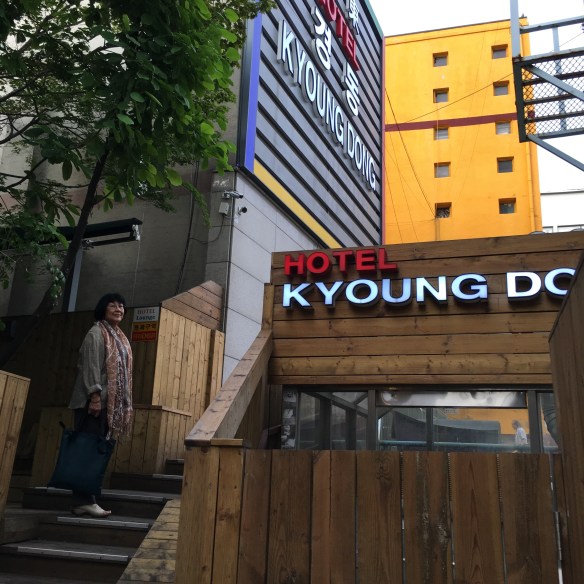
The planning was the easy part. Like I always do, I went online—to skyscanner.com for the plane fares and to booking.com and tripadvisor.com for the hotel. AirAsia had a good deal for the period, and I was able to locate a small, affordable hotel at a great location in central Seoul with four-star reviews—the Hotel Kyoung Dong in the Namdaemun/Namsan Park area.

IMG_8667.jpg

Because of the fare structure, we signed up for a six-night, Tuesday-Monday stay—a tad longer than our usual four-day getaways. But this would open, as I’ll report next week, more fruitful possibilities beyond sightseeing and shopping. This week, I’ll focus on the personal impressions of a casual tourist, hoping they’ll be of some help when you, dear reader (and dear reader’s husband/wife/partner) make your own plans for Seoul.

Yes, we Pinoys need visas for Korea, but if you’ve done a bit of traveling before or can prove you can pay for your own kimchi, then it shouldn’t be a problem (until the end of this year, and by special arrangement, BPI Gold cardholders practically get a free pass to a three-year multiple-entry visa).

It’s a four-hour flight to Seoul and ours left around 7 am, which was perfect for avoiding the horrendous traffic around NAIA and for arriving at Incheon International Airport at midday (Korean time is one hour ahead). I’d already exchanged my pesos for Korean won at the money changer in NAIA (P1,000=W25,000), so we headed straight for the express bus shuttle to downtown Seoul, a little over an hour away. Immediately Beng was struck by how clean and modern everything looked—no litter, no “informal settlements,” no traffic—and I had to give her a spiel about how it hadn’t always been like that, and how Korea had transformed itself into an economic powerhouse within a couple of generations.

Our bus dropped us off at Namdaemun Market—which was like dropping off Beng at the portals of paradise, shopping-wise. As we would realize not too long after, Namdaemun is like Greenhills multiplied by ten—and it was hardly alone, as there was also Dongdaemun to contend with, among other emporia.

IMG_8541.jpg

But first, we had to locate our hotel. I usually roam on my phone, so we would have depended on Waze or Google Maps to get us there, but for some reason, I couldn’t get online, so we had to resort to the old-fashioned way: asking for directions—which, in non-Anglophone Korea, isn’t exactly the easiest thing to do. (And as every wife knows, men would rather walk a mile the wrong way before asking for directions, which is why I always bring Beng along.)

And here we made our first pleasant discovery—that contrary to the notion that Koreans are rude, those we met were invariably kind and helpful. Amid a flurry of gestures and grunts, a parking attendant pointed us in the right direction, and an old man took over on the other side of the street and delivered us to our hotel’s doorstep. On the super-efficient Seoul Metro (the arrival of whose trains are heralded by a trumpet flourish you might hear at the Kentucky Derby), we would routinely see younger commuters yielding their seats to their elders, including us (haplessly incontrovertible proof of our visible age).

The last time I was in Korea, everything had been briskly orchestrated by our hosts, with nary a moment for exploring on our own, but now, with a long, lazy week stretching out ahead of us, we had hours to fill with markets and museums, parks and palaces, porcelain-cheeked nymphets in baby-doll dresses (and sometimes even more smartly coiffed young men), impeccably good food, and streetside bargains that gratified our pedestrian desires.

Beng and I didn’t sign up for any tours, nor did we venture out too far from the heart of the city. This vagabond pair of seniors decided that they would go as far as their subway tickets and their feet would carry them, spend an hour on a park bench just enjoying the scenery while munching on a slice of sweet green melon or a cob of corn (each for 1,000 won, or 40 pesos), and save our energy for the flea markets that, truth to tell and next to the museums, are always our prime targets wherever we go, and Seoul has half a dozen of them on the weekends.

IMG_8639.jpg

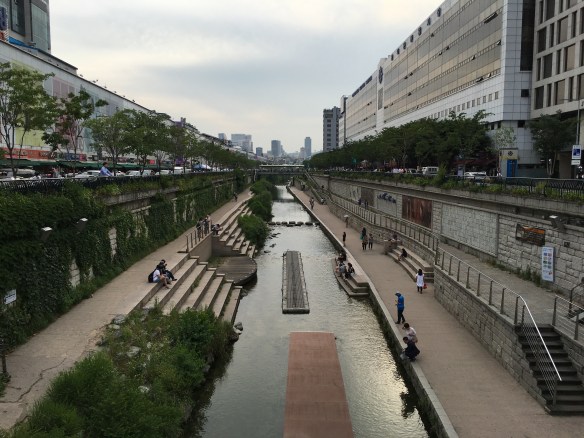
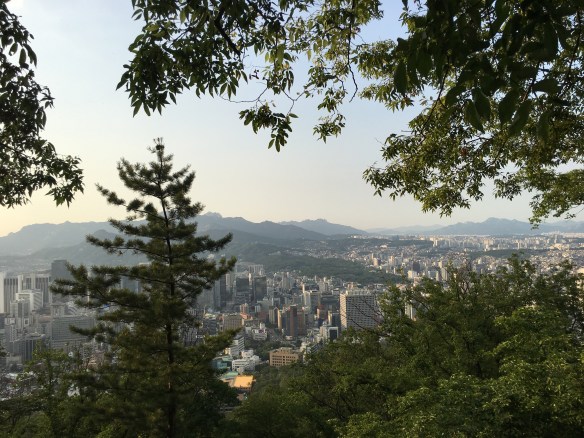
This, Beng and I acknowledged with a sigh and a smile, was tourism senior-style, punctuated by Zantac instead of ziplines, by moisturizer instead of, well, moisture. Some of our happiest moments were the quietest ones—watching the sunset from the peak of Namsan Hill, and the ducks and the carp at Cheonggyecheon Stream.

This brings up one of our small but vital complaints: as wonderful as the city was, Seoul can be hilly in parts, making for long, punishing climbs. Somehow, that doesn’t seem to deter the posses of ajummas—bag-toting Korean matrons sporting broad-brimmed visors—from marching to the markets for their daily dose of retail therapy, or perhaps even just the company of the similarly disposed. Had we lived there, we might have done the same.

Next week, I’ll report on less geriatric topics: culture, literature, and community.


Penman No. 196: A Frenchman in Jalajala

Gironiere1.jpg

Penman for Monday, April 18, 2016


I USUALLY ask my wife Beng to ride out with me on a day trip during the Holy Week break, and this year our destination was rather unusual, in that it never figures in the travel plans of Manileños, although it’s a short and pleasant drive from Quezon City or Ortigas. We took the scenic route from Diliman via Antipolo, Teresa, and Morong, and soon found ourselves following the lakeshore of Laguna de Bay on the peninsula of Jalajala, Rizal, described by the guidebook as “a fourth-class municipality with a population of 30,074 people.”

We were there on the trail of an extraordinary author and adventurer who, nearly two centuries ago, had lived in Jalajala, and had written about his sojourn in a book that had been a favorite of mine for 40 years.

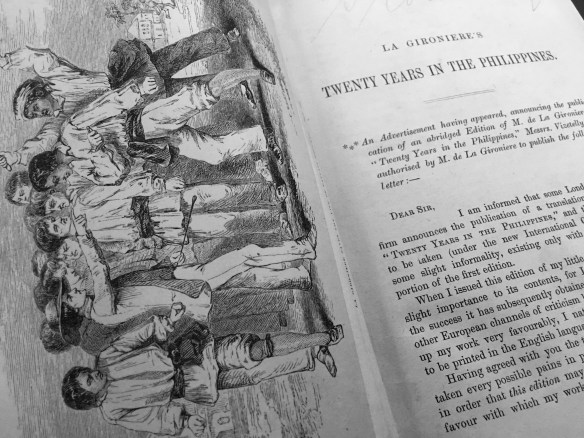
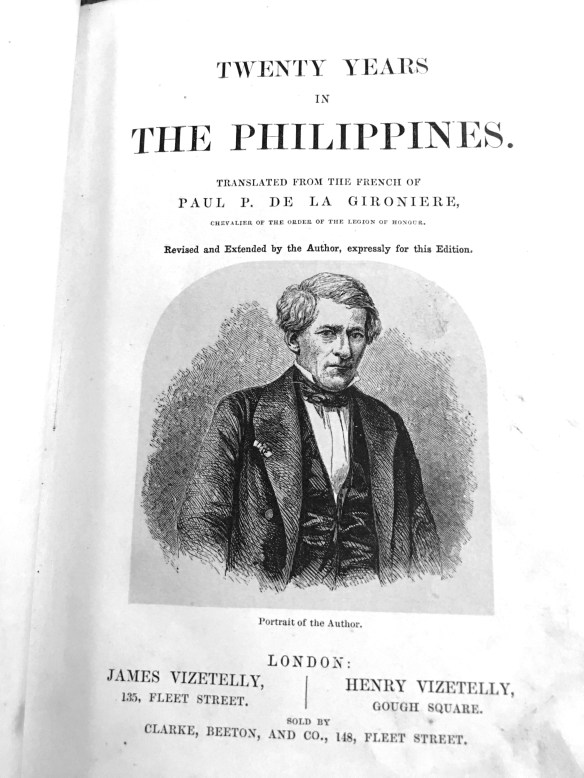
The book was Paul Proust de la Gironiere’s Twenty Years in the Philippines (subsequently expanded under the title of Adventures of a Frenchman in the Philippines), and I had recently acquired a copy on eBay, all the way from the UK—the first English edition published by James and Henry Vizetelly, undated but very likely from 1853, a year ahead of the American edition published by Harper & Bros. in 1854. The copy was far from mint, but it was in its original binding and still very readable, and wonderfully illustrated with engravings of local scenes.

Gironiere2.jpg

Gironiere was an adventurer from France who came to the Philippines in 1819 in his early 20s as a ship’s surgeon and stayed on for the next two decades, establishing himself as a landlord and farmer in what today is Jalajala, Rizal. His travails begin shortly after his arrival on the ship Cultivateur, and his account of a massacre shows why his book is—in that awful word coined by book reviewers—“unputdownable”:

I had only resided a short time at Cavite when that terrible scourge, the cholera, broke out at Manilla, in September, 1820, and quickly ravaged the whole island. Within a few days of its first appearance the epidemic spread rapidly; the Indians succumbed by thousands; at all hours of the day and of the night the streets were crowded with the dead-carts. Next to the fright occasioned by the epidemic, quickly succeeded rage and despair. The Indians said, one to another, that the strangers poisoned the rivers and the fountains, in order to destroy the native population and possess themselves of the Philippines.

On the 9th October, 1820 … a dreadful massacre commenced at Manilla and at Cavite…Almost all the French who resided at Manilla were slain, and their houses pillaged and destroyed. The carnage only ceased when there were no longer any victims. 

…Four hundred Indians surrounded me; the only way of dealing with them was by audacity. I said in Tagaloc to the Indian who had attempted to stab the captain: “You are a scoundrel.” The Indian sprang towards me; he raised his arm: I struck him on the head with a cane which I held in my hand; he waited in astonishment for a moment, and then returned towards his companions to excite them. Daggers were drawn on every side; the crowd formed a circle around me, which gradually concentrated. Mysterious influence of the white man over his coloured brother! Of all these four hundred Indians, not one dared attack me the first; they all wished to strike together. Suddenly a native soldier, armed with a musket, broke through the crowd; he struck down my adversary, took away his dagger, and holding his musket by the bayonet end, he swung it round and round his head, thus enlarging the circle at first, and then dispersing a portion of my enemies. “Fly, sir!” said my liberator; “now that I am here, no one will touch a hair of your head.” In fact the crowd divided, and left me a free passage. I was saved, without knowing by whom, or for what reason, until the native soldier called after me: “You attended my wife who was sick, and you never asked payment of me. I now settle my debt.”

I had first read the book a long time ago, and kept my copy of Adventures, in a Filipiniana Book Guild edition reprinted locally in paperback by Burke-Miailhe in 1972, with a foreword by the eminent historian and economist Benito J. Legarda. In his foreword, Dr. Legarda says that Gironiere’s book was “probably the best seller among books about the Philippines in the 19th century,” noting that “What attracted the 19th century reader was of course the narration of several adventures, at that time considered unusual or bizarre. Among them may be enumerated the killing of man-eating crocodiles, the hunting of wild carabaos, the exploration of caves, the customs of pagan tribes, and the adventures of those caught in captivity by Moro pirates.”

IMG_8257.jpg

While granting that Gironiere’s accounts may have taken certain fanciful liberties, Legarda also considers the many real contributions the Frenchman made to his adopted soil, particularly as an agricultural pioneer who planted coffee, abaca, indigo, and rice on his 2,400-hectare estate in Jalajala, then part of Morong. Of Jalajala, Gironiere would write that it was “the greatest game preserve in the island: wild boars, deer, buffaloes, fowls, quail, snipe, pigeons of fifteen or twenty different varieties, parrots in short all sorts of birds abound in them.”

Gironiere returned to France in 1839, crushed by the deaths of his son, daughter, and wife, and he eventually remarried, and yet nothing, he said, “could induce me to forget my Indians, Jala-Jala, and my solitary excursions in the virgin forests. The society of men reared in extreme civilisation could not efface from my memory my past modest life.”

IMG_8124

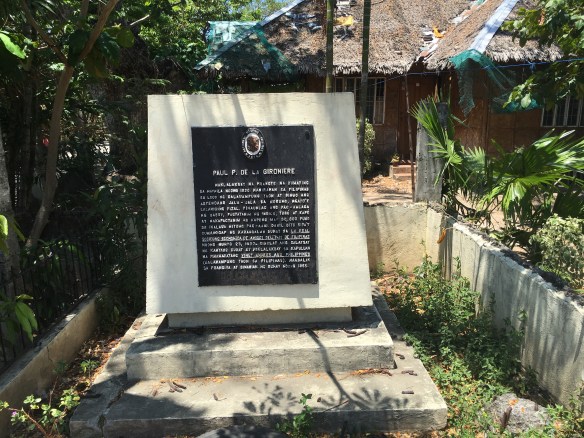
Was there anything left of Gironiere’s vast estate? All I could find on the Internet was a marker put up by the National Historical Institute in 1978 on what presumably had been his property, so I resolved to find at least that. We were there on the Wednesday of Holy Week, so I knew I had to catch someone at the municipio before it closed for the half-day, and fortunately a kind gentleman from the agriculturist’s office recognized the marker and offered to lead us there. And a short drive later, there it was, on a lot in the shade of towering acacia trees.

Nothing else would have suggested Gironiere’s presence, except possibly a stump of bricks in a corner of the lot. Not too far away was the water’s edge, and the slim profile of Talim Island, which Gironiere would have seen out his window. I struggled to imagine this spot as the center of a visiting Frenchman’s adopted life and holdings, his pursuit of bats and lizards, crocodiles and gold dust.

I didn’t feel let down; I was looking at an empty stage, but I knew the play, and I could hear the lead actor’s parting words: “Overwhelmed by the weight of troubles and of the laborious works I had executed, there was only one wish to excite me, and that was, to see France again; and yet my recollections took me continually back to Jala-Jala. Poor little corner of the globe… where my best years were spent in a life of labour, of emotions, of happiness, and of bitterness! Poor Indians! who loved me so much! I was never to see you again! We were soon to be separated by the immensity of the ocean.”

Penman No. 190: A Makati Staycation

IMG_7988

Penman for Monday, March 7, 2016


THE WORD “staycation” must have been invented for people like my wife Beng and me, who now and then like to laze around in a hotel away from home, though not too far away that we’d have to book a flight or take a long bus ride. For those who’ve been living under a rock, a “staycation” is defined as “a holiday spent in one’s home country rather than abroad, or one spent at home and involving day trips to local attractions.”

For us Pinoys, a staycation is halfway to heaven. It’s neither home nor Hawaii; usually, it means parking the car and one’s brood in a local hotel, then spending the weekend pigging out on restaurant fare and TV marathons, scouting the nearby shops, and flopping around in the pool. So it’s not free, but it won’t break the bank, either.

Of course, there will be people who—for perfectly good reasons—will ask, “Why even bother? Why not just stay at home?” Yes, sure, home won’t cost you a thing, but that won’t do what a staycation does, which is to play and pretend for a blessed couple of days that you’re somewhere or someone else, like a tourist in your own country. A fancy word critics might use for the experience is “defamiliarization,” which is looking at the same old things with new eyes, producing unexpected effects.

Well, Beng and I got a pleasant dose of defamiliarization a couple of weekends ago when a friend generously passed us a staycation package that she and her husband couldn’t avail themselves of, and we found ourselves at the door of a hotel that we’d never really noticed before, in a neighborhood we’d never really lived in before.

The neighborhood, of all places, was Makati. Both steadfast northerners, Beng and I have lived in Quezon City nearly all our adult lives, and crossing Guadalupe Bridge—despite the many thousands of times we’ve done it for business and pleasure sorties to the south—still means crossing a psychological barrier. Makati was always just a place for shopping or for work, or otherwise for attending some bash at a big hotel. And I realized that until that weekend, it had probably been at least 15 years when we last slept over in Makati, thanks to our daughter Demi who was then working for a big hotel chain.

So it was about time we got a bit cozier with our southern metropolis, and off we went to the City Garden Grand Hotel at the corner of Makati and Kalayaan Avenues, a 33-storey, 300-room structure that I vaguely remembered seeing rising but had never stepped into. (An older and smaller cousin, the City Garden—minus the “grand”—was just across the street, and I almost mixed up the two.) The drive up the parking ramp was a bit steep and the elevator could have used a shot of adrenaline in its pulleys, but that would turn out to be the first and last of our complaints.

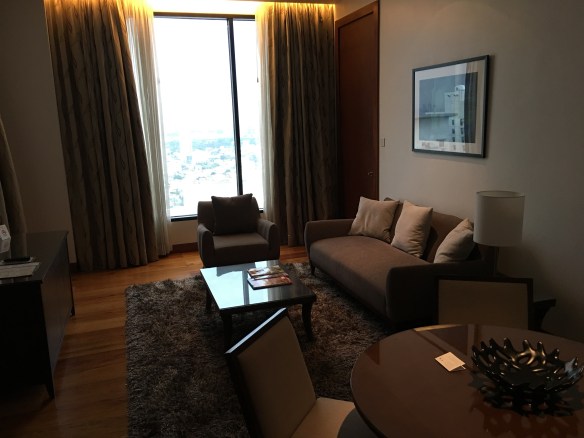
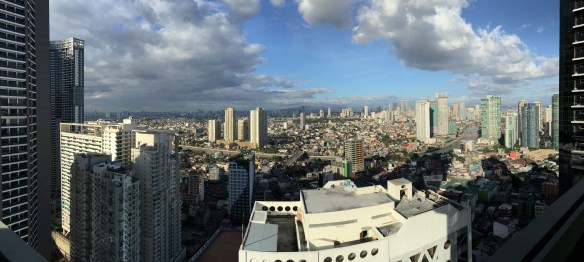
We were booked into a junior suite on the 30th floor, with a spacious living room and entertainment area (and a large sofa that could have easily slept one more) plus a bedroom with a king-size bed; the suite also contained one big bathroom and two toilets, two TVs, a full-size fridge, a microwave, and a coffeemaker—plus, let’s not forget that most essential of today’s amenities, free wi-fi. In other words, it was a hotel easily at par with its four-star counterparts in Hong Kong or Singapore in terms of creature comforts. We were on the north side of the building, so throwing our curtains open revealed a vista we weren’t used to seeing—our part of the city, stretching from the Pasig to the hills of Antipolo.

IMG_7958.jpg

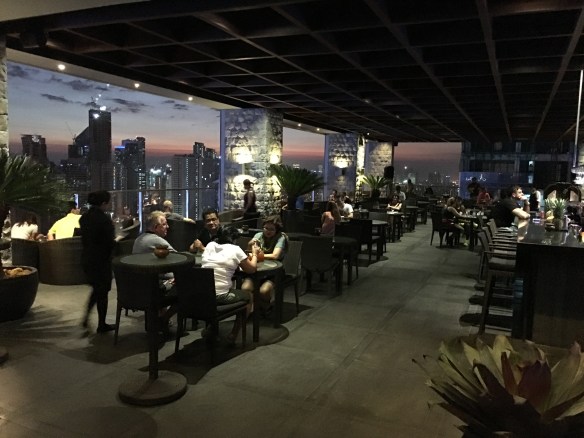
An even better view could be had just two floors up, as we soon discovered. The City Garden Grand’s piece de resistance is arguably its 32nd-floor Firefly roofdeck bar, which offers a nearly 360-degree perspective of Manila and its environs. (A terrace on the 33rd floor is used for weddings and other special events.) Looking southward at sunset, Laguna de Bay shimmered on the left and Manila Bay glowed on the right, while behind us the darkening north soon lit up like a bed of stars. With a cold beer in hand, the swimming pool bubbling in a corner of the roofdeck, a barbecue on the grill casting its savory spell, and the city twinkling at our feet, we felt utterly transported. The sense of estrangement was enhanced by the preponderance of foreigners in the hotel’s clientele—Australians, Brits, and Germans, it seemed to me, who were leveling up from backpacking.

Beng’s a huge fan of breakfast buffets, and even more than dinner, we both look forward to a hearty breakfast to start the day with, and will often judge a hotel by its breakfast buffet; we’d rather live with a smaller room than a skimpy spread. In this respect, the City Garden Grand passed with flying colors, offering a range wide enough to please everyone, from mushroom with truffles to crispy dangguit (and the menu rotated from one day to the next, providing even more variety).

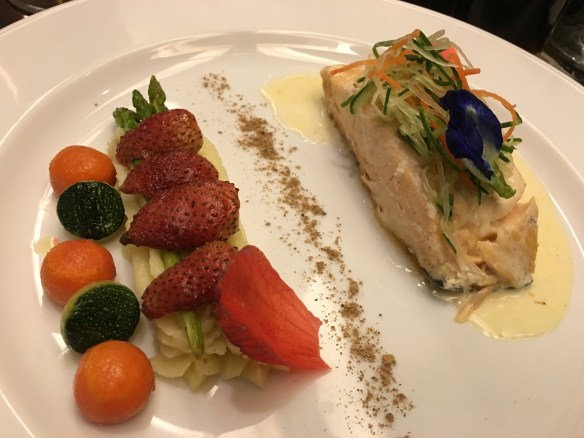
But the best was yet to come, as we were to discover at dinner. Beng and I usually prefer to go Chinese, but as a set dinner at the hotel’s Spice restaurant on the 7th floor was included in the “Love and Luck” package, we decided to give it a try, despite my well-known and admittedly strange aversion to fine dining. Dinner proved a pleasant shock to my pedestrian palate, from the organic mixed salad of shrimp toast and edible flower in strawberry vinaigrette to the broccoli and garlic soup with beetroot foam and focaccia bread to the entrée of beef wellington with bone marrow sauce (Beng’s choice) or sous vide of New Zealand salmon with brown butter asparagus (mine). (I may be a culinary philistine, but I’m addicted to food and cooking shows, so I knew at least what sous vide involved and meant—in short, scrumptious.) The dessert of deconstructed strawberry shortcake with berry coulis and chocolate marble proved too much, on top of everything—we ordered just one and happily had the other taken out.

IMG_8001.jpg

We were so impressed that we asked to see the chef, and were even more floored when he turned out to be no imported Frenchman or Swiss but an entirely homegrown 24-year-old, Ariel “Yeye” dela Umbria, a proud graduate of NCBA’s HRM program.

The surroundings of a hotel are always part of the package, and Beng and I were glad to spend the weekend exploring Century City Mall (just a couple of blocks away) and the Greenbelt-Glorietta area (a longer 20-minute walk, but good for the exercise). Of course, the entire Kalayaan-Jupiter district is a prime restaurant and entertainment zone, which we’ll revisit at greater leisure one of these days.

Meanwhile, our warmest thanks to that friend for the weekend break and for giving us more reasons to enjoy the metropolis; 30 floors up, it never looked so good.

IMG_7991


Penman No. 182: In NVM’s Footsteps

IMG_7884.jpg

Penman for Monday, January 11, 2016


I’M WRITING this in Calapan, Oriental Mindoro, where I’ve come with a group of writers, most of them visiting Filipino-Americans, for the second and closing leg of the NVM Gonzalez Workshop, organized and led by NVM’s son Dr. Michael Gonzalez. Last year, 2015, marked the centenary of the late National Artist’s birth, and Myke thought that it would be fitting to hold the workshop, now on its sixth iteration, in the place most closely associated with his father, Mindoro.

NVM was actually born in my home province, Romblon (“about 60 kilometers and 40 years away,” I like to say), but he grew up in Mindoro, and wrote most of his works about its hardy people and their way of life, even when he moved to the United States. NVM died in 1999, but his memory remains fresh among his friends, colleagues, and former students on both sides of the Pacific. It was to honor that memory that Myke put this group together for both a workshop and a literary pilgrimage to the Philippines.

This year’s US-based contingent includes Mary Grace Bertulfo, who has written for television and children’s education and who runs a children’s creative writing workshop, Taleblazers, in Chicago; Anna Alves, a PhD student with the American Studies Program at Rutgers University in New Jersey; Chris “Kawika” Guillermo, a mixed-race Asian-American with Chinese, Filipino and Irish roots who has a PhD in English from the University of Washington, specializing in Asian and Asian-American fiction; Lisa Suguitan Melnick, a third-generation Filipina-American, an adjunct professor at the College of San Mateo and a contributing writer for PositivelyFilipino.com; Penelope Flores, a retired mathematician and educator from San Francisco State University; Myke Gonzalez, of course, who teaches Philippine Studies and Behavioral Science at the City College of San Francisco; and Evelina Galang, the workshop director, an accomplished fictionist who directs the Creative Writing program at the University of Miami.

Their local counterparts were Kat Cruz, a UP Business Administration graduate and company executive with a keen interest in writing; Meeko Camba, a young opera singer now studying Journalism in UP; Sarah Matias, a Creative Writing major who now runs Ant Savvy Creatives, a marketing and events company; Marily Orosa, a prizewinner publisher of coffee table books; Timmy Tuason, an expert in instructional design, materials development and project management; Jojo Hosaka, a surgeon and dog-show judge (and, like Timmy, a fellow fountain-pen enthusiast); Claire Agbayani, a graduate writing student at DLSU and PR practitioner; Judith Castillo, a teacher of English in Calapan; and Raul Manicad, an engineer, businessman, and guitarmaker. Myke and Evelyn were backstopped on the teaching staff by veteran fictionist Charlson Ong and myself.

We held the first part of the workshop from January 4 to 5 at the University of the Philippines in Diliman, where NVM had taught for many years in the 1950s, in the Gonzalo Gonzalez Reading Room of the College of Arts and Letters Library, which my office—the UP Institute of Creative Writing—administers as a repository of contemporary Philippine and Southeast Asian literature. From January 6 to 9, we moved to Calapan, where NVM used to go from their home in Mansalay to type out his manuscripts at the municipio, on paper that, Myke recalls, NVM apparently “borrowed” from the municipal government, whose stamp it bore.

The mixed composition of the group and the diversity of the participants’ backgrounds led to some very interesting discussions dealing with identity, race, language, and representation. While this was a writers’ workshop focused as much on technique as one’s philosophy of writing, inevitably the politics of writing took the foreground, given the Fil-Ams’ engagement with the issues that come with writing as a minority in America.

We talked about how the writer’s political positions define or feed into craft and technique, and how they shape the story itself. Understandably, given the environment they operate in, our US-based friends were keen on discussing the representation of race, of the Other, and the depiction of character in a racially or ethnically charged environment. We agreed that it was important to be accurate and to be fair in creating characters who will inevitably be seen to represent their race, whatever they may be; on the other hand, I interjected, it was just as important to remember that the character had first to succeed as an individual in the story, and that the character could even—and more interestingly—go against type; while we share many beliefs and practices as Filipinos, not all Filipinos think alike, and thankfully so.

The discussions also became a mutual revelation of what it was like to write as a Filipino and as a Filipino-American, and how we could be so similar yet also different in many ways. It wasn’t just the vocabulary, but the sensibility that came into play. In the end, we took the cue from NVM himself, who once famously explained his use of language thus: “I write in Filipino, using English.”

I learned a new word from Myke, who has a background in the social sciences—schismogenesis, promoted by the anthropologist Gregory Bateson in the 1930s, which roughly translates into how groups proliferate by breaking up. The context was the oft-made observation of how Fil-Ams and their organizations tend to fall apart because of personal and political differences (by one account I read, there are more than 3,500 Fil-Am organizations in Southern California alone)—a tendency we uniformly deplore. But Myke’s new word suggests a positive aspect, a way by which a race and its culture propagates itself.

We’d like to thank our hosts—the Madrigal-Gonzalez clan, for the use of the reading room in UP; Myke’s sister Selma, who spread out a very generous merienda for us; the Mother Butler Guild of Calapan, who conducted a charming putongan ceremony for the visitors; Florante Villarica, who has written a history of Oriental Mindoro and who had us over for dinner at his home; Anya Postma and the Mangyan Heritage Center, who made a wonderful presentation on Mangyan life and culture; and Chicago-based Almi Gilles, who lent us her their family’s beach house in Puerto Galera for our penultimate day in Mindoro.

And thanks, of course, to Myke and the Gonzalez family, for keeping their father’s flame alive.