Penman No. 302: A Happy Refuge

IMG_5667.jpg

Penman for Monday, May 14, 2018


THESE PAST few weeks and months have been fraught with loss and sadness, given the passing of many friends and personages in the arts community—National Artist Billy Abueva, National Artist Cirilo Bautista, architect and heritage advocate Toti Villalon, writer Jing Hidalgo’s daughter Lara, and, most recently, poet and inimitable punster Ed Maranan.

It’s in times like these that we seek refuge and relief in what amounts, for many if not most of us, to another realm of life, if not life itself—the world of art. Being inherently transcendent, art has a way of lifting us up and moving us away from often sordid and prosaic reality, reminding us that as ugly as the world can get (often the very subject of art), beauty exists and endures, like love, in the most unlikely places.

And sometimes beauty can be so sublime that it will not only take your breath away but cause you to smile, and even break out in wild laughter. I remember one such moment of sheer exhilaration from about eight years ago when I stepped out of the train in Sta. Lucia station for my first sight of Venice on a bright summer afternoon, and everything was as it would have been in a painting by Turner or Canaletti—not just the canals, gondolas, and cupolas, but the people and the pigeons, the thrum of the vaporettos and the bells of the bicycles darting past me. At that instant, all I could do was laugh, my joy tempered only by the fact that I didn’t bring Beng with me (four years later, on our fortieth anniversary, I made good on a promise and did just that).

Two events in this first quarter of the year provoked a similar response in me.
IMG_5417.jpg

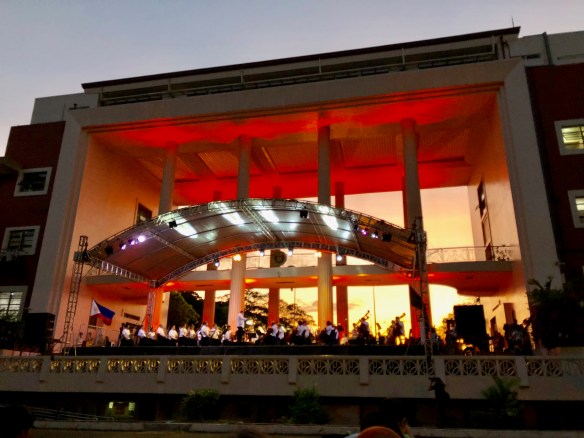
The first was a free, open-air concert given last March 23 at the Amphitheater in UP Diliman by the Philippine Philharmonic Orchestra, under the baton of resident conductor Dr. Herminigildo G. Ranera. The idea was hatched between Cultural Center of the Philippines President Arsenio “Nick” Lizaso and UP President Danilo “Danicon” L. Concepcion. Nick’s a seasoned actor and director and longtime cultural advocate who took charge of the CCP last year with the view of bringing that venerable institution closer to the masses. Danicon, who had also just marked his first year in office, wanted something fresh and inspiring to happen on campus to buoy people’s spirits up and spur cultural appreciation in the community. Backstopping both was former UP Diliman College of Music dean and tenor Ramon “Montet” Acoymo, who helped put a program together for the PPO in UP.

The brief was simple, but surely a nightmare to execute: bring the PPO’s 58 members to the backside of Quezon Hall facing the amphitheater, where graduations are usually held, fill up that sprawling space with people, and have the PPO perform a program of light classics that everyone could relate and hum along to. Oh—and find sponsors to foot the bill, to do away with tickets and invite even slipper-shod retirees and children to enjoy the music on the grass, under the stars.

And that’s exactly what happened. Like magic—with pieces ranging from the William Tell Overture and Les Miserables to Star Wars and Despacito—the PPO serenaded the spillover crowd and proved, once again—despite the turmoil and clamor of politics—that music hath charms to soothe a savage breast, as the poet said. Thank you, Nick, Danicon, and the PPO for the rare treat—and folks, await a Yuletide reprise, which is being planned out as I write.

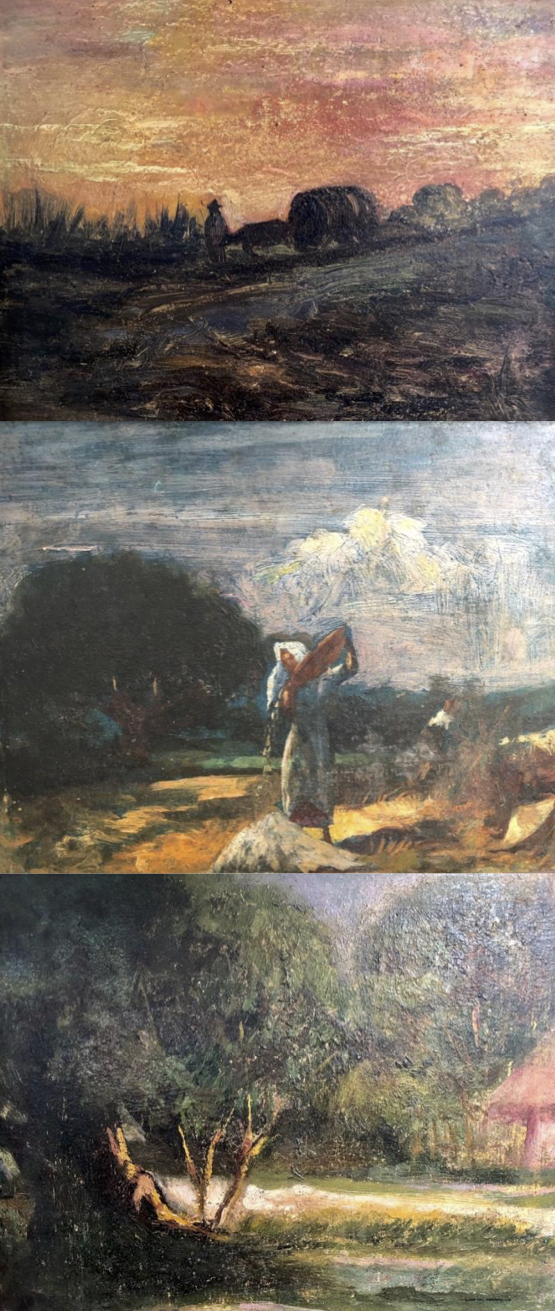
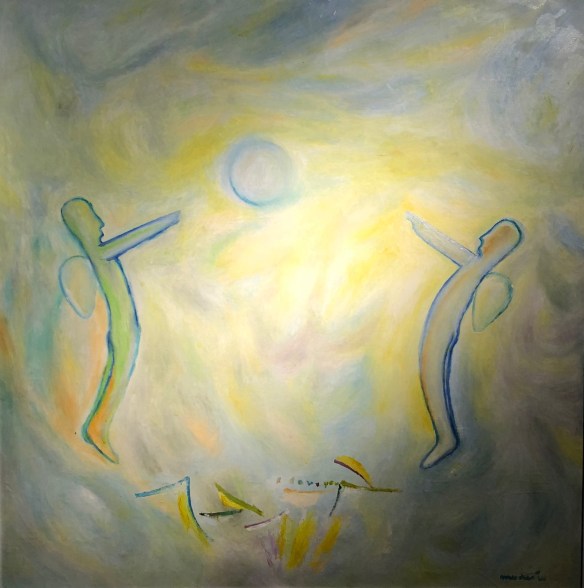
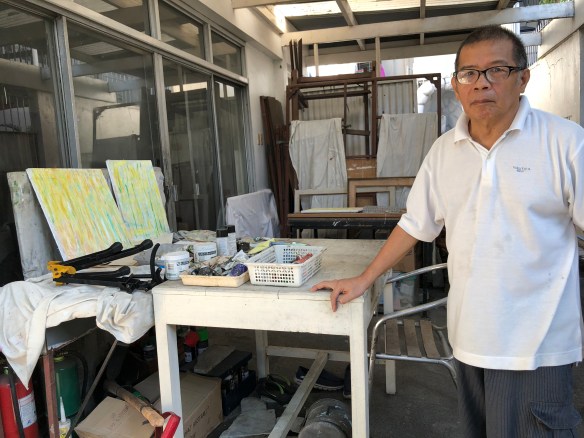
My second moment of wonderment came when Beng and I stepped last week into the new (and still ongoing) exhibit of painter Fernando “Mode” Modesto at the downstairs gallery of the Globe Tower in BGC, care of the Hiraya Gallery. Titled “Bliss from Bygone Days,” the exhibit celebrates “euphoria, delight, and rapture,” but I didn’t need to read the liner notes to know that. I felt it the minute I paused in front of a painting like “Khartoum”—a lemony depiction of two angels playing with a ball, and my favorite of the lot alongside “Bali,” a blue sky streaked with orange and yellow. They’re paintings you could stare at, smiling, for hours.
IMG_5802.jpg

I’d known Mode since the mid-1970s when I hung out at the Philippine Association of Printmakers studio in Ermita, and he was an enfant terrible shocking matrons with his paintings of airborne phalluses. He still shocks today—but with an exuberant wit, a brazen intent to make the viewer smile and be happy despite the tribulations of life in the age of tokhang. Even when he uses black, Mode’s subversive humor pops up, insect-like.

I often ask my writing students, “Where’s the humor in our fiction? Why is every damn story I get a self-obsessed and anguished one of defeat and despair? Sure, life sucks—but I already know that. Can’t you bring me somewhere we haven’t been—like a happiness I can believe in?”

That’s where I thought I was when I stepped into Mode’s works; too bad I had to step back out into the world again.
Penman No. 301: Mysteries of Art (2)

RizalMural

Penman for Monday, May 7, 2018


LAST WEEK, I wrote about acquiring a trio of unsigned paintings I’m attributing to Serafin Serna (1919-1979), drawing on stylistic, thematic, and circumstantial evidence. This week, I’ll walk you on the trail of an art mystery that’s puzzled generations of viewers and scholars at the University of the Philippines.

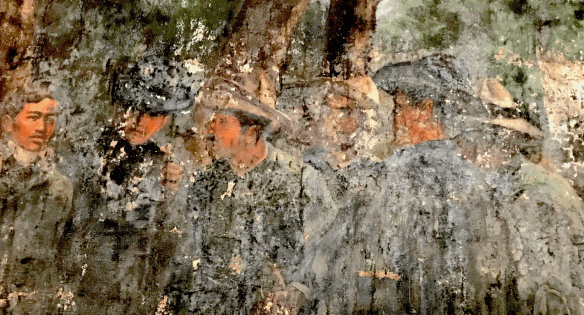
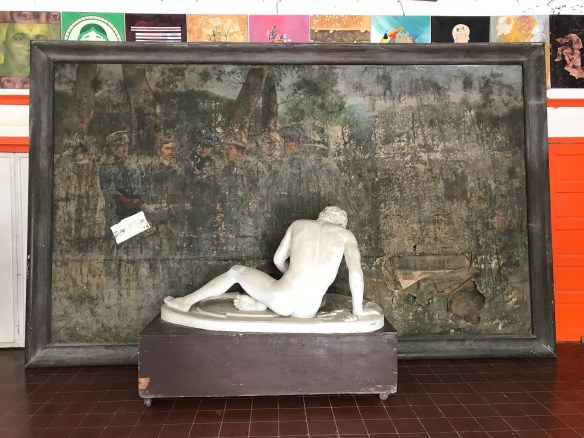
For many decades now, a huge painting has been parked somewhere in UP Diliman—first at the College of Law, from where it was moved to the College of Fine Arts. Although terribly deteriorated, the painting depicts a man—clearly Jose Rizal—being accosted under the trees by at least six other men dressed in two kinds of uniforms—two priests, four soldiers—with more onlookers in the background. Rizal’s arms seem to be held behind his back, so he must be on his way to his execution; his sad, pensive demeanor certainly suggests so.

RizalMartinez

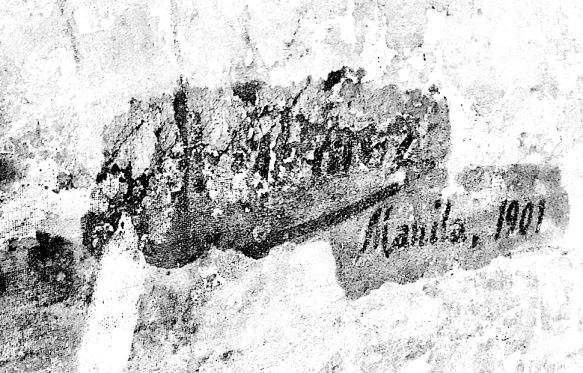
It seems to be an important painting—as any work with Rizal would tend to be, especially given its life-size dimensions (184 x 106 inches)—but the big question is, who painted it? It’s dated by the artist to “Manila, 1901,” but the signature above that has been blurred by age and grime. In the university’s inventory, it’s ascribed to an “A. Gomez,” the name whose letters appeared to emerge from the haze. Because nobody knows an “A. Gomez” who’s ever figured in our art history, the painting was considered second-rate and left quietly to decay.

Enter UP President Danny “Danicon” Concepcion, who as Law dean had seen the painting many times and had wondered, like everyone else, about its origins. Even without establishing who the painter was, now that he was president, he wanted the painting restored, given that it’s been with UP for so long and features a national hero.

For advice on the restoration, Danicon turned to my wife Beng, who’s worked on scores of master paintings over the past 20 years, from pieces by Juan Luna to Anita Magsaysay-Ho. (Just to be clear about this, Beng and I have agreed that she’s not going to do more for or with UP than give advice, pro bono, while I’m serving as Vice President for Public Affairs, to avoid any suggestion of impropriety. If no one else can or will do the job, then she’ll take it on for the most minimal fee she can quote, subject to all the applicable rules.) At the president’s request, Beng got together with noted artist Neil Doloricon, an old friend and former dean of the CFA, to sort out the situation.

They faced the same inescapable question: who painted Rizal & Co., and who was “A. Gomez”? As it happens, I think I’ve found the answer, or at least my theory of it.

MartinezSignatureEnhanced

Using high-resolution photographs Beng took of the painting, I digitally enhanced the signature and rendered it in monochrome to sharpen the contrast between the letters and the background. Indeed there’s what looks like an MEZ at the end with a long tail, and ahead of them, what seems to be an A. But I wasn’t seeing a G or an O to make GOMEZ. The more I stared at it, the more I saw “MARTINEZ” shaping up.

Martinez1

Martinez2

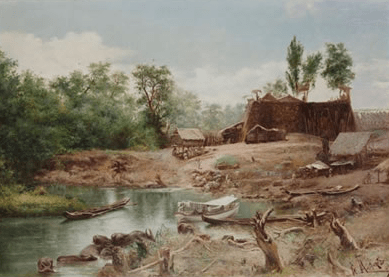
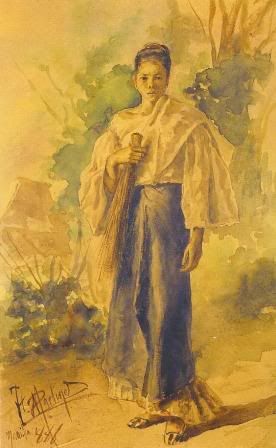
Some Googling revealed that a painter named Felix Martinez (1859-1907) was “a painter and muralist who created religious, genre, landscape and still-life paintings. He was a contemporary of Simon Flores, Lorenzo Guerrero, Paz Paterno and her half-sister Adelaida Paterno…. (He) also painted the interior of the San Sebastian church in Quiapo.” The ASEMUS website notes that “Felix Martinez y Lorenzo was a member of a family of sculptors and artisans. He was also an illustrator and an art professor. As an illustrator, he participated in… La Ilustración Filipina(1894-96) depicting daily life scenes. He also helped Regino García (1840-1916), another known Filipino naturalist art painter, illustrate La Flora de Filipinas(The Flora of the Philippines 1878), a creation of Fray Manuel Blanco.”

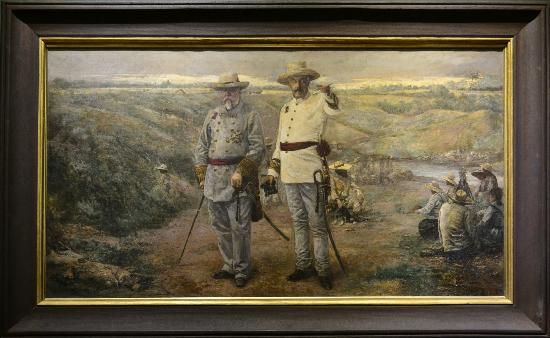
Examples of his paintings—particularly the one of “Gov. Blanco and His Troops” (1895), now at the National Museum—showed that again, in style and substance (and even in coloration), the Rizal mural could well have been his.

Martinez3

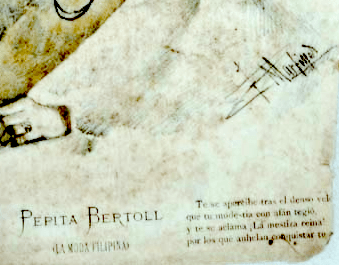
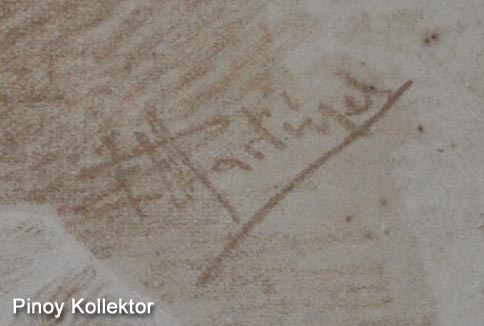
Do the signatures match? From those I’ve recovered—particularly a sharp one from a portrait of Pepita Bertoll in La Moda Filipina(with thanks to Pinoy Kollektor)—there’s a striking resemblance. I could be imagining things, but I can seem to discern the elevated M and T. Of course it will take more than my 64-year-old eyes and my enthusiasm to prove the case—further cleaning of the signature and better digital enhancement will surely yield clearer results—but an argument for Felix Martinez seems to be shaping up. But whether it’s by Martinez or not, this painting of Rizal by one of his contemporaries deserves to be saved.

Bertoll

Signature copy

(With many thanks to pinoykollektor.com for permission to repost the images.)

Penman No. 300: Mysteries of Art (1)

IMG_5617.jpg

Penman for Monday, April 30, 2018


I’LL ASK my readers to bear with me as I explore and try to solve, in another two-part series, some mysteries of art.

Alongside my recent love affair with old books, I’ve rekindled an early and abiding interest in art, particularly in paintings of a certain kind. My wife Beng, of course, is an artist—a watercolorist, a dreamer of waterscapes and landscapes—who’s also an art restorer and conservator, so the two of us have been fortunate to come closer to the works of the masters than most gallery hoppers. And I mean close, as in half an inch away from the tip of one’s nose to an Amorsolo or a Botong or, when we visit museums abroad, to a Rembrandt or a Tiepolo, because Beng can’t resist examining the minutiae of the painting’s restoration, often prompting a frantic museum guard to shriek, “Step back, Madame!”

We enjoy most schools and styles of art, from El Greco and Turner to O’Keefe and Matisse, but—as you can gather from those names I just dropped—our sexagenarian sensibilities might have a hard time cozying up to the likes of Basquiat, whom we could try to understand and appreciate, like we were taking an exam for a Humanities class, but not hang above our bed. (I’ll receive those boos now from my hipper friends.)

I myself have been veering closer, in my creeping senescence, toward something I can only vaguely describe as a midcentury romanticism—an imagined age of innocence before the Second World War, and of optimism after, like the war never happened, like no war could obliterate. Perhaps it’s my form of escapism from the madness of the present, but I’m drawn to landscapes with bamboos rustling in the breeze, to sunsets bursting with fruity promise, to rivers teeming with lilies, to beaches without people. Over the past few months, I’ve been picking up art pieces—paintings and prints—in this old-fashioned mode.

Given my UP professor’s salary, I have to work within a very limited budget, so I collect by sight rather than by name. This means that a painting should enthrall me—I should feel a rush of excitement, or a pang of melancholy, a cry of delight, the minute I see the piece; I should want to think about it again, to have it intrude into the most inconvenient moment of some mundane preoccupation. It might make me want to know more about the artist after—not necessarily before—I buy the painting.

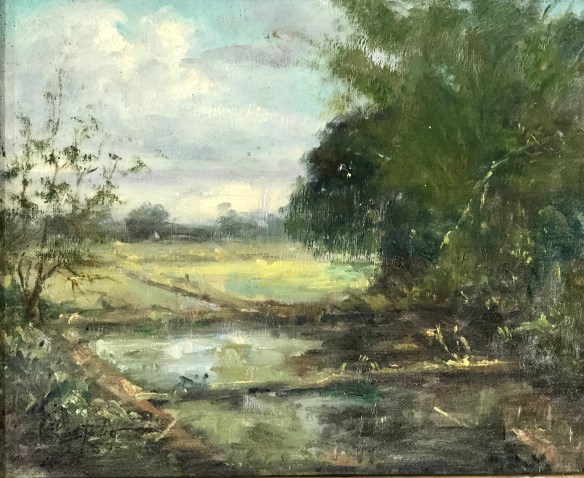
I felt that surge last month when Beng and I drove out on a Saturday to a corner of Pampanga to view three small paintings I had spotted online, being offered by a picker. They were unsigned—so forget finding some mislaid Amorsolo—but they exuded rustic charm, a harking back to a lost provincial Eden. All my seller could say about them was that he had acquired them as a batch with a fourth and larger one, in the same style, that he had sold earlier, and that other one was signed “Serna 1944.” Serafin Serna (1919-1979) was, indeed, a painter of nature, a student of Amorsolo; most significantly, his brief biography online mentioned that Serna often didn’t sign his works. So the tantalizing possibility remains that my pastoral paeans were done by his hand, and they will be so attributed in our home gallery, pending proof to the contrary.

IMG_5553.jpg

IMG_5554.jpg

Not long after, pretty much by the same route (although this one led to a gas station in Parañaque), I picked up two other little gems of the genre—landscapes done in 1957 by Gabriel Custodio (1912-1993), who I was ashamed to admit I knew nothing about until that instant. But again, encountering Custodio (another student of Amorsolo) reminded me of how important it is to scour our backyard for obscure treasures—many hidden, but others in plain sight.

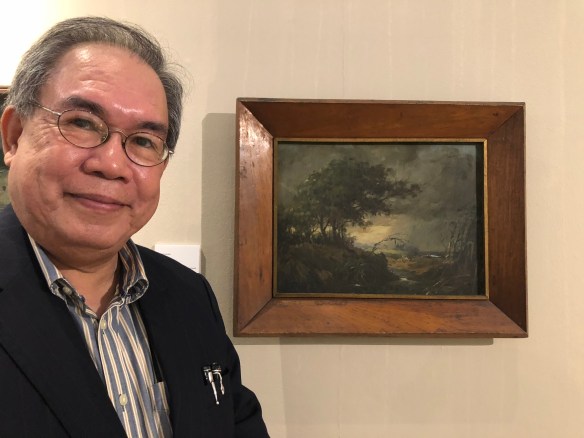
Imagine my exhilaration when, two Saturdays ago, Beng and I attended the opening of the Metropolitan Museum’s fabulous new exhibit, “Fascination with Filipiniana: The Vargas Collection in the Wake of War and the Modern: Manila 1941-1961.” The curator himself, Dr. Patrick Flores, walked me up to one Serna and Custodio after the other, educating me on that key period of transition between the traditionalists and modernists—particularly the fact that the lines between were never that sharply drawn.

IMG_5587.jpg

For now this is just a long introduction to build up some credibility for what I’m about to claim, which is a heightened sense of awareness in things artistic, albeit from a strictly amateur perspective. It’s the kind of awareness that allows me to pronounce (at least to myself), “Hmmm, this painting looks nice, but unfortunately it’s a fake, because XX never used an apostrophe when he dated his later signatures, as in ’76 or ’83,” or “How can this be from 1995 when ZZ died in 1986? Besides the strokes are all wrong, they’re way too hurried.”

Next week, we’ll deal with a real whodunit: who did that life-size painting of Rizal and a cohort of Spaniards stored for decades in UP Diliman? I’ll offer my conjecture.


Penman No. 296: My Past as a Printmaker

Beng1.jpeg

Penman for Monday, April 2, 2018


EVERY NOW and then I get a reminder from somewhere very far that, at one point in my past, I led a very different life and might have gone down another path altogether.

Last month I received a message from a gentleman in England, asking me if I knew the artist of a print he had acquired, an etching of a water buffalo with a bird perched on his back, dated 1974, titled “Katuwaan Lang,” and signed by a “j y dalisay jr.” I received similar inquiries from two ladies in the States back in 2008 and 2015, who both sent me pictures of prints I hadn’t seen in decades.

Yes, I told them all, once upon a time I worked as a printmaker, and it happened this way.

In January 1973, I was arrested by the military for alleged subversion—I was 18, a college dropout, and a fledgling reporter for the Philippines Herald and Taliba—and was thrown, along with a couple hundred other inmates, into a detention camp somewhere in what people now smartly call Bonifacio Global City. Back then it was just the Ipil Rehabilitation Center, a repurposed Army barracks enclosed in barbed wire.

Among my fellow detainees—aside from the likes of Jojo Binay, Orly Mercado, and Zeus Salazar—was the artist Orlando “Orly” Castillo, who organized an Artists’ Group which conducted sketching sessions and painted and sold little souvenir items to our Sunday visitors. Not knowing how long we were going to be detained—I for one was never arraigned or tried in court, although I was interrogated and beaten up—I signed up with the group, having done a bit of drawing since grade school.

As it turned out, I would be released after seven months (“Go pack your bags, we have nothing on you,” said the officer). Instead of returning to school in UP—which I found deathly quiet and unconducive to learning—I sought out Orly, who had been released earlier, and joined him and a group of new friends at the Philippine Association of Printmakers studio and gallery at 1680 Jorge Bocobo Street in Ermita, Manila.

It was really little more than a big box at the far end of a lot, but it housed an etching press, and I learned printmaking on that press just by watching the regulars going through the motions of coating zinc plates with asphalt “ground,” drawing their designs on the ground, soaking the plates in a bath of nitric acid, inking the plates, and printing copies of the artwork off them under the rolling press. I looked over the shoulders of people like the late Manolito Mayo, Tiny Nuyda, Joel Soliven, Bing del Rosario, Fil de la Cruz, Ronald Veluz, and Emet Valente. (Yes, most of the regulars there were guys, although Petite Calaguas, Adiel Arevalo, and Ivi Avellana-Cosio would also come by.) Sometimes Bencab dropped in, and I was very happy when he remarked kindly on one of my etchings of a boat in Romblon harbor.

Kamias.jpeg

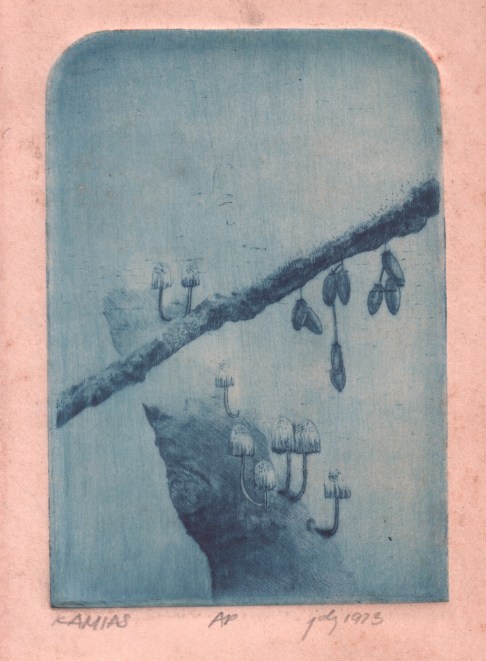
I did etchings like everybody else, but my preferred technique was drypoint, which meant scratching and digging the design straight onto the zinc plate with nothing more than the needle of a compass. My fingers would get so sore they nearly bled, but drypoint lent the work a certain delicacy of line that you couldn’t get with nitric acid. For inspiration, I turned to the pages of E. S. Lumsden’s 1926 classic The Art of Etching, a copy of which I still keep.

I became a printmaker for a while, not just because I loved the craft and the company, but because I was jobless. Selling prints in bulk to a dealer who sold them framed to US servicemen sustained me through that lean season. The prints sold for maybe just 15 or 20 pesos each, but a few hundred went a long way then.

At some point I won an honorable mention for the drypoint print of a farmer, and served as Vice President of PAP under Lito Mayo—not for any abundance of artistic talent (I was way too conservative to amount to much), but, I suspect, because of my way with words, a facility I have found useful to this day. But inevitably life’s other challenges caught up.

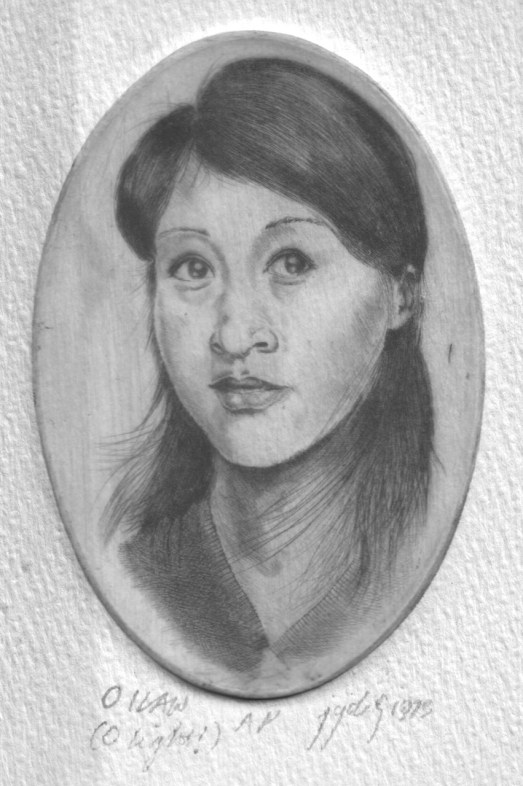
It was at the PAP where I met my wife to be, a pretty girl named June, and I courted her with letters handwritten with a Mars Lumograph and, of course, a drypoint portrait I made of her. A few months after we met, we were married—but not before I managed to find a more stable job, at my mother’s insistence, this time as a writer for the National Economic and Development Authority, just around the corner.

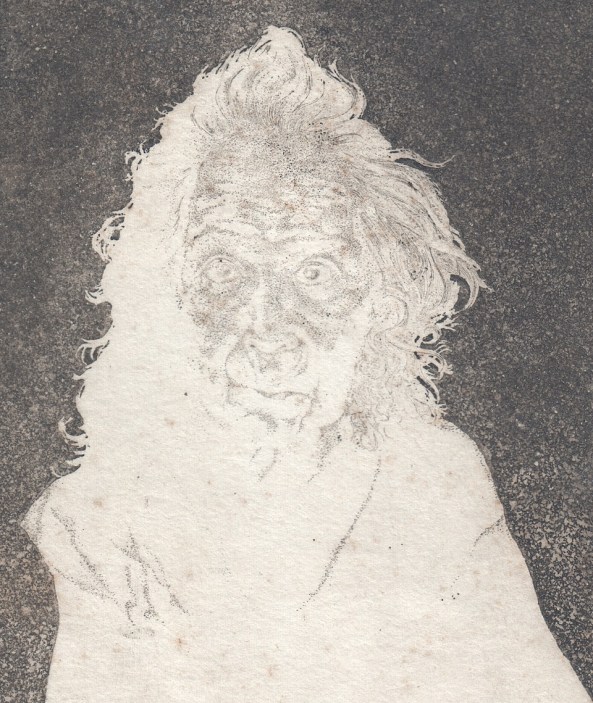
The PAP has long left J. Bocobo and all I have from those days is a small album of about a dozen stray prints, but I still feel a surge of fraternity whenever I meet Bencab, Tiny, Ivi, and the other true masters of the art. I like to think that I’ve ported over my sense of imagery and detail to my writing. We can always hope that here or elsewhere, in whatever form, the art will survive the artist; ars longa, vita brevis. (That’s my grandmother Mamay below, in and etching with drypoint and aquatint.)

Mamay.jpeg


Penman No. 294: From Bach to Baleh

IMG_5277.jpg

Penman for Monday, March 19, 2018


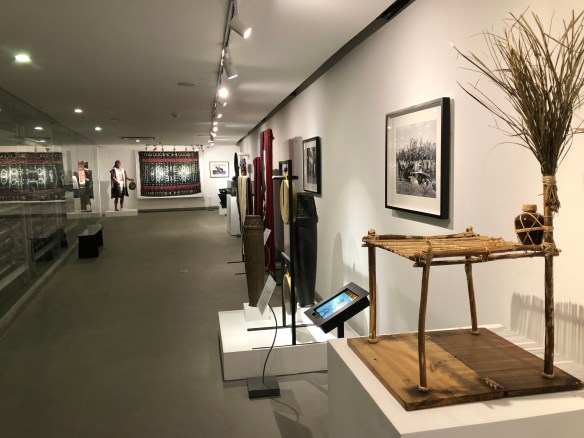
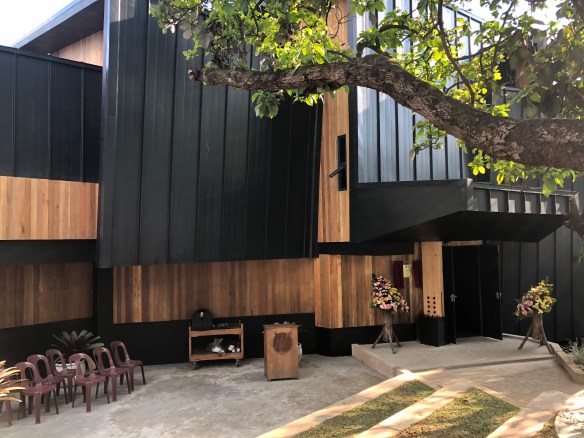
SOMETIME LAST year, I reported on the opening of the new Museo Kordilyera at the University of the Philippines Baguio (UPB), and predicted that it was going to become one of the new “must-sees” for the culturally savvy Baguio visitor, alongside such landmarks as the Bencab Museum. I was back there last week to help inaugurate a new theater and enjoy a concert—about which you’ll hear more in a bit—but what sealed UPB’s reputation for me as that region’s cultural beacon was its new exhibit titled “Feasts of Merit” which opened last month and which will run all year long.

As UPB Professor Emeritus Delfin Tolentino explains it, the title refers to the “prestige feasts” sponsored by the well-off families of traditional societies around Asia and in the Philippine north, such as by the Ifugao, Bontok, and Ibaloy. In these feasts—now long gone, for obvious reasons—hundreds of pigs and carabaos would be slaughtered in a show of affluence—indeed, in what could be seen as a deliberate exercise in excess, as Museo director Dr. Analyn “Ikin” Salvador-Amores acknowledges. But alongside this excess was the idea that wealth was meaningless if it could not be shared with others, so the point of the feast was to have the community partake of it, thereby strengthening the ties between and among the people.

IMG_5265.jpg

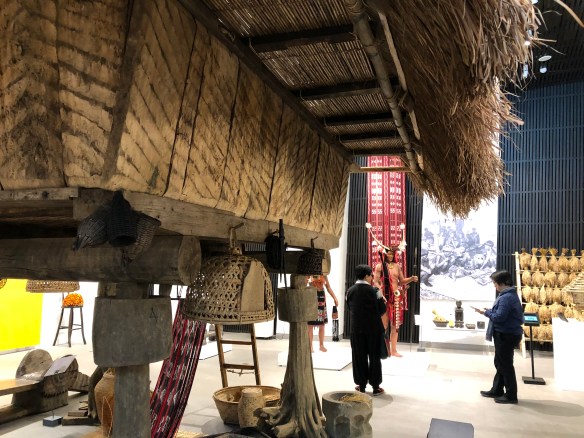
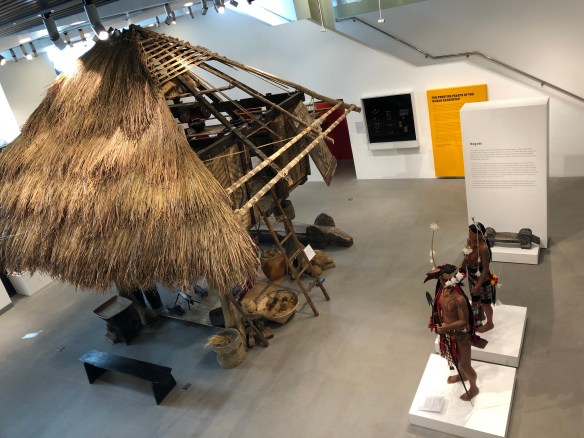
To liven up the scene, the Museo purchased (with sponsorships), dismantled, transported, and reassembled a complete traditional Ifugao house or baleh which now forms the centerpiece of the exhibit. The 50-year-old house took four days to put back together, says Ikin, employing no nails. Walking around and beneath it gives the visitor an intimate sense of family and village life—as well as of the ingenuity of the native architect, in such touches as the rat guards circling every post, preventing rodents and other pests from clambering up into the house proper.

The baleh may be the most arresting feature of the exhibit, but equally fascinating are the large-scale reproductions of vintage photographs lining the walls, chronicling a lost way of life in the highlands, from Bontok women threshing rice together to other women wearing golden mouth guards to display their wealth (or, as one of those women said, “to shut us up” because the men wore no such flashy encumbrances).

IMG_5284.jpg

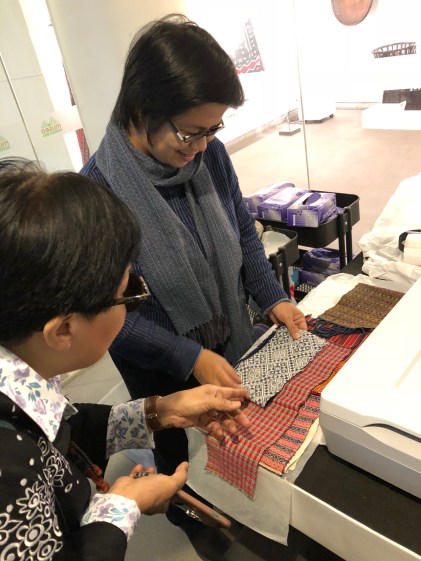
An especially fascinating corner of the museum houses its impressive collection of heirloom textiles, many sporting designs unseen and unwoven for many decades. As two of her assistants carefully folded and scanned some specimens to create digital files of their designs, Ikin unrolled a large swath of an indigo-dyed textile from the 1920s—still looking new and sharp—that she had found in Chicago, being sold by a Filipino, whom she had managed to persuade to sell the precious artifact.

Foreign sponsors and benefactors such as the Newberry Library in Chicago, the University of Michigan, and the Kunstkamera in St. Petersburg, Russia helped make the exhibit possible; local supporters like the National Artist Bencab have also generously lent or donated items from their extensive collections. Dr. Amores says the Museo would be very happy to receive more donations of choice items from private collections, and I can’t think of a more fitting recipient myself of such pieces than the Museo Kordilyera and its state-of-the-art facilities and curatorial services.

IMG_5279.jpg

The Museo and its exhibits are part of a broader UPB program to revitalize its campus as a regional center for cultural awareness and research under Chancellor Ray Rovillos, who also happens to be a historian. With just a six-hectare footprint and a steeply sloping landscape to work with, Dr. Rovillos and his architect, the brilliantly adaptive Aris Go, have given UPB a smart new environment that goes beyond looks to include catchments for rainwater, among other innovations.

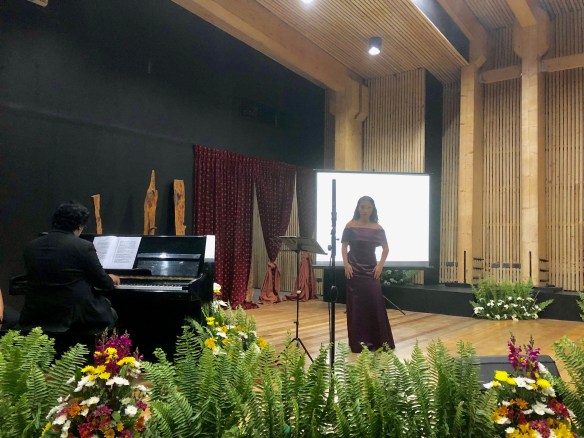
Thanks to the support of the cultural maven Sen. Loren Legarda, UPB also now has an impressive new theater, the Teatro Amianan, which was inaugurated last week with a concert, and the adjoining Darnay Demetillo Art Space.

IMG_5261.jpg

The concert opened with some popular numbers by UPB’s homegrown Tinig Amianan, after which the audience was treated to a stellar performance by soprano Stephanie Quintin, a Baguio girl and UP graduate who has trained in Germany and Hong Kong. Stephanie presented a selection of vocal classics from Bach to Lizst and Gounod before wowing the crowd with Nicanor Abelardo’s “Bituing Marikit” and a rousing rendition of Jose Estella’s “Ang Maya.” She was very capably accompanied by the young pianist Gabriel Paguirigan, who’s still in school at the UP College of Music after graduating from the Philippine High School for the Arts, but who has already won a slew of awards.

It may be quite a stretch from Bach to the baleh, but it’s precisely the kind of imaginative leap from the tribal to the global that Baguio has always been known for, and as a UP official myself, I felt immensely proud to see UPB on top of the effort. Bravo!

IMG_5258.jpg


Penman No. 293: Adventures in Bookhunting (2)


IMG_4898

Penman for Monday, March 12, 2018


I HAD an interesting exchange online recently with a forum member who was responding to my call for old, interesting books that people wanted to sell. I’d explained that by “old,” I meant books from at least the early 1900s, and preferably from the 1800s (my collection includes books and documents from the 1700s, 1600s, and 1500s, but in the Philippine context, 18-something should be old enough).

I got a text from this nice fellow who said that he had a complete set of the first edition of the Encyclopedia Britannica from 1768 to sell to me. I’d specifically stated in my ad that I wasn’t interested in buying encyclopedias, Bibles, and law books. But the message pricked my attention because, as unlikely as finding any book from the 1700s might be in the Philippines, my oldest book—a work in English on the history of institutions, published in London in 1551 and still in very good condition—actually turned up in Cubao. So I wasn’t about to brush off a lead offhand; the strangest things have emerged from local sources in my antiquarian forays.

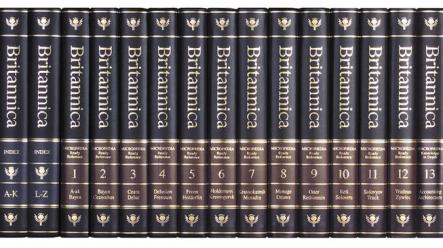
The seller swore that the set had been in his family for generations, and that it had come down to him from his Lola Filomena. (Names have been changed to protect the innocent.) All right, I thought—that at least was a good sign, the stamp of age. Might the books have been brought to Manila by a British trader in the 1800s (the encyclopedia hadn’t been published yet when they occupied Manila in 1762-64), then acquired by Lola Filomena’s buena familia forbears? I was thrilled by the possibilities, and asked the seller to send me a picture of the set. (The set below is from nbc.com, but it looked like it.)

Britannica-1

Of course, as soon as it arrived, all my silly hopes were dashed, as I saw a pile of crisp volumes that looked very much like the set I owned back in college. The seller confirmed that the set, indeed, was published in 1970, but that it was truly and surely the original 1768 edition. “Look,” he said with more than a hint of exasperation, “it says Copyright 1768!” I tried to explain the difference between copyright dates and editions (the 15thedition in 2010 was the Britannica’s last printed version). But my textmate wouldn’t budge. “My Lola Filomena wouldn’t lie!” he insisted. I wanted to scream, “But your lola wasn’t alive in 1768!”, but I let it go at that, and thanked him for his time, and for his patience with a curmudgeon.

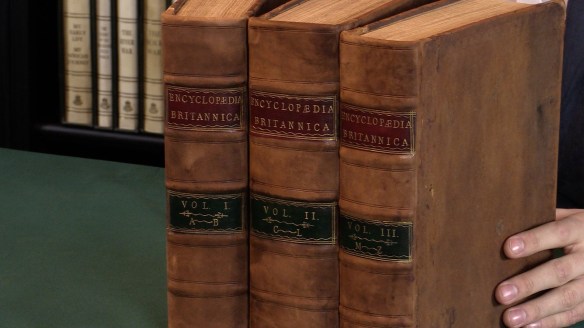
One of the most frequently asked questions online with regard to old books is “How much is my 1768 Britannica set worth?” Inevitably they show modern editions, not worth very much beyond the priceless knowledge they contain. A facsimile edition came out in 1971 and would itself by now have some value, but let’s face it—a copy’s a copy. Here’s a quick way of being sure that your plastic-covered, 30-volume Britannica set isn’t that old: the 1768 original had only three volumes (oddly broken down into A-B, C-L, and M-Z). Here’s a picture from YouTube of the real 1768 set:

Britannica

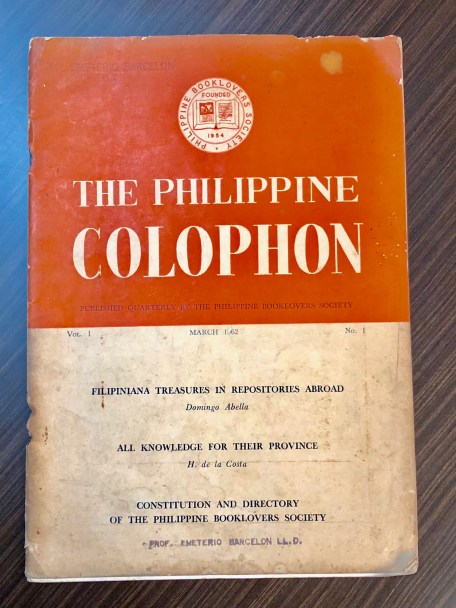
A great find last week—aside from the 1961 first edition of Nick Joaquin’s The Woman Who Had Two Navels—was the maiden (March 1962) issue of The Philippine Colophon, “published quarterly by the Philippine Booklovers Society.” I’d never heard of the PBS before, but its roster of members included such dignitaries as Antonio Abad (the poet Jimmy’s dad), Teodoro Agoncillo, Encarnacion Alzona, Gabriel Bernardo (the UP librarian who helped safeguard leftist documents in the ‘50s), Alberto Florentino, Amado Hernandez, Serafin Lanot (the poet Marra’s dad, and proprietor of Tamaraw Press), Benito Legarda Jr., Charito Planas, and Leopoldo Yabes.

The lead article alone was worth the issue—“Filipiniana Treasures Abroad” by Domingo Abella, a physician-turned-historian who became director of the National Archives. Dr. Abella provides a comprehensive and personally annotated list of foreign libraries—from the US and Mexico to Spain, the UK, Japan, and Macau. He talks about poking around the bookshops in Kanda Street in Tokyo, finding books on the Philippines authored by Western writers.

At a dinner party last weekend, I sat beside a well-known collector who recounted how, back in the day, you could acquire a true first edition of the Noli and Fili and the full 55-volume 1909 edition of Blair and Robertson without hocking the family jewels. “There aren’t too many of us looking for these old books,” he mused. Not few enough, I thought, and indeed, the fewer the better, from the rabid collector’s viewpoint, despite my professed belief in the charitable sharing of knowledge.

Speaking of which, do attend the free public lecture of the renowned bookbinder Mark Cockram at the Ortigas Foundation Library on Thursday, March 15 at 6 pm. He will also hold a workshop on bookbinding for beginners at the OFL on March 13-14. For details, email ortigasfoundation@ortigas.com.ph.


Penman No. 292: Adventures in Bookhunting (1)

IMG_4893.jpg

Penman for Monday, March 5, 2018


OVER THE past couple of years, slowly but surely, my collecting focus has shifted from vintage fountain pens to even older books, for several reasons. One is that I’ve actually run out of “grail” pens, as we call them, to chase after—the realistically reachable ones, at least (although some will argue that holy grails, almost by definition, should lie beyond one’s grasp).

The second is that old books, on average, are much more affordable than pens. Just for example, I recently sold a 1945 Parker Vacumatic Senior Maxima (a big, black, art-decoish pen to you) to a former student for P10,000 (well below its market value, because I liked the guy). Flush with disposable cash, I went on a book-buying spree on eBay, and for $200 I was able to get (1) the 1895 edition of Bartlett’s Quotations, the last edition Bartlett himself edited; (2) a 1946 edition from Guatemala of Thomas Gage: The English-American—A New Survey of the West Indies 1648, a thrilling account of travel on the galleons, although Gage never made it to Manila; (3) Das Leben und Leiden Jesu Christi den Joseph Berg, from 1910; (4) A Venetian June by Anna Fuller from 1895; 95) The Writings of John Burroughs, Vol. 7, Signs and Seasons, from 1914; (5) Petit Voyage Autour du Monde by Pierre Blanchard from 1850; (6) The Laughter of My Father by Carlos Bulosan in a 1946 Bantam paperback edition; (8) La France Coloniale Illustrée, a profusely illustrated travel book from 1895; (9) An American Doctor’s Odyssey by Victor Heiser from 1936, a first edition in its dust jacket; and (10) A Book of Delights by John Hadfield, a book of poetry and fine art from 1954.

That’s ten wonderful books averaging $20 each, some of them going for no more than $5, often with free Stateside shipping (I hoard them in my daughter’s place in California, then she ships them to me in bulk). Can and do I actually read all these books? Honestly, no. I did learn some French, German, and Spanish in school, but hardly enough to figure things out without a dictionary. But as book collectors are wont to do, I picked some of these books less for their contents than their covers—exquisite bindings, lush illustrations, fantastic condition after a century’s passage. I do plan on enjoying them in my retirement, but I’ll dwell on that another time.

All of the books above came from eBay in the US and the UK, but some of my best finds have happened right here—none more spectacular, perhaps, than a 1551 volume in English that I picked up last Christmas Eve in Cubao.

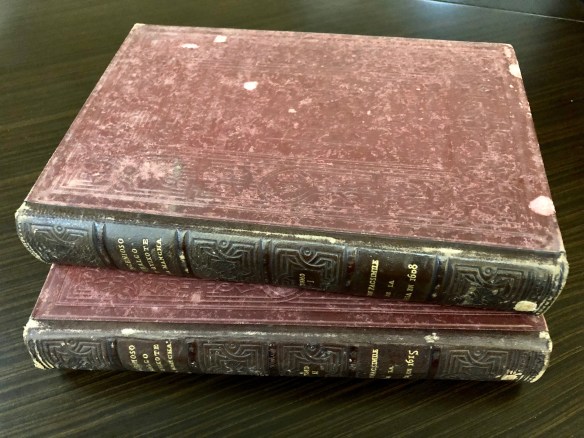
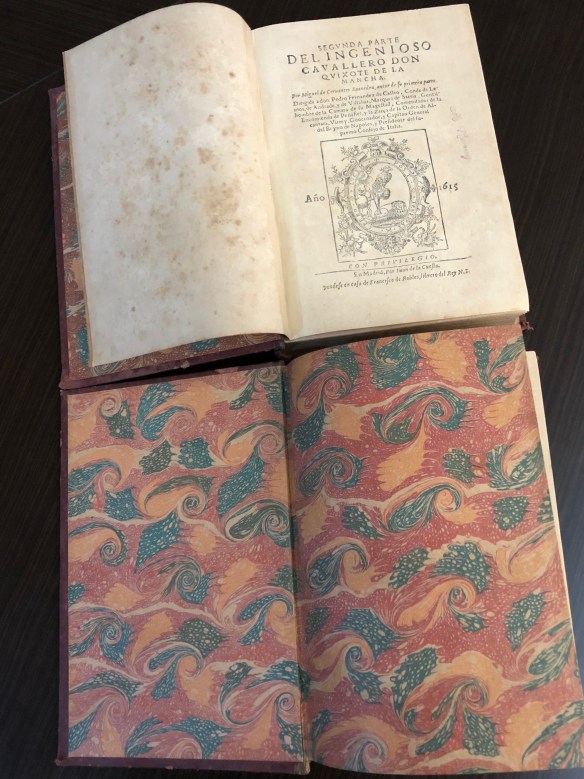
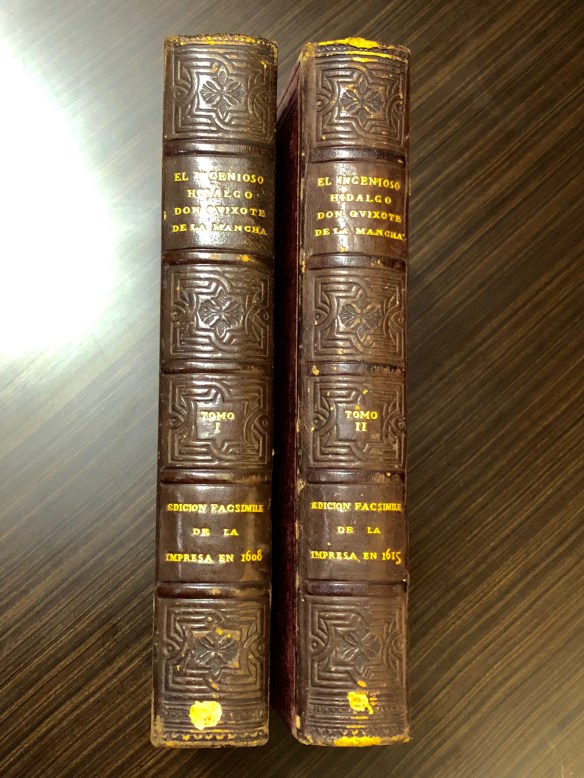
One day last week turned out to be a particularly fine day for bookhunting. I checked out the usual places online and saw that someone was selling a very interesting pair of old books. I messaged the seller, and after a bit of haggling, we met at a burger joint in Tandang Sora (my favorite kind of place for these transactions; about 11 years ago I picked up a first edition of Bulosan’s America Is in the Heart in another fastfood in Philcoa), and instead of a Big Mac, I came away with a facsimile edition, in two volumes, of Cervantes’ deathless El Ingenioso Hidalgo Don Quixote de la Mancha from 1608/1615.

IMG_4889.jpg

Collectors rarely bother with facsimiles or photographic copies, but this one, published in Barcelona in 1897, had acquired an appeal of its own, and it was in good shape and nicely bound.

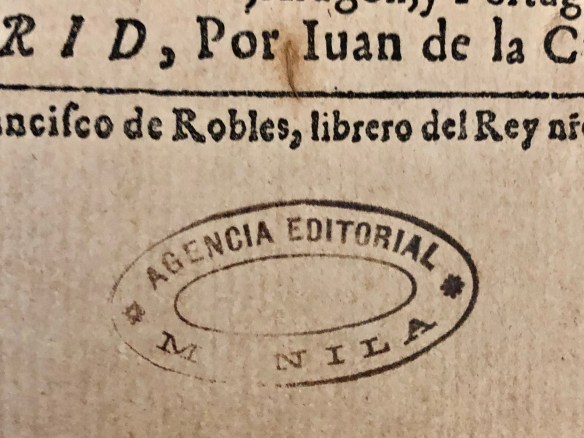
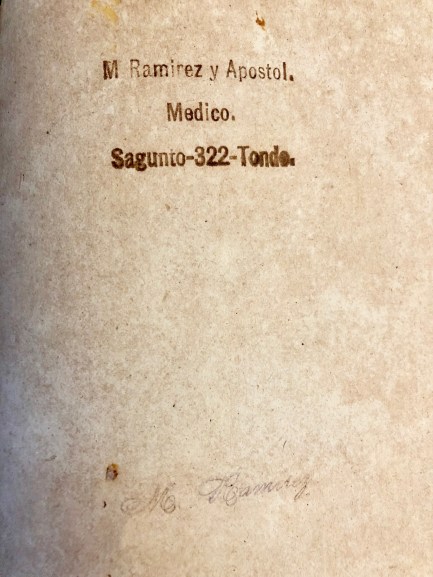
What was even more interesting was when I opened the books and discovered stamps. One displayed the name of the previous owner, a certain “M. Ramirez y Apostol, Medico, Sagunto-322-Tondo,” and another simply said “Agencia Editorial.” That sent me scurrying to Google, which revealed, first of all, that Agencia Editorial was a bookshop in Escolta run by a man named Manuel Arias y Rodriguez (1850-1924). Arias was a Spaniard, but he sympathized with the brewing revolution and (says our source at nigelgooding.co.uk) sold the Noli and Fili on the sly. He was also an amateur photographer who covered the revolution as a war correspondent for a Barcelona newspaper, and famously took Rizal’s execution picture. He died in Tokyo in 1924 as Spain’s ambassador there.

IMG_4892.jpg

I couldn’t find anything specific on “M. Ramirez y Apostol,” but I did establish that the family must have been quite well off, because an Ildefonso Ramirez y Apostol sold some land on Calle Ilaya in Tondo in 1908, which became the subject of litigation. Calle Sagunto (now Sto. Cristo) intersected with Azcarraga (now C. M. Recto), in a theater-and-restaurant district, and was the street on which Andres Bonifacio lived and where the Katipunan was founded in 1892. On Nov. 24, 1919, a scandal exploded in the newspaper La Nacion’s headlines: prominent Manileños and politicians had been caught by the police in a raid on a gambling den in Quiapo—among them, a powerful banker named Eusebio Ramirez y Apostol.

IMG_4891.jpg

It wasn’t what I was looking for when I bought Don Quixote, but side-stories like these make bookhunting even more of an adventure, albeit from an armchair. And the day wasn’t over yet—I later picked up a journal from 1962 called The Philippine Colophon, full of bookhunting stories, but that will have to wait for next time.

IMG_4886.jpg


Penman No. 290: My Cabinet of Curiosities

IMG_4755.jpg

Penman for Monday, February 12, 2018


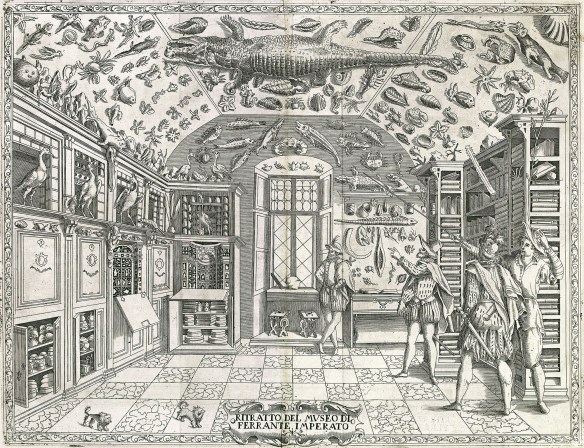
HISTORY TELLS us that museums began as private collections of odds and ends—Wunderkammer or “rooms of wonder” in German, later to be known as “cabinets of curiosities”—where wealthy Europeans of the 16th century amassed objects from all around the world for the amazement and delectation of their friends. Those objects ranged from stuffed crocodiles and “unicorn” (narwhal) horns to Roman coins, clockwork globes, and such vestiges of defeated empires as the feather crown of the Aztec Montezuma (now in Vienna’s Museum of Ethnology).

Kept and shown in—yes—cabinets (although originally “cabinets” could also mean whole rooms), these collections formed the basis for what later became full-scale and more specialized museums. Those museums are what Beng and I make a beeline for every time we land on foreign territory, eager for the chance to see wondrous objects from the past with our own eyes. Topping that list would be perennials like the Smithsonian Institution, the British Museum, the Field Museum, and the New York City Public Library—for which one lifetime seems inadequate to appreciate in their entirety—as well as art palaces such as the Louvre, the Prado, the Art Institute of Chicago, the Tate, and the Getty.

RitrattoMuseoFerranteImperato.jpg

For reasons we can only guess at, the routing in those places almost always ends at the gift shop, where you can pick up a pewter Colosseum or a Vincent van Gogh fridge magnet (both made, of course, in China) to remember your visit by.

My urges, however, have gone in another direction: instead of spending $24.99 on a fake Lindbergh cap at the Air and Space Museum, I’d rather spend it on a book on early aviation or on a 1927 newspaper marking the historic trans-Atlantic flight. You’d be surprised how inexpensive the real thing can be, compared to the mock memento.

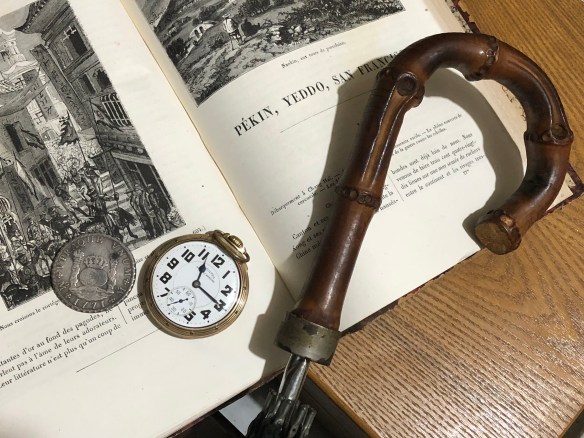
Given that mindset—and the fact that I’ve had more than 30 years of collecting old fountain pens, watches, and other men’s junk behind me—it’s no surprise that I’ve cobbled together my own cabinet of curiosities at home, representing half a lifetime of picking rubbish off the street. Some people would call me a pack rat, for keeping Love Bus tickets ca. 1978 or real plane tickets from back when they used red carbon paper for the passenger coupons.

Lately I’ve been prowling eBay for fine old books, but I get as much pleasure finding treasure in a Cavite junkyard as I do securing a 130-year-old travel book in French online (you’ll see both below).

I’ll leave it for Beng and Demi to sort everything out when I myself become a candidate for taxidermy, but here’s a sampler of what a visitor to my mini-museum will find:

  1. A man’s black umbrella with a classic bent-bamboo handle, found for P120 in a Japanese surplus store in Bacoor. Beng rhapsodizes over the ceramics in these stores, and rightly so, but I’ve been strangely attracted to wooden umbrellas, clocks, and boxes;
  2. A silver “Dos Mundos” coin from 1771, big and fat, from my home island of Tablas in Romblon, reputed to be a pirate haven in Spanish times.
  3. A gold-tinted medallion given out to luminaries and guests at the Independence Day celebration on July 4, 1946, the kind gift of a dear family friend, whose father was one of those guests;
  4. A Form 5 (at it was already called then) that a student registered with at the University of the Philippines in the 1930s, accompanied by a booklet of course offerings for that time.
  5. A 900-page travel book, published in Paris in 1878, with 360 beautiful engravings of scenes from Australia, Java, Japan, and China, sourced from Funchal in Portugal;
  6. A gold Hamilton railroad watch from around 1925, large and bright, so-called because railroads required precise timekeeping down to the exact second to avoid collisions, and such watches were synchronized by telegraphy;
  7. The original iPhone from 2007 (of which I must sheepishly admit I have three, two of which still function perfectly), which I predict will be tomorrow’s great collectible (alongside my EasyCall pager, which still glows when turned on, a near-mint BlackBerry, and four Palm PDAs);
  8. A copy of The Gentleman’s Magazine from November 1773—no, not an early version of Playboy or Penthouse, but the very first publication to call itself a magazine, or a collection of general-interest articles, including the title story on “The Frugal Housewife, wherein the art of dressing all sorts of viands with cleanliness, decency, and elegance, is explained….”; and
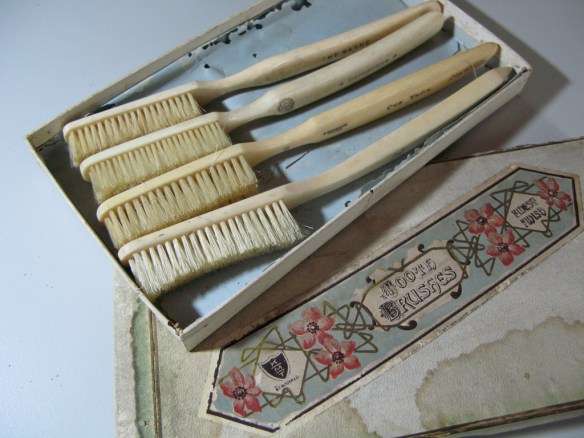
  9. An array of French-made 19th-century toothbrushes with bone handles and boar bristles.

2153883977_aa8979c3b2_b.jpg

I could go on and on—but it only gets worse (or more fascinating, if you like extracted teeth, gallstones, and other wonders of the natural world). Don’t be shy, come on in!


Penman No. 289: PowerPeeves

PowerPoint-Clips-Featured-382x255.jpg

Penman for Monday, February 5, 2018


I’VE NEVER used PowerPoint in my life as much as I had to this past year, largely because I’ve been asked to do many presentations—briefings, TEDTalks, and such. For the longest time, I’d resisted using PowerPoint (and its Mac counterpart, Keynote), not because I dislike visual aids, but because I felt confident that I could get my message across just by having people listen to my words and my voice.

That works—sometimes. I feel that when I’m talking to persuade—like when I spoke at the annual conference of the Writers Union of the Philippines to argue for the need to give evil a human face, or when I exhorted young writers at the Palancas to remember to write for oneself after writing for others—then direct address works better, without props or pictures.

After more than 30 years of teaching, I’ve long lost whatever shyness I may have had about public speaking—a teacher has no better tool in a classroom than his or her voice—but that doesn’t mean talking comes naturally, especially if you have to make sense. In the ten minutes or so before every class, walking down the corridor or up to my floor, I rehearse the lines I’ll be opening with, the points I have to make. It does get easier with time and practice, but every class is a performance, every audience a fresh challenge.

Perhaps it helped that, in our elementary years, we had a subject called Declamation which forced us to memorize and recite long, elaborate poems and speeches like Edwin Markham’s “The Man with the Hoe” and Mark Antony’s lament at Caesar’s funeral. We may not have understood what we were emoting about with full juvenile fervor, but—at least for me—it got rid of the stage fright, and I marveled at the fact that, if you spoke well and clearly, people listened.

Of course that was something that politicians already knew. They could whip the masses up into a maniacal frenzy—just with words. No flash cards, no graphs and charts, and yes, no PowerPoint. Not for Hitler, not for Marcos, not for… well, most other demagogues you can think of, some orange-haired presidents included. They knew that nothing could mobilize people better than fear, and nothing could stoke fear better than the imagination, such as of alien hordes and drug-crazed zombies streaming over the border. (On the other hand, the good guys could raise the dead as well with eloquently simple but moving oratory—think of Churchill’s “blood, toil, tears, and sweat” speech of 1940, which drew on similar remarks made much earlier by Theodore Roosevelt, not always a good guy.)

It’s tempting to suggest that if Churchill et al. had to use PowerPoint to rally the troops, the Battle of Britain would have been lost as he fidgeted, as presenters often do, with the controls and clicked back and forth between slides of Spitfires, Hurricanes, Heinkels, and Dorniers and rattled off their ranges and payloads. If Genghis Khan had to sit for a PowerPoint presentation on the economic and tourism potentials of every new territory over the horizon before he actually shouted “Advance! Kill! Plunder!”, he would never have gone past the Yellow River.

But of course today very little can happen without someone first having to plunk down a laptop, connect a medley of cables and wires, tinker with screen and clicker, and run through a cascade of slides in a coma-inducing monotone.

But I’ll admit it: there’s nothing like PowerPoint when people need to see what you’re talking about, whether it’s the tomb of Tamerlane in Samarkand, a genetically modified eggplant, or a fountain pen Jose Rizal would have written with. It’s most useful in speeches and lectures meant to inform, providing visual reinforcement for such abstract (and, these days, politically unfashionable) concepts as “human rights,” “freedom of the press,” and “territorial integrity.”

I remember being fascinated by scenes from the Bible that our Religion teacher in grade school flipped through in a roll of posters, and I’m sure we’ll all agree that the impact images produce is visceral.

That said, let me rattle off some of my pet peeves when it comes to PowerPoint presentations:

  1. Slides full of long text, which the presenters then read word for word, line by line. For heaven’s sake, summarize, condense, get to the core of things!
  2. Presenters who mumble like they were confessing their sins.
  3. Slides of cute babies, puppies, kittens, and sunsets when you’re talking about sexual harassment, Bentham Rise, or global warming.
  4. Whoosh! Swirl! Zoom! Dazzling and dizzying transitions and visual effects, accompanied by a fruit salad of colors and a library of exotic fonts.
  5. And, of course, presentations that just go on and on and on, because the presenters never bothered to do a dry run, edit their draft, or look at the clock and all the bored faces.

All yours, Genghis!


(Image from makeuseof.com)


Penman No. 288: From Quiapo to Norwich

QuiapoPic.png

Penman for Monday, January 29, 2018


IT’S A strange title, I know, but it’s all I could come up with to highlight the two topics I’m taking up this week. They’re not actually connected—at least not yet—but they were much on my mind as I dusted off my texts for a new semester of teaching at UP (all for naught, as it turned out, as my graduate writing class was dissolved for lack of students—to my secret relief).

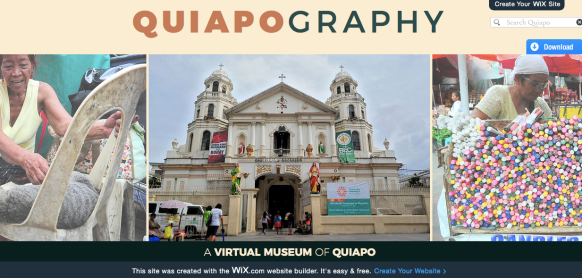
“Quiapo” is at the core of Quiapography, a digital-humanities project designed and led last semester by Dr. Patricia May Jurilla. Normally our resident expert on the history of books and publishing—one of those rare nerds who shares my strange attraction to Gothic blackletter and to the aroma of centuries-old paper—May branched out not only into a new subject but also a new approach to teaching and learning under the rubric of “digital humanities.”

Or maybe not that new. I asked Dr. Jurilla to explain the concept to me, and I was told that “Digital humanities has been in practice for over twenty years now. It’s emerged as a discipline itself with its own league of practitioners, dedicated book series and journals, circuit of conferences and events, degree programs, and new job opportunities in the tight academic market.”

Better than any explanation is the product itself of her PhD students’ semester, during which May directed them in a digital exploration and presentation of that most quintessentially Pinoy of urban spaces, Quiapo. That can be seen on the Quiapographywebsite at https://updigitalhumanities.wixsite.com/quiapography, “a virtual museum designed to document and map the culture of Quiapo in order to celebrate, re-view, and rediscover its heritage and its importance in Philippine history and society.”

Aside from the familiar photographs of and stories about Quiapo Church, amulet vendors, and the Black Nazarene, the site contains useful resources such as a list of literary works about Quiapo, pieces on the district’s fortune tellers, camera shops, and historical heritage, and photo galleries of just about everything.

Myself, I wish that I’d known about the project earlier, as I would’ve had my own Quiapo stories to contribute, as central as the place was to my young life—from my memories of descending for the first time into its brand-new underpass (something straight out of a sci-fi fantasy to a ten-year-old) to marching at Plaza Miranda with fist raised as a teenage Maoist and buying Christmas ham on Echague as a family man.

For those who’ve never strayed into this crucible of Filipino-ness (and sadly, in today’s mall-oriented culture, that would be millions of Pinoy millennials), Quiapographyshould provide a perfect introduction.

L1030874.jpg

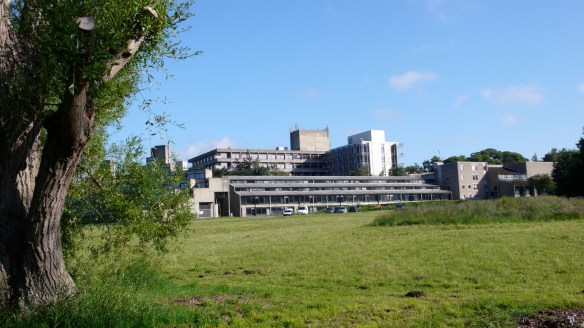
And now a quick cut to Norwich, some 10,600 kilometers away from Quiapo in southeastern England. For nine months between 1999 and 2000, this city became home for me and Beng when I took up residency there as the David T. K. Wong Fellow at the University of East Anglia. It was a restful but also fruitful stay that led to what became my second novel, Soledad’s Sister.

To put it simply, UEA is the most vibrant center of creative writing in the UK. Its community of writers was founded by Sir Angus Wilson and Sir Malcolm Bradbury in 1970, and its graduates have included the likes of Kazuo Ishiguro, Ian McEwan, and Rose Tremain. (Among the privileges of being there was having books signed by future Nobel prizewinners J. M. Coetzee and Ishiguro.)

Every year, UEA invites a writer to stay and write there—no teaching, no research, no lectures, just writing and relaxation—at its expense, or rather that of a sponsor named David T. K. Wong. A former journalist, civil servant, and businessman from Hong Kong who also writes fiction, Mr. Wong did well enough in life to endow the generous fellowship, an award of £26,000 to enable a fiction writer who wants to write in English about Asia.

I was the second Wong Fellow, and over the 20 years since the fellowship’s inception in 1998, two other Filipinos have followed me to Norwich—Lakambini Sitoy in 2003, and the current fellow, the Davao-born but US-based Nathan Go.

This brings me to my pitch: if you think you have a great novel or collection of stories welling in you—and you’d like to finish it in England, looking out on a lagoon full of graceful swans—please apply for the next Wong Fellowship, like I dared to do two decades ago. All you basically need, aside from the forms and the £10 application fee, is a 2,500-word excerpt from your proposed fiction project. The deadline for applications is February 28. For forms and more information, go here:https://www.uea.ac.uk/literature/fellowships/david-tk-wong-fellowship. Good luck!